As filed with the Securities and Exchange Commission on August 8, 2025.
Registration
Nos. 333-287425
SECURITIES
AND EXCHANGE COMMISSION
Washington, D.C. 20549
FORM N-4
REGISTRATION STATEMENT | ||
|
|
|
Pre-Effective Amendment No. | X | |
Post-Effective Amendment No. | O | |
PACIFIC
LIFE & ANNUITY COMPANY
(Name of Depositor)
700 Newport Center Drive
Newport
Beach, California 92660
(Address of Depositor’s Principal Executive Offices) (Zip
Code)
(949) 219-3011
(Depositor’s
Telephone Number, including Area Code)
Alison Ryan
Assistant Vice President
and Managing Assistant General Counsel II
Pacific Life & Annuity Company
700
Newport Center Drive
Newport Beach, California 92660
(Name and Address of Agent for Service)
Approximate Date of Proposed Public Offering: As soon as practicable after the effective date of the Registration Statement.
It is proposed that this filing will become effective (check appropriate box)
O
immediately upon filing pursuant to paragraph (b) of Rule 485
O on ________,
pursuant to paragraph (b) of Rule 485
O 60 days after filing pursuant to paragraph (a)(1) of Rule 485
O
on ________, pursuant to paragraph (a)(1) of Rule 485
If appropriate, check the following box:
O This post-effective amendment designates a new effective date for a previously filed post-effective amendment.
Check each box that appropriately characterizes the Registrant:
☐ New Registrant (as applicable, a Registered Separate Account or Insurance Company that has not filed a Securities Act registration statement or amendment thereto within 3 years preceding this filing)
☐ Emerging Growth Company (as defined by Rule 12b-2 under the Securities Exchange Act of 1934 (“Exchange Act”))
☐ If an Emerging Growth Company, indicate by check mark if the Registrant has elected not to use the extended transition period for complying with any new or revised financial accounting standards provided pursuant to Section 7(a)(2)(B) of Securities Act
☒ Insurance Company relying on Rule 12h-7 under the Exchange Act
☐ Smaller reporting company (as defined by Rule 12b-2 under the Exchange Act)
Title of Securities Being Registered: Pacific Protective Growth Limited Premium Registered Index-Linked Deferred Annuity
The registrant hereby amends this registration statement on such date or dates as may be necessary to delay its effective date until the registrant shall file a further amendment which specifically states that this registration statement shall thereafter become effective in accordance with Section 8(a) of the Securities Act of 1933 or until the registration statement shall become effective on such date as the Securities and Exchange Commission, acting pursuant to said Section 8(a), may determine.
THE INFORMATION IN THIS PROSPECTUS IS NOT COMPLETE AND MAY BE CHANGED.
WE MAY NOT SELL THESE SECURITIES UNTIL THE REGISTRATION STATEMENT FILED WITH THE SECURITIES AND EXCHANGE COMMISSION IS EFFECTIVE. THIS PROSPECTUS IS NOT AN OFFER TO SELL THESE SECURITIES AND IT IS NOT SOLICITING AN OFFER TO BUY THESE SECURITIES IN ANY STATE WHERE THE OFFER OR SALE IS NOT PERMITTED.
PACIFIC PROTECTIVE GROWTH NY
Limited Premium Registered Index-Linked Deferred Annuity Contract
Issued by PACIFIC LIFE & ANNUITY COMPANY
Prospectus Dated: [ ]
This prospectus describes the Pacific Protective Growth NY contract (the “Contract”), a limited premium registered index-linked deferred annuity contract issued by Pacific Life & Annuity Company (“Pacific Life & Annuity”). We do not allow additional Purchase Payments under the Contract after the initial Purchase Payment, except for transfers from other financial products requested at the time your Contract application is submitted and transferred within 90 days after the Contract Issue Date. The Contract is available for use in connection with non-qualified annuity contracts (for after-tax contributions only), individual retirement accounts (“IRAs”), Roth IRAs, SEP IRAs, Inherited IRAs and Roth IRAs and Post-Death Non-Qualified plans. If the Contract is purchased through a tax-qualified IRA or plan, or non-qualified plan, it provides no additional tax benefit to the investor beyond that already provided under the Internal Revenue Code. The Contract may be offered for use in connection with other types of qualified plans in the future.
This prospectus (“Prospectus”) describes all material terms of the Contract. Please read it carefully before investing and keep it for future reference. This Prospectus is not an offer in any state or jurisdiction in which the Contract may not lawfully be sold. The Contract is only available in New York. The Contract is an insurance contract designed to help you accumulate funds for retirement or other long-term financial planning purposes on a tax-deferred basis. Under the Contract, you may invest your money in the various Interest Crediting Options available under the Contract, which include the fixed interest rate option (the “Fixed Account Option” or “Fixed Account”), which credits a fixed rate of interest guaranteed for 1-year periods, and the Index-Linked Options (“ILOs”) which credit returns based on the performance of a specific market Index(es) during a defined period of time (a “Term”). See APPENDIX A — INTEREST CREDITING OPTIONS AVAILABLE UNDER THE CONTRACT at the end of this Prospectus for additional information about the Interest Crediting Options currently available under the Contract.
The Contract is a complex investment and involves risks, including potential loss of principal and previously-credited earnings in the Contract. Negative Index returns may be limited by the applicable Protection Level for each ILO, which provides limited protection from negative Index performance at the end of each Term. Each ILO provides a Protection Level in the form of a Buffer Rate or Dual Direction Buffer Rate. If you invest in an ILO with a Buffer (including the Dual Direction Buffer), depending on the Buffer or Dual Direction Buffer rate of the ILO(s) in which you invest, your potential losses at the end of a Term due to negative Index performance are currently limited to a maximum of 80 to 90% of your investment in the ILO for that Term.
Cumulative loss over the life of the Contract could be much greater. We reserve the right to stop offering all but one ILO. The 1-year S&P 500® with Cap Rate with Participation Rate and 10% Buffer ILO, in addition to the Fixed Account Option, will always be available under your Contract. In the future, we may not offer ILOs with any other Protection Level other than a 10% Buffer. We do not guarantee a minimum Dual Direction Buffer Rate, and we do not guarantee that we will always offer ILOs with a Dual Direction Buffer. If we stop offering all but one ILO (the 1-year S&P 500® with Cap Rate with Participation Rate and 10% Buffer ILO), you will be limited to investing in only one ILO and the Fixed Account Option. If there is only one ILO available, you will be limited to investing in only one ILO with terms that may not be acceptable to you. The terms and features of that ILO may not meet your investment objectives or be suitable for your financial goals, and this Contract may not be appropriate for you if you intend to invest solely in ILOs with a Dual Direction Buffer. In the future, any ILOs we offer (in addition to the 1-year S&P 500® with Cap Rate with Participation Rate and 10% Buffer ILO) will always have some level of downside protection but we do not guarantee a minimum level, unless required by applicable law. If you are not satisfied with the available ILOs, you may choose to surrender your Contract, but you may be subject to surrender charges, taxes, and tax penalties, and a negative Adjustment.
We limit the amount you can earn on an ILO based on the applicable interest crediting method (“Crediting Strategy”) of each ILO. Each ILO offers a Crediting Strategy in the form of a Cap Rate with a Participation Rate, Cap Rate with Dual Direction Buffer, Performance Mix with Participation Rate and a Cap Rate, Tiered Participation Rate and a Cap Rate, or Performance Triggered Rate. Any 1-year ILO Term with a 10% Buffer Rate provides a minimum Cap Rate or minimum Performance Triggered Rate of 5.00%. Any 1-year ILO with a 15% Buffer Rate provides a minimum Cap Rate or minimum Performance Triggered Rate of 4.50%. Any 6-year ILO with a 10% Buffer Rate provides a minimum Cap Rate of 30.00%. Any 6-year ILO with a 15% Buffer Rate provides a minimum Cap Rate of 27.00%. Any 6-year ILO with a 20% Buffer Rate provides a minimum Cap Rate of 24.00%. The minimum Participation Rate for any ILO is 100%. The Contract is not a short-term investment and is not appropriate for investors who need ready access to cash. Withdrawals, including ongoing withdrawals and distributions, or surrenders could result in the imposition of surrender charges or application of an Interim Value Calculation and negative Adjustment, and possible negative tax consequences, including federal income tax on the taxable portion and a tax penalty of
10% if you have not reached age 591/2. The Interim Value is the amount in the ILO(s) that is available for surrenders (including Free Look surrenders), withdrawals (including Required Minimum Distributions (“RMDs”), free withdrawal amounts, pre-authorized withdrawals, and rider charges, and), death benefit payments, and annuitization that occur between the beginning of the Term (the “Term Start Date”) and the end of the Term (the “Term End Date”). We calculate the Interim Value of your investment in each ILO at the end of each Business Day between the Term Start Date and the Term End Date. The Interim Value may be less than your investment in the ILO, even if the Index is performing positively, and may be less than the amount you would receive had you held the investment until the end of the Term. An Interim Value Calculation and Adjustment could result in the loss of your principal investment and previously credited Contract earnings, and in extreme circumstances, such losses could be as high as 100% of your ILO value. See FEES, CHARGES, AND ADJUSTMENTS for more information.
The Contract includes a “Performance Lock” feature for all ILOs to lock-in the Interim Value of an ILO before the end of a Term. If you exercise the Performance Lock feature, the value of your investment in an ILO will be credited with a fixed rate of interest until the next Contract Anniversary. You should fully understand the operation and risks of the Performance Lock before choosing to exercise this feature. See PRINCIPAL RISKS OF INVESTING IN THE CONTRACT and PERFORMANCE LOCK in this Prospectus for more information.
The Contract permits ongoing withdrawals and deductions from the ILOs prior to the Term End Date, such as, systematic withdrawals, and/or required minimum distributions. These withdrawals and deductions may have an adverse effect on the values and benefits, including the Return of Purchase Payments Death Benefit Rider, under your Contract. If you intend to make such ongoing withdrawals or elect such deductions, you should consult with a financial professional about whether this Contract is appropriate for you.
Investment in the Contract is subject to the risks related to Pacific Life & Annuity. Any obligations under the Contract are subject to our claims-paying ability and financial strength.
If you are a new investor in the Contract, you may cancel your Contract within 10 days (60 calendar days if you are replacing another annuity contract or life insurance policy) of receiving it without paying fees or penalties, although we will apply an Interim Value Calculation to determine the amount you will receive upon cancellation. Upon cancellation, you will generally receive the Contract Value which is the sum of the Interim Value of your Index-Linked Options plus any value in the Fixed Account Option. You should review this Prospectus and consult with your investment professional for additional information about the specific cancellation terms that apply.
Additional information about certain investment products, including index-linked annuity contracts, has been prepared by the Securities and Exchange Commission’s staff and is available at Investor.gov.
Neither the U.S. Securities and Exchange Commission (“SEC”) nor any state securities commission has approved or disapproved of these securities or determined if this Prospectus is accurate or complete. Any representation to the contrary is a criminal offense. The Contracts are not bank deposits, and are not insured or guaranteed by the Federal Deposit Insurance Corporation or any other government agency. The Contracts are not obligations of or guaranteed by any banking or financial institution. All obligations and guarantees under the Contract are subject to the creditworthiness and claims-paying ability of the Company.
Pacific Select Distributors, LLC is the principal underwriter of the Contracts. The offering of the Contracts is intended to be continuous.
TABLE OF CONTENTS
| SPECIAL TERMS | 7 |
| OVERVIEW OF THE CONTRACT | 12 |
| Phases of the Contract | 12 |
| CONTRACT FEATURES | 10 |
| CONTRACT ADJUSTMENTS | 14 |
| KEY INFORMATION | 16 |
| FEE TABLES | 23 |
| PRINCIPAL RISKS OF INVESTING IN THE CONTRACT | 24 |
| Risk of Loss | 24 |
| Liquidity Risk | 24 |
| Transfer and Reallocation Limitations | 25 |
| Withdrawal and Surrender Risk | 25 |
| Interim Value Calculation and Adjustment Risk | 26 |
| Fixed Account Option Risk | 27 |
| Crediting Strategy & Protection Level Risk | 27 |
| Performance Lock Risk | 28 |
| Availability of Indexes and Index-Linked Options | 29 |
| Availability by Selling Broker-Dealer Firm | 30 |
| Investment Risks for the Market Indexes | 30 |
| Index Risks | 31 |
| Return of Purchase Payments Death Benefit Rider Risk | 31 |
| Insurance Company Risks | 31 |
| Cyber Security Risks | 32 |
| BENEFITS AVAILABLE UNDER THE CONTRACT | 32 |
| FEES, CHARGES AND ADJUSTMENTS | 36 |
| Surrender Charge | 36 |
| Return of Purchase Payments Death Benefit Rider Charge | 37 |
| Interim Value Calculation and Adjustment | 38 |
| BUYING YOUR CONTRACT | 40 |
| Purchasing The Contract | 41 |
| Methods of Payment | 42 |
| Subsequent Purchase Payments | 42 |
| Rate Lock | 43 |
| Right to Cancel ("Free Look") | 43 |
| INVESTING IN THE CONTRACT | 43 |
| Allocating Your Purchase Payments | 43 |
| The Fixed Account Option | 43 |
| The Indexed-Linked Options | 44 |
| Index-Linked Option Term | 45 |
| The Indexes | 46 |
| Index Performance Examples | 48 |
| Index-Linked Option Value | 51 |
| Index-Linked Option Credit | 52 |
| Performance Lock | 58 |
| ORDER OF OPERATIONS FOR CONTRACT ANNIVERSARY PROCESSING | 60 |
| CONTRACT VALUE | 60 |
| Fixed Account Option Value | 60 |
| Index-Linked Option Value | 60 |
| ACCESS TO YOUR MONEY | 61 |
| Withdrawals and Surrenders | 61 |
| Fixed Account Option Value | 64 |
| TRANSFERS AND REALLOCATIONS | 65 |
| Transfer Restrictions | 65 |
| Default Allocation Procedures | 65 |
| Annuitization | 65 |
| ANNUITIZATION | 65 |
| Selecting Your Annuitant | 66 |
| Annuitization | 66 |
| Choosing Your Annuity Date | 66 |
| Default Annuity Date and Options | 66 |
| DEATH BENEFIT | 70 |
| Optional Death Benefit Rider | 73 |
| FEDERAL TAX ISSUES | 75 |
| Taxation of Annuities – General Provisions | 75 |
| Non-Qualified Contracts – General Rules | 76 |
| ADDITIONAL INFORMATION | 84 |
| PACIFIC LIFE & ANNUITY COMPANY AND THE GENERAL ACCOUNT | 89 |
| APPENDIX A: INTEREST CREDITING OPTIONS AVAILABLE UNDER THE CONTRACT | 91 |
| APPENDIX B: INDEX DISCLOSURES | 94 |
| APPENDIX C: RETURN OF PURCHASE PAYMENTS DEATH BENEFIT RIDER SAMPLE CALCULATIONS | 97 |
| Where To Go For More Information | Back Cover |
SPECIAL TERMS
Some of the terms we’ve used in this Prospectus may be new to you. We have identified these terms and provided explanations of what they mean below. These terms are capitalized throughout the Prospectus except as otherwise noted.
Adjusted Index Return — The percentage rate at which we credit interest to the Index-Linked Option Value at the end of each Term. The Adjusted Index Return is determined by comparing the Index Price on the Term Start Date to the Index Price on the Term End Date of a Term and applying any applicable adjustment for the Crediting Strategy or Protection Level. The Adjusted Index Return can be positive, negative, or equal to zero. The Adjusted Index Return is multiplied by the Investment Base to get the dollar amount of the Index-Linked Option Credit. The application of a negative Adjusted Index Return will result in a reduction of the Investment Base by the dollar amount of the Index-Linked Option Credit. The application of a positive Adjusted Index Return will result in an increase to the Investment Base by the dollar amount of the Index-Linked Option Credit.
Annuitant — The person on whose life annuity payments may be determined. An Annuitant’s life may also be used to determine death benefits, in the case of a Non- Natural Owner, and to determine the Annuity Date. A Contract may name a single (“sole”) Annuitant or two (“Joint”) Annuitants. You may choose a Contingent Annuitant only if you have a sole Annuitant (you cannot have Joint Annuitants and a Contingent Annuitant at the same time). If you name Joint Annuitants or a Contingent Annuitant, “the Annuitant” means the sole surviving Annuitant, unless otherwise stated.
Annuity Date — The date annuity payments are scheduled to begin if the Annuitant (or Joint Annuitants) is (or are) still living and your Contract is in force. The maximum Annuity Date is the Annuitant’s 110th birthday (youngest Annuitant’s 110th birthday if there are Joint Annuitants) and is the latest date we will begin paying you an annuity income. You may contact us if you would like to change your Annuity Date.
Annuity Option — Any one of the income options available for a series of payments after the Annuity Date.
Beneficiary — The person who may have a right to receive any death benefit proceeds before the Annuity Date or any remaining annuity payments after the Annuity Date, if any Owner (or Annuitant in the case of a Non-Natural Owner) dies.
Buffer (Buffer Rate) — A type of Protection Level that provides limited protection against negative Index performance. The Buffer Rate protects against negative Index Return up to the stated Buffer percentage. Any negative Index Return in excess of the Buffer Rate will result in a negative Adjusted Index Return at the end of a Term. The Buffer Rates are guaranteed not to change for as long as we continue to offer those Index-Linked Options. The 1-year S&P 500® with Cap Rate with Participation Rate and 10% Buffer ILO will always be available under your Contract.
Business Day — Each day the New York Stock Exchange (“NYSE”) is open for regular trading. Each Business Day ends when the NYSE closes each day which is typically 4:00 p.m. Eastern Standard Time. In this Prospectus, references to “day” or “date” means Business Day unless otherwise specified. If any transaction or event called for under a Contract is scheduled to occur on a day that is not a Business Day, such transaction or event will be deemed to occur on the next following Business Day unless otherwise specified. If any transaction is requested for a day that does not exist in a given calendar month, it will occur on the last day of such month. Any systematic pre-authorized transaction scheduled to occur on December 30th or December 31st where that day is not a Business Day will be deemed an order for the last Business Day of the calendar year and will be calculated using the applicable values at the close of that Business Day.
Cap Rate with Participation Rate — A type of Crediting Strategy. The Cap Rate is the maximum amount of positive Index Return that can be credited to the Investment Base at the end of a Term. The Participation Rate is the percentage portion of the positive Index Return that will be used to determine the Index-Linked Option. The Cap Rate limits the potential positive Index-Linked Option Credit that may be applied at the end of a Term. The Cap Rate is also a part of the Cap Rate with Dual Direction Buffer, the Tiered Participation Rate with Cap Rate, and the Performance Mix Crediting Strategies. In some cases, we may declare a Cap Rate for an ILO as “uncapped” in which case the amount of positive Index Return that can be credited to your ILO Value at the end of a Term is equal to the Index Return, subject to any applicable Participation Rate.
Cap Rate with Dual Direction Buffer (“Dual Direction”) — A type of Crediting Strategy. The Adjusted Index Return will equal any positive Index Return up to the Cap, or the absolute value of any negative Index Return up to the Buffer Rate. The absolute value of a number is simply that number without regard to it being positive or negative. For example, the absolute value of -10 is 10. If the positive Index Return exceeds the Cap Rate, the Adjusted Index Return will equal the Cap Rate. If the negative Index Return exceeds the Buffer Rate, the Adjusted Index Return will equal the negative Index Return in excess of the Buffer Rate. In marketing and
supplemental materials, we sometimes may refer to the Cap Rate with Dual Direction Buffer Crediting Strategy as simply the “Dual Direction Buffer Crediting Strategy.”
Cash Surrender Value — The amount available upon full surrender of the Contract. The Cash Surrender Value is the Contract Value (which may be the Interim Value), adjusted for any applicable surrender charges, rider charges, and charges for premium and other taxes.
Code — The Internal Revenue Code of 1986, as amended.
Contingent Annuitant — A person, if named in your Contract, who will become the sole surviving Annuitant if the existing sole Annuitant should die before the Annuity Date.
Contingent Beneficiary — A person, if any, you select to become the Beneficiary if the Beneficiary predeceases the Owner (or Annuitant in the case of a Non-Natural Owner).
Contract Anniversary — The same date, each subsequent year, as your Contract Issue Date.
Contract Issue Date — The date we issue your Contract. The Contract Issue Date will be no later than two Business Days after we receive your initial Purchase Payment and Contract application In Proper Form. Contract Years and Contract Anniversaries are measured from this date.
Contract Owner, Owner, you, or your — Generally, a person who purchases a Contract and makes the investments. A Contract Owner has all rights in the Contract, including the right to make withdrawals, designate and change Beneficiaries, transfer amounts among the Interest Crediting Options, and designate an Annuity Option. If your Contract names Joint Owners, both Joint Owners are Contract Owners and share all such rights. Except in the case of a Non-Natural Owner, the Owner’s life is used to determine death benefits.
Contract Value — The total amount attributable to your Contract. The Contract Value is the sum of the Index-Linked Option Values and the Fixed Account Option Value.
Contract Year — The 12-month period beginning on the Contract Issue Date and on each Contract Anniversary date thereafter.
Crediting Strategy — The method of determining the amount of positive interest, if any, credited to your Index-Linked Option Value for each Index-Linked Option Term. The Crediting Strategies offered under the Contract are the Cap Rate with a Participation Rate, Performance Mix with Participation Rate and Cap Rate, Tiered Participation Rate with Cap Rate, Performance Triggered Rate, and Cap Rate with Dual Direction Buffer. Each Index-Linked Option will apply only one type of Crediting Strategy.
Dual Direction Buffer Rate (“Dual Direction Buffer”) —A type of Protection Level. The Dual Direction Buffer is only offered with the Cap Rate with Dual Direction Buffer Crediting Strategy. The Adjusted Index Return will equal the absolute value of any negative Index Return up to the Dual Direction Buffer Rate. The absolute value of a number is simply that number without regard to it being positive or negative. For example, the absolute value of -10 is 10. The positive interest credited by the Dual Direction Buffer may exceed the Cap Rate. If the negative Index Return exceeds the Dual Direction Buffer Rate, the Adjusted Index Return will equal the negative Index Return in excess of the Dual Direction Buffer Rate.
Fixed Account Option (the “Fixed Account”) — An Interest Crediting Option to which Purchase Payments and transfers may be allocated that credits a fixed rate of interest daily at the declared rate. The Fixed Account Option will always be available under the Contract.
Fixed Account Option Value — The value allocated to the Fixed Account Option plus interest credited daily that compounds over one year to the Guaranteed Rate, Purchase Payments, less transfers, fees, premium and other taxes, and deductions for any withdrawals.
Guaranteed Rate for the Fixed Account Option (Guaranteed Rate) — The annual rate of interest that we declare from time to time for the Fixed Account Option and which accrues daily. The Guaranteed Rate for the Fixed Account will be declared on each Contract Anniversary and will never be less than 1.0%.
In Proper Form (In Good Order) — This is the standard we apply when we determine whether an instruction is satisfactory to us. An instruction (in writing or by other means that we accept (e.g. via telephone or electronic submission)) is considered to be In Proper Form if it is received at our Service Center in a manner that is satisfactory to us, such that is sufficiently complete and clear so that we do not have to exercise any discretion to follow the instruction, including any information and supporting legal documentation necessary to effect the transaction. Any forms that we provide will identify any necessary supporting documentation. We may, in our sole discretion, determine whether any particular transaction request is In Proper Form, and we reserve the right to change or waive any In Proper Form requirements at any time.
Index — The market index used to determine any Adjusted Index Return that is credited to an Index-Linked Option at the end of a Term. Each Index is a price return index, not a total return index, and therefore its performance does not reflect any dividends or distributions paid by the Index’s component companies. We reserve the right to add, remove, or replace an Index.
Index-Linked Option (“ILO”) — An Interest Crediting Option under the Contract to which Purchase Payments and transfers may be allocated that provides for credited interest based on the performance of a particular Index (or Indexes) and the applicable Crediting Strategy and Protection Level. Each ILO varies by Index, Crediting Strategy, Protection Level, and Term length. In marketing and supplemental materials, we sometimes may refer to ILOs as “crediting strategies.”
Index-Linked Option (“ILO”) Budget Rate — This rate is equivalent to the fair value of hypothetical derivatives supporting the ILO on the Term Start Date.
Index-Linked Option (“ILO”) Credit — The dollar amount of interest added to or subtracted from the Index-Linked Option Investment Base at the end of a Term. The Index-Linked Option Credit is equal to the Investment Base multiplied by the Adjusted Index Return. The Index-Linked Option Credit may be positive, negative, or zero according to the Adjusted Index Return.
Index-Linked Option (“ILO”) Value — Refers to both the total amount invested in a single Index-Linked Option, or the entire amount of your Contract Value invested in multiple Index-Linked Options. On the Term Start Date, the Index- Linked Option Value is equal to the Investment Base. On all days except for the Term Start Date and the Term End Date, the Index-Linked Option Value is equal to the Interim Value. On the Term End Date, the Index-Linked Option Value is equal to the Investment Base adjusted for the Index-Linked Option Credit(s), which may be positive, negative, or equal to zero.
Index Price — The prices for the Indexes that are published by the Index providers as of the close of the New York Stock Exchange (NYSE) each day that the NYSE is open. On any day that the NYSE is not open, the Index Price from the last NYSE close will apply. The change in the Index Price over the course of a Term is used to determine the Index Return.
Index Return — Represents the price performance of the Index. The Index Return is the percentage change in the Index Price Point to Point, before any applicable adjustment for the Crediting Strategy or Protection Level. The Index Return can be positive, negative, or equal to zero.
Interest Crediting Option(s) — The Index-Linked Options and the Fixed Account Option offered under this Contract to which Purchase Payments and transfers may be allocated and that provides for credited interest.
Interim Value — The value of an Index-Linked Option in which you invest on any date during the Term after the Term Start Date and before the Term End Date.
Interim Value Adjustment (or “Adjustment”) — The proportionate reduction to your ILO Investment Base and death benefit that occurs when a withdrawal is made from the ILOs during a Term based on Interim Values. The Investment Base and death benefit are reduced by the same proportion (rather than on a dollar-for-dollar basis) that the Interim Value is reduced by the withdrawal.
Interim Value Calculation — The calculation of the Interim Value as a result of annuitization, death benefits, withdrawals or surrenders from the ILOs during a Term.
Investment Base — The amount that is allocated to an Index- Linked Option on the Term Start Date, reduced thereafter for withdrawals during the Term (including applicable surrender charges and taxes), and to which is applied the ILO Credit on the Term End Date.
Joint Annuitant — If your Contract is a Non-Qualified Contract, you may name two Annuitants, called “Joint Annuitants,” in your application for your Contract. Special restrictions may apply for Qualified Contracts.
Minimum Guaranteed Rate for the Fixed Account (“Minimum Guaranteed Rate”)— The current Minimum Guaranteed Rate for the Fixed Account Option will not be less than 1%. This interest rate is guaranteed to be a rate not less than the minimum allowed by state law. During the first 6 Contract Years, the Minimum Guaranteed Rate for the Fixed Account Option under that Contract will not change. After the first 6 Contract Years, a new Minimum Guaranteed Rate for the Fixed Account Option under the Contract will be declared on each Contract Anniversary. The applicable Minimum Guaranteed Rate for the Fixed Account Option can also be found in your Contract.
Minimum Limit on Index Gain — The minimum percentage, for the life of the Index-Linked Option, we may use in any Crediting Strategy to limit the amount of positive Index Return credited on the Term End Date. (In the Contract, we may refer to these Minimum Limits on Index Gains as “guaranteed minimum” rates).
Non-Natural Owner — A corporation, trust or other entity that is not a (natural) person.
Non-Qualified Contract — A Contract other than a Qualified Contract.
Notice Date — The Business Day on which we receive, In Proper Form, proof of death and instructions regarding payment of
death benefit proceeds.
Pacific Life (“we,” “us,” and “our”) — Pacific Life & Annuity Company (“PL&A”)
Performance Mix with Participation Rate and Cap Rate (“Performance Mix”) — A type of Crediting Strategy that determines the Index Return based on the combined weighted average of the performance of the S&P 500®, Russell 2000®, and MSCI EAFE® Indexes. The Index-Linked Option Credit is subject to a Participation Rate and a Cap Rate. The Participation Rate is the percentage portion of the combined positive Index Return that will be used to determine the Index-Linked Option Credit. The Cap Rate is the maximum amount of positive Index Return that can be credited to the Investment Base at the end of a Term. The Participation Rate and the Cap Rate limit the potential positive Index-Linked Option Credit that may be applied at the end of a Term.
Performance Lock — A feature offered under the Contract for all ILOs that allows you to “lock-in” the Interim Value of an ILO before the Term End Date. If you exercise the Performance Lock feature during a Term, your Index-Linked Option Value will equal the Interim Value on the date the Performance Lock is exercised and will be credited with a fixed rate of interest beginning on the day following the day the Performance Lock was exercised until the next Contract Anniversary.
Exercising the Performance Lock will terminate your ability to receive an Index- Linked Option Credit or the protection of the Buffer to mitigate any loss.
Performance Triggered Rate — A type of Crediting Strategy. The Performance Triggered Rate is a fixed rate of interest that will be credited to the Investment Base on the Term End Date if the Index Return is equal to zero or positive.
Point to Point — The Index Return for an Index-Linked Option is determined by comparing the Index Price on the Index Term Start Date to the Index Price on the Index Term End Date.
Protection Level — The Protection Level provides limited protection to your ILO Value against negative Index Returns. There are two types of Protection Levels: Buffer Rates and Dual Direction Buffer Rates. Each ILO will apply only one type of Protection Level.
Purchase Payment — An amount paid to us by or on behalf of a Contract Owner as consideration for the benefits provided under the Contract and invested into the Interest Crediting Options offered under the Contract.
Qualified Contract — A Contract that qualifies under the Code as an individual retirement annuity or account (IRA), or form thereof, or a Contract purchased by a Qualified Plan, qualifying for special tax treatment under the Code Sections 401, 403, 408A and 457. The Contract may not currently be available to all types of Qualified Contracts.
Service Center — Pacific Life & Annuity Company
P.O. Box 2736
Omaha, Nebraska 68103-2378
(800) 748-6907
For more complete contact information, see ADDITIONAL INFORMATION — INQUIRIES AND SUBMITTING FORMS AND REQUESTS in this Prospectus.
Subsequent Purchase Payment(s) — Additional Purchase Payments submitted after the initial Purchase Payment. Subsequent Purchase Payments are permitted only for 90 calendar days after your Contract Issue Date and are only permitted as a result of transfers or exchanges from other financial products requested at the time your Contract application is submitted. No other Purchase Payments are permitted under the Contract.
Subsequent Term — A Term that starts on a Contract Anniversary.
Term — The period of time over which the change in Index performance is measured to determine the Index Return and the Index-Linked Option Credit(s). The Term begins on the Term Start Date and ends on the Term End Date.
Term End Date — The Contract Anniversary on the last day of the Term. On this date, the Index-Linked Option Credit, which may be positive, negative, or zero, is calculated and applied to your Investment Base. All Purchase Payments in an ILO will have the same Term End Date regardless of the date they were received.
Term Start Date — The Term Start Date is the date that a new Term begins. On this date, Contract Value (or your Purchase Payment) is allocated to the ILO and the starting Index Price is determined. The Term Start Date for your initial Purchase Payment is the Contract Issue Date. The Term Start Date for any Subsequent Purchase Payments will be the Business Day the Subsequent Purchase Payment is received prior to market close. All future Term Start Dates will be on a Contract Anniversary, on which date you will transfer or reinvest Contract Value into a new Term.
Tiered Participation Rate with Cap Rate — A type of Crediting Strategy. The Tiered Participation Rates are a percentage of positive Index Return that will be used to determine the Index- Linked Option Credit. Tiered Participation Rates include a Tier One Participation Rate, a Tier Two Participation Rate and a Cap Rate. Positive Index Return less than or equal to the Tier Level is multiplied by the Tier One Participation Rate. Positive Index Return in excess of the Tier Level is multiplied by the Tier Two Participation Rate. The Adjusted Index Return is equal to the sum of these two values subject to the Cap Rate. The Cap Rate is the maximum amount of positive Index Return that can be credited to the Investment Base at the end of a Term. The Tiered Participation Rate and the Cap Rate may limit the potential positive Index-Linked Option Credit that may be applied at the end of a Term.
Total Adjusted Purchase Payments — The Total Adjusted Purchase Payments is equal to the sum of all Purchase Payments made into the Contract, reduced by a Pro Rata Reduction for each prior withdrawal. The Pro Rata Reduction is the reduction percentage that is calculated at the time of a withdrawal by dividing the amount of the withdrawal by the Contract Value immediately prior to the withdrawal.
You and Your — The Owner(s) of this Contract
OVERVIEW OF THE CONTRACT
The Contract is a limited premium registered index-linked deferred annuity contract issued by us that is designed to help you accumulate funds for retirement or other long-term financial planning purposes on a tax-deferred basis. The Contract also includes a death benefit to help financially protect your Beneficiaries. This Contract may be appropriate for you if you have a long-term investment horizon and are looking to supplement your retirement income or you want to meet other long-term financial objectives. The Contract is not designed to be a short-term investment and may be inappropriate for you if you intend to take frequent withdrawals prior to annuitization, withdrawals during the 6-year surrender charge period, or withdrawals from the ILOs before the end of a Term.
It is possible to lose up to 100% of your principal and previously credited Contract earnings. You should discuss with your financial professional whether an index-linked annuity contract, the optional death benefit, and which Interest Crediting Options are appropriate for you, taking into consideration your age, income, net worth, tax status, insurance needs, financial objectives, investment goals, liquidity needs, investment time horizon, risk tolerance and other relevant information. Together, you can decide if the Pacific Protective Growth contract is right for you.
We offer a variety of annuity contracts. Not every contract we issue is available through every selling broker-dealer. Upon request, your financial professional can provide information regarding our other annuity contracts that his or her broker-dealer makes available. You can also contact us to find out more about the availability of any of our annuity contracts.
Some selling broker-dealers may not recommend certain features and options of the contract, as well as limit the overall availability of the contracts, based on issue age or other general investor suitability criteria established by the selling broker-dealer. For example, a firm may choose not to recommend certain ILOs that are described in this Prospectus. Only those ILOs and optional benefits available through your firm will be available under your Contract. Before you purchase the Contract, you should ask your financial professional for details about the specific ILOs, Indexes, and optional benefits available through their firm. If a particular feature that interests you is not recommended through your broker-dealer, you may want to contact another broker-dealer or us to explore its availability.
Please note that the Contract permits ongoing withdrawals and deductions from the ILOs prior to the Term End Date, such as rider charges, systematic withdrawals, and/or required minimum distributions. These withdrawals and deductions may have an adverse effect on the values and benefits under your Contract. If you intend to make such ongoing withdrawals or elect such deductions, you should consult with a financial professional about whether this Contract is appropriate for you.
PHASES OF THE CONTRACT
This Contract has two phases: the accumulation (savings) phase and the annuitization (income) phase.
Accumulation Phase
The accumulation phase begins on your Contract Issue Date and continues until your Annuity Date. During this phase, you invest in the Contract’s Interest Crediting Options, which include the ILOs and the Fixed Account Option, each of which has its own risks. Any earnings accumulate on a tax-deferred basis. Additional information about each of the Interest Crediting Options available under the Contract is provided in an appendix to this Prospectus. See APPENDIX A — INTEREST CREDITING OPTIONS AVAILABLE UNDER THE CONTRACT.
Index-Linked Options. The ILOs are a type of Interest Crediting Option available under the Contract to which Purchase Payments and transfers may be allocated. We will credit interest (which may be positive, negative, or zero) at the end of each Term to amounts allocated to an ILO (the “ILO Value”) based, in part, on the performance of a particular Index (or Indexes). Each ILO varies by Index, Crediting Strategy, Protection Level, and Term length. Crediting Strategies and Protection Levels only apply at the end of each Term. You could lose a significant amount of money if the Index of an ILO in which you are invested declines in value.
• We limit the negative Index Return used in calculating the interest credited to an ILO at the end of each Term through the applicable Protection Level of each ILO. There are two types of Protection Levels that we use to limit negative Index Returns: Buffer Rates, and Dual Direction Buffer Rates. Each ILO will have only one type of Protection Level. The Protection Level type and rate for each ILO is guaranteed not to change for as long as we offer the ILO.
The 1-year S&P 500® with Cap Rate with Participation Rate and 10% Buffer ILO will always be available under your Contract. In the future, we may not offer ILOs with any other Protection Level other than a 10% Buffer. We do not guarantee a minimum Dual Direction Buffer Rate, and we do not guarantee that we will always offer ILOs with a Dual Direction Buffer. If we stop offering all but one ILO (the 1-year S&P 500® with Cap Rate with Participation Rate and 10% Buffer ILO), you will be limited to investing in only one ILO and the Fixed Account Option. The terms and features of that ILO may not meet your investment objectives or be suitable for your financial goals, and this Contract may not be appropriate for you if you intend to invest solely in ILOs with a Dual Direction Buffer.
In the future, any ILOs we offer (in addition to the 1-year S&P 500® with Cap Rate with Participation Rate and 10% Buffer ILO) will always have some level of downside protection, but we do not guarantee a minimum level, unless required by applicable law. If, in the future, you are not satisfied with the available ILOs, you may choose to surrender your Contract, but you may be subject to surrender charges, taxes, and tax penalties, and a negative Adjustment.
1. The Buffer protects against negative Index Return up to the stated Buffer percentage. Any negative Index Return in excess of the Buffer Rate will result in negative interest being credited to your ILO Value at the end of a Term. For example, if the Buffer Rate of the ILO is 15%, and the Index Return is -20%, we will credit your ILO Value with -5% (the amount of the negative Index Return that exceeds the Buffer Rate) at the end of the Term, meaning your ILO Value will decrease by 5%.
2. The Dual Direction Buffer protects against negative Index
Return up to the stated Dual Direction Buffer percentage. The Dual Direction Buffer is only offered with
the Cap Rate with Dual Direction Buffer Crediting Strategy. Any negative Index Return up to and including
the Dual Direction Buffer Rate will result in positive interest equal to the absolute value of the Index
Return being credited to your ILO Value at the end of the Term. The absolute value of a number is simply
the value of a number without regard to it being positive or negative. For example, the absolute value
of -10 is 10. Positive interest credited by the Dual Direction Buffer may exceed the Cap Rate.
Any
negative Index Return in excess of the Dual Direction Buffer Rate will result in negative interest being
credited to your ILO Value at the end of a Term in the amount that the negative Index Return exceeds
the Dual Direction Buffer Rate. For example, if the Dual Direction Buffer Rate of the ILO is 15%, and
the Index Return is -15%, we will credit your ILO Value with 15% (the absolute value of the negative
Index Return up to the Dual Direction Buffer Rate) at the end of the Term, meaning your ILO Value will
increase by 15%. However, if the Dual Direction Buffer Rate of the ILO is 15%, and the Index Return is
-20%, we will credit your ILO Value with -5% (the amount of the negative Index Return that exceeds the
Dual Direction Buffer Rate) at the end of the Term, meaning your ILO Value will decrease by 5%.
• We limit the positive Index Return used in calculating the interest credited to an ILO at the end of each Term through the applicable Crediting Strategy of each ILO. There are four types of Crediting Strategies that we use to calculate positive Index Returns: Cap Rate with Participation Rate, Performance Mix, Tiered Participation Rates with Cap Rate, or Performance Triggered Rates. Each ILO will have only one type of Crediting Strategy. The Crediting Strategy rate is guaranteed for the Term in which you are invested. For 1-year ILOs, we will declare new rates for Subsequent Terms, which may differ from current rates, subject to the Minimum Limits on Index Gain for each Crediting Strategy type. We do not offer Subsequent Terms for 6-year ILOs, which means Performance Mix and Tiered Participation Rate Crediting Strategies will never have Subsequent Terms because they are only offered as 1-year ILOs.
1. The Cap Rate with a Participation Rate Crediting Strategy includes both a declared Cap Rate and Participation Rate. The Cap Rate is the maximum amount of positive Index Return that can be credited to your ILO Value at the end of a Term and the Participation Rate is the percentage portion of the positive Index Return that will also be used to determine the Index-Linked Option Credit. You will not incur any positive Index Return in excess of the Cap Rate. For example, if the Cap Rate of the ILO is 15%, and the Index Return is 20%, we will credit your ILO Value with 15% (the lesser of the positive Index Return multiplied by the Participation Rate or the Cap Rate) at the end of the Term, meaning that your ILO Value will increase by 15%. Any 1-year ILO Term with a 10% Buffer Rate provides a minimum Cap Rate of 5.00%. Any 1-year ILO with a 15% Buffer Rate provides a minimum Cap Rate of 4.50%. Any 6-year ILO with a 10% Buffer Rate provides a minimum Cap Rate of 30.00%. Any 6-year ILO with a 15% Buffer Rate provides a minimum Cap Rate of 27.00%. Any 6-year ILO with a 20% Buffer Rate provides a minimum Cap Rate of 24.00%. The minimum Participation Rate for any ILO is 100%. The Cap Rate is also a part of the Cap Rate with Dual Direction Buffer, the Performance Mix and Tiered Participation Rate Crediting Strategies.
2. The Performance Mix with Participation Rate and Cap Rate measures the performance of a combination of three Indexes: The S&P 500®, Russell 2000®, and the MSCI EAFE. The Index Return of the Performance Mix is determined based on the combined weighted average of those stated Indexes: 50% is based on the Index with the highest return, 30% is based on the Index with the next best return, and 20% is based on the Index with the lowest return. The Participation Rate is the percentage portion of the positive Index Return that will be used in calculating the interest credited to your Investment Base at the end of a Term. The Participation Rate is multiplied by the Index Return, subject to the Cap Rate, to yield the interest credited to your ILO Value. The Cap Rate is the maximum amount of positive Index Return that can be credited to the Investment Base at the end of a Term. The Cap Rate limits the potential positive Index-Linked Option Credit that may be applied at the end of a Term. For example, if the Participation Rate of the ILO is 100% and the Cap Rate is 80%, and the
combined Index Return of the three Indexes is 20%, we will credit your ILO Value with 20% (1.00 x 20, or 100% of the Index Return) at the end of the Term, meaning that your ILO Value will increase by 20%. If the combined Index Return of the three Indexes is 85%, we will credit your ILO with 80% at the end of the Term. The minimum Cap Rate for Performance Mix ILO with a 10% Buffer Rate is 30.00%. The Minimum Limit on Index Gain for the Participation Rate strategy for any ILO offered for the life of this Contract is 100%.
3. The Tiered Participation Rate is a percentage portion of positive Index Return that will be used in calculating the interest credited to your ILO Value at the end of a Term. The Tiered Participation Rate Crediting Strategy has three components: the Tier One Participation Rate, the Tier Two Participation Rate, and the Tier Level. Positive Index Return less than or equal to the Tier Level is multiplied by the Tier One Participation Rate. The amount of positive Index Return in excess of the Tier Level is multiplied by the Tier Two Participation Rate. The positive interest credited to your ILO Value is equal to the sum of these two values, subject to the Cap Rate. The Cap Rate is the maximum amount of positive Index Return that can be credited to the Investment Base at the end of a Term. The Cap Rate limits the potential positive Index-Linked Option Credit that may be applied at the end of a Term.
For example, assume that the Index Return is 48%, and the Tiered Participation Rate for the ILO includes the following values: Tier 1 Participation Rate — 100%; Tier 2 Participation Rate — 125%; Tier Level — 25% and the Cap Rate is 50%. The percentage portion of positive Index Return is 53.75%. which is the sum of 25% (the Tier One Participation Rate 100% multiplied by the Index Return up to the Tier Level 25%), plus 28.75% (the Tier Two Participation Rate 125% multiplied by the amount of Index Return in excess of the Tier Level 23%). Since the Adjusted Index Return is greater than or equal to the Cap Rate, we will credit your ILO Value with 50%. The Minimum Limit on Index Gain for the Tiered Participation Rate strategy for any ILO offered for the life of this Contract is 100% for both Tier One and Tier Two Participation Rates and Minimum Cap Rate is 30%.
4. The Performance Triggered Rate is a fixed rate of interest that will be credited to your ILO Value at the end of a Term if the Index Return is greater than or equal to zero. For example, if the Performance Triggered Rate of the ILO is 15%, and the positive Index Return is 0%, 5%, or 25%, in each circumstance, we will credit your ILO Value with 15% (the Performance Triggered Rate) at the end of the Term, meaning that your ILO Value will increase by 15%. The Minimum Limit on Index Gain for the Performance Triggered Rate strategy ILO with a 10% Buffer Rate is 5%. The Minimum Limit on Index Gain for the Performance Triggered Rate strategy ILO with a 15% Buffer Rate is 4.5%.
Fixed Account Option. The Fixed Account is a type of Interest Crediting Option available under the Contract to which Purchase Payments and transfers may be allocated. The Fixed Account credits a fixed rate of interest daily at the Guaranteed Rate to the amount invested in the Fixed Account (the “Fixed Account Option Value”). The Guaranteed Rate for the Fixed Account will be declared on each Contract Anniversary, and will never be less than 1%. The Fixed Account Option will always be available for the life of your Contract.
Annuitization Phase
The annuitization (income) phase occurs when you annuitize your Contract. If you annuitize your Contract, you will turn your Contract Value into a stream of income payments over a fixed period or for life. Annuity payments will be in a fixed-dollar amount. If you annuitize, you will be unable to make withdrawals and death benefits will terminate. You are not required to annuitize until the maximum Annuity Date, which is the Annuitant’s (youngest Annuitant if there are Joint Annuitants) 110th birthday. Before annuitizing or selecting a payment option, you should consult with a financial professional and/or contact us at our Service Center to obtain information on what the annuity payment would be prior to annuitizing.
CONTRACT FEATURES
Accessing Your Money. Before you annuitize, you can withdraw money from your Contract at any time. Withdrawing only a portion of your Contract Value is referred to as a “withdrawal.” Withdrawing your entire Contract Value is referred to as a “surrender” and will terminate your Contract. Withdrawals or surrenders taken during the surrender charge period, which is the first 6 Contract Years, may be subject to a surrender charge. Withdrawals and surrenders may also be subject to taxes, and tax penalties. Withdrawals and surrenders from the ILOs before the end of a Term will result in an Interim Value Calculation and Adjustment being applied to your ILO Value.
Preauthorized Withdrawals. You may elect to automatically withdraw money from your Contract on a regular basis at any time before your Annuity Date. You may choose monthly, quarterly, semi-annual or annual withdrawals. Preauthorized withdrawals may be subject to surrender charges, an Interim Value Calculation and Adjustment, taxes, and tax penalties.
Free Withdrawal Amount. Each Contract Year, you may withdraw a portion of your Contract Value without incurring a surrender charge, as applicable. The annual free withdrawal amount will still trigger an Interim Value Calculation and Adjustment if taken from the ILOs before the end of a Term, and be subject to taxes and tax penalties.
Nursing Home and Terminal Illness Waivers. These waivers are included in the Contract for no additional charge. Under
these waivers, surrender charges will be waived for all withdrawals and surrenders of the Contract if the Annuitant or Owner is diagnosed with a terminal illness, as defined by the waiver, or is confined to an accredited nursing home, and certain other conditions are met. Withdrawals and surrenders under these waivers may still trigger an Interim Value Calculation and Adjustment, taxes, and tax penalties.
Death Benefits. The Contract provides a death benefit payout, at no additional cost, to help protect your Beneficiaries during the accumulation phase. Depending on your age at the Contract Issue Date, the standard Death Benefit Amount is either (a) the greater of the Contract Value or the Total Adjustment Purchase Payments, reduced by any taxes, or (b) the Contract Value, reduced by any taxes. For an additional cost, Contract Owners between the ages of 81 and 85 on the Contract Issue Date may purchase the optional death benefit rider, the Return of Purchase Payments Death Benefit Rider (the “ROP Death Benefit Rider,” or the “Rider”), which can increase the amount of money payable to your Beneficiaries.
Tax Treatment. Your Purchase Payments accumulate value on a tax-deferred basis. Your earnings generally are not taxed until money is withdrawn from the Contract, such as when you make a withdrawal from or surrender your Contract, or receive an annuity payment from the Contract, or a death benefit is paid.
Performance Lock. For no additional cost, the Contract includes a “Performance Lock” feature for all ILOs which enables you to “lock-in” the Interim Value of an ILO before the end of a Term. If you exercise the Performance Lock feature, the value of your investment in an ILO will equal the Interim Value on the date the Performance Lock is exercised and will be credited with a fixed rate of interest until the next Contract Anniversary. See PERFORMANCE LOCK for more information.
CONTRACT ADJUSTMENTS
Interim Value Calculation and Adjustment
On any Business Day during the Term after the Term Start Date and before Term End Date, your ILO Value is equal to the Interim Value. Each ILO will have a separate Interim Value. The Interim Value is the amount in the ILO(s) that is available for surrenders (including Free Look surrenders), withdrawals (including Required Minimum Distributions (“RMDs”), free withdrawal amounts, pre-authorized withdrawals, and rider charges,), annuitization, and death benefit payments that occur between the beginning of the Term (the “Term Start Date”) and the end of the Term (the “Term End Date”). The Interim Value is also the amount available for exercise of the Performance Lock feature. All of these transactions, if taken during the Term, will be based on Interim Value(s) and will trigger an Interim Value Calculation to your ILO Value and a proportional reduction to your principal investment in the ILO (the “Investment Base”) and death benefit (the “Interim Value Adjustment”).
The Interim Value Calculation and Adjustment could result in significant losses if amounts are removed from the ILOs before the end of a Term. You will not receive an Index-Linked Option Credit or the protection of the Buffer or Dual Direction Buffer to mitigate any loss. See FEES, CHARGES, AND ADJUSTMENTS and ACCESS TO YOUR MONEY and for more information about the Interim Value Calculation and Adjustment. If you intend to take ongoing withdrawals or elect features with ongoing deductions, you should consult with a financial professional to discuss any adverse impact of such ongoing withdrawals and deductions and whether this Contract is appropriate for you.
KEY INFORMORMATION
Important information you should consider about the Pacific Protective Growth NY Contract
FEES, EXPENSES, AND ADJUSTMENTS | LOCATION IN PROSPECTUS | |||
Are
There Charges or Adjustments | Yes. If you withdraw money from or surrender your Contract within 6 years following the Contract Issue Date, you may be assessed a surrender charge of up to 7% of the amount withdrawn or surrendered in excess of the 10% annual free withdrawal amount. For example, if you surrender your Contract, you could pay a surrender charge of up to $7,000, assuming your Contract Value is $100,000 at the time of the surrender. This loss will be greater if there is a negative Interim Value Calculation and Adjustment, taxes, or tax penalties. If you surrender or withdraw value from the ILOs before the Term End Date, your ILO Value will be subject to an Interim Value Calculation and Adjustment, which may be negative. The Interim Value Calculation and Adjustment could result in loss. In extreme circumstances, such losses could be as high as 100%. For example, if you invest $100,000 in the ILOs available under the Contract, and surrender the entire ILO Value before the end of the Term, you could lose up to $100,000 of your investment. This loss will be greater if the amount withdrawn is also subject to surrender charges, taxes or tax penalties. The following transactions will use Interim Values if taken from the ILOs before the Term End Date: (1) surrenders (including Free Look surrenders), (2) withdrawals (including Required Minimum Distributions (“RMDs”), free withdrawal amounts, pre-authorized withdrawals, and rider charges), (3) death benefit payments, and (4) annuitization of the Contract. | FEE TABLE FEES, CHARGES, AND ADJUSTMENTS PRINCIPAL RISKS OF INVESTING IN THE CONTRACT | ||
Are There Transaction Charges? | No. There are no transaction charges under this Contract. | N/A | ||
Are There Ongoing Fees and Expenses? | Yes. The table below describes the fees and expenses that you may pay each year, depending on the optional benefits you choose. Please refer to your Contract specifications page for information about the specific fees you will pay each year if you have elected the Return of Purchase Payments (“ROP”) Death Benefit. There is an implicit ongoing fee on the Index-Linked Options (“ILOs”) to the extent that your participation in Index gains is limited by us through the use of the applicable Crediting Strategy of the ILO. This means that your returns may be lower than the Index’s returns. In return for accepting this limit on Index gains, you will receive some protection from Index losses through the ILO Protection Level. This implicit ongoing fee is not reflected in the tables below. | FEE TABLE FEES, CHARGES, AND ADJUSTMENTS | ||
ANNUAL FEES | MINIMUM | MAXIMUM | ||
Optional benefits available for an additional charge (for a single optional benefit, if elected) | 0.30%(1) | 0.30%(1) | ||
(1) As a percentage of your Contract Value each Contract Anniversary. Because your Contract is customizable, the choices you make affect how much you will pay. To help you understand the cost of owning your Contract, the following table shows the lowest and highest cost you could pay each year, based on current charges. This estimate assumes that you do not take withdrawals from the Contract, which could add surrender charges and negative Contract adjustments that substantially increase costs. | ||||
Lowest Annual Cost: $0 | Highest Annual Cost: $295.98 | |||
FEES, EXPENSES, AND ADJUSTMENTS | LOCATION IN PROSPECTUS | ||
Assumes: ● Investment of $100,000 ● 5% annual appreciation ● No optional benefits ● No sales charges ● No additional purchase payments, transfers, or withdrawals | Assumes: ● Investment of $100,000 ● 5% annual appreciation ● Most expensive combination of optional benefits (ROP Death Benefit) ● No sales charges ● No additional purchase payments, transfers, or withdrawals ● 0% Interim Value Calculation and Adjustment | ||
RISKS | LOCATION IN PROSPECTUS | |
Is There a Risk of Loss | Yes. You can lose money by investing in the Contract, including loss of principal investment and any previously-credited earnings in the Contract. • If you invest in an ILO with a Buffer (including the Dual Direction Buffer), depending on the Buffer or Dual Direction Buffer rate of the ILO(s) in which you invest, your potential losses at the end of a Term due to negative Index performance are currently limited to a maximum of 80 to 90% of your investment in the ILO for that Term. Cumulative loss over the life of the Contract could be much greater. • The 1-year S&P 500® with Cap Rate with Participation Rate and 10% Buffer ILO, in addition to the Fixed Account Option, will always be available under your Contract. In the future, we may not offer ILOs with any other Protection Level other than a 10% Buffer. We do not guarantee a minimum Dual Direction Buffer Rate, and we do not guarantee that we will always offer ILOs with Dual Direction Buffer. • In the future, any ILOs we offer (in addition to the 1-year S&P 500® with Cap Rate with Participation Rate and 10% Buffer ILO) will always have some level of downside protection, but we do not guarantee a minimum level, unless required by applicable law. | PRINCIPAL RISKS
OF INVESTING |
Is this a Short-Term Investment? | No. The Contract is not a short-term investment, and is not appropriate for you if you need ready access to cash. The Contract’s tax deferral and long-term income features are generally more beneficial to investors with a long-term investment horizon. • Withdrawals and surrenders from the Contract may be subject to surrender charges, taxes, and tax penalties. Amounts withdrawn or surrendered from the ILOs before the end of a Term may also result in a negative Interim Value Calculation and Adjustment to your ILO Value, and the loss of positive Index performance. • Withdrawals will reduce the death benefit and your Contract Value, perhaps significantly. Transactions that are based on Interim Value will reduce the Interim Value of your investment in the ILOs by the amount of the withdrawal. Additionally, the transaction will reduce your ILO Investment Base in the same proportion that the Interim Value is reduced (rather than on a dollar-for-dollar basis) and will also proportionately reduce the death benefit. The proportionate reduction in the Investment Base and death benefit may be greater than the dollar amount of the withdrawal. Such reduction will reduce your Investment Base for the remainder of the Term, and may significantly reduce any amount credited at the end of the Term. • At the end of each Term, on the Term End Date (which will fall on a Contract Anniversary), your Contract Value will be transferred or reallocated among the available Interest Crediting Options for a new Term, according to your transfer instructions. | PRINCIPAL RISKS OF INVESTING IN THE CONTRACT TRANSFERS AND REALLOCATIONS FEES, CHARGES, AND ADJUSTMENTS |
RISKS | LOCATION IN PROSPECTUS | |
• If we do not receive transfer instructions from you prior to the close of Business on the Term End Date, we will automatically reallocate or transfer your Contract Value according to the following procedures. Amounts that we automatically reallocate or transfer among the ILOs in the absence of transfer instructions cannot be transferred until the next Term End Date or Contract Anniversary if the amount is invested in the Fixed Account. Any Contract Value in an expiring 1-year ILO will remain in its current allocation for the next Term, subject to the renewal Crediting Strategy Rates declared for that Term, as long as that ILO remains available for investment. • If that ILO is not available for investment for a Subsequent Term, the Contract Value in that ILO will automatically be transferred to the Fixed Account Option, subject to the renewal Guaranteed Rate. • Any Contract Value in an expiring 6-year ILO will automatically be transferred to the corresponding 1-year ILO (i.e., a 1-year ILO with the same reference Index, type of Crediting Strategy and Protection Level, and Protection Level rate), subject to the renewal Crediting Strategy Rates declared for that ILO. If the corresponding 1-year ILO is not available for investment, the Contract Value in the expiring 6-year ILO will automatically be transferred to the Fixed Account Option, subject to the renewal Guaranteed Rate. | ||
What Are the Risks Associated with the Investment Options? | An investment in the Contract is subject to the risk of poor investment performance and can vary depending on the performance of the ILOs available under the Contract that you select. Each investment option, referred to as an “Interest Crediting Option” (including the Fixed Account Option) in this prospectus, will have its own unique risks. You should review and understand the available Interest Crediting Options before making investment decisions. The applicable Crediting Strategy of each ILO (i.e., the Cap Rate with a Participation Rate (including Cap Rate with Dual Direction Buffer), Performance Mix with Participation Rate and Cap Rate, Tiered Participation Rate with Cap Rate, or Performance Triggered Rate) will limit positive Index Returns (e.g., limited upside). This may result in you earning less than the Index Return. For example: • Cap Rate with a Participation Rate. If the Cap Rate of the ILO is 15%, the Participation Rate is 100% and the Index Return is 20%, we will credit your ILO Value with 15% (the Cap Rate). • Performance Mix with Participation Rate and Cap Rate. If the Participation Rate of the ILO is 100% the Cap Rate is 80%, and the combined Index Return is 75%, we will credit your ILO Value with 75% (0.75 x 100%), which is below the Cap Rate of 80%. If the Participation Rate is 100%, the Cap Rate is 80%, and the combined Index Return is 85%, we will credit your ILO Value with 80% (0.85 x 100% = 85%, which is reduced to the Cap Rate of 80%. • Tiered Participation Rate with Cap Rate. If the Tiered Participation Rate for the ILO includes the following values: Tier 1 Participation Rate — 100%; Tier 2 Participation Rate — 125%; Tier Level — 25% with a Cap Rate of 80%; and the Index Return is 60%, we will credit your ILO Value with 68.75% ((1.00 x 25%) + ((60 – 25) x 1.25)) = 68.75% which is below the Cap Rate of 80%. If the Index Return is 75%, we will credit your ILO Value with 80%. ((1.00 x 25%) + ((75 – 25) x 1.25)) = 87.50% which is reduced to the Cap Rate of 80%. • Performance Triggered Rate. If the Performance Triggered Rate of the ILO is 15%, and the Index Return is 0%, 5%, or 25%, in each circumstance, we will credit your ILO Value with 15% (the Performance Triggered Rate). The applicable Protection Level of each ILO (i.e., the Buffer Rate, or Dual- Direction Buffer Rate) will limit negative Index Returns (e.g., limited protection in the case of market decline). This may provide you with limited protection in the case of market decline. For example: • Buffer Rate. If the Buffer Rate of the ILO is 15%, and the Index Return is -20%, we will credit your ILO Value with -5% (the amount of the negative Index Return that | PRINCIPAL RISKS OF INVESTING IN THE CONTRACT INVESTING IN THE CONTRACT |
RISKS | LOCATION IN PROSPECTUS | |
exceeds the Buffer Rate). • Dual-Direction Buffer Rate. If the Dual Direction Buffer Rate of the ILO is 15%, and the Index Return is -15%, we will credit your ILO Value with 15% (the absolute value of the negative Index Return up to the Dual Direction Buffer Rate). The Dual Direction Buffer is only offered with the Cap Rate with Dual Direction Buffer Crediting Strategy, and the positive interest credited by the Dual Direction Buffer may exceed the Cap Rate. If the Dual Direction Buffer Rate of the ILO is 15%, and the Index Return is -20%, we will credit your ILO Value with -5% (the amount of the negative Index Return that exceeds the Dual Direction Buffer Rate). Each Index underlying the ILOs is a price return index, not a total return index, and therefore its performance does not reflect any dividends or distributions paid by the Index’s component companies. | ||
What Are the Risks Related to the Insurance Company? | Investment in the Contract is subject to the risks related to PL&A. Any obligations (including under the Fixed Account Option and the ILOs), guarantees, or benefits of the Contract are subject to our claims- paying ability and financial strength. Information about PL&A, including its applicable financial strength ratings, is available upon request by contacting our Service Center. | PRINCIPAL RISKS OF INVESTING IN THE CONTRACT PACIFIC LIFE & ANNUITY COMPANY AND THE GENERAL ACCOUNT |
RESTRICTIONS | LOCATION IN PROSPECTUS | |
Are There Limits on the Investment Crediting Options? | Yes. • Purchase Payments. ◦ Additional Purchase Payments after the initial Purchase Payment are not permitted, except for transfers from other financial products requested at the time the investor’s Contract application is submitted and transferred within 90 days after the Contract Issue Date (“Subsequent Purchase Payments”). ◦ Your initial Purchase Payment and any Subsequent Purchase Payments, in the aggregate, must be at least $25,000 in the aggregate for qualified and non-qualified Contracts. • Transfers and Reallocations. o Transfers and reallocations from the ILOs are only permitted on Term End Dates (which will fall on a Contract Anniversary), unless you exercise the Performance Lock feature on a 6-year ILO. o Transfers from the Fixed Account are only permitted on Contract Anniversaries. o If you do not want to remain invested in the Fixed Account Option until the next Contract Anniversary, or in an ILO until the end of the Term, your only options will be to take a withdrawal from the Fixed Account Option or ILO or surrender the Contract, or exercise the Performance Lock feature and transfer your ILO Value on the next Contract Anniversary. All of these options will be based on the Interim Values of the ILOs, and withdrawals and surrenders may be subject to surrender charges, taxes, and tax penalties. • Investment Restrictions. o You may only invest in a 6-year ILO Term on the Contract Issue Date. At the end of the 6-year ILO, you will be unable to invest in 6-year ILO Terms and only 1-year ILOs and the Fixed Account will be available to you for the remainder of the time that you own the Contract. • Our Rights to Change the ILOs and Indexes Offered Under the Contract. o We reserve the right to add or remove an ILO or Index, subject to applicable regulatory approvals. We may stop offering an ILO for investment at the end of a Term to new and existing Contracts. o We may remove or replace an Index if it is discontinued, if the calculation of the Index is substantially changed by the Index provider, if Index values become unavailable for any reason, if hedging instruments become difficult to acquire or the cost of hedging becomes excessive, or if its investment objectives, strategies, or risks substantially change. If we substitute an Index, we will select a new Index that we determine in our judgment is comparable to the original Index, however, the performance of the new Index may not be satisfactory to you. o We may change the Crediting Strategy rates and Protection Level rates of the ILOs available under the Contract, subject to the stated Minimum Limits on Index Gain or maximum rates. Crediting Strategy rates will not change during a Term. Protection Level rates for the currently offered ILOs will not change for the life of the ILO. o There is no guarantee that a particular ILO will be available during the entire time that you own your Contract. We reserve the right to stop offering all except for one ILO, in addition to the Fixed Account. The 1-year S&P 500® with Cap Rate with Participation Rate and 10% Buffer ILO will always be available under | PRINCIPAL RISKS OF INVESTING IN THE CONTRACT PURCHASING THE CONTRACT TRANSFERS AND REALLOCATIONS |
RESTRICTIONS | LOCATION IN PROSPECTUS | |
your Contract. The Minimum Limit on Index Gain for the Cap Rate strategy for this ILO is 5% and the minimum Participation Rate is 100% for the life of this Contract. In the future, we may not offer ILOs with any other Protection Level other than a 10% Buffer. We do not guarantee a minimum Dual Direction Buffer Rate, and we do not guarantee that we will always offer ILOs with a Dual Direction Buffer. o If we stop offering all but one ILO (the 1-year S&P 500® with Cap Rate with Participation Rate and 10% Buffer ILO), you will be limited to investing in only one ILO and the Fixed Account Option. The terms and features of that ILO may not meet your investment objectives or be suitable for your financial goals, and this Contract may not be appropriate for you if you intend to invest solely in ILOs with a Dual Direction Buffer. o In the future, any ILOs we offer (in addition to the 1-year S&P 500® with Cap Rate with Participation Rate and 10% Buffer ILO) will always have some level of downside protection, but we do not guarantee a minimum level, unless required by applicable law. o If, in the future, you are not satisfied with the available ILOs, you may choose to withdraw your ILO Value or surrender your Contract, but you may be subject to surrender charges, taxes, and tax penalties, and an Interim Value Calculation and Adjustment if the surrender or withdrawal is made before the end of a Term. Certain ILOs and Indexes may not be available through your financial professional. You may obtain information about the ILOs and Indexes that are available to you by contacting your financial professional. | ||
Are There Any Restrictions on Contract Benefits? | Yes. • Return of Purchase Payments Death Benefit Rider ◦ The ROP Death Benefit Rider is only available for purchase at the time of Contract application, and once elected, the Rider may not be voluntarily terminated. ◦ Withdrawals may affect the availability of the benefit, perhaps significantly, and/or could terminate the benefit. ◦ The ROP Death Benefit fee is an ongoing deduction that can result in adverse impacts to your Contract values. For example, if you elect an ILO with a 6-year Term, the deduction of the annual ROP Death Benefit fee on the Contract Anniversary will result in an Interim Value Calculation and Adjustment each time the fee is deducted on an Anniversary other than the Term End Date and could result in a loss. ◦ We may stop offering the optional ROP Death Benefit Rider to new Contract Owners at any time. The ROP Death Benefit Rider may not be available through your financial professional. You may obtain information about the optional benefits that are available to you by contacting your financial professional. • Performance Lock ◦ If you exercise the Performance Lock feature, you will “lock-in” the Interim Value. The Interim Value may be less than the potential ILO Value you would receive at the end of the Term had you not exercised the feature. The Crediting Strategy or Protection Level will not be applied. ◦ Performance Lock may only be exercised after the 60th calendar day from the Term Start Date. ◦ The request to exercise the Performance Lock feature must be received by us before close of Business in order to lock-in that day’s ending Interim Value. | FEES, CHARGES, AND ADJUSTMENTS |
RESTRICTIONS | LOCATION IN PROSPECTUS | |
◦ You may only exercise the Performance Lock feature once for each ILO during each Term (or once each “segment” within an ILO, if applicable). ◦ You must lock in your entire value in the ILO when exercising Performance Lock. ◦ Exercising Performance Lock is irrevocable and may only be cancelled if we receive the request to cancel before close of Business on the same Business Day that the request to exercise the feature is received. ◦ You will not be able to determine the Interim Value that will be locked-in prior to the Performance Lock request. ◦ Once Performance Lock is exercised, the locked-in amount cannot be transferred to a new ILO, the Fixed Account or begin a new Term in the same ILO, until the next Contract Anniversary. ◦ The locked-in value will be credited with a fixed rate of interest, which could be as little as 0.0%. | ||
TAXES | LOCATION IN PROSPECTUS | |
What Are the Contract’s Tax Implications? | You should consult with a tax professional to determine the tax implications of an investment in, withdrawals from, and Purchase Payments received under the Contract. There is no additional tax benefit if you purchase the Contract through a tax-qualified plan or IRA. Withdrawals and surrenders will be subject to ordinary income tax, and may be subject to tax penalties if you withdraw money before age 591∕2. | FEDERAL TAX ISSUES |
CONFLICTS OF INTEREST | LOCATION IN PROSPECTUS | |
How Are Investment Professionals Compensated? | Your financial professional may receive compensation for selling the Contract to you in the form of commissions and non-cash compensation. This compensation may influence your financial professional to offer or recommend the Contract over another investment. | DISTRIBUTION ARRANGEMENTS |
Should I Exchange My Contract? | Some financial professionals may have a financial incentive to offer you a new contract in place of the one you own. You should only exchange your existing contract if you determine, after comparing the features, fees, and risks of both contracts, and any fees or penalties to terminate the existing contact, that it is preferable for you to purchase the new contract rather than continue to own your existing contract. Call your financial professional or call us at (800) 748-6907 if you are interested in this option. | ADDITIONAL INFORMATION — REPLACEMENT OF LIFE INSURANCE OR ANNUITIES |
FEE TABLE
The following tables describe the fees, expenses, and adjustments that you will pay when buying, owning, and surrendering or making withdrawals from an Interest Crediting Option or from the Contract. Please refer to your Contract specifications page for information about the specific fees you will pay each year based on the options you have elected.
The first table describes the fees and expenses that you will pay at the time that you surrender or make withdrawals from an Interest Crediting Option or from the Contract. State premium taxes may also be deducted.
TRANSACTION EXPENSES
Maximum Surrender Charge(1)
(as a percentage of the amount surrendered or withdrawn) 7%
(1) The surrender charge applies to withdrawals and surrenders in excess of the annual 10% free withdrawal amount during the first 6 Contract Years. Withdrawals and surrenders that are not subject to a surrender charge may still be subject to an Interim Value Calculation and Adjustment if withdrawn from the ILOs during a Term, taxes, and tax penalties. See FEES, CHARGES, AND ADJUSTMENTS for a list of withdrawals and surrenders that will not be subject to a surrender charge. The surrender charge declines to zero over the surrender charge period according to the following schedule:
Contract Year | Surrender Charge Percentage | |
Contract Year 1 | . . . . . . . . . . . . . . . . . . . . . . . . . . . . . . . . . . . . . . . . . . . . . . . . . . . . . . . . . . . . | 7% |
Contract Year 2 | . . . . . . . . . . . . . . . . . . . . . . . . . . . . . . . . . . . . . . . . . . . . . . . . . . . . . . . . . . . . | 7% |
Contract Year 3 | . . . . . . . . . . . . . . . . . . . . . . . . . . . . . . . . . . . . . . . . . . . . . . . . . . . . . . . . . . . . | 6% |
Contract Year 4 | . . . . . . . . . . . . . . . . . . . . . . . . . . . . . . . . . . . . . . . . . . . . . . . . . . . . . . . . . . . . | 5% |
Contract Year 5 | . . . . . . . . . . . . . . . . . . . . . . . . . . . . . . . . . . . . . . . . . . . . . . . . . . . . . . . . . . . . | 4% |
Contract Year 6 | . . . . . . . . . . . . . . . . . . . . . . . . . . . . . . . . . . . . . . . . . . . . . . . . . . . . . . . . . . . . | 3% |
Contract Year 7+ | . . . . . . . . . . . . . . . . . . . . . . . . . . . . . . . . . . . . . . . . . . . . . . . . . . . . . . . . . . . . | 0% |
The
next table describes
the adjustments, in
addition to any
transaction expenses, that
apply if all
or a portion
of the Contract
Value is removed from
an Interest Crediting
Option or from
the Contract before
the expiration of
a specified period.
ADJUSTMENTS
Interim Value Calculation and Adjustment Maximum Potential Loss(1)
(as a percentage of your investment in the ILO) 100%
(1) An Interim Value Calculation and Adjustment will apply to your ILO Value upon any surrender (including Free Look surrenders), withdrawal (including RMDs, free withdrawal amounts, pre-authorized withdrawals, and rider charges), death benefit payment, and annuitization of the Contact if value is taken from the ILOs before the Term End Date. An Interim Value Calculation will also apply upon exercise of the Performance Lock for any ILO. See FEES, CHARGES, AND ADJUSTMENTS for more information. The maximum loss would occur under extreme circumstances upon a withdrawal or surrender.
The next table describes the fees and expenses that you will pay each year during the time that you own the Contract. If you choose to purchase an optional benefit, you will pay additional charges, as shown below.
ANNUAL CONTRACT EXPENSES
Optional Benefit Expenses
Optional Benefit Maximum Charge
Return of Purchase Payments Death Benefit Rider 1.50%(1)
(1) As a percentage of your Contract Value deducted each Contract Anniversary.
In addition to the fees described above, we limit the amount you can earn on the ILOs. This means your returns may be lower than the Index’s returns. In return for accepting this limit on Index gains, you will receive some protection from Index losses.
PRINCIPAL RISKS OF INVESTING IN THE CONTRACT
An investment in the Contract involves certain risks that you should consider carefully before purchasing the Contract.
RISK OF LOSS
This Contract is unsuitable as a short-term savings vehicle. You can lose money by investing in this Contract, including loss of a substantial portion or all of your principal investment and any previously-credited earnings in the Contract despite the Protection Levels. Additionally, positive interest credited to your ILO Value will be limited to the extent the Index Return exceeds the Cap or Performance Triggered Rate, as applicable. Each Interest Crediting Option, including the Fixed Account Option, has its own unique risks. You should review and understand the Interest Crediting Options before making an investment decision.
You may experience significant negative returns under the Contract due to the poor investment performance of the ILOs you select (even with downside protection offered by the Protection Levels), the timing of any transactions you request, such as withdrawals and transfers, and any fees and adjustments associated with those transactions. The Contract is not a deposit or obligation of or guaranteed or endorsed by any bank. It is not federally insured by the Federal Deposit Insurance Corporation (FDIC), the Federal Reserve Board, or any other government agency.
The Protection Level of each ILO may limit the amount of negative Index Return used in calculating the interest credited to your ILO Value at the end of each Term. You can still incur losses even with the application of a Protection Level. There are two types of Protection Levels that we use to limit negative Index Returns: Buffer Rates and Dual Direction Buffer Rates.
If you invest in an ILO with a Buffer (including the Dual Direction Buffer), depending on the Buffer or Dual Direction Buffer rate of the ILO(s) in which you invest, your potential losses at the end of a Term due to negative Index performance are currently limited to a maximum of 80 to 90% of your investment in the ILO. Cumulative loss over the life of the Contract could be much greater.
The 1-year S&P 500® with Cap Rate with Participation Rate and 10% Buffer ILO, and the Fixed Account Option, will always be available under your Contract. In the future, we may not offer ILOs with any other Protection Level other than a 10% Buffer. We do not guarantee a minimum Dual Direction Buffer Rate, and we do not guarantee that we will always offer ILOs with a Dual Direction Buffer. In the future, any ILOs we offer (in addition to the 1-year S&P 500® with Cap Rate with Participation Rate and 10% Buffer ILO) will always have some level of downside protection, but we do not guarantee a minimum level, unless required by applicable law.
If you take a surrender or withdraw money from an ILO during a Term (including full surrenders, Free Look surrenders, RMDs, free withdrawal amounts, pre-authorized withdrawals, and rider charges), a death benefit is paid, or you annuitize the Contract before the Term End Date, the ILO Value available for the transaction will be your Interim Value. The Protection Levels do not protect your ILO Value from loss before the end of a Term. The Interim Value calculated may result in a loss even if the Index is performing positively at the time of the transaction, and may be less than the amount you would receive had you held the investment until the end of the Term after the application of the Protection Level. The Interim Value Calculation and Adjustment could result in the loss of principal and previously-credited earnings in the Contract, and in extreme circumstances, such losses could be as high as 100%. The Protection Levels also do not limit losses from surrender charges, and taxes, which could result in greater loss of principal or previously credited earnings in the Contract even if investment performance has been positive. Any potential for gain should be carefully weighed against the risk of loss.
LIQUIDITY RISK
This Contract is unsuitable as a short-term savings vehicle. This Contract may be appropriate for you if you have a long-term investment horizon and are looking to supplement your retirement income or you want to meet other long-term financial objectives. The Contract is not designed to be a short-term investment and may be inappropriate for you if you intend to take frequent withdrawals prior to annuitization, withdrawals during the 6-year surrender charge period, or withdrawals from the ILOs before the end of a Term.
Before you annuitize, you can withdraw money from or surrender your Contract at any time, however, withdrawals or surrenders taken during the surrender charge period may be subject to a surrender charge. Withdrawals and surrenders may also be
subject to an Interim Value Calculation and Adjustment if taken from the ILOs before the end of a Term, taxes, and tax penalties. A negative Interim Value Calculation and Adjustment could result in the loss of your principal investment and previously credited earnings in the Contact, and in extreme circumstances, such losses could be as high as 100% of the ILO Value. See FEES, CHARGES, AND ADJUSTMENTS and ACCESS TO YOUR MONEY.
Please note that the Contract permits ongoing withdrawals and deductions from the ILOs prior to the Term End Date, such as, rider charges, systematic withdrawals, and/or required minimum distributions. These withdrawals and deductions may have an adverse effect on the values and benefits under your Contract. If you intend to make such ongoing withdrawals or elect such deductions, you should consult with a financial professional about whether this Contract is appropriate for you.
TRANSFER AND REALLOCATION LIMITATIONS
Transfers from and to the ILOs, and reallocations into the same ILO for a new Term, or into a 1-year ILO from a 6-year ILO, are only permitted on Term End Dates (which will fall on a Contract Anniversary), unless you exercise the Performance Lock feature on a 6-year ILO. Transfers to and from the Fixed Account are permitted every Contract Anniversary. Transfer instructions can be requested, changed or cancelled any time prior to close of the Business Day on Term End Date. These transfer restrictions significantly limit your ability to reallocate your Contract Value in response to changes in market conditions, Interest Crediting Option performance, or personal needs.
If we do not receive transfer instructions from you prior to the close of Business on the Term End Date, we will automatically reallocate or transfer your Contract Value. Any Contract Value in an expiring ILO Term will remain in its current allocation for the next Term, subject to the renewal Crediting Strategy Rates declared for that Term, as long as that ILO remains available for investment. If the expiring ILO is not available for investment for a Subsequent Term, the Contract Value in that ILO will automatically be transferred to a default ILO, subject to the renewal Crediting Strategy Rates, or to the Fixed Account Option, subject to the renewal Guaranteed Rate. See TRANSFERS AND REALLOCATIONS – DEFAULT ALLOCATION PROCEDURES. Amounts that we automatically reallocate or transfer in the absence of transfer instructions cannot be transferred until the next Contract Anniversary, or Term End Date, which will fall on a Contract Anniversary (unless the Performance Lock is exercised on a 6-year ILO). This will occur even if the Crediting Strategy rate or Index associated with the new ILO Term has changed, in which case the new ILO Term may not be satisfactory to you.
If you fail to transfer ILO Value at the end of a Term and do not wish to remain invested in a particular ILO for another Term, your only alternative will be to surrender or withdraw the related ILO Value. Surrendering all or withdrawing a portion of your Contract Value may cause you to incur surrender charges, taxes, and tax penalties. If you surrender or withdraw the ILO Value during the Term, the amount available for surrender or withdrawal will be your Interim Value. The Interim Value calculated could be less than your investment in the ILO even if the Index is performing positively, and may be less than the amount you would receive had you held the investment until the end of the Term after the application of the Protection Level. This means that there could be significantly less money available under your Contract for a surrender or withdrawal during the Term.
6-Year Index-Linked Option Investment Limitations
You may only invest in a 6-year ILO Term at Contract issue. You will be unable to invest in subsequent 6-year ILO Terms and only 1-year ILOs and the Fixed Account will be available to you for the remainder of the time that you own the Contract.
WITHDRAWAL AND SURRENDER RISK
All withdrawals (including RMDs, preauthorized withdrawals, and rider charges) will reduce your Contract Value and the death benefit, and withdrawals and surrenders may be subject to a negative adjustment based on the Interim Value Calculation, surrender charge, taxes, and tax penalties. See FEES, CHARGES, AND ADJUSTMENTS for a list of withdrawals and surrenders that will not be subject to a surrender charge.
Withdrawals and surrenders from the ILOs at the end of a Term will reduce the Investment Base and death benefit by the amount requested. Any applicable surrender charge, taxes, and tax penalties will subsequently be deducted from the amount you receive from a withdrawal or surrender. Withdrawals and surrenders from the ILOs between the Term Start Date and the Term End Date will trigger an Interim Value Calculation to your ILO Value, and will reduce the Interim Value in the ILOs by the amount requested. Additionally, the transaction will reduce your ILO Investment Base in the same proportion that the Interim Value is reduced (rather than on a dollar-for-dollar basis) and will also proportionately reduce the death benefit (the Interim Value Adjustment). The Interim Value Adjustment may be greater than the dollar amount of the withdrawal, and will reduce the Investment Base for the remainder of the Term. See INTERIM VALUE CALCULATION AND ADJUSTMENT RISK below for more information. Amounts withdrawn or surrendered will not receive an ILO Credit, which is the dollar amount of interest added to or subtracted from your ILO Investment Base at the end of each Term.
Withdrawals based on Interim Value may significantly reduce the value of any gains credited at the end of the Term because the amount of the ILO Credit is calculated as a percentage of the Investment Base, which will be reduced proportionately by the withdrawal. The Interim Value does not receive the application of the Protection Level to mitigate any loss. The
Interim Value Calculation and Adjustment could result in a loss, and this loss may be greater than the loss that would be incurred on the Term End Date after the application of the Protection Level. The Interim Value Calculation and Adjustment could also result in lower gain than would be credited on the Term End Date after the application of the Crediting Strategy. If you plan on taking frequent withdrawals for short-term needs that will be subject to surrender charges, an Interim Value Calculation and Adjustment, and/or additional taxes, this Contract may not be appropriate for you. You may contact us at our Service Center to obtain your Interim Value(s) for any ILO in which you are invested prior to effecting a transaction, although your Interim Value(s) may change by the time the transaction is executed. To avoid an Interim Value Calculation and Adjustment to your ILO Value, you should schedule withdrawals and other transactions to fall on Term End Dates.
All withdrawals from the ILOs during the Term will trigger an Interim Value Calculation and Adjustment. A negative Interim Value Calculation and Adjustment could result in significant loss. All withdrawals may also affect the availability of the ROP Death Benefit Rider, perhaps significantly, and/or could terminate the benefit if the Contract Value is reduced to zero.
Income taxes and certain tax restrictions may apply to any withdrawal or surrender. If taken before age 591∕2, a withdrawal or surrender may also be subject to a 10% federal penalty tax.
We generally make payment of any amount due from the Contract within seven calendar days from the date we receive a request In Proper Form. When permitted by law, however, we may defer payment of any withdrawal or surrender proceeds for up to six months from the date we receive your request.
INTERIM VALUE CALCULATION AND ADJUSTMENT RISK
The Interim Value is the amount in the ILO that is available for surrenders, withdrawals, death benefit payments, and annuitization that occurs between the Term Start Date and the Term End Date, including full surrenders (including Free Look surrenders), RMDs, free withdrawal amounts, pre-authorized withdrawals, and rider charges. All of these transactions, if taken during the Term, will be based on Interim Value(s) and will trigger an Interim Value Calculation to your ILO Value. The Interim Value is calculated based on the value of a hypothetical portfolio of financial instruments designed to replicate the value of the ILO if it were held until the end of the Term. We calculate the Interim Value of your investment in each ILO at the end of each Business Day between the Term Start Date and the Term End Date.
The Interim Value fluctuates each Business Day, and the change, or adjustment, may be positive, negative, or zero compared to the last Business Day, even if the Index has increased in value. Changes to your Interim Value are not directly tied to the performance of the relevant Index, although Index performance impacts your Interim Value. You should also understand that the Interim Value for an ILO on a Business Day will not impact your principal investment in the ILO (the Investment Base) unless a withdrawal, surrender, death benefit payment, or annuitization occurs during the Term on that Business Day. This means that the Interim Value calculated could be less than your investment in the ILO even if the Index is performing positively, and may be less than the amount you would receive had you held the investment until the end of the Term.
If you effect a withdrawal that is based on Interim Value, the withdrawal will reduce the Interim Value of your investment in the ILOs by the amount requested. Any applicable surrender charge, taxes, and tax penalties will subsequently be deducted from the amount you receive from a withdrawal or surrender. Additionally, the withdrawal will reduce your ILO Investment Base in the same proportion that the Interim Value is reduced (rather than on a dollar-for-dollar basis) and will also proportionately reduce the death benefit (the “Interim Value Adjustment”). The Interim Value Adjustment to the Investment Base and death benefit may be greater than the dollar amount of the withdrawal, and will reduce the Investment Base for the remainder of the Term. The amount withdrawn or surrendered will not receive an ILO Credit.
A negative Interim Value Calculation and Adjustment will decrease the amount available under your Contract in the ILOs for transactions involving withdrawal, surrender, annuitization, and the death benefit. An Interim Value Calculation and Adjustment will impact your Contract Value (including your Cash Surrender Value, death benefit amount, and amount converted to an Annuity Option), but the reduction will not be deducted from the amount you receive if you take a partial withdrawal. You may contact us at our Service Center to obtain your Interim Value(s) for any ILO in which you are invested prior to initiating a transaction, although your Interim Value(s) may change by the time the transaction is executed.
Withdrawals based on Interim Value may significantly reduce the value of any gains credited at the end of the Term because the dollar amount of the ILO Credit is calculated as a percentage of the Investment Base, which will be reduced proportionately
by the withdrawal. The Interim Value Calculation and Adjustment could also result in a loss, and this loss may be greater than the loss that would be incurred on the Term End Date after the application of the Protection Level. The Interim Value Calculation and Adjustment could also result in lower gain than would be credited on the Term End Date after the application of the Crediting Strategy.
Additionally, neither the Protection Level nor Crediting Strategy of the ILO will be applied to Interim Values. As such,
when a transaction is processed based on the Interim Value of the ILOs, there could be significantly less money available under your Contract for withdrawals, surrender, annuitization, and the death benefit. The Interim Value Calculation and Adjustment may result in a loss even if the Index is performing positively at the time of the transaction, and may be less than the amount you would have received had you held the investment until the end of the Term. If you use the Performance Lock feature to lock-in an Interim Value that is lower than your Investment Base on the Term Start Date, you will lock-in a loss. The Interim Value Calculation and Adjustment could result in the loss of principal and previously-credited earnings in the Contract, and in extreme circumstances, such losses could be as high as 100%. To avoid an Interim Value Calculation and Adjustment to your ILO Value, you should schedule withdrawals and other transactions to fall on Term End Dates.
FIXED ACCOUNT OPTION RISK
The Guaranteed Rate for the Fixed Account Option will never be less than 1% for the Fixed Account. The effective annual interest rate represents the rate of daily compounded interest over a 12-month period. You bear the risk that we will never declare a Guaranteed Rate for the Fixed Account Option that is higher than the Minimum Guaranteed Rate for the Fixed Account.
CREDITING STRATEGY & PROTECTION LEVEL RISK
Each ILO has an applicable Crediting Strategy and Protection Level that determines the positive, negative, or zero interest rate applied to your ILO Investment Base at the end of each Term (the “Adjusted Index Return”). The Crediting Strategy and Protection Level only apply on the Term End Date.
Crediting Strategy Risk
If you invest in the ILOs, positive Index Returns may be limited based on the applicable Crediting Strategy of each ILO. The Crediting Strategies may therefore limit any positive ILO Credit that may be applied to your Investment Base for a given Term. Because of the application of the Crediting Strategy, the Adjusted Index Return for a Term may be less than the positive Index Return.
The Crediting Strategies benefit us because they limit the amount of positive interest that we may be obligated to credit for any Term. We set the Crediting Strategy rates each Term at our discretion, however, they will never be less than the Minimum Limits on Index Gain set forth in this Prospectus. You bear the risk that we will not set the Crediting Strategy rates higher than these minimums.
Initial and renewal Crediting Strategy rates may vary depending on the Index, market conditions, Crediting Strategy type, Protection Level, or Term length.
Cap Rates and Performance Triggered Rates; Positive interest credited to your ILO Value will be limited to the extent the Index Return exceeds the Cap or Performance Triggered Rate. If you allocate Contract Value to an ILO with a Cap Rate (including the Cap Rate with Dual Direction Buffer, the Tiered Participation Rate with Cap Rate, and Performance Mix) or a Performance Triggered Rate, the highest possible Adjusted Index Return that you may earn for a given Term is the Cap Rate or the Performance Triggered Rate. The Performance Triggered Rate credits a fixed rate of interest to your ILO Investment Base on the Term End Date if the Index Return is greater than or equal to zero, and the Cap Rate is the maximum amount of positive interest that may be credited to your Investment Base on the Term End Date. As a result, you will only be credited with a maximum amount of interest even if the positive Index Return is much greater than that rate. Additionally, Cap Rates for ILOs with 6-year Terms apply on a Point to Point basis. This means that the Cap Rate is applied to the Index Return for the entire Term, not on an annual basis.
Participation Rates and Tiered Participation Rates. If you allocate Contract Value to an ILO with a 6-year Term, the Participation Rate and Tiered Participation Rate apply on a Point to Point basis. This means that the Participation Rate or Tiered Participation Rate is applied to the Index Return for the entire Term, not on an annual basis. A Cap Rate will also apply to the Cap Rate with a Participation Rate, Performance Mix and Tiered Participation Rate with Cap Rate Crediting Strategies.
Protection Level Risk
Negative Index Returns may be limited by the applicable Protection Level for each ILO. Protection Levels provide only limited protection against negative Index performance. You may lose money. When you invest Contract Value in the ILOs, you bear the risk that negative Index performance may cause the Adjusted Index Return to be negative even after the application of the Protection Level. This would result in a negative ILO Credit and reduce your Investment Base by the amount of the ILO Credit. Additionally, the Protection Level provides downside protection only on the Term End Date, so
your exposure to negative Index performance during a Term is greatest before the Term End Date.
There are two types of Protection Levels that we use to limit negative Index Returns: Buffer Rates and Dual Direction Buffer Rates. In the future, we may not offer ILOs with any other Protection Level other than a 10% Buffer. We do not guarantee a minimum Dual Direction Buffer Rate, and we do not guarantee that we will always offer ILOs with a Dual Direction Buffer. This Contract may not be appropriate for you if you intend to invest solely in ILOs with a Dual Direction Buffer.
Protection Levels for ILOs with 6-year Terms apply on a Point to Point basis. This means that the Buffer or Dual Direction Buffer is applied to the Index Return for the entire Term, and not on an annual basis. For each ILO, the Protection Level (e.g. Buffer or Dual Direction Buffer) is set at Contract issue and will never change in future Contract years for the life of the Contract.
We set Protection Level rates for each ILO at our discretion. Protection Level rates declared for future ILOs under this Contact may vary depending on the Index, market conditions, Crediting Strategy, and rates, the type of Protection Level, and the Term length. Assuming the same Index and Term length, an ILO that provides more protection from Index losses will generally tend to have less potential for Index gains; conversely, an ILO that provides less protection from Index losses will generally tend to have more potential for Index gains.
Dual Direction Buffer Rates and Buffer Rates. The risk of loss may be significant with a Buffer ILO (including the Dual Direction Buffer) during times of steep market decline. For example, if the Index Return is -40%, and the Buffer Rate or Dual Direction Buffer Rate is 10%, your Adjusted Index Return will be -30% (the amount that the negative Index Return exceeds the Buffer or Dual Direction Buffer Rate).
Dual Direction Buffer. Because the absolute value of any negative Index Return up to and including the Dual Direction Buffer Rate will be credited to your Investment Base as positive interest, a negative Index Return on the Term End Date that is slightly below or slightly above the Dual Direction Buffer Rate can result in very different ILO Credits. You will receive positive interest if the negative Index Return does not exceed the Dual Direction Buffer Rate, and you will receive negative interest if the negative Index Return exceeds the Dual Direction Buffer Rate on the Term End Date. Any negative Index Return in excess of the Dual Direction Buffer Rate will result in negative interest being credited to your Investment Base in the amount that the negative Index Return exceeds the Dual Direction Buffer Rate.
For example, if the ILO Dual Direction Buffer Rate is 10%, and the negative Index Return is -10%, we will credit your Investment Base with 10%. However, if the negative Index Return is -10.01%, we will credit your Investment Base with -0.01%.
PERFORMANCE LOCK RISK
You may exercise the Performance Lock feature once for each ILO during each Term to “lock-in” your Interim Value, not the Index performance, as of the Business Day the request is submitted. The locked-in value will equal the Interim Value of the ILO calculated at the end of the Business Day that the Performance Lock is requested, and will be credited with a fixed rate of interest equal to the annualized ILO Budget rate beginning on the day following the day the Performance Lock was exercised until the next Contract Anniversary. The Interim Value can be negative even when Index performance is positive.. You must lock-in the entire value in the ILO. If you have made Subsequent Purchase Payments into the same ILO, each Purchase Payment will constitute a different “segment” in the initial ILO Term with its own Investment Base and Interim Value, and the investment performance of each segment will be tracked separately. If you have multiple segments in the same ILO in the initial Term due to multiple Purchase Payments in the first Contract Year, the value of each segment may be locked-in independently. You may exercise the Performance Lock feature once for each segment during the ILO Term. If you exercise the Performance Lock for more than one segment within an ILO, it is possible that the Interim Value of one segment may have increased, while the Interim Value of another segment may have decreased at the time the Performance Lock is exercised.
The minimum fixed interest rate will never be less than 0.0%. Exercising the Performance Lock will terminate your ability to receive an ILO Credit or the application of the Crediting Strategy or Protection Level to mitigate any loss. Withdrawals will reduce the locked-in value. Any applicable surrender charge, taxes, and tax penalties will adjust the amount you receive from the withdrawal.
Your decision to exercise the Performance Lock is irrevocable. Once the Performance Lock is exercised, the locked-in amount cannot be transferred to a new ILO, the Fixed Account, or begin a new Term in the same ILO, until the next Contract Anniversary. If you exercise the Performance Lock on a 6-year ILO, you will be unable to transfer or reallocate your Contract Value to another 1-year ILO Term until the end of the current Term.
You will not be able to determine the Interim Value that will be locked-in prior to the Performance Lock request. You bear the risk that the Interim Value that is locked in will be lower than the Interim Value you last obtained, and lower than the potential ILO Value you would receive at the end of the Term, and the difference could be significant. If you exercise the
Performance Lock feature at a time when your Interim Value has declined, you will lock-in any loss. An Interim Value Adjustment could be negative and could result in a significant loss beyond the protection of the Buffer Rate. In extreme circumstances, you could lose up to 100% of the value of the ILO if you exercise Performance Lock. There may not be an optimal time to exercise the Performance Lock feature. It may be better for you if you do not exercise the Performance Lock feature during a Term. We will not advise you as to whether or when you should or should not exercise the Performance Lock, and we are not responsible for any losses that may occur due to your decision to exercise this feature.
Performance Lock may only be exercised after the 60th calendar day from the Term Start Date. Beginning on the 61st calendar day, You may request to exercise the Performance Lock feature by notifying us before close of Business on any Business Day prior to the Term End Date. See ADDITIONAL INFORMATION — INQUIRIES AND SUBMITTING FORMS AND REQUESTS for instructions on how to contact us. The request to exercise the Performance Lock feature must be received by us before close of Business in order to lock-in that day’s ending Interim Value. Requests received after close of Business are considered received on the following Business Day and will lock-in that next Business Day’s Interim Value.
You should
contact us at
our Service Center
at (800) 748-6907 or at www.pacificliferates.com to
obtain your Interim
Value(s) and the
current annualized ILO
Budget rate and
speak to your
financial professional before
exercising a Performance
Lock. However, Interim Values fluctuate daily, and the current value(s) quoted
may be more or less than the actual value(s) calculated. Your Interim
Value(s) may change
by the time
the Performance Lock is exercised.
AVAILABILITY OF INDEXES AND INDEX-LINKED OPTIONS
We reserve the right to add or remove an ILO or Index, subject to applicable regulatory approvals. We reserve the right to stop offering any of the ILOs to new and existing Contracts, and to close any of the ILOs to new transfers at the end of a Term. We may change the Crediting Strategy rates and Protection Level rates subject to the stated Minimum Limit on Index Gain or maximum rates. There is no guarantee that a particular ILO will be available during the entire time that you own your Contract. If we decide to discontinue offering any ILOs or Indexes, we will amend this Prospectus. An ILO that is currently available may not be available for transfers from other Interest Crediting Options or reallocations of Contract Value into the same ILO for a new Term, or may be closed to new Contract issues. If you reallocate into the same ILO for a consecutive Term, the ILO’s underlying Index or features may have changed, or the ILO may no longer be available for investment. If your desired ILO is not available for investment, and you do not provide timely transfer instructions to us, you could be automatically reallocated into a default ILO, or the Fixed Account, which may not be acceptable to you. The 1-year S&P 500® with Cap and 10% Buffer ILO, in addition to the Fixed Account Option, will always be available under your Contract. The Cap Rate for this ILO is subject to a Minimum Limit on Index Gain of 5% and the Minimum Participation Rate of 100% for the life of this Contract.
We reserve the right to stop offering all but one ILO (the 1-year S&P 500® with Cap Rate, Participation Rate and 10% Buffer ILO) in addition to the Fixed Account Option. In the future, we may not offer ILOs with any other Protection Level other than a 10% Buffer. We do not guarantee a minimum Dual Direction Buffer Rate, and we do not guarantee that we will always offer ILOs with Dual Direction Buffer. If we stop offering all but one ILO (the 1-year S&P 500® with Cap Rate with Participation Rate and 10% Buffer ILO), you will be limited to investing in only one ILO and the Fixed Account Option. The terms and features of that ILO may not meet your investment objectives or be suitable for your financial goals, and this Contract may not be appropriate for you if you intend to invest solely in ILOs with a Dual Direction Buffer. In the future, any ILOs we offer (in addition to the 1-year S&P 500® with Cap Rate with Participation Rate and 10% Buffer ILO) will always have some level of downside protection, but we do not guarantee a minimum level, unless required by applicable law. If you are not satisfied with the available ILOs, you may choose to surrender your Contract, but you may be subject to surrender charges, taxes, and tax penalties, and the calculation of the surrender amount based on Interim Value if the surrender is made before the end of a Term. If you purchase another retirement vehicle, it may have different features, fees, and risks than the Contract. Discuss with your financial professional whether the Contract is appropriate for you given our right to make such changes to the allowable ILOs.
If we add or remove an Index (as opposed to replacing an Index with another Index), the changes will not be effective for your Contract until the start of the next Term. We may remove or replace an Index if it is discontinued, if the calculation of the Index is substantially changed by the Index provider, if Index values become unavailable for any reason, if hedging instruments become difficult to acquire or the cost of hedging becomes excessive, or if its investment objectives, strategies, or risks substantially change. The new Index may not be desirable to you. If we substitute an Index, we will select a new Index that we determine in our judgment is comparable to the original Index, however, the performance of the new Index may differ from the original Index. The Index Return for the new Index will be utilized when determining the ILO Credit on the Term End Date even if the Index is substituted near the end of the Term. This may negatively affect the interest that you earn during that Term. You may receive a greater loss or lower gain than if we continued to use the original Index for the entire Term. We may replace an Index at any time during a Term. If we replace an Index during a Term, the ILO Crediting Strategy and Protection Level will not change. We will notify you in writing prior to replacing an Index. You will have no
right to reject the replacement of an Index, and you will not be permitted to transfer ILO Value until the end of a Term even if we replace the Index during the Term. If we substitute an Index and you do not wish to remain invested in the relevant ILO for the remainder of the Term, your only options will be to withdraw the ILO Value or surrender the Contract, or exercise the Performance Lock feature and transfer your ILO Value on the next Contract Anniversary. All of these options will trigger an Interim Value Calculation, and taking a withdrawal or surrender may cause you to incur surrender charges, taxes, and tax penalties.
AVAILABILITY BY SELLING BROKER-DEALER FIRM
The availability of the ILOs, Indexes, and optional benefits described in this Prospectus may vary by selling broker-dealer firm. For example, a firm may choose not to recommend certain ILOs that are described in this Prospectus. Only those ILOs and optional benefits available through your firm will be available under your Contract. Before you purchase the Contract, you should ask your financial professional for details about the specific ILOs, Indexes, and optional benefits available through their firm. If a particular feature that interests you is not recommended through your broker-dealer, you may want to contact another broker-dealer or us to explore its availability.
INVESTMENT RISKS FOR THE MARKET INDEXES
Investing in the ILOs will subject you to risks related to the Indexes, such as the following:
No Dividends. Each Index is a price return index, not a total return index, and therefore its performance does not reflect any dividends or distributions paid by the Index’s component companies. This will reduce the Index Return and will cause the Index to underperform a direct investment in the securities composing the Index. If dividends and other distributions were included, the Index performance would be higher.
No Rights in the Index. An investment in an ILO is not an investment in the Index or in the securities tracked by the Index. You have no voting, liquidation, or other rights with respect to the Index, its publisher, or any of the component companies.
Index Performance. An investment in the Contract is subject to the risk of poor investment performance of the ILOs you select. If you allocate money to an ILO, the value of your investment depends in part on the performance of the applicable Index.
You could lose a significant amount of money if the Index of an ILO declines in value. The performance of an Index is based on changes in the values of the securities or other instruments that comprise or define the Index. The securities and instruments comprising or defining the Indexes are subject to a variety of investment risks that you are indirectly exposed to. These risks may affect capital markets generally, specific market segments, or specific issuers. The performance of the Indexes may fluctuate, sometimes rapidly and unpredictably. Negative Index performance may cause you to realize losses, which may be significant.
Performance Mix. The Performance Mix strategy calculates index-linked interest using a weighted average of the performance of three market indexes. At the end of the Term, the three indexes are ranked based on their performance: the highest-performing index receives a 50% weight, the second-highest receives a 30% weight, and the lowest-performing index receives a 20% weight. The final weighted return is subject to the strategy’s Participation Rate and Cap Rate. Index return is weighted based on relative performance, not absolute returns. A high performing index will only receive 50% weight if it ranks highest among the three indexes at the end of the Term. In addition, strong index performance may be diluted by weaker results from the other indexes. The blended nature of this strategy may result in lower returns compared to strategies tied to a single index with similar upside potential.
The historical performance of an Index or an ILO does not guarantee future results. Because we measure Index performance from the Term Start Date to the Term End Date, you bear the risk that the Index Return may be negative or zero at the end of a Term, even if the Index performed positively at times.
• Market Risk. Market risk is the risk that short-term market movements may cause the value of an Index to fluctuate, sometimes rapidly and unpredictably. Index performance could decrease over longer periods of time during more prolonged market downturns. Market changes can result from disasters and other events, such as storms, earthquakes, fires, outbreaks of infectious diseases, utility failures, terrorist acts, political and social developments, and military and governmental actions.
• Issuer Risk. Issuer risk is the risk that Index performance may decline for reasons directly related to the issuer, as opposed to the market generally. Changes in the financial condition or credit rating of an issuer of the securities that make up an Index may cause the Index performance to decline.
INDEX RISKS
S&P 500® Index. This Index is comprised of equity securities issued by large-capitalization U.S. companies. In general,
large-capitalization companies may be unable to respond quickly to new competitive challenges, and may not be able to attain the high growth rate of successful smaller companies.
MSCI EAFE Index. This Index is designed to follow the performance of large- and mid-capitalization companies across
21 developed markets around the world excluding the U.S. and Canada. Political, social and economic developments abroad and differences between the regulations and reporting standards and practices to which foreign issuers are subject as compared to
U.S. issuers may affect the Index Performance. In addition, to the extent the component securities are denominated in foreign currencies, their values may be subject to risks related to changes in currency exchange rates. Risks of investing in foreign securities are generally increased by investing in emerging market countries.
Nasdaq-100 Index®. This Index includes 100 of the largest domestic and international non-financial companies listed on the Nasdaq Stock Market based on market capitalization. In general, large- capitalization companies may be unable to respond quickly to new competitive challenges and may not be able to attain the high growth rate of successful smaller companies.
Russell 2000 Index. This Index is composed of small-capitalization U.S. equities. The Russell 2000 Index measures the performance of the small capitalization sector of the U.S. equity market, as defined by FTSE Russell. Compared to mid- and large-capitalization companies, small-capitalization companies may be less stable and more susceptible to adverse developments. The securities of small-capitalization companies may be more volatile and less liquid than those of mid- and large-capitalization companies. As a result, the Index’s performance may be more volatile than that of an index with greater focus on large- or mid-capitalization stocks.
RETURN OF PURCHASE PAYMENTS DEATH BENEFIT RIDER RISK
Once purchased, the ROP Death Benefit Rider may not be voluntarily terminated by the Contract Owner. Rider charges are ongoing and will be deducted on each Contract Anniversary. Rider charges deducted from the ILOs on a Term End Date and from the Fixed Account will reduce the Contract Value and death benefit by the amount of the charge in the same manner as any other withdrawal. Rider charges deducted from a 6-year ILO on a Contract Anniversary prior to the Term End Date will trigger an Interim Value Calculation and an Interim Value Adjustment to the Investment Base. Rider charges assessed on a Term End Date will be assessed after the application of the ILO Credit. Accordingly, the ILO Credit will be reduced by the deduction of Rider charges. All withdrawals will reduce the Rider benefit, perhaps significantly, and/or could terminate the benefit if the Contract Value is reduced to zero. For any portion of the Contract Value allocated to an ILO, the Death Benefit Amount will be based on Interim Value(s) if the death benefit is paid before the end of a Term.
As noted above, the ROP Death Benefit Rider charge may be deducted from the ILOs on a date prior to the Term End Date. The ongoing deduction of the Rider charge on such a date may have an adverse effect on values and benefits under the Contract. If you intend to elect the ROP Death Benefit Rider, you should consult with a financial professional to discuss whether the Rider or this Contract is appropriate for you.
In the future, we may stop offering the Rider to new purchasers. The Rider may not be available through your financial professional. You may obtain information about the optional benefits that are available to you by contacting your financial professional.
INSURANCE COMPANY RISKS
PL&A is a life insurance company domiciled in Arizona. Along with our subsidiaries and affiliates, our operations include life insurance, annuity, mutual funds, broker-dealer operations, and investment advisory services. Our executive office is located at 700 Newport Center Drive, Newport Beach, California 92660.
Investment in the Contract is subject to the risks related to us, and any obligations (including under the Fixed Account Option and the ILOs), guarantees, or benefits of the Contract are subject to our claims-paying ability and financial strength. You should look to our financial strength with regard to such guarantees. Your financial professional’s firm is not responsible for any Contract guarantees. If we experience financial distress, we may not be able to meet our obligations to you. More information about us, including our financial strength ratings, is available upon request by calling (800) 748-6907 or visiting our website at www.PacificLife.com.
The assets supporting the ILOs are held in a non-registered, non-insulated separate account established under Arizona insurance law for the purpose of supporting our obligations under the Contract. These assets are subject to the claims of our creditors. Therefore, the benefits provided under the ILOs are subject to the claims-paying ability of Pacific Life. You may obtain information about our financial condition by reviewing our financial statements included in this Prospectus.
We reserve the right to add or remove an ILO or Index, subject to applicable regulatory approvals; stop offering an ILO for investment at the end of a Term; change the Crediting Strategy rates and Protection Level rates of the ILOs available under the Contract, subject to the stated Minimum Limit on Index Gain or maximum rates and the terms described in this prospectus; and impose investment or transfer limitations, as described in this prospectus. Additional Purchase Payments after the initial Purchase Payment are not permitted, except for transfers from other financial products requested at the time the investor's Contract application is submitted and transferred within 90 days after the Contract Issue Date (“Subsequent Purchase Payments”). See “TRANSFER AND REALLOCATION LIMITATIONS,” “CREDITING STRATEGY AND PROTECTION LEVEL RISK,” and “AVAILABILITY OF INDEXES AND INDEX-LINKED OPTIONS” in this section for more information. You bear the risks relating to any material reservation of rights
CYBER SECURITY RISKS
Our business is highly dependent upon the effective operation of our computer systems and those of our business partners. As a result, our business is potentially susceptible to operational and information security risks associated with the technologies, processes and practices designed to protect networks, systems, computers, programs and data from attack, damage or unauthorized access. These risks include, among other things, the theft, loss, misuse, corruption and destruction of data maintained online
or digitally, denial of service on websites and other operational disruption, and unauthorized release of confidential customer information. Cyber-attacks affecting us, any third-party administrator, the Indexes or Index issuers, intermediaries, and other affiliated or third-party service providers may adversely affect us and your Contract Value. For instance, cyber-attacks may interfere with Contract transaction processing, including the processing of requests from our website; impact our ability to calculate Index Return or the ILO Credit; cause the release and possible destruction of confidential customer or business information; impede transaction processing; subject us and/or our service providers and intermediaries to regulatory fines and financial losses; and/or cause reputational damage. Cybersecurity risks may also impact the issuers of securities that comprise the Indexes, which may cause the Indexes underlying the ILOs to lose value. The constant change in technologies and increased sophistication and activities of hackers and others, continue to pose new and significant cybersecurity threats. While measures have been developed that are designed to reduce cybersecurity risks, there can be no guarantee or assurance that we, the underlying Funds, or our service providers will not suffer losses affecting your Contract due to cyber-attacks or information security breaches in the future.
We are also exposed to risks related to natural and man-made disasters or other events, including (but not limited to) earthquakes, fires, floods, storms, epidemics and pandemics (such as COVID-19), terrorist acts, civil unrest, malicious acts and/or other events that could adversely affect our ability to conduct business. The risks from such events are common to all insurers. To mitigate such risks, we have business continuity plans in place that include remote workforces, remote system and telecommunication accessibility, and other plans to ensure availability of critical resources and business continuity during an event. Such events can also have an adverse impact on financial markets, U.S. and global economies, service providers, and index performance for the Indexes underlying the ILOs available through your Contract. There can be no assurance that we, the Indexes or Index issuers, or our service providers will avoid such adverse impacts due to such events and some events may be beyond control and cannot be fully mitigated or foreseen.
BENEFITS AVAILABLE UNDER THE CONTRACT
The following tables summarize information about the benefits available under the Contract. Standard Benefits (No Additional Charge) | ||
Name of Benefit | Purpose | Brief Description of Restriction/Limitations |
Standard Death Benefit | Provides a death benefit equal to (1) the Contract Value; or (2) the greater of (a) the Contract Value or (b) the Total Adjustment Purchase Payments. | ● Only available during the accumulation phase. ● If the Contract Owner (or Annuitant) is over age 80 on the Contract Issue Date, the death benefit is equal to the Contract Value. ● If all Contract Owners (or Annuitants) are age 80 or younger on the Contract Issue Date, the death benefit is equal to the greater of Contract Value or the Total Adjusted Purchase Payments. ● Death Benefit Amount will be based on Interim Values if paid from the ILOs before a Term End Date. ● Withdrawals will reduce the death benefit, perhaps significantly. |
Preauthorized Withdrawals | Permits automatic withdrawals from the Contract on a monthly, quarterly, semi-annual, or annual basis | ● Only available during the accumulation phase. ● Withdrawals will reduce the Contract Value and the death benefit, perhaps significantly. ● Withdrawals from the ILOs during a Term will trigger an Interim Value Adjustment. ● Withdrawals may be subject to surrender charges, taxes, and tax penalties. ● You should consult a financial professional if you intend to take preauthorized withdrawals from an ILO before the Term End Date. |
Free Withdrawal Amount | Permits withdrawal of a portion of your aggregate Purchase Payments or Contract each year without incurring a surrender charge. | ● Only available during the accumulation phase. ● During the surrender charge period, the annual free withdrawal amount is 10% of the aggregate Purchase Payments. ● Withdrawals will reduce the Contract Value and the death benefit, perhaps significantly. ● Free withdrawal amounts from the ILOs during a Term will trigger an Interim Value Calculation and Adjustment. ● Free withdrawal amounts may be subject to taxes and tax penalties. |
Nursing Home Waiver | Waives the surrender charge on withdrawals and surrenders in the event the Contract Owner (or Annuitant) is confined to an accredited nursing home. | ● Only available during the accumulation phase. ● Withdrawals and surrenders must be made after 90 calendar days from the Contract Issue Date. ● Period of confinement must be at least 30 days. ● Waiver applies for a maximum of 90 calendar days after the Contract Owner (or Annuitant) leaves the nursing home. ● Nursing home must be “accredited” as defined by the benefit. ● Nursing home confinement period must begin after the Contract Issue Date. ● Withdrawals will reduce the Contract Value and the death benefit, perhaps significantly. ● Withdrawals and surrenders from the ILOs during a Term will trigger an Interim Value Calculation and Adjustment. ● Withdrawals may be subject to taxes and tax penalties. |
Terminal Illness Waiver | Waives the surrender charge on withdrawals and surrenders in the event the Contract Owner (or Annuitant) is diagnosed with a Terminal Illness. | ● Only available during the accumulation phase. ● Withdrawals and surrenders must be made after the 1st Contract Anniversary. ● Contract Owner (or Annuitant) must be diagnosed by a terminal illness as defined by the benefit. ● Withdrawals will reduce the Contract Value and the death benefit, perhaps significantly. ● Withdrawals and surrenders from the ILOs during a Term will trigger an Interim Value Calculation and Adjustment. ● Withdrawals may be subject to taxes and tax penalties. |
Performance Lock | Permits you to “lock-in” the Interim Value of an ILO before the Term End Date. | ● Only available during the accumulation phase. ● May only be exercised after the 60th calendar day from the Term Start Date. ● Exercise of the Performance Lock is irrevocable. ● May be exercised only once for each ILO (or each segment in the ILO) during a Term. ● The locked-in value will be the Interim Value of the ILO. ● The entire value in an ILO (or segment) will be locked-in. ● The locked-in amount will be credited with a fixed rate of interest until the next Contract Anniversary. ● The locked-in amount may not be transferred or reallocated into an available 1-Year ILO Term or the Fixed Account Option until the next Contract Anniversary. ● Locked-in amount will not receive an ILO Credit or the application of the Protection Level at the end of the Term. ● Withdrawals will reduce the locked-in value by the amount requested. ● You will be unable to determine the Interim Value to be locked-in prior to exercise of the request. |
Optional Benefits (Additional Charges Apply) | |||
Name of Benefit | Purpose | Maximum Fee | Brief Description of Restrictions/Limitations |
Return of Purchase Payments Death Benefit Rider | Provides a death benefit equal to the greater of (a) the Contract Value or (b) the Total Adjustment Purchase Payments for Contract Owners (or Annuitants) age 81 – 85 on the Contract Issue Date. | 1.50% (annually as a percentage of the Contract Value on the Contract Anniversary) | • Only available during the accumulation phase. • May not be voluntarily terminated. • Only available for purchase on the Contract Issue Date. • Only available if the oldest Contract Owner is age 81 – 85 on the Contract Issue Date. • Death Benefit Amount will be based on Interim Values if paid from the ILOs before a Term End Date. • Rider charges will reduce the ILO Credit. • Rider charges deducted on a Term End Date will reduce the Contract Value and death benefit by the amount of the charge. • Rider charges deducted from the ILOs on a Contract Anniversary during a 6-year ILO Term will trigger an Interim Value Calculation and Adjustment. • Withdrawals will reduce the benefit, perhaps significantly, and/or could terminate the benefit. • We may stop offering this benefit at any time to new purchasers. The benefit may not be available through your financial professional. |
FEES, CHARGES, AND ADJUSTMENTS
SURRENDER CHARGE
Withdrawals and surrenders from the Contract during the first 6 Contract Years (the surrender charge period) in excess of the annual free withdrawal amount are generally subject to a surrender charge, in addition to taxes, and tax penalties. See the list below, and ACCESS TO YOUR MONEY — WITHDRAWALS AND SURRENDERS — Withdrawals Free of a Surrender Charge for information regarding withdrawals and surrenders that are not subject to a surrender charge. The surrender charge is taken as a percentage of the amount withdrawn or surrendered in excess of the annual free withdrawal amount, in addition to any taxes. During the first Contract Year, the surrender charge is 7%, and declines to 0% by the 7th Contract Year. The amount of the surrender charge depends on the Contract Year in which you take the withdrawal and the amount you withdraw. The Contract is in year 1 from the Contract Issue Date until the day preceding the first Contract Anniversary. Beginning on the day preceding your first Contract Anniversary, your Contract will be in year 2, and will increase in Contract Years on the day preceding each subsequent Contract Anniversary.
When you withdraw or surrender an amount subject to the surrender charge, your Contract Year determines the surrender charge percentage according to the following schedule:
Surrender Charge Percentage | ||
Contract Year | ||
Contract Year 1 | . . . . . . . . . . . . . . . . . . . . . . . . . . . . . . . . . . . . . . . . . . . . . . . . . . . . . . . . . . . . | 7% |
Contract Year 2 | . . . . . . . . . . . . . . . . . . . . . . . . . . . . . . . . . . . . . . . . . . . . . . . . . . . . . . . . . . . . | 7% |
Contract Year 3 | . . . . . . . . . . . . . . . . . . . . . . . . . . . . . . . . . . . . . . . . . . . . . . . . . . . . . . . . . . . . | 6% |
Contract Year 4 | . . . . . . . . . . . . . . . . . . . . . . . . . . . . . . . . . . . . . . . . . . . . . . . . . . . . . . . . . . . . | 5% |
Contract Year 5 | . . . . . . . . . . . . . . . . . . . . . . . . . . . . . . . . . . . . . . . . . . . . . . . . . . . . . . . . . . . . | 4% |
Contract Year 6 | . . . . . . . . . . . . . . . . . . . . . . . . . . . . . . . . . . . . . . . . . . . . . . . . . . . . . . . . . . . . | 3% |
Contract Year 7+ | . . . . . . . . . . . . . . . . . . . . . . . . . . . . . . . . . . . . . . . . . . . . . . . . . . . . . . . . . . . | 0% |
You may choose which Interest Crediting Options to withdraw money from. The surrender charge is deducted proportionately from all the Interest Crediting Options from which your withdrawal occurs. A withdrawal amount requested will be processed as a “gross” amount, which means that applicable surrender charges, taxes, and tax penalties will be deducted from the requested amount.
Example of a Gross Withdrawal:
Contract Year: 3
Surrender charge percentage: 6%
Gross withdrawal amount: $10,000
Free withdrawal amount prior to withdrawal: $4,000
Surrender charge: $360 (($10,000 – $4,000) x 6%)
Tax withholding: $1,500
Amount Received: $8,140 ($10,000 – $360 – $1,500)
The surrender charge is designed to reimburse us for sales commissions and other expenses associated with the promotion and solicitation of offers for the Contracts, although our actual expenses may be greater or less than the surrender charge amount. See ADDITIONAL INFORMATION — DISTRIBUTION ARRANGEMENTS for information regarding commissions and other amounts paid to broker-dealers in connection with Contract distribution.
No surrender charge is imposed on the following withdrawals and surrenders. These transactions may still be subject to taxes, tax penalties, and an Interim Value Adjustment if taken from the ILOs before the end of a Term:
• cancellations of the Contract during the Free Look period. See RIGHT TO CANCEL (“FREE LOOK”);
• the annual free withdrawal amount. See ACCESS TO YOUR MONEY — WITHDRAWALS AND SURRENDERS — Withdrawals Free of a Surrender Charge;
• withdrawals and surrenders after the surrender charge period;
• death benefit proceeds, except as provided under the DEATH BENEFIT — Non-Natural Owner section for certain Non- Natural Owners;
• amounts converted to an Annuity Option. See ANNUITIZATION — CHOOSING YOUR ANNUITY OPTION;
• withdrawals by Owners to meet the RMD rules (Owners must be enrolled in Pacific Life’s RMD program) for IRAs and Qualified Contracts as they apply to amounts held under the Contract (except for any new Inherited Qualified Contracts);
• withdrawals and surrenders after the 1st Contract Anniversary under the Terminal Illness Waiver. See SURRENDER CHARGE — Terminal Illness Waiver;
• withdrawals and surrenders after 90 calendar days from the Contract Issue Date under the Nursing Home Waiver. See
SURRENDER CHARGE — Nursing Home Waiver;
• Rider charges.
Nursing Home Waiver
The nursing home waiver applies to waive the surrender charge on withdrawals and surrenders made after 90 calendar days from the Contract Issue Date while the Owner (or Annuitant in the case of a Non-Natural Owner) has been confined in an accredited nursing home for at least 30 calendar days, or within 90 calendar days after the Owner (or Annuitant in the case of a Non- Natural Owner) leaves the nursing home. The nursing home confinement period for which you seek the waiver must begin after the Contract Issue Date. In order to use this waiver, you must submit with your withdrawal request the following documents:
• an admittance form which shows the type of facility the Owner (or Annuitant in the case of a Non-Natural Owner) entered, and
• a bill from the nursing home which shows that the Owner (or Annuitant in the case of a Non-Natural Owner) met the 30 calendar day nursing home confinement requirement.
An accredited nursing home is defined as a home or facility that:
• is operating in accordance with the law of jurisdiction in which it is located,
• is primarily engaged in providing, in addition to room and board, skilled nursing care under the supervision of a duly licensed physician, and
• provides continuous 24-hour-a-day nursing service by or under the supervision of a registered nurse and maintains a daily record of the patient.
Withdrawals from the ILOs during the Term under the nursing home waiver are based on Interim Values. Such withdrawals will cause a reduction in your Interim Value and an Interim Value Adjustment in your Investment Base and death benefit. The Interim Value Adjustment to the Investment Base and death benefit may be greater than the dollar amount of the withdrawal and will reduce the Investment Base for the remainder of the Term, and may significantly reduce the value of any positive ILO Credit at the end of the Term. Withdrawals under the nursing home waiver may still be subject to taxes and tax penalties.
Terminal Illness Waiver
The terminal illness waiver applies to waive the surrender charge on withdrawals and surrenders made after the 1st Contract Anniversary if the Owner (or Annuitant in the case of a Non-Natural Owner) has been diagnosed on or after the Contract Issue Date with a medically determinable condition that results in a life expectancy of 12 months or less, and we are provided with medical evidence In Proper Form. In order to use this waiver, you must submit with your withdrawal request a Terminal Illness Certification Form signed by a physician.
Withdrawals from the ILOs during the Term under the terminal illness waiver are based on Interim Values. Such withdrawals will cause a reduction in your Interim Value and an Interim Value Adjustment in your Investment Base and death benefit. The Interim Value Adjustment to the Investment Base and death benefit may be greater than the dollar amount of the withdrawal and will reduce the Investment Base for the remainder of the Term, and may significantly reduce the value of any positive ILO Credit at the end of the Term. Withdrawals under the terminal illness waiver may still be subject to taxes and tax penalties.
RETURN OF PURCHASE PAYMENTS DEATH BENEFIT RIDER CHARGE
See DEATH BENEFIT — OPTIONAL DEATH BENEFIT RIDER for more information about the ROP Death Benefit Rider.
The Rider charge will be assessed in arrears as a percentage of the Contract Value on the date of the charge, and
deducted each Contract Anniversary (including during a 6-year ILO Term) after the Contract Issue Date. The maximum annual Rider charge is 1.50%. The current annual Rider charge is 0.30%. The charge amount will be deducted from all Interest Crediting Options on a pro-rata basis relative to the Contract Value in each Interest Crediting Option. The portion of the Rider charge deducted from each of the ILOs on a Term End Date and the Fixed Account will reduce the Investment Base and the death benefit by the amount of the charge in the same manner as a withdrawal. Any portion of the Rider charge deducted from a 6-year ILO on a Contract Anniversary prior to the Term End Date will reduce the ILO Interim Value dollar-for-dollar and result in an Interim Value Adjustment to the Investment Base and death benefit in the same manner as a withdrawal. The deduction of the Rider charge will not be subject to a surrender charge. Rider charges assessed on a Term End Date will be assessed after the application of the ILO Credit. Accordingly, the ILO Credit will be reduced by the deduction of Rider charges. As noted above, the ROP Death Benefit Rider charge may be deducted from the ILOs on a date prior to the Term End Date. The ongoing deduction of the Rider charge on such dates may have an adverse effect on values and benefits under the Contract. If you intend to elect the ROP Death Benefit Rider, you should consult with a financial professional to discuss whether the Rider or this Contract is appropriate for you.
INTERIM VALUE CALCULATION AND ADJUSTMENT
On any Business Day during the Term after the Term Start Date and before Term End Date, your ILO Value is equal to the Interim Value. Each ILO will have a separate Interim Value. In the initial Term, Subsequent Purchase Payments invested in the same ILO will each constitute a different segment in the initial ILO Term, and each ILO segment will have its own associated Interim Value and Investment Base during the initial Term. The Interim Value is the amount in the ILO that is available for surrenders, withdrawals, annuitization, and death benefit payments that occur between the Term Start Date and the Term End Date, including surrenders (including Free Look surrenders), RMDs, free withdrawal amounts, pre-authorized withdrawals, and rider charges. The Interim Value is also the amount available for exercise of the Performance Lock feature. All of these transactions, if taken during the Term, will be based on Interim Value(s) and will trigger an Interim Value determination (“Interim Value Calculation”) of your ILO Value.
The Interim Value is calculated based on the value of a hypothetical portfolio of financial instruments designed to replicate the value of the ILO if it were held until the end of the Term. We calculate the Interim Value of your investment in each ILO at the end of each Business Day between the Term Start Date and the Term End Date. The Interim Value fluctuates each
Business Day, and the change, or adjustment, may be positive, negative, or zero compared to the last Business Day, even if the Index has increased in value. Changes to your Interim Value are not directly tied to the performance of the relevant Index, although Index performance impacts your Interim Value. The Interim Value on a given Business Day determines the amount available from that ILO for withdrawals, surrenders, death benefits payments, and annuitization that may occur on that date. If you have multiple ongoing ILOs, the transaction will be based on the Interim Value for some or all of your ILOs. You should understand that the Interim Value for an ILO on a Business Day will not impact your principal investment in the ILO (the Investment Base) unless a withdrawal, surrender, death benefit payment, or annuitization occurs during the Term on that Business Day. This means that the Interim Value calculated could be less than your investment in the ILO even if the Index is performing positively, and may be less than the amount you would receive had you held the investment until the end of the Term.
If you take a withdrawal that is based on Interim Value, the withdrawal will reduce the Interim Value of your investment in the ILOs by the amount requested. Any applicable surrender charge, taxes, and tax penalties will subsequently be deducted from the amount you receive from a withdrawal or surrender. Additionally, the withdrawal will reduce your ILO Investment Base in the same proportion that the Interim Value is reduced (rather than on a dollar-for-dollar basis) and will also proportionately reduce the death benefit (the “Interim Value Adjustment”). The Interim Value Adjustment to the Investment Base and death benefit may be greater than the dollar amount of the withdrawal, and will reduce the Investment Base for the remainder of the Term. Amounts withdrawn or surrendered will not receive an ILO Credit.
A negative Interim Value Calculation and Adjustment will decrease the amount available under your Contract in the ILOs for transactions involving withdrawal, surrender, annuitization, and the death benefit. If you use the Performance Lock feature to lock-in an Interim Value that is lower than your Investment Base on the Term Start Date, you will lock-in a loss. See PERFORMANCE LOCK for more information. An Interim Value Calculation and Adjustment will impact your Contract Value (including your Cash Surrender Value, death benefit amount, and amount converted to an Annuity Option), but the Adjustment will not be deducted from the amount you receive if you take a partial withdrawal. You may contact us at our Service Center to obtain your Interim Value(s) for any ILO in which you are invested prior to initiating a transaction, although your Interim Value(s) may change by the time the transaction is executed.
The Interim Values generally reflect less gain and more downside than would otherwise apply at the end of the Term. Additionally, neither the Protection Level nor Crediting Strategy will be applied. As such, when a transaction is processed based on the Interim Value of the ILOs, the Interim Value could reflect less gain or more loss (perhaps significantly less
gain or more loss) than would be applied at the end of the Term. This means that there could be significantly less money available under your Contract for withdrawals, surrender, annuitization, and payment of the death benefit during the Term. The Interim Value Calculation and Adjustment may result in a loss even if the Index is performing positively at the time of the transaction, and may be less than the amount you would receive if you held the investment until the end of the Term. The Interim Value Calculation and Adjustment could result in the loss of principal and previously-credited earnings in the Contract, and in extreme circumstances, such losses could be as high as 100%. The maximum loss would occur under extreme circumstances upon a withdrawal or a total surrender of your ILO Value. To avoid an Interim Value Calculation and Adjustment to your ILO Value, you should schedule withdrawals and other transactions to fall on Term End Dates.
Effect of Transactions Based on Interim Value
A reduction in your Interim Value will cause your ILO Value for the remainder of the Term to be lower than if you did not take the withdrawal. Withdrawals based on Interim Value may significantly reduce the value of any gains credited at the end of the Term because the dollar amount of the ILO Credit is calculated as a percentage of the Investment Base, which will be reduced proportionately by the withdrawal. The Interim Value Calculation and Adjustment could also result in a loss, and this loss may be greater than the loss that would be incurred on the Term End Date after the application of the Protection Level. The Interim Value Calculation and Adjustment could also result in lower gain than would be credited on the Term End Date after the application of the Crediting Strategy.
The Interim Value Calculation and Adjustment, if negative, could result in significant losses. All withdrawals based on Interim Values will also affect the availability of the ROP Death Benefit Rider, perhaps significantly, and/or could terminate the benefit if the Contract is reduced to zero.
While you may exercise the Performance Lock feature after taking a withdrawal during the Term, your Interim Value for the remainder of the Term will generally be lower than if you did not take the withdrawal. The Interim Value that you are able to lock-in with the Performance Lock feature will likely be lower than the Interim Value that would have been possible had you not taken the withdrawal. See PERFORMANCE LOCK for more information.
Ongoing withdrawals and deductions from the ILOs prior to the Term End Date (such as rider charges, systematic withdrawals, and/or required minimum distributions) may have an adverse effect on the values and benefits under your Contract. If you intend to take ongoing withdrawals under this Contract or elect features with ongoing deductions, you should consult with a financial professional about whether this Contract is appropriate for you.
Interim Value Calculation
We calculate the Interim Value using a formula that looks to changes in the values of hypothetical financial instruments, less the prorated fair value of the hypothetical derivatives supporting the ILO if it were held until the end of the Term. The hypothetical derivatives used are designed to approximate the market value of the Index. The formula takes into account the ILO Investment Base, the market value of the hypothetical derivatives underlying the ILO, the percentage of the Term remaining at the time of the transaction, and the ILO Budget rate, which is an interest rate equivalent to the fair value of the hypothetical derivatives supporting the ILO on the Term Start Date. The formula for 6-year ILOs also takes into account the market value of the hypothetical investments in fixed instruments funding the obligation underlying the ILO. The values of these instruments can be affected by factors such as Index performance since the Term Start Date, implied volatility, dividend rates, interest rates, and the time remaining in the ILO Term. This formula is intended to produce an estimated fair value for your investment in the ILO on that Business Day.
The Interim Value Calculation and Adjustment protects the Company from risks related to the value of the financial instruments purchased to support the Contract guarantees if amounts are withdrawn or surrendered prior to the end of an ILO Term. The Interim Value Calculation and Adjustment shifts this risk from the Company to Contract Owners. Please see the SAI for detailed explanations and examples of how we calculate the Interim Value in various scenarios.
TAXES
A tax may be imposed on your Purchase Payments (“premium tax”) at the time your Purchase Payment is made, at the time of a surrender or withdrawal, at the time any death benefit proceeds are paid, at annuitization or at such other time as taxes may be imposed. Currently, the state of New York does not impose premium taxes on the sale of this type of product. However, future changes in facts or state law may require premium tax charges. Premium tax is charged according to the rate determined by your state of residence at the time of annuitization and tax rates ranging from 0% to 3.5% are currently in effect, but may change in the future.
If we pay any premium taxes attributable to Purchase Payments, we will impose a similar charge against your Contract
Value. We normally will charge you when you annuitize some or all of your Contract Value. We reserve the right to impose this charge for applicable premium taxes and/or other taxes when you make a full or partial withdrawal, at the time any death benefit proceeds are paid, or when those taxes are incurred. For these purposes, “premium taxes” include any state or local premium or retaliatory taxes and any federal, state or local income, excise, business or any other type of tax (or component thereof) measured by or based upon, directly or indirectly, the amount of Purchase Payments we have received. We currently base this charge on your Contract Value, but we reserve the right to base this charge on the transaction amount, the aggregate amount of Purchase Payments we receive under your Contract, or any other amount, that in our sole discretion we deem appropriately reimburses us for premium taxes paid on this Contract.
BUYING THE CONTRACT
PURCHASING THE CONTRACT
To purchase a Contract, you must work with your financial professional to complete an application and submit it along with your initial Purchase Payment to Pacific Life & Annuity Company at P.O. Box 2736, Omaha, Nebraska 68103-2736. Your initial Purchase Payment and any subsequent Purchase Payments, in aggregate, must be greater than or equal to $25,000. In those instances when we receive electronic transmission of the information on the application from your financial professional’s distribution firm and our administrative procedures with your distribution firm so provide, we consider the application to be received on the Business Day we receive the transmission. If your application and Purchase Payment are complete when received, or once they have become complete, we will issue your Contract within 2 Business Days. The date that we issue your Contract is your Contract Issue Date. If some information is missing from your application, we may delay issuing your Contract while we obtain the missing information. However, we will not hold your initial Purchase Payment for more than 5 Business Days without your permission. In any case, we will not hold your initial Purchase Payment after 20 Business Days.
You may also purchase a Contract by exchanging your existing annuity. All contract exchange and transfer requests must be submitted with the Contract application, and no subsequent exchange or transfer requests may be initiated. Some financial professionals may have a financial incentive to offer you this Contract in place of the one you already own. You should only exchange your existing contract for this Contract if you determine, after comparing the features, fees, and risks of both contracts, that it is preferable for you to purchase this Contract rather than continue your existing contract. Call your financial professional or call us at (800) 748-6907 if you are interested in this option. Financial professionals may call us at (833) 953-1863.
We reserve the right to reject any application or Purchase Payment for any reason, subject to any applicable nondiscrimination laws and to our own standards and guidelines. On your application, you must provide us with a valid U.S. tax identification number for federal, state, and local tax reporting purposes.
The maximum age of a Contract Owner/Annuitant, including Joint Owners, Joint Annuitants, and Contingent Annuitants, for which a Contract will be issued is 85. The Contract Owner’s age is calculated as of his or her last birthday. If any Contract Owner (or any Annuitant in the case of a Non-Natural Owner) named in the application for a Contract dies and we are notified of the death before we issue the Contract, then we will return the amount we received. If we issue the Contract and are subsequently notified after Contract issuance that the death occurred prior to issue, then the application for the Contract and/or any Contract issued will be deemed cancelled and a refund will be issued. The refund amount will be the Contract Value based on the Fixed Account Option Value and the ILO Value (which may include Interim Value(s)) next determined after we receive proof of death, In Proper Form, of the Contract Owner (or Annuitant in the case of a Non-Natural Owner), plus a refund of any amount used to pay premium taxes and/or any other taxes. Any refunded assets may be subject to probate.
We offer a variety of annuity contracts. Not every contract we issue is available through every selling broker-dealer. Upon request, your financial professional can provide information regarding our other annuity contracts that his or her broker-dealer makes available. You can also contact us to find out more about the availability of any of our annuity contracts.
Making Your Initial Purchase Payment
Your initial Purchase Payment and any subsequent Purchase Payments, in aggregate, must be greater than or equal to $25,000 for both Non-Qualified and Qualified Contracts. You must obtain our consent before making an initial (or additional) Purchase Payment that will bring your aggregate Purchase Payments over $1,000,000. For purposes of this limit, the aggregate Purchase Payments are based on all contracts for which you are either owner and/or annuitant.
When Your Purchase Payment is Effective
Your initial Purchase Payment is effective on your Contract Issue Date, which will be no later than 2 Business Days after we receive your initial Purchase Payment and Contract application In Proper Form. Any Subsequent Purchase Payment is effective on the Business Day we receive it In Proper Form. See ADDITIONAL INFORMATION — INQUIRIES AND SUBMITING FORMS AND REQUESTS. On the Contract Issue Date, we will allocate your initial Purchase Payment, minus any applicable taxes, to the Interest Crediting Options you selected according to the initial allocation instructions submitted with your application In Proper Form. Allocation instructions must be in whole percentages only. If we do not receive instructions allocating your initial Purchase Payment, your application is not In Proper Form and we will not issue your Contract.
METHODS OF PAYMENT;
All Purchase Payments may be sent by personal or bank check or by wire transfer. Purchase Payments must be made in a form acceptable to us before we can process it. Acceptable forms of Purchase Payments are:
• personal checks or cashier’s checks drawn on a U.S. bank,
• money orders and traveler’s checks in single denominations of more than $10,000 if they originate in a U.S. bank,
• third party payments when there is a clear connection of the third party to the underlying transaction, and
• wire transfers that originate in U.S. banks.
We will not accept Purchase Payments in the following forms:
• cash,
• credit cards or checks drawn against a credit card account,
• money orders or traveler’s checks in single denominations of $10,000 or less,
• starter checks,
• home equity checks,
• eChecks,
• cashier’s checks, money orders, traveler’s checks or personal checks drawn on non-U.S. banks, even if the payment may be effected through a U.S. bank,
• third party payments if there is not a clear connection of the third party to the underlying transaction, and
• wire transfers that originate from foreign bank accounts.
All unacceptable forms of Purchase Payments will be returned to the payor along with a letter of explanation. We reserve the right to reject or accept any form of payment. Any unacceptable Purchase Payment inadvertently invested may be returned and the amount returned may be more or less than the amount submitted. If a Purchase Payment is made by check other than a cashier’s check, we may hold the check and the payment of any withdrawal proceeds and any refund during the “Right to Cancel” period may be delayed until we receive confirmation in our Service Center that your check has cleared. In general, a delay of the payment of withdrawal proceeds or any refund during the check hold period will not exceed 10 Business Days after we receive your withdrawal or “Right to Cancel” request In Proper Form. We will calculate the value of your proceeds as of the end of the Business Day we received your withdrawal or “Right to Cancel” request In Proper Form. See BUYING THE CONTRACT — RIGHT TO CANCEL (“FREE LOOK”).
SUBSEQUENT PURCHASE PAYMENTS
Subsequent Purchase Payments are permitted only for 90 calendar days after your Contract Issue Date and are only permitted as a result of transfers or exchanges from other financial products requested at the time your Contract application is submitted. No other Purchase Payments are permitted. You must obtain our consent before making any Purchase Payment that will bring your aggregate Purchase Payments over $1,000,000. For purposes of this limit, the aggregate Purchase Payments are based on all contracts for which you are either owner and/or annuitant.
Each Subsequent Purchase Payment must be at least $1,000. Subsequent Purchase Payments will be allocated according to the same allocation instructions as the initial Purchase Payment, and will receive the same interest rates and ILO crediting rates that were applied to the initial Purchase Payment on the Contract Issue Date.
Initial Term. For the initial Term, each Subsequent Purchase Payment will receive the Index Price as of the date the payment is received. Each Subsequent Purchase Payment allocated into the same ILO will constitute a different “segment” in the initial ILO Term, and the investment performance of each ILO segment will be tracked separately. Each ILO
segment in the same ILO Term have its own associated Interim Value and Investment Base during the initial Term.
The ending Index Price for all ILO segments will be the Index Price determined on the Contract Anniversary that falls on the initial Term End Date. Each ILO segment will also receive a separate ILO Credit applied to each respective Investment Base at the end of the initial Term. The ILO Credit is applied before the deduction of charges for any optional riders. This means that any positive ILO Credit will be reduced by those charges, and any negative ILO Credit will be increased by those charges.
Example: Subsequent Purchase Payments (Assuming No Withdrawals)
Initial payment (received 12/1/2024) = $100,000
Index Linked Option = 100% allocated to the S&P 500® Cap Rate and Participation Rate with 10% Buffer Starting Index Price (as of 12/1/2024) = 4,400
Investment Base = $100,000
Subsequent Payment (received 12/20/2024) = $25,000
Index Linked Option = 100% allocated to the S&P 500® Cap Rate and Participation Rate with 10% Buffer Starting Index Price (as of 12/20/2024) = 4,315
Investment Base = $25,000
For Subsequent Terms, all Contract Value allocated to same ILO will be combined into one segment and will receive the same starting Index Price determined on the Contract Anniversary that falls on the Term Start Date.
See INVESTING IN THE CONTRACT — INDEX-LINKED OPTION CREDIT FORMULA below for more information on how the Index Price is used to determine the Index Return and the ILO Credit.
RATE LOCK
Typically, we declare Guaranteed Rates for the Fixed Account and Crediting Strategy rates twice a month. Pacific Life reserves the right to declare rates more frequently. We will make the current interest rates and Crediting Strategy rates available online at www.pacificliferates.com at least 10 days prior to any Term Start Date. Information about current interest rates and Crediting Strategy rates for the ILOs is incorporated into this Prospectus by reference from www.pacificliferates.com. The initial Crediting Strategy rates (Cap Rates, Performance Triggered Rates, Participation Rates and Tiered Participation Rates) applicable to your Contract are applied on the Contract Issue Date and are guaranteed for the length of the initial Term, and the initial Guaranteed Rate for the Fixed Account Option is guaranteed for one Contract Year. The initial Guaranteed Rate and Crediting Strategy rates will also apply to all Subsequent Purchase Payments.
Rate Lock Guidelines
The initial interest rates and ILO Crediting Strategy rates applicable on the Contract Issue Date are determined as follows:
For paper applications, if the application with cash or transfer/exchange request is received In Proper Form at Pacific Life by the 14th calendar day after the date the application is signed (the “application-signed date”), the Contract will receive the higher of the interest rates and Crediting Strategy rates in effect on (1) the application-signed date, or (2) the Contract Issue Date.
For electronic applications, the same rules apply, except that the application-signed date will be the date the application is submitted by your financial professional to their respective office. If this date is not provided to us, we will use the date that Pacific Life receives the application.
If the application with cash or transfer/exchange request is not received by the 14th calendar day after the application-signed date, then the Contract will receive the interest rates and Crediting Strategy rates in effect on the Contract Issue Date.
For transfer/exchange requests, the initial Purchase Payment must be received within 90 days of the application receipt date for the rate lock to apply. If these conditions are not met, the Contract will receive the interest rates and Crediting Strategy rates in effect on the date the Contract is issued. If your Contract purchase is through a replacement that involves Regulation 60, the application sign date is not used to determine Rate Lock. In this situation, all references to “application”
refer to the Regulation 60 Authorization to Release Information form.
RIGHT TO CANCEL (“FREE LOOK”)
You may return your Contract for cancellation and a refund during your Free Look period. Your Free Look period is the 10-calendar day period beginning on the calendar day you receive your Contract. If you are replacing another annuity contract or life insurance policy, the Free Look period ends 60 calendar after you Contract. If you return your Contract during the Free Look period, we reserve the right to prohibit you from purchasing another Pacific Life registered index-linked annuity (“RILA”) contract for 6 months. We also reserve the right to rescind the Contract if you purchased it within 6 months of exercising the Free Look provision under another Pacific Life RILA.
If you return your Contract and provide cancellation instructions, and it is post-marked during the Free Look period, it will be cancelled as of the Business Day we receive your Contract and cancellation instructions In Proper Form. The amount of your refund will generally be the Contract Value which is the sum of the Interim Value of your Index-Linked Options plus any value in the Fixed Account Option. This means that you will be subject to the risk of loss during the Free Look period. You may contact us at our Service Center to obtain your Interim Value(s) for any ILO in which you are invested, although your Interim Value(s) may change by the time your Free Look cancellation is effective. See PRINCIPAL RISKS OF INVESTING IN THE CONTRACT — LIQUIDITY RISK and ACCESS TO YOUR MONEY. Please reach out to your financial professional for more details. Your refund amount may be subject to income tax consequences, which includes tax penalties, but will not be subject to surrender charges. You should consult with a qualified tax advisor before cancelling your Contract for a refund.
If you cancel your Contract during the Free Look period, no withdrawal charge will be imposed and we will refund the Contract Value as of the date of surrender when the returned Contract is delivered to us, including any fees or charges for applicable taxes that were deducted from the Contract Value.
If a Purchase Payment is made by check other than a cashier’s check, we may hold the check and the payment of any refund during the Free Look period may be delayed until we receive confirmation in our Service Center that your check has cleared. If you return your Contract and provide cancellation instructions and it is post-marked during the Free Look period, your Contract will be cancelled as of the Business Day we receive your Contract and cancellation instructions In Proper Form.
For replacement business, the Free Look period may be extended and the amount returned (Purchase Payment versus Contract Value) may be different than for non-replacement business. Please consult with your financial professional if you have any questions regarding your state’s Free Look period and the amount of any refund. See ADDITIONAL INFORMATION — REPLACEMENT OF LIFE INSURANCE OR ANNUITIES.
INVESTING IN THE CONTRACT
ALLOCATING YOUR PURCHASE PAYMENTS
You may allocate your Purchase Payments and Contract Value among any of the available Interest Crediting Options, which include the ILOs and the Fixed Account Option. Allocations of your initial Purchase Payment to the Interest Crediting Options you select will be effective on your Contract Issue Date. Each Subsequent Purchase Payment will be allocated to the Interest Crediting Options according to the same allocation instructions as the initial Purchase Payment, and will receive the same ILO crediting rates. Transfers of Contract Value into a new Interest Crediting Option, or reallocations of Contract Value into the same ILO for a new Term are only permitted on the Term End Dates, which occur on a Contract Anniversary, by providing new allocation instructions to us. See TRANSFERS AND REALLOCATIONS for more information.
THE FIXED ACCOUNT OPTION
The Fixed Account Option credits a fixed rate of interest daily that compounds over one year to the annual fixed rate (the “Guaranteed Rate”). Interest is credited daily to your investment in the Fixed Account as a percentage of the Fixed Account Option Value, which is the amount allocated to the Fixed Account Option, plus interest credited previously, less transfers and deductions for any withdrawals (which will include applicable surrender charges, taxes, and tax penalties). Information regarding the features of the Fixed Account Option, including (i) its name, (ii) its term length, and (iii) its minimum guaranteed interest rate, is available in an appendix to the Prospectus. See APPENDIX A — INTEREST CREDITING OPTIONS AVAILABLE UNDER THE CONTRACT. Interests in the Fixed Account Option are not registered under the Securities Act of 1933 (the “Securities Act”) and the Fixed Account Option is not registered as an “investment company” under the Investment Company Act of 1940. Disclosures in this prospectus regarding the Fixed
Account Option are subject to certain generally applicable provisions of the federal securities laws regarding the accuracy and completeness of disclosures.
The initial Guaranteed Rate for Purchase Payments allocated to the Fixed Account Option is set according to the Rate Lock guidelines above and is guaranteed for one Contract Year. See BUYING THE CONTRACT — RATE LOCK for more details. A new Guaranteed Rate will be declared each Contract Anniversary, and will be guaranteed for one Contract Year. The Fixed Account Option Guaranteed Rate will never be less than 1%. The Minimum Guaranteed Rate for the Fixed Account Option is assigned at Contract issue and will not change for the first 6 Contract Years. After the first 6 Contract Years, a new Minimum Guaranteed Rate for the Fixed Account Option will be declared on each Contract Anniversary. We will determine any interest we credit to amounts allocated to the Fixed Account in excess of the Minimum Guaranteed Interest Rate at our sole discretion. We have no specific formula for determining the interest rate. Some factors we may consider are regulatory and tax requirements, general economic trends and competitive factors.
Renewal Guaranteed Rates for the Fixed Account declared on Contract Anniversaries may be different from the Guaranteed Rates applied to new Purchase Payments offered at the same time, subject to the Minimum Guaranteed Rate for the Fixed Account. You bear the risk that the Guaranteed Rates we declare each Contract Anniversary for the Fixed Account Option will not exceed the Minimum Guaranteed Rate or the initial declared rate.
The Fixed Account Option Value may be transferred to the available ILOs every Contract Anniversary. ILO Value may transferred into the Fixed Account Option on Term End Dates, which will fall on Contract Anniversaries. We will send you a notice 30 days prior to a Contract Anniversary explaining the ILOs available to you for transfer or reallocation on the upcoming Contract Anniversary, reminding you to review any transfer instructions you may have previously submitted to us, and directing you to our website where you can view renewal Guaranteed Rates and ILO crediting rates declared for the next Term. If you do not provide new allocation instructions to transfer any of your Fixed Account Option Value to one or more of the available ILOs, on the Contract Anniversary, such amount will automatically be reinvested into the Fixed Account Option for another year, subject to the renewal Guaranteed Rate, unless you withdraw the amount from the Contract. Amounts automatically reinvested into the Fixed Account may not be transferred until the next Contract Anniversary. See TRANSFERS AND REALLOCATIONS and ACCESS TO YOUR MONEY for more information. The Fixed Account will always be available for investment under your Contract.
Withdrawals, Surrenders, and Payments from the Fixed Account
Withdrawals from the Fixed Account Option will reduce the Fixed Account Option Value and the death benefit by the amount requested on a dollar-for-dollar basis, or proportionately for the Return of Purchase Payments death benefit. Withdrawals and surrenders from the Fixed Account may be subject to surrender charges, taxes, and tax penalties. Any applicable surrender charge, taxes, and tax penalties will be deducted from the amount you receive from a withdrawal or surrender.
Surrenders, death benefit payments, and annuitization from the Fixed Account Option are subject to minimum amounts required by state law. We guarantee that if one of these events occurs, then the proceeds from the Fixed Account Option (the amount applied to annuity payments or paid for a surrender or death benefit) will be at least equal to the minimums required by state law.
THE INDEX-LINKED OPTIONS
You can allocate your Purchase Payments and Contract Value to one or more of the ILOs offered under the Contract, in addition to the Fixed Account Option. Each ILO consists of the following components to calculate the ILO Credit:
• A reference Index;
• A Term;
• A Crediting Strategy; and
• A Protection Level
Each of these components is described in more detail below. Each ILO is offered with the Performance Lock feature. Information regarding the features of each currently-offered ILO, including (i) its name, (ii) market index, or a brief statement describing the assets that the Index seeks to track (e.g., U.S. large-cap equities), (iii) its Term length,
(iv) its Crediting Strategy, (v) its current limit on Index loss, and (vi) its Minimum Limit on Index Gain for the Crediting Strategy, is available in an appendix to the Prospectus. See APPENDIX A — INTEREST CREDITING OPTIONS AVAILABLE UNDER THE CONTRACT.
Certain ILOs and Indexes also may not be available through your financial professional. You may obtain information about the
ILOs and Indexes that are available to you by contacting your financial professional.
You may currently allocate your Contract Value to any number of the available ILOs, in addition to the Fixed Account Option. You may have multiple ongoing Terms at the same time, and may allocate your Contract Value to both the 1-year and 6-year Terms of an ILO at the same time. Allocations must be in whole percentages only.
We generally reserve the right to add or remove ILOs and Indexes, subject to applicable regulatory approvals. We reserve the right to stop offering any of the ILOs to new and existing Contracts, and to close any of the ILOs to new transfers at the end of the Term. We may change the Crediting Strategy rates and Protection Level rates subject to the stated Minimum Limit on Index Gain or maximum rates. If we decide to discontinue offering any ILOs or Indexes, we will amend this Prospectus. An ILO that is currently available may not be available for transfers from other Interest Crediting Options or reallocations of Contract Value into the same ILO for a new Term, or may be closed to new Contract issues. If you reallocate into the same ILO for a consecutive Term, the ILO's underlying Index or features may have changed, or the ILO may no longer be available for investment. If your desired ILO is not available for investment, and you do not provide timely transfer instructions to us, you could be automatically reallocated into a default ILO, or the Fixed Account, which may not be acceptable to you. However, the 1-year S&P 500® with Cap Rate with Participation Rate and 10% Buffer ILO will always be available under your Contract. The Minimum Limit on Index Gain for the Cap Rate strategy for this ILO is 5% and the minimum Participation Rate is 100% for the life of this Contract.
We reserve the right to stop offering all but one ILO (the 1-year S&P 500® with Cap Rate with Participation Rate and 10% Buffer ILO), in addition to the Fixed Account Option. In the future, we may not offer ILOs with any other Protection Level other than a 10% Buffer. We do not guarantee a minimum Dual Direction Buffer Rate, and we do not guarantee that we will always offer ILOs with a Dual Direction Buffer. If we stop offering all but one ILO (the 1-year S&P 500® with Cap Rate with Participation Rate and 10% Buffer ILO), you will be limited to investing in only one ILO and the Fixed Account Option. The terms and features of that ILO may not meet your investment objectives or be suitable for your financial goals, and this Contract may not be appropriate for you if you intend to invest solely in ILOs with a Dual Direction Buffer. Any ILOs we offer in the future (in addition to the 1-year S&P 500® with Cap Rate with Participation Rate and 10% Buffer ILO) will always have some level of downside protection, but we do not guarantee a minimum level, unless required by applicable law.
If, in the future, you are not satisfied with the available ILOs, you may choose to surrender your Contract, but you may be subject to surrender charges, taxes, and tax penalties, and the calculation of the surrender amount based on Interim Value if the surrender is made before the end of a Term. If you purchase another retirement vehicle, it may have different features, fees, and risks than the Contract. Discuss with your financial professional whether the Contract is appropriate for you given our right to make such changes to the allowable ILOs.
INDEX-LINKED OPTION TERM
The Term is the investment duration of an ILO. This is the period of time we use to measure the change in Index Price and credit interest, if any, to your Contract. We measure the change in Index Price, or the Index Return, on a Point to Point basis. A Point to Point basis means that we compare the Index Price on the Term Start Date to the Index Price on the Term End Date to determine the Index Return. The Index Return is used to calculate the value of the ILO Credit we apply to your Contract (which may be positive, negative, or equal to zero) at the end of the Term. We currently offer Terms of 1 Contract Year and 6 Contract Years.
Term Start Date
The Term Start Date is the Contract Anniversary date that a new Term begins. On this date, Contract Value (or your Purchase Payment) is allocated to the ILO and the starting Index Price is determined. The Term Start Date for your initial Purchase Payment is the Contract Issue Date. The Term Start Date for any Subsequent Purchase Payments will be the Business Day the Subsequent Purchase Payment is received prior to market close. Because of this, Subsequent Purchase Payments will not be invested for the full initial Term. All future Term Start Dates will be on a Contract Anniversary, on which date you may transfer Contract Value to other Interest Crediting Options and/or reallocate Contract Value into the same ILO, if available, for a new Term or into the Fixed Account Option.
Term End Date
The Term End Date is the Contract Anniversary date that the Term ends. Each Term End Date is also the Term Start Date for the next Term. All Purchase Payments in an ILO will have the same Term End Date regardless of when they were received. Assuming the Performance Lock feature is not exercised during the Term, on the Term End Date, the ending Index Price is determined and the Index Return for the Term is calculated. If the Contract Anniversary falls on a non-Business Day, then the Index Return will be determined based on values of the prior Business Day. On the Term End Date, your ILO
Credit will be added to or subtracted from your Investment Base. The amount of the positive or negative ILO Credit will depend on the Index Return and the applicable ILO Crediting Strategy or Protection Level. Assuming the Performance Lock feature was not exercised during the Term, the Term End Date (which is also the next Term Start Date) is the date on which the resulting ILO Value may be transferred and/or reallocated into the same or other Interest Crediting Options. See TRANSFERS AND REALLOCATIONS for more information on transfers and reallocations.
Amounts must remain in an ILO until the end of the Term to receive all or partial interest, as applicable, and to avoid a possible Interim Value Calculation and Adjustment to the ILO Value, in addition to any applicable surrender charges, taxes, and tax penalties. Any surrenders (including Free Look surrenders), withdrawals (including RMDs, free withdrawal amounts, pre-authorized withdrawals, and rider charges,), death benefit payment, and amounts applied to an Annuity Option from the ILOs before the end of a Term will trigger an Interim Value Calculation (and an Interim Value Adjustment to the Investment Base and death benefit if the Contract is not terminated or annuitized). See FEES, CHARGES, AND ADJUSTMENTS — INTERIM VALUE ADJUSTMENT; and ACCESS TO YOUR MONEY — EFFECT OF WITHDRAWALS AND SURRENDERS for more information.
If you invest in a 6-year ILO, you will only be able to withdraw or surrender ILO Value from the ILO without triggering an Interim Value Calculation and Adjustment on the Term End Date. This may reduce your ability to access your Contract Value to meet your liquidity needs or for other purposes, and may increase the risk that an Interim Value Calculation will be applied to the death benefit payment and amounts applied to an Annuity Option. The potential for gains may be higher for 6-year ILOs than for 1-year ILOs. This is because Index Return is measured on a Point to Point basis, which means that the Index Return for a 6-year ILO is measured over the course of 6 Contract Years instead of 1 Contract Year.
Term Restrictions
You may only invest in a 6-year ILO Term at Contract issue. This means that you will be unable to invest in another 6-year ILO Term. At the end of the Term, you will be unable to invest in 6-year ILOs and only 1-year ILOs and the Fixed Account will be available to you for investment for the remainder of the time you own the Contract.
THE INDEXES
The Indexes under the ILOs are the benchmarks used to establish the starting and ending Index Prices and the Index Return for each Term. An investment in an ILO is not an investment in the Index. Each Index is a price return index, not a total return index, and therefore its performance does not reflect any dividends or distributions paid by the Index’s component companies. If dividends and other distributions were included, the Index performance would be higher. Each ILO determines the ILO Credit applied to your Investment Base at the end of each Term based on the performance of one (or three, in the case of the Performance Mix ILO) of the following Indexes, each covering different asset classes. You may lose a significant amount of money if the Index declines in value. The following Indexes are currently available:
• S&P 500®. Widely regarded as the best gauge of the U.S. stock market, this index tracks the performance of 500 large companies in leading industries of the U.S. economy.
• MSCI EAFE®. The MSCI EAFE® (Morgan Stanley Capital International, Europe, Australasia, and Far East) Index is composed of large- and mid-capitalization companies across 21 developed markets around the world, including countries in Europe, Australia, and the Far East, but excluding the U.S. and Canada.
• Nasdaq 100®. The Nasdaq-100 Index® includes 100 of the largest domestic and international non-financial securities listed on the Nasdaq Stock Market based on market capitalization. The Index reflects companies across major industry groups including computer hardware and software, telecommunications, retail/wholesale trade and biotechnology. It does not contain securities of financial companies including investment companies.
• Russell 2000®. The Russell 2000® Index is an index composed of small capitalization U.S. equities. The Russell® 2000 Index measures the performance of the small capitalization sector of the U.S. equity market, as defined by FTSE Russell. -cap segment of the U.S. equity universe. The Russell 2000® is a subset of the Russell 3000® Index representing approximately 10% of the total market capitalization of that index. It includes approximately 2000 of the smallest securities based on a combination of their market cap and current index membership.
Performance Mix. The Performance Mix with Participation Rate and Cap Rate Crediting Strategy measures the performance of a combination of three Indexes: The S&P 500®, MSCI EAFE® and Russell 2000®. The Index Return of the Performance Mix is determined based on the combined weighted average of those stated Indexes at the end of the Term: 50% is based on the Index with the highest return, 30% is based on the Index with the next best return, and 20% is based on the Index with the lowest return.
There are risks associated with each of the Indexes and with the Performance Mix with Participation Rate and Cap Rate Crediting Strategy that utilizes three of the Indexes. See PRINCIPAL RISKS OF INVESTING IN THE CONTRACT —
INDEX RISKS and INVESTMENT RISKS FOR THE MARKET INDEXES for more information about these risks. Please also see APPENDIX B — INDEX DISCLOSURES for more information about the Indexes.
Replacing an Index
We reserve the right to add, remove or replace any Index at any time, subject to applicable regulatory approvals. We will notify you in writing at least 30 days prior to replacing an Index. Changes to the ILO Crediting Strategies, if any, occur at the start of the next Term. If we add or remove an Index (as opposed to replacing an Index with another Index), the changes will not be effective for your Contract until the start of the next Term.
We may remove or replace an Index if it is discontinued, if the calculation of the Index is substantially changed by the Index provider, if Index values should become unavailable for any reason, if hedging instruments become difficult to acquire or the cost of hedging becomes excessive, or if its investment objectives, strategies, or risks substantially change. The new Index may not be desirable to you. If we substitute an Index, we will attempt to select a new Index that we determine in our judgment is comparable to the original Index. In making this evaluation, we will look at factors such as asset class, Index composition, strategy or methodology inherent to the Index and Index liquidity. We may replace an Index at any time during a Term. If we replace an Index during a Term, we will calculate the Index Return using the original Index up until the replacement date. After the replacement date, we will calculate the Index Return using the new Index, but with a modified starting Index Price for the new Index. The modified starting Index Price for the new Index will reflect the Index Return for the original Index from the start of the Term to the replacement date. If we replace an Index during the Term, the ILO Crediting Strategy and Protection Level for the current Term will not change.
The Index Return for the new Index will be utilized when determining the ILO Credit on the Term End Date even if the Index is substituted near the end of the Term. The performance of the new Index may differ from the original Index, and this may negatively affect the interest that you earn during that Term. You may receive a greater loss or lower gain than if we continued to use the original Index for the entire Term. You will have no right to reject the replacement of an Index during a Term, and you will not be permitted to transfer ILO Value until the end of the Term. If we substitute an Index and you do not wish to remain invested in the relevant ILO for the remainder of the Term, your only options will be to withdraw the ILO Value or surrender the Contract, or exercise the Performance Lock feature and transfer your ILO Value on the next Contract Anniversary. All of these options will trigger an Interim Value calculation, and taking a withdrawal or surrender may cause you to incur surrender charges and taxes. See FEES, CHARGES, AND ADJUSTMENTS, and ACCESS TO YOUR MONEY.
Example: Index Return Calculation When the Index is Replaced During a Term
Index Return on replacement date for original Index
Original Index Price at beginning of Term | 4,000 |
Original Index Price on replacement date | 4,050 |
Index Return for old Index on replacement date | (4,050 – 4,000) / 4,000 = 1.25% |
The Index Return percentage on the replacement date is then used to calculate the modified starting Index Price for the new Index.
Modified starting Index Price for new Index
Index Return for original Index on replacement date | 1.25% |
Index Price for new Index on replacement date | 20,250 |
Modified starting Index Price for new Index | 20,250 / (1 + 1.25%) = 20,000 |
The Index Return calculation for the Term is then determined based on the change between the modified starting Index Price for the new Index, and the ending Index Price for the new Index.
INDEX PERFORMANCE EXAMPLES
The bar charts shown below provide each Index’s annual returns for the last 10 calendar years (or for the life of the Index if less than 10 years), as well as the Index Returns after applying a hypothetical 5% Cap Rate, a hypothetical 100% Participation Rate, and a hypothetical 10% Buffer Rate. The charts illustrate the variability of the returns from year to year and shows how hypothetical limits on Index gains and losses may affect these returns. Past performance is not necessarily an indication of future performance.
The performances below are NOT the performance of any ILO. Your performance under the Contract will differ, perhaps significantly. The performances below may reflect a different return calculation, time period, and limit on Index gains and losses than the ILOs, and does not reflect Contract fees and charges, including surrender charges and the Interim Value Calculation, which reduce performance.
S&P 500®*

* Index is a “price return index,” not a “total return index,” and therefore does not reflect the dividends paid on the assets composing the Index, which will reduce the Index Return and cause the Index to underperform a direct investment in the securities composing the Index.
MSCI EAFE®*
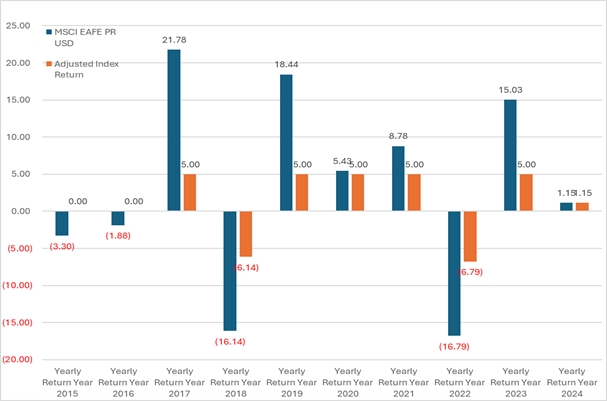
* Index is a “price return index,” not a “total return index,” and therefore does not reflect the dividends paid on the assets composing the Index, which will reduce the Index Return and cause the Index to underperform a direct investment in the securities composing the Index.
Nasdaq 100®
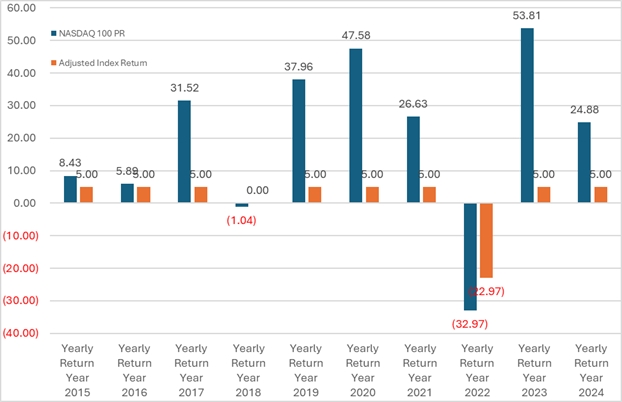
*
* Index is a “price return index,” not a “total return index,” and therefore does not reflect the dividends paid on the assets composing the Index, which will reduce the Index Return and cause the Index to underperform a direct investment in the securities composing the Index.
Russell 2000®
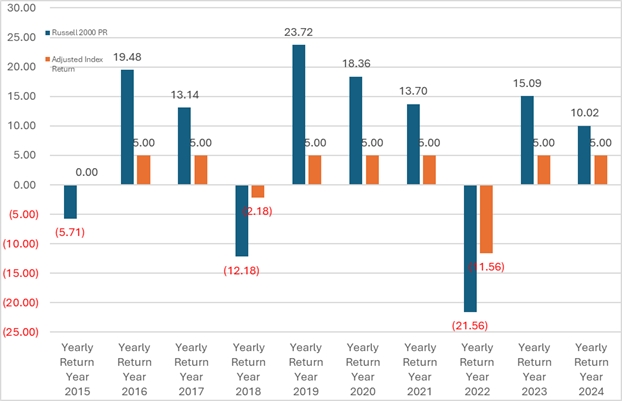
* Index is a “price return index,” not a “total return index,” and therefore does not reflect the dividends paid on the assets composing the Index, which will reduce the Index Return and cause the Index to underperform a direct investment in the securities composing the Index.
INDEX-LINKED OPTION VALUE
Your ILO Value reflects the portion of your Contract Value attributable to the ILO(s) at any given time. You will have a separate ILO Value for each ILO in which you are invested. For the initial ILO Term, if you invest Subsequent Purchase Payments in the same ILO, each Purchase Payment will constitute a different segment in the ILO. Each segment will have a separate ILO Value in the same ILO Term. The performance of each segment will be tracked separately, and each segment will earn a separate ILO Credit on the initial ILO Term End Date.
Term Start Date. On the Term Start Date (which will be your Contract Issue Date for the initial Term), your ILO Value for a specific ILO is equal to your Investment Base. Your Investment Base is the initial investment allocated to the ILO on the Term Start Date after any applicable withdrawals or transfers. Each ILO you invest in will have a separate Investment Base for each Term. In the initial Term, each segment in the same ILO will each have a separate Investment Base. Your Investment Base in an ILO will not change for the remainder of the Term unless a transaction results in a withdrawal or surrender from that ILO, a death benefit is paid, or the Contract is annuitized. For more information about the Investment Base, including how the Investment Base is affected by withdrawals, please see CONTRACT VALUE; ACCESS TO YOUR MONEY; and FEES, CHARGES, AND ADJUSTMENTS — INTERIM VALUE ADJUSTMENT.
Term End Date. If you do not exercise the Performance Lock feature during the Term, then on the Term End Date, your Value in an ILO will be equal to the Investment Base plus or minus the ILO Credit determined on the Term End Date. In the initial Term, a separate ILO Credit will be determined for each segment in the same ILO, and will be added to or subtracted from the respective Investment Base.
Interim Value. On any Business Day during the Term after the Term Start Date and before the Term End Date, your ILO Value is equal to your Interim Value. Each ILO will have a separate Interim Value. In the initial Term, each segment in an ILO will have a separate Interim Value. The Interim Value is the amount in that ILO available for full surrenders (including Free Look surrenders), withdrawals (including RMDs, free withdrawal amounts, pre-authorized withdrawals, and rider charges), death benefit payments, and annuitization during the Term. All of these transactions, if taken during the Term, will be based on Interim Value(s) and will trigger an Interim Value Calculation and Adjustment to your ILO Value. We calculate
the Interim Value of your investment in each ILO at the end of each Business Day between the Term Start Date and the Term End Date. Your Interim Value fluctuates each Business Day independent of the value of your Investment Base in that ILO. The Interim Value calculated could be less than your investment in the ILO even if the Index is performing positively, and may be less than the amount you would receive had you held the investment until the end of the Term.
An Interim Value Calculation could cause you to lose a significant amount of money if amounts are withdrawn or surrendered from the ILOs before the end of a Term, or a death benefit is paid or the Contract is annuitized. Withdrawals from an ILO during the Term will reduce your Interim Value by the amount requested, and will cause an Interim Value Adjustment to your ILO Investment Base and the death benefits, assuming the Contract is not annuitized or terminated. Such reduction could be greater than the dollar amount of the withdrawal. Any applicable surrender charge, taxes, and tax penalties will subsequently be deducted from the amount you receive from the withdrawal. The Interim Value Calculation and Adjustment could result in the loss of principal and previously-credited earnings in the Contract, and in extreme circumstances, such losses could be as high as 100%. You may contact us at our Service Center to obtain your Interim Value(s) for any ILO in which you are invested, although your Interim Value(s) may change by the time a transaction is executed. If you intend to take ongoing withdrawals or elect features with ongoing deductions, you should consult with a financial professional to discuss any potential adverse impact of such ongoing withdrawals and deductions and whether this Contract is appropriate for you. For more information about Interim Values and how withdrawals and other transactions based on Interim Values will affect your Contract, see FEES, CHARGES, AND ADJUSTMENTS — INTERIM VALUE ADJUSTMENT; CONTRACT VALUE; and ACCESS TO YOUR MONEY — EFFECT OF WITHDRAWALS AND SURRENDERS. See the SAI for detailed explanations and examples of how we calculate the Interim Value in various scenarios.
Performance Lock Feature. If you choose to exercise the Performance Lock feature for an ILO during a Term, your entire ILO Value (or segment in the ILO) will be “locked-in” at the Interim Value calculated at the end of the Business Day that the Performance Lock is exercised, and will be credited with a fixed rate of interest equal to the annualized ILO Budget rate beginning on the day following the day the Performance Lock was exercised until the next Contract Anniversary. The ILO Budget rate is an interest rate equivalent to the fair value of the hypothetical derivatives supporting the ILO on the Term Start Date. This means that you will no longer have the ability to receive an ILO Credit or the application of the Crediting Strategy or Protection Level to protect against any loss. You should contact us at our Service Center to obtain your Interim Value(s) and the current annualized ILO Budget rate(s) and speak to your financial professional before exercising a Performance Lock, although your Interim Value(s) may change by the time the Performance Lock is exercised. For more information about the Performance Lock feature, including how withdrawals will affect the locked-in value, please see PERFORMANCE LOCK.
INDEX-LINKED OPTION CREDIT
For each ILO to which you allocate Contract Value, we will add or subtract interest from your Investment Base at the end of the Term (unless you exercise the Performance Lock feature during the Term). The dollar-value of this interest is referred to as the ILO Credit. The ILO Credit may be positive, negative, or equal to zero, based on the Index Return, Crediting Strategy, and Protection Level of the ILO. If the ILO Credit is positive, your Investment Base in that ILO will be increased by a dollar amount equal to the positive credit. If the ILO Credit is negative, your Investment Base will be decreased by a dollar amount equal to the negative credit. If the ILO Credit is equal to zero, no interest will be credited and your ILO Value at the end of the Term will remain equal to your Investment Base. The ILO Credit is applied before the deduction of charges for any optional riders on the Term End Date. This means that any positive ILO Credit will be reduced by those charges, and any negative ILO Credit will be increased by those charges.
In the initial Term, a separate ILO Credit will be determined for each segment in the same ILO, and will be added to or subtracted from the respective Investment Base. For purposes of calculating the ILO Credit, each segment will use the Index price on the date the Purchase Payment is received. If you allocate Contract Value to multiple ILOs at once, assuming you do not exercise the Performance Lock feature for any ILO, each ILO in which you invest will apply a separate ILO Credit for each Term. Even if you receive a positive ILO Credit for one or more ILOs (or segments), your overall Contract Value may still be reduced by any negative ILO Credit you receive for other ILOs (or segments) during that Term.
Change in Index Price
To determine the ILO Credit applied to your Investment Base at the end of a Term, we first determine the change in Index Price over the course of the Term for that ILO. The percentage change in Index Price is the Index Return. The Index Return is calculated on a Point to Point basis, which means that the Index Return is determined by comparing the Index Price on the Term Start Date to the Index price on the Term End Date. The Index Return for all ILOs except for the Performance Mix ILO is calculated using the following formula:
Index Return = (Ending Index Price – Starting Index Price) / Starting Index Price.
Example: Calculation of the Index Return
Index Price on Term Start Date | 4,000 |
Index Price on Term End Date | 4,050 |
Index Return on Term End Date | (4,050 – 4,000) / 4,000 = 1.25% |
The Index Return of the Performance Mix ILO, which is based on the combined performance of the S&P 500®, Russell 2000, and the MSCI EAFE Indexes, is calculated using the formula below:
Index Return = [Best Performing Index: 50% x (Ending Index Price – Starting Index Price) / Starting Index Price] + [Next Best Performing Index: 30% x (Ending Index Price – Starting Index Price) / Starting Index Price] + [Lowest Performing Index: 20% x (Ending Index Price – Starting Index Price) / Starting Index Price]
Example: Calculation of the Index Return for a Performance Mix ILO
Starting Index Price | Ending Index Price | Index Return | |
Best Performing Index | 6,000 | 7,800 | (7,800 – 6,000) / 6,000 = 30% |
Next Best Performing Index | 5,000 | 5,400 | (5,400 – 5,000) / 5,000 = 8% |
Lowest Performing Index | 6,500 | 5,850 | (5,850 – 6,500) / 6,500 = -10% |
Index Return for Performance Mix ILO | [50% x 30%] + [30% x 8%] + [20% x -10%] = 15.4% | ||
The starting and ending Index Prices are determined based on the following rules: for the starting Index Price in the initial Term, each Purchase Payment invested in the same ILO will constitute a different segment and will use the Index Price on the date the payment is received. For Subsequent Terms, all amounts allocated to an ILO Term will constitute one segment and the starting Index Price will be the Index Price on the Term Start Date, which will be a Contract Anniversary. If the Contract Anniversary is not a Business Day, the starting Index Price will be the Index Price of the most recent Business Day prior to the Contract Anniversary. The ending Index Price for all amounts in the initial Term and Subsequent Terms will be the Index Price determined on the Term End Date, which will be a Contract Anniversary. If the Contract Anniversary is not a Business Day, the ending Index Price will be the Index Price from the most recent Business Day prior to the Contract Anniversary.
Adjusted Index Return
After the Index Return is calculated, we next determine the Adjusted Index Return. The Adjusted Index Return is a percentage of interest determined at the end of each ILO Term by applying the ILO Crediting Strategy, or the Protection Level, as applicable, to the Index Return. The Adjusted Index Return may be positive, negative or zero.
The Adjusted Index Return is multiplied by the Investment Base (adjusted for any withdrawals) to yield the dollar value of the ILO Credit at the end of each ILO Term. The ILO Credit is then added to or subtracted from the Investment Base on the Term End Date to determine the ending ILO Value. The application of a negative Adjusted Index Return will result in a reduction of the Investment Base by the dollar amount of the ILO Credit. The application of a positive Adjusted Index Return will result in an increase to the Investment Base by the dollar amount of the ILO Credit.
ILO Credit = Investment Base x Adjusted Index Return
Example: Calculation of the ILO Credit (assuming no withdrawals)
Investment Base | $100,000 |
Adjusted Index Return | 5% |
ILO Credit | $100,000 x 5% = $5,000 |
Ending ILO Value | $100,000 + $5,000 = $105,000 |
Investment Base | $100,000 |
Adjusted Index Return | -5% |
ILO Credit | $100,000 x -5% = -$5,000 |
Ending ILO Value | $100,000 – $5,000 = $95,000 |
Crediting Strategies & Protection Levels
The Contract offers ILOs with one of the following Crediting Strategies and related Protection Level. Each Crediting
Strategy and Protection Level is further explained below. Crediting Strategies and Protection Levels only apply on the Term End Date. See APPENDIX A — INTEREST CREDITING OPTIONS AVAILABLE UNDER THE CONTRACT for more information about each of the available ILOs.
• Cap Rate with Participation Rate and Buffer
• Cap Rate and Dual Direction Buffer
• Performance Triggered Rate and Buffer
• Tiered Participation Rate with Cap Rate and Buffer
• Performance Mix with Participation Rate and Cap Rate and Buffer
Crediting Strategies
We will limit the positive Index Return used in calculating the Adjusted Index Return credited to an ILO at the end of each Term through the use of the applicable Crediting Strategy. The Crediting Strategy is a method of determining how much positive interest, if any, will be credited to your ILO Investment Base. Each ILO will apply only one type of Crediting Strategy. The Crediting Strategy is applied to the Index Return to determine the positive Adjusted Index Return. Except for the Cap Rate with Dual Direction Buffer Crediting Strategy, Crediting Strategies are not applied if the Index Return is negative. The Crediting Strategy for an ILO will be in the form of a Cap Rate with Participation Rate (including the Cap Rate with Dual Direction Buffer, Performance Mix and Tiered Participation Rate with Cap Rate), Performance Mix, Tiered Participation Rate with Cap Rate, or Performance Triggered Rate. For 6-year ILOs, the Crediting Strategy rates are applied on a Point to Point basis and are not annualized. This means that the Crediting Strategies are applied to the Index Return for the entire Term, not on an annual basis.
The Crediting Strategy rates are guaranteed for the length of the Term. We typically declare renewal Crediting Strategy rates for the ILOs twice a month, but we reserve the right to declare these rates more frequently. The initial Crediting Strategy Rates in effect for your Contract are established according to the procedures outlined above under “ BUYING THE CONTRACT — RATE LOCK.” These initial rates will not change after the Contract Issue Date and apply to all Purchase Payments, and are guaranteed for the length of the initial Term. See BUYING THE CONTRACT — RATE LOCK and TRANSFERS AND REALLOCATIONS for additional details. We declare renewal Crediting Strategy rates for each Subsequent Term on the Contract Anniversary that is the Term Start Date. These renewal rates may be higher or lower than the initial rate, subject to the Minimum Limits on Index Gain set forth in this Prospectus. Initial and renewal rates may vary depending on the Index, market conditions, Crediting Strategy, Protection Level, or Term length. Minimum Limits on Index Gain are set at Contract issue and will not change for the life of your Contract. We may declare new Minimum Limits on Index Gain for new Contract issues. In some cases, we may declare a Cap Rate for an ILO as “uncapped” in which case the amount of positive Index Return that can be credited to your ILO Value at the end of a Term is equal to the Index Return, subject to any applicable Participation Rate.
We will send you a notice 30 days prior to the Term End Date explaining the ILOs available to you for transfer or reallocation on the upcoming Contract Anniversary, reminding you to review any transfer instructions you may have previously submitted to us, and directing you to our website, www.pacificliferates.com, where you can view renewal Guaranteed Rates for the Fixed Account and ILO crediting rates declared for the next Term.
The various Crediting Strategies (Cap Rate with Participation Rate (including Cap Rate with Dual Direction Buffer, Performance Mix and Tiered Participation Rate with Cap Rate), Performance Mix, Tiered Participation Rate with Cap Rate, and Performance Triggered Rate) may limit the highest possible Adjusted Index Return that you may receive and therefore may limit the positive ILO Credit, if any, that may be applied to your ILO Investment Base. Because of the application of the Crediting Strategy, the Adjusted Index Return may be less than the positive Index Return. These Crediting Strategies benefit us because they limit the amount of positive interest that we may be obligated to credit for any Term. We set the Crediting Strategy rates at our discretion, however, they will never be less than the Minimum Limits on Index Gain set forth in this Prospectus. You bear the risk that we will not set Crediting Strategy rates higher than these minimums. The Cap Rates, Participation Rates and Performance Triggered Rates are determined using the associated derivative option costs that are applicable to each ILO. (The Hypothetical Derivative Strategy table, found in the SAI, shows the specific set of derivative options that are used to replicate the potential ILO Credit for each ILO.) The primary factors that will impact derivative option costs include the applicable Protection Level (e.g. Buffer or Dual Direction Buffer), interest rates, implied volatility, dividend yield of the Index, and the length of the Term.
The following examples illustrate how we calculate and credit interest under each crediting methodology, assuming hypothetical Index Returns and hypothetical limits on Index gains and losses. The examples assume no withdrawals.
Cap Rate with a Participation Rate. The Cap Rate is a percentage that signifies the maximum amount of positive Adjusted Index Return that can be credited to the Investment Base at the end of the Term. The Participation Rate is the percentage portion of the positive Index Return that will be used to determine the Index-Linked Option Credit. When Index Return is positive or equal to
zero, the Adjusted Index Return will be the lesser of the (Index Return x Participation Rate) or the Cap Rate. This means that any positive Index Return will be multiplied by the Participation Rate but will be limited by the Cap Rate. Any 1-year ILO with a 10% Buffer Rate provides a minimum Cap Rate of 5.00%. Any 1-year ILO with a 15% Buffer Rate provides a minimum Cap Rate of 4.50%. Any 6-year ILO with a 10% Buffer Rate provides a minimum Cap Rate of 30.00%. Any 6-year ILO with a 15% Buffer Rate provides a minimum Cap Rate of 27.00%. Any 6-year ILO with a 20% Buffer Rate provides a minimum Cap Rate of 24.00%. The Cap Rate is also a part of the Cap Rate with Dual Direction Buffer Crediting Strategy.
Example: Application of a 10% Cap Rate with a 100% Participation Rate
Index Return | Adjusted Index Return |
0% | 0% |
5% | 5% |
10% | 10% |
15% | 10% |
Performance Mix with Participation Rate and Cap Rate. The Performance Mix measures the performance of a combination of three Indexes: The S&P 500®, the Russell 2000, and the MSCI EAFE. The Index Return of the Performance Mix is determined based on the combined weighted average of those stated Indexes: 50% is based on the Index with the highest return, 30% is based on the Index with the next best return, and 20% is based on the Index with the lowest return. The calculation of the combined Index Return for the Performance Mix is demonstrated by the following formula:
Index Return = [Best Performing Index: 50% x (Ending Index Price – Starting Index Price) / Starting Index Price] + [Next Best Performing Index: 30% x (Ending Index Price – Starting Index Price) / Starting Index Price] + [Lowest Performing Index: 20% x (Ending Index Price – Starting Index Price) / Starting Index Price]
The Participation Rate and Cap Rate are used to determine the Adjusted Index Return. The Participation rate is a set percentage that determines what portion of the positive combined Index Return for the Term will be used before applying the Cap Rate to determine the ILO Credit. When the combined Index Return is positive, the Adjusted Index Return will be the lesser of the combined Index Return multiplied by the Participation Rate or the Cap Rate. The Participation Rate and Cap Rate are not applied if the combined Index Return is negative. The Cap Rate is the maximum amount of positive Index Return that can be credited to the Investment Base at the end of a Term. The Cap Rate limits the potential positive Index-Linked Option Credit that may be applied at the end of a Term. The minimum Participation Rate for any ILO offered for the life of this Contract is 100%. The Minimum Limit on Index Gain for the Participation Rate strategy for any ILO offered for the life of this Contract is 30%.
Example: Application of a 100% Participation Rate and 80% Cap Rate
Combined Index Return | Adjusted Index Return |
0% | 0% |
30% | 30% |
60% | 60% |
90% | 80% |
Tiered Participation Rate with Cap Rate. The Tiered Participation Rate includes two set percentages that determine what portion of any positive Index Return will be used to determine the ILO Credit. The Tiered Participation Rate provides a Tier One Participation Rate, a Tier Two Participation Rate, and a Cap Rate. Index Return equal to zero and any positive Index Return less than or equal to the Tier Level is multiplied by the Tier One Participation Rate. Positive Index Return in excess of the Tier Level is multiplied by the Tier Two Participation Rate. The Adjusted Index Return is equal to the sum of these two values subject to the Cap Rate. The Tiered Participation Rate and Cap Rate are not applied if the Index Return is negative. The Cap Rate is the maximum amount of positive Index Return that can be credited to the Investment Base at the end of a Term. The Cap Rate limits the potential positive Index-Linked Option Credit that may be applied at the end of a Term. The Cap Rate limits the potential positive Index-Linked Option Credit that may be applied at the end of a Term.
The minimum Participation Rate for any ILO offered for the life of this Contract is 100%. The Minimum Limit on Index Gain for the Tiered Participation Rate strategy for any ILO offered for the life of this Contract is 30%.
Example: Application of a Tiered Participation Rate and Cap Rate
Index Return = | 75% |
Tier Level = | 25% |
Tier 1 Participation Rate = | 100% |
Tier 2 Participation Rate = | 125% |
Cap Rate | 80% |
The Adjusted Index Returns is equal to the sum of the following values subject to the Cap Rate: the Index Return up to the Tier Level (25%) multiplied by the Tier One Participation Rate (100%), plus the Index Return in excess of the Tier Level (determined by subtracting the Tier Level from the Index Return – 75% – 25% = 50%) multiplied by the Tier Two Participation Rate (125%).
Performance Triggered Rate. A Performance Triggered Rate is a flat percentage of interest that will be credited if the Index Return is equal to zero or positive. This means that the Adjusted Index Return will always be equal to the Performance Triggered Rate, even if the positive Index Return is greater or less than the Performance Triggered Rate. The Minimum Limit on Index Gain for the Performance Triggered Rate strategy for any ILO with a 10% Buffer Rate offered for the life of this Contract is 5%. The Minimum Limit on Index Gain for the Performance Triggered Rate strategy for any ILO with a 15% Buffer Rate offered for the life of this Contract is 4.5%.
Example: Application of an 8% Performance Triggered Rate
Index Return | Adjusted Index Return |
0% | 8% |
5% | 8% |
10% | 8% |
15% | 8% |
Crediting Strategy Considerations
We set the rates for the Crediting Strategies at our discretion, subject to Minimum Limits on Index Gain. We consider various factors in determining the limits on Index gains, including market conditions, regulatory and tax requirements, competitive factors, administrative costs, risk management, and general economic trends.
In addition, initial and renewal Crediting Strategy rates may vary depending Crediting Strategy type, Protection Level, and Term length.
If you allocate Contract Value to an ILO with a Cap Rate or a Performance Triggered Rate, the highest possible Adjusted Index Return that you may earn for a given Term when the Index Return is positive is the Cap Rate or the Performance Triggered Rate. As a result, you will only be credited with a maximum amount of interest even if the positive Index Return is much greater than the Cap Rate or Performance Triggered Rate. Additionally, Cap Rates for ILOs with 6-year Terms apply on a Point to Point basis. This means that the Cap Rate is applied to the Index Return for the entire Term, not on an annual basis.
Under certain conditions, a Performance Triggered Rate ILO may provide greater potential for Index gains than a Cap Rate, Tiered Participation Rate with Cap Rate, or Performance Mix ILO when the Crediting Strategy rates are identical. This is because a fixed rate of interest will be credited when the Index Return is greater than or equal to zero, even if the positive Index Return is less than the Performance Triggered Rate. For example, if two ILOs offer identical rates of 8% for the Cap Rate and Performance Triggered Rate, and the positive Index Return is 5%, your Adjusted Index Return will be 8% under the Performance Triggered Rate ILO (the fixed rate of interest), but 5% under the Cap Rate with Participation Rate ILO assuming a 100% Participation Rate.
Protection Levels
We will limit the negative Index Return used in calculating the Adjusted Index Return credited to an ILO at the end of each Term through the use of the applicable Protection Level. The Protection Levels provide only limited protection against downside risk at the end of a Term. You may lose money. When you invest Contract Value in the ILOs, you bear the risk that negative Index performance may cause the Adjusted Index Return to be negative even after the application of the
Protection Level. Each ILO includes a Protection Level in the form of a Buffer, or Dual Direction Buffer, which may limit how much loss you will incur at the end of the Term when the Index Return is negative. The Protection Level does not apply when the Index Return is positive or equal to zero. On the Term End Date, the applicable Protection Level is applied to the negative Index Return to determine the Adjusted Index Return. For 6-year ILOs, the Protection Level is applied on a Point to Point basis and is not annualized. This means that for 6-year Terms, the Buffer or Dual Direction Buffer is applied to the Index Return for the entire Term, not on an annual basis.
We reserve the right to stop offering all but one ILO. The S&P 500® 1-year ILO with Cap and 10% Buffer will always be available under your Contract. In the future, we may not offer ILOs with any other Protection Level other than a 10% Buffer. We do not guarantee a minimum Dual Direction Buffer Rate, and we do not guarantee that we will always offer ILOs with a Dual Direction Buffer. If we stop offering all but one ILO (the 1-year S&P 500® with Cap Rate with Participation Rate and 10% Buffer ILO), you will be limited to investing in only one ILO and the Fixed Account Option. The terms and features of that ILO may not meet your investment objectives or be suitable for your financial goals, and this Contract may not be appropriate for you if you intend to invest solely in ILOs with a Dual Direction Buffer. Any ILOs we do offer (in addition to the 1-year S&P 500® with Cap Rate with Participation Rate and 10% Buffer ILO) will always have some level of downside protection, but we do not guarantee a minimum level, unless required by applicable law. If, in the future, you are not satisfied with the available ILOs, you may choose to surrender your Contract, but you may be subject to surrender charges, taxes, and tax penalties, and the calculation of the surrender amount based on Interim Value if the surrender is made before the end of a Term.
The following examples illustrate how we calculate and credit interest under each Protection Level methodology, assuming hypothetical Index Returns and hypothetical limits on Index gains and losses. The examples assume no withdrawals.
Buffer. The Buffer Rate is the maximum loss we will protect you from at the end of the Term. We protect your ILO Value from any loss up to and including the Buffer Rate. When the Index Return is negative, then the Adjusted Index Return is equal to the lesser of the negative Index Return plus the Buffer Rate, or zero. You will only incur a loss by the amount that the Index Return has declined in excess of the Buffer Rate. If the Index Return has declined less than or up to your Buffer Rate, your Adjusted Index Return will be zero. We currently offer Buffer Rates of 10%, 15%, and 20%, depending on which ILO(s) you choose.
Example: Application of 10% Buffer Rate
Index Return | Adjusted Index Return |
-5% | 0% |
-10% | 0% |
-15% | -5% |
-20% | -10% |
Dual Direction Buffer. Under the Dual Direction Buffer, we protect your ILO Value from any loss up to and including the Dual Direction Buffer Rate. The Dual Direction Buffer is only offered with the Cap Rate with Dual Direction Buffer Crediting Strategy. If the negative Index Return is less than zero and within or equal to the Dual Direction Buffer percentage, the Adjusted Index Return will be a positive rate of interest equal to the absolute value of the Index Return. The absolute value of a number is the value of that number without regard to it being positive or negative. For example, the absolute value of -10 is 10. This means that the absolute value of any negative Index Return up to and including the Dual Direction Buffer Rate will be credited to your Investment Base as positive interest. If the Dual Direction Buffer Rate of the ILO is greater than the Cap Rate, the positive interest credited by the Dual Direction Buffer may exceed the Cap Rate. If negative Index Return exceeds the Dual Direction Buffer Rate, then the Adjusted Index Return is equal to the negative Index Return in excess of the Dual Direction Buffer Rate. You will only incur a loss by the amount that the negative Index Return exceeds the Dual Direction Buffer Rate.
Example: Application of 10% Dual Direction Buffer Rate with 8% Cap Rate
Index Return | Adjusted Index Return |
-5% | 5% |
-10% | 10% |
-15% | -5% |
-20% | -10% |
The Protection Levels provide only limited protection against negative Index Return. When you invest Purchase Payments and/or Contract Value in an ILO, you bear the risk that negative Index performance may cause the Adjusted Index Return to be negative even after the application of the Buffer, or Dual Direction Buffer. This would result in a negative ILO Credit and reduce your Investment Base. Additionally, the Protection Levels provide downside protection only on the ILO Term End Date, so your exposure to negative Index performance during a Term is greatest before the ILO Term End Date.
Protection Level Considerations
Protection Levels for the currently offered ILOs will not change for the life of these ILO offerings. Protection Level rates declared for future ILOs under this Contact may vary depending on the Index, market conditions, Crediting Strategy, and rates, the type of Protection Level, and the Term length.
Assuming the same Index and Term length, an ILO that provides more protection from Index losses will generally tend to have less potential for Index gains; conversely, an ILO that provides less protection from Index losses will generally tend to have more potential for Index gains.
Because the absolute value of any negative Index Return up to and including the Dual Direction Buffer Rate will be credited to your ILO Value as positive interest, a negative Index Return on the Term End Date that is slightly below or slightly above the Dual Direction Buffer Rate can result in very different ILO Credits. You will receive positive interest if the negative Index Return does not exceed the Dual Direction Buffer Rate, and you will receive negative interest if the negative Index Return exceeds the Dual Direction Buffer Rate on the Term End Date. Any negative Index Return in excess of the Dual Direction Buffer Rate will result in negative interest being credited to your ILO Value in the amount that the negative Index Return exceeds the Dual Direction Buffer Rate. For example, if the ILO Dual Direction Buffer Rate is 10%, and the negative Index Return is -10%, your Adjusted Index Return will be 10%. However, if the negative Index Return is -10.01%, your Adjusted Index Return will be -0.01%.
We set the Protection Level rates at our discretion. We consider various factors in determining the Protection Level rates, including, but not limited to, market conditions, administrative expenses, regulatory requirements, general economic trends, and competitive factors. In deciding whether to choose an ILO with a higher Protection Level, you should consider that ILOs with higher Protection Levels tend to have lower Cap Rates, Participation Rates, and Performance Triggered Rates.
PERFORMANCE LOCK
If you allocate Purchase Payments or Contract Value to any of the ILOs, you may request to exercise the Performance Lock feature at any time after the 60th calendar day from the Term Start Date until and including the Business Day before the Term End Date. If you choose to exercise the Performance Lock feature for an ILO during a Term, generally, your entire value in the ILO will be “locked-in” at the Interim Value calculated at the end of the Business Day that the Performance Lock is exercised.
However, if you have made Subsequent Purchase Payments into the same ILO in the first Contract Year, each Purchase Payment will constitute a different “segment” in the initial ILO Term with its own Investment Base and Interim Value, and the investment performance of each segment will be tracked separately. If you have multiple segments in the same ILO in the initial Term due to multiple Purchase Payments in the first Contract Year, the value of each segment may be locked-in independently. You may exercise the Performance Lock feature once for each segment during the initial Term. When you exercise the Performance Lock feature, you must clearly indicate which segment(s) to lock-in.
The Performance Lock will be exercised on the Business Day that we receive your request In Proper Form. The entire value in an ILO (or segment) will be locked-in. The locked-in value will remain in the ILO, but will be credited with a fixed rate of interest equal to the annualized ILO Budget rate beginning on the day following the day the Performance Lock was exercised until the next Contract Anniversary. The minimum ILO Budget Rate is 0.0% (which means the minimum fixed rate of interest that will apply to the locked-in value is 0.0%). The ILO Budget Rate is an interest rate equivalent to the fair value of the hypothetical derivatives supporting the ILO on the Term Start Date. The hypothetical value of derivatives for each ILO is a dollar value. The ILO Budget Rate is a percentage, which is the ratio of the dollar amount of the hypothetical value of the derivatives divided by your ILO Investment Base. There is no defined minimum ILO Budget Rate. The ILO Budget Rate is directly computed from the hypothetical value of derivatives. The Minimum Limits on Index Gain for Cap Rates will dictate a theoretical minimum ILO Budget Rate; however, this rate will vary because multiple factors can influence the hypothetical value of derivatives.
Your decision to exercise the Performance Lock will terminate your ability to receive an ILO Credit or the application of the Crediting Strategy or Protection Level to protect against any loss. Withdrawals from the locked-in amount are not subject to an Interim Value Calculation and will not result in an Interim Value Adjustment to the Investment Base or death benefit, but are subject to applicable surrender charges, taxes, and tax penalties. Withdrawals will reduce the locked-in value by the amount
requested. Any applicable surrender charge, taxes, and tax penalties will adjust the amount you receive from the withdrawal.
Once the Performance Lock is exercised, the locked-in value cannot be transferred to a new ILO, the Fixed Account, or begin a new Term in the same ILO, until the next Contract Anniversary. Because the ILO Protection Level only applies at the end of the ILO Term on the Term End Date, the locked-in value will not be protected from any negative Index performance. On the next Contract Anniversary, the locked-in value will begin a new Term in the same 1-year ILO that was previously locked-in, unless you provide us with transfer instructions. If the Performance Lock is exercised on a 6-year ILO, then on the next Contract Anniversary, the locked-in value will automatically begin a new Term in the corresponding 1-year ILO (i.e., a 1-year ILO with the same reference Index, type of Crediting Strategy and Protection Level, and Protection Level rate) unless you provide us with transfer instructions. If a 1-year ILO is not available for a new Term, your previously-locked-in value will be transferred to the Fixed Account Option unless you provide us with transfer instructions. See TRANSFERS AND REALLOCATIONS for more information.
You may exercise the Performance Lock feature only once during each Term for each ILO (and once for each segment during any initial ILO Term due to Subsequent Purchase Payments in the first Contract Year). This is because the entire value in an ILO (or segment) is locked-in, and your ability to receive the application of the Crediting Strategy or Protection Level in the ILO terminates. You may request to exercise the Performance Lock feature by notifying us before close of Business on any Business Day prior to the Term End Date. See ADDITIONAL INFORMATION — INQUIRIES AND SUBMITTING FORMS AND REQUESTS for instructions on how to contact us. The request to exercise the Performance Lock feature must be received by us before close of Business in order to lock-in that day’s ending Interim Value. Requests received after close of Business are considered received on the following Business Day, and will lock-in that Business Day’s Interim Value.
The exercise of the Performance Lock feature is irrevocable and may only be cancelled if we receive the request to cancel before close of Business on the same Business Day that the request to exercise the feature is received.
See the examples in the SAI for a description of how Interim Values are calculated. You should contact us at our Service Center to obtain your Interim Value(s) and the current annualized ILO Budget rate and speak to your financial professional before exercising a Performance Lock, although your Interim Value(s) may change by the time the Performance Lock is exercised.
Because we determine the Interim Value at the end of the Business Day that the Performance Lock request is received, you will not be able to determine the Interim Value that will be locked-in prior to the Performance Lock request. Even if the Index’s performance has been positive, it is possible that your Interim Value may have decreased at the time we lock-in the ILO Value, and may be less than the amount you would receive if you held the investment until the end of the Term. Also, if the Index’s performance has been negative, it is possible that your Interim Value may have decreased further at the time you exercise the Performance Lock. You bear the risk that the Interim Value you lock-in will be lower than the Interim Value you last obtained, and lower than the potential ILO Value you would receive at the end of the Term, and the difference could be significant. If you exercise the Performance Lock feature when the Interim Value is higher than your Investment Base at the beginning of the Term, you will lock-in any positive gain with respect to that ILO for that Term (excluding the impact of any withdrawals taken during the Term). If you exercise the Performance Lock feature when the Interim Value is lower than your Investment Base at the beginning of the Term, you will lock-in any loss. If you have multiple segments in the same ILO for the initial Term and you exercise the Performance Lock feature on a segment during the initial Term, you will lock-in the Interim Value for that segment. It is possible that one segment’s Interim Value may have increased, while other segments’ Interim Values may have decreased at the time the Performance Lock is exercised.
Please keep in mind that the ILO Protection Level only applies to protect you from limited negative Index performance at the end of the ILO Term. If you exercise the Performance Lock, you bear the risk that the Interim Value that you lock-in will be lower than the potential ILO Value you would have received at the end of the Term if the Protection Level were applied. You also bear the risk that any gain you may lock-in will be lower than the ILO Credit you would have received at the end of the Term after the application of the Crediting Strategy. If you exercise the Performance Lock feature at a time when your Interim Value has declined, you will lock-in any loss. There may not be an optimal time to exercise the Performance Lock feature. It may be better for you if you do not exercise the Performance Lock feature during a Term. We will not advise you as to whether or when you should or should not exercise the Performance Lock feature, and we are not responsible for any losses that may occur due to your decision to exercise this feature. See PRINCIPAL RISKS OF INVESTING IN THE CONTRACT — PERFORMANCE LOCK RISK.
ORDER OF OPERATIONS FOR CONTRACT ANNIVERSARY PROCESSING
The following is the order in which transactions and other requests will be carried out on each Contract Anniversary, regardless of whether or not the Contract Anniversary falls on a Business Day.
Step 1: The ILO Credit is calculated and applied to the Investment Base to determine the Term ending ILO Value.
Step 2: Transactions effective on the Contract Anniversary are processed in the following order, from first to last:
• Death benefit, then
• Rider charges (if applicable), then
• Withdrawals, then
• Surrender, then
• Annuitization, then
• Transfers
Step 3: The Investment Base for the next Term beginning on the Contract Anniversary is determined.
CONTRACT VALUE
On the Contract Issue Date, your Contract Value is your initial Purchase Payment. Your Contract Value is increased by the amount of any Subsequent Purchase Payments. After the Contract Issue Date, your Contract Value is the sum of your investments in the ILOs (the ILO Value) and the Fixed Account Option (the Fixed Account Option Value).
FIXED ACCOUNT OPTION VALUE
The Fixed Account Option value is the amount allocated to the Fixed Account Option, plus the daily interest credited, less any transfers and withdrawals (which include applicable surrender charges and taxes).
INDEX-LINKED OPTION VALUE
Investment Base
On the Term Start Date (or your Contract Issue Date), your ILO Value for a specific ILO is equal to your Investment Base. The Investment Base is your initial investment into a Term. Each ILO you invest in will have a separate Investment Base for each Term. The Investment Base for the initial Term is the amount of your Purchase Payments allocated to the ILO. In the initial Term, Subsequent Purchase Payments allocated to the same ILO will each constitute a separate segment in the ILO. Each segment will have a separate Investment Base. You may have more than one Investment Base in the same ILO Term. On Subsequent Term Start Dates, the Investment Base is the total amount allocated to an ILO on the Contract Anniversary after the application of the ILO Credit(s) from the previous Term, any applicable withdrawals and transfers. The Investment Base will remain the same during the Term unless a withdrawal is taken from the ILO. Withdrawals taken from the ILOs on any day other than the Term Start Date and the Term End Date will reduce the Investment Base in the same proportion that the Interim Value (excluding any locked-in value under the Performance Lock feature) is reduced by the amount of the withdrawal. This reduction percentage will be determined by dividing the amount of the withdrawal removed from the ILO by the Interim Value of the ILO immediately prior to the withdrawal. The percentage is then multiplied by the Investment Base prior to the withdrawal in order to determine the dollar value of the reduction to the Investment Base. Withdrawals during the Term may reduce your Investment Base by an amount greater than the dollar value of the withdrawal. Applicable surrender charges, taxes, and tax penalties are deducted from the amount of the withdrawal requested. The examples below demonstrate the reduction to the Investment Base after a withdrawal based on Interim Value.
Example: ILO Interim Value Less Than the ILO Investment Base at Time of the Withdrawal Investment Base (Prior to Withdrawal) = $100,000
Interim Value Immediately prior to Withdrawal = $85,000
Withdrawal Amount from ILO = $20,000
Investment Base Reduction = ($20,000 / $85,000) x $100,000 = $23,529.41
Investment Base (After Withdrawal) = $100,000 − $23,529.41 = $76,470.59
Example: ILO Interim Value Greater Than the ILO Investment Base at the Time of the Withdrawal Investment Base (Prior to Withdrawal) = $100,000
Interim Value Immediately prior to Withdrawal = $115,000
Withdrawal Amount from ILO = $20,000
Investment Base Reduction = ($20,000 / $115,000) x $100,000 = $17,391.30
Investment Base (After Withdrawal) = $100,000 − $17,391.30 = $82,608.70
At the end of the Term, assuming you do not exercise the Performance Lock feature, the Investment Base is used to determine the ILO Credit, which may be positive, negative, or equal to zero, and the ILO Credit is applied to your Investment Base to determine your ending ILO Value. The Investment Base is increased or decreased by the dollar value of the ILO Credit. At the end of the initial Term, each segment in an ILOs (due to Subsequent Purchase Payments) will each receive a separate ILO Credit, which will be added to the respective Investment Base. The ILO Credit is applied before the deduction of charges for any optional riders. This means that any positive ILO Credit will be reduced by those charges, and any negative ILO Credit will be increased. Withdrawals at the end of the Term will be made after the application of the ILO Credit, and will reduce your ILO Value dollar-for-dollar by the amount requested. Your ending ILO Value may be reallocated into a new Term in the same ILO, if available, or transferred into a new Interest Crediting Option on the Contract Anniversary coinciding with the Term End Date and the next Term Start Date.
Adjusted Index Return
The ILO Adjusted Index Return is a percentage used to determine the ILO Credit at the end of the Term. The Adjusted Index Return is determined by adjusting the Index Return by the applicable Protection Level or Crediting Strategy. Once the Adjusted Index Return is calculated, it is multiplied by the Investment Base in that ILO to determine the dollar value of the ILO Credit. See INVESTING IN YOUR CONRACT — INDEX-LINKED OPTION CREDIT for more information on how we determine the Adjusted Index Return.
Interim Value
On any Business Day during the Term after the Term Start Date and before Term End Date, your ILO Value is equal to the Interim Value. Each ILO will have a separate Interim Value. In the initial Term, Subsequent Purchase Payments invested in the same ILO will each constitute a different segment in the initial ILO Term, and each ILO segment will have its own associated Interim Value and Investment Base during the initial Term. The Interim Value is the amount in the ILO that is available for surrenders (including Free Look surrenders), withdrawals (including RMDs, free withdrawal amounts, pre-authorized withdrawals, and rider charges), annuitization, and death benefit payments that occur before the Term End Date. The Interim Value is also the amount available for exercise of the Performance Lock feature.
All of these transactions, if taken during the Term, will be based on Interim Value(s) and will trigger an Interim Value Calculation and Adjustment to your ILO Value. See PRINCIPAL RISKS OF INVESTING IN THE CONTRACT — INTERIM VALUE ADJUSTMENT RISK; FEES, CHARGES, AND ADJUSTMENTS — INTERIM VALUE ADJUSTMENT; ACCESS TO YOUR MONEY — EFFECT OF WITHDRAWALS AND SURRENDERS; and PERFORMANCE LOCK for more information about Interim Values and transactions based on Interim Values. See the SAI for detailed explanations and examples of how we calculate the Interim Value in various scenarios.
ACCESS TO YOUR MONEY
WITHDRAWALS AND SURRENDERS
Optional Withdrawals and Surrenders
You may, on or prior to your Annuity Date, withdraw a portion of the amount available under your Contract while the Owner (or Annuitant in the case of a Non-Natural Owner) is living and your Contract is in force. You may also make a full withdrawal of your entire Contract Value at any time, which is referred to as a “surrender,” and which will terminate your Contract. Withdrawals are not permitted after the Annuity Date. Withdrawals are generally not permitted until 30 calendar days after your Contract Issue Date; however, we are currently not enforcing this limitation.
You may request to withdraw a specific dollar amount or a specific percentage of your Contract Value. You may choose to make your withdrawal from specified Interest Crediting Options, or your entire Contract Value. If you do not specify the Interest Crediting Options, your withdrawal will typically be taken from all of your Interest Crediting Options proportionately on the date of the withdrawal. If Subsequent Purchase Payments are allocated to the ILOs in the first Contract Year, withdrawals will be taken on a First-In, First-Out (“FIFO”) basis during the initial ILO Term for purposes of interest calculations. For all Subsequent Terms, withdrawals will be taken from all of the Interest Crediting Options proportionately.
Each withdrawal must be at least $500. Pre-authorized withdrawals must be at least $500, except for pre-authorized withdrawals distributed by Electronic Funds Transfer (EFT), which must be at least $100. Upon taking a withdrawal, we will send you the amount of the net withdrawal, which is equal to the amount of the gross withdrawal requested, adjusted for any applicable surrender charge, taxes, and/or tax penalties. Upon making a surrender, we will send you your entire Cash Surrender Value. See FEES, CHARGES, AND ADJUSTMENTS.
Amounts transferred or withdrawn from the Fixed Account Option may be delayed under extraordinary circumstances. See
ADDITIONAL INFORMATION — TIMING OF PAYMENTS AND TRANSACTIONS.
Distributions made due to divorce instructions or under Code Section 72(t)/72(q) (substantially equal periodic payments) are treated as withdrawals for Contract purposes and may result in a surrender charge assessment.
Amount Available for Withdrawal
The amount available for surrender or withdrawal is your Cash Surrender Value, which is your Contract Value at the end of the Business Day on which your withdrawal or surrender request is effective, adjusted for any applicable rider charges, surrender charges, taxes, and/or tax penalties. The amount we send to you will be adjusted for any required or requested federal and state income tax withholding. Any amounts surrendered (including Free Look surrenders) or withdrawn (including RMDs, deductions for rider charges, withdrawals free of a surrender charge, and pre-authorized withdrawals) from an ILO during a Term will trigger an Interim Value Calculation and Adjustment. You may contact us at our Service Center to obtain your Interim Value(s) for any ILO in which you are invested prior to initiating a transaction, although your Interim Value(s) may change by the time a transaction is executed.
You assume investment risk on Purchase Payments in the ILOs. As a result, the amount available to you for withdrawal from any ILO may be more or less than the total Purchase Payments you have allocated to that ILO, or your Investment Base in the ILO. See PRINCIPAL RISKS OF INVESTING IN THE CONTRACT.
Effective Date of Withdrawal Requests
Withdrawals and surrenders will be effective as of the end of the Business Day on which we receive the request In Proper Form. If you surrender your Contract, it will be terminated as of the effective date of the withdrawal. Withdrawal and surrender requests we receive before the close of the New York Stock Exchange, which usually closes at 4:00 p.m. Eastern Time, will be effective at the end of the same Business Day that we receive them In Proper Form unless the transaction or event is scheduled to occur on another Business Day. Withdrawal and surrender requests received after the close of the New York Stock Exchange will be effective on the following Business Day. We will normally send the proceeds within 7 calendar days after your request is effective. See ADDITIONAL INFORMATION — TIMING OF PAYMENTS AND TRANSACTIONS. If a Purchase Payment is made by check and you submit a withdrawal request immediately afterwards, we may hold the check and the payment of any withdrawal or surrender proceeds may be delayed until we receive confirmation in our Service Center that your check has cleared. In general, a delay of the payment of withdrawal or surrender proceeds during the check hold period will not exceed ten Business Days after we receive your withdrawal or surrender request In Proper Form. If we delay the payment of withdrawal or surrender proceeds during the check hold period, we will calculate the value of your withdrawal or surrender proceeds as of the end of the Business Day we received your withdrawal or surrender request In Proper Form.
Withdrawals Free of a Surrender Charge
Subject to the provisions described above, each Contract Year during the surrender charge period you may withdraw a portion of your Contract Value without incurring a surrender charge. This amount is referred to as the “free withdrawal amount.” While the Contract is in the surrender charge period, the free withdrawal amount in each Contract Year
is equal to 10% of the aggregate Purchase Payments. Any eligible portion of the annual free withdrawal amount not withdrawn during a Contract Year may not be carried over to the next Contract Year. The annual free withdrawal amount may trigger an Interim Value Calculation and Adjustment, premium taxes and/or other taxes, including federal income tax on its taxable portion, and may be subject to a tax penalty of 10% if the investor has not reached age 591∕2.
Pre-Authorized Withdrawals
You may select pre-authorized withdrawals any time before your Annuity Date. You may choose monthly, quarterly, semi-annual or annual withdrawals. Each withdrawal must be for at least $500, except for withdrawals distributed by Electronic Funds Transfer (EFT), which must be at least $100. Each pre-authorized withdrawal may also be subject to surrender charges, premium taxes and/or other taxes, federal income tax on its taxable portion, and may be subject to a tax penalty of 10% if you have not reached age 591∕2. Pre-authorized withdrawals will trigger an Interim Value Calculation and Adjustment if withdrawn from the ILOs before the end of a Term. Pre-authorized withdrawals cannot be used to continue the Contract beyond the Annuity Date. See FEDERAL TAX ISSUES and THE GENERAL ACCOUNT. If you intend to take ongoing systematic withdrawals, you should consult with a financial professional to discuss any adverse impact of such ongoing withdrawals and whether this Contract is appropriate for you.
Special Requirements for Withdrawals and Payments to Third Party Payees
Withdrawals may not be directed to individual third-party payees. If you wish to have a surrender or withdrawal check made payable to a third-party payee that is a financial institution, trust, or charity, you must provide complete instructions and the request may require an original signature and/or signature guarantee.
Special Restrictions Under Qualified Plans
Qualified Plans may have additional rules regarding withdrawals from a Contract purchased under such a Plan. In general, if your Contract was issued under certain Qualified Plans, you may not withdraw amounts attributable to contributions made pursuant to a salary reduction agreement (as defined in Code Section 402(g)(3)(A)) or to transfers from a custodial account (as defined in Code Section 403(b)(7)) except in cases of your:
• severance from employment,
• death,
• disability as defined in Code Section 72(m)(7),
• distributions upon termination of a Qualified Plan,
• reaching age 591∕2, or
• hardship as defined for purposes of Code Section 401.
These limitations do not affect certain rollovers or exchanges between Qualified Plans, and do not apply to rollovers from these Qualified Plans to an individual retirement account or individual retirement annuity. In the case of a 403(b) plan, these limitations do not apply to certain salary reduction contributions made, and investment results earned, prior to dates specified in the Code. Hardship withdrawals under the exception provided above are restricted to amounts attributable to salary reduction contributions, and do not include investment results. This additional restriction does not apply to salary reduction contributions made, or investment results earned, prior to dates specified in the Code.
Certain distributions, including rollovers, may be subject to mandatory withholding of 20% for federal income tax and to an additional tax of 10% if the distribution is taken before age 591∕2, and is not transferred directly to the trustee of another Qualified Plan, or to the custodian of an individual retirement account or issuer of an individual retirement annuity. See FEDERAL
TAX ISSUES — Tax Withholding for Qualified Contracts. Distributions may also trigger withholding for state income taxes. The tax and the Employee Retirement Income Security Act of 1974 (“ERISA”) rules relating to withdrawals from Contracts issued to Qualified Plans are complex. We are not the administrator of any Qualified Plan. You should consult your qualified tax advisor and/or your Plan Administrator before you withdraw any portion of your Contract Value.
Tax Consequences of Withdrawals
All withdrawals, including pre-authorized withdrawals, will generally have federal income tax consequences, which could include federal income tax on the taxable portion, and a tax penalty of 10% if you have not reached age 591∕2. You should consult with a qualified tax advisor before making any withdrawal or selecting the pre- authorized withdrawal option. See FEDERAL TAX ISSUES — 10% Tax Penalty Applicable to Certain Withdrawals and Annuity Payments.
EFFECT OF WITHDRAWALS AND SURRENDERS
All withdrawals will reduce your Contract Value and death benefit. The reduction may be significant, and may be more than the amount of the withdrawal.
Withdrawals and Surrenders from the Fixed Account
Withdrawals from the Fixed Account Option will reduce the Fixed Account Option Value by the amount requested on a dollar- for-dollar basis. Withdrawals and surrenders from the Fixed Account may be subject to surrender charges, taxes,
and tax penalties. Any applicable surrender charge, taxes, and tax penalties will be deducted from the amount you receive from a withdrawal or surrender. Certain transactions are not subject to surrender charges. See FEES, CHARGES, AND ADJUSTMENTS for more information.
Withdrawals and Surrenders from the ILOs
Withdrawals (including RMDs, free withdrawal amounts, pre-authorized withdrawals, and rider charges) from an ILO on the Contract Anniversary corresponding with the Term End Date will reduce the Investment Base and death benefit by the dollar amount requested after the ILO Credit is applied. If you surrender the Contract Value in the ILOs on the Term End Date, you will receive the entire ILO Value. Any applicable surrender charge, taxes, and tax penalties will be deducted from the amount you receive from the withdrawal or surrender.
If you take a surrender (including Free Look surrenders) or withdrawal (including RMDs, free withdrawal amounts, pre- authorized withdrawals, and rider charges) from an ILO during a Term, the withdrawal will trigger an Interim Value Calculation to your ILO Value. The Interim Value calculated could be less than your investment in the ILO even if the Index is performing positively, and may be less than the amount you would receive had you held the investment until the end of the Term after the application of the Protection Level. This means that there could be significantly less money available under your Contract for a surrender or withdrawal during the Term. Withdrawals or surrenders that are based on ILO Interim Value(s) could result in the loss of your principal investment and previously credited Contract earnings, and in extreme circumstances such losses could be as high as 100%. The maximum loss would only occur in extreme circumstances upon a withdrawal or surrender of your ILO Value during the Term. A withdrawal will reduce your Interim Value by the amount requested and will reduce your Investment Base in the ILO and the death benefit by the same proportion that the Interim Value is reduced by the withdrawal (an Interim Value Adjustment). Any applicable surrender charge, taxes, and tax penalties will be deducted from the amount you receive from a withdrawal or surrender. The resulting reduction in
your Investment Base and death benefit may be more than the amount of the withdrawal and may be significant, and will reduce your Investment Base for the remainder of the Term. Amounts withdrawn or surrendered will not receive an ILO Credit.
A reduction in your Interim Value will cause your ILO Value for the remainder of the Term to be lower than if you did not take the withdrawal. Withdrawals based on Interim Value may significantly reduce the value of any gains credited at the end of the Term because the dollar amount of the ILO Credit is calculated as a percentage of the Investment Base, which will be reduced proportionately by the withdrawal. Neither the Protection Level nor the Crediting Strategy will be applied to the Interim Value. The Interim Value Calculation and Adjustment could result in a loss, and this loss may be greater than the loss that would be incurred on the Term End Date after the application of the Protection Level. The Interim Value Calculation and Adjustment could also result in lower gain than would be credited on the Term End Date after the application of the Crediting Strategy. All withdrawals based on Interim Values will also affect the availability of the ROP Death Benefit Rider, perhaps significantly, and/or could terminate the benefit if the Contract is reduced to zero.
Please note that the Contract permits ongoing withdrawals and deductions from the ILOs prior to the Term End Date, such as rider charges, systematic withdrawals, and/or required minimum distributions. These withdrawals and deductions may have an adverse effect on the values and benefits under your Contract. If you intend to take ongoing withdrawals or elect optional features with ongoing deductions, you should consult with a financial professional to discuss any potential adverse impact of such ongoing withdrawals and deductions and whether this Contract is appropriate for you.
You may contact us at our Service Center to obtain your Interim Value(s) for any ILO in which you are invested prior to initiating a transaction, although your Interim Value(s) may change by the time the transaction is executed. To avoid an Interim Value Calculation and Adjustment to your ILO Value, you should schedule withdrawals and other transactions to fall on Term End Dates.
Withdrawals Under the Performance Lock
While you may still exercise the Performance Lock feature after taking a withdrawal, because your Interim Value for the remainder of the Term will generally be lower than if you did not take a withdrawal, the Interim Value that you are able to
lock-in with the Performance Lock feature will likely be lower than the Interim Value that would have been possible had you not taken the withdrawal. Withdrawals from the locked-in amount are not subject to an Interim Value Calculation and will not result in an Interim Value Adjustment to the Investment Base or death benefit, but are subject to applicable surrender charges, taxes, and tax penalties. Withdrawals will reduce the locked-in value by the amount requested. Any applicable surrender charge, taxes, and tax penalties will adjust the amount you receive from the withdrawal. See PERFORMANCE LOCK for more information.
TRANSFERS AND REALLOCATIONS
You may transfer or reallocate Contract Value into one or more of the available ILOs and the Fixed Account Option. You may transfer Contract Value to and from the ILOs among the available Interest Crediting Options, free of charge, or reallocate your ILO Value into the same ILO for a new Term, on the Term End Date, which will fall on a Contract Anniversary. Transfers to and from the Fixed Account are permitted every Contract Anniversary. Transfers and reallocations among the ILOs are not permitted during a Term (except transfers permitted on the next Contract Anniversary after the exercise of the Performance Lock on a 6-year ILO). Transfers are not permitted during the Contract Year for amounts invested in the Fixed Account. Transfer instructions may be submitted to us at any time prior to the close of the Business Day on the upcoming Term End Date, and must be provided at least prior to the close of Business on the Term End Date, which will fall on a Contract Anniversary. If we receive your request on a non-Business Day or after the close of a Business Day, your request will be deemed to be received on the next Business Day. Transfer instructions can be requested, changed or cancelled any time prior to close of Business on the Term End Date.
We will send you a notice 30 days prior to the Term End Date (or the Contract Anniversary for amounts invested in the Fixed Account) explaining the ILOs available to you for transfer or reallocation on the next Contract Anniversary, reminding you to review any transfer instructions you may have previously submitted to us, and directing you to our website where you can view the renewal interest rates and ILO Crediting Strategy rates declared for the next Term.
We have the right, at our discretion (unless otherwise required by law), to require certain minimums in the future in connection with transfers. These may include a minimum transfer amount and a minimum Contract Value, if any, in the Interest Crediting Option from which the transfer is made or to which the transfer is made. If your transfer request results in your having a remaining Contract Value in an Interest Crediting Option that is less than $500 immediately after such transfer, we may (with prior written notice) transfer that Contract Value to the other Interest Crediting Options you are invested in on a pro rata basis, relative to your most recent allocation instructions.
Any policy we may establish with regard to the exercise of any of these rights will be applied uniformly to all Contract Owners.
TRANSFER RESTRICTIONS
Transfers and reallocations into a 6-year ILO Term at the beginning of a Term are not permitted. At the end of the Term, you will only be able to transfer or reallocate your Contract Value into 1-year ILOs and the Fixed Account Option.
DEFAULT ALLOCATION PROCEDURES
If we do not receive transfer instructions from you prior to the close of Business on the Term End Date, we will automatically reallocate or transfer your ILO Value. Your Contract Value in any expiring 1-year ILO will remain in its current allocation for the next Term, subject to the renewal Crediting Strategy Rates declared for that Term, as long as that ILO remains available for investment, unless other instructions are provided. The Protection Levels (Buffer and Dual Direction Buffer) for the ILOs are guaranteed not to change for as long as we offer those ILOs. Any Contract Value in an expiring 6-year ILO will not remain in its current allocation for the next 6-year Term. If no transfer instructions are received and your Contract Value is invested in a 1-year ILO that is not available for reallocation for a Subsequent Term, the Contract Value in the expiring ILO will automatically be transferred to the Fixed Account Option, subject to the renewal Guaranteed Rate, until the next Contract Anniversary. If your Contract Value is invested in a 6-year ILO, in the absence of transfer instructions, the Contract Value in the expiring ILO will automatically be transferred to the corresponding 1-year ILO (i.e., a 1-year ILO with the same reference Index, type of Crediting Strategy and Protection Level, and Protection Level rate), subject to the renewal Crediting Strategy Rates, until the next Contract Anniversary. If the corresponding 1-year ILO is not available for investment, the Contract Value in the expiring ILO will automatically be transferred to the Fixed Account Option, subject to the renewal Guaranteed Rate, until the next Contract Anniversary. Amounts already in the Fixed Account will remain in the Fixed Account, subject to the renewal Guaranteed Rate. Amounts that are automatically reallocated or transferred in the absence of transfer instructions cannot be reallocated until the next Term End Date, or Contract Anniversary if the amount is invested in the Fixed Account.
ANNUITIZATION
SELECTING YOUR ANNUITANT
When you submit your Contract application, you must choose a sole Annuitant or Joint Annuitants. Once your Contract is issued, the sole Annuitant or Joint Annuitants cannot be changed. You must make your choices based on the following:
• If you are buying a Non-Qualified Contract, you may choose yourself as the Annuitant, another person as the Annuitant, or you may choose Joint Annuitants. If you do not choose Joint Annuitants when your Contract is issued, you
may only add a Joint Annuitant on the Annuity Date. You may choose a Contingent Annuitant only if you have a sole Annuitant (cannot have Joint Annuitants and a Contingent Annuitant at the same time). You may add or change the Contingent Annuitant prior to the Annuity Date, provided the Contingent Annuitant is not the sole surviving Annuitant. If the Contract is owned by a Non-Natural Owner, you may not designate a Contingent Annuitant.
• If you are buying a Qualified Contract, you must be the sole Annuitant. You may only add a Joint Annuitant on the Annuity Date and no Contingent Annuitant can be chosen.
No Annuitant (sole, Joint or Contingent) may be named upon or after reaching his or her 86th birthday. We reserve the right to require proof of age or survival of the Annuitant(s). If the sole surviving Annuitant predeceases the Owner, the Owner (or youngest Owner if there are Joint Owners) becomes the Annuitant.
ANNUITIZATION
You may annuitize your Contract Value at any time after the first Contract Anniversary. The annuitized amount will based on the Contract Value (which may include Interim Value(s) if annuitization occurs before the end of an ILO Term). Annuitization occurs on the Annuity Date when you convert your Contract from the accumulation phase to the annuitization (income) phase. You may choose both your Annuity Date and your Annuity Option. At the Annuity Date, you must annuitize your entire Contract Value, less any applicable charge for premium taxes and/or other taxes, (the “Conversion Amount”). Surrender charges do not apply to the annuitized amount. Annuitization of only a portion of your Contract Value is not permitted. The Conversion Amount annuitized must be at least $5,000. We will send the annuity payments to the payee that you designate. You will not be able to surrender or withdraw any Contract Value amount after the Annuity Date. You should consult a qualified tax advisor for information on annuitization.
Annuitizing based on your Interim Values could result in a greater loss or lower gain than the ILO would provide at the end of the Term because the Protection Level and Crediting Strategy do not apply on any day other than the Term End Date.
CHOOSING YOUR ANNUITY DATE
You should choose your Annuity Date when you submit your Contract application, or we will apply a default Annuity Date to your Contract. You may change your Annuity Date by notifying us, In Proper Form, at least 10 Business Days prior to the earlier of your current Annuity Date or your new Annuity Date. Your Annuity Date cannot be earlier than your first Contract
Anniversary. Adverse federal tax consequences may result if you choose an Annuity Date that is prior to an Owner’s attained age 591∕2. See FEDERAL TAX ISSUES — Impact of Federal Income Taxes.
If you have a sole Annuitant, your Annuity Date cannot be later than the sole Annuitant’s 110th birthday. This is your maximum Annuity Date. If you have Joint Annuitants, your maximum Annuity Date cannot be later than the younger Joint Annuitant’s 110th birthday. We may, at our sole discretion, allow you to extend your Annuity Date. We reserve the right, at any time, to not offer any extension to your Annuity Date regardless of whether we may have granted any extensions to you or to any others in the past. Some Broker/Dealers may not allow their clients to extend the Annuity Date beyond age 110.
If your Contract is a Qualified Contract, you may also be subject to additional restrictions. In order to meet the Code minimum distribution rules, your RMDs may begin earlier than your Annuity Date. For instance, under Code Section 401 (for Qualified Plans) and Code Section 408 (for IRAs), the entire interest under the Contract must be distributed to the Owner/Annuitant no later than the Owner/Annuitant’s Required Beginning Date (“RBD”), or distributions over the life of the Owner/Annuitant (or the Owner/Annuitant and his or her Beneficiary) must begin no later than the RBD. For more information see FEDERAL TAX ISSUES — Required Minimum Distributions.
DEFAULT ANNUITY DATE AND OPTIONS
If you have a Non-Qualified Contract and you do not choose an Annuity Date when you submit your application, your Annuity Date will be your Annuitant’s 110th birthday or your younger Joint Annuitant’s 110th birthday, whichever applies. If you have a Qualified Contract and you do not choose an Annuity Date when you submit your application, your Annuity Date will be your Annuitant’s 110th birthday. Qualified Contracts other than Roth IRAs (e.g., plans under Code Sections 401 and 408) require distributions to occur at an earlier age. If you have not specified an Annuity Option or do not instruct us otherwise, at your Annuity Date your Contract Value, less any charges for premium taxes and/or other taxes, will be converted (if this net amount is at least $5,000) to a fixed annuity payout option.
Additionally:
• If you have a Non-Qualified Contract, your default Annuity Option will be Life with a ten year Period Certain.
• If you have a Qualified Contract, your default Annuity Option will be Life with a ten year Period Certain or a shorter
period certain as may be required by federal regulation. If you are married, different requirements may apply. Please contact your plan administrator for further information, if applicable.
• If the net amount is less than $5,000 and if no Purchase Payments have been made for a period of 3 full years, the entire amount will be distributed in one lump sum.
CHOOSING YOUR ANNUITY OPTION
You should carefully review the Annuity Options with a qualified tax advisor, and, for Qualified Contracts, reference should be made to the terms of the particular plan and the requirements of the Code for pertinent limitations regarding annuity payments, RMDs, and other matters. Not all payment options necessarily will satisfy RMD requirements. Under Qualified Contracts, beginning with deaths happening on or after January 1, 2020, subject to certain exceptions, most non-spouse beneficiaries must now complete death benefit distributions within ten years of the Owner’s death. Consult a tax adviser before electing a payout option.
Annuity payments will be in a fixed dollar amount. This Contract does not offer variable-dollar amount annuity payments, which vary with the investment performance of the Interest-Crediting Options you select. You may make 2 basic decisions about your annuity payments. First, you may choose the form of annuity payments (see Annuity Options below). Second, you may decide how often you want annuity payments to be made (the “frequency” of the payments). You may not change these selections after the Annuity Date.
Fixed Payment Options. Fixed annuity payments are based on a fixed rate and the 2012 Individual Annuity Mortality Period Life Table with the ages set back 10 years. Each periodic annuity payment received will be equal to the initial annuity payment, unless you select a Joint and Survivor Life annuity with reduced survivor payments when the Primary Annuitant dies. The Conversion Amount you convert to fixed annuity payments will be held in our General Account (but not under the Fixed Account Option).
Annuity Options
Nine Annuity Options are currently available under the Contract, as listed below. Additional options may become available in the future. Only fixed payment options are available.
1. Life Only. Periodic payments are made to the designated payee during the Annuitant’s lifetime. Payments stop when the Annuitant dies. Annuitization becomes effective when the first payment is processed. If the Annuitant dies prior to the first payment the death benefit would be calculated as described under the DEATH BENEFIT section of the Prospectus and no annuity payment would be made. If the Annuitant passes away after the first payment has processed, payments will cease and there would be no death benefit.
2. Life with Period Certain. Periodic payments are made to the designated payee during the Annuitant’s lifetime, with payments guaranteed for a specified period. You may choose to have payments guaranteed from 5 through 30 years (in full years only). The guaranteed period may be limited on Qualified Contracts to comply with RMD regulations, and this option may be restricted for certain Qualified Contracts or Qualified Plans. Annuitization becomes effective when the first payment is processed. If the Annuitant dies prior to the first payment the death benefit would be calculated as described under the DEATH BENEFIT section of the Prospectus and no annuity payments would be made. If the Annuitant dies after the first payment has processed, payments will continue for any remainder of the Period Certain time frame.
3. Joint and Survivor Life. Periodic payments are made to the designated payee during the lifetime of the Primary Annuitant. After the death of the Primary Annuitant, periodic payments will continue to be made during the lifetime of the secondary Annuitant named in the election. You may choose to have the payments during the lifetime of the surviving secondary Annuitant equal 50%, 66 2∕3% or 100% of the original amount payable during the lifetime of the Primary Annuitant (you must make this election when you choose your Annuity Option). If you elect a reduced payment based on the life of the secondary Annuitant, fixed annuity payments will be equal to 50% or 66 2∕3% of the original fixed payment payable during the lifetime of the Primary Annuitant. Payments stop when both Annuitants have died. Annuitization becomes effective when the first payment is processed. If one or both Annuitants die prior to the first payment the death benefit would be calculated as described under the DEATH BENEFIT section of the Prospectus and no annuity payment would be made. If both Annuitants pass away after the first payment has processed, payments will cease and there would be no death benefit.
4. Period Certain Only. Periodic payments are made to the designated payee, guaranteed for a specified period. You may choose to have payments guaranteed from 5 through 30 years (in full years only). Additional
guaranteed time periods may become available in the future. Before you annuitize your Contract, please contact us for additional guaranteed time period options that may be available. The guaranteed period may be limited on Qualified Contracts to comply with RMD regulations, and this option may be restricted for certain Qualified Contracts or Qualified Plans. Annuitization becomes effective when the first payment is processed. If the Annuitant dies prior to the first payment the death benefit would be calculated as described under the DEATH BENEFIT section of the Prospectus and no annuity payments would be made. If the Annuitant dies after the first payment has processed, payments will continue for any remainder of the Period Certain time frame.
5. Life with Cash Refund. Periodic payments are made to the designated payee during the Annuitant’s lifetime. Annuitization becomes effective when the first payment is processed. If the Annuitant dies prior to the first payment the death benefit would be calculated as described under the DEATH BENEFIT section of the Prospectus and no annuity payment would be made. If the Annuitant dies after the Annuity Date and the total of all annuity payments received is less than the amount annuitized, an amount equal to the amount annuitized less the total annuity payments made, will be made in a single sum. If the Annuitant dies and the total amount of annuity payments made under the Contract is equal to or exceeds the amount annuitized, then no additional lump sum or annuity payments will be paid.
6. Life with Installment Refund. Periodic payments are made to the designated payee during the Annuitant’s lifetime. If the Annuitant dies after the Annuity Date but before the total of all annuity payments made equals or exceeds the amount annuitized, annuity payments will continue to be made until the total amount of annuity payments made equals the amount annuitized; the final annuity payment may be less than the periodic annuity payment. Annuitization becomes effective when the first payment is processed. If the Annuitant dies prior to the first payment the death benefit would be calculated as described under the DEATH BENEFIT section of the Prospectus and no annuity payment would be made. If the Annuitant dies and the total amount of annuity payments made is equal to or exceeds the amount annuitized, then no additional annuity payments will be made. This Annuity Option is not available for Qualified Contracts.
7. Joint Life with Period Certain. Periodic payments are made to the designated payee during the Primary Annuitant’s lifetime, with payments guaranteed for a specified period. After the death of the Primary Annuitant, periodic payments will continue to be made during the lifetime of the secondary Annuitant named in the election or until the end of the period certain period, whichever is later. You may choose to have payments guaranteed from 5 through 30 years (in full years only). The guaranteed period may be limited on Qualified Contracts to comply with RMD regulations, and this option may be restricted for certain Qualified Contracts and Qualified Plans. Annuitization becomes effective when the first payment is processed. If one or both Annuitants die prior to the first payment the death benefit would be calculated as described under the DEATH BENEFIT section of the Prospectus and no annuity payment would be made. If both Annuitants die after the first payment has been processed, payments will continue for any remainder of the Period Certain time frame.
8. Joint Life with Cash Refund. Periodic payments are made to the designated payee during the lifetimes of the Primary Annuitant and Joint Annuitant. If both Annuitants die before the total of all annuity payments made equal the amount annuitized, an amount equal to the amount annuitized, less total annuity payments made under the Contract, will be made in a single sum. Annuitization becomes effective when the first payment is processed. If one or both Annuitants die prior to the first payment the death benefit would be calculated as described under the DEATH BENEFIT section of the Prospectus and no annuity payment would be made. If both Annuitants die and the total amount of annuity payments made under the Contract is equal to or exceeds the amount annuitized, then no additional lump sum or annuity payments will be paid. This option may be restricted for certain Qualified Contracts or Qualified Plans.
9. Joint Life with Installment Refund. Periodic Payments are made to the designate payee during the lifetimes of the Primary Annuitant and Joint Annuitant. If both Annuitants die before the total of all annuity payments made equals or exceeds the amount annuitized, annuity payments will continue to be made until the total amount of annuity payments made equals the amount annuitized; the final annuity payment may be less than the periodic annuity payment. Annuitization becomes effective when the first payment is processed. If one or both Annuitants die prior to the first payment the death benefit would be calculated as described under the DEATH BENEFIT section of the Prospectus and no annuity payment would be made. If both Annuitants die and the total amount of annuity payments made under the Contract is equal to or exceeds the amount annuitized, then no additional annuity payments will be paid. This Annuity Option is not available for Qualified Contracts.
If the Annuitant dies before the guaranteed payments under Annuity Options 2 and 4-9 are completed, we will pay the remainder of the guaranteed payments to the first person among the following who is (1) living; or (2) an entity or
corporation entitled to receive the remainder of the guaranteed payments:
• the Owner;
• the Joint Owner;
• the Beneficiary; or
• the Contingent Beneficiary.
If none are living (or if there is no entity or corporation entitled to receive the remainder of the guaranteed payments), we will pay the remainder of the guaranteed payments to the Owner’s estate.
If any Owner dies on or after the Annuity Date, but payments have not yet been completed, then distributions of the remaining amounts payable under the Contract must be made at least as rapidly as the method of distribution that was being used at the date of the Owner’s death. All of the Owner’s rights granted by the Contract will be assumed by the first among the following who is (1) living; or (2) an entity or corporation entitled to assume the Owner’s rights granted by the Contract:
• the Joint Owner;
• the Beneficiary; or
• Contingent Beneficiary
If none are living (or if there is no entity or corporation entitled to assume the Owner’s rights granted by the Contract), all of the Owner’s rights granted by the Contract will be assumed by the Owner’s estate.
Beneficiary of Qualified Contracts
For Qualified Contracts, upon the death of the Owner (Annuitant if the contract is held as a custodial IRA), if there are any remaining guaranteed payments, we may shorten such payment period in order to ensure that payments to the beneficiary do not continue beyond the 10-year death distribution rule under Code section 401(a)(9). In such instances, we will use the present value of any remaining guaranteed payments to determine the amount and pay out the lump sum to the designated beneficiary. The present value is determined using Moody’s Long-Term Corporate Bond Yield Averages less 0.75%.
For Qualified Contracts, please refer to the CHOOSING YOUR ANNUITY DATE section in this Prospectus for additional distribution requirements that may apply to these contracts. If your Contract was issued in connection with a qualified plan under section 401(a) of the Code or otherwise subject to Title I of ERISA, your spouse’s consent may be required when you seek any distribution under your Contract, unless your Annuity Option is
Joint and Survivor Life with survivor payments of at least 50%, and your spouse is your Joint Annuitant.
We may discontinue offering any of the Annuity Options referenced above or add additional Annuity Options in the future. If we discontinue offering or add additional Annuity Options, we will amend this Prospectus to reflect any changes.
YOUR ANNUITY PAYMENTS
Frequency of Payments
You may choose to have annuity payments made monthly, quarterly, semi-annually, or annually. The payment amount will be determined on the date corresponding to your Annuity Date, and payment will be made on the next Business Day. Your initial annuity payment must be at least $20. Depending on the amount you annuitize, this requirement may limit your options regarding the period and/or frequency of annuity payments.
Amount of the First Payment
Your Contract contains tables that we use to determine the amount of the first annuity payment under your Contract, taking into consideration the annuitized Contract Value at the Annuity Date. This amount will vary, depending on the annuity period and payment frequency you select. This amount will be larger in the case of shorter Period Certain annuities and smaller for longer Period Certain annuities. Similarly, this amount will be greater for a Life Only annuity than for a Joint and Survivor Life annuity, because we will expect to make payments for a shorter period of time on a Life Only annuity. If you do not choose the Period Certain Only annuity, this amount will also vary depending on the age of the Annuitant(s) on the Annuity Date and, for some Contracts in some states, the sex of the Annuitant(s).
The guaranteed income factors in our tables are based on an annual interest rate of 1.0% and the 2012 Individual Annuity Mortality Period Life Table with the ages set back 10 years. Fixed annuity payments will be based on the periodic income
factors in effect for your Contract on the Annuity Date which are at least the guaranteed income factors under the Contract.
DEATH BENEFIT
DEATH BENEFITS
Death benefit proceeds may be payable before the Annuity Date upon the death of any Contract Owner or any Annuitant in the case of a Non-Natural Owner, while the Contract is in force. Any death benefit payable will be calculated on the Notice Date, which is the Business Day on which we receive, In Proper Form, proof of death and instructions regarding payment of death benefit proceeds. See ADDITIONAL INFORMATION — INQUIRIES AND SUBMITTING FORMS AND REQUESTS for information on how to contact us. If a Contract has multiple Beneficiaries, death benefit proceeds will be calculated when we first receive proof of death and instructions, In Proper Form, from any Beneficiary. The death benefit proceeds still remaining to be paid to other Beneficiaries will be transferred to the Fixed Account Option.
Death benefit payments from the ILOs on any day other than a Term End Date will be based on your Interim Values. This could result in a greater loss or lower gain than the ILO would provide at the end of the Term.
Death Benefit Proceeds
Death benefit proceeds will be payable on the Notice Date. If proceeds are used to purchase an Annuity Option from us, such proceeds will be reduced by any charge for premium taxes and/or other taxes. The death benefit proceeds may be payable in a single sum, as an Annuity Option available under the Contract, commencing within one year of the Owner's death, towards the purchase of any other Annuity Option we then offer, or in any other manner permitted by the IRS and approved by us. The Owner’s spouse may continue the Contract (see DEATH BENEFIT — Spousal Continuation). In addition, there may be legal requirements that limit the recipient’s Annuity Options and the timing of any payments. State unclaimed property regulations may shorten the amount of time a recipient has to make a death benefit election. A recipient should consult a qualified tax advisor before making a death benefit election.
The death benefit proceeds will be paid to the first among the following who is (1) living; or (2) an entity or corporation entitled to receive the death benefit proceeds, in the following order:
• Owner,
• Joint Owner,
• Beneficiary, or
• Contingent Beneficiary.
If a Contract has Joint Owners, and the surviving Joint Owner dies before the Notice Date, the death benefit proceeds will be paid to the Beneficiary or Contingent Beneficiary. If the Beneficiary or Contingent Beneficiary is living at the time of the Owner’s death but dies prior to the claim being paid, the proceeds will be paid to the Beneficiary or Contingent Beneficiary’s estate. If none are living (or if there is no entity or corporation entitled to receive the death benefit proceeds), the proceeds will be payable to the Owner’s Estate.
Death Benefit Amount
If the oldest Contract Owner or Annuitant is between the ages of 81 to 85 on the Contract Issue Date, the optional Return of Purchase Payments Death Benefit Rider may be elected for an additional charge, which may increase the Death Benefit Amount. See Return of Purchase Payments Death Benefit Rider below for more details.
If all Contract Owners and Annuitants are 80 years of age or younger at Contract issue, the Death Benefit Amount as of any Business Day before the Annuity Date is equal to the greater of the Contract Value as of the Notice Date, or the Total Adjusted Purchase Payments as of the Notice Date. The Total Adjusted Purchase Payments is equal to the sum of all Purchase Payments made into the Contract, reduced by a Pro Rata Reduction for each prior withdrawal. This amount may be adjusted if there is a change in Owner. The Pro Rata Reduction is the reduction percentage that is calculated at the time of a withdrawal by dividing the amount of the withdrawal (including any applicable surrender charges and taxes) by the Contract Value immediately prior to the withdrawal. If the oldest Contract Owner or Annuitant was over 80 years of age at Contract issue, the Death Benefit Amount as of any Business Day before the Annuity Date is equal to the Contract Value as of the Notice Date. Surrender charges do not apply to the Death Benefit Amount. Death benefit proceeds will be reduced by any charges for premium taxes and/or other taxes. The Contract Value will be based on Interim Values if the death benefit is paid from the ILOs before the end of a Term.
We calculate the Death Benefit Amount as of the Notice Date and the death benefit proceeds will be paid in accordance with the Death Benefit Proceeds section above.
After the death benefit is processed, the Death Benefit Amount will be transferred to the Fixed Account Option. The amount in the Fixed Account Option will earn interest at the Guaranteed Rates declared on the prior Contract Anniversary. Transfers out of the Fixed Account Option will be permitted on the following Contract Anniversary; however, the 6-year ILOs will be unavailable for investment.
Owner Change
If there is an Owner change to someone other than the previous Owner’s spouse, to a Trust or non-natural entity where the Owner and Annuitant are not the same person prior to the Owner change, or if an Owner is added that is not the Owner’s spouse, the Total Adjusted Purchase Payments will be reset to equal the lesser of:
• the Contract Value as of the effective date of the Owner change (“Change Date”), or
• Total Adjusted Purchase Payments as of the Change Date.
For an Owner change to occur, the new owner must be less than or equal to age 80 on the change date. After the Change Date, the Total Adjusted Purchase Payments will be reduced by any Pro Rata Reduction for any withdrawals made after the Change Date. An Owner change to a Trust or non-natural entity where the Owner and the Annuitant are the same person prior to the Owner change will not trigger a reset.
Any death benefit paid will be paid in accordance with the Death Benefit Proceeds subsection above.
Spousal Continuation
Generally, a sole designated recipient who is the Owner’s spouse may elect to become the Owner (and sole Annuitant if the deceased Owner had been the Annuitant) and continue the Contract until the earliest of the spouse’s death, or the Annuity Date, except in the case of a Contract issued to a Qualified Plan other than an IRA. The spousal continuation election must be made by the first anniversary of the death of the Contract Owner for Non-Qualified Contracts. On the Notice Date, if the surviving spouse is deemed to have continued the Contract, we will set the Contract Value equal to the death benefit proceeds that would have been payable to the spouse as the deemed Beneficiary/designated recipient of the death benefit proceeds.
An Add-In Amount may be added to the death benefit proceeds if the surviving spouse continues the Contract. This “Add-In Amount” is the difference between the Contract Value and the death benefit proceeds that would have been payable. The Add-In Amount will be added to the Contract Value on the Notice Date and allocated to the Fixed Account Option. The surviving spouse may transfer the Contract Value out of the Fixed Account on the next Contract Anniversary. The remaining Contract Value will continue to be allocated to the same Interest Crediting Options that were elected prior to the Notice Date, and may be transferred on the next Contract Anniversary, subject to the terms outlined in the TRANSFERS AND REALLOCATIONS section above. There will be no adjustment to the Contract Value if the Contract Value is equal to or greater than the death benefit proceeds as of the Notice Date. Upon spousal continuation, the current Term will continue, if applicable, and the surviving spouse may elect to renew at the end of the current Term. The Add-In Amount may, under certain circumstances, be considered earnings. The Add-In Amount is not treated as a new Purchase Payment.
A Joint Owner who is the designated recipient, but not the Owner’s spouse, may not continue the Contract. Under IRS Guidelines, once a surviving spouse continues the Contract, the Contract may not be continued again in the event the surviving spouse remarries.
Example: Spousal Continuation
On the Notice Date, the Owner’s surviving spouse elects to continue the Contract. On that date, the death benefit proceeds were $100,000 and the Contract Value was $85,000. Since the surviving spouse elected to continue the Contract in lieu of receiving the death benefit proceeds, we will increase the Contract Value by an Add-In Amount of $15,000 ($100,000 – $85,000 = $15,000). If the Contract Value on the Notice Date was $100,000 or higher, then nothing would be added to the Contract Value.
The continuing spouse is subject to the same fees, charges and expenses applicable to the deceased Owner of the Contract.
Death of Annuitant
If an Annuitant (who is not an Owner) dies before the Annuity Date and there is a surviving Joint Annuitant, the surviving Joint Annuitant becomes the Annuitant. If there is no surviving Joint Annuitant but there is a Contingent Annuitant, the Contingent Annuitant becomes the Annuitant. If there is no surviving Joint Annuitant or Contingent Annuitant, the youngest Owner becomes the Annuitant, provided that the Owner is not a Non-Natural Owner. No death benefit will be paid, except as otherwise provided under the Death Benefit Proceeds section.
If an Annuitant dies after the Annuity Date, any further annuity benefit will be paid based on the life of the Joint Annuitant, if a Joint income option was in effect at the time of death. If the annuitization option included a period certain, remaining period certain payments will be paid in accordance with the Death Benefit Proceeds section and in accordance with federal income tax distribution at death rules discussed in the FEDERAL TAX ISSUES — Contract Owner’s Estate section.
Death of Owner
If any Owner (or first Annuitant if a non-natural Owner) dies before the Annuity Date, the amount of the death benefit will be equal to the Death Benefit Amount as of the Notice Date and will be paid in accordance with the Death Benefit Proceeds section and in accordance with the federal income tax distribution at death rules discussed in the FEDERAL TAX ISSUES — Contract Owner’s Estate section.
If any Owner, who is not the Annuitant, dies after the Annuity Start Date, the payments continue to the Joint Owner, if any, otherwise to the Beneficiary, if living, and otherwise to the Contingent Beneficiary. The Annuitant and the Annuity Payout option remain the same.
Non-Natural Owner
If you are a Non-Natural Owner of a Contract other than a Qualified Contract, the Annuitant (either Annuitant if there are Joint Annuitants) will be treated as the Owner of the Contract for purposes of the Non-Qualified Contract Distribution Rules. If there are Joint Annuitants, the death benefit proceeds will be payable on proof of death of the first annuitant. If there is a change in the Primary Annuitant prior to the Annuity Date, such change will be treated as the death of the Owner (however, under the terms of your Contract, you cannot change the Primary Annuitant). The Death Benefit Amount will be: (a) the Contract Value, if the Non-Natural Owner elects to maintain the Contract and reinvest the Contract Value into a new contract in the same amount as immediately prior to the distribution; or (b) the Contract Value, less any surrender charge, and charges for premium taxes and/or other taxes, if the Non-Natural Owner elects a cash distribution and will be paid in accordance with the Death Benefits Proceeds section and in accordance with the federal income tax distribution at death rules.
Non-Qualified Contract Distribution Rules
The Contract is intended to comply with all applicable provisions of Code Section 72(s) and any successor provision, as deemed necessary by us to qualify the Contract as an annuity contract for federal income tax purposes. If an Owner of a Non-Qualified Contract dies before the Annuity Date, distribution of the death benefit proceeds must begin within 1 year after the Owner’s death or complete distribution within 5 years after the Owner’s death. In order to satisfy this requirement, the designated recipient must receive a final lump sum payment by the 5th anniversary of the Contract Owner’s death, or elect to receive an annuity for life or over a period that does not exceed the life expectancy of the designated recipient with annuity payments that start within 1 year after the Owner’s death. If an election to receive an annuity is not made within 60 calendar days of our receipt of proof, In Proper Form, of the Owner’s death or, if earlier, 60 calendar days (or shorter period as we permit) prior to the 1st anniversary of the Owner’s death, the option to receive annuity payments is no longer available. If a Non-Qualified Contract has Joint Owners, this requirement applies to the first Contract Owner to die.
The Owner may designate that the Beneficiary will receive death benefit proceeds in a lump sum, or through annuity payments for life, life with period certain, period certain only, or a scheduled payout option. Any life with period certain or period certain only option may not exceed the life expectancy of the Beneficiary. The Owner must designate the payment method in writing in a form acceptable to us. The Owner may revoke the designation only in writing and only in a form acceptable to us. Once the Owner dies, the Beneficiary cannot change or revoke the Owner’s instructions regarding the payment of death benefit proceeds.
Qualified Contract Distribution Rules
Under Treasury regulations and our administrative procedures, if the Contract is owned under a Qualified Plan as defined in Code Sections 401, 403, 457(b), 408, or 408A of the Code distributions to the Beneficiary must satisfy the Required Minimum Distribution (RMD) rules of Code Section 401(a)(9). For Owner/Annuitants who die after December 31, 2019, the RMD rules for Beneficiaries are different depending on whether the Beneficiary is an “Eligible Designated Beneficiary” (EDB) or not. An EDB includes a surviving spouse, a disabled individual, a chronically ill individual, a minor child, or an individual who is not more than 10 years younger than the Owner/Annuitant. Certain trusts created for the exclusive benefit of disabled or chronically ill Beneficiaries are included. These EDBs may take their distributions over the longer of the Beneficiary’s life expectancy or the remaining life expectancy of the Owner/Annuitant and those distributions must commence by December 31st of the year following the death of the Owner/Annuitant. Alternatively, if the Owner/Annuitant died prior to the date RMDs are required to commence, rather than take lifetime distributions, the EDB may elect to have the
entire interest distributed by the end of the year containing the tenth anniversary of the Owner/Annuitant’s death. If the EDB is a minor child of the Owner/Annuitant, all amounts must be fully distributed by the earlier of (1) the end of the year the child reaches age 31 (i.e. 10 years after reaching age 21) or (2) the end of the year containing the tenth anniversary of the minor child’s death. Additionally, a surviving spouse Beneficiary may elect to delay commencement of distributions until the later of the end of the year that the Owner/Annuitant would have attained age their RMD Age (73, or such later age that may be applicable under Code Section 401(a)(9)(C)), or when the surviving spouse turns their RMD Age. Upon the death of an EDB who elected lifetime income, the entire interest of the Contract must be distributed to any successor Beneficiary within 10 years of the EDB’s death (except in the case of a minor child EDB, as described above).
The Owner may designate that the Beneficiary will receive death benefit proceeds in a lump sum, or through annuity payments period certain only. Period certain only annuity options are limited. The Owner must designate the payment method in writing in a form acceptable to us. The Owner may revoke the designation only in writing and only in a form acceptable to us. Once the Owner dies, the Beneficiary cannot change or revoke the Owner’s instructions regarding the payment of death benefit proceeds.
Designated Beneficiaries, who are not an EDB, must withdraw the entire account by the 10th calendar year following the death of the Owner/Annuitant.
Non-designated Beneficiaries must withdraw the entire account within 5 years of the Owner/Annuitant’s death if distributions have not begun prior to death unless the Owner dies after commencing his or her RMD payments.
If the Owner/Annuitant dies after the commencement of RMDs (except in the case of a Roth IRA when RMDs do not apply) but before the Annuitant’s entire interest in the Contract (other than a Roth IRA) has been distributed, the remaining interest in the Contract must be distributed to the non-designated Beneficiary at least as rapidly as under the distribution method in effect at the time of the Annuitant’s death.
You are responsible for monitoring distributions that must be taken to meet IRS guidelines.
The Owner may designate that the Beneficiary will receive death benefit proceeds in a lump sum, or through annuity payments for a Period Certain of 5 through 9 years. The Owner must designate the payment method in writing in a form acceptable to us. The Owner may revoke the designation only in writing and only in a form acceptable to us. Once the Owner dies, the Beneficiary cannot change or revoke the Owner’s instructions regarding the payment of death benefit proceeds.
OPTIONAL DEATH BENEFIT RIDER
The optional death benefit rider is subject to availability and may be discontinued for purchase at any time. The optional death benefit rider may not be available through your financial professional. You may obtain information about the optional benefits that are available to you by contacting your financial professional. Before purchasing the rider, make sure you understand all of the terms and conditions and consult with your financial professional for advice on whether the rider is appropriate for you.
Return of Purchase Payments Death Benefit Rider
The Return of Purchase Payments Death Benefit Rider (the “Rider”) is only available for an additional charge if the oldest Contract Owner or Annuitant is between the ages of 81 to 85 on the Contract Issue Date. This optional Rider allows your Death Benefit Amount, as of the Notice Date, to be the greater of the Contract Value (which will be based on Interim Value(s) if the death benefit is paid from the ILOs before the end of a Term) or the Total Adjusted Purchase Payments. An Owner change may only be elected if the age of any new Owner is 85 years or younger on the effective date of the Owner change (see the Owner Change subsection below).
Purchasing the Rider
You may purchase this optional Rider at the time your application is completed and before your Contract is issued. You may not purchase this Rider after the Contract Issue Date. This Rider may only be purchased if the age of the oldest Owner or Annuitant is between the ages of 81 to 85 on the Contract Issue Date.
Rider Charge
The annual Rider charge of .30% is assessed in arrears as a percentage of your Contract Value and deducted each Contract Anniversary (including during a 6-year ILO Term) proportionately from the Interest Crediting Options in which you are invested. The maximum Rider charge is 1.50%. The current Rider charge of 0.30% will not change after the Rider is issued. The portion of the Rider charge deducted from each of the ILOs on the Contract Anniversary will reduce the Investment Base in the same manner as a withdrawal. Any portion of the Rider charge deducted from a 6-year ILO on a Contract Anniversary prior to the Term End Date will trigger an Interim Value Calculation and Adjustment to the Investment Base proportionally in the same manner as a withdrawal. The deduction of the Rider charge will not be subject to a surrender
charge.
As noted above, the ROP Death Benefit Rider charge may be deducted from the ILOs on a date prior to the Term End Date. The ongoing deduction of the Rider charge on such dates may have an adverse effect on values and benefits under the Contract. If you intend to elect the ROP Death Benefit Rider, you should consult with a financial professional to discuss whether the Rider or this Contract is appropriate for you.
Rider Terms
Total Adjusted Purchase Payments. The sum of all Purchase Payments made to the Contract, reduced by a Pro Rata Reduction for each prior withdrawal, including withdrawals under a withdrawal benefit rider or RMDs. This amount may be adjusted if there is an Owner change.
Pro Rata Reduction. The reduction percentage that is calculated at the time of the withdrawal by dividing the amount of each withdrawal (including any applicable surrender charges and taxes) by the Contract Value immediately prior to the withdrawal. The reduction made, when the Contract Value is less than the Total Adjusted Purchase Payments made into the Contract, may be greater than the actual amount withdrawn. See APPENDIX D — RETURN OF PURCHASE PAYMENTS DEATH BENEFIT RIDER SAMPLE CALCULATIONS for an example and description of how the Pro Rata Reduction is calculated.
How the Rider Works
Upon the death of the first Owner (any Annuitant for Non-Natural Owners), before the Annuity Date, the Death Benefit Amount under this Rider will be equal to the greater of:
• the Contract Value as of the Notice Date, or
• Total Adjusted Purchase Payments as of the Notice Date.
Owner Change
If there is an Owner change to someone other than the previous Owner’s spouse, to a Trust or non-natural entity where the Owner and Annuitant are not the same person prior to the Owner change, or if an Owner is added that is not the Owner’s spouse, the Total Adjusted Purchase Payments will be reset to equal the lesser of:
• the Contract Value as of the effective date of the Owner change (“Change Date”), or
• Total Adjusted Purchase Payments as of the Change Date.
The Total Adjusted Purchase Payments will be reduced by any Pro Rata Reduction for any withdrawals made after the Change Date. An Owner change to a Trust or non-natural entity where the Owner and the Annuitant are the same person prior to the Owner change will not trigger a reset.
Any death benefit paid under this Rider will be paid in accordance with the Death Benefit Proceeds subsection.
See APPENDIX D — RETURN OF PURCHASE PAYMENTS DEATH BENEFIT RIDER SAMPLE CALCULATIONS for
an example of how the death benefit is calculated following an Owner change.
Termination
The Rider will remain in effect until the earlier of:
• the date you reduce your Contract Value to zero through a withdrawal,
• when death benefit proceeds become payable under the Contract (except where the spouse of the deceased Owner continues the Contract. See Spousal Continuation above,
• the Contract is terminated in accordance with the provisions of the Contract, or
• the Annuity Date
The Rider may not otherwise be cancelled.
RESTRICTED BENEFICIARY DESIGNATION / PRE-DETERMINED BENEFICIARY OPTION
For Non-Qualified, Traditional IRA, and Roth IRA Contracts, the Owner may choose how death benefit proceeds are paid (e.g., annuity payments rather than a lump sum) to a Beneficiary through the Restricted Beneficiary Provision. The Owner
may choose from the following methods of payment, which are also described above under ANNUITIZATION — CHOOSING YOUR ANNUITY OPTION. Only fixed payment options are available. The terms of each payment option may differ for Qualified and Non-Qualified Contracts.
• 100% lump sum, or in a lump sum combination with one of the annuity payout options listed below;
• Annuity Payout
1. Life Only.
2. Life with Period Certain.
3. Period Certain Only.
• Systematic Withdrawals
1. Life Expectancy with No Additional Cash Access.
2. Life Expectancy with Future Cash Access.
The Owner may choose the frequency of death benefit payments to the Beneficiary, which may be monthly, quarterly,
semi-annually, or annually. To elect a method of payment, the Owner must complete and sign the “Pre-Determined Beneficiary Form” to name a Restricted Beneficiary and to select the pre- determined beneficiary options. See ADDITIONAL INFORMATION — INQUIRIES AND SUBMITTING FORMS AND REQUESTS for information on submitting forms to our Service Center. Once elected, only the Owner may remove or modify these pre-determined beneficiary options. This may be done by completing and signing an additional “Pre-Determined Beneficiary Form.” The Beneficiary cannot revoke or modify the pre-determined beneficiary options. A minimum death benefit proceeds amount of $5,000 is required for payments to the Beneficiary under this provision.
FEDERAL TAX ISSUES
The following summary of federal income tax issues is based on our understanding of current tax laws and regulations, which may be changed by legislative, judicial, or administrative action. The summary is general in nature and is not intended as tax advice. Moreover, it does not consider any applicable foreign, state, or local tax laws. We do not make any guarantee regarding the tax status, federal, foreign, state, or local, of any Contract or any transaction involving the Contracts. Accordingly, you should consult a qualified tax advisor for complete information and advice before purchasing a Contract. We reserve the right to amend this Contract without the Owner’s consent to reflect any clarifications that may be needed or are appropriate to maintain its tax qualification or to conform this Contract to any applicable changes in the tax qualification requirements. A transfer or assignment of ownership of a Contract, the designation of an annuitant other than the owner, the selection of certain maturity dates, or the exchange of a Contract may result in certain tax consequences to you that are not discussed herein. In particular, there is a risk that an Annuity Date at advanced ages may not be treated as an annuity for Federal income tax purposes. An owner contemplating any such transfer, assignment or exchange, or selecting an Annuity Date above age 110 should consult a tax advisor as to the tax consequences.
TAXATION OF ANNUITIES — GENERAL PROVISIONS
Section 72 of the Code governs the taxation of annuities in general, and we designed the Contracts to meet the requirements of Section 72 of the Code. We believe that, under current law, the Contract will be treated as an annuity for federal income tax purposes if the Contract Owner is a natural person or an agent for a natural person, and that we (as the issuing insurance company), and not the Contract Owner(s), will be treated as the owner of the investments underlying the Contract. Accordingly, no tax should be payable by you as a Contract Owner as a result of any increase in Contract Value until you receive money under your Contract. You should, however, consider how amounts will be taxed when you do receive them. The following discussion assumes that your Contract will be treated as an annuity for federal income tax purposes.
The Contract provides that upon your death, a surviving spouse may have certain continuation rights that he or she may elect to exercise for the Contract’s death benefit. All Contract provisions relating to spousal continuation are available only to a person who meets the definition of “spouse” under federal law. The U.S. Supreme Court has held that same-sex marriages must be permitted under state law and that marriages recognized under state law will be recognized for federal law purposes. Domestic partnerships and civil unions that are not recognized as legal marriages under state law, however, will not be treated as marriages under federal law. Consult a tax adviser for more information on this subject.
NON-QUALIFIED CONTRACTS — GENERAL RULES
These general rules apply to Non-Qualified Contracts. As discussed below, however, tax rules may differ for Qualified Contracts and you should consult a qualified tax advisor if you are purchasing a Qualified Contract.
Taxes Payable
A Contract Owner is not taxed on the increases in the value of a Contract until an amount is received or deemed to be received. An amount could be received or deemed to be received, for example, if there is a partial distribution, a lump sum distribution, an Annuity payment or a material change in the Contract or if any portion of the Contract is transferred, pledged or assigned. See the Addition of Optional Rider or Material Change to Contract section below. Increases in Contract Value that are received or deemed to be received are taxable to the Contract Owner as ordinary income.
Any taxable distribution from your Contract may also be subject to a net investment income tax of 3.8%. This tax applies to various investment income such as interest, dividends, royalties, payments from annuities, and the disposition of property, but only to the extent a taxpayer’s modified adjusted gross income exceeds certain thresholds ($200,000 for individuals/$250,000 if married filing jointly). Please speak to your tax advisor about this tax.
Non-Natural Persons as Owners
If a contract is not owned or held by a natural person or as agent for a natural person, the contract generally will not be treated as an “annuity” for tax purposes, meaning that the Contract Owner will be subject to current tax on annual increases in Contract Value at ordinary income rates unless some other exception applies. Certain entities, such as some trusts, may be deemed to be acting as agents for natural persons. Please speak to your tax advisor to determine whether this applies to you and whether you need to report the annual increases in the Contract Value.
Addition of Optional Rider or Material Change to Contract
The addition of a rider to the Contract, or a material change in the Contract’s provisions, such as a change in Contract ownership or an assignment of the Contract, could cause it to be considered newly issued or entered into for tax purposes, and thus could cause a taxable event or the Contract to lose certain grandfathered tax status. Please contact your tax advisor for more information.
Taxes Payable on Withdrawals Prior to the Annuity Date
Amounts you withdraw before annuitization, including amounts withdrawn from your Contract Value in connection with partial withdrawals for payment of any charges and fees, will be treated first as taxable income to the extent that your Contract Value exceeds the aggregate of your Purchase Payments reduced by non-taxable amounts previously received (investment in the Contract), and then as nontaxable recovery of your Purchase Payments. Therefore, you include in your gross income the smaller of: a) the amount of the partial withdrawal, or b) the amount by which your Contract Value immediately before you receive the distribution exceeds your investment in the Contract at that time.
Exceptions to this rule are distributions in full discharge of your Contract (a full surrender) or distributions from contracts issued before August 14, 1982.
If at the time of a partial withdrawal your Contract Value does not exceed your investment in the Contract, then the withdrawal will not be includable in gross income and will simply reduce your investment in the Contract.
The assignment or pledge of (or agreement to assign or pledge) the value of the Contract for a loan will be treated as a withdrawal subject to these rules. You should consult your tax advisor for additional information regarding taking a partial or a full distribution from your Contract.
Multiple Contracts (Aggregation Rule)
Multiple deferred Non-Qualified Contracts that are issued after October 21, 1988, by us or our affiliates to the same Owner during the same calendar year are treated as one Contract for purposes of determining the taxation of distributions (the amount includable in gross income under Code Section 72(e)) prior to the Annuity Date from any of the Contracts. A Contract received in a tax-free exchange under Code Section 1035 may be treated as a new Contract for this purpose. For Contracts subject to the Aggregation Rule, the values of the Contracts and the investments in the Contracts should be added together to determine the taxation under Code Section 72(e).
Withdrawals will be treated first as withdrawals of income until all of the income from all such Contracts is withdrawn. The Treasury Department has specific authority under Code Section 72(e)(11) to issue regulations to prevent the avoidance of
the income-out-first rules for withdrawals prior to the Annuity Date through the serial purchase of Contracts or otherwise. As of the date of this Prospectus there are no regulations interpreting these aggregation provisions.
10% Tax Penalty Applicable to Certain Withdrawals and Annuity Payments
The Code provides that the taxable portion of a withdrawal or other distribution may be subject to a tax penalty equal to 10% of that taxable portion unless the withdrawal is:
• made on or after the date you reach age 591∕2,
• made by a Beneficiary after your death,
• attributable to your becoming disabled,
• any payments annuitized using a Life Contingent Annuity Option,
• attributable to an investment in the Contract made prior to August 14, 1982, or
• any distribution that is a part of a series of substantially equal periodic payments (Code Section 72(q) payments) made (at least annually) over your life (or life expectancy) or the joint lives (or life expectancies) of you and your designated beneficiary.
Withdrawals from a Qualified Contract have a similar 10% additional tax and have similar exceptions (see Taxes Payable on Annuity Payments and the applicable Qualified Contracts).
Taxes Payable on Optional Rider Charges
It is our understanding that the charges relating to any optional rider are not subject to current taxation and we will not report them as such. However, Treasury or the IRS may determine that these charges should be treated as partial withdrawals subject to current taxation to the extent of any gain and, if applicable, the 10% tax penalty. We reserve the right to report any optional rider charges as partial withdrawals if we believe that we would be expected to report them in accordance with Treasury Regulations or IRS guidance.
Distributions After the Annuity Date
After you annuitize, a portion of each annuity payment you receive under a Contract generally will be treated as a partial recovery of Investments (as used here, “Investments” means the aggregate Purchase Payments less any amounts that were previously received under the Contract but not included in income) and will not be taxable. (In certain circumstances, subsequent modifications to an initially-established payment pattern may result in the imposition of a tax penalty.) The remainder of each annuity payment will be taxed as ordinary income. However, after the full amount of aggregate Investments has been recovered, the full amount of each annuity payment will be taxed as ordinary income. Exactly how an annuity payment is divided into taxable and non- taxable portions depends on the period over which annuity payments are expected to be received, which in turn is governed by the form of annuity selected and, where a lifetime annuity is chosen, by the life expectancy of the Annuitant(s) or payee(s). Such a payment may also be subject to a tax penalty if taken prior to age 591∕2.
For periodic (annuity) payments, we will default your state tax withholding (as applicable) based upon the marital status and allowance(s) provided for your federal taxes or, if no withholding instructions are provided, we will default to your resident state’s prescribed withholding default (if applicable). Please consult with a tax advisor for additional information, including whether your resident state has a specific version of the W-4P form that should be submitted to us with state-specific income tax information.
Distributions to Beneficiary After Contract Owner’s Death
Generally, the same tax rules apply to amounts received by the Beneficiary as those that apply to the Contract Owner, except that the early withdrawal tax penalty does not apply. Thus, any annuity payments or lump sum withdrawal will be divided into taxable and non- taxable portions.
If death occurs after the Annuity Date, but before the expiration of a period certain option, the Beneficiary will recover the balance of the Investments as payments are made and may be allowed a deduction on the final tax return for the unrecovered Investments in the Contract. A lump sum payment taken by the Beneficiary in lieu of remaining monthly annuity payments is not considered an annuity payment for tax purposes. The portion of any lump sum payment to a Beneficiary in excess of aggregate unrecovered Investment in the Contract would be subject to income tax.
Contract Owner’s Estate
Generally, any amount payable to a Beneficiary after the Contract Owner’s death, whether before or after the Annuity Date, will be included in the estate of the Contract Owner for federal estate tax purposes. Under certain circumstances, the Code may impose a generation-skipping (“GST”) tax when all or part of an annuity contract is transferred to, or a death benefit is paid to, an individual two or more generations younger than the Owner. Regulations issued under the Code may require us to deduct the tax from your Contract, or from any applicable payment, and pay it directly to the IRS.
The federal estate tax, gift tax, and GST tax exemptions and maximum rates may be adjusted each year. The potential application of these taxes underscores the importance of seeking guidance from a qualified adviser to help ensure that your estate plan adequately addresses your needs and those of your beneficiaries under all possible scenarios. You should consult with a qualified tax advisor if you have questions about federal estate tax, IRD, or GSTT.
Gifts of Annuity Contracts
Generally, gifts of Non-Qualified Contracts prior to the annuity Start Date will trigger tax reporting to the donor on the gain on the Contract, with the donee getting a stepped-up basis for the amount included in the donor’s income. The 10% early withdrawal tax penalty and gift tax also may be applicable. This provision does not apply to transfers between spouses or incident to a divorce, or transfers to and from a trust acting as agent for the Owner or the Owner’s spouse.
Tax Withholding for Non-Qualified Contracts
Unless you elect to the contrary, any amounts you receive under your Contract will be subject to withholding to meet federal income tax obligations. For nonperiodic distributions, you will have the option to provide us with withholding information by submitting Form W-4R at the time of your withdrawal request. If you do not provide us with withholding information, we will generally withhold 10% of the taxable distribution amount and remit it to the IRS. For periodic (annuity) payments, the rate of withholding will be determined on the basis of the withholding information you provide to us by submitting Form W-4P. If you do not provide us with withholding information, we are required to determine the Federal income tax withholding according to the then current defaults for marital status and number of adjustments, if any. State and local withholding may apply different defaults and will be determined by applicable law.
Certain states have indicated that pension and annuity withholding will apply to payments made to residents.
Please call (800) 748-6907 with any questions about the required withholding information. Financial professionals may call us at 800-748-6907.
Tax Withholding for Non-resident Aliens or Non U.S. Persons
Taxable distributions to Contract Owners who are non-resident aliens or other non U.S. persons are generally subject to U.S. federal income tax withholding at a 30% rate, unless a lower treaty rate applies. Prospective foreign owners are advised to consult with a tax advisor regarding the U.S., state and foreign tax treatment of a Contract. Currently, we require all Contract Owners to be a U.S. person (citizen) or a U.S. resident alien.
Exchanges of Non-Qualified Contracts (1035 Exchanges)
You may make your initial or a Subsequent Purchase Payment through an exchange of an existing annuity contract or endowment life insurance contract pursuant to Section 1035 of the Code (a 1035 exchange). The exchange can be effected by completing the Transfer/ Exchange form, indicating in the appropriate section of the form that you are making a 1035 exchange and submitting any applicable Regulation 60 paperwork. The form is available by calling your financial professional, by calling our Contract Owner number at (800) 748-6907, or on our website at www.PacificLife.com.Once completed, the form should be mailed to us. If you are making an initial Purchase Payment, a completed Contract application should also be attached.
A post-death 1035 exchange of Non-Qualified assets may be available for beneficiaries who have elected to receive lifetime payments under Section 72(s) of the Code. Note that we reserve the right to restrict the maximum issue age for this type of transaction. Additionally, we will not accept additional Purchase Payments or allow a change in ownership (including collateral assignment requests) for a Contract issued via a post-death 1035 exchange of Non-Qualified assets.
In general terms, Section 1035 of the Code provides that no gain or loss is recognized when you exchange one annuity or life insurance contract for another annuity contract. Transactions under Section 1035, however, may be subject to special rules and may require special procedures and record keeping, particularly if the exchanged annuity contract was issued prior to August 14, 1982. You should consult your tax advisor prior to affecting a 1035 exchange.
Partial 1035 Exchanges and Annuitization
A partial exchange is the direct transfer of only a portion of an existing annuity’s Contract Value to a new annuity contract. Under Rev. Proc. 2011-38 a partial exchange will be treated as tax-free under Code Section 1035 if there are no distributions, from either annuity, within 180 calendar days after the partial 1035 exchange. Any distribution taken during the 180 calendar days may jeopardize the tax- free treatment of the partial exchange. Such determination will be made by the IRS, using general tax principals, to determine the substance, and thus the treatment of the transaction. In addition, annuity payments that are based on one or more lives or for a period of 10 or more years (as described in Code Section 72(a)(2)) will not be treated as a distribution from either the old or new contract when determining whether the tax treatment described in Rev. Proc. 2011-38 will apply.
Rev. Proc. 2011-38 applies to partial exchanges and partial annuitizations on or after October 24, 2011.
You should consult your tax advisor prior to affecting a partial 1035 exchange or a partial annuitization.
IMPACT OF FEDERAL INCOME TAXES
In general, in the case of Non-Qualified Contracts, if you are an individual and expect to accumulate your Contract Value over a relatively long period of time without making significant withdrawals, there may be federal income tax advantages in purchasing such a Contract. This is because any increase in Contract Value is not subject to current taxation. Income taxes are deferred until the money is withdrawn, at which point taxation occurs only on the gain from the investment in the Contract. With income taxes deferred, you may accumulate more money over the long term through an index-linked annuity than you may through non- tax-deferred investments. The advantage may be greater if you decide to liquidate your Contract Value in the form of monthly annuity payments after your retirement, or if your tax rate is lower at that time than during the period that you held the Contract, or both.
When withdrawals or distributions are taken from the index-linked annuity, the gain is taxed as ordinary income. This may be a potential disadvantage because money that had been invested in other types of assets may qualify for a more favorable federal tax rate. For example, the tax rate applicable both to the sale of capital gain assets held more than 1 year and to the receipt of qualifying dividends by individuals is a maximum of 20% (as low as 0% for lower-income individuals). In contrast, an ordinary income tax rate of up to 37% applies to taxable withdrawals on distributions from an index-linked annuity. Also, withdrawals or distributions taken from an index-linked annuity prior to attaining age 591∕2 may be subject to a tax penalty equal to 10% of the taxable portion, although exceptions to the tax penalty may apply.
An owner of an index-linked annuity cannot deduct or offset losses on transfers to or from ILOs, or at the time of any partial withdrawals. Additionally, if you surrender your Contract and your Contract Value is less than the aggregate of your investments in the Contract (reduced by any previous non-taxable distributions), you cannot deduct the ordinary income loss as a miscellaneous itemized deduction subject to the 2% floor of AGI. This provision of the 2017 Tax Cuts and Jobs Act is effective for taxable years beginning after December 31, 2017, and sunsets after 2025. Consult with your tax advisor regarding the impact of federal income taxes on your specific situation.
TAXES ON PACIFIC LIFE
Under current law, we may incur state and local taxes (in addition to premium taxes) in several states. At present, these taxes are not significant and they are not charged against the Contract or the Separate Account. If there is a material change in applicable state or local tax laws, the imposition of any such taxes upon us that are attributable to the Separate Account or to our operations with respect to your Contract may result in a corresponding charge against the Separate Account or your Contract.
Given the uncertainty of future changes in applicable federal, state or local tax laws, we cannot appropriately describe the effect a tax law change may have on taxes that would be attributable to the Separate Account or your Contract.
QUALIFIED CONTRACTS — GENERAL RULES
The Contracts are available to a variety of Qualified Plans and IRAs, however Contracts may not be available to all Qualified Plans subject to ERISA. Tax restrictions and consequences for Contracts under each type of Qualified Plan and IRAs differ from each other and from those for Non-Qualified Contracts. No attempt is made herein to provide more than general information about the use of the Contract with the various types of Qualified Plans and IRAs.
Participants under such Qualified Plans, as well as Contract Owners, Annuitants and Beneficiaries, are cautioned that the
rights of any person to any benefits under such Qualified Plans may be subject to the terms and conditions of the Plans themselves or limited by applicable law, regardless of the terms and conditions of the Contract issued in connection therewith. If the Contract is purchased through a tax-qualified IRA or plan, it provides no additional tax benefit to the investor beyond those already provided under the Internal Revenue Code.
Tax Deferral
It is important to know that Qualified Plans such as 401(k)s, as well as IRAs, are already tax-deferred. Therefore, an annuity contract should be used to fund an IRA or Qualified Plan to benefit from the annuity’s features other than tax deferral. Other benefits of using an index-linked annuity to fund a Qualified Plan or an IRA include the lifetime income options, guaranteed death benefit options and the ability to transfer among Interest Crediting Options at the end of a Term without sales or surrender charges. You should consider if the Contract is a suitable investment if you are investing through a Qualified Plan or IRA.
Taxes Payable
Generally, amounts received from Qualified Contracts are taxed as ordinary income under Code Section 72, to the extent that they are not treated as a tax-free recovery of after-tax contributions (if any). Amounts you withdraw before annuitization, including amounts withdrawn from your Contract Value in connection with partial withdrawals for payment of any charges and fees, will be treated as ordinary income. Different rules apply for Roth IRAs. Consult your tax advisor before requesting a distribution from a Qualified Contract
10% Additional Tax for Early Withdrawals
Generally, distributions from IRAs and Qualified Plans that occur before you attain age 591∕2 are subject to a 10% additional tax imposed on the amount of the distribution that is includable in gross income, with certain exceptions. These exceptions include distributions:
• made to a beneficiary after the owner’s/participant’s death,
• attributable to the owner/participant becoming disabled under Code Section 72(m)(7),
• that are part of a series of substantially equal periodic payments (also referred to as SEPPs or 72(t) payments) made (at least annually) over your life (or life expectancy) or the joint lives (or joint life expectancies) of you and your designated beneficiary, and commence after you have separated from service (if payments are made from a qualified retirement plan),
• for qualified birth or adoption expenses,
• made on or after the date on which the owner/participant has been certified by a physician as being terminally ill as defined under Code Section 72(t)(2)(L),
• for certain qualified disaster recovery distributions,
• for certain emergency personal expenses,
• for certain distributions made to domestic abuse victims,
• for certain higher education expenses (IRAs only),
• used to pay for certain health insurance premiums or medical expenses (IRAs only),
• for costs related to the purchase of your first home (IRAs only), and
• (except for IRAs) made to an employee after separation from service if the employee separates from service during or after the calendar year in which he or she attains age 55 (or age 50 in the case of a qualified public safety employee).
Tax Withholding for Qualified Contracts
Distributions from a Contract under a Qualified Plan (not including an individual retirement annuity subject to Code Section 408 or Code Section 408A) to an employee, surviving spouse, or former spouse who is an alternate payee under a qualified domestic relations order, that are permitted to be rolled over to an eligible retirement plan, are subject to mandatory income tax withholding of 20% of the taxable amount of the distribution, unless the distributee directs the transfer of such amounts in cash to another Qualified Plan or a traditional IRA.
Distributions that are not an eligible rollover distribution include:
• any distribution that is a minimum distribution required under the Code, which includes any annuity payment made on or after January 1 of the year you turn age 73 (or 701∕2 if born prior to July 1, 1949, 72 if born prior to January 1, 1951, or 75 if born after 1959);
• any portion of the distribution that is not includable in gross income because it is a return of any after-tax contributions;
• any distribution that is part of a series of substantially equal periodic payments made over your life or the lives or you and your designated beneficiary, or made for fixed period of at least 10 years.
The taxable amount is the amount of the distribution less the amount allocable to after-tax contributions. All other types of taxable distributions are subject to 10% federal withholding unless the distributee elects not to have withholding apply.
For periodic (annuity) payments, the rate of withholding will be determined on the basis of the withholding information you provide to us by submitting Form W-4P. If you do not provide us with withholding information, we are required to determine the Federal income tax withholding according to the then current defaults for marital status and number of exemptions. State and local withholding may apply different defaults and will be determined by applicable law.
IRAs and Other Qualified Contracts with Optional Benefit Riders
As of the date of this Prospectus, there are special considerations for purchases of any optional living or death benefit riders. Treasury Regulations state that Individual Retirement Accounts (IRAs) may generally not invest in life insurance contracts. We believe that these Regulations do not prohibit the living or death benefit riders from being added to your Contract if it is issued as a Traditional IRA, Roth IRA, or SEP IRA. However, the law is unclear and it is possible that a Contract that has living or death benefit riders and is issued as a Traditional IRA, Roth IRA, or SEP IRA could be disqualified and may result in increased taxes to the Owner.
Similarly, Code Section 401 plans, Code Section 403(b), 457(b) annuities and IRAs (but not Roth IRAs) can only offer incidental death benefits. The IRS could take the position that the enhanced death benefits provided by optional benefit riders are not incidental. In addition, to the extent that the optional benefit riders alter the timing or the amount of the payment of distributions under a Qualified Contract, the riders cannot be paid out in violation of the minimum distribution rules of the Code.
It is our understanding that the charges relating to the optional benefit riders are not subject to current taxation and we will not report them as such. However, Treasury or the IRS may determine that these charges should be treated as partial withdrawals subject to current income taxation to the extent of any gain and, if applicable, the 10% additional tax. We reserve the right to report the rider charges as partial withdrawals if we believe that we would be expected to report them in accordance with Treasury Regulations or IRS guidance.
Required Minimum Distributions
Treasury Regulations provide that you cannot keep assets in Qualified Plans or IRAs indefinitely. Eventually they are required to be distributed; at that time (the Required Beginning Date (RBD)), Required Minimum Distributions (RMDs) are the amount that must be distributed each year. The information below is for Qualified Contracts held in either a Qualified Plan, or IRA, prior to the Annuity Start Date.
Under Code Section 401 (for Qualified Plans) and Code Section 408 (for IRAs), the entire interest under the Contract must be distributed to the Owner/Annuitant no later than the Owner/Annuitant’s RBD, or distributions over the life of the Owner/ Annuitant (or the Owner/Annuitant and his beneficiary) must begin no later than the RBD.
The RBD for distributions from a Qualified Contract maintained for an IRA under Code Section 408 is generally April 1 of the calendar year following the year in which the Owner/Annuitant reaches age 73 (or 701∕2 if born prior to July 1, 1949, 72 if
born prior to January 1, 1951, or 75 if born after 1959). The RBD for a Qualified Contract maintained for a qualified retirement or pension plan under Code Section 401 or a Code Section 403(b) annuity is April 1 of the calendar year following the later of the year in which the Owner/Annuitant reaches age 73 (or 701∕2 if born prior to July 1, 1949, 72 if born prior to January 1, 1951, or 75 if born after 1959), or, if the plan so provides, the year in which the Owner/Annuitant retires. There is no RBD for a
Roth IRA maintained pursuant to Code Section 408A or for a Designated Roth Account in a Qualified Plan.
The Treasury Regulations require that all IRA holders and Qualified Plan Participants (with one exception discussed below) use the Uniform Lifetime Table to calculate their RMDs.
The Uniform Lifetime Table is based on a joint life expectancy and uses the IRA owner’s actual age and assumes that the beneficiary is 10 years younger than the IRA owner. Note that under these Regulations, the IRA owner does not need to actually have a named beneficiary when they reach the RBD.
The exception noted above is for an IRA owner who has a spouse, who is more than 10 years younger, as the sole beneficiary on the IRA. In that situation, the spouse’s actual age (and life expectancy) will be used in the joint life calculation.
Required Minimum Distributions for Beneficiaries
For Owner/Annuitants who died prior to January 1, 2020, their designated beneficiaries calculate RMDs using the Single Life Table (Table I, Appendix B, Publication 590-B, Distributions from Individual Retirement Arrangements (IRAs)). The table provides a life expectancy factor based on the beneficiary’s age. The account balance is divided by this life expectancy factor to determine the first RMD. The life expectancy is reduced by one for each subsequent year.
For Owner/Annuitants who die after December 31, 2019, the RMD rules for Beneficiaries are different depending on whether the Beneficiary is an “eligible designated beneficiary” or not. An eligible designated beneficiary includes a surviving spouse, a disabled individual, a chronically ill individual, a minor child, or an individual who is not more than 10 years younger than the account owner. Certain trusts created for the exclusive benefit of disabled or chronically ill Beneficiaries are included. These eligible designated beneficiaries may take their distributions over the Beneficiary’s life expectancy. However, minor children must still take remaining distributions within 10 years of reaching age 21. Additionally, a surviving spouse beneficiary may elect to delay commencement of distributions until the later of the end of the year that the Owner/Annuitant would have attained age 73, or the surviving spouse’s RBD.
Designated Beneficiaries, who are not an eligible designated beneficiary, must withdraw the entire account by the 10th calendar year following the death of the Owner/Annuitant. IRS and Treasury have released final regulations that require a Beneficiary to take distributions “at least as rapidly” as the Owner/Annuitant did after his RBD and had begun receiving minimum distributions. These final regulations require the Beneficiary to continue receiving distributions during the 10 years following the Owner/Annuitant’s death. Please consult your tax advisor for more information about these new final regulations and the impact they may have on your situation.
Non-designated Beneficiaries must withdraw the entire account within 5 years of the Owner/Annuitant’s death if distributions have not begun prior to death. For IRA distributions, see Publication 590-B, Distribution from Individual Retirement Arrangements (IRAs).
Actuarial Value
In accordance with Treasury Regulations, RMDs and Roth IRA conversions may be calculated based on the sum of the contract value and the actuarial value of any additional death benefits and benefits from optional riders that you have purchased under the Contract. As a result, RMDs and taxes due on Roth IRA Conversions may be larger than if the calculation were based on the contract value only, which may in turn result in an earlier (but not before the required beginning date) distribution under the Contract and an increased amount of taxable income distributed to the contract owner, and a reduction of death benefits and the benefits of any optional riders.
RMDs and Annuity Options
For retirement plans that qualify under Code Section 401 or 408, the period elected for receipt of RMDs as annuity payments under Annuity Options 2 and 4 generally may be:
• no longer than the joint life expectancy of the Annuitant and Beneficiary in the year that the Annuitant reaches age 73 (or 701∕2 if born prior to July 1, 1949, 72 if born prior to January 1,1951, or 75 if born after 1959), and
• must be shorter than such joint life expectancy if the Beneficiary is not the Annuitant’s spouse and is more than 10 years younger than the Annuitant, and
• may be further limited to comply with the RMD requirements for beneficiaries (e.g., the 10-year rule).
Under Annuity Option 3, if the Beneficiary is not the Annuitant’s spouse and is more than 10 years younger than the Annuitant, the 662∕3% and 100% elections specified below may not be available. The restrictions on options for retirement plans that
qualify under Code Sections 401 and 408 also apply to a retirement plan that qualifies under Code Section 403(b) with respect to amounts that accrued after December 31, 1986.
Annuity payments made on or after January 1st of the year the Owner/Annuity turns 73 (or 701∕2 if born prior to July 1, 1949, or 72 if born prior to January 1,1951) are considered RMDs and are therefore not eligible rollover distributions. The Owner/ Annuitant may not request a direct or indirect rollover of any annuity payment made on or after this date.
In order to comply with RMD regulations, some riders or benefits may not be available for your Contract.
We urge you to consult with a qualified tax advisor prior to effecting any loan transaction under your Contract.
IRAS AND QUALIFIED PLANS
The following is only a general discussion about types of IRAs and Qualified Plans for which the Contracts may be available. Contracts may not be available to all Qualified Plans subject to ERISA. We are not the administrator of any Qualified Plan. The plan administrator and/or custodian, whichever is applicable, (but not us) is responsible for all Plan administrative duties including, but not limited to, notification of distribution options, disbursement of Plan benefits, handling any processing and administration of Qualified Plan loans, compliance regulatory requirements and federal and state tax reporting of income/distributions from the Plan to Plan participants and, if applicable, Beneficiaries of Plan participants and IRA contributions from Plan participants. Our administrative duties are limited to administration of the Contract and any disbursements of any Contract benefits to the Owner, Annuitant, or Beneficiary of the Contract, as applicable. Our tax reporting responsibility is limited to federal and state tax reporting of income/distributions to the applicable payee and IRA contributions from the Owner of a Contract, as recorded on our books and records. The Qualified Plan (the plan administrator or the custodian) is required to provide us with information regarding individuals with signatory authority on the Contract(s) owned. If you are purchasing a Qualified Contract, you should consult with your plan administrator and/or a qualified tax advisor. You should also consult with a qualified tax advisor and/or plan administrator before you withdraw any portion of your Contract Value.
Individual Retirement Annuities (“IRAs”)
In addition to “traditional” IRAs established under Code Section 408, there are SEP IRAs under Code Section 408(k), and Roth IRAs governed by Code Section 408A. Also, Qualified Plans under Code Sections 401, 403(b), or 457(b) of the Code that include after-tax employee contributions may be treated as deemed IRAs subject to the same rules and limitations as traditional IRAs. Contributions to each of these types of IRAs are subject to differing limitations. The following is a very general description of each type of IRA and other Qualified Plans.
Traditional IRAs
Traditional IRAs are subject to limitations on the amount that may be contributed each year, the persons who may be eligible to contribute, when rollovers are available and when distributions must commence. Depending upon the circumstances of the individual, contributions to a traditional IRA may be made on a deductible or non-deductible basis.
Annual contributions are generally allowed for persons who have compensation (as defined by the Code) of at least the contribution amount. Distributions of minimum amounts specified by the Code and Treasury Regulations must commence by April 1 of the calendar year following the calendar year in which you attain age 73 (or 701∕2 if born prior to July 1, 1949, 72 if born prior to January 1, 1951, or 75 if born after 1959). Failure to make mandatory minimum distributions may result in imposition of a 25% penalty excise on any difference between the required distribution amount and the amount actually distributed. This excise tax is reduced to 10% if a distribution of the shortfall is made within two years and prior to the date the excise tax is assessed or imposed by the IRS. Additional distribution rules apply after your death.
You (or your surviving spouse if you die) may rollover funds (such as proceeds from existing insurance policies, annuity contracts or securities) from certain existing Qualified Plans into your traditional IRA if those funds are in cash. This will require you to liquidate any value accumulated under the existing Qualified Plan. Mandatory withholding of 20% may apply to any rollover distribution from your existing Qualified Plan if the distribution is not transferred directly to your traditional IRA. To avoid this withholding, you may wish to have cash transferred directly from the insurance company or plan trustee to your traditional IRA.
SEP-IRAs
A Simplified Employee Pension (SEP) is an employer sponsored retirement plan under which employers are allowed to make contributions toward their employees’ retirement, as well as their own retirement (if the employer is self-employed). A SEP is a type of IRA established under Code Section 408(k). Under a SEP, a separate IRA account called a SEP-IRA is set up by or for each eligible employee and the employer makes the contribution to the account. Like other IRAs, a 10% additional tax is imposed on certain distributions that occur before an employee attains age 591∕2.
Roth IRAs
Code Section 408A permits eligible individuals to establish a Roth IRA. Contributions to a Roth IRA are not deductible, but withdrawals of amounts contributed and the earnings thereon that meet certain requirements are not subject to federal income tax. In general, Roth IRAs are subject to limitations on the amount that may be contributed and the persons who may be eligible to contribute and are subject to certain required distribution rules on the death of the Contract Owner. Unlike a traditional IRA, Roth IRAs are not subject to minimum required distribution rules during the Contract Owner’s lifetime.
However, upon the death of the Contract Owner, the Beneficiary is required to take RMDs, similar to Beneficiaries of traditional IRAs. The owner of a traditional IRA may convert a traditional IRA into a Roth IRA under certain circumstances. The conversion of a traditional IRA to a Roth IRA will subject the amount of the converted traditional IRA to federal income tax. Anyone considering the purchase of a Qualified Contract as a Roth IRA or a “conversion” Roth IRA should consult with a qualified tax advisor.
In accordance with recent changes in laws and regulations, at the time of either a full or partial conversion from a Traditional IRA annuity to a Roth IRA annuity, the determination of the amount to be reported as income will be based on the annuity contract’s “fair market value”, which will include all front- end loads and other non-recurring charges assessed in the 12 months immediately preceding the conversion, and the actuarial present value of any additional contract benefits.
One IRA Rollover Per Year
Effective January 1, 2015, the IRS will only permit a taxpayer to complete one 60-day indirect IRA-to-IRA rollover per 12 month period. This means that a taxpayer could not make a 60-day indirect IRA-to-IRA rollover if he or she had made such a
rollover involving any of the taxpayer’s IRAs in the preceding 1-year period. The limit will apply by aggregating all of the individual’s IRAs, including SEP IRAs as well as traditional and Roth IRAs, effectively treating them as one IRA for purposes of the limit.
This rule does not affect the ability of an IRA owner to transfer funds from one IRA trustee directly to another, because such a transfer is not a rollover (but rather a direct transfer) and therefore, is not subject to the one-rollover-per-year limitation of Code Section 408(d) (3)(B). For additional information, see IRS Announcements 2014-15 and 2014-32. Always confirm with your own tax advisor whether this rule impacts your circumstances.
401(k) Plans; Pension and Profit-Sharing Plans
Qualified Plans may be established by an employer for certain eligible employees under Code Section 401. These plans may be 401(k) plans, profit-sharing plans, or other pension or retirement plans. Contributions to these plans are subject to limitations. Rollover to other eligible plans may be available. Please consult your Qualified Plans Summary Plan description for more information.
Tax Sheltered Annuities (“TSAs”)
Employees of certain tax-exempt organizations, such as public schools or hospitals, may defer compensation through an eligible plan under Code Section 403(b). Salary deferral amounts received from employers for these employees are excludable from the employees’ gross income (subject to maximum contribution limits). Distributions under these Contracts must comply with certain limitations as to timing, or result in tax penalties. Distributions from amounts contributed to a TSA pursuant to a salary reduction arrangement, may be made from a TSA only upon attaining age 591∕2, severance from employment, death, disability, or financial hardship. Code Section 403(b) annuity distributions can be rolled over to other Qualified Plans in a manner similar to those permitted by Qualified Plans that are maintained pursuant to Code Section 401.
In accordance with Code Section 403(b) and related Treasury Regulations, we are required to provide information regarding contributions, loans, withdrawals, and hardship distributions from your Contract to your 403(b) employer or an agent of your 403(b) employer, upon request. In addition, prior to processing your request for certain transactions, we are required to verify certain information about you with your 403(b) employer (or if applicable, former 403(b) employer) which may include obtaining authorization from either your employer or your employer’s third-party administrator.
Section 457(b) Non-Qualified Deferred Compensation Plans
Certain employees of governmental entities or tax-exempt employers may defer compensation through an eligible plan under Code Section 457(b). Contributions to a Contract of an eligible plan are subject to limitations. Subject to plan provisions and a qualifying triggering event, assets in a 457(b) plan established by a governmental entity may be transferred or rolled into an IRA or another Qualified Plan, if the Qualified Plan allows the transfer or rollover. If a rollover to an IRA is completed, the assets become subject to IRA rules, including the 10% additional tax on distributions prior to age 591∕2. Assets from other plans may be rolled into a governmental 457(b) plan if the 457(b) plan allows the rollover and if the investment provider is able to segregate the assets for tax reporting purposes. Consult both the distributing plan and the receiving plan prior to making this election. Assets in a 457(b) plan set up by a tax exempt employer may not be rolled to a different type of Qualified Plan or IRA at any time.
ADDITIONAL INFORMATION
CHANGES TO YOUR CONTRACT
Contract Owner(s)
Transfer of Contract ownership may involve federal income tax and/or gift tax consequences; you should consult a qualified tax advisor before effecting such a transfer. A change to or from joint Contract ownership is considered a transfer of ownership. If your Contract is Non-Qualified, you may change Contract ownership at any time prior to your Annuity Date. You may name a different Owner or add or remove a Joint Owner. A Contract cannot name more than two Contract Owners at any time. Any newly-named Contract Owners must be under the age of 85 at the time of change or addition. The Contract Owner(s) may make all decisions regarding the Contract, including making allocation decisions and exercising voting rights. Transactions under a Contract with Joint Owners require approval from both Owners. In addition, Contract ownership changes may impact death benefit provisions. Work with your financial professional prior to making any ownership changes.
If your Contract is Qualified under Code Sections 401 or 457(b), the Qualified Plan must be the sole Owner of the Contract and the ownership cannot be changed unless and until a triggering event has been met under the terms of the Qualified Plan. Upon such event, the ownership can only be changed to the Annuitant. If your Contract is Qualified under Code Sections 408, you must be the sole Owner of the Contract and no changes can be made.
Annuitant and Contingent or Joint Annuitant
Once your Contract is issued, your sole Annuitant or Joint Annuitants cannot be changed. For certain Contracts, you may only add a Joint Annuitant on the Annuity Date. Certain changes may be permitted in connection with Contingent Annuitants. See ANNUITIZATION — SELECTING YOUR ANNUITANT. There may be limited exceptions for certain Qualified Contracts.
Beneficiaries
Your Beneficiary is the person(s) or entity who may receive death benefit proceeds under your Contract before the Annuity Date or any remaining annuity payments after the Annuity Date if any Owner (or Annuitant in the case of a Non-Natural Owner) dies. See the DEATH BENEFIT section for additional information regarding death benefit payouts. You may change or remove your Beneficiary or add Beneficiaries at any time prior to the death of any Owner (or Annuitant in the case of a Non-Natural Owner), as applicable. Any change or addition will generally take effect only when we receive all necessary documents, In Proper Form, and we record the change or addition. Any change or addition will not affect any payment made or any other action taken by us before the change or addition was received and recorded. Under our administrative procedures, a signature guarantee and/or other verification of identity or authenticity may be required when processing a claim payable to a Beneficiary.
Spousal consent may be required to change a Qualified Contract Beneficiary. If you are considering removing a spouse as a Beneficiary, it is recommended that you consult your legal or tax advisor regarding any applicable state or federal laws prior to requesting the change. Qualified Contracts may have additional restrictions on naming and changing Beneficiaries. If your Contract was issued in connection with a Qualified Plan subject to Title I of ERISA, contact your Plan Administrator for details. We require that Contracts issued under Code Sections 401 and 457(b) name the Plan as Beneficiary. If the Plan is unable to set up a trust account for Beneficiary payouts, we will pay the designated Plan Beneficiary under certain conditions. If you leave no surviving Beneficiary or Contingent Beneficiary, your estate will receive any death benefit proceeds under your Contract.
INQUIRIES AND SUBMITTING FORMS AND REQUESTS
You may reach our service representatives at (800) 748-6907 between the hours of 6:00 a.m. and 5:00 p.m., Pacific time on any Business Day.
Please send your forms and written requests or questions to our Service Center:
Pacific Life & Annuity Company
P.O. Box 2829
Omaha, Nebraska 68103-2839
If you are submitting a Purchase Payment or other payment by mail, please send it, along with your application if you are submitting one, to our Service Center at the following address:
Pacific Life & Annuity Company
P.O. Box 2739
Omaha, Nebraska 68103-2736
If you are using an overnight delivery service to send payments, please send them to our Service Center at the following address:
Pacific Life & Annuity Company 6750 Mercy Road, RSD Omaha, Nebraska 68106
The effective date of certain notices or of instructions is determined by the date and time on which we receive the notice or instructions In Proper Form. In those instances when we receive electronic transmission of the information on the application from your financial professional’s broker-dealer firm and our administrative procedures with your broker-dealer so provide, we consider the application to be received on the Business Day we receive the transmission. In those instances when information regarding your Purchase Payment is electronically transmitted to us by the broker-dealer, we will consider the Purchase Payment to be received by us on the Business Day we receive the transmission of the information. Please call us if you or your financial professional have any questions regarding which address you should use.
We reserve the right to process any Purchase Payment received at an incorrect address when it is received at either the address indicated in your Contract specification pages or the appropriate address indicated in the Prospectus.
Purchase Payments after your initial Purchase Payment, transfer requests, and withdrawal requests we receive before the close of the New York Stock Exchange, which usually closes at 4:00 p.m. Eastern time, will be effective at the end of the same Business Day that we receive them In Proper Form unless the transaction or event is scheduled to occur on another Business Day. Generally, whenever you submit any other form, notice or request, your instructions will be effective on the next Business Day after we receive them In Proper Form unless the transaction or event is scheduled to occur on another Business Day. We may also require, among other things, a signature guarantee or other verification of authenticity. We do not generally require a signature guarantee unless it appears that your signature may have changed over time or the signature does not appear to be yours; or an executed application or confirmation of application, as applicable, In Proper Form is not received by us; or, to protect you or us. Requests regarding death benefit proceeds must be accompanied by both proof of death and instructions regarding payment In Proper Form. You should call your financial professional or us if you have questions regarding the required form of a request.
TELEPHONE AND ELECTRONIC TRANSACTIONS
You are automatically entitled to make certain transactions by telephone or, to the extent available, electronically. You may also authorize other people to make certain transaction requests by telephone or, to the extent available, electronically by so indicating on the application or by sending us instructions in writing in a form acceptable to us. We cannot guarantee that you or any other person you authorize will always be able to reach us to complete a telephone or electronic transaction; for example, all telephone lines may be busy or access to our website may be unavailable during certain periods, such as periods of substantial market fluctuations or other drastic economic or market change, or telephones or the Internet may be out of service or unavailable during severe weather conditions or other emergencies. Under these circumstances, you should submit your request in writing (or other form acceptable to us). Transaction instructions we receive by telephone or electronically before the close of the New York Stock Exchange, which usually closes at 4:00 p.m. Eastern time, on any Business Day will usually be effective at the end of that day, and we will provide you confirmation of each telephone or electronic transaction.
We have established procedures reasonably designed to confirm that instructions communicated by telephone or electronically are genuine. These procedures may require any person requesting a telephone or electronic transaction to provide certain personal identification upon our request. We may also record all or part of any telephone conversation with respect to transaction instructions. We reserve the right to deny any transaction request made by telephone or electronically. You are authorizing us to accept and to act upon instructions received by telephone or electronically with respect to your Contract, and you agree that, so long as we comply with our procedures, neither we, any of our affiliates, nor any Fund, or any of their directors, trustees, officers, employees or agents will be liable for any loss, liability, cost or expense (including attorneys’ fees) in connection with requests that we believe to be genuine. This policy means that so long as we comply with our procedures, you will bear the risk of loss arising out of the telephone or electronic transaction privileges of your Contract. If a Contract has Joint Owners, each Owner may individually make telephone and/or electronic transaction requests.
The authorization to make transactions by telephone or, to the extent available, electronically, will terminate when we receive notification of your death, and telephone or electronic transactions will no longer be accepted.
ELECTRONIC INFORMATION CONSENT
Subject to availability, you may authorize us to provide prospectuses, prospectus supplements, reports, annual statements, statements and immediate confirmations, tax forms, proxy solicitations, privacy notice and other notices and documentation in electronic format when available instead of receiving paper copies of these documents by U.S. mail. You may enroll in this
service by so indicating on the application, via our Internet website, or by sending us instructions in writing in a form acceptable to us to receive such documents electronically. Not all contract documentation and notifications may be currently available in electronic format. You will continue to receive paper copies of any documents and notifications not available in electronic format by U.S. mail. For jointly owned contracts, both Owners are consenting to receive information electronically. Documents will be available on our Internet website. As documents become available, we will notify you of this by sending you an e-mail message that will include instructions on how to retrieve the document.
You must have ready access to a computer with Internet access, an active e-mail account to receive this information electronically, and the ability to read and retain it. You may access and print all documents provided through this service.
If you plan on enrolling in this service, or are currently enrolled, please note that:
• There is no charge for electronic delivery, although your Internet provider may charge for Internet access.
• You should provide a current e-mail address and notify us promptly when your e-mail address changes.
• You should update any e-mail filters that may prevent you from receiving e-mail notifications from us.
• You may request a paper copy of the information at any time for no charge, even though you consented to electronic delivery, or if you decide to revoke your consent.
• For jointly owned contracts, all information will be provided to the e-mail address that is provided to us.
• Electronic delivery will be cancelled if e-mails are returned undeliverable.
• This consent will remain in effect until you revoke it.
If you are currently enrolled in this service, please call (800) 748-6907 if you would like to revoke your consent, wish to receive a paper copy of the information above, or need to update your e-mail address. You may opt out of electronic delivery at any
time.
TIMING OF PAYMENTS AND TRANSACTIONS
For withdrawals, including exchanges under Code Section 1035 and other Qualified transfers, from the ILOs or for Death Benefit payments attributable to your ILO Value, we will normally send the proceeds within 7 calendar days after your request is effective or after the Notice Date, as the case may be. We will normally effect periodic annuity payments on the day that corresponds to the Annuity Date and will make payment on the following Business Day. Payments or transfers may be suspended for a longer period under certain extraordinary circumstances. These include: a closing of the New York Stock Exchange other than on a regular holiday or weekend; a trading restriction imposed by the SEC; or an emergency declared by the SEC. Payments (including fixed annuity payments), withdrawals or transfers from the General Account (including the Fixed Account Option) may be delayed for up to six months after the request is effective. See PACIFIC LIFE & ANNUITY COMPANY AND THE GENERAL ACCOUNT for more details.
CONFIRMATIONS, STATEMENTS AND OTHER REPORTS TO CONTRACT OWNERS
Confirmations will be sent out for Purchase Payments, transfers, and withdrawals. We will send you a statement that provides certain information pertinent to your Contract. These statements disclose Contract Value, ILO values, Fixed Account Option values, fees and charges applied to your Contract Value, transactions made and specific Contract data that apply to your Contract. You may also access these statements online.
If you suspect an error on a confirmation or statement, you must notify us in writing as soon as possible, preferably within 30 calendar days of receiving the transaction confirmation or statement. When you write, tell us your name, contract number and a description of the suspected error.
Contract Owner Mailings. To help reduce expenses, environmental waste and the volume of mail you receive, only one copy of Contract Owner documents (such as the Prospectus, supplements, and announcements) may be mailed to Contract Owners who share the same household address (Householding). If you are already participating, you may opt out by contacting us. Please allow 30 calendar days for regular delivery to resume. You may also elect to participate in Householding by writing or calling us. The current documents are available on our website any time or an individual copy of any of these documents may be requested.
DISTRIBUTION ARRANGEMENTS
Pacific Select Distributors, LLC (“PSD”), a broker-dealer and our subsidiary, pays various forms of sales compensation to broker-dealers (including other affiliates) that solicit applications for the Contracts. PSD also may reimburse other expenses associated with the promotion and solicitation of applications for the Contracts.
We offer the Contracts for sale through broker-dealers that have entered into selling agreements with PSD. Broker-dealers sell the Contracts through their financial professionals. PSD pays compensation to broker-dealers for the promotion and sale of the Contracts. The individual financial professional who sells you a Contract typically will receive a portion of the compensation, under the financial professional’s own arrangement with his or her broker-dealer. Broker-dealers may generally receive aggregate commissions of up to 7% of your aggregate Purchase Payments. Under certain circumstances where PSD pays lower initial commissions, certain broker dealers that solicit applications for Contracts may be paid an ongoing persistency trail commission (sometimes called a residual) which will take into account, among other things, the Contract Value and the length of time Purchase Payments have been held under a Contract. A trail commission is not anticipated to exceed 1.50%, on an annual basis, of the Contract Value considered in connection with the trail commission.
We may also provide compensation to broker-dealers for providing ongoing service in relation to Contracts that have already been purchased.
Additional Compensation and Revenue Sharing
To the extent permitted by SEC and FINRA rules and other applicable laws and regulations, selling broker-dealers may receive additional payments in the form of cash, other special compensation or reimbursement of expenses, sometimes called “revenue sharing”. These additional compensation or reimbursement arrangements may include, for example, payments in connection with the firm’s “due diligence” examination of the contracts, payments for providing conferences or seminars, sales or training programs for invited financial professionals and other employees, payments for travel expenses, including lodging, incurred by financial professionals and other employees for such seminars or training programs, seminars for the public, advertising and sales campaigns regarding the Contracts, and payments to assist a firm in connection with its administrative systems, operations and marketing expenses and/or other events or activities sponsored by the firms. Subject to applicable FINRA rules and other applicable laws and regulations, PSD and its affiliates may contribute to, as well as sponsor, various educational programs, or promotions in which participating firms and their salespersons may receive prizes such as merchandise, cash, or other awards.
Such additional compensation may give us greater access to financial professionals of the broker-dealers that receive such compensation or may otherwise influence the way that a broker-dealer and financial professional market the Contracts.
These arrangements may not be applicable to all firms, and the terms of such arrangements may differ between firms. We provide additional information on special compensation or reimbursement arrangements involving selling firms and other financial institutions available upon request. Any such compensation will not result in any additional direct charge to you by us.
The compensation and other benefits provided by PSD or its affiliates may be more or less than the overall compensation on similar or other products. This may influence your financial professional or broker-dealer to present this Contract over other investment vehicles available in the marketplace. You may ask your financial professional about these differing and divergent interests, how he/she is personally compensated and how his/her broker-dealer is compensated for soliciting applications for the Contract.
REPLACEMENT OF LIFE INSURANCE OR ANNUITIES
The term “replacement” has a special meaning in the life insurance industry and is described more fully below. Before you make your purchase decision, we want you to understand how a replacement may impact your existing plan of insurance.
A policy “replacement” occurs when a new policy or contract is purchased and, in connection with the sale, an existing policy or contract is surrendered, lapsed, forfeited, assigned to the replacing insurer, otherwise terminated, or used in a financed purchase. A “financed purchase” occurs when the purchase of a new life insurance policy or annuity contract involves the use of funds obtained from the values of an existing life insurance policy or annuity contract through withdrawal, surrender or loan. There are circumstances in which replacing your existing life insurance policy or annuity contract can benefit you. As a general rule, however, replacement is not in your best interest. Accordingly, you should make a careful comparison of the costs and benefits of your existing policy or contract and the proposed policy or contract to determine whether replacement is in your best interest.
Reinstatements
If we are the issuer of a Contract that is being replaced, we will reinstate the original Contract within 60 calendar days of the date of delivery of the replacing contract if the Owner decides to keep the original Contract and:
● we receive notification that the replacing contract has been cancelled, including the date of cancellation, and
● the replacing insurer processes a check and forwards it to us.
The original Contract will be reinstated with its original provisions and the amount of the check will be credited to the Contract on the date that all requirements are received In Proper Form. If any charges or fees were deducted from the Contract Value at the time the
Contract was replaced, these charges and fees will be credited to the Contract at the time of the reinstatement. Any charges or fees that were scheduled to be processed between the date that the Contract was replaced and the date we completed the reinstatement will be assessed upon completion of the reinstatement processing.
LEGAL PROCEEDINGS
Pacific Life & Annuity Company and its affiliates are parties to various legal proceedings. In our view, none of these proceedings would be likely to have a material adverse effect upon the ability of the principal underwriter to perform its contract with us, or our ability to meet our obligations under the contracts.
FINANCIAL STATEMENTS
PL&A’s financial statements are incorporated by reference in the Statement of Additional Information to the filed Form N-VPFS. The financial statements have relevance to the contracts only to the extent that they bear upon the ability of the Company to meet its obligations under the Contracts. The SAI is available free of charge by contacting our Service Center at (800) 748-6907.
PACIFIC LIFE & ANNUITY COMPANY AND THE GENERAL ACCOUNT
PACIFIC LIFE AND ANNUITY COMPANY
Pacific Life & Annuity Company is a life insurance company domiciled in Arizona. Along with our subsidiaries and affiliates, our operations include life insurance, annuity, mutual funds, broker-dealer operations, and investment advisory services.
Our executive office is located at 700 Newport Center Drive, Newport Beach, California 92660.
Our affiliate, Pacific Select Distributors, LLC (PSD), serves as the principal underwriter (distributor) for the Contracts. PSD is located at 700 Newport Center Drive, Newport Beach, California 92660. We and PSD enter into selling agreements with distribution firms whose financial professionals are authorized by the Superintendent of the New York State Department of Financial Services to sell the Contracts.
Pacific Life & Annuity Company is obligated to pay all amounts promised to investors under the Contracts, subject to its financial strength and claims-paying ability. We may provide you with reports of our ratings both as an insurance company and as to our claims-paying ability with respect to our General Account assets.
Pacific Life Insurance Company
Pacific Life Insurance Company administers the policies sold under this Prospectus. Pacific Life’s executive office is located at 700 Newport Center Drive, Newport Beach, California 92660.
Our subsidiary, Pacific Select Distributors, LLC (“PSD”) serves as the principal underwriter (distributor) for the Contracts. PSD is located at 700 Newport Center Drive, Newport Beach, California 92660. We and PSD enter into selling agreements with broker-dealers whose financial professionals are authorized by state insurance departments to sell the Contracts.
We may provide you with reports of our ratings both as an insurance company and as to our claims-paying ability with respect to our General Account assets.
THE SEPARATE ACCOUNT AND THE GENERAL ACCOUNT
The Separate Account and the General Account
The assets supporting the ILOs are held in a non-registered, non-insulated separate account established under Arizona insurance law for the purpose of supporting our obligations under the Contract. You will not share in the investment experience of Separate Account assets. Assets of the Separate Account are chargeable with the claims of any of the Company’s contract owners as well as the Company’s creditors, and are subject to the liabilities arising out of any other business the Company conducts.
All amounts allocated to the Fixed Account Option become part of our General Account. Subject to applicable law, we exercise sole discretion over the investment of General Account assets, and bear the associated investment risk. You will not share in
the investment experience of General Account assets. The General Account is subject to liabilities arising from any of our other
business.
Investment in the Contract is subject to the risks related to Pacific Life. We are obligated to pay all amounts promised to investors under the Contracts, subject to our financial strength and claims-paying ability. You should look to the strength of the insurance company with regard to such guarantees. Payments (including fixed annuity payments) or withdrawals from the General Account may be delayed for up to six months after the request is effective.
Because of exemptive and exclusionary provisions, interests in the General Account and the Separate Account under the Contract are not registered under the Securities Act of 1933, as amended, and the Separate Account has not been registered as an investment company under the 1940 Act. Any interest you have in the ILOs or the Fixed Account Option is not subject to these Acts. This disclosure is, however, subject to certain provisions of federal securities laws relating to the accuracy and completeness of statements made in prospectuses.
Status Pursuant to Securities Exchange Act of 1934
Pacific Life relies on the exemption provided by Rule 12h-7 under the Securities Exchange Act of 1934 from the requirement to file reports pursuant to Section 15(d) of that Act.
Guarantee Terms
When you allocate any portion of your Purchase Payments or Contract Value to the Fixed Account Option, we guarantee you an interest rate (a “Guaranteed Rate”) for 1 year (a “Guarantee Term”). Guarantee Terms will be offered at our discretion. Guaranteed Rates for the Fixed Account Option may be changed periodically for new allocations. Your allocation will receive the Guaranteed Rate in effect for the Fixed Account Option on the effective date of your allocation. All Guaranteed Rates will credit interest daily at a rate that compounds over one year to equal the annual effective rate. The Minimum Guaranteed Rate on your Fixed Account Option Value will remain in effect for the Guarantee Term and will never be less than 1.0% for the Fixed Account.
Withdrawals and Transfers
Prior to the Annuity Date, on each Contract Anniversary, you may withdraw or transfer amounts from the Fixed Account Option to one or more of the available ILOs.
Currently, we are not requiring the 30-day waiting period on partial withdrawals, but we reserve the right to require the 30-day waiting period on partial withdrawals in the future. We will provide at least a 30 calendar day prior notice before we enforce the 30-day waiting period on partial withdrawals.
Amounts transferred or withdrawn from the Fixed Account Option may be delayed, as described under ADDITIONAL INFORMATION — TIMING OF PAYMENTS AND TRANSACTIONS. Any amount delayed, so long as it is held under the Fixed Account Option, will continue to earn interest at the Guaranteed Rate then in effect until that Guarantee Term for the Fixed Account has ended. The Guaranteed Rate for the Fixed Account Option will never be less than 1.0%, unless state law requires a greater rate be paid.
APPENDIX A: INTEREST CREDITING OPTIONS AVAILABLE UNDER THE CONTRACT
The following is a list of ILOs currently available under the Contract. We may change the features of the ILOs listed below (including the Index and the current limits on Index gains and losses), offer new ILOs, and terminate existing ILOs. We will provide you with written notice before making any changes other than changes to current limits on Index gains. Information about current limits on Index gains is available at www.pacificliferates.com. For additional information about the features of the ILOs, please see INVESTING IN THE CONTRACT.
Note: If amounts are removed from an ILO before the end of a Term, we will apply a Contract adjustment. This may result in a significant reduction in your Contract Value that could exceed any protection from Index loss that would be in place if you held the ILO until the end of the Term. Please see FEES, CHARGES, AND ADJUSTMENTS.
Index(1) | Type of Index | Term(2) | Crediting Strategy | Current Limit on Index Loss (if held until the end of the Term) | Minimum Limit | ||
S&P® 500 | Market index | 1 Year | Cap Rate with Participation Rate | 10% Buffer | 5% Cap Rate 100% Participation Rate | ||
S&P® 500 | Market index | 1 Year | Cap Rate with Participation Rate | 15% Buffer | 4.5% Cap Rate | ||
S&P® 500 | Market index | 1 Year | Cap Rate with Participation Rate | 10% Dual Direction Buffer | 5% Cap Rate 100% Participation Rate | ||
S&P® 500 | Market index | 1 Year | Cap Rate with Participation Rate | 15% Dual Direction Buffer | 4.5% Cap Rate | ||
S&P® 500 | Market index | 1 Year | Performance Triggered Rate | 10% Buffer | 5% Performance Triggered Rate | ||
S&P® 500 | Market index | 1 Year | Performance Triggered Rate | 15% Buffer | 4.5% Performance Triggered Rate | ||
S&P® 500 | Market index | 6 Years(2) | Cap Rate with Participation Rate | 10% Buffer | 30% Cap Rate | ||
S&P® 500 | Market index | 6 Years(2) | Cap Rate with Participation Rate | 15% Buffer | 27% Cap Rate | ||
S&P® 500 | Market index | 6 Years(2) | Cap Rate with Participation Rate | 20% Buffer | 24% Cap Rate | ||
S&P® 500 | Market index | 6 Years(2) | Cap Rate with Participation Rate | 10% Dual Direction Buffer | 30% Cap Rate | ||
S&P® 500 | Market index | 6 Years(2) | Cap Rate with Participation Rate | 15% Dual Direction Buffer | 27% Cap Rate | ||
S&P® 500 | Market index | 6 Years(2) | Cap Rate with Participation Rate | 20% Dual Direction Buffer | 24% Cap Rate | ||
S&P® 500 | Market index | 6 Years(2) | Tiered Participation Rate with Cap Rate | 10% Buffer | 100% for Tier One;
| ||
MSCI EAFE® | Market index | 1 Year | Cap Rate with Participation Rate | 10% Buffer | 5% Cap Rate 100% Participation Rate | ||
MSCI EAFE® | Market index | 1 Year | Cap Rate with Participation Rate | 15% Buffer | 4.5% Cap Rate | ||
MSCI EAFE® | Market index | 1 Year | Cap Rate with Participation Rate | 10% Dual Direction Buffer | 5% Cap Rate 100% Participation Rate | ||
MSCI EAFE® | Market index | 1 Year | Cap Rate with Participation Rate | 15% Dual Direction Buffer | 4.5% Cap Rate | ||
MSCI EAFE® | Market index | 1 Year | Performance Triggered Rate | 10% Buffer | 5% Performance Triggered Rate | ||
MSCI EAFE® | Market index | 1 Year | Performance Triggered Rate | 15% Buffer | 4.5% Performance Triggered Rate | ||
MSCI EAFE® | Market index | 6 Years(2) | Cap Rate with Participation Rate | 10% Buffer | 30% Cap Rate | ||
MSCI EAFE® | Market index | 6 Years(2) | Cap Rate with Participation Rate | 15% Buffer | 27% Cap Rate | ||
Index(1) | Type of Index | Term(2) | Crediting Strategy | Current Limit on Index Loss (if held until the end of the Term) | Minimum Limit | |
MSCI EAFE® | Market index | 6 Years(2) | Cap Rate with Participation Rate | 20% Buffer | 24% Cap Rate | |
MSCI EAFE® | Market index | 6 Years(2) | Cap Rate with Participation Rate | 10% Dual Direction Buffer | 30% Cap Rate | |
MSCI EAFE® | Market index | 6 Years(2) | Cap Rate with Participation Rate | 15% Dual Direction Buffer | 27% Cap Rate | |
MSCI EAFE® | Market index | 6 Years(2) | Cap Rate with Participation Rate | 20% Dual Direction Buffer | 24% Cap Rate | |
MSCI EAFE® | Market index | 6 Years(2) | Tiered Participation Rate with Cap Rate | 10% Buffer | 100% for Tier One;
| |
Russell 2000® | Market index | 1 Year | Cap Rate with Participation Rate | 10% Buffer | 5% Cap Rate 100% Participation Rate | |
Russell 2000® | Market index | 1 Year | Cap Rate with Participation Rate | 15% Buffer | 4.5% Cap Rate | |
Russell 2000® | Market index | 1 Year | Cap Rate with Participation Rate | 10% Dual Direction Buffer | 5% Cap Rate 100% Participation Rate | |
Russell 2000® | Market index | 1 Year | Cap Rate with Participation Rate | 15% Dual Direction Buffer | 4.5% Cap Rate | |
Russell 2000® | Market index | 1 Year | Performance Triggered Rate | 10% Buffer | 5% Performance Triggered Rate | |
Russell 2000® | Market index | 1 Year | Performance Triggered Rate | 15% Buffer | 4.5% Performance Triggered Rate | |
Russell 2000® | Market index | 6 Years(2) | Cap Rate with Participation Rate | 10% Buffer | 30% Cap Rate | |
Russell 2000® | Market index | 6 Years(2) | Cap Rate with Participation Rate | 15% Buffer | 27% Cap Rate | |
Russell 2000® | Market index | 6 Years(2) | Cap Rate with Participation Rate | 20% Buffer | 24% Cap Rate | |
Russell 2000® | Market index | 6 Years(2) | Cap Rate with Participation Rate | 10% Dual Direction Buffer | 30% Cap Rate | |
Russell 2000® | Market index | 6 Years(2) | Cap Rate with Participation Rate | 15% Dual Direction Buffer | 27% Cap Rate | |
Russell 2000® | Market index | 6 Years(2) | Cap Rate with Participation Rate | 20% Dual Direction Buffer | 24% Cap Rate | |
Russell 2000® | Market index | 6 Years(2) | Tiered Participation Rate with Cap Rate | 10% Buffer | 100% for Tier One;
| |
Nasdaq-100 | Market index | 1 Year | Cap Rate with Participation Rate | 10% Buffer | 5% Cap Rate 100% Participation Rate | |
Nasdaq-100 | Market index | 1 Year | Cap Rate with Participation Rate | 15% Buffer | 4.5% Cap Rate | |
Nasdaq-100 | Market index | 1 Year | Cap Rate with Participation Rate | 10% Dual Direction Buffer | 5% Cap Rate 100% Participation Rate | |
Nasdaq-100 | Market index | 1 Year | Cap Rate with Participation Rate | 15% Dual Direction Buffer | 4.5% Cap Rate | |
Nasdaq-100 | Market index | 1 Year | Performance Triggered Rate | 10% Buffer | 5% Performance Triggered Rate | |
Nasdaq-100 | Market index | 1 Year | Performance Triggered Rate | 15% Buffer | 4.5% Performance Triggered Rate | |
Nasdaq-100 | Market index | 6 Years(2) | Cap Rate with Participation Rate | 10% Buffer | 30% Cap Rate | |
Nasdaq-100 | Market index | 6 Years(2) | Cap Rate with Participation Rate | 15% Buffer | 27% Cap Rate | |
Index(1) | Type of Index | Term(2) | Crediting Strategy | Current Limit on Index Loss (if held until the end of the Term) | Minimum Limit | |
Nasdaq-100 | Market index | 6 Years(2) | Cap Rate with Participation Rate | 20% Buffer | 24% Cap Rate | |
Nasdaq-100 | Market index | 6 Years(2) | Cap Rate with Participation Rate | 10% Dual Direction Buffer | 30% Cap Rate | |
Nasdaq-100 | Market index | 6 Years(2) | Cap Rate with Participation Rate | 15% Dual Direction Buffer | 27% Cap Rate | |
Nasdaq-100 | Market index | 6 Years(2) | Cap Rate with Participation Rate | 20% Dual Direction Buffer | 24% Cap Rate | |
Nasdaq-100 | Market index | 6 Years(2) | Tiered Participation Rate with Cap Rate | 10% Buffer | 100% for Tier One;
| |
Combined
| Market indexes | 6 Years(2) | Performance Mix with Participation Rate and Cap Rate | 10% Buffer | 100% Participation
Rate | |
(1) Each Index is a price return index, not a total return index, and therefore does not reflect dividends paid on the securities composing the Index. This will reduce the Index Return and will cause the Index to underperform a direct investment in the securities composing the Index.
(2) Investment in 6-year ILOs is only permitted at Contract issue.
If an investor executes a Performance Lock, the investor will not earn Index interest but the Company will credit a fixed rate of interest until the end of the Term, equal to the ILO Budget Rate, subject to a 0% minimum guarantee.
The 1-year S&P 500® with Cap Rate with Participation Rate and 10% Buffer ILO will always be available under your Contract. In the future, we may not offer ILOs with any other Protection Level other than a 10% Buffer. We do not guarantee a minimum Dual Direction Buffer Rate, and we do not guarantee that we will always offer ILOs with a Dual Direction Buffer. In the future, any ILOs we offer (in addition to the 1-year S&P 500® with Cap Rate with Participation Rate and 10% Buffer ILO) will always have some level of downside protection, but we do not guarantee a minimum level, unless required by applicable law.
Any 1-Year ILO with a 10% Buffer Rate provides a minimum Cap Rate or minimum Performance Triggered Rate of 5.00%. Any 1-Year ILO with a 15% Buffer Rate provides a minimum Cap Rate or minimum Performance Triggered Rate of 4.50%. Any 6-Year ILO with a 10% Buffer Rate provides a minimum Cap Rate of 30.00%. Any 6-Year ILO with a 15% Buffer Rate provides a minimum Cap Rate of 27.00%. Any 6-Year ILO with a 20% Buffer Rate provides a minimum Cap Rate of 24.00%. The minimum Participation Rate for any ILO is 100%.
The following lists the Fixed Account Option currently available under the Contract. We may change the features of the Fixed Account Option listed below, or offer new fixed options. We will provide you with written notice before doing so. See INVESTING IN THE CONTRACT — FIXED ACCOUNT OPTION for more information.
Note: Amounts withdrawn or surrendered from the Fixed Account Option may be subject to surrender charges, taxes, and tax penalties. See FEES, CHARGES, AND ADJUSTMENTS for more information.
Name | Term | Minimum Guaranteed Rate |
Fixed Account Option | 1-year | 1.0% |
APPENDIX B: INDEX DISCLOSURES
S&P 500®
The “S&P 500®” is a product of S&P Dow Jones Indices LLC or its affiliates (“SPDJI”) and has been licensed for use by Pacific Life & Annuity Company (“Pacific Life” or “Licensee”). S&P®, S&P 500®, US 500, The 500, iBoxx®, iTraxx® and CDX® are trademarks of S&P Global, Inc. or its affiliates (“S&P”); Dow Jones® is a registered trademark of Dow Jones Trademark Holdings LLC (“Dow Jones”). It is not possible to invest directly in an index. The Pacific Protective Growth annuity is not sponsored, endorsed, sold or promoted by SPDJI, Dow Jones, S&P, any of their respective affiliates (collectively, “S&P Dow Jones Indices”). S&P Dow Jones Indices do not make any representation or warranty, express or implied, to the owners of the Pacific Protective Growth annuity or any member of the public regarding the advisability of investing in securities generally or in the Pacific Protective Growth annuity particularly or the ability of the S&P 500® to track general market performance. Past performance of an index is not an indication or guarantee of future results. S&P Dow Jones Indices’ only relationship to Pacific Life with respect to the S&P 500® is the licensing of the Index and certain trademarks, service marks and/or trade names of S&P Dow Jones Indices and/or its licensors. The S&P 500® is determined, composed and calculated by S&P Dow Jones Indices without regard to Pacific Life or the Pacific Protective Growth annuity. S&P Dow Jones Indices have no obligation to take the needs of Pacific Life or the owners of the Pacific Protective Growth annuity into consideration in determining, composing or calculating the S&P 500®. S&P Dow Jones Indices has no obligation or liability in connection with the administration, marketing or trading of the Pacific Protective Growth annuity. There is no assurance that investment products based on the S&P 500® will accurately track index performance or provide positive investment returns. S&P Dow Jones Indices LLC is not an investment adviser, commodity trading advisory, commodity pool operator, broker dealer, fiduciary, promoter (as defined in the Investment Company Act of 1940, as amended), “expert” as enumerated within 15 U.S.C. § 77k(a) or tax advisor. Inclusion of a security, commodity, crypto currency, or other asset within an index is not a recommendation by S&P Dow Jones Indices to buy, sell, or hold such security, commodity, crypto currency or other asset, nor is it considered to be investment advice or commodity trading advice.
NEITHER S&P DOW JONES INDICES NOR THIRD PARTY LICENSOR GUARANTEES THE ADEQUACY, ACCURACY, TIMELINESS AND/OR THE COMPLETENESS OF THE INDEX OR ANY DATA RELATED THERETO OR ANY COMMUNICATION, INCLUDING BUT NOT LIMITED TO, ORAL OR WRITTEN COMMUNICATION (INCLUDING ELECTRONIC COMMUNICATIONS) WITH RESPECT THERETO. S&P DOW JONES INDICES SHALL NOT BE SUBJECT TO ANY DAMAGES OR LIABILITY FOR ANY ERRORS, OMISSIONS, OR DELAYS THEREIN. S&P DOW JONES INDICES MAKES NO EXPRESS OR IMPLIED WARRANTIES, AND EXPRESSLY DISCLAIMS ALL WARRANTIES, OF MERCHANTABILITY OR FITNESS FOR A PARTICULAR PURPOSE OR USE OR AS TO RESULTS TO BE OBTAINED BY PACIFIC LIFE INSURANCE COMPANY, OWNERS OF THE PRODUCT, OR ANY OTHER PERSON OR ENTITY FROM THE USE OF THE INDEX OR WITH RESPECT TO ANY DATA RELATED THERETO. WITHOUT LIMITING ANY OF THE FOREGOING, IN NO EVENT WHATSOEVER SHALL S&P DOW JONES INDICES BE LIABLE FOR ANY INDIRECT, SPECIAL, INCIDENTAL, PUNITIVE, OR CONSEQUENTIAL DAMAGES INCLUDING BUT NOT LIMITED TO, LOSS OF PROFITS, TRADING LOSSES, LOST TIME OR GOODWILL, EVEN IF THEY HAVE BEEN ADVISED OF THE POSSIBLITY OF SUCH DAMAGES, WHETHER IN CONTRACT, TORT, STRICT LIABILITY, OR OTHERWISE. S&P DOW JONES INDICES HAS NOT REVIEWED, PREPARED AND/OR CERTIFIED ANY PORTION OF, NOR DOES S&P DOW JONES INDICES HAVE ANY CONTROL OVER, THE LICENSEE PRODUCT REGISTRATION STATEMENT, PROSPECTUS OR OTHER OFFERING MATERIALS. THERE ARE NO THIRD-PARTY BENEFICIARIES OF ANY AGREEMENTS OR ARRANGEMENTS BETWEEN S&P DOW JONES INDICES AND PACIFIC LIFE INSURANCE COMPANY, OTHER THAN THE LICENSORS OF S&P DOW JONES INDICES.
Russell 2000®
The product has been developed solely by Pacific Life. The Product is not in any way connected to or sponsored, endorsed, sold or promoted by the London Stock Exchange Group plc and its group undertakings (collectively, the “LSE Group”). FTSE Russell is a trading name of certain of the LSE Group companies. All rights in the Russell® 2000 Index (the “Index”) vest in the relevant LSE Group company which owns the Index. Russell® is a trademark(s) of the relevant LSE Group company and is/are used by any other LSE Group company under license. The Index is calculated by or on behalf of Frank Russell Company or its affiliate, agent or partner. The LSE Group does not accept any liability whatsoever to any person arising out of (a) the use of, reliance on or any error in the Index or (b) investment in or operation of the Product. The LSE Group makes no claim, prediction, warranty or representation either as to the results to be obtained from the Product or the suitability of the Index for the purpose to which it is being put by Pacific Life.
MSCI EAFE®
Pacific Protective Growth and its MSCI EAFE® Index-Linked Options referred to herein are not sponsored, endorsed, or promoted by MSCI, and MSCI bears no liability with respect to any such Products or any index on which such Products are based. The Contract contains a more detailed description of the limited relationship MSCI has with Pacific Life & Annuity Company and any related products.
THIS PRODUCT IS NOT SPONSORED, ENDORSED, SOLD OR PROMOTED BY MSCI INC. (“MSCI”), ANY OF ITS AFFILIATES, ANY OF ITS INFORMATION PROVIDERS OR ANY OTHER THIRD PARTY INVOLVED IN, OR RELATED TO, COMPILING, COMPUTING OR CREATING ANY MSCI INDEX (COLLECTIVELY, THE “MSCI PARTIES”). THE MSCI INDEXES ARE THE EXCLUSIVE PROPERTY OF MSCI. MSCI AND THE MSCI INDEX NAMES ARE SERVICE MARK(S) OF MSCI OR ITS AFFILIATES AND HAVE BEEN LICENSED FOR USE FOR CERTAIN PURPOSES BY PACIFIC LIFE & ANNUITY COMPANY. NONE OF THE MSCI PARTIES MAKES ANY REPRESENTATION OR WARRANTY, EXPRESS OR IMPLIED, TO THE ISSUER OR OWNERS OF THIS PRODUCT OR ANY OTHER PERSON OR ENTITY REGARDING THE ADVISABILITY OF INVESTING IN PRODUCTS GENERALLY OR IN THIS PRODUCT PARTICULARLY OR THE ABILITY OF ANY MSCI INDEX TO TRACK CORRESPONDING STOCK MARKET PERFORMANCE. MSCI OR ITS AFFILIATES ARE THE LICENSORS OF CERTAIN TRADEMARKS, SERVICE MARKS AND TRADE NAMES AND OF THE MSCI INDEXES WHICH ARE DETERMINED, COMPOSED AND CALCULATED BY MSCI WITHOUT REGARD TO THIS PRODUCT OR THE ISSUER OR OWNERS OF THIS PRODUCT OR ANY OTHER PERSON OR ENTITY. NONE OF THE MSCI PARTIES HAS ANY OBLIGATION TO TAKE THE NEEDS OF THE ISSUER OR OWNERS OF THIS PRODUCT OR ANY OTHER PERSON OR ENTITY INTO CONSIDERATION IN DETERMINING, COMPOSING OR CALCULATING THE MSCI INDEXES. NONE OF THE MSCI PARTIES IS RESPONSIBLE FOR OR HAS PARTICIPATED IN THE DETERMINATION OF THE TIMING OF, PRICES AT, OR QUANTITIES OF THIS PRODUCT TO BE ISSUED OR IN THE DETERMINATION OR CALCULATION OF THE EQUATION BY OR THE CONSIDERATION INTO WHICH THIS PRODUCT IS REDEEMABLE. FURTHER, NONE OF THE MSCI PARTIES HAS ANY OBLIGATION OR LIABILITY TO THE ISSUER OR OWNERS OF THIS PRODUCT OR ANY OTHER PERSON OR ENTITY IN CONNECTION WITH THE ADMINISTRATION, MARKETING OR OFFERING OF THIS PRODUCT.
ALTHOUGH MSCI SHALL OBTAIN INFORMATION FOR INCLUSION IN OR FOR USE IN THE CALCULATION OF THE MSCI INDEXES FROM SOURCES THAT MSCI CONSIDERS RELIABLE, NONE OF THE MSCI PARTIES WARRANTS OR GUARANTEES THE ORIGINALITY, ACCURACY AND/OR THE COMPLETENESS OF ANY MSCI INDEX OR ANY DATA INCLUDED THEREIN. NONE OF THE MSCI PARTIES MAKES ANY WARRANTY, EXPRESS OR IMPLIED, AS TO RESULTS TO BE OBTAINED BY THE ISSUER OF THE PRODUCT, OWNERS OF THE PRODUCT, OR ANY OTHER PERSON OR ENTITY, FROM THE USE OF ANY MSCI INDEX OR ANY DATA INCLUDED THEREIN. NONE OF THE MSCI PARTIES SHALL HAVE ANY LIABILITY FOR ANY ERRORS, OMISSIONS OR INTERRUPTIONS OF OR IN CONNECTION WITH ANY MSCI INDEX OR ANY DATA INCLUDED THEREIN. FURTHER, NONE OF THE MSCI PARTIES MAKES ANY EXPRESS OR IMPLIED WARRANTIES OF ANY KIND, AND THE MSCI PARTIES HEREBY EXPRESSLY DISCLAIM ALL WARRANTIES OF MERCHANTABILITY AND FITNESS FOR A PARTICULAR PURPOSE, WITH RESPECT TO EACH MSCI INDEX AND ANY DATA INCLUDED THEREIN. WITHOUT LIMITING ANY OF THE FOREGOING, IN NO EVENT SHALL ANY OF THE MSCI PARTIES HAVE ANY LIABILITY FOR ANY DIRECT, INDIRECT, SPECIAL, PUNITIVE, CONSEQUENTIAL OR ANY OTHER DAMAGES (INCLUDING LOST PROFITS) EVEN IF NOTIFIED OF THE POSSIBILITY OF SUCH DAMAGES.
Nasdaq-100 Index®
Pacific Protective Growth NY is not sponsored, endorsed, sold or promoted by Nasdaq, Inc. or its affiliates (Nasdaq, with its affiliates, are referred to as the “Corporations”). The Corporations have not passed on the legality or suitability of, or the accuracy or adequacy of descriptions and disclosures relating to Product. The Corporations make no representation or warranty, express or implied to the owners of the Product(s) or any member of the public regarding the advisability of investing in securities generally or in the Product particularly, or the ability of the Nasdaq-100 Index® to track general stock market performance. The Corporations’ only relationship to Pacific Life & Annuity Company (“Licensee”) is in the licensing of The Nasdaq Stock Market® LLC and certain trade names of the Corporations and the use of the Nasdaq-100 Index® which is determined, composed and calculated by Nasdaq without regard to Licensee or the Product. Nasdaq has no obligation to take the needs of the Licensee or the owners of the Product into consideration in determining, composing or calculating the Nasdaq-100 Index®. The Corporations are not responsible for and have not participated in the determination of the timing of, prices at, or quantities of the Product to be issued or in the determination or calculation of the equation by which the Product is to be converted into cash. The Corporations have no liability in connection with the administration, marketing, or trading of the Product.
The Corporations do not guarantee the accuracy and/or uninterrupted calculation of Nasdaq-100 Index® or any data included therein. The Corporations make no warranty, express or implied, as to results to be obtained by Licensee, owners of the product(s), or any other person or entity from the use of the Nasdaq-100 Index® or any data included therein. The Corporations make no express or implied warranties, and expressly disclaim all warranties of merchantability or fitness for a particular purpose or use with respect to the Nasdaq-100 Index® or any data included therein. Without limiting any of the foregoing, in no event shall the Corporations have any liability for any lost profits or special, incidental, punitive, indirect, or consequential damages, even if notified of the possibility of such damages.
APPENDIX C: RETURN OF PURCHASE PAYMENTS DEATH BENEFIT RIDER SAMPLE CALCULATIONS
The examples provided are based on certain hypothetical assumptions and are for example purposes only. Where Contract Value is reflected, the examples do not assume any specific return percentage. They have been provided to assist in understanding the death benefit amount provided under the optional Return of Purchase Payments Death Benefit and to demonstrate how Purchase Payments and withdrawals made from the Contract may affect the values and benefits. There may be minor differences in the calculations due to rounding. These examples are not intended to reflect what your actual death benefit proceeds will be or serve as projections of future investment returns, nor are they a reflection of how your Contract will actually perform.
Under the base Contract (no optional death benefit riders selected), assuming the age of the Contract Owner at Contract issue is less than or equal to 80, the Death Benefit Amount is equal to the greater of Contract Value or the Total Adjusted Purchase Payments as of the Notice Date.
THE EXAMPLES BELOW ASSUME NO OWNER CHANGE OR AN OWNER CHANGE TO THE PREVIOUS OWNER’S SPOUSE;
Return of Purchase Payments Death Benefit
The values shown below are based on the following assumptions:
• Initial Purchase Payment = $100,000
• Rider Effective Date = Contract Date
• A Subsequent Purchase Payment of $25,000 is received in Contract Year 1.
• A withdrawal of $35,000 is taken during Contract Year 6.
• A withdrawal of $10,000 is taken during Contract Year 11.
• Owner is 60 years of age at Contract issuance.
Beginning of Contract Year | Purchase Payments Received | Withdrawal Amount | Contract Value(1) | Total Adjusted Purchase Payments(1) |
1 | $100,000 | $100,000 | $100,000 | |
Activity | $ 25,000 | $128,000 | $125,000 | |
2 | $131,090 | $125,000 | ||
3 | $133,468 | $125,000 | ||
4 | $134,458 | $125,000 | ||
5 | $138,492 | $125,000 | ||
6 | $142,647 | $125,000 | ||
Activity | $35,000 | $110,844 | $ 95,000 | |
7 | $111,666 | $ 95,000 | ||
8 | $103,850 | $ 95,000 | ||
9 | $ 96,580 | $ 95,000 | ||
10 | $ 89,820 | $ 95,000 | ||
11 | $ 83,530 | $ 95,000 | ||
Activity | $10,000 | $ 73,530 | $ 83,629 | |
12 | $ 68,383 | $ 83,629 | ||
13 | $ 63,596 | $ 83,629 | ||
14 Death Occurs | $ 59,144 | $ 83,629 |
(1) The greater of the Contract Value or the Total Adjusted Purchase Payments represents the Death Benefit Amount. On the Rider Effective Date, the initial values are set as follows:
• Total Adjusted Purchase Payment = Initial Purchase Payment = $100,000
• Contract Value = Initial Purchase Payment = $100,000
During Contract Year 1, a Subsequent Purchase Payment of $25,000 was received within 60 days of Contract Issue as part of transfer instructions received with the application. The Total Adjusted Purchase Payment amount increased to $125,000. The Contract Value increased to $128,000.
During Contract Year 6, a withdrawal of $35,000 was made. This withdrawal reduced the Total Adjusted Purchase Payment amount on a pro rata basis to $95,000 and decreased the Contract Value to $110,844. Numerically, the new Total Adjusted Purchase Payment amount is calculated as follows:
First, determine the Pro Rata Reduction. The percentage is the withdrawal amount divided by the Contract Value prior to the withdrawal ($145,844, which equals the $110,844 Contract Value after the withdrawal plus the $35,000 withdrawal amount). Numerically, the percentage is 24.00% ($35,000 ÷ $145,844 = 0.2400 or 24.00%).
Second, determine the new Total Adjusted Purchase Payment amount. The Total Adjusted Purchase Payment amount prior to the withdrawal is multiplied by 1 less the Pro Rata Reduction determined above. Numerically, the new Total Adjusted Purchase Payment amount is $95,000 (Total Adjusted Purchase Payment amount prior to the withdrawal x (1 – Pro Rata Reduction); $125,000 x (1 – 24.00%); $125,000 x 76.00% = $95,000).
During Contract Year 11, a withdrawal of $10,000 was made. This withdrawal reduced the Total Adjusted Purchase Payment amount on a pro rata basis to $83,629 and decreased the Contract Value to $73,530. Numerically, the new Total Adjusted Purchase Payment amount is calculated as follows:
First, determine the Pro Rata Reduction. The percentage is the withdrawal amount divided by the Contract Value prior to the withdrawal ($83,530, which equals the $73,530 Contract Value after the withdrawal plus the $10,000 withdrawal amount). Numerically, the percentage is 11.97% ($10,000 ÷ $83,530 = 0.1197 or 11.97%).
Second, determine the new Total Adjusted Purchase Payment amount. The Total Adjusted Purchase Payment amount prior to the withdrawal is multiplied by 1 less the Pro Rata Reduction determined above. Numerically, the new Total Adjusted Purchase Payment amount is $83,629 (Total Adjusted Purchase Payment prior to the withdrawal x (1 – Pro Rata Reduction);
$95,000 x (1 – 11.97%); $95,000 x 88.03% = $83,629). Since the Total Adjusted Purchase Payments were greater than the Contract Value at the time of the withdrawal, the Pro Rata Reduction resulted in the Total Purchase Payments being reduced by a greater amount than the withdrawal amount.
During Contract Year 14, death occurs. The Death Benefit Amount under the Return of Purchase Payments Death Benefit will be the Total Adjusted Purchase Payments ($83,629) because that amount is greater than the Contract Value ($59,144).
Using the table above, if death occurred in Contract Year 7, the Death Benefit Amount under the Return of Purchase Payments Death Benefit would be the Contract Value ($111,666) because that amount is greater than the Total Adjusted Purchase Payment of $95,000.
THE EXAMPLES BELOW ASSUME OWNER CHANGE TO SOMEONE OTHER THAN PREVIOUS OWNER’S SPOUSE, TO A TRUST OR NON-NATURAL ENTITY WHERE THE OWNER AND ANNUITANT ARE NOT THE SAME PERSON PRIOR TO THE CHANGE OR IF AN OWNER IS ADDED THAT IS NOT A SPOUSE OF THE OWNER.
Return of Purchase Payments Death Benefit
The values shown below are based on the following assumptions:
• Initial Purchase Payment = $100,000
• Rider Effective Date = Contract Date
• A Subsequent Purchase Payment of $25,000 is received in Contract Year 1.
• A withdrawal of $35,000 is taken during Contract Year 6.
• Owner change to someone other than previous Owner’s Spouse during Contract Year 8.
• A withdrawal of $10,000 is taken during Contract Year 11.
• Initial Owner is 60 years of age at Contract issuance and the new Owner is 65 years of age on the date of
Ownership change.
Beginning of Contract Year | Purchase Payments Received | Withdrawal Amount | Contract Value(1) | Total Adjusted Purchase Payments(1) |
1 | $100,000 | $100,000 | $100,000 | |
Activity | $ 25,000 | $128,000 | $125,000 | |
2 | $131,090 | $125,000 | ||
3 | $133,468 | $125,000 | ||
4 | $134,458 | $125,000 | ||
5 | $138,492 | $125,000 | ||
6 | $142,647 | $125,000 | ||
Activity | $35,000 | $110,844 | $ 95,000 | |
7 | $111,666 | $ 95,000 | ||
8 | $103,850 | $ 95,000 | ||
Owner Change | $100,735 | $ 95,000 | ||
9 | $ 96,580 | $ 95,000 | ||
10 | $ 89,820 | $ 95,000 | ||
11 | $ 83,530 | $ 95,000 | ||
Activity | $10,000 | $ 73,530 | $ 83,629 | |
12 | $ 68,383 | $ 83,629 | ||
13 | $ 63,596 | $ 83,629 | ||
14 Death Occurs | $ 59,144 | $ 83,629 |
(1) The greater of the Contract Value or the Total Adjusted Purchase Payments represents the Death Benefit Amount. On the Rider Effective Date, the initial values are set as follows:
• Total Adjusted Purchase Payment = Initial Purchase Payment = $100,000
• Contract Value = Initial Purchase Payment = $100,000
During Contract Year 1, a Subsequent Purchase Payment of $25,000 was received within 60 days of Contract Issue as part of a transfer instructions with the application. The Total Adjusted Purchase Payment amount increased to $125,000. The Contract Value increased to $128,000.
During Contract Year 6, a withdrawal of $35,000 was made. This withdrawal reduced the Total Adjusted Purchase Payment amount 95,000 and decreased the Contract Value to $110,844. Numerically, the new Total Adjusted Purchase Payment calculated as follows:
First, determine the Pro Rata Reduction. The percentage is the withdrawal amount divided by the Contract Value prior to the withdrawal ($145,844, which equals the $110,844 Contract Value after the withdrawal plus the $35,000 withdrawal amount). Numerically, the percentage is 24.00% ($35,000 ÷ $145,844 = 0.2400 or 24.00%).
Second, determine the new Total Adjusted Purchase Payment amount. The Total Adjusted Purchase Payment amount prior to the withdrawal is multiplied by 1 less the Pro Rata Reduction determined above. Numerically, the new Total Adjusted Purchase Payment amount is $95,000 (Total Adjusted Purchase Payment amount prior to the withdrawal x (1 – Pro Rata Reduction); $125,000 x (1 – 24.00%); $125,000 x 76.00% = $95,000).
During Contract Year 8, an Owner change to someone other than the previous Owner’s spouse occurred. The Total Adjusted Purchase Payments on the effective date of the Owner change (the “Change Date”) will be reset to equal the lesser of the Contract Value as of the Change Date or the Total Adjusted Purchase Payments as of the Change Date. Numerically, the Total Adjusted Purchase Payments amount will be $95,000 since the Total Adjusted Purchase Payments as of the Change Date ($95,000) is less than the Contract Value as of the Change Date ($100,735).
After the Change Date, the Total Adjusted Purchase Payments will be reduced by any Pro Rata Reduction for withdrawals made after the Change Date.
During Contract Year 11, a withdrawal of $10,000 was made. This withdrawal reduced the Total Adjusted Purchase Payments
amount on a pro rata basis to $83,629 and decreased the Contract Value to $73,530. Numerically, the new Total Adjusted Purchase Payments amount is calculated as follows:
First, determine the Pro Rata Reduction. The percentage is the withdrawal amount divided by the Contract Value prior to the withdrawal ($83,530, which equals the $73,530 Contract Value after the withdrawal plus the $10,000 withdrawal amount). Numerically, the percentage is 11.97% ($10,000 ÷ $83,530 = 0.1197 or 11.97%).
Second, determine the new Total Adjusted Purchase Payments amount. The Total Adjusted Purchase Payments amount prior to the withdrawal is multiplied by 1 less the Pro Rata Reduction determined above. Numerically, the new Total Adjusted Purchase Payments amount is $83,629 (Total Adjusted Purchase Payments amount prior to the withdrawal x (1 – Pro
Rata Reduction); $95,000 x (1 – 11.97%); $95,000 x 88.03% = $83,629). Since the Total Adjusted Purchase Payments were greater than the Contract Value at the time of the withdrawal, the Pro Rata Reduction resulted in the Total Purchase Payments being reduced by a greater amount than the withdrawal amount.
During Contract Year 14, death occurs. The Death Benefit Amount under the Return of Purchase Payments Death Benefit will be the Total Adjusted Purchase Payments ($83,629) because that amount is greater than the Contract Value ($59,144).
Using the table above, if death occurred in Contract Year 7, the Death Benefit Amount under the Return of Purchase Benefit would be the Contract Value ($111,666) because that amount is greater than the Total Adjusted Purchase Payment of $95,000.
WHERE TO GO FOR MORE INFORMATION
The Statement of Additional Information (“SAI”), dated the same date as this Prospectus, contains additional information about the Contract and Pacific Life & Annuity Company. The SAI has been filed with the SEC and is incorporated by reference into this Prospectus. The SAI is available, free of charge, upon request. To obtain a copy of the SAI, request other information, or ask questions about your Contract, please contact your financial professional, visit our website at www.PacificLife.com, or contact our Service Center as instructed below.
Reports and other information about Pacific Life are also available on the SEC’s website at http://www.sec.gov. Copies of this information may be obtained, upon payment of a duplicating fee, by electronic request at the following email address: publicinfo@sec.gov.
How to Contact Our Service Center
Call or write our Service Center at:
Pacific Life & Annuity Company
P.O. Box 2829
Omaha,
Nebraska 68103-2829
(800) 748-6907
6 a.m. through 5 p.m. Pacific time
Send Purchase Payments, other payments and application forms to our Service Center at the following address:
By
mail
Pacific Life & Annuity Company
P.O. Box 2736
Omaha,
Nebraska 68103-2736
By overnight delivery service
Pacific Life & Annuity
Company
6750 Mercy Road, RSD
Omaha, Nebraska 68106
FINRA Public Disclosure Program
The Financial Industry Regulatory Authority (“FINRA”) provides investor protection education through its website and printed materials. The FINRA regulation website address is www.finra.org. An investor brochure that includes information describing the BrokerCheck program may be obtained from FINRA. The FINRA BrokerCheck hotline number is (800) 289-9999. FINRA does not charge a fee for the BrokerCheck program services.
EDGAR Contract No. C[ ]
Pacific Life & Annuity Company
Mailing address:
P.O. Box 2736
Omaha, NE 68103-2736
Visit us at our website: www.PacificLife.com
Stat-[ ]
STATEMENT OF ADDITIONAL INFORMATION
[ ]
PACIFIC PROTECTIVE GROWTH
Limited Premium Registered Index-Linked Deferred Annuity Contract
Issued by PACIFIC LIFE & ANNUITY COMPANY
Pacific Protective Growth (the “Contract”) is a limited premium registered index-linked deferred
annuity contract offered by
Pacific Life & Annuity Company (“Pacific Life”).
This Statement of Additional Information (“SAI”) is not a Prospectus and should be read in conjunction with the Contract’s Prospectus, dated [ ], and any supplement thereto, which is available without charge upon written or telephone request to PL&A or by visiting our website at www.pacificlife.com. Terms used in this SAI have the same meanings as in the Prospectus, and some additional terms are defined particularly for this SAI. This SAI is incorporated by reference into the Contract’s Prospectus.
Pacific Life & Annuity Company
Mailing address: P.O. Box 2829
Omaha, Nebraska 68103-2829
(800) 748-6907 - Contract Owners
(800) 748-6907 - Financial Professionals
TABLE OF CONTENTS
i
PACIFIC LIFE & ANNUITY COMPANY
Pacific Life & Annuity Company
Pacific Life & Annuity Company is a life insurance company domiciled in Arizona. Our operations include life insurance, annuity, institutional products, and various other insurance products and services.
We are authorized to conduct our life insurance and annuity business in New York. Our executive office is located at 700 Newport Center Drive, Newport Beach, California 92660.
PL&A was incorporated in 1982 under the name of Pacific Financial Life Insurance Company. We merged with Pacific Financial Life Insurance Company of Arizona and assumed the PM Group Life Insurance Company in transferring domicile from California to Arizona, which was completed in 1990. On January 1, 1999, we changed our name to our current name, Pacific Life & Annuity Company.
We may provide you with reports of our ratings both as an insurance company and as to our claims-paying ability with respect to our General Account assets.
Pursuant to Commodity Futures Trading Commission Rule 4.5, PL&A has claimed an exclusion from the definition of the term “commodity pool operator” under the Commodity Exchange Act. Therefore, it is not subject to registration or regulation as a commodity pool operator under the Commodity Exchange Act.
PRINCIPAL UNDERWRITER AND DISTRIBUTION OF THE CONTRACTS
Pacific Select Distributors, LLC (PSD)
Pacific Select Distributors, LLC, our subsidiary, acts as the principal underwriter (distributor) of the Contracts and offers the Contracts on a continuous basis. PSD is located at 700 Newport Center Drive, Newport Beach, California 92660. PSD is registered as a broker-dealer with the SEC and is a member of FINRA. We pay PSD for acting as distributor under a Distribution Agreement. We and PSD enter into selling agreements with broker-dealers whose financial professionals are authorized by the Superintendent of the New York State Department of Financial Services to solicit applications for the Contracts. [Because this Contract was not offered before 2025, PSD was not paid any previous underwriting commission with regard to this Contract.]
PSD or an affiliate pays various sales compensation to broker-dealers that solicit applications for the Contracts. PSD or an affiliate also may provide reimbursement for other expenses associated with the promotion and solicitation of applications for the Contracts. Your financial professional typically receives a portion of the compensation that is payable to his or her broker-dealer in connection with the Contract, depending on the agreement between your financial professional and his or her firm. PL&A is not involved in determining that compensation arrangement, which may present its own incentives or conflicts. You may ask your financial professional how he/she will personally be compensated for the transaction.
Under certain circumstances where PSD pays lower initial commissions, certain broker-dealers that solicit applications for Contracts may be paid an ongoing persistency trail commission (sometimes called a residual). The mix of Purchase Payment- based versus trail commissions varies depending upon our agreement with the selling broker-dealer and the commission option selected by your financial professional or broker-dealer.
In addition to the Purchase Payment-based and trail commissions described above, we and/or an affiliate may pay additional cash compensation from our own resources in connection with the promotion and solicitation of applications for the Contracts by some, but not all, broker-dealers. The range of additional cash compensation based on Purchase Payments generally does not exceed 0.40% and trailing compensation based on Contract Value generally does not exceed 0.15% on an annual basis. Such additional compensation may give Pacific Life greater access to financial professionals of the broker-dealers that receive such compensation. While this greater access provides the opportunity for training and other educational
1
programs so that your financial professional may serve you better, this additional compensation also may afford Pacific Life a “preferred” status at the recipient broker-dealer and provide some other marketing benefit such as website placement, access to financial professional lists, extra marketing assistance or other heightened visibility and access to the broker-dealer’s sales force that otherwise influences the way that the broker-dealer and the financial professional market the Contracts.
Index providers of the ILOs available under this Contract may from time to time bear all or a portion of the expenses of conferences or meetings sponsored by Pacific Life or PSD that are attended by, among others, representatives of PSD, who would receive information and/or training regarding the Index in addition to information regarding products issued by Pacific Life and its affiliates. Other persons may also attend all or a portion of any such conferences or meetings, including directors, officers and employees of Pacific Life and spouses/guests of the foregoing. Additional expenses and promotional items may be paid for by Pacific Life and/or Index providers. PSD serves as this product’s Distributor.
We may pay amounts from our own resources (up to $24 per 403(b) contract holder on an annual basis) to compensate or reimburse unaffiliated financial intermediaries for administrative services provided to certain contract holders of 403(b) plans. These administrative services include, among other services, providing plan documents, determining eligibility and participation requirements, processing loan, distribution, and hardship withdrawals, answering questions, establishing and maintaining individual account records (e.g., sources of deferrals, tracking contribution limits and vesting schedules), and delivering applicable tax forms to 403(b) participants/contract owners.
As of December 31, 2024, the following firms have arrangements in effect with the Distributor pursuant to which the firm is entitled to receive a revenue sharing payment:
American Portfolios Financial Services Inc., Ameriprise Financial Services Inc., Bok Financial Securities Inc, Cabot Lodge Securities LLC., Cadaret, Grant & Co., Cambridge Investment Research Inc, Charles Schwab & Co Inc., Centaurus Financial Inc., C U S O Financial Services, Cetera Advisors LLC, Cetera Advisors Network LLC, Cetera Financial Institutions, Cetera Financial Specialists, Citigroup Global Markets Inc., Commonwealth Financial Network, Concourse Financial Group Securities Inc., DPL, Edward D. Jones & Co., EF Legacy Securities LLC, Equity Services Inc., Farmers Financial Solutions,F S C Securities Corporation, First Heartland Capital Inc., First Horizon Advisors, Geneos Wealth Management Inc., Grove Point Investments LLC, Horan Securities Inc., Independent Financial Group, Jacques Financial LLC, Janney Montgomery Scott Inc., Key Investment Services LLC, Kestra Investment Services,LPL Financial LLC, Lincoln Financial Advisors Corp., Lincoln Financial Securities Corp., Lion Street Financial LLC, M Holdings Securities Inc., MML Investors Services Inc., Morgan Stanley & Co. Incorporated, Mutual Of Omaha Investor Services Inc., NEXT Financial Group Inc., Osaic Institutions, Inc, Osaic Wealth, Park Avenue Securities LLC., PNC Investments Inc., Purshe Kaplan Sterling,RBC Capital Markets Corporation, Raymond James & Associates Inc., Raymond James Financial Services Inc., Santander Securities LLC, Securities AmericaInc., Sorrento Pacific Financial LLC, Southern Wealth Securities, LLC., Stephens Inc., Stifel Nicolaus & Company Inc.,S C F Securities Inc., Sigma Financial Corporation, TD AMERITRADE Inc, The Huntington Investment, Triad Advisors Inc., Thurston, Spring, Miller, Herd & Titak,UBS Financial Services Inc., U S Bancorp Investments Inc., Unionbanc Investment Services LLC, United Planners’ Financial Services of America, Wells Fargo Advisors LLC, Wells Fargo Investments LLC, Western International Securities Inc, Woodbury Financial Services Inc.
We or our affiliates may also pay override payments, expense allowances and reimbursements, bonuses, wholesaler fees, and training and marketing allowances. Such payments may offset the broker-dealer’s expenses in connection with activities that it is required to perform, such as educating personnel and maintaining records. Financial professionals may also receive non-cash compensation, such as expense-paid educational or training seminars involving travel within and outside the U.S. or promotional merchandise.
All of the compensation described in this section, and other compensation or benefits provided by us or our affiliates, may be more or less than the overall compensation on similar or other products and may influence your financial professional or broker-dealer to present this Contract over other investment
2
options. You may ask your financial professional about these potential conflicts of interest and how he/she and his/her broker-dealer are compensated for selling the Contract.
If any transaction or event under your Contract is scheduled to occur on a “corresponding date” that does not exist in a given calendar period, the transaction or event will be deemed to occur on the following Business Day. In addition, as stated in the Prospectus, any event scheduled to occur on a day that is not a Business Day will occur on the next succeeding Business Day.
Example: If your Contract is issued on February 29 in year 1 (a leap year), your Contract Anniversary in years 2, 3 and 4 will be on March 1.
Example: If your Annuity Date is July 31, and you select monthly annuity payments, the payments received will be based on valuations made on July 31, August 31, October 1 (for September), October 31, December 1 (for November), December 31, January 31, March 1 (for February), March 31, May 1 (for April), May 31 and July 1 (for June).
Age and Sex of Owner and Annuitant
The Contracts generally provide for sex-distinct annuity income factors in the case of life annuities. Statistically, females tend to have longer life expectancies than males; consequently, if the amount of annuity payments is based on life expectancy, they will ordinarily be higher if an annuitant is male than if an annuitant is female. Certain states’ regulations prohibit sex-distinct annuity income factors, and Contracts issued in those states will use unisex factors. In addition, Contracts issued in connection with certain Qualified Plans are required to use unisex factors.
We may require proof of your Annuitant’s age and/or sex before or after commencing annuity payments. If the age or sex (or both) of your Annuitant are incorrectly stated in your Contract, we will correct the amount payable to equal the amount that the annuitized portion of the Contract Value under that Contract would have purchased for your Annuitant’s correct age and sex. If we make the correction after annuity payments have started, and we have made overpayments based on the incorrect information, we will deduct the amount of the overpayment, with interest as stated in your Contract, from any payments due then or later; if we have made underpayments, we will add the amount, with interest as stated in your Contract, of the underpayments to the next payment we make after we receive proof of the correct age and/or sex.
Additionally, we may require proof of the Annuitant’s or Owner’s age and/or sex before any payments associated with the Death Benefit provisions of your Contract are made. If the age or sex is incorrectly stated in your Contract, we will base any payment associated with the Death Benefit provisions on your Contract on the Annuitant’s or Owner’s correct age or sex.
You may specify a dollar amount for your pre-authorized withdrawals, or you may specify a percentage of your Contract Value.. You may direct us to make your pre-authorized withdrawals from one or more specific Interest Crediting Options. If you do not give us these specific instructions, amounts will be deducted proportionately from your Contract Value in each Interest Crediting Option.
You may make your request at any time and it will be effective when we receive it In Proper Form. If you stop the pre-authorized withdrawals, you must wait 30 days to begin again. Currently, we are not enforcing the 30-day waiting period but we reserve the right to enforce such waiting period in the future. We will provide at least a 30-day prior notice before we enforce the 30-day waiting period.
Pre-authorized withdrawals are subject to the same withdrawal charges as are other withdrawals and each withdrawal is subject to any applicable charge for premium taxes and/or other taxes, to federal income tax on its taxable portion, and, if you have not reached age 59½, may be subject to a 10% federal tax penalty.Pre-authorized
3
withdrawals taken from the ILOs before the Tern End Date will trigger an Interim Value Calculation and Adjustment.
On any Business Day during the Term after the Term Start Date and before Term End Date, your ILO Value is equal to the Interim Value. Each ILO will have a separate Interim Value. In the initial Term, Subsequent Purchase Payments invested in the same ILO will each constitute a different segment in the initial ILO Term, and each ILO segment will have its own associated Interim Value and Investment Base during the initial Term. The Interim Value is the amount in the ILO that is available for surrenders, withdrawals, annuitization, and death benefit payments that occur between the Term Start Date and the Term End Date, including surrenders (including Free Look surrenders), RMDs, free withdrawal amounts, pre-authorized withdrawals, rider charges, and guaranteed withdrawal amounts under the GLWB Rider. The Interim Value is also the amount available for exercise of the Performance Lock feature. All of these transactions, if taken during the Term, will be based on Interim Value(s) and will trigger an Interim Value Calculation and Adjustment of your ILO Value.
The Interim Value fluctuates each Business Day, and the change may be positive, negative, or zero compared to the last Business Day, even if the Index has increased in value. Changes to your Interim Value are not directly tied to the performance of the relevant Index (although Index performance impacts your Interim Value). We calculate the Interim Value using the formula below, which looks to changes in the values of hypothetical derivative financial instruments, less the prorated fair value of the hypothetical derivatives supporting the ILO if it were held until the end of the Term. The hypothetical derivatives used are designed to approximate the market value of the Index. The formula takes into account the ILO Investment Base, the market value of the hypothetical derivatives underlying the ILO, the percentage of the Term remaining at the time of the transaction, and the ILO Budget rate, which is an interest rate equivalent to the fair value of the hypothetical derivatives supporting the ILO on the Term Start Date. The values of these instruments can be affected by factors such as Index performance since the Term Start Date, implied volatility, dividend rates, interest rates, and the time remaining in the ILO Term. This formula is intended to produce an estimated fair value for your investment in the ILO on that Business Day.
The 6-year ILO Interim Value formula also looks to changes in the values of the hypothetical investments in fixed instruments funding the obligations under the ILO. The fair value of these hypothetical investments is derived using the change in Indexes comprised of publicly traded USD-denominated, investment-grade corporate bonds with a duration aligned to the ILO Term.
Interim Value Maximum Potential Loss. Withdrawals, surrenders, annuitization, and death benefit payments that are based on an ILO Interim Value Calculation could result in the loss of principal and previously-credited earnings in the Contract, and such losses could be as high as 100%. The maximum loss would occur if there is a total distribution from an ILO during the Term at a time when the Index Price has declined to zero.
See “FEES, CHARGES. AND ADJUSTMENTS — Interim Value Calculation and Adjustment,” and “ACCESS TO YOUR MONEY” in the prospectus for more information on Interim Values and the effect of surrenders and the Contract. You may contact us at our Service Center to obtain your Interim Value(s) for any ILO in which you are invested, although your Interim Values may change by the time the transaction is executed.
1-Year ILO Interim Value = 
And
6-Year
ILO Interim Value = 
Where:
4
A = Investment Base
B = Market Value of Derivatives supporting the ILO
C = ILO Budget rate
D = Percentage of ILO Term time remaining
I = Average of the J.P. Morgan 5-Year U.S. Liquid Index yield and the J.P. Morgan 7-Year U.S. Liquid Index yield as of the Business Day prior to Contract Date
J = Average of the J.P. Morgan 5-Year U.S. Liquid Index yield and the J.P. Morgan 7-Year U.S. Liquid Index yield as of the prior Business Day
• Investment Base. Similar to the end of a Term, we calculate the Interim Value of an ILO by applying a percentage gain or loss to your Investment Base.
• Market Value of Derivatives supporting the ILO. Gains and losses for Interim Values are not directly tied to the performance of the Index for the ILO. We calculate the Interim Value by using a formula that looks to changes in the values of hypothetical derivative financial instruments, less the prorated fair value of the hypothetical derivatives supporting the ILO if it were held until the end of the Term. The hypothetical derivatives used are designed to approximate the market value of the Index. The values of these instruments can be affected by factors such as Index performance since the Term Start Date, implied volatility, dividend rates, interest rates, and the time remaining in the ILO Term. This formula is intended to produce an estimated fair value for your investment in the ILO on that Business Day. The estimated fair value is intended to reflect factors such as the likelihood, and magnitude of, a positive or negative Index Return at the end of the Term, and the risk of loss and the possibility of gain at the end of the Term.
• ILO Budget Rate. The ILO Budget rate is an interest rate equivalent to the fair value of the hypothetical derivatives supporting the ILO on the Term Start Date. Pacific Life supports the ILOs available under this Contract through the purchase or sale of derivative instruments. Derivatives are purchased on each ILO Term Start Date to align with the ILO Crediting Strategies (see ILO Crediting Strategy below for a description of the derivatives purchased to support each Crediting Strategy). For withdrawals taken during the ILO Term, the ILO Interim Value calculation approximates the fair value change in the portion of hypothetical derivative instruments that must be sold to fund the withdrawal, including the recapture of the unvested portion of the ILO Budget used to purchase the derivatives calculated on the ILO Term Start Date. The recapture of the unvested portion of the ILO Budget Rate represents lost fixed income investment income to the company that would have been realized if the withdrawal had instead remained invested until the ILO Term End Date. The vesting period is equal to the length of the ILO Term. The ILO Budget rate (as calculated on the ILO Start Date) that remains unvested is equal to the number of days remaining in the ILO Term, as of the date the ILO Interim Value is calculated due to the withdrawal, divided by the length (in days) of the ILO Term.
• Percentage of ILO Term Time Remaining. This percentage is calculated by dividing the total number of days remaining in the Term by the total number of days in the Term (including leap days when applicable).
• The average of the J.P. Morgan 5-Year U.S. Liquid Index yield and the J.P. Morgan 7-Year U.S. Liquid Index yield. (JP Morgan 5-Year U.S. Liquid Index Ticker symbol = JULI05YYand JP Morgan 7-Year U.S. Liquid Index Ticker symbol = JULI07YY) The Indexes are comprised of publicly traded USD-denominated, investment-grade corporate bonds issued by U.S. and international corporations that are rated BBB- or better, and have an approximate 5 or 7-year maturity, respectively. Current day prices of the JP Morgan 5-Year and 7-Year U.S. Liquid Indexes will be publicly available on our website at www.annuities.pacificlife.com/jpmorgan-indices.html. Prices may change by the time your transaction is executed.
5
Discontinuation of or Substantial Change in the JP Morgan 5-Year U.S. Liquid Index or JP Morgan 7-Year U.S. Liquid Index. If the JP Morgan 5-Year U.S. Liquid Index or JP Morgan 7-Year U.S. Liquid Index prices are no longer available to us, or if the manner in which the prices are determined is substantially changed, we will substitute an equivalent Index(es), subject to prior approval by the insurance regulatory authority of the state in which this Contract is delivered. We will send you a notice describing the substitution prior to the date it becomes effective.
ILO Crediting Strategy
The Company supports the index-linked benefits of this Contract through the purchase or sale of derivative instruments. Derivatives are purchased on each Index to align with the ILO Crediting Strategies. For distributions taken during the ILO Term, the ILO Interim Value approximates the market (or fair) value change in the portion of hypothetical derivative instruments that must be sold to fund the distribution, including the recapture of the unvested portion of the ILO Budget calculated on the ILO Term Start Date. The recapture of the unvested portion of the ILO Budget represents lost fixed income investment income to the Company that would have been realized if the withdrawal had been held to the ILO Term End Date. The vesting period is equal to the length of the ILO Term. The portion of the ILO Budget calculated at the beginning of the ILO Term that remains unvested is equal to the number of days remaining in the ILO Term, as of the date the ILO Interim Value is calculated, divided by the length (in days) of the ILO Term. The following table summarizes the hypothetical derivatives used in the ILO Interim Value calculation by ILO Crediting Strategy:
Downside Protection | Crediting Strategy | Hypothetical Derivative Strategy |
Buffer | Cap Rate with Participation Rate | Sell OTM Put; Buy ATM Call; Sell OTM Call Market Value of Derivatives supporting the ILO = ATM Call*(Participation Rate) – OTM Call* – OTM Put |
Dual Direction | Buy ATM Call; Sell OTM Call; Buy ATM Put; Sell 2x OTM Put; Sell OTM Binary Put Market Value of Derivatives supporting the ILO = ATM Call – OTM Call + ATM Put – 2 * (OTM Put) – Binary Put * (Buffer%) | |
Tiered Participation Rate | Sell OTM Put; Buy ATM Call; Buy/(Sell) OTM Call; ● Buy if Tier 2 par rate > Tier 1 par rate; ● Sell if Tier 2 par rate < Tier 1 par rate) Market Value of Derivatives supporting the ILO = ATM Call * (Tier 1 Participation Rate) + OTM Call * (Tier 2 Participation Rate – Tier 1 Participation Rate) – OTM Call * (Tier 2 Participation Rate) – OTM Put |
6
Downside Protection | Crediting Strategy | Hypothetical Derivative Strategy |
Performance Mix | Sell OTM Put; Buy ATM Call; Sell OTM Call Market Value of Derivatives supporting the ILO = ATM Call * (Participation Rate) – OTM Call * (Participation Rate) – OTM Put Percentage weights are assigned based on the relative value for each hypothetical derivative strategy across the component indices. ● 50% weight is assigned to the hypothetical derivative strategy with the highest relative value ● 30% weight is assigned to the hypothetical derivative strategy with the second highest relative value ● 20% weight is assigned to the hypothetical derivative strategy with the lowest value | |
Performance Trigger | Sell OTM Put; Buy ATM
Binary Call Market Value of Derivatives supporting the ILO = ATM Binary Call * (Performance Trigger Rate) – OTM Put |
Interim Value Calculation Examples
The following examples are intended to illustrate how an Interim Value is calculated with different Protection Levels and both positive and negative Index performance. The examples assume that there is no GLWB Rider, and that the Performance Lock feature is not exercised, in addition to the following:
All examples assume the following information:
• Contract Issue Date: 1/1/2024
• Both 1-Year and 6-Year ILO Terms are shown where available:
• For 1-Year ILO Terms, the ILO Term End Date is 1/1/2025
• For 6-Year ILO Terms, the ILO Term End Date is 1/1/2030
The examples also do not reflect an MVA or the deduction of taxes, which could cause additional losses.
All calculations for 1-Year Cap and Participation Rate with Buffer ILOs are shown on exactly halfway through the first Contract Year. All calculations for 6-Year Cap and Participation Rate with Buffer ILOs are shown at the start of the third Contract Year. For the 1-Year Cap and Participation Rate with Buffer ILOs, this means there is 0.5 years remaining in the 1-Year ILO Term and 4 years remaining in the 6-Year ILO Term.
Each example assumes a single allocation of $100,000 to the Buffer Protection Option with a Cap Rate and Participation Rate. The ILO Interim Value calculations vary by ILO term.
Example 1: Calculation of the Interim Value for a 10% Buffer and Cap ILO
7
ILO Term | 1-Year | 1-Year | 1-Year | 1-Year | 6-Year | 6-Year | 6-Year | 6-Year | |
Investment Base (A) | $ 100,000 | $ 100,000 | $ 100,000 | $ 100,000 | $ 100,000 | $ 100,000 | $ 100,000 | $ 100,000 | |
Buffer | 10% | 10% | 10% | 10% | 10% | 10% | 10% | 10% | |
Cap | 16% | 16% | 16% | 16% | 200% | 200% | 200% | 200% | |
Participation Rate | 100% | 100% | 100% | 100% | 100% | 100% | 100% | 100% | |
ILO Budget (C) | 4.40% | 4.40% | 4.40% | 4.40% | 21.00% | 21.00% | 21.00% | 21.00% | |
Percentage of ILO Term Remaining (D) | 0.50 | 0.50 | 0.50 | 0.50 | 0.67 | 0.67 | 0.67 | 0.67 | |
Index Return | -40% | -10% | 10% | 40% | -40% | -10% | 10% | 40% | |
Approximate average yield of U.S. corporate bond (I) | N/A | N/A | N/A | N/A | 3.00% | 3.00% | 3.00% | 3.00% | |
Approximate average yield of U.S. corporate bond (J) | N/A | N/A | N/A | N/A | 2.00% | 3.25% | 2.75% | 4.00% | |
Interim Value Calculation | 1-Year | 1-Year | 1-Year | 1-Year | 6-Year | 6-Year | 6-Year | 6-Year | |
Market Value of ATM Call Option | 0.00% | 0.90% | 13.95% | 42.40% | 1.51% | 14.56% | 30.04% | 56.26% | |
Market Value of OTM Call Option | 0.00% | -0.02% | -3.55% | -27.59% | 0.00% | 0.00% | -0.01% | -0.69% | |
Market Value of OTM Put Option | -27.89% | -3.28% | -0.91% | -0.34% | -20.86% | -8.10% | -5.50% | -3.75% | |
Market Value of Hypothetical Derivatives supporting the ILO (B) | -27.89% | -2.40% | 9.48% | 14.47% | -19.35% | 6.46% | 24.53% | 51.83% | |
Unvested portion of ILO Budget (C * D) | 2.21% | 2.21% | 2.21% | 2.21% | 14.00% | 14.00% | 14.00% | 14.00% | |
1-Year Interim Value=A x (1 - C x D) + A x B | 69,903.17 | 95,397.65 | 107,273.02 | 112,266.80 | N/A | N/A | N/A | N/A | |
Fixed Income Asset Adjustment ((1 + I)/(1 + J))^(6 * D) | N/A | N/A | N/A | N/A | 103.98% | 99.03% | 100.98% | 96.21% | |
6-Year
Interim Value | N/A | N/A | N/A | N/A | 70,073.02 | 91,627.85 | 111,372.64 | 134,569.69 | |
Free Withdrawal Amount | 10,000 | 10,000 | 10,000 | 10,000 | 10,000 | 10,000 | 10,000 | 10,000 | |
Withdrawal Charge Percentage | 7% | 7% | 7% | 7% | 6% | 6% | 6% | 6% | |
Withdrawal Charge Amount (Amount in excess of Free Withdrawal Amount * Withdrawal Charge Percentage) | 4,193.22 | 5,977.84 | 6,809.11 | 7,158.68 | 3,604.38 | 4,897.67 | 6,082.36 | 7,474.18 | |
Full Withdrawal Value | 65,709.95 | 89,419.81 | 100,463.91 | 105,108.12 | 66,468.64 | 86,730.18 | 105,290.28 | 127,095.51 | |
Percentage Change in Investment Base | -34.29% | -10.58% | 0.46% | 5.11% | -33.53% | -13.27% | 5.29% | 27.10% |
8
Hypothetical End of Term Value if the ILO was held until the Term End Date | 70,000 | 100,000 | 110,000 | 116,000 | 70,000 | 100,000 | 110,000 | 140,000 |
9
Pacific Life & Annuity Company’s statutory basis financial statements as of December 31, 2024 and 2023 and for each of the three years in the period ended December 31, 2024 are incorporated by reference to the Insurance Company’s Form N-VPFS, under CIK 0001094010 filed with the SEC on July 24, 2025. These financial statements should be considered only as bearing on the ability of Pacific Life to meet its obligations under the Contracts and not as bearing on the investment performance of the assets held in the Separate Account.
CHANGES IN AND DISAGREEMENTS WITH ACCOUNTANTS
None.
The statutory basis financial statements of Pacific Life & Annuity Company as of December 31, 2024 and 2023 and for each of the three years in the period ended December 31, 2024 incorporated by reference in the Statement of Additional Information and appearing in the Variable Account’s Form N-VPFS, under CIK 0001094010 filed with the SEC on July 24, 2025, have been audited by Deloitte & Touche LLP, independent auditors, as stated in their report which express an unqualified opinion on the statutory basis financial statements and an adverse opinion on accounting principles generally accepted in the United State of America. Such financial statements incorporated by reference in reliance upon the report of such firm given upon their authority as experts in accounting and auditing.
The business address of Deloitte & Touche LLP, is 695 Town Center Dr. Suite 1000, Costa Mesa, CA 92626.
10
Form No. SAI-[ ]
PART C: OTHER INFORMATION (Pacific Protective Growth)
Item 27. Exhibits
| ||
(a) | Board of Directors Resolution Minutes of Action of Board of Directors of PM Group Life Insurance Company (PM Group) (PL&A) dated July 1, 1998; included in Registration Statement on Form N-4, File No. 333-122914, Accession No. 0000950137-05-002003, filed on February 18, 2005, and incorporated by reference herein. This exhibit can be found at http://www.sec.gov/Archives/edgar/data/1074486/000095013705002003/a02470exv99w1xay.htm. | |
(b) | Custodian Agreements | |
|
| |
Inapplicable | ||
|
|
|
(c) | Underwriting Contracts | |
|
| |
(1) | Form of Selling Agreement; included in Registrant’s Form N-4, File No.333-282283, Accession No. 0001104659-24-122125, filed on November 22, 2024, and incorporated by reference herein. This exhibit can be found at http://www.sec.gov/Archives/edgar/data/1080429/000110465924122125/tm2424582d1_ex99-x27xcx1.htm | |
(2) | Distribution Agreement between Pacific Life Insurance Company, Pacific Life & Annuity Company and Pacific Select Distributors, Inc (PSD); included in Registrant’s Form N-4, File No.333-282283, Accession No. 0001104659-24-122125, filed on November 22, 2024, and incorporated by reference herein. This exhibit can be found at http://www.sec.gov/Archives/edgar/data/1080429/000110465924122125/tm2424582d1_ex99-x27xcx2.htm | |
(3) | Distribution Agreement (Amended and Restated between Pacific Life Insurance Company, Pacific Life & Annuity Company and Pacific Select Distributors, Inc. (PSD); included in Registrant’s Form N-4, File No.333-282283, Accession No. 0001104659-24-122125, filed on November 22, 2024, and incorporated by reference herein. This exhibit can be found at http://www.sec.gov/Archives/edgar/data/1080429/000110465924122125/tm2424582d1_ex99-x27xcx3.htm | |
(d) | Contracts | |
| ||
(1) | Form of Limited Premium Registered Indexed-Linked Deferred Annuity Contract; [TO BE FILED] | |
|
| |
(4) | Form of Performance Lock Rider, [TO BE FILED] | |
| ||
(5) | Point to Point Cap Rate with Dual Direction Buffer Strategy Rider; [TO BE FILED] | |
| ||
(6) | Point to Point Performance Mix with a Participation Rate and Buffer Strategy Rider; [TO BE FILED] | |
| ||
(7) | Point to Point with a Cap and Buffer Strategy Rider; [TO BE FILED] | |
| ||
(9) | Point to Point with a Performance Triggered Rate and Buffered Strategy Rider; [TO BE FILED] | |
| ||
(10) | Point to Point with a Performance Triggered Rate and Floor Strategy Rider; [TO BE FILED] | |
| ||
(11) | Point to Point with a Tiered Participation Rate and Buffer Strategy Rider; [TO BE FILED] | |
|
| |
(12) | Return of Purchase Payment Death Benefit Rider; [TO BE FILED] | |
(e) | Applications | |
| ||
(a) | Form of Limited Premium Registered Index-Linked Deferred Annuity Application; [TO BE FILED] | |
| ||
(f) | Depositor’s Certificate of Incorporation and By-Laws | |
|
| |
(1) | Articles of Incorporation of PM Group Life; included in Registration Statement on Form N-4, File No. 333-122914, Accession No. 0000950137-05-002003, filed on February 18, 2005, and incorporated by reference herein. This exhibit can be found at http://www.sec.gov/Archives/edgar/data/1074486/000095013705002003/a02470exv99w6xay.htm | |
| ||
(2) | Amended and Restated Articles of Incorporation of PL&A; included in Registration Statement on Form N-4, File No. 333-122914, Accession No. 0000950137-05-002003, filed on February 18, 2005, and incorporated by reference herein. This exhibit can be found at http://www.sec.gov/Archives/edgar/data/1074486/000095013705002003/a02470exv99w6xby.htm | |
| ||
(3) | By-laws of Pacific Life & Annuity Company; included in Registration Statement on Form N-4, File No. 333-122914, Accession No. 0000950137-05-002003, filed on February 18, 2005, and incorporated by reference herein. This exhibit can be found at http://www.sec.gov/Archives/edgar/data/1074486/000095013705002003/a02470exv99w6xcy.htm. | |
| ||
(g) | Reinsurance Contracts | |
| ||
Inapplicable | ||
| ||
(h) | Participation Agreements | |
| ||
Inapplicable | ||
| ||
(i) | Administrative Contracts | |
| ||
Inapplicable | ||
(j) | Other Material Contracts | |
Inapplicable | ||
| ||
(k) | Legal Opinion | |
| ||
Opinion and Consent of Counsel; [TO BE FILED] | ||
| ||
(l) | Other Opinions | |
| ||
| ||
(m) | Omitted Financial Statements |
| |
Inapplicable | |
| |
(n) | Initial Capital Agreements |
| |
Inapplicable | |
| |
(o) | |
(p) | |
| |
(q) | Letter Regarding Change in Certifying Accountant |
Inapplicable | |
(r) | Historical Current Limits on Index Gains; [TO BE FILED] |
Item 28. Directors and Officers of Pacific Life
Name and Address | Positions and Offices with Pacific Life |
Darryl D. Button | Director, Chairman, President and Chief Executive Officer |
Vibhu R. Sharma | Director, Executive Vice President and Chief Financial Officer |
Jason Orlandi | Director, Executive Vice President, General Counsel and Assistant Secretary |
Dawn M. Behnke | Executive Vice President |
Carol J. Krosky | Senior Vice President and Chief Accounting Officer |
Starla Yamauchi | Vice President and Secretary |
Craig W. Leslie | Senior Vice President and Treasurer |
The address for each of the persons listed above is as follows:
700 Newport Center Drive Newport Beach, California 92660
Item 29. Persons Controlled by or Under Common Control with Pacific Life
The following is an explanation of the organization chart of Pacific Life & Annuity Company’s subsidiaries:
PACIFIC LIFE & ANNUITY COMPANY, SUBSIDIARIES & AFFILIATED ENTERPRISES
LEGAL STRUCTURE
Pacific Life & Annuity Company is an Arizona Stock Life Insurance Company wholly-owned by Pacific Life Insurance Company (a Nebraska Stock Life Insurance Company) which is wholly-owned by Pacific LifeCorp (a Delaware Stock Holding Company) which is, in turn, 100% owned by Pacific Mutual Holding Company (a Nebraska Mutual Insurance Holding Company).
Item 30. Indemnification
(a) The Distribution Agreement between Pacific Life Insurance Company, Pacific Life & Annuity Company (collectively referred to as “Pacific Life”) and Pacific Select Distributors, LLC (PSD) provides substantially as follows:
Pacific Life shall indemnify and hold harmless PSD and PSD’s officers, directors, agents, controlling persons, employees, subsidiaries and affiliates for all attorneys’ fees, litigation expenses, costs, losses, claims, judgments, settlements, fines, penalties, damages, and liabilities incurred as the direct or indirect result of: (i) negligent, dishonest, fraudulent, unlawful, or criminal acts, statements, or omissions by Pacific Life or its employees, agents, officers, or directors; (ii) Pacific Life’s breach of this Agreement; (iii) Pacific Life’s failure to comply with any statute, rule, or regulation; (iv) a claim or dispute between Pacific Life and a Broker/Dealer (including its Representatives) and/or a Contract owner. Pacific Life shall not be required to indemnify or hold harmless PSD for expenses, losses, claims, damages, or liabilities that result from PSD’s misfeasance, bad faith, negligence, willful misconduct or wrongful act.
PSD shall indemnify and hold harmless Pacific Life and Pacific Life’s officers, directors, agents, controlling persons, employees, subsidiaries and affiliates for all attorneys’ fees, litigation expenses, costs, losses, claims, judgments, settlements, fines, penalties, damages and liabilities incurred as the direct or indirect result of: (i) PSD’s breach of this Agreement; and/or (ii) PSD’s failure to comply with any statute, rule, or regulation. PSD shall not be required to indemnify or hold harmless Pacific Life for expenses, losses, claims, damages, or liabilities that have resulted from Pacific Life’s willful misfeasance, bad
faith, negligence, willful misconduct or wrongful act.
(b) The Form of Selling Agreement between Pacific Life, Pacific Select Distributors, LLC (PSD) and Various Broker-Dealers and
Agency (Selling Entities) provides substantially as
follows:
Pacific Life and PSD agree to indemnify and hold harmless Selling Entities, their officers, directors, agents and employees, against any and all losses, claims, damages, or liabilities to which they may become subject under the Securities Act, the Exchange Act, the Investment Company Act of 1940, or other federal or state statutory law or regulation, at common law or otherwise, insofar as such losses, claims, damages or liabilities (or actions in respect thereof) arise out of or are based upon any untrue statement or alleged untrue statement of a material fact or any omission or alleged omission to state a material fact required to be stated or necessary to make the statements made not misleading in the registration statement for the Contracts or for the shares of Pacific Select Fund (the “Fund”) filed pursuant to the Securities Act, or any prospectus included as a part thereof, as from time to time amended and supplemented, or in any advertisement or sales literature provided by Pacific Life and PSD.
Selling Entities agree to, jointly and severally, hold harmless and indemnify Pacific Life and PSD and any of their respective affiliates, employees, officers, agents and directors (collectively, “Indemnified Persons”) against any and all claims, liabilities and expenses (including, without limitation, losses occasioned by any rescission of any Contract pursuant to a “free look” provision or by any return of initial purchase payment in connection with an incomplete application), including, without limitation, reasonable attorneys’ fees and expenses and any loss attributable to the investment experience under a Contract, that any Indemnified Person may incur from liabilities resulting or arising out of or based upon (a) any untrue or alleged untrue statement other than statements contained in the registration statement or prospectus relating to any Contract, (b) (i) any inaccurate or misleading, or allegedly inaccurate or misleading sales material used in connection with any marketing or solicitation relating to any Contract, other than sales material provided preprinted by Pacific Life or PSD, and (ii) any use of any sales material that either has not been specifically approved in writing by Pacific Life or PSD or that, although previously approved in writing by Pacific Life or PSD, has been disapproved, in writing by either of them, for further use, or (c) any act or omission of a Subagent, director, officer or employee of Selling Entities, including, without limitation, any failure of Selling Entities or any Subagent to be registered as required as a broker/dealer under the 1934 Act, or licensed in accordance with the rules of any applicable SRO or insurance regulator.
(c) Insofar as indemnification for liabilities arising under the Securities Act of 1933 (“Act”) may be permitted to directors, officers or persons controlling Pacific Life pursuant to the foregoing provisions, Pacific Life has been informed that in the opinion of the Securities and Exchange Commission such indemnification is against public policy as expressed in the Act and is, therefore, unenforceable. In the event that a claim for indemnification against such liabilities (other than the payment by the registrant of expenses incurred or paid by a director, officer or controlling person of the registrant in the successful defense of any action, suit or proceeding) is asserted by such director, officer or controlling person in connection with the securities being registered, the registrant will, unless in the opinion of its counsel the matter has been settled by controlling precedent, submit to a court of appropriate jurisdiction the question whether such indemnification by it is against public policy as expressed in the Act and will be governed by the final adjudication of such issue.
Item 31. Principal Underwriters
(a) | PSD also acts as principal underwriter for Pacific Life Insurance Company, on its own behalf and on behalf of its Separate Account I, Separate Account A, Separate Account B, Pacific Select Variable Annuity Separate Account, Pacific Corinthian Variable Separate Account, Pacific Select Exec Separate Account, Pacific COLI Separate Account, Pacific COLI Separate Account II, Pacific COLI Separate Account III, Pacific COLI Separate Account IV, Pacific COLI Separate Account V, Pacific COLI Separate Account VI, Pacific COLI Separate Account X, Pacific COLI Separate Account XI, Pacific Select Separate Account, and Pacific Life & Annuity Company, on its own behalf and on behalf of its Separate Account A, Pacific Select Exec Separate Account, and Separate Account I. |
(b) | For information regarding the officers and directors of PSD, reference is made to Form B-D, SEC File No. 8-15264, which is incorporated herein by reference. This exhibit can be found at http://brokercheck.finra.org/firm/summary/4452 |
(c) | Because this Contract was not offered before 2024, PSD was not paid any previous underwriting commissions or compensation with regard to this Contract. |
Item 31A. Information about Contracts with Index-Linked Options and Fixed Options Subject to a Contract Adjustment
(a) Inapplicable
(b) Inapplicable
Item 32. Location of Accounts and Records
The accounts, books and other documents required to be maintained by Registrant pursuant to Section 31(a) of the Investment Company Act of 1940 and the rules under that section will be maintained by Pacific Life at 700 Newport Center Drive, Newport Beach, California 92660.
Item 33. Management Services
Inapplicable
Item 34. Undertakings
Pacific Life & Annuity Company undertakes to file, during any period in which offers or sales are being made, a post-effective amendment to the registration statement to include any prospectus required by section 10(a)(3) of the Securities Act; and that, for the purpose of determining any liability under the Securities Act, each such post-effective amendment shall be deemed to be a new registration statement relating to the securities offered therein, and the offering of such securities at that time shall be deemed to be the initial bona fide offering thereof.
Additional Representations
Pacific Life Insurance Company and the Registrant are relying upon American Council of Life Insurance, SEC No-Action Letter, SEC Ref. No. 1P-6-88 (November 28, 1988) with respect to annuity contracts offered as funding vehicles for retirement plans meeting the requirements of Section 403(b) of the Internal Revenue Code, and the provisions of paragraphs (1)-(4) of this letter have been complied with.
SIGNATURES
Pursuant to the requirements of the Securities Act of 1933, the Registrant certifies that it has caused this Registration Statement on Form N-4 to be signed on its behalf by the undersigned thereunto duly authorized in the City of Newport Beach, and the State of California on this 8th day of August, 2025.
|
| |
| ||
|
|
|
| PACIFIC LIFE & ANNUITY COMPANY | |
|
| (Registrant) |
| By: |
|
|
| Darryl D. Button* |
|
| Director, Chairman, President, Chief Executive Officer and President |
|
|
|
| PACIFIC LIFE & ANNUITY COMPANY | |
|
| (Depositor) |
|
|
|
| By: |
|
|
| Darryl D. Button* |
|
| Director, Chairman, President, Chief Executive Officer and President |
Pursuant to the requirements of the Securities Act of 1933, this Registration Statement has been signed below by the following persons in the capacities and on the dates indicated:
Signature |
| Title |
| Date | |
|
|
|
|
| |
|
| Director, Chairman, President, Chief Executive Officer and President |
| August 8, 2025 | |
Darryl D. Button* |
|
|
| ||
|
|
|
|
| |
| Director, Executive Vice President and Chief Financial Officer |
| August 8, 2025 | ||
Vibhu R. Sharma* |
|
|
| ||
|
| Director, Executive Vice President and General Counsel |
| August 8, 2025 | |
Jason Orlandi* |
|
|
| ||
|
|
|
|
| |
|
| Vice President and Secretary |
| August 8, 2025 | |
Starla C. Yamauchi* |
|
|
| ||
|
|
|
|
| |
|
| Executive Vice President |
| August 8, 2025 | |
Dawn M. Behnke* |
|
|
| ||
| Senior Vice President and Chief Accounting Officer | August 8, 2025 | |||
Carol J. Krosky* | |||||
|
| Senior Vice President and Treasurer |
| August 8, 2025 | |
Craig W. Leslie* |
|
|
| ||
|
|
|
|
| |
*By: | /s/ ALISON RYAN |
|
|
| August 8, 2025 |
| Alison Ryan |
|
|
|
|
| as attorney-in-fact |
|
|
|
|
(Powers of Attorney are contained in this Registration Statement as Exhibit 27(p)). |
Exhibit 99.(l)
CONSENT OF INDEPENDENT AUDITORS
We consent to the incorporation by reference in this Pre-effective amendment to Registration Statement number 333-287425 on Form N-4 of our report dated March 28, 2025 related to the statutory-basis financial statements of Pacific Life & Annuity Company as of December 31, 2024 and 2023, and for each of the three years in the period ended December 31, 2024, incorporated by reference in the Statement of Additional Information, which is part of such Registration Statement, and to the reference to us under the heading "Independent Auditors" in the Statement of Additional Information, which is part of such Registration Statement.
/s/ DELOITTE & TOUCHE LLP
Costa Mesa, California
August 8, 2025
Exhibit 99.(o)
THE INFORMATION IN THIS PROSPECTUS IS NOT COMPLETE AND MAY BE CHANGED.
WE MAY NOT SELL THESE SECURITIES UNTIL THE REGISTRATION STATEMENT FILED WITH THE SECURITIES AND EXCHANGE COMMISSION IS EFFECTIVE. THIS PROSPECTUS IS NOT AN OFFER TO SELL THESE SECURITIES AND IT IS NOT SOLICITING AN OFFER TO BUY THESE SECURITIES IN ANY STATE WHERE THE OFFER OR SALE IS NOT PERMITTED.
INITIAL SUMMARY PROSPECTUS FOR NEW INVESTORS
[ ]
PACIFIC PROTECTIVE GROWTH NY
Issued by Pacific Life & Annuity Company
This summary prospectus summarizes key features of Pacific Protective Growth NY, a limited premium registered index-linked deferred annuity contract. Before you invest, you should also review the prospectus for this Contract, which contains more information about the Contract’s features, benefits, and risks. You can find this document and other information about the Contract online at PacificLife.com/Prospectuses. You can also obtain this information at no cost by calling (833) 455-0901 or by sending an email request to Prospectuses@PacificLife.com.
If you are a new investor in the Contract, you may cancel your Contract within 10 days (60 calendar days if you are replacing another annuity contract or life insurance policy) of receiving it without paying fees or penalties, although we will apply an Interim Value Calculation to determine the amount you will receive upon cancellation. Upon cancellation, you will generally receive the Contract Value which is the sum of the Interim Value of your Index-Linked Options plus any value in the Fixed Account Option. You should review this summary prospectus and consult with your investment professional for additional information about the specific cancellation terms that apply.
Additional information about certain investment products, including index-linked annuity contracts, has been prepared by the Securities and Exchange Commission’s staff and is available at Investor.gov.
To view our latest Privacy Notice, please visit https://paclife.co/privacy-promise or contact (877) 722-7848 for additional information.
TABLE OF CONTENTS
| SPECIAL TERMS | 2 |
| OVERVIEW OF THE CONTRACT | 6 |
| PHASES OF THE CONTRACT | 7 |
| IMPORTANT INFORMATION YOU SHOULD CONSIDER ABOUT THE CONTRACT | 10 |
| BENEFITS AVAILABLE UNDER THE CONTRACT | 18 |
| BUYING THE CONTRACT | 20 |
| MAKING WITHDRAWALS: ACCESSING THE MONEY IN YOUR CONTRACT | 22 |
| ADDITIONAL INFORMATION ABOUT FEES | 25 |
| APPENDIX A: INTEREST CREDITING OPTIONS AVAILABLE UNDER THE CONTRACT | 26 |
SPECIAL TERMS
Some of the terms we’ve used in this Prospectus may be new to you. We have identified these terms and provided explanations of what they mean below. These terms are capitalized throughout the Prospectus except as otherwise noted.
To make this summary prospectus easier to read, we sometimes use different terminology and phrases in this summary prospectus (and in the Contract) than in supplemental or marketing materials. Any alternate terminology used for specific terms is indicated in the definitions below. Although we may use different words, the descriptions of how the product works in the summary prospectus and statutory prospectus, Contracts, and supplemental or marketing materials are wholly consistent. Your financial professional can also provide further explanation about this summary prospectus, your Contract or supplemental materials.
Adjusted Index Return — The percentage rate at which we credit interest to the Index-Linked Option Value at the end of each Term. The Adjusted Index Return is determined by comparing the Index Price on the Term Start Date to the Index Price on the Term End Date of a Term and applying any applicable adjustment for the Crediting Strategy or Protection Level. The Adjusted Index Return can be positive, negative, or equal to zero. The Adjusted Index Return is multiplied by the Investment Base to get the dollar amount of the Index- Linked Option Credit. The application of a negative Adjusted Index Return will result in a reduction of the Investment Base by the dollar amount of the Index-Linked Option Credit. The application of a positive Adjusted Index Return will result in an increase to the Investment Base by the dollar amount of the Index-Linked Option Credit.
Annuitant — The person on whose life annuity payments may be determined. An Annuitant’s life may also be used to determine death benefits, in the case of a Non- Natural Owner, and to determine the Annuity Date. A Contract may name a single (“sole”) Annuitant or two (“Joint”) Annuitants. You may choose a Contingent Annuitant only if you have a sole Annuitant (you cannot have Joint Annuitants and a Contingent Annuitant at the same time). If you name Joint Annuitants or a Contingent Annuitant, “the Annuitant” means the sole surviving Annuitant, unless otherwise stated.
Annuity Date — The date annuity payments are scheduled to begin if the Annuitant (or Joint Annuitants) is (or are) still living and your Contract is in force. The maximum Annuity Date is the Annuitant’s 110th birthday (youngest Annuitant’s 110th birthday if there are Joint Annuitants) and is the latest date we will begin paying you an annuity income. State variations may apply.
Annuity Option — Any one of the income options available for a series of payments after the Annuity Date.
Beneficiary — The person who may have a right to receive any death benefit proceeds before the Annuity Date or any remaining annuity payments after the Annuity Date, if any Owner (or Annuitant in the case of a Non-Natural Owner) dies.
Buffer (Buffer Rate) — A type of Protection Level that provides limited protection against negative Index performance. The Buffer Rate protects against negative Index Return up to the stated Buffer percentage. Any negative Index Return in excess of the Buffer Rate will result in a negative Adjusted Index Return at the end of a Term. The Buffer Rates are guaranteed not to change for as long as we continue to offer those Index-Linked Options. The 1-year S&P 500® with Cap Rate with Participation Rate and 10% Buffer ILO will always be available under your Contract.
Business Day — Each day the New York Stock Exchange (“NYSE”) is open for regular trading. Each Business Day ends
when the NYSE closes each day which is typically 4:00 p.m. Eastern Standard Time. In this Prospectus, references to “day” or “date” means Business Day unless otherwise specified. If any transaction or event called for under a Contract is scheduled to occur on a day that is not a Business Day, such transaction or event will be deemed to occur on the next following Business Day unless otherwise specified. If any transaction is requested for a day that does not exist in a given calendar month, it will occur on the last day of such month. Any systematic pre-authorized transaction scheduled to occur on December 30th or December 31st where that day is not a Business Day will be deemed an order for the last Business Day of the calendar year and will be calculated using the applicable values at the close of that Business Day.
Cap Rate with Participation Rate — A type of Crediting Strategy. The Cap Rate is the maximum amount of positive Index Return that can be credited to the Investment Base at the end of a Term. The Participation Rate is the percentage portion of the positive Index Return that will be used to determine the Index-Linked Option. The Cap Rate limits the potential positive Index-Linked Option Credit that may be applied at the end of a Term. The Cap Rate is also a part of the Cap Rate with Dual Direction Buffer, the Tiered Participation Rate with Cap Rate, and the Performance Mix Crediting Strategies. In some cases, we may declare a Cap Rate for an ILO as “uncapped” in which case the amount of positive Index Return that can be credited to your ILO Value at the end of a Term is equal to the Index Return, subject to any applicable Participation Rate.
Cap Rate with Dual Direction Buffer (“Dual Direction”) — A type of Crediting Strategy. The Adjusted Index Return will equal any positive Index Return up to the Cap, or the absolute value of any negative Index Return up to the Buffer Rate. The absolute value of a number is simply that number without regard to it being positive or negative. For example, the absolute value of -10 is 10. If the positive Index Return exceeds the Cap Rate, the Adjusted Index Return will equal the Cap Rate. If the negative Index Return exceeds the Buffer Rate, the Adjusted Index Return will equal the negative Index Return in excess of the Buffer Rate. In marketing and supplemental materials, we sometimes may refer to the Cap Rate with Dual Direction Buffer Crediting Strategy as simply the “Dual Direction Buffer Crediting Strategy.”
Cash Surrender Value — The amount available upon full surrender of the Contract. The Cash Surrender Value is the Contract Value (which may be the Interim Value), adjusted for any applicable surrender charges, market value adjustment, rider charges, and charges for premium and other taxes.
Code — The Internal Revenue Code of 1986, as amended.
Contingent Annuitant — A person, if named in your Contract, who will become the sole surviving Annuitant if the existing sole Annuitant should die before the Annuity Date.
Contract Anniversary — The same date, each subsequent year, as your Contract Issue Date.
Contract Issue Date — The date we issue your Contract. The Contract Issue Date will be no later than two Business Days after we receive your initial Purchase Payment and Contract application In Proper Form. Contract Years and Contract Anniversaries are measured from this date.
Contract Owner, Owner, you, or your — Generally, a person who purchases a Contract and makes the investments. A Contract Owner has all rights in the Contract, including the right to make withdrawals, designate and change Beneficiaries, transfer amounts among the Interest Crediting Options, and designate an Annuity Option. If your Contract names Joint Owners, both Joint Owners are Contract Owners and share all such rights. Except in the case of a Non-Natural Owner, the Owner’s life is used to determine death benefits.
Contract Value — The total amount attributable to your Contract. The Contract Value is the sum of the Index-Linked Option Values and the Fixed Account Option Value.
Contract Year — The 12-month period beginning on the Contract Issue Date and on each Contract Anniversary date thereafter.
Crediting Strategy — The method of determining the amount of positive interest, if any, credited to your Index-Linked Option Value for each Index-Linked Option Term. The Crediting Strategies offered under the Contract are the Cap Rate with a Participation Rate, Performance Mix with Participation Rate, Tiered Participation Rate, Performance Triggered Rate, and Cap Rate with Dual Direction Buffer. Each Index-Linked Option will apply only one type of Crediting Strategy.
Dual Direction Buffer Rate (“Dual Direction Buffer”) —A type of Protection Level. The Dual Direction Buffer is only offered with the Cap Rate with Dual Direction Buffer Crediting Strategy. The Adjusted Index Return will equal the absolute value of any negative Index Return up to the Dual Direction Buffer Rate. The absolute value of a number is simply that number without regard to it being positive or negative. For example, the absolute value of -10 is 10. The positive interest credited by the Dual Direction Buffer may exceed the Cap Rate. If the negative Index Return exceeds the Dual Direction Buffer Rate, the Adjusted Index Return will equal the negative Index Return in excess of the Dual Direction Buffer Rate.
Fixed Account Option (the “Fixed Account”) — An Interest Crediting Option to which Purchase Payments and transfers may be allocated that credits a fixed rate of interest daily at the declared rate, subject to the 0.50% Minimum Guaranteed Rate for the Fixed Account. The Fixed Account Option will always be available under the Contract.
Fixed Account Option Value — The value allocated to the Fixed Account Option plus interest credited daily that compounds over one year to the Guaranteed Rate, Purchase Payments, less transfers, fees, premium and other taxes, and deductions for any withdrawals.
Guaranteed Rate for the Fixed Account Option (Guaranteed Rate) — The annual rate of interest that we declare from time to time for the Fixed Account Option and which accrues daily. The Guaranteed Rate for the Fixed Account will be declared on each Contract Anniversary and will never be less than 1.0%.
In Proper Form (In Good Order) — This is the standard we apply when we determine whether an instruction is satisfactory to us. An instruction (in writing or by other means that we accept (e.g. via telephone or electronic submission)) is considered to be In Proper Form if it is received at our Service Center in a manner that is satisfactory to us, such that is sufficiently complete and clear so that we do not have to exercise any discretion to follow the instruction, including any information and supporting legal documentation necessary to effect the transaction. Any forms that we provide will identify any necessary supporting documentation. We may, in our sole discretion, determine whether any particular transaction request is In Proper Form, and we reserve the right to change or waive any In Proper Form requirements at any time.
Index — The market index or exchange-traded fund (“ETF”) used to determine any Adjusted Index Return that is credited to an Index-Linked Option at the end of a Term. Each Index is a price return index, not a total return index, and therefore its performance does not reflect any dividends or distributions paid by the Index’s component companies. We reserve the right to add, remove, or replace an Index.
Index-Linked Option (“ILO”) — An Interest Crediting Option under the Contract to which Purchase Payments and transfers may be allocated that provides for credited interest based on the performance of a particular Index (or Indexes) and the applicable Crediting Strategy and Protection Level. Each ILO varies by Index, Crediting Strategy, Protection Level, and Term length. In marketing and supplemental materials, we sometimes may refer to ILOs as “crediting strategies.”
Index-Linked Option (“ILO”) Credit — The dollar amount of interest added to or subtracted from the Index-Linked Option Investment Base at the end of a Term. The Index-Linked Option Credit is equal to the Investment Base multiplied by the Adjusted Index Return. The Index-Linked Option Credit may be positive, negative, or zero according to the Adjusted Index Return.
Index-Linked Option (“ILO”) Value — Refers to both the total amount invested in a single Index-Linked Option, or the entire amount of your Contract Value invested in multiple Index-Linked Options. On the Term Start Date, the Index- Linked Option Value is equal to the Investment Base. On all days except for the Term Start Date and the Term End Date, the Index-Linked Option Value is equal to the Interim Value. On the Term End Date, the Index-Linked Option Value is equal to the Investment Base adjusted for the Index-Linked Option Credit(s), which may be positive, negative, or equal to zero.
Index Price — The prices for the Indexes that are published by the Index providers as of the close of the New York Stock Exchange (NYSE) each day that the NYSE is open. On any day that the NYSE is not open, the Index Price from the last NYSE close will apply. The change in the Index Price over the course of a Term is used to determine the Index Return.
Index Return — Represents the price performance of the Index. The Index Return is the percentage change in the Index Price Point to Point, before any applicable adjustment for the Crediting Strategy or Protection Level. The Index Return can be positive, negative, or equal to zero.
Interest Crediting Option(s) — The Index-Linked Options and the Fixed Account Option offered under this Contract to which Purchase Payments and transfers may be allocated and that provides for credited interest.
Interim Value — The value of an Index-Linked Option in which you invest on any date during the Term after the Term Start Date and before the Term End Date.
Interim Value Adjustment (or “Adjustment”) — The proportionate reduction to your ILO Investment Base and death benefit that occurs when a withdrawal is made from the ILOs during a Term based on Interim Values. The Investment Base and death benefit are reduced by the same proportion (rather than on a dollar-for-dollar basis) that the Interim Value is reduced by the withdrawal.
Interim Value Calculation — The calculation of the Interim Value as a result of a withdrawal or surrender from the ILOs during a Term.
Investment Base — The amount that is allocated to an Index- Linked Option on the Term Start Date, reduced thereafter for withdrawals during the Term (including applicable surrender charges and taxes), and to which is applied the ILO Credit on the Term End Date.
Joint Annuitant — If your Contract is a Non-Qualified Contract, you may name two Annuitants, called “Joint Annuitants,” in
your application for your Contract. Special restrictions may apply for Qualified Contracts.
Minimum Guaranteed Rate for the Fixed Account (“Minimum
Guaranteed Rate”) — The current Minimum Guaranteed Rate for the Fixed Account Option
will not be less than 1%. This interest rate is guaranteed to be a rate not less than the minimum allowed by state law.
During the first 6 Contract Years, the Minimum Guaranteed Rate for the Fixed Account Option under that Contract will not change. After
the first 6 Contract Years, a new Minimum Guaranteed Rate for the Fixed Account Option under the Contract will be declared on each Contract
Anniversary. The applicable Minimum Guaranteed Rate for the Fixed Account Option can also be found in your Contract.
Minimum Limit on Index Gain — The minimum percentage, for the life of the Index-Linked Option, we may use in any Crediting Strategy to limit the amount of positive Index Return credited on the Term End Date. (In the contracts, We may refer to these Minimum Limits on Index Gains as “guaranteed minimum” rates).
Non-Natural Owner — A corporation, trust or other entity that is not a (natural) person.
Non-Qualified Contract — A Contract other than a Qualified Contract.
Notice Date — The Business Day on which we receive, In Proper Form, proof of death and instructions regarding payment of death benefit proceeds.
Pacific Life (“we,” “us,” and “our”) — Pacific Life & Annuity Company
Performance Mix with Participation Rate and Cap Rate (“Performance Mix”) — A type of Crediting Strategy that determines the Index Return based on the combined weighted average of the performance of the S&P 500®, Russell 2000, and MSCI EAFE Indexes. The Index-Linked Option Credit is subject to a Participation Rate and a Cap Rate. The Participation Rate is the percentage portion of the combined positive Index Return that will be used to determine the Index-Linked Option Credit. The Cap Rate is the maximum amount of positive Index Return that can be credited to the Investment Base at the end of a Term. The Participation Rate and the Cap Rate limit the potential positive Index-Linked Option Credit that may be applied at the end of a Term.
Performance Lock — A feature offered under the Contract for all ILOs that allows you to “lock-in” the Interim Value of an ILO before the Term End Date. If you exercise the Performance Lock feature during a Term, your Index-Linked Option Value will equal the Interim Value on the date the Performance Lock is exercised and will be credited with a fixed rate of interest beginning on the day following the day the Performance Lock was exercised until the next Contract Anniversary. Exercising the Performance Lock will terminate your ability to receive an Index- Linked Option Credit or the protection of the Buffer to mitigate any loss.
Performance Triggered Rate — A type of Crediting Strategy. The Performance Triggered Rate is a fixed rate of interest that will be credited to the Investment Base on the Term End Date if the Index Return is equal to zero or positive.
Point to Point — The Index Return for an Index-Linked Option is determined by comparing the Index Price on the Index Term Start Date to the Index Price on the Index Term End Date.
Protection Level — The Protection Level provides limited protection to your ILO Value against negative Index Returns. There are two types of Protection Levels: Buffer Rates and Dual Direction Buffer Rates. Each ILO will apply only one type of Protection Level.
Purchase Payment — An amount paid to us by or on behalf of a Contract Owner as consideration for the benefits provided under the Contract and invested into the Interest Crediting Options offered under the Contract.
Qualified Contract — A Contract that qualifies under the Code as an individual retirement annuity or account (IRA), or form thereof, or a Contract purchased by a Qualified Plan, qualifying for special tax treatment under the Code Sections 401, 403, 408A and 457. The Contract may not currently be available to all types of Qualified Contracts.
Subsequent Purchase Payment(s) — Additional Purchase Payments submitted after the initial Purchase Payment. Subsequent Purchase Payments are permitted only for 90 calendar days after your Contract Issue Date and are only permitted as a result of transfers or exchanges from other financial products requested at the time your Contract application is submitted. No other Purchase Payments are permitted under the Contract.
Subsequent Term — A Term that starts on a Contract Anniversary.
Term — The period of time over which the change in Index performance is measured to determine the Index Return and the Index-Linked Option Credit(s). The Term begins on the Term Start Date and ends on the Term End Date.
Term End Date.
-- The Contract Anniversary on the last day of the Term. On this date, the Index-Linked Option Credit, which may be
positive, negative, or zero, is calculated and applied to your Investment Base. All Purchase Payments in an ILO will have the same Term
End Date regardless of the date they were received.
Term Start Date — The Term Start Date is the date that a new Term begins. On this date, Contract Value (or your Purchase Payment) is allocated to the ILO and the starting Index Price is determined. The Term Start Date for your initial Purchase Payment is the Contract Issue Date. The Term Start Date for any Subsequent Purchase Payments will be the Business Day the Subsequent Purchase Payment is received prior to market close. All future Term Start Dates will be on a Contract Anniversary, on which date you will transfer or reinvest Contract Value into a new Term.
Tiered Participation Rate with Cap Rate — A type of Crediting Strategy. The Tiered Participation Rates are a percentage of positive Index Return that will be used to determine the Index- Linked Option Credit. Tiered Participation Rates include a Tier One Participation Rate, a Tier Two Participation Rate and a Cap Rate. Positive Index Return less than or equal to the Tier Level is multiplied by the Tier One Participation Rate. Positive Index Return in excess of the Tier Level is multiplied by the Tier Two Participation Rate. The Adjusted Index Return is equal to the sum of these two values subject to the Cap Rate. The Cap Rate is the maximum amount of positive Index Return that can be credited to the Investment Base at the end of a Term. The Tiered Participation Rate and the Cap Rate may limit the potential positive Index-Linked Option Credit that may be applied at the end of a Term.
Total Adjusted Purchase Payments — The Total Adjusted Purchase Payments is equal to the sum of all Purchase Payments made into the Contract, reduced by a Pro Rata Reduction for each prior withdrawal. The Pro Rata Reduction is the reduction percentage that is calculated at the time of a withdrawal by dividing the amount of the withdrawal by the Contract Value immediately prior to the withdrawal.
You and Your — The Owner(s) of this Contract.
OVERVIEW OF THE CONTRACT
The Contract is a limited premium registered index-linked deferred annuity contract issued by us that is designed to help you accumulate funds for retirement or other long-term financial planning purposes on a tax-deferred basis. The Contract also includes a death benefit to help financially protect your Beneficiaries. This Contract may be appropriate for you if you have a long-term investment horizon and are looking to supplement your retirement income or you want to meet other long-term financial objectives. The Contract is not designed to be a short-term investment and may be inappropriate for you if you intend to take frequent withdrawals prior to annuitization, withdrawals during the 6-year surrender charge period, or withdrawals from the ILOs before the end of a Term.
It is possible to lose up to 100% of your principal and previously credited Contract earnings. You should discuss with your financial professional whether an index-linked annuity contract, the optional living and death benefits, and which Interest Crediting Options are appropriate for you, taking into consideration your age, income, net worth, tax status, insurance needs, financial objectives, investment goals, liquidity needs, investment time horizon, risk tolerance and other relevant information. Together, you can decide if the Pacific Protective Growth contract is right for you.
We offer a variety of annuity contracts. Not every contract we issue is available through every selling broker-dealer. Upon request, your financial professional can provide information regarding our other annuity contracts that his or her broker-dealer makes available. You can also contact us to find out more about the availability of any of our annuity contracts.
Some selling broker-dealers may not recommend certain features and options of the contract, as well as limit the overall availability of the contracts, based on issue age or other general investor suitability criteria established by the selling broker-dealer. For example, a firm may choose not to recommend certain ILOs that are described in this Prospectus. Only those ILOs and optional benefits available through your firm will be available under your Contract. Before you purchase the Contract, you should ask your financial professional for details about the specific ILOs, Indexes, and optional benefits available through their firm. If a particular feature that interests you is not recommended through your broker-dealer, you may want to contact another broker-dealer or us to explore its availability.
Please note that the Contract permits ongoing withdrawals and deductions from the ILOs prior to the Term End Date, such as rider charges, systematic withdrawals, and/or required minimum distributions. These withdrawals and deductions may have an adverse
effect on the values and benefits under your Contract. If you intend to make such ongoing withdrawals or elect such deductions, you should consult with a financial professional about whether this Contract is appropriate for you.
PHASES OF THE CONTRACT
This Contract has two phases: the accumulation (savings) phase and the annuitization (income) phase.
Accumulation Phase
The accumulation phase begins on your Contract Issue Date and continues until your Annuity Date. During this phase, you invest in the Contract’s Interest Crediting Options, which include the ILOs and the Fixed Account Option, each of which has its own risks. Any earnings accumulate on a tax-deferred basis. Additional information about each of the Interest Crediting Options available under the Contract is provided in an appendix to this Prospectus. See APPENDIX A — INTEREST CREDITING OPTIONS AVAILABLE UNDER THE CONTRACT.
Index-Linked Options. The ILOs are a type of Interest Crediting Option available under the Contract to which Purchase Payments and transfers may be allocated. We will credit interest (which may be positive, negative, or zero) at the end of each Term to amounts allocated to an ILO (the “ILO Value”) based, in part, on the performance of a particular Index (or Indexes). Each ILO varies by Index, Crediting Strategy, Protection Level, and Term length. Crediting Strategies and Protection Levels only apply at the end of each Term. You could lose a significant amount of money if the Index of an ILO in which you are invested declines in value.
| · | We limit the negative Index Return used in calculating the interest credited to an ILO at the end of each Term through the applicable Protection Level of each ILO. There are two types of Protection Levels that we use to limit negative Index Returns: Buffer Rates and Dual Direction Buffer Rates. Each ILO will have only one type of Protection Level. The Protection Level type and rate for each ILO is guaranteed not to change for as long as we offer the ILO. |
The 1-year S&P 500® with Cap Rate with Participation Rate and 10% Buffer ILO will always be available under your Contract. In the future, we may not offer ILOs with any other Protection Level other than a 10% Buffer. We do not guarantee a minimum Dual Direction Buffer Rate, and we do not guarantee that we will always offer ILOs with a Dual Direction Buffer. If we stop offering all but one ILO (the 1-year S&P 500® with Cap Rate with Participation Rate and 10% Buffer ILO), you will be limited to investing in only one ILO and the Fixed Account Option. The terms and features of that ILO may not meet your investment objectives or be suitable for your financial goals, and this Contract may not be appropriate for you if you intend to invest solely in ILOs with a Dual Direction Buffer.
In the future, any ILOs we offer (in addition to the 1-year S&P 500® with Cap Rate with Participation Rate and 10% Buffer ILO) will always have some level of downside protection, but we do not guarantee a minimum level, unless required by applicable law. If, in the future, you are not satisfied with the available ILOs, you may choose to surrender your Contract, but you may be subject to surrender charges, taxes, and tax penalties, and a negative Adjustment.
| 1. | The Buffer protects against negative Index Return up to the stated Buffer percentage. Any negative Index Return in excess of the Buffer Rate will result in negative interest being credited to your ILO Value at the end of a Term. For example, if the Buffer Rate of the ILO is 15%, and the Index Return is -20%, we will credit your ILO Value with -5% (the amount of the negative Index Return that exceeds the Buffer Rate) at the end of the Term, meaning your ILO Value will decrease by 5%. |
| 2. | The Dual Direction Buffer protects against negative Index Return up to the stated Dual Direction Buffer percentage. The Dual Direction Buffer is only offered with the Cap Rate with Dual Direction Buffer Crediting Strategy. Any negative Index Return up to and including the Dual Direction Buffer Rate will result in positive interest equal to the absolute value of the Index Return being credited to your ILO Value at the end of the Term. The absolute value of a number is simply the value of a number without regard to it being positive or negative. For example, the absolute value of -10 is 10. Positive interest credited by the Dual Direction Buffer may exceed the Cap Rate. Any negative Index Return in excess of the Dual Direction Buffer Rate will result in negative interest being credited to your ILO Value at the end of a Term in the amount that the negative Index Return exceeds the Dual Direction Buffer Rate. |
For example, if the Dual Direction Buffer Rate of the ILO is 15%, and the Index Return is -15%, we will credit your ILO Value with 15% (the absolute value of the negative Index Return up to the Dual Direction Buffer Rate) at the end of the Term, meaning your ILO Value will increase by 15%. However, if the Dual Direction Buffer Rate of the ILO is 15%, and the Index Return is -20%, we will credit your ILO Value with -5% (the amount of the negative Index Return that exceeds the Dual Direction Buffer Rate) at the end of the Term, meaning your ILO Value will decrease by 5%.
| · | We limit the positive Index Return used in calculating the interest credited to an ILO at the end of each Term through the applicable Crediting Strategy of each ILO. There are four types of Crediting Strategies that we use to calculate positive Index Returns: Cap Rate with Participation Rate, Performance Mix, Tiered Participation Rates with Cap Rate, or Performance Triggered Rates. Each ILO will have only one type of Crediting Strategy. The Crediting Strategy rate is guaranteed for the Term in which you are invested. For 1-year ILOs, we will declare new rates for Subsequent Terms, which may differ from current rates, subject to the Minimum Limits on Index Gain for each Crediting Strategy type. We do not offer Subsequent Terms for 6-year |
| ILOs, which means Performance Mix and Tiered Participation Rate Crediting Strategies will never have Subsequent Terms because they are only offered as 1-year ILOs. |
| 1. | The Cap Rate with a Participation Rate Crediting Strategy includes both a declared Cap Rate and Participation Rate. The Cap Rate is the maximum amount of positive Index Return that can be credited to your ILO Value at the end of a Term and the Participation Trate is the percentage portion of the positive Index Return that will also be used to determine the Index-Linked Option Credit. You will not incur any positive Index Return in excess of the Cap Rate. For example, if the Cap Rate of the ILO is 15%, and the Index Return is 20%, we will credit your ILO Value with 15% (the lesser of the positive Index Return multiplied by the Participation Rate or the Cap Rate) at the end of the Term, meaning that your ILO Value will increase by 15%. Any 1-year ILO Term with a 10% Buffer Rate provides a minimum Cap Rate of 5.00%. Any 1-year ILO with a 15% Buffer Rate provides a minimum Cap Rate of 4.50%. Any 6-year ILO with a 10% Buffer Rate provides a minimum Cap Rate of 30.00%. Any 6-year ILO with a 15% Buffer Rate provides a minimum Cap Rate of 27.00%. Any 6-year ILO with a 20% Buffer Rate provides a minimum Cap Rate of 24.00%. The Cap Rate is also a part of the Cap Rate with Dual Direction Buffer, the Performance Mix and Tiered Participation Rate Crediting Strategies. |
| 2. | The Performance Mix with Participation Rate and Cap Rate measures the performance of a combination of three Indexes: The S&P 500®, the Russell 2000, and the MSCI EAFE. The Index Return of the Performance Mix is determined based on the combined weighted average of those stated Indexes: 50% is based on the Index with the highest return, 30% is based on the Index with the next best return, and 20% is based on the Index with the lowest return. The Participation Rate is the percentage portion of the positive Index Return that will be used in calculating the interest credited to your ILO Value at the end of a Term. The Participation Rate is multiplied by the Index Return to yield the interest credited to your ILO Value. The Cap Rate is the maximum amount of positive Index Return that can be credited to the Investment Base at the end of a Term. The Cap Rate limits the potential positive Index-Linked Option Credit that may be applied at the end of a Term. For example, if the Participation Rate of the ILO is 100% and the Cap Rate is 80%, and the combined Index Return of the three Indexes is 20%, we will credit your ILO Value with 20% (1.00 x 20, or 100% of the Index Return) at the end of the Term, meaning that your ILO Value will increase by 20%. If the combined Index Return of the three Indexes is 85%, we will credit your ILO with 80% at the end of the Term. The minimum Cap Rate for Performance Mix ILO with a 10% Buffer Rate is 30.00%. The Minimum Limit on Index Gain for the Participation Rate strategy for any ILO offered for the life of this Contract is 100%. |
| 3. | The Tiered Participation Rate is a percentage portion of positive Index Return that will be used in calculating the interest credited to your ILO Value at the end of a Term. The Tiered Participation Rate Crediting Strategy has three components: the Tier One Participation Rate, the Tier Two Participation Rate, and the Tier Level. Positive Index Return less than or equal to the Tier Level is multiplied by the Tier One Participation Rate. The amount of positive Index Return in excess of the Tier Level is multiplied by the Tier Two Participation Rate. The positive interest credited to your ILO Value is equal to the sum of these two values, subject to the Cap Rate. The Cap Rate is the maximum amount of positive Index Return that can be credited to the Investment Base at the end of a Term. The Cap Rate limits the potential positive Index-Linked Option Credit that may be applied at the end of a Term. |
For example, assume that the Index Return is 48%, and the Tiered Participation Rate for the ILO includes the following values: Tier 1 Participation Rate — 100%; Tier 2 Participation Rate — 125%; Tier Level — 25% and the Cap Rate is 50%. The percentage portion of positive Index Return is 53.75%, which is the sum of 25% (the Tier One Participation Rate 100% multiplied by the Index Return up to the Tier Level 25%), plus 28.75% (the Tier Two Participation Rate 125% multiplied by the amount of Index Return in excess of the Tier Level 23%). Since the Adjusted Index Return is greater than or equal to the Cap Rate, we will credit your ILO Value with 50%.The Minimum Limit on Index Gain for the Tiered Participation Rate strategy for any ILO offered for the life of this Contract is 100% for both Tier One and Tier Two Participation Rates and Minimum Cap Rate is 30%.
| 4. | The Performance Triggered Rate is a fixed rate of interest that will be credited to your ILO Value at the end of a Term if the Index Return is greater than or equal to zero. For example, if the Performance Triggered Rate of the ILO is 15%, and the positive Index Return is 0%, 5%, or 25%, in each circumstance, we will credit your ILO Value with 15% (the Performance Triggered Rate) at the end of the Term, meaning that your ILO Value will increase by 15%. The Minimum Limit on Index Gain for the Performance Triggered Rate strategy ILO with a 10% Buffer Rate is 5%. The Minimum Limit on Index Gain for the Performance Triggered Rate strategy ILO with a 15% Buffer Rate is 4.5%. |
Fixed Account Option. The Fixed Account is a type of Interest Crediting Option available under the Contract to which Purchase Payments and transfers may be allocated. The Fixed Account credits a fixed rate of interest daily at the Guaranteed Rate to the amount invested in the Fixed Account (the “Fixed Account Option Value”). The Guaranteed Rate for the Fixed Account will be declared on each Contract Anniversary, and will never be less than 1%. The Fixed Account Option will always be available for the life of your Contract.
Annuitization Phase
The annuitization (income) phase occurs when you annuitize your Contract. If you annuitize your Contract, you will turn your Contract Value into a stream of income payments over a fixed period or for life. Annuity payments will be in a
fixed-dollar amount. If you annuitize, you will be unable to make withdrawals and death benefits will terminate. You are not required to annuitize until the maximum Annuity Date, which is the Annuitant’s (youngest Annuitant if there are Joint Annuitants) 110th birthday. Before annuitizing or selecting a payment option, you should consult with a financial professional and/or contact us at our Service Center to obtain information on what the annuity payment would be prior to annuitizing.
CONTRACT FEATURES
Accessing Your Money. Before you annuitize, you can withdraw money from your Contract at any time. Withdrawing only a portion of your Contract Value is referred to as a “withdrawal.” Withdrawing your entire Contract Value is referred to as a “surrender” and will terminate your Contract. Withdrawals or surrenders taken during the surrender charge period, which is the first 6 Contract Years, may be subject to a surrender charge. Withdrawals and surrenders may also be subject to, taxes, and tax penalties. Withdrawals and surrenders from the ILOs before the end of a Term will result in an Interim Value Calculation and Adjustment being applied to your ILO Value.
Preauthorized Withdrawals. For no additional cost, you may elect to automatically withdraw money from your Contract on a regular basis at any time before your Annuity Date. You may choose monthly, quarterly, semi-annual or annual withdrawals. Preauthorized withdrawals may be subject to surrender charges, an Interim Value Calculation and Adjustment, taxes, and tax penalties.
Free Withdrawal Amount. Each Contract Year, you may withdraw a portion of your Contract Value without incurring a surrender charge, as applicable. The annual free withdrawal amount will still trigger an Interim Value Calculation and Adjustment if taken from the ILOs before the end of a Term, and be subject to taxes and tax penalties.
Nursing Home and Terminal Illness Waivers. These waivers are included in the Contract for no additional charge. Under these waivers, surrender charges will be waived for all withdrawals and surrenders of the Contract if the Annuitant or Owner is diagnosed with a terminal illness, as defined by the Waiver, or is confined to an accredited nursing home, and certain other conditions are met. Withdrawals and surrenders under these waivers may still trigger an Interim Value Calculation and Adjustment, taxes, and tax penalties.
Death Benefits. The Contract provides a death benefit payout, at no additional cost, to help protect your Beneficiaries during the accumulation phase. Depending on your age at the Contract Issue Date, the standard Death Benefit Amount is either (a) the greater of the Contract Value or the Total Adjustment Purchase Payments, reduced by any taxes, or (b) the Contract Value, reduced by any taxes. For an additional cost, Contract Owners between the ages of 81 and 85 on the Contract Issue Date may purchase the optional death benefit rider, the Return of Purchase Payments Death Benefit Rider (the “ROP Death Benefit Rider,” or the “Rider”), which can increase the amount of money payable to your Beneficiaries.
Tax Treatment. Your Purchase Payments accumulate value on a tax-deferred basis. Your earnings generally are not taxed until money is withdrawn from the Contract, such as when you make a withdrawal from or surrender your Contract, or receive an annuity payment from the Contract, or a death benefit is paid.
Performance Lock. For no additional cost, the Contract includes a “Performance Lock” feature for all ILOs which enables you to “lock-in” the Interim Value of an ILO before the end of a Term. If you exercise the Performance Lock feature, the value of your investment in an ILO will equal the Interim Value on the date the Performance Lock is exercised and will be credited with a fixed rate of interest until the next Contract Anniversary. See PERFORMANCE LOCK for more information.
CONTRACT ADJUSTMENTS
Interim Value Calculation and Adjustment
On any Business Day during the Term after the Term Start Date and before Term End Date, your ILO Value is equal to the Interim Value. Each ILO will have a separate Interim Value. The Interim Value is the amount in the ILO(s) that is available for surrenders (including Free Look surrenders), withdrawals (including Required Minimum Distributions (“RMDs”), free withdrawal amounts, pre-authorized withdrawals, and rider charges), annuitization, and death benefit payments that occur between the beginning of the Term (the “Term Start Date”) and the end of the Term (the “Term End Date”). The Interim Value is also the amount available for exercise of the Performance Lock feature. All of these transactions, if taken during the Term, will be based on Interim Value(s) and will trigger an Interim Value Calculation to your ILO Value and a proportional reduction to your principal investment in the ILO (the “Investment Base”) and death
benefit (the “Interim Value Adjustment”).
The Interim Value Calculation and Adjustment could result in significant losses if amounts are removed from the ILOs before the end of a Term. You will not receive an Index-Linked Option Credit or the protection of the Buffer or Dual Direction Buffer to mitigate any loss. See FEES, CHARGES, AND ADJUSTMENTS and ACCESS TO YOUR MONEY and for more information about the Interim Value Calculation and Adjustment. If you intend to take ongoing withdrawals or elect features with ongoing deductions, you should consult with a financial professional to discuss any adverse impact of such ongoing withdrawals and deductions and whether this Contract is appropriate for you.
KEY INFORMATION
Important information you should consider about the Pacific Protective Growth NY Contract
| FEES, EXPENSES, AND ADJUSTMENTS | LOCATION IN PROSPECTUS | |
| Are There Charges or Adjustments for Early Withdrawals? |
Yes. If you withdraw money from or surrender your Contract within 6 years following the Contract Issue Date, you may be assessed a surrender charge of up to 7% of the amount withdrawn or surrendered in excess of the 10% annual free withdrawal amount.
For example, if you surrender your Contract, you could pay a surrender charge of up to $7,000, assuming your Contract Value is $100,000 at the time of the surrender. This loss will be greater if there is a negative Interim Value Calculation and Adjustment, taxes, or tax penalties.
If you surrender or withdraw value from the ILOs before the Term End Date, your ILO Value will be subject to an Interim Value Calculation and Adjustment, which may be negative. The Interim Value Calculation and Adjustment could result in loss. In extreme circumstances, such losses could be as high as 100%.
For example, if you invest $100,000 in the ILOs available under the Contract, and surrender the entire ILO Value before the end of the Term, you could lose up to $100,000 of your investment. This loss will be greater if the amount withdrawn is also subject to surrender charges, taxes or tax penalties. The following transactions will use Interim Values if taken from the ILOs before the Term End Date: (1) surrenders (including Free Look surrenders), (2) withdrawals (including Required Minimum Distributions (“RMDs”), free withdrawal amounts, pre-authorized withdrawals, and rider charges), (3) death benefit payments, and (4) annuitization of the Contract.
|
FEE TABLE FEES, CHARGES, AND ADJUSTMENTS
PRINCIPAL RISKS OF INVESTING IN THE CONTRACT
|
| Are There Transaction Charges? | No. There are no transaction charges under this Contract. | N/A |
| Are There Ongoing Fees and Expenses? |
Yes. The table below describes the fees and expenses that you may pay each year, depending on the optional benefits you choose. Please refer to your Contract specifications page for information about the specific fees you will pay each year if you have elected the Return of Purchase Payments (“ROP”) Death Benefit.
There is an implicit ongoing fee on the Index-Linked Options (“ILOs”) to the extent that your participation in Index gains is limited by us through the use of the applicable Crediting Strategy of the ILO. This means that your returns may be lower than the Index’s returns. In return for accepting this limit on Index gains, you will receive some protection from Index losses through the ILO Protection Level. This implicit ongoing fee is not reflected in the tables below.
|
FEE TABLE FEES, CHARGES, AND ADJUSTMENTS
|
| ANNUAL FEES | MINIMUM | MAXIMUM | ||
| Optional benefits available for an additional charge (for a single optional benefit, if elected) | 0.30%(1) | 0.30%(1) |
| FEES, EXPENSES, AND ADJUSTMENTS | LOCATION IN PROSPECTUS | |
|
(1) As a percentage of your Contract Value each Contract Anniversary.
Because your Contract is customizable, the choices you make affect how much you will pay. To help you understand the cost of owning your Contract, the following table shows the lowest and highest cost you could pay each year, based on current charges. This estimate assumes that you do not take withdrawals from the Contract, which could add surrender charges and negative Contract adjustments that substantially increase costs. |
| Lowest Annual Cost: $0 | Highest Annual Cost: $295.98 | ||
|
Assumes:
· Investment of $100,000 · 5% annual appreciation · No optional benefits · No sales charges · No additional purchase payments, transfers, or withdrawals |
Assumes:
· Investment of $100,000 · 5% annual appreciation · Most expensive combination of optional benefits (ROP Death Benefit) · No sales charges · No additional purchase payments, transfers, or withdrawals · 0% Interim Value Calculation and Adjustment |
| RISKS | LOCATION IN PROSPECTUS | |
| Is There a Risk of Loss from Poor Performance? |
Yes. You can lose money by investing in the Contract, including 100% loss of principal investment and any previously-credited earnings in the Contract.
· If you invest in an ILO with a Buffer (including the Dual Direction Buffer), depending on the Buffer or Dual Direction Buffer rate of the ILO(s) in which you invest, your potential losses at the end of a Term due to negative Index performance are currently limited to a maximum of 80 to 90% of your investment in the ILO for that Term. Cumulative loss over the life of the Contract could be much greater.
· The 1-year S&P 500® with Cap Rate with Participation Rate and 10% Buffer ILO, in addition to the Fixed Account Option, will always be available under your Contract. In the future, we may not offer ILOs with any other Protection Level other than a 10% Buffer. We do not guarantee a minimum Dual Direction Buffer Rate, and we do not guarantee that we will always offer ILOs with a Dual Direction Buffer.
· In the future, any ILOs we offer (in addition to the 1-year S&P 500® with Cap Rate with Participation Rate and 10% Buffer ILO) will always have some level of downside protection, but we do not guarantee a minimum level, unless required by applicable law.
|
PRINCIPAL RISKS OF INVESTING IN THE CONTRACT |
| Is this a Short-Term Investment? |
No. The Contract is not a short-term investment, and is not appropriate for you if you need ready access to cash. The Contract’s tax deferral and long-term income features are generally more beneficial to investors with a long-term investment horizon.
· Withdrawals and surrenders from the Contract may be subject to surrender charges, taxes, and tax penalties. Amounts withdrawn or surrendered from any of the Interest Crediting Options before the end of a Term may result in a negative Interim Value Calculation and Adjustment to your ILO Value, and the loss of positive Index performance.
· Withdrawals will reduce the death benefit and your Contract Value, perhaps significantly. Transactions that are based on Interim Value will reduce the |
PRINCIPAL RISKS OF INVESTING IN THE CONTRACT
TRANSFERS AND REALLOCATIONS
FEES, CHARGES, AND ADJUSTMENTS |
| RISKS | LOCATION IN PROSPECTUS | |
Interim Value of your investment in the ILOs by the amount of the withdrawal. Additionally, the transaction will reduce your ILO Investment Base in the same proportion that the Interim Value is reduced (rather than on a dollar-for-dollar basis) and will also proportionately reduce the death benefit. The proportionate reduction in the Investment Base and death benefit may be greater than the dollar amount of the withdrawal. Such reduction will reduce your Investment Base for the remainder of the Term, and may significantly reduce any amount credited at the end of the Term.
· At the end of each Term, on the Term End Date (which will fall on a Contract Anniversary), your Contract Value will be transferred or reallocated among the available Interest Crediting Options for a new Term, according to your transfer instructions.
· If we do not receive transfer instructions from you prior to the close of Business on the Term End Date, we will automatically reallocate or transfer your Contract Value according to the following procedures. Amounts that we automatically reallocate or transfer among the ILOs in the absence of transfer instructions cannot be transferred until the next Term End Date or Contract Anniversary if the amount is invested in the Fixed Account. Any Contract Value in an expiring 1-year ILO will remain in its current allocation for the next Term, subject to the renewal Crediting Strategy Rates declared for that Term, as long as that ILO remains available for investment.
· If that ILO is not available for investment for a Subsequent Term, the Contract Value in that ILO will automatically be transferred to the Fixed Account Option, subject to the renewal Guaranteed Rate.
· Any Contract Value in an expiring 6-year ILO will automatically be transferred to the corresponding 1-year ILO (i.e., a 1-year ILO with the same reference Index, type of Crediting Strategy and Protection Level, and Protection Level rate), subject to the renewal Crediting Strategy Rates declared for that ILO. If the corresponding 1-year ILO is not available for investment, the Contract Value in the expiring 6-year ILO will automatically be transferred to the Fixed Account Option, subject to the renewal Guaranteed Rate.
|
||
| What Are the Risks Associated with the Investment Options? |
An investment in the Contract is subject to the risk of poor investment performance and can vary depending on the performance of the ILOs available under the Contract that you select. Each investment option, referred to as an “Interest Crediting Option” (including the Fixed Account Option) in this prospectus, will have its own unique risks. You should review and understand the available Interest Crediting Options before making investment decisions.
The applicable Crediting Strategy of each ILO (i.e., the Cap Rate with a Participation Rate (including Cap Rate with Dual Direction Buffer), Performance Mix with Participation Rate and Cap Rate, Tiered Participation Rate with Cap Rate, or Performance Triggered Rate) will limit positive Index Returns (e.g., limited upside). This may result in you earning less than the Index Return. For example:
· Cap Rate with a Participation Rate. If the Cap Rate of the ILO is 15%, the Participation Rate is 100% and the Index Return is 20%, we will credit your ILO Value with 15% (the Cap Rate).
· Performance Mix with Participation Rate and Cap Rate. If the Participation Rate of the ILO is 100% the Cap Rate is 80%, and the combined Index Return is 75%, we will credit your ILO Value with 75% (0.75 x 100%), which is below the Cap Rate of 80%. If the Participation Rate is 100%, the Cap Rate is 80%, and the combined Index Return is 85%, we will credit your ILO Value with 80% (0.85 x 100% = 85%, which is reduced to the Cap Rate of 80%.
· Tiered Participation Rate with Cap Rate. If the Tiered Participation Rate for the ILO includes the following values: Tier 1 Participation Rate — 100%; Tier 2 Participation Rate — 125%; Tier Level — 25% with a Cap Rate of 80[x]%; and the |
PRINCIPAL RISKS OF INVESTING IN THE CONTRACT
INVESTING IN THE CONTRACT
|
| RISKS | LOCATION IN PROSPECTUS | |
Index Return is 460%, we will credit your ILO Value with 68.75% ((1.00 x 25%) + ((60 – 25) x 1.25)) = 68.75% which is below the Cap Rate of 80%. If the Index Return is 75%, we will credit your ILO Value with 80%. ((1.00 x 25%) + ((75 – 25) x 1.25)) = 87.50% which is reduced to the Cap Rate of 80%.43.75% ((1.00 x 25%) + (40 – 25) x 1.25). If the Index Return is [Y]%, we will credit your ILO Value with [X]%.
· Performance Triggered Rate. If the Performance Triggered Rate of the ILO is 15%, and the Index Return is 0%, 5%, or 25%, in each circumstance, we will credit your ILO Value with 15% (the Performance Triggered Rate).
The applicable Protection Level of each ILO (i.e., the Buffer Rate, or Dual- Direction Buffer Rate) will limit negative Index Returns (e.g., limited protection in the case of market decline). This may provide you with limited protection in the case of market decline. For example:
· Buffer Rate. If the Buffer Rate of the ILO is 15%, and the Index Return is -20%, we will credit your ILO Value with -5% (the amount of the negative Index Return that exceeds the Buffer Rate).
· Dual-Direction Buffer Rate. If the Dual Direction Buffer Rate of the ILO is 15%, and the Index Return is -15%, we will credit your ILO Value with 15% (the absolute value of the negative Index Return up to the Dual Direction Buffer Rate). The Dual Direction Buffer is only offered with the Cap Rate with Dual Direction Buffer Crediting Strategy, and the positive interest credited by the Dual Direction Buffer may exceed the Cap Rate.
If the Dual Direction Buffer Rate of the ILO is 15%, and the Index Return is -20%, we will credit your ILO Value with -5% (the amount of the negative Index Return that exceeds the Dual Direction Buffer Rate).
Each Index underlying the ILOs is a price return index, not a total return index, and therefore its performance does not reflect any dividends or distributions paid by the Index’s component companies.
|
||
| What Are the Risks Related to the Insurance Company? | Investment in the Contract is subject to the risks related to PL&A. Any obligations (including under the Fixed Account Option and the ILOs), guarantees, or benefits of the Contract are subject to our claims- paying ability and financial strength. Information about PL&A, including its applicable financial strength ratings, is available upon request by contacting our Service Center. |
PRINCIPAL RISKS OF INVESTING IN THE CONTRACT
PACIFIC LIFE & ANNNUITY COMPANY AND THE GENERAL ACCOUNT |
| RESTRICTIONS | LOCATION IN PROSPECTUS | |
|
Are There Limits on the Investment Crediting Options?
|
Yes.
· Purchase Payments.
◦ Additional Purchase Payments after the initial Purchase Payment are not permitted, except for transfers from other financial products requested at the time the investor’s Contract application is submitted and transferred within 60 days after the Contract Issue Date (“Subsequent Purchase Payments”).
◦ Your initial Purchase Payment and any Subsequent Purchase Payments, in the aggregate, must be at least $25,000 in the aggregate for qualified and non-qualified Contracts.
· Transfers and Reallocations.
◦ Transfers and reallocations from the ILOs are only permitted on Term End Dates (which will fall on a Contract Anniversary), unless you exercise the Performance Lock feature on a 6-year ILO.
◦ Transfers from the Fixed Account are only permitted on Contract Anniversaries.
◦ If you do not want to remain invested in the Fixed Account Option until the next Contract Anniversary, or in an ILO until the end of the Term, your only options will be to take a withdrawal from the Fixed Account Option or ILO or surrender the Contract, or exercise the Performance Lock feature and transfer your ILO Value on the next Contract Anniversary. All of these options will be based on the Interim Values of the ILOs, and withdrawals and surrenders may be subject to surrender charges, taxes, and tax penalties.
· Investment Restrictions.
◦ ◦ You may only invest in a 6-year ILO Term on the Contract Issue Date. At the end of the 6-year ILO, you will be unable to invest in 6-year ILO Terms and only 1-year ILOs and the Fixed Account will be available to you for the remainder of the time that you own the Contract.
◦Our Rights to Change the ILOs and Indexes Offered Under the Contract.
◦ We reserve the right to add or remove an ILO or Index, subject to applicable regulatory approvals. We may stop offering an ILO for investment at the end of a Term to new and existing Contracts.
◦ We may remove or replace an Index if it is discontinued, if the calculation of the Index is substantially changed by the Index provider, if Index values become unavailable for any reason, if hedging instruments become difficult to acquire or the cost of hedging becomes excessive, or if its investment objectives, strategies, or risks substantially change. If we substitute an Index, we will select a new Index that we determine in our judgment is comparable to the original Index, however, the performance of the new Index may not be satisfactory to you.
◦ We may change the Crediting Strategy rates and Protection Level rates of the ILOs available under the Contract, subject to the stated Minimum Limits on Index Gain or maximum rates. Crediting Strategy rates will not change during a Term. Protection Level rates for the currently-offered ILOs will not change for the life of the ILO.
◦ There is no guarantee that a particular ILO will be available during the entire time that you own your Contract. We reserve the right to stop offering all except for one ILO, in addition to the Fixed Account. The 1-year S&P 500® with Cap Rate, Participation Rate and 10% Buffer ILO will always be available under your Contract. The Minimum Limit on Index Gain for the Cap Rate strategy for this ILO is 5% for the life of this Contract. In the future, we may not offer ILOs with any |
PRINCIPAL RISKS OF INVESTING IN THE CONTRACT
PURCHASING THE CONTRACT
TRANSFERS AND REALLOCATIONS
|
| RESTRICTIONS | LOCATION IN PROSPECTUS | |
other Protection Level other than a 10% Buffer. We do not guarantee a minimum Dual Direction Buffer Rate, and we do not guarantee that we will always offer ILOs with a Dual Direction Buffer.
◦ If we stop offering all but one ILO (the 1-year S&P 500® with Cap Rate, Participation Rate and 10% Buffer ILO), you will be limited to investing in only one ILO and the Fixed Account Option. The terms and features of that ILO may not meet your investment objectives or be suitable for your financial goals, and this Contract may not be appropriate for you if you intend to invest solely in ILOs with a Dual Direction Buffer.
◦ In the future, any ILOs we offer (in addition to the 1-year S&P 500® with Cap Rate, Participation Rate and 10% Buffer ILO) will always have some level of downside protection, but we do not guarantee a minimum level, unless required by law.
◦ If, in the future, you are not satisfied with the available ILOs, you may choose to withdraw your ILO Value or surrender your Contract, but you may be subject to surrender charges, taxes, and tax penalties, and an Interim Value Calculation and Adjustment if the surrender or withdrawal is made before the end of a Term.
Certain ILOs and Indexes may not be available through your financial professional. You may obtain information about the ILOs and Indexes that are available to you by contacting your financial professional. |
||
| RESTRICTIONS | LOCATION IN PROSPECTUS | |
|
Are There Any Restrictions on Contract Benefits?
|
Yes.
· Return of Purchase Payments Death Benefit Rider
◦ The ROP Death Benefit Rider is only available for purchase at the time of Contract application, and once elected, the Rider may not be voluntarily terminated.
◦ Withdrawals may affect the availability of the benefit, perhaps significantly, and/or could terminate the benefit.
◦ The ROP Death Benefit fee is an ongoing deduction that can result in adverse impacts to your Contract values. For example, if you elect an ILO with a 6-year Term, the deduction of the annual ROP Death Benefit fee on the Contract Anniversary will result in an Interim Value Calculation and Adjustment each time the fee is deducted on an Anniversary other than the Term End Date and could result in a loss.
◦ We may stop offering the optional ROP Death Benefit Rider to new Contract Owners at any time. The ROP Death Benefit Rider may not be available through your financial professional. You may obtain information about the optional benefits that are available to you by contacting your financial professional.
· Performance Lock
◦ If you exercise the Performance Lock feature, you will “lock-in” the Interim Value. The Interim Value may be less than the potential ILO Value you would receive at the end of the Term had you not exercised the feature. The Crediting Strategy or Protection Level will not be applied.
◦ Performance Lock may only be exercised after the 60th calendar day from the Term Start Date.
◦ The request to exercise the Performance Lock feature must be received by us before close of Business in order to lock-in that day’s ending Interim Value.
◦ You may only exercise the Performance Lock feature once for each ILO during each Term (or once each “segment” within an ILO, if applicable).
◦ You must lock in your entire value in the ILO when exercising Performance Lock.
◦ Exercising Performance Lock is irrevocable and may only be cancelled if we receive the request to cancel before close of Business on the same Business Day that the request to exercise the feature is received.
◦ You will not be able to determine the Interim Value that will be locked-in prior to the Performance Lock request.
◦ Once Performance Lock is exercised, the locked-in amount cannot be transferred to a new ILO, the Fixed Account or begin a new Term in the same ILO, until the next Contract Anniversary.
◦ The locked-in value will be credited with a fixed rate of interest, which could be as little as 0.0%. |
FEES, CHARGES, AND ADJUSTMENTS |
| TAXES | LOCATION IN PROSPECTUS | |
| What Are the Contract’s Tax Implications? | You should consult with a tax professional to determine the tax implications of an investment in, withdrawals from, and Purchase Payments received under the Contract. There is no additional tax benefit if you purchase the Contract through a tax-qualified plan or IRA. Withdrawals and surrenders will be subject to ordinary income tax, and may be subject to tax penalties if you withdraw money before age 591∕2. | FEDERAL TAX ISSUES |
| CONFLICTS OF INTEREST | LOCATION IN PROSPECTUS | |
| How Are | Your financial professional may receive compensation for selling the Contract to you in | DISTRIBUTION |
| CONFLICTS OF INTEREST | LOCATION IN PROSPECTUS | |
Investment Professionals Compensated? |
the form of commissions and non-cash compensation. This compensation may influence your financial professional to offer or recommend the Contract over another investment.
|
ARRANGEMENTS
|
| Should I Exchange My Contract? | Some financial professionals may have a financial incentive to offer you a new contract in place of the one you own. You should only exchange your existing contract if you determine, after comparing the features, fees, and risks of both contracts, and any fees or penalties to terminate the existing contact, that it is preferable for you to purchase the new contract rather than continue to own your existing contract. Call your financial professional or call us at (800) 748-6907 if you are interested in this option. | ADDITIONAL INFORMATION — REPLACEMENT OF LIFE INSURANCE OR ANNUITIES |
BENEFITS AVAILABLE UNDER THE CONTRACT
The following tables summarize information about the benefits available under the Contract.
| Standard Benefits (No Additional Charge) | ||
| Name of Benefit | Purpose | Brief Description of Restriction/Limitations |
| Standard Death Benefit | Provides a death benefit equal to (1) the Contract Value; or (2) the greater of (a) the Contract Value or (b) the Total Adjustment Purchase Payments. |
· Only available during the accumulation phase. · If the Contract Owner (or Annuitant) is over age 80 on the Contract Issue Date, the death benefit is equal to the Contract Value. · If all Contract Owners (or Annuitants) are age 80 or younger on the Contract Issue Date, the death benefit is equal to the greater of Contract Value or the Total Adjusted Purchase Payments. · Death Benefit Amount will be based on Interim Values if paid from the ILOs before a Term End Date. · Withdrawals will reduce the death benefit, perhaps significantly.
|
| Preauthorized Withdrawals | Permits automatic withdrawals from the Contract on a monthly, quarterly, semi-annual, or annual basis |
· Only available during the accumulation phase. · Withdrawals will reduce the Contract Value and the death benefit, perhaps significantly. · Withdrawals from the ILOs during a Term will trigger an Interim Value Adjustment. · Withdrawals may be subject to surrender charges, taxes, and tax penalties. · You should consult a financial professional if you intend to take preauthorized withdrawals from an ILO before the Term End Date. |
| Free Withdrawal Amount | Permits withdrawal of a portion of your aggregate Purchase Payments or Contract each year without incurring a surrender charge. |
· Only available during the accumulation phase. · During the surrender charge period, the annual free withdrawal amount is 10% of the aggregate Purchase Payments. · Withdrawals will reduce the Contract Value and the death benefit, perhaps significantly. · Free withdrawal amounts from the ILOs during a Term will trigger an Interim Value Calculation and Adjustment. · Free withdrawal amounts may be subject to taxes and tax penalties. |
| Nursing Home Waiver | Waives the surrender charge on withdrawals and surrenders in the event the Contract Owner (or Annuitant) is confined to an accredited nursing home. |
· Only available during the accumulation phase. · Withdrawals and surrenders must be made after 90 calendar days from the Contract Issue Date. · Period of confinement must be at least 30 days. · Waiver applies for a maximum of 90 calendar days after the Contract Owner (or Annuitant) leaves the nursing home. · Nursing home must be “accredited” as defined by the benefit. · Nursing home confinement period must begin after the Contract Issue Date. · Withdrawals will reduce the Contract Value and the death benefit, perhaps significantly. · Withdrawals and surrenders from the ILOs during a Term will trigger an Interim Value Calculation and Adjustment. · Withdrawals may be subject to taxes and tax penalties. |
| Terminal Illness Waiver | Waives the surrender charge on withdrawals and surrenders in the event the Contract Owner (or Annuitant) is diagnosed with a Terminal Illness. |
· Only available during the accumulation phase. · Withdrawals and surrenders must be made after the 1st Contract Anniversary. · Contract Owner (or Annuitant) must be diagnosed by a terminal illness as defined by the benefit. · Withdrawals will reduce the Contract Value and the death benefit, perhaps significantly. · Withdrawals and surrenders from the ILOs during a Term will trigger an Interim Value Calculation and Adjustment. · Withdrawals may be subject to taxes and tax penalties. |
| Performance Lock | Permits you to “lock-in” the Interim Value of an ILO before the Term End Date. |
· Only available during the accumulation phase. · May only be exercised after the 60th calendar day from the Term Start Date. · Exercise of the Performance Lock is irrevocable. · May be exercised only once for each ILO (or each segment in the ILO) during a Term. · The locked-in value will be the Interim Value of the ILO. · The entire value in an ILO (or segment) will be locked-in. · The locked-in amount will be credited with a fixed rate of interest until the next Contract Anniversary. · The locked-in amount may not be transferred or reallocated into an available 1-Year ILO Term or the Fixed Account Option until the next Contract Anniversary. · Locked-in amount will not receive an ILO Credit or the application of the Protection Level at the end of the Term. · Withdrawals will reduce the locked-in value by the amount requested. · You will be unable to determine the Interim Value to be locked-in prior to exercise of the request. |
| Optional Benefits (Additional Charges Apply) | |||
|
Name of Benefit |
Purpose |
Maximum Fee |
Brief Description of Restrictions/Limitations |
| Return of Purchase Payments Death Benefit Rider |
Provides a death benefit equal to the greater of (a) the Contract Value or (b) the Total Adjustment Purchase Payments for Contract Owners (or Annuitants) age 81 – 85 on the Contract Issue Date. |
1.50% (annually as a percentage of the Contract Value on the Contract Anniversary) |
· Only available during the accumulation phase. · May not be voluntarily terminated. · Only available for purchase on the Contract Issue Date. · Only available if the oldest Contract Owner is age 81 – 85 on the Contract Issue Date. · Death Benefit Amount will be based on Interim Values if paid from the ILOs before a Term End Date. · Rider charges will reduce the ILO Credit. · Rider charges deducted on a Term End Date will reduce the Contract Value and death benefit by the amount of the charge. · Rider charges deducted from the ILOs on a Contract Anniversary during a 6-year ILO Term will trigger an Interim Value Calculation and Adjustment. · Withdrawals will reduce the benefit, perhaps significantly, and/or could terminate the benefit. · We may stop offering this benefit at any time to new purchasers. The benefit may not be available through your financial professional. |
BUYING THE CONTRACT
PURCHASING THE CONTRACT
To purchase a Contract, you must work with your financial professional to complete an application and submit it along with your initial Purchase Payment to Pacific Life & & Annuity Company at P.O. Box 2736, Omaha, Nebraska 68103-2736. Your initial Purchase Payment and any subsequent Purchase Payments, in aggregate, must be greater than or equal to $25,000. In those instances when we receive electronic transmission of the information on the application from your financial professional’s distribution firm and our administrative procedures with your distribution firm so provide, we consider the application to be received on the Business Day we receive the transmission. If your application and Purchase Payment are complete when received, or once they have become complete, we will issue your Contract within 2 Business Days. The date that we issue your Contract is your Contract Issue Date. If some information is missing from your application, we may delay issuing your Contract while we obtain the missing information. However, we will not hold your initial Purchase Payment for more than 5 Business Days without your permission. In any case, we will not hold your initial Purchase Payment after 20 Business Days.
You may also purchase a Contract by exchanging your existing annuity. All contract exchange and transfer requests must be submitted with the Contract application, and no subsequent exchange or transfer requests may be initiated. Some financial professionals may have a financial incentive to offer you this Contract in place of the one you already own. You should only exchange your existing contract for this Contract if you determine, after comparing the features, fees, and risks of both contracts, that it is preferable for you to purchase this Contract rather than continue your existing contract. Call your financial professional or call us at (800) 748-6907 if you are interested in this option.
We reserve the right to reject any application or Purchase Payment for any reason, subject to any applicable nondiscrimination laws and to our own standards and guidelines. On your application, you must provide us with a valid U.S. tax identification number for federal, state, and local tax reporting purposes.
The maximum age of a Contract Owner/Annuitant, including Joint Owners, Joint Annuitants, and Contingent Annuitants, for which a Contract will be issued is 85. The Contract Owner’s age is calculated as of his or her last birthday. If any Contract Owner (or any Annuitant in the case of a Non-Natural Owner) named in the application for a Contract dies and we are notified the death before we issue the Contract, then we will return the amount we received. If we issue the Contract and are subsequently notified after Contract issuance that the death occurred prior to issue, then the application for the Contract and/or any Contract issued will be deemed cancelled and a refund will be issued. The refund amount will be the Contract Value based on the Fixed Account Option Value and the ILO Value (which may include Interim Value(s)) next determined after we receive proof of death, In Proper Form, of the Contract Owner (or Annuitant in the case of a Non-Natural Owner), plus a refund of any amount used to pay premium taxes and/or any other taxes. Any refunded assets may be subject to probate.
We offer a variety of annuity contracts. Not every contract we issue is available through every selling broker-dealer. Upon request, your financial professional can provide information regarding our other annuity contracts that his or her broker-dealer makes available. You can also contact us to find out more about the availability of any of our annuity contracts.
Making Your Initial Purchase Payment
Your initial Purchase Payment and any subsequent Purchase Payments, in aggregate, must be greater than or equal to $25,000 for both Non-Qualified and Qualified Contracts. You must obtain our consent before making an initial (or additional) Purchase Payment that will bring your aggregate Purchase Payments over $1,000,000. For purposes of this limit, the aggregate Purchase Payments are based on all contracts for which you are either owner and/or annuitant.
When Your Purchase Payment is Effective
Your initial Purchase Payment is effective on your Contract Issue Date, which will be no later than 2 Business Days after we receive your initial Purchase Payment and Contract application In Proper Form. Any Subsequent Purchase Payment is effective on the Business Day we receive it In Proper Form. See ADDITIONAL INFORMATION — INQUIRIES AND SUBMITING FORMS AND REQUESTS in the Prospectus. On the Contract Issue Date, we will allocate your initial Purchase Payment, minus any applicable taxes, to the Interest Crediting Options you selected according to the initial allocation instructions submitted with your application In Proper Form. Allocation instructions must be in whole percentages only. If we do not receive instructions allocating your initial Purchase Payment, your application is not In Proper Form and we will not issue your Contract.
METHODS OF PAYMENT
All Purchase Payments may be sent by personal or bank check or by wire transfer. Purchase Payments must be made in a form acceptable to us before we can process it. Acceptable forms of Purchase Payments are:
| · | personal checks or cashier’s checks drawn on a U.S. bank, |
| · | money orders and traveler’s checks in single denominations of more than $10,000 if they originate in a U.S. bank, |
| · | third party payments when there is a clear connection of the third party to the underlying transaction, and |
| · | wire transfers that originate in U.S. banks. |
We will not accept Purchase Payments in the following forms:
| · | cash, |
| · | credit cards or checks drawn against a credit card account, |
| · | money orders or traveler’s checks in single denominations of $10,000 or less, |
| · | starter checks, |
| · | home equity checks, |
| · | eChecks, |
| · | cashier’s checks, money orders, traveler’s checks or personal checks drawn on non-U.S. banks, even if the payment may be effected through a U.S. bank, |
| · | third party payments if there is not a clear connection of the third party to the underlying transaction, and |
| · | wire transfers that originate from foreign bank accounts. |
All unacceptable forms of Purchase Payments will be returned to the payor along with a letter of explanation. We reserve the
right to reject or accept any form of payment. Any unacceptable Purchase Payment inadvertently invested may be returned and the amount returned may be more or less than the amount submitted. If a Purchase Payment is made by check other than a cashier’s check, we may hold the check and the payment of any withdrawal proceeds and any refund during the “Right to Cancel” period may be delayed until we receive confirmation in our Service Center that your check has cleared. In general, a delay of the payment of withdrawal proceeds or any refund during the check hold period will not exceed 10 Business Days after we receive your withdrawal or “Right to Cancel” request In Proper Form. We will calculate the value of your proceeds as of the end of the Business Day we received your withdrawal or “Right to Cancel” request In Proper Form. See BUYING THE CONTRACT — RIGHT TO CANCEL (“FREE LOOK”) in the Prospectus.
SUBSEQUENT PURCHASE PAYMENTS
Subsequent Purchase Payments are permitted only for 90 calendar days after your Contract Issue Date and are only permitted as a result of transfers or exchanges from other financial products requested at the time your Contract application is submitted. No other Purchase Payments are permitted. You must obtain our consent before making any Purchase Payment that will bring your aggregate Purchase Payments over $1,000,000. For purposes of this limit, the aggregate Purchase Payments are based on all contracts for which you are either owner and/or annuitant. Each Subsequent Purchase Payment must be at least $1,000. Subsequent Purchase Payments will be allocated according to the same allocation instructions as the initial Purchase Payment, and will receive the same interest rates and ILO crediting rates that were applied to the initial Purchase Payment on the Contract Issue Date.
Initial Term. For the initial Term, each Subsequent Purchase Payment will receive the Index Price as of the date the payment is received. Each Subsequent Purchase Payment allocated into the same ILO will constitute a different “segment” in the initial ILO Term, and the investment performance of each ILO segment will be tracked separately. Each ILO segment in the same ILO Term have its own associated Interim Value and Investment Base during the initial Term.
The ending Index Price for all ILO segments will be the Index Price determined on the Contract Anniversary that falls on the initial Term End Date. Each ILO segment will also receive a separate ILO Credit applied to each respective Investment Base at the end of the initial Term. The ILO Credit is applied before the deduction of charges for any optional riders. This means that any positive ILO Credit will be reduced by those charges, and any negative ILO Credit will be increased by those charges.
Example: Subsequent Purchase Payments (Assuming No Withdrawals)
Initial payment (received 12/1/2024) = $100,000
Index Linked Option = 100% allocated to the S&P 500® Cap Rate and Participation Rate
with 10% Buffer Starting Index Price (as of 12/1/2024) = 4,400
Investment Base = $100,000
Subsequent Payment (received 12/20/2024) = $25,000
Index Linked Option = 100% allocated to the S&P 500® Cap Rate and Participation Rate
with 10% Buffer Starting Index Price (as of 12/20/2024) = 4,315
Investment Base = $25,000
For Subsequent Terms, all Contract Value allocated to same ILO will be combined into one segment and will receive the same starting Index Price determined on the Contract Anniversary that falls on the Term Start Date. See INVESTING IN THE CONTRACT — INDEX-LINKED OPTION CREDIT FORMULA in the Prospectus for more information on how the Index Price is used to determine the Index Return and the ILO Credit.
MAKING WITHDRAWALS: ACCESSING THE MONEY IN YOUR CONTRACT
WITHDRAWALS AND SURRENDERS
Optional Withdrawals and Surrenders
You may, on or prior to your Annuity Date, withdraw a portion of the amount available under your Contract while the Owner (or Annuitant in the case of a Non-Natural Owner) is living and your Contract is in force. You may also make a full withdrawal of your entire Contract Value at any time, which is referred to as a “surrender,” and which will terminate your Contract.
Withdrawals are not permitted after the Annuity Date. Withdrawals are generally not permitted until 30 calendar days after your Contract Issue Date; however, we are currently not enforcing this limitation.
You may request to withdraw a specific dollar amount or a specific percentage of your Contract Value. You may choose to make your withdrawal from specified Interest Crediting Options, or your entire Contract Value. If you do not specify the Interest Crediting Options, your withdrawal will typically be taken from all of your Interest Crediting Options proportionately on the date of the withdrawal. If Subsequent Purchase Payments are allocated to the ILOs in the first Contract Year, withdrawals will be taken on a First-In, First-Out (“FIFO”) basis during the initial ILO Term for purposes of interest calculations. For all Subsequent Terms, withdrawals will be taken from all of the Interest Crediting Options proportionately.
Each withdrawal must be at least $500. Pre-authorized withdrawals must be at least $250, except for pre-authorized withdrawals distributed by Electronic Funds Transfer (EFT), which must be at least $100. Upon taking a withdrawal, we will send you the amount of the net withdrawal, which is equal to the amount of the gross withdrawal requested, adjusted for any applicable surrender charge,
taxes, and/or tax penalties. Upon making a surrender, we will send you your entire Cash Surrender Value. See FEES, CHARGES, AND ADJUSTMENTS in the Prospectus.
Amounts transferred or withdrawn from the Fixed Account Option may be delayed under extraordinary circumstances. See ADDITIONAL INFORMATION — TIMING OF PAYMENTS AND TRANSACTIONS in the Prospectus.
Distributions made due to divorce instructions or under Code Section 72(t)/72(q) (substantially equal periodic payments) are treated as withdrawals for Contract purposes and may result in a surrender charge assessment.
Amount Available for Withdrawal
The amount available for surrender or withdrawal is your Cash Surrender Value, which is your Contract Value at the end of the Business Day on which your withdrawal or surrender request is effective, adjusted for any applicable rider charges, surrender charges, taxes, and/or tax penalties. The amount we send to you will be adjusted for any required or requested federal and state income tax withholding. Any amounts surrendered (including Free Look surrenders) or withdrawn (including RMDs, deductions for rider charges, withdrawals free of a surrender charge and, pre-authorized withdrawals,) from an ILO during a Term will trigger an Interim Value Calculation and Adjustment. You may contact us at our Service Center to obtain your Interim Value(s) for any ILO in which you are invested prior to initiating a transaction, although your Interim Value(s) may change by the time a transaction is executed.
You assume investment risk on Purchase Payments in the ILOs. As a result, the amount available to you for withdrawal from any ILO may be more or less than the total Purchase Payments you have allocated to that ILO, or your Investment Base in the ILO. See PRINCIPAL RISKS OF INVESTING IN THE CONTRACT in the Prospectus.
Effective Date of Withdrawal Requests
Withdrawals and surrenders will be effective as of the end of the Business Day on which we receive the request In Proper Form. If you surrender your Contract, it will be terminated as of the effective date of the withdrawal. Withdrawal and surrender requests we receive before the close of the New York Stock Exchange, which usually closes at 4:00 p.m. Eastern Time, will be effective at the end of the same Business Day that we receive them In Proper Form unless the transaction or event is scheduled to occur on another Business Day. Withdrawal and surrender requests received after the close of the New York Stock Exchange will be effective on the following Business Day. We will normally send the proceeds within 7 calendar days after your request is effective. See ADDITIONAL INFORMATION — TIMING OF PAYMENTS AND TRANSACTIONS in the Prospectus. If a Purchase Payment is made by check and you submit a withdrawal request immediately afterwards, we may hold the check and the payment of any withdrawal or surrender proceeds may be delayed until we receive confirmation in our Service Center that your check has cleared. In general, a delay of the payment of withdrawal or surrender proceeds during the check hold period will not exceed ten Business Days after we receive your withdrawal or surrender request In Proper Form. If we delay the payment of withdrawal or surrender proceeds during the check hold period, we will calculate the value of your withdrawal or surrender proceeds as of the end of the Business Day we received your withdrawal or surrender request In Proper Form.
Withdrawals Free of a Surrender Charge
Subject to the provisions described above, each Contract Year during the surrender charge period you may withdraw a portion of your Contract Value without incurring a surrender charge. This amount is referred to as the “free withdrawal amount.” While the Contract is in the surrender charge period, the free withdrawal amount in each Contract Year is equal to 10% of the aggregate Purchase Payments. No surrender charge is imposed on withdrawals after the end of the surrender charge period.
Any eligible portion of the annual free withdrawal amount not withdrawn during a Contract Year may not be carried over to the next Contract Year. The annual free withdrawal amount may trigger an Interim Value Calculation and Adjustment, premium taxes and/or other taxes, including federal income tax on its taxable portion, and may be subject to a tax penalty of 10% if the investor has not reached age 591∕2.
Pre-Authorized Withdrawals
You may select pre-authorized withdrawals any time before your Annuity Date. You may choose monthly, quarterly, semi-annual or annual withdrawals. Each withdrawal must be for at least $500, except for withdrawals distributed by Electronic Funds Transfer (EFT), which must be at least $100. Each pre-authorized withdrawal may also be subject to surrender charges, , premium taxes and/or other taxes, federal income tax on its taxable portion, and may be subject to a tax penalty of 10% if you have not reached age 591∕2. Pre-authorized withdrawals will trigger an Interim Value Calculation and Adjustment if withdrawn from the ILOs before the end of a Term. Pre-authorized withdrawals cannot be used to continue the Contract beyond the Annuity Date. See FEDERAL TAX ISSUES and THE GENERAL ACCOUNT in the Prospectus. If you intend to take ongoing systematic withdrawals, you should consult with a financial professional to discuss any adverse impact of such ongoing withdrawals and whether this Contract is appropriate for you.
Tax Consequences of Withdrawals
All withdrawals, including pre-authorized withdrawals, will generally have federal income tax consequences, which could include federal income tax on the taxable portion, and a tax penalty of 10% if you have not reached age 591∕2. You should consult with a qualified tax advisor before making any withdrawal or selecting the pre- authorized withdrawal option. See FEDERAL TAX ISSUES — 10% Tax Penalty Applicable to Certain Withdrawals and Annuity Payments in the Prospectus.
EFFECT OF WITHDRAWALS AND SURRENDERS
All withdrawals will reduce your Contract Value and death benefit. The reduction may be significant, and may be more than the amount of the withdrawal. All withdrawals, may also affect the availability of the ROP Death Benefit Rider, perhaps significantly, and/or could terminate the benefit if the Contract Value is reduced to zero.
Withdrawals and Surrenders from the Fixed Account
Withdrawals from the Fixed Account Option will reduce the Fixed Account Option Value by the amount requested on a dollar- for-dollar basis. Withdrawals and surrenders from the Fixed Account may be subject to surrender charges, taxes, and tax penalties. Any applicable surrender charge, taxes, and tax penalties will be deducted from the amount you receive from a withdrawal or surrender. Certain transactions are not subject to surrender charges. See FEES, CHARGES, AND ADJUSTMENTS in the Prospectus for more information.
Surrenders, death benefit payments, and annuitization from the Fixed Account Option are subject to minimum amounts required by state law. We guarantee that if one of these events occurs, then the proceeds from the Fixed Account Option (the amount applied to annuity payments or paid for a surrender or death benefit) will be at least equal to the minimums required by state law.
Withdrawals and Surrenders from the ILOs
Withdrawals (including RMDs, free withdrawal amounts, pre-authorized withdrawals, and rider charges) from an ILO on the Contract Anniversary corresponding with the Term End Date will reduce the Investment Base and death benefit by the dollar amount requested after the ILO Credit is applied. If you surrender the Contract Value in the ILOs on the Term End Date, you will receive the entire ILO Value. Any applicable surrender charge, taxes, and tax penalties will be deducted from the amount you receive from the withdrawal or surrender.
If you take a surrender (including Free Look surrenders) or withdrawal (including RMDs, free withdrawal amounts, pre- authorized withdrawals, and rider charges) from an ILO during a Term, the withdrawal will trigger an Interim Value Calculation of your ILO Value. The Interim Value calculated could be less than your investment in the ILO even if the Index is performing positively, and may be less than the amount you would receive had you held the investment until the end of the Term after the application of the Protection Level. This means that there could be significantly less money available under your Contract for a surrender or withdrawal during the Term. Withdrawals or surrenders that are based on ILO Interim Value(s) could result in the loss of your principal investment and previously credited Contract earnings, and in extreme circumstances such losses could be as high as 100%. The maximum loss would only occur in extreme circumstances upon a withdrawal or surrender of your ILO Value during the Term. A withdrawal will reduce your Interim Value by the amount requested and will reduce your Investment Base in the ILO and the death benefit by the same proportion that the Interim Value
is reduced by the withdrawal (an Interim Value Adjustment). Any applicable surrender charge, taxes, and tax penalties will be deducted from the amount you receive from a withdrawal or surrender. The resulting reduction in your Investment Base and death benefit may be more than the amount of the withdrawal and may be significant, and will reduce your Investment Base for the remainder of the Term. Amounts withdrawn or surrendered will not receive an ILO Credit.
A reduction in your Interim Value will cause your ILO Value for the remainder of the Term to be lower than if you did not take the withdrawal. Withdrawals based on Interim Value may significantly reduce the value of any gains credited at the end of the Term because the dollar amount of the ILO Credit is calculated as a percentage of the Investment Base, which will be reduced proportionately by the withdrawal. Neither the Protection Level nor the Crediting Strategy will be applied to the Interim Value. The Interim Value Calculation and Adjustment could result in a loss, and this loss may be greater than the loss that would be incurred on the Term End Date after the application of the Protection Level. The Interim Value Calculation and Adjustment could also result in lower gain than would be credited on the Term End Date after the application of the Crediting Strategy. All withdrawals based on Interim Values will also affect the availability of the ROP Death Benefit Rider, perhaps significantly, and/or could terminate the benefit if the Contract is reduced to zero.
Please note that the Contract permits ongoing withdrawals and deductions from the ILOs prior to the Term End Date, such as guaranteed withdrawal amounts under rider charges, systematic withdrawals, and/or required minimum distributions. These withdrawals and deductions may have an adverse effect on the values and benefits under your Contract. If you intend to take ongoing withdrawals or elect optional features with ongoing deductions, you should consult with a financial professional to discuss any potential adverse impact of such ongoing withdrawals and deductions and whether this Contract is appropriate for you.
You may contact us at our Service Center to obtain your Interim Value(s) for any ILO in which you are invested prior to initiating a transaction, although your Interim Value(s) may change by the time the transaction is executed. To avoid an Interim Value Calculation and Adjustment to your ILO Value, you should schedule withdrawals and other transactions to fall on Term End Dates.
Withdrawals Under the Performance Lock
While you may still exercise the Performance Lock feature after taking a withdrawal, because your Interim Value for the remainder of the Term will generally be lower than if you did not take a withdrawal, the Interim Value that you are able to lock-in with the Performance Lock feature will likely be lower than the Interim Value that would have been possible had you not taken the withdrawal. Withdrawals from the locked-in amount are not subject to an Interim Value Calculation and will not result in an Interim Value Adjustment to the Investment Base or death benefit, but are subject to applicable surrender charges, taxes, and tax penalties. Withdrawals will reduce the locked-in value by the amount requested. Any applicable surrender charge, taxes, and tax penalties will adjust the amount you receive from the withdrawal. See PERFORMANCE LOCK in the Prospectus for more information.
ADDITIONAL INFORMATION ABOUT FEES
The following tables describe the fees, expenses, and adjustments that you will pay when buying, owning, and surrendering or making withdrawals from an Interest Crediting Option or from the Contract. Please refer to your Contract specifications page for information about the specific fees you will pay each year based on the options you have elected.
The first table describes the fees and expenses that you will pay at the time that you surrender or make withdrawals from an Interest Crediting Option or from the Contract. State premium taxes may also be deducted.
TRANSACTION EXPENSES
| Maximum Surrender Charge(1) | ||
| (as a percentage of the amount surrendered or withdrawn) | 7% |
| (1) | The surrender charge applies to withdrawals and surrenders in excess of the annual 10% free withdrawal amount during the first 6 Contract Years. Withdrawals and surrenders that are not subject to a surrender charge may still be subject to an Interim Value Calculation and Adjustment if withdrawn from the ILOs during a Term, taxes, and tax penalties. See FEES, CHARGES, AND ADJUSTMENTS for a list of withdrawals and surrenders that will not be subject to a surrender charge. The surrender charge declines to zero over the surrender charge period according to the following schedule: |
|
Contract Year |
Surrender Percentage | |
|
Contract Year 1 |
7% | |
| Contract Year 2 | 7% |
| Contract Year 3 | 6% | |
| Contract Year 4 | 5% | |
| Contract Year 5 | 4% | |
| Contract Year 6 | 3% | |
| Contract Year 7+ | 0% |
The next table describes the adjustments, in addition to any transaction expenses, that apply if all or a portion of the Contract Value is removed from an Interest Crediting Option or from the Contract before the expiration of a specified period.
ADJUSTMENTS
| Interim Value Calculation and Adjustment Maximum Potential Loss(1) | ||
| (as a percentage of your investment in the ILO) | 100% | |
| (1) | An Interim Value Calculation and Adjustment will apply to your ILO Value upon any surrender (including Free Look surrenders), withdrawal (including RMDs, free withdrawal amounts, pre-authorized withdrawals, and rider charges), death benefit payment, and annuitization of the Contact if value is taken from the ILOs before the Term End Date. An Interim Value Calculation will also apply upon exercise of the Performance Lock for any ILO. See FEES, CHARGES, AND ADJUSTMENTS for more information. The maximum loss would occur under extreme circumstances upon a withdrawal or surrender. |
(2)
The next table describes the fees and expenses that you will pay each year during the time that you own the Contract. If you choose to purchase an optional benefit, you will pay additional charges, as shown below.
ANNUAL CONTRACT EXPENSES
Optional Benefit Expenses
|
Optional Benefit |
Maximum Charge | |
| Return of Purchase Payments Death Benefit Rider | 1.50%(1) | |
| (1) | As a percentage of your Contract Value deducted each Contract Anniversary. |
In addition to the fees described above, we limit the amount you can earn on the ILOs. This means your returns may be lower than the Index’s returns. In return for accepting this limit on Index gains, you will receive some protection from Index losses.
APPENDIX A: INTEREST CREDITING OPTIONS AVAILABLE UNDER THE CONTRACT
The following is a list of ILOs currently available under the Contract. We may change the features of the ILOs listed below (including the Index and the current limits on Index gains and losses), offer new ILOs, and terminate existing ILOs. We will provide you with written notice before making any changes other than changes to current limits on Index gains. Information about current limits on Index gains is available at www.pacificliferates.com. For additional information about the features of the ILOs, please see INVESTING IN THE CONTRACT.
Note: If amounts are removed from an ILO before the end of a Term, we will apply a Contract adjustment. This may result in a significant reduction in your Contract Value that could exceed any protection from Index loss that would be in place if you held the ILO until the end of the Term. Please see FEES, CHARGES, AND ADJUSTMENTS.
| Index(1) | Type of Index | Term(2) | Crediting Strategy | Current Limit on Index Loss (if held until the end of the Term) | Minimum Limit on Index Gain (for life of the ILO) |
| S&P® 500 | Market index | 1 Year | Cap Rate with Participation Rate | 10% Buffer |
5% Cap Rate 100% Participation Rate |
| S&P® 500 | Market index | 1 Year | Cap Rate with Participation Rate | 15% Buffer | 4.5% Cap Rate 100% Participation Rate |
| S&P® 500 | Market index | 1 Year | Cap Rate with Participation Rate | 10% Dual Direction Buffer |
5% Cap Rate 100% Participation Rate |
| S&P® 500 | Market index | 1 Year | Cap Rate with Participation Rate | 15% Dual Direction Buffer | 4.5% Cap Rate 100% Participation Rate |
| S&P® 500 | Market index | 1 Year | Performance Triggered Rate | 10% Buffer | 5% Performance Triggered Rate |
| S&P® 500 | Market index | 1 Year | Performance Triggered Rate | 15% Buffer | 4.5% Performance Triggered Rate |
| S&P® 500 | Market index | 6 Years(2) | Cap Rate with Participation Rate | 10% Buffer | 30% Cap Rate 100% Participation Rate |
| S&P® 500 | Market index | 6 Years(2) | Cap Rate with Participation Rate | 15% Buffer | 27% Cap Rate 100% Participation Rate |
| S&P® 500 | Market index | 6 Years(2) | Cap Rate with Participation Rate | 20% Buffer | 24% Cap Rate 100% Participation Rate |
| S&P® 500 | Market index | 6 Years(2) | Cap Rate with Participation Rate | 10% Dual Direction Buffer | 30% Cap Rate 100% Participation Rate |
| S&P® 500 | Market index | 6 Years(2) | Cap Rate with Participation Rate | 15% Dual Direction Buffer | 27% Cap Rate 100% Participation Rate |
| S&P® 500 | Market index | 6 Years(2) | Cap Rate with Participation Rate | 20% Dual Direction Buffer | 24% Cap Rate 100% Participation Rate |
| S&P® 500 | Market index | 6 Years(2) | Tiered Participation Rate with Cap Rate | 10% Buffer | 100% for Tier One; 100% for Tier Two 30% Cap Rate |
| MSCI EAFE® | Market index | 1 Year | Cap Rate with Participation Rate | 10% Buffer |
5% Cap Rate 100% Participation Rate |
| MSCI EAFE® | Market index | 1 Year | Cap Rate with Participation Rate | 15% Buffer | 4.5% Cap Rate 100% Participation Rate |
| MSCI EAFE® | Market index | 1 Year | Cap Rate with Participation Rate | 10% Dual Direction Buffer |
5% Cap Rate 100% Participation Rate |
| MSCI EAFE® | Market index | 1 Year | Cap Rate with Participation Rate | 15% Dual Direction Buffer | 4.5% Cap Rate 100% Participation Rate |
| MSCI EAFE® | Market index | 1 Year | Performance Triggered Rate | 10% Buffer | 5% Performance Triggered Rate |
| MSCI EAFE® | Market index | 1 Year | Performance Triggered Rate | 15% Buffer | 4.5% Performance Triggered Rate |
| MSCI EAFE® | Market index | 6 Years(2) | Cap Rate with Participation Rate | 10% Buffer | 30% Cap Rate 100% Participation Rate |
| MSCI EAFE® | Market index | 6 Years(2) | Cap Rate with Participation Rate | 15% Buffer | 27% Cap Rate 100% Participation Rate |
| MSCI EAFE® | Market index | 6 Years(2) | Cap Rate with Participation Rate | 20% Buffer | 24% Cap Rate 100% Participation Rate |
| Index(1) | Type of Index | Term(2) | Crediting Strategy | Current Limit on Index Loss (if held until the end of the Term) | Minimum Limit on Index Gain (for life of the ILO) |
| MSCI EAFE® | Market index | 6 Years(2) | Cap Rate with Participation Rate | 10% Dual Direction Buffer | 30% Cap Rate 100% Participation Rate |
| MSCI EAFE® | Market index | 6 Years(2) | Cap Rate with Participation Rate | 15% Dual Direction Buffer | 27% Cap Rate 100% Participation Rate |
| MSCI EAFE® | Market index | 6 Years(2) | Cap Rate with Participation Rate | 20% Dual Direction Buffer | 24% Cap Rate 100% Participation Rate |
| MSCI EAFE® | Market index | 6 Years(2) | Tiered Participation Rate with Cap Rate | 10% Buffer | 100% for Tier One; 100% for Tier Two 30% Cap Rate |
| Russell 2000® | Market index | 1 Year | Cap Rate with Participation Rate | 10% Buffer |
5% Cap Rate 100% Participation Rate |
| Russell 2000® | Market index | 1 Year | Cap Rate with Participation Rate | 15% Buffer | 4.5% Cap Rate 100% Participation Rate |
| Russell 2000® | Market index | 1 Year | Cap Rate with Participation Rate | 10% Dual Direction Buffer |
5% Cap Rate 100% Participation Rate |
| Russell 2000® | Market index | 1 Year | Cap Rate with Participation Rate | 15% Dual Direction Buffer | 4.5% Cap Rate 100% Participation Rate |
| Russell 2000® | Market index | 1 Year | Performance Triggered Rate | 10% Buffer | 5% Performance Triggered Rate |
| Russell 2000® | Market index | 1 Year | Performance Triggered Rate | 15% Buffer | 4.5% Performance Triggered Rate |
| Russell 2000® | Market index | 6 Years(2) | Cap Rate with Participation Rate | 10% Buffer | 30% Cap Rate 100% Participation Rate |
| Russell 2000® | Market index | 6 Years(2) | Cap Rate with Participation Rate | 15% Buffer | 27% Cap Rate 100% Participation Rate |
| Russell 2000® | Market index | 6 Years(2) | Cap Rate with Participation Rate | 20% Buffer | 24% Cap Rate 100% Participation Rate |
| Russell 2000® | Market index | 6 Years(2) | Cap Rate with Participation Rate | 10% Dual Direction Buffer | 30% Cap Rate 100% Participation Rate |
| Russell 2000® | Market index | 6 Years(2) | Cap Rate with Participation Rate | 15% Dual Direction Buffer | 27% Cap Rate 100% Participation Rate |
| Russell 2000® | Market index | 6 Years(2) | Cap Rate with Participation Rate | 20% Dual Direction Buffer | 24% Cap Rate 100% Participation Rate |
| Russell 2000® | Market index | 6 Years(2) | Tiered Participation Rate with Cap Rate | 10% Buffer | 100% for Tier One; 100% for Tier Two 30% Cap Rate |
| Nasdaq-100 | Market index | 1 Year | Cap Rate with Participation Rate | 10% Buffer |
5% Cap Rate 100% Participation Rate |
| Nasdaq-100 | Market index | 1 Year | Cap Rate with Participation Rate | 15% Buffer | 4.5% Cap Rate 100% Participation Rate |
| Nasdaq-100 | Market index | 1 Year | Cap Rate with Participation Rate | 10% Dual Direction Buffer |
5% Cap Rate 100% Participation Rate |
| Nasdaq-100 | Market index | 1 Year | Cap Rate with Participation Rate | 15% Dual Direction Buffer | 4.5% Cap Rate 100% Participation Rate |
| Nasdaq-100 | Market index | 1 Year | Performance Triggered Rate | 10% Buffer | 5% Performance Triggered Rate |
| Nasdaq-100 | Market index | 1 Year | Performance Triggered Rate | 15% Buffer | 4.5% Performance Triggered Rate |
| Nasdaq-100 | Market index | 6 Years(2) | Cap Rate with Participation Rate | 10% Buffer | 30% Cap Rate 100% Participation Rate |
| Nasdaq-100 | Market index | 6 Years(2) | Cap Rate with Participation Rate | 15% Buffer | 27% Cap Rate 100% Participation Rate |
| Nasdaq-100 | Market index | 6 Years(2) | Cap Rate with Participation Rate | 20% Buffer | 24% Cap Rate 100% Participation Rate |
| Index(1) | Type of Index | Term(2) | Crediting Strategy | Current Limit on Index Loss (if held until the end of the Term) | Minimum Limit on Index Gain (for life of the ILO) |
| Nasdaq-100 | Market index | 6 Years(2) | Cap Rate with Participation Rate | 10% Dual Direction Buffer | 30% Cap Rate 100% Participation Rate |
| Nasdaq-100 | Market index | 6 Years(2) | Cap Rate with Participation Rate | 15% Dual Direction Buffer | 27% Cap Rate 100% Participation Rate |
| Nasdaq-100 | Market index | 6 Years(2) | Cap Rate with Participation Rate | 20% Dual Direction Buffer | 24% Cap Rate 100% Participation Rate |
| Nasdaq-100 | Market index | 6 Years(2) | Tiered Participation Rate with Cap Rate | 10% Buffer | 100% for Tier One; 100% for Tier Two 30% Cap Rate |
| Combined S&P 500®, Russell 2000®, MSCI EAFE® |
Market indexes | 6 Years(2) | Performance Mix with Participation Rate and Cap Rate | 10% Buffer | 100% Participation Rate 30% Cap Rate |
| (1) | Each Index is a price return index, not a total return index, and therefore does not reflect dividends paid on the securities composing the Index. This will reduce the Index Return and will cause the Index to underperform a direct investment in the securities composing the Index. |
| (2) | Investment in 6-year ILOs is only permitted at Contract issue. |
If an investor executes a Performance Lock, the investor will not earn Index interest but the Company will credit a fixed rate of interest until the end of the Term, equal to the ILO Budget Rate, subject to a 0% minimum guarantee.
The 1-year S&P 500® with Cap Rate, Participation Rate and 10% Buffer ILO will always be available under your Contract. In the future, we may not offer ILOs with any other Protection Level other than a 10% Buffer. We do not guarantee a minimum or Dual Direction Buffer Rate, and we do not guarantee that we will always offer ILOs with a Dual Direction Buffer. In the future, any ILOs we offer (in addition to the 1-year S&P 500® with Cap Rate, Participation Rate and 10% Buffer ILO) will always have some level of downside protection, but we do not guarantee a minimum level, unless required by applicable law
Any 1-Year ILO with a 10% buffer provides a minimum Cap Rate or minimum Performance Triggered Rate of 5.00%. Any 1-Year ILO with a 15% buffer provides a minimum Cap Rate or minimum Performance Triggered Rate of 4.50%. Any 6-Year ILO with a 10% buffer provides a minimum Cap Rate of 30.00%. Any 6-Year ILO with a 15% buffer provides a minimum Cap Rate of 27.00%. Any 6-Year ILO with a 20% buffer provides a minimum Cap Rate of 24.00%. The minimum Participation Rate for any ILO is 100%. The following lists the Fixed Account Option currently available under the Contract. We may change the features of the Fixed Account Option listed below, or offer new fixed options. We will provide you with written notice before doing so. See INVESTING IN THE CONTRACT — FIXED ACCOUNT OPTION for more information.
Note: Amounts withdrawn or surrendered from the Fixed Account Option may be subject to surrender charges, taxes, and tax penalties. See FEES, CHARGES, AND ADJUSTMENTS for more information.
| Name | Term | Minimum Guaranteed Rate |
| Fixed Account Option | 1-year | 1.00% |
This summary prospectus incorporates by reference the prospectus and Statement of Additional Information for the Contract, both dated [ ], as supplemented. The SAI may be obtained, free of charge, in the same manner as the prospectus.
EDGAR Contract Identifier: [ ]
Visit us at our website: www.PacificLife.com
ISP-[ ]
Exhibit 99.(p)
POWER OF ATTORNEY
KNOW ALL PERSONS BY THESE PRESENTS, that the undersigned officer and/or director of Pacific Life & Annuity Company (“Company”) constitutes and appoints Jason Orlandi and Alison Ryan, each individually as his/her true and lawful attorney-in-fact and agent, each with full power of substitution and resubstitution for his/her name, place, and stead, in any and all capacities, to sign and file on behalf of the Company and/or any of its Separate Accounts, any and all Registration Statements, amendments, supplements and/or exhibits thereto, and any other instruments necessary or desirable in connection therewith, with the Securities and Exchange Commission under the Securities Act of 1933, as amended, and/or the Investment Company Act of 1940, as amended, granting unto said attorney-in-fact and agent, full power and authority to do and perform each and every act and thing requisite and necessary to be done, as fully to all intents and purposes as he/she might or could do in person, hereby ratifying and confirming all that said attorney-in-fact and agent, or his/her substitute or substituted, may lawfully do or cause to be done by virtue hereof:
| · | Registration Statements under Separate Account A of Pacific Life & Annuity Company (811-09203): 333-71081, 333-100907, 333-122914, 333-107571, 333-136598, 333-140986, 333-141136, 333-145824, 333-148891, 333-160131, 333-160773, 333-161000, 333-168027, 333-168285, 333-175280, 333-178742, 333-184972, 333-185329, 333-185330, 333-185331, 333-212626, 333-236928, 333-240071, 333-250191, 333-261004, 333-263417, 333-265389, 333-283966, and 333-283966. |
| · | Registration Statements under the Pacific Select Exec Separate Account of Pacific Life & Annuity Company (811-09389): 333-80825, 333-106721, 333-138906, 333-62446 and 333-153085. |
| · | Registration Statement under Pacific Life & Annuity Company: 333-287425. |
| · | New Registration Statements issued by Pacific Life & Annuity Company, to be filed with the SEC. |
This Power of Attorney is intended to supersede any and all prior Powers of Attorney in connection with the above mentioned acts, and remains in effect until revoked or revised.
| August 1, 2025 | /s/ Darryl D. Button | ||
| Dated: | |||
| Darryl D. Button |
POWER OF ATTORNEY
KNOW ALL PERSONS BY THESE PRESENTS, that the undersigned officer and/or director of Pacific Life & Annuity Company (“Company”) constitutes and appoints Jason Orlandi and Alison Ryan, each individually as his/her true and lawful attorney-in-fact and agent, each with full power of substitution and resubstitution for his/her name, place, and stead, in any and all capacities, to sign and file on behalf of the Company and/or any of its Separate Accounts, any and all Registration Statements, amendments, supplements and/or exhibits thereto, and any other instruments necessary or desirable in connection therewith, with the Securities and Exchange Commission under the Securities Act of 1933, as amended, and/or the Investment Company Act of 1940, as amended, granting unto said attorney-in-fact and agent, full power and authority to do and perform each and every act and thing requisite and necessary to be done, as fully to all intents and purposes as he/she might or could do in person, hereby ratifying and confirming all that said attorney-in-fact and agent, or his/her substitute or substituted, may lawfully do or cause to be done by virtue hereof:
| · | Registration Statements under Separate Account A of Pacific Life & Annuity Company (811-09203): 333-71081, 333-100907, 333-122914, 333-107571, 333-136598, 333-140986, 333-141136, 333-145824, 333-148891, 333-160131, 333-160773, 333-161000, 333-168027, 333-168285, 333-175280, 333-178742, 333-184972, 333-185329, 333-185330, 333-185331, 333-212626, 333-236928, 333-240071, 333-250191, 333-261004, 333-263417, 333-265389, 333-283966, and 333-283966. |
| · | Registration Statements under the Pacific Select Exec Separate Account of Pacific Life & Annuity Company (811-09389): 333-80825, 333-106721, 333-138906, 333-62446 and 333-153085. |
| · | Registration Statement under Pacific Life & Annuity Company: 333-287425. |
| · | New Registration Statements issued by Pacific Life & Annuity Company, to be filed with the SEC. |
This Power of Attorney is intended to supersede any and all prior Powers of Attorney in connection with the above mentioned acts, and remains in effect until revoked or revised.
| August 1, 2025 | /s/ Vibhu R. Sharma | ||
| Dated: | |||
| Vibhu R. Sharma |
POWER OF ATTORNEY
KNOW ALL PERSONS BY THESE PRESENTS, that the undersigned officer and/or director of Pacific Life & Annuity Company (“Company”) constitutes and appoints Alison Ryan, individually as his/her true and lawful attorney-in-fact and agent, each with full power of substitution and resubstitution for his/her name, place, and stead, in any and all capacities, to sign and file on behalf of the Company and/or any of its Separate Accounts, any and all Registration Statements, amendments, supplements and/or exhibits thereto, and any other instruments necessary or desirable in connection therewith, with the Securities and Exchange Commission under the Securities Act of 1933, as amended, and/or the Investment Company Act of 1940, as amended, granting unto said attorney-in-fact and agent, full power and authority to do and perform each and every act and thing requisite and necessary to be done, as fully to all intents and purposes as he/she might or could do in person, hereby ratifying and confirming all that said attorney-in-fact and agent, or his/her substitute or substituted, may lawfully do or cause to be done by virtue hereof:
| · | Registration Statements under Separate Account A of Pacific Life & Annuity Company (811-09203): 333-71081, 333-100907, 333-122914, 333-107571, 333-136598, 333-140986, 333-141136, 333-145824, 333-148891, 333-160131, 333-160773, 333-161000, 333-168027, 333-168285, 333-175280, 333-178742, 333-184972, 333-185329, 333-185330, 333-185331, 333-212626, 333-236928, 333-240071, 333-250191, 333-261004, 333-263417, 333-265389, 333-283966, and 333-283966. |
| · | Registration Statements under the Pacific Select Exec Separate Account of Pacific Life & Annuity Company (811-09389): 333-80825, 333-106721, 333-138906, 333-62446 and 333-153085. |
| · | Registration Statement under Pacific Life & Annuity Company: 333-287425. |
| · | New Registration Statements issued by Pacific Life & Annuity Company, to be filed with the SEC. |
This Power of Attorney is intended to supersede any and all prior Powers of Attorney in connection with the above mentioned acts, and remains in effect until revoked or revised.
| August 1, 2025 | /s/ Jason Orlandi | ||
| Dated: | |||
| Jason Orlandi |
POWER OF ATTORNEY
KNOW ALL PERSONS BY THESE PRESENTS, that the undersigned officer and/or director of Pacific Life & Annuity Company (“Company”) constitutes and appoints Jason Orlandi and Alison Ryan, each individually as his/her true and lawful attorney-in-fact and agent, each with full power of substitution and resubstitution for his/her name, place, and stead, in any and all capacities, to sign and file on behalf of the Company and/or any of its Separate Accounts, any and all Registration Statements, amendments, supplements and/or exhibits thereto, and any other instruments necessary or desirable in connection therewith, with the Securities and Exchange Commission under the Securities Act of 1933, as amended, and/or the Investment Company Act of 1940, as amended, granting unto said attorney-in-fact and agent, full power and authority to do and perform each and every act and thing requisite and necessary to be done, as fully to all intents and purposes as he/she might or could do in person, hereby ratifying and confirming all that said attorney-in-fact and agent, or his/her substitute or substituted, may lawfully do or cause to be done by virtue hereof:
| · | Registration Statements under Separate Account A of Pacific Life & Annuity Company (811-09203): 333-71081, 333-100907, 333-122914, 333-107571, 333-136598, 333-140986, 333-141136, 333-145824, 333-148891, 333-160131, 333-160773, 333-161000, 333-168027, 333-168285, 333-175280, 333-178742, 333-184972, 333-185329, 333-185330, 333-185331, 333-212626, 333-236928, 333-240071, 333-250191, 333-261004, 333-263417, 333-265389, 333-283966, and 333-283966. |
| · | Registration Statements under the Pacific Select Exec Separate Account of Pacific Life & Annuity Company (811-09389): 333-80825, 333-106721, 333-138906, 333-62446 and 333-153085. |
| · | Registration Statement under Pacific Life & Annuity Company: 333-287425. |
| · | New Registration Statements issued by Pacific Life & Annuity Company, to be filed with the SEC. |
This Power of Attorney is intended to supersede any and all prior Powers of Attorney in connection with the above mentioned acts, and remains in effect until revoked or revised.
| August 1, 2025 | /s/ Starla C. Yamauchi | ||
| Dated: | |||
| Starla C. Yamauchi |
POWER OF ATTORNEY
KNOW ALL PERSONS BY THESE PRESENTS, that the undersigned officer and/or director of Pacific Life & Annuity Company (“Company”) constitutes and appoints Jason Orlandi and Alison Ryan, each individually as his/her true and lawful attorney-in-fact and agent, each with full power of substitution and resubstitution for his/her name, place, and stead, in any and all capacities, to sign and file on behalf of the Company and/or any of its Separate Accounts, any and all Registration Statements, amendments, supplements and/or exhibits thereto, and any other instruments necessary or desirable in connection therewith, with the Securities and Exchange Commission under the Securities Act of 1933, as amended, and/or the Investment Company Act of 1940, as amended, granting unto said attorney-in-fact and agent, full power and authority to do and perform each and every act and thing requisite and necessary to be done, as fully to all intents and purposes as he/she might or could do in person, hereby ratifying and confirming all that said attorney-in-fact and agent, or his/her substitute or substituted, may lawfully do or cause to be done by virtue hereof:
| · | Registration Statements under Separate Account A of Pacific Life & Annuity Company (811-09203): 333-71081, 333-100907, 333-122914, 333-107571, 333-136598, 333-140986, 333-141136, 333-145824, 333-148891, 333-160131, 333-160773, 333-161000, 333-168027, 333-168285, 333-175280, 333-178742, 333-184972, 333-185329, 333-185330, 333-185331, 333-212626, 333-236928, 333-240071, 333-250191, 333-261004, 333-263417, 333-265389, 333-283966, and 333-283966. |
| · | Registration Statements under the Pacific Select Exec Separate Account of Pacific Life & Annuity Company (811-09389): 333-80825, 333-106721, 333-138906, 333-62446 and 333-153085. |
| · | Registration Statement under Pacific Life & Annuity Company: 333-287425. |
| · | New Registration Statements issued by Pacific Life & Annuity Company, to be filed with the SEC. |
This Power of Attorney is intended to supersede any and all prior Powers of Attorney in connection with the above mentioned acts, and remains in effect until revoked or revised.
| August 1, 2025 | /s/ Carol J. Krosky | ||
| Dated: | |||
| Carol J. Krosky |
POWER OF ATTORNEY
KNOW ALL PERSONS BY THESE PRESENTS, that the undersigned officer and/or director of Pacific Life & Annuity Company (“Company”) constitutes and appoints Jason Orlandi and Alison Ryan, each individually as his/her true and lawful attorney-in-fact and agent, each with full power of substitution and resubstitution for his/her name, place, and stead, in any and all capacities, to sign and file on behalf of the Company and/or any of its Separate Accounts, any and all Registration Statements, amendments, supplements and/or exhibits thereto, and any other instruments necessary or desirable in connection therewith, with the Securities and Exchange Commission under the Securities Act of 1933, as amended, and/or the Investment Company Act of 1940, as amended, granting unto said attorney-in-fact and agent, full power and authority to do and perform each and every act and thing requisite and necessary to be done, as fully to all intents and purposes as he/she might or could do in person, hereby ratifying and confirming all that said attorney-in-fact and agent, or his/her substitute or substituted, may lawfully do or cause to be done by virtue hereof:
| · | Registration Statements under Separate Account A of Pacific Life & Annuity Company (811-09203): 333-71081, 333-100907, 333-122914, 333-107571, 333-136598, 333-140986, 333-141136, 333-145824, 333-148891, 333-160131, 333-160773, 333-161000, 333-168027, 333-168285, 333-175280, 333-178742, 333-184972, 333-185329, 333-185330, 333-185331, 333-212626, 333-236928, 333-240071, 333-250191, 333-261004, 333-263417, 333-265389, 333-283966, and 333-283966. |
| · | Registration Statements under the Pacific Select Exec Separate Account of Pacific Life & Annuity Company (811-09389): 333-80825, 333-106721, 333-138906, 333-62446 and 333-153085. |
| · | Registration Statement under Pacific Life & Annuity Company: 333-287425. |
| · | New Registration Statements issued by Pacific Life & Annuity Company, to be filed with the SEC. |
This Power of Attorney is intended to supersede any and all prior Powers of Attorney in connection with the above mentioned acts, and remains in effect until revoked or revised.
| August 3, 2025 | /s/ Dawn M. Behnke | ||
| Dated: | |||
| Dawn M. Behnke |
POWER OF ATTORNEY
KNOW ALL PERSONS BY THESE PRESENTS, that the undersigned officer and/or director of Pacific Life & Annuity Company (“Company”) constitutes and appoints Jason Orlandi and Alison Ryan, each individually as his/her true and lawful attorney-in-fact and agent, each with full power of substitution and resubstitution for his/her name, place, and stead, in any and all capacities, to sign and file on behalf of the Company and/or any of its Separate Accounts, any and all Registration Statements, amendments, supplements and/or exhibits thereto, and any other instruments necessary or desirable in connection therewith, with the Securities and Exchange Commission under the Securities Act of 1933, as amended, and/or the Investment Company Act of 1940, as amended, granting unto said attorney-in-fact and agent, full power and authority to do and perform each and every act and thing requisite and necessary to be done, as fully to all intents and purposes as he/she might or could do in person, hereby ratifying and confirming all that said attorney-in-fact and agent, or his/her substitute or substituted, may lawfully do or cause to be done by virtue hereof:
| · | Registration Statements under Separate Account A of Pacific Life & Annuity Company (811-09203): 333-71081, 333-100907, 333-122914, 333-107571, 333-136598, 333-140986, 333-141136, 333-145824, 333-148891, 333-160131, 333-160773, 333-161000, 333-168027, 333-168285, 333-175280, 333-178742, 333-184972, 333-185329, 333-185330, 333-185331, 333-212626, 333-236928, 333-240071, 333-250191, 333-261004, 333-263417, 333-265389, 333-283966, and 333-283966. |
| · | Registration Statements under the Pacific Select Exec Separate Account of Pacific Life & Annuity Company (811-09389): 333-80825, 333-106721, 333-138906, 333-62446 and 333-153085. |
| · | Registration Statement under Pacific Life & Annuity Company: 333-287425. |
| · | New Registration Statements issued by Pacific Life & Annuity Company, to be filed with the SEC. |
This Power of Attorney is intended to supersede any and all prior Powers of Attorney in connection with the above mentioned acts, and remains in effect until revoked or revised.
| August 1, 2025 | /s/ Craig W. Leslie | ||
| Dated: | |||
| Craig W. Leslie |
