An offering statement pursuant to Regulation
A relating to these securities has been filed with the Securities and Exchange Commission. The information contained in this preliminary
offering circular is subject to completion or amendment. These securities may not be sold nor may offers to buy be accepted before the
offering statement filed with the Commission is qualified. This preliminary offering circular shall not constitute an offer to sell or
the solicitation of an offer to buy nor may there be any sales of these securities in any state in which such offer, solicitation or
sale would be unlawful before registration or qualification under the laws of such state. The Company may elect to satisfy its obligation
to deliver a final offering circular by sending you a notice within two business days after the completion of the Company’s sale
to you that contains the URL where the final offering circular or the offering statement in which such final offering circular was filed
may be obtained.
AMENDMENT NO. 6
PRELIMINARY OFFERING CIRCULAR DATED MARCH 7,
2025
WATER ON DEMAND, INC.
13575 58th Street North, Suite 200
Clearwater, FL 33760
https://www.waterondemand.net/
UNITS (1 SHARE COMMON STOCK AND 2 WARRANTs)
MINIMUM INDIVIDUAL INVESTMENT: 400 UNITS ($
1,000)
SEE “SECURITIES BEING OFFERED”
AT PAGE 42
| Units | |
Price to Public | | |
Underwriting Discount and
Commissions * | | |
Proceeds to
Issuer
Before Expenses | |
| Price Per Unit | |
$ | 2.50 | | |
$ | - | | |
$ | 2.50 | |
| Total Maximum** | |
$ | 25,000,000 | | |
$ | - | | |
$ | 25,000,000 | |
| * | The Company previously engaged Castle
Placement LLC to act as placement agent for this offering. However, effective March 9, 2023,
the Company terminated Castle Placement LLC and is now selling the Units directly without
a placement agent. |
| ** | Does not include up to $50,000,000 from
the exercise of up to 20,000,000 Warrants to purchase common stock at $2.50 per share. No
commissions will be paid upon the exercise of the Warrants. |
The Company expects that the amount of expenses
of the offering (not including marketing to investors and commissions or state filing fees) will be approximately $100,000.
The Company has engaged Enterprise Bank as
an escrow agent (the “Escrow Agent”) to hold funds tendered by investors, and may hold a series of closings on a rolling
basis at which we receive the funds from the escrow agent and issue the Securities to investors. The offering will terminate at the earlier
of the date at which the maximum offering amount has been sold or the date at which the offering is earlier terminated by the Company
in its sole discretion. After each closing, funds tendered by investors will be available to the Company.
THE UNITED STATES SECURITIES AND EXCHANGE
COMMISSION DOES NOT PASS UPON THE MERITS OR GIVE ITS APPROVAL OF ANY SECURITIES OFFERED OR THE TERMS OF THE OFFERING, NOR DOES IT PASS
UPON THE ACCURACY OR COMPLETENESS OF ANY OFFERING CIRCULAR OR OTHER SOLICITATION MATERIALS. THESE SECURITIES ARE OFFERED PURSUANT TO
AN EXEMPTION FROM REGISTRATION WITH THE COMMISSION; HOWEVER THE COMMISSION HAS NOT MADE AN INDEPENDENT DETERMINATION THAT THE SECURITIES
OFFERED ARE EXEMPT FROM REGISTRATION
GENERALLY NO SALE MAY BE MADE TO YOU IN THIS
OFFERING IF THE AGGREGATE PURCHASE PRICE YOU PAY IS MORE THAN 10% OF THE GREATER OF YOUR ANNUAL INCOME OR NET WORTH. DIFFERENT RULES
APPLY TO ACCREDITED INVESTORS AND NON-NATURAL PERSONS. BEFORE MAKING ANY REPRESENTATION THAT YOUR INVESTMENT DOES NOT EXCEED APPLICABLE
THRESHOLDS, WE ENCOURAGE YOU TO REVIEW RULE 251(d)(2)(i)(C) OF REGULATION A. FOR GENERAL INFORMATION ON INVESTING, WE ENCOURAGE YOU TO
REFER TO www.investor.gov.
This offering is inherently risky. See “Risk
Factors” on page 16.
Sales of these securities will commence on
approximately April 4, 2025.
The Company is following the “Offering
Circular” format of disclosure under Regulation A.
TABLE OF CONTENTS
In this Offering Circular, the term Water
On Demand,” “we,” “us,” “our,” or “the Company” refers to Water On Demand, Inc.
THIS OFFERING CIRCULAR MAY CONTAIN FORWARD-LOOKING
STATEMENTS AND INFORMATION RELATING TO, AMONG OTHER THINGS, THE COMPANY, ITS BUSINESS PLAN AND STRATEGY, AND ITS INDUSTRY. THESE FORWARD-LOOKING
STATEMENTS ARE BASED ON THE BELIEFS OF, ASSUMPTIONS MADE BY, AND INFORMATION CURRENTLY AVAILABLE TO THE COMPANY’S MANAGEMENT. WHEN
USED IN THE OFFERING MATERIALS, THE WORDS “ESTIMATE,” “PROJECT,” “BELIEVE,” “ANTICIPATE,”
“INTEND,” “EXPECT, “ASSUME” AND SIMILAR EXPRESSIONS ARE INTENDED TO IDENTIFY FORWARD-LOOKING STATEMENTS,
WHICH CONSTITUTE FORWARD LOOKING STATEMENTS. THESE STATEMENTS REFLECT MANAGEMENT’S CURRENT VIEWS WITH RESPECT TO FUTURE EVENTS
AND ARE SUBJECT TO RISKS AND UNCERTAINTIES THAT COULD CAUSE THE COMPANY’S ACTUAL RESULTS TO DIFFER MATERIALLY FROM THOSE CONTAINED
IN THE FORWARD-LOOKING STATEMENTS. INVESTORS ARE CAUTIONED NOT TO PLACE UNDUE RELIANCE ON THESE FORWARD-LOOKING STATEMENTS, WHICH SPEAK
ONLY AS OF THE DATE ON WHICH THEY ARE MADE. THE COMPANY DOES NOT UNDERTAKE ANY OBLIGATION TO REVISE OR UPDATE THESE FORWARD-LOOKING STATEMENTS
TO REFLECT EVENTS OR CIRCUMSTANCES AFTER SUCH DATE OR TO REFLECT THE OCCURRENCE OF UNANTICIPATED EVENTS.
SUMMARY
Water on Demand, Inc. (“WODI”)
is an enterprise of companies organized by OriginClear, Inc., a Nevada public corporation (“OCLN”). WODI designs,
manufactures installs and maintains a complete line of water treatment systems for municipal, industrial and pure water applications
using a wide range of technologies, including chemical injection, media filters, membrane, ion exchange and SCADA (supervisory control
and data acquisition) technology in turnkey systems.
In
October 2015, OCLN acquired Progressive Water Treatment, Inc. (“PWT”), an established designer and manufacturer of
a complete line of water treatment systems for municipal, industrial and pure water applications. OCLN’s acquisition of PWT marked
the beginning of a series of acquisitions of leading U.S. water services companies focused on specialized water treatment with the vision
of creating an end-to-end water treatment offering to serve the growing demand for outsourced water. In 2015, PWT had already established
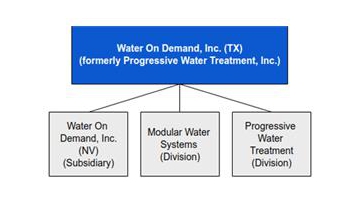
robust design and manufacturing offerings as well as maintenance and service offerings. In September 2023, PWT merged with Water on Demand,
Inc., a Nevada corporation (“WODI NV”), a pay-as-you-go water financing company which was also a former subsidiary
of OCLN. As a result of the merger, PWT changed its name to Water on Demand, Inc.
Water On Demand
The Company is developing an outsourced water
treatment business known as WOD, operated through its subsidiary, WODI. The WOD model aims to offer customers water self-sustainability
as a service – allowing them to pay on a per-gallon basis for managed wastewater treatment services rather than incurring significant
upfront capital equipment acquisition costs. This approach, generally known as DBOO, provides an alternative to conventional on-site
wastewater treatment solutions requiring substantial initial investments.
The Company is currently evaluating opportunities
for outsourced water treatment as a managed service, featuring pay-by-the-gallon pricing. Recently it announced agreements with Enviromaintenance
®, a water services company, and Klir®, a utility network software provider, to support a WOD pilot program in the mobile home
park sector. Under this model, WODI may initially build, maintain, and service the water treatment system it finances. As the program
expands, WODI intends to rely on regional water service providers to perform these functions.
WODI intends to delegate the building and operation
of WOD-Financed systems to regional water companies under performance contracts, thus creating a network of partners that can enable
rapid scaling and establish a competitive barrier to entry. At the time of this filing, WODI has made its first acquisition of personnel
resource, hiring veteran C-Level Executive, James Woloszyn as it Chief Operating Officer. The Company intends to scale as it expands
by acquiring additional staff or independent resources. WODI’s divisions, PWT and MWS together employee 24 people. All other members
of WODI’s Board of Directors and executive officers are currently the same as those of OriginClear, and WODI obtains administrative
support from OriginClear under a management services arrangement.
On March 26, 2024, the Company announced a Memorandum
of Understanding between MWS and Enviromaintenance to collaborate on the planned WOD pilot program in the Greater Central Texas Region.
On April 9, 2024, the Company announced that Klir, Inc. had been selected to support the WOD pilot, further bolstering the Company’s
efforts to provide decentralized water management solutions on a pay-per-gallon basis. Additional information regarding these developments
is available in the Company’s publicly filed materials.
Modular Water Systems
MWS provides a distinctive
line of prefabricated water transport and treatment systems. Daniel “Dan” Early P.E. leads the MWS division. On June 25,
2018, Mr. Early granted the Company a worldwide, exclusive, non-transferable license to the underlying MWS technology and know-how. In
connection with a subsequent ten-year renewal, effective May 2020, added the right to sublicense the technology and form manufacturing
joint ventures.
On June 9th,
2023, Daniel M Early executed the same licensing agreement with Water on Demand, Inc. and on June 12, 2023, mutually cancelled with OriginClear
the May 2020 license.
MWS, supported by PWT
and other fabricators, designs, manufactures, and delivers prefabricated water transport products, marketed under the EveraMOD™
brand; and wastewater treatment plant (“WWTP”) solutions, sold under the EveraSKID™ and EveraTREAT™ brands. These
systems serve a variety of end users – including schools, small communities, institutional facilities, real estate developments,
factories, and industrial parks – that must treat their own wastewater.
On August 12, 2022,
the Company announced the delivery and installation of its EveraBOX™ solution for the Beaver Falls Municipal Water Authority in
Pennsylvania. EveraBOX, like other MWS products, utilizes High-Density Polyethylene (HDPE) or Polypropylene (PP) – classified as
Structural Reinforced Thermoplastic Pipe (SRTP) materials. These materials are resistant to supply chain disruptions affecting metal
and fiberglass construction.
On January 10, 2024,
OCLN and Plastic Welding and Fabrication, Ltd. (“PWF”), based in Buda, Texas, announced a Memorandum of Understanding for
a strategic partnership between WODI and PWF. PWF currently serves as a key fabricator of durable, patent-based enclosures used by MWS.
This MOU is intended to enhance strategic relationships and enable MWS to build complete water systems at the same location where the
enclosures are manufactured, increasing efficiency and speed. The parties also signed a Letter of Intent (“LOI”) setting
forth a framework for a potential WODI acquisition of PWF. If executed, such an acquisition would establish WODI’s first in-house
manufacturing facility for MWS and is expected to be accretive. Discussions are at an early stage, and there can be no assurance that
a definitive agreement will be reached.
On March 26, 2024, OCLN announced an MOU between
MWS and Enviromaintenance of Georgetown, TX to collaborate on sales of standardized systems in the Greater Central Texas Region. Enviromaintenance,
a provider of on-site wastewater treatment and disposal systems, particularly for the Mobile Home Park (“MHP”) industry,
will recommend MWS’s fully integrated, modular wastewater treatment systems. These products are intended to offer MHP owners cost
effective, reliable, and efficient means of treating their wastewater. Additional information is available at: https://www.originclear.com/company-news/originclears-modular-water-systems-and-enviromaintenance-partner-for-water-on-demand-pilot-program.
Water on Demand NV
In 2023, OCLN launched WODI NV to offer private
businesses the opportunity to outsource and finance water treatment and purification services on a per-gallon basis while gaining independence
from traditional, centralized private water infrastructure. WODI NV’s value proposition is that by outsourcing water treatment
and purification, private businesses can gain the water security of a private, decentralized infrastructure while avoiding the capital,
technological and administrative burden required to design, finance, build, operate and maintain a water treatment solution. WODI NV
uses a Design-Build-Own-Operate model for its pay-as-you-go water solutions for private businesses. WODI NV’s products include
financing lines and pay-as-you-go financing for water solutions.
Combined Companies
As of February 15, 2025, Water on Demand, MWS
and WODI NV have been consolidated under the Company, with OCLN being the largest single shareholder of the combined companies. The combined
companies have complementary offerings that create meaningful synergies with the goal of allowing the Company to emerge as a leader in
offering end-to-end outsourced water treatment services.
Products of Combined Company
| Division |
|
Products |
|
Customers |
|
Geographic Region |
|
Financing
provided by WODI |
| MWS |
|
Municipal and Commercial Wastewater treatment systems
including pump stations, disinfection systems, headworks packages, sludge holding systems and modular equipment buildings. |
|
Municipalities, Industrial clients |
|
North America |
|
Not applicable |
| PWT |
|
High-purity water systems, Reverse Osmosis (RO) Systems,
Deionization Systems, Water Softening Solutions |
|
Municipalities, Power Generation and Semiconductor. |
|
North America |
|
Not applicable |
| WODI |
|
Pay-as-you-go Project Financing, Turnkey Water Treatment
Systems, SCADA and Data Acquisition Technology |
|
Businesses, Municipalities, Industrial Clients |
|
North America |
|
WODI provides financing options for water development
projects helping clients manage upfront costs. These include structured financing plans that spread costs over time. |
Industry Background
Traditional Water Treatment Practices
Public water utilities manage the collection,
treatment, and distribution of water for residential, medical, and industrial use, as well as wastewater treatment. Globally, water treatment
is centralized at large municipal facilities, benefiting from economies of scale. In the U.S, approximately 16,000 publicly owned wastewater
treatment systems exist, however the largest 10% of these publicly owned plants process over 80% of all wastewaters. Just 1.25% of facilities
handle more than half of the nation’s wastewater.
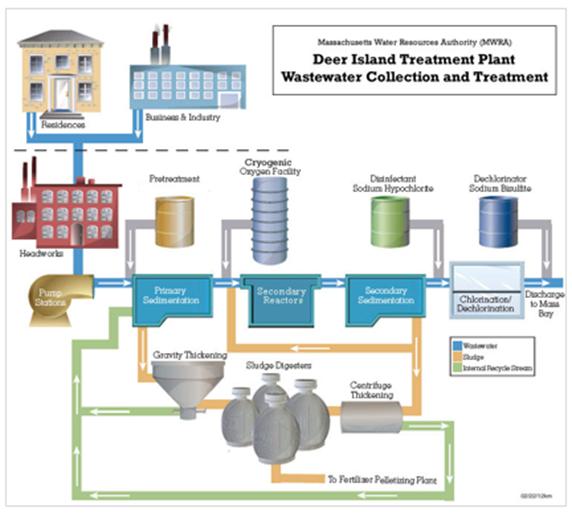
Wastewater treatment plants receive ss wastewater
from residential, commercial and ground runoff, through a network of storm drains and sewer lines. The wastewater is processed in three
phases:
In preliminary treatment, large debris, sand,
and mud settle in grit chamber, which is later disposed of in landfills for environmentally safe disposal. During primary treatment,
wastewater enters settling tanks, where up to 60% of solids are separated as a sludge-water mixture. While this removes a majority of
solid waste it does not remove toxic chemicals. In secondary treatment, oxygen is introduced through aeration, accelerating the growth
of microorganisms which break down organic matter and reduce harmful gases. These microorganisms settle to the bottom of the secondary
settling tanks. After secondary treatment, 80-90% of human waste, solids, and toxins have been removed from the wastewater.
During the final stage of secondary treatment,
water is disinfected – typically with chlorine, which eliminates over 99% of bacteria. Before discharging the treated water into
the environment, chlorine is neutralized to prevent ecological harm. As an alternative to chlorination and dichlorination, some facilities
remove bacteria using ultraviolet light, carbon absorption, distillation and reverse osmosis.
Sludge from primary and secondary treatment undergoes
further processing in digesters where it is mixed and heated t to reduce volume and eliminate disease-causing bacteria. The processed
solids are then heat-dried in pelletizing plants and converted into fertilizer for use in agriculture, forestry, and land reclamation.
This three-phase process is the global standard
for wastewater treatment. Given the industrial nature of the process and cost efficiencies achieved through economies of scale, treatment
facilities are constructed on a massive scale with large facilities capable of processing over 1 billion gallons of water per day and
construction costs billions of dollars.
Infrastructure – Maintenance and
Investment
Despite the historical construction of large
treatment facilities, U.S. investment in water infrastructure has lagged behind demand. Of the approximately 16,000 wastewater treatment
plants (WWTPs) in the United States, 81% are operating at or near design capacity while 15% have exceeded their limits, according to
the American Society of Civil Engineers. While significant capital investments have addressed sanitary sewer overflows, expansion efforts
have slowed in recent years. Many facilities are aging and require substantial maintenance and renovation.
The majority of WWTPs are designed with an average
lifespan of 40 to 50 years, so systems that were constructed in the 1970s, around the passing of the Clean Water Act of 1972, are reaching
the end of their service lives. Nationwide, drinking water and wastewater pipes in the ground are on average 45 years old, while some
systems have pipes more than a century old. The typical expected lifespan for wastewater pipes is 50 to 100 years. As collection systems
age and decline in condition, groundwater and stormwater enter the networks through cracks and joints, leading to overflows. Aging systems
require increased capital investments which, at the municipal level, increased nationally from $20 billion in 1993 to $55 billion in
2017. In 2019, the American Society of Civil Engineers estimated an $81 billion deficit in required water infrastructure investment,
which is expected to grow to $434 billion by 2029 if left unaddressed.
In November 2023, President Biden signed the
Infrastructure Investment and Jobs Act, also known as the Bipartisan Infrastructure Law, which allocated more than $50 billion to improving
America’s drinking water, wastewater and stormwater infrastructure
Regulatory requirements for utilities continue
to increase due to rising enforcement of long-standing requirements and the creation of new requirements. In February 2021, the EPA announced
two actions to address levels of polyfluoroalkyl substances (PFAS), human-made chemicals used through industry and consumer products,
in drinking water. In December 2020, the EPA finalized its revised Lead and Copper rule, compliance with which the American Society of
Civil Engineers estimates will cost between $130 million and $286 million.
Privatization and Decentralization
As water utilities struggle to manage the increased
costs of maintenance and operations with decreased federal support, few observers believe that significant ongoing rate increases are
a viable option. According to McKinsey & Company, even before the COVID-19 pandemic, 20% of U.S. households in 2019 were paying more
than 4.5 % of their household income on water bills—a level that is considered unaffordable. This figure rose to 24% in the first
seven months of 2021. In 2020, 60% of utilities surveyed said they experienced or anticipated negative financial impacts during the pandemic
due to revenue loss, water-shutoff moratorium policies and forgiveness of nonpayment of bills. Despite these challenges, utilities did
not expect to implement rate increases until 2022.
The Drinking Water and Wastewater Infrastructure
Act of 2021, which included $55 billion in funding, demonstrated some awareness by the federal government of the challenges to funding
and maintaining water infrastructure, however, even large increases in federal funding cannot fully cover the needed investment. In November
2023, the Environmental Protection Agency (EPA) proposed amendments to the Lead and Copper Rule (LCR), which was established in 1991
and intended to regulate the control and monitoring of lead in drinking water. The proposed new rule requires water systems to replace
all lead pipelines within 10 years (and faster when feasible), lowers the levels at which agencies must take additional steps to eliminate
lead in drinking water, and contains provisions intended to improve accuracy in identifying where higher levels of lead in drinking water
are within communities. Even a five-fold increase in federal funding would leave a 22% shortfall in the capital necessary to serve the
growing need for water infrastructure. In response, investor and private-sector interest in water and wastewater services has increased
and M&A transactions in the water sector have increased annually from 2012 to 2017.
Given increased utility prices and increased concerns
surrounding the maintenance and operations of WWTPs and utilities, businesses are increasingly choosing to treat and purify their own
water, in a trend known as Decentralized Water. Decentralized wastewater treatment consists of a variety of approaches for collection,
treatment and dispersal/reuse of wastewater for individual dwellings, industrial or institutional facilities, clusters of homes or businesses,
and entire communities. Decentralized water systems offer several advantages including the ability to tailor facilities to meet the cost
and quality requirements of specific uses (i.e., medical vs. residential vs. industrial), flexibility in adapting to demographic shifts,
reduced operating and maintenance costs, avoiding large capital costs, relative speed and ease of installation and ability to serve rural,
suburban and urban settings.
Water Usage
While traditional water supply and treatment
face particular challenges related to aging infrastructure, significant capital costs and shortfalls in funding, global water supply
challenges are putting stress on the supply side of the water equation. Supply side risks, including climate change, migration, industrial
reshoring, government regulation and industrial centralization, increase the need to rethink traditional water systems and supplement
established programs.
Climate Change. Freshwater scarcity occurs
when the demand for fresh water in an area exceeds the total available amount. Record-breaking heat waves and droughts have increasingly
brought freshwater scarcity to the forefront of public policy and the national consciousness as a changing climate changes precipitation
patterns across the United States. The combination of diminishing precipitation and rising demand has caused U.S. aquifer levels to decline
more quickly than can naturally be replenished. As weather patterns become increasingly difficult to predict and precipitation becomes
increasingly concentrated and more difficult to capture for productive use, the global supply of natural fresh water grows increasingly
constrained.
Migration. Prior to the COVID-19 pandemic,
domestic migration trends illustrated increasing populations in urban areas, however, following the pandemic these trends reversed. Regardless
of whether migration trends away from urban centers continue, social, economic and environmental factors make it increasingly difficult
to predict demographic trends and shifts in populations. Large WWTPs require decades for planning, financing and construction and decreasing
confidence in planners’ ability to predict domestic migration trends counts in favor of decentralized water systems, which require
significantly smaller capital investments and can be brought into use in a fraction of the time.
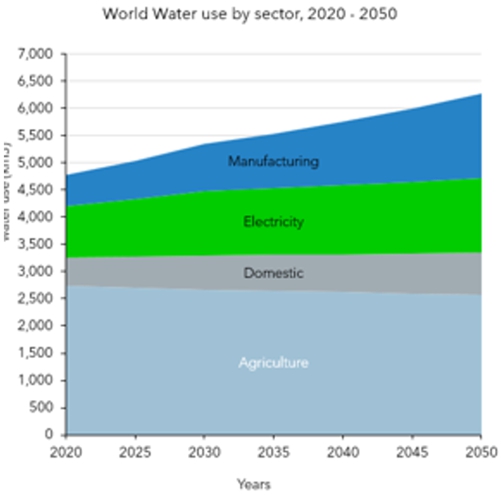
Reshoring of Manufacturing. While agricultural
use continues to constitute the majority of water consumption, demand in the manufacturing sector has seen the largest increases in demand
with increasing demand projected for the future. This pattern becomes particularly important in the context of increasing re-shoring
as supply chains are reconfigured in response to the COVID-19 pandemic, the war in Ukraine, and shifting global economies. American political
ambitions have also reinforced and promoted an increase in manufacturing as two successive presidents from opposing political parties
have prioritized the development and increase of domestic manufacturing. As the manufacturing industry continues to use water resources
more intensively and as domestic manufacturing continues to grow, these forces combine to increase demands on U.S. water supply.
Regulatory and Public Funding Risk. As
freshwater resources come under increasing stress, policymakers are increasingly challenging established water policies. The St. Louis
Federal Reserve has expressed growing concern for the allocation of water resources and has called for “more optimal mechanisms
for allocating water.” In November 2021, the U.S. Supreme Court ruled on claims between the State of Tennessee and the State of
Mississippi regarding the apportionment of interstate groundwater. In the western United States, growing concerns regarding decreased
supply and growing demand for water in the Colorado Basin have produced tensions and limited collaboration between seven western states.
Disputes between states, municipalities and cities over water use and development are growing increasingly common and are yet another
factor in the growing number of supply risks for water.
Industrial Centralization Risk. In an
increasingly security conscious world, the centralization of water treatment substantially increases the risks of a single failure whether
caused by natural disaster, financial factors or other security threats. Centralizing and concentrating water infrastructure creates
a system with millions of individuals and businesses downstream from single failure points. Decentralizing water supply and treatment
disperses risk and provides individuals and industry greater control over a critical resource.
Water on Demand
Through WOD, the Company provides financing for
water development projects. The Water On Demand initiative enables businesses and communities to finance water projects by paying only
for the water they use without the high cost of upfront capital expenditures. End-users simply sign a long-term service contract, with
regional water companies providing expert support. Innovative OriginClear modular systems are licensed to builders to standardize the
fleet, leaving zero “new technology” risk as only proven technologies, systems, and methods are implemented.
According to a 2021 study by scientists at Utrecht
University and United Nations University about half of global wastewater is released untreated into rivers, streams and aquifers. In
addition, only 11% of the wastewater produced globally is currently being reused. Increasing this percentage is essential, because by
2025, two-thirds of the world’s population may face water shortages, according to the World Wildlife Fund. Compounding the problem
in North America’s supply system, an estimated 20 to 50 percent of water is lost to leaks – a major issue as utilities contend
with how to sustain a growing population in an era of water scarcity, according to a study published by Stanford University. Additionally,
about half of the river and stream miles and lake acres across the United States are too polluted for swimming, fishing or drinking,
according to the Environmental Integrity Project. Awareness of the problem is growing in a 2017 Gallup poll, 63% of Americans worried
a great deal about pollution of drinking water, and 57% about pollution of rivers, lakes and reservoirs. In short, water management is
a major issue, but awareness of the problem is strong, opening the door to a solution.
It is becoming more difficult for businesses
to rely on giant, centralized water utilities to meet the challenge and more and more business users are doing their own water treatment
and recycling. Whether by choice or necessity, those businesses that invest in onsite water systems gain a tangible asset on their business
and real estate and can enjoy better water quality at a lower cost, especially if treated water is recycled.
The Company helps self-reliant businesses build
“decentralized water wealth” for themselves while also helping their communities. Environmental, social and governance (ESG)
investing guidelines, which drive about a quarter of all professionally managed assets around the world, specifically include the
key factor of how well corporations manage water.
As civil infrastructure ages and fails and as
the costs for new and replacement infrastructure increase year over year, we believe engineers and end-users will search for new ways
and methods of deploying water and wastewater systems that are less expensive to deliver and much less expensive to own and operate,
with the mission of substantially increasing the replacement intervals currently experienced by conventional construction materials and
product delivery models.
The Company offers a unique product line of prefabricated
water transport and treatment systems. WODI designs, manufactures and delivers (i) prefabricated water transport (pump and lift stations)
under the EveraMOD brand, and (ii) WWTP products under the EveraSKID and EveraTREAT brands to customers and end-users that are required
to clean their own wastewater, such as schools, small communities, institutional facilities, real estate developments, factories, and
industrial parks.
Modular Water Systems
The Company provides a broad selection of standardized
and custom engineered wastewater treatment products, packaged lift stations, and ancillary wastewater infrastructure solutions for agricultural,
commercial, industrial, and municipal customers. Wastewater collection, treatment, and disposal systems reflect a substantial investment
in both time and money and given the importance of protecting the environment and our precious water resources. The Company strives to
deliver the industry’s most durable, sustainable, and affordable equipment packages. Our utilization of heavy plastic manufacturing
combined with the integration of emerging treatment technologies creates a robust combination of capabilities that will significantly
improve system performance, substantially extend continuous duty service life, and dramatically reduce operating costs.
Packaged wastewater treatment systems have been
around for more than 75 years. While typically out of sight and mind, they are a necessary component to many aspects of human life and
provide an important service by protecting our health and the local environment. Unfortunately, decentralized wastewater treatment technologies
have not evolved significantly over the past 50 years, especially when compared to things like personal computers, smart phones, solar
panels, and the electric car. Older clunky treatment technologies that are expensive to construct and difficult to operate have been
the norm for way too long. One of our goals is to simplify the delivery of packaged wastewater treatment systems. Buying and installing
a treatment system must be easy and inexpensive.
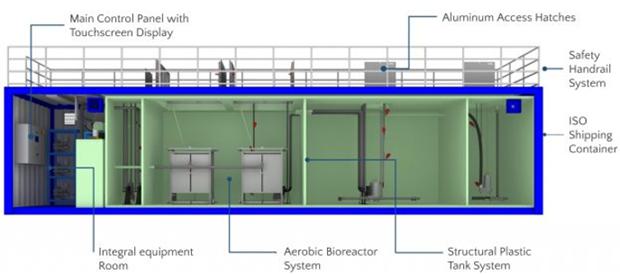
The Company’s EveraSKID is a modular mobile
packaged wastewater treatment system designed to treat domestic, municipal, and light industrial wastewaters. EveraSKID is factory assembled
so that it ships as a finished product that is ready for immediate use once installed at its final site destination. In other words,
it’s a “plug and play” system that commissions in less than one day. EveraSKID utilizes the lasted advancements in
wastewater technology including fixed film biological treatment, membrane bioreactor filtration, and real-time remote monitoring and
control systems. With two pipe connection points, one power connection, and an internet connection, we believe EveraSKID is the simplest
to install treatment system in the market today.
With vessel service life lasting 75+ years—typically
three times longer than conventional systems—SRTP materials represent a major advancement in the delivery and sustainability of
industrial water and wastewater systems. Our water and wastewater treatment solutions will reduce both capital and operating expenses
dramatically.
Civil Engineers and Utility Owners are faced
with the daunting task of trying to service an ever-growing threat to the environment resulting from deteriorated and failing utility
systems. Implementing sustainability requirements into water and wastewater processing solutions has become increasingly important. The
implementation of SRTP tankage offers the first real significant material advancement in the last 50 years that will overcome these serious
challenges to sustainability.
Because Modular Water Systems use SRTP materials
and high-tolerance factory assembly under controlled conditions, our units will reduce both installation time and costs, as well as total
lifetime cost of product ownership.
The Company’s product line of wastewater
management systems is a preferred choice for decentralized wastewater treatment in residential, commercial, agricultural and many industrial
and municipal settings. Treatment capacities in our standard units range from the modular 2,000-10,000 gallons per day (GPD) and 10,000-25,000
GPD standard compacts and 25,000 GPD up to 250,000 GPD in larger custom-built units. Some applications enable standard units used in
tandem for average daily flows of up to 50,000 GPD.
Competitive Strengths
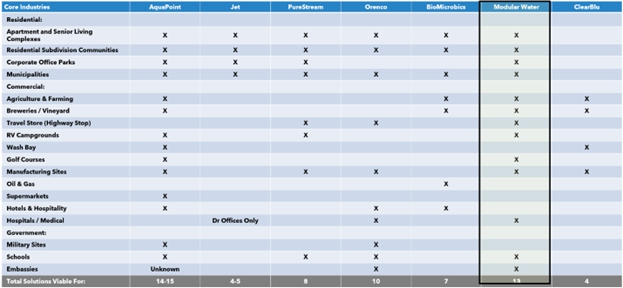
Marketing. The Company’s competitors
in the mid-market decentralized water business tend to focus on sub-segments of the industry but fail to position their products as a
practical solution in a variety of contexts. In contrast, the Company has positioned itself as a viable solution in a variety of residential,
commercial and governmental contexts.
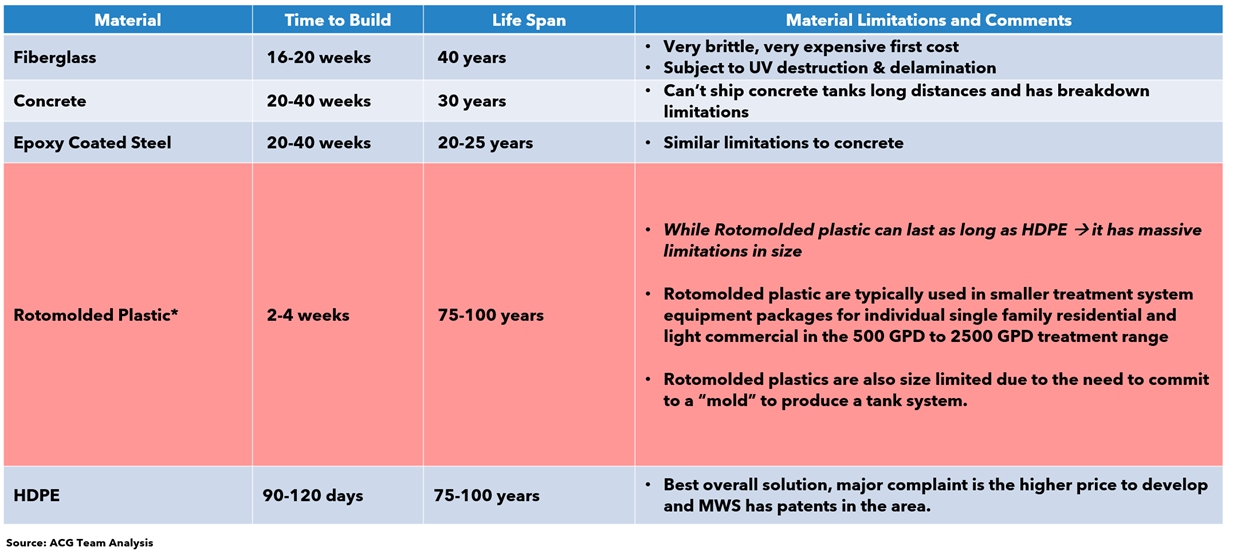
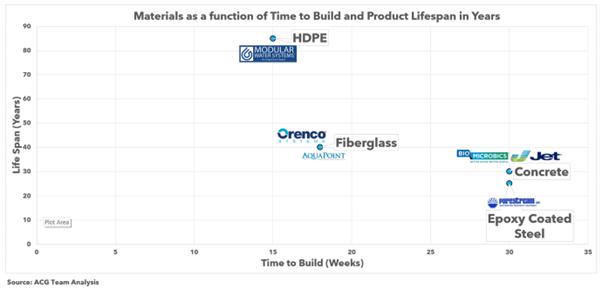
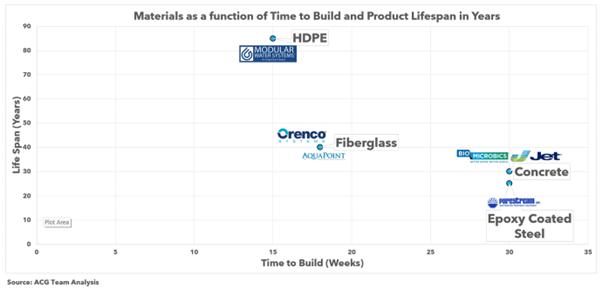
Materials. The Company utilizes high density
polyethylene (“HDPE”) in constructing its water treatment products in contrast to competitors which use fiberglass,
concrete, epoxy coated steel and rotomolded plastic. HDPE presents significant advantages related to reduced construction times, increased
life span and transportability. Fiberglass construction is fragile, comes with high initial costs and is subject to UV destruction. Concrete
and epoxy coated steel are durable but are extremely limited by shipping and transport issues. Rotomolded plastic offers faster construction
times but is extremely limited in size. Typically, HDPE’s downfall is its higher development cost, however, the Company’s
proprietary processes address this issue. Among its competitors, only the Company has a unique, patented materials solution which is
superior to its competitors.
Patents. The Company’s chief engineer,
Dan Early, holds critical patents, which are exclusively licensed to the Company, which allow the Company to utilize HDPE in its construction,
and offer innovative wastewater treatment solutions.
The Company’s Competition
Competitive Analysis
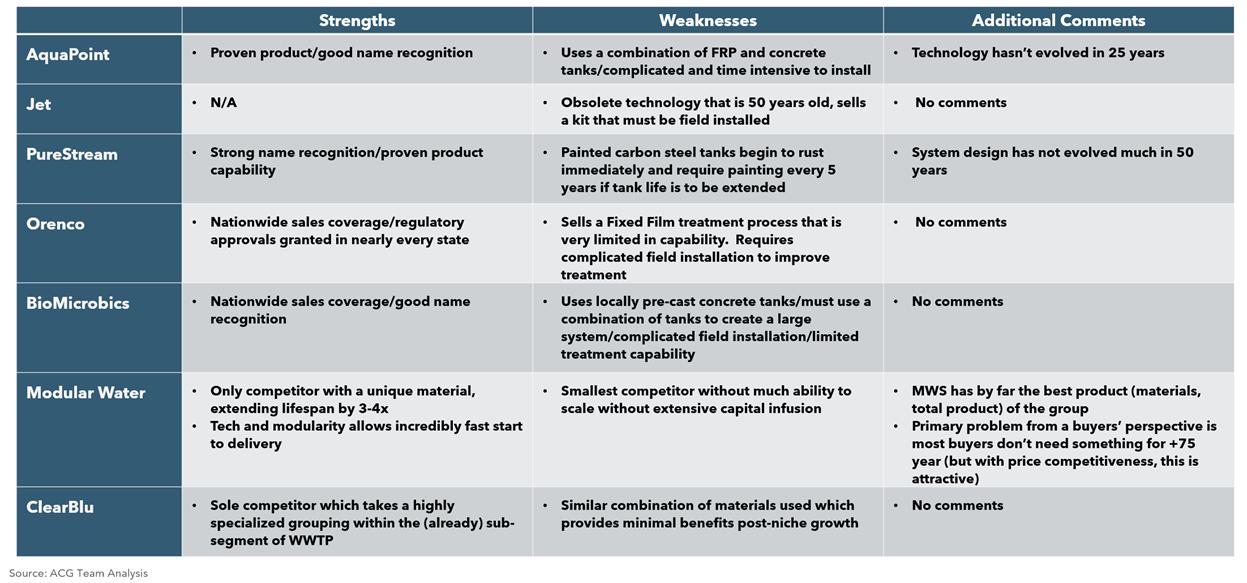
The Company’s competitors fail to differentiate
in terms of technology and marketing, subjecting them to macro-industry opportunities and threats. In contrast, the Company stands out
in terms of technology, product, installation and marketing.
Patents and Intellectual
Property
On June 25, 2018, Dan
Early granted the Company a worldwide, exclusive, non-transferable license to intellectual property, which includes five issued U.S.
patents, as well as design software, CAD files, marketing materials, and design and specification documents (collectively referred to
as “Early IP”).
On May 20, 2020, the
license was renewed for an additional ten years, with the possibility of three-year extensions. The renewal also granted the Company
the rights to sublicense the Early IP, and, with approval, to establish ISO-compliant manufacturing joint ventures.
As part of the sale
of MWS assets to WODI on April 14, 2023, the license to the Early IP was included. On 9 June 2023, Early signed a new, ten-year license
agreement with WODI which assigned these rights to WODI and updated Early’s terms of compensation. On June 12, 2023, the May 20,
2020 license with OriginClear was cancelled by mutual agreement.
The Early IP consists
of combined protection on the materials and configurations of complete packaged water treatment systems, built into containers. The patents
consist of the following:
| # |
|
Description |
|
Patent
No. |
|
Date
Patent
Issued |
|
Expiration
Date |
| 1 |
|
Wastewater System & Method |
|
US 8,372,274 B2
Applications: WIPO, Mexico |
|
02/12/13 |
|
07/16/31 |
| 2 |
|
Steel Reinforced HDPE Rainwater Harvesting |
|
US 8,561,633 B2 |
|
10/22/13 |
|
05/16/32 |
| 3 |
|
Wastewater Treatment System CIP |
|
US 8,871,089 B2 |
|
10/28/14 |
|
05/07/32 |
| 4 |
|
Scum Removal System for Liquids |
|
US 9,205,353 B2 |
|
12/08/15 |
|
02/19/34 |
| 5 |
|
Portable, Steel Reinforced HDPE Pump Station CIP |
|
US 9,217,244 B2 |
|
12/22/15 |
|
10/20/31 |
On May 10, 2021, OCLN
announced the filing of a patent application titled “System And Method For Water Treatment Incentive”, which utilizes blockchain
technology and non-fungible tokens (NFT) to streamline the distribution of payments for outsourced water treatment and purification services,
billed on a pay-per-gallon basis ahead of inflation.
As demand grows for
localized, point-of-use or point-of-discharge water treatment solutions, the MWS licensed IP family has become the foundation for a portable,
integrated, transportable, plug-and-play system. Unlike other packaged solutions, these systems can be manufactured in series, having
a longer lifespan and are more environmentally friendly.
The common feature of
this IP family is the use of Structural Reinforced ThermoPlastic, for the containers that offer several advantages:
| |
● |
Durability: An estimated
life cycle of 75 to 100-year life years, compared to a few decades for metal and r 40 to 50 years for concrete. |
| |
|
|
| |
● |
Ease of Manufacture:
The manufacturing process for these vessels can be automated. |
| |
|
|
| |
● |
Reliability: The
materials are recyclable and can be made out of biomaterials. |
Patent No. 8,372,274
specifically relates to the use of vessels or containers made from this material, combined with a configuration of functional modules
or processes for general water treatment.
Although Patent Nos.
8,561,633 and 8,871,089 have expired, the Company believes they may be reinstated and in any case they are not considered core IP:
| |
● |
Patent No. 8,561,633 is
a stormwater filtration patent not directly related to the MWS business model, |
| |
● |
while Patent No. 8,871,089
is a Continuation-in-Part (CIP) of the original Patent No. 8,372,274. |
The original patent,
along with Patent No. 9,217,244, forms the basis of the current MWS business, so the status of the CIP is not considered material.
Government Regulation
We are subject to various laws, regulations,
and permitting requirements of federal, state, and local authorities, related to health and safety, anti-corruption and export controls.
The foregoing may include the U.S. Foreign Corrupt Practices Act of 1977, the U.S. Export Administration Regulations, Money Laundering
Control Act of 1986 and any other equivalent or comparable laws of other countries. We believe that we are in material compliance with
all such laws, regulations, and permitting requirements.
Employees and Human Capital Resources
As of the filing date, the Company, together
with its operating companies, had 24 full-time employees. The Company has an arrangement with OCLN whereby OCLN provides operational
and administrative services for the Company.
Facilities
The Company’s corporate headquarters are
located at 13575 58th Street North, Suite 200, Clearwater, Florida 33760. The Company leases a production facility at 5225
W Houston Sherman, Texas, under a non-cancelable operating lease classified in accordance with ASC 842, Leases. The lease commenced on
July 1, 2024, with a 61-month term. Under a Triple Net (NNN) arrangement, the Company is responsible for property taxes, insurance and
maintenance costs.
Legal Proceedings
The Company is not involved in any litigation,
and its management is not aware of any pending or threatened legal actions relating to its intellectual property, conduct of business
activities or otherwise. From time to time, we may be involved in pending or threatened claims relating to contract disputes, employment,
intellectual property and other matters that arise in the normal course of our business, which we do not deem to be material to the business.
Patents
WODI’s chief engineer, Dan Early, holds
critical patents, which are exclusively licensed to WODI, which allow the Company to utilize HDPE in its construction, and offer innovative
wastewater treatment solutions.
Employees
As of the date of this filing, the Company had
24 employees. The Company has an arrangement with OCLN whereby OCLN provides operational and administrative services for the Company.
The Offering
| Securities offered |
|
Units (1 share
of Common Stock and 2 Warrants) Maximum of 10,000,000 Units at $2.50 per share(1). |
| |
|
|
| Offering Amount |
|
Total targeted proceeds is $75,000,000 from the sale of 10,000,000 Units at $2.50 per Unit and the
exercise of 20,000,000 Units at $2.50 per share. |
| |
|
|
| Warrants |
|
200% warrant coverage;
3-year term; $2.50 exercise price, eligible for cashless option |
| |
|
|
| Common Shares outstanding prior to this offering |
|
14,144,835 shares(2) |
| |
|
|
| Number of Common Shares issued previously in this offering |
|
25,112(3) |
| |
|
|
| Number of Common Shares following this offering Presuming all shares sold and all warrants issued. |
|
$44,144,835 |
| |
|
|
| Use of proceeds |
|
The net proceeds of a fully subscribed offering, after estimated total offering expenses and commissions
will be used for general corporate SG&A and business purposes including professional services fees, fees to OCLN for supporting
administrative functions, IT infrastructure, acquisitions, hiring of personnel, sales and marketing expenses and general working
capital, acquisitions, and to provide debt financing to one or more project specific subsidiaries of the Company. The details
of our plans are set forth in “Use of Proceeds.” |
| (1) | Estimated pre-offering valuation of
$66,000,000 based on the Fairness Opinion dated October 24, 2023, and 2025 anticipated revenue.
The Company may amend or withdraw this Offering in the future to reprice the Securities of
Common Stock at any time as it deems necessary or appropriate. |
| (2) | Non-diluted. Does not include the rights
to receive up to 10,131,471common shares related to certain restricted stock grant agreements. |
| (3) | Prior to this amendment, the Company
issued 25,112 common shares. This amendment amends the securities being offered from common
shares to Units (1 Common Share and 2 Warrants). |
Selected Risks Associated with Our Business
Our business is subject to a number of risks
and uncertainties, including those highlighted in the section titled “Risk Factors” immediately following this summary. These
risks include, but are not limited to, the following:
| ● | We
are an early-stage company and have not yet generated any profits or significant revenues. |
| ● | We
may not be able to continue to operate the business if we are not successful in securing
significant additional fundraising in a short timeframe and, as a result, we may not be able
to continue as a going concern. |
| ● | The
Company relies on rolling closes of equity infusions for its financings which may pose a
risk to having sufficient capital on hand at any point in time. |
| ● | The
Company has a limited operating history by which performance can be gauged. |
| ● | The
Company is subject to potential fluctuations in operating results. |
| ● | The
Company’s future operating results are difficult to predict and may be affected by
a number of factors, many of which are outside of the Company’s control. |
| ● | Unanticipated
obstacles may hinder the execution of the Company’s business plan. |
| ● | We
have limited market acceptance of our services. |
| ● | We
cannot assure you that we will effectively manage our growth. |
| ● | Our
costs may grow more quickly than our revenues, harming our business and profitability. |
| ● | We
expect to raise additional capital through equity and/or debt offerings and to provide our
employees with equity incentives. Therefore, your ownership interest in the Company is likely
to continue to be diluted and subordinated. |
| ● | The
loss of one or more of our key personnel, or our failure to attract and retain other highly
qualified personnel in the future, could harm our business. |
| ● | If
we are unable to protect our intellectual property, the value of our brand and other intangible
assets may be diminished and our business may be adversely affected. |
| ● | Our
financial results will fluctuate in the future, which makes them difficult to predict. |
| ● | We
may face additional competition. |
| ● | In
connection with the audit of our financial statements for the period from inception to August
31, 2022, our independent auditor identified material weaknesses in our internal control
over financial reporting related to certain corporate finance and accounting oversight, which
were primarily the result of the lack of sufficient and competent accounting and finance
resources. Our failure to implement and maintain effective internal control over financial
reporting may in the future result in material misstatements in our financial statements,
which has and could in the future require us to restate financial statements, cause investors
to lose confidence in our reported financial information and could have an adverse effect
on our ability to fundraise. |
| ● | We
realized a gross and net loss for each period since our inception to date, and there can
be no assurances that the Company will become profitable in the future. |
| ● | The
Company is controlled by its OriginClear, Inc. (OCLN), which also provides all funding, sales
and administrative resources. |
| ● | Our
results of operations may be negatively impacted by the coronavirus outbreak. |
| ● | Actual
or threatened epidemics, pandemics, outbreaks, or other public health crises may adversely
affect our business, including pandemics similar to the novel COVID-19 outbreak. |
| ● | The
offering price for the Securities has been determined by the Company rather than any of the
investors. |
| ● | An
investment in the Securities is not a diversified investment. |
| ● | Subsequent
offerings or potential recapitalizations of the Company’s capital stock below the offering
price or on terms better than the Securities may adversely affect the market price of the
Company’s capital stock and may make it difficult for the Company to continue to sell
Units or other equity or debt securities. |
| ● | The
Company may apply the proceeds of this offering to uses for which you may disagree. |
| ● | Investors
in this offering may not be entitled to a jury trial with respect to claims arising under
the subscription agreement, which could result in less favorable outcomes to the plaintiff(s)
in any action under the agreement. |
| ● | There
is no current market for any of our shares of stock. |
RISK FACTORS
The Commission requires the Company to identify
risks that are specific to its business and its financial condition. The Company is still subject to all the same risks that all companies
in its business, and all companies in the economy, are exposed to. These include risks relating to economic downturns, political and
economic events and technological developments (such as hacking and the ability to prevent hacking). Additionally, early-stage companies
are inherently riskier than more developed companies. You should consider general risks as well as specific risks when deciding whether
to invest.
This investment has a high
degree of risk. Before you invest you should carefully consider the risks and uncertainties described below and the other information
in this prospectus. If any of the following risks actually occur, our business, operating results and financial condition could be harmed
and the value of our stock could go down. This means you could lose all or a part of your investment.
We have a limited operating history upon
which you can evaluate our performance, and accordingly, our prospects must be considered in light of the risks that any new company
encounters.
The Company is still in an early phase and we
are just beginning to implement our business plan. There can be no assurance that we will ever operate profitably. The likelihood of
our success should be considered in light of the problems, expenses, difficulties, complications and delays usually encountered by early-stage
companies. The Company may not be successful in attaining the objectives necessary for it to overcome these risks and uncertainties.
The amount of capital the Company is attempting
to raise in this Offering may not be enough to sustain the Company’s current business plan.
In order to achieve the Company’s near
and long-term goals, the Company may need to procure funds in addition to the amount raised in the Offering. There is no guarantee the
Company will be able to raise such funds on acceptable terms or at all. If we are not able to raise sufficient capital in the future,
we may not be able to execute our business plan, our continued operations will be in jeopardy and we may be forced to cease operations
and sell or otherwise transfer all or substantially all of our remaining assets, which could cause an Investor to lose all or a portion
of their investment.
We may face potential difficulties in obtaining
capital.
We may have difficulty raising needed capital
in the future as a result of, among other factors, our lack of revenues from sales, as well as the inherent business risks associated
with our Company and present and future market conditions. Future sources of revenue may not be sufficient to meet our future capital
requirements. We will require additional funds to execute our business strategy and conduct our operations. If adequate funds are unavailable,
we may be required to delay, reduce the scope of or eliminate one or more of our research, development or commercialization programs,
product launches or marketing efforts, any of which may materially harm our business, financial condition and results of operations.
We may implement new lines of business
or offer new products and services within existing lines of business.
As an early-stage company, we may implement new
lines of business at any time. There are substantial risks and uncertainties associated with these efforts, particularly in instances
where the markets are not fully developed. In developing and marketing new lines of business and/or new products and services, we may
invest significant time and resources. Initial timetables for the introduction and development of new lines of business and/or new products
or services may not be achieved, and price and profitability targets may not prove feasible. We may not be successful in introducing
new products and services in response to industry trends or developments in technology, or those new products may not achieve market
acceptance. As a result, we could lose business, be forced to price products and services on less advantageous terms to retain or attract
clients or be subject to cost increases. As a result, our business, financial condition or results of operations may be adversely affected.
In order to satisfy the Company’s
obligations as a public company, we will need to hire qualified accounting and financial personnel with appropriate public company experience.
As a public company, we will need to establish
and maintain effective disclosure and financial controls and make changes in its corporate governance practices. We may need to hire
additional accounting and financial personnel with appropriate public company experience and technical accounting knowledge, and it may
be difficult to recruit and retain such personnel. Even if the Company is able to hire appropriate personnel, its existing operating
expenses and operations will be impacted by the direct costs of their employment and the indirect consequences related to the diversion
of management resources from research and development efforts.
The commercial and credit environment may
adversely affect the Company’s access to capital.
We will need to continue to raise capital in
order to execute our business plan. the Company’s ability to issue debt or enter into other financing arrangements on acceptable
terms could be adversely affected if there is a material decline in the demand for its products or in the solvency of its customers or
suppliers or if there are other significantly unfavorable changes in economic conditions. Volatility in the world financial markets could
increase borrowing costs or affect the Company’s ability to access the capital markets. Capital raised by us may have a dilutive
impact on existing stockholders and if the Company is unable to raise additional capital on favorable terms, or at all, we may be unable
to maintain its research and development activities or may be unable to grow its business, which could impact the Company’s operating
results and gross margin adversely.
Wage increases and pressure in certain
geographies may prevent us from sustaining the Company’s competitive advantage and may reduce its profit margin.
Measures are being taken in the United States
and globally to increase minimum wages, and there is a shortage of skilled labor in certain locations leading to increased wage pressure.
Similarly, with an increased global focus on environmental, social and corporate-governance concerns and sustainability, input costs
have been steadily rising. Accordingly, we may need to increase the levels of labor compensation more rapidly than in the past to remain
competitive in attracting and retaining the quality and amount of labor that its business requires. To the extent that the Company is
not able to control or share wage increases, wage increases may reduce its margins and cash flows, which could adversely affect its business.
The loss of one or more key members of
the Company’s management team or personnel, or its failure to attract, integrate and retain additional personnel in the future,
could harm its business and negatively affect its ability to successfully grow its business.
The Company is highly dependent upon the continued
service and performance of the key members of the Company’s management team and other personnel. The loss of any of these individuals,
each of whom is “at will” and may terminate his or her employment relationship with us at any time, could disrupt its operations
and significantly delay or prevent the achievement of its business objectives. We believe that its future success will also depend in
part on its continued ability to identify, hire, train and motivate qualified personnel. High demand exists for senior management and
other key personnel (including technical, engineering, product, finance and sales personnel) in the infrastructure and manufacturing
industry. A possible shortage of qualified individuals in the regions where we operate might require us to pay increased compensation
to attract and retain key employees, thereby increasing its costs. In addition, we face intense competition for qualified individuals
from numerous companies, many of whom have substantially greater financial and other resources and name recognition than us. We may be
unable to attract and retain suitably qualified individuals who are capable of meeting its growing operational, managerial and other
requirements, or we may be required to pay increased compensation in order to do so. For example, the Company’s failure to attract
and retain shop floor employees may inhibit its ability to fulfill production orders for its customers. the Company’s failure to
attract, hire, integrate and retain qualified personnel could impair its ability to achieve its business objectives.
All of the Company’s employees (which includes
full time and part time employees and consultants) are at-will employees, meaning that they may terminate their employment relationship
with us at any time, and their knowledge of its business and industry would be extremely difficult to replace. We generally enter into
non-competition agreements with its employees and certain consultants. These agreements prohibit the Company’s employees and applicable
consultants from competing directly with us or working for its competitors or customers while they work for us, and in some cases, for
a limited period after they cease working for us. We may be unable to enforce these agreements under the laws of the jurisdictions in
which its employees and applicable consultants work and it may be difficult for us to restrict the Company’s competitors from benefiting
from the expertise that the Company’s former employees or consultants developed while working for us. If we cannot demonstrate
that its legally protectable interests will be harmed, we may be unable to prevent its competitors from benefiting from the expertise
of its former employees or consultants and its ability to remain competitive may be diminished.
Risks Related to Government Regulations
Our business is subject to various laws
and regulations and changes in such laws and regulations, or failure to comply with existing or future laws and regulations, could adversely
affect our business.
Our business is subject to numerous and frequently
changing federal, state and local laws and regulations. We routinely incur significant costs in complying with these regulations. The
complexity of the regulatory environment in which we operate and the related cost of compliance are increasing due to additional legal
and regulatory requirements, our expanding operation and increased enforcement efforts. Further, uncertainties exist regarding the future
application of certain of these legal requirements to our business. New or existing laws, regulations and policies, liabilities arising
thereunder and the related interpretations and enforcement practices, particularly those dealing with environmental protection and compliance,
taxation, zoning and land use, workplace safety, public health, recurring debit and credit card charges, information security, consumer
protection, and privacy and labor and employment, among others, or changes in existing laws, regulations, policies and the related interpretations
and enforcement practices, particularly those governing the sale of products and consumer protection, may result in significant added
expenses or may require extensive system and operating changes that may be difficult to implement and/or could materially increase our
cost of doing business. For example, we have to comply with recent new laws in some of the states in which we operate regarding recycling,
waste, minimum wages, and sick time. In addition, we are subject to environmental laws pursuant to which we could be strictly liable
for any contamination at our current or former locations, or at third-party waste disposal sites, regardless of our knowledge of or responsibility
for such contamination.
Our operations are subject to certain environmental
laws and regulations.
Our current and former operations are governed
by federal, state and local laws and regulations, including environmental regulations. Certain business activities involve the handling,
storage, transportation, import/export, recycling, or disposing of various new and used products and generate solid and hazardous wastes.
These business activities are subject to stringent federal, regional, state and local laws, by-laws and regulations governing
the storage and disposal of these products and wastes, the release of materials into the environment or otherwise relating to environmental
protection. These laws and regulations may impose numerous obligations upon our locations’ operations, including the acquisition
of permits to conduct regulated activities, the imposition of restrictions on where or how to store and how to handle new products and
to manage or dispose of used products and wastes, the incurrence of capital expenditures to limit or prevent releases of such material,
the imposition of substantial liabilities for pollution resulting from our locations’ operations, and costs associated with workers’
compensation and similar health claims from employees.
Environmental laws and regulations have generally
imposed further restrictions on our operations over time, which may result in significant additional costs to our business. Failure to
comply with these laws, regulations, and permits may result in the assessment of administrative, civil, and criminal penalties, the imposition
of remedial and corrective action obligations, and the issuance of injunctions limiting or preventing operation of our locations. Any
adverse environmental impact on our locations, including, without limitation, the imposition of a penalty or injunction, or increased
claims from employees, could materially and adversely affect our business and the results of our operations.
Environmental laws also impose liability for
damages from and the costs of investigating and cleaning up sites of spills, disposals or other releases of hazardous materials. Such
liability may be imposed, jointly and severally, on the current or former owners or operators of properties or parties that sent wastes
to third-party disposal facilities, in each case without regard to fault or whether such persons knew of or caused the release. Moreover,
neighboring landowners and other third parties may file claims for nuisance (including complaints involving noise and light), personal
injury and property or natural resource damage allegedly caused by our operations and the release of petroleum hydrocarbons, hazardous
substances or wastes into the environment. Although we are not presently aware of any such material liability related to our current
or former locations or business operations, such liability could arise in the future and could materially and adversely affect our business
and the results of our operations.
Government regulations, weather conditions
and natural hazards may affect our business.
Climate change, drought, overuse of sources of
water, the protection of threatened species or habitats or other factors may limit the availability of ground and surface water. Climate
change and seasonal drought conditions may impact our access to water supplies, and drought conditions currently exist in several areas
of the United States. Governmental restrictions on water use may also result in decreased access to water supplies, which may adversely
affect our financial condition and results of operations. Water service interruptions due to severe weather events are also possible.
These include winter storms and freezing conditions in colder climate locations, high wind conditions in areas known to experience tornados,
earthquakes in areas known to experience seismic activity, high water conditions in areas located in or near designated flood plains,
hurricanes and severe electrical storms also have the potential to impact our access to water.
Any interruption in our ability to access water
could materially and adversely affect our financial condition and results of operations. Furthermore, losses from business interruptions
or damage to our facilities might not be covered by our insurance policies and such losses may make it difficult for us to secure insurance
in the future at acceptable rates.
Failure to protect or enforce our intellectual
property could reduce or eliminate any competitive advantage and reduce our potential sales and profitability and the cost of protecting
or enforcing our intellectual property may be significant.
Our long-term success depends on our ability
to market innovative competitive products. We own a number of patents, trade secrets, copyrights, trademarks, trade names and other forms
of intellectual property related to our products and services throughout the world and the operation of our business, which we rely on
to distinguish our services and solutions from those of our competitors. Patents have a limited life and, in some cases, have expired
or will expire in the near future. We also have non-exclusive rights to intellectual property owned by others in certain of our markets.
For example, some of our products may include components that are manufactured by our competitors. Our intellectual property may be challenged,
invalidated, stolen, circumvented, infringed or otherwise violated upon by third parties or we may be unable to maintain, renew or enter
into new license agreements with third-party owners of intellectual property on reasonable terms, or at all. In addition, the global
nature of our business increases the risk that our intellectual property may be subject to infringement, theft or other unauthorized
use or disclosure by others. Our ability to protect and enforce intellectual property rights, including through litigation or other legal
proceedings, also varies across jurisdictions and in some cases, our ability to protect our intellectual property rights by legal recourse
or otherwise may be limited, particularly in countries where laws or enforcement practices are less protective than those in the United
States. Our inability to obtain sufficient protection for our intellectual property, or to effectively maintain or enforce our intellectual
property rights, could lead to reputational harm and/or adversely impact our competitive position, business, financial condition or results
of operations.
Competitors and others may also initiate litigation
or other proceedings to challenge the scope, validity or enforceability of our intellectual property or allege that we infringed, misappropriated
or otherwise violated their intellectual property. Any litigation or proceedings to defend ourselves against allegations of infringement,
misappropriation, or other violations of intellectual property rights, regardless of merit, could be costly, divert attention of management
and may not ultimately be resolved in our favor. If we are unable to successfully defend against claims that we have infringed the intellectual
property rights of others, we may be prevented from using certain intellectual property or offering certain products, or may be liable
for substantial damages, which in turn could materially adversely affect our business, financial condition or results of operations.
We may also be required to develop an alternative, non-infringing product that could be costly, time-consuming or impossible, or seek
a license from a third party, which may not be available on terms that are favorable to us, or at all. Any of the foregoing could have
a material adverse effect on our business, financial condition and results of operations.
We rely on a limited number of suppliers
for certain raw materials and supplied components. We may not be able to obtain sufficient raw materials or supplied components to meet
our manufacturing and operating needs, or obtain such materials on favorable terms, which could impair our ability to fulfill our orders
in a timely manner or increase our costs of production.
Our ability to manufacture is dependent upon
sufficient availability of raw materials and supplied components, which we secure from a limited number of suppliers. Our reliance on
suppliers to secure these raw materials and supplied components exposes us to volatility in the prices and availability of these materials.
We may not be able to obtain sufficient supply of raw materials or supplied components, on favorable terms or at all, which could result
in delays in manufacture of our spacecraft or increased costs.
Additionally, the imposition of tariffs on such
raw materials or supplied components could have a material adverse effect on our operations. Prolonged disruptions in the supply of any
of our key raw materials or components, difficulty qualifying new sources of supply, implementing use of replacement materials or new
sources of supply or any volatility in prices could have a material adverse effect on our ability to operate in a cost-efficient, timely
manner and could cause us to experience cancellations or delays of scheduled launches, customer cancellations or reductions in our prices
and margins, any of which could harm our business, financial condition and results of operations.
Although dependent on certain key personnel,
the Company does not have any key person life insurance policies on any such people.
We are dependent on certain key personnel in
order to conduct our operations and execute our business plan, however, the Company has not purchased any insurance policies with respect
to those individuals in the event of their death or disability. Therefore, if any of these personnel die or become disabled, the Company
will not receive any compensation to assist with such person’s absence. The loss of such person could negatively affect the Company
and our operations. We have no way to guarantee key personnel will stay with the Company, as many states do not enforce non-competition
agreements, and therefore acquiring key man insurance will not ameliorate all of the risk of relying on key personnel.
Potential Risks Associated with Global
Panemics
COVID-19. On March 11, 2020, the World Health
Organization declared the current outbreak of a novel coronavirus disease 2019 (“COVID-19”) to be a global pandemic. The
COVID-19 outbreak led (and may continue to lead) to disruptions in the global economy, including extreme volatility in the stock market
and capital markets and severe disruptions in the global supply chain, capital markets and economies. Future outbreaks of similar pandemics
could have a significant affect upon the Company, its business and its ability to continue as a going concern.
Financial projections require caution
Prospective investors are urged to consider that
any financial projections which might be discussed by the Company or its officers, employees, etc. should not be understood as any guarantee
or assurance made on behalf of the Company. Projections based on past performance data or mathematical models are subject to externalities
and risks of which the compiler may not or could not be aware. Such projections would not and should not be construed as indications
or guarantees of future financial performance, nor should they be understood as such by prospective investors. Prospective investors
should be aware of the inherent inaccuracies of forecasting. Although the Company has a reasonable basis for projections it might make
and provide them herewith in good faith, prospective investors may wish to consult independent market professionals about the Company’s
potential future performance.
Damage to our reputation could negatively
impact our business, financial condition and results of operations
Our reputation and the quality of our brand
are critical to our business and success in existing markets and will be critical to our success as we enter new markets. Any incident
that erodes consumer loyalty for our brand could significantly reduce its value and damage our business. We may be adversely affected
by any negative publicity, regardless of its accuracy. Also, there has been a marked increase in the use of social media platforms and
similar devices, including blogs, social media websites and other forms of internet-based communications that provide individuals with
access to a broad audience of consumers and other interested persons. The availability of information on social media platforms is virtually
immediate as is it’s impact. Information posted may be adverse to our interests or may be inaccurate, each of which may harm our
performance, prospects or business. The harm may be immediate and may disseminate rapidly and broadly, without affording us an opportunity
for redress or correction.
Risks Related to the Securities
The Securities will not be freely tradable
under the Securities Act until one year from the initial purchase date. Although the Securities may be tradable under federal securities
law, state securities regulations may apply, and each Investor should consult with their attorney.
You should be aware of the long-term nature of
this investment. Because the Securities have not been registered under the Securities Act or under the securities laws of any state or
foreign jurisdiction, the Securities have transfer restrictions and cannot be resold in the United States except pursuant to an applicable
securities exemption. Although the Company is party to the Business Combination Agreement, there is no guarantee that the Business Combination
will ever be completed and that the Company’s shares will be registered. Limitations on the transfer of the Securities may also
adversely affect the price that you might be able to obtain for the Securities in a private sale. Investors should be aware of the long-term
nature of their investment in the Company. Each Investor in this Offering will be required to represent that they are purchasing the
Securities for their own account, for investment purposes and not with a view to resale or distribution thereof exchange.
This Offering is not Registered.
The offerings of the Securities will not be registered
with the SEC under the Securities Act or with the securities authorities of any state. The Securities are being offered in reliance on
exemptions from the registration provisions of Regulation A of the Securities Act and state securities laws applicable to offers and
sales to prospective Investors meeting the prospective investor suitability requirements set forth herein. If the Board or the Company
fail to comply with the requirements of such exemptions, prospective purchasers may have the right to rescind their purchase of the Securities,
as applicable.
There is no guarantee of a return on an
Investor’s investment.
There is no assurance that an Investor will realize
a return on their investment or that they will not lose their entire investment. For this reason, each Investor should read this Memorandum
and all exhibits carefully and should consult with their attorney and business advisor prior to making any investment decision.
There is currently no public market for
our Securities. Failure to develop or maintain a trading market could negatively affect the value of our Securities and make it difficult
or impossible for you to sell your Securities.
Prior to this Offering, there has been no public
market for our Securities and a public market for our Securities may not develop after completion of this offering. There is no guarantee
that the Business Combination will be completed or that there will ever be a public market for the Securities. There can be no assurance
as to the liquidity of any markets that may develop for our Securities, the ability of holders of Securities to sell their Securities,
or the prices at which holders may be able to sell Securities.
Your percentage ownership in the Company
may be diluted in the future.
Stockholders’ percentage ownership in the
Company may be diluted in the future because of equity issuances for acquisitions, capital market transactions or otherwise, including
equity awards that the Combined Company will be granting to directors, officers and other employees. The Board has adopted an equity
incentive plan subject to stockholder approval, for the benefit of certain of our current and future employees, service providers and
non-employee directors.
From time-to-time, the Company may opportunistically
evaluate and pursue acquisition opportunities, including acquisitions for which the consideration thereof may consist partially or entirely
of newly-issued shares of Company common stock and, therefore, such transactions, if consummated, would dilute the voting power and/or
reduce the value of our common stock.
An active, liquid trading market for the
Company’s common stock may not develop, which may limit your ability to sell your shares.
The Company is currently a private company. An
active trading market for the Company’s shares of common stock may never develop or be sustained following the consummation of
the Business Combination. A public trading market having the desirable characteristics of depth, liquidity and orderliness depends upon
the existence of willing buyers and sellers at any given time, such existence being dependent upon the individual decisions of buyers
and sellers over which neither the Company nor any market maker has control. The failure of an active and liquid trading market to develop
and continue would likely have a material adverse effect on the value of the Company’s common stock. An inactive market may also
impair the Company’s ability to raise capital to continue to fund operations by issuing shares and may impair the Company’s
ability to acquire other companies or technologies by using the Company’s shares as consideration.
The issuance of additional shares of common
stock, preferred stock or convertible securities will likely dilute your ownership and could adversely affect the stock price.
From time to time in the future, the Company
will likely issue additional shares of common stock, preferred stock or securities convertible into common stock pursuant to a variety
of transactions, including acquisitions. Additional shares of common stock may also be issued upon exercise of outstanding stock options
and warrants to purchase common stock. The issuance by us of additional shares of common stock or securities convertible into common
stock would dilute your ownership of the Company and the sale of a significant amount of such shares in the public market could adversely
affect prevailing market prices of our common stock. Subject to the satisfaction of vesting conditions and the expiration of lockup agreements,
shares issuable upon exercise of options will be available for resale immediately in the public market without restriction.
Issuing additional shares of the Company’s
capital stock, other equity securities, or securities convertible into equity would dilute the economic and voting rights of our existing
stockholders, could reduce the market price of our common stock, or both. Debt securities convertible into equity could be subject to
adjustments in the conversion ratio pursuant to which certain events may increase the number of equity securities issuable upon conversion.
Preferred stock, if issued, could have a preference with respect to liquidating distributions or a preference with respect to dividend
payments that could limit our ability to pay dividends to the holders of our common stock. The Company’s decision to issue securities
in any future offering will depend on market conditions and other factors beyond our control, which may adversely affect the amount,
timing, or nature of our future offerings. As a result, holders of the Company’s common stock bear the risk that the Company’s
future offerings may reduce the market price of the Company’s common stock and dilute their percentage ownership.
There is a risk of a loss of your investments.
There is no assurance that the Company’s
activities will be profitable or that your investment in the Preferred Securities will be profitable. You may lose all of your investment.
There is an absence of a merit review of
this offering.
No state or federal authority has reviewed the
accuracy or adequacy of the information contained herein nor has any regulatory authority made a merit review of the offering or the
terms of the Securities. Therefore, you must judge for yourself the adequacies of the disclosures, the pricing and fairness of the terms
of the offering. This offering is being made in reliance on an exemption from registration contained in the Act and the rules and regulations
thereunder, and on similar exemptions from the qualification provisions of applicable state securities laws. You must also recognize
that they do not necessarily have any of the protections afforded by applicable federal and state securities laws as may be provided
in registered and/or qualified offerings and therefore must judge the fairness of the terms of this Subscription and the adequacy and
accuracy of the Memorandum without the benefit of prior review by any regulatory agency.
No Representation of Investors.
Each of the Investors acknowledges and agrees
that counsel for the Company does not represent and shall not be deemed under the applicable codes of professional responsibility to
have represented or to be representing any or all of the Investors in any respect.
No Broker Dealer.
Currently the Board has not engaged the services
of a broker dealer and it is uncertain whether a broker dealer will be used for this Offering. Under federal securities laws, an independent
broker-dealer is expected to take steps to ensure that the information contained in this Memorandum is accurate and complete. The steps
are typically taken by the “Managing Underwriter” or “Managing Dealer” who participates in the preparation of
an offering memorandum. In addition, the Managing Dealer has certain duties related to an offering, including a duty to a prospective
investor to ensure that an investment in a security is suitable for that prospective investor, a duty to conduct adequate due diligence
with respect to the offering and a duty to comply with federal and state securities laws. Although the Company has not engaged a Managing
Dealer for this Offering, Clarity Partners, a business consulting firm and not a registered broker dealer, has performed an independent
review and analysis of the Memorandum and this Offering will not be conducted.
Forward-Looking Statements
The Private Placement Memorandum contains certain
forward-looking statements regarding the plans and objectives of management for future operations, including plans and objectives relating
to the development of the Company’s business. The forward-looking statements included herein are based on current expectations
and assumptions that involve numerous risks and uncertainties. Although the Company believes that its assumptions underlying the forward-looking
statements are reasonable, any of the assumptions could prove inaccurate. As a result, there can be no assurance that the forward-looking
statements included in the Private Placement Memorandum shall prove to be accurate. In light of the significant uncertainties inherent
in the forward-looking statements included herein, the inclusion of such information should not be regarded as a representation by the
Company or any other entity that the objectives and plans for the Company shall be achieved.
The foregoing list of risk factors does not
purport to be complete and does not describe all of the risks relating to an investment in the Company. Some of the other risks of an
investment in the Company are nor foreseen or fully discernible, understood or recognizable by the Company. Subscribers should read the
Operating Agreement, this Agreement, these Risk Factors and consult with their own legal and financial advisers before investing in the
Company.
THE SECURITIES OFFERED INVOLVE A HIGH DEGREE
OF RISK AND MAY RESULT IN THE LOSS OF YOUR ENTIRE INVESTMENT. ANY PROSPECTIVE INVESTOR CONSIDERING THE PURCHASE OF THESE SECURITIES SHOULD
BE AWARE OF THESE AND OTHER FACTORS SET FORTH IN THIS MEMORANDUM AND SHOULD CONSULT WITH HIS OR HER LEGAL, TAX AND FINANCIAL ADVISORS
PRIOR TO MAKING AN INVESTMENT IN THE SECURITIES. THE SECURITIES SHOULD ONLY BE PURCHASED BY PERSONS WHO CAN AFFORD TO LOSE ALL OF THEIR
INVESTMENT.
IN ADDITION TO THE RISKS LISTED ABOVE, RISKS
AND UNCERTAINTIES NOT PRESENTLY KNOWN, OR WHICH WE CONSIDER IMMATERIAL AS OF THE DATE OF THIS MEMORANDUM, MAY ALSO HAVE AN ADVERSE EFFECT
ON OUR BUSINESS AND RESULT IN THE TOTAL LOSS OF YOUR INVESTMENT.
DILUTION
Dilution means a reduction in value, control,
or earnings of the Securities the investor owns.
Immediate dilution
An early-stage company typically sells its shares
(or grants options over its shares) to its founders and early employees at a very low cash cost, because they are, in effect, putting
their “sweat equity” into the Company. When the Company seeks cash investments from outside investors, like you, the new
investors typically pay a much larger sum for their shares than the founders or earlier investors, which means that the cash value of
your stake is diluted because all the Securities are worth the same amount, and you paid more than earlier investors for your shares.
The following table presents the Company’s
capitalization as of the date of this Offering Circular and compares the price that new investors are paying for their shares with the
effective cash price paid by existing stockholders (which includes officers, directors, promoters or affiliated persons of the Company),
assuming full conversion of preferred stock and full vesting and exercise of outstanding stock options, and based on the assumption that
the price per Unit/Common Share in this offering is $2.50. This method gives investors a better picture of what they will pay for their
investment compared to the Company’s insiders. In the past year, none of the Company’s officers, directors, promoters or
affiliated persons have acquired any shares of Common or Preferred Stock of the Company.
INCLUDING ALL ISSUED (NON-FORFEITED) OPTIONS
AND SHARES:
| | |
Shares | | |
Potential
Common
Shares | | |
Total Issued and
Potential Common
Shares | | |
Effective Cash
Price per
Share at
Issuance or
Potential
Conversion | |
| Common Stock(1)(2)((3)(4) | |
| 14,144,835 | | |
| 14,144,835 | | |
| 14,144,835 | | |
$ | 5.00 | |
| Series A Preferred Stock(5) | |
| 6,262,813 | | |
| 6,262,813 | | |
| 6,262,813 | | |
$ | 0.16 | |
| Series B Preferred Stock(6) | |
| - | | |
| - | | |
| - | | |
| - | |
| Series C Preferred Stock(7) | |
| 1,000 | | |
| - | | |
| - | | |
| - | |
| Shares offered in this offering, assuming $75 million raised(8) | |
| 30,000,000 | | |
| 30,000,000 | | |
| 30,000,000 | | |
$ | 2.50 | |
| | |
| | | |
| | | |
| | | |
| | |
| Total after inclusion of this offering (as converted) | |
| 50,408,648 | | |
| | | |
| | | |
| | |
| * | Issued and outstanding as of the date of this filing |
| (1) | Includes 12,171,067 common shares owned by OriginClear,
Inc. |
| (2) | Includes 2,173,425 common shares issued in exchange
for the contribution of cash and services |
| (3) | Includes 25,112 common shares sold in this offering
previously. |
| (4) | Includes
up to 6,500,000 shares granted to certain executives under Restricted Share Grant Agreements. |
| (5) | Convertible
into common shares at a rate of 1:1 |
| (6) | Convertible
into common shares at a rate of 1:1 |
| (7) | Non-convertible
shares issued to and owned solely by T. Riggs Eckelberry, Chief Executive Officer. |
| (8) | Includes
up to 10,000,00 Shares of Common Stock offered pursuant to this Offering and Warrants to
purchase up to 20,000,000 common shares. |
Future dilution
Another important way of looking at dilution
is the dilution that happens due to future actions by the Company. The investor’s stake in a company could be diluted due to the
Company issuing additional shares. In other words, when the Company issues more shares, the percentage of the Company that you own will
go down, even though the value of the Company may go up. You will own a smaller piece of a larger company. This increase in number of
shares outstanding could result from a stock offering (such as an initial public offering, another crowdfunding round, a venture capital
round, angel investment), employees exercising stock options, or by conversion of certain instruments (e.g. convertible bonds, preferred
shares or warrants) into stock.
If the Company decides to issue more shares,
an investor could experience value dilution, with each share being worth less than before, and control dilution, with the total percentage
an investor owns being less than before. There may also be earnings dilution, with a reduction in the amount earned per share (though
this typically occurs only if the Company offers dividends, and most early-stage companies are unlikely to offer dividends, preferring
to invest any earnings into the Company).
If you are making an investment expecting to
own a certain percentage of the Company or expecting each share to hold a certain amount of value, it’s important to realize how
the value of those shares can decrease by actions taken by the Company. Dilution can make drastic changes to the value of each share,
ownership percentage, voting control, and earnings per share.
USE OF PROCEEDS
The net proceeds of a fully subscribed $75,000,000
offering (10,000,000 Units at $2.50 per Unit and the exercise of 20,000,000 warrants at $2.50 per share), after estimated total offering
expenses and commissions of $187,500 will be approximately $74,812,500. Water On Demand plans to use these proceeds as follows:
| Use of Proceeds | |
25% Funded ($18.75M) | | |
50% Funded ($37.5M) | |
| Water on Demand Financings and Acquisitions | |
$ | 4,658,063 | | |
| 24.8 | % | |
$ | 9,316,125 | | |
| 24.8 | % |
| Offering Expenses & Commissions(1) | |
| 2,250,000 | | |
| 12.0 | % | |
| 4,500,000 | | |
| 12.0 | % |
| Project Specific Debt Financings | |
| 9,315,625 | | |
| 49.7 | % | |
| 18,631,250 | | |
| 49.7 | % |
| General corporate SG&A and business purposes(2) | |
| 2,526,312 | | |
| 13.5 | % | |
| 5,052,625 | | |
| 13.5 | % |
| TOTAL | |
$ | 18,750,000 | | |
| 100.0 | % | |
$ | 37,500,000 | | |
| 100.0 | % |
| Use of Proceeds | |
75% Funded ($56.25M) | | |
100% Funded ($75M) | |
| Water on Demand Financings and Acquisitions | |
$ | 13,974,188 | | |
| 24.8 | % | |
$ | 18,632,250 | | |
| 24.8 | % |
| Offering Expenses & Commissions(1) | |
| 6,750,000 | | |
| 12.0 | % | |
| 9,000,000 | | |
| 12.0 | % |
| Project Specific Debt Financings | |
| 27,946,875 | | |
| 49.7 | % | |
| 37,262,500 | | |
| 49.7 | % |
| General corporate SG&A and business purposes(2) | |
| 7,578,937 | | |
| 13.5 | % | |
| 10,105,250 | | |
| 13.5 | % |
| TOTAL | |
$ | 56,250,000 | | |
| 100.0 | % | |
$ | 75,000,000 | | |
| 100.0 | % |
| (1) | Offering expenses and commissions include fees, offering
marketing expenses, audit fees, legal fees, escrow agent fees, transactional costs and investor relations
expense. |
| (2) | General corporate, SG&A and business purpose
include - professional service fees, fees to OCLN for supporting administrative functions, IT
infrastructure, hiring of personnel, sales and marketing expense and general working capital. |
Because the offering is a “best efforts”
offering without a required minimum offering amount, we may close the offering without sufficient funds for all the intended purposes
set out above. There is no arrangement to return funds to subscribers if all of the securities offered are not sold.
The Company reserves the right to change the
above use of proceeds without notice if management believes it is in the best interests of the Company.
THE COMPANY’S BUSINESS
Progressive Water Treatment WT
PWT, based in Sherman,
Texas, designs, builds, and services a broad range of industrial water treatment solutions. It seeks to provide a comprehensive, end-to-end
offering that addresses the increasing corporate demand for outsourced water treatment.
PWT designs and manufactures
turnkey water treatment systems for municipal, industrial and pure water applications. Its competitive advantages lie in 25-years’
experience that enables depth of understanding each customer’s needs and employing multiple technologies – such as chemical
injection, media filtration, membranes, ion exchange, and supervisory control and data acquisition (“SCADA”) systems –
to deliver complete, customized solutions.
In addition to system
design and manufacturing, PWT offers ongoing services that include maintenance contracts, retrofits, and replacement support. The Company
also rents equipment under contracts of varying terms.
Modular Water Systems
In 2018, OCLN launched Modular Water Systems
(“MWS”), a leader in onsite, prefabricated wastewater treatment systems made with sophisticated materials that can last decades.
MWS offers modular wastewater treatment products designed for commercial development, RV parks and campgrounds, residential development,
schools and institutions, hotels and resorts and various other applications. MWS’s modular water treatment systems are factory
assembled before shipment and on-site installation. MWS’s pre-fabrication strategy significantly simplifies and expedites final
installation.
With PWT and other companies as fabricators and
assemblers, MWS designs, manufactures and delivers prefabricated water transport (pump and lift stations) under the EveraMOD™ brand;
and wastewater treatment plant (“WWTP”) products under the EveraSKID™ and EveraTREAT™ brands to customers and
end-users which are required to clean their own wastewater, such as schools, small communities, institutional facilities, real estate
developments, factories, and industrial parks.
MWS’s modular systems utilize the latest
advancements in wastewater technology including fixed film biological treatment, membrane bioreactor filtration and real-time remote
monitoring and control systems. MWS systems utilize high quality Structurally Reinforced ThermoPlastics (SRTP), which offers significant
advantages over other treatment systems, including longevity and transportability.
In April 2023, OCLN sold all of the assets and
intellectual property associated with MWS to WODI NV and as a result, MWS became a business division of WODI NV.
On August 12, 2022, MWS announced the inaugural
delivery and installation of its pre-engineered EveraBOX™ to implement a low-risk Liquid Ammonium Sulfate (LAS) disinfectant system
for Pennsylvania’s Beaver Falls Municipal Water Authority (BFMA). Typical of MWS products, EveraBOX is manufactured using inexpensive,
long-lasting High-Density Polyethylene (HDPE) or Polypropylene (PP) materials. These are also classified as Structural Reinforced Thermoplastic
Pipe (SRTP). These materials have proven to be less affected by supply chain issues currently impacting metal and fiberglass construction.
On January 10, 2024, OCLN and Buda, Texas-based
Plastic Welding and Fabrication, Ltd. (PWF) jointly announced a Memorandum of Understanding (MOU) for a strategic partnership between
OriginClear’s subsidiary, Water On Demand, Inc., and PWF.
PWF is already a key fabricator of highly durable,
patent-based enclosures for Modular Water Systems (MWS), the technology division of Water on Demand that designs and develops highly
scalable systems for self-contained water treatment and transportation. The MOU enhances the strategic relationship and enables MWS to
build its complete water systems right where the enclosures are manufactured, for maximum efficiency and speed.
Additionally, Water on Demand and PWF signed
a Letter of Intent (LOI) which provides a framework for negotiating a definitive agreement for WODI to acquire PWF and, if executed,
would establish the first in-house manufacturing facility for the Modular Water Systems division. The acquisition is expected to be accretive.
The parties caution that talks are in an early stage and may not succeed.
On March 26, 2024, OCLN announced the signing
of a Memorandum of Understanding (MOU) between MWS and Enviromaintenance of Georgetown, TX to collaborate on sales of standardized systems
in the Greater Central Texas Region, from Waco to San Antonio. Enviromaintenance is a leading provider of large community scale-on-site
wastewater treatment and disposal systems, with a significant market presence in the Mobile Home Park (MHP) industry in the greater Austin
area. The Company plans to recommend MWS’s fully integrated, modular wastewater treatment systems to MHPs, thereby providing mobile
home park owners an affordable, reliable and efficient way to treat their wastewater.
Water on Demand
In 2023, OCLN launched WODI NV to offer private
businesses the opportunity to outsource and finance water treatment and purification services on a per-gallon basis while gaining independence
from traditional, centralized private water infrastructure. WODI NV’s value proposition is that by outsourcing water treatment
and purification, private businesses can gain the water security of a private, decentralized infrastructure while avoiding the capital,
technological and administrative burden required to design, finance, build, operate and maintain a water treatment solution. WODI NV
uses a DBOO model for its pay-as-you-go water solutions for private businesses. WODI NV’s products include financing lines and
pay-as-you-go financing for water solutions.
Combined Companies
As of this reporting period, Water on Demand,
MWS and WODI NV have been consolidated under the Company, with OCLN being the largest single shareholder of the combined companies. The
combined companies have complementary offerings that create meaningful synergies with the goal of allowing the Company to emerge as a
leader in offering end-to-end outsourced water treatment services.
Reducing Risk through Outsourcing
Inflation of water rates greatly exceeds core
inflation, creating a risk for managers of businesses served by municipalities. We believe this creates an incentive for self-treatment;
but these businesses may lack the capital for large water plant expenditures, and the in-house expertise to manage them. Outsourcing
through Water on Demand means that these companies do not have to worry about financing or managing the project.
As an example, in information technology sector,
a limited number of companies operate their own server in-house powering their website. Rather, such servers are typically managed by
professionals through a service level agreement. We believe this same concept can be applied towards water treatment, using outsourced
water treatment solutions whereby the vendor retains ownership of the equipment. This concept is expanded to “Own and Operate”,
an extension of the basic “Design and Build”, for a full offering known as “Design Build Own and Operate” or
“DBOO”, which is very similar to the solar energy programs known as Power Purchase Agreements (PPAs).
Under such a plan, a business can outsource its
wastewater treatment and avoid significant capital expenses and management responsibilities which can be a distraction from their core
business.
We believe this is financially and operationally
attractive to industrial, agricultural and commercial water users and can potentially drive additional revenue streams for OriginClear
by providing water treatment as a service.
Market Opportunity
Globally, only about 20% of all sewage and 30%
of all industrial wastewater undergo treatment or recycling, while approximately 35% of clean water is lost through leakage. Halving
this loss could provide clean water to an additional 100 million people. This urgent challenge also presents a significant opportunity.
We believe businesses can no longer depend solely
on large, centralized water utilities. Increasingly, commercial and industrial users are taking responsibility for their own water treatment
and recycling. By installing on-site systems, these businesses secure a tangible asset that can increase property value, improve water
quality, and lower costs – particularly when treated water is reused.
In our view, companies that invest in on-site
water treatment are quietly establishing ‘decentralized water wealth’ for themselves while benefiting their communities.
Notable, ESG criteria – which guide roughly one-quarter of all professionally managed investments worldwide – specifically
consider how effectively corporations manage their water resources.
As aging infrastructure continues to fail and
as the cost of new and replacement infrastructure escalates, we believe engineers and end-users will seek methods that make water and
wastewater systems less expensive to deploy, own and operate. We expect the industry to place increasing emphasis on materials and delivery
models designed for longer intervals between replacements, contributing to more cost-effective and sustainable solutions.
Competition
At the moment, we are not aware of any direct
competitors in the pay as you go water treatment services that have viable commercial products, at the same scale as Water On Demand
with l paying customers.
Employees
As of March 3rd, 2025, we had 24 full-time employees
working for the Company. The Company has an arrangement with OriginClear, Inc. whereby OriginClear provides operational and administrative
services for the Company.
Ligation
The Company is not involved in any litigation,
and its management is not aware of any pending or threatened legal actions relating to its intellectual property, conduct of business
activities or otherwise. From time to time, we may be involved in pending or threatened claims relating to contract disputes, employment,
intellectual property and other matters that arise in the normal course of our business, which we do not deem to be material to the business.
The Company’s Property
The Company is co-located with OCLN at its headquarters
at 13575 58th Street North, Suite 200, Clearwater, FL 33760-3739 for a cost of $0 per month.
MANAGEMENT’S DISCUSSION AND ANALYSIS
OF
FINANCIAL CONDITION AND RESULTS OF OPERATIONS
The following discussion of our financial condition
and results of operations should be read in conjunction with the financial statements and the related notes included elsewhere in this
Offering Circular. The following discussion contains forward-looking statements that reflect our plans, estimates, and beliefs. Our actual
results could differ significantly from those discussed in the forward-looking statements. Unless otherwise indicated, the latest results
discussed below are as of December 31, 2023, December 31, 2024 and June 30, 2024.
Water on Demand, Inc. (Texas)(Formerly
Progressive Water Treatment, Inc.)
Critical Accounting Policies
The SEC defines “critical accounting policies”
as those requiring management’s most challenging, subjective or complex judgments, often involving estimates of inherently uncertain
matters that may change over time.
While not all accounting policies involve such
judgements or estimates, the following policies meet the SEC’s definition of critical accounting policy.
Revenue Recognition
We recognize revenue when services are performed,
and at the time of shipment of products, provided that evidence of an arrangement exists, title and risk of loss have passed to the customer,
fees are fixed or determinable, and collection of the related receivable is reasonably assured.
Revenues and related costs on construction contracts
are recognized as the performance obligations for work are satisfied over time in accordance with Accounting Standards Codification (“ASC”)
606, Revenue from Contracts with Customers. Under ASC 606, revenue and associated profit will be recognized as the customer obtains control
of the goods and services promised in the contract (i.e., performance obligations). All un-allocable indirect costs and corporate general
and administrative costs are charged to the periods as incurred. However, in the event a loss on a contract is foreseen, the Company
will recognize the loss as it is determined. Revisions in cost and profit estimates during the course of the contract are reflected
in the accounting period in which the facts for the revisions become known. Provisions for estimated losses on uncompleted contracts
are made in the period in which such losses are determined. Changes in job performance, job conditions, and estimated profitability,
including those arising from contract penalty provisions, and final contract settlements, may result in revisions to costs and income,
which are recognized in the period the revisions are determined
Use of Estimates
The preparation of financial statements in conformity
with generally accepted accounting principles requires management to make estimates and assumptions that affect the reported amounts
of assets and liabilities, disclosure of contingent assets and liabilities at the date of the financial statements, and the reported
amounts of revenues and expenses during the reporting period. Actual results could differ from those estimates. Significant estimates
include estimates used to review the Company’s goodwill, impairments and estimations of long-lived assets, revenue recognition
on percentage of completion type contracts, allowances for uncollectible accounts, inventory valuation, valuations of non-cash capital
stock issuances and the valuation allowance on deferred tax assets. The Company bases its estimates on historical experience and on various
other assumptions that the Company believes to be reasonable in the circumstances, the results of which form the basis for making judgments
about the carrying values of assets and liabilities that are not readily apparent from other sources. Actual results may differ from
these estimates under different assumptions or conditions.
Fair Value of Financial Instruments
Fair value of financial instruments requires
disclosure of the fair value information, whether or not recognized in the balance sheet, where it is practicable to estimate that value.
As of December 31, 2023 and 2022 and the six months ended June 30,2024, the amounts reported for cash, prepaid expenses, accounts payable
and accrued expenses approximate the fair value because of their short maturities.
Results of Operations
The Company consists of three business units
formed by OriginClear, Inc., PWT, MWS and WODI NV. These combined entities provide complementary services, creating operational synergies
aimed at establishing the Company as a leader in end-to-end outsourced water treatment solutions.
The Company designs and manufactures a complete
line of water treatment systems for municipal, industrial and pure water applications. Its uniqueness is its ability to gain an in-depth
understanding of customers’ needs and then to design and build an integrated water treatment system using multiple technologies
to provide a complete solution for its customers. the Company utilizes a wide range of technologies, including chemical injection, media
filters, membrane, ion exchange and SCADA (supervisory control and data acquisition) technology in turnkey systems. The Company also
offers a broad range of services including maintenance contracts, retrofits and replacement assistance. In addition, the Company rents
equipment in contracts of varying duration. Customers are primarily served in the United States and Canada, with the Company’s
reach extending worldwide from Siberia to Argentina to the Middle East.
In 2018, OCLN launched MWS, a leader in onsite,
pre-fabricated wastewater treatment systems made with sophisticated materials that can last decades. MWS offers modular wastewater treatment
products designed for commercial development, RV parks and campgrounds, residential development, schools and institutions, hotels and
resorts and various other applications. MWS’s modular water treatment systems are factory assembled before shipment and on-site
installation. MWS’s pre-fabrication strategy significantly simplifies and expedites final installation.
MWS’s modular systems utilize the latest
advancements in wastewater technology including fixed film biological treatment, membrane bioreactor filtration and real-time remote
monitoring and control systems. MWS systems utilize high quality Structurally Reinforced ThermoPlastics (SRTP), which offers significant
advantages over other treatment systems, including longevity and transportability.
In 2023, OCLN launched WODI NV to offer private
businesses the opportunity to outsource and finance water treatment and purification services on a per-gallon basis while gaining independence
from traditional, centralized private water infrastructure. WODI NV’s value proposition is that by outsourcing water treatment
and purification, private businesses can gain the water security of a private, decentralized infrastructure while avoiding the capital,
technological and administrative burden required to design, finance, build, operate and maintain a water treatment solution. WODI NV
uses a Design-Build-Own-Operate model for its pay-as-you-go water solutions for private businesses.
We are incurring expenses in connection with
the operation of the business.
| | |
Year
Ended December 31, | |
Six
Months Ended, June 30 |
| | |
2023 | |
2022 | |
2024 | |
2023 |
| Revenue | |
| 6,681,886 | | |
| 10,350,281 | | |
| 2,604,196 | | |
| 3,823,932 | |
| Cost of goods sold | |
| 6,055,365 | | |
| 8,890,837 | | |
| 2,332,346 | | |
| 3,513,086 | |
| Operating expenses | |
| 1,847,793 | | |
| 1,355,060 | | |
| 673,455 | | |
| 603,236 | |
| | |
| | | |
| | | |
| | | |
| | |
| (Loss) income | |
$ | (1,221,272 | ) | |
$ | 104,384 | | |
$ | (401,605 | ) | |
$ | (292,390 | ) |
| | |
| | | |
| | | |
| | | |
| | |
| Other income (expense) | |
| (18,341,253 | ) | |
| (430,994 | ) | |
| (4,737,764 | ) | |
| (8,979,157 | ) |
| | |
| | | |
| | | |
| | | |
| | |
| Net loss | |
$ | (19,562,525 | ) | |
$ | (326,610 | ) | |
$ | (5,139,369 | ) | |
$ | (9,271,547 | ) |
Revenue and Cost of Sales
For the six months ended June 30, 2024, revenue was $2,604,196,
compared to $3,823,932 for the same period in 2023, representing a decrease of $1,219,736 (31.9%). The decline was due to shifts in customer
demand, changes in product mix, and other operational factors.
Cost of goods sold for the six months ended June 30, 2024, was
$2,332,346, compared to $3,513,086 in 2023, reflecting a decrease of $1,180,740 (33.6%). The decrease was driven by lower production
costs in line with reduced revenue, as well as operational efficiencies and cost management efforts.
Revenue for the year
ended December 31, 2023, and 2022 was $6,681,886 and $10,350,281, respectively, representing a decrease of $3,668,395 (35.4%). This decrease
was primarily due to the completion of a large contract in 2022 which resulted in higher income for that year. In 2023, the volume of
contracts executed was lower, contributing to the decline in revenue. The higher revenue in 2022 was also driven by an increased number
of contracts acquired and executed in that period.
The cost of goods sold
for the year ended December 31, 2023, was $6,055,365, a decrease of $2,835,472 (31.9%) from $8,890,837 for the year ended December 31,
2022. The decrease was the result of decreased revenue as a result of fewer projects in 2023 compared to 2022 and consequently a decrease
in cost of goods sold.
Operating Expenses
Operating expenses for the six months ended
June 30, 2024 were $673,455 compared to $603,236 for the same period in 2023, reflecting an increase of $70,219 (11.6%). The increase
was driven by higher administrative costs, expanded business operations, and investments in sales and marketing efforts. While operating
expenses rose, the Company continue to focus on cost control measures to optimize efficiency and manage expenses in alignment with revenue
trends.
Operating Expenses for the years ended
December 31, 2023, and 2022, were $1,847,793 and $1,355,060, respectively. The $492,733 increase was the result of an increase of
selling and marketing expenses in the amount of $73,101 and an increase of general administrative costs of $419,632 which included
an increase in legal, accounting and compliance expenses primarily related to the business combination and registration process.
Other Income (expense)
Other expenses for the six months ended June 30, 2024, were $(4,737,764),
compared to $(8,979,157) for the same period in 2023, representing a decrease of $4,241,393 (47.2%). The decrease was driven by lower
non-cash expenses related to the conversion and settlement value added to note purchase agreements, which declined from $(6,037,589)
in 2023 to $(1,297,000) in 2024.
Impairment of receivable from SPAC decreased from $(2,600,985)
in 2023 to $(1,128,000) in 2024, contributing to the overall reduction in other expenses. However, this was partially offset by a $(1,273,680)
loss upon deconsolidation recorded in 2024, which was not present in the prior year.
Net Income (Loss)
Net loss for the six months ended June 30,
2024, was $(5,139,369), compared to $(9,271,547) for the same period in 2023. The $4,132,178 reduction in net loss is driven by
a significant decrease in other expenses, including lower impairment charges, reduced non-cash settlement costs, and improved operational
efficiency. While revenue declined year-over-year, disciplined cost management efforts helped offset the impact, contributing to the
overall improvement in net loss.
While revenue declined year-over-year, disciplined
cost management efforts helped offset the impact, contributing to the overall improvement in net loss. The Company continues to focus
on optimizing financial performance through strategic cost control and operational efficiencies.
For the year ended December
31, 2023, net loss of $19,562,525, compared to a net loss of $326,610 for the year ended December 31, 2022, representing an increase
in net loss of $19,235,915. This increase was primarily due to a decrease in revenue of $3,668,395 (35.4%) resulting from fewer contracts
executed in 2023, an increase in operating expenses of $492,733 compared to 2022, and a significant increase in other expenses of $17,910,259.
The increase in other expenses was largely attributable to the impairment of receivables related to SPAC and related party balances,
which reflected fair value adjustments of the subsidiary’s assets and liabilities at the time of deconsolidation from OCLN. Additionally,
conversion and settlement costs associated with note purchase agreements, coupled with the lack of repayment on outstanding related party
receivables, contributed to the overall increase in expenses.
As of December 31, 2023, total assets of $2,742,167,
consisting of $374,191 in cash, $1,509,504 in contracts receivable, $455,102 in contract assets, $3,370 in net property and equipment,
and $400,000 in SPAC Class B common shares. Total liabilities amounted to $21,844,957, including $1,335,210 in accounts payable, $1,103,158
in accrued expenses, $1,346,366 in contract liabilities, $13,600 in tax liabilities, $143,503 in customer deposits, $20,000 in warranty
reserves, $178,808 for a line of credit, $864,528 due to related parties, and $16,729,089 in convertible promissory notes. The increase
in total liabilities from December 31, 2022, was primarily due to the issuance of additional convertible promissory notes and increased
accrued expenses related to the business combination process and other operational costs.
As of December 31, 2022, total assets of $5,262,287
and total liabilities of $5,764,170. The significant decrease in total assets by $2,520,120 (47.9%) from December 31, 2022, to December
31, 2023, was primarily due to reductions in contracts receivable and contract assets, reflecting slower project acquisition and completion
rates. The increase in liabilities by $16,080,787 (279%) was primarily attributable to additional borrowings and higher accrued expenses
associated with restructuring and operational activities.
Net cash used in operating activities was $3,747,544
for the year ended December 31, 2023, compared to net cash provided by operating activities of $300,001 for the year ended December 31,
2022. This significant increase in cash outflows reflects higher operating costs related to the business combination and restructuring
efforts. The increased outflows were driven by integration challenges and efforts to address operational inefficiencies.
As of December 31, 2023, working capital deficit
of $19,506,160 and an accumulated deficit of $20,089,408, compared to a working capital deficit of $909,269 and an accumulated deficit
of $588,318 as of December 31, 2022. These deficits, combined with ongoing operational challenges, raise substantial doubt about the
Company’s ability to continue as a going concern. The increase in the working capital and accumulated deficits is primarily due
to increased borrowings, higher operating expenses, and significant impairment charges.
Our independent auditors have expressed substantial
doubt about the Company’s ability to continue as a going concern in their report on the audited financial statements for the years
ended December 31, 2023, and 2022. Continuation as a going concern depends on securing additional funding. During 2023 and the first
half of 2024, the Company obtained funds from investors and is actively pursuing financing alternatives to support ongoing operations.
Management believes that continued funding from current and new investors will provide the necessary capital for medium- to long-term
sustainability.
The Company estimates that a minimum of $2,500,000
in additional capital is required over the next twelve months to support planned operations. Available capital includes cash on hand
and receivables. Depending on available resources, adjustments to the business plan may be necessary, including changes to capital expenditures,
acquisitions, and business expansion efforts.
There is no guarantee that the required funding
will be available in sufficient amounts or on favorable terms. Management anticipates that contributions from existing shareholders,
prospective investors, and future revenue streams will provide the cash needed to meet obligations and advance core business operations.
To mitigate these risks, the Company is exploring
alternative financing options, including issuing additional equity or debt securities, securing credit facilities, and forming strategic
partnerships or collaborations to provide additional funding or reduce costs. These measures are subject to market conditions and investor
willingness to support the Company’s initiatives.
Cash Flow
The table below, for
the periods indicated, provides selected cash flow information:
| | |
December 31, | |
| | |
2023 | | |
2022 | |
| Net cash (used in) provided by operating activities | |
| (3,747,544 | ) | |
| 300,001 | |
| Net cash used in investing activities | |
| (3,979,985 | ) | |
| (1,137,267 | ) |
| Net cash provided by financing activities | |
| 7,537,603 | | |
| 1,304,631 | |
| Net increase (decrease) in cash and cash equivalents | |
| (189,927 | ) | |
$ | 467,365 | |
At December 31, 2023, we had cash of $374,191
and $564,118 as of December 31, 2022.
During the year ended December 31, 2023, we raised
an aggregate of $7,537,603 in convertible secured promissory notes and issuance of common stock as compared to $1,304,631 for the year
ended December 31, 2022. Our ability to continue as a going concern is dependent upon raising capital from financing transactions and
future revenue, however, there cannot be any assurance that we will be able to raise additional capital from financing.
Net cash used in operating activities was $(3,747,544)
for the year ended December 31, 2023 as compared to net cash provided by operating activities of $300,001 for the year ended December
31, 2022.
Net cash used in investing activities for the
year ended December 31, 2023 was $(3,979,985) as compared to ($1,137,267) for the year ended December 31, 2022.
Net cash provided by financing activities was
$7,537,603 for the year ended December 31, 2023 as compared to $1,304,631 for the year ended December 31, 2022.
The table below, for
the periods indicated, provides selected cash flow information:
| | |
Six Months
Ended
June 30,
2024 | | |
Six Months
Ended
June 30,
2023 | |
| Net cash used in operating activities | |
$ | (1,332,087 | ) | |
$ | (2,437,273 | ) |
| Net cash used in investing activities | |
| (1,128,000 | ) | |
| (2,600,985 | ) |
| Net cash provided by financing activities | |
| 2,288,540 | | |
| 5,582,494 | |
| Net increase in cash and cash equivalents | |
| (171,547 | ) | |
| 544,236 | |
At June 30, 2024, we had cash of $202,644 and
$374,191 at December 31, 2023.
During
the six months ended June 30, 2024, net cash used in operating activities was $(1,332,087), compared to $(2,437,273) in 2023. The reduction
in cash outflows was primarily driven by a lower net loss of $(5,139,369) in 2024, compared to $(9,271,547) in 2023, partially offset
by working capital changes. Key adjustments included the $1,273,680 loss upon deconsolidation recorded in 2024 and a $4,740,589 decrease
in non-cash conversion and settlement value losses related to note purchase agreements.
Investing activities used $(1,128,000) for
the six months ended June 30, 2024, primarily for SPAC notes payable, compared to $(2,600,985) in 2023 due to lower issuance of convertible
secured promissory notes.
Financing activities provided $2,288,540 for
the six months ended June 30, 2024, down from $5,582,494 in 2023, due to lower issuance of convertible secured promissory notes.
Although our proceeds from the issuance of convertible
debt together with revenue from operations are currently sufficient to fund our operating expenses in the near future, we will need to
raise additional funds in the future so that we can expand our operations and complete the business combination. Therefore, our future
operations are dependent on our ability to secure additional financing. Financing transactions may include the issuance of equity or
debt securities, obtaining credit facilities, or other financing mechanisms. However, a downturn in the U.S. equity and debt markets
could make it more difficult to obtain financing through the issuance of equity or debt securities. Even if we are able to raise the
funds required, it is possible that we could incur unexpected costs and expenses, fail to collect significant amounts owed to us, or
experience unexpected cash requirements that would force us to seek alternative financing. Furthermore, if we issue additional equity
or debt securities, stockholders may experience additional dilution or the new equity securities may have rights, preferences or privileges
senior to those of existing holders of our common stock. The inability to obtain additional capital may restrict our ability to grow
and may reduce our ability to continue to conduct business operations. If we are unable to obtain additional financing, we may have to
curtail our marketing and development plans and possibly cease our operations.
We have estimated our current average burn and
believe that we have assets to ensure that we can function without liquidation for a limited time, due to our cash on hand, future revenue,
and our ability to raise money from our investor base. Based on the aforesaid, we believe we have the ability to continue our operations
for the immediate future and will be able to realize assets and discharge liabilities in the normal course of operations. However, there
cannot be any assurance that any of the aforementioned assumptions will come to fruition and as such we may only be able to function
for a short time.
Common Control Transactions
The financial statements presented are based
on common control accounting per Financial Accounting Standards Boards (“FASB”) Accounting Standards Codification (“ASC”)
805 as the Company’s Executive Officer, T. Riggs Eckelberry, has a controlling financial interest in both the Company and PWT and therefore,
the Company. Mr. Eckelberry holds 1,000 shares of Series C preferred stock of OriginClear, Inc. which entitles Mr. Eckelberry 51% of
the total voting power of OriginClear, Inc. stockholders. As of June 30, 2024, OriginClear, Inc. owned 90% of the Company. OriginClear,
Inc. provides operational, management and administrative services to the Company including its Chief Executive Officer, Chief Financial
Officer, Chief Operating Officer, full-time employees and consultants.
Off-Balance Sheet
Financing Arrangements
We have no obligations,
assets or liabilities that would be considered off-balance sheet arrangements as of June 30, 2024 and December 31, 2023. We do not
participate in transactions that create relationships with unconsolidated entities or financial partnerships, often referred to as variable
interest entities, which would have been established for the purpose of facilitating off-balance sheet arrangements. We have not entered
into any off-balance sheet financing arrangements, established any special purpose entities, guaranteed any debt or commitments of other
entities, or purchased any non-financial assets.
Contractual Obligations
As of June 30, 2024, the Company had an aggregate
of $20,068,589 in convertible promissory notes classified as short-term liabilities. This amount is strictly related to the convertible
NPA loans and does not include the promissory notes payable to related parties. An additional $680,986 in promissory notes payable to
related parties is reflected in the combined financial statements.
Fair Value of
Financial Instruments
ASC Topic 820 “Fair
Value Measurements and Disclosures” defines fair value, the methods used to measure fair value and the expanded disclosures
about fair value measurements. Fair value is the price that would be received to sell an asset or paid to transfer a liability in an
orderly transaction between the buyer and the seller at the measurement date. In determining fair value, the valuation techniques consistent
with the market approach, income approach and cost approach shall be used to measure fair value. ASC Topic 820 establishes a fair value
hierarchy for inputs, which represent the assumptions used by the buyer and seller in pricing the asset or liability. These inputs are
further defined as observable and unobservable inputs. Observable inputs are those that buyer and seller would use in pricing the asset
or liability based on market data obtained from sources independent of us. Unobservable inputs reflect our assumptions about the inputs
that the buyer and seller would use in pricing the asset or liability developed based on the best information available in the circumstances.
The fair value hierarchy
is categorized into three levels based on the inputs as follows:
| |
● |
Level 1 – Valuations
based on unadjusted quoted prices in active markets for identical assets or liabilities that we have the ability to access. Valuation
adjustments and block discounts are not being applied. Since valuations are based on quoted prices that are readily and regularly
available in an active market, valuation of these securities does not entail a significant degree of judgment. |
| |
● |
Level 2 – Valuations
based on (i) quoted prices in active markets for similar assets and liabilities, (ii) quoted prices in markets that are
not active for identical or similar assets, (iii) inputs other than quoted prices for the assets or liabilities, or (iv) inputs
that are derived principally from or corroborated by market through correlation or other means. |
| |
● |
Level 3 – Valuations
based on inputs that are unobservable and significant to the overall fair value measurement. |
The fair value of our
assets and liabilities, which qualify as financial instruments under ASC Topic 820, “Fair Value Measurements and Disclosures,”
approximates the carrying amounts represented in the accompanying balance sheets, primarily due to their short-term nature.
Income Taxes
We account for income
taxes under ASC 740 Income Taxes (“ASC 740”). ASC 740 requires the recognition of deferred tax assets and liabilities for
both the expected impact of differences between the financial statement and tax basis of assets and liabilities and for the expected
future tax benefit to be derived from tax loss and tax credit carry forwards. ASC 740 additionally requires a valuation allowance to
be established when it is more likely than not that all or a portion of deferred tax assets will not be realized.
ASC 740 also clarifies
the accounting for uncertainty in income taxes recognized in an enterprise’s financial statements and prescribes a recognition
threshold and measurement process for financial statement recognition and measurement of a tax position taken or expected to be taken
in a tax return. For those benefits to be recognized, a tax position must be more-likely-than-not to be sustained upon examination by
taxing authorities. ASC 740 also provides guidance on derecognition, classification, interest and penalties, accounting in interim period,
disclosure and transition.
We recognize accrued
interest and penalties related to unrecognized tax benefits as income tax expense. There were no unrecognized tax benefits, and no amounts
accrued for interest and penalties as of December 31, 2023 and 2022. We are currently not aware of any issues under review that could
result in significant payments, accruals or material deviation from its position.
We have identified the
United States as its only “major” tax jurisdiction.
We may be subject to
potential examination by federal and state taxing authorities in the areas of income taxes. These potential examinations may include
questioning the timing and amount of deductions, the nexus of income among various tax jurisdictions and compliance with federal and
state tax laws. Our management does not expect that the total amount of unrecognized tax benefits will materially change over the next
twelve months.
We comply with accounting
and disclosure requirements of FASB ASC 260, Earnings Per Share. In order to determine the net income (loss) attributable to both the
redeemable shares and non-redeemable shares, we first considered the undistributed income (loss) allocable to both the redeemable common
stock and non-redeemable common stock and the undistributed income (loss) is calculated using the total net loss less any dividends paid.
We then allocated the undistributed income (loss) ratably based on the weighted average number of shares outstanding between the redeemable
and non-redeemable common stock. Any remeasurement of the accretion to redemption value of the common stock subject to possible redemption
was considered to be dividends paid to the public stockholders.
Recent Accounting
Pronouncements
In August 2020,
the FASB issued ASU 2020-06, “Debt – Debt Conversion and Other Options (Subtopic 470-20) and Derivatives and Hedging –
Contracts in Entity’s Own Equity (Subtopic 815-40).” The amendment in this ASU is to address issues identified as a result
of the complexity associated with applying generally accepted accounting principles (GAAP) for certain financial instruments with characteristics
of liabilities and equity. For convertible instruments, the Board decided to reduce the number of accounting models for convertible debt
instruments and convertible preferred stock per this ASU. Limiting the accounting models results in fewer embedded conversion features
being separately recognized from the host contract as compared with prior GAAP. Convertible instruments that continue to be subject to
separation models are (1) those with embedded conversion features that are not clearly and closely related to the host contract, that
meet the definition of a derivative, and that do not qualify for a scope exception from derivative accounting and (2) convertible debt
instruments issued with substantial premiums for which the premiums are recorded as paid-in capital. The amendments in this ASU are effective
for public business entities that meet the definition of a Securities and Exchange Commission (SEC) filer, excluding entities eligible
to be smaller reporting companies as defined by the SEC, for fiscal years beginning after December 15, 2021, including interim periods
within those fiscal years. For all other entities, the amendments are effective for fiscal years beginning after December 15, 2023, including
interim periods within those fiscal years. Early adoption is permitted, but no earlier than fiscal years beginning after December 15,
2020, including interim periods within those fiscal years. The Board specified that an entity should adopt the guidance as of the beginning
of its annual fiscal year. We have not early adopted the ASU and it will become effective for us on January 1, 2024 as we are an emerging
growth company. We believe the adoption of this ASU would not have a material effect on our financial statements.
Management does not
believe that any recently issued, but not effective, accounting standards, if currently adopted, would have a material effect on our
financial statements.
Recent Trends
Our primary goal remains
meeting client demands for additional orders of our technology and ensuring consistent performance in the field. The Company is focused
on scaling its business to meet incoming orders. Increasing demand, along with media coverage in the United States, has driven and continues
to drive an increase in orders and client inquiries.
Sales trends for the
periods ended June 30, 2024 and December 31, 2023 showed demand across all of Water On Demand’s product service lines. The sales
pipeline continues to grow and is strong, though similar to many business-to-business transactions, the enterprise sales cycle is extremely
lengthy. Although we have executed contracts in less than 30 days, notionally these negotiations can range up to several years, taking
into account the customer’s budget, finance, legal, facilities and other reviews. The sales process for this brand-new offering
type requires significant streamlining and improvements, and we are taking steps to ensure our sales processes are robust, repeatable,
and can enable our products to move through the sales pipeline quicker.
Transactions
With Related Persons And Conflicts Of Interest
From time to time the Company may engage in transactions
with related persons. Related persons are defined as any manager or officer of the Company; any person who is the beneficial owner of
twenty percent (20%) or more of the Company’s outstanding voting equity securities, calculated on the basis of voting power; any
promoter of the Company; any immediate family member of any of the foregoing persons or an entity controlled by any such person or persons.
Additionally, the Company will disclose here any transaction since the beginning of the issuer’s last fiscal year, or any currently proposed
transaction, to which the issuer was or is to be a party and the amount involved exceeds five percent (5%) of the aggregate amount of
capital raised by the issuer in reliance on section 4(a)(6), including the Target Offering Amount of this Offering, and the counter party
is either (i) any manager or officer of the issuer; (ii) any person who is, as of the most recent practicable date but no earlier than
120 days prior to the date the offering statement or report is filed, the beneficial owner of twenty percent (20%) or more of the issuer’s
outstanding voting equity securities, calculated on the basis of voting power; (iii) if the issuer was incorporated or organized within
the past three years, any promoter of the issuer; or (iv) any member of the family of any of the foregoing persons, which includes a
child, stepchild, grandchild, parent, stepparent, grandparent, spouse or spousal equivalent, sibling, mother-in-law, father-in-law, son-in-law,
daughter-in-law, brother-in-law, or sister-in-law, and shall include adoptive relationships. The term spousal equivalent means
a cohabitant occupying a relationship generally equivalent to that of a spouse.
As of the date of this Memorandum, the Company
has not conducted any transactions with any related persons.
DIRECTORS, EXECUTIVE OFFICERS AND SIGNIFICANT
EMPLOYEES
The directors, officers, managers, and key persons
of the Company are listed below along with all positions and offices held at the Company and their principal occupation and employment
responsibilities for the past three (3) years.
The Company’s directors and executive officers
are as follows as of the Record Date:
| Name |
|
Age |
|
Position |
| T. Riggs Eckelberry |
|
73 |
|
Chief Executive Officer, Chairman of the Board of Directors,
Secretary, Treasurer, and President |
| Prasad Tare |
|
50 |
|
Chief Financial Officer |
| James Woloszyn |
|
49 |
|
Chief Operating Officer |
| Byron Elton |
|
71 |
|
Director |
| Jean-Louis Kindler |
|
63 |
|
Director |
| Stephen Hall |
|
48 |
|
Director |
Riggs Eckelberry; Co-Founder, Chairman
and CEO. Mr. Eckelberry has served as OCLN’s Chief Executive Officer, Chairman, Secretary, Treasurer, and President since
OCLN was acquired in October 2015. As co-founder, Mr. Eckelberry brings his veteran technology management skills to the Blue Technology
sector. Prior to joining OCLN, Mr. Eckelberry served as President and COO of CyberDefender Corporation from 2005 to 2006, where he was
instrumental in building the Company and its innovative product line, helping to achieve initial funding and a NASDAQ IPO. From 2001
to mid-2005, he served as founder and President of TechTransform, a technology consulting firm. From 2003 to 2004, he served as a marketing
consultant where he was a key member of the team that commercialized YellowPages.com, resulting in its sale for $100 million to SBC/BellSouth.
In 2003, Mr. Eckelberry served as the U.S. General Manager of Panda Software. During the high-tech boom of the 1990s, he was responsible
for the global brand success of the software product, CleanSweep; as Chief Operating Officer of MicroHouse Technologies, he helped to
achieve a successful sale of the Company to Earthweb; and he was a key member of the team that sale of venture-backed TriVida to what
is now a division of ValueClick.
Ken Berenger; Co-Chairman, Executive Vice
President. Mr. Berenger joined OriginClear in 2018 and currently serves as Co-Chairman of Water on Demand, Inc. while continuing
his role as Executive Vice President of OriginClear, Inc. He brings over twenty-five years of experience in banking, investment, consulting,
sales force training, and corporate finance, with expertise spanning public markets, private debt and equity, consumer debt counseling
and resolution, and real estate financing. .
Earlier in his career, Mr. Berenger worked extensively
with distressed homeowners and legal professionals during the 2008 foreclosure crisis, providing financial solutions and advisory services.
He holds an Emeritus Credential in Fintech Revolution:
Transformative Financial Services and Strategies from the Wharton School of the University of Pennsylvania.
Prasad Tare; Chief Financial Officer.
Prasad Tare has served as the Chief Financial Officer of OriginClear since June 2021. From March 2019 to April 2021, he was the Chief
Financial Officer of Vertical Global Investments LLC, a private investment group. Prior to that, he was a Director at CBIZ Risk Advisory
Services, a national public accounting and consulting firm, from 2016 to 2019, a Manager at RSM US LLP from 2013 to 2016 and a Senior
Manager at EisnerAmper from 2004 to 2013.
James Woloszyn; Chief Operating Officer.
James is an experienced operations executive with a track record of leading large-scale business transformations across multiple industries.
He has held senior leadership roles at global corporations, including Boeing, HP, HPE and Northwestern Mutual, where he specialized in
optimizing operations, implementing best practices, and driving financial and strategic growth.
Before joining Water on Demand in January 2025,
James served as President and General Manager of Blackbird Vineyards, where he led a successful turnaround, improving profitability,
increasing revenue, and restructuring activities for long-term stability. He also held the role of Vice President, HR Strategy, Finance,
and Organizational Excellent at Northwestern Mutual, where he developed enterprise-wide strategies and operational frameworks to enhance
efficient and performance. Additionally, he was Vice President, Global Customer Advocacy at Hewlett Packard Enterprise, where he played
a key role in customer engagement and strategic initiatives.
James holds a Bachelor of Science degree in Genetics
and Advanced Biology from the University of Witwatersand. He also completed studies in Business Administration at the Segal School of
Business, Simon Fraser University from 20025 to 2008 and earned a Diploma in Management in Advanced Technology from Simon Fraser University
in 2003.
AJ Fikejs; Vice President of Marketing.
AJ Fikejs joined OriginClear in November 2023 as Vice President of Marketing. From October 2022 to November 2023, Mr. Fikejs
was a Product Manager at Nielsen Holdings. Prior to that he was a Product Owner at Philips Respironics from July 2015 to October 2022.
Mr. Fikejs holds a BS in Business Administration from Westminster College and an MBA from Chatham University.
Daniel M. Early, P.E.; Chief Engineer.
Daniel Early has served as Chief Engineer of OriginClear since January 2020 and General Manager of MWS since July 2018. From
2017 to 2018 he was a Senior Engineer and National Sales Manager at Applied Technologies, Inc. He was the Chief Technology Officer of
Apptech Solutions, LLC from August 2010 to December 2016 and the President and Managing Partner of ACS Design, LLC from April 2002 to
August 2010. Mr. Early holds a Bachelor of Science in Civil Engineering from Virginian Polytechnic Institute & State University (Virginia
Tech) and is licensed as a Professional Engineer in Virginia, North Carolina, West Virginia, Montana, Pennsylvania, Maryland, New Mexico
and North Dakota.
Marc Stevens; President, PWT Division.
Marc Stevens founded Progressive Water Treatment, Inc. in 2000. In October 2015, OriginClear closed on the acquisition of PWT.
Mr. Stevens started in the water industry in the 1980s as an assembler and shop helper, ultimately responsible for mechanical design,
equipment fabrication, installation, startup and various service projects. He graduated to production and facility maintenance, and team
management, before launching PWT. Marc is a graduate of DHP’s Water Treatment Certification Program (WTCP), the only high purity
water treatment certification program in the industry.
Indemnification
Indemnification is authorized by the Company
to managers, officers or controlling persons acting in their professional capacity pursuant to Texas law. Indemnification includes expenses
such as attorney’s fees and, in certain circumstances, judgments, fines and settlement amounts actually paid or incurred in connection
with actual or threatened actions, suits or proceedings involving such person, except in certain circumstances where a person is adjudged
to be guilty of gross negligence or willful misconduct, unless a court of competent jurisdiction determines that such indemnification
is fair and reasonable under the circumstances.
Employees
The Company currently has 24 employees.
COMPENSATION OF DIRECTORS AND EXECUTIVE OFFICERS
Unless the context otherwise requires, any
reference in this section of this Offering Circular to the “Company” “we,” “us” or “our”
refers to Water on Demand, Inc. As an “emerging growth company,” we have opted to comply with the executive compensation
disclosure rules applicable to “emerging growth companies” and “smaller reporting companies” as such terms are
defined in the Securities Act and the Exchange Act, and the rules promulgated thereunder.
To achieve the Company’s goals, the Company
has designed its compensation and benefits program to attract, retain, incentivize and reward deeply talented and qualified executives
who share its philosophy and desire to work towards achieving the Company’s goals. The Company believes its compensation program
should promote the success of the Company and align executive incentives with the long-term interests of its stockholders. The Company’s
current compensation arrangements consist principally of a base salary, an annual cash incentive bonus and equity compensation, as described
below.
The Company’s Board has historically determined
the compensation of WODI’s executive officers. For the years ended December 31, 2022 and 2023 and six months ending on June 30,
2024, WODI’s named executive officers were T. Riggs Eckelberry, Chief Executive Officer and Prasad Tate, Chief Financial Officer.
This section provides an overview of WODI’s
executive compensation arrangements with its executive officers, including a narrative description of the material factors necessary
to understand the information disclosed in the summary compensation table below. This section may contain forward-looking statements
that are based on our current plans, considerations, expectations and determinations regarding future compensation programs. Actual compensation
programs that we adopt following the completion of the Business Combination may differ materially from the currently planned programs
summarized in this discussion.
Summary Compensation
Table
The
following table presents information regarding the compensation paid by OriginClear, Inc. on behalf of WODI, to T. Riggs Eckelberry,
Chief Executive Officer and Prasad Tate, Chief Financial Officer, during the fiscal years ended December 31, 2023 and 2024. We refer
to these individuals as our “named executive officers.”
| | |
| |
Salary | | |
Bonus | | |
Stock
Awards | | |
Option
Awards | | |
Non-Equity
Incentive Plan
Compensation | | |
Non-qualified
Deferred
Compensation
Earnings | | |
All Other
Compensation | | |
Total | |
| Name and Principal Position | |
Year | |
($) | | |
($) | | |
($) | | |
($) | | |
($) | | |
($) | | |
($) | | |
($) | |
| T. Riggs Eckelberry, | |
2024 | |
| 420,000 | | |
| 0 | | |
| | | |
| | | |
| - | | |
| - | | |
| 0 | | |
| 420,000 | |
| Chairman of the Board, Secretary & Treasurer, President and CEO | |
2023 | |
| 370,000 | | |
| 50,000 | | |
| | | |
| | | |
| - | | |
| - | | |
| 3,000 | | |
| 420,000 | |
| | |
| |
| | | |
| | | |
| | | |
| | | |
| | | |
| | | |
| | | |
| | |
| Prasad Tare, (1) | |
2024 | |
| 180,000 | | |
| 0 | | |
| | | |
| | | |
| - | | |
| - | | |
| 0 | | |
| 180,000 | |
| Chief Financial Officer | |
2023 | |
| 180,000 | | |
| 10,000 | | |
| | | |
| | | |
| - | | |
| - | | |
| 3,000 | | |
| 193,000 | |
| (1) | Mr. Eckelberry is entitled to up to 2,600,000 shares
of common stock under a Restricted Stock Grant Agreement, subject to vesting and forfeiture. |
| (2) | Mr. Tare is entitled to up to 450,000 shares of common
stock under a Restricted Stock Grant Agreement, subject to vesting and forfeiture. |
Outstanding Equity Awards at December
31, 2024
The following table summarizes the outstanding
equity awards held by each of our named executive officers as of December 31, 2024, which were granted under the Equity Incentive
Plan. The numbers in the following table have not been adjusted to reflect any adjustment in contemplation of the Business Combination
transaction.
| | |
Equity Awards | |
| Name | |
Restricted
Share Grants | | |
Stock
Options | | |
Other
Awards | |
| T. Riggs Eckelberry, Chief Executive Officer(1)(2) | |
| 2,600,000 | | |
| - | | |
| - | |
| Prasad Tare, Chief Financial Officer(3)(4) | |
| 450,000 | | |
| - | | |
| - | |
| (1) | Mr. Eckelberry’s restricted stock grants vest
over two-years with 100% of the shares vesting on October 23, 2025 and February 18, 2027, contingent on his continued service through
each vesting date. |
| (2) | In the event of a change of control, all unvested shares
will fully vest, immediately before the transaction occurs. |
| (3) | Mr. Tare’s restricted stock grants vest over two-years
with 100% of the shares vesting on October 23, 2025, and February 18, 2027,subject to Mr. Tare’s continuous service through each
vesting date. |
| (4) | In the event of a change of control event, the awards will
automatically vest in full, immediately prior to the occurrence of the change of control event. |
Employment Agreements
WODI currently does not have
an employment agreement with either of its named executive officers.
Employee Benefit Plans
We offer the WODI Equity Incentive
Plan, employee health insurance and 401(k) retirement plan as part of our benefits package.
Compensation of Directors
WODI’s current directors
presently do not receive monetary compensation for their service on the board of directors. Although WODI previously intended to adopt
a non-employee director compensation program following the consummation of the Business Combination, that transaction has been terminated.
WODI may evaluate and implement a compensation structure for non-employee directors in the future, which could include annual cash retainer,
meeting fees, and/or equity based awards.
SECURITY OWNERSHIP OF MANAGEMENT AND CERTAIN
STOCKHOLDERS
The following table sets out, as of the date
of this Offering Circular, the voting securities of the Company that are beneficially owned by the executive officers and sole director,
and other persons holding more than 10% of any class of the Company’s voting securities, or having the right to acquire those securities.
| Beneficial Owner | |
Title of Class | |
Address of
Beneficial
Owner(1) | |
Amount and
Nature of
Beneficial
Ownership(2) | |
Amount and
Nature of
Beneficial
Ownership
Acquirable
(Stock
Options)(3) | | |
Percent of
Class(4) | | |
Total
Voting
Power(5) | |
| Director and Executive Officers Owning Over 10% of Common Stock | |
| | |
| | |
| |
| | |
| | |
| | |
| |
| T. Riggs Eckelberry(2) | |
CEO | |
| |
| |
| 2,600,000 | | |
| 10.225 | % | |
| - | |
| | |
| |
| |
| |
| | | |
| | | |
| | |
| Kenneth Berenger | |
Co-Chairman | |
| |
| |
| 2,150,000 | | |
| 8.455 | % | |
| - | |
| | |
| |
| |
| |
| | | |
| | | |
| | |
| Byron Elton(2) | |
Director | |
| |
| |
| 108,769 | | |
| 0.428 | % | |
| - | |
| | |
| |
| |
| |
| | | |
| | | |
| | |
| Jean-Louis Kindler(2) | |
Director | |
| |
| |
| 108,769 | | |
| 0.428 | % | |
| - | |
| | |
| |
| |
| |
| | | |
| | | |
| | |
| Stephen Hall(2) | |
Director | |
| |
| |
| 500,000 | | |
| 1.97 | % | |
| - | |
| | |
| |
| |
| |
| | | |
| | | |
| | |
| All (5) current officers and directors as a group: | |
| |
| |
| |
| 5,467,538 | | |
| 21.502 | % | |
| - | |
| | |
| |
| |
| |
| | | |
| | | |
| | |
| Stockholders with Over 10% Beneficial Ownership of Preferred Stock(6) | |
| | | |
| | | |
| | |
| | |
| | | |
| | | |
| | |
| T. Riggs Eckelberry | |
| |
| |
1,000 Series C | |
| | | |
| 100 | % | |
| 100 | % |
| (1) | The
address for each of the officers and directors is 13575 58th Street North, Suite 200 Clearwater, FL 33760 |
| (2) | Indirect
Ownership through OriginClear, Inc. OriginClear, Inc. owns 12,171,067 shares of Common Stock. |
| (3) | Rights
to receive common shares under Restricted Stock Grant Agreements |
| (4) | Based
on a total of 20,407,648 issued and outstanding shares on a fully diluted basis (includes the rights to receive up to 10,131,471 shares
under Restricted Stock Grant Agreements) |
| (5) | Percentage
of total voting power represents voting power with respect to all shares of the Company’s outstanding capital stock as if converted
to Common Stock, as a single class. The holders of our Common Stock are entitled to one vote per share and our holders of voting Preferred
Stock are entitled to vote with the holders of the Common Stock on an as converted basis. |
| (5) | No
other officer or director owns Preferred Stock |
INTEREST OF MANAGEMENT AND OTHERS IN CERTAIN
TRANSACTIONS
Other than grants of stock options, we have not
entered into any transactions in which the management or related persons have an interest outside of the ordinary course of our operations.
SECURITIES BEING OFFERED
General
The Company is offering up to 30,000,000 Units.
Each Unit consists of 1 share of Common Stock and 2 Warrants.
The following description summarizes the most
important terms of the Company’s capital stock. This summary does not purport to be complete and is qualified in its entirety by
the provisions of Water On Demand’s amended and restated certificate of incorporation and bylaws, copies of which have been filed
as exhibits to the Offering Statement of which this Offering Circular is a part. For a complete description of Water On Demand’s
capital stock, you should refer to the amended and restated certificate of incorporation and bylaws and to the applicable provisions
of Texas law.
At the date of this Offering Circular, Water
On Demand’s authorized capital stock consists of
| ● | 400,000,000
shares of Common Stock, $0.0001 par value per share, |
| ● | 100,000,000
shares of Preferred Stock, $0.0001 par value per share, of which |
10,000,000 shares are designated as Series A Preferred Stock
1,000,000 shares are designated as Series B Preferred Stock; and
1,000 shares are designated as Series C Preferred Stock.
At the date of this Offering Circular, the issued
and outstanding shares of the Company are as follows:
| ● | 14,144,835
shares of Common Stock; |
| ● | 6,262,813
shares of Series A Preferred Stock |
| ● | 0
shares of Series B Preferred Stock. |
| ● | 1,000
shares of Series C Preferred Stock |
Common Stock
We have one class of common stock. The Series
A Preferred Stock currently outstanding are convertible into shares of Common Stock., The Series C Preferred Stock (“Super Voting
Preferred Stock”) are not convertible into shares of Common Stock.
Voting Rights
Holders of our Common Stock are entitled to vote
on any matter that is submitted to a vote of our stockholders. Holders of Common Stock are entitled to one vote per share. Holders of
shares of Common Stock vote together as a single class on all matters (including the election of directors) submitted to a vote of stockholders,
unless otherwise required by Nevada law or our certificate of incorporation.
Our board of directors currently consists of
four members and we have not provided for cumulative voting for the election of directors in our certificate of incorporation.
Dividend Rights
Holders of the Company’s common stock are
entitled to receive dividends, as may be declared from time to time by the board of directors out of legally available funds and only
following payment to holders of the Company’s Preferred Stock, as detailed in the Company’s amended and restated certificate
of incorporation. Following payment of dividends to the holders of Preferred Stock in accordance with the preferential order set out
in the amended and restated certificate of incorporation, and any certificate of designation, any additional dividends set aside or paid
in a given year, shall be set aside and paid among the holders of the Preferred Stock and common stock on an as-converted basis. The
rights to dividends are not cumulative. The Company has never declared or paid cash dividends on any of its capital stock and currently
does not anticipate paying any cash dividends after this offering or in the foreseeable future.
Liquidation Rights
In the event of a voluntary or involuntary liquidation,
dissolution, or winding up of the Company, the holders of common stock are entitled to share ratably in the net assets legally available
for distribution to stockholders after the payment of all debts and other liabilities of the Company and only after the satisfaction
of any liquidation preferences granted to the holders of all shares of the outstanding Preferred Stock in accordance with the liquidation
stack provided for in the amended and restated certificate of incorporation of the Company.
Rights and Preferences
Holders of the Company’s common stock have
no preemptive, conversion, or other rights, and there are no redemptive or sinking fund provisions applicable to the Company’s
common stock.
Preferred Stock
The Company has authorized the issuance of two
series of Preferred Stock. The series are designated Series A Preferred Stock, Series B Preferred Stock and Series C Preferred Stock
(the “Preferred Stock”).
Dividend Rights
The classes Preferred Stock holders are not entitled
to receive dividends.
No Distributions shall be made with respect to
the Series C Preferred Stock.
No Distributions shall be made with respect to
the Common Stock unless dividends on the Preferred Stock have been declared in accordance with the preferences stated in the applicable
certificates of designations and all declared dividends on the Preferred Stock have been paid or set aside for payment to the Preferred
Stock holders.
The Company has never declared or paid cash dividends
on any of its capital stock and currently does not anticipate paying any cash dividends after this offering or in the foreseeable future.
Conversion Rights
Except as set forth, shares of Series A Preferred
Stock are convertible into fully-paid nonassessable shares of the Company’s Common Stock at the then-applicable conversion rate
as set forth in the applicable Certificate of Designation.
In accordance with the Second Amended Certificate
of Formation, each share of Series A Preferred Shares or Series B Preferred Shares shall be convertible, at any time and from time to
time from and after the original issue date at the option of the Holder thereof, into that number of shares of common stock determined
in accordance with the conversion ratio.
The conversion ratio for the Series A Preferred
Shares and the Series B Preferred Shares shall be based upon the original issue price as set forth in the Company’s Second Amended
and Restated Certificate of Formation.
The Securities of Series C Preferred Shares are
not convertible into shares of common stock.
Additionally, each share of Series A Preferred
Stock will automatically convert into Common Stock immediately prior to the closing of a firm commitment underwritten public offering,
registered under the Securities Act. The stock will convert in the same manner as a voluntary conversion.
Voting Rights
The holders of the Series A and B Preferred Stock
have voting rights on an as converted basis. The holders of the Series C Shares (“Holders”) shall vote with the holders of
the common shares on an as converted basis and shall have voting rights equal to 20 times the sum of: i) the total number of shares of
Common stock which are issued and outstanding at the time of voting, plus ii) the total number of shares of all Series of Preferred stocks
which are issued and outstanding at the time of voting.
Preemptive Rights
The Preferred Stock does not have any pre-emptive
rights.
Right to Receive Liquidation Distributions
In the event of a Liquidation Event, the holders
of the Preferred Stock shall not be entitled to any liquidation preference but shall participate, pro-rata, in any distribution of the
assets of the Company together with the holders Common Stock in a manner as if all shares of the applicable series of Preferred Stock
were converted to Common Stock immediately prior to such Liquidation Event.
Conversion Rights
The Series A and B Shares are convertible into
shares of common stock. Series C and are not convertible into shares of Common Stock.
PLAN OF DISTRIBUTION
Plan of Distribution
The Company is offering up to 10,000,000 Units, as described in this
Offering Circular. Persons who desire information about the offering may find it at www.manhattanstreetcapital.com/wodi.
This Offering Circular will be furnished to prospective investors via download 24 hours per day, 7 days per week on the startengine.com
website.
The Company has engaged FundAthena, Inc. dba Manhattan Street Capital
(“Manhattan Street Capital” or “MSC”) to act as an advisor. No broker dealer, placement agent or underwriter
has been engaged.
Commissions and Discounts
The following table shows the total discounts
and commissions payable to Rialto in connection with this offering by the Company, assuming all shares are sold:
| | |
Per Unit | | |
Total | |
| Public offering price | |
$ | 2.50 | | |
$ | 25,000,000 | |
| | |
| | | |
| | |
| Commissions | |
$ | 0.025 | | |
$ | 250,000 | |
| | |
| | | |
| | |
| Proceeds, before offering expenses | |
$ | 2.475 | | |
$ | 24,750,000 | |
Does not include up to $50,000,000 from the exercise
of up to 20,000,000 Warrants to purchase common stock at $2.50 per share. No commissions will be paid upon the exercise of the Warrants.
The Online Platform
We have engaged Manhattan Street Capital to
perform the following administrative and technology related functions in connection with this offering, but not for underwriting or
placement agent services. Manhattan Street Capital will contract the services of third parties; Enterprise Bank and Stripe; for the
purpose of payment processing and storage of confidential investor data. The following administrative and technology related
functions that Manhattan Street Capital will perform are listed below:
| ● | Accept
investor data from potential investors on our behalf; |
| ● | Reject
investors that do not pass anti-money laundering (“AML”) or that do not provide the required information; |
| ● | Process
subscription agreements and reject investors that do not complete subscription agreements; |
| ● | Reject
investments from potential investors who do not meet requirements for permitted investment limits for investors pursuant to Regulation
A, Tier 2; |
| ● | Reject
investments from potential investors with inconsistent, incorrect or otherwise flagged (e.g. for underage or AML reasons) subscriptions; |
| ● | Receive
and transmit investor data to Enterprise Bank to store investor details and data confidentially and not disclose to any third party except
as required by regulators, by law or in our performance under this Agreement (e.g. as needed for AML). |
We will pay Manhattan Street Capital for its
services in hosting the Offering of the shares on its online platform. Further, we have entered into an Engagement Agreement with Manhattan
Street Capital (the “Engagement Agreement”) which includes consulting services and technology services. We will pay Manhattan
Street Capital the
following:
| ● | A
project management retainer fee: $9,000 paid monthly in advance for 12-months, and 108,000 cashless exercise warrants exercisable at
the lowest price at which securities will be sold in the Offering. |
| ● | A
listing fee of $4,500 per month while the Offering is live for investment or reservations, and the same value of ten-year cashless exercise
warrants priced at the lowest price at which securities were sold in the Offering. |
| ● | Manhattan
Street Capital technology administrative and service fee: $25.00 per investment in the Offering, plus the same value of ten-year cashless
exercise warrants priced at the lowest price at which securities were sold in the Offering. |
| ● | AML
(anti-money laundering) fee of $5 per investor or $15 per trust or company. |
| ● | All
fees are due to Manhattan Street Capital regardless of whether investors are rejected after
AML checks or the success of the Offering. |
Manhattan Street Capital does not directly solicit
or communicate with investors with respect to offerings posted on its site, although it does advertise the existence of its platform,
which may include identifying issuers listed on the platform. The Offering Circular will be furnished to prospective investors in this
offering via download 24 hours a day, 7 days a week on the www.manhattanstreetcapital.com website.
Payments are processed by the Escrow Agents named
below and upon each closing, funds will be deposited immediately available to us at our nominated account. If a subscription is rejected,
funds will be returned to subscribers within thirty days of such rejection without deduction or interest. Upon acceptance by us of a
subscription, we will send confirmation of such acceptance to the subscriber.
Manhattan Street Capital has not investigated
the desirability or advisability of investment in the shares nor approved, endorsed, or passed upon the merits of purchasing the Shares.
Manhattan Street Capital is not participating as an underwriter and under no circumstance will it solicit any investment in us, recommend
our securities or provide investment advice to any prospective investor, or make any securities recommendations to investors. Manhattan
Street Capital is not distributing any securities offering prospectuses or making any oral representations concerning the securities
offering prospectus or the securities offering. Based upon Manhattan Street Capital’s anticipated limited role in this offering,
it has not and will not conduct extensive due diligence of this securities offering and no investor should rely on Manhattan Street Capital’s
involvement in this offering as any basis for a belief that it has done extensive due diligence. Manhattan Street Capital does not expressly
or impliedly affirm the completeness or accuracy of our Form 1-A and/or Offering Circular presented to investors by us. All inquiries
regarding this offering should be made directly to us.
Electronic Offer, Sale and Distribution of
Our Shares
The final offering circular and subscription
agreement will be furnished to prospective investors and will be available for viewing and download 24 hours per day, seven days per
week through the MSC online platform located at www.manhattanstreetcapital.com/wodi
(the “MSC Platform” or the “Platform”) operated by MSC.
There is no minimum amount of this offering before
it becomes effective other than the minimum investment requirement of $1,000 for standalone investments and $300 for subscription-based
investments. The duration of the offering is until the earlier of (1) the sale of the maximum number of Units offered hereby, (2) one
year from the date this offering begins, or (3) a date prior to one year from the date this offering begins that is so determined by
our board of directors. We will have immediate access to the proceeds of the offering as soon as the shares are issued.
Subscription Procedures
After the Offering Statement has been qualified
by the Commission, the Company will accept tenders of funds to purchase the Securities. The Company may close on investments on a “rolling”
basis (so not all investors will receive their shares on the same date). Investors may subscribe by tendering funds via wire or ACH only,
or credit and debit cards, checks will not be accepted, to the escrow account to be setup by the Escrow Agent. Tendered funds will remain
in escrow until a closing has occurred. Upon closing, funds tendered by investors will be made available to the Company for its use.
The minimum investment in this offering is $1,000
or 400 Units.
In order to invest you will be required to subscribe
to the offering via the Online Platform and agree to the terms of the offering, Subscription Agreement, and any other relevant exhibit
attached thereto.
Investors will be required to complete a subscription
agreement in order to invest. The subscription agreement includes a representation by the investor to the effect that, if the investor
is not an “accredited investor” as defined under securities law, the investor is investing an amount that does not exceed
the greater of 10% of his or her annual income or 10% of your net worth (excluding the investor’s principal residence).
The Company has entered into an Escrow Services
Agreement with Enterprise Bank (the “Escrow Agent”). Investor funds will be held by the Escrow Agent pending closing or termination
of the offering. All subscribers will be instructed by the Company or its agents to transfer funds by wire, credit or debit card,
or ACH transfer directly to the escrow account established for this offering. The Company may terminate the offering at any time for
any reason at its sole discretion. Investors should understand that acceptance of their funds into escrow does not necessarily result
in their receiving shares; escrowed funds may be returned.
Rialto is not participating as an underwriter
or placement agent or sales agent of this offering and will not solicit any investment in the Company, recommend the Company’s
securities or provide investment advice to any prospective investor, and no communication through any medium, including any website,
should be construed as such, or distribute this Offering Circular or other offering materials to investors. The use of technology should
not be interpreted and is not intended as an endorsement or recommendation by it of the Company or this offering. All inquiries regarding
this offering or escrow should be made directly to the Company.
In the event that the Company terminates the
offering while investor funds are held in escrow, those funds will promptly be refunded to each investor without deduction or interest
and in accordance with Rule 10b-9 under the Exchange Act.
In the event that it takes some time for the
Company to raise funds in this offering, the Company will rely on income from sales and funds raised in any offerings of debt or equity
securities from accredited investors.
Provisions of Note in Our Subscription Agreement
Jury Trial Waiver
The subscription agreement provides that subscribers
waive the right to a jury trial of any claim they may have against us arising out of or relating to the agreement, including any claim
under federal securities laws. By signing the subscription agreement an investor will warrant that the investor has reviewed
this waiver with the investor’s legal counsel, and knowingly and voluntarily waives his or her jury trial rights following consultation
with the investor’s legal counsel. If we opposed a jury trial demand based on the waiver, a court would determine whether the waiver
was enforceable given the facts and circumstances of that case in accordance with applicable case law. In addition, by agreeing to the
provision, subscribers will not be deemed to have waived the Company’s compliance with the federal securities laws and the rules
and regulations promulgated thereunder.
Forum Selection Provisions
The subscription agreement that investors will
execute in connection with the offering includes a forum selection provision that requires any claims against the Company based on the
agreement to be brought in a state or federal court of competent jurisdiction in the State of Texas, for the purpose of any suit, action
or other proceeding arising out of or based upon the agreement. Although we believe the provision benefits us by providing increased
consistency in the application of Texas law in the types of lawsuits to which it applies and in limiting our litigation costs, to the
extent it is enforceable, the forum selection provision may limit investors’ ability to bring claims in judicial forums that they
find favorable to such disputes and may discourage lawsuits with respect to such claims. The Company has adopted the provision to limit
the time and expense incurred by its management to challenge any such claims. As a company with a small management team, this provision
allows its officers to not lose a significant amount of time travelling to any particular forum so they may continue to focus on operations
of the Company. Section 22 of the Securities Act creates concurrent jurisdiction for federal and state courts over all suits brought
to enforce any duty or liability created by the Securities Act or the rules and regulations thereunder. We believe that the exclusive
forum provision applies to claims arising under the Securities Act, but there is uncertainty as to whether a court would enforce such
a provision in this context. Section 27 of the Exchange Act creates exclusive federal jurisdiction over all suits brought to enforce
any duty or liability created by the Exchange Act or the rules and regulations thereunder. As a result, the exclusive forum provision
will not apply to suits brought to enforce any duty or liability created by the Exchange Act or any other claim for which the federal
courts have exclusive jurisdiction. Investors will not be deemed to have waived the Company’s compliance with the federal
securities laws and the rules and regulations thereunder.
ONGOING REPORTING AND SUPPLEMENTS TO THIS OFFERING
CIRCULAR
We are required to make annual and semi-annual
filings with the Commission. We will make annual report filings on Form 1-K within 120 days after the end of the fiscal year. The annual
report will include audited financial statements for the previous fiscal year. We will make semi-annual filings on Form 1-SA, which will
be due by September 28th each year, which will include unaudited financial statements for the six months to June 30.
We will also file a Form 1-U to announce important events such as the loss of a senior officer, a change in auditors or certain types
of capital-raising. We will be required to keep making these reports unless we file a Form 1-Z to exit the reporting system, which we
will only be able to do if we have less than 300 stockholders of record and have filed at least one Form 1-K.
We may supplement the information in this Offering
Circular by filing a Supplement with the Commission. We hereby incorporate by reference into this Offering Circular all such Supplements,
and the information on any Form 1-K, 1-SA or 1-U filed after the date of this Offering Circular.
All these filings will be available on the Commission’s
EDGAR filing system. You should read all the available information before investing.
WATER ON DEMAND, INC.
FINANCIAL STATEMENTS
December 31, 2022 – available (audited)
December 31, 2023 – available (audited)
June 30, 2024 -available (unaudited)
Item 7. Financial Statements
WATER ON DEMAND, INC.
TABLE OF CONTENTS
REPORT OF INDEPENDENT REGISTERED PUBLIC ACCOUNTING
FIRM
To the Board of Directors and Stockholders of Water on Demand, Inc.
Opinion on the Financial Statements
We have audited the accompanying consolidated
balance sheets of Water on Demand, Inc. (the Company) as of December 31, 2023 and 2022, and the related consolidated statements of operations,
stockholders’ equity (deficit), and cash flows for each of the years in the two-year period ended December 31, 2023, and the related
notes (collectively referred to as the financial statements). In our opinion, the consolidated financial statements present fairly, in
all material respects, the financial position of the Company as of December 31, 2023 and 2022, and the results of its operations and
its cash flows for each of the years in the two-year period ended December 31, 2023, in conformity with accounting principles generally
accepted in the United States of America.
Going Concern
The accompanying consolidated financial statements
have been prepared assuming that the Company will continue as a going concern. As discussed in Note 1 to the consolidated financial statements,
the Company suffered a net loss from operations and used cash in operations, which raises substantial doubt about its ability to continue
as a going concern. Management’s plans regarding those matters are also described in Note 1. The consolidated financial statements
do not include any adjustments that might result from the outcome of this uncertainty.
Basis for Opinion
These consolidated financial statements are the
responsibility of the Company’s management. Our responsibility is to express an opinion on the Company’s consolidated financial
statements based on our audits. We are a public accounting firm registered with the Public Company Accounting Oversight Board (United
States) (PCAOB) and are required to be independent with respect to the Company in accordance with the U.S. federal securities laws and
the applicable rules and regulations of the Securities and Exchange Commission and the PCAOB.
We conducted our audits in accordance with the
standards of the PCAOB. Those standards require that we plan and perform the audit to obtain reasonable assurance about whether the consolidated
financial statements are free of material misstatement, whether due to error or fraud. The Company is not required to have, nor were
we engaged to perform, an audit of its internal control over financial reporting. As part of our audits, we are required to obtain an
understanding of internal control over financial reporting, but not for the purpose of expressing an opinion on the effectiveness of
the Company’s internal control over financial reporting. Accordingly, we express no such opinion.
Our audits included performing procedures to
assess the risks of material misstatement of the consolidated financial statements, whether due to error or fraud, and performing procedures
that respond to those risks. Such procedures included examining, on a test basis, evidence regarding the amounts and disclosures in the
consolidated financial statements. Our audits also included evaluating the accounting principles used and significant estimates made
by management, as well as evaluating the overall presentation of the financial statements. We believe that our audits provide a reasonable
basis for our opinion.
Critical Audit Matter
The critical audit matter
communicated below is a matter arising from the current period audit of the financial statements that was communicated or required to
be communicated to the audit committee and that: (1) relate to accounts or disclosures that are material to the financial statements
and (2) involved our especially challenging, subjective, or complex judgments. The communication of critical audit matters does not alter
in any way our opinion on the financial statements, taken as a whole, and we are not, by communicating the critical audit matter below,
providing separate opinions on the critical audit matter or on the accounts or disclosures to which it relates.
Revenue Recognition
As discussed in Note
2, the Company recognizes revenue upon transfer of control of promised services to customers in an amount that reflects the consideration
the Company expects to receive in exchange for those products or services.
Auditing management’s
evaluation of agreements with customers involves significant judgment, given the fact that some agreements require management’s
evaluation and allocation of the standalone transaction prices to the performance obligations.
To evaluate the appropriateness
and accuracy of the assessment by management, we evaluated management’s assessment in relationship to the relevant agreements.
| /s/ M&K CPAS, PLLC |
|
| |
|
| We have served as the Company’s auditor since 2020. |
| |
|
| The Woodlands, TX |
|
| |
|
| July 2, 2024 |
|
WATER ON DEMAND, INC.
CONSOLIDATED BALANCE SHEETS
(Audited)
| | |
December 31,
2023 | | |
December 31,
2022 | |
| ASSETS | |
| | |
| |
| CURRENT ASSETS | |
| | |
| |
| Cash and cash equivalents | |
$ | 374,191 | | |
$ | 564,118 | |
| Contracts receivable, net allowance of $379,335 and $17,315, respectively | |
| 1,509,504 | | |
| 2,479,123 | |
| Contract assets | |
| 455,102 | | |
| 1,479,491 | |
| Due from related party | |
| - | | |
| 332,169 | |
| | |
| | | |
| | |
| TOTAL CURRENT ASSETS | |
| 2,338,797 | | |
| 4,854,901 | |
| | |
| | | |
| | |
| NET PROPERTY AND EQUIPMENT | |
| 3,370 | | |
| 7,386 | |
| | |
| | | |
| | |
| OTHER ASSETS | |
| | | |
| | |
| SPAC Class B common shares purchase cost | |
| 400,000 | | |
| 400,000 | |
| | |
| | | |
| | |
| TOTAL OTHER ASSETS | |
| 400,000 | | |
| 400,000 | |
| | |
| | | |
| | |
| TOTAL ASSETS | |
$ | 2,742,167 | | |
$ | 5,262,287 | |
| LIABILITIES AND SHAREHOLDERS’ DEFICIT | |
| | | |
| | |
| Current Liabilities | |
| | | |
| | |
| Accounts payable and other payable | |
$ | 1,335,210 | | |
$ | 2,993,590 | |
| Accrued expenses | |
| 1,103,158 | | |
| 42,519 | |
| Contract liabilities | |
| 1,346,366 | | |
| 932,458 | |
| Tax liability 83(b) | |
| 13,600 | | |
| 15,600 | |
| Customer deposit | |
| 143,503 | | |
| 143,503 | |
| Warranty reserve | |
| 20,000 | | |
| 20,000 | |
| Line of credit | |
| 178,808 | | |
| - | |
| Due to related party | |
| 864,528 | | |
| 269,000 | |
| Loan payable, merchant cash advance | |
| 110,695 | | |
| - | |
| Convertible secured promissory note (Note 5) | |
| 16,729,089 | | |
| 1,347,500 | |
| | |
| | | |
| | |
| Total Current Liabilities | |
| 21,844,957 | | |
| 5,764,170 | |
| | |
| | | |
| | |
| Total Liabilities | |
| 21,844,957 | | |
| 5,764,170 | |
| | |
| | | |
| | |
| SHAREHOLDERS’ DEFICIT | |
| | | |
| | |
| Common stock | |
| 1,840 | | |
| 578 | |
| Additional paid in capital - Common stock | |
| 1,009,778 | | |
| 85,857 | |
| Accumulated deficit | |
| (20,089,408 | ) | |
| (588,318 | ) |
| | |
| | | |
| | |
| TOTAL SHAREHOLDERS’ DEFICIT | |
| (19,077,790 | ) | |
| (501,883 | ) |
| | |
| | | |
| | |
| TOTAL LIABILITIES AND SHAREHOLDERS’ DEFICIT | |
$ | 2,767,167 | | |
$ | 5,262,287 | |
The accompanying notes are an integral part of
these unaudited condensed consolidated financial statements
Water
on Demand, Inc.
CONSOLIDATED STATEMENTS OF OPERATIONS
(Audited)
| | |
Twelve Months Ended | |
| | |
December 31,
2023 | | |
December 31,
2022 | |
| Sales | |
$ | 6,681,886 | | |
$ | 10,350,281 | |
| | |
| | | |
| | |
| Cost of goods sold | |
| 6,055,365 | | |
| 8,890,837 | |
| | |
| | | |
| | |
| Gross Profit | |
| 626,521 | | |
| 1,459,444 | |
| | |
| | | |
| | |
| Operating Expenses | |
| | | |
| | |
| Selling and marketing expenses | |
| 182,048 | | |
| 108,947 | |
| General and administrative expenses | |
| 1,665,745 | | |
| 1,246,113 | |
| | |
| | | |
| | |
| Total Operating Expenses | |
| 1,847,793 | | |
| 1,355,060 | |
| | |
| | | |
| | |
| Loss from Operations | |
| (1,221,272 | ) | |
| 104,384 | |
| | |
| | | |
| | |
| OTHER INCOME (EXPENSE) | |
| | | |
| | |
| Other income | |
| 127,448 | | |
| 352,827 | |
| Impairment of receivable from SPAC | |
| (3,979,985 | ) | |
| (737,267 | ) |
| Preferred stock incentive compensation | |
| (576,618 | ) | |
| - | |
| Conversion and settlement value added to note purchase agreements | |
| (8,108,589 | ) | |
| - | |
| Interest expense | |
| (1,172,460 | ) | |
| (46,554 | ) |
| Loss upon deconsolidation | |
| (4,631,049 | ) | |
| - | |
| | |
| | | |
| | |
| TOTAL OTHER (EXPENSE) | |
| (18,341,253 | ) | |
| (430,994 | ) |
| | |
| | | |
| | |
| NET LOSS | |
| (19,562,525 | ) | |
$ | (326,610 | ) |
| | |
| | | |
| | |
| BASIC AND DILUTED | |
| (1.86 | ) | |
| (0.07 | ) |
| | |
| | | |
| | |
| WEIGHTED-AVERAGE COMMON SHARES OUTSTANDING,
BASIC AND DILUTED | |
| 10,516,531 | | |
| 2,615,254 | |
The accompanying notes are an integral part of
these unaudited condensed consolidated financial statements
WATER ON DEMAND INC.
CONSOLIDATED STATEMENTS OF SHAREHOLDERS’
DEFICIT
(Audited)
| | |
Preferred stock | | |
Common stock | | |
Additional
Paid in | | |
Accumulated
Other
Comprehensive | | |
Accumulated | | |
| |
| | |
Shares | | |
Amount | | |
Shares | | |
Amount | | |
Capital | | |
loss | | |
Deficit | | |
Total | |
| Balance at December 31, 2021 | |
| - | | |
$ | - | | |
| 779,638 | | |
$ | 78 | | |
$ | 61,357 | | |
$ | - | | |
$ | (261,708 | ) | |
$ | (200,273 | ) |
| Issuance of common stock for cash | |
| - | | |
| - | | |
| 5,000,000 | | |
| 500 | | |
| 24,500 | | |
| - | | |
| - | | |
| 25,000 | |
| Preferred Series C shares issued | |
| 1,000,000 | | |
| - | | |
| - | | |
| - | | |
| - | | |
| - | | |
| - | | |
| - | |
| Preferred Series A shares issued | |
| 1,475 | | |
| - | | |
| - | | |
| - | | |
| - | | |
| - | | |
| - | | |
| - | |
| Net loss | |
| - | | |
| - | | |
| - | | |
| - | | |
| - | | |
| - | | |
| (326,610 | ) | |
| (326,610 | ) |
| Balance at December 31, 2022 | |
| 1,001,475 | | |
$ | - | | |
| 5,779,638 | | |
$ | 578 | | |
$ | 85,857 | | |
$ | - | | |
$ | (588,318 | ) | |
$ | (501,883 | ) |
| | |
Preferred stock | | |
Common stock | | |
Additional
Paid in | | |
Accumulated
Other
Comprehensive | | |
Accumulated | | |
| |
| | |
Shares | | |
Amount | | |
Shares | | |
Amount | | |
Capital | | |
loss | | |
Deficit | | |
Total | |
| Balance at December 31, 2022 | |
| 1,001,475 | | |
$ | - | | |
| 5,779,638 | | |
$ | 578 | | |
$ | 85,857 | | |
$ | - | | |
$ | (588,318 | ) | |
$ | (501,883 | ) |
| Rounding | |
| | | |
| 100 | | |
| | | |
| | | |
| | | |
| | | |
| | | |
| 100 | |
| Common shares issued for Transfer of MWS assets/IP to WODI | |
| - | | |
| - | | |
| 6,000,000 | | |
| 600 | | |
| (600 | ) | |
| - | | |
| - | | |
| - | |
| Issuance of Series A and B Preferred stock granted to Series Y investors at fair value | |
| 545,191 | | |
| 54 | | |
| - | | |
| - | | |
| 576,563 | | |
| - | | |
| - | | |
| 576,617 | |
| Issuance of common shares for Reg A for cash | |
| - | | |
| - | | |
| 12,000 | | |
| 1 | | |
| 59,999 | | |
| - | | |
| - | | |
| 60,000 | |
| Cancellation of Reg A common and Series A and B Preferred shares | |
| (1,546,666 | ) | |
| (154 | ) | |
| (12,000 | ) | |
| - | | |
| (113 | ) | |
| - | | |
| - | | |
| (267 | ) |
| Common shares converted to PWT common due to Merger | |
| - | | |
| - | | |
| (11,779,638 | ) | |
| (1,179 | ) | |
| (60,088 | ) | |
| - | | |
| 61,435 | | |
| 168 | |
| Common shares issued to OriginClear Inc. due to Merger | |
| | | |
| | | |
| 12,171,067 | | |
| 1,217 | | |
| (1,217 | ) | |
| | | |
| | | |
| - | |
| Common shares issued to Reg A shareholders due to Merger | |
| | | |
| | | |
| 25,112 | | |
| 3 | | |
| (3 | ) | |
| | | |
| | | |
| - | |
| Common shares issued to Series A and Series B Preferred Stockholders due to Merger | |
| | | |
| | | |
| 1,203,038 | | |
| 120 | | |
| (120 | ) | |
| | | |
| | | |
| - | |
| Issuance of warrants | |
| | | |
| | | |
| | | |
| | | |
| 325,000 | | |
| | | |
| | | |
| 325,000 | |
| Net loss | |
| - | | |
| - | | |
| - | | |
| - | | |
| - | | |
| - | | |
| (19,562,525 | ) | |
| (19,562,525 | ) |
| Balance at December 31, 2023 | |
| - | | |
$ | - | | |
| 13,399,217 | | |
$ | 1,340 | | |
$ | 985,278 | | |
$ | - | | |
$ | (20,089,408 | ) | |
$ | (19,102,790 | ) |
The accompanying notes are an integral part of
these unaudited condensed consolidated financial statements
WATER ON DEMAND INC.
CONSOLIDATED STATEMENTS OF CASH FLOWS
(Audited)
| | |
Twelve Months Ended | |
| | |
December 31,
2023 | | |
December 31,
2022 | |
| CASH FLOWS FROM OPERATING ACTIVITIES: | |
| | |
| |
| Net Income (loss) | |
$ | (19,562,525 | ) | |
$ | (326,610 | ) |
| Adjustment to reconcile net loss to net cash used in operating activities | |
| | | |
| | |
| Depreciation and amortization | |
| 4,016 | | |
| 9,561 | |
| Preferred stock incentive compensation expense | |
| 576,618 | | |
| - | |
| Debt discount recognized as interest expense | |
| 59,900 | | |
| - | |
| Impairment of receivable from SPAC | |
| 3,979,985 | | |
| 737,267 | |
| Loss on conversion and settlement value of notes | |
| 8,108,589 | | |
| - | |
| Loss upon deconsolidation | |
| 4,631,049 | | |
| - | |
| Change in Assets (Increase) Decrease in: | |
| | | |
| | |
| Contracts receivable | |
| 969,619 | | |
| (328,419 | ) |
| Contract asset | |
| 1,024,389 | | |
| (1,100,559 | ) |
| Inventory asset | |
| - | | |
| 2,850 | |
| Loan receivable, related party | |
| (3,353,351 | ) | |
| 263 | |
| Change in Liabilities Increase (Decrease) in: | |
| | | |
| | |
| Accounts payable | |
| (1,658,379 | ) | |
| 2,146,295 | |
| Accrued interest on convertible promissory notes | |
| 1,032,123 | | |
| - | |
| Accrued expenses | |
| 28,517 | | |
| 29,241 | |
| Tax liability 83(b) | |
| (2,000 | ) | |
| 15,600 | |
| Loan payable, related party | |
| - | | |
| 69,000 | |
| Contract liabilities | |
| 413,908 | | |
| (954,488 | ) |
| | |
| | | |
| | |
| NET CASH (USED IN) PROVIDED BY OPERATING ACTIVITIES | |
| (3,747,544 | ) | |
| 300,001 | |
| | |
| | | |
| | |
| CASH FLOWS USED FROM INVESTING ACTIVITIES: | |
| | | |
| | |
| Purchase of SPAC notes payable | |
| (3,979,985 | ) | |
| (737,267 | ) |
| Purchase of Class B Common Shares in SPAC | |
| - | | |
| (400,000 | ) |
| | |
| | | |
| | |
| NET CASH USED IN INVESTING ACTIVITIES | |
| (3,979,985 | ) | |
| (1,137,267 | ) |
| | |
| | | |
| | |
| CASH FLOWS FROM FINANCING ACTIVITIES: | |
| | | |
| | |
| Proceeds from line of credit | |
| 345,875 | | |
| - | |
| Payments on line of credit | |
| (167,067 | ) | |
| | |
| Proceeds from loans, merchant cash advance | |
| 90,000 | | |
| - | |
| Payments on loans, merchant cash advance | |
| (39,205 | ) | |
| | |
| Proceeds from loans, related party | |
| - | | |
| 740,000 | |
| Repayment of loans, related party | |
| - | | |
| (690,000 | ) |
| Loan receivable, related party | |
| | | |
| (117,869 | ) |
| Proceeds from convertible notes | |
| 6,923,000 | | |
| 1,347,500 | |
| Proceeds from issuance of common stock | |
| 60,000 | | |
| 25,000 | |
| Proceeds from issuance of warrants | |
| 325,000 | | |
| - | |
| | |
| | | |
| | |
| NET CASH PROVIDED BY FINANCING ACTIVITIES | |
| 7,537,603 | | |
| 1,304,631 | |
| | |
| | | |
| | |
| NET INCREASE IN CASH | |
| (189,927 | ) | |
| 467,365 | |
| | |
| | | |
| | |
| CASH BEGINNING OF YEAR | |
| 564,118 | | |
| 96,753 | |
| | |
| | | |
| | |
| CASH END OF YEAR | |
$ | 374,191 | | |
$ | 564,118 | |
| | |
| | | |
| | |
| SUPPLEMENTAL DISCLOSURES OF CASH FLOW INFORMATION | |
| | | |
| | |
| Interest and dividends paid | |
$ | 50,437 | | |
$ | 41,563 | |
| Taxes paid | |
$ | - | | |
$ | - | |
| | |
| | | |
| | |
| SUPPLEMENTAL DISCLOSURES OF NON CASH TRANSACTIONS | |
| | | |
| | |
| Issuance of common stock to WODI shareholders | |
$ | 61,435 | | |
$ | - | |
| Redemptions of preferred stock for promissory notes | |
$ | 350,000 | | |
$ | - | |
The accompanying notes are an integral part of
these unaudited condensed consolidated financial statements
WATER ON DEMAND, INC.
NOTES TO CONSOLIDATED
FINANCIAL STATEMENTS - AUDITED
DECEMBER 31, 2023,
AND 2022
| 1. |
ORGANIZATION AND LINE OF BUSINESS |
Basis of Presentation
The accompanying audited condensed
consolidated financial statements of Water on Demand, Inc. (“WODI”) have been prepared in accordance with generally accepted
accounting principles (GAAP) for financial information. These statements do not include all the information and footnotes required for
complete financial statements. For additional information, refer to the financial statements and notes included in OriginClear, Inc. (the
“Parent Company”)’s Form 10-K for the year ended December 31, 2023.
Organization
WODI was incorporated in Nevada on
April 22, 2022, as a subsidiary of OriginClear, Inc. WODI is developing an outsourced water treatment business, Water On Demand (“WOD”),
which offers businesses water treatment services on a per-gallon basis through a Design-Build-Own-Operate (“DBOO”) model.
The Company collaborates with regional water service providers to finance, build, and operate water treatment systems.
On November 16, 2022, WODI filed a
Form 1-A Offering Circular under Regulation A to allow direct investment in the Company, with a minimum investment of $1,000. In December
2022, WODI acquired 100% membership interest in Fortune Rise Sponsor, LLC, the sponsor of Fortune Rise Acquisition Corporation (“FRLA”),
a blank-check company, for $1,137,267. This acquisition included 2,343,750 shares of Class B common stock in FRLA, which can convert to
Class A shares.
In January 2023, WODI signed a non-binding
Letter of Intent (“LOI”) with FRLA for a potential business combination. The agreement was updated in September 2023 to designate
the newly merged WODI/PWT entity as the acquisition target. On October 24, 2023, WODI and FRLA entered into a definitive Business Combination
Agreement (“BCA”). To support the combination process, WODI funded extensions of FRLA’s merger timeline to November
5, 2024.
In April 2023, WODI acquired MWS business
in exchange for 6,000,000 shares of WODI common stock. The transaction included licenses, intellectual property, and contracts and was
recorded as a common control reorganization. In September 2023, WODI merged with PWT, which became the surviving entity and was renamed
Water On Demand, Inc. This merger was also treated as a common control transaction and recorded at historical cost.
WODI now comprises three operating
units: MWS, PWT, and WOD. MWS focuses on prefabricated water treatment solutions, PWT provides custom-engineered water systems, and WOD
is a development-stage business implementing the DBOO model. The Parent Company continues to provide management support and services to
WODI while initiating acquisition discussions to enhance enterprise value.
Line of Business
With the support of its Parent Company,
WODI is developing WOD, an outsourced water treatment business offering private businesses the ability to pay for water treatment and
purification services on a per-gallon basis. This approach, known as Design-Build-Own-Operate (“DBOO”), involves collaborating
with regional water service companies to finance, build, and operate water treatment systems.
As WOD remains in early-stage development,
the Parent Company combined its MWS division and its wholly owned subsidiary, PWT, into WODI. Due to its established operating history,
PWT became the primary corporate entity and was renamed Water On Demand, Inc. The Parent Company’s in-house business unit, MWS,
was also absorbed into PWT.
Currently, WODI operates as a consolidated
entity with three divisions: MWS, PWT, and WOD, the latter of which is a development-stage business. The Parent Company continues to support
WODI’s initiatives by providing management services, facilitating the Business Combination Agreement (“BCA”) process,
and pursuing non-binding acquisition agreements for related businesses. The scope of these efforts will depend on the final outcome of
the BCA process.
Going Concern
The accompanying financial statements
have been prepared on a going concern basis of accounting, which contemplates continuity of operations, realization of assets and liabilities
and commitments in the normal course of business. The accompanying financial statements do not reflect any adjustments that might result
if WODI is unable to continue as a going concern. These factors, among others, raise substantial doubt about WODI’s ability
to continue as a going concern. Our independent auditors, in their report on the Parent Company’s audited financial statements for
the years ended December 31, 2023, and 2022 expressed substantial doubt about our ability to continue as a going concern.
The ability of WODI to continue as
a going concern and appropriateness of using the going concern basis is dependent upon, among other things, achieving a level of profitable
operations and receiving additional cash infusions. During the periods ended December 31, 2023, and 2022, WODI obtained funds from
the issuance of convertible note agreements. Management believes this funding will continue from its’ current investors and from
new investors. Management believes the existing shareholders and prospective new investors will provide the additional cash needed to
meet WODI’s obligations as they become due and will allow the development of its core business operations. No assurance can be given
that any future financing will be available or, if available, that it will be on terms that are satisfactory to WODI. Even if WODI is
able to obtain additional financing, it may contain restrictions on our operations, in the case of debt financing or cause substantial
dilution for our stockholders, in case of equity financing.
| 2. |
SUMMARY OF SIGNIFICANT ACCOUNTING POLICES |
This summary of significant accounting
policies is presented to assist in understanding WODI’s financial statements. The financial statements and accompanying notes are
the responsibility of WODI’s management, which is responsible for their integrity and objectivity. These accounting policies conform
to GAAP and have been consistently applied in the preparation of the financial statements.
Principles of Consolidation
WODI is a wholly owned subsidiary of
its Parent Company. Its accounts are fully consolidated into the Parent Company’s consolidated financial statements for the years
ended December 31, 2023, and 2022, in accordance with Accounting Standards Codification (ASC) 810, Consolidation.
All intercompany accounts, transactions,
and balances have been eliminated in the consolidation process. As a result, the consolidated financial statements present the Parent
Company and its subsidiaries as a single economic entity.
Cash and Cash Equivalent
WODI considers all highly liquid investments
with an original maturity of three months or less to be cash equivalents.
Use of Estimates
The preparation of financial statements
in accordance with GAAP requires management to make estimates and assumptions that affect the reported amounts of assets, liabilities,
revenues, and expenses, as well as disclosures of contingent assets and liabilities at the reporting date. Actual results may differ from
these estimates.
Significant estimates include assessments
related to impairments of long-lived assets, revenue recognition for percentage-of-completion contracts, allowances for uncollectible
accounts, warranty reserves, inventory valuation, derivative liabilities and other conversion features, fair value measurements, valuations
of non-cash stock issuances, and the valuation allowance on deferred tax assets. These estimates are based on historical experience and
other factors deemed reasonable under the circumstances.
Net Earnings (Loss) per Share Calculations
Basic loss per share is calculated
by dividing net income (loss) available to common shareholders by the weighted-average number of common shares outstanding during the
period. Diluted earnings per share is calculated similarly but includes the effect of potentially dilutive securities, such as stock options,
warrants, and convertible instruments, if their inclusion would be dilutive.
For the years ended December 31, 2023,
and 2022, WODI’s diluted loss per share equals basic loss per share because the inclusion of potential common shares would have
been anti-dilutive.
Revenue Recognition
Revenue is recognized in accordance
with ASC 606, Revenue from Contracts with Customers. Revenue is recognized when control of the promised goods or services is transferred
to the customer in an amount that reflects the consideration to which the Company expects to be entitled. For product sales, this typically
occurs upon shipment when title and risk of loss pass to the customer, provided that an arrangement exists, the transaction price is fixed
or determinable, and collection is reasonably assured. Revenue from services is recognized as the services are performed.
Nature of Contracts and Performance
Obligations
Engineered Water Treatment Solutions
WODI designs, manufactures, and installs
water treatment systems for municipalities, industrial clients, and commercial entities. Performance obligations typically include the
delivery and installation of water treatment systems that meet specific customer requirements.
Revenue from these contracts is recognized
over time as performance obligations are satisfied, using the cost-to-cost input method, which reflects progress toward completion. The
transaction price is based on fixed contract fees, with any variable consideration, such as performance bonuses, estimated at contract
inception and constrained to prevent significant revenue reversals.
Sales Price Calculation
The transaction price for each contract
is based on agreed terms, including fixed fees and any variable consideration. Variable consideration is estimated at inception and constrained
to ensure revenue is not subject to significant future reversals when uncertainties are resolved.
Contract Modifications
Contract modifications are recognized
when they create or alter enforceable rights and obligations. Any impact on transaction prices and performance obligations is accounted
for in the period the modification is approved.
Significant Judgements and Estimates
| |
☐ |
Estimating Progress Towards Completion: For long-term contracts, we use the cost-to-cost method to estimate progress towards completion, considering total costs incurred relative to total estimated costs to complete the project. |
| |
☐ |
Variable Consideration: Estimates to variable considerations are constrained to ensure that recognized revenue is not subject to significant reversals in future periods. |
Material Rights and Obligations
WODI’s contracts may provide
customers with material rights related to effective water treatment solutions and ongoing maintenance services. The Company’s obligations
include designing, manufacturing, delivering, installing, and maintaining water treatment systems, as well as providing continuous water
treatment services under the DBOO model.
Significant Customers and Cost
Revisions
Revisions in cost and profit estimates
are recognized in the period when the facts prompting revisions become known. Loss provisions on uncompleted contracts are recorded in
the period such losses are determined. Changes in job performance, job conditions, and estimated profitability, including penalties and
settlements, are recognized as they occur.
Contract Receivable
WODI bills customers based on contractual
terms, typically on a progressive basis as work is completed. Credit is extended following an evaluation of the customer’s financial
condition, and collateral is not required.
WODI maintains an allowance for doubtful
accounts to address potential credit losses. Management evaluates receivables monthly using both quantitative and qualitative analyses
of past-due accounts. An allowance is recorded for uncollectible amounts when all reasonable collection efforts have been exhausted, and
recovery is deemed unlikely.
As of December 31, 2023, the net contract
receivable balance was $1,509,504, reflecting an allowance for doubtful accounts of $379,335. As of December 31, 2022, the net contract
receivable balance was $2,479,123, with an allowance for doubtful accounts of $17,315.
Indefinite Lived Intangibles and
Goodwill Assets
WODI accounts for business combinations
under the acquisition method in accordance with ASC 805, Business Combinations. The total purchase price is allocated to the acquired
tangible and identifiable intangible assets and assumed liabilities based on their estimated fair values at the acquisition date. Adjustments
to these allocations may occur within one year of the acquisition date as additional information becomes available regarding asset valuations,
assumed liabilities, and other estimates. Any excess purchase price over the fair value of net assets acquired is recorded as goodwill.
WODI tests indefinite-lived intangibles
and goodwill for impairment annually in the fourth quarter or more frequently if events or circumstances indicate potential impairment.
A qualitative assessment was performed as of December 31, 2023, and 2022, and no impairment of indefinite-lived intangibles or goodwill
was identified.
Promissory Notes
On December 22, 2022, WODI acquired
a sponsorship interest in the SPAC. Between this acquisition date and December 31, 2023, WODI and its Parent Company made aggregate payments
of $4,029,985 on behalf of the SPAC to cover its operating expenses and extension payments. In exchange, WODI and the Parent Company received
unsecured promissory notes (the “SPAC Notes”) from the SPAC totaling $4,029,985 as of December 31, 2023.
The SPAC Notes are non-interest bearing
and payable, subject to the waiver of FRLA trust provisions, on the earlier of (i) the consummation of FRLA’s initial business combination
or (ii) FRLA’s liquidation. FRLA may elect to prepay the principal balance of the notes at any time.
Impairment of receivable
Although the payments made on behalf
of the SPAC are recorded as amounts receivable to WODI, the aggregate amounts of $3,979,985 and $737,827 for the SPAC Notes as of December
31, 2023, and 2022, respectively, were deemed impaired. WODI recorded these amounts as an expense in the consolidated income statements,
as it is considered probable that the SPAC may lack sufficient funds to fully repay the Class A shareholders and WODI for the amounts
advanced, including interest.
If WODI successfully completes a merger
with the SPAC, all amounts paid by WODI on behalf of the SPAC, including any future payments made prior to the merger’s consummation,
are expected to be recoverable by WODI.
Impairment analysis for Class B
Common Founder Shares as at December 31, 2023 and 2022
The Parent Company retained an independent
valuation firm for the purpose of conducting a valuation of the fair value of Sponsor Founder Shares (Class B) of FRLA as of December
31, 2023 and 2022.
The independent firm (i) evaluated
and analyzed various Sponsor Founder Shares of Fortune Rise Acquisition Corp. (“FRLA”); (ii) assessed the terms including
various redemption and liquidation features considering each of the Company’s financial plans and market conditions; and (iii) determined
the underlying value to be assigned to the FRLA Sponsor Founder Shares as of the Date of Valuation and evaluated the FRLA Sponsor Founder
Shares for impairment by performing the following procedures:
| |
● |
Analyzed the Company’s S-4 filing, business combination agreement and other documentation. |
| |
● |
Developed Monte Carlo Model that values the FRLA Sponsor Founder Shares based on a multipath random event model and future projections of the various potential outcomes. The Monte Carlo Model simulation included 50,000 iterations and simulated the stock price, the timing of the business combination, and the timing of the lapse of the transfer restrictions. |
| |
|
|
| |
● |
Developed the discounted cash flow from the sale of the securities at the time the restrictions terminated. |
| |
|
|
| |
● |
Probability weighted the cash flow, discounted for lack of marketability. |
| |
● |
Valued the FRLA Sponsor Founder Shares as of the dates of valuation. |
Based on the procedures performed the
independent valuation firm concluded that the value of FRLA Sponsor Founder Shares was not impaired.
Recording of membership interest
As of December 31, 2023, and 2022,
WODI recorded the purchase of Class B Founder Shares at the lower of cost or market value, amounting to $400,000. This amount is reported
as Other asset on the consolidated balance sheet.
Operating Unit and Segment Reporting
Policy
WODI has identified its operating units
based on the internal organizational structure used by the Chief Operating Decision Maker (CODM) to allocate resources and evaluate performance.
The operating divisions are as follows:
| |
● |
MWS is engaged in the design, manufacture, and installation of water treatment systems. |
| |
● |
PWT focuses on providing custom-engineered water treatment solutions for industrial and municipal clients. |
| |
● |
WOD is currently in its development stage and is focused on offering water treatment services using a DBOO. |
While WODI operates through three distinct
operating divisions, the CODM evaluates the Company’s financial performance as a single reporting segment due to the similarities
in products, services, and operational processes across the units. As such, WODI reports its financial results on a consolidated basis.
Management Assertion on WODI Expense
Reporting
Management asserts that all expenses
reported in WODI’s financial statements are directly attributable to its operations and fully borne by WODI. These financial statements
are prepared in accordance with GAAP and accurately present WODI’s operational costs.
Recently Issued Accounting Pronouncements
Management has reviewed recently issued
pronouncements and determined that none of the standards not yet effective, if currently adopted, would have a material impact on the
accompanying condensed financial statements.
WODI Preferred Stock
On April 22, 2022, WODI designated
50,000,000 shares of Preferred Stock with a par value of $0.0001 as part of its authorized capital structure.
Series A Preferred Stock
On October 13, 2022, WODI designated
1,000,000 shares of its authorized preferred stock as Series A Preferred Stock, with a par value of $0.0001 per share. These shares were
reserved for issuance to holders of the Parent Company’s Series Y preferred shares at a ratio of 500:1.
Holders of Series A Preferred Stock
were not entitled to dividends or voting rights until the shares were converted to common stock. Each share of Series A Preferred Stock
was convertible at any time at a ratio of 50:1 or another rate determined by the Board. However, the total converted Series A shares were
subject to a dilution floor, ensuring that the converted shares represented at least 10% of the total authorized common stock (on a fully
diluted basis), adjusted proportionately based on the actual number of Series Y shares sold.
On November 7, 2022, WODI filed an
Amended and Restated Certificate of Incorporation, effecting a 20:1 reverse stock split for both common shares and Series A Preferred
Stock.
During the year ended December 31,
2023, WODI issued 6,791 shares of Series A Preferred Stock to certain holders of the Parent Company’s Series Y preferred shares
at a par value of $0.0001 per share. Following WODI’s merger with PWT on September 21, 2023, all Series A Preferred Stock was fully
converted into common stock.
As of December 31, 2023, there were
no shares of Series A Preferred Stock issued and outstanding.
Valuation
The Series A preferred shares were
valued by an independent valuation expert based on a Probability Weighted Expected Return Methodology (“PWERM”) with an underlying
Discounted Cash Flow (“DCF”) analysis.
Key parameters considered in the valuation
included:
| |
1. |
Settlement Scenarios: Two potential settlement options were evaluated—(i) a successful merger with the SPAC and the associated likelihood of occurrence, and (ii) no merger scenario. |
| |
2. |
Valuation Tranches: The analysis considered three primary valuation dates, aligned with the timing of bulk share issuances. |
| |
3. |
SPAC Offer Value: The valuation reflected management’s representations of the SPAC offer terms under negotiation at the time of the share issuances. |
| |
4. |
Base Value of WODI: The underlying value was supported by a market analysis conducted during the Reg A offering and adjusted in Q3 2023 to reflect the fair value of Modular Water Systems assets contributed to the business and the merger with PWT. |
| |
5. |
Event Timing: The analysis incorporated the expected timing of settlement or conversion events for the Series A Preferred Shares under the two settlement options. |
| |
6. |
Expected Issuances: Consideration was given to the anticipated outstanding issuance of Series Y Preferred Shares and convertible debt as of the settlement date. |
Based on the above, the value of WODI
Series A preferred shares were determined to be as follows:
| Valuation Date |
|
Fair Value of
shares |
|
| 12/28/2022 |
|
$ |
56.68 |
|
| 02/08/2023 |
|
$ |
106.67 |
|
| 06/15/2023 |
|
$ |
266.73 |
|
| 08/21/2023 |
|
$ |
54.58 |
|
During the nine months ended September
30, 2023, WODI issued a total of 6,791 shares of Series A Preferred Stock. The issuances were valued as follows:
| |
● |
201 shares issued in Q1 2023 were valued at $106.67 per share. |
| |
● |
8 shares issued in Q2 2023 were valued at $266.73 per share. |
| |
● |
6,582 shares issued in Q3 2023 were valued at $54.58 per share. |
The total expense recognized for these
issuances was $382,793, which was recorded as preferred stock incentive compensation in the consolidated financial statements for the
year ended December 31, 2023.
Series B Preferred Stock
On April 28, 2023, WODI designated
1,000,000 shares of its authorized preferred stock as Series B Preferred Stock, with a par value of $0.0001 per share and an initial issuance
value of $5.00 per share. These shares were reserved for issuance to holders of the Parent Company’s Series X Preferred Shares and
for other direct issuances at the discretion of WODI’s Board of Directors.
Holders of Series B Preferred Shares
were not entitled to dividends or voting rights until the shares were converted to common stock. Each share of Series B Preferred Stock
was convertible in accordance with the terms outlined in the Series B Certificate of Designation. The conversion terms included a Dilution
Floor, ensuring that converted Series B shares represented at least 2.5% of the total authorized shares of common stock (on a fully diluted
basis), adjusted proportionately based on the actual number of Series B shares issued, with an anticipated issuance of $5,000,000 in Series
B shares.
During the year ended December 31,
2023, WODI issued 538,400 shares of Series B Preferred Stock to holders of the Parent Company’s Series X Preferred Shares and WODI
Note Purchase Agreements. Following WODI’s merger with PWT on September 21, 2023, all Series B Preferred Shares were fully converted
to common stock.
As of December 31, 2023, there were
no shares of Series B Preferred Stock issued and outstanding.
Valuation of Series B Preferred
Stock
The Series B preferred shares were
valued by an independent valuation expert based on a PWERM with an underlying DCF analysis.
The following parameters were considered
in this analysis:
| |
1. |
Settlement Scenarios: Two settlement options were evaluated—(i) a successful merger with the SPAC, and (ii) no merger. |
| |
2. |
SPAC Offer Value: Valuation incorporated management’s representations of the terms under negotiation at the time of issuances |
| |
3. |
Base Value of WODI: Supported by a market analysis during the Reg A offering and adjusted in Q3 2023 to reflect the fair value of Modular Water Systems assets and the merger with PWT. |
| |
4. |
Event Timing: Timing of settlement or conversion events for Series B Preferred Shares under the two scenarios. |
| |
5. |
Outstanding Issuances: Consideration of the expected issuance of Series Y Preferred Shares and convertible debt as of the settlement date. |
Based on this analysis, the fair value
of Series B preferred shares was determined as follows:
| Valuation Date | |
Fair Value of
shares | |
| 06/27/2023 | |
$ | 0.36 | |
| 08/21/2023 | |
$ | 0.37 | |
For the year ended December 31, 2023,
Series B Preferred Shares granted in Q2 and Q3 were valued at $0.36 and $0.37 per share, respectively, resulting in an aggregate expense
of $193,824, recorded as Preferred stock incentive compensation in the consolidated financial statements.
Series C Preferred Stock
On October 13, 2022, the Board of Directors
authorized the issuance of 1,000,000 shares of Series C Preferred Stock, with a par value of $0.0001 per share, to T. Riggs Eckelberry
(the “Holder”) in exchange for his continued employment with the Parent Company. The Series C Preferred Stock did not entitle
the Holder to receive dividends or a liquidation preference and did not include conversion rights.
The Holder of Series C Preferred Stock
was entitled to vote with common shareholders on an as-converted basis and was granted voting power equal to 51% of the total number of
voting shares as long as any Series C Preferred Shares were outstanding. WODI could not, without the affirmative vote of the majority
of Series C Preferred Shareholders, alter or adversely change the powers, preferences, or rights of the Series C Preferred Shares; amend
its Articles of Incorporation or other governing documents in a way that affected these rights; increase the number of authorized Series
C Preferred Shares; or enter into agreements affecting these rights.
As part of the merger agreement between
WODI and PWT on September 21, 2023, all outstanding Series C Preferred Shares were cancelled. As of December 31, 2023, there were no Series
C Preferred Shares outstanding.
WODI Common Stock
On February 17, 2023, the SEC qualified
the Offering Circular for the offering of securities by WODI under the Reg A Offering. The purpose of Reg A Offering was to accumulate
capital for WODI to direct toward WOD projects. On March 9, 2023, the Parent Company announced the launch of a limited preview of the
Reg A Offering for WODI.
As of June 26, 2023, the Parent Company
suspended the sale of securities under the Reg A Offering (the “Termination Date”). By the Termination Date, WODI had sold
12,000 shares of common stock, generating total proceeds of $60,000.
On September 21, 2023, WODI merged
with PWT. As part of the merger, 8,151 shares of WODI Series A Preferred Stock were converted into 509,482 shares of WODI common stock,
and 538,400 shares of WODI Series B Preferred Stock were converted into 637,000 shares of WODI common stock. In total, 1,146,482 shares
of WODI common stock were issued upon conversion of Series A and Series B Preferred Stock.
Pursuant to the merger: Pursuant to
the Merger Agreement with PWT, these shares, along with the 12,000 Reg A shares, were exchanged for a total of 1,228,150 shares of PWT
common stock.
PWT Common Stock
On September 19, 2023, PWT implemented
an equity restructuring plan, including a forward stock split of 1,000:1 for PWT common stock. Following this stock split and prior to
the issuance of PWT common stock in connection with the WODI merger, PWT had 10,000,000 shares of common stock issued and outstanding
On September 21, 2023, WODI merged
with PWT. Pursuant to the merger agreement, 12,171,067 PWT common shares were issued to the Parent Company. Additionally, 25,112 PWT common
shares, including make-good shares, were issued to WODI common shareholders who participated in the WODI Regulation A offering. Former
WODI Series A Preferred Stockholders received 518,322 PWT common shares, including make-good shares, while former WODI Series B Preferred
Stockholders received 684,716 PWT common shares, also including make-good shares.
The aggregate number of PWT common
shares issued as part of the merger totaled 1,228,150 shares, which reconciles with the conversion of WODI equity. As of December 31,
2023, PWT had 13,399,267 shares of common stock issued and outstanding.
| 4. |
RESTRICTED STOCK GRANTS AND WARRANTS |
Restricted Stock to WODI Board,
Employees and Consultants
Between August 12, 2022, and August
3, 2023, WODI entered into Restricted Stock Grant Agreements (RSGAs) with its Board, employees, and consultants, issuing up to 15,550,000
shares of common stock, subject to milestones and vesting conditions. Shares will vest upon WODI’s uplisting to a national securities
exchange, with 25% vesting immediately and 6.25% quarterly thereafter. If WODI does not achieve the uplisting within three years, vesting
will occur at 25% on the three-year anniversary, with subsequent quarterly vesting.
Following the merger with PWT on September
21, 2023, RSGA shares were converted to 3,069,100 shares at a conversion ratio of 0.19737. As of October 23, 2023, certain RSGAs were
canceled and replaced, reducing the total issuable shares to 2,581,344 as of December 31, 2023.
No shares vested during the years ended
December 31, 2023, and 2022, and no costs were recognized as milestones had not been achieved.
Warrants
During the year ended December 31,
2023, WODI issued 1,087,869 warrants generating proceeds of $325,000.
| 5. |
CONVERTIBLE PROMISSORY NOTES |
In December 2022, WODI issued $1,347,500
in convertible secured promissory notes to investors at an interest rate of 10% per annum. The funds raised were used for the acquisition
of equity interests in SPAC for $400,000 and to repay the SPAC’s outstanding promissory notes. These notes mature twelve months
from issuance, with an option to extend for up to two additional six-month periods. They are payable upon an event of default.
During the year ended December 31,
2023, WODI raised an additional $6,923,000 through convertible secured promissory notes. An investor also exchanged $250,000 of Series
X preferred stock and $100,000 of Series R preferred stock for a WODI convertible secured promissory note.
Pursuant to settlement, conversion,
and redemption agreements, 853,916,848 shares of the Parent Company’s common stock were redeemed. The total cash value of these
redemptions, based on fair market prices ranging from $0.00640 to $0.12000, was $8,108589 and was added to the WODI convertible secured
promissory notes.
As of December 31, 2023, and 2022,
WODI had outstanding convertible secured promissory notes totaling $16,729,089 and $1,347,500, respectively.
In 2023, WODI recognized a loss of
$8,108,859 related to the conversion and settlement value added to the note purchase agreements. This loss, based on the fair market value
of common stock issued upon conversion compared to the carrying value of the notes, is reflected under Other Income (Expense) in the consolidated
statements of operations.
The conversion feature of the notes
is contingent upon a merger event. As of December 31, 2023, the merger event had not occurred and there was no binding commitment ensuring
its completion. Therefore, in accordance with applicable GAAP guidance, the contingent conversion feature has not been recognized in the
financial statements.
Under the terms of their agreements,
a number of WODI shareholders, who were original investors in WODI’s parent company, had the option to redeem their OCLN shares
contingent upon continued investment in WODI. The redemption option was provided as an incentive for additional investment.
The cash value of the redemptions was
included in the WODI convertible promissory notes in accordance with ASC 470-20, which requires that the fair value of equity instruments
issued in a financing transaction be included in the measurement of related debt, ensuring compliance with GAAP.
| 6. |
REVENUE FROM CONTRACTS WITH CUSTOMERS |
Equipment Contracts
Revenue from equipment contracts is
recognized over time as performance obligations are satisfied, in accordance with ASC 606, Revenue from Contracts with Customers. Revenue
and associated profit are recognized as the customer obtains control of the goods and services. Indirect costs and corporate general and
administrative expenses are expensed as incurred. If a loss on a contract is anticipated, the loss is recognized when determined.
For the years ended December 31, 2023,
and 2022, total revenue from contracts with customers was $6,681,886 and $10,350,281, respectively.
Contract assets represent revenue recognized
in excess of amounts billed on contracts in progress, while contract liabilities represent billings in excess of revenue recognized. These
amounts are classified as current assets and current liabilities on the balance sheet, as they are expected to be liquidated in the normal
course of contract completion. As of December 31, 2023, and 2022, contract assets were $455,102 and $1,479,491, respectively, and contract
liabilities were $1,346,366 and $932,458, respectively.
| 7. |
EMPLOYEE RETENTION TAX CREDIT |
Under the provisions of the Coronavirus
Aid, Relief, and Economic Security Act (CARES Act), as extended by the United States Congress, the Parent Company was eligible for a refundable
Employee Retention Tax Credit (ERTC) subject to specific criteria. The Parent Company’s subsidiary, PWT, applied for the ERTC.
For the years ended December 31, 2023,
and 2022, PWT received $126,879 and $352,437, respectively, in ERTC funds. These amounts were recognized as Other income in the consolidated
financial statements.
| 8. |
COMMITMENTS AND CONTINGENCIES |
Facility Rental – Related
Party
PWT leases a 12,000 square foot facility
located at 2535 E. University Drive, McKinney, TX 75069, with a monthly rent of $8,500.
Related Party Transactions
WODI transfers funds to the Parent
Company as needed to support operations and provide intercompany transfers. As of December 31, 2023, and 2022, WODI owed $864,528 and
$269,000, respectively, to the Parent Company and its subsidiaries. These amounts are reflected in WODI’s financial statements.
Additionally, as of December 31, 2023, WODI recognized an impairment of $4,631,049 on related party receivables due to a low probability
of repayment by the Parent Company.
Warranty Reserve
Customer projects are generally guaranteed
against defects in materials and workmanship for one year from completion, with extended guarantees for certain construction and materials
aspects. WODI maintains insurance policies believed to adequately cover potential claims. A warranty reserve of $20,000, based
on historical data and management’s judgment, is reflected in the consolidated financial statements for the years ended December
31, 2023, and 2022.
During the year ended December 31,
2023, PWT obtained 12-month credit lines totaling $345,875, with an interest rate of 26.07%. During the same period, PWT paid down
$167,067 in principal, leaving a remaining principal balance of $178,808 as of December 31, 2023.
Management has evaluated subsequent
events according to the requirements of ASC TOPIC 855 and has determined that there are the following subsequent events:
Between January 5, 2024 and June 5,
2024, WODI made payments on behalf of the SPAC in the aggregate amount of $947,000.
Between January 8, 2024, and July 2,
, 2024, an aggregate of 144,841,728 shares of common stock were redeemed by the Parent Company, and the redemption amount, together
with cash paid by the redeeming stockholders, were used by the stockholders to purchase convertible secured promissory notes from WODI.
On February 14, 2024, the Parent Company
and Fortune Rise Acquisition Corporation (Nasdaq: FRLA), filed a registration statement on Form S-4 with the SEC which includes a preliminary
proxy statement and prospectus in connection with the proposed business combination with WODI.
On or around March 5, 2024, PWT was
named as a defendant in a case filed by Process Solutions, Inc (“PSI”). The case was filed in the Court of Common Pleas in
Hamilton County, Ohio. The complaint alleges that PWT breached a contract with PSI and alleges damages of $143,675 plus attorneys
fees. PWT has removed the case to federal court, denies the claims in the complaint and intends to enforce a binding arbitration provision
between the parties and to bring counter claims against PSI for failing to pay PWT for services rendered.
On May 10, 2024, WODI entered into
a new facility lease effective July 1, 2024 for an initial term of five years. The new facility located in Sherman, Texas includes approximately
21,300 square feet with a monthly base rent in the amount of $13,313 plus fees.
Water on Demand Inc.
Consolidated Balance
Sheets
(unaudited)
| | |
June
30, 2024 | | |
December
31, 2023 | |
| ASSETS | |
| | |
| |
| CURRENT ASSETS: | |
| | |
| |
| Cash and cash equivalents | |
$ | 202,644 | | |
$ | 374,191 | |
| Contracts receivable, net allowance of $368,917 and $379,335, respectively. | |
| 1,247,416 | | |
| 1,509,504 | |
| Contract assets | |
| 476,906 | | |
| 455,102 | |
| Prepaid expenses | |
| 34,354 | | |
| - | |
| Total Current Assets | |
$ | 1,961,320 | | |
$ | 2,338,797 | |
| PROPERTY AND EQUIPMENT, NET | |
| 2,006 | | |
| 3,370 | |
| NON-CURRENT ASSETS | |
| | | |
| | |
| SPAC Class B common shares purchase cost | |
| 400,000 | | |
| 400,000 | |
| Security deposit | |
| 18,000 | | |
| - | |
| Total Non-Current Assets | |
$ | 418,000 | | |
$ | 400,000 | |
| TOTAL ASSETS | |
$ | 2,381,326 | | |
$ | 2,742,167 | |
| LIABILITIES AND SHAREHOLDERS’ DEFICIT | |
| | | |
| | |
| CURRENT LIABILITIES | |
| | | |
| | |
| Accounts payable and other payable | |
$ | 1,459,460 | | |
$ | 1,335,210 | |
| Accrued expenses | |
| 1,992,045 | | |
| 1,103,158 | |
| Customer deposit and escrow | |
| 143,503 | | |
| 143,503 | |
| Line of credit | |
| 53,063 | | |
| 178,808 | |
| Loan payable, merchant cash advance | |
| 146,250 | | |
| 110,695 | |
| Contract liabilities | |
| 1,619,759 | | |
| 1,346,366 | |
| Tax liability 83(b) | |
| 13,600 | | |
| 13,600 | |
| Warranty reserve | |
| 20,000 | | |
| 20,000 | |
| Related party liability | |
| 680,986 | | |
| 864,528 | |
| Convertible secured promissory notes | |
| 20,068,589 | | |
| 16,729,089 | |
| Total Current Liabilities | |
$ | 26,197,255 | | |
$ | 21,844,957 | |
| TOTAL LIABILITIES | |
$ | 26,197,255 | | |
$ | 21,844,957 | |
| SHAREHOLDERS’ DEFICIT | |
| | | |
| | |
| Common Stock | |
| 1,340 | | |
| 1,340 | |
| Additional paid in capital - Common stock | |
| 1,411,508 | | |
| 985,278 | |
| Accumulated deficit | |
| (25,228,777 | ) | |
| (20,089,408 | ) |
| TOTAL SHAREHOLDERS’ DEFICIT | |
| (23,815,929 | ) | |
| (19,102,790 | ) |
| TOTAL LIABILITIES AND SHAREHOLDERS’ DEFICIT | |
$ | 2,381,326 | | |
$ | 2,742,167 | |
The accompanying notes are an integral part
of these financial statements.
Water on Demand, Inc.
Consolidated Statements
of Operations
(unaudited)
| | |
Six Months Ended
June 30, | |
| | |
2024 | | |
2023 | |
| Revenue | |
$ | 2,604,196 | | |
$ | 3,823,932 | |
| Cost of goods sold | |
| 2,332,346 | | |
| 3,513,086 | |
| Gross Profit | |
| 271,850 | | |
| 310,846 | |
| Operating Expenses | |
| | | |
| | |
| Selling and marketing expenses | |
| 94,671 | | |
| 42,988 | |
| General and administrative expenses | |
| 578,784 | | |
| 560,248 | |
| Total Operating Expenses | |
| 673,455 | | |
| 603,236 | |
| Loss from Operations | |
| (401,605 | ) | |
| (292,390 | ) |
| OTHER INCOME (EXPENSE) | |
| | | |
| | |
| Other income | |
| 1,143 | | |
| 126,879 | |
| Impairment of receivable from SPAC | |
| (1,128,000 | ) | |
| (2,600,985 | ) |
| Preferred stock incentive compensation | |
| - | | |
| (155,852 | ) |
| Conversion and settlement value added to note purchase agreements | |
| (1,297,000 | ) | |
| (6,037,589 | ) |
| Interest expense | |
| (1,040,227 | ) | |
| (311,610 | ) |
| Loss upon deconsolidation | |
| (1,273,680 | ) | |
| - | |
| TOTAL OTHER EXPENSE | |
| (4,737,764 | ) | |
| (8,979,157 | ) |
| NET LOSS | |
$ | (5,139,369 | ) | |
$ | (9,271,547 | ) |
| | |
| | | |
| | |
| Basic and Diluted | |
| (0.38 | ) | |
| (1.60 | ) |
| | |
| | | |
| | |
| Weighted average shares outstanding: | |
| | | |
| | |
| Basic and Diluted | |
| 13,399,217 | | |
| 5,783,156 | |
The accompanying notes are an integral part
of these financial statements.
Water on Demand, Inc.
Consolidated Statements
of Stockholders’ Equity
(unaudited)
| |
|
Preferred stock |
|
|
Common stock |
|
|
Additional |
|
|
Accumulated |
|
|
|
|
| |
|
Shares |
|
|
Amount |
|
|
Shares |
|
|
Amount |
|
|
Capital |
|
|
Deficit |
|
|
Total |
|
| Balance at December 31, 2022 |
|
|
1,001,475 |
|
|
$ |
- |
|
|
|
5,779,638 |
|
|
$ |
578 |
|
|
$ |
85,857 |
|
|
$ |
(588,318 |
) |
|
$ |
(501,883 |
) |
| Issuance of Series A and B Preferred stock granted
to Series Y investors at fair value |
|
|
367,609 |
|
|
|
37 |
|
|
|
- |
|
|
|
- |
|
|
|
155,852 |
|
|
|
- |
|
|
|
155,852 |
|
| Issuance of common shares fro Reg A for cash |
|
|
- |
|
|
|
- |
|
|
|
7,500 |
|
|
|
- |
|
|
|
37,500 |
|
|
|
- |
|
|
|
37,500 |
|
| Net loss |
|
|
- |
|
|
|
- |
|
|
|
- |
|
|
|
- |
|
|
|
- |
|
|
|
(9,271,547 |
) |
|
|
(9,271,547 |
) |
| Balance at June 30, 2023 |
|
|
1,369,084 |
|
|
$ |
37 |
|
|
|
5,787,138 |
|
|
$ |
578 |
|
|
$ |
279,209 |
|
|
$ |
(9,859,865 |
) |
|
$ |
(9,580,078 |
) |
| |
|
Preferred stock |
|
|
Common stock |
|
|
Additional
Paid-in- |
|
|
Accumulated |
|
|
|
|
| |
|
Shares |
|
|
Amount |
|
|
Shares |
|
|
Amount |
|
|
Capital |
|
|
Deficit |
|
|
Total |
|
| Balance at December 31, 2023 |
|
|
- |
|
|
$ |
- |
|
|
|
13,399,267 |
|
|
$ |
1,340 |
|
|
$ |
985,278 |
|
|
$ |
(20,089,408 |
) |
|
$ |
(19,102,790 |
) |
| Issuance of warrants for cash |
|
|
- |
|
|
|
- |
|
|
|
- |
|
|
|
- |
|
|
|
426,230 |
|
|
|
- |
|
|
|
426,230 |
|
| Net loss |
|
|
- |
|
|
|
- |
|
|
|
- |
|
|
|
- |
|
|
|
- |
|
|
|
(5,139,369 |
) |
|
|
(5,139,369 |
) |
| Balance at June 30, 2024 |
|
|
- |
|
|
$ |
- |
|
|
|
13,399,267 |
|
|
$ |
1,340 |
|
|
$ |
1,411,508 |
|
|
$ |
(25,228,777 |
) |
|
$ |
(23,815,929 |
) |
The
accompanying notes are an integral part of these financial statements.
Water on Demand, Inc.
Consolidated Statements
of Cash Flows
(unaudited)
| | |
Six Months Ended June 30, | |
| | |
2024 | | |
2023 | |
| CASH FLOWS FROM OPERATING ACTIVITIES: | |
| | |
| |
| Net loss | |
$ | (5,139,369 | ) | |
$ | (9,271,547 | ) |
| Adjustment to reconcile net loss to net cash used in operating activities: | |
| | | |
| | |
| Depreciation and amortization | |
| 1,364 | | |
| 2,278 | |
| Stock based compensation expense | |
| - | | |
| 155,852 | |
| Loss upon deconsolidation | |
| 1,273,680 | | |
| - | |
| Debt discount recognized as interest expense | |
| 90,000 | | |
| - | |
| Impairment of receivable from SPAC | |
| 1,128,000 | | |
| 2,600,985 | |
| Conversion and settlement value loss on WODI | |
| 1,297,000 | | |
| 6,037,589 | |
| Change in Assets (Increase) Decrease in: | |
| | | |
| | |
| Contracts receivable | |
| 262,088 | | |
| 1,061,010 | |
| Contract asset | |
| (21,804 | ) | |
| 390,206 | |
| Prepaid expenses and other assets | |
| (34,354 | ) | |
| - | |
| Loan receivable, related party | |
| (1,457,221 | ) | |
| (2,447,150 | ) |
| Other assets | |
| (18,000 | ) | |
| (40,194 | ) |
| Change in Liabilities Increase (Decrease) in: | |
| | | |
| | |
| Accounts payable | |
| 124,251 | | |
| (1,243,251 | ) |
| Accrued interest on convertible promissory notes | |
| 920,390 | | |
| 277,658 | |
| Accrued expenses | |
| (31,504 | ) | |
| 11,592 | |
| Contract liabilities | |
| 273,393 | | |
| (208,564 | ) |
| Loan payable, related party | |
| | | |
| 238,263 | |
| Tax liability 83(b) | |
| - | | |
| (2,00 | ) |
| Net cash used in operating activities | |
| (1,332,087 | ) | |
| (2,437,273 | ) |
| | |
| | | |
| | |
| CASH FLOWS USED IN INVESTING ACTIVITIES: | |
| | | |
| | |
| Purchase of SPAC notes payable | |
| (1,128,000 | ) | |
| (2,600,985 | ) |
| Net cash used in investing activities | |
| (1,128,000 | ) | |
| (2,600,985 | ) |
| | |
| | | |
| | |
| CASH FLOWS FROM FINANCING ACTIVITIES: | |
| | | |
| | |
| Proceeds from line of credit | |
| - | | |
| 241,542 | |
| Payments on line of credit | |
| (125,745 | ) | |
| (40,548 | ) |
| Proceeds from loans, merchant cash advance | |
| 135,000 | | |
| | |
| Payments on loans, merchant cash advance | |
| (189,445 | ) | |
| | |
| Proceeds from convertible secured promissory notes | |
| 2,042,500 | | |
| 5,344,000 | |
| Common stock issued for RegA cash | |
| | | |
| 37,500 | |
| Proceeds from issuance of warrants | |
| 426,230 | | |
| | |
| Net cash provided by financing activities | |
| 2,288,540 | | |
| 5,582,494 | |
| | |
| | |
| |
| NET (DECREASE) INCREASE IN CASH AND CASH EQUIVALENTS | |
| (171,547 | ) | |
| 544,236 | |
| CASH AND CASH EQUIVALENTS BEGINNING OF PERIOD | |
| 374,191 | | |
| 564,118 | |
| CASH AND CASH EQUIVALENTS END OF PERIOD | |
$ | 202,644 | | |
$ | 1,108,354 | |
| SUPPLEMENTAL DISCLOSURES OF CASH FLOW INFORMATION | |
| | | |
| | |
| Interest and dividends paid | |
$ | 28,817 | | |
$ | 18,952 | |
The accompanying notes are an integral part
of these financial statements.
Water on Demand, Inc.
Notes to Consolidated
Financial Statements (unaudited)
June 30, 2024
| 1. |
ORGANIZATION AND LINE OF BUSINESS |
The
accompanying condensed consolidated financial statements of Water On Demand, Inc. (WODI”) have been prepared in accordance with
Generally Accepted Accounting Principles (GAAP) for interim financial information. These statements do not include all disclosures required
for annual financial statements.
For
additional details, refer to the audited financial statements and footnotes included in the Form 10-K of OriginClear, Inc. (“Parent
Company”) for the year ended December 31, 2023, and Form 10-Q for the six months ended June 30, 2024.
Organization
WODI was incorporated in the state
of Nevada on April 22, 2022. WODI, supported by its parent company, is focused on developing the “Water On Demand” business
model, which enables private businesses to pay for water treatment services on a per-gallon basis under the Design-Build-Own-Operate (DBOO)
framework. WODI collaborates with regional water service providers to finance, build, and operate these systems.
On
November 16, 2022, WODI filed a Regulation A Offering Circular with the SEC, allowing investors to invest directly in WODI with
a minimum investment of $1,000.
On December 22, 2022, WODI acquired
100% of the membership interests in Fortune Rise Sponsor LLC (“Sponsor”) for $1,137,267. This transaction included $400,000
to purchase 2,343,750 shares of Class B Common Stock in Fortune Rise Acquisition Corporation (“FRLA”), a blank-check company
formed in 2021, and $737,267 to reimburse prior SPAC extension payments. The Class B shares are exercisable into an equivalent number
of Class A shares. To fund this acquisition, WODI issued convertible secured promissory notes bearing an annual interest rate of 10%.
As of June 30, 2023, the outstanding balance on these notes was $12,729,089. The notes mature 12 months from issuance, with options for
two six-month extensions.
On January 5, 2023, WODI entered into
a non-binding Letter of Intent (LOI) with FRLA to negotiate a potential business combination. The LOI outlines the intention to consolidate
all outstanding equity securities of WODI, including common stock, preferred stock, and warrants, into a new merged entity upon consummation
of the combination.
To maintain FRLA’s timeline for
completing its initial business combination, WODI assumed responsibility for extension payments. This included payments for extensions
from November 5, 2022, to February 5, 2023, and from February 5, 2023, to May 5, 2023, which totaled $977,500. On April 10, 2023, FRLA
shareholders approved a final extension of the deadline to November 5, 2023.
On April 14, 2023, WODI acquired the
Parent Company’s “Modular Water Service” business through an Asset Purchase Agreement. This transaction involved the
transfer of intellectual property, patents, business models, and related assets in exchange for 6,000,000 shares of WODI common stock.
Effective immediately, all MWS-related accounts receivable, accounts payable, and revenue were transferred to WODI. Additionally, the
agreement assigned WODI the global master license for patents developed by Daniel M. Early, P.E., with rights to file patents for subsequent
inventions
As of June 30, 2024, WODI held cash
and cash equivalents totaling $202,644, primarily reflecting proceeds from financing activities. The Company’s financial obligations
included $20,068,589 in outstanding convertible secured promissory notes.
Line of Business
WODI, with the support of its parent
company, is developing a new outsourced water treatment business under the WOD model. This model enables private businesses to pay for
water treatment and purification services on a per-gallon basis, a framework commonly known as DBOO. WODI collaborates with regional water
service providers to finance, build, and operate the systems it develops.
As part of WODI’s early-stage
development, the Parent Company consolidated its MWS division and its wholly owned subsidiary, PWT, into WODI. PWT, given its established
operating history, became the master corporate entity and was subsequently renamed Water On Demand, Inc. This restructuring integrated
MWS and WODI’s operations into the renamed entity.
Currently, WODI consists of two operating
divisions, MWS and PWT, alongside WOD, which remains a development-stage business. For financial reporting purposes, WODI is considered
a single reporting unit.
The Parent Company continues to support
WODI’s business combination agreement (BCA) process, provide management services to WODI and the potential post-merger entity, and
initiate non-binding agreements for potential acquisitions. These activities will depend on the outcome of the BCA process and related
strategic developments
Going Concern
The accompanying financial statements
have been prepared on a going concern basis of accounting, which contemplates continuity of operations, realization of assets and liabilities
and commitments in the normal course of business. The accompanying financial statements do not reflect any adjustments that might result
if WODI is unable to continue as a going concern. These factors, among others raise substantial doubt about WODI’s ability
to continue as a going concern. Our independent auditors, in their report on the Parent Company’s audited financial statements for
the year ended December 31, 2023 expressed substantial doubt about our ability to continue as a going concern.
The ability of WODI to continue as
a going concern and appropriateness of using the going concern basis is dependent upon, among other things, achieving a level of profitable
operations and receiving additional cash infusions. During the period ended June 30, 2024, WODI obtained funds from the issuance
of convertible note agreements. Management believes this funding will continue from its’ current investors and from new investors.
Management believes the existing shareholders and prospective new investors will provide the additional cash needed to meet WODI’s
obligations as they become due and will allow the development of its core business operations. No assurance can be given that any future
financing will be available or, if available, that it will be on terms that are satisfactory to WODI. Even if WODI is able to obtain additional
financing, it may contain restrictions on our operations, in the case of debt financing or cause substantial dilution for our stockholders,
in case of equity financing.
| 2. |
SUMMARY OF SIGNIFICANT ACCOUNTING POLICES |
This summary of significant accounting
policies is presented to assist in understanding WODI’s financial statements. The financial statements and accompanying notes are
the responsibility of WODI’s management, which is responsible for their integrity and objectivity. These accounting policies conform
to GAAP and have been consistently applied in the preparation of the financial statements.
Principles of Consolidation
Water on Demand Inc. accounts are included
on its Parent Company’s consolidated financial statements for the six months ended June 30, 2024, and 2023, and for year ended December
31, 2022.
Cash and Cash Equivalent
WODI considers all highly liquid investments
with an original maturity of three months or less to be cash equivalents.
Use of Estimates
The preparation of financial statements
in accordance with GAAP requires management to make estimates and assumptions that affect the reported amounts of assets, liabilities,
revenues, and expenses, as well as disclosures of contingent assets and liabilities at the reporting date. Actual results may differ from
these estimates.
Significant estimates include assessments
related to impairments of long-lived assets, revenue recognition for percentage-of-completion contracts, allowances for uncollectible
accounts, warranty reserves, inventory valuation, derivative liabilities and other conversion features, fair value measurements, valuations
of non-cash stock issuances, and the valuation allowance on deferred tax assets. These estimates are based on historical experience and
other factors deemed reasonable under the circumstances.
Net Earnings (Loss) per Share Calculations
Basic loss per share is calculated
by dividing net income (loss) available to common shareholders by the weighted-average number of common shares outstanding during the
period. Diluted earnings per share is calculated similarly but includes the effect of potentially dilutive securities, such as stock options,
warrants, and convertible instruments, if their inclusion would be dilutive.
For the six months ended June 30, 2024,
and 2023, WODI’s diluted loss per share was the same as its basic loss per share, as the inclusion of potential common shares would
have been anti-dilutive.
Revenue Recognition
WODI recognizes revenue in accordance
with ASC 606, Revenue from Contracts with Customers. Revenue is recognized when control of the promised goods or services is transferred
to the customer in an amount that reflects the consideration expected to be received.
Nature of Contracts and Performance
Obligations
Engineered Water Treatment Solutions
WODI designs, manufactures, and installs
water treatment systems for municipalities, industrial clients, and commercial entities. Performance obligations typically include the
delivery and installation of water treatment systems that meet specific customer requirements.
Revenue from these contracts is recognized
over time as performance obligations are satisfied, using the cost-to-cost input method, which reflects progress toward
completion. The transaction price is based on fixed contract fees, with any variable consideration, such as performance bonuses, estimated
at contract inception and constrained to prevent significant revenue reversals.
Sales Price Calculation
The transaction price for each contract
is based on agreed terms, including fixed fees and any variable consideration. Variable consideration is estimated at inception and constrained
to ensure revenue is not subject to significant future reversals when uncertainties are resolved
Contract Modifications
Contract modifications are recognized
when they create or alter enforceable rights and obligations. Any impact on transaction prices and performance obligations is accounted
for in the period the modification is approved.
Significant
Judgements and Estimates
| ☐ | Estimating
Progress Towards Completion: For long-term contracts, we use the cost-to-cost method to estimate
progress towards completion, considering total costs incurred relative to total estimated
costs to complete the project. |
| ☐ | Variable
Consideration: Estimates to variable considerations are constrained to ensure that recognized
revenue is not subject to significant reversals in future periods. |
Material
Rights and Obligations
WODI’s contracts may provide
customers with material rights related to effective water treatment solutions and ongoing maintenance services. The company’s obligations
include designing, manufacturing, delivering, installing, and maintaining water treatment systems, as well as providing continuous water
treatment services under the DBOO model.
Contract Receivable
WODI bills customers based on contractual
terms, typically on a progressive basis as work is completed. Credit is extended following an evaluation of the customer’s financial
condition, and collateral is not required.
WODI maintains an allowance for doubtful
accounts to address potential credit losses. Management evaluates receivables monthly using both quantitative and qualitative analyses
of past-due accounts. An allowance is recorded for uncollectible amounts when all reasonable collection efforts have been exhausted, and
recovery is deemed unlikely.
As of June 30, 2024, the net contract
receivable balance was $1,247,416, with an allowance for doubtful accounts of $368,917. As of December 31, 2023, the net contract receivable
balance was $1,509,504, with an allowance for doubtful accounts of $379,335.
Indefinite Lived Intangibles and
Goodwill Assets
WODI accounts for business combinations
under the acquisition method of accounting in accordance with ASC 805, “Business Combinations,” where the total purchase price
is allocated to the tangible and identified intangible assets acquired and liabilities assumed based on their estimated fair values. The
purchase price is allocated using the information currently available, and may be adjusted, up to one year from acquisition date, after
obtaining more information regarding, among other things, asset valuations, liabilities assumed and revisions to preliminary estimates.
The purchase price in excess of the fair value of the tangible and identified intangible assets acquired less liabilities assumed is recognized
as goodwill.
WODI tests for indefinite lived intangibles
and goodwill impairment in the fourth quarter of each year and whenever events or circumstances indicate that the carrying amount of the
asset exceeds its fair value and may not be recoverable. In accordance with its policies, WODI performed a qualitative assessment of indefinite
lived intangibles and goodwill at June 30, 2024 and December 31, 2023 and determined there
was no impairment of indefinite lived intangibles and goodwill.
Promissory
Notes
From December 22, 2022, through June
30, 2024, WODI and its parent company, made payments totaling $6,179,985 on behalf of FRLA to cover operating expenses and extension payments.
This includes additional payments of $1,128,000 made during the six months ended June 30, 2024. In exchange, WODI and the Parent Company
received unsecured promissory notes from the FRLA (the “SPAC Notes”) in an aggregate principal amount of $6,179,985.
The
SPAC Notes are non-interest bearing and payable (subject to the waiver against SPAC trust provisions) on the earlier of (i) consummation
of the SPAC initial business combination; or (ii) the date of the liquidation of the SPAC. The principal balance of each SPAC Note may
be prepaid at any time, at the election of the FRLA. The SPAC Notes are non-interest bearing and are payable, subject to the waiver
of FRLA trust provisions, on the earlier of (i) the consummation of the FRLA’s initial business combination or (ii) FRLA liquidation.
FRLA may elect to prepay the principal balance of the notes at any time.
Impairment
of receivable
Although the payments made on behalf
of FRLA are amounts receivable to WODI, the Company deemed it probable that FRLA may not have sufficient funds to repay all Class A shareholders
and WODI for the amounts advanced. As a result, WODI recognized an impairment expense of $1,128,000 and $2,600,985 for the periods ended
June 30, 2024, and 2023, respectively. These amounts were recorded as expenses on the consolidated income statements.
If WODI successfully merges with FRLA,
all amounts paid by WODI on behalf of FRLA, including any future payments made until the merger is consummated, will be recoverable by
WODI.
Recording
of membership interest
As
of June 30, 2024, and December 31, 2023, WODI recorded the purchase of Class B Founder Shares at lower of cost or market. The purchase
price of $400,000 is reflected on the consolidated balance sheet as other assets.
Recently Issued Accounting Pronouncements
Management reviewed currently issued
pronouncements and does not believe that any other recently issued, but not yet effective, accounting standards, if currently adopted,
would have a material effect on the accompanying condensed financial statements.
WODI
Common Stock
On February 17, 2023, the SEC qualified
the Offering Circular for the offering of securities by WODI under a Regulation A offering (the “Reg A”). Reg A was intended
to accumulate capital for WODI to direct toward WOD projects.
On March 9, 2023, the Parent Company
announced a limited preview of Reg A for WODI.
As of June 26, 2023 (the “Termination
date”), the Parent Company suspended the sale of securities under Reg A. As of the Termination Date, 12,000 shares were sold generating
total proceeds of $60,000.
As of June 30, 2024, WODI had 13,399,217
shares issued and outstanding.
| 4. |
RESTRICTED STOCK GRANTS AND WARRANTS |
Restricted
Stock Grants
Between August 12, 2022, and August
3, 2023, WODI entered into Restricted Stock Grant Agreements (“RSGAs”) with its Board members, employees, and consultants
to incentivize economic performance and enhance the Company’s value. Under these agreements, up to 15,550,000 shares of WODI common
stock may be issued upon achieving specified milestones and vesting requirements.
Restricted shares vest incrementally
based on WODI’s uplisting to a national securities exchange and subsequent trading volume. If WODI does not achieve an exchange
listing within three years of the RSGA effective date, 25% of the restricted shares will vest on the three-year anniversary, with an additional
6.25% vesting quarterly thereafter.
As of June 30, 2024, no milestones
were achieved, and no costs were recognized for the RSGAs. There were 2,581,344 total issuable shares under the RSGAs as of that date.
During the six months ended June 30, 2024, no restricted shares vested, and no costs associated with the milestones were recognized, as
milestone achievement was deemed not probable.
| 5. |
CONVERTIBLE PROMISSORY NOTES |
During the six months ended June 30,
2024, WODI raised an additional $2,042,500 through the issuance of convertible secured promissory notes with the same 10% annual interest
rate. Further, under settlement, conversion, and redemption agreements, shareholders redeemed an aggregate of 139,560,037 shares of the
Parent Company’s common stock. The cash equivalent of these redemptions, based on the fair market value at the redemption dates,
was used to purchase WODI convertible secured promissory notes. A loss of $1,297,000 resulting from these agreements was recognized in
the consolidated statements of operations.
As of June 30, 2024, WODI had outstanding
convertible secured promissory notes totaling $20,068,589.
| 6. |
REVENUE FROM CONTRACTS WITH CUSTOMERS |
Equipment Contracts
Revenues and related costs on equipment
contracts are recognized over time as performance obligations are satisfied, in accordance with Accounting Standards Codification (“ASC”)
606, Revenue from Contracts with Customers. Under ASC 606, revenue and associated profit are recognized as the customer obtains control
of the goods and services promised in the contract. Unallocated indirect costs and corporate general and administrative expenses are charged
to the periods as incurred. In the event of a foreseeable loss on a contract, WODI recognizes the loss as soon as it is determined.
For the six months ended June 30,
2024, and 2023, total revenue from contracts with customers was $2,604,196 and $3,823,932 respectively.
Contract assets represent revenues
recognized in excess of amounts billed on contracts in progress, while contract liabilities represent billings in excess of revenues recognized
on contracts in progress. Contract-related assets and liabilities are included in current assets and current liabilities on the balance
sheet, as they are expected to be liquidated in the normal course of contract completion.
As of June 30, 2024, and December 31,
2023, contract assets were $476,906 and $455,102, respectively. Contract liabilities as of the same dates were $1,619,759 and $1,346,366,
respectively.
| 7. |
COMMITMENTS AND CONTINGENCIES |
Facility Rental – Related
Party
PWT, a subsidiary of WODI, rents a
12,000-square-foot facility located at 2535 E. University Drive, McKinney, TX 75069. The current monthly rent is $8,500.
Related Party Transactions
WODI transfers funds to its Parent
Company, OriginClear, Inc., on an as-needed basis to support operations and provide intercompany transfers to its subsidiaries. As of
June 30, 2024, and December 31, 2023, WODI reported balances of $620,069 and $864,528, respectively, due to the Parent Company and its
subsidiaries.
Due to a low probability of repayment,
WODI recognized an impairment on related party receivables of $1,273,680 as of June 30, 2024. This amount is reflected in the consolidated
financial statements.
Warranty Reserve
Customer projects are generally guaranteed
against defects in material and workmanship for one year from the date of completion, with some guarantees extending beyond one year for
specific areas of construction and materials. Management believes that existing insurance policies adequately cover potential claims.
Based on historical data and management’s
assessment, WODI has established a warranty reserve of $20,000, which is reflected in the consolidated financial statements as of June
30, 2024, and December 31, 2023.
PART III
INDEX TO EXHIBITS
SIGNATURES
Pursuant to the requirements
of Regulation A, the issuer certifies that it has reasonable grounds to believe that it meets all of the requirements for filing on Form
1-A and has duly caused this Offering Statement to be signed on its behalf by the undersigned, thereunto duly authorized, in Clearwater,
Florida, on March 13, 2025.
| |
Water On Demand, Inc. |
| |
|
| |
/s/ T. Riggs Eckelberry |
| |
By: T. Riggs Eckelberry,
Chief Executive Officer |
Pursuant to the requirements
of Regulation A, this Offering Statement has been signed below by the following person on behalf of the issuer and in the capacities and
on the date indicated.
| |
/s/
T. Riggs Eckelberry |
| |
By: T. Riggs Eckelberry,
as Chief Executive Officer, and Director |
| |
|
| |
/s/
Prasad Tare |
| |
By: Prasad Tare,
as Chief Financial Officer,
Principal Accounting Officer |
| |
|
| |
/s/
Byron Elton |
| |
By: Byron Elton,
as
Director |
| |
|
| |
/s/
Jean-Louis Kindler |
| |
By: Jean Louis Kindler,
as Director |
| |
|
| |
/s/
Stephen Hall |
| |
By:
Stephen Hall,
as Director |
Date: March 13, 2025
Exhibit 11.1

CONSENT OF INDEPENDENT
REGISTERED PUBLIC ACCOUNTING FIRM
We hereby consent to the inclusion in this
Registration Statement on Form 1-A/A of our report dated July 2, 2024, of Water on Demand, Inc. relating to the audit of the financial
statements for the period ending December 31, 2023 and 2022 and the reference to our firm under the caption “Experts” in the
Registration Statement.
/s/ M&K CPAS, PLLC
www.mkacpas.com
The Woodlands, Texas
March 13, 2025
Exhibit 12.1
March 7, 2025
Water on Demand, Inc.
13575 58th Street North, Suite 200
Clearwater, FL 33760
Ladies and Gentlemen:
We have acted as
counsel to Water on Demand, Inc. a Nevada corporation (the “Company”), in connection with the Offering Statement on
Form 1-A (as amended, the “Offering Statement”) being filed by the Company with the Securities and Exchange Commission
under the Securities Act of 1933, as amended (the “Securities Act”), and Regulation A thereunder. The Offering Statement
relates to the issuance and sale by the Company of up to $25,000,000 of Units, which include common Securities and warrants (the “Securities”).
As such counsel,
we have examined such documents and such matters of fact and law that we have deemed necessary for the purpose of rendering the opinion
set forth herein. As to questions of fact material to this opinion, we have relied on certificates or comparable documents of public officials
and of officers and representatives of the Company. In rendering the opinion expressed below, we have assumed without verification the
genuineness of all signatures, the legal capacity of natural persons, the authenticity of all documents submitted to us as originals,
the conformity to the originals of all documents submitted to us as copies and the authenticity of the originals of such copies.
Based on the foregoing,
and subject to the qualifications, assumptions and limitations stated herein, we are of the opinion that the Securities have been duly
authorized and, when the Securities have been duly issued and delivered against payment therefore in accordance with the terms of the
Subscription Agreement, the Securities will be validly issued, and purchasers of the Securities will have no obligation to make payments
to the Company or its creditors (other than the purchase price for the Securities) or contributions to the Company or its creditors solely
by reason of the purchasers’ ownership of the Securities.
Our opinion that any document is legal, valid and binding
is qualified as to:
(a) limitations
imposed by bankruptcy, insolvency, reorganization, arrangement, fraudulent conveyance, moratorium or other laws relating to or
affecting the rights of creditors generally;
(b) rights
to indemnification and contribution, which may be limited by applicable law or equitable principles; and
(c) general
principles of equity, including without limitation concepts of materiality, reasonableness, good faith and fair dealing, and the
possible unavailability of specific performance or injunctive relief and limitation of rights of acceleration, regardless of whether
such enforceability is considered in a proceeding in equity or at law.
We hereby consent
to the filing of this opinion letter as Exhibit 12.1 to the Offering Circular included in the Offering Statement. In giving this consent,
we do not hereby admit that we are in the category of persons whose consent is required under Section 7 of the Securities Act. We consent
to the reference to Kunzler Bean & Adamson under the caption “Legal Matters” in the Offering Statement.

This opinion letter
is given as of the date hereof, and we express no opinion as to the effect of subsequent events or changes in law occurring or becoming
effective after the date hereof. We assume no obligation to update this opinion letter or otherwise advise you with respect to any facts
or circumstances or changes in law that may hereafter occur or come to our attention (even though the change may affect the legal conclusions
stated in this opinion letter).
| |
Respectfully submitted, |
| |
|
| |
/s/ Kunzler Bean & Adamson |
| |
Kunzler Bean & Adamson |