SECURITIES AND EXCHANGE COMMISSION
Washington, D.C. 20549
FORM N-1A
REGISTRATION STATEMENT (NO. 33-73824)
UNDER
THE SECURITIES ACT OF 1933
Pre-Effective Amendment No.
Post-Effective Amendment No. 39
and
REGISTRATION STATEMENT
UNDER
THE INVESTMENT COMPANY ACT OF 1940
Investment Company Act File No. 811-8274
Amendment No. 41
MASSMUTUAL SELECT FUNDS
(Exact Name of Registrant as Specified in Declaration of Trust)
1295 State Street, Springfield, Massachusetts 01111
(413) 788-8411
Name and Address of Agent for Service
Andrew M. Goldberg, Esq.
Assistant Secretary
MassMutual Select Funds
1295 State Street
Springfield, Massachusetts 01111
Copy to:
Timothy W. Diggins, Esq.
Ropes & Gray
One International Place
Boston, MA 02110
It is proposed that this filing become effective on December 14, 2006 pursuant to paragraph (b) of rule 485.
Approximate Date of Proposed Public Offering: As soon as practicable after this Registration Statement becomes effective.
TO THE SECURITIES AND EXCHANGE COMMISSION:
Registrant submits this Post-Effective Amendment No. 39 to its Registration Statement No. 33-73824 under the Securities Act of 1933 and this Amendment No. 41 to its Registration Statement No. 811-8274 under the Investment Company Act of 1940. This Post-Effective Amendment relates only to the MassMututal Select Diversified International Fund. No other information relating to any other series of Registrant is amended or superceded hereby.
MASSMUTUAL SELECT FUNDS
This Prospectus describes the following Fund:
| International/Global |
Sub-Advised by: | |
| MassMutual Select Diversified International Fund | AllianceBernstein L.P. | |
The Securities and Exchange Commission has not approved or disapproved these securities or passed upon the adequacy of this Prospectus. Any statement to the contrary is a crime.
PROSPECTUS
December 14, 2006
– 1 –
| Table Of Contents | Page | |
| 3 | ||
| About the Fund |
||
| 4 | ||
| 6 | ||
| About the Investment Adviser and Sub-Adviser |
||
| 8 | ||
| 8 | ||
| About the Classes of Shares – Multiple Class Information |
||
| 10 | ||
| 10 | ||
| 11 | ||
| 11 | ||
| 11 | ||
| 12 | ||
| Investing in the Fund |
||
| 13 | ||
| 14 | ||
| 14 | ||
| 15 | ||
| Waivers of Class A and Class N Contingent Deferred Sales Charges |
15 | |
| 16 | ||
| 16 | ||
| 16 | ||
| 18 | ||
| 19 | ||
– 2 –
MassMutual Select Funds (the “Funds” or the “Trust”) provides a broad range of investment choices across the risk/return spectrum. The summary pages that follow describe the MassMutual Select Diversified International Fund’s (“the Fund”):
| · | Investment objective. |
| · | Principal Investment Strategies and Risks. A “Summary of Principal Risks” of investing in the Fund begins on page 6. |
| · | Fees and Expenses. |
A description of the Trust’s policies and procedures with respect to the disclosure of the Fund’s portfolio securities is available in the Fund’s Statement of Additional Information.
Past Performance is not an indication of future performance. There is no assurance that the Fund’s investment objective will be achieved, and you can lose money by investing in the Fund.
Important Notes about performance information for the Fund.
Performance information provided for the Fund is based on a composite of all portfolios managed by the Fund’s sub-adviser with investment objectives, policies and investment strategies substantially similar to those of the Fund and without material client-imposed restrictions, and is provided solely to illustrate the sub-adviser’s performance in managing such a portfolio. The performance provided does not show the Fund’s performance. For the composite, some of these portfolios are mutual funds registered with the SEC and some are private accounts. The performance provided reflects the sub-adviser’s composite performance, adjusted for estimated expenses of each class of the Fund. The investment returns assume the reinvestment of dividends and capital gains distributions. The performance provided does not reflect fees that may be paid by investors for administrative services or group annuity contract charges. The composite of portfolios was not subject to all of the investment restrictions to which the Fund will be subject, including restrictions imposed by the Investment Company Act of 1940 and the Internal Revenue Code of 1986, each as amended. No assurance can be given that the Fund’s performance would not have been lower had it been in operation during the period for which composite performance is provided. The Fund’s performance may have differed due to factors such as differences in cash flows into and out of the Fund, differences in fees and expenses, and differences in portfolio size and investments. Prior performance of the sub-adviser is not indicative of future rates of return and is no indication of future performance of the Fund.
Investment returns assume the reinvestment of dividends and capital gains distributions. Performance shown does not reflect fees that may be paid by investors for administrative services or group annuity contract charges.
Important Note about Fees and Expenses.
As an investor, you pay certain fees and expenses in connection with your investment. These fees and expenses will vary depending on the Fund in which you invest and the class of shares that you purchase. The fee table shown on page 5 under “Expense Information” is meant to assist you in understanding these fees and expenses. The fee table shows, in addition to any shareholder fees, the Fund’s Annual Fund Operating Expenses. These costs are deducted from the Fund’s assets, which means you pay them indirectly.
– 3 –
MassMutual Select Diversified International Fund
Investment Objective
This Fund seeks growth of capital over the long-term.
Principal Investment Strategies and Risks
The Fund seeks to achieve its objective by investing primarily in a diversified portfolio of equity securities of established companies selected from more than 40 industries and more than 40 developed and emerging market countries. The Fund normally invests in companies in at least three countries other than United States. These countries currently include the developed nations in Europe and the Far East, Canada, Australia and emerging market countries worldwide. The Fund invests in companies that are determined by the Fund’s Sub-Adviser, AllianceBernstein L.P. (“AllianceBernstein”), through the investment professionals of its Bernstein unit, to be undervalued, using a fundamental value approach. In selecting securities for the Fund’s portfolio, AllianceBernstein uses its fundamental and quantitative research to identify companies whose long-term earnings power is not reflected in the current market price of their securities. AllianceBernstein’s fundamental value approach to equity investing generally defines value as the relationship between a security’s current price and its intrinsic economic value, as measured by long-term earnings prospects. In each market, this approach seeks to identify a universe of securities that are considered to be undervalued because they are attractively priced relative to their future earnings power. Accordingly, forecasting corporate earnings and dividend paying capability is the heart of the fundamental value approach. AllianceBernstein’s fundamental analysis depends heavily upon its large internal research staff. The research staff begins with a global research universe of approximately 2,500 international and emerging market companies. Teams within the research staff cover a given industry worldwide, to better understand each company’s competitive position in a global context.
AllianceBernstein’s staff of company and industry analysts develop earnings estimates and financial models for each company analyzed. AllianceBernstein identifies and quantifies the critical variables that influence a business’s performance and uses this research insight to forecast each company’s long-term prospects and expected returns. As one of the largest multinational investment firms, AllianceBernstein has global access to considerable information concerning all of the companies followed, an in-depth understanding of the products, services, markets and competition of these companies and a good knowledge of the management of most of the companies in the research universe. A company’s financial performance is typically projected over a full economic cycle, including a trough and a peak, within the context of forecasts for real economic growth, inflation and interest rate changes. As a result, forecasts of near-term economic events are generally not of major consequence.
Senior investment professionals, including the Fund’s portfolio managers, carefully review the research process to ensure that the analysts have appropriately considered key issues facing each company, that forecasts of a company’s future are compatible with its history, and that all forecasts use consistent analytic frameworks and economic assumptions. Once AllianceBernstein has applied its fundamental analysis to determine the intrinsic economic value of each of the companies in its research universe, the companies are ranked in order of the highest to lowest risk-adjusted expected return.
The Fund does not simply purchase the top-ranked securities. Rather, AllianceBernstein considers aggregate portfolio characteristics when deciding how much of each security to purchase for the Fund. AllianceBernstein’s quantitative analysts build valuation and risk models to ensure that the Fund’s portfolio is constructed to obtain an effective balance of risk and return. By evaluating overall regional, country and currency exposures, sector concentration, degree of undervaluation and other subtle similarities among investments, AllianceBernstein selects those top-ranked securities that also tend to diversify the Fund’s risk.
A disparity between a company’s current stock price and the assessment of intrinsic value can arise, at least in part, as a result of adverse, short-term market reactions to recent events or trends. In order to reduce the risk that an undervalued security will be purchased before such an adverse market reaction has run its course, AllianceBernstein also analyzes relative return trends (also called “momentum”) so as to better time new purchases and sales of securities. Currencies can have a dramatic impact on equity returns, significantly adding to returns in some years and greatly diminishing them in others. Currency and equity positions are evaluated separately. AllianceBernstein may seek to hedge the currency exposure resulting from securities positions when it finds the currency exposure unattractive. To hedge a portion of its currency risk, the Fund may from time to time invest in currency futures contracts or currency forward contracts. Currency forward contracts may be purchased, such that net exposure to an individual currency exceeds the underlying stock investments in that country.
A security generally will be sold when it reaches fair value. The Fund may enter into derivatives transactions, such as options, futures, forwards, and swap agreements and the Fund may invest in depositary receipts and equity linked notes.
The Principal Risks of investing in the Fund are Market Risk, Credit Risk, Management Risk, Liquidity Risk, Derivative Risk, Foreign Investment Risk, Emerging Markets Risk, Currency Risk, Value Company Risk and Leveraging Risk.
These Risks are described beginning on page 6.
Annual Performance
The Fund began operations December 14, 2006, and therefore has no performance history. There will be risks of investing in the Fund because the returns can be expected to vary from year to year.
Average Annual Total Returns
Because this Fund is new, there is no table which shows how the Fund’s returns have deviated from the broad market.
– 4 –
Expense Information
| Class S | Class Y | Class L | Class A | Class N | |||||||||
| Shareholder Fees (fees paid directly from your investment) | |||||||||||||
| Maximum Sales Charge (Load) on purchases (as a % of offering price) |
None | None | None | 5.75% | None | ||||||||
| Maximum Deferred Sales Charge (Load) (as a % of the lower of the original offering price or redemption proceeds) |
None | None | None | None | (1) | 1.00% | (2) | ||||||
| Annual Fund Operating Expenses (expenses that are deducted from Fund assets) (% of average net assets) | |||||||||||||
| Management Fees |
.90% | .90% | .90% | .90% | .90% | ||||||||
| Distribution and Service (Rule 12b-1) Fees |
None | None | None | .25% | .50% | ||||||||
| Other Expenses(3) |
.09% | .19% | .34% | .34% | .39% | ||||||||
| Total Annual Fund Operating Expenses | .99% | 1.09% | 1.24% | 1.49% | 1.79% | ||||||||
| Less Expense Reimbursement(4) |
– | – | (.07% | ) | (.07% | ) | (.07% | ) | |||||
| Net Fund Expenses(5) |
.99% | 1.09% | 1.17% | 1.42% | 1.72% |
Examples
These examples are intended to help you compare the cost of investing in the Fund with the cost of investing in other mutual funds. The examples assume that you invest $10,000 in each share class of the Fund for the time periods indicated and then redeem all of your shares at the end of those periods. For Class A shares, the examples include the initial sales charge. The examples also assume that your investment earns a 5% return each year and that the Fund’s operating expenses remain the same. Although your actual costs may be higher or lower, based on these assumptions your costs would be:
| 1 Year | 3 Years | |||||
| Class S |
$ | 101 | $ | 316 | ||
| Class Y |
$ | 111 | $ | 347 | ||
| Class L |
$ | 119 | $ | 387 | ||
| Class A |
$ | 712 | $ | 1,014 | ||
| Class N |
$ | 278 | $ | 558 | ||
Except for Class N shares, the figures shown above would be the same whether you sold your shares at the end of a period or kept them. For Class N shares, you would pay the following expenses if you did not redeem your shares:
| 1 Year | 3 Years | |||||
| Class N |
$ | 175 | $ | 558 | ||
| (1) | A contingent deferred sales charge may apply to shares redeemed within 18 months of purchase from initial investments of $1 million or more. |
| (2) | Applies to shares redeemed within 18 months of purchase. |
| (3) | Other Expenses are based on estimated amounts for the first fiscal year of the Fund. |
| (4) | The expenses in the above table reflect a written agreement by MassMutual to cap the fees and expenses of the Fund (other than extraordinary litigation and legal expenses, or other non-recurring or unusual expenses) at these amounts through March 31, 2008. The agreement cannot be terminated unilaterally by MassMutual. |
| (5) | Employee benefit plans which invest in the Fund through MassMutual separate investment accounts may pay additional charges under their group annuity contract or services agreement. Investors who purchase shares directly from the Fund may also be subject to charges imposed in their administrative services or other agreement with MassMutual or MassMutual affiliate. None of these charges are deducted from Fund assets. |
AllianceBernstein
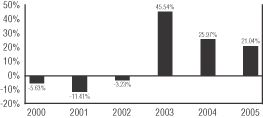
Prior Performance for Similar Accounts*
The bar chart illustrates the variability of returns achieved by AllianceBernstein for accounts with investment objectives, policies and investment strategies similar to that of the Fund.
During the periods shown above, the highest quarterly return was 11.78% for the quarter ended April 30, 2003 and the lowest was -11.17% for the quarter ended September 30, 2001.
AllianceBernstein Average Annual
Total Returns for Similar Accounts*
(for the periods ended December 31, 2005)
The table compares AllianceBernstein’s investment results for accounts with investment objectives, policies and investment strategies similar to that of the Fund to that of an index measuring the broad market over different time periods.
| AllianceBernstein Composite | One Year |
Five Years |
Since Inception (4/99) | |||
| Class S* |
21.04% | 13.73% | 11.57% | |||
| Class Y* |
20.94% | 13.63% | 11.47% | |||
| Class L* |
20.86% | 13.54% | 11.39% | |||
| Class A* |
13.67% | 11.96% | 9.13% | |||
| Class N* |
19.31% | 12.99% | 10.82% | |||
| MSCI ACWI ex US^ |
16.62% | 6.27% | 6.27% |
* Performance shown is a composite of all fee-paying institutional discretionary accounts managed by AllianceBernstein with substantially similar investment objectives, policies and investment strategies and without significant client-imposed restrictions, adjusted to reflect the fees and expenses of each of the Fund’s share classes, including sales loads. The bar chart is based on Class S expenses. The composite performance does not represent the historical performance of the MassMutual Select Diversified International Fund and should not be interpreted as being indicative of the future performance of the Fund. For additional information, please refer to “Investment Performance” in this Prospectus. Performance shown does not reflect fees that may be paid by investors for administrative services or group annuity contract charges.
^The Morgan Stanley Capital International All Country World Index (MSCI ACWI®) ex US is an unmanaged index representative of stocks domiciled in global developed and emerging markets, excluding the United States. The Index does not incur expenses or reflect any deduction for taxes and cannot be purchased directly by investors.
– 5 –
The value of your investment in the Fund changes with the values of the investments in the Fund’s portfolio. Many things can affect those values. Factors that may have an important or significant effect on the Fund’s portfolio as a whole are called “Principal Risks”. These Principal Risks are summarized in this section. The Fund could be subject to additional risks. Although the Fund strives to reach its stated goal, it cannot offer guaranteed results. You have the potential to make money in the Fund, but you can also lose money.
| · | Market Risk |
The Fund is subject to market risk, which is the general risk of unfavorable market-induced changes in the value of a security. The Fund is subject to market risk since stock prices can fall for any number of factors, including general economic and market conditions, real or perceived changes in the prospects of the security’s issuer, changing interest rates and real or perceived economic and competitive industry conditions.
The Fund maintains substantial exposure to equities and does not attempt to time the market. Because of this exposure, the possibility that stock market prices in general will decline over short or even extended periods subjects the Fund to unpredictable declines in the value of its shares, as well as periods of poor performance. Market risk also includes specific risks affecting the companies whose shares are purchased by the Fund, such as management performance, financial leverage, industry problems and reduced demand for the issuer’s goods or services.
| · | Credit Risk. The Fund is subject to credit risk. This is the risk that the issuer or the guarantor of a debt security, or the counterparty to a derivatives contract or securities loan, will be unable or unwilling to make timely principal and/or interest payments, or to otherwise honor its obligations. There are varying degrees of credit risk, which are often reflected in credit ratings. |
| · | Management Risk. The Fund is subject to management risk because the Fund is actively managed. Management risk is the chance that poor security selection will cause the Fund to underperform other funds with similar investment objectives. The Fund’s investment Sub-Adviser manages the Fund according to the traditional methods of active investment management, which involves the buying and selling of securities based upon economic, financial and market analysis and investment judgment. The Fund’s investment Sub-Adviser applies its investment techniques and risk analyses in making investment decisions for the Fund, but there can be no guarantee that they will produce the desired result. |
| · | Liquidity Risk. Liquidity risk exists when particular investments are difficult to sell. The Fund may not be able to sell these illiquid securities at the best prices. Investments in derivatives, foreign securities and securities having small market capitalization, substantial market and/or credit risk tend to involve greater liquidity risk. |
| · | Derivative Risk. The Fund may use derivatives, which are financial contracts whose value depends on, or is derived from, the value of an underlying asset, interest rate or index. The Fund may sometimes use derivatives as part of a strategy designed to reduce other risks and sometimes will use derivatives for leverage, which increases opportunities for gain but also involves greater risk. In addition to other risks such as the credit risk of the counterparty, derivatives involve the risk of mispricing or improper valuation and the risk that changes in the value of the derivative may not correlate perfectly with relevant assets, rates and indices. In addition, the Fund’s use of derivatives may affect the timing and amount of taxes payable by shareholders. |
Terms appearing in bold type are discussed in greater detail under “Additional Investment Policies and Risk Considerations”. Those sections also include more information about the Fund, its investments and the related risks.
– 6 –
| · | Foreign Investment Risk. Funds investing in foreign securities may experience more rapid and extreme changes in value than funds which invest solely in U.S. companies. This is because the securities markets of many foreign countries are relatively small, with a limited number of companies representing a small number of industries. In addition, foreign companies are usually not subject to the same degree of regulation as U.S. companies. Reporting, accounting and auditing standards of foreign countries differ, in some cases significantly, from U.S. standards. Also, nationalization, expropriation or confiscatory taxation, currency blockage, political changes or diplomatic developments could adversely affect the Fund’s non-U.S. investments. In the event of nationalization, expropriation or other confiscation, the Fund could lose its entire investment. Economic downturns in certain regions, such as Southeast Asia, can also adversely affect other countries whose economies appear to be unrelated. |
The Fund may also invest in foreign securities known as American Depositary Receipts (“ADRs”), Global Depositary Receipts (“GDRs”) and European Depositary Receipts (“EDRs”). ADRs, GDRs and EDRs represent securities or a pool of securities of an underlying foreign or, in the case of GDRs and EDRs, U.S. or non-U.S. issuer. They are subject to many of the same risks as foreign securities. ADRs, GDRs and EDRs are more completely described in the Statement of Additional Information.
| • | Emerging Markets Risk. The Fund may invest in issuers located in emerging markets, subject to the applicable restrictions on foreign investments, when the Sub-Adviser deems those investments are consistent with the Fund’s investment objectives and policies. Emerging markets are generally considered to be the countries having “emerging market economies” based on factors such as the country’s foreign currency debt rating, its political and economic stability, the development of its financial and capital markets and the level of its economy. Investing in securities from emerging markets involves special risks, including less liquidity and more price volatility than securities of comparable domestic issuers or in established foreign markets. Emerging markets also may be concentrated towards particular industries. There may also be different clearing and settlement procedures, or an inability to handle large volumes of transactions. These factors could result in settlement delays and temporary periods when a portion of the Fund’s assets is not invested and could cause a loss in value due to illiquidity. |
| • | Currency Risk. The Fund is subject to currency risk to the extent that it invests in securities of foreign companies that are traded in, and receive revenues in, foreign currencies or to the extent it buys currencies in excess of underlying equities. Currency risk is caused by uncertainty in foreign currency exchange rates. Fluctuations in the value of the U.S. dollar relative to foreign currencies may enhance or diminish returns that a U.S. investor would receive on foreign investments. The Fund may, but will not necessarily, engage in foreign currency transactions in order to protect against fluctuations in the value of holdings denominated in or exposed to other currencies or to generate additional returns by buying currencies in excess of underlying equities when opportunities arise. Those currencies can decline in value relative to the U.S. Dollar, or, in the case of hedging positions, the U.S. Dollar can decline in value relative to the currency hedged. The Fund’s investment in foreign currencies may increase the amount of ordinary income recognized by the Fund. |
| • | Value Company Risk. The value approach carries the risk that the market will not recognize a security’s intrinsic value for a long time, or that a stock judged to be undervalued may actually be appropriately priced. |
| • | Leveraging Risk. When the Fund borrows money or otherwise leverages its portfolio, the value of an investment in the Fund will be more volatile and all other risks will tend to be compounded. The Fund may take on leveraging risk by investing collateral from securities loans, by using derivatives and by borrowing money to repurchase shares or to meet redemption requests. Leveraging may increase the assets on which the investment adviser’s fee is based. |
– 7 –
About the Investment Adviser and Sub-Adviser
Massachusetts Mutual Life Insurance Company (“MassMutual”) located at 1295 State Street, Springfield, Massachusetts 01111, is the Fund’s investment adviser and is responsible for providing all necessary investment management and administrative services. Founded in 1851, MassMutual is a mutual life insurance company that provides a broad range of insurance, money management, retirement and asset accumulation products and services for individuals and businesses. As of December 31, 2005, MassMutual, together with its subsidiaries, had assets under management in excess of $390 billion.
MassMutual will be paid an investment management fee of .90% of the Fund’s average daily net assets.
A discussion regarding the basis for the board of trustees approving the investment advisory contracts of the Fund will be available in the Fund’s annual report to shareholders dated December 31, 2006.
The Fund also pays MassMutual an administrative and shareholder service fee at an annual rate based on a percentage of daily net assets for the applicable class of shares. The fee for each share class of the Fund is .05% for Class S shares; .15% for Class Y shares; .30% for Class L and Class A shares; and .35% for Class N shares.
Kristin Bushard, CFA, and the MassMutual Retirement Services Investment Services Group are responsible for determining the allocation of portfolio assets and/or cash flows among Sub-Advisers for those Funds with multiple sub-advisers. Ms. Bushard joined MassMutual in 2003 as Managing Director for the MassMutual Retirement Services Investment Services Group. She leads a team of investment professionals who conduct money manager research for the MassMutual Investment Program. Prior to joining MassMutual, Ms. Bushard worked in various positions at Allmerica Financial, including investment consulting for the company’s variable and group retirement products, and stable value risk analysis.
MassMutual contracts with the following Sub-Adviser to help manage the Fund:
AllianceBernstein L.P. (“AllianceBernstein”), located at 1345 Avenue of the Americas, New York, New York 10105, manages the investments of the Diversified International Fund. AllianceBernstein is a limited partnership, the majority ownership interests in which are held by its affiliates: AllianceBernstein Holding L.P., a publicly traded partnership; and AXA Financial, Inc. (“AXA Financial”) together with certain wholly-owned subsidiaries of AXA Financial. AXA Financial is a wholly-owned subsidiary of AXA. As of September 30, 2006, AllianceBernstein managed approximately $659 billion in assets.
Henry S. D’Auria
is a portfolio manager of the Diversified International Fund, which is managed on a team basis. Mr. D’Auria, a Chartered Financial Analyst, was named co-CIO – International Value equities in 2003, adding to his responsibilities as CIO – Emerging Markets Value equities, which he assumed in 2002. Mr. D’Auria was one of the chief architects of Bernstein’s global research department, which he managed from 1998 through 2002. Over the years, he has also served as director of research – Small Cap Value equities and director of research – Emerging Markets Value equities. Mr. D’Auria joined the firm in 1991 as a research analyst covering consumer and natural-gas companies, and he later covered the financial-services industry.
Sharon E. Fay
is a portfolio manager of the Diversified International Fund, which is managed on a team basis. Ms. Fay, a Chartered Financial Analyst, joined Bernstein in 1990 as a research analyst, following the airline, lodging, trucking and retail industries, and has been Executive Vice President and Chief Investment Officer-Global Value Equities of AllianceBernstein since 2003, overseeing all portfolio management and research activities relating to cross-border and non-US value investment portfolios and chairing the Global Value Investment Policy Group. Until January 2006, Ms. Fay was Co-CIO – European and UK Value Equities. She also serves on AllianceBernstein’s Management Executive Committee, the group of senior professionals responsible for managing the firm, enacting key strategic initiatives and allocating resources.
– 8 –
Between 1997 and 1999, Ms. Fay was CIO – Canadian Value Equities. Prior to that, she had been a senior portfolio manager of International Value Equities since 1995.
Marilyn G. Fedak
is a portfolio manager of the Diversified International Fund, which is managed on a team basis. Ms. Fedak joined Bernstein in 1984 as a senior portfolio manager. An Executive Vice President of AllianceBernstein since 2000, she is Head of Global Value Equities and chair of the US Large Cap Value Equity Investment Policy Group. From 1993-2000, Ms. Fedak was Chief Investment Officer for U.S. Value Equities. In 2003, she named John Mahedy, a Senior Vice President, her co-CIO. Ms. Fedak serves on AllianceBernstein’s Management Executive Committee, a group of senior professionals responsible for managing the firm, enacting key strategic initiatives and allocating resources. Ms. Fedak is also a Director of SCB Inc. Ms. Fedak had served on the board of directors of Sanford C. Bernstein & Co., Inc. from 1994 until the combination with Alliance Capital in 2000. Early in her career at Bernstein, she played a key role in developing its US Diversified Value service. Prior to joining Bernstein, Ms. Fedak was a portfolio manager and research analyst at Morgan Guaranty Trust Company from 1972 to 1983.
John P. Mahedy
is a portfolio manager of the Diversified International Fund, which is managed on a team basis. Mr. Mahedy was named Co-CIO – US Value equities in 2003. He continues to serve as director of research – US Value Equities, a position he has held since 2001. Previously, Mr. Mahedy was a senior research analyst in Berstein’s institutional research and brokerage unit, covering the domestic and international energy industry from 1995 to 2001 and the oil-services industry from 1988 to 1991. He also covered oil services briefly at Morgan Stanley for three years in the early 1990s.
Kevin F. Simms
is a portfolio manager of the Diversified International Fund, which is managed on a team basis. Mr. Simms was named co-CIO – International Value equities in 2003, which he has assumed in addition to his role as director of research – Global and International Value equities, a position he has held since 1999. Between 1998 and 2000, Mr. Simms served as director of research – Emerging Markets Value equities. He joined Bernstein in 1992 as a research analyst, and his industry coverage over the next six years included financial services, telecommunications and utilities.
The Fund’s Statement of Additional Information (“SAI”) provides additional information about each portfolio manager’s compensation, other accounts managed by the portfolio managers and each portfolio manager’s ownership of securities in the Fund.
MassMutual has received exemptive relief from the Securities and Exchange Commission to permit MassMutual to change sub-advisers or hire new sub-advisers for one or more funds from time to time without obtaining shareholder approval. Normally, shareholders are required to approve investment sub-advisory agreements. Several other mutual fund companies have received similar relief. MassMutual believes having this authority is important, because it allows MassMutual to remove and replace a sub-adviser in a quick, efficient and cost-effective fashion when its performance is inadequate or the sub-adviser no longer is able to meet a fund’s investment objective and strategies. The shareholders of the Fund have previously approved this arrangement. Pursuant to the exemptive relief, MassMutual will provide to the Fund’s shareholders, within 90 days of the hiring of a new sub-adviser, an information statement describing the new sub-adviser.
– 9 –
About the Classes of Shares – Multiple Class Information
The Fund offers five Classes of shares: Class S, Class Y, Class L, Class A and Class N. Class A shares have up-front sales charges and Class N shares have contingent deferred sales charges. Only Class A and Class N shares charge Rule 12b-1 fees.
Class S, Class Y, Class L and Class Z shares are primarily offered to institutional investors through institutional distribution channels, such as employer-sponsored retirements plans or through broker-dealers, financial institutions or insurance companies. Class A and N shares are primarily offered through distribution channels, such as broker-dealers or financial institutions. The different Classes have different fees, expenses and/or minimum investor size requirements. The difference in the fee structures among the Classes is the result of their separate arrangements for shareholder and distribution services and not the result of any difference in amounts charged by MassMutual for investment advisory services. Accordingly, management fees do not vary by Class. Different fees and expenses of a Class will affect performance of that Class. For additional information, call us toll free at 1-888-743-5274 or contact a sales representative or financial intermediary who offers the Classes.
Except as described below, all Classes of shares of the Fund have identical voting, dividend, liquidation and other rights, preferences, terms and conditions. The only differences among the various Classes are: (a) each Class may be subject to different expenses specific to that Class; (b) each Class has a different Class designation; (c) each Class has exclusive voting rights with respect to matters solely affecting such Class; (d) each Class offered in connection with a 12b-1 Plan will bear the expense of the payments that would be made pursuant to that 12b-1 Plan, and only that Class will be entitled to vote on matters pertaining to that 12b-1 Plan; and (e) each Class will have different exchange privileges.
Each Class of the Fund’s shares invests in the same portfolio of securities. Because each Class will have different expenses, they will likely have different share prices. All Classes of shares are available for purchase by insurance company separate investment accounts. Each Class of shares of the Fund may also be purchased by the following Eligible Purchasers:
Eligible Purchasers. Class S shares may be purchased by:
| · | Qualified plans under Section 401(a) of the Internal Revenue Code of 1986 as amended (the “Code”), Code Section 403(b) plans, Code Section 457 plans and other retirement plans, where plan assets of the employer generally exceed or are expected to exceed $100 million; |
| · | Certain non-qualified deferred compensation plans; |
| · | Registered mutual funds and collective trust funds; and |
| · | Other institutional investors with assets generally in excess of $100 million. |
These Eligible Purchasers must have an agreement with MassMutual or a MassMutual affiliate to purchase Class S Shares.
Shareholder and Distribution Fees. Class S shares of the Fund are purchased directly from the Trust without a front-end sales charge. Therefore, 100% of an Investor’s money is invested in the Fund. Class S shares do not have deferred sales charges or any Rule 12b-1 fees.
Eligible Purchasers. Class Y shares may be purchased by:
| · | Non-qualified deferred compensation plans; |
| · | Registered mutual funds and collective trust funds; |
| · | Qualified plans under Code Section 401(a), Code Section 403(b) plans, Code Section 457 plans and other retirement plans, where plan assets of the employer generally exceed or are expected to exceed $5 million; and |
| · | Other institutional investors with assets generally in excess of $5 million. |
These Eligible Purchasers must have an agreement with MassMutual or a MassMutual affiliate to purchase Class Y Shares.
– 10 –
Shareholder and Distribution Fees. The Class Y shares are 100% no load, so you pay no fees (sales loads) when you buy or sell Class Y shares. Therefore, all of your money is invested in the Fund. Class Y shares do not have any Rule 12b-1 fees.
Eligible Purchasers. Class L shares may be purchased by:
| · | Non-qualified deferred compensation plans; |
| · | Qualified plans under Code Section 401(a), Code Section 403(b) plans, Code Section 457 plans and other retirement plans, where plan assets of the employer generally exceed or are expected to exceed $1 million; and |
| · | Other institutional investors with assets generally in excess of $1 million. |
These Eligible Purchasers must have an agreement with MassMutual or a MassMutual affiliate to purchase Class L shares. Class L shares are generally sold in connection with the use of an intermediary performing third party administration and/or other shareholder services.
Shareholder and Distribution Fees. Class L shares of the Fund are purchased directly from the Trust without a front-end sales charge. Therefore, 100% of an Investor’s money is invested in the Fund. Class L shares do not have deferred sales charges or any Rule 12b-1 fees.
Eligible Purchasers. Class A and Class N shares may be purchased by:
| · | Qualified plans under Code Section 401(a), Code Section 403(b) plans, Code Section 457 plans and other retirement plans; |
| · | Individual retirement accounts described in Code Section 408; and |
| · | Other institutional investors, nonqualified deferred compensation plans and voluntary employees’ beneficiary associations described in Code Section 501(c)(9). |
These Eligible Purchasers must have an agreement with MassMutual or a MassMutual affiliate to purchase Class A or Class N shares. There is no minimum plan or institutional investor size to purchase Class A or Class N shares.
Class A and Class N shares may be offered to present or former officers, directors, trustees and employees (and their spouses, parents, children and siblings) of the Fund, MassMutual and its affiliates and retirement plans established by them for their employees.
Distribution and Service (Rule 12b-1) Fees. Class A shares are sold at net asset value per share plus an initial sales charge. Class N shares are sold at net asset value per share without an initial sales charge. Therefore, for Class N shares, 100% of an Investor’s money is invested in the Fund. The Fund has adopted Rule 12b-1 Plans for Class A and Class N shares of the Fund.
Under the Class A Plan, the Fund is permitted to pay distribution and service fees at the annual rate of .25%, in the aggregate, of the Fund’s average daily net assets attributable to Class A shares. Distribution fees may be paid to brokers or other financial intermediaries for providing services in connection with the distribution and marketing of Class A shares and for related expenses. Services fees may be paid to brokers or other financial intermediaries for providing personal services to Class A shareholders and/or maintaining Class A shareholder accounts and for related expenses. Compensation under the Plan for service fees will be paid to MassMutual, through MML Distributors, LLC (the “Distributor”), and compensation under the Plan for distribution fees will be paid to the Distributor. MassMutual and the Distributor will be entitled to retain a portion of the fees generated by an account, or may reallow the full amount to the brokers or other intermediaries. MassMutual may pay any Class A 12b-1 service fees to brokers or other financial intermediaries in advance for the first year after the shares are sold. After the shares have been held for a year, MassMutual pays the service fees on a quarterly basis.
Under the Class N Plan, the Fund pays the Distributor an annual distribution fee of .25%. The Fund also pays .25% in services fees to MassMutual each year under the Plan. MassMutual will be entitled to retain a portion of the fees generated by an account, or may reallow the full amount to brokers or other financial intermediaries for providing personal services to Class N shareholders and/or maintaining Class N shareholder accounts and for related expenses. MassMutual may pay the .25% service fees to brokers or other financial intermediaries in advance for the first year after the shares are sold.
– 11 –
After the shares have been held for a year, MassMutual pays the service fees on a quarterly basis. The Distributor will be entitled to retain a portion of the fees generated by an account, or may reallow the full amount to brokers or other financial intermediaries for providing services in connection with the distribution and marketing of Class N shares and for related expenses.
Because these fees are paid out of the Fund’s assets on an on-going basis, over time these fees will increase the costs of your investment in the Class A and Class N shares and may cost you more than other types of sales charges.
Compensation to Intermediaries
The Distributor may directly, or through MassMutual, pay a sales concession of up to 1.00% of the purchase price of Class N, Class A and Class L shares to brokers or other financial intermediaries from its own resources at the time of sale. However, the total amount paid to brokers or other financial intermediaries at the time of sale of Class N and Class A shares, including any advance of 12b-1 service fees by MassMutual, may be only 1.00% of the purchase price. In addition, MassMutual may directly, or through the Distributor, pay up to .25% of the amount invested to intermediaries who provide services on behalf of Class S, Class Y, Class L, Class A or Class N shares. This compensation is paid by MassMutual, not from Fund assets. The payments on account of Class S, Class Y, Class L, Class A or Class N shares will be based on criteria established by MassMutual. In the event that amounts paid by the Fund to MassMutual as administrative or management fees are deemed indirect financing of distribution or servicing costs for Class S, Class Y or Class L shares, the Fund has adopted distribution and servicing plans (i.e., Rule 12b-1 Plans) authorizing such payments. No additional fees are paid by the Fund under these plans. Compensation paid by the Fund to brokers or other intermediaries for providing services on account of Class A or Class N shares is described above under “Distribution and Service (Rule 12b-1) Fees”. Where Class S, Class Y, Class L, Class A or Class N shares are sold in connection with nonqualified deferred compensation plans where the employer sponsor has an administrative services agreement with MassMutual or its affiliate, additional compensation may be paid as determined by MassMutual from time to time according to established criteria. As of the date of this Prospectus, aggregate annual compensation in such cases does not exceed ..50%. Annual compensation paid on account of Class S, Class Y, Class L, Class A or Class N shares will be paid quarterly, in arrears.
MassMutual may also make payments, out of its own assets, to intermediaries, including broker-dealers, insurance agents and other service providers, that relate to the sale of the Fund or certain of MassMutual’s variable annuity contracts for which the Fund is an underlying investment option.
This compensation may take the form of:
| · | Payments to administrative service providers that provide enrollment, recordkeeping and other services to pension plans; |
| · | Cash and non-cash benefits, such as bonuses and allowances or prizes and awards, for certain brokers, administrative service providers and MassMutual insurance agents; |
| · | Payments to intermediaries for, among other things, training of sales personnel, conference support, marketing or other services provided to promote awareness of MassMutual’s products; |
| · | Payments to broker-dealers and other intermediaries that enter into agreements providing the Distributor with access to representatives of those firms or with other marketing or administrative services; and |
| · | Payments under agreements with MassMutual not directly related to the sale of specific variable annuity contracts or the Fund, such as educational seminars and training or pricing services. |
These compensation arrangements are not offered to all intermediaries and the terms of the arrangements may differ among intermediaries. These arrangements may provide an intermediary with an incentive to recommend one mutual fund over another, one share class over another, or one insurance or annuity contract over another. You may want to take these compensation arrangements into account when evaluating any recommendations regarding the Fund or any contract using the Fund as an investment option. You may contact your intermediary to find out more information about the compensation they may receive in connection with your investment.
– 12 –
Investing In The Fund
Buying, Redeeming and Exchanging Shares
The Fund sells its shares at a price equal to its net asset value (“NAV”) plus any initial sales charge that applies. The Fund generally determines its NAV at the market close (usually 4:00 p.m. Eastern Time) every day the New York Stock Exchange (“NYSE”) is open (“Business Day”). Your purchase order will be priced at the next NAV calculated after the order is received and accepted by the transfer agent, MassMutual or another intermediary. The Fund will suspend selling its shares during any period when the determination of NAV is suspended. The Fund can reject any purchase order and can suspend purchases if it is in its best interest.
The Fund redeems its shares at its next NAV computed after your redemption request is received and accepted by the transfer agent, MassMutual or another intermediary. You will usually receive payment for your shares within 7 days after your redemption request is received and accepted. If, however, you request redemption of shares recently purchased by check, you may not receive payment until the check has been collected, which may take up to 15 days from time of purchase. The Fund can also suspend or postpone payment, when permitted by applicable law and regulations.
You can exchange shares of the Fund for the same class of shares of another fund. An exchange is treated as a sale of shares in one fund and a purchase of shares in another fund at the NAV next determined after the exchange request is received and accepted by the transfer agent, MassMutual or another intermediary. Exchange requests involving a purchase into the the Fund, however, will not be accepted if received by the transfer agent, MassMutual or another intermediary after the earlier of 2:30 p.m. Eastern Time or the market close, on any Business Day. Furthermore, exchange requests involving a purchase into the Fund will not be accepted if you have already made a purchase followed by a redemption involving the Fund within the last 30 days. Your right to exchange shares is subject to applicable regulatory requirements or contractual obligations. The Fund may limit, restrict or refuse exchanges, if, in the opinion of MassMutual:
| · | you have engaged in excessive trading; |
| · | the Fund receives or expects simultaneous orders affecting significant portions of the Fund’s assets; |
| · | a pattern of exchanges occurs which coincides with a market timing strategy; or |
| · | the Fund would be unable to invest the funds effectively based on its investment objectives and policies, or if the Fund would be adversely affected. |
Purchases and exchanges of shares of the Fund should be made for investment purposes only. Excessive trading and/or market timing activity involving the Fund can disrupt the management of the Fund. These disruptions can result in increased expenses and can have an adverse effect on fund performance.
MassMutual has adopted policies and procedures to help identify those individuals or entities MassMutual determines may be engaging in excessive trading and/or market timing trading activities. MassMutual monitors trading activity to enforce these procedures. However, those who engage in such activities may employ a variety of techniques to avoid detection. Therefore, despite MassMutual’s efforts to prevent excessive trading and/or market timing trading activities, there can be no assurance that MassMutual will be able to identify all those who trade excessively or employ a market timing strategy and curtail their trading in every instance.
The monitoring process involves scrutinizing transactions in fund shares that exceed certain monetary thresholds or numerical limits within a specified period of time. Trading activity identified by either, or a combination, of these factors, or as a result of any other information actually available at the time, will be evaluated to determine whether such activity might constitute excessive trading and/or market timing activity. When trading activity is determined by the Fund or MassMutual, in their sole discretion, to be excessive in nature, certain account-related privileges, such as the ability to place purchase, redemption and exchange orders over the internet, may be suspended for such account.
The Fund reserves the right to modify or terminate the exchange privilege as described above on 60 days written notice.
– 13 –
The Fund does not accept purchase, redemption or exchange orders or compute its NAV on days when the NYSE is closed. This includes: weekends, Good Friday and all federal holidays other than Columbus Day and Veterans Day. Certain foreign markets may be open on days when the Fund does not accept orders or price its shares. As a result, the NAV of the Fund’s shares may change on days when you will not be able to buy or sell shares.
Class A shares are sold at their offering price, which is normally NAV plus an initial sales charge. However, in some cases, as described below, purchases are not subject to an initial sales charge, and the offering price will be the NAV. In other cases, reduced sales charges may be available, as described below. Out of the amount you invest, the Fund receives the net asset value to invest for your account.
The sales charge varies depending on the amount of your purchase. A portion of the sales charge may be retained by the Distributor or allocated to your dealer as a concession. The Distributor reserves the right to reallow the entire sales charge as a concession to dealers. The current sales charge rates and concessions paid to dealers and brokers are as follows:
| Front-End Sales Charge (As a Percentage of Offering Price) / Front-End Sales Charge (As a Percentage of Net Amount Invested)/Concession (As a Percentage of Offering Price) for Different Purchase Amounts: | ||||||
| Price Breakpoints |
General Equity |
General Taxable Bond |
Shorter- Term Bond | |||
| Less than |
5.75%/ 6.10%/ 4.75% |
4.75%/ 4.99%/ 4.00% |
3.50%/ 3.63%/ 3.00% | |||
| $25,000- $49,999 |
5.50%/ 5.82%/ 4.75% |
4.75%/ 4.99%/ 4.00% |
3.50%/ 3.63%/ 3.00% | |||
| $50,000- |
4.75%/ 4.99%/ 4.00% |
4.50%/ 4.71%/ 3.75% |
3.50%/ 3.63%/ 3.00% | |||
| $100,000- |
3.75%/ 3.90%/ 3.00% |
3.50%/ 3.63%/ 2.75% |
3.00%/ 3.09%/ 2.50% | |||
| $250,000- |
2.50%/ 2.56%/ 2.00% |
2.00%/ 2.04%/ 2.25% |
2.50%/ 2.56%/ 2.00% | |||
| $500,000- |
2.00%/ 2.04%/ 1.60% |
2.00%/ 2.04%/ 1.60% |
2.00%/ 2.04%/ 1.50% | |||
| $1,000,000 |
None/ None/ 1.00% |
None/ None/ 1.00% |
None/ None/ .50% | |||
A reduced sales charge rate may be obtained for Class A shares under the Fund’s “Rights of Accumulation” because of the economies of sales efforts and reduction in expenses realized by the Distributor, dealers and brokers making such sales.
To qualify for the lower sales charge rates that apply to larger purchases of Class A shares, you can add together:
| · | Current purchases of Class A shares of more than one fund subject to an initial sales charge to reduce the sales charge rate that applies to current purchases of Class A shares; and |
| · | Class A shares of funds you previously purchased subject to an initial or contingent deferred sales charge to reduce the sales charge rate for current purchases of Class A shares, provided that you still hold your investment in the previously purchased funds. |
The Distributor will add the value, at current offering price, of the shares you previously purchased and currently own to the value of current purchases to determine the sales charge rate that applies. The reduced sales charge will apply only to current purchases. You must request it when you buy shares and inform your broker-dealer or other financial intermediary of Class A shares of any other funds that you own. Information regarding reduced sales charges can be found on the MassMutual website at http://www.massmutual.com/retire.
There is an initial sales charge on the purchase of Class A shares of each of the MassMutual Select Funds.
Contingent Deferred Sales Charges
There is no initial sales charge on purchases of Class A shares of any one or more of the funds aggregating $1 million or more. The Distributor pays dealers of record concessions in an amount equal to 1.0% or .50% of purchases of $1 million or more as shown in the above table. The concession will not be paid on purchases of shares by exchange or that were previously subject to a front-end sales charge and dealer concession.
If you redeem any of those shares within a holding period of 18 months from the beginning of the calendar month of their purchase, a contingent deferred sales charge of 1.0% will be deducted from the redemption proceeds (unless you are eligible for a
– 14 –
waiver of that sales charge based on the categories listed below and you advise the Transfer Agent, MassMutual or another intermediary of your eligibility for the waiver when you place your redemption request).
If Class N shares are redeemed within a holding period of 18 months from the beginning of the calendar month of their purchase, a contingent deferred sales charge of 1.0% will be deducted from the redemption proceeds (unless you are eligible for a waiver of that sales charge based on the categories listed below and you advise the Transfer Agent, MassMutual or another intermediary of your eligibility for the waiver when you place your redemption request). The Class N contingent deferred sales charge is paid to compensate the Distributor for its expenses of providing distribution-related services to the Fund in connection with the sale of Class N shares.
All contingent deferred sales charges will be based on the lesser of the net asset value of the redeemed shares at the time of redemption or the original net asset value. A contingent deferred sales charge is not imposed on:
| · | the amount of your account value represented by an increase in net asset value over the initial purchase price, |
| · | shares purchased by the reinvestment of dividends or capital gains distributions, or |
| · | shares redeemed in the special circumstances described on the following page. |
To determine whether a contingent deferred sales charge applies to a redemption, the Fund redeems shares in the following order:
| 1. | shares acquired by reinvestment of dividends and capital gains distributions, and |
| 2. | shares held the longest. |
Contingent deferred sales charges are not charged when you exchange shares of the Fund for shares of any other fund. However, if you exchange them within the applicable contingent deferred sales charge holding period, the holding period will carry over to the fund whose shares you acquire. Similarly, if you acquire shares of a fund by exchanging shares of another fund that are still subject to a contingent deferred sales charge holding period, that holding period will carry over to the acquired fund.
Waivers of Class A Initial Sales Charges
The Class A sales charges will be waived for shares purchased in the following types of transactions:
| · | Purchases into insurance company separate investment accounts. |
| · | Purchases into Retirement Plans or other employee benefit plans. |
| · | Purchases of Class A shares aggregating $1 million or more. |
| · | Purchases into accounts for which the broker-dealer of record has entered into a special agreement with the Distributor allowing this waiver. |
| · | Purchases into accounts for which no sales concession is paid to any broker-dealer or other financial intermediary at the time of sale. |
| · | Shares sold to the Manager or its affiliates. |
| · | Shares sold to registered management investment companies or separate accounts of insurance companies having an agreement with the Manager or the Distributor for that purpose. |
| · | Shares issued in plans of reorganization to which the Fund is a party. |
| · | Shares sold to present or former officers, directors, trustees or employees (and their “immediate families1”) of the Fund, the Manager and its affiliates. |
Waivers of Class A and Class N Contingent Deferred Sales Charges
The Class A and Class N contingent deferred sales charges will not be applied to shares purchased in certain types of transactions or redeemed in certain circumstances described below.
| A. | Waivers for Redemptions in Certain Cases. |
The Class A and Class N contingent deferred sales charges will be waived for redemptions of shares in the following cases:
| · | Redemptions from insurance company separate investment accounts. |
| · | Redemptions from Retirement Plans or other employee benefit plans. |
| 1 | The term “immediate family” refers to one’s spouse, children, grandchildren, grandparents, parents, parents-in-law, brothers and sisters, sons- and daughters-in-law, a sibling’s spouse, a spouse’s siblings, aunts, uncles, nieces and nephews; relatives by virtue of a remarriage (step-children, step-parents, etc.) are included. |
– 15 –
| · | Redemptions from accounts other than Retirement Plans following the death or disability of the last surviving shareholder, including a trustee of a grantor trust or revocable living trust for which the trustee is also the sole beneficiary. The death or disability must have occurred after the account was established, and for disability you must provide evidence of a determination of disability by the Social Security Administration. |
| · | Redemptions from accounts for which the broker-dealer of record has entered into a special agreement with the Distributor allowing this waiver. |
| · | Redemptions from accounts for which no sales concession was paid to any broker-dealer or other financial intermediary at the time of sale. |
| · | Redemptions of Class A and Class N shares under an Automatic Withdrawal Plan from an account other than a Retirement Plan if the aggregate value of the redeemed shares does not exceed 10% of the account’s value annually. |
| · | In the case of an IRA, to make distributions required under a divorce or separation agreement described in Section 71(b) of the Internal Revenue Code. |
| B. | Waivers for Shares Sold or Issued in Certain Transactions. |
The contingent deferred sales charge is also waived on Class A and Class N shares sold or issued in the following cases:
| · | Shares sold to the Manager or its affiliates. |
| · | Shares sold to registered management investment companies or separate accounts of insurance companies having an agreement with the Manager or the Distributor for that purpose. |
| · | Shares issued in plans of reorganization to which the Fund is a party. |
| · | Shares sold to present or former officers, directors, trustees or employees (and their “immediate families1”) of the Fund, the Manager and its affiliates. |
The Trust calculates the Net Asset Value (“NAV”) of each class of shares of the Fund separately. The NAV for shares of a class of the Fund is determined by adding the current value of all of the Fund’s assets attributable to that class, subtracting the liabilities attributable to that class and then dividing the resulting number by the total outstanding shares of the class.
The Fund’s assets are valued based on market value of the Fund’s total portfolio. Securities are typically valued on the basis of valuations furnished by a pricing service. However, valuation methods approved by the Fund’s Board of Trustees which are intended to reflect fair value may be used when pricing service information is not readily available or when a security’s value is believed to have been materially affected by a significant event, such as a natural disaster, an economic event like a bankruptcy filing, or a substantial fluctuation in domestic or foreign markets, that has occurred after the close of the exchange or market on which the security is principally traded (for example, a foreign exchange or market). In such a case, the Fund’s value for a security is likely to be different from the last quoted market price or pricing service information. Due to the subjective and variable nature of fair value pricing, it is possible that the value determined for a particular asset may be materially different from the value realized upon such asset’s sale.
The Fund’s valuation methods are more fully described in the Statement of Additional Information.
When you buy shares of the Fund through an agreement with MassMutual, your agreement will describe how you need to submit buy, sell and exchange orders. Purchase orders must be accompanied by sufficient funds. You can pay by check or Federal Funds wire transfer. You must submit any buy, sell or exchange orders in “good form” as described in your agreement.
The Fund intends to continue to qualify as a regulated investment company under Subchapter M of the Internal Revenue Code. As a regulated investment company, the Fund will not be subject to Federal income taxes on its ordinary income and net realized capital gain distributed to its shareholders. In general, a fund that fails to distribute at least 98% of such income and gain in the calendar year in which earned will be subject to a 4% excise tax on the undistributed amount. Many investors, including most tax qualified plan investors, may be eligible for
– 16 –
preferential Federal income tax treatment on distributions received from the Fund and dispositions of Fund shares. This Prospectus does not attempt to describe in any respect such preferential tax treatment. Any prospective investor that is a trust or other entity eligible for special tax treatment under the Code that is considering purchasing shares of the Fund, including either directly or indirectly through a life insurance company separate investment account, should consult its tax advisers about the Federal, state, local and foreign tax consequences particular to it, as should persons considering whether to have amounts held for their benefit by such trusts or other entities investing in shares of the Fund.
Investors that do not receive preferential tax treatment are subject to Federal income taxes on distributions received in respect of their shares. Distributions of the Fund’s ordinary income and short-term capital gains (i.e. gains from capital assets held for one year or less) are taxable to the shareholder as ordinary income whether received in cash or additional shares. Certain designated dividends may be eligible for the dividends-received deduction for corporate shareholders. Designated capital gain dividends (relating to gains from capital assets held for more than one year) are taxable as long-term capital gains in the hands of the investor whether distributed in cash or additional shares and regardless of how long the investor has owned shares of the Fund. For taxable years beginning on or before December 31, 2008, distributions of investment income designated by the Fund as derived from “qualified dividend income” will be taxed in the hands of individuals at the rates applicable to long-term capital gain provided holding period and other requirements are met at both the shareholder and Fund level. The nature of the Fund’s distributions will be affected by its investment strategies. A fund whose investment return consists largely of interest, dividends and capital gains from short-term holdings will distribute largely ordinary income. A fund whose return comes largely from the sale of long-term term holdings will distribute largely capital gain dividends. Long-term capital gain rates applicable to individuals have been temporarily reduced, in general, to 15% with lower rates applying to taxpayers in the 10% and 15% rate brackets for taxable years beginning on or before December 31, 2008. Distributions are taxable to a shareholder even though they are paid from income or gains earned by the Fund prior to the shareholder’s investment and thus were included in the NAV paid by the shareholder.
The Fund intends to pay out as dividends substantially all of its net investment income (which comes from dividends and any interest it receives from its investments). The Fund also intends to distribute substantially all of its net realized long- and short-term capital gains, if any, after giving effect to any available capital loss carryovers. Distributions, if any, are declared and paid at least annually. Distributions may be taken either in cash or in additional shares of the Fund at the Fund’s net asset value on the first business day after the record date for the distribution, at the option of the shareholder.
Any gain resulting from the exchange or redemption of an investor’s shares in the Fund will generally be subject to tax. A loss incurred with respect to shares of the Fund held for six months or less will be treated as a long-term capital loss to the extent of long-term capital gains dividends with respect to such shares.
The Fund’s investments in foreign securities may be subject to foreign withholding taxes. In that case, the Fund’s yield on those securities would be decreased. Shareholders of the Fund may be entitled to claim a credit or deduction with respect to foreign taxes. In addition, the Fund’s investments in foreign securities or foreign currencies may increase or accelerate the Fund’s recognition of ordinary income and may affect the timing or amount of the Fund’s distributions.
Shareholders should consult their tax adviser for more information on their own tax situation, including possible state, local and foreign taxes.
– 17 –
Similar account performance for the Sub-Adviser is provided solely to illustrate the Sub-Adviser’s performance in managing portfolios with investment objectives, policies and investment strategies substantially similar to the Fund. The Fund’s performance would have differed due to factors such as differences in cash flows into and out of the Fund, differences in fees and expenses, and differences in portfolio size and investments. Similar account performance is not indicative of future rates of return. Prior performance of the Sub-Adviser is no indication of future performance of the Fund. In addition, the private account portfolios are not registered with the SEC and therefore are not subject to the limitations, diversification requirements and other restrictions to which the Fund, as a registered mutual fund, is subject. The performance of the private accounts may have been adversely affected if they had been registered with the SEC.
The following chart summarizes the composite performance of the Sub-Adviser’s investment results for accounts with investment objectives similar to that of the Fund. The Sub-Adviser’s similar account performance has been adjusted to reflect the fees and expenses of each of the Fund’s share classes.
| Sub-Adviser/Fund | Share Class |
1 Year Return (%) as of 12/31/05 |
3 Year Return (%) as of 12/31/05 |
5 Year Return (%) as of 12/31/05 |
Since Inception (4/99) Return (%) as of 12/31/05 | |||||
| Alliance Bernstein/ |
S | 21.04% | 30.44% | 13.73% | 11.57% | |||||
| Y | 20.94% | 30.34% | 13.63% | 11.47% | ||||||
| L | 20.86% | 30.26% | 13.54% | 11.39% | ||||||
| A | 13.67% | 27.47% | 11.96% | 9.13% | ||||||
| N | 19.31% | 29.71% | 12.99% | 10.82% | ||||||
– 18 –
ADDITIONAL INVESTMENT POLICIES
AND RISK CONSIDERATIONS
The Fund may invest in a wide range of investments and engage in various investment-related transactions and practices. These practices are pursuant to non-fundamental policies and therefore may be changed by the Board of Trustees of the Trust without the consent of shareholders. Some of the more significant practices and some associated risks are discussed below.
Repurchase Agreements and Reverse Repurchase Agreements
The Fund may engage in repurchase agreements and reverse repurchase agreements. A repurchase agreement is a contract pursuant to which a fund agrees to purchase a security and simultaneously agrees to resell it at an agreed-upon price at a stated time, thereby determining the yield during the Fund’s holding period. A reverse repurchase agreement is a contract pursuant to which a fund agrees to sell a security and simultaneously agrees to repurchase it at an agreed-upon price at a stated time. The Statement of Additional Information provides a detailed description of repurchase agreements, reverse repurchase agreements and related risks.
Securities Lending
The Fund may seek additional income by making loans of portfolio securities of not more than 33% of its total assets taken at current value. Although lending portfolio securities may involve the risk of delay in recovery of the securities loaned or possible loss of rights in the collateral should the borrower fail financially, loans will be made only to borrowers deemed by MassMutual and the Fund’s custodian to be in good standing.
Under applicable regulatory requirements and securities lending agreements (which are subject to change), the loan collateral received by the Fund when it lends portfolio securities must, on each business day, be at least equal to the value of the loaned securities. Cash collateral received by the Fund will be reinvested by the Fund’s securities lending agent in high quality, short term instruments, including bank obligations, U.S. Government securities, repurchase agreements, money market funds and U.S. dollar denominated corporate instruments with an effective maturity of one-year or less, including variable rate and floating rate securities, insurance company funding agreements and asset-backed securities. All investments of cash collateral by the Fund are for the account and risk of the Fund.
Hedging Instruments and Derivatives
The Fund may buy or sell forward contracts and other similar instruments and may engage in foreign currency transactions (collectively referred to as “hedging instruments” or “derivatives”), as more fully discussed in the Statement of Additional Information.
The portfolio managers may normally use derivatives:
| · | to protect against possible declines in the market value of the Fund’s portfolio resulting from downward trends in the markets (for example, in the debt securities markets generally due to increasing interest rates); |
| · | to protect the Fund’s unrealized gains or limit its unrealized losses; |
| · | to manage the Fund’s exposure to changing securities prices; and |
| · | to generate additional investment returns. |
Portfolio managers may also use derivatives to establish a position in the debt or equity securities markets as a temporary substitute for purchasing or selling particular securities and to manage the effective maturity or duration of fixed income securities in the Fund’s portfolio.
| (1) | Forward Contracts – The Fund may purchase or sell securities on a “when issued” or delayed delivery basis or may purchase or sell securities on a forward commitment basis (“forward contracts”). When such transactions are negotiated, the price is fixed at the time of commitment, but delivery and payment for the securities can take place a month or more after the commitment date. The securities so purchased or sold are subject to market |
– 19 –
| fluctuations and no interest accrues to the purchaser during this period. While the Fund also may enter into forward contracts with the initial intention of acquiring securities for its portfolio, it may dispose of a commitment prior to settlement if MassMutual or the Fund’s Sub-Adviser deems it appropriate to do so. |
| (2) | Currency Transactions – The Fund may, but will not necessarily, engage in foreign currency transactions with counterparties in order to hedge the value of portfolio holdings denominated in or exposed to particular currencies against fluctuations in relative value or to generate additional returns by buying currencies in excess of underlying equities when opportunities arise. |
Certain limitations apply to the use of forward contracts by the Fund. For example, the Fund will not enter into a forward contract if, as a result, more than 25% of its total assets would be held in a segregated account covering such contracts. For more information about forward contracts and currency transactions and the extent to which tax considerations may limit the Fund’s use of such instruments, see the Statement of Additional Information.
There can be no assurance that the use of hedging instruments and derivatives by the Fund will assist it in achieving its investment objective. Risks inherent in the use of these instruments include the following:
| · | the risk that interest rates and securities prices will not move in the direction anticipated; |
| · | the imperfect correlation between the prices of a forward contract and the price of the securities being hedged; and |
| · | the Fund’s portfolio manager may not have the skills needed to manage these strategies. |
Therefore, there is no assurance that hedging instruments and derivatives will assist the Fund in achieving its investment objective. As to forward contracts, the risk exists that the counterparty to the transaction will be incapable of meeting its commitment, in which case the desired hedging protection may not be obtained and the Fund may be exposed to risk of loss. As to currency transactions, risks exist that purchases and sales of currency and related instruments can be negatively affected by government exchange controls, blockages, and manipulations or exchange restrictions imposed by governments which could result in losses to the Fund if it is unable to deliver or receive currency or funds in settlement of obligations. It also could cause hedges it has entered into to be rendered useless, resulting in full currency exposure as well as incurring transaction costs.
Options and Futures Contracts
The Fund may engage in options transactions, such as writing covered put and call options on securities and purchasing put and call options on securities. These strategies are designed to increase the Fund’s portfolio return, or to protect the value of the portfolio, by offsetting a decline in portfolio value through the options purchased. Writing options, however, can only constitute a partial hedge, up to the amount of the premium, and due to transaction costs.
The Fund may also write covered call and put options and purchase call and put options on stock indexes in order to increase portfolio income or to protect the Fund against declines in the value of portfolio securities. In addition, the Fund may also purchase and write options on foreign currencies to protect against declines in the dollar value of portfolio securities and against increases in the dollar cost of securities to be acquired.
The Fund may also enter into stock index futures contracts and foreign currency futures contracts. These transactions are hedging strategies. They are designed to protect the Fund’s current or intended investments from the effects of changes in exchange rates or market declines. They may also be used for other purposes, such as an efficient means of adjusting the Fund’s exposure to certain markets; in an effort to enhance income; and as a cash management tool. The Fund will incur brokerage fees when it purchases and sells futures contracts. Futures contracts entail risk of loss in portfolio value, if the Sub-Adviser is incorrect in anticipating the direction of exchange rates or the securities markets.
The Fund may also purchase and write options on these futures contracts. This strategy also is intended to protect against declines in the values of portfolio securities or against increases in the costs of securities to be acquired. Like other options, options on futures contracts constitute only a partial hedge up to the amount of the premium, and due to transaction costs.
– 20 –
While these strategies will generally be used by the Fund for hedging purposes, there are risks. For example, the Sub-Adviser may incorrectly forecast the direction of exchange rates or of the underlying securities index or markets. When these transactions are unsuccessful, the Fund may experience losses. When the Fund enters into these transactions to increase portfolio value (i.e., other than for hedging purposes), there is a liquidity risk that no market will arise for resale and the Fund could also experience losses. Options and Futures Contracts strategies and risks are described more fully in the Statement of Additional Information.
Illiquid Securities
The Fund may invest up to 15% of its net assets in illiquid securities. These policies do not limit the purchase of securities eligible for resale to qualified institutional buyers pursuant to Rule 144A under the Securities Act of 1933, as amended, provided that such securities are determined to be liquid by MassMutual or the Sub-Adviser pursuant to Board-approved guidelines. If there is a lack of trading interest in particular Rule 144A securities, the Fund’s holdings of those securities may be illiquid, resulting in the possibility of undesirable delays in selling these securities at prices representing fair value.
Foreign Securities
Investments in foreign securities offer potential benefits not available from investing solely in securities of domestic issuers, such as the opportunity to invest in foreign issuers that appear to offer growth potential, or to invest in foreign countries with economic policies or business cycles different from those of the United States or foreign stock markets that do not move in a manner parallel to U.S. markets, thereby diversifying risks of fluctuations in portfolio value.
Investments in foreign securities, however, entail certain risks, such as: the imposition of dividend or interest withholding or confiscatory taxes; currency blockages or transfer restrictions; expropriation, nationalization, military coups or other adverse political or economic developments; less government supervision and regulation of securities exchanges, brokers and listed companies; and the difficulty of enforcing obligations in other countries. Certain markets may require payment for securities before delivery. The Fund’s ability and decision to purchase and sell portfolio securities may be affected by laws or regulations relating to the convertibility of currencies and repatriation of assets. Further, it may be more difficult for the Fund’s agents to keep currently informed about corporate actions which may affect the prices of portfolio securities. Communications between the United States and foreign countries may be less reliable than within the United States, thus increasing the risk of delayed settlements of portfolio transactions or loss of certificates for portfolio securities.
Trading
The Fund’s Sub-Adviser may use trading as a means of managing the portfolios of the Fund in seeking to achieve their investment objectives. Transactions will occur when the Sub-Adviser believes that the trade, net of transaction costs, will improve interest income or capital appreciation potential, or will lessen capital loss potential. Whether the goals discussed above will be achieved through trading depends on the Sub-Adviser’s ability to evaluate particular securities and anticipate relevant market factors, including interest rate trends and variations from such trends. If such evaluations and expectations prove to be incorrect, the Fund’s income or capital appreciation could fall and its capital losses could increase. In addition, high portfolio turnover in the Fund can result in additional brokerage commissions to be paid by the Fund and can reduce the Fund’s return. It may also result in higher short-term capital gains that are taxable to shareholders.
Cash Positions
The Fund may hold cash or cash equivalents to provide for expenses and anticipated redemption payments and so that an orderly investment program may be carried out in accordance with the Fund’s investment policies. In certain market conditions, the Fund’s Sub-Adviser may, for temporary defensive purposes, invest in investment grade debt securities, government obligations, or money market instruments or cash equivalents. These temporary defensive positions may cause the Fund not to achieve its investment objective. These investments may also give the Fund liquidity and allow it to achieve an investment return during such periods.
Industry Concentration
The Fund will not acquire securities of issuers in any one industry (as determined by the Board of Trustees of the Trust) if as a result 25% or more of the value
– 21 –
of the total assets of the Fund would be invested in such industry, with the following exception:
| (1) | There is no limitation for U.S. Government Securities. |
Mortgage-Backed Securities and CMOs
The Fund may invest in mortgage-backed securities and collateralized mortgage obligations (“CMOs”). These securities represent participation interests in pools of residential mortgage loans made by lenders such as banks and savings and loan associations. The pools are assembled for sale to investors (such as the Fund) by government agencies and private issuers, which issue or guarantee the securities relating to the pool. Such securities differ from conventional debt securities which generally provide for periodic payment of interest in fixed or determinable amounts (usually semi-annually) with principal payments at maturity or specified call dates. Some mortgage-backed securities in which the Fund may invest may be backed by the full faith and credit of the U.S. Treasury (e.g., direct pass-through certificates of the Government National Mortgage Association); some are supported by the right of the issuer to borrow from the U.S. Government (e.g., obligations of the Federal Home Loan Mortgage Corporation); and some are backed by only the credit of the issuer itself (e.g., private issuer securities). Those guarantees do not extend to the value or yield of the mortgage-backed securities themselves or to the NAV of the Fund’s shares. These issuers may also issue derivative mortgage backed securities such as CMOs.
The expected yield on mortgage-backed securities is based on the average expected life of the underlying pool of mortgage loans. The actual life of any particular pool will be shortened by any unscheduled or early payments of principal. Principal prepayments generally result from the sale of the underlying property or the refinancing or foreclosure of underlying mortgages. The occurrence of prepayments is affected by a wide range of economic, demographic and social factors and, accordingly, it is not possible to predict accurately the average life of a particular pool. Yield on such pools is usually computed by using the historical record of prepayments for that pool, or, in the case of newly-issued mortgages, the prepayment history of similar pools. The actual prepayment experience of a pool of mortgage loans may cause the yield realized by the Fund to differ from the yield calculated on the basis of the expected average life of the pool.
Prepayments tend to increase during periods of falling interest rates, while during periods of rising interest rates prepayments may likely decline. When prevailing interest rates rise, the value of a pass-through security may decrease as do the values of other debt securities, but, when prevailing interest rates decline, the value of a pass-through security is not likely to rise to the extent that the values of other debt securities rise, because of the risk of prepayment. The Fund’s reinvestment of scheduled principal payments and unscheduled prepayments it receives may occur at times when available investments offer higher or lower rates than the original investment, thus affecting the yield of the Fund. Monthly interest payments received by the Fund have a compounding effect which may increase the yield to the Fund more than debt obligations that pay interest semi-annually. Because of these factors, mortgage-backed securities may be less effective than bonds of similar maturity at maintaining yields during periods of declining interest rates. The Fund may purchase mortgage-backed securities at a premium or at a discount. Accelerated prepayments adversely affect yields for pass-through securities purchased at a premium (i.e., at a price in excess of their principal amount) and may involve additional risk of loss of principal because the premium may not have been fully amortized at the time the obligation is repaid. The opposite is true for pass-through securities purchased at a discount.
Asset-Backed Securities
These securities, issued by trusts and special purpose entities, are backed by pools of assets, such as automobile and credit-card receivables and home equity loans, which pass through the payments on the underlying obligations to the security holders (less servicing fees paid to the originator or fees for any credit enhancement). The value of an asset-backed security is affected by changes in the market’s perception of the asset backing the security, the creditworthiness of the servicing agent for the loan pool, the originator of the loans and the financial institution providing any credit enhancement. Value is also affected if any credit enhancement has been exhausted. Payments of principal and interest passed through to holders of asset-backed securities are typically supported by some form of credit enhancement, such as a letter of credit, surety bond, limited guarantee by another entity or by having a priority to certain of the borrower’s other assets. The degree of credit enhancement varies, and generally applies to only a fraction of the asset-backed
– 22 –
security’s par value until exhausted. If the credit enhancement of an asset-backed security held by the Fund has been exhausted, and, if any required payments of principal and interest are not made with respect to the underlying loans, the Fund may experience losses or delays in receiving payment. The risks of investing in asset-backed securities are ultimately dependent upon payment of consumer loans by the individual borrowers. As a purchaser of an asset-backed security, the Fund would generally have no recourse to the entity that originated the loans in the event of default by a borrower. The underlying loans are subject to prepayments, which shorten the weighted average life of asset-backed securities and may lower their return, in the same manner as described above for prepayments of a pool of mortgage loans underlying mortgage-backed securities. However, asset-backed securities do not have the benefit of the same security interest in the underlying collateral as do mortgage-backed securities.
Dollar Roll Transactions
To take advantage of attractive financing opportunities in the mortgage market and to enhance current income, the Fund may engage in dollar roll transactions. A dollar roll transaction involves a sale by the Fund of a GNMA certificate or other mortgage backed securities to a financial institution, such as a bank or broker-dealer, concurrent with an agreement by the Fund to repurchase a similar security from the institution at a later date at an agreed upon price. The securities that are repurchased will bear the same interest rate as those sold, but generally will be collateralized by different pools of mortgages with different prepayment histories than those sold. Dollar roll transactions involve potential risks of loss which are different from those related to the securities underlying the transaction. The Statement of Additional Information gives a more detailed description of dollar roll transactions and related risks.
Certain Debt Securities
While the Fund may invest in investment grade debt securities that are rated in the fourth highest rating category by at least one nationally recognized statistical rating organization (e.g., Baa3 by Moody’s Investors Service, Inc.) or, if unrated, are judged by the Fund’s Sub-Adviser to be of equivalent quality, such securities have speculative characteristics, are subject to greater credit risk, and may be subject to greater market risk than higher rated investment grade securities.
When Issued Securities
The Fund may purchase securities on a “when-issued” or on a “forward delivery” basis, which means securities will be delivered to the Fund at a future date beyond the settlement date. The Fund will not have to pay for securities until they are delivered. While waiting for delivery of the securities, the Fund will segregate sufficient liquid assets to cover its commitments. Although the Fund does not intend to make such purchases for speculative purposes, there are risks related to liquidity and market fluctuations prior to the Fund taking delivery.
Net Assets
For purposes of clarifying the term as used in this Prospectus, “Net Assets” includes any borrowings for investment purposes.
– 23 –
MASSMUTUAL SELECT FUNDS
1295 State Street
Springfield, Massachusetts 01111
Learning More About the Fund
You can learn more about the Fund by reading the Fund’s Annual and Semiannual Reports when they become available and the Statement of Additional Information (SAI). This information is available free upon request. In the Annual and Semiannual Reports, you will find a discussion of market conditions and investment strategies that significantly affected the Fund’s performance during the period covered by the Report and a listing of the Fund’s portfolio securities as of the end of such period. The SAI provides additional information about the Fund and will provide you with more detail regarding the organization and operation of the Fund, including its investment strategies. The SAI is incorporated by reference into this Prospectus and is therefore legally considered a part of this Prospectus.
How to Obtain Information
From MassMutual Select Funds: You may request information about the Fund (including the Annual/Semiannual Reports and the SAI) or make shareholder inquiries by calling 1-888-309-3539 or by writing MassMutual Select Funds c/o Massachusetts Mutual Life Insurance Company, 1295 State Street, Springfield, Massachusetts 01111-0111, Attention: Retirement Services Marketing. You may also obtain copies of the Annual/Semiannual Reports and the SAI at http://www.massmutual.com/retire.
From the SEC: You may review and copy information about the Fund (including the SAI) at the SEC’s Public Reference Room in Washington, D.C. (call 1-202-942-8090 for information regarding the operation of the SEC’s public reference room). You can get copies of this information, upon payment of a copying fee, by writing to the SEC’s Public Reference Section, Washington, D.C. 20549-0102 or by electronic request at publicinfo@sec.gov. Alternatively, if you have access to the Internet, you may obtain information about the Fund from the SEC’s EDGAR database on its Internet site at http://www.sec.gov.
When obtaining information about the Fund from the SEC, you may find it useful to reference the Fund’s SEC file number: 811-8274.

MASSMUTUAL SELECT FUNDS
1295 State Street
Springfield, Massachusetts 01111
STATEMENT OF ADDITIONAL INFORMATION
THIS STATEMENT OF ADDITIONAL INFORMATION (“SAI”) IS NOT A PROSPECTUS. IT SHOULD BE READ IN CONJUNCTION WITH THE PROSPECTUS OF MASSMUTUAL SELECT FUNDS (THE “TRUST”) DATED DECEMBER 14, 2006, AS AMENDED FROM TIME TO TIME (THE “PROSPECTUS”). TO OBTAIN A PROSPECTUS, CALL TOLL-FREE 1-888-309-3539, OR WRITE THE TRUST AT THE ABOVE ADDRESS.
This SAI relates to the following Fund:
| • | MassMutual Select Diversified International Fund |
No dealer, salesman or any other person has been authorized to give any information or to make any representations, other than those contained in this SAI or in the related Prospectus, in connection with the offer contained herein, and, if given or made, such other information or representation must not be relied upon as having been authorized by the Trust or MML Distributors, LLC (the “Distributor”). This SAI and the related Prospectus do not constitute an offer by the Trust or by the Distributor to sell or a solicitation of any offer to buy any of the securities offered hereby in any jurisdiction to any person to whom it is unlawful to make such offer in such jurisdiction.
Dated December 14, 2006
B-1
| Page | ||
| B-3 | ||
| B-3 | ||
| B-22 | ||
| B-24 | ||
| B-25 | ||
| B-30 | ||
| B-32 | ||
| B-33 | ||
| B-33 | ||
| B-34 | ||
| B-35 | ||
| B-35 | ||
| B-35 | ||
| B-35 | ||
| B-37 | ||
| B-37 | ||
| B-37 | ||
| B-37 | ||
| B-39 | ||
| B-41 | ||
| B-41 | ||
| B-42 | ||
| B-44 | ||
| B-49 | ||
B-2
MassMutual Select Funds (the “Trust”) is a professionally managed, open-end investment company. This SAI describes the following series of the Trust: MassMutual Select Diversified International Fund (“Diversified International Fund”). Currently, the Trustees have authorized a total of thirty-four separate series. Additional series may be created by the Trustees from time-to-time.
The Trust is organized under the laws of The Commonwealth of Massachusetts as a Massachusetts business trust pursuant to an Agreement and Declaration of Trust dated May 28, 1993, as amended from time to time (the “Declaration of Trust”). The investment adviser for the Fund is Massachusetts Mutual Life Insurance Company (“MassMutual” or the “Adviser”). The investment sub-adviser for the Fund is AllianceBernstein L.P. (“AllianceBernstein” or the “Sub-Adviser”), located at 1345 Avenue of the Americas, New York, New York 10105.
ADDITIONAL INVESTMENT POLICIES
The Fund has a distinct investment objective which it pursues through separate investment policies, as described in the Prospectus and below. The fundamental investment policies and fundamental investment restrictions of the Fund may not be changed without the vote of a majority of the Fund’s outstanding shares (which, under the Investment Company Act of 1940, as amended (the “1940 Act”) and the rules thereunder and as used in this Statement of Additional Information and in the Prospectus, means the lesser of (l) 67% of the shares of the Fund present at a meeting if the holders of more than 50% of the outstanding shares of the Fund are present in person or by proxy, or (2) more than 50% of the outstanding shares of the Fund). The Board of Trustees of the Trust may adopt new or amend or delete existing non-fundamental investment policies and restrictions without shareholder approval. There is no guarantee that the Fund will achieve its investment objective.
The following discussion elaborates on the presentation of the Fund’s investment policies contained in the Prospectus. Investment policies and restrictions described below are non-fundamental, unless otherwise noted. For a description of the ratings of corporate debt securities and money market instruments in which the Fund may invest, reference should be made to the Appendix.
Fixed Income Securities
The Fund may invest to a limited extent in debt securities that are rated below investment grade or, if unrated, are considered by the Adviser or the Sub-Adviser to be of comparable quality. The Fund may invest up to 25% of its total assets in these types of securities. A decline in prevailing levels of interest rates generally increases the value of debt securities in a fund’s portfolio, while an increase in rates usually reduces the value of those securities. As a result, to the extent that the Fund invests in debt securities, interest rate fluctuations will affect its net asset value, but not the income it receives from its debt securities. In addition, if the debt securities contain call, prepayment or redemption provisions, during a period of declining interest rates, those securities are likely to be redeemed, and the Fund would probably be unable to replace them with securities having as great a yield.
Investment in medium- or lower-grade debt securities involves greater investment risk, including the possibility of issuer default or bankruptcy. An economic downturn could severely disrupt this market and adversely affect the value of outstanding bonds and the ability of the issuers to repay principal and interest. In addition, lower-quality bonds are less sensitive to interest rate changes than higher-quality instruments and generally are more sensitive to adverse economic changes or individual corporate developments. During a period of adverse economic changes, including a period of rising interest rates, issuers of such bonds may experience difficulty in servicing their principal and interest payment obligations. Furthermore, medium- and lower-grade
B-3
debt securities tend to be less marketable than higher-quality debt securities because the market for them is less broad. The market for unrated debt securities is even narrower. During periods of thin trading in these markets, the spread between bid and asked prices is likely to increase significantly, and the Fund may have greater difficulty selling its portfolio securities. The market value of these securities and their liquidity may be affected by adverse publicity and investor perceptions.
Common and Preferred Stocks
Stocks represent shares of ownership in a company. Generally, preferred stock has a specified dividend and ranks after bonds and before common stocks in its claim on income for dividend payments and on assets should the company be liquidated. After other claims are satisfied, common stockholders participate in company profits on a pro-rata basis. Profits may be paid out in dividends or reinvested in the company to help it grow. Increases and decreases in earnings are usually reflected in a company’s stock price, so common stocks generally have the greatest appreciation and depreciation potential of all corporate securities. While most preferred stocks pay a dividend, preferred stocks may be purchased where the issuer as omitted, or is in the danger of omitting, payment of its dividend. Such investments would be made primarily for their capital appreciation.
Warrants and Rights
A warrant typically gives the holder the right to purchase underlying stock at a specified price for a designated period of time. Warrants may be relatively volatile investments. The holder of a warrant takes the risk that the market price of the underlying stock may never equal or exceed the exercise price of the warrant. A warrant will expire without value if it is not exercised or sold during its exercise period. Rights are similar to warrants, but normally have a short duration and are distributed directly by the issuer to its shareholders. Warrants and rights have no voting rights, receive no dividends, and have no rights to the assets of the issuer.
Subject to the other investment limitations and the Fund’s investment objective, the Fund may invest in warrants and rights.
Convertible Securities
Investments may be made in debt or preferred equity securities convertible into or exchangeable for, equity securities. Traditionally, convertible securities have paid dividends or interest at rates higher than common stocks but lower than nonconvertible securities. They generally participate in the appreciation or depreciation of the underlying stock into which they are convertible, but to a lesser degree. In recent years, convertibles have been developed which combine higher or lower current income with options and other features.
Repurchase and Reverse Repurchase Agreements
In a repurchase agreement transaction, the Fund acquires a security from, and simultaneously resells it to, an approved vendor (a U.S. commercial bank or the U.S. branch of a foreign bank, or a broker-dealer which has been designated a primary dealer in government securities and which must meet the credit requirements set by the Trust’s Board of Trustees from time to time) for delivery on an agreed-upon future date. The resale price exceeds the purchase price by an amount that reflects an agreed-upon interest rate effective for the period during which the repurchase agreement is in effect. The majority of these agreements run from day to day, and delivery pursuant to the resale agreement typically will occur within one to five days of the purchase. Repurchase agreements are considered “loans” under the 1940 Act, collateralized by the underlying security. The Fund’s repurchase agreements require that at all times while the repurchase agreement is in effect, the value of the collateral must equal or exceed the repurchase price to fully collateralize the loan. Additionally, the Adviser or Sub-Adviser will impose creditworthiness requirements to confirm that the vendor is financially sound and will continuously monitor the collateral’s value. However, if the seller defaults, the Fund could realize a loss on the sale of the underlying security. In addition, if the seller should be involved in bankruptcy or insolvency
B-4
proceedings, the Fund may incur delays and costs in selling the underlying security or may suffer a loss of principal and interest if the Fund is treated as an unsecured creditor and required to return the underlying securities to the seller’s bankruptcy estate.
A reverse repurchase agreement is a contract pursuant to which the Fund agrees to sell a security and simultaneously agrees to repurchase it at an agreed-upon price at a stated time. A fund engaging in reverse repurchase agreements will maintain a segregated account with its custodian containing cash or liquid securities, having a current market value at all times in an amount sufficient to repurchase securities pursuant to outstanding reverse repurchase agreements. Reverse repurchase agreements are borrowings subject to Restriction (2) under “Fundamental Investment Restrictions.”
Dollar Roll Transactions
To take advantage of attractive financing opportunities in the mortgage market and to enhance current income, the Fund may engage in dollar roll transactions. A dollar roll transaction involves a sale by the Fund of a GNMA certificate or other mortgage-backed securities to a financial institution, such as a bank or broker-dealer, concurrently with an agreement by the Fund to repurchase a similar security from the institution at a later date at an agreed upon price. The securities that are repurchased will bear the same interest rate as those sold, but generally will be collateralized by different pools of mortgages with different prepayment histories than those sold. During the period between the sale and repurchase, the Fund will not be entitled to receive the interest and principal payments on the securities sold. Proceeds of the sale will be invested in additional instruments for the Fund. The Fund is compensated for agreeing to repurchase the security by the difference between the current sales price and the price for the future purchase (often referred to as the “drop”) as well as by the interest earned on the cash proceeds of the initial sale. Dollar rolls may be renewed over a period of several months with a different repurchaser or repurchase price and a cash settlement made at each renewal without physical delivery of securities. Moreover, the Fund may enter into a dollar roll transaction involving a security not then in the Fund’s portfolio so long as the transaction is preceded by a firm commitment agreement pursuant to which the Fund has agreed to buy the securities on a future date.
The Fund will not use such transactions for leveraging purposes and, accordingly, will segregate cash or other liquid securities in an amount sufficient to meet its obligations under dollar roll transactions. Dollar roll transactions involve potential risks of loss which are different from those related to the securities underlying the transaction. For example, if the counterparty were to become insolvent, the Fund’s right to purchase from the counterparty may be restricted. Additionally, the market value of the securities sold by the Fund may decline below the repurchase price of those securities to be purchased. Dollar roll transactions are borrowings subject to Restriction (2) under “Fundamental Investment Restrictions.”
Short-Term Debt Securities
Bank Obligations. The Fund may invest in bank obligations, including certificates of deposit, time deposits, banker’s acceptances and other short-term obligations of domestic banks, foreign subsidiaries of domestic banks, foreign branches of domestic banks, and domestic and foreign branches of foreign banks, domestic savings and loan associations and other banking institutions.
Certificates of deposit (“CD’s”) are negotiable certificates evidencing the obligations of a bank to repay funds deposited with it for a specified period of time. Time deposits are non-negotiable deposits maintained in a banking institution for a specified period of time at a stated interest rate. Time deposits which may be held by the Fund will not benefit from insurance from the Bank Insurance Fund or the Savings Association Insurance Fund administered by the Federal Deposit Insurance Corporation. Bankers’ acceptances are credit instruments evidencing the obligation of a bank to pay a draft drawn on it by a customer. These instruments reflect the obligation both of the bank and the drawer to pay the face amount of the instrument upon maturity. The other short-term obligations may include uninsured, direct obligations, bearing fixed, floating- or variable-interest rates.
B-5
Short-Term Instruments and Temporary Investments. The Fund may invest in high-quality money market instruments on an ongoing basis to provide liquidity when there is an unexpected level of shareholder purchases or redemptions. In addition, in adverse market conditions, the Fund also may invest in these short-term instruments for temporary, defensive purposes. The instruments in which the Fund may invest include: (i) short-term obligations issued or guaranteed by the U.S. Government, its agencies or instrumentalities (including government-sponsored enterprises); (ii) CDs, bankers’ acceptances, fixed time deposits and other obligations of domestic banks (including foreign branches) that have more than $1 billion in total assets at the time of investment and that are members of the Federal Reserve System or are examined by the Comptroller of the Currency or whose deposits are insured by the FDIC; (iii) commercial paper rated at the date of purchase “Prime-1” by Moody’s or “A-1+” or “A-1” by S&P, or, if unrated, of comparable quality as determined by the Sub-Adviser; (iv) non-convertible corporate debt securities (e.g., bonds and debentures) with remaining maturities at the date of purchase of not more than one year that are rated at least “Aa” by Moody’s or “AA” by S&P; (v) repurchase agreements; and (vi) short-term, U.S. dollar-denominated obligations of foreign banks (including U.S. branches) that, at the time of investment have more than $1 billion, or the equivalent in other currencies, in total assets and in the opinion of the Sub-Adviser are of comparable quality to obligations of U.S. banks which may be purchased by the Fund.
Commercial Paper and Short-Term Corporate Debt Instruments. The Fund may invest in commercial paper (including variable amount master demand notes) consisting of short-term, unsecured promissory notes issued by corporations to finance short-term credit needs. Commercial paper is usually sold on a discount basis and has a maturity at the time of issuance not exceeding nine months. Variable amount master demand notes are demand obligations that permit the investment of fluctuating amounts at varying market rates of interest pursuant to arrangements between the issuer and a commercial bank acting as agent for the payee of such notes whereby both parties have the right to vary the amount of the outstanding indebtedness on the notes. The Sub-Adviser monitors on an ongoing basis the ability of an issuer of a demand instrument to pay principal and interest on demand. The Fund also may invest in non-convertible corporate debt securities (e.g., bonds and debentures) with not more than one year remaining to maturity at the date of settlement.
Some U.S. Government Securities are backed by the full faith and credit of the U.S. Government; others are secured by the right of the issuer to borrow from the U.S. Treasury; while others are supported only by the credit of the issuing agency or instrumentality. There can be no assurance that the U.S. Government will pay interest and principal on securities on which it is not legally obligated to do so.
The Fund may also invest in obligations issued or guaranteed by U.S., local, city and state governments and agencies.
The Fund will limit its investments in certificates of deposit and bankers’ acceptances to U.S. dollar-denominated obligations of U.S. banks and savings and loan associations, London branches of U.S. banks (“Eurodollar obligations”) and U.S. branches of foreign banks (“Yankeedollar obligations”). In the case of foreign banks, the $1 billion deposit requirement will be computed using exchange rates in effect at the time of the banks’ most recently published financial statements. Eurodollar obligations and Yankeedollar obligations will not be acquired if as a result more than 25% of the Fund’s net assets would be invested in such obligations. Obligations of foreign banks and of foreign branches of U.S. banks may be affected by foreign governmental action, including imposition of currency controls, interest limitations, withholding taxes, seizure of assets or the declaration of a moratorium or restriction on payments of principal or interest. Foreign banks and foreign branches of U.S. banks may provide less public information than, and may not be subject to the same accounting, auditing and financial recordkeeping standards as, domestic banks.
Letters of Credit. Certain of the debt obligations (including municipal securities, certificates of participation, commercial paper and other short-term obligations) which the Fund may purchase may be backed by an unconditional and irrevocable letter of credit of a bank, savings and loan association or insurance company which assumes the obligation for payment of principal and interest in the event of default by the issuer. Only
B-6
banks, savings and loan associations and insurance companies which, in the opinion of the Adviser or the Sub-Adviser, are of comparable quality to issuers of other permitted investments of the Fund may be used for letter of credit-backed investments.
Zero-Coupon, Step Coupon and Pay-In-Kind Securities
Other debt securities in which the Fund may invest include zero coupon, step coupon and pay-in-kind securities (but generally no more than 10% of the Fund’s net assets will be invested in these types of securities). Zero coupon bonds are issued and traded at a discount from their face value. They do not entitle the holder to any periodic payment of interest prior to maturity. Step coupon bonds trade at a discount from their face value and pay coupon interest. The coupon rate is low for an initial period and then increases to a higher coupon rate thereafter. The discount from the face amount or par value depends on the time remaining until cash payments begin, prevailing interest rates, liquidity of the security and the perceived credit quality of the issue. Pay-in-kind bonds normally give the issuer an option to pay cash at a coupon payment date or give the holder of the security a similar bond with the same coupon rate and a face value equal to the amount of the coupon payment that would have been made. For the purpose of any restriction on investing in income-producing securities, income producing securities include securities that make periodic interest payments as well as those that make interest payments on a deferred basis or pay interest only at maturity (such as Treasury bills and zero coupon bonds).
Current federal income tax law requires holders of zero coupon and step coupon securities to report the portion of the original issue discount on such securities that accrues during a given year as interest income, even though holders receive no cash payments of interest during the year. In order to qualify as a regulated investment company under the Internal Revenue Code of 1986 and the regulations thereunder (the “Code”), the Fund must distribute its investment company taxable income, including the original issue discount accrued on zero coupon or step coupon bonds. Because the Fund will not receive cash payments on a current basis in respect of accrued original issue discount on zero coupon or step coupon bonds during the period before interest payments begin, in some years the Fund may have to distribute cash obtained from other sources in order to satisfy the distribution requirements under the Code. The Fund might obtain such cash from selling other portfolio holdings which might cause the Fund to incur capital gains or losses on the sale. Additionally, these actions are likely to reduce the assets to which Fund expenses could be allocated and to reduce the rate of return for the Fund. In some circumstances, such sales might be necessary in order to satisfy cash distribution requirements even though investment considerations might otherwise make it undesirable for the Fund to sell the securities at the time.
Generally, the market prices of zero coupon, step coupon and pay-in-kind securities are more volatile than the prices of securities that pay interest periodically and in cash and are likely to respond to changes in interest rates to a greater degree than other types of debt securities.
Pass-Through Securities
The Fund may invest in various types of pass-through securities, such as mortgage-backed securities, asset-backed securities and participation interests. A pass-through security is a share or certificate of interest in a pool of debt obligations that have been repackaged by an intermediary, such as a bank or broker-dealer. The purchaser of a pass-through security receives an undivided interest in the underlying pool of securities. The issuers of the underlying securities make interest and principal payments to the intermediary which are passed through to purchasers, such as the Fund. The most common type of pass-through securities are mortgage-backed securities. Government National Mortgage Association (“GNMA”) Certificates are mortgage-backed securities that evidence an undivided interest in a pool of mortgage loans. GNMA Certificates differ from bonds in that principal is paid back monthly by the borrowers over the term of the loan rather than returned in a lump sum at maturity. The Fund may purchase modified pass-through GNMA Certificates, which entitle the holder to receive a share of all interest and principal payments paid and owned on the mortgage pool, net of fees paid to the issuer and GNMA, regardless of whether or not the mortgagor actually makes the payment. GNMA Certificates are backed as to the timely payment of principal and interest by the full faith and credit of the U.S. Government.
B-7
The Federal Home Loan Mortgage Corporation (“FHLMC”) issues two types of mortgage pass-through securities: mortgage participation certificates and guaranteed mortgage certificates. Participation certificates resemble GNMA Certificates in that the participation certificates represent a pro rata share of all interest and principal payments made and owned on the underlying pool. FHLMC guarantees timely payments of interest on the participation certificates and the full return of principal. Guaranteed mortgage certificates also represent a pro rata interest in a pool of mortgages. However, these instruments pay interest semi-annually and return principal once a year in guaranteed minimum payments. This type of security is guaranteed by FHLMC as to timely payment of principal and interest but is not backed by the full faith and credit of the U.S. Government.
The Federal National Mortgage Association (“FNMA”) issues guaranteed mortgage pass-through certificates. FNMA Certificates resemble GNMA Certificates in that each FNMA Certificate represents a pro rata share of all interest and principal payments made and owned on the underlying pool. This type of security is guaranteed by the FNMA as to timely payment of principal and interest but is not backed by the full faith and credit of the U.S. Government.
Except for guaranteed mortgage certificates, each of the mortgage-backed securities described above is characterized by monthly payments to the holder, reflecting the monthly payments made by the borrowers who received the underlying mortgage loans. The payments to the securities holders, such as the Fund, like the payments on the underlying loans, represent both principal and interest. Although the underlying mortgage loans are for specified periods of time, such as 20 or 30 years, the borrowers can, and typically do, pay them off sooner. Thus, the security holders frequently receive prepayments of principal in addition to the principal that is part of the regular monthly payments. A portfolio manager will consider estimated prepayment rates in calculating the average weighted maturity of a fund which owns these securities. A borrower is more likely to prepay a mortgage that bears a relatively high rate of interest. This means that in times of declining interest rates, higher yielding mortgage-backed securities held by a fund might be converted to cash and the fund will be forced to accept lower interest rates when that cash is used to purchase additional securities in the mortgage-backed securities sector or in other investment sectors. Additionally, prepayments during such periods will limit a fund’s ability to participate in as large a market gain as may be experienced with a comparable security not subject to prepayment.
The Fund may also invest in Collateralized Loan Obligations, Collateralized Debt Obligations and Collateralized Bond Obligations.
Asset-backed securities represent interests in pools of consumer loans and are backed by paper or accounts receivables originated by banks, credit card companies or other providers of credit. Generally, the originating bank or credit provider is neither the obligor nor the guarantor of the security, and interest and principal payments ultimately depend upon payment of the underlying loans by individuals.
Other Income-Producing Securities
Other types of income-producing securities the Fund may purchase, include, but are not limited to, the following:
| • | Variable and floating rate obligations. These types of securities have variable or floating rates of interest and, under certain limited circumstances, may have varying principal amounts. These securities pay interest at rates that are adjusted periodically according to a specified formula, usually with reference to some interest rate index or market interest rate. The floating rate tends to decrease the security’s price sensitivity to changes in interest rates. These types of securities are relatively long-term instruments that often carry demand features permitting the holder to demand payment of principal at any time or at specified intervals prior to maturity. |
In order to most effectively use these investments, the Sub-Adviser must correctly assess probable movements in interest rates. This involves different skills than those used to select most portfolio
B-8
securities. If the Sub-Adviser incorrectly forecasts such movements, the Fund could be adversely affected by the use of variable or floating rate obligations.
| • | Standby commitments. These instruments, which are similar to a put, give the Fund the option to obligate a broker, dealer or bank to repurchase a security held by the Fund at a specified price. |
| • | Tender option bonds. Tender option bonds are relatively long-term bonds that are coupled with the agreement of a third party, such as a broker, dealer or bank, to grant the holders of such securities the option to tender the securities to the institution at periodic intervals. |
| • | Inverse floaters. These are debt instruments whose interest bears an inverse relationship to the interest rate on another security. It is expected that no Fund will invest more than 5% of its assets in inverse floaters. Similar to variable and floating rate obligations, effective use of inverse floaters requires skills different from those needed to select most portfolio securities. If movements in interest rates are incorrectly anticipated, the Fund could lose money or the net asset value of its shares could decline by the use of inverse floaters. |
| • | Strip bonds. Strip bonds are debt securities that are stripped of their interest, usually by a financial intermediary, after the securities are issued. The market value of these securities generally fluctuates more in response to changes in interest rates than interest-paying securities of comparable maturities. |
Standby commitments, tender option bonds and instruments with demand features are primarily used by the Fund for the purpose of increasing the liquidity of the Fund’s portfolio.
Securities Lending
The Fund may seek additional income by making loans of portfolio securities of not more than 33% of its total assets taken at current market value. Under applicable regulatory requirements and securities lending agreements (which are subject to change), the loan collateral must, on each business day, be at least equal to the value of the loaned securities and must consist of cash (which may be invested by the Fund in any investment not otherwise prohibited by the Prospectus or this SAI), bank letters of credit or securities of the U.S. Government (or its agencies or instrumentalities), or other cash equivalents in which the Fund is permitted to invest. The terms of the Fund’s loans must also meet certain tests under the Code and must permit the Fund to reacquire loaned securities on five business days’ notice or in time to vote on any important matter.
Hedging Instruments And Derivatives
The Fund currently may use the hedging instruments and derivatives discussed below. In the future, the Fund may employ hedging instruments and strategies that are not currently contemplated but which may be developed, to the extent such investment methods are consistent with the Fund’s investment objective, legally permissible and disclosed in its Prospectus or in this SAI.
(1) Forward Contracts—The Fund may purchase or sell securities on a forward commitment basis (“forward contracts”). When such transactions are negotiated, the price is fixed at the time of commitment, but delivery and payment for the securities can take place a month or more after the commitment date. The securities so purchased or sold are subject to market fluctuations and no interest accrues to the purchaser during this period. At the time of delivery the securities may be worth more or less than the purchase or sale price. While the Fund also may enter into forward contracts with the initial intention of acquiring securities for its portfolio, it may dispose of a commitment prior to settlement if the Sub-Adviser deems it appropriate to do so. The Fund may realize short-term gains or losses upon the sale of forward contracts. If the Fund enters into a forward contract, it will establish a segregated account with its custodian consisting of cash or liquid securities, having a current market value equal to or greater than the aggregate amount of the Fund’s commitment under forward contracts (that is, the purchase price of the underlying security on the delivery date). As an alternative to maintaining all or part of the segregated account, the Fund could buy call or put options to “cover” the forward contracts. The Fund
B-9
will not enter into forward contracts if as a result more than 25% of the Fund’s total assets would be held in a segregated account covering such contracts.
(2) Currency Transactions—The Fund may engage in currency transactions with counterparties in order to convert foreign denominated securities or obligations (or obligations exposed to foreign currency fluctuation) to U.S. dollar-denominated investments. The Fund may also engage in currency transactions to hedge the value of portfolio holdings denominated in or exposed to particular currencies against fluctuations in relative value or to generate additional returns by buying currencies in excess of underlying equities when opportunities arise.
Currency transactions include forward currency contracts, exchange listed currency futures, exchange listed and OTC options on currencies, and currency swaps. A forward currency contract involves a privately negotiated obligation to purchase or sell (with delivery generally required) a specific currency at a future date, which may be any fixed number of days from the date of the contract agreed upon by the parties, at a price set at the time of the contract. A currency swap is an agreement to exchange cash flows based on the notional difference among two or more currencies and operates similarly to an interest rate swap. The Fund may enter into currency transactions with counterparties which have received (or the guarantors of the obligations of which have received) a credit rating of A-I or P-1 by Standard & Poor’s Ratings Group (“S&P”) or Moody’s Investors Service, Inc. (“Moody’s”), respectively, or that have an equivalent rating from a nationally recognized statistical rating organization (“NRSRO”) or (except for OTC currency options) are determined to be of equivalent credit quality by the Adviser or the Sub-Adviser.
The Fund may deal in forward currency contracts and other currency transactions such as futures, options, options on futures, and swaps, but will be limited to hedging involving either specific transactions or portfolio positions. Transaction hedging is entering into a currency transaction with respect to specific assets or liabilities of the Fund, which will generally arise in connection with the purchase or sale of its portfolio securities or the receipt of income therefrom. Position hedging is entering into a currency transaction with respect to portfolio security positions denominated or generally quoted in that currency. For example, if the Fund believes that a foreign currency may suffer a substantial decline against the U.S. dollar, it may enter into a forward sale contract to sell an amount of that foreign currency approximating the value of some or all of the Fund’s portfolio securities denominated in or exposed to such foreign currency. The Fund may also cross-hedge currencies by entering into transactions to purchase or sell one or more currencies that are expected to appreciate or decline in value relative to other currencies to which the Fund has or in which the Fund expects to have portfolio exposure, such that net exposure to an individual country’s currency may exceed (or more than offset) the underlying stock exposure in a particular country.
The Fund will not enter into a transaction to hedge currency exposure to an extent greater, after netting all transactions intended wholly or partially to offset other transactions, than the aggregate market value (at the time of entering into the transaction) of the securities held in its portfolio that are denominated or generally quoted in or currently convertible into such currency, other than with respect to proxy hedging as described below.
To reduce the effect of currency fluctuations on the value of existing or anticipated holdings of portfolio securities, the Fund may also engage in proxy hedging. Proxy hedging is often used when the currency to which the Fund’s portfolio is exposed is difficult to hedge or to hedge against the dollar. Proxy hedging entails entering into a forward contract to sell a currency whose changes in value are generally considered to be linked to a currency or currencies in which some or all of the Fund’s portfolio securities are or are expected to be denominated, and to buy U.S. dollars. Currency hedging involves some of the same risks and considerations as other transactions with similar instruments. Currency transactions can result in losses to the Fund if the currency being hedged fluctuates in value to a degree or in a direction that is not anticipated. Further, there is the risk that the perceived linkage between various currencies may not be present during the particular time that the Fund is engaging in proxy hedging.
(3) Risks Regarding Hedging Instruments and Derivatives—Some of the general risks associated with hedging and the use of derivatives include: (a) the possible absence of a liquid secondary market for any
B-10
particular hedging instrument at any time; (b) these instruments can be highly volatile; and (c) the possible need
to defer closing out certain positions to avoid adverse tax consequences. More specific risks are set forth below.
(i) Forward Contracts: Forward contracts involve a risk of loss if the value of the security to be purchased declines prior to the settlement date, which risk is in addition to the risk of decline in value of the Fund’s other assets.
(ii) Currency Transactions: Currency transactions are subject to risks different from those of other portfolio transactions. Because currency control is of great importance to the issuing governments and influences economic planning and policy, purchases and sales of currency and related instruments can be negatively affected by government exchange controls, blockages, and manipulations or exchange restrictions imposed by governments. These can result in losses to the Fund if it is unable to deliver or receive currency or funds in settlement of obligations and could also cause hedges it has entered into to be rendered useless, resulting in full currency exposure as well as incurring transaction costs. Buyers and sellers of currency futures are subject to the same risks that apply to the use of futures generally. Further, settlement of a currency futures contract for the purchase of most currencies must occur at a bank based in the issuing nation. Trading options on currency futures is relatively new, and the ability to establish and close out positions on such options is subject to the maintenance of a liquid market which may not always be available. Currency exchange rates may fluctuate based on factors extrinsic to that country’s economy.
Derivatives
(1) Options and Futures Transactions. The Fund may utilize the following types of “Derivative” instruments, in varying degrees, subject to the Fund’s investment objective. The Fund, may (a) purchase and sell exchange traded and over-the-counter (OTC) put and call options on equity securities, fixed income securities or indexes of interest rates (i.e. Eurodollar options), equity or fixed income securities, (b) purchase and sell futures contracts on fixed income securities or indexes of interest rates, equity or fixed income securities, and (c) purchase and sell put and call options on futures contracts on fixed income securities or indexes of interest rates, equity or fixed income securities. Each of these instruments is a derivative instrument as its value derives from the underlying asset or index.
The Fund may purchase put and call options on securities, indexes of securities and futures contracts, or purchase and sell futures contracts, if (i) the aggregate premiums paid on all such options which are held at any time do not exceed 20% of the Fund’s net assets, and (ii) the aggregate margin deposits required on all such futures or options thereon held at any time do not exceed 5% of the Fund’s total assets.
The Fund may utilize options and futures contracts to manage exposure to changing interest rates and/or security prices. Some options and futures strategies, including selling futures contracts and buying puts, tend to hedge the Fund’s investments against price fluctuations. Other strategies, including buying futures contracts, writing puts and calls, and buying calls, tend to increase market exposure. Options and futures contracts may be combined with each other or with forward contracts in order to adjust the risk and return characteristics of the Fund’s overall strategy in a manner deemed appropriate to the Sub-Adviser and consistent with the Fund’s objective and policies. Because combined options positions involve multiple trades, they result in higher transaction costs and may be more difficult to open and close out.
The use of options and futures is a highly specialized activity which involves investment strategies and risks different from those associated with ordinary portfolio securities transactions, and there can be no guarantee that their use will increase the Fund’s return. While the use of these instruments by the Fund may reduce certain risks associated with owning its portfolio securities, these techniques themselves entail certain other risks. If the Fund’s investment sub-advisor applies a strategy at an inappropriate time or judges market conditions or trends incorrectly, options and futures strategies may lower the Fund’s return. Certain strategies limit the Fund’s possibilities to realize gains as well as limiting its exposure to losses. The Fund could also experience losses if the prices of its options and futures positions were poorly correlated with its other investments, or if it could not
B-11
close out its positions because of an illiquid secondary market. In addition, the Fund will incur transaction costs, including trading commissions and option premiums, in connection with its futures and options transactions, and these transactions could significantly increase the Fund’s turnover rate.
(2) Purchasing Put and Call Options. The Fund may purchase put and call options. By purchasing a put option, the Fund obtains the right (but not the obligation) to sell the instrument underlying the option at a fixed strike price. In return for this right, the Fund pays the current market price for the option (known as the option premium). Options have various types of underlying instruments, including specific securities, indexes of securities, indexes of securities prices, indexes of interest rates, and futures contracts. The Fund may terminate its position in a put option it has purchased by allowing it to expire or by exercising the option. The Fund may also close out a put option position by entering into an offsetting transaction, if a liquid market exists. If the option is allowed to expire, the Fund will lose the entire premium it paid. If the Fund exercises a put option on a security, it will sell the instrument underlying the option at the strike price. If the Fund exercises an option on an index, settlement is in cash and does not involve the actual sale of securities. If an option is American style, it may be exercised on any day up to its expiration date. A European style option may be exercised only on its expiration date.
The buyer of a typical put option can expect to realize a gain if the price of the underlying instrument falls substantially. However, if the price of the instrument underlying the option does not fall enough to offset the cost of purchasing the option, a put buyer can expect to suffer a loss (limited to the amount of the premium paid, plus related transaction costs).
The features of call options are essentially the same as those of put options, except that the purchaser of a call option obtains the right to purchase, rather than sell, the instrument underlying the option at the option’s strike price. A call buyer typically attempts to participate in potential price increases of the instrument underlying the option with risk limited to the cost of the option if security prices fall. At the same time, the buyer can expect to suffer a loss if security prices do not rise sufficiently to offset the cost of the option.
(3) Selling (Writing) Put and Call Options. The Fund may also “write” put and call options. When the Fund writes a put option, it takes the opposite side of the transaction from the option’s purchaser. In return for receipt of the premium, the Fund assumes the obligation to pay the strike price for the instrument underlying the option if the other party to the option chooses to exercise it. The Fund may seek to terminate its position in a put option it writes before exercise by purchasing an offsetting option in the market at its current price. If the market is not liquid for a put option the Fund has written, however, the Fund must continue to be prepared to pay the strike price while the option is outstanding, regardless of price changes, and must continue to post margin as discussed below.
If the price of the underlying instrument rises, a put writer would generally expect to profit, although its gain would be limited to the amount of the premium it received. If security prices remain the same over time, it is likely that the writer will also profit, because it should be able to close out the option at a lower price. If security prices fall, the put writer would expect to suffer a loss. This loss should be less than the loss from purchasing and holding the underlying instrument directly, however, because the premium received for writing the option should offset a portion of the decline.
Writing a call option obligates the Fund to sell or deliver the option’s underlying instrument in return for the strike price upon exercise of the option. The characteristics of writing call options are similar to those of writing put options, except that writing calls generally is a profitable strategy if prices remain the same or fall. Through receipt of the option premium a call writer offsets part of the effect of a price decline. At the same time, because a call writer must be prepared to deliver the underlying instrument in return for the strike price, even if its current value is greater, a call writer gives up some ability to participate in security price increases.
The writer of an exchange traded put or call option on a security, an index of securities or a futures contract is required to deposit cash or securities or a letter of credit as margin and to make mark to market payments of variation margin as the position becomes unprofitable.
B-12
(4) Options on Indexes. The Fund may also purchase options on indexes. Options on securities indexes are similar to options on securities, except that the exercise of securities index options is settled by cash payment and does not involve the actual purchase or sale of securities. In addition, these options are designed to reflect price fluctuations in a group of securities or segment of the securities market rather than price fluctuations in a single security. The Fund, in purchasing or selling index options, is subject to the risk that the value of its portfolio securities may not change as much as an index because the Fund’s investments generally will not match the composition of an index. The Fund may also invest in futures and options on commodity indices.
For a number of reasons, a liquid market may not exist and thus the Fund may not be able to close out an option position that it has previously entered into. When the Fund purchases an OTC option, it will be relying on its counterparty to perform its obligations, and the Fund may incur additional losses if the counterparty is unable to perform.
(5) Exchange Traded and OTC Options. All options purchased or sold by the Fund will be traded on a securities exchange or will be purchased or sold by securities dealers (OTC options) that meet creditworthiness standards approved by the Trust’s Board of Trustees. While exchange-traded options are obligations of the Options Clearing Corporation, in the case of OTC options, the Fund relies on the dealer from which it purchased the option to perform if the option is exercised. Thus, when the Fund purchases an OTC option, it relies on the dealer from which it purchased the option to make or take delivery of the underlying securities. Failure by the dealer to do so would result in the loss of the premium paid by the Fund as well as loss of the expected benefit of the transaction.
Provided that the Fund has arrangements with certain qualified dealers who agree that the Fund may repurchase any option it writes for a maximum price to be calculated by a predetermined formula, the Fund may treat the underlying securities used to cover written OTC options as liquid. In these cases, the OTC option itself would only be considered illiquid to the extent that the maximum repurchase price under the formula exceeds the intrinsic value of the option.
(6) Futures Contracts and Options on Futures Contracts. The Fund may purchase or sell (write) futures contracts and purchase or sell put and call options, including put and call options on futures contracts. Futures contracts obligate the buyer to take and the seller to make delivery at a future date of a specified quantity of a financial instrument or an amount of cash based on the value of a securities index. Currently, futures contracts are available on various types of fixed income securities, including but not limited to U.S. Treasury bonds, notes and bills, Eurodollar certificates of deposit and on indexes of fixed income securities and indexes of equity securities.
The Fund may use futures contracts as a hedge against the effects of interest rate changes. In managing cash flows, the Fund may use futures contracts as a substitute for holding the designated securities underlying the futures contract.
Transactions by the Fund in futures contracts involve certain risks. Although the Fund intends to purchase or sell futures contacts only if there is an active market for such contracts, no assurance can be given that a liquid market will exist for any particular contract at any particular time. Many futures exchanges and boards of trade limit the amount of fluctuation permitted in futures contract prices during a single trading day. Once the daily limit has been reached in a particular contract, no trades may be made that day at a price beyond that limit or trading may be suspended for specified periods during the trading day. Futures contract prices could move to the limit for several consecutive trading days with little or no trading, thereby preventing prompt liquidation of futures positions and potentially subjecting the Fund to substantial losses. If it is not possible, or if the Fund determines not to close a futures position in anticipation of adverse price movements, the Fund will be required to make daily cash payments on variation margin.
Stock Index Futures and Options on Stock Index Futures. The Fund may invest in stock index futures contracts and options on stock index futures contracts as a substitute for a comparable market position in the
B-13
underlying securities comprising the index which the Fund is seeking to replicate. A stock index future obligates the seller to deliver (and the purchaser to take), effectively, an amount of cash equal to a specific dollar amount times the difference between the value of a specific stock index at the close of the last trading day of the contract and the price at which the agreement is made. No physical delivery of the underlying stocks in the index is made. With respect to stock indices that are permitted investments, the Fund intends to purchase and sell futures contracts on the stock index for which it can obtain the best price with consideration also given to liquidity. There can be no assurance that a liquid market will exist at the time when the Fund seeks to close out a futures contract or a futures option position. Lack of a liquid market may prevent liquidation of an unfavorable position.
Future Developments. The Fund may take advantage of opportunities in the area of options and futures contracts and options on futures contracts and any other derivative investments which are not presently contemplated for use by the Fund or which are not currently available but which may be developed, to the extent such opportunities are both consistent with the Fund’s investment objective and legally permissible for the Fund. Before entering into such transaction or making any such investment, the Fund will provide appropriate disclosure in its Prospectus or this Statement of Additional Information.
Unlike a futures contract, which requires the parties to buy and sell a security or make a cash settlement payment based on changes in a financial instrument or securities index on an agreed date, an option on a futures contract entitles its holder to decide on or before a future date whether to enter into such a contract. If the holder decides not to exercise its option, the holder may close out the option position by entering into an offsetting transaction or may decide to let the option expire and forfeit the premium thereon. The purchaser of an option on a futures contract pays a premium for the option but makes no initial margin payments or daily payments of cash in the nature of “variation” margin payments to reflect the change in the value of the underlying contract as does a purchaser or seller of a futures contract.
The seller of an option on a futures contract receives the premium paid by the purchaser and may be required to pay initial margin. Amounts equal to the initial margin and any additional collateral required on any options on futures contracts sold by the Fund are paid by the Fund into a segregated account, in the name of the futures commission merchant, as required by the 1940 Act and the Securities and Exchange Commission’s (“SEC”) interpretations thereunder.
(7) Combined Positions. The Fund is permitted to purchase and write options in combination with each other, or in combination with futures or forward contracts, to adjust the risk and return characteristics of the overall position. For example, the Fund may purchase a put option and write a call option on the same underlying instrument, in order to construct a combined position whose risk and return characteristics are similar to selling a futures contract. Another possible combined position would involve writing a call option at one strike price and buying a call option at a lower price, in order to reduce the risk of the written call option in the event of a substantial price increase. Because combined options positions involve multiple trades, they result in higher transaction costs and may be more difficult to open and close out.
(8) Risks Regarding Options and Futures Transactions. Some of the general risks associated with the use of options and futures include:
(a) Correlation of Price Changes. Because there are a limited number of types of exchange-traded options and futures contracts, it is likely that the standardized options and futures contracts available will not match the Fund’s current or anticipated investments exactly. The Fund may invest in options and futures contracts based on securities with different issuers, maturities, or other characteristics from the securities in which it typically invests, which involves a risk that the options or futures position will not track the performance of the Fund’s other investments.
Options and futures contracts prices can also diverge from the prices of their underlying instruments, even if the underlying instruments match the Fund’s investments well. Options and futures contracts prices are affected by such factors as current and anticipated short term interest rates, changes in volatility of the
B-14
underlying instrument, and the time remaining until expiration of the contract, which may not affect security prices the same way. Imperfect correlation may also result from differing levels of demand in the options and futures markets and the securities markets, from structural differences in how options and futures and securities are traded, or from imposition of daily price fluctuation limits or trading halts. The Fund may purchase or sell options and futures contracts with a greater or lesser value than the securities it wishes to hedge or intends to purchase in order to attempt to compensate for differences in volatility between the contract and the securities, although this may not be successful in all cases. If price changes in the Fund’s options or futures positions are poorly correlated with its other investments, the positions may fail to produce anticipated gains or result in losses that are not offset by gains in other investments.
(b) Liquidity of Options and Futures Contracts. There is no assurance a liquid market will exist for any particular option or futures contract at any particular time even if the contract is traded on an exchange. In addition, exchanges may establish daily price fluctuation limits for options and futures contracts and may halt trading if a contract’s price moves up or down more than the limit in a given day. On volatile trading days when the price fluctuation limit is reached or a trading halt is imposed, it may be impossible for the Fund to enter into new positions or close out existing positions. If the market for a contract is not liquid because of price fluctuation limits or otherwise, it could prevent prompt liquidation of unfavorable positions, and could potentially require the Fund to continue to hold a position until delivery or expiration regardless of changes in its value. As a result, the Fund’s access to other assets held to cover its options or futures positions could also be impaired. (See “Exchange Traded and OTC Options” above for a discussion of the liquidity of options not traded on an exchange.)
(c) Position Limits. Futures exchanges can limit the number of futures and options on futures contracts that can be held or controlled by an entity. If an adequate exemption cannot be obtained, the Fund or the Sub-Adviser may be required to reduce the size of its futures and options positions or may not be able to trade a certain futures or options contract in order to avoid exceeding such limits.
(d) Asset Coverage for Futures Contracts and Options Positions. The Fund intends to comply with Section 4.5 of the regulations under the Commodity Exchange Act, which limits the extent to which the Fund can commit assets to initial margin deposits and option premiums. In addition, the Fund will comply with guidelines established by the SEC with respect to coverage of options and futures contracts by mutual funds, and if the guidelines so require, will set aside appropriate liquid assets in the amount prescribed.
(9) Swaps and Related Swap Products: The Fund may engage in swap transactions, including, but not limited to, interest rate, currency, credit default, indices, basket, specific security and commodity swaps, interest rate caps, floors and collars and options on swaps (collectively defined as “swap transactions”).
The Fund may enter into swap transactions for any legal purpose consistent with its investment objective and policies, such as for the purpose of attempting to obtain or preserve a particular return or spread at a lower cost than obtaining that return or spread through purchases and/or sales of instruments in cash markets, to protect against currency fluctuations, as a duration management technique, to protect against any increase in the price of securities the Fund anticipates purchasing at a later date, or to gain exposure to certain markets in the most economical way possible. The Fund will not sell interest rate caps, floors or collars if it does not own securities with coupons which provide the interest that the Fund may be required to pay.
Swap agreements are two-party contracts entered into primarily by institutional counterparties for periods ranging from a few weeks to several years. In a standard swap transaction, two parties agree to exchange the returns (or differentials in rates of return) that would be earned or realized on specified notional investments or instruments. The gross returns to be exchanged or “swapped” between the parties are calculated by reference to a “notional amount,” i.e., the return on or increase in value of a particular dollar amount invested at a particular interest rate, in a particular foreign currency or commodity, or in a “basket” of securities representing a particular index. The purchaser of an interest rate cap or floor, upon payment of a fee, has the right to receive payments (and the seller of the cap is obligated to make payments) to the extent a specified interest rate exceeds (in the
B-15
case of a cap) or is less than (in the case of a floor) a specified level over a specified period of time or at specified dates. The purchaser of an interest rate collar, upon payment of a fee, has the right to receive payments (and the seller of the collar is obligated to make payments) to the extent that a specified interest rate falls outside an agreed upon range over a specified period of time or at specified dates. The purchaser of an option on an interest rate swap, upon payment of a fee (either at the time of purchase or in the form of higher payments or lower receipts within an interest rate swap transaction) has the right, but not the obligation, to initiate a new swap transaction of a pre-specified notional amount with pre-specified terms with the seller of the option as the counterparty.
The “notional amount” of a swap transaction is the agreed upon basis for calculating the payments that the parties have agreed to exchange. For example, one swap counterparty may agree to pay a floating rate of interest (e.g., 3 month LIBOR) calculated based on a $10 million notional amount on a quarterly basis in exchange for receipt of payments calculated based on the same notional amount and a fixed rate of interest on a semi-annual basis. In the event the Fund is obligated to make payments more frequently than it receives payments from the other party, it will incur incremental credit exposure to that swap counterparty. This risk may be mitigated somewhat by the use of swap agreements which call for a net payment to be made by the party with the larger payment obligation when the obligations of the parties fall due on the same date. Under most swap agreements entered into by the Fund, payments by the parties will be exchanged on a “net basis”, and the Fund will receive or pay, as the case may be, only the net amount of the two payments.
The amount of the Fund’s potential gain or loss on any swap transaction is not subject to any fixed limit. Nor is there any fixed limit on the Fund’s potential loss if it sells a cap or collar. If the Fund buys a cap, floor or collar, however, the Fund’s potential loss is limited to the amount of the fee that it has paid. When measured against the initial amount of cash required to initiate the transaction, which is typically zero in the case of most conventional swap transactions, swaps, caps, floors and collars tend to be more volatile than many other types of instruments.
The use of swap transactions, caps, floors and collars involves investment techniques and risks which are different from those associated with portfolio security transactions. If the Sub-Adviser is incorrect in its forecasts of market values, interest rates, and other applicable factors, the investment performance of the Fund will be less favorable than if these techniques had not been used. These instruments are typically not traded on exchanges. Accordingly, there is a risk that the other party to certain of these instruments will not perform its obligations to the Fund or that the Fund may be unable to enter into offsetting positions to terminate its exposure or liquidate its position under certain of these instruments when it wishes to do so. Such occurrences could result in losses to the Fund.
The Sub-Adviser will, however, consider such risks and will enter into swap and other derivatives transactions only when it believes that the risks are not unreasonable.
The Fund will maintain cash or liquid assets in an amount sufficient at all times to cover its current obligations under its swap transactions, caps, floors and collars. If the Fund enters into a swap agreement on a net basis, it will segregate assets with a daily value at least equal to the excess, if any, of the Fund’s accrued obligations under the swap agreement over the accrued amount the Fund is entitled to receive under the agreement. If the Fund enters into a swap agreement on other than a net basis, or sells a cap, floor or collar, it will segregate assets with a daily value at least equal to the full amount of the Fund’s accrued obligations under the agreement.
The Fund will not enter into any swap transaction, cap, floor, or collar, unless the counterparty to the transaction is deemed creditworthy by the Adviser and/or the Sub-Adviser. If a counterparty defaults, the Fund may have contractual remedies pursuant to the agreements related to the transaction. The swap markets in which many types of swap transactions are traded have grown substantially in recent years, with a large number of banks and investment banking firms acting both as principals and as agents utilizing standardized swap
B-16
documentation. As a result, the markets for certain types of swaps (e.g., interest rate swaps) have become relatively liquid. The markets for some types of caps, floors and collars are less liquid.
During the term of a swap, cap, floor or collar, changes in the value of the instrument are recognized as unrealized gains or losses by marking to market to reflect the market value of the instrument. When the instrument is terminated, the Fund will record a realized gain or loss equal to the difference, if any, between the proceeds from (or cost of) the closing transaction and the Fund’s basis in the contract.
The federal income tax treatment with respect to swap transactions, caps, floors, and collars may impose limitations on the extent to which the Fund may engage in such transactions.
(10) Structured Notes and Hybrid Instruments: Structured notes are derivative debt securities, the interest rate or principal of which is determined by an unrelated indicator. Indexed securities include structured notes as well as securities other than debt securities, the interest rate or principal of which is determined by an unrelated indicator. Indexed securities may include a multiplier that multiplies the indexed element by a specified factor and, therefore, the value of such securities may be very volatile.
A hybrid instrument can combine the characteristics of securities, futures, and options. For example, the principal amount or interest rate of a hybrid could be tied (positively or negatively) to the price of some commodity, currency or securities index or another interest rate (each a “benchmark”). The interest rate or (unlike most fixed income securities) the principal amount payable at maturity of a hybrid security may be increased or decreased, depending on changes in the value of the benchmark.
Hybrids can be used as an efficient means of pursuing a variety of investment goals, including currency hedging, duration management, and increased total return. Hybrids may not bear interest or pay dividends. The value of a hybrid or its interest rate may be a multiple of a benchmark and, as a result, may be leveraged and move (up or down) more steeply and rapidly than the benchmark. These benchmarks may be sensitive to economic and political events, such as commodity shortages and currency devaluations, which cannot be readily foreseen by the purchaser of a hybrid. Under certain conditions, the redemption value of a hybrid could be zero. Thus, an investment in a hybrid may entail significant market risks that are not associated with a similar investment in a traditional, U.S. dollar-denominated bond that has a fixed principal amount and pays a fixed rate or floating rate of interest. The purchase of hybrids also exposes the Fund to the credit risk of the issuer of the hybrids. These risks may cause significant fluctuations in the net asset value of the Fund.
Illiquid Securities
The Fund may invest not more than 15% of its net assets in illiquid securities. Illiquid securities may include repurchase agreements with maturities greater than seven days, futures contracts and options thereon for which a liquid secondary market does not exist, time deposits maturing in more than seven calendar days and securities of new and early stage companies whose securities are not publicly traded. These policies do not limit the purchases of securities eligible for resale to qualified institutional buyers pursuant to Rule 144A under the Securities Act of 1933, provided that such securities are determined to be liquid by the Board of Trustees, the Adviser and/or the Sub-Adviser, if such determination by the Adviser or the Sub-Adviser is pursuant to Board-approved guidelines. Such guidelines shall take into account trading activity for such securities and the availability of reliable pricing information, among other factors. If there is a lack of trading interest in particular Rule 144A securities, the Fund’s holdings of those securities may be illiquid, resulting in undesirable delays in selling these securities at prices representing fair value. Additionally, this policy is not intended to apply to securities which become illiquid, i.e., difficult to sell at a favorable price, as a result of market conditions.
Investments may be illiquid because there is no active trading market for them, making it difficult to value them or dispose of them promptly at an acceptable price. The Sub-Adviser monitors holdings of illiquid securities on an ongoing basis to determine whether to sell any holding to maintain adequate liquidity.
B-17
Foreign Securities
The Fund is permitted to invest in foreign securities. Foreign securities include securities of foreign companies and foreign governments (or agencies or subdivisions thereof). If the Fund’s securities are held abroad, the countries in which such securities may be held and the sub-custodian holding them must be approved by the Board of Trustees or its delegate under applicable rules adopted by the SEC. In buying foreign securities, the Fund may convert U.S. dollars into foreign currency.
The globalization and integration of the world economic system and related financial markets have made it increasingly difficult to define issuers geographically. Accordingly, the Fund intends to construe geographic terms such as “foreign,” “non-U.S.,” “European, “ “Latin American,” “Asian,” and “emerging markets” in the manner that affords to the Fund the greatest flexibility in seeking to achieve the investment objective(s) of the Fund. Specifically, in circumstances where the investment objective and/or strategy is to invest (a) exclusively in “foreign securities,” “non-U.S. securities” “European securities,” “Latin American securities,” “Asian securities,” or “emerging markets” (or similar directions) or (b) at least some percentage of the Fund’s assets in foreign securities, etc., the Fund will take the view that a security meets this description so long as the issuer of a security is tied economically to the particular country or geographic region indicated by words of the relevant investment objective and/or strategy (the “Relevant Language”). For these purposes the issuer of a security is deemed to have that tie if:
(i) the issuer is organized under the laws of the country or a country within the geographic region suggested by the Relevant Language or maintains its principal place of business in that country or region; or
(ii) the securities are traded principally in the country or region suggested by the Relevant Language; or
(iii) the issuer, during its most recent fiscal year, derived at least 50% of its revenues or profits from goods produced or sold, investments made, or services performed in the country or region suggested by the Relevant Language or has at least 50% of its assets in that country or region.
In addition, the Fund intends to treat derivative securities (e.g., call options) by reference to the underlying security. Conversely, if the investment objective and/or strategy of the Fund limits the percentage of assets that may be invested in “foreign securities,” etc. or prohibits such investments altogether, the Fund intends to categorize securities as “foreign,” etc. only if the security possesses all of the attributes described above in clauses (i), (ii) and (iii).
Foreign securities also include securities of foreign issuers represented by American Depositary Receipts (“ADRs”). ADRs are issued by a U.S. depository institution, but they represent a specified quantity of shares of a non-U.S. stock company. ADRs trade on U.S. securities exchanges but are treated as “foreign securities” for purposes of the limitations on the Fund’s investments in foreign securities because they are subject to many of the same risks as foreign securities as described below.
In addition to ADRs, the Fund may invest in sponsored or unsponsored Global Depositary Receipts (“GDRs”) and European Depositary Receipts (“EDRs”) to the extent they become available. GDRs and EDRs are typically issued by foreign depositaries and evidence ownership interests in a security or pool of securities issued by either a foreign or a U.S. corporation. Holders of unsponsored GDRs and EDRs generally bear all the costs associated with establishing them. The depositary of an unsponsored GDR or EDR is under no obligation to distribute shareholder communications received from the underlying issuer or to pass through to the GDR or EDR holders any voting rights with respect to the securities or pools of securities represented by the GDR or EDR. GDRs and EDRs also may not be denominated in the same currency as the underlying securities. Registered GDRs and EDRs are generally designed for use in U.S. securities markets, while bearer form GDRs and EDRs are generally designed for non-U.S. securities markets. The Fund will treat the underlying securities of a GDR or EDR as the investment for purposes of its investment policies and restrictions.
B-18
Investments in foreign securities involve special risks and considerations. As foreign companies are not generally subject to uniform accounting, auditing and financial reporting standards, practices and requirements comparable to those applicable to domestic companies, there may be less publicly available information about a foreign company than about a domestic company. For example, foreign markets have different clearance and settlement procedures. Delays in settlement could result in temporary periods when assets of the Fund are uninvested. The inability of the Fund to make intended security purchases due to settlement problems could cause it to miss certain investment opportunities. They may also entail certain other risks, such as the possibility of one or more of the following: imposition of dividend or interest withholding or confiscatory taxes, higher brokerage costs, thinner trading markets, currency blockages or transfer restrictions, expropriation, nationalization, military coups or other adverse political or economic developments; less government supervision and regulation of securities exchanges, brokers and listed companies; and the difficulty of enforcing obligations in other countries. Purchases of foreign securities are usually made in foreign currencies and, as a result, the Fund may incur currency conversion costs and may be affected favorably or unfavorably by changes in the value of foreign currencies against the U.S. dollar. Further, it may be more difficult for the Fund’s agents to keep currently informed about corporate actions which may affect the prices of portfolio securities. Communications between the United States and foreign countries may be less reliable than within the United States, thus increasing the risk of delayed settlements of portfolio transactions or loss of certificates for portfolio securities. Certain markets may require payment for securities before delivery. The Fund’s ability and decisions to purchase and sell portfolio securities may be affected by laws or regulations relating to the convertibility of currencies and repatriation of assets.
A number of current significant political, demographic and economic developments may affect investments in foreign securities and in securities of companies with operations overseas. Such developments include dramatic political changes in government and economic policies in several Eastern European countries and the republics composing the former Soviet Union, as well as the unification of the European Economic Community. The course of any one or more of these events and the effect on trade barriers, competition and markets for consumer goods and services are uncertain. Similar considerations are of concern with respect to developing countries. For example, the possibility of revolution and the dependence on foreign economic assistance may be greater in these countries than in developed countries. Management seeks to mitigate the risks associated with these considerations through diversification and active professional management.
In addition to the general risks of investing in foreign securities, investments in emerging markets involve special risks. Securities of many issuers in emerging markets may be less liquid and more volatile than securities of comparable domestic issuers. Emerging markets may have different clearance and settlement procedures, and in certain markets there have been times when settlements have been unable to keep pace with the volume of securities transactions, making it difficult to conduct such transactions. Delays in settlement could result in temporary periods when a portion of the assets of the Fund is uninvested and no return is earned thereon. The inability of the Fund to make intended security purchases due to settlement problems could cause the Fund to miss attractive investment opportunities. Inability to dispose of portfolio securities due to settlement problems could result in losses to the Fund due to subsequent declines in values of the portfolio securities, decrease in the level of liquidity in the Fund’s portfolio, or, if the Fund has entered into a contract to sell the security, possible liability to the purchaser. Certain markets may require payment for securities before delivery, and in such markets the Fund bears the risk that the securities will not be delivered and that the Fund’s payments will not be returned. Securities prices in emerging markets can be significantly more volatile than in the more developed nations of the world, reflecting the greater uncertainties of investing in less established markets and economies. In particular, countries with emerging markets may have relatively unstable governments, present the risk of nationalization of businesses, or may have restrictions on foreign ownership or prohibitions of repatriation of assets, and may have less protection of property rights than more developed countries. The economies of countries with emerging markets may be predominantly based on only a few industries, may be highly vulnerable to changes in local or global trade conditions, and may suffer from extreme and volatile debt burdens or inflation rates. Local securities markets may trade a small number of securities and may be unable to respond effectively to increases in trading volume, potentially making prompt liquidation of substantial holdings difficult or
B-19
impossible at times. Securities of issuers located in countries with emerging markets may have limited marketability and may be subject to more abrupt or erratic price movements.
Certain emerging markets may require governmental approval for the repatriation of investment income, capital or the proceeds of sales of securities by foreign investors. In addition, if a deterioration occurs in an emerging market’s balance of payments or for other reasons, a country could impose temporary restrictions on foreign capital remittances. The Fund could be adversely affected by delays in, or a refusal to grant, any required governmental approval for repatriation of capital, as well as by the application to the Fund of any restrictions on investments.
Investment in certain foreign emerging market debt obligations may be restricted or controlled to varying degrees. These restrictions or controls may at times preclude investment in certain foreign emerging market debt obligations and increase the expenses of the Fund.
When-Issued Securities
The Fund may purchase securities on a “when-issued” or on a “forward delivery” basis. Generally, under normal circumstances, the Fund is expected to take delivery of securities purchased. When the Fund commits to purchase a security on a “when-issued” or on a “forward delivery” basis, it will set up procedures consistent with SEC policies, which currently recommend that an amount of the Fund’s assets equal to the amount of the purchase be held aside or segregated to be used to pay for the commitment. Therefore, the Fund will always have liquid assets sufficient to cover any commitments or to limit any potential risk. However, although the Fund does not intend to make such purchases for speculative purposes, there are risks. For example, the Fund may have to sell assets which have been set aside in order to meet redemptions. Also, if the Fund determines it necessary to sell the “when-issued” or “forward delivery” securities before delivery, the Fund may incur a loss because of market fluctuations since the time the commitment to purchase the securities was made.
Portfolio Management
The Sub-Adviser uses trading as a means of managing the portfolio of the Fund in seeking to achieve its investment objective. Transactions will occur when the Sub-Adviser believes that the trade, net of transaction costs, will improve interest income or capital appreciation potential, or will lessen capital loss potential. Whether the goals discussed above will be achieved through trading depends on the Sub-Adviser’s ability to evaluate particular securities and anticipate relevant market factors, including interest rate trends and variations from such trends. If such evaluations and expectations prove to be incorrect, the Fund’s income or capital appreciation may be reduced and its capital losses may be increased. In addition, high turnover in the Fund could result in additional brokerage commissions to be paid by the Fund. See also “Taxation” below.
The Fund may pay brokerage commissions to affiliates of one or more affiliates of the Sub-Adviser.
Other Investment Companies
Certain markets are closed in whole or in part to equity investments by foreigners. The Fund may be able to invest in such markets solely or primarily through governmentally authorized investment vehicles or companies. The Fund generally may invest up to 10% of its total assets in the aggregate in shares of other investment companies and up to 5% of its assets in any one investment company, as long as no investment represents more than 3% of the outstanding voting stock of the acquired investment company at the time of investment. Investment in another investment company may involve the payment of a premium above the value of such issuers’ portfolio securities, and is subject to market availability. The Fund does not intend to invest in such vehicles or funds unless, in the judgment of the Adviser or the Sub-Adviser, and subject to the Fund’s investment restrictions set forth in its Prospectus and in this Statement of Additional Information, the potential benefits of the investment justify the payment of any applicable premium or sales charge. As a shareholder in an investment
B-20
company, Fund shareholders would indirectly pay a portion of that investment company’s expenses, including its advisory administration, brokerage, shareholder servicing and other expenses. At the same time the Fund would continue to pay its own management fees and other expenses.
Exchange Traded Funds (ETFs)
These are a type of investment company bought and sold on a securities exchange. An ETF represents a fixed portfolio of securities designed to track a particular market index. The Fund could purchase an ETF to temporarily gain exposure to a portion of the U.S. or a foreign market while awaiting purchase of underlying securities. The risks of owning an ETF generally reflect the risks of owning the underlying securities they are designed to track, although lack of liquidity in an ETF could result in it being more volatile and ETFs have management fees which increase their costs.
Index-Related Securities (Equity Equivalents)
The Fund may invest in certain types of securities that enable investors to purchase or sell shares in a portfolio of securities that seeks to track the performance of an underlying index or a portion of an index. Such Equity Equivalents include, among others, DIAMONDS (interests in a portfolio of securities that seeks to track the performance of the Dow Jones Industrial Average), SPDRs or Standard & Poor’s Depositary Receipts (interests in a portfolio of securities that seeks to track the performance of the S&P 500 Index), WEBS or World Equity Benchmark Shares (interests in a portfolio of securities that seeks to track the performance of a benchmark index of a particular foreign country’s stocks), and the Nasdaq-100 Trust (interests in a portfolio of securities of the largest and most actively traded non-financial companies listed on the Nasdaq Stock Market). Such securities are similar to index mutual funds, but they are traded on various stock exchanges or secondary markets. The value of these securities is dependent upon the performance of the underlying index on which they are based. Thus, these securities are subject to the same risks as their underlying indexes as well as the securities that make up those indices. For example, if the securities comprising an index that an index-related security seeks to track perform poorly, the index-related security will lose value.
Equity Equivalents may be used for several purposes, including to simulate full investment in the underlying index while retaining a cash balance for fund management purposes, to facilitate trading, to reduce transaction costs or to seek higher investment returns where an Equity Equivalent is priced more attractively than securities in the underlying index. Because the expense associated with an investment in Equity Equivalents may be substantially lower than the expense of small investments directly in the securities comprising the indices they seek to track, investments in Equity Equivalents may provide a cost-effective means of diversifying the fund’s assets across a broad range of equity securities.
The prices of Equity Equivalents are derived and based upon the securities held by the particular investment company. Accordingly, the level of risk involved in the purchase or sale of an Equity Equivalent is similar to the risk involved in the purchase or sale of traditional common stock, with the exception that the pricing mechanism for such instruments is based on a basket of stocks. The market prices of Equity Equivalents are expected to fluctuate in accordance with both changes in the net asset values of their underlying indices and the supply and demand for the instruments on the exchanges on which they are traded. Substantial market or other disruptions affecting an Equity Equivalent could adversely affect the liquidity and value of the shares of the fund investing in such instruments.
Cash Positions
The Fund may hold cash or cash equivalents to provide for expenses and anticipated redemption payments and so that an orderly investment program may be carried out in accordance with the Fund’s investment policies. To provide liquidity, for temporary defensive purposes and to receive a return on uninvested cash during such periods, the Fund may invest in investment grade debt securities, government obligations, or money market instruments or money market mutual funds.
B-21
Short Sales Against-the-box
Selling short “against-the-box” refers to the sale of securities actually owned by the seller but held in safekeeping. In such short sales, while the short position is open, the Fund must own an equal amount of such securities, or by virtue of ownership of securities have the right, without payment of further consideration, to obtain an equal amount of securities sold short. Short sales against-the-box generally produce current recognition of gain (but not loss) for federal income tax purposes on the constructive sale of securities “in the box” prior to the time the short position is closed out. The Fund does not currently intend to engage in short sales against-the-box but is permitted to do so.
Investment Basket
Notwithstanding the Fund’s fundamental investment restrictions (except those imposed as a matter of law), the Board of Trustees may authorize the Fund to invest in any type of security or instrument, or to engage in any type of transaction or practice, such as newly developed debt securities, hedging programs or derivatives, so long that the Board of Trustees has determined that to do so is consistent with the Fund’s investment objectives and policies and has adopted reasonable guidelines for use by the Sub-Adviser, and provided further that at the time of making such investment or entering into such transaction, such investments or instruments account for not more than 10% of the Fund’s total assets. The Trust has no current intention of using this investment basket authority but is permitted to do so.
Concentration
For purposes of the Fund’s concentration limitation as disclosed in the Prospectus, the Fund applies such policy to direct investments in the securities of issuers in a particular industry, as determined by the Sub-Adviser. The Sub-Adviser may analyze the characteristics of a particular issuer and security and assign an industry or sector classification consistent with those characteristics in the event that the third party classification provider used by the sub-adviser does not assign a classification.
DISCLOSURE OF PORTFOLIO HOLDINGS
The Trustees of the Fund, including a majority of directors who are not “interested persons” of the Fund (as defined in the Investment Company Act of 1940, as amended (the “1940 Act”)), have adopted policies and procedures with respect to the disclosure of the Fund’s portfolio holdings. These policies and procedures generally provide that no disclosure of portfolio holdings information may be made unless publicly disclosed as described below or made to the Fund’s Adviser, Sub-Adviser, or any of their affiliates who provide services to the Fund. Certain limited exceptions pursuant to the Fund’s policies and procedures are described below. The Fund’s portfolio holdings information may not be disseminated for compensation. Any exceptions to the Fund’s policies and procedures may be made only if approved in writing by the Fund’s Principal Executive Officer and the Chief Compliance Officer as being in the best interests of the Fund, and then only if the recipients are subject to a confidentiality agreement as described below. Any such exceptions must be reported to the Fund’s Board of Trustees at its next regularly scheduled meeting.
MassMutual and the Sub-Adviser are primarily responsible for compliance with these policies and procedures, which includes maintaining such internal informational barriers (e.g., “Chinese walls”) as each believes are reasonably necessary for preventing the unauthorized disclosure of portfolio holdings information. Pursuant to Rule 38a-1 under the 1940 Act, the Trustees will periodically (at least annually) receive reports from the Fund’s Chief Compliance Officer regarding the operation of these policies and procedures, including a
B-22
confirmation by the Chief Compliance Officer that MassMutual’s and the Sub-Adviser’s policies, procedures and/or processes are reasonably designed to comply with the Fund’s policies and procedures in this regard.
Public Disclosures
The Fund’s portfolio holdings are currently disclosed to the public through required filings with the SEC and as described below. The Fund files its portfolio holdings with the SEC for each fiscal quarter on Form N-CSR (with respect to each annual period and semi-annual period) and Form N-Q (with respect to the first and third quarters of the Fund’s fiscal year) no later than 60 days after the end of the applicable quarter. Shareholders may obtain the Fund’s Form N-CSR and N-Q filings on the SEC’s Web site at http://www.sec.gov. In addition, the Fund’s Form N-CSR and N-Q filings may be reviewed and copied at the SEC’s public reference room in Washington, D.C. You may call the SEC at 1-800-SEC-0330 for information about the SEC’s Web site or the operation of the public reference room.
The Fund’s most recent portfolio holdings as of the end of February, May, August and November are available on http://www.massmutual.com/retire no earlier than 30 days after the end of each of these respective months. In addition, the Fund’s top ten holdings are made available in quarterly reports and on http://www.massmutual.com/retire as soon as possible after each calendar quarter-end.
Other Disclosures
To the extent permitted under applicable law, MassMutual and the Sub-Adviser may distribute (or authorize the Fund’s custodian to distribute) information regarding the Fund’s portfolio holdings more frequently than as provided above on a confidential basis to various service providers and others who require such information in order to fulfill their contractual duties with respect to the Fund. These service providers include the Fund’s custodian and sub-administrator (Investors Bank & Trust Company), the Fund’s independent registered public accounting firm (Deloitte & Touche LLP), legal counsel (Ropes & Gray LLP), financial printer (R.R. Donnelley), any proxy voting service employed by the Fund, MassMutual, or the Sub-Adviser, and any pricing services employed by the Fund. The Fund may also periodically provide non-public information about their portfolio holdings to rating and ranking organizations, such as Lipper Inc. and Morningstar Inc., in connection with those firms’ research on and classification of the Fund and in order to gather information about how the Fund’s attributes (such as volatility, turnover, and expenses) compared with those of peer funds.
Such disclosures may be made only if (i) the recipients of such information are subject to a written confidentiality agreement specifying that the Fund’s portfolio holdings information is the confidential property of the Fund and may not be used for any purpose except in connection with the provision of services to the Fund and, in particular, that such information may not be traded upon; and (ii) if the Fund’s Chief Compliance Officer (or a person designated by the Chief Compliance Officer) determines that, under the circumstances, disclosure is in the best interests of the Fund’s shareholders. The information distributed is limited to the information that MassMutual or the Sub-Adviser believes is reasonably necessary in connection with the services provided by the service provider receiving the information.
B-23
INVESTMENT RESTRICTIONS OF THE FUND
FUNDAMENTAL INVESTMENT RESTRICTIONS OF THE FUND
The Fund is subject to certain fundamental restrictions on its investments, which may not be changed without the affirmative vote of a majority of the outstanding shares of the Fund. Investment restrictions that appear below or elsewhere in this SAl and in the Prospectus which involve a maximum percentage of securities or assets shall not be considered to be violated unless an excess over the percentage occurs immediately after, and is caused by, an acquisition or encumbrance of securities or assets of, or borrowings by or on behalf of, the Fund. The Trust may not, on behalf of the Fund:
(1) Purchase any security (other than U.S. Treasury securities or U.S. Government Securities) if as a result, with respect to 75% of the Fund’s assets, more than 5% of the value of the total assets (determined at the time of investment) of the Fund would be invested in the securities of a single issuer.
(2) Borrow money, except from banks for temporary or emergency purposes not in excess of one-third of the value of the Fund’s assets, except that the Fund may enter into reverse repurchase agreements or roll transactions. For purposes of calculating this limitation, entering into portfolio lending agreements shall not be deemed to constitute borrowing money. The Fund would not make any additional investments while its borrowings exceeded 5% of its assets.
(3) Issue senior securities (as defined in the 1940 Act) except for securities representing indebtedness not prevented by paragraph (2) above.
(4) Make short sales, except for sales “against-the-box.”
(5) Act as an underwriter, except to the extent that, in connection with the disposition of portfolio securities, the Fund may be deemed an underwriter under applicable laws.
(6) Invest in oil, gas or other mineral leases, rights, royalty contracts or exploration or development programs, real estate or real estate mortgage loans. This restriction does not prevent the Fund from purchasing readily marketable securities secured or issued by companies investing or dealing in real estate and by companies that are not principally engaged in the business of buying and selling such leases, rights, contracts or programs.
(7) Purchase physical commodities or commodity contracts (except futures contracts, including but not limited to contracts for the future delivery of securities and futures contracts based on securities indices).
(8) Make loans other than by investing in obligations in which the Fund may invest consistent with its investment objective and policies and other than repurchase agreements and loans of portfolio securities.
(9) Pledge, mortgage or hypothecate assets taken at market to an extent greater than 15% of the total assets of the Fund except in connection with permitted transactions in options, futures contracts and options on futures contracts, reverse repurchase agreements and securities lending.
(10) Purchase any security (other than securities issued, guaranteed or sponsored by the U.S. Government or its agencies or instrumentalities) if, as a result, with respect to 75% of the Fund’s assets, the Fund would hold more than 10% of the outstanding voting securities of an issuer.
Notwithstanding any fundamental investment restriction set forth above or in the Prospectus, the Fund may: (1) engage in hedging transactions, techniques, and practices using forward contracts and similar instruments, to the extent and in a manner permitted by law; and (2) invest in any security or investment-related instrument, or engage in any investment-related transaction or practice, provided that the Board of Trustees has determined that to do so is consistent with the investment objective and policies of the Fund and has adopted reasonable guidelines for use by the Fund’s Adviser and/or Sub-Adviser, and provided further that at the time of entering into such investment or transaction, such investments or instruments account for no more than 10% of the Fund’s total assets.
B-24
NON-FUNDAMENTAL INVESTMENT RESTRICTIONS OF THE FUND
In addition to the fundamental investment restrictions described above, the Board of Trustees of the Trust has voluntarily adopted certain policies and restrictions which are observed in the conduct of the affairs of the Fund. These represent intentions of the Trustees based upon current circumstances. They differ from fundamental investment restrictions in that the following additional investment restrictions may be changed or amended by action of the Trustees without requiring prior notice to or approval of shareholders.
In accordance with such policies and guidelines, the Fund may not:
(1) Invest for the purpose of exercising control over, or management of, any company.
(2) Invest in securities of other investment companies, except by purchase in the open market where no commission or profit to a sponsor or dealer results from such purchase other than the customary broker’s commission, except when such purchase is part of a plan of merger, consolidation, reorganization or acquisition or except shares of money market funds advised by MassMutual or an affiliate thereof. It is expected that the Fund would purchase shares of such money market funds only if arrangements are made to eliminate duplicate advisory and distribution fees.
(3) To the extent that shares of the Fund are purchased or otherwise acquired by other series of the Trust, acquire any securities of registered open-end investment companies or registered unit investment trusts in reliance on Section 12(d)(1)(F) or Section 12(d)(1)(G) of the 1940 Act.
The Trust has a Board of Trustees, a majority of which must not be “interested persons” (as defined in the 1940 Act) of the Trust. The Board of Trustees of the Trust is generally responsible for management of the business and affairs of the Trust. The Trustees formulate the general policies of the Trust and the Fund, approve contracts and authorize Trust officers to carry out the decisions of the Board. As Adviser and Sub-Adviser to the Fund, respectively, MassMutual, and AllianceBernstein may be considered part of the management of the Trust. The Trustees and principal officers of the Trust are listed below together with information on their positions with the Trust, address, age, principal occupations during the past five years and other principal business affiliations.
Disinterested Trustees
| Richard H. Ayers 1295 State Street Springfield, MA 01111 Age: 64 Trustee since 1996 Trustee of 49 portfolios in fund complex |
Trustee of the Trust |
Retired; former adviser to Chairman (1997), Chairman and Chief Executive Officer (1989-1996) and Director (1985-1996), The Stanley Works (manufacturer of tools, hardware and specialty hardware products); Director, Applera Corporation; Trustee (since 1999), Advisory Board Member (1996-1999), MML Series Investment Fund (open-end investment company).
B-25
| Allan W. Blair 1295 State Street Springfield, MA 01111 Age: 58 Trustee since 2003 Trustee of 49 portfolios in fund complex |
Trustee of the Trust |
President and Chief Executive Officer (since 1996), Economic Development Council of Western Massachusetts; President and Chief Executive Officer (since 1993), Westmass Area Development Corporation; President and Chief Executive Officer (since 1984), Westover Metropolitan Development Corporation; Director (since 2001), Future Works, Inc.; Trustee (since 2003), MML Series Investment Fund (open-end investment company).
| Mary E. Boland 1295 State Street Springfield, MA 01111 Age: 67 Trustee since 1994 Trustee of 49 portfolios in fund complex |
Trustee of the Trust |
Attorney-at-Law (since 2004); Attorney-at-Law (1965-2004), Egan, Flanagan and Cohen, P.C. (law firm), Springfield, MA; Director (1995-1999), Trustee (until 1995), SIS Bank (formerly, Springfield Institution for Savings); Director (since 1999), BankNorth Massachusetts; Vice Chairman (since 1999), Massachusetts Educational Financing Authority; Trustee (since 1973), MML Series Investment Fund (open-end investment company).
| Richard W. Greene 1295 State Street Springfield, MA 01111 Age: 71 Trustee since 1996 Trustee of 49 portfolios in fund complex |
Chairman and Trustee of the Trust |
Retired; Vice President for Investments and Treasurer (1998-2000), Executive Vice President and Treasurer (1986-1998), University of Rochester (private university); Trustee (since 1999), Advisory Board Member (1996-1999), MML Series Investment Fund (open-end investment company).
| R. Alan Hunter, Jr. 1295 State Street Springfield, MA 01111 Age: 59 Trustee since 2003 Trustee of 49 portfolios in fund complex |
Trustee of the Trust |
Retired; President and Chief Operating Officer (1993-1997), The Stanley Works (manufacturer of tools, hardware and specialty hardware products); Trustee (since 2003), MML Series Investment Fund (open-end investment company).
B-26
| F. William Marshall, Jr. 1295 State Street Springfield, MA 01111 Age: 64 Trustee since 1996 Trustee of 87 portfolios in fund complex |
Trustee of the Trust |
Consultant (since 1999); Chairman (1999), Family Bank, F.S.B. (formerly SIS Bank); Executive Vice President (1999), Peoples Heritage Financial Group; President, Chief Executive Officer and Director (1993-1999), SIS Bancorp, Inc. and SIS Bank (formerly, Springfield Institution for Savings); Trustee (since 2000), Board II Oppenheimer Funds; Trustee (since 1996), MML Series Investment Fund (open-end investment company).
Interested Trustees*
| Frederick C. Castellani 1295 State Street Springfield, MA 01111 Age: 59 Trustee since 2001 Trustee of 80 portfolios in fund complex |
Trustee and President of the Trust |
Executive Vice President (since 2001), Senior Vice President (1996-2001), MassMutual; Senior Vice President (1993-1996), CIGNA (Investment and Retirement Services); Trustee (since 2001), MML Series Investment Fund (open-end investment company); Trustee, Vice Chairman and President (since 2006), Vice President (2004-2006), MassMutual Premier Funds (open-end investment company); Trustee, Vice Chairman and Vice President (since 2006), MML Series Investment Fund II (open-end investment company).
| Robert E. Joyal 1295 State Street Springfield, MA 01111 Age: 61 Trustee since 2003 Trustee of 51 portfolios in fund complex |
Vice Chairman and Trustee of the Trust |
Retired; President (2001-2003), Managing Director (2000-2001) and Executive Director (1999-2000), David L. Babson & Company Inc.; Executive Director (1997-1999), Massachusetts Mutual Life Insurance Company; Trustee (since 2003), President (1999-2003), MassMutual Corporate Investors (closed-end investment company); Director (since 2003), Pemco Aviation Group, Inc.; Trustee (since 2003), President (1999-2003), MassMutual Participation Investors (closed-end investment company); Trustee (since 2003), MML Series Investment Fund (open-end investment company); Director (since 2005), York Enhanced Strategies Fund (closed-end investment company); Director (since 2006), Jeffries Group, Inc. (investment bank).
| * | Trustee who is an “interested person” of the Trust within the definition set forth in Section 2(a)(19) of the 1940 Act. |
B-27
Principal Officers
| Michael A. Chong 1295 State Street Springfield, MA 01111 Age: 48 Officer since 2004 Officer of 80 portfolios in fund complex |
Vice President and Chief Compliance Officer of the Trust |
Vice President, Compliance (since 2004), Vice President and Associate General Counsel (1999-2004), Second Vice President (1996-1999), MassMutual; Vice President and Chief Compliance Officer (since 2004), MassMutual Premier Funds (open-end investment company); Vice President and Chief Compliance Officer (since 2004), MML Series Investment Fund (open-end investment company); Vice President and Chief Compliance Officer (since 2005), MML Series Investment Fund II (open-end investment company).
| Nicholas H. Palmerino 1295 State Street Springfield, MA 01111 Age: 41 Officer since 2006 Officer of 80 portfolios in fund complex |
Chief Financial Officer and Treasurer of the Trust |
Assistant Vice President (since 2006), MassMutual; Vice President (2006), Consultant (2005-2006), JP Morgan Chase Worldwide Securities Services; Senior Vice President (2003-2004), CDC IXIS Asset Management Services, Inc. and CDC IXIS Asset Management Advisers, L.P.; Vice President (1996-2003), Loomis Sayles & Company, L.P.; Chief Financial Officer and Treasurer (since 2006), MML Series Investment Fund (open-end investment company); Chief Financial Officer and Treasurer (since 2006), MassMutual Premier Funds (open-end investment company); Chief Financial Officer and Treasurer (since 2006), MML Series Investment Fund II (open-end investment company).
| Eric H. Wietsma 1295 State Street Springfield, MA 01111 Age: 40 Officer since 2006 Officer of 80 portfolios in fund complex |
Vice President of the Trust |
Vice President (since 2005), MassMutual; Vice President (1999-2005), Hartford Life Insurance Company; Vice President (since 2006), MML Series Investment Fund (open-end investment company); Vice President (since 2006), MassMutual Premier Funds (open-end investment company); Vice President (since 2006), MML Series Investment Fund II (open-end investment company).
| Kristin L. Bushard 1295 State Street Springfield, MA 01111 Age: 40 Officer since 2005 Officer of 80 portfolios in fund complex |
Vice President of the Trust |
Assistant Vice President (since 2005), Managing Director (2003-2005), MassMutual; Assistant Vice President (2000-2003), Allmerica Asset Management; Vice President (since 2005), MassMutual Premier Funds (open-end investment company); Vice President (since 2005), MML Series Investment Fund (open-end investment company); Vice President (since 2005), MML Series Investment Fund II (open-end investment company).
B-28
| John E. Deitelbaum 1295 State Street Springfield, MA 01111 Age: 38 Officer since 2006 Officer of 80 portfolios in fund complex |
Vice President, Secretary and Chief Legal Officer of the Trust |
Vice President and Associate General Counsel (since 2006), Second Vice President and Associate General Counsel (2000-2006), MassMutual; Vice President, Clerk and Chief Legal Officer (since 2006), MassMutual Premier Funds (open-end investment company); Vice President, Secretary and Chief Legal Officer (since 2006), MML Series Investment Fund (open-end investment company); Vice President, Clerk and Chief Legal Officer (since 2006), MML Series Investment Fund II (open-end investment company).
The table below sets forth information regarding the Trustees’ beneficial ownership of Fund shares, based on the value of such shares as of December 31, 2005.
| Name of Trustee |
The Dollar Range of Equity Securities Beneficially Owned in the Trust |
Aggregate Dollar Range of Equity Securities in All Registered Investment Companies Overseen by Trustee in Family of Investment Companies | ||
| Disinterested Trustees |
||||
| Richard H. Ayers |
None | None | ||
| Allan W. Blair |
None | Over $100,000 | ||
| Mary E. Boland |
None | None | ||
| Richard W. Greene |
None | None | ||
| R. Alan Hunter, Jr. |
None | None | ||
| F. William Marshall, Jr. |
None | None | ||
| Interested Trustees |
||||
| Frederick C. Castellani |
None | None | ||
| Robert E. Joyal |
None | None |
Each Trustee of the Trust serves until the next meeting of shareholders called for the purpose of electing Trustees and until the election and qualification of his successor or until he dies, resigns or is removed. Notwithstanding the foregoing, unless the Trustees determine that it is desirable and in the best interest of the Trust than an exception to the retirement policy of the Trust be made, a Trustee shall retire and cease to serve as a Trustee as of the first board meeting following the date on which the Trustee attains the age of seventy-two years.
The Board of Trustees had four regularly scheduled meetings in 2005 and one special meeting.
The Trust has an Audit Committee, consisting of Trustees who are not “interested persons” (as defined in the 1940 Act) of the Trust. The Audit Committee, whose members are Messrs. Ayers and Hunter and Ms. Boland, makes recommendations to the Trustees as to the engagement or discharge of the Trust’s independent auditors, supervises investigations into matters relating to audit functions, reviews with the Trust’s independent auditors the results of the audit engagement, and considers the audit fees. In 2005, the Audit Committee met twice.
The Trust has a Nominating Committee, consisting of each Trustee who is not an “interested person” of the Trust. There are no regular meetings of the Nominating Committee but rather meetings are held as appropriate. The Nominating Committee met twice during 2005. The Nominating Committee evaluates the qualifications of Trustee candidates and nominates candidates to the full Board of Trustees. The Nominating Committee will consider nominees for the position of Trustee recommended by shareholders. Recommendations should be
B-29
submitted to the Nominating Committee in care of the Secretary of the Trust at 1295 State Street, Springfield, MA 01111. The Nominating Committee also considers candidates from among the Trustees to serve as Chairperson of the Board of Trustees and periodically reviews the compensation of the Trust’s independent trustees.
The Trust has a Contract Committee, consisting of each Trustee who is not an “interested person” of the Trust. The Contract Committee met once during 2005. The Contract Committee performs the specific tasks assigned to independent trustees by the 1940 Act, including the periodic consideration of the Trust’s investment management agreements and sub-advisory agreements.
The Trust has a Governance Committee, whose members are Messrs. Blair, Castellani, Joyal and Marshall and Ms. Boland. The Governance Committee met twice during 2005. The Governance Committee oversees board governance issues including, but not limited to, the following: (i) to evaluate the board and committee structure and the performance of Trustees, (ii) to consider and address any conflicts and (iii) to consider the retirement policies of the Board.
The Trust has an Investment Pricing Committee, consisting of the Chairman, President, Treasurer, Assistant Treasurer and Vice Presidents (except for the CCO) of the Trust. The Investment Pricing Committee determines whether market quotations are readily available for securities held by each series of the Trust, determines the fair value of securities held by each series of the Trust for which market quotations are not readily available, and determines the fair value of assets of each series of the Trust which are not held in the form of securities. There are no regular meetings of the Investment Pricing Committee but rather meetings are held as appropriate.
The Trust, on behalf of the Fund, pays each of its Trustees who is not an officer or employee of MassMutual a fee of $6,800 per quarter plus $3,600 per meeting attended in-person or $1,400 per meeting attended by telephone. Such Trustees who serve on the Audit Committee or the Contract Committee of the Trust are paid an additional fee of $1,400 per meeting attended. Such Trustees who serve on the Nominating Committee or the Governance Committee are paid an additional fee of $700 per meeting attended. The Chairperson of the Board of Trustees is paid an additional fee of $3,425 per quarter. The Chairperson of the Audit Committee is paid an additional fee of $1,400 annually. The Chairpersons of each of the Contract Committee, the Nominating Committee and the Governance Committee are paid an additional fee of $700 annually. In addition, the Trust reimburses out-of-pocket business travel expenses to such Trustees. Trustees who are officers or employees of MassMutual receive no fees from the Trust.
B-30
The following table discloses actual compensation paid to Trustees of the Trust during the 2005 fiscal year. The Trust has no pension or retirement plan, but does have a deferred compensation plan. The plan provides for amounts deferred to be credited a rate of interest set by the Board of Trustees from time to time, currently eight percent (8%). Each of the Trustees also serves as Trustee of one other registered investment company managed by MassMutual, MML Series Investment Fund.
| Name/Position |
Aggregate Compensation from the Trust |
Deferred Compensation and Interest accrued as part of Fund Expenses |
Total Compensation from the Trust and Fund Complex | ||||||
| Richard H. Ayers Trustee |
$ | — | $ | 28,372 | $ | 56,660 | |||
| Allan W. Blair Trustee |
$ | 25,500 | — | $ | 51,000 | ||||
| Mary E. Boland Trustee |
— | $ | 38,425 | $ | 76,376 | ||||
| Richard W. Greene Trustee |
$ | 29,250 | — | $ | 58,500 | ||||
| R. Alan Hunter, Jr. Trustee |
$ | — | $ | 28,447 | $ | 56,810 | |||
| Robert E. Joyal Trustee |
— | $ | 28,154 | $ | 56,139 | ||||
| F. William Marshall, Jr. Trustee |
$ | 25,500 | — | $ | 169,500 | ||||
The Trust’s shareholders have the right, upon the declaration in writing or vote of at least two-thirds of the votes represented by its outstanding shares, to remove a Trustee. The Trustees shall call a meeting of shareholders to vote on the removal of a Trustee upon the written request of the record holders of shares representing at least 10% of all of the votes represented by all outstanding shares of the Trust. In addition, whenever ten or more shareholders of record who have been such for at least six months preceding the date of application, and who hold in the aggregate either shares having a net asset value of at least $25,000 or at least 1% of the Trust’s outstanding shares, whichever is less, shall apply to the Trustees in writing, stating that they wish to communicate with other shareholders with a view to obtaining signatures for a request for a meeting for the purpose of voting upon the question of removal of any Trustee or Trustees and accompanied by the form of communication and request which they wish to transmit, the Trustees shall within five business days after receipt of such application either: (1) afford to such applicants access to a list of the names and addresses of all shareholders as recorded on the books of the Trust; or (2) inform such applicants as to the approximate number of shareholders of record, and the approximate cost of mailing to them the proposed communication and form of request. If the Trustees elect to follow the latter course, the Trustees, upon the written request of such applicants, accompanied by a tender of the material to be mailed and of the reasonable expenses of mailing, shall, with reasonable promptness, mail such material to all shareholders of record at their addresses as recorded on the books of the Trust, unless within five business days after such tender the Trustees shall mail to such applicants and file with the SEC, together with a copy of the material to be mailed, a written statement signed by at least a majority of the Trustees to the effect that in their opinion either such material contains untrue statements of fact or omits to state facts necessary to make the statements contained therein not misleading, or would be in violation of applicable law, and specifying the basis of such opinion.
After opportunity for hearing regarding the objections specified in the written statement so filed, the SEC may, and if demanded by the Trustees or by such applicants shall, enter an order either sustaining one or more of such objections, or refusing to sustain any of them. If the SEC shall enter an order refusing to sustain any such objections or if, after the entry of an order sustaining one or more of such objections, the SEC shall find, after notice and opportunity for hearing, that all objections so sustained have been met, and shall enter an order so
B-31
declaring, the Trustees shall mail copies of such material to all shareholders with reasonable promptness after the entry of such order and the renewal of such tender.
On any matters submitted to a vote of shareholders, all shares of the Trust then entitled to vote shall be voted in the aggregate as a single class without regard to series or class, except that: (i) when required by the 1940 Act or when the Trustees shall have determined that the matter affects one or more of the series or classes materially differently, shares will be voted by individual series or class; and (ii) when the Trustees have determined that any matter affects only the interests of one or more series or classes, then only shareholders of such series or class shall be entitled to vote thereon. Shareholder inquiries should be directed to MassMutual Select Funds, Attn: B379, 1295 State Street, Springfield, Massachusetts 01111.
INVESTMENT ADVISER AND SUB-ADVISER
MassMutual serves as investment adviser to the Fund pursuant to an Investment Management Agreement with the Trust, on behalf of the Fund, dated as of December 14, 2006 (the “Advisory Agreement”). Under the Advisory Agreement, MassMutual is obligated to provide for the management of the Fund’s portfolio of securities, subject to policies established by the Trustees of the Trust and in accordance with the Fund’s investment objective, policies and restrictions as set forth herein and in the Prospectus, and has the right to select sub-advisers to the Fund pursuant to investment sub-advisory agreements (the “Sub-Advisory Agreements”).
The Advisory Agreement may be terminated at any time without the payment of any penalty by the Trustees, or by vote of a majority of the outstanding shares of the Fund, or by MassMutual, on sixty days’ written notice. In addition, the Advisory Agreement automatically terminates if it is assigned or if its continuance is not specifically approved at least annually (after its initial 2 year period): (1) by the affirmative vote of a majority of the Trustees or by the affirmative vote of a majority of the Fund’s shares, and (2) by an affirmative vote of a majority of the Trustees who are not “interested persons” (as defined in the 1940 Act) of the Trust. Under the terms of the Advisory Agreement, the Fund recognizes MassMutual’s control of the name “MassMutual” and the Trust agrees that its right to use such name is nonexclusive and can be terminated by MassMutual at any time. MassMutual’s liability regarding its investment management obligations and duties is limited to situations involving its willful misfeasance, bad faith, gross negligence or reckless disregard of such obligations and duties.
MassMutual also serves as investment adviser to: MassMutual Select Strategic Bond Fund, MassMutual Select Strategic Balanced Fund, MassMutual Select Diversified Value Fund, MassMutual Select Fundamental Value Fund, MassMutual Select Value Equity Fund, MassMutual Select Large Cap Value Fund, MassMutual Select Indexed Equity Fund, MassMutual Select Core Opportunities Fund, MassMutual Select Blue Chip Growth Fund, MassMutual Select Large Cap Growth Fund, MassMutual Select Growth Equity Fund, MassMutual Select Aggressive Growth Fund, MassMutual Select OTC 100 Fund, MassMutual Select Focused Value Fund, MassMutual Select Small Cap Value Equity Fund, MassMutual Select Small Company Value Fund, MassMutual Select Small Cap Core Equity Fund, MassMutual Select Mid-Cap Value Fund, MassMutual Select Mid Cap Growth Equity Fund, MassMutual Select Mid Cap Growth Equity II Fund, MassMutual Select Small Cap Growth Equity Fund, MassMutual Select Small Company Growth Fund, MassMutual Select Emerging Growth Fund, MassMutual Select Overseas Fund, MassMutual Select Destination Retirement Income Fund, MassMutual Select Destination Retirement 2010 Fund, MassMutual Select Destination Retirement 2020 Fund, MassMutual Select Destination Retirement 2030 Fund and MassMutual Select Destination Retirement 2040 Fund, which are other series of the Trust; MassMutual Premier Value Fund, MassMutual Premier Core Bond Fund, MassMutual Premier Small Company Opportunities Fund, MassMutual Premier Balanced Fund, MassMutual Premier Diversified Bond Fund, MassMutual Premier Short-Duration Bond Fund, MassMutual Premier Money Market Fund, MassMutual Premier Inflation-Protected Bond Fund, MassMutual Premier International Equity Fund, MassMutual Premier Core Growth Fund, MassMutual Premier Enhanced Index Core Fund, MassMutual Premier Enhanced Index Growth Fund, MassMutual Premier Enhanced Index Value Fund, MassMutual Premier Enhanced Index Value Fund II, MassMutual Premier High Yield Fund, MassMutual Premier Small Cap Value
B-32
Fund, MassMutual Premier Strategic Income Fund, MassMutual Premier Main Street Fund, MassMutual Premier Capital Appreciation Fund, MassMutual Premier Global Fund, MassMutual Premier Discovery Value Fund, MassMutual Premier Focused International Fund and MassMutual Premier Main Street Small Cap Fund, which are series of MassMutual Premier Funds, an open-end management investment company; MML Large Cap Value Fund, MML Equity Index Fund, MML Growth Equity Fund, MML OTC 100 Fund, MML Small Cap Growth Equity Fund, MML Emerging Growth Fund, MML Asset Allocation Fund, MML Blue Chip Growth Fund, MML Concentrated Growth Fund, MML Equity Income Fund, MML Foreign Fund, MML Global Fund, MML Growth and Income Fund, MML Income and Growth Fund, MML Large Cap Growth Fund, MML Mid Cap Growth Fund, MML Mid Cap Value Fund, MML Small Cap Index Fund and MML Small Cap Value Fund, which are series of MML Series Investment Fund, an open-end management investment company; MML Money Market Fund, MML Inflation-Protected Bond Fund, MML Managed Bond Fund, MML Blend Fund, MML Equity Fund, MML Enhanced Index Core Equity Fund, MML Small Cap Equity Fund and MML Small Company Opportunities Fund, which are series of MML Series Investment Fund II, an open-end management investment company; certain wholly owned subsidiaries of MassMutual; and various employee benefit plans and separate investment accounts in which employee benefit plans invest.
The Trust, on behalf of the Fund, pays MassMutual an investment advisory fee monthly, at an annual rate of .90% of the average daily net assets of the Fund.
AllianceBernstein serves as investment sub-adviser for the Fund.
ADMINISTRATOR AND SUB-ADMINISTRATOR
MassMutual has entered into a separate administrative services agreement (the “Administrative Services Agreement”) with the Trust, on behalf of the Fund, pursuant to which MassMutual is obligated to provide all necessary administrative and shareholder services and to bear some expenses of the Fund, such as federal and state registration fees. MassMutual may, at its expense, employ others to supply all or any part of the services to be provided to the Fund pursuant to the Administrative Services Agreement. The Trust, on behalf of the Fund, pays MassMutual an administrative services fee monthly at an annual rate based upon the average daily net assets of the applicable class of shares of the Fund which are .35% for Class N shares, .30% for Class A shares, .30% for Class L shares, .15% for Class Y shares and .05% for Class S shares. MassMutual has entered into a sub-administration agreement with Investors Bank & Trust Company (“IBT”). As sub-administrator, IBT generally assists in all aspects of fund administration and is compensated by MassMutual for providing administrative services to the Fund.
The Trust’s shares are continuously distributed by MML Distributors, LLC (the “Distributor”), located at 1295 State Street, Springfield, Massachusetts 01111-0001, pursuant to a Principal Underwriter Agreement with the Trust dated as of February 6, 2006 (the “Distribution Agreement”). The Distributor pays commissions to its selling dealers as well as the costs of printing and mailing Prospectuses to potential investors and of any advertising incurred by it in connection with distribution of shares of the Fund. The Distributor is a wholly-owned subsidiary of MassMutual.
The Distribution Agreement will continue in effect for an initial two-year period, and thereafter for successive one-year periods, provided that each such continuance is specifically approved (i) by the vote of a majority of the Trustees or by a vote of a majority of the shares of the Trust; and (ii) by a majority of the Trustees who are not parties to the Distribution Agreement or interested persons (as defined in the 1940 Act) of any such person, cast in person at a meeting called for the purpose of voting on such approval.
B-33
The Distributor has also entered into a Sub-Distributor’s Agreement with OppenheimerFunds Distributor, Inc. (the “Sub-Distributor”) dated as of February 7, 2003. The Sub-Distributor is an affiliate of the Distributor and an indirect majority-owned subsidiary of MassMutual.
CLASS A AND CLASS N DISTRIBUTION AND SERVICE PLANS
The Trust has adopted, with respect to the Class A and Class N shares of the Fund, a Distribution and Service Plan and Agreement (the “Plan”) pursuant to Rule 12b-1 under the 1940 Act. The Trustees of the Trust, including a majority of the Trustees who are not interested persons of the Trust and who have no direct or indirect financial interest in the operation of the Plans, by vote cast in person at a meeting called for the purpose of voting on the Plans, approved the Class A and Class N Plans for the Fund on November 6, 2006.
Under the terms of the Class A Plan, the Trust is permitted to compensate, out of the assets attributable to the Class A shares of the Fund, in an amount up to .25%, in the aggregate, on an annual basis of the average daily net assets attributable to that Class, (i) the Distributor for services provided and expenses incurred by it in connection with the distribution of Class A shares of the Fund (“Distribution Fee”) and (ii) MassMutual for services provided and expenses incurred by it for purposes of maintaining or providing personal services (the “Servicing Fee”) to Class A shareholders.
Under the terms of the Class N Plan, the Trust is permitted to compensate, out of the assets attributable to the Class N shares of the Fund, (i) a Distribution Fee in an amount up to .25%, in the aggregate, on an annual basis of the average daily net assets attributable to that Class and (ii) a Servicing Fee in an amount up to ..25%, in the aggregate, on an annual basis of the average daily net assets attributable to that Class.
The Distribution Fee may be spent by the Distributor on any activities or expenses primarily intended to result in the sale of Class A or Class N shares of the Fund, including, but not limited to, compensation to, and expenses (including overhead and telephone expenses) of, financial consultants or other employees of the Distributor or of participating or introducing brokers who engage in the distribution of Class A or Class N shares, preparing, printing and delivering prospectuses and reports for other than existing Class A or Class N shareholders, providing facilities to answer questions from other than existing Class A or Class N shareholders, advertising and preparation, printing and distribution of sales literature, receiving and answering correspondence, including requests for prospectuses and statements of additional information, and complying with Federal and state securities laws pertaining to the sale of Class A or Class N shares.
The Servicing Fee may be spent by MassMutual on personal services rendered to Class A or Class N shareholders of the Fund and/or maintenance of Class A or Class N shareholder accounts. MassMutual’s Servicing Fee expenditures may include, but shall not be limited to, compensation to, and expenses (including telephone and overhead expenses) of agents or employees of MassMutual or the Distributor, pension consultants or participating or introducing brokers and other financial intermediaries who assist investors in completing account forms and selecting dividend and other account options; who aid in the processing of redemption requests for Class A or Class N shares or the processing of dividend payments with respect to Class A or Class N shares; who prepare, print and deliver prospectuses and shareholder reports to Class A or Class N shareholders; who oversee compliance with federal and state laws pertaining to the sale of Class A or Class N shares; who provide information periodically to Class A or Class N shareholders showing their position in Class A or Class N shares; who issue account statements to Class A or Class N shareholders; who furnish shareholder sub-accounting; who forward communications from the Fund to Class A or Class N shareholders; who render advice regarding particular shareholder account options offered by the Fund in light of shareholder needs; who provide and maintain elective shareholder services; who provide and maintain pre-authorized investment plans for Class A or Class N shareholders; who respond to inquiries from Class A or Class N shareholders relating to such services; and/or who provide such similar services as permitted under applicable statutes, rules or regulations.
B-34
Each Plan provides that it may not be amended to materially increase the costs which Class A or Class N shareholders may bear under the Plan without the approval of a majority of the outstanding Class A or Class N shares of the Fund.
Each Plan provides that it may not take effect until approved by vote of a majority of both (i) the Trustees of the Trust and (ii) the Trustees of the Trust who are not interested persons of the Trust and have no direct or indirect financial interest in the operation of the Plan or any agreements related to it. Each Plan provides that it shall continue in effect so long as such continuance is specifically approved at least annually by (i) the Trustees of the Trust and (ii) the Trustees of the Trust who are not interested persons of the Trust and have no direct or indirect financial interest in the operation of the Plan or any agreements related to it. Each Plan provides that MassMutual shall provide to the Trustees, and the Board shall review at least quarterly, a written report of the amounts so expended and the purposes for which such expenditures were made.
CUSTODIAN, DIVIDEND DISBURSING AGENT AND TRANSFER AGENT
IBT, located at 200 Clarendon Street, Boston, Massachusetts 02116, is the custodian of the Fund’s investments (the “Custodian”) and is the Fund’s transfer agent and dividend disbursing agent (the “Transfer Agent”). As custodian, IBT has custody of the Fund’s securities and maintains certain financial and accounting books and records. The Custodian and the Transfer Agent do not assist in, and are not responsible for, the investment decisions and policies of the Fund.
INDEPENDENT REGISTERED PUBLIC ACCOUNTING FIRM
Deloitte & Touche LLP, located at 200 Berkeley Street, Boston, MA 02116, is the Trust’s independent registered public accounting firm.
The Trust, MassMutual, the Distributor and AllianceBernstein have each adopted a code of ethics (the “Codes of Ethics”) pursuant to Rule 17j-1 under the 1940 Act and Rule 204A-1 under the Investment Advisers Act of 1940. The Codes of Ethics permit Fund personnel to invest in securities for their own accounts, but require compliance with various pre-clearance requirements (with certain exceptions). The Codes of Ethics are on public file with, and are available from, the SEC.
PORTFOLIO TRANSACTIONS AND BROKERAGE
Purchases and sales of securities on a securities exchange are effected by brokers, and a fund which purchases or sells securities on a securities exchange pays a brokerage commission for this service. In transactions on stock exchanges in the United States, these commissions are negotiated, whereas on many foreign stock exchanges these commissions are fixed. In the over-the-counter markets, securities are generally traded on a “net” basis with dealers acting as principal for their own accounts without a stated commission, although the price of the security usually includes a profit to the dealer. In underwritten offerings, securities are purchased at a fixed price which includes an amount of compensation to the underwriter, generally referred to as the underwriter’s concession or discount. On occasion, certain money market instruments may be purchased directly from an issuer, in which case no commissions or discounts are paid.
The primary consideration in placing portfolio security transactions with broker-dealers for execution is to obtain and maintain the availability of execution at the most favorable prices and in the most effective manner
B-35
possible. The Sub-Adviser attempts to achieve this result by selecting broker-dealers to execute portfolio transactions on the basis of their professional capability, the value and quality of their brokerage services, including anonymity and trade confidentiality, and the level of their brokerage commissions.
Under the Sub-Advisory Agreement and as permitted by Section 28(e) of the Securities Exchange Act of 1934, the Sub-Adviser may cause the Fund to pay a broker-dealer that provides brokerage and research services to the Sub-Adviser an amount of commission for effecting a securities transaction for the Fund in excess of the amount other broker-dealers would have charged for the transaction if the Sub-Adviser determines in good faith that the greater commission is reasonable in relation to the value of the brokerage and research services provided by the executing broker-dealer viewed in terms of either a particular transaction or the Sub-Adviser’s overall responsibilities to the Trust and to its other clients. The term “brokerage and research services” includes: providing advice as to the value of securities, the advisability of investing in, purchasing, or selling securities, and the availability of securities or of purchasers or sellers of securities; furnishing analyses and reports concerning issuers, industries, securities, economic factors and trends, portfolio strategy and the performance of accounts; and effecting securities transactions and performing functions incidental thereto such as clearance and settlement.
Although commissions paid on every transaction will, in the judgment of the Sub-Adviser, be reasonable in relation to the value of the brokerage services provided, commissions exceeding those which another broker might charge may be paid to broker-dealers (except the Distributor) who were selected to execute transactions on behalf of the Trust and the Sub-Adviser’s other clients in part for providing advice as to the availability of securities or of purchasers or sellers of securities and services in effecting securities transactions and performing functions incidental thereto such as clearance and settlement.
Broker-dealers may be willing to furnish statistical, research and other factual information or services (“Research”) to the Sub-Adviser for no consideration other than brokerage or underwriting commissions. Research provided by brokers is used for the benefit of all of the Sub-Adviser’s clients and not solely or necessarily for the benefit of the Trust. The Sub-Adviser attempts to evaluate the quality of Research provided by brokers. Results of this effort are sometimes used by the Sub-Adviser as a consideration in the selection of brokers to execute portfolio transactions.
The investment advisory fee that the Trust pays on behalf of the Fund to MassMutual will not be reduced as a consequence of the Sub-Adviser’s receipt of brokerage and research services. To the extent the Trust’s portfolio transactions are used to obtain such services, the brokerage commissions paid by the Trust will exceed those that might otherwise be paid, by an amount which cannot now be determined. Such services would be useful and of value to the Sub-Adviser in serving both the Trust and other clients and, conversely, such services obtained by the placement of brokerage business of other clients would be useful to the Sub-Adviser in carrying out its obligations to the Trust.
Subject to the overriding objective of obtaining the best execution of orders, the Fund may use broker-dealer affiliates of its Sub-Adviser to effect portfolio brokerage transactions under procedures adopted by the Trustees. Pursuant to these procedures, the commission rates and other remuneration paid to the affiliated broker-dealer must be fair and reasonable in comparison to those of other broker-dealers for comparable transactions involving similar securities being purchased or sold during a comparable time period. This standard would allow the affiliated broker or dealer to receive no more than the remuneration which would be expected to be received by an unaffiliated broker.
The Fund may allocate brokerage transactions to broker-dealers (including affiliates of its Sub-Adviser) who have entered into arrangements with the Trust under which the broker-dealer allocates a portion of the commissions paid back to the Fund. The transaction quality must, however, be comparable to that of other qualified broker-dealers.
B-36
SHAREHOLDER INVESTMENT ACCOUNT
A Shareholder Investment Account is established for each investor in the Fund. Each account contains a record of the shares of the Fund maintained by the Transfer Agent. No share certificate will be issued. Whenever a transaction takes place in the Shareholder Investment Account, the investor will be mailed a statement showing the transaction and the status of the account.
The Trust is a series company. The Trust may issue an unlimited number of shares of multiple classes, in one or more series as the Trustees may authorize, with or without par value as the Trustees may prescribe. Each share of a particular class of a series represents an equal proportionate interest in that series with each other share of the same class, none having priority or preference over another. Each series is preferred over all other series in respect of the assets allocated to that series. Each share of a particular class of a series is entitled to a pro rata share of any distributions declared in respect of that class and, in the event of liquidation, a pro rata share of the net assets of that class remaining after satisfaction of outstanding liabilities. When issued, shares are fully paid and nonassessable and have no preemptive or subscription rights. Under the Trust’s Declaration of Trust, the Board of Trustees is authorized to create new series and classes without shareholder approval. To date shares of thirty-two separate series have been authorized, all of which constitute the interests in the Fund described in the Prospectus. Shares of the Fund entitle their holder to one vote for each dollar (or proportionate fractional vote for each fraction of a dollar) of net asset value per share of the Fund or class for each share held as to any matter on which such shareholders are entitled to vote.
Under Massachusetts law, shareholders could, under certain circumstances, be held personally liable for the obligations of the Trust. However, the Trust’s Declaration of Trust disclaims liability of the shareholders, Trustees, or officers of the Trust for acts or obligations of the Trust, which are binding only on the assets and property of the Trust, and requires that notice of such disclaimer be given in each agreement, obligation, or instrument entered into or executed by the Trust or the Trustees. The Trust’s Declaration of Trust provides for indemnification out of the Trust property for all loss and expense of any shareholder held personally liable for the obligations of the Trust. Thus, the risk of a shareholder incurring financial loss on account of shareholder liability is considered remote since it is limited to circumstances in which the disclaimer is inoperative and the Trust itself is unable to meet its obligations.
With respect to the Fund, the Trustees may suspend the right of redemption, postpone the date of payment or suspend the determination of net asset value (a) for any period during which the NYSE is closed (other than for customary weekend and holiday closing), (b) for any period during which trading in the markets the Fund normally uses is restricted, (c) when an emergency exists as determined by the SEC so that disposal of the Fund’s investments or a determination of its net asset value is not reasonably practicable, or (d) for such other periods as the SEC by order may permit for the protection of the Trust’s shareholders. While the Trust’s Declaration of Trust would permit it to redeem shares in cash or other assets of the Fund or both, the Trust has filed an irrevocable election with the SEC to pay in cash all requests for redemption received from any shareholder if the aggregate amount of such requests in any 90-day period does not exceed the lesser of $250,000 or 1% of the Fund’s net assets.
VALUATION OF PORTFOLIO SECURITIES
The net asset value per share of the Fund is determined by the Custodian at 4:00 p.m., Eastern Time, on each day the NYSE is open for trading and the Custodian is open for business. The NYSE currently is not open
B-37
for trading on New Year’s Day, Martin Luther King, Jr. Day, President’s Day, Good Friday, Memorial Day, Independence Day, Labor Day, Thanksgiving Day and Christmas Day and on occasion is closed early or entirely due to weather or other conditions.
Equity securities are valued on the basis of valuations furnished by a pricing service, authorized by the Board of Trustees, which provides the last reported sale price for securities listed on a national securities exchange or the official closing price on the NASDAQ National Market System, or in the case of over-the- counter securities not so listed, the last reported bid price. Debt securities (other than short-term obligations with a remaining maturity of sixty days or less) are valued on the basis of valuations furnished by a pricing service, authorized by the Board of Trustees, which determines valuations taking into account appropriate factors such as institutional-size trading in similar groups of securities, yield, quality, coupon rate, maturity, type of issue, trading characteristics and other market data. Money market obligations with a remaining maturity of sixty days or less are valued at amortized cost unless such value does not represent fair value. All other securities and other assets, including futures, options, swaps and debt securities for which the prices supplied by a pricing agent are deemed by MassMutual not to be representative of market values, but excluding money market instruments with a remaining maturity of sixty days or less and including some restricted securities and securities for which no market quotation is available, are valued at fair value in accordance with procedures approved by and determined in good faith by the Trustees, although the actual calculation may be done by others. Securities are typically valued on the basis of valuations furnished by a primary pricing service or, if no such valuation is available, from a secondary pricing service. However, valuation methods approved by the Board of Trustees which are intended to reflect fair value may be used when pricing service information is not readily available or when a security’s value is believed to have been materially affected by a significant event, such as a natural disaster, an economic event like a bankruptcy filing, or a substantial fluctuation in domestic or foreign markets, that has occurred after the close of the exchange or market on which the security is principally traded (for example, a foreign exchange or market). In such a case, the Fund’s value for a security is likely to be different from the last quoted market price or pricing service information. In addition, for each of the Trust’s foreign funds, a fair value pricing service is used to assist in the pricing of foreign securities. Due to the subjective and variable nature of fair value pricing, it is possible that the value determined for a particular asset may be materially different from the value realized upon such asset’s sale.
Portfolio securities traded on more than one U.S. national securities exchange or foreign securities exchange are valued at the last price on the business day as of which such value is being determined at the close of the exchange representing the principal market for such securities. All assets and liabilities expressed in foreign currencies will be converted into U.S. dollars at the mean between the buying and selling rates of such currencies against U.S. dollars last quoted by any major bank. If such quotations are not available, the rate of exchange will be determined in accordance with policies established by the Trustees.
Foreign Securities: Because of time zone differences, foreign exchanges and securities markets will usually be closed before the closing of the NYSE. Therefore, the Trust will determine the value of foreign securities as of the closing of those exchanges and securities markets. Events affecting the values of foreign securities, however, may occasionally occur between the closings of such exchanges and securities markets and the time the Fund determines its net asset value. If an event occurs that the Fund determines materially affects the value of foreign securities during this period, then the Trust will value such securities at fair value as determined in good faith in accordance with procedures adopted by the Trustees. In addition, the Fund may hold portfolio securities that are primarily listed on foreign exchanges that trade on weekends or other days when the Fund does not accept orders or price its shares. As a result, the value of any such securities held by the Fund may change on days when you will not be able to purchase or redeem the Fund’s shares.
The prices of foreign securities are quoted in foreign currencies. The Trust converts the values of foreign currencies into U.S. dollars at the rate of exchange prevailing at the time it determines net asset value. Changes in the exchange rate, therefore, if applicable, will affect the net asset value of shares of the Fund even when there has been no change in the values of the foreign securities measured in terms of the currency in which they are denominated.
B-38
The proceeds received by the Fund for each issue or sale of its shares, all net investment income, and realized and unrealized gain will be specifically allocated to the Fund and constitute the underlying assets of the Fund. The underlying assets of the Fund will be segregated on the books of account, and will be charged with the liabilities in respect of the Fund and with a share of the general liabilities of the Trust. Expenses with respect to any two or more funds are to be allocated in proportion to the net asset values of the respective funds except where allocations of direct expenses can otherwise be fairly made. Each class of shares of the Fund will be charged with liabilities directly attributable to such class, and other Fund expenses are to be allocated in proportion to the net asset values of the respective classes.
The Fund intends to qualify each year and elect to be taxed as a regulated investment company under Subchapter M of the Code. In order to qualify as a “regulated investment company,” the Fund must, among other things: (a) derive at least 90% of its gross income from dividends, interest, payments with respect to securities loans, gains from the sale or other disposition of stock, securities, or foreign currencies, and other income (including gains from forward contracts) derived with respect to its business of investing in such stock, securities, or currencies; and (b) diversify its holdings so that, at the close of each quarter of its taxable year, (i) at least 50% of the value of its total assets consists of cash, cash items, U.S. Government securities, and other securities limited generally with respect to any one issuer to not more than 5% of the total assets of the Fund and not more than 10% of the outstanding voting securities of such issuer, and (ii) not more than 25% of the value of its total assets is invested in the securities of any issuer (other than U.S. Government securities). If the Fund fails to qualify as a regulated investment company, it will be treated as an ordinary corporation for federal income tax purposes.
As a regulated investment company electing to have its tax liability determined under Subchapter M, in general the Fund will not be subject to federal income tax on its ordinary income or capital gains that are distributed. As a Massachusetts business trust, the Fund under present law will not be subject to any excise or income taxes imposed by Massachusetts.
An excise tax at the rate of 4% will be imposed on the excess, if any, of the Fund’s “required distribution” over its actual distributions in any calendar year. Generally, the “required distribution” is 98% of the Fund’s ordinary income for the calendar year plus 98% of its capital gain net income recognized during the one-year period ending on October 31 (or December 31, if the Fund so elects) plus undistributed amounts from prior years. The Fund intends to make distributions sufficient to avoid imposition of the excise tax. Distributions declared by the Fund during October, November or December to shareholders of record on a date in any such month and paid by the Fund during the following January will be treated for federal tax purposes as paid by the Fund and received by shareholders on December 31 of the year in which declared.
Except in the case of certain shareholders eligible for preferential tax treatment, e.g., qualified retirement or pension trusts, shareholders of the Fund will be subject to federal income taxes on distributions made by the Fund whether received in cash or additional shares of the Fund. Distributions by the Fund of net income and short-term capital gains, if any, will be taxable to shareholders as ordinary income. Properly designated distributions of long-term capital gains, if any, will be taxable to shareholders as long-term capital gains, without regard to how long a shareholder has held shares of the Fund. Long-term capital gains generally will be subject to a 20% tax rate.
Dividends and distributions on Fund shares received shortly after their purchase, although in effect a return of capital, are subject to federal income taxes. Investment income and gains received by the Fund from sources outside the United States might be subject to foreign taxes which are withheld at the source. The effective rate of these foreign taxes cannot be determined in advance because it depends on the specific countries in which its assets will be invested, the amount of the assets invested in each such country and the possible applicability of treaty relief.
B-39
The Fund may be eligible to make an election under Section 853 of the Code so that any of its shareholders subject to federal income taxes will be able to claim a credit or deduction on their income tax returns for, and will be required to treat as part of the amounts distributed to them, their pro rata portion of qualified taxes paid by the Fund to foreign countries. The ability of shareholders of the Fund to claim a foreign tax credit is subject to certain limitations imposed by Section 904 of the Code, which in general limits the amount of foreign tax that may be used to reduce a shareholder’s U.S. tax liability to that amount of U.S. tax which would be imposed on the amount and type of income in respect of which the foreign tax was paid. In addition, the ability of shareholders to claim a foreign tax credit is subject to a holding period requirement. A shareholder who for U.S. income tax purposes claims a foreign tax credit in respect of Fund distributions may not claim a deduction for foreign taxes paid by the Fund, regardless of whether the shareholder itemizes deductions. Also, under Section 63 of the Code, no deduction for foreign taxes may be claimed by shareholders who do not itemize deductions on their federal income tax returns. It should also be noted that a tax-exempt shareholder, like other shareholders, will be required to treat as part of the amounts distributed to it a pro rata portion of the income taxes paid by the Fund to foreign countries. However, that income will generally be exempt from U.S. taxation by virtue of such shareholder’s tax-exempt status and such a shareholder will not be entitled to either a tax credit or a deduction with respect to such income. The Fund will notify its shareholders each year of the amount of dividends and distributions and the shareholder’s pro rata share of qualified taxes paid by the Fund to foreign countries. Investment by a Fund in “passive foreign investment companies” could subject the Fund to a U.S. federal income tax or other charge on the proceeds from the sale of its investment in such a company; however, this tax can be avoided by making an election to mark such investments to market annually or to treat the passive foreign investment company as a “qualified electing fund.”
Redemptions and exchanges of the Fund’s shares are taxable events and, accordingly, shareholders subject to federal income taxes may realize gains and losses on these transactions. If shares have been held for more than one year, gain or loss realized will be long-term capital gain or loss, provided the shareholder holds the shares as a capital asset. Long-term capital gains generally will be subject to a 20% tax rate. However, a loss on the sale of shares held for six months or less will be treated as a long-term capital loss to the extent of any long-term capital gain dividend paid to the shareholder with respect to such shares. Furthermore, no loss will be allowed on the sale of Fund shares to the extent the shareholder acquired other shares of the same Fund within 30 days prior to the sale of the loss shares or 30 days after such sale. The state and local tax effects of distributions received from the Fund, and any special tax considerations associated with foreign investments of the Fund, should be examined by investors with regard to their own tax situation.
The Fund’s transactions in foreign currency-denominated debt instruments and its hedging activities will likely produce a difference between its book income and its taxable income. This difference may cause a portion of the Fund’s distributions of book income to constitute returns of capital for tax purposes or require the Fund to make distributions exceeding book income in order to permit the Fund to continue to qualify, and be taxed under Subchapter M of the Code, as a regulated investment company.
Under federal income tax law, a portion of the difference between the purchase price of zero-coupon securities in which the Fund has invested and their face value (“original issue discount”) is considered to be income to the Fund each year even though the Fund will not receive cash interest payments from these securities. This original issue discount (imputed income) will make up a part of the net investment income of the Fund which must be distributed to shareholders in order to maintain the qualification of the Fund as a regulated investment company and to avoid federal income tax at the level of the Fund.
The foregoing is a general and abbreviated summary of the applicable provisions of the Code and regulations currently in effect. For the complete provisions, reference should be made to the pertinent Code sections and regulations. The Code and regulations are subject to change by legislative or administrative action. This discussion of the federal income tax treatment of the Fund and its shareholders does not describe in any respect the tax treatment of any particular arrangement, e.g., tax-exempt trusts or insurance products, pursuant to which or by which investments in the Fund may be made.
B-40
Ropes & Gray, One International Place, Boston, Massachusetts 02110 serves as counsel to the Trust.
Currency Transactions: include forward currency contracts, exchange listed currency futures, exchange listed and OTC options on currencies, and currency swaps. A forward currency contract involves a privately negotiated obligation to purchase or sell (with delivery generally required) a specific currency at a future date, which may be any fixed number of days from the date of the contract agreed upon by the parties, at a price set at the time of the contract. A currency swap is an agreement to exchange cash flows based on the notional difference among two or more currencies and operates similarly to an interest rate swap.
Duration: indicates how interest rate changes will affect a debt instrument’s price. As a measure of a fixed-income security’s cash flow, duration is an alternative to the concept of “term to maturity” in assessing the price volatility associated with changes in interest rates. Generally, the longer the duration, the more volatility an investor should expect. For example, the market price of a bond with a duration of two years would be expected to decline 2% if interest rates rose 1%. Conversely, the market price of the same bond would be expected to increase 2% if interest rates fell 1%. The market price of a bond with a duration of four years would be expected to increase or decline twice as much as the market price of a bond with a two-year duration. Duration measures a security’s maturity in terms of the average time required to receive the present value of all interest and principal payments as opposed to its term to maturity. The maturity of a security measures only the time until final payment is due; it does not take account of the pattern of a security’s cash flow over time, which would include how cash flow is affected by prepayments and by changes in interest rates. Incorporating a security’s yield, coupon interest payments, final maturity and option features into one measure, duration is computed by determining the weighted average maturity of a bond’s cash flows, where the present values of the cash flows serve as weights. Determining duration may involve the Sub-Adviser’s estimates of future economic parameters, which may vary from actual future values.
NRSRO: means a nationally recognized statistical rating organization. For a description of the ratings of two NRSROs, Standard & Poor’s Ratings Group (“S&P”) and Moody’s Investors Service, Inc. (“Moody’s”), see the Appendix to the SAI. For example, the four investment grade ratings in descending order for debt securities as rated by Moody’s are Aaa, Aa, A and Baa- including Baa3. The four investment grade ratings for debt securities as rated by S&P are AAA, AA, A and BBB- including BBB-. For commercial paper, Moody’s two highest ratings are P-1 and P-2 and S&P’s two highest ratings are A-1 and A-2.
U.S. Government Securities: include obligations issued, sponsored, assumed and guaranteed as to principal and interest by the Government of the United States, its agencies and instrumentalities, and securities backed by such obligations, including FHA/VA guaranteed mortgages.
The name MassMutual Select Funds is the designation of the Trustees under a Declaration of Trust dated May 28, 1993, as amended from time to time. The obligations of such Trust are not personally binding upon, nor shall resort be had to the property of any of the Trustees, shareholders, officers, employees or agents of such Trust, but only the property of the relevant Fund shall be bound.
B-41
APPENDIX A—DESCRIPTION OF SECURITIES RATINGS
Although the ratings of fixed-income securities by S&P and Moody’s are a generally accepted measurement of credit risk, they are subject to certain limitations. For example, ratings are based primarily upon historical events and do not necessarily reflect the future. Furthermore, there is a period of time between the issuance of a rating and the update of the rating, during which time a published rating may be inaccurate.
The descriptions of the S&P and Moody’s commercial paper, bond and municipal securities ratings are set forth below.
Commercial Paper Ratings:
S&P commercial paper ratings are graded into four categories, ranging from A for the highest quality obligations to D for the lowest. Issues assigned the highest rating of A are regarded as having the greatest capacity for timely payment. Issues in this category are further refined with the designations 1, 2, and 3 to indicate the relative degree of safety. The A-1 and A-2 categories are described as follows:
A-1 This designation indicates that the degree of safety regarding timely payment is strong. Those issues determined to possess extremely strong safety characteristics will be noted with a plus (+) sign designation.
A-2 Capacity for timely payment on issues with this designation is satisfactory. However, the relative degree of safety is not as high as for issues designated A-1.
Moody’s employs three designations, all judged to be investment grade, to indicate the relative repayment ability of rated issuers. The two highest designations are as follows:
Issuers (or supporting institutions) rated Prime-1 (or P-1) have a superior ability for repayment of senior short-term debt obligations. Prime-1 (or P-1) repayment ability will normally be evidenced by many of the following characteristics:
| • | Leading market positions in well-established industries. |
| • | High rates of return on funds employed. |
| • | Conservative capitalization structure with moderate reliance on debt and ample asset protection. |
| • | Broad margins in earnings coverage of fixed financial charges and high internal cash generation. |
| • | Well-established access to a range of financial markets and assured sources of alternate liquidity. |
Issuers (or supporting institutions) rated Prime-2 (or P-2) have a strong ability for repayment of senior short-term debt obligations. This will normally be evidenced by many of the characteristics cited above but to a lesser degree. Earnings trends and coverage ratios, while sound, may be more subject to variation. Capitalization characteristics, while still appropriate, may be more affected by external conditions. Ample alternate liquidity is maintained.
Bond Ratings:
S&P describes its four highest ratings for corporate debt as follows:
AAA Debt rated AAA has the highest rating assigned by S&P. Capacity to pay interest and repay principal is extremely strong.
AA Debt rated AA has a very strong capacity to pay interest and repay principal and differs from the higher rated issues only in a small degree.
B-42
A Debt rated A has a strong capacity to pay interest and repay principal although it is somewhat more susceptible to the adverse effects of changes in circumstances and economic conditions than debt in higher rated categories.
BBB Debt rated BBB is regarded as having an adequate capacity to pay interest and repay principal. Whereas such debt normally exhibits adequate protection parameters, adverse economic conditions or changing circumstances are more likely to lead to a weakened capacity to pay interest and repay principal for debt in this category than in higher rated categories.
The ratings from AA to CCC may be modified by the addition of a plus or minus sign to show relative standing within the major rating categories.
Moody’s describes its four highest corporate bond ratings as follows:
Aaa Bonds which are rated Aaa are judged to be of the best quality. They carry the smallest degree of investment risk and are generally referred to as “gilt-edged.” Interest payments are protected by a large or by an exceptionally stable margin and principal is secure. While the various protective elements are likely to change, such changes as can be visualized are most unlikely to impair the fundamentally strong position of such issues.
Aa Bonds which are rated Aa are judged to be of high quality by all standards. Together with the Aaa group they compose what are generally known as high grade bonds. They are rated lower than the best bonds because margins of protection may not be as large as in Aaa securities or fluctuation of protective elements may be of greater amplitude or there may be other elements present which make the long-term risks appear somewhat larger than in Aaa securities.
A Bonds which are rated A possess many favorable investment attributes and may be considered as upper medium grade obligations. Factors giving security to principal and interest are considered adequate but elements may be present which suggest a susceptibility to impairment in the future.
Baa Bonds which are rated Baa are considered as medium grade obligations, i.e., they are neither highly protected nor poorly secured. Interest payments and principal security appear adequate for the present but certain protective elements may be lacking or may be characteristically unreliable over any great length of time. Such bonds lack outstanding investment characteristics and in fact have speculative characteristics as well.
Moody’s applies numerical modifiers 1, 2 and 3 in each generic rating classification from Aa through Caa in its corporate bond rating system. The modifier 1 indicates that the security ranks in the higher end of its generic rating category; the modifier 2 indicates a mid-range ranking; and the modifier 3 indicates that the issue ranks in the lower end of its generic rating category.
B-43
APPENDIX B—PROXY VOTING POLICIES
The following represents the proxy voting policies (the “Policies”) of the MassMutual Select Funds (the “Funds”) with respect to the voting of proxies on behalf of each series of the Funds (the “Series”). It is the general policy of the Funds, and Massachusetts Mutual Life Insurance Company (“MassMutual”) as investment manager to the Series, to delegate voting responsibilities and duties with respect to all proxies to the investment sub-advisers (the “Sub-Advisers”) of the Series.
I. GENERAL PRINCIPLES
In voting proxies, the Sub-Advisers shall be guided by general fiduciary principles and their respective written proxy voting policies. The Sub-Advisers shall act prudently and solely in the best interest of the beneficial owners of the accounts they respectively manage, and for the exclusive purpose of providing benefit to such persons.
II. SUB-ADVISERS
1. The Sub-Advisers shall each have the duty to provide a copy of their written proxy voting policies to MassMutual and the Funds annually. The Sub-Advisers’ written proxy voting policies shall maintain procedures that address potential conflicts of interest.
2. The Sub-Advisers shall each maintain a record of all proxy votes exercised on behalf of each series of the Funds for which they act as investment sub-adviser and shall furnish such records to MassMutual and the Funds annually.
3. The Sub-Advisers shall report any exceptions to their respective proxy voting policies to MassMutual quarterly.
4. The Sub-Advisers shall provide the Funds and MassMutual with all such information and documents relating to the Sub-Adviser’s proxy voting in a timely manner, as shall be necessary for the Funds and MassMutual to comply with applicable laws and regulations.
III. THE FUNDS AND MASSMUTUAL
1. The officers of the Funds shall annually update the Trustees after a review of the Sub-Advisers’ proxy voting policies and actual voting records.
2. The Trustees of the Funds shall not vote proxies on behalf of the Funds or the Series.
3. MassMutual shall not vote proxies on behalf of the Funds or the Series.
Information regarding how the Funds voted proxies relating to portfolio securities during the most recent 12-month period ended June 30 is available, without charge, upon request, on the MassMutual website at http://www.massmutual.com/retire and on the Securities and Exchange Commission’s website at http://www.sec.gov.
B-44
October 2005
ALLIANCEBERNSTEIN L.P.
Statement of Policies and Procedures for Proxy Voting
Introduction
As a registered investment adviser, AllianceBernstein L.P. (“AllianceBernstein”, “we” or “us”) has a fiduciary duty to act solely in the best interests of our clients. We recognize that this duty requires us to vote client securities in a timely manner and make voting decisions that are in the best interests of our clients. Consistent with these obligations, we will disclose our clients’ voting records only to them and as required by mutual fund vote disclosure regulations. In addition, the proxy committees may, after careful consideration, choose to respond to surveys regarding past votes.
This statement is intended to comply with Rule 206(4)-6 of the Investment Advisers Act of 1940. It sets forth our policies and procedures for voting proxies for our discretionary investment advisory clients, including investment companies registered under the Investment Company Act of 1940. This statement applies to AllianceBernstein’s growth and value investment groups investing on behalf of clients in both US and non-US securities.
Proxy Policies
This statement is designed to be responsive to the wide range of proxy voting subjects that can have a significant effect on the investment value of the securities held in our clients’ accounts. These policies are not exhaustive due to the variety of proxy voting issues that we may be required to consider. AllianceBernstein reserves the right to depart from these guidelines in order to avoid voting decisions that we believe may be contrary to our clients’ best interests. In reviewing proxy issues, we will apply the following general policies:
Corporate Governance: AllianceBernstein’s proxy voting policies recognize the importance of good corporate governance in ensuring that management and the board of directors fulfill their obligations to the shareholders. We favor proposals promoting transparency and accountability within a company. We will vote for proposals providing for equal access to the proxy materials so that shareholders can express their views on various proxy issues. We also support the appointment of a majority of independent directors on key committees and separating the positions of chairman and chief executive officer. Finally, because we believe that good corporate governance requires shareholders to have a meaningful voice in the affairs of the company, we will support non-binding shareholder proposals that request that companies amend their by-laws to provide that director nominees be elected by an affirmative vote of a majority of the votes cast.
Elections of Directors: Unless there is a proxy fight for seats on the Board or we determine that there are other compelling reasons for withholding votes for directors, we will vote in favor of the management proposed slate of directors. That said, we believe that directors have a duty to respond to shareholder actions that have received significant shareholder support. We may withhold votes for directors that fail to act on key issues such as failure to implement proposals to declassify boards, failure to implement a majority vote requirement, failure to submit a rights plan to a shareholder vote or failure to act on tender offers where a majority of shareholders have tendered their shares. In addition, we will withhold votes for directors who fail to attend at least seventy-five percent of board meetings within a given year without a reasonable excuse. Finally, we may withhold votes for directors of non-U.S. issuers where there is insufficient information about the nominees disclosed in the proxy statement.
Appointment of Auditors: AllianceBernstein believes that the company remains in the best position to choose the auditors and will generally support management’s recommendation. However, we recognize that there may be inherent conflicts when a company’s independent auditor performs substantial non-audit related services
B-45
for the company. Although we recognize that there may be special circumstances that could lead to high levels of non-audit fees in some years, we would normally consider non-audit fees in excess of 70% of total fees paid to the auditing firm to be disproportionate. Therefore, absent unique circumstances, we may vote against the appointment of auditors if the fees for non-audit related services exceed 70% of the total fees paid by the company to the auditing firm or there are other reasons to question the independence of the company’s auditors.
Changes in Legal and Capital Structure: Changes in a company’s charter, articles of incorporation or by-laws are often technical and administrative in nature. Absent a compelling reason to the contrary, AllianceBernstein will cast its votes in accordance with the company’s management on such proposals. However, we will review and analyze on a case-by-case basis any non-routine proposals that are likely to affect the structure and operation of the company or have a material economic effect on the company. For example, we will generally support proposals to increase authorized common stock when it is necessary to implement a stock split, aid in a restructuring or acquisition or provide a sufficient number of shares for an employee savings plan, stock option or executive compensation plan. However, a satisfactory explanation of a company’s intentions must be disclosed in the proxy statement for proposals requesting an increase of greater than one hundred percent of the shares outstanding. We will oppose increases in authorized common stock where there is evidence that the shares will be used to implement a poison pill or another form of anti-takeover device.
Corporate Restructurings, Mergers and Acquisitions: AllianceBernstein believes proxy votes dealing with corporate reorganizations are an extension of the investment decision. Accordingly, we will analyze such proposals on a case-by-case basis, weighing heavily the views of our research analysts that cover the company and our investment professionals managing the portfolios in which the stock is held.
Proposals Affecting Shareholder Rights: AllianceBernstein believes that certain fundamental rights of shareholders must be protected. We will generally vote in favor of proposals that give shareholders a greater voice in the affairs of the company and oppose any measure that seeks to limit those rights. However, when analyzing such proposals we will weigh the financial impact of the proposal against the impairment of shareholder rights.
Anti-Takeover Measures: AllianceBernstein believes that measures that impede corporate transactions such as takeovers or entrench management not only infringe on the rights of shareholders but may also have a detrimental effect on the value of the company. We will generally oppose proposals, regardless of whether they are advanced by management or shareholders, the purpose or effect of which is to entrench management or excessively or inappropriately dilute shareholder ownership. Conversely, we support proposals that would restrict or otherwise eliminate anti-takeover or anti-shareholder measures that have already been adopted by corporate issuers. For example, we will support shareholder proposals that seek to require the company to submit a shareholder rights plan to a shareholder vote. We will evaluate, on a case-by-case basis, proposals to completely redeem or eliminate such plans. Furthermore, we will generally oppose proposals put forward by management (including the authorization of blank check preferred stock, classified boards and supermajority vote requirements) that appear to be anti-shareholder or intended as management entrenchment mechanisms.
Executive Compensation: AllianceBernstein believes that company management and the compensation committee of the board of directors should, within reason, be given latitude to determine the types and mix of compensation and benefit awards offered to company employees. Whether proposed by a shareholder or management, we will review proposals relating to executive compensation plans on a case-by-case basis to ensure that the long-term interests of management and shareholders are properly aligned. In general, we will analyze the proposed plans to ensure that shareholder equity will not be excessively diluted. With regard to stock award or option plans, we consider whether the option exercise prices are below the market price on the date of grant and whether an acceptable number of employees are eligible to participate in such programs. We will generally oppose plans that have below market value exercise prices on the date of issuance or permit repricing of underwater stock options without shareholder approval. Other factors such as the company’s performance and industry practice will generally be factored into our analysis. We will support proposals requiring managements
B-46
to submit severance packages that exceed 2.99 times the sum of an executive officer’s base salary plus bonus that are triggered by a change in control to a shareholder vote. Finally, we will support shareholder proposals requiring companies to expense stock options because we view them as a large corporate expense that should be appropriately accounted for.
Social and Corporate Responsibility: AllianceBernstein will review and analyze on a case-by-case basis proposals relating to social, political and environmental issues to determine whether they will have a financial impact on shareholder value. We will vote against proposals that are unduly burdensome or result in unnecessary and excessive costs to the company. We may abstain from voting on social proposals that do not have a readily determinable financial impact on shareholder value.
Proxy Voting Procedures
Proxy Voting Committees
Our growth and value investment groups have formed separate proxy voting committees to establish general proxy policies for AllianceBernstein and consider specific proxy voting matters as necessary. These committees periodically review these policies and new types of corporate governance issues, and decide how we should vote on proposals not covered by these policies. When a proxy vote cannot be clearly decided by an application of our stated policy, the proxy committee will evaluate the proposal. In addition, the committees, in conjunction with the analyst that covers the company, may contact corporate management and interested shareholder groups and others as necessary to discuss proxy issues. Members of the committee include senior investment personnel and representatives of the Legal and Compliance Department. The committees may also evaluate proxies where we face a potential conflict of interest (as discussed below). Finally, the committees monitor adherence to these policies.
Conflicts of Interest
AllianceBernstein recognizes that there may be a potential conflict of interest when we vote a proxy solicited by an issuer whose retirement plan we manage, or we administer, who distributes AllianceBernstein sponsored mutual funds, or with whom we or an employee has another business or personal relationship that may affect how we vote on the issuer’s proxy. Similarly, AllianceBernstein may have a potential material conflict of interest when deciding how to vote on a proposal sponsored or supported by a shareholder group that is a client. We believe that centralized management of proxy voting, oversight by the proxy voting committees and adherence to these policies ensures that proxies are voted with only our clients’ best interests in mind. Additionally, we have implemented procedures to ensure that our votes are not the product of a material conflict of interests, including: (i) on an annual basis, the proxy committees will take reasonable steps to evaluate the nature of AllianceBernstein’s and our employees’ material business and personal relationships (and those of our affiliates) with any company whose equity securities are held in client accounts and any client that has sponsored or has material interest in a proposal upon which we will be eligible to vote; (ii) requiring anyone involved in the decision making process to disclose to the chairman of the appropriate proxy committee any potential conflict that they are aware of (including personal relationships) and any contact that they have had with any interested party regarding a proxy vote; (iii) prohibiting employees involved in the decision making process or vote administration from revealing how we intend to vote on a proposal in order to reduce any attempted influence from interested parties; and (iv) where a material conflict of interests exists, reviewing our proposed vote by applying a series of objective tests and, where necessary, considering the views of third party research services to ensure that our voting decision is consistent with our clients’ best interests.
Because under certain circumstances AllianceBernstein considers the recommendation of third party research services, the proxy committees will take reasonable steps to verify that any third party research service is in fact independent based on all of the relevant facts and circumstances. This includes reviewing the third party research service’s conflict management procedures and ascertaining, among other things, whether the third party
B-47
research service (i) has the capacity and competency to adequately analyze proxy issues; and (ii) can make such recommendations in an impartial manner and in the best interests of our clients.
Proxies of Certain Non-US Issuers
Proxy voting in certain countries requires “share blocking.” Shareholders wishing to vote their proxies must deposit their shares shortly before the date of the meeting (usually one-week) with a designated depositary. During this blocking period, shares that will be voted at the meeting cannot be sold until the meeting has taken place and the shares are returned to the clients’ custodian banks. Absent compelling reasons to the contrary, AllianceBernstein believes that the benefit to the client of exercising the vote does not outweigh the cost of voting (i.e. not being able to sell the shares during this period). Accordingly, if share blocking is required we generally abstain from voting those shares.
In addition, voting proxies of issuers in non-US markets may give rise to a number of administrative issues that may prevent AllianceBernstein from voting such proxies. For example, AllianceBernstein may receive meeting notices without enough time to fully consider the proxy or after the cut-off date for voting. Other markets require AllianceBernstein to provide local agents with power of attorney prior to implementing AllianceBernstein’s voting instructions. Although it is AllianceBernstein’s policy to seek to vote all proxies for securities held in client accounts for which we have proxy voting authority, in the case of non-US issuers, we vote proxies on a best efforts basis.
Loaned Securities
Many clients of AllianceBernstein have entered into securities lending arrangements with agent lenders to generate additional revenue. AllianceBernstein will not be able to vote securities that are on loan under these types of arrangements. However, under rare circumstances, for voting issues that may have a significant impact on the investment, we may request that clients recall securities that are on loan if we determine that the benefit of voting outweighs the costs and lost revenue to the client or fund and the administrative burden of retrieving the securities.
Proxy Voting Records
Clients may obtain information about how we voted proxies on their behalf by contacting their AllianceBernstein administrative representative. Alternatively, clients may make a written request for proxy voting information to: Mark R. Manley, Senior Vice President & Chief Compliance Officer, AllianceBernstein L.P., 1345 Avenue of the Americas, New York, NY 10105.
B-48
APPENDIX C—ADDITIONAL PORTFOLIO MANAGER INFORMATION
AllianceBernstein L.P.
Diversified International Fund
Team Description:
The management of and investment decisions for the Fund’s portfolio are made by the Global Value Investment Policy Group, comprised of senior Global Value Investment Team members. The Global Value Investment Policy Group relies heavily on the fundamental analysis and research of AllianceBernstein’s large internal research staff. No one person is principally responsible for making recommendations for the Fund’s portfolio. The members of the Global Value Investment Policy Group with the most significant responsibility for the day-to-day management of the Fund’s portfolio are: Henry D’Auria, Sharon Fay, Marilyn Fedak, John Mahedy and Kevin Simms.
Henry D’Auria
Registered Investment Companies:*
| Total Number of Accounts: |
66 | ||
| Total Assets in Accounts: |
$ | 30,863,000,000 | |
| Number of Performance-Based Accounts: |
2 | ||
| Total Assets in Performance-Based Accounts: |
$ | 3,525,000,000 |
Other Pooled Investment Vehicles:*
| Total Number of Accounts: |
116 | ||
| Total Assets in Accounts: |
$ | 21,807,000,000 | |
| Number of Performance-Based Accounts: |
1 | ||
| Total Assets in Performance-Based Accounts: |
$ | 870,000,000 |
Other Accounts:*
| Total Number of Accounts: |
742 | ||
| Total Assets in Accounts: |
$ | 120,610,000,000 | |
| Number of Performance-Based Accounts: |
106 | ||
| Total Assets in Performance-Based Accounts: |
$ | 19,827,000,000 |
Sharon Fay
Registered Investment Companies:*
| Total Number of Accounts: |
106 | ||
| Total Assets in Accounts: |
$ | 58,471,000,000 | |
| Number of Performance-Based Accounts: |
3 | ||
| Total Assets in Performance-Based Accounts: |
$ | 10,069,000,000 |
Other Pooled Investment Vehicles:*
| Total Number of Accounts: |
134 | ||
| Total Assets in Accounts: |
$ | 24,494,000,000 | |
| Number of Performance-Based Accounts: |
1 | ||
| Total Assets in Performance-Based Accounts: |
$ | 870,000,000 |
B-49
Other Accounts:*
| Total Number of Accounts: |
38,779 | ||
| Total Assets in Accounts: |
$ | 179,481,000,000 | |
| Number of Performance-Based Accounts: |
119 | ||
| Total Assets in Performance-Based Accounts: |
$ | 22,927,000,000 |
Marilyn Fedak
Registered Investment Companies:*
| Total Number of Accounts: |
106 | ||
| Total Assets in Accounts: |
$ | 58,471,000,000 | |
| Number of Performance-Based Accounts: |
3 | ||
| Total Assets in Performance-Based Accounts: |
$ | 10,069,000,000 |
Other Pooled Investment Vehicles:*
| Total Number of Accounts: |
134 | ||
| Total Assets in Accounts: |
$ | 24,494,000,000 | |
| Number of Performance-Based Accounts: |
1 | ||
| Total Assets in Performance-Based Accounts: |
$ | 870,000,000 |
Other Accounts:*
| Total Number of Accounts: |
38,779 | ||
| Total Assets in Accounts: |
$ | 179,481,000,000 | |
| Number of Performance-Based Accounts: |
119 | ||
| Total Assets in Performance-Based Accounts: |
$ | 22,927,000,000 |
John Mahedy
Registered Investment Companies:*
| Total Number of Accounts: |
106 | ||
| Total Assets in Accounts: |
$ | 58,471,000,000 | |
| Number of Performance-Based Accounts: |
3 | ||
| Total Assets in Performance-Based Accounts: |
$ | 10,069,000,000 |
Other Pooled Investment Vehicles:*
| Total Number of Accounts: |
134 | ||
| Total Assets in Accounts: |
$ | 24,494,000,000 | |
| Number of Performance-Based Accounts: |
1 | ||
| Total Assets in Performance-Based Accounts: |
$ | 870,000,000 |
Other Accounts:*
| Total Number of Accounts: |
38,779 | ||
| Total Assets in Accounts: |
$ | 179,481,000,000 | |
| Number of Performance-Based Accounts: |
119 | ||
| Total Assets in Performance-Based Accounts: |
$ | 22,927,000,000 |
B-50
Kevin Simms
Registered Investment Companies:*
| Total Number of Accounts: |
106 | ||
| Total Assets in Accounts: |
$ | 58,471,000,000 | |
| Number of Performance-Based Accounts: |
3 | ||
| Total Assets in Performance-Based Accounts: |
$ | 10,069,000,000 |
Other Pooled Investment Vehicles:*
| Total Number of Accounts: |
134 | ||
| Total Assets in Accounts: |
$ | 24,494,000,000 | |
| Number of Performance-Based Accounts: |
1 | ||
| Total Assets in Performance-Based Accounts: |
$ | 870,000,000 |
Other Accounts:*
| Total Number of Accounts: |
38,779 | ||
| Total Assets in Accounts: |
$ | 179,481,000,000 | |
| Number of Performance-Based Accounts: |
119 | ||
| Total Assets in Performance-Based Accounts: |
$ | 22,927,000,000 |
| * | Information as of 9/30/06. |
Ownership of Securities: The portfolio managers do not own any shares of the Diversified International Fund.
Investment Professional Conflict of Interest Disclosure.
As an investment adviser and fiduciary, AllianceBernstein owes its clients and shareholders an undivided duty of loyalty. We recognize that conflicts of interest are inherent in our business and accordingly have developed policies and procedures (including oversight monitoring) reasonably designed to detect, manage and mitigate the effects of actual or potential conflicts of interest in the area of employee personal trading, managing multiple accounts for multiple clients, including AllianceBernstein Mutual Funds, and allocating investment opportunities. Investment professionals, including portfolio managers and research analysts, are subject to the above-mentioned policies and oversight monitoring to ensure that all clients are treated equitably. We place the interests of our clients first and expect all of our employees to meet their fiduciary duties.
Employee Personal Trading.
AllianceBernstein has adopted a Code of Business Conduct and Ethics that is designed to detect and prevent conflicts of interest when investment professionals and other personnel of AllianceBernstein own, buy or sell securities which may be owned by, or bought or sold for, clients. Personal securities transactions by an employee may raise a potential conflict of interest when an employee owns or trades in a security that is owned or considered for purchase or sale by a client, or recommended for purchase or sale by an employee to a client. Subject to the reporting requirements and other limitations of its Code of Business Conduct and Ethics, AllianceBernstein permits its employees to engage in personal securities transactions, and also allows them to acquire investments in the AllianceBernstein Mutual Funds through direct purchase, 401K/profit sharing plan investment and/or notionally in connection with deferred incentive compensation awards. AllianceBernstein’s Code of Ethics and Business Conduct requires disclosure of all personal accounts and maintenance of brokerage accounts with designated broker-dealers approved by AllianceBernstein. The Code also requires preclearance of all securities transactions and imposes a one-year holding period for securities purchased by employees to discourage short-term trading.
B-51
Managing Multiple Accounts for Multiple Clients.
AllianceBernstein has compliance policies and oversight monitoring in place to address conflicts of interest relating to the management of multiple accounts for multiple clients. Conflicts of interest may arise when an investment professional has responsibilities for the investments of more than one account because the investment professional may be unable to devote equal time and attention to each account. The investment professional or investment professional teams for each client may have responsibilities for managing all or a portion of the investments of multiple accounts with a common investment strategy, including other registered investment companies, unregistered investment vehicles, such as hedge funds, pension plans, separate accounts, collective trusts and charitable foundations. Among other things, AllianceBernstein’s policies and procedures provide for the prompt dissemination to investment professionals of initial or changed investment recommendations by analysts so that investment professionals are better able to develop investment strategies for all accounts they manage. In addition, investment decisions by investment professionals are reviewed for the purpose of maintaining uniformity among similar accounts and ensuring that accounts are treated equitably. No investment professional that manages client accounts carrying performance fees is compensated directly or specifically for the performance of those accounts. Investment professional compensation reflects a broad contribution in multiple dimensions to long-term investment success for our clients and is not tied specifically to the performance of any particular client’s account, nor is it directly tied to the level or change in level of assets under management.
Allocating Investment Opportunities.
AllianceBernstein has policies and procedures intended to address conflicts of interest relating to the allocation of investment opportunities. These policies and procedures are designed to ensure that information relevant to investment decisions is disseminated promptly within its portfolio management teams and investment opportunities are allocated equitably among different clients. The investment professionals at AllianceBernstein routinely are required to select and allocate investment opportunities among accounts. Portfolio holdings, position sizes, and industry and sector exposures tend to be similar across similar accounts, which minimizes the potential for conflicts of interest relating to the allocation of investment opportunities. Nevertheless, investment opportunities may be allocated differently among accounts due to the particular characteristics of an account, such as size of the account, cash position, tax status, risk tolerance and investment restrictions or for other reasons.
AllianceBernstein’s procedures are also designed to prevent potential conflicts of interest that may arise when AllianceBernstein has a particular financial incentive, such as a performance-based management fee, relating to an account. An investment professional may perceive that he or she has an incentive to devote more time to developing and analyzing investment strategies and opportunities or allocating securities preferentially to accounts for which AllianceBernstein could share in investment gains.
To address these conflicts of interest, AllianceBernstein’s policies and procedures require, among other things, the prompt dissemination to investment professionals of any initial or changed investment recommendations by analysts; the aggregation of orders to facilitate best execution for all accounts; price averaging for all aggregated orders; objective allocation for limited investment opportunities (e.g., on a rotational basis) to ensure fair and equitable allocation among accounts; and limitations on short sales of securities. These procedures also require documentation and review of justifications for any decisions to make investments only for select accounts or in a manner disproportionate to the size of the account.
Portfolio Manager Compensation.
AllianceBernstein’s compensation program for investment professionals is designed to be competitive and effective in order to attract and retain the highest caliber employees. The compensation program for investment professionals is designed to reflect their ability to generate long-term investment success for our clients,
B-52
including shareholders of the AllianceBernstein Mutual Funds. Investment professionals do not receive any direct compensation based upon the investment returns of any individual client account, nor is compensation tied directly to the level or change in level of assets under management. Investment professionals’ annual compensation is comprised of the following:
| (i) | Fixed base salary: This is generally the smallest portion of compensation. The base salary is a relatively low, fixed salary within a similar range for all investment professionals. The base salary is determined at the outset of employment based on level of experience, does not change significantly from year-to-year and hence, is not particularly sensitive to performance. |
| (ii) | Discretionary incentive compensation in the form of an annual cash bonus: AllianceBernstein’s overall profitability determines the total amount of incentive compensation available to investment professionals. This portion of compensation is determined subjectively based on qualitative and quantitative factors. In evaluating this component of an investment professional’s compensation, AllianceBernstein considers the contribution to his/her team or discipline as it relates to that team’s overall contribution to the long-term investment success, business results and strategy of AllianceBernstein. Quantitative factors considered include, among other things, relative investment performance (e.g., by comparison to competitor or peer group funds or similar styles of investments, and appropriate, broad-based or specific market indices), and consistency of performance. There are no specific formulas used to determine this part of an investment professional’s compensation and the compensation is not tied to any pre-determined or specified level of performance. AllianceBernstein also considers qualitative factors such as the complexity and risk of investment strategies involved in the style or type of assets managed by the investment professional; success of marketing/business development efforts and client servicing; seniority/length of service with the firm; management and supervisory responsibilities; and fulfillment of AllianceBernstein’s leadership criteria. |
| (iii) | Discretionary incentive compensation in the form of awards under AllianceBernstein’s Partners Compensation Plan (“deferred awards”): AllianceBernstein’s overall profitability determines the total amount of deferred awards available to investment professionals. The deferred awards are allocated among investment professionals based on criteria similar to those used to determine the annual cash bonus. There is no fixed formula for determining these amounts. Deferred awards, for which there are various investment options, vest over a four-year period and are generally forfeited if the employee resigns or AllianceBernstein terminates his/her employment. Investment options under the deferred awards plan include many of the same AllianceBernstein Mutual Funds offered to mutual fund investors, thereby creating a close alignment between the financial interests of the investment professionals and those of AllianceBernstein’s clients and mutual fund shareholders with respect to the performance of those mutual funds. AllianceBernstein also permits deferred award recipients to allocate up to 50% of their award to investments in AllianceBernstein’s publicly traded equity securities.1 |
| (iv) | Contributions under AllianceBernstein’s Profit Sharing/401(k) Plan: The contributions are based on AllianceBernstein’s overall profitability. The amount and allocation of the contributions are determined at the sole discretion of AllianceBernstein. |
| 1 | Prior to 2002, investment professional compensation also included discretionary long-term incentive in the form of restricted grants of AllianceBernstein’s Master Limited Partnership Units. |
B-53
PART C
Information required to be included in Part C is set forth under the appropriate item, so numbered, in Part C to this Registration Statement.
PART C: OTHER INFORMATION
Item 23: Exhibits
Exhibit A: Copy of Registrant’s Agreement and Declaration of Trust, as amended June 14, 1993.(1)
Exhibit B: Copy of Registrant’s By-Laws, as now in effect.(1)
Exhibit C: None.
Exhibit D:
(1) Copy of Specimen Investment Management Agreement between Registrant and Massachusetts Mutual Life Insurance Company (“MassMutual”) on behalf of each of Registrant’s series, incorporated by reference as Exhibit D(1) to Registrant’s Post-Effective Amendment No. 11 to the Registration Statement filed via EDGAR on April 30, 1999.
(2) Investment Sub-Advisory Agreement between MassMutual and Grantham, Mayo, Van Otterloo & Co. LLC with respect to MassMutual Growth Equity Fund (now known as MassMutual Select Growth Equity Fund), incorporated by reference to Exhibit D(4) of Registrant’s Post-Effective Amendment No. 28 to the Registration Statement filed via EDGAR on July 27, 2004.
(3) Investment Sub-Advisory Agreement between MassMutual and Navellier & Associates, Inc. with respect to MassMutual Mid Cap Growth Equity Fund (now known as MassMutual Select Mid Cap Growth Equity Fund) effective as of May 1, 2002 is incorporated by reference to Exhibit D(5) of Registrant’s Post-Effective Amendment No. 21 to the Registration Statement filed via EDGAR on October 15, 2002.
(4) Investment Sub-Advisory Agreement between MassMutual and Waddell & Reed Investment Management Company with respect to MassMutual Small Cap Growth Equity Fund (now known as MassMutual Select Small Cap Growth Equity Fund), incorporated by reference to Exhibit D(8) of Registrant’s Post-Effective Amendment No. 11 to the Registration Statement filed via EDGAR on April 30, 1999.
(5) Investment Sub-Advisory Agreement between MassMutual and Davis Selected Advisers, L.P. with respect to MassMutual Select Large Cap Value Fund effective as of November 15, 2005 is incorporated by reference to Exhibit D(5) of Registrant’s Post-Effective Amendment No. 34 to the Registration Statement filed via EDGAR on January 13, 2006.
(6) Investment Sub-Advisory Agreement between MassMutual and Sands Capital Management, Inc. with respect to MassMutual Aggressive Growth Fund (now known as MassMutual Select Aggressive Growth Fund) effective as of February 9, 2004 is incorporated by reference to Exhibit D(8) of Registrant’s Post-Effective Amendment No. 26 to the Registration Statement filed via EDGAR on February 20, 2004.
1
(7) Investment Sub-Advisory Agreement between MassMutual and Harris Associates L.P. with respect to MassMutual Focused Value Fund (now known as MassMutual Select Focused Value Fund) effective as of March 26, 2001 is incorporated by reference to Exhibit D(10) of Registrant’s Post-Effective Amendment No. 18 to the Registration Statement filed via EDGAR on October 16, 2001.
(8) Investment Sub-Advisory Agreement between MassMutual and T. Rowe Price Associates Inc. with respect to MassMutual Mid Cap Growth Equity II Fund (now known as MassMutual Select Mid Cap Growth Equity II Fund) incorporated by reference to Exhibit D(11) of Registrant’s Post-Effective Amendment No. 16 to the Registration Statement filed via EDGAR on February 15, 2001.
(9) Investment Sub-Advisory Agreement between MassMutual and Delaware Management Company with regard to MassMutual Select Emerging Growth Fund dated as of August 7, 2006 (4).
(10) Investment Sub-Advisory Agreement between MassMutual and Northern Trust Investments, Inc. with respect to MassMutual Indexed Equity Fund (now known as MassMutual Select Indexed Equity Fund) dated as of January 31, 2003 is incorporated by reference to Exhibit D(12) of Registrant’s Post-Effective Amendment No. 23 to the Registration Statement Filed via EDGAR on April 29, 2003.
(11) Investment Sub-Advisory Agreement between MassMutual and Northern Trust Investments, Inc. with regard to MassMutual OTC 100 Fund (now known as MassMutual Select OTC 100 Fund) dated as of January 31, 2003 is incorporated by reference to Exhibit D(13) of Registrant’s Post-Effective Amendment No. 23 to the Registration Statement filed via EDGAR on April 29, 2003.
(12) Investment Sub-Advisory Agreement between MassMutual and T. Rowe Price Associates, Inc. with regard to MassMutual Select Blue Chip Growth Fund dated as of February 16, 2006 is incorporated by reference to Exhibit D(12) of Registrant’s Post-Effective Amendment No. 35 to the Registration Statement filed via EDGAR on March 31, 2006.
(13) Investment Sub-Advisory Agreement between MassMutual and Fidelity Management & Research Company with regard to MassMutual Value Equity Fund (now known as MassMutual Select Value Equity Fund) dated as of May 1, 2001 is incorporated by reference to Exhibit D(16) of Registrant’s Post-Effective Amendment No. 18 to the Registration Statement filed via EDGAR on October 16, 2001.
(14) Investment Sub-Advisory Agreement between MassMutual and Harris Associates L.P. with regard to MassMutual Overseas Fund (now known as MassMutual Select Overseas Fund) dated as of August 6, 2001 is incorporated by reference to Exhibit D(17) of Registrant’s Post-Effective Amendment No. 18 to the Registration Statement filed via EDGAR on October 16, 2001.
(15) Investment Sub-Advisory Agreement between MassMutual and Massachusetts Financial Services Company with regard to MassMutual Select Overseas Fund dated as of September 13, 2005 is incorporated by reference to Exhibit D(15) of Registrant’s Post-Effective Amendment No. 34 to the Registration Statement filed via EDGAR on January 13, 2006.
(16) Investment Sub-Advisory Agreement between MassMutual and Wellington Management Company, LLP with regard to MassMutual Small Cap Growth Equity Fund (now known as MassMutual Select Small Cap Growth Equity Fund) dated as of December 3, 2001 is incorporated by reference to Exhibit D(19) of Registrant’s Post-Effective Amendment No. 19 to the Registration Statement filed via EDGAR on February 20, 2002.
(17) Investment Sub-Advisory Agreement between MassMutual and Alliance Capital Management L.P. (now known as AllianceBernstein L.P.) with regard to MassMutual Large Cap Growth Fund (now known as MassMutual Select Large Cap Growth Fund) dated as of December 31, 2001 is incorporated by reference to Exhibit D(20) of Registrant’s Post-Effective Amendment No. 19 to the Registration Statement filed via EDGAR on February 20, 2002.
- 2 -
(18) Investment Sub-Advisory Agreement between MassMutual and Eagle Asset Management, Inc. with regard to MassMutual Select Small Company Growth Fund dated as of February 17, 2005 is incorporated by reference to Exhibit D(18) of Registrant’s Post-Effective Amendment No. 34 to the Registration Statement filed via EDGAR on January 13, 2006.
(19) Investment Sub-Advisory Agreement between MassMutual and Clover Capital Management, Inc. with regard to MassMutual Small Company Value Fund (now known as MassMutual Select Small Company Value Fund) dated as of December 31, 2001 is incorporated by reference to Exhibit D(22) of Registrant’s Post-Effective Amendment No. 19 to the Registration Statement filed via EDGAR on February 20, 2002.
(20) Investment Sub-Advisory Agreement between MassMutual and Mazama Capital Management, Inc. with regard to MassMutual Small Company Growth Fund (now known as MassMutual Select Small Company Growth Fund) dated as of December 31, 2001 is incorporated by reference to Exhibit D(23) of Registrant’s Post-Effective Amendment No. 19 to the Registration Statement filed via EDGAR on February 20, 2002.
(21) Investment Sub-Advisory Agreement between MassMutual and T. Rowe Price Associates, Inc. with regard to MassMutual Small Company Value Fund (now known as MassMutual Select Small Company Value Fund) dated as of December 31, 2001 is incorporated by reference to Exhibit D(24) of Registrant’s Post-Effective Amendment No. 19 to the Registration Statement filed via EDGAR on February 20, 2002.
(22) Investment Sub-Advisory Agreement between MassMutual and Wellington Management Company, LLP with regard to MassMutual Fundamental Value Fund (now known as MassMutual Select Fundamental Value Fund) dated as of December 31, 2001 is incorporated by reference to Exhibit D(25) of Registrant’s Post-Effective Amendment No. 19 to the Registration Statement filed via EDGAR on February 20, 2002.
(23) Investment Sub-Advisory Agreement between MassMutual and ClearBridge Advisors, LLC with regard to MassMutual Select Strategic Balanced Fund dated as of November 15, 2006 is filed herein as Exhibit D(23).
(24) Investment Sub-Advisory Agreement between MassMutual and Western Asset Management Company with regard to MassMutual Strategic Balanced Fund (now known as MassMutual Select Strategic Balanced Fund) dated as of December 31, 2003 is incorporated by reference to Exhibit D(28) of Registrant’s Post-Effective Amendment No. 26 to the Registration Statement filed via EDGAR on February 20, 2004.
(25) Investment Sub-Advisory Agreement between MassMutual and Cooke & Bieler, L.P. with regard to MassMutual Focused Value Fund (now known as MassMutual Select Focused Value Fund), incorporated by reference to Exhibit D(29) of Registrant’s Post-Effective Amendment No. 28 to the Registration Statement filed via EDGAR on July 27, 2004.
(26) Investment Sub-Advisory Agreement between MassMutual and Alliance Capital Management L.P. (now known as AllianceBernstein L.P.) with regard to MassMutual Diversified Value Fund (now known as MassMutual Select Diversified Value Fund) is incorporated by reference to Exhibit D(30) of Registrant’s Post-Effective Amendment No. 29 to the Registration Statement filed via EDGAR on October 8, 2004.
(27) Investment Sub-Advisory Agreement between MassMutual and Western Asset Management Company with regard to MassMutual Select Strategic Bond Fund dated as of December 31, 2004 is incorporated by reference to Exhibit D(27) of Registrant’s Post-Effective Amendment No. 31 to the Registration Statement filed via EDGAR on December 29, 2004.
(28) Investment Sub-Advisory Agreement between MassMutual and Western Asset Management Company Limited with regard to MassMutual Select Strategic Balanced Fund dated as of September 13, 2005 is incorporated by reference to Exhibit D(28) of Registrant’s Post-Effective Amendment No. 34 to the Registration Statement filed via EDGAR on January 13, 2006.
(29) Investment Sub-Advisory Agreement between MassMutual and Western Asset Management Company Limited with regard to MassMutual Select Strategic Bond Fund dated as of September 13, 2005 is incorporated by reference to Exhibit D(29) of Registrant’s Post-Effective Amendment No. 34 to the Registration Statement filed via EDGAR on January 13, 2006.
(30) Investment Sub-Advisory Agreement between MassMutual and EARNEST Partners, LLC with regard to MassMutual Select Small Company Value Fund dated as of February 17, 2005 is incorporated by reference to Exhibit D(30) of Registrant’s Post-Effective Amendment No. 34 to the Registration Statement filed via EDGAR on January 13, 2006.
(31) Investment Sub-Advisory Agreement between MassMutual and Victory Capital Management Inc. with regard to MassMutual Select Core Opportunities Fund dated as of March 31, 2006 is incorporated by reference to Exhibit D(31) of Registrant’s Post-Effective Amendment No. 35 to the Registration Statement filed via EDGAR on March 31, 2006.
(32) Investment Sub-Advisory Agreement between MassMutual and SSgA Funds Management, Inc. with regard to MassMutual Select Small Cap Value Equity Fund dated as of March 31, 2006 is incorporated by reference to Exhibit D(32) of Registrant’s Post-Effective Amendment No. 35 to the Registration Statement filed via EDGAR on March 31, 2006.
(33) Investment Sub-Advisory Agreement between MassMutual and Goldman Sachs Asset Management, L.P. with regard to MassMutual Select Small Cap Core Equity Fund dated as of March 31, 2006 is incorporated by reference to Exhibit D(33) of Registrant’s Post-Effective Amendment No. 35 to the Registration Statement filed via EDGAR on March 31, 2006.
(34) Investment Sub-Advisory Agreement between MassMutual and Delaware Management Company with regard to MassMutual Select Aggressive Growth Fund dated as of June 1, 2006 is incorporated by reference to Exhibit D(34) of Registrant’s Post-Effective Amendment No. 36 to the Registration Statement filed via EDGAR on June 14, 2006.
(35) Investment Sub-Advisory Agreement between MassMutual and Insight Capital Research & Management, Inc. with regard to MassMutual Select Emerging Growth Fund (4).
(36) Investment Sub-Advisory Agreement between MassMutual and Cooke & Bieler, L.P. with regard to MassMutual Select Mid-Cap Value Fund dated as of August 29, 2006 (4).
(37) Investment Sub-Advisory Agreement between MassMutual and AllianceBernstein L.P. with regard to MassMutual Select Diversified International Fund is filed herein as Exhibit D(37).
Exhibit E
(1) Principal Underwriter Agreement between the Trust and MML Distributors, LLC dated as of February 6, 2006 is incorporated by reference to Exhibit E(1) of Registrant’s Post-Effective Amendment No. 35 to the Registration Statement filed via EDGAR on March 31, 2006.
(2) Sub-Distributor’s Agreement between MML Distributors, LLC and OppenheimerFunds Distributor, Inc. dated as of February 7, 2003 is incorporated by reference to Exhibit E(2) of Registrant’s Post-Effective Amendment No. 23 to the Registration Statement filed via EDGAR on April 29, 2003.
Exhibit F
Deferred Compensation Plan for Trustees of Registrant, incorporated by reference to Exhibit F of Registrant’s Post-Effective Amendment No. 15 to the Registration Statement filed via EDGAR on May 1, 2000.
Exhibit G:
(1) Form of Custodian Agreement between Registrant and Investors Bank & Trust Company (“IBT”) with respect to each series of the Trust(1)
(2) Specimen Administrative and Shareholder Servicing Agreement between MassMutual and the Trust on behalf of each Registrant’s series, incorporated by reference as Exhibit G(3) to Registrant’s Post-Effective Amendment No. 11 to the Registration Statement filed via EDGAR on April 30, 1999.
(3) Amendment, dated February 6, 2006, to Administrative and Shareholder Services Agreements is incorporated by reference to Exhibit G(3) of Registrant’s Post-Effective Amendment No. 35 to the Registration Statement filed via EDGAR on March 31, 2006.
(4) Amended and Restated Transfer Agency Agreement among the Trust, MassMutual and IBT, incorporated by reference to Registrant’s Post-Effective Amendment No. 11 to Registration Statement filed via EDGAR on April 30, 1999.
Exhibit H:
- 3 -
(1) Expense Limitation Agreement between the Trust and MassMutual with respect to the MassMutual Select Strategic Bond Fund, MassMutual Select Strategic Balanced Fund, MassMutual Select Indexed Equity Fund, MassMutual Select Blue Chip Growth Fund, MassMutual Select Core Opportunities Fund, MassMutual Select Small Cap Value Equity Fund, MassMutual Select Small Cap Core Equity Fund, MassMutual Select Overseas Fund and each of the MassMutual Select Destination Retirement Funds is incorporated by reference to Exhibit H(1) of Registrant’s Post-Effective Amendment No. 35 to the Registration Statement filed via EDGAR on March 31, 2006.
(2) Expense Limitation Agreement between the Trust and MassMutual with respect to the MassMutual Select Mid-Cap Value Fund (4).
(3) Expense Limitation Agreement between the Trust and MassMutual with respect to the MassMutual Select Diversified International Fund is filed herein as Exhibit H(3).
Exhibit I:
(1) Consent of Ropes & Gray previously filed as Exhibit 10 to Registrant’s Pre-Effective Amendment No. 2 to the Registration Statement filed August 30, 1994.
(2) Opinion of Counsel, incorporated by reference to Exhibit 10 of Registrant’s Post-Effective Amendment No. 7 filed via EDGAR on February 9, 1998.
(3) Opinion of Counsel, incorporated by reference to Exhibit I(2) of Registrant’s Post-Effective Amendment No. 11 to the Registration Statement filed via EDGAR on April 30, 1999.
(4) Opinion of Counsel and Consent, incorporated by reference to Exhibit I(3) of Registrant’s Post-Effective Amendment No. 15 to the Registration Statement filed via EDGAR on May 1, 2000.
(5) Opinion of Counsel and Consent, incorporated by reference to Exhibit I(4) of Registrant’s Post-Effective Amendment No. 17 to the Registration Statement filed via EDGAR on April 30, 2001.
(6) Opinion of Counsel and Consent, incorporated by reference to Exhibit I(6) of Registrant’s Post-Effective Amendment No. 20 to the Registration Statement filed via EDGAR on April 30, 2002.
(7) Opinion of Counsel and Consent, incorporated by reference to Exhibit I(7) of Registrant’s Post-Effective Amendment No. 25 to the Registration Statement filed via EDGAR on December 30, 2003.
(8) Opinion of Counsel and Consent, incorporated by reference to Exhibit I(8) of Registrant’s Post-Effective Amendment No. 31 to the Registration Statement filed via EDGAR on December 29, 2004.
(9) Opinion of Counsel and Consent, incorporated by reference to Exhibit I(9) of Registrant’s Post-Effective Amendment No. 33 to the Registration Statement filed via EDGAR on March 31, 2005.
(10) Opinion of Counsel and Consent is incorporated by reference to Exhibit I(10) of Registrant’s Post-Effective Amendment No. 35 to the Registration Statement filed via EDGAR on March 31, 2006.
(11) Opinion of Counsel and Consent (4).
(12) Opinion of Counsel and Consent is filed herein as Exhibit I(12).
Exhibit J:
(1) Not Applicable.
(2) Power of Attorney for Richard H. Ayers, Allan W. Blair, Mary E. Boland, Frederick C. Castellani, Richard W. Greene, R. Alan Hunter, Jr., Robert E. Joyal and F. William Marshall, Jr. is incorporated by reference to Exhibit J(2) of Registrant’s Post-Effective Amendment No. 35 to the Registration Statement filed via EDGAR on March 31, 2006.
Exhibit K: Not Applicable
Exhibit L: Not Applicable
Exhibit M:
(1) Form of Class A Distribution and Service (Rule 12b-1) Plan for all series of the Trust incorporated by reference to Registrant’s Post-Effective Amendment No. 13 to the Registration Statement filed via EDGAR on June 29, 1999.
(2) Form of Class Y Rule 12b-1 Plans, incorporated by reference as Exhibit M(4) to Registrant’s Post-Effective Amendment No. 11 to the Registration Statement filed via EDGAR on April 30, 1999
(3) Form of Class L Rule 12b-1 Plans, incorporated by reference as Exhibit M(5) to Registrant’s Post-Effective Amendment No. 11 to the Registration Statement filed via EDGAR on April 30, 1999
(4) Form of Class S Rule 12b-1 Plans, incorporated by reference to Exhibit M(4) of Registrant’s Post-Effective Amendment No. 17 to the Registration Statement filed via EDGAR on April 30, 2001.
(5) Form of Class N Rule 12b-1 Plans, incorporated by reference to Exhibit M(5) of Registrant’s Post-Effective Amendment No. 21 to the Registration Statement filed via EDGAR on October 15, 2002.
Exhibit N:
- 4 -
Amended and Restated Rule 18f-3 Plan effective as of December 14, 2006 is filed herein as Exhibit N.
Exhibit O: Not Applicable
Exhibit P:
(1) Code of Ethics for Davis Selected Advisers, L.P. (2).
(2) Code of Ethics for Waddell & Reed Investment Management Company (3).
(3) Code of Ethics for Massachusetts Mutual Life Insurance Company, MML Distributors, LLC and MassMutual Select Funds is filed herein as Exhibit P(3).
(4) Code of Ethics for Northern Trust Investments, N.A. (2).
(5) Code of Ethics for Delaware Management Company (4).
(6) Code of Ethics for T. Rowe Price Associates, Inc. (2).
(7) Code of Ethics for Fidelity Management & Research Company (2).
(8) Code of Ethics for Harris Associates L.P. (3).
(9) Code of Ethics for Navellier & Associates, Inc. (3).
(10) Code of Ethics for Victory Capital Management Inc. (3).
(11) Code of Ethics for Clover Capital Management, Inc. (3).
(12) Code of Ethics for AllianceBernstein L.P. is filed herein as Exhibit P(12).
(13) Code of Ethics for Mazama Capital Management, Inc. (3).
(14) Code of Ethics for Wellington Management Company, LLP. (3).
(15) Code of Ethics for Cooke & Bieler, L.P. (3).
(16) Code of Ethics for Sands Capital Management, Inc. (3).
(17) Code of Ethics for ClearBridge Advisors, LLC (3).
(18) Code of Ethics for Western Asset Management Company (2).
(19) Code of Ethics for Grantham, Mayo, Van Otterloo & Co. LLC (3).
(20) Code of Ethics for EARNEST Partners, LLC (2).
(21) Code of Ethics for Eagle Asset Management, Inc. (3).
(22) Code of Ethics for SSgA Funds Management, Inc. (3).
(23) Code of Ethics for Goldman Sachs Asset Management, L.P. (3).
(24) Code of Ethics for Massachusetts Financial Services Company (3).
(25) Code of Ethics for Insight Capital Research & Management, Inc. (4).
| (1) | Incorporated by reference to Registrant’s Post-Effective Amendment No. 3 to the Registration Statement filed via EDGAR on October 2, 1997. |
| (2) | Incorporated by reference to Registrant’s Post-Effective Amendment No. 33 to the Registration Statement filed via EDGAR on March 31, 2005. |
| (3) | Incorporated by reference to Registrant’s Post-Effective Amendment No. 35 to the Registration Statement filed via EDGAR on March 31, 2006. |
| (4) | Incorporated by reference to Registrant’s Post-Effective Amendment No. 37 to the Registration Statement filed via EDGAR on August 24, 2006. |
- 5 -
| Item 24: | Person Controlled by or Under Common Control with the Fund |
At the date of this Post-Effective Amendment to the Registration Statement, Registrant did not, directly or indirectly, control any person. Registrant was organized by MassMutual primarily to offer investors both the opportunity to pursue long-term investment goals and the flexibility to respond to changes in their investment objectives and economic and market conditions. Currently, the Registrant provides a vehicle for the investment of assets of various separate investment accounts established by MassMutual. The assets in such separate accounts are, under state law, assets of the life insurance companies which have established such accounts. Thus, at any time MassMutual and its life insurance company subsidiaries will own such outstanding shares of Registrant’s series as are purchased with separate account assets. As a result, MassMutual will own a substantial number of the shares of Registrant, probably for a number of years. MassMutual owned more than 25% of the outstanding shares of each series of the Trust and therefore is deemed to “control” each such series of the Trust within the meaning of the Investment Company Act of 1940 (the “1940 Act”).
The following entities are, or may be deemed to be, controlled by MassMutual through the direct or indirect ownership of such entities’ stock.
1. CM Assurance Company, a Connecticut corporation that operates as a life and health insurance company, all the stock of which is owned by MassMutual. This subsidiary is inactive.
2. CM Benefit Insurance Company, a Connecticut corporation that operates as a life and health insurance company, all the stock of which is owned by MassMutual. This subsidiary is inactive.
3. C.M. Life Insurance Company, a Connecticut corporation that operates as a life and health insurance company, all the stock of which is owned by MassMutual.
4. MML Bay State Life Insurance Company, a Connecticut corporation that operates as a life and health insurance company, all the stock of which is owned by C.M. Life Insurance Company.
5. MassMutual Mortgage Finance, LLC, a Delaware limited liability company that makes, acquires, holds and sells mortgage loans, all the stock of which is owned by MassMutual. This entity has been dissolved.
6. The MassMutual Trust Company, a federally chartered stock savings bank that performs trust services, all the stock of which is owned by MassMutual.
7. MML Distributors, LLC, a Connecticut limited liability company that operates as a securities broker-dealer. MassMutual has a 99% ownership interest and MassMutual Holding LLC has a 1% ownership interest.
8. MassMutual Holding LLC, a Delaware corporation that operates as a holding company for certain MassMutual entities, all the stock of which is owned by MassMutual.
9. MassMutual Funding LLC, a Delaware limited liability company that issues commercial paper, all the stock of which is owned by MassMutual Holding LLC.
10. MassMutual Owners Association, Inc., a Massachusetts company that is authorized to conduct sales and marketing operations, all the stock of which is owned by MassMutual.
11. MassMutual Assignment Company, a North Carolina corporation that operates a structured settlement business, all the stock of which is owned by MassMutual Holding LLC.
12. MML Investors Services, Inc., a Massachusetts corporation that operates as a securities broker-dealer, all the capital stock of which is owned by MassMutual Holding LLC.
13. MML Insurance Agency, Inc., a Massachusetts corporation that operates as an insurance broker, all the stock of which is owned by MML Investors Services, Inc.
14. MMLISI Financial Alliances, LLC, a Delaware limited liability company that operates as a securities broker-dealer, all the stock of which is owned by MML Investors Services, Inc.
- 6 -
15. MassMutual Holding MSC, Inc., a Massachusetts corporation that operates as a holding company for MassMutual positions in investment entities organized outside of the United States. MassMutual Holding LLC owns all of the outstanding shares of MassMutual Holding MSC, Inc. This subsidiary qualifies as a “Massachusetts Security Corporation” under Chapter 63 of the Massachusetts General Laws.
16. MassMutual Corporate Value Limited, a Cayman Islands corporation, 46% of the shares of which are owned by MassMutual Holding MSC, Inc.
17. MassMutual Corporate Value Partners Limited, a Cayman Islands corporation that operates as a high yield bond fund. MassMutual Corporate Value Limited holds an ownership interest of approximately 88.4% in MassMutual Corporate Value Partners Limited.
18. 9048-5434 Quebec, Inc., a Canadian corporation that operated as the owner of Hotel du IIin Montreal, Quebec, Canada. MassMutual Holding MSC, Inc. owned all the shares of 9048-5434 Quebec, Inc. This subsidiary is inactive.
19. 1279342 Ontario Limited, a Canadian corporation that operates as the owner of Deerhurst Resort in Huntsville, Ontario, Canada. MassMutual Holding MSC, Inc. owns all of the shares of 1279342 Ontario Limited.
20. Cornerstone Real Estate Advisers LLC, a Delaware limited liability company that operates as an investment adviser, all the stock of which is owned by MassMutual Holding LLC.
21. Cornerstone Office Management, LLC, a Delaware limited liability company that serves as the general partner of Cornerstone Suburban Office, L.P. Cornerstone Office Management, LLC is 50% owned by Cornerstone Real Estate Advisers, LLC and 50% owned by MML Realty Management Corporation.
22. Cornerstone Suburban Office, LP, a Delaware limited partnership, that operates as a real estate operating company. Cornerstone Office Management, LLC holds a 1% general partnership interest in this fund and MassMutual holds a 30% limited partnership interest.
23. Babson Capital Management LLC, a Delaware limited liability company that operates as an investment adviser, all the stock of which is owned by MassMutual Holding LLC.
24. Charter Oak Capital Management, Inc., a Delaware corporation that formerly operated as a manager of institutional investment portfolios. Babson Capital Management LLC owns 100% of the capital stock of Charter Oak Capital Management, Inc.
25. Babson Capital Securities Inc. (formerly Babson Securities Corporation), a Massachusetts corporation that operates as a securities broker-dealer, all of the stock of which is owned by Babson Capital Management LLC.
26. Babson Investment Company, a Massachusetts securities corporation used to hedge certain employee benefit obligations of Babson Capital Management LLC.
27. S.I. International Assets (formerly known as Babson-Stewart Ivory International), a Massachusetts general partnership that previously operated as an investment adviser. Babson Capital Management LLC holds a 50% ownership interest in the firm.
28. FITech Asset Management, L.P. (“AM”), a Delaware Limited Partnership, formed to manage FITech Domestic Value, L.P. (“the Fund”), a “fund-of-funds” that invests in hedge funds. Babson Capital Management LLC is a limited partner in AM, with a 58% controlling interest.
29. FITech Domestic Partners, LLC (“DP”), a Delaware limited liability company that is a general partner of FITech Asset Management, L.P. (“AM”). Babson Capital Management LLC is a limited partner in DP, holding a 58% controlling interest.
30. Leland Fund Multi G.P., Ltd. (“Multi”) is a corporation that acts as the general partner to several entities that comprise the hedge fund known as Leland, all the stock of which is owned by Babson Capital Management LLC.
31. Babson Capital Japan KK, formerly known as MassMutual Investment Management Company, a Japanese registered investment adviser, all the stock of which is owned by Babson Capital Management LLC.
32. Babson Capital Management Inc., a California corporation that holds a real estate license, all the stock of which is owned by Babson Capital Management LLC.
- 7 -
33. Babson Capital Guernsey Limited, an investment management company organized under the laws of the Isle of Guernsey, all the stock of which is owned by Babson Capital Management LLC.
34. Babson Capital Europe Limited (formerly known as Duke Street Capital Debt Management of London), an institutional debt-fund manager organized under the laws of England and Wales, all the stock of which is owned by Babson Capital Guernsey Limited.
35. Almack Holding Partnership GP Limited, an English company that will serve as a general partner of each of Almack Leveraged 1 LP, Almack Unleveraged 1 LP, Almack Leveraged 2 LP and Almack Unleveraged 2 LP, all the stock of which is owned by Babson Capital Europe Limited.
36. Almack Mezzanine Fund Limited, an English company that will serve as general partner of Almack Mezzanine Founder LP and Almack Mezzanine 1 LP, all the stock of which is owned by Babson Capital Europe Limited.
37. Oppenheimer Acquisition Corp. (“OAC”), a Delaware corporation that operates as a holding company for the Oppenheimer companies. MassMutual Holding LLC owns 96.8% of the capital stock of OAC.
38. OppenheimerFunds, Inc. (“OFI”), a Colorado corporation that operates as the investment adviser to the Oppenheimer Funds, all the stock of which is owned by OAC.
39. Centennial Asset Management Corporation, a Delaware corporation that operates as investment adviser and general distributor of the Centennial Funds. OppenheimerFunds, Inc. owns all of the stock of Centennial Asset Management Corporation.
40. OppenheimerFunds Distributor, Inc., a New York corporation that operates as a securities broker-dealer, all the stock of which is owned by OppenheimerFunds, Inc.
41. Oppenheimer Partnership Holdings, Inc., a Delaware corporation that operates as a holding company, all the stock of which is owned by OppenheimerFunds, Inc.
42. Oppenheimer Real Asset Management, Inc., a Delaware corporation that is the sub-adviser to a mutual fund investing in the commodities markets, all the stock of which is owned by OppenheimerFunds, Inc.
43. Shareholder Financial Services, Inc., a Colorado corporation that operates as a transfer agent for mutual funds, all the stock of which is owned by OppenheimerFunds, Inc.
44. Shareholder Services, Inc., a Colorado corporation that operates as a transfer agent for various OppenheimerFunds, Inc. (“OFI”) and MassMutual funds, all the stock of which is owned by OppenheimerFunds, Inc.
45. OFI Private Investments, Inc., a New York based corporation that operates as a registered investment adviser, managing smaller separate accounts, commonly known as wrap-fee accounts, which are introduced by unaffiliated broker-dealers on a subadvisory basis for a stated fee. OppenheimerFunds, Inc. owns all of the stock of OFI Private Investments, Inc.
46. OFI Institutional Asset Management, Inc. (formerly known as OAM Institutional, Inc.), a New York based corporation that operates as a registered investment adviser, providing investment supervisory services on a discretionary basis to individual accounts, pension plans, insurance company separate accounts, public funds and corporations for a stated fee. OppenheimerFunds, Inc. owns all of the stock of OFI Institutional Asset Management, Inc.
47. Trinity Investment Management Corporation, a Pennsylvania corporation and registered investment adviser that provides portfolio management and equity research services primarily to institutional clients, all the stock of which is owned by OFI Institutional Asset Management, Inc.
48. OFI Trust Company (formerly known as Oppenheimer Trust Company), a New York corporation that conducts the business of a trust company, all the stock of which is owned by OFI Institutional Asset Management, Inc.
49. HarbourView Asset Management Corporation, a New York corporation that operates as an investment adviser, all the stock of which is owned by OFI Institutional Asset Management, Inc.
- 8 -
50. OppenheimerFunds (Asia) Limited, a Hong Kong mutual fund marketing company that is a subsidiary of OFI Institutional Asset Management, Inc. OppenheimerFunds, Inc. holds a 5% ownership interest and OFI Institutional Asset Management, Inc. holds a 95% ownership interest in OppenheimerFunds (Asia) Limited.
51. OppenheimerFunds International, Ltd. (“OFIL”), a wholly owned subsidiary of OppenheimerFunds, Inc. (“OFI”), is the manager of Oppenheimer Real Asset Futures plc and OppenheimerFunds plc, each a Dublin-based investment company for which OFI provides portfolio management services as investment adviser. OFIL is located at Block C, Irish Life Center, Lower Abbey Street, Dublin 1, Ireland.
52. Tremont Capital Management, Inc. (formerly Tremont Advisers, Inc.), a New York-based investment services provider that specializes in hedge funds, all the stock of which is owned by Oppenheimer Acquisition Corporation.
53. Tremont (Bermuda), Ltd., a Bermuda-based investment adviser, all the stock of which is owned by Tremont Capital Management, Inc.
54. Tremont Partners, Inc. (formerly Tremont Advisers, Inc.), a Connecticut corporation that operates as a registered investment adviser, all the stock of which is owned by Tremont Capital Management, Inc.
55. Tremont Capital Management Limited, a company based in the United Kingdom, all the stock of which is owned by Tremont Capital Management, Inc.
56. Tremont Futures, Inc., a Delaware company that operates as a commodity pool operator and commodity trading adviser, all the stock of which is owned by Tremont Capital Management, Inc. This entity has been dissolved.
57. Tremont Securities, Inc., a New York Company that acts as a registered broker-dealer, all the stock of which is owned by Tremont Capital Management, Inc.
58. Tremont Capital Management Corp., a New York Company, 77% of which is owned by Tremont Capital Management, Inc.
59. Tremont Capital Management (Asia) Limited, all the stock of which is owned by Tremont Capital Management, Inc.
60. Tremont Capital Management (Ireland) Limited, the manager of an Irish umbrella trust that manages a series of non-U.S. strategy based funds, all the stock of which is owned by Tremont Capital Management, Inc.
61. HYP Management LLC, a Delaware limited liability company that operates as the “LLC Manager” of MassMutual High Yield Partners II LLC, a high yield bond fund. MassMutual Holding LLC owns all of the outstanding stock of HYP Management LLC.
62. MassMutual High Yield Partners II LLC, a Delaware limited liability company that operates as a high yield bond fund. MassMutual holds approximately 2.49%, MMHC Investment LLC holds approximately 34.11% and HYP Management, Inc. holds approximately 6.82% for an approximate total of 43.42% of the ownership interest in MassMutual High Yield Partners II LLC.
63. MassMutual Benefits Management, Inc. (formerly known as Westheimer 335 Suites, Inc.), a Delaware corporation that supports MassMutual with benefit plan administration and planning services. MassMutual Holding LLC owns all of the outstanding stock of MassMutual Benefits Management, Inc.
64. MMHC Investment LLC (formerly known as MMHC Investment, Inc.), a Delaware limited liability company that is a passive investor in MassMutual/Darby CBO IM, Inc., MassMutual/Darby CBO LLC, MassMutual High Yield Partners II, LLC and other MassMutual investments. MassMutual Holding LLC owns all of the outstanding stock of MMHC Investment LLC.
65. MassMutual/Darby CBO IM, Inc. a Delaware corporation that operates as the “LLC Manager” of MassMutual/Darby CBO LLC, a collateralized bond obligation fund. MMHC Investment LLC owns 50% of MassMutual/Darby CBO IM, Inc.
66. MassMutual/Darby CBO, LLC, a Delaware limited liability company that operates as a fund investing in high yield debt securities of U.S. and emerging market issuers. Babson Capital Management LLC is the Investment Manager. MassMutual owns 1.79%, MMHC Investment LLC owns 50% and MassMutual High Yield Partners LLC owns 2.39% of the ownership interest in MassMutual/Darby CBO LLC.
- 9 -
67. MML Realty Management Corporation, a Massachusetts corporation that formerly operated as a manager of properties owned by MassMutual, all the stock of which is owned by MassMutual Holding LLC.
68. MassMutual International, Inc., a Delaware corporation that operates as a holding company for those entities constituting MassMutual’s international insurance operations, all the stock of which is owned by MassMutual Holding LLC.
69. MassMutual (Bermuda) Ltd., a corporation organized in Bermuda that operates as an exempted insurance company, all the stock of which is owned by MassMutual International, Inc.
70. MassMutual Europe, S.A., a corporation organized in the Grand Duchy of Luxembourg that operates as a life insurance company, 99.99% of which is owned by MassMutual International, Inc. and .01% of which is owned by MassMutual Holding LLC.
71. MassMutual Asia Limited, a corporation organized in Hong Kong that operates as a life insurance company, 99.99% of which is owned by MassMutual International, Inc. and .01% of which is owned by MassMutual Holding LLC.
72. MassMutual Insurance Consultants Limited, a corporation organized in Hong Kong that operates as a general insurance agent, all the stock of which is owned by MassMutual Asia Limited.
73. MassMutual Trustees Limited, a corporation organized in Hong Kong that operates as an approved trustee for the mandatory provident funds. MassMutual Asia Limited, MassMutual Services Limited (in trust for MassMutual Asia Limited), MassMutual Guardian Limited (in trust for MassMutual Asia Ltd.) and Kenneth Yu (in trust for MassMutual Asia Ltd.) each hold a 20% ownership interest in MassMutual Trustees Limited.
74. Protective Capital (International) Limited, a corporation organized in Hong Kong that is a dormant investment company, all the stock of which is owned by MassMutual Asia Limited. Protective Capital (International) Limited currently holds a 12% ownership interest in MassMutual Life Insurance Company in Japan.
75. MassMutual Services Limited, a corporation organized in Hong Kong that provided policyholders with estate planning services. MassMutual Asia Limited holds a 50% interest and Elroy Chan holds a 50% interest (in trust for MassMutual Asia Limited) in MassMutual Services Limited. This company is now inactive.
76. MassMutual Guardian Limited, a corporation organized in Hong Kong that provided policyholders with estate planning services. MassMutual Asia Limited holds a 50% interest and Elroy Chan (in trust for MassMutual Asia Limited) holds a 50% interest in MassMutual Guardian Limited. This company is now inactive.
77. MassMutual Asia Investors Limited, a Hong Kong company that provides investment advisory services, all the stock of which is owned by MassMutual Asia Limited.
78. MassMutual International Holding MSC, Inc., a Massachusetts corporation that currently acts as a holding company for the interests of MassMutual International, Inc. in Taiwan, all the stock of which is owned by MassMutual International, Inc.
79. MassMutual Mercuries Life Insurance Co., a Taiwan corporation that operates as a life insurance company. MassMutual International Holding MSC, Inc. holds a 38% ownership interest in MassMutual Mercuries Life Insurance Co.
80. Fuh Hwa Investment Trust Co. Ltd., a mutual fund firm in Taiwan. MassMutual Mercuries Life Insurance Company holds a 31% ownership interest and MassMutual International Holding MSC, Inc. holds an 18.4% ownership interest.
81. MassMutual Life Insurance Company, a Japanese corporation that operates as a life insurance company. MassMutual International, Inc. owns 88.7%, MassMutual Real Estate Co., Ltd. owns 1.3% and Protective Capital (International) Limited owns 9.9% of the outstanding shares of MassMutual Life Insurance Company (Japan).
82. MM Real Estate Co., Ltd., a Japanese entity that holds and manages real estate. MassMutual Life Insurance Company (Japan) holds a 4.8% ownership interest and MassMutual International, Inc. holds a 95.2% ownership interest in MM Real Estate Co., Ltd.
- 10 -
83. MassMutual Leasing Company, a Japanese company that leases office equipment and performs commercial lending. MML Real Estate Co., Ltd. holds a 90% interest and MassMutual Life Insurance Company (Japan) holds a 10% ownership interest in MassMutual Leasing Company.
84. MassMutual Internacional (Chile) Limitada, a corporation organized in the Republic of Chile that operates as a holding company. MassMutual International, Inc. holds a 79.43% ownership interest, 1279342 Ontario Limited holds a 20.5% ownership interest and MassMutual Holding LLC holds a .07% ownership interest in MassMutual Internacional (Chile) Limitada.
85. Compañia de Seguros Vida Corp S.A., (formerly Mass Seguros de Vida, S.A.) a corporation organized in the Republic of Chile that operates as an insurance company. MassMutual Internacional (Chile) Limitada owns 33.5% of the outstanding shares of Compañia de Seguros Vida Corp S.A.
86. MML Financial, LLC, a Delaware limited liability company that operates as a holding company, all the stock of which is owned by MassMutual Holding LLC.
87. MML Investment Products, LLC, a Delaware limited liability company licensed to carry on any lawful business purpose or activity not restricted by the Delaware Limited Liability Company Act, all the stock of which is owned by MML Financial, LLC. This company primarily makes investments.
88. MMLA UK Limited, a limited liability company organized under the laws of England and Wales, all the stock of which is owned by MML Financial, LLC.
89. MML Assurance, Inc., a New York insurance company, all the stock of which is owned by MML Financial, LLC.
90. MML Financial Products, LLC, a Delaware limited liability company that is authorized to carry on any lawful business purpose or activity not restricted by the Delaware Limited Liability Act, all the stock of which is owned by MML Financial, LLC. This company primarily enters into derivatives transactions in the form of credit default swaps.
91. MassMutual Baring Holding, LLC, a Delaware limited liability company that will act as a holding company for certain MassMutual subsidiaries, all the stock of which is owned by MassMutual Holding LLC.
92. MassMutual Holdings (Bermuda) Ltd., a Bermuda company that acts as a holding company for certain MassMutual subsidiaries, all the stock of which is owned by MassMutual Baring Holding LLC.
93. Baring Asset Management Limited, a company incorporated under the laws of England and Wales that acts an investment manager/adviser, all the stock of which is owned by MassMutual Holdings (Bermuda) Ltd.
94. Baring Asset Management Life Limited, a company incorporated under the laws of England and Wales that acts as an authorized representative of NNUK under Section 44 of the Financial Services Act of 1986, all the stock of which is owned by Baring Asset Management Limited.
95. Baring Fund Managers Limited, a company incorporated under the laws of England and Wales that acts as a manager of BAM UK Collective Investment Schemes, all the stock of which is owned by Baring Asset Management Limited.
96. Baring International Investment Limited, a company incorporated under the laws of England and Wales that acts as an investment manager/adviser, all the stock of which is owned by Baring Asset Management Limited.
97. Baring Pension Trustees Limited, a company organized under the laws of England and Wales that acts as a trustee for the pension scheme covering UK-based employees of Baring Asset Management Limited, all the stock of which is owned by Baring Asset Management Limited.
98. Baring Private Investment Management Limited, a company incorporated under the laws of England and Wales, all the stock of which is owned by Baring Asset Management Limited. This is a non-trading company.
99. Baring International Investment Management Holdings Limited, a company incorporated under the laws of England and Wales that acts as an intermediate holding company, all the stock of which is owned by Baring Asset Management Limited.
- 11 -
100. Baring Investment Services Limited, a company incorporated under the laws of England and Wales that acts as a service company which supports all the BAM Group operating companies within the UK, all the stock of which is owned by Baring International Investment Management Holdings Limited.
101. Baring Asset Management GmbH, a company incorporated under the laws of Germany that provides marketing and client services regarding investment funds and other asset management products of the BAM group, all the stock of which is owned by Baring International Investment Management Holdings Limited.
102. Baring France S.A.S. (formerly known as Baring Asset Management France S.A.), a company incorporated under the laws of France that acts as an investment manager/adviser, all the stock of which is owned by Baring International Investment Management Holdings Limited.
103. Baring Investment Administrative Services (South Africa) Limited, a company incorporated under the laws of South Africa, all the stock of which is owned by Baring International Investment Management Holdings Limited. The company was incorporated to serve as the South African Representative Office for selected collective investment schemes as contemplated in the Regulations made pursuant to Section 37A(1) of the Units Trusts Control Act, 1981, as amended.
104. Baring International Investment Management Limited, an intermediate holding company organized in Hong Kong, all the stock of which is owned by Baring International Investment Management Holdings Limited.
105. Baring Mutual Fund Management S.A., a company organized in the Grand Duchy of Luxembourg that acts as the manager of the New Russia Fund, all the stock of which is owned by Baring International Investment Management Limited.
106. Baring Asset Management UK Holdings Limited, a company incorporated under the laws of England and Wales that acts as an intermediate holding company, all the stock of which is owned by Baring International Investment Management Limited.
107. Baring Asset Management (CI) Limited, an investment management company organized under the laws of the Isle of Guernsey, all the stock of which is owned by Baring Asset Management UK Holdings Limited.
108. Baring International Fund Managers (Ireland) Limited, a company incorporated under the laws of Ireland that acts as a manager of BAM Irish Collective Investment Schemes and Funds, all the stock of which is owned by Baring Asset Management UK Holdings Limited.
109. Baring Mutual Fund Management (Ireland) Limited, a company incorporated under the laws of Ireland that acts as an investment adviser, all the stock of which is owned by Baring Asset Management UK Holdings Limited.
110. Baring Sice (Taiwan) Limited, a regulated company organized in Taiwan, all the stock of which is owned by Baring Asset Management UK Holdings Limited.
111. Baring Asset Management (Asia) Holdings Limited, an intermediate holding company organized in Hong Kong, all the stock of which is owned by Baring Asset Management UK Holdings Limited.
112. Baring Asset Management (Asia) Limited, a company organized in Hong Kong that acts as an investment adviser, all the stock of which is owned by Baring Asset Management (Asia) Holdings Limited.
113. Baring International Fund Managers (Bermuda) Limited, a company incorporated under the laws of Bermuda that acts as a trustee of Baring Korea Trust Fund Ltd.’s undistributed funds, all the stock of which is owned by Baring Asset Management (Asia) Holdings Limited.
114. Baring Asset Management (Japan) Limited, a company organized in Japan that acts as an investment adviser, all the stock of which is owned by Baring Asset Management Asia Holdings Limited.
115. Baring Asset Management (Australia) Pty Limited, an investment adviser incorporated under the laws of Australia, all the stock of which is owned by Baring Asset Management Asia Holdings Limited.
116. Baring Asset Management Holdings, Inc., a Delaware corporation that acts as an intermediate holding company, all the stock of which is owned by MassMutual Baring Holding LLC.
117. Baring Asset Management, Inc., a Massachusetts corporation that acts as an investment adviser, all the stock of which is owned by Baring Asset Management Holdings, Inc.
118. Baring Investment Services, Inc., a Delaware corporation that acts as a captive broker-dealer, all the stock of which is owned by Baring Asset Management Holdings, Inc.
119. Golden Retirement Resources, Inc., a Delaware corporation that develops insurance-related products, all the stock of which is owned by MassMutual Holding LLC.
120. MML Series Investment Fund (the “Trust”), a Massachusetts business trust that operates as an open-end investment company. All shares issued by the Trust are owned by MassMutual and certain of its affiliates.
121. MML Series Investment Fund II, a Massachusetts business trust that operates as an open-end investment company. All shares issued by MML Series Investment Fund II are owned by MassMutual and certain of its affiliates.
122. MassMutual Select Funds, a Massachusetts business trust that operates as an open-end investment company. The majority of shares are owned by MassMutual.
123. MassMutual Premier Funds, a Massachusetts business trust that operates as an open-end investment company. The majority of shares are owned by MassMutual.
124. Panorama Series Fund, Inc., a Maryland corporation that operates as an open-end investment company. All shares issued by the fund are owned by MassMutual and certain affiliates.
125. Oppenheimer Series Fund Inc., a Maryland corporation that operates as an investment company of which MassMutual and its affiliates own a majority of certain series of shares issued by the fund.
126. Somers CDO, Limited, a Cayman Islands corporation that operates as a fund investing in high yield debt securities of primarily U.S. issuers. MMHC Investment LLC holds 37.04% of the subordinated notes of this issue, which are treated as equity for tax purposes. MassMutual is the collateral manager of Somers CDO, Limited. Babson Capital Management LLC acts as sub-adviser.
12
127. Saar Holdings CDO, Limited, a Cayman Islands corporation that operates as a collateralized debt obligation fund investing in high yield debt securities of primarily US issuers including, to a limited extent, convertible high yield bonds. MMHC Investment LLC holds 40% of the mandatorily redeemable preferred shares if this issuer. Such preferred shares are treated as equity for tax purposes. MassMutual is the collateral manager of Saar Holdings CDO, Limited. Babson Capital Management LLC acts as sub-adviser.
128. Perseus CDO I, Limited is a Cayman Islands corporation that operates as a collateralized debt obligation fund investing in a diversified portfolio of assets including high yield bonds, senior secured loans, a limited amount of equity securities and certain other assets. MMHC Investment LLC holds 33.4% of the Class D subordinated notes issued by Perseus CDO I Limited. Such notes are treated as equity for tax purposes. MassMutual is the portfolio manager and Perseus Advisors, L.L.C. is the portfolio advisor of Perseus CDO I, Limited. Babson Capital Management LLC acts as sub-adviser.
129. MassMutual Global CBO I Limited is a Cayman Island Corporation that operates as a collateralized bond obligation fund investing in emerging market securities and high yield bonds. As of the closing date of this fund (June 16, 1999), MassMutual and its indirect subsidiary, MMHC Investment LLC, hold in the aggregate approximately 39.7% of the subordinated notes that are treated as equity for tax purposes. MassMutual is the Collateral Manager of MassMutual Global CBO I Limited. Babson Capital Management LLC acts as sub-adviser.
130. Antares Funding L.P. is a Cayman Islands exempted limited partnership that invests primarily in high yield bank loans and public high yield bonds. Antares Capital Corporation, formerly an indirect subsidiary of MassMutual, is the collateral manager of Antares Funding LP. Antares Capital Corporation manages the selection, acquisition and disposition of the Loan Collateral Debt Securities. MassMutual manages the High Yield Collateral Debt Securities and Babson Capital Management LLC acts as sub-adviser.
131. Simsbury CLO Limited is a Cayman Islands corporation that operates as a collateralized bond obligations fund that invests primarily in bank loans and high yield bonds. MassMutual is investment adviser and Babson Capital Management LLC acts as sub-adviser. MassMutual and its affiliated subsidiaries own 34.35% of the Junior Subordinated Notes.
132. Enhanced Mortgage-Backed Securities Fund Limited is a special purpose company incorporated with limited liability in the Cayman Islands, investing primarily in mortgage-backed securities. Babson Capital Management LLC is the investment manager. MassMutual holds all of the Class B notes and has covenanted to hold at least 25% of the aggregate principal amount of the Class C Certificates directly or through a wholly owned affiliate.
MassMutual or Babson Capital acts as the investment adviser of the following investment companies, and as such may be deemed to control them.
1. MML Series Investment Fund II, a Massachusetts business trust that operates as an open-end investment company. All shares issued by MML Series Investment Fund II are owned by MassMutual and certain of its affiliates. MassMutual acts as adviser for MML Series Investment Fund II and Babson Capital Management LLC acts as sub-adviser to certain series.
2. MassMutual Premier Funds, a Massachusetts business trust that operates as an open-end investment company. All shares issued by the Trust are owned by MassMutual. MassMutual acts as adviser for each series and Babson Capital Management LLC acts as sub-adviser to certain series. OppenheimerFunds, Inc. and Baring International Investment Limited also act as sub-advisers to certain series.
3. MassMutual Corporate Investors (“CI”), a Massachusetts business trust that operates as a closed-end investment company. Babson Capital Management LLC is the investment adviser to CI.
4. MassMutual Participation Investors (“PI”), a Massachusetts business trust which operates as a closed end investment company. Babson Capital Management LLC acts as the investment adviser to PI.
5. Antares Funding L.P. is a Cayman Islands exempted limited partnership that invests primarily in high yield bank loans and public high yield bonds. Antares Capital Corporation, formerly an indirect subsidiary of MassMutual, is the collateral manager of Antares Funding LP. Antares Capital Corporation manages the selection, acquisition and disposition of the Loan Collateral Debt Securities. MassMutual manages the High Yield Collateral Debt Securities and Babson Capital Management LLC acts a sub-adviser.
- 13 -
6. MassMutual Corporate Value Partners Limited, a Cayman Islands corporation that operates as a high-yield bond fund. MassMutual Corporate Value Limited holds an ownership interest of approximately 88.4% in MassMutual Corporate Value Partners Limited.
7. MassMutual High Yield Partners II LLC, a Delaware limited liability company that operates as a high yield bond fund. MassMutual holds approximately 2.49%, MMHC Investment LLC holds approximately 34.11%, and HYP Management, Inc. holds approximately 6.82% for an approximate total of 43.42% of the ownership interest in this company.
8. MassMutual/Darby CBO, LLC, a Delaware limited liability company that operates as a fund investing in high yield debt securities of U.S. and emerging market issuers. Babson Capital Management LLC is the Investment Manager. MassMutual holds 1.79%, MMHC Investment LLC holds 50% and MassMutual High Yield Partners LLC holds 2.39% of the ownership interest in MassMutual/Darby CBO, LLC.
9. Somers CDO, Limited, a Cayman Islands corporation that operates as a fund investing in high yield debt securities of primarily U.S. issuers. MMHC Investment LLC holds 37.04% of the subordinated notes of this issue, which are treated as equity for tax purposes. MassMutual is the collateral manager of Somers CDO, Limited. Babson Capital Management LLC acts as sub-adviser.
10. Saar Holdings CDO, Limited, a Cayman Islands corporation that operates as a collateralized debt obligation fund investing in high yield debt securities of primarily U.S. issuers including, to a limited extent, convertible high yield bonds. MMHC Investment LLC holds 40% of the mandatorily redeemable preferred shares of this issuer. Such preferred shares are treated as equity for tax purposes. MassMutual is the collateral manager of Saar Holdings CDO, Limited. Babson Capital Management LLC acts as sub-adviser.
11. Perseus CDO I, Limited is a Cayman Island Corporation that operates as a collateralized debt obligation fund investing in a diversified portfolio of assets including high yield bonds, senior secured loans, a limited amount of equity securities and certain other assets. MMHC Investment LLC holds 33.4% of the Class D subordinated notes issued by Perseus CDO I Limited. Such notes are treated as equity for tax purposes. MassMutual is the portfolio manager and Perseus Advisors, L.L.C. is the portfolio advisor of Perseus CDO I, Limited. Babson Capital Management LLC is the sub-adviser.
12. MassMutual Global CBO I Limited is a Cayman Island Corporation that operates as a collateralized bond obligation fund investing in emerging market securities and high yield bonds. As of the closing date of this fund (June 16, 1999), MassMutual and its indirect subsidiary, MMHC Investment LLC hold in the aggregate approximately 39.7% of the subordinated notes that are treated as equity for tax purposes. MassMutual is the Collateral Manager of MassMutual Global CBO I Limited. Babson Capital Management LLC acts as sub-adviser.
13. Maplewood (Cayman) Limited is an entity organized under the laws of the Cayman Islands that invests primarily in bank loans. Babson Capital Management LLC acts as investment adviser.
14. Suffield CLO, Limited is a Cayman Islands Corporation that operates as a collateralized loan obligations fund that invests primarily in domestic bank loans and high yield bonds. Babson Capital Management LLC is the investment adviser. MassMutual holds 23.13% of the preferred shares.
15. Wilbraham CBO Ltd. is a Cayman Islands limited liability company that operates as collateralized bond obligations fund that invests primarily in bank loans and high yield bonds. Babson Capital Management LLC is the investment manager. MassMutual owns 33.99% of the preferred shares.
16. Enhanced Mortgage-Backed Securities Fund Limited is a special purpose company incorporated with limited liability in the Cayman Islands, investing primarily in mortgage-backed securities. Babson Capital Management LLC is the investment manager. MassMutual holds all of the Class B notes and has covenanted to hold at least 25% of the aggregate principal amount of the Class C Certificates directly or through a wholly owned affiliate.
17. Enhanced Mortgage-Backed Securities Fund II is a special purpose company incorporated with limited liability in the Cayman Islands, investing primarily in mortgage-backed securities. Babson Capital Management LLC is the investment manager. MassMutual holds approximately 33% of the Class C Certificates.
18. Special Value Bond Fund II, LLC is a Delaware limited liability company that operates as a high yield bond fund. Babson Capital Management LLC is co-manager of the fund. MassMutual owns 20% of the subordinated notes.
- 14 -
19. Leland Fund, L.P., a Delaware limited partnership that has made investments in a diversified international fund. Babson Capital Management LLC is the investment manager. MassMutual holds 70.47% of the ownership interest in this entity.
20. Longmeadow CDO Debt Fund I, Limited, a fund investing in collateralized debt obligation securities that is managed by Babson Capital Management LLC.
21. Hampden CBO Ltd, a cash/flow CDO investing in investment-grade bonds and loans, primarily U.S. MassMutual holds a 23% interest in the fund, which is managed by Babson Capital Management LLC.
22. Phoenix Funding Limited, a cash/flow CDO that is managed by Babson Capital Management LLC.
23. Palmyra Funding Limited, a fund investing in credit default swaps that is managed by Babson Capital Management LLC.
24. Palmyra Funding II Limited, a fund investing in credit default swaps that is managed by Babson Capital Management LLC.
25. Enhanced Mortgage-Backed Securities Fund Limited III is a special purpose company incorporated with limited liability in the Cayman Islands, investing primarily in mortgage-backed and asset-backed securities, collateralized mortgage obligations, debt securities and derivative instruments. Mass Mutual holds approximately 90% of the equity in the Fund. Babson Capital Management LLC serves as the investment manager.
26. Connecticut Valley Structured Credit CDO I, Ltd., a fund investing in CBO debt securities. Babson Capital Management LLC serves as the investment manager. MassMutual currently has a 28% interest in the fund.
27. MassMutual/Boston Capital Mezzanine Partners, L.P. (“Fund I”) is a Delaware limited partnership that operates as a fund investing in junior and senior mortgage loans, mezzanine investments, preferred equity interests and other real estate assets located primarily in the United States. MMHC Investments LLC is a limited partner and owns 26.17 % of Fund I. Boston Mass, LLC, a Delaware limited liability company, is the investment advisor and general partner and owns 1.0% of Fund I. MassMutual Mortgage Finance, LLC, a Delaware limited liability company and wholly owned subsidiary of MassMutual, is a co-manager and owns 50% of Boston Mass LLC.
28. Constitution Wharf Fund, LLC (formerly known as Copper Beech Fund LLC), a limited liability hedge fund organized under Delaware law for which Babson Capital Management LLC serves as investment manager. MassMutual currently has a majority ownership interest.
29. Constitution Wharf Offshore Fund Ltd. (formerly known as Copper Beech Offshore Fund Ltd.), a hedge fund registered in the Cayman Islands for which Babson Capital Management LLC serves as the investment adviser. MassMutual currently has a majority ownership interest.
30. Storrs CDO Ltd., a special purpose corporation organized under the laws of the Cayman Islands, that invests primarily in residential mortgage-backed securities, commercial mortgage-backed securities, debt issued by real estate investment trusts and collateralized debt obligations. MassMutual holds a 20% equity interest in the company. Babson Capital Management LLC serves as investment adviser.
31. Phoenix LINRA Limited, a public limited liability company incorporated and registered in Jersey, Channel Islands, that invests primarily in synthetic investment grade bonds using credit default swaps. Babson Capital Management LLC acts as a financial sub agent.
32. Newton CDO Limited, an exempted company with limited liability incorporated under the laws of the Cayman Islands, that primarily invests in bank loans and high yield bonds. Babson Capital Management LLC acts as a collateral manager.
33. Tower Square Capital Partners, L.P., a Delaware limited partnership organized by Babson Capital Management LLC Capital Management LLC to invest primarily in mezzanine debt securities, and to a lesser extent in senior debt and/or private equity securities. MassMutual and its affiliates own, directly or indirectly, approximately 71% of the equity interests, of which a subsidiary of Babson Capital Management LLC is the general partner. MassMutual has purchased 33% of the Limited Partnership Interests in Tower Square Capital Partners, L.P. Babson Capital Management LLC serves as the Investment Manager.
- 15 -
34. Quantitative Enhanced Decisions Fund, L.P. is a Delaware limited partnership and Quantitative Enhanced Decisions Offshore Fund, Ltd is an exempted company incorporated under the laws of the Cayman Islands. Substantially all of the capital of these entities is invested through a master feeder structure in Quantitative Enhanced Decisions Master Fund, L.P., a Cayman Islands limited partnership. These funds, organized in 2002, seek to achieve returns through investments primarily in investment-grade fixed income assets, including mortgage-backed securities and asset-backed securities, and derivative instruments. MassMutual currently owns approximately 60% of the equity in the domestic fund. Babson Capital Management LLC acts as an adviser through its relationship in the GP adviser.
35. Union Wharf Fund, LLC, a limited liability hedge fund organized under Delaware law for which Babson Capital Management LLC serves as investment manager.
36. Union Wharf Offshore Fund Ltd, a hedge fund registered in the Cayman Islands for which Babson Capital Management LLC serves as the investment adviser.
37. Sargent’s Wharf Fund, LLC, a limited liability hedge fund organized under Delaware law for which Babson Capital Management LLC serves as investment manager.
38. Sargent’s Wharf Offshore Fund Ltd., a hedge fund registered in the Cayman Islands for which Babson Capital Management LLC serves as the investment adviser.
39. MassMutual/Boston Capital Mezzanine Partners II, L.P. (“Fund II”) is a Delaware limited partnership that operates as a fund investing in junior and senior mortgage loans, mezzanine investments, preferred equity interests and other real estate assets located primarily in the United States. MassMutual is a limited partner and owns 28.7% of Fund II. Boston Mass II LLC, a Delaware limited liability company, is the investment advisor and general partner. Babson Capital Management LLC is a co-manager and owns 50% of Boston Mass II LLC. CM Life is a 1.04% limited partner of Fund II.
40. Special Value Absolute Return Fund, LLC, a market value high yield/special situations CDO, organized under the laws of Delaware—Babson Capital Management LLC is a Co-Manager and a 7.5% Member of the Managing Member—MassMutual owns 7.5% of the equity in the fund (as a Member).
41. Mill River Capital Partners, LP, a Convertible Arbitrage hedge fund (feeder fund), organized under the laws of Delaware. Babson Capital Management LLC is the sole member of the GP and is the Investment Manager—GP owns 0.1% of fund, MassMutual owns 99.9% (as the sole limited partner (LP)) (this is the on-shore feeder to the fund next named below).
42. Mill River Master Fund, LP, a Convertible Arbitrage hedge fund (master fund) organized under the laws of the Cayman Islands. Babson Capital Management LLC is the sole member of the GP and is the Investment Manager—GP owns 0.1% of fund, feeder owns 99.9%.
43. Connecticut Valley Structured Credit CDO II, Ltd., a cash flow CDO investing in CDO debt securities that is organized under the laws of the Cayman Islands. Babson Capital Management LLC is Portfolio Manager—MassMutual owns 22.24% of preference shares.
44. Tower Square Capital Limited—Mezzanine debt and equity fund organized under the laws of the Cayman Islands, an offshore feeder for Tower Square fund.
45. Freedom Collateralized Holding 1999 CDO, Ltd., a cash flow high yield bond CDO organized under the laws of the Cayman Islands. Babson Capital Management LLC serves as Investment Manager.
46. Freedom Collateralized Holding 2000 CDO, Ltd, a cash flow high yield bond CDO organized under the laws of the Cayman Islands. Babson Capital Management LLC serves as Investment Manager. MassMutual owns 26% of the preference shares.
47. Seaboard CLO 2000 Ltd., a Cash flow CLO organized under the laws of the Cayman Islands. Babson Capital Management LLC serves as Collateral Manager—MassMutual owns 40% of equity (“subordinated notes”).
48. Babson CLO Ltd. 2003-I is a Cayman Islands exempted limited liability company that operates as a collateralized loan obligations fund that invests primarily in domestic bank loans. Babson Capital Management LLC is the collateral manager. MassMutual holds 30.36% of the ordinary preferred shares.
- 16 -
49. Jackson Creek CDO, Ltd. a Cayman corporation that operates as a fund investing in high yield debt securities. MassMutual owns 32.5% of the non-voting preferred shares. Babson Capital Management LLC is the collateral manager of Jackson Creek CDO, Ltd.
50. Hakone Fund LLC, a Delaware limited liability company that invests in high yield bank loans, high yield bonds and commercial mortgage loans. MassMutual Life Insurance Company, a majority-owned indirect subsidiary of MassMutual will be the sole investor in Hakone. Babson Capital Management LLC is the investment manager.
51. Enhanced Mortgage-Backed Securities Fund Limited IV is a special purpose company incorporated with limited liability in the Cayman Islands, investing primarily in mortgage-backed and asset-backed securities. Mass Mutual holds 38.33% interest in the Fund. Babson Capital Management LLC serves as the investment manager.
52. Babson Capital High Yield LLC, a Delaware limited liability company that is an unregistered, open-end investment fund investing primarily in high yield corporate debt obligations. MassMutual owns approximately 27% of the interests in this fund.
53. Babson Capital Small Cap Growth LLC, a Delaware limited liability company that is an unregistered, open-end investment fund investing primarily in small cap equity securities. MassMutual owns approximately 1.5% of the interests in this fund.
54. Leland Fund (Cayman), Ltd., a Cayman Islands exempted company that acts as a private investment fund, all the stock of which is owned by Leland Fund Multi G.P., Ltd.
55. Winterset Capital Partners, L.P., a Delaware limited partnership that is a hedge fund. MassMutual holds 100% of the ownership interest in this fund.
56. Winterset Master Fund, L.P., a Cayman Islands limited partnership that operates as a high yield bond and loan and special opportunities hedge fund.
57. Babson CLO Ltd. 2004-I, an exempted company incorporated with limited liability under the laws of the Cayman Islands. MassMutual holds approximately 20% of the ownership interests in this fund in the form of subordinated notes.
58. Leland Fund (Onshore), L.P.
59. Hanover/Babson Equity Investors Manager LLC.
60. Babson CLO Ltd. 2004-II.
61. Babson CLO Ltd. 2005-I.
62. Babson CLO Ltd. 2005-II.
63. Great Lakes LLC.
64. J/Z CBO (Delaware), LLC.
65. Tower Square Capital LLC.
66. TSCP Selective, L.P., a United States partnership.
67. Babson Capital Loan Strategies Fund L.P.
68. Pioneer Valley Structured Credit CDO I, Ltd.
69. Stony Hill CDO I (Cayman), Ltd.
70. Stony Hill CDO II (Cayman), Ltd.
71. Stony Hill CDO III (Cayman), Ltd.
72. Stony Hill CDO IV (Cayman), Ltd.
73. Stony Hill CDO V (Cayman), Ltd.
- 17 -
74. Griffin’s Wharf Fund, LLC, a Delaware limited liability company that operates as a long/short equity hedge fund.
75. Griffin’s Wharf Offshore Fund, Ltd., a Cayman Islands corporation that operates as a long/short equity hedge fund.
76. Simsbury CLO Limited is a Cayman Islands corporation that operates as a collateralized bond obligations fund that invests primarily in bank loans and high yield bonds. MassMutual is investment adviser and Babson Capital Management LLC acts as sub-adviser. MassMutual and its affiliated subsidiaries own 34.35% of the Junior Subordinated Notes.
77. Babson CLO Ltd. 2005 III
78. Babson Capital Small Cap Relative Value, LLC
79. Babson Capital Loan Strategies Master Fund, L.P.
80. Braemar Energy Ventures, LP
81. Cobbs Wharf Fund, L.P.
82. Cobbs Wharf Master Fund, L.P.
83. Oasis Development Limited a private limited liability company incorporated and registered in Jersey, Channel Islands, the managing agent of PALMYRA Funding Limited and PALMYRA II Funding Limited, public limited liability companies that invest primarily in synthetic investment grade bonds using credit default swaps.
84. Osprey Strategies Ltd.
85. Quantitative Enhanced Decisions Master Fund, LP.
86. Quantitative Enhanced Decisions Offshore Fund, Ltd.
87. Quantitative Enhanced Decisions Offshore Fund II, Ltd.
88. Special Value Opportunities Fund, LLC
89. Tower Square Capital Partners II, L.P.
90. Tower Square Capital Partners II-A, L.P.
91. Whately CDO I, Ltd.
92. Enhanced Mortgage-Backed Securities Fund V Limited
93. Apex (IDM) CDO I, Ltd.
94. Duchess I CDO S.A.
95. Duchess II CDO S.A.
96. Duchess III CDO S.A.
97. Duchess IV CDO S.A.
98. Duchess V CDO S.A.
99. ELC (Cayman) Ltd.
100. ELC (Cayman) Ltd. CDO Series 1999-1
101. ELC (Cayman) Ltd. 1999-II
102. ELC (Cayman) Ltd. 1999-III
- 18 -
103. ELC (Cayman) Ltd. 2000-I
104. Tryon CLO Ltd. 2000-I
MassMutual or Cornerstone Real Estate Advisers LLC acts as the investment adviser or manager of the following investment companies and limited liability companies, and as such may be deemed to control them.
1. Cornerstone Apartment Fund I, LLC. MassMutual’s ownership interest in this company is 19%.
2. Cornerstone Partners I, LLC. MassMutual’s ownership interest in this company is 35%.
3. Cambridge Hotel, LLC, a Delaware limited liability company. MassMutual holds a 65% ownership interest in this company.
4. CAV I, Inc., a Maryland corporation that invests in residential properties. MassMutual holds a 24.1% ownership interest in this corporation.
5. Cornerstone Partners IV, LLC, a Delaware limited liability company. MassMutual holds a 55% ownership interest in this company.
6. Cornerstone Rotational Fund, LLC, a Delaware diversified, closed-end fund. MassMutual holds 100% of the ownership interest in this fund.
7. CREA/PPC Venture, LLC, a Delaware limited liability company. MassMutual is the managing and controlling member of this entity.
8. LVC-APTS, LP, a Delaware limited partnership formed to take title to residential property.
9. Cornerstone Apartment Venture I, LLC is 100% owned by MassMutual on behalf of MassMutual and a MassMutual insurance company separate investment account whose sole contract holder is a New York State Teacher’s Retirement System. The entity was formed for the purpose of acquiring interest in entities that develop, own and operate apartment projects.
10. West Conshohocken, LP, a Pennsylvania limited partnership that owns an office building in suburban Philadelphia. MassMutual wholly owns this entity.
11. West Conshohocken, LLC, a Pennsylvania limited liability company that is the general partner of West Conshohocken, LP.
12. Rockville Town Center, LLC is a joint venture that owns real property. Because a third party is entitled to a contingent interest in cash flow and sale proceeds after a preferred return is realized, MassMutual holds a variable interest in this limited liability company.
13. Marco Island Condominium, LLC, a Florida limited liability company that was formed for the purpose of developing and selling condominiums constructed in Marco Island, Florida. This entity is 100% owned by MassMutual.
14. 300 Third Street, LLC is a joint venture that owns real property. Because a third party is entitled to a contingent interest in cash flow and sale proceeds after a preferred return is realized, MassMutual holds a variable interest in this limited liability company.
15. Hickory Creek Industrial, LLC is a joint venture that owns real property. Because a third party is entitled to a contingent interest in cash flow and sale proceeds after a preferred return is realized, MassMutual holds a variable interest in this limited liability company.
16. VPRH, LLC is a joint venture that owns real property. Because a third party is entitled to a contingent interest in cash flow and sale proceeds after a preferred return is realized, MassMutual holds a variable interest in this limited liability company.
17. Corporate Crossing, LLC is a joint venture that owns real property. Because a third party is entitled to a contingent interest in cash flow and sale proceeds after a preferred return is realized, MassMutual holds a variable interest in this limited liability company.
- 19 -
| Item 25: | Indemnification |
Article VIII of Registrant’s Agreement and Declaration of Trust provides for the indemnification of Registrant’s Trustees and officers. Registrant undertakes to apply the indemnification provisions of its Agreement and Declaration of Trust in a manner consistent with Securities and Exchange Commission Release No. IC-11330 so long as the interpretation of Section 17(h) and 17(i) of the Investment Company Act of 1940 (the “1940 Act”) set forth in such Release shall remain in effect and be consistently applied.
Trustees and officers of Registrant are also indemnified by MassMutual pursuant to its by-laws which apply to subsidiaries, including Registrant. No indemnification is provided with respect to any liability to any entity which is registered as an investment company under the 1940 Act or to the security holders thereof, where the basis for such liability is willful misfeasance, bad faith, gross negligence or reckless disregard of the duties involved in the conduct of office.
MassMutual’s directors’ and officers’ liability insurance program, which covers Registrant’s Trustees and officers, consist of two distinct coverages. The first coverage reimburses MassMutual, subject to specified limitations, for amounts which MassMutual is legally obligated to pay out under its indemnification by-law, discussed above. The second coverage directly protects a Trustee or officer of Registrant against liability from shareholder derivative and similar lawsuits which are indemnifiable under the law. There are, however, specific acts giving rise to liability which are excluded from this coverage. For example, no Trustee or officer is insured against personal liability for libel or slander, acts of deliberate dishonesty, fines or penalties, illegal personal profit or advantage at the expense of Registrant or its shareholders, violation of employee benefit plans, regulatory statutes, and similar acts which would traditionally run contrary to public policy and hence reimbursement by insurance.
Insofar as indemnification for liabilities arising under the Securities Act of 1933 (the “1933 Act”) may be permitted to trustees, officers and controlling persons of Registrant pursuant to the foregoing provisions, or otherwise, Registrant has been advised that in the opinion of the Securities and Exchange Commission such indemnification is against public policy as expressed in the 1933 Act, and is, therefore, unenforceable. In the event that a claim for indemnification against such liabilities (other than the payment by Registrant of expenses incurred or paid by a Trustee, officer or controlling person of Registrant in the successful defense of any action, suit or proceeding) is asserted by such Trustee, officer or controlling person in connection with the securities being registered, Registrant will, unless in the opinion of its counsel the matter has been settled by controlling precedent, submit to a court of appropriate jurisdiction the question whether such indemnification by it is against public policy as expressed in the 1933 Act and will be governed by the final adjudication of such issue.
| Item 26: | Business and Other Connections of the Investment Adviser |
a. The Investment Adviser
MassMutual is the investment adviser for the Registrant. MassMutual is a mutual life insurance company organized as a Massachusetts corporation, which was originally chartered in 1851. As a mutual life insurance company, MassMutual has no shareholders. MassMutual’s primary business is ordinary life insurance. It also provides, directly or through its subsidiaries, a wide range of annuity and disability products, and pension and pension-related products and services, as well as investment services to individuals, and corporations and other institutions, in all 50 states of the United States and the District of Columbia. MassMutual is also licensed to transact business in Puerto Rico, and six provinces of Canada, but has no export sales. Effective February 29, 1996, Connecticut Mutual Life Insurance Company merged into MassMutual. MassMutual’s principal lines of business are (i) the Individual Products business and Annuities business, which provide life insurance including variable and universal life insurance, annuities and
- 20 -
disability income insurance to individuals and small businesses; (ii) Retirement Services, which provides group pension investment products and administrative services, primarily to sponsors of tax qualified retirement plans; and (iii) MassMutual International.
The directors and executive vice presidents of MassMutual, which is located at 1295 State Street, Springfield, Massachusetts, 01111-0001, their positions with MassMutual, and their other principal business affiliations and business experience for the past two years are as follows:
Directors
ROGER G. ACKERMAN, Director (since 1991) and Member, Corporate Governance, Executive and Operations Committees
Retired Chairman and Chief Executive Officer (since 2001), Corning Incorporated, P.O. Box 45, Phoenix, New York 13135 (manufacturer of advanced materials, communication equipment and environmental products); Director (since 1991), The Brinks Company (transportation and security services), 1801 Bayberry Ct., P.O. Box 18100, Richmond, Virginia 23226-8100; Member, Business Roundtable (since 1996); Member, The Business Council (since 1997); Member, Executive committee, National Association of Manufacturers (since 1991); and Member, Board of Overseers, Rutgers University Foundation (since 1996).
JAMES R. BIRLE, Chairman (since 2005), Director (since 1996), Chairman, Executive and Investment Committees and Member, Corporate Governance and Operations Committees
Chairman of the Board of Directors, MassMutual (since 2005); Chairman (since 1997), Resolute Partners, LLC; President (1994-1997) and Founder (1994), Resolute Partners, Inc. (private merchant bank), Greenwich, Connecticut; Chairman (1994-2003), Drexel Industries, LLC; and Trustee (1994-2003), Villanova University.
GENE CHAO, Director (since 1996) and Member, Corporate Governance and Human Resources Committees
Chairman and Chief Executive Officer (since 2000), Director (since 1997) National Captioning Institute, 1900 Gallows Road, Suite 3000, Vienna, Virginia 22182; and Chairman, Chief Executive Officer and Director (since 2002), ULTECH LLC, 125 North Benson Road, Middlebury, Connecticut 06762.
JAMES H. DeGRAFFENREIDT, JR., Director (since 2002) and Member, Audit and Corporate Governance Committees
Chairman and Chief Executive Officer (since 1998), Director (since 2001), WGL Holdings, Inc., Washington, D.C., parent company of Washington Gas Light Company (public utility holding company), 101 Constitution Avenue, NW, Washington, DC 20080; Chairman and Chief Executive Officer (since 1998), Director (since 1994), Washington Gas Light Company; Director (since 1998), American Gas Association, Washington, D.C.; Director (since 1996), Harbor Bankshares Corporation (Holding Company), Baltimore, Maryland; Director (since 1998), MedStar Health, Columbia, Maryland; Co-Chairman of the Board (since 2004) and Director (1998-2004), Alliance to Save Energy, Washington, DC; Trustee (since 1999), Federal City Council, Washington, D.C.; Trustee (since 1995), Maryland Science Center, Baltimore, Maryland; and Trustee (since 1999), Walters Art Museum, Baltimore, Maryland.
PATRICIA DIAZ DENNIS, Director (since 1996) and Member, Human Resources and Investment Committees
Senior Vice President and Assistant General Counsel (since 2004), AT&T Services, Inc. (formerly SBC Services, Inc.), San Antonio, Texas; Senior Vice President, General Counsel and Secretary (2002-2004), SBC West, 2600 Camino Ramon, Room 4CS100, San Ramon, California 94583; Chair (2003-2005) and Secretary/Trustee (1991-2003), The Tomas Rivera Policy Institute; Trustee (1993-2005), Radio and Television News Directors Foundation; National Secretary (since 1999) National First Vice-Chair (2002-2005) and Chairman of the National Board of Directors (since 2005), Girl Scouts of the U.S.A.; Director (since 2001), UST-NYSE; Director (2001-2005), Entravision-NYSE; Director (since 2005), CarrAmerica NYSE; Trustee (since 2004), NHPfoundation; and Regent (1999-2005), Texas State University System.
JAMES L. DUNLAP, Director (since 1989) and Member, Audit and Human Resources Committees
Member, Board of Trustees (since 1990), Culver Educational Foundation, 130 Academy Road, Culver, Indiana 46511-1291; Member, Council of Overseers (since 1987), Jesse H. Jones Graduate School of Administration, Rice University, MS 531, 6100 Main Street, Houston, Texas 77005-1891; Member of the Corporation (since 2001), Woods Hole Oceanographic Institution, Woods Hole, Massachusetts 02543; Member, Board of Trustees (since 1991), Nantucket Conservation Foundation, Inc., P.O. Box 13, 118 Cliff Road, Nantucket, Massachusetts 02554-0013; and Director and Member of Compensation and Governance Committees (since 2003), El Paso Corporation, 1001 Louisiana Street, Houston, Texas.
- 21 -
WILLIAM B. ELLIS, Director (since 1996) and Member, Audit, Executive and Investment Committees
Lecturer and Resident Fellow (since 1995), Yale University School of Forestry and Environmental Studies, New Haven, Connecticut; Director (1996-2004) and Chairman, Investment Committee, MassMutual Foundation for Hartford (formerly Connecticut Mutual Life Foundation, Inc.); Director (since 1998), Pew Center on Global Climate Change; Trustee (1998-2004), Carnegie Mellon University; and Director (since 1995), Catalytica Energy Systems, Inc.
ROBERT A. ESSNER, Director (since 2002) and Member, Human Resources and Operations Committees
Chairman, President and Chief Executive Officer (since 2003), Director (since 1997), Wyeth, 5 Giralda Farms, Madison, New Jersey; and Trustee (since 2002), PennMedicine (the entity governing the University of Pennsylvania School of Medicine and the University of Pennsylvania Health System).
ROBERT M. FUREK, Director (since 1996) and Member, Corporate Governance and Operations Committees
Partner (since 1997), Resolute Partners LLC (private merchant bank); President (since 2003), CATELECTRIC Corp.; Corporator, (1991-2004), The Bushnell Memorial, Hartford, Connecticut; and Trustee, Chair of the Development Committee (since 1997), Kingswood-Oxford School.
CAROL A. LEARY, PH.D, Director (since 2004) and Member, Audit and Investment Committees
President (since 1994), Bay Path College, 588 Longmeadow Street, Longmeadow, Massachusetts 01106; Director (since 2001), United Bank, 95 Elm Street, West Springfield, Massachusetts 01089; Chair (2003-2004), and Past Chair-Chair of Nominating Committee (2004-2005), the Association of Independent Colleges and Universities in Massachusetts; Chair (since 2004), Vice Chair (2002-2004), Chair, Education Committee (2002-2004), Member, Executive Committee (On-going), Community Foundation of Western Massachusetts; Board Member (since 2002) and Treasurer (since 2005), Women’s College Coalition; Member, Board of Trustees (since 2003), The Frank Stanley Beveridge Foundation, Inc.; Member (2000-2004), Longmeadow Long-Range Planning Committee, Longmeadow, Massachusetts; Member (since 1995), Affiliated Chambers of Commerce of Greater Springfield (Massachusetts); Tourism Committee (since 2002), Economic Development Council; Member (since 1994), Cooperating Colleges of Greater Springfield (Massachusetts); Board Member (since 2004), Go Fit Foundation; and Chair (2004), American Heart Association of Western Massachusetts Heart Walk.
WILLIAM B. MARX, JR., Director (since 1990) and Chairman, Operations Committee, Member, Corporate Governance Committee
Senior Executive Vice President, Retired (since 1996), Lucent Technologies (public telecommunications systems and software), 600 Mountain Avenue, Murray Hill, New Jersey 07947; Director (2001-2003) Bethesda Hospital Foundation, Boynton Beach, Florida; and Trustee (2001-2004), Community Child Care Center, Delray Beach, Florida.
- 22 -
JOHN F. MAYPOLE, Director (since 1996) and Member, Corporate Governance and Operations Committees
Managing Partner, (since 1984), Peach State Real Estate Holding Company, LLP (Real Estate Investment Company); Co-owner of family businesses (including Maypole Chevrolet, Inc.) (since 1984); Director (1992-2005), Chair-Nominating, Corporate Committees, Member, Governance & Compensation Committee and Member, Audit Committee, Dan River, Inc. (textile manufacturer); Director (1998-2005) and Member, Compensation Committee, Meridian Automotive Systems, Inc. (formerly American Bumper & Mfg. Co.) (manufacturer of automotive/truck components); Director (since 1999) and Chair, Governance and Nominating Committee, Church & Dwight Co., Inc. (household product/personal care and specialty chemical (Arm & Hammer)) Princeton, New Jersey; Director (2000-2003), Chair, Audit Committee and Member, Budget Committee, Whitehead Institute For Biomedical Research; Director (since 2002), Chair, Auditing and Investment Committees, and Member, Board Governance, and Compensation & Development Committees, National Captioning Institute, 1900 Gallows Road, Suite 3000, Vienna, Virginia 22182; and Director (since 2004) and Chair, Audit Committee, Knoll, Inc. (design and manufacturer of office furniture and textiles).
MARC RACICOT, Director (since 2001) and Member, Audit and Human Resources Committees
President (since 2005), American Insurance Association, 1130 Connecticut Avenue, NW, Suite 1000, Washington, DC 20036; Partner (2001-2005), Bracewell & Patterson, L.L.P., 2000 K Street, N.W., Suite 500, Washington, D.C. 20006-1872; Chairman (2002-2003), Republican National Committee; Director (since 2001), Burlington Northern Santa Fe Corporation; Member (2000-2004), Corporation for National Service and Community Service; Chairman (since 1999) and Member (since 1993), Jobs for America’s Graduates; Co-Chairman (2001-2005) and Member, United States Consensus Council; Director (since 2001), Siebel Systems; and Chairman (2003-2004), Bush-Cheney 2004.
STUART H. REESE, Director (since 2005) and Member, Corporate Governance and Investment Committees
Executive Officer
STUART H. REESE, President and Chief Executive Officer and Director
President and Chief Executive Officer (since 2005), Director (since 2005), Executive Vice President and Chief Investment Officer (2000-2005), MassMutual; Chairman (2001-2005) Member of the Board of Managers and Chief Executive Officer (1999-2005), and President (1999-2001 and 2003-2005), Babson Capital Management LLC, Independence Wharf, 470 Atlantic Avenue, Boston, Massachusetts 02210-2208; Chairman and Trustee (1999-2005), MML Series Investment Fund and MassMutual Select Funds (open-end investment companies); Chairman (1995-2005) and Trustee (1995-2005), MassMutual Participation Investors and MassMutual Corporate Investors (closed-end investment companies); Chairman (2001-2005), MMCI Subsidiary Trust and MMPI Subsidiary Trust; Director (1995-2005), MassMutual Corporate Value Partners Limited, (investment company); Member of the Advisory Board (1996-2005), MassMutual High Yield Partners II LLC (investment company); President (1996-2005), HYP Management LLC; Chairman, Director (since 1996) and President and Chief Executive Officer (since 2003), Charter Oak Capital Management, Inc.; Director (2003-2005), Babson Capital Securities Inc (broker-dealer); Director and Member, Compensation and Audit Committees (1999-2005), Cornerstone Real Estate Advisers LLC; President (1998-2004), MassMutual/Darby CBO LLC (investment company); Director (since 1999), MLDP Holdings; President (1996-2003), MMHC Investment LLC (formerly known as MMHC Investment, Inc.); Chairman (since 2005), Director, President and Chief Executive Officer (since 1996) and Executive Vice President-Investments (1996-2005), MML Bay State Life Insurance Company; Chairman (since 2005), Director, President and Chief Executive Officer (since 1996) and Executive Vice President-Investments (1996-2005), C.M. Life Insurance Company; Chairman, Director, President and Chief Executive Officer (since 2005) and Executive Vice President (2000-2005), MassMutual Holding LLC; Director (1999-2005), MassMutual Holding MSC, Inc.; Director (since 2005), MassMutual International, Inc.; Director (since 2004), MassMutual Investment Management Company (Japan); Director (2004-2005), MML Assurance, Inc.; Director and Member of Audit Committee (since 1999), Oppenheimer Acquisition Corp.; Director (to December 2005), MassMutual Corporate Value Limited; Executive Vice President (1996-2005), CM Assurance Company; Executive Vice President (1996-2005), CM Benefit Insurance Company; Director (2001-2005), Antares Asset Management, Inc.; Director and Chairman (1996-2005), Antares Capital Corp.; Director (2003-2005), Babson Investment Company; Director (1999-2005), Merrill Lynch Derivative Products; and Advisory Board Member (since 1995), Kirtland Capital Partners (investment partnership).
- 23 -
Executive Vice Presidents
FREDERICK C. CASTELLANI, Executive Vice President
Executive Vice President (since 2001), Senior Vice President (1996-2001), MassMutual; Trustee and President (since 2001), MassMutual Select Funds (open-end investment company); Trustee (since 2001) and President (2001-2004), MML Series Investment Fund (open-end investment company); Trustee and Vice President (since 2004), MassMutual Premier Funds (open-end investment company); Trustee (since 2005), MML Series Investment Fund II (open-end investment company); and Executive Vice President (since 2001), MassMutual Holding LLC.
ROGER W. CRANDALL, Executive Vice President and Chief Investment Officer
Executive Vice President and Chief Investment Officer (since 2005) and Member of the Office of the CEO (since 2005), MassMutual; President and Chief Executive Officer (2006), Chairman (since 2005) and Member of the Board of Managers (since 2004), Vice Chairman (from March 2005-June 2005), Managing Director (2000-2005) and Director (2003-2004), Babson Capital Management LLC; Non-Executive Director (since 2005), Baring Asset Management Limited; Director (since 2004), Babson Capital Europe Limited; Chairman and Trustee (since 2005), President (2003-2005) and Vice President (2002-2003), MassMutual Corporate Investors and MassMutual Participation Investors; Chairman (since 2005), Trustee and President (since 2003), MassMutual Subsidiary Trust; Director (since 2005), Babson Capital Japan KK; Chairman and Director (since 2005), Cornerstone Real Estate Advisers LLC; Executive Vice President-Investments (since 2005) C.M. Life Insurance Company; Executive Vice President-Investments (since 2005), MML Bay State Life Insurance Company; Director (since 2005), MassMutual Corporate Value Limited; Director (since 2005), MassMutual Corporate Value Partners Limited; Director and Vice President (since 2005), MassMutual Holdings (Bermuda) Ltd.; Director and President (since 2005), MassMutual Holding MSC, Inc.; Director (2003-2005), Antares Capital Corporation; Director (2003-2005), Antares Asset Management, Inc; Director (since 2004) and Executive Committee Member (since 2005), MML Assurance, Inc.; President (since 2003), Director (since 1996) and Member of the Advisory Board (since 2003), HYP Management LLC; President (since 1998), MassMutual/Darby CBO IM, Inc.; President (since 2003), MMHC Investment LLC; and Director (since 2005), Oppenheimer Acquisition Corp.
HOWARD GUNTON, Executive Vice President and Chief Financial Officer
Executive Vice President and Chief Financial Officer (since 2001) and Member of the Office of the CEO (since 2005), MassMutual; Director (since 2000) and Member, Compensation Committee, MML Investors Services, Inc. (wholly-owned broker-dealer subsidiary of MassMutual Holding LLC) 1414 Main Street, Springfield; Massachusetts 01144-1013; Director (since 2000), CM Benefit Insurance Company; Director, Executive Vice President and Chief Financial Officer (since 2002), C.M. Life Insurance Company; Director, Executive Vice President and Chief Financial Officer (since 2002), MML Bay State Life Insurance Company; Director (since 2004), Babson Capital Japan KK; Director (since 2000), Cornerstone Real Estate Advisers LLC; Director (since 2000), MassMutual Asia Limited; Director (since 2002), MassMutual Benefits Management, Inc.; Director (since 2000), MassMutual Funding LLC; Director, Executive Vice President and Chief Financial Officer (since 2000), MassMutual Holding LLC; Director (since 2000), MassMutual Holding MSC, Inc.; Director (since 2001), MassMutual International Holding MSC, Inc.; Director (since 2001), MassMutual International, Inc.; Director (since 2000), MassMutual Services Limited (inactive subsidiary of MassMutual Asia, Ltd); Director (since 2000), MassMutual Trustees Limited (subsidiary of MassMutual Asia, Ltd.); Director (since 2000), MassMutual Guardian Limited (inactive subsidiary of MassMutual Asia, Ltd.); Director, Oppenheimer Acquisition Corp.; and Director (since 2004) and President, 9048-5434 Quebec, Inc.
JOHN V. MURPHY, Executive Vice President
Executive Vice President (since 1997) and Member of the Office of the CEO (since 2005), Executive Vice President (since 2000), MassMutual Holding LLC; MassMutual, 1295 State Street, Springfield, Massachusetts; Chairman, President (since 2001) and Director, Oppenheimer Acquisition Corp. and Oppenheimer Partnership Holdings, Inc.; Director (since 2001), Centennial Asset Management Corporation; Director, OppenheimerFunds Distributor, Inc.; Chairman, President and Chief Executive Officer, OppenheimerFunds, Inc.; Chairman and Director, Shareholder Services, Inc. and Shareholder Financial Services, Inc.; President and Director, OppenheimerFunds Legacy Program; Director, OFI Institutional Asset Management, Inc., Trinity Investment Management Corporation, Tremont Capital Management, Inc., HarbourView Asset Management Corporation and OFI Private Investments, Inc.; President and Director of Oppenheimer Real Asset Management, Inc.; and member, Board of Governors of the Investment Company Institute.
MARK D. ROELLIG, Executive Vice President and General Counsel
Executive Vice President and General Counsel (since December 2005), MassMutual; Vice President, General Counsel and Secretary (2005), Fisher Scientific International Inc.; Vice President, General Counsel and Secretary (2002-2005), Storage Technology Corp.; Board Member and Corporate Secretary (2000-2002), Bulletin News Network Inc.; and Executive Vice President Public Policy, Human Resources & Law, Secretary and General Counsel, US WEST, Inc.
WILLIAM F. GLAVIN, JR., Executive Vice President
Executive Vice President (since 2006), MassMutual; Chief Executive Officer (2005-2006), President (2005-2006), Managing Director (2003-2006), Chief Operating Officer and Chief Compliance Officer (2003-2006), and Member of the Board of Managers (since 2003), Babson Capital; Director (since 2005), Baring Asset Management Limited; Director and Deputy Chairman (since 2005), MassMutual Holdings (Bermuda) Ltd.; President (2003-2006) and Chief Compliance Officer (2004-2006), Babson Capital Securities Inc; and President (U.S. Retail) (2000-2003), Chief Operating Officer (U.S. Direct) (1999-2000), General Manager (AARP Investment Program) (1997-1999), Scudder Investments/Deutsche Asset Management.
- 24 -
NAVELLIER & ASSOCIATES, INC. (“Navellier”)
Name and Principal Business Address
Navellier & Associates, Inc.
One East Liberty
Third Floor
Reno, NV 89501
Business and Other Connections of Investment Adviser
Navellier & Associates, Inc. provides investment supervisory services and manages Investment Advisory accounts for individuals, trusts, estates charitable organizations and endowments, professional and religious organizations, corporations, pension plans, Regulation D partnerships, collective trusts, open-end investment companies, and private pooled funds.
Navellier is the adviser to the Navellier Performance Funds and the Navellier Millennium Funds, which are open-end investment companies. Navellier acts as the sub-adviser to the Touchstone Large Cap Growth Fund, the Clarington Navellier U.S. All Cap Fund, the Mass Mutual Mid Cap Growth Equity Fund, and the AIG SunAmerica Focused Series—Focused Large Cap Growth portfolio.
Navellier Hedge Management, Inc. is another investment Advisory firm whose majority owner is Louis G. Navellier. Navellier Hedge Management, Inc. is the adviser to and general partner of Navellier Vista III, L.P., Navellier Dynamic MPT, L.P., Navellier Dynamic Fundamental A, L.P., and Navellier Dynamic MPT II, L.P. Navellier Hedge Management, Inc. is also the adviser to Navellier Vista Overseas, Inc., a Cayman Island Corporation.
Louis Navellier writes the investment commentary and provides the research data for Louis Navellier’s Blue Chip Growth Letter, the Louis Navellier’s Emerging Growth Newsletter (formerly Louis Navellier’s MPT Review), the Quantum Growth Newsletter, and Louis Navellier’s Global Growth Newsletter. All four newsletters are owned and published by Phillips Publishing, Inc.
Investment Personnel
Louis Navellier - Chairman, Chief Investment Officer, Chief Executive Officer
Louis Navellier is Chairman of the Board, Chief Executive Officer, and Chief Investment Officer of Navellier & Associates, Inc., located in Reno, Nevada. Mr. Navellier is also editor of the MPT Review, Quantum Growth, Blue Chip Growth, and Global Growth stock advisory newsletters. Mr. Navellier has been very successful in translating what had been purely academic techniques into “real market” applications. Mr. Navellier believes that disciplined, quantitative analysis can select stocks that will significantly outperform the overall market. Mr. Navellier employs a three-step, highly disciplined, “bottom-up” stock selection process, including quantitative analysis, fundamental analysis, and optimization of the securities selected for the portfolio. In 1980, Mr. Navellier began publishing his research in his stock advisory newsletter, the MPT Review. Since 1987, Mr. Navellier has been active in the management of individual portfolios, mutual funds, and institutional portfolios.
Louis Navellier has been broadly publicized. In addition to appearing on CNBC, Bloomberg, The Nightly Business
- 25 -
Report, and Wall Street Week, Mr. Navellier has been featured in Barron’s, Forbes, Fortune, Investor’s Business Daily, Money, Smart Money, and The Wall Street Journal. Most recently he was featured in Kenneth A. Stern’s book Secrets of the Investment All-Stars in the interview “Louis Navellier, A Man Who Has Beat Them All” as well as Alan R. Ackerman’s book Investing Under Fire: Winning Strategies from the Masters for Bulls, Bears, and the Bewildered.
Mr. Navellier received a B.S. in business administration in 1978 and an M.B.A. in finance in 1979 from California State University, Hayward.
Michael Borgen - Portfolio Manager
Michael Borgen joined Navellier in 1995 as a Quantitative Research Analyst and has eleven years of experience in the securities industry. Mr. Borgen has been the Portfolio Manager of the Mid Cap Growth Portfolio since its inception in 1997. Mr. Borgen is also responsible for the management of the Micro-to-Small Cap Growth strategy, and he participates on the management team of the Small-to-Mid Cap Growth strategy. Mr. Borgen is an integral member of Navellier’s research team and conducts ongoing research enhancements of the firm’s quantitative investment process and is involved with product development.
Mr. Borgen received a B.S. in finance and an M.S. in economics from the University of Nevada, Reno.
- 26 -
WADDELL & REED INVESTMENT MANAGEMENT COMPANY (“WRIMCO”)
Waddell & Reed Investment Management Company (“WRIMCO”) is an indirect subsidiary of Waddell & Reed Financial, Inc., a publicly held company. The address of these companies is 6300 Lamar Avenue, P.O. Box 29217, Shawnee Mission, Kansas 62201-9217. WRIMCO and/or its predecessor have served as investment manager to each of the registered investment companies in the Waddell & Reed Advisors Funds, W&R Target Funds, Inc. and Waddell & Reed InvestEd Portfolios, Inc. since each company’s inception.
WRIMCO Directors and Officers
HENRY J. HERRMANN
CEO, Director, President (since 1991)
Hire Year 1971
Education: New York University – BS 1966 Chartered Financial Analyst
MIKE L. AVERY
Executive Vice President and Chief Investment Officer (since 2005)
Hire Year 1981
Education: University of Missouri – BS, Saint Louis University - MBA 1981
JOHN E. SUNDEEN, JR.,
Chief Accounting Officer, Director (since 2001), Executive Vice President, and Chief Administrative Officer
(since 2004)
Hire Year 1983
Education: University of Kansas – BS 1983, University of Missouri/Kansas City - MBA, 1986 Chartered
Financial Analyst
MARK G. SEFEROVICH
Senior Vice President and Portfolio Manager (since 1996)
Hire Year 1989
Education: University of Kansas - BA 1969, University of Arkansas – MBA 1971, Chartered Financial Analyst
KENNETH G. MCQUADE
Vice President and Portfolio Manager (since 2003)
Hire Year 1997
Education: Bradley University, Peoria, IL - BS 1992
BRENT K. BLOSS
Treasurer (since 2004)
Hire Year 2002
Education: Southwest Missouri State University-B.S. in Accounting 1991, C.P.A.
- 27 -
LAWRENCE J. CIPOLLA
Chief Operations Officer and Senior Vice President (since 2004)
Hire Year 1995
Education: University of Missouri at Warrensburg, University of Missouri at Kansas City, University of
Wisconsin Graduate School of Banking
DANIEL P. CONNEALY
Chief Financial Officer and Senior Vice President (since 2004)
Hire Year 2004
Education: Rockhurst University (1968) - BSBA in Accounting, C.P.A.
WENDY HILLS, Vice President, Associate General Counsel and Secretary
Vice President and Associate General Counsel (since 2004) and Secretary (since 2003)
Hire Year 1998
Education: University of Kansas - BA, 1993, University of Kansas - School of Law 1997
KRISTEN A. RICHARDS
Vice President, Associate General Counsel (since 2000) and Chief Compliance Officer (since 2001)
Hire Year 1995
Education: University of Kansas - BA, 1991, University of Kansas - School of Law – JD, 1994.
DANIEL C. SCHULTE
Senior Vice President and General Counsel (since 2000)
Hire Year 1998
Education: Bethel College - BS, 1988 University of Kansas - School of Law – JD, 1992
- 28 -
NORTHERN TRUST INVESTMENTS. N.A. (“NTI”)
Business and Other Connections of Investment Adviser
Northern Trust Investments, N.A. (“NTI,” formerly known and conducting business as Northern Trust Investments, Inc.) is a wholly-owned subsidiary of The Northern Trust Company (“TNTC”), an Illinois state chartered bank. TNTC is a wholly-owned subsidiary of Northern Trust Corporation (“NTC”), a bank holding company. NTI is located at 50 South LaSalle Street, Chicago, IL 60675-5986. Unless otherwise indicated, NTI and TNTC are referred to collectively as “Northern Trust.” Set forth below is a list of officers and directors of NTI, together with information as to any other business, profession, vocation or employment of a substantial nature engaged in by such officers and directors during the past two years. Most officers and directors of NTI hold comparable positions with TNTC (other than as director), as indicated below, and certain other officers of NTI hold comparable positions with Northern Trust Securities, Inc. (“NTSI”), a wholly-owned subsidiary of NTC. NTSI is located at 50 South LaSalle Street, Chicago, IL 60675-5986.
| Name and Position with Investment Adviser (NTI) |
Name of Other Company |
Position with Other Company | ||
| Beckman, Carl P. Treasurer |
The Northern Trust Company | Senior Vice President | ||
| Carberry, Craig R. Secretary |
The Northern Trust Company | Senior Attorney | ||
| Dudley, Jr., Orie Leslie Director, Executive Vice President and Chief Investment Officer |
The Northern Trust Company and Northern Trust Corporation | Executive Vice President and Chief Investment Officer | ||
| Gossett, Mark C. Director and Chief Operating Officer |
The Northern Trust Company | Senior Vice President | ||
| Logan, Lyle Director |
The Northern Trust Company | Senior Vice President | ||
| Sagraves, Barry R. Director |
The Northern Trust Company | Senior Vice President | ||
| Schreuder, Jana R. Director |
The Northern Trust Company | Executive Vice President | ||
| Toth, Terence J. Chairman, President and Chief Executive Officer |
The Northern Trust Company | President | ||
- 29 -
| Taccetta, Scott Controller |
Northern Trust Securities, Inc. | Vice President | ||
| Vardas, Michael A. Director |
The Northern Trust Company |
Senior Vice President | ||
| Waddell, Frederick H. Director |
The Northern Trust Company |
Executive Vice President | ||
| Wennlund, Lloyd A. Director and Executive Vice President |
The Northern Trust Company |
Executive Vice President | ||
- 30 -
DAVIS SELECTED ADVISERS, L.P. (“DSA”)
Davis Selected Advisers, L.P. (“DSA”) and subsidiary companies comprise a financial services organization whose business consists primarily of providing investment management services as the investment adviser and manager for investment companies registered under the Investment Company Act of 1940, unregistered off-shore investment companies, and as an investment adviser to institutional and individual accounts. DSA also serves as sub-investment adviser to other investment companies. Davis Investments, LLC is the sole general partner of DSA. Its sole member, Christopher C. Davis, controls Davis Investment, LLC. Venture Advisers, Inc. is a corporation whose primary purpose is to hold limited partner units in DSA. Davis Distributors LLC, a wholly-owned subsidiary of DSA, is a registered broker-dealer. Davis Selected Advisers NY, Inc., another wholly-owned subsidiary, provides investment management services to various registered and unregistered investment companies, pension plans, institutions and individuals. Davis serves as investment sub-adviser to one series of Registrant, as well as to a series of another registered investment company for which MassMutual serves as investment adviser. To the best knowledge of Registrant, except as set forth below, the directors and executive officers of Davis have had as their sole business, profession, vocation or employment during the past two years only their duties as executive officers/employees of Davis or its predecessors. The business address of Davis is 2949 East Elvira Road, Suite 101, Tucson, Arizona 85706.
Andrew A. Davis
(6/25/63) 124 East Marcy Street, Santa Fe, NM 87501. Director and President or Vice President of each of the Davis Funds and the Selected Funds. President of Davis Investments, LLC. Also serves as a director and/or senior officer for several companies affiliated with DSA which are described above.
Christopher C. Davis
(7/13/65) 609 Fifth Avenue, New York, NY 10017. Director and Chief Executive Officer, President, and/or Vice President of each of the Davis Funds and the Selected Funds; Director, Chairman and Chief Executive Officer of Davis Investments, LLC. Also serves as a director and/or senior officer for several companies affiliated with DSA, which are described above. Is an employee of Shelby Cullom Davis & Co., a registered broker/dealer.
Kenneth C. Eich
(8/14/53) 2949 East Elvira Road, Suite 101, Tucson, AZ 85706. Executive Vice President and Principal Executive Officer of each of the Davis Funds and Selected Funds; Chief Operating Officer of Davis Investments, LLC. Also serves as a senior officer for several companies affiliated with DSA which are described above.
Douglas Haines
(3/4/71) 2949 East Elvira Road, Suite 101, Tucson, AZ 85706. Vice President, Treasurer Chief Financial Officer, Principal Financial Officer, and Principal Accounting Officer of each of the Davis Funds and Selected Funds.
Sharra L. Reed
(9/25/66) 2949 East Elvira Road, Suite 101, Tucson, AZ 85706. Vice President Chief Compliance Officer of each of the Davis Funds and Selected Funds; Vice President of Davis Investments, LLC. Also serves as Chief Compliance Officer for DSA and as a senior officer for several companies affiliated with DSA which are described above.
Thomas D. Tays
(03/07/57) 2949 East Elvira Road, Suite 101, Tucson, AZ 85706. Vice President, Chief Legal Officer and Secretary, Davis Investments, LLC. Also serves as a senior officer for several companies affiliated with DSA which are described above.
Gary Tyc
(05/27/56) 2949 East Elvira Road, Suite 101, Tucson, AZ 85706. Vice President, Chief Financial Officer Treasurer, and Assistant Secretary of Davis Investments, LLC. Also serves as a senior officer for several companies affiliated with DSA which are described above.
Russell O. Wiese
(05/18/66) 609 Fifth Avenue, New York, NY 10017. Chief Marketing Officer of Davis Investments, LLC. Also serves as a director and/or senior officer for several companies affiliated with DSA which are described above.
- 31 -
T. ROWE PRICE ASSOCIATES, INC. (“T. ROWE PRICE”)
Item 26. Business and Other Connections of Investment Manager
T. Rowe Price Group, Inc. (“Group”) owns 100% of the stock of T. Rowe Price Associates, Inc. Group was formed in 2000 as a holding company for the T. Rowe Price affiliated companies.
T. Rowe Price Associates, Inc. (“Price Associates”), a wholly owned subsidiary of Group, was incorporated in Maryland in 1947. Price Associates serves as investment adviser to individual and institutional investors, including investment companies. Price Associates is registered as an investment adviser under the Investment Advisers Act of 1940.
T. Rowe Price Savings Bank (“Savings Bank”), a wholly owned subsidiary of Price Associates, was incorporated in 2000 as a federally chartered savings bank. The Savings Bank provides federally insured bank products to a national customer base.
T. Rowe Price International, Inc. (“T. Rowe Price International”), a wholly owned subsidiary of T. Rowe Price Finance, Inc., was incorporated in Maryland in 1979 and provides investment counsel service with respect to foreign securities for institutional investors. In addition to managing private counsel client accounts, T. Rowe Price International also sponsors and serves as adviser and subadviser to U.S. and foreign registered investment companies which invest in foreign securities, serves as general partner of T. Rowe Price International Partners, Limited Partnership, and provides investment advice to the T. Rowe Price Trust Company, trustee of the International Common Trust Fund. T. Rowe Price International, which has offices in Baltimore, London, Hong Kong, Singapore, and Buenos Aires, is registered as an investment adviser under the Investment Advisers Act of 1940, and is also registered with the Financial Services Authority (“FSA”) in the United Kingdom and the Securities and Futures Commission of Hong Kong.
T. Rowe Price Global Investment Services Limited (“Global Investment Services”), an English corporation, was incorporated in 2000 and is a wholly owned subsidiary of Group. Global Investment Services provides investment management, sales, and client servicing to non-U.S. institutional and retail investors. Global Investment Services is an SEC registered investment adviser under the Investment Advisers Act of 1940 and is also registered with the U.K. Financial Services Authority.
T. Rowe Price Global Asset Management Limited (“Global
- 32 -
Asset Management”), an English corporation, was incorporated in 1999 and is a wholly owned subsidiary of Group. Global Asset Management is an SEC registered investment adviser under the Investment Advisers Act of 1940. Global Asset Management is also registered with the U.K. Financial Services Authority and provides investment management services to Japanese investment trusts and other accounts for institutional investors in Japan pursuant to one or more delegation agreements entered into between Daiwa SB Investments, Ltd. and Global Asset Management or other advisory agreements.
T. Rowe Price Investment Services, Inc. (“Investment Services”), a wholly owned subsidiary of Price Associates, was incorporated in Maryland in 1980 for the specific purpose of acting as principal underwriter and distributor for the registered investment companies which Price Associates and T. Rowe Price International sponsor and serve as investment adviser (the “Price Funds”). Investment Services also serves as distributor for any proprietary variable annuity products. Investment Services is registered as a broker-dealer under the Securities Exchange Act of 1934 and is a member of the National Association of Securities Dealers, Inc. In 1984, Investment Services expanded its activities to include a brokerage service.
T. Rowe Price Associates Foundation, Inc. (the “Foundation”) was incorporated in 1981 (and is not a subsidiary of Price Associates). The Foundation’s overall objective is to improve the quality of life in the community at large by making charitable contributions to nonprofit organizations benefiting education, arts and culture, civic and community, and human services interests. In addition to grant making, the Foundation also has a very generous matching gift program whereby contributions and volunteer service T. Rowe Price employees give to qualifying organizations of their choice are matched according to established guidelines.
T. Rowe Price Services, Inc. (“Price Services”), a wholly owned subsidiary of Price Associates, was incorporated in Maryland in 1982 and is registered as a transfer agent under the Securities Exchange Act of 1934. Price Services provides transfer agent, dividend disbursing, and certain other services, including accounting and shareholder services, to the Price Funds, and also provides accounting services to certain affiliates of Price Associates.
T. Rowe Price Retirement Plan Services, Inc. (“RPS”), a wholly owned subsidiary of Price Associates, was incorporated in Maryland in 1991 and is registered as a transfer agent under the Securities Exchange Act of 1934. RPS provides administrative, recordkeeping, and subaccounting services to administrators of employee benefit plans.
- 33 -
T. Rowe Price Trust Company (“Trust Company”), a wholly owned subsidiary of Price Associates, was incorporated in 1983 as a Maryland-chartered limited-service trust company for the purpose of providing fiduciary services. The Trust Company serves as trustee and/or custodian of certain qualified and nonqualified employee benefit plans, individual retirement accounts, and common trust funds.
T. Rowe Price Investment Technologies, Inc. (“Investment Technologies”), a wholly owned subsidiary of Price Associates, was incorporated in Maryland in 1996. Investment Technologies owns the technology rights, hardware, and software of Price Associates and affiliated companies and provides technology services to them.
TRPH Corporation, a wholly owned subsidiary of Price Associates, was incorporated in 1997 to acquire an interest in a U.K.-based corporate finance advisory firm.
T. Rowe Price Threshold Fund Associates, Inc., a wholly owned subsidiary of Price Associates, was incorporated in Maryland in 1994 and serves as the general partner of T. Rowe Price Threshold Fund III, L.P., a Delaware limited partnership organized in 1995 which invests in private financings of emerging growth companies.
T. Rowe Price Recovery Fund II Associates, L.L.C., is a Maryland limited liability company (with Price Associates and the Trust Company as its members) incorporated in 1996 to serve as General Partner of T. Rowe Price Recovery Fund II, L.P., a Delaware limited partnership which invests in financially distressed companies.
T. Rowe Price (Canada), Inc. (“TRP Canada”), a wholly owned subsidiary of Price Associates, was incorporated in Maryland in 1988. TRP Canada is registered as an investment adviser under the Investment Advisers Act of 1940 as well as with the Ontario Securities Commission, as a non-Canadian Adviser, Investment Counsel, and Portfolio Manager to provide advisory services to individual and institutional clients residing in Canada.
T. Rowe Price Insurance Agency, Inc., a wholly owned subsidiary of Group, was incorporated in Maryland in 1994 and licensed to do business in several states to act primarily as a distributor of proprietary variable annuity products.
Since 1983, Price Associates has organized several distinct Maryland limited partnerships, which are informally called the Pratt Street Ventures partnerships, for the purpose of acquiring interests in growth-oriented businesses.
- 34 -
TRP Suburban, Inc. (“TRP Suburban”), a wholly owned subsidiary of Price Associates, was incorporated in Maryland in 1990. TRP Suburban entered into agreements with McDonogh School and CMANE-McDonogh-Rowe Limited Partnership to construct an office building in Owings Mills, Maryland, which currently houses Price Associates investment technology personnel.
TRP Suburban Second, Inc., a wholly owned Maryland subsidiary of Price Associates, was incorporated in 1995 to primarily engage in the development and ownership of real property located in Owings Mills, Maryland. The corporate campus houses transfer agent, plan administrative services, retirement plan services, and operations support functions.
TRP Suburban Third, Inc., a wholly owned Maryland subsidiary of Price Associates, was incorporated in 1999 to primarily engage in the development and ownership of real property located in Colorado Springs, Colorado.
TRP Finance, Inc., a wholly owned subsidiary of Price Associates, was incorporated in Delaware in 1990 to manage certain passive corporate investments and other intangible assets.
T. Rowe Price Advisory Services, Inc., (“Advisory Services”), a wholly owned subsidiary of Group, was incorporated in Maryland in 2000. Advisory Services is registered as an investment adviser under the Investment Advisers Act of 1940, and provides investment advisory services to individuals, including shareholders of the Price Funds.
Listed below are the directors and executive officers of Group who have other substantial businesses, professions, vocations, or employment aside from their association with Price Associates:
Directors of T. Rowe Price Group, Inc.
JAMES T. BRADY, Director of T. Rowe Price Group, Inc. Mr. Brady is managing director of Mid Atlantic, Ballantrae International, Ltd., a management consulting firm; Aether Systems, Inc., an owner and manager of mortgage securities and government agency investments; Constellation Energy Group, a diversified energy company; and McCormick & Company, Inc., a manufacturer, marketer, and distributor of spices and seasonings. Mr. Brady’s address is 5625 Broadmoor Terrace, Ijamsville, Maryland 21754.
J. ALFRED BROADDUS, JR., Director of T. Rowe Price Group, Inc.
- 35 -
Mr. Broaddus is a former president of the Federal Reserve Bank of Richmond and is a member of the American Economic Association and the National Association of Business Economists. He also serves on the board of directors of Owens & Minor, Inc., a medical/ surgical supplies distributor; Albemarle Corporation, a specialty chemicals producer; and Markel Corporation, a specialty insurer. Mr. Broaddus’ address is 4114 Hanover Avenue, Richmond, Virginia 23221.
DONALD B. HEBB, JR., Director of T. Rowe Price Group, Inc. Mr. Hebb is the managing general partner of ABS Capital Partners. Mr. Hebb’s address is 400 E. Pratt Street, Suite 910, Baltimore, Maryland 21202.
DR. ALFRED SOMMER, Director of T. Rowe Price Group, Inc. Dr. Sommer is dean of the Johns Hopkins Bloomberg School of Public Health and professor of ophthalmology, epidemiology, and international health; Director of the Academy for Educational Development and of Becton Dickinson, a medical technology company; Chairman of the Expert Group on Health of the World Economic Forum’s Global Governance Initiative and of the International Vitamin A Consultative Group Steering Committee; and senior medical advisor for Helen Keller International. Dr. Sommer’s address is 615 N. Wolfe Street, Room 1041, Baltimore, Maryland 21205.
DWIGHT S. TAYLOR, Director of T. Rowe Price Group, Inc. Mr. Taylor is president of Corporate Development Services, LLC, a commercial real estate developer that is a subsidiary of Corporate Office Properties Trust, and director of MICROS Systems, Inc., a provider of information technology for the hospitality and retail industry. He also serves on the Board of Maryland Chapter and is on the Executive Committee of the National Board of the National Association of Industrial & Office Properties. Mr. Taylor’s address is 8815 Centre Park Drive, Suite 400, Columbia, Maryland 21045.
ANNE MARIE WHITTEMORE, Director of T. Rowe Price Group, Inc. Mrs. Whittemore is a partner of the law firm of McGuireWoods, L.L.P. and a Director of Owens & Minor, Inc. and Albemarle Corporation. Mrs. Whittemore’s address is One James Center, Richmond, Virginia 23219.
All of the following directors of Group are employees of Price Associates:
EDWARD C. BERNARD, Director and Vice President of T. Rowe Price Group, Inc. and T. Rowe Price Associates, Inc.; Director and President of T. Rowe Price Advisory Services, Inc., T. Rowe Price Insurance Agency, Inc., and T. Rowe Price Investment Services, Inc.; Director of T. Rowe Price Services, Inc.; Chairman of the Board and Director of T. Rowe Price Savings Bank
- 36 -
JAMES A.C. KENNEDY, Director and Vice President of T. Rowe Price Group, Inc., T. Rowe Price Associates, Inc., and T. Rowe Price Threshold Fund Associates, Inc.; Director of T. Rowe Price Global Asset Management Limited, T. Rowe Price Global Investment Services Limited, and T. Rowe Price International, Inc.
JAMES S. RIEPE, Vice Chairman of the Board, Director, and Vice President of T. Rowe Price Group, Inc.; Director and Vice President of T. Rowe Price Associates, Inc.; Chairman of the Board, Director, President, and Trust Officer of T. Rowe Price Trust Company; Chairman of the Board, Director, and President of T. Rowe Price (Canada), Inc.; Chairman of the Board and Director of T. Rowe Price Global Asset Management Limited, T. Rowe Price Global Investment Services Limited, T. Rowe Price Investment Services, Inc., T. Rowe Price Retirement Plan Services, Inc., and T. Rowe Price Services, Inc.; Director of T. Rowe Price Advisory Services, Inc., T. Rowe Price Insurance Agency, Inc., T. Rowe Price International, Inc., TRP Suburban, Inc., TRP Suburban Second, Inc., TRP Suburban Third, Inc., and TRPH Corporation
GEORGE A. ROCHE, Chairman of the Board, Director, and President of T. Rowe Price Group, Inc.; Director and President of T. Rowe Price Associates, Inc.; Chairman of the Board and Director of TRP Finance, Inc.; Director of T. Rowe Price International, Inc. and T. Rowe Price Retirement Plan Services, Inc.; Director and Vice President of T. Rowe Price Threshold Fund Associates, Inc., TRP Suburban, Inc., TRP Suburban Second, Inc., and TRP Suburban Third, Inc.
BRIAN C. ROGERS, Chief Investment Officer, Director, and Vice President of T. Rowe Price Group, Inc. and T. Rowe Price Associates, Inc.; Director and Vice President of T. Rowe Price Trust Company
Additional Executive Officers
KENNETH V. MORELAND, Chief Financial Officer and Vice President of T. Rowe Price Group, Inc.; Chief Financial Officer of T. Rowe Price Associates, Inc.; Director and President of TRP Finance, Inc.; President of TRP Suburban, Inc., TRP Suburban Second, Inc., and TRP Suburban Third, Inc.
Certain directors and officers of Group and Price Associates are also officers and/or directors of one or more of the Price Funds and/or one or more of the affiliated entities listed herein.
See also “Management of the Funds,” in Registrant’s Statement of Additional Information.
- 37 -
HARRIS ASSOCIATES L.P. (“HARRIS ASSOCIATES”)
Harris Associates L.P. (“HALP”) is a registered investment adviser under the Advisers Act. The directors and executive officers of Harris Associates have had as their sole business, profession, vocation or employment during the past two years only their duties as executive officers/employees of Harris Associates or its predecessors. Harris Associates Inc. (“HAI”) is HALP’s general partner. HALP is affiliated with and a limited partner of Harris Associates Securities L.P. (“HASLP”), a broker-dealer. The business address of Harris Associates is Two North LaSalle Street, Suite 500, Chicago, Illinois 60602.
Directors and Officers
Name, Address and Position(s) and Age at December 31, 2005 and Principal Occupation(s) during the Past Five Years.
PETER S. VOSS. 59. Chairman and Chief Executive Officer, IXIS Asset Management Group, President and Chief Executive Officer, IXIS Asset Management North America L.P., formerly named CDC IXIS Asset Management North America L.P. (investment management), Member of the Supervisory Board, IXIS Asset Management; Director, Harris Associates Inc., Address: c/o IXIS Asset Management Group, 399 Boylston Street, Boston, Massachusetts 02116.
ROBERT LEVY. 55. Chairman, HAI, Chief Investment Officer, HALP, since 2001; President and Chief Executive Officer, HAI, HALP and HASLP, 1997-2002; Portfolio Manager, HALP.
HENRY R. BERGHOEF. 56. Director of Domestic Research, since January 2003; Vice President and Analyst and Portfolio Manager, HALP; Associate Director of Research, 2001-2002.
DAVID G. HERRO. 45. Director, HAI, Chief Investment Officer, International Equity, since 2003; Portfolio Manager, and Analyst, HALP.
JOHN R. RAITT. 51. Director, HAI, President and Chief Executive Officer of HAI, HALP and HASLP, since January 2003; Vice President, Chief Operating Officer, HALP, 2001-2003; Director of Research, 1998-2003, and Associate Director of Research, HALP prior thereto; Analyst, HALP.
JANET L. REALI. 54. Vice President, General Counsel, and Secretary, HAI, HALP and HASLP, since 2001. Senior Executive Vice President, General Counsel and Secretary, Everen Capital Corp. and Everen Securities, Inc. 1995-1999 (broker-dealer).
KRISTI L. ROWSELL. 39. Director, Treasurer, Chief Financial Officer, HAI, HALP and HASLP, since 1999.
FLOYD J. BELLMAN. 49. Vice President, HAI, since 1999; Portfolio Manager, HALP, since 1995.
G. NEAL RYLAND. 64. Director, HAI, since 2000; Executive Vice President and CFO, IXIS Asset Management US LLC, since 2000. Address: c/o IXIS Asset Management Group, 399 Boylston Street, Boston, Massachusetts 02116.
- 38 -
FIDELITY MANAGEMENT & RESEARCH COMPANY (“FMR”)
FMR serves as investment adviser to a number of other investment companies. The directors and officers of the Adviser have held, during the past two fiscal years, the following positions of a substantial nature.
| Edward C. Johnson 3d | Chairman of the Board and Director of Fidelity Management & Research Company (FMR), FMR Co., Inc. (FMRC), Fidelity Management & Research (Far East) Inc. (FMR Far East), and Fidelity Investments Money Management, Inc. (FIMM); Chief Executive Officer, Chairman of the Board, and Director of FMR Corp.; Trustee of funds advised by FMR. | |
| Abigail P. Johnson | Previously served as President and Director of FMR, FMRC, and FIMM (2005), Senior Vice President of funds advised by FMR (2005), and Trustee of funds advised by FMR (2006). Currently a Director of FMR Corp., President of Fidelity Employer Service Co. (FESCO) (2005), and President and a Director of Fidelity Investments Institutional Operations Company, Inc. (FIIOC) (2005). | |
| Peter S. Lynch | Vice Chairman and Director of FMR and FMRC and member of the Advisory Board of funds advised by FMR (2003). Previously served as Trustee of funds advised by FMR (2003). | |
| Robert L. Reynolds | President and Director of FMR, FMRC, and FIMM (2005); Director and Chief Operating Officer of FMR Corp. | |
| Stephen P. Jonas | Executive Director of FMR and FMRC (2005); Director of FIMM (2005), and FMR Corp.; Senior Vice President of funds advised by FMR. | |
| Thomas Allen | Vice President of FMR and FMRC, and funds advised by FMR. | |
| Paul Antico | Vice President of FMR, FMRC, and a fund advised by FMR. | |
| Ramin Arani | Vice President of FMR, FMRC, and a fund advised by FMR. | |
| John Avery | Vice President of FMR, FMRC, and a fund advised by FMR. | |
| David Bagnani | Vice President of FMR and FMRC (2004). | |
| Robert Bertelson | Vice President of FMR, FMRC, and a fund advised by FMR. | |
| Stephen Binder | Vice President of FMR, FMRC and a fund advised by FMR. | |
| William Bower | Vice President of FMR, FMRC, and funds advised by FMR. | |
| Philip L. Bullen | Senior Vice President of FMR and FMRC; Vice President of certain Equity funds advised by FMR; President and Director of FMR Far East and Fidelity Management & Research (U.K.) Inc. (FMR U.K.); Previously served as Director of Strategic Advisers, Inc. | |
| Steve Buller | Vice President of FMR, FMRC, and funds advised by FMR. | |
| John H. Carlson | Senior Vice President of FMR and FMRC (2003); Vice President of funds advised by FMR; Previously served as Vice President of FMR and FMRC (2003). | |
- 39 -
| Stephen Calhoun | Vice President of FMR, FMRC (2005), and funds advised by FMR. | |
| James Catudal | Vice President of FMR, FMRC, and a fund advised by FMR. | |
| Ren Y. Cheng | Vice President of FMR, FMRC, and funds advised by FMR. | |
| C. Robert Chow | Vice President of FMR, FMRC, and a fund advised by FMR. | |
| Dwight D. Churchill | Executive Vice President of FMR and FMRC (2005); Senior Vice President of FIMM and Vice President of Equity funds advised by FMR; Previously served as Senior Vice President of FMR (2005). | |
| Timothy Cohen | Vice President of FMR, FMRC (2003), and funds advised by FMR. | |
| Katherine Collins | Senior Vice President of FMR and FMRC (2003); Previously served as Vice President of FMR and FMRC (2003). | |
| Michael Connolly | Vice President of FMR and FMRC. | |
| Matthew Conti | Vice President of FMR, FMRC (2003), and funds advised by FMR. | |
| William Danoff | Senior Vice President of FMR, FMRC, and Vice President of funds advised by FMR. | |
| Joseph Day | Vice President of FMR and FMRC (2003). | |
| Scott E. DeSano | Previously served as Senior Vice President of FMR and FMRC (2005). | |
| Penelope Dobkin | Vice President of FMR, FMRC, and a fund advised by FMR. | |
| Julie Donovan | Vice President of FMR and FMRC (2003). | |
| Walter C. Donovan | Executive Vice President of FMR and FMRC (2005); Vice President of High-Yield and Fixed-Income funds advised by FMR; Previously served as Senior Vice President of FMR and FMRC (2003). | |
| Bettina Doulton | Senior Vice President of FMR and FMRC and Vice President of funds advised by FMR. | |
| Stephen DuFour | Vice President of FMR, FMRC, and funds advised by FMR. | |
| William Eigen | Previously served as Vice President of FMR, FMRC, Strategic Advisers, Inc., and funds advised by FMR (2005). | |
| Michael Elizondo | Vice President of FMR and FMRC (2004). | |
| Bahaa Fam | Vice President of FMR, FMRC, and funds advised by FMR. | |
| Jeffrey Feingold | Vice President of FMR and FMRC (2005). | |
| Robert Scott Feldman | Vice President of FMR and FMRC (2003). | |
| Richard B. Fentin | Senior Vice President of FMR and FMRC and Vice President of funds advised by FMR. | |
- 40 -
| Keith Ferguson | Previously served as Vice President of FMR and FMRC (2005). | |
| Karen Firestone | Previously served as Vice President of FMR, FMRC, and funds advised by FMR (2005). | |
| Jay Freedman | Assistant Secretary of FMR, FMRC and Fidelity Distributors Corporation (FDC); Secretary of FMR U.K., FMR Far East, FIMM, Strategic Advisers, Inc., and FMR Corp. | |
| Christopher J. Goudie | Vice President of FMR and FMRC (2004). | |
| Boyce I. Greer | Executive Vice President of FMR and FMRC (2005); Vice President of the Select and Asset Allocation funds advised by FMR. | |
| Bart A. Grenier | Previously served as Senior Vice President of FMR and FMRC, Vice President of certain Equity and High Income funds advised by FMR, and President and Director of Strategic Advisers, Inc. (2005). | |
| Robert J. Haber | Senior Vice President of FMR and FMRC. | |
| Richard C. Habermann | Senior Vice President of FMR and FMRC and Vice President of funds advised by FMR. | |
| John F. Haley | Vice President of FMR and FMRC (2003). | |
| Karen Hammond |
Executive Vice President of FMR (2005); Previously served as Assistant Treasurer of FMR, FMRC, FMR U.K., FMR Far East, and FIMM, Vice President of FMR U.K., FMR Far East, FIMM, and Strategic Advisers, Inc., and Treasurer of Strategic Advisers, Inc. and FMR Corp. (2005). | |
| Brian J. Hanson | Vice President of FMR, FMRC (2004), and funds advised by FMR. | |
| James Harmon | Vice President of FMR, FMRC, and funds advised by FMR. | |
| Lionel Harris | Previously served as Vice President of FMR and FMRC (2003). | |
| Ian Hart | Vice President of FMR, FMRC and funds advised by FMR. | |
| Teresa A. Hassara | Vice President of FMR (2005). | |
| Timothy F. Hayes | Executive Vice President of FMR (2005). | |
- 41 -
| John Hebble | Vice President of FMR (2003). | |
| Timothy Heffernan | Vice President of FMR and FMRC (2003). | |
| Thomas Hense | Vice President of FMR and FMRC. | |
| Cesar Hernandez | Vice President of FMR and FMRC. | |
| Bruce T. Herring | Vice President of FMR and FMRC. | |
| Adam Hetnarski | Vice President of FMR, FMRC, and funds advised by FMR. | |
| Frederick D. Hoff, Jr. | Vice President of FMR, FMRC, and a fund advised by FMR. | |
| Brian Hogan | Vice President of FMR and FMRC. | |
| Michael T. Jenkins | Vice President of FMR and FMRC (2004). | |
| David B. Jones | Vice President of FMR. | |
| Rajiv Kaul | Vice President of FMR, FMRC (2003), and funds advised by FMR. | |
| Steven Kaye | Senior Vice President of FMR and FMRC and Vice President of a fund advised by FMR. | |
| Jonathan Kelly | Vice President of FMR and FMRC (2003). | |
| William Kennedy | Vice President of FMR, FMRC, and funds advised by FMR. | |
| Francis V. Knox, Jr. | Previously served as Vice President of FMR and Assistant Treasurer of funds advised by FMR (2005). | |
| Harry W. Lange | Vice President of FMR, FMRC, and funds advised by FMR. | |
| Harley Lank | Vice President of FMR and FMRC. | |
| Thomas P. Lavin | Vice President of FMR and FMRC (2005). | |
| Maxime Lemieux | Vice President of FMR, FMRC, and a fund advised by FMR. | |
| Harris Leviton | Vice President of FMR, FMRC, and funds advised by FMR. | |
| Douglas Lober | Vice President of FMR and FMRC (2003). | |
| Peter S. Lynch | Vice Chairman and Director of FMR and FMRC and member of the Advisory Board of funds advised by FMR (2003). Previously served as Trustee of funds advised by FMR (2003). | |
| James MacDonald | Previously served as Senior Vice President of FMR (2005). | |
| Robert B. MacDonald | Previously served as Vice President of FMR and FMRC (2004); Vice President of Strategic Advisers, Inc. (2004). | |
| Richard R. Mace | Senior Vice President of FMR and FMRC and Vice President of funds advised by FMR. | |
| Charles A. Mangum | Senior Vice President of FMR and FMRC (2005); Vice President of funds advised by FMR; Previously served as Vice President of FMR and FMRC (2005) | |
| Kevin McCarey | Vice President of FMR, FMRC, and funds advised by FMR. | |
- 42 -
| Christine McConnell | Vice President of FMR, FMRC (2003), and a fund advised by FMR. | |
| John B. McDowell | Senior Vice President of FMR and FMRC and Vice President of certain Equity funds advised by FMR. | |
- 43 -
| Neal P. Miller | Vice President of FMR, FMRC, and a fund advised by FMR. | |
| Peter J. Millington | Vice President of FMR and FMRC (2004) | |
| Jeffrey Mitchell | Vice President of FMR and FMRC (2003). | |
| Eric M. Mollenhauer | Vice President of FMR and FMRC (2004). | |
| Charles S. Morrison | Vice President of FMR; Senior Vice President of FIMM (2003); Previously served as Vice President of FIMM and Bond funds advised by FMR (2003). | |
| David L. Murphy | Executive Vice President of FMR (2005); Vice President of Fixed-Income and Money Market funds advised by FMR; Senior Vice President of FIMM (2003); Previously served as Vice President of FMR (2005) and FIMM (2003).. | |
| Steve Neff | Senior Vice President of FMR (2005). | |
| Mark Notkin | Vice President of FMR, FMRC, and funds advised by FMR. | |
| Scott Offen | Vice President of FMR and FMRC (2003). | |
| Fatima Penrose | Senior Vice President of FMR (2005); Previously served as Vice President of FMR (2005). | |
| Stephen Petersen | Senior Vice President of FMR and FMRC and Vice President of funds advised by FMR. | |
| John R. Porter | Vice President of FMR, FMRC (2004), and funds advised by FMR. | |
| Keith Quinton | Vice President of FMR, FMRC, and funds advised by FMR. | |
| Alan Radlo | Vice President of FMR and FMRC. | |
| Larry Rakers | Vice President of FMR, FMRC, and funds advised by FMR. | |
| William R. Ralls | Previously served as Vice President of FMR (2005). | |
| Kenneth A. Rathgeber | Chief Compliance Officer of FMR, FMRC, FMR U.K., FMR Far East, FIMM, and Strategic Advisers, Inc. (2005). | |
| Christine Reynolds | Vice President of FMR (2003); President and Treasurer of funds advised by FMR (2004); Anti-Money Laundering Officer (2004). | |
| Kennedy Richardson | Vice President of FMR and FMRC. | |
| Clare S. Richer | Previously served as Senior Vice President of FMR (2005); Chief Financial Officer and Executive Vice President of FMR Corp. (2005). | |
| Eric D. Roiter | Vice President, General Counsel, and Secretary of FMR and FMRC; Secretary of funds advised by FMR; Assistant Secretary of FMR U.K., FMR Far East, and FIMM; Previously served as Vice President and Secretary of FDC (2005). | |
| Stephen Rosen | Vice President of FMR, FMRC (2004), and a fund advised by FMR. | |
| Louis Salemy | Vice President of FMR, FMRC, and funds advised by FMR. | |
- 44 -
| Lee H. Sandwen | Vice President of FMR and FMRC. | |
| Peter Saperstone | Vice President of FMR, FMRC, and a fund advised by FMR. | |
| Beso Sikharulidze | Previously served as Vice President of FMR, FMRC, and a fund advised by FMR (2005).. | |
| Carol A. Smith–Fachetti | Vice President of FMR and FMRC. | |
| Steven J. Snider | Vice President of FMR, FMRC, and a fund advised by FMR. | |
| Mark P. Snyderman | Vice President of FMR, FMRC (2004), and a fund advised by FMR. | |
| Thomas T. Soviero | Senior Vice President of FMR and FMRC (2005); Vice President of funds advised by FMR; Previously served as Vice President of FMR and FMRC (2005). | |
| Robert E. Stansky | Senior Vice President of FMR and FMRC and Vice President of a fund advised by FMR. | |
| Nicholas E. Steck | Vice President of FMR (2003); Compliance Officer of FMR U.K., FMR Far East, Strategic Advisers, Inc. (2005), and FMR Corp. | |
- 45 -
| Susan Sturdy | Assistant Secretary of FMR, FMRC, FMR U.K., FMR Far East, FIMM, Strategic Advisers, Inc., FDC, and FMR Corp | |
| Yolanda Taylor | Vice President of FMR and FMRC. | |
| Victor Thay | Vice President of FMR, FMRC (2003), and funds advised by FMR. | |
| Joel C. Tillinghast | Senior Vice President of FMR, FMRC, and Vice President of a fund advised by FMR. | |
| Matthew C. Torrey | Vice President of FMR and FMRC (2004) | |
| Robert Tuckett | Vice President of FMR. | |
| Jennifer Uhrig | Senior Vice President of FMR (2005); Vice President of FMRC and funds advised by FMR; Previously served as Vice President of FMR (2005). | |
| George A. Vanderheiden | Senior Vice President of FMR and FMRC. | |
| Robert B. Von Rekowsky | Vice President of FMR, FMRC (2004), and funds advised by FMR. | |
| J. Gregory Wass | Assistant Treasurer of FMR, FMRC, FMR U.K., FMR Far East, FIMM, Strategic Advisers, Inc., FDC and FMR Corp. (2003); Vice President, Taxation, of FMR Corp. | |
| Jason Weiner | Vice President of FMR, FMRC, and a fund advised by FMR. | |
| Ellen Wilson | Previously served as Vice President of FMR (2004); Executive Vice President, Human Resources, of FMR Corp. (2004. | |
| Steven S. Wymer | Senior Vice President of FMR (2005); Vice President of FMRC and a fund advised by FMR; Previously served as Vice President of FMR (2005). | |
| JS Wynant | Vice President of FMR and FMRC; Treasurer of FMR, FMRC, FMR U.K., FMR Far East, and FIMM. | |
| Derek L. Young | Vice President of FMR and FMRC (2004) | |
FMR CO., INC. (FMRC)
FMRC provides investment advisory services to Fidelity Management & Research Company. The directors and officers of the Sub–Adviser have held the following positions of a substantial nature during the past two fiscal years.
| Edward C. Johnson 3d | Chairman of the Board and Director of FMRC, FMR, FMR Far East, and FIMM ; Chief Executive Officer, Chairman of the Board and Director of FMR Corp.; Trustee of funds advised by FMR. |
- 46 -
| Abigail P. Johnson | Previously served as President and Director of FMRC, FMR, and FIMM (2005), Senior Vice President of funds advised by FMR (2005), and Trustee of funds advised by FMR (2006). Currently a Director of FMR Corp., President of FESCO (2005), and President and a Director of FIIOC (2005). | |
| Peter S. Lynch | Vice Chairman and Director of FMRC and FMR and member of the Advisory Board of funds advised by FMR (2003). Previously served as Trustee of funds advised by FMR (2003). | |
| Robert L. Reynolds | President and Director of FMRC, FMR, and FIMM (2005); Director and Chief Operating Officer of FMR Corp | |
| Stephen P. Jonas | Executive Director of FMRC and FMR (2005); Director of FIMM (2005), and FMR Corp.; Senior Vice President of funds advised by FMR. | |
| Thomas Allen | Vice President of FMRC, FMR, and funds advised by FMR. | |
| Paul Antico | Vice President of FMRC, FMR, and a fund advised by FMR. | |
| Ramin Arani | Vice President of FMRC, FMR, and a fund advised by FMR. | |
| John Avery | Vice President of FMRC, FMR, and a fund advised by FMR. | |
| David Bagnani | Vice President of FMRC and FMR (2004). | |
| Robert Bertelson | Vice President of FMRC, FMR, and a fund advised by FMR. | |
| Stephen Binder | Vice President of FMRC, FMR, and a fund advised by FMR. | |
| William Bower | Vice President of FMRC, FMR, and funds advised by FMR. | |
| Philip L. Bullen | Senior Vice President of FMRC and FMR; Vice President of certain Equity Funds advised by FMR; President and Director of FMR Far East and FMR U.K.; Director of Strategic Advisers, Inc. | |
| Steve Buller | Vice President of FMRC, FMR, and a fund advised by FMR. | |
| Steven Calhoun | Vice President of FMRC, FMR (2005), and funds advised by FMR. | |
| John H. Carlson | Senior Vice President of FMRC and FMR (2003); Previously served as Vice President of FMRC, FMR, and funds advised by FMR (2003). | |
| James Catudal | Vice President of FMRC, FMR, and a fund advised by FMR | |
| Ren Y. Cheng | Vice President of FMRC, FMR and funds advised by FMR. | |
| C. Robert Chow | Vice President of FMRC, FMR, and a fund advised by FMR. | |
| Dwight D. Churchill | Executive Vice President of FMRC and FMR (2005); Senior Vice President of FIMM and Vice President of Equity funds advised by FMR; Previously served as Senior Vice President of FMR (2005). | |
| Timothy Cohen | Vice President of FMRC, FMR (2003), and funds advised by FMR. | |
| Katherine Collins | Senior Vice President of FMRC and FMR (2003); Previously served as Vice President of FMRC and FMR (2003). | |
- 47 -
| Michael Connolly | Vice President of FMRC and FMR. | |
| Matthew Conti | Vice President of FMRC, FMR (2003), and funds advised by FMR. | |
| William Danoff | Senior Vice President of FMRC and FMR and Vice President of funds advised by FMR. | |
| Joseph Day | Vice President of FMRC and FMR (2003). | |
| Scott E. DeSano | Previously served as Senior Vice President of FMRC and FMR (2005).. | |
| Penelope Dobkin | Vice President of FMRC, FMR, and a fund advised by FMR. | |
| Julie Donovan | Vice President of FMRC and FMR (2003). | |
| Walter C. Donovan | Executive Vice President of FMRC and FMR (2005); Vice President of High-Yield and Fixed-Income funds advised by FMR; Previously served as Senior Vice President of FMRC and FMR (2005). | |
| Bettina Doulton | Senior Vice President of FMRC and FMR and Vice President of funds advised by FMR. | |
| Stephen DuFour | Vice President of FMRC, FMR, and funds advised by FMR. | |
| William Eigen | Previously served as Vice President of FMRC, FMR, Strategic Advisers, Inc., and funds advised by FMR (2005). | |
| Michael Elizondo | Vice President of FMRC and FMR (2004). | |
| Bahaa Fam | Vice President of FMRC, FMR, and funds advised by FMR. | |
| Jeffrey Feingold | Vice President of FMRC and FMR (2005) | |
| Robert Scott Feldman | Vice President of FMRC and FMR (2003). | |
| Richard B. Fentin | Senior Vice President of FMRC and FMR and Vice President of a fund advised by FMR. | |
| Keith Ferguson | Previously served as Vice President of FMRC and FMR (2005).. | |
| Karen Firestone | Previously served as Vice President of FMRC, FMR, and funds advised by FMR (2005).. | |
| Jay Freedman | Assistant Secretary of FMRC, FMR and FDC; Secretary of FMR U.K., FMR Far East, FIMM, Strategic Advisers, Inc., and FMR Corp. | |
| Christopher J. Goudie | Vice President of FMRC and FMR (2004). | |
| Boyce I. Greer | Executive Vice President of FMRC and FMR (2005); Vice President of the Select and Asset Allocation funds advised by FMR. | |
| Bart A. Grenier | Previously served as Senior Vice President of FMRC and FMR, Vice President of certain Equity and High Income funds advised by FMR, and President and Director of Strategic Advisers, Inc. (2005). | |
- 48 -
| Robert J. Haber | Senior Vice President of FMRC and FMR; Vice President of a fund advised by FMR. | |
| Richard C. Habermann | Senior Vice President of FMRC and FMR and Vice President of funds advised by FMR. | |
| John F. Haley | Vice President of FMRC and FMR (2003). | |
| Karen Hammond | Previously served as Assistant Treasurer of FMRC, FMR, FMR U.K., FMR Far East, and FIMM, Vice President of FMR U.K., FMR Far East, FIMM, and Strategic Advisers, Inc., and Treasurer of Strategic Advisers, Inc. and FMR Corp.(2005); Executive Vice President of FMR (2005).. | |
| Brian J. Hanson | Vice President of FMRC, FMR (2004), and funds advised by FMR. | |
| James Harmon | Vice President of FMRC and FMR. | |
| Lionel Harris | Previously served as Vice President of FMRC and FMR (2003). | |
| Ian Hart | Vice President of FMRC, FMR and funds advised by FMR. | |
| Timothy Heffernan | Vice President of FMRC and FMR (2003). | |
| Thomas Hense | Vice President of FMRC and FMR. | |
| Cesar Hernandez | Vice President of FMRC and FMR. | |
| Bruce T. Herring | Vice President of FMRC and FMR. | |
- 49 -
| Adam Hetnarski | Vice President of FMRC, FMR, and funds advised by FMR. | |
| Frederick D. Hoff, Jr. | Vice President of FMRC, FMR, and a fund advised by FMR. | |
| Brian Hogan | Vice President of FMRC and FMR. | |
| Michael T. Jenkins | Vice President of FMRC and FMR (2004). | |
| Rajiv Kaul | Vice President of FMRC and FMR (2003). | |
| Steven Kaye | Senior Vice President of FMRC and FMR and Vice President of a fund advised by FMR. | |
| Jonathan Kelly | Vice President of FMRC and FMR (2003). | |
| William Kennedy | Vice President of FMRC, FMR, and funds advised by FMR. | |
| Harry W. Lange | Vice President of FMRC, FMR, and funds advised by FMR. | |
| Harley Lank | Vice President of FMRC and FMR. | |
| Thomas P. Lavin | Vice President of FMRC and FMR (2005) | |
| Maxime Lemieux | Vice President of FMRC and FMR. | |
| Harris Leviton | Vice President of FMRC, FMR, and funds advised by FMR. | |
| Douglas Lober | Vice President of FMRC and FMR (2003). | |
| Peter S. Lynch | Vice Chairman and Director of FMRC and FMR and member of the Advisory Board of funds advised by FMR (2003). Previously served as Trustee of funds advised by FMR (2003). | |
| Robert B. MacDonald | Previously served as Vice President of FMRC and FMR (2004); Vice President of Strategic Advisers, Inc. (2004). | |
| Richard R. Mace | Senior Vice President of FMRC and FMR and Vice President of funds advised by FMR. | |
| Charles A. Mangum | Vice President of FMRC, FMR, and funds advised by FMR. | |
| Kevin McCarey | Vice President of FMRC, FMR, and funds advised by FMR | |
| Christine McConnell | Vice President of FMRC and FMR (2003). | |
| John B. McDowell | Senior Vice President of FMRC and FMR and Vice President of certain Equity funds advised by FMR. | |
- 50 -
| Neal P. Miller | Vice President of FMRC, FMR, and a fund advised by FMR. | |
| Peter J. Millington | Vice President of FMRC and FMR (2004). | |
| Jeffrey Mitchell | Vice President of FMRC and FMR (2003). | |
| Eric M. Mollenhauer | Vice President of FMRC and FMR (2004) | |
| Mark Notkin | Vice President of FMRC, FMR, and funds advised by FMR. | |
| Scott Offen | Vice President of FMRC and FMR (2003). | |
| Shep Perkins | Vice President of FMRC (2004). | |
| Stephen Petersen | Senior Vice President of FMRC and FMR and Vice President of funds advised by FMR. | |
| John R. Porter | Vice President of FMRC, FMR (2004), and funds advised by FMR. | |
| Keith Quinton | Vice President of FMRC and FMR. | |
| Alan Radlo | Vice President of FMRC and FMR. | |
- 51 -
| Larry Rakers | Vice President of FMRC and FMR. | |
| Kenneth A. Rathgeber | Chief Compliance Officer of FMRC, FMR, FMR U.K., FMR Far East, FIMM, and Strategic Advisers, Inc. (2005). | |
| Kennedy Richardson | Vice President of FMRC and FMR. | |
| Eric D. Roiter | Vice President, General Counsel, and Secretary of FMRC and FMR; Secretary of funds advised by FMR;; Assistant Secretary of FMR U.K., FMR Far East, and FIMM; Previously served as Vice President and Secretary of FDC (2005). | |
| Stephen Rosen | Vice President of FMRC, FMR (2004), and a fund advised by FMR. | |
| Louis Salemy | Vice President of FMRC, FMR, and funds advised by FMR. | |
| Lee H. Sandwen | Vice President of FMRC and FMR. | |
| Peter Saperstone | Vice President of FMRC and FMR. | |
| Beso Sikharulidze | Previously served as Vice President of FMRC, FMR, and a fund advised by FMR (2005). | |
| Carol A. Smith–Fachetti | Vice President of FMRC and FMR. | |
| Steven J. Snider | Vice President of FMRC, FMR, and a fund advised by FMR. | |
| Mark P. Snyderman | Vice President of FMRC, FMR (2004), and a fund advised by FMR. | |
| Thomas T. Soviero | Vice President of FMRC, FMR, and a fund advised by FMR. | |
| Robert E. Stansky | Senior Vice President of FMRC and FMR and Vice President of a fund advised by FMR. | |
| Susan Sturdy | Assistant Secretary of FMRC, FMR, FMR U.K., FMR Far East, FIMM, Strategic Advisers, Inc., FDC, and FMR Corp.. | |
| Yolanda Taylor | Vice President of FMRC and FMR. | |
| Victor Thay | Vice President of FMRC and FMR (2003). | |
| Joel C. Tillinghast | Senior Vice President of FMRC, FMR, and Vice President of a fund advised by FMR. | |
| Matthew C. Torrey | Vice President of FMRC and FMR (2004). | |
| Jennifer Uhrig | Vice President of FMRC, FMR, and funds advised by FMR. | |
| George A. Vanderheiden | Senior Vice President of FMRC and FMR. | |
| Robert B. Von Rekowsky | Vice President of FMRC, FMR (2004), and funds advised by FMR. | |
- 52 -
| J. Gregory Wass | Assistant Treasurer of FMRC, FMR, FMR U.K., FMR Far East, FIMM, Strategic Advisers, Inc., FDC and FMR Corp. (2003); Vice President, Taxation, of FMR Corp. | |
| Jason Weiner | Vice President of FMRC, FMR, and a fund advised by FMR. | |
| Steven S. Wymer | Vice President of FMRC, FMR, and a fund advised by FMR. | |
| JS Wynant | Vice President of FMRC and FMR; Treasurer of FMRC, FMR, FMR U.K., FMR Far East, and FIMM. | |
| Derek L. Young | Vice President of FMRC and FMR (2004). | |
- 53 -
MAZAMA CAPITAL MANAGEMENT, INC. (“MAZAMA”)
The following are the names of the principal executive officers of Mazama and their positions with Mazama and other entities.
Executive Management
Ronald A. Sauer
CEO/Chief Investment Officer/Senior Portfolio Manager
Investment experience: since 1980
Mr. Sauer is the founder of Mazama Capital Management. He oversees the investment process and is the lead portfolio manager on all Mazama strategies. Mr. Sauer has been active in small and mid cap investing since 1980. In his role as President and Director of Research for Black & Company, Ron spent 14 years assisting small and mid cap managers with stock selection. Earlier in his career as an analyst at Willamette Management, and now as our lead portfolio manager, Mr. Sauer developed a highly disciplined and successful investment process. He developed Mazama’s proprietary Price Performance Model (PPM) in 1980, and it is a critical component and the underlying discipline of Mazama’s investment approach. Mr. Sauer earned his BA in Finance from the University of Oregon in 1980.
Brian P. Alfrey
EVP/Chief Operating Officer
Investment Experience: since 1987
Mr. Alfrey is a co-founder of Mazama Capital Management with over 17 years of industry experience, and oversees all aspects of the firm’s operation, responsible for business administration; operational infrastructure; personnel; finance and compliance. Prior to joining Mazama he was a Regional Vice President for Qualivest Mutual Funds (BISYS, Inc.) where he was a Product Manager responsible for distribution and marketing. Mr. Alfrey helped launch Qualivest’s successful mutual fund family in 1994, which surpassed $2.5 billion in assets during his tenure. Earlier, he worked as the Compliance Officer for US Bancorp’s Securities Division and as a Registered Representative and Investment Executive for Paine Webber. Mr. Alfrey earned his BS in Economics from Portland State University.
Stephen C. Brink, CFA
SVP/Portfolio Manager/Director of Research
Investment Experience: since 1977
Mr. Brink is a co-founder of Mazama Capital Management. He oversees the investment process and is responsible for research information flow and quality. Mr. Brink provides a solid analytical foundation, developed during his extensive experience in the investment industry. Mr. Brink began as a research analyst covering public and private small companies with Willamette Management. He joined US Trust in 1984, later becoming its Chief Investment Officer of the Pacific Northwest Office responsible for the investment advisory services for over $1.5 billion in client assets. He left US Trust in 1997 to join Mazama Capital Management. Mr. Brink received his BS in Business Administration from Oregon State University in 1977 and his Chartered Financial Analyst designation in 1982.
Jill R. Collins
Senior VP Marketing & Client Service
Investment Experience: since 1987
Ms. Collins is a co-founder of Mazama Capital Management and leads the marketing and client service efforts for the firm. Prior to joining Mazama, Ms. Collins spent 9 years with Marsh & McLennan, Inc.,
- 54 -
where she focused on large, corporate clients. As Senior Vice President at Marsh, she was responsible for building the company’s West Coast sales organization and leading its efforts to attract and retain new institutional clients. Prior to that, she was the marketing manager for San Francisco-based Fee + Munson Architects. Ms. Collins brings a relationship-driven approach to marketing that is at the heart of Mazama’s focus on client service. She received her Bachelor of Architecture degree from the University of Oregon in 1981.
Helen M. Degener
Strategic Advisor
Investment Experience: since 1966
Firm Experience: since 1999
Ms. Degener provides strategic advice to the executive management team and the portfolio management team, drawing upon her over 30 years of investment management experience. A close colleague of Ron Sauer’s for the last 17 years, Ms. Degener has been active in small & mid cap investing since 1970. Formerly Senior Vice President & Portfolio Manager for Fiduciary Trust and Vice President & Portfolio Manager for J.P. Morgan, Ms. Degener has managed over $1 billion in small and mid cap portfolios for over 15 years. Her career on Wall Street began in 1966, including positions as Vice President, Portfolio Manager & Director of Research at Lepercq de Neuflize and as a Research Analyst at Manufacturers Hanover Trust Company. Helen received a BA in Economics from Lake Erie College in 1963.
- 55 -
ALLIANCE CAPITAL MANAGEMENT L.P. (“ALLIANCE CAPITAL”)
The information with respect to each director and principal executive officer of Alliance Capital Management L.P. is as follows:
| Name and Address |
Position With Alliance Capital Management L.P. |
Occupation | ||
| Alliance Capital Management Corp. (ACMC) | General Partner | N/A | ||
| Alliance Capital Management Holding L.P. | Limited Partner | N/A | ||
| AXA Equitable Life Insurance Company (AELIC) | Limited Partner | N/A | ||
| Lewis A. Sanders | Chairman of the Board and Chief Executive Officer | Chairman of the Board and Chief Executive Officer/ Director of ACMC | ||
| Roger Hertog | Vice Chairman and Director | Vice Chairman of ACMC | ||
| Benjamin Duke Holloway | Director | Consultant, The Continental Companies | ||
| Dominique Carrel-Billiard | Director | Senior Vice President, AXA | ||
| Henri DeCastries | Director | Chairman, Management Board, AXA Director, AELIC Chairman of the Board, AXA Financial | ||
| Denis Duverne | Director | Chief Financial Officer, AXA Director, AELIC | ||
| W. Edwin Jarmain | Director | President, Jarmain Group Inc. | ||
| Nicolas Moreau | Director | Chief Executive Officer, AXA Investment Managers | ||
| Lorie A. Slutsky | Director | |||
| Peter J. Tobin | Director | Special Assistant to the President, St. John’s University | ||
| Stanley B. Tulin | Director | Vice Chairman & Chief Financial Officer, AXA Financial | ||
| Christopher M. Condron | Director | Director, President & Chief Executive Officer, AXA Financial Chairman and Chief Executive Officer, AELIC Member of the Management Board, AXA | ||
| Gerald M. Lieberman | President, Chief Operating Officer and Director | President and Chief Operating Officer of ACMC | ||
| Lawrence H. Cohen | Executive Vice President | Executive Vice President of ACMC | ||
| Laurence E. Cranch | Executive Vice President and General Counsel | Executive Vice President and General Counsel of ACMC | ||
| Sharon E. Fay | Executive Vice President | Executive Vice President of ACMC | ||
| Marilyn G. Fedak | Executive Vice President | Executive Vice President of ACMC | ||
- 56 -
| Name and Address |
Position With Alliance Capital Management L.P. |
Occupation | ||
| Mark R. Gordon |
Executive Vice President | Executive Vice President of ACMC | ||
| Thomas S. Hexner |
Executive Vice President | Executive Vice President of ACMC | ||
| Seth J. Masters |
Executive Vice President | Executive Vice President of ACMC | ||
| Marc O. Mayer |
Executive Vice President | Executive Vice President of ACMC | ||
| Douglas J. Peebles |
Executive Vice President | Executive Vice President of ACMC | ||
| Jeffrey S. Phlegar |
Executive Vice President | Executive Vice President of ACMC | ||
| James G. Reilly |
Executive Vice President | Executive Vice President of ACMC | ||
| Paul C. Rissman |
Executive Vice President | Executive Vice President of ACMC | ||
| Lisa A. Shalett |
Executive Vice President | Executive Vice President of ACMC | ||
| David A. Steyn |
Executive Vice President | Executive Vice President of ACMC | ||
| Christopher M. Toub |
Executive Vice President | Executive Vice President of ACMC | ||
| Robert Henry Joseph, Jr. |
Senior Vice President and Chief Financial Officer | Senior Vice President and Chief Financial Officer of ACMC | ||
| Mark R. Manley |
Senior Vice President and Chief Compliance Officer | Senior Vice President and Chief Compliance Officer of ACMC | ||
- 57 -
CLOVER CAPITAL MANAGEMENT (“CLOVER”)
The following are the names of the principal executive officers of Clover and their positions with Clover and its affiliated entities are:
Michael E. Jones, CFA (Officer - President and Director) Mike is THE Chief Executive Officer and a co-founder of the Firm. Mike’s primary role is Chief Investment Officer, where he oversees the Firm’s portfolio management effort. In addition to his strategy and portfolio management responsibilities, Mike conducts equity research in the Health Care and Consumer Discretionary sectors.
Stephen J. Carl, Esq. (Officer – Secretary & Treasurer and Director) Steve is the Firm’s Chief Operating Officer, overseeing the Firm’s Operations, Legal/Compliance and the Sales/Marketing efforts. After practicing law privately for several years, Steve became Legal Counsel to a Family of Companies, including two investment advisors, a mutual fund complex and a trust company. He joined Clover Capital in 2000, broadening his horizons by assuming business and client service responsibilities on top of his legal/compliance functions.
James G. Gould, CPA (Director) Jim was Vice President of Marketing and Client Services at Clover from 1987-2000, until he founded WealthCFO, LLC in 2000, known since late 2002 as Alesco Advisers, LLC.
WELLINGTON MANAGEMENT COMPANY, LLP (“WELLINGTON MANAGEMENT”)
The principal business address of Wellington Management Company, LLP is 75 State Street, Boston, Massachusetts 02109. Wellington Management Company, LLP is an investment adviser registered under the Investment Advisers Act of 1940. During the last two fiscal years, no partner of Wellington Management Company, LLP, the Fund’s investment sub-adviser, has engaged in any other business, profession, vocation or employment of a substantial nature other than that of the business of investment management.
- 58 -
SANDS CAPITAL MANAGEMENT, LLC (“SANDS”)
Sands Capital Management, LLC is located at:
1100 Wilson Blvd., Suite 3050, Arlington, VA 22209
Listed below are the names, addresses, and principal occupations during the past five years for the principal executive officers, directors, or general partners of Sands Capital:
| Name |
Title/Principal Occupation |
Address | ||
| Frank M. Sands, Sr., CFA |
Chairman, CEO, Chief Investment Officer, Director (Since 2/90) | 1100 Wilson Blvd., Suite 3050, Arlington, VA 22209 | ||
| Frank M. Sands, Jr., CFA |
President, Director of Research, Director (since 7/00); formerly Principal, Research Analyst, Portfolio Manager of Fayez Sarofim & Co. | 1100 Wilson Blvd., Suite 3050, Arlington, VA 22209 | ||
| William L. Johnson |
Senior Vice President (since 2/92) | 1100 Wilson Blvd., Suite 3050, Arlington, VA 22209 | ||
| Robert C. Puff, Jr. |
Vice Chairman, Director (since 7/02); Formerly Chief Investment Officer of American Century Investment Management, Inc. | 8 Davis Head Rd., Marblehead, MA 01945 | ||
| Robert C. Hancock |
Managing Director, Chief Operating Officer, Chief Compliance Officer (Since 4/04); formerly Managing Director, Chief Operating Officer of 1838 Investment Advisors, LLC. | 1100 Wilson Blvd., Suite 3050, Arlington, VA 22209 | ||
- 59 -
WESTERN ASSET MANAGEMENT COMPANY (“WESTERN ASSET”)
| NAME AND POSITION WITH WESTERN ASSET |
NATURE OF COMPANY AND/OR PRINCIPAL BUSINESS |
CAPACITY | ||
| Bruce Daniel Alberts, Chief Financial Officer |
— | — | ||
| Gregory B. McShea, General Counsel; Head of Legal & Compliance |
— | — | ||
| James William Hirschmann, Director, President & CEO |
Western Asset Management Company Limited | Director and Managing Director | ||
| Stephen A. Walsh, Deputy Chief Investment Officer |
— | — | ||
| Gavin L. James, Head of Global Client Service |
— | — | ||
| Stephen Kenneth Leech, |
— | — | ||
| Chief Investment Officer |
||||
| Peter L. Bain, Non-Employee Director |
Western Asset Management Company Limited | Director | ||
| Legg Mason, Inc. | Senior Executive Vice President | |||
| Brandywine Asset Management, LLC | Director | |||
| Legg Mason Funds Management, Inc. | Manager | |||
| 3040692 Nova Scotia Company | Director | |||
| Legg Mason Capital Management | Director | |||
| Barrett Associates, Inc. | Director | |||
| Bartlett & Co. | Director | |||
| Berkshire Asset Management, Inc. | Director | |||
| Focus Capital, Inc. | Director | |||
| Legg Mason Real Estate Services, Inc. | Director | |||
| Legg Mason Funding Corp. | Director | |||
| Legg Mason Realty Group, Inc. | Director | |||
| Legg Mason Tower, Inc. | Director | |||
| PCM Holdings I, Inc. | Director | |||
| PCM Holdings II, Inc. | Director | |||
| Royce & Associates, LLC | Manager | |||
| Michael Even, Non-Employee Director | Legg Mason, Inc. | Executive Vice President | ||
- 60 -
WESTERN ASSET MANAGEMENT LIMITED (“WAML”)
| NAME AND POSITION WITH WAML |
NATURE OF COMPANY AND/OR PRINCIPAL BUSINESS |
CAPACITY | ||
| Andrew Garnett, |
— | — | ||
| Manager of International Compliance and Company Secretary |
||||
| James William Hirschmann, Managing Director and Director |
Western Asset Management Company | Director, President and CEO | ||
| Peter L. Bain, Director |
Western Asset Management Company Limited | Director | ||
| Legg Mason, Inc. | Senior Executive Vice President | |||
| Brandywine Asset Management, LLC | Director | |||
| Legg Mason Funds Management, Inc. | Manager | |||
| 3040692 Nova Scotia Company | Director | |||
| Legg Mason Capital Management | Director | |||
| Barrett Associates, Inc. | Director | |||
| Bartlett & Co. | Director | |||
| Berkshire Asset Management, Inc. | Director | |||
| Focus Capital, Inc. | Director | |||
| Legg Mason Real Estate Services, Inc. | Director | |||
| Legg Mason Funding Corp. | Director | |||
| Legg Mason Realty Group, Inc. | Director | |||
| Legg Mason Tower, Inc. | Director | |||
| PCM Holdings I, Inc. | Director | |||
| PCM Holdings II, Inc. | Director | |||
| Royce & Associates, LLC | Manager | |||
| Michael Even, Non-Employee Director |
Legg Mason, Inc. | Executive Vice President | ||
| Suzanne Taylor-King, Finance Officer |
— | — | ||
| Michael Baruch Zelouf, Director and Senior Executive Officer |
— | — | ||
- 61 -
EAGLE ASSET MANAGEMENT (“EAGLE”)
OTHER FUNDS MANAGED BY THE SUBADVISERS
The following table sets forth information relating to the other registered investment company portfolios for which the Subadvisers act as an investment adviser or subadviser with investment objectives, policies and strategies that are substantially similar to those of the Portfolio.
| Fund |
Annual Management Fee (as a % of average net assets) |
Approximate
Net | ||
| Ohio National Fund Capital Growth Portfolio |
0.59 upto $100 mil 0.55 next $100 mil 0.50 in excess of $200 mil | 28,361,326.00 | ||
| Ameritas Small Cap Portfolio |
0.60 upto $200 mil 0.50 in excess of $200 mil |
35,591,897.00 | ||
| American Skandia Trust Small Cap Portfolio |
0.45 upto first $100 million .40 over $100 mil |
94,805,246.00 | ||
| Prudential SP Small Cap Portfolio |
0.45 upto first $100 million .40 over $100 mil |
68,966,249.00 | ||
| Heritage Series Trust Small Cap Fund |
Affiliated Adviser pays Eagle 0.375 | 162,340,108.00 | ||
| AXA Enterprise Growth Fund |
0.59 upto $100 mil 0.55 next $100 mil 0.50 in excess of $200 mil | 104,221,348.00 | ||
| Jackson National Life Series Trust Small Cap Portfolio |
0.60 upto $100 mil 0.55 next $100 mil 0.50 in excess of $200 mil | 159,881,022.00 | ||
The table below lists the name, address, position with Eagle Asset Management and principal occupation during the past five years for the principal executive officers and directors of Eagle Asset Management
| Name and Address* |
Position with Eagle Asset Management. and Principal Occupation | |||
| Name |
Position With Eagle |
Principal Occupations | ||
| Thomas A. James |
Director |
March 1984 to present - Mr. James is Chairman of the Board of Directors of Eagle Asset Management, Inc. June 1985 to present - Mr. James is Chairman of the Board of Trustees of the Heritage Family of Mutual Funds. June 1985 to present - Mr. James is Director of Heritage Asset Management Inc.. | ||
- 62 -
| Richard K. Riess |
Chief Executive Officer | October 1996 to present - Mr. Riess is Chief Executive Officer of Eagle Asset Management, Inc. May 1998 to present - Mr. Riess is Executive Vice President—Managing Director of Asset Management of Raymond James Financial, Inc. October 2000 to present - Mr. Riess is President of Heritage Family of Mutual Funds April 2000 to present - Mr. Riess is Chief Executive Officer of Heritage Asset Management, Inc. October 1996 to March 2000 - Mr. Riess was President of Eagle Asset Management, Inc July 1988 to present - Mr. Riess is a Director of Eagle Asset Management, Inc. June 1985 to present - Mr. Riess is a Director of Heritage Asset Management, Inc. June 1985 to present - Mr. Riess is a Trustee for the Heritage Family of FundsP | ||
| Stephen G. Hill |
President and Chief Operating Officer | December 2001 to present - Manager, EB Management I, LLC, general partner of investment limited partnership. April 2000 to present - Mr. Hill is President and Chief Operating Officer of Eagle Asset Management, Inc. | ||
| December 2000 to present - Manager, EA Management I, LLC, general partner of investment limited partnerships. October 1998 to present - Mr. Hill is a Director of Awad Asset Management, Inc. January 1995 to present - Mr. Hill is a Director of Eagle Asset Management, Inc. December 1994 to present - Mr. Hill is a Director of Heritage Asset Management, Inc. November 1991 to March 2000 and from November 2005 to present - Mr. Hill is President of Heritage Mutual Funds. April 1989 to March 2000 and from November 2005 to present - Mr. Hill is President of Heritage Asset Managment. | ||||
| Richard Rossi | Executive Vice President | From November 2005 to Present – Mr. Rossi is President of Heritage Funds Distributor Inc. From October 1999 to Present - Mr. Rossi is Executive Vice President with Eagle and responsible for Eagle Sales and Marketing. March 1999 to present - Mr. Rossi is a Registered Representative with Raymond James & Associates, Inc. | ||
| Stephen W. Faber | Corporate Counsel | January 1990 to present: Corporate Counsel, Eagle Asset Management, Inc. . | ||
| Damian D. Sousa | Chief Compliance Officer | August 2002 to present - Mr. Sousa is Vice President, Director of Compliance of Eagle Asset Management, Inc.. February 2003 Mr. Sousa was appointed Chief Compliance Officer. August 2002 to present - Mr. Sousa is a Registered Representative of Raymond James & Associates, Inc. | ||
- 63 -
| December 2000 to August 2002 - Mr. Sousa was Senior Vice President, Compliance Director of Fleet Investment Advisors, Inc. July 1997 to December 2000 - Mr. Sousa was Vice President, Senior Compliance Manager of FleetBoston Corporate Compliance. | ||||
| Eric C. Wilwant |
Treasurer | February 2003 to present - Mr. Wilwant is Treasurer of Eagle Asset Management. September 2000 to present - Mr. Wilwant is Vice President of Eagle Asset Management. Responsible for Operations, Trading Operations and Administration. April 1995 to September 2000 - Mr. Wilwant was Head of Trading and Trading Systems at Dolphin Capital Management. | ||
| * | The address of each person is 880 Carillon Parkway, St Petersburg, Florida, 33716. |
- 64 -
GRANTHAM, MAYO, VAN OTTERLOO & CO. LLC (“GMO”)
The names and principal occupations of the current directors and principal executive officer of GMO are set forth as follows:
| NAME AND POSITION |
PRINCIPAL OCCUPATION | |
| Christopher Darnell |
Investment Director of GMO’s | |
| Board Member and Partner |
Quantitative Division | |
| Arjun Divecha |
Investment Director of GMO’s | |
| Board Member and Partner |
Emerging Markets Division | |
| Scott Eston |
Chief Operating Officer | |
| Chief Operating Officer and Partner |
||
| R. Jeremy Grantham |
Founding Partner | |
| Chairman of the Board and |
||
| Founding Partner |
||
| Jon Hagler |
Board Member | |
| Board Member and Partner |
||
| Bevis Longstreth |
Board Member | |
| Board Member and Partner |
||
| John Rosenblum |
Board Member | |
| Board Member and Partner |
||
| Ben Inker |
Investment Director of GMO’s | |
| Investment Director of GMO’s |
Asset Allocation Division | |
| Asset Allocation Division and Partner |
||
| Tony Ryan |
Head of Global Client Relations | |
| Head of Global Client Relations |
and Sales | |
| and Sales and Partner |
||
| Ann Spruill |
Investment Director of GMO’s | |
| Board Member and Partner |
International Active Division | |
| Eyk Van Otterloo |
Founding Partner | |
| Board Member and |
||
| Founding Partner |
||
Each of these individuals has a business address of Grantham, Mayo, Van Otterloo & Co. LLC, 40 Rowes Wharf, Boston, MA 02110.
- 65 -
COOKE & BIELER, L.P. (“COOKE & BIELER”)
SAMUEL H. BALLAM, III
Partner
Sam received his undergraduate degree from the University of Miami, then earned his M.B.A. from Northwestern University’s Kellogg Graduate School of Management with a double major in Finance and Accounting. Following ten years of corporate financial experience, Sam served as the Treasurer of Thomas Jefferson University overseeing in excess of $300 million of endowment and pension assets. From 1990 to 1997, he was Senior Vice President, Finance and Chief Financial Officer for Main Line Health, a multi-hospital system, with over $700 million in investment funds. An institutional client of Cooke & Bieler for 13 years, Sam joined the firm in 1997 to lead the client service and business development functions. He is a Certified Public Accountant (C.P.A.).
KERMIT S. ECK, CFA
Partner
Kermit graduated with distinction from Montana State University with a B.S. degree in Computer Science, where he was also a member and captain of the varsity tennis team. After receiving his M.B.A. from Stanford University’s Graduate School of Business he joined Cooke & Bieler in 1980. He left the firm in 1984 to become Director of Product Marketing for Eczel Corp., a computer products start-up company. From 1987 to 1992, Kermit was part of an investor group purchasing privately held companies, most recently serving as Executive Vice President of one of the businesses, Keystone Natural Water. Kermit rejoined Cooke & Bieler in 1992.
JOHN J. MEDVECKIS
Partner
John has thirty-three years of experience in the investment business. His undergraduate degree is in Economics from the University of Cincinnati. He taught investments for two years at Purdue University and was admitted to the Indianapolis Society of Financial Analyst. John was an Officer of the American Fletcher National Bank in Indianapolis where he managed individual trust accounts. He joined Cooke & Bieler in 1973. John is currently a Trustee of the Curtis Institute of Music, a Trustee of the Philadelphia Museum of Art, and a former Director of the U.S. Baltic Foundation. He serves on the Board of Advisors of the Annenberg Center at the University of Pennsylvania and the Visual Arts Committee of the U.S. Library of Congress. He is also a member of the Philadelphia Museum of Art and the Curtis Institute of Music Investment Committees and also Overseer of the University of Pennsylvania Museum of Archeology and Anthropology..
LINDA N. PERNA
Chief Compliance Officer
Linda graduated magna cum laude from Temple University in 1993 with a B.B.A. degree in Finance & Real Estate. After working five years full time for Cooke & Bieler as a performance specialist, Linda attended the Executive MBA program at Drexel University graduating with an M.B.A. degree in 2000. Linda joined Cooke & Bieler in 1988 and is a member of the National Society of Compliance Professionals and the Philadelphia Compliance Roundtable.
- 66 -
MICHAEL M. MEYER, CFA
Partner
Mike graduated from Davidson College cum laude in 1987 with distinction in Economics, where he was also a member and captain of the varsity tennis team. After working four years for Sterling Capital Management as an equity analyst and head equity trader, Mike attended The Wharton School of Business graduating with an M.B.A. degree in Finance in 1993. Mike joined Cooke & Bieler in 1993.
JAMES R. NORRIS
Partner
Jim earned a bachelor of science degree in Management from Guilford College where he graduated with high honors, first in his class. Jim received his M.B.A. from the University of North Carolina at Chapel Hill where he graduated in the top 5% of his class and was a recipient of the Dean’s Scholar Award. Following graduate school, he spent nearly 10 years with Sterling Capital Management as Senior Vice President of Equity Portfolio Management before joining Cooke & Bieler in 1998.
R. JAMES O’NEIL, CFA
Partner
Jamie received his undergraduate degree cum laude with distinction in Economics from Colby College, where he was a member and captain of the varsity soccer team. He was an Investment Officer in the Capital Markets Department at the Mellon Bank for three years before enrolling at the Harvard Business School and receiving his M.B.A. in 1988. He joined Cooke & Bieler in that year.
R. JAMES O’NEIL, CFA
Partner
Jamie received his undergraduate degree cum laude with distinction in Economics from Colby College, where he was a member and captain of the varsity soccer team. He was an Investment Officer in the Capital Markets Department at the Mellon Bank for three years before enrolling at the Harvard Business School and receiving his M.B.A. in 1988. He joined Cooke & Bieler in that year.
BRUCE A. SMITH
Partner
Bruce graduated from the College of Wooster in 1976 with a bachelor of arts degree in Economics. He joined Cooke & Bieler as a research assistant in 1979 after working for the Union Carbide Corporation. After a leave of absence to earn an M.B.A. degree at the University of Michigan in 1984, Bruce returned to Cooke & Bieler.
MEHUL TRIVEDI, CFA
Partner
Mehul graduated magna cum laude with a dual degree from The Wharton School of Business and The College of Arts and Science from the University of Pennsylvania in 1993. He received a B.S. in Economics with concentration in Finance and Statistics, and a B.A. in International relations. After working as a fixed income financial analyst at Blackrock Financial Management and product manager at PNC Asset Management, Mehul attended The Wharton School of Business graduating with an M.B.A. degree in 1998. Mehul joined Cooke & Bieler in 1998 after serving as a summer intern in 1997.
- 67 -
EARNEST PARTNERS, LLC (“EARNEST”)
Names and positions of the principal executive officers and directors of EARNEST Partners as of December 31, 2005. The principal address of each individual as it relates to his duties at EARNEST Partners is the same as that of EARNEST Partners.
| Name |
Position(s) with EARNEST Partners | |
| Paul E. Viera, Jr. |
Chief Executive Officer | |
| Matthew Bronfman |
Partner and Director | |
| James M. Wilson |
Chief Compliance Officer | |
| John G. Whitmore, II |
Chief Operating Officer | |
VICTORY CAPITAL MANAGEMENT INC. (“VICTORY”)
EXECUTIVE OFFICERS AND DIRECTORS
| Full Legal Name |
Title or Status |
Date Title or Status Acquired | ||
| KeyBank N.A. |
Shareholder | 7/2003 | ||
| Babin, Lawrence G. |
CIO, Diversified Product | 9/2004 | ||
| Dunkerley, G. Patrick |
CIO, Mid Cap Product | 1/2005 | ||
| Fox, Kenneth F. |
CCO | 9/2001 | ||
| Janus, Richard A. |
CIO, Convertible Securities Product | 1/2005 | ||
| Koury, Cynthia G. |
CIO, Balanced Product | 3/2005 | ||
| Maronak, Erick F. |
CIO, NewBridge Division | 1/2005 | ||
| Sachdeva, Arvind K. |
CIO, Intrinsic & Deep Value Product | 9/2004 | ||
| Savvas, Catherine H. |
CFO | 4/2005 | ||
| Seay, Thomas M. |
CIO, Fixed Income | 9/2004 | ||
| Summers, Mark H. |
CAO | 12/2002 | ||
| Wagner, Robert L. |
President & CEO | 3/2005 | ||
| Zeiger, Richard G. |
Secretary | 5/2005 |
- 68 -
Lawrence G. Babin, CFA
Chief Investment Officer – Diversified Equity
Senior Portfolio Manager
Senior Managing Director
Mr. Babin is a Senior Portfolio Manager and Senior Managing Director with Victory Capital Management. He is the Chief Investment Officer for Victory’s diversified equity strategy. Mr. Babin joined Victory and/or an affiliate in 1982 following five years prior investment experience. He is the portfolio manager for common, collective and mutual funds as well as portfolios for corporations, endowments, foundations, health care and nonprofits managed in the diversified style.
Prior to joining the firm, Mr. Babin held a variety of positions including security analyst, investment analyst, and portfolio manager for Detroit Bank & Trust, Joseph Miller & Russell and H. I. Glass.
Mr. Babin is a recognized expert in the financial markets and has been featured, or quoted, in publications and media outlets such as: Barron’s, Dow Jones News, Financial Advisor, Kiplinger’s Personal Finance and The Wall Street Journal. In addition, he and his team were awarded the prestigious #1 rating from Lipper for the Victory Diversified Stock Fund. He has a long established track record of providing large cap core clients with superior returns while controlling risk.
Mr. Babin holds a Bachelor of Science from the Wharton School at the University of Pennsylvania and a Master of Business Administration from the University of Michigan. In addition, he is a Chartered Financial Analyst Charterholder.
- 69 -
G. Patrick Dunkerley, CFA
Chief Investment Officer – Mid Cap Core/Relative Value Equity
Senior Portfolio Manager
Managing Director
Mr. Dunkerley is a Chief Investment Officer, Senior Portfolio Manager, and Managing Director with Victory Capital Management. He joined Victory in 2001 following eight years prior investment experience. Mr. Dunkerley is the lead portfolio manager for the Mid Cap Core/Relative Value team which manages common, collective, mutual fund, as well as portfolios for high net worth individuals, corporations, endowments, foundations, healthcare and nonprofit organizations.
Prior to his tenure with the firm, he was a vice president and Director of Equity Research for Securities Corporation of Iowa.
Mr. Dunkerley has been quoted in a variety of media publications, including the “Heard on the Street” column of The Wall Street Journal, and excerpts from his research have been published in Barron’s. He has served as a guest lecturer at the University of Iowa discussing the methodologies of securities analysis.
Mr. Dunkerley holds a Bachelor of Science in Business Administration from the University of Missouri and a Master of Business Administration from Golden Gate University (California). In addition, he is a Chartered Financial Analyst Charterholder.
- 70 -
Kenneth F. Fox, Jr.
Chief Compliance Officer
Managing Director
Mr. Fox is Chief Compliance Officer and a Managing Director with Victory Capital Management. He has been with Victory and/or an affiliate since 1997. Previously, he served as a compliance officer and an audit manager with McDonald Investments.
Mr. Fox received a Bachelor of Science from Bowling Green State University, and a Master of Business Administration from Cleveland State University. In addition, he holds Series 7, 8, 63, and 66 licenses and Ohio Life, Health, and Variable Annuity licenses.
- 71 -
Richard A. Janus, CFA, CFP
Chief Investment Officer – Convertible Securities
Senior Portfolio Manager
Senior Managing Director
Mr. Janus is a Senior Portfolio Manager and Senior Managing Director with Victory Capital Management. He is the Chief Investment Officer for Convertible Securities. He joined Victory and/or an affiliate in 1977 following three years prior investment experience.
Prior to his tenure with the firm, Mr. Janus was a bank examiner with the Treasury Department. Currently, he serves as the lead portfolio manager for several common, collective and mutual funds, as well as individual, high net worth portfolios.
A frequent lecturer on convertible securities, Mr. Janus has written several articles on this subject and has served as a product expert on this unique asset class.
Mr. Janus holds a Bachelor of Science from David N. Myer College and a Master of Economics from Cleveland State University. In addition, he is a Chartered Financial Analyst Charterholder and a Certified Financial Planner.
- 72 -
Cynthia G. Koury
Chief Investment Officer – Balanced Strategy
Senior Portfolio Manager
Senior Managing Director
Ms. Koury is a Senior Portfolio Manager and Senior Managing Director with Victory Capital Management. She is the Chief Investment Officer for Victory’s Balanced strategy.
Ms. Koury began her investment career with Victory and/or an affiliate in 1996 following seven years prior investment experience. She is the Chief Investment Officer for the balanced team which is responsible for the oversight of all balanced accounts with Victory Capital Management. As team lead, she also chairs the asset allocation committee. Her area of expertise is managing portfolios for foundations, endowments, and nonprofit organizations. Ms. Koury manages several large accounts that require alternative investments such as hedge funds and private equity.
Ms. Koury is a trustee for Applewood Center, Inc., Cleveland, Ohio and ClevelandScores. She is a member of the Financial Advisory Board for The Sisters of the Humility of Mary and the investment committee of St. Paul’s Church, Cleveland, Ohio. She is a member of the Cleveland Society of Security Analysts. She has lectured on socially responsible investing and has appeared on local television programs as a guest expert on asset management.
Ms. Koury holds a Bachelor of Arts from the University of Vermont and a Master of Business Administration from Case Western Reserve University.
- 73 -
Erick F. Maronak
Chief Investment Officer, Victory NewBridge
Senior Managing Director
Mr. Maronak is the Chief Investment Officer and Senior Managing Director with Victory NewBridge Capital Management. Additionally, he is a member of the Investment Policy Committee.
Previously, he was a portfolio manager and the director of research in the Campbell, Cowperthwait division of U.S. Trust Company. Mr. Maronak joined U.S. Trust in February of 1990.
He received his Bachelor of Science in Economics from the City University of New York, Queens College in 1990 and a Master of Business Administration in Finance from St. John’s University in 1996.
- 74 -
Arvind K. Sachdeva, CFA
Chief Investment Officer – Intrinsic Large Cap & Deep Value
Senior Portfolio Manager
Senior Managing Director
Mr. Sachdeva is a Senior Portfolio Manager and Senior Managing Director with Victory Capital Management. He is the Chief Investment Officer for Intrinsic Large Cap Value and Deep Value strategies.
He joined Victory and/or an affiliate in 2000 following 16 years prior investment experience. Mr. Sachdeva oversees all elements of the Intrinsic Large Cap Value and Deep Value portfolio construction processes. He is also the portfolio manager for Victory’s Table Pounders equity product.
Prior to his tenure with the firm, Mr. Sachdeva served as Deputy Chief Investment Officer and Director of Research at Dean Investments.
Mr. Sachdeva is a recognized authority on the specific securities which are considered appropriate for the portfolios he manages. He has been quoted in publications and media outlets, including: The Associated Press, Bloomberg Radio, Bloomberg Television, Business Week, Dow Jones News, Reuters, and The Wall Street Journal. He a published author who has written on the evolution of the Asian economy, specifically China, and the impact it has on the economy of the United States.
Mr. Sachdeva holds a Bachelor of Business Administration from Georgia State University. In addition, he is a Chartered Financial Analyst Charterholder.
- 75 -
Catherine Savvas, CPA
Chief Financial Officer
Managing Director
Ms. Savvas is a Managing Director and Chief Financial Officer with Victory Capital Management. She is a member of the senior management and pricing committees. Ms. Savvas has been with KeyCorp since 2001 and joined Victory in 2005.
Prior to her tenure as Chief Financial Officer, she was Vice President and Senior Accounting Manager for KeyCorp’s Accounting Policy and Research Group. Additional past responsibilities include Controller for Trion Technologies, Senior Manager of International Business Services for PricewaterhouseCoopers, and various finance and accounting positions for PepsiCo.
Ms. Savvas holds a Bachelor of Arts in Accounting and Spanish and a Masters in International Management from the American Graduate School of International Management (Thunderbird) and is a Certified Public Accountant.
- 76 -
Thomas M. Seay
Chief Investment Officer – Fixed Income
Senior Portfolio Manager
Senior Managing Director
Mr. Seay is a Senior Portfolio Manager and Senior Managing Director with Victory Capital Management. He is the Chief Investment Officer for the Fixed Income investment management division.
He joined Victory and/or an affiliate in 1998 following 19 years prior investment experience. He is responsible for all fixed income portfolio management, including mutual funds, commingled funds and separately managed accounts.
Prior to joining the firm, Mr. Seay was a vice president at Lexington Global Asset Managers, where he was responsible for the active management of all institutional fixed income accounts. Additionally, he spent two years as a portfolio manager with Travelers Asset Management International Corp.
Mr. Seay is a frequent commentator and a recognized and sought-after speaker on Fixed Income investing and the economy. He has been quoted in such publications and media outlets as Bloomberg, Bloomberg News, Dow Jones News Service and The Wall Street Journal.
Mr. Seay holds a Bachelor of Science in Business Administration from the University of Denver and a Master of Business Administration from the University of Virginia.
- 77 -
Mark H. Summers
Chief Administrative Officer
Senior Managing Director
Mr. Summers is a Senior Managing Director and Chief Administrative Officer with Victory Capital Management.
He joined Victory in 2002, bringing more than 23 years of financial industry experience to the position. His responsibilities include: overseeing Victory’s equity trading division, operations department, technical support, management information systems and Master Trust, Custody and Corporate Escrow services. In addition, he coordinates corporate support functions (such as training and compliance) as they relate to Victory Capital Management, and is Victory’s primary liaison with KeyCorp for compliance, legal and Sarbanes-Oxley testing and verification. He oversees Victory’s disaster recovery plan as well.
He is a member of the following committees: senior management, pricing, project advisory, compliance and trust oversight.
Mr. Summers spent 17 years with McDonald Investments Inc., rising to the position of Chief Administrative Officer within Key Capital Partners. Prior to joining McDonald, he served as a government bond sales professional for Prescott, Ball and Turben.
Mr. Summers holds a Bachelor of Arts degree from Baldwin-Wallace College and received his Master of Arts from Bowling Green State University. He holds the following securities licenses: Series 7, 63.
- 78 -
Robert Wagner
President & Chief Executive Officer
Mr. Wagner is President & Chief Executive Officer with Victory Capital Management. He is responsible for overseeing all aspects of Victory’s asset management business and leads the senior management and pricing committees. Mr. Wagner joined the firm in 2004 as President and was promoted to Chief Executive Officer in the spring of 2005.
Previously, Mr. Wagner served as President and CEO of Gartmore Emerging Managers, LLC, as well as Executive Vice President of Institutional Markets. In this capacity, he identified and recruited talented investment teams and built businesses around them. He was responsible for the management and business performance of those teams. As Executive Vice President of Institutional Markets, he oversaw Gartmore’s development and delivery of investment products to Defined Benefit, Defined Contribution, Family Office, and Hedge Fund Aggregator clients.
Prior to joining Gartmore in 2002, Mr. Wagner was with JMI Equity Fund and served as President and Chief Executive Officer of one of its privately held venture-backed companies that provided technology and consulting solutions to the financial services market. Prior to JMI, he served as President of the Institutional Markets Division at Pilgrim Baxter & Associates. He also spent 13 years with SEI Investments in a number of executive management positions.
Mr. Wagner received his bachelor’s degree in business from Western Illinois University. He holds the following securities licenses: 7 and 63.
- 79 -
GOLDMAN SACHS ASSET MANAGEMENT, L.P. (“GSAM LP”)
Goldman Sachs Asset Management, L.P. (“GSAM LP”) and Goldman Sachs Asset Management International (“GSAMI”) are wholly-owned subsidiaries of the Goldman Sachs Group, Inc. and serve as investment advisers to the Registrant. Set forth below are the names, businesses and business addresses of certain managing directors of GSAM LP and GSAMI who are engaged in any other business, profession, vocation or employment of a substantial nature.
| Name and Position with the Investment Advisers |
Name and Address of Other Company |
Connection with Other Company | ||
| Henry M. Paulson, Jr. |
The Goldman Sachs Group, Inc. |
Chairman, Chief | ||
| Managing Director- |
85 Broad Street |
Executive Officer and | ||
| GSAM LP |
New York, New York 10004 |
Director | ||
| Goldman, Sachs & Co. |
Managing Director | |||
| 85 Broad Street |
||||
| New York, New York 10004 |
||||
| Robert J. Hurst |
The Goldman Sachs Group, Inc. |
Vice Chairman and | ||
| Managing Director- |
85 Broad Street |
Director | ||
| GSAM LP |
New York, New York 10004 |
|||
| Goldman, Sachs & Co. |
Managing Director | |||
| 85 Broad Street New York, New York 10004 |
||||
| Lloyd C. Blankfein |
The Goldman Sachs Group, Inc. |
President, Chief | ||
| Managing Director- |
85 Broad Street |
Operating Officer and | ||
| GSAM LP |
New York, New York 10004 |
Director | ||
| Goldman, Sachs & Co. |
Managing Director | |||
| 85 Broad Street |
||||
| New York, New York 10004 |
||||
- 80 -
SSgA FUNDS MANAGEMENT, INC. (“SsgA FM”)
Officers and Directors of SSgA FM
James E. Ross
Jim is President of SSgA Funds Management, Inc., and Co-Head of Advisor Strategies. He is responsible for the product management of all of SSgA’s investment strategies offered through financial intermediaries. Prior to this role, Jim was responsible for the global product development of exchange traded funds. Jim also has extensive experience at both SSgA and State Street in all aspects of fund administration, fund accounting and custody services.
Prior to joining State Street in 1992, Jim was employed by Ernst & Young as a senior accountant, responsible for auditing investment companies and insurance companies. Jim holds a Bachelor’s degree in Accountancy from Bentley College and has passed the Certified Public Accountant exam in Massachusetts.
Mitchell H. Shames
Mitch is a Senior Principal of State Street Global Advisors and the firm’s Chief Counsel and is a Director of SSgA Funds Management, Inc. He joined SSgA in 1990 and has over 15 years of experience in Securities, Tax and ERISA. Prior to joining SSgA, Mitch was a Tax Associate in the Boston law firm of Goulston & Storrs. Mitch also worked as a Tax Associate in the law firm of Power & Needham in Boston.
Mitch earned a Bachelors degree from the University of Chicago and a Juris Doctor from Boston College Law School. He holds his L.L.M in taxation from New York University. Mitch is also a member of the bar of the Commonwealth of Massachusetts and New York State.
Peter A. Ambrosini, Esq.
Peter is a Senior Principal of State Street Global Advisors and SSgA Funds Management, Inc. He is the Chief Compliance and Risk Management Officer for State Street Global Advisors and its affiliates.
Prior to joining SSgA in 2001, Peter was the Managing Director of the Regulatory Compliance and Consulting Group at PricewaterhouseCoopers for 15 years. For the previous six years, Peter managed the regulatory programs for the New England region of the US Securities and Exchange Commission. This included inspections of all registered investment companies, investment Sub-advisers, broker-dealers and transfer agents. Prior to this, he was Special Counsel to the SEC’s Division of Investment Management in Washington, D.C. He has designed and conducted special compliance reviews of registered investment companies, investment Sub-advisers, and broker-dealers mandated by the SEC and voluntary compliance reviews for both PwC audit and non-audit clients.
Peter received his Bachelors degree from Holy Cross College and his degree in law from Boston College. He is an Adjunct Professor of Law at Suffolk University Law School since 1978 and is admitted to practice law in Maine, Massachusetts, and the District of Columbia.
Mark Duggan
Mark is a Principal and Associate Counsel at State Street Global Advisors and Chief Legal Counsel of SSgA Funds Management, Inc. He joined the firm in 1996. Mark is responsible for legal issues relating to ERISA, tax, banking, and securities laws, including investment Sub-adviser and mutual fund regulation.
- 81 -
Prior to this, Mark was in-house Counsel at The Boston Company, Inc., specializing in mutual fund administration and investment sub-advisory work. Preceding this, he was an Associate in the corporate department of the Boston law firm Ropes & Gray, concentrating on mutual funds, investment sub-advisory and other financial services issues.
Mark received a BA from the University of Notre Dame and a JD from the University of Chicago.
Thomas Kelly
Tom is a Senior Principal of State Street Global Advisors and Treasurer of SSgA Funds Management, Inc. He joined the firm in 1979. Tom manages the team that is responsible for monitoring all aspects of SSgA’s revenue and expense budgets as well as the financial reporting processes.
Prior to joining SSgA, he worked for the Chief Financial Officer as Corporate Staff Comptroller. Preceding this, Tom was responsible for managing all administrative activities for the Information Systems division of the firm. Previously, he has also held positions in the Funds Flow Department and the Master Trust Division of State Street Corporation. Tom has been working in the investment management field since 1993.
Tom holds an MBA from Babson College and is a graduate of Bentley College.
- 82 -
MASSACHUSETTS FINANCIAL SERVICES COMPANY (“MFS”)
MFS serves as investment adviser to the following open-end Funds comprising the MFS Family of Funds: Massachusetts Investors Growth Stock Fund; Massachusetts Investors Trust; MFS Government Limited Maturity Fund; MFS Government Securities Fund; MFS Growth Opportunities Fund; MFS Series Trust I (which has 8 series: MFS Cash Reserve Fund, MFS Core Equity Fund, MFS Core Growth Fund, MFS New Discovery Fund, MFS Research International Fund, MFS Strategic Growth Fund, MFS Technology Fund and MFS Value Fund); MFS Series Trust II (which has one series: MFS Emerging Growth Fund); MFS Series Trust III (which has three series: MFS High Income Fund, MFS High Yield Opportunities Fund and MFS Municipal High Income Fund); MFS Series Trust IV (which has four series: MFS Government Money Market Fund, MFS Mid Cap Growth Fund, MFS Money Market Fund and MFS Municipal Bond Fund); MFS Series Trust V (which has three series: MFS International New Discovery Fund, MFS Research Fund and MFS Total Return Fund); MFS Series Trust VI (which has three series: MFS Global Equity Fund, MFS Global Total Return Fund and MFS Utilities Fund); MFS Series Trust VII (which has one series: MFS Capital Opportunities Fund); MFS Series Trust VIII (which has two series: MFS Global Growth Fund and MFS Strategic Income Fund); MFS Series Trust IX (which has seven series: MFS Bond Fund, MFS Inflation-Adjusted Bond Fund, MFS Intermediate Investment Grade Bond Fund, MFS Limited Maturity Fund, MFS Municipal Limited Maturity Fund, MFS Research Bond Fund and MFS Research Bond Fund J); MFS Series Trust X (which has 13 series: MFS Aggressive Growth Allocation Fund, MFS Conservative Allocation Fund, MFS Emerging Markets Debt Fund, MFS Emerging Markets Equity Fund, MFS Floating Rate High Income Fund, MFS Growth Allocation Fund, MFS International Diversification Fund, MFS International Growth Fund, MFS International Value Fund, MFS Moderate Allocation Fund, MFS New Endeavor Fund and MFS Strategic Value Fund); MFS Series Trust XI (which has two series: MFS Mid Cap Value Fund and MFS Union Standard Equity Fund); MFS Series Trust XII (which has 5 series: MFS Lifetime Retirement Income Fund, MFS Lifetime 2010 Fund, MFS Lifetime 2020 Fund, MFS Lifetime 2030 Fund and MFS Lifetime 2040 Fund; and MFS Municipal Series Trust (which has 16 series: MFS Alabama Municipal Bond Fund, MFS Arkansas Municipal Bond Fund, MFS California Municipal Bond Fund, MFS Florida Municipal Bond Fund, MFS Georgia Municipal Bond Fund, MFS Maryland Municipal Bond Fund, MFS Massachusetts Municipal Bond Fund, MFS Mississippi Municipal Bond Fund, MFS Municipal Income Fund, MFS New York Municipal Bond Fund, MFS North Carolina Municipal Bond Fund, MFS Pennsylvania Municipal Bond Fund, MFS South Carolina Municipal Bond Fund, MFS Tennessee Municipal Bond Fund, MFS Virginia Municipal Bond Fund and MFS West Virginia Municipal Bond Fund (the “MFS Funds”). The principal business address of each of the MFS Funds is 500 Boylston Street, Boston, Massachusetts, 02116.
MFS also serves as investment adviser of the following open-end Funds: MFS Institutional Trust (“MFSIT”) (which has 4 series) and MFS Variable Insurance Trust (“MVI”) (which has 16 series). The principal business address of each of the aforementioned funds is 500 Boylston Street, Boston, Massachusetts 02116.
In addition, MFS serves as investment adviser to the following closed-end funds: MFS Municipal Income Trust, MFS Multimarket Income Trust, MFS Government Markets Income Trust, MFS Intermediate Income Trust, MFS Charter Income Trust and MFS Special Value Trust (the “MFS Closed-End Funds”). The principal business address of each of the MFS Closed-End Funds is 500 Boylston Street, Boston, Massachusetts 02116.
Lastly, MFS serves as investment adviser to MFS/Sun Life Series Trust (“MFS/SL”) (which has 28 series), Money Market Variable Account, High Yield Variable Account, Capital Appreciation Variable Account, Government Securities Variable Account, Global Governments Variable Account and Total Return Variable Account (collectively, the “Accounts”). The principal business address of MFS/SL is 500 Boylston Street, Boston, Massachusetts 02116. The principal business address of each of the aforementioned Accounts is One Sun Life Executive Park, Wellesley Hills, Massachusetts 02181.
- 83 -
The Directors of MFS are Robert J. Manning, Martin E. Beaulieu, Robin A. Stelmach, Donald A. Stewart, C. James Prieur, William W. Stinson, James C. Baillie, Ronald W. Osborne and William K. O’Brien. Robert C. Pozen is the Chairman, Mr. Manning is Chief Executive Officer, Chief Investment Officer and President, Mr. Beaulieu is Executive Vice President and the Director of Global Distribution, Ms. Stelmach is Executive Vice President and Chief Operating Officer; Maria D. Dwyer is Executive Vice President and Chief Regulatory Officer, [TBA] is Senior Vice President, General Counsel and Secretary of MFS, Mitchell C. Freestone and Brian T. Hourihan are Assistant Secretaries, Michael W. Roberge is an Executive Vice President, Chief Fixed Income Officer and Director of Fixed Income Research, David A. Antonelli is an Executive Vice President and Chief Equity Officer, Deborah H. Miller is an Executive Vice President and Director of Equity Quantitative Research, Paul T. Kirwan is an Executive Vice President and Chief Financial Officer, Thomas B. Hastings is a Senior Vice President and Treasurer, Michael H. Whitaker is a Senior Vice President and Chief Compliance Officer and Joseph E. Lynch is the Assistant Treasurer.
Massachusetts Investors Trust
Massachusetts Investors Growth Stock Fund
MFS Growth Opportunities Fund
MFS Government Securities Fund
MFS Government Limited Maturity Fund
MFS Series Trust I
MFS Series Trust II
MFS Series Trust III
MFS Series Trust IV
MFS Series Trust V
MFS Series Trust VI
MFS Series Trust VII
MFS Series Trust VIII
MFS Series Trust IX
MFS Series Trust X
MFS Series Trust XI
MFS Series Trust XII
MFS Municipal Series Trust
MFS Variable Insurance Trust
MFS Institutional Trust
MFS Municipal Income Trust
MFS Multimarket Income Trust
MFS Government Markets Income Trust
MFS Intermediate Income Trust
MFS Charter Income Trust
MFS Special Value Trust
J. Atwood Ives is the Chair, Robert J. Manning is President, Tracy A. Atkinson, a Senior Vice President of MFS, is Treasurer, James O. Yost, Ellen M. Moynihan, David L. DiLorenzo and Mark Fischer, Vice Presidents of MFS, are the Assistant Treasurers, Mark N. Polebaum, Senior Vice President, General Counsel and Secretary of MFS, is the Secretary, Brian T. Hourihan, Vice President and Senior Counsel, Christopher R. Bohane and Susan A. Pereira, Vice Presidents and Senior Counsels of MFS and Ethan D. Corey, Special Counsel of MFS are Assistant Secretaries and Assistant Clerks.
- 84 -
MFS/Sun Life Series Trust
J. Kermit Birchfield is Chairman, Robert J. Manning is President, Tracy A. Atkinson is the Treasurer, James O. Yost, Ellen M. Moynihan, David L. DiLorenzo and Mark Fischer are the Assistant Treasurers, Mark N. Polebaum is the Secretary, Brian T. Hourihan is the Assistant Secretary and Assistant Clerk.
Money Market Variable Account
High Yield Variable Account
Capital Appreciation Variable Account
Government Securities Variable Account
Total Return Variable Account
Global Governments Variable Account
J. Kermit Birchfield is Chairman, Robert J. Manning is President and a Director, Tracy A. Atkinson is Treasurer, Jim Yost, Ellen M. Moynihan, David L. DiLorenzo and Mark Fischer are the Assistant Treasurers, Mark N. Polebaum is the Secretary and Brian T. Hourihan, Christopher R. Bohane, Ethan D. Corey and Susan A. Pereira are the Assistant Secretaries.
.MFS Floating Rate Income Fund - (Cayman Islands Registered Fund)
MFS Meridian Funds, SICAV
Martin E. Beaulieu, Maria F. Dwyer and Robin A. Stelmach are Directors, Tracy A. Atkinson is Treasurer, James O. Yost and Ellen M. Moynihan are the Assistant Treasurers, and Christopher R. Bohane is the Assistant Secretary.
MFS International Ltd. (“MIL Bermuda”), a limited liability company organized under the laws of Bermuda and a subsidiary of MFS, whose principal business address is Canon’s Court, 22 Victoria Street, Hamilton HM 12 Bermuda, serves as investment adviser to and distributor for MFS Floating Rate Income Fund and the MFS Meridian Funds, SICAV (“SICAV Funds”). The SICAV Funds are organized in Luxembourg and qualify as an undertaking for collective investments in transferable securities (UCITS). The principal business address of the Funds is 47, Boulevard Royal, L-2449 Luxembourg. The SICAV Funds include Asia Pacific Ex-Japan Fund, Continental European Equity Fund, Emerging Markets Debt Fund, Emerging Markets Equity Fund, Euro Reserve Fund, European Bond Fund, European Equity Fund, European Growth Fund, European High Yield Bond Fund, European Smaller Companies Fund, European Value Fund, Global Balanced Fund, Global Equity Fund, Global Growth Fund, Global Value Fund, Inflation-Adjusted Bond Fund, Japan Equity Fund, Limited Maturity Fund, Research Bond Fund, Research International Fund, Strategic Income Fund, Technology Fund, UK Equity Fund, US Dollar Money Market Fund, US Emerging Growth Fund, US Equity Fund, US Government Bond Fund, US High Yield Bond Fund, US Research Fund, US Strategic Growth Fund and US Value Fund. The MFS Floating Rate Income Fund is organized as an exempt company under the laws of the Cayman Islands. The principal business address for the MFS Floating Rate Income Fund is P.O. Box 309, Grand Cayman, Cayman Islands, British West Indies.
Robert J. Manning is Director and President, Peter Bubenzner is a Director, Judith Collis is a Director, Paul T. Kirwan is the Treasurer, Martin E. Beaulieu is a Director and Vice President, Mark N. Polebaum is the Secretary, Mitchell C. Freestone, Ethan D. Corey, Jeremy Kream, Suzanne Michaud, Susan Newton and Brian T. Hourihan are Assistant Secretaries and Thomas B. Hastings is the Assistant Treasurer. Timothy F. Tierney is the Tax Officer.
MFS International (U.K.) Ltd. (“MIL-UK”), a private limited company registered with the Registrar of Companies for England and Wales whose current address is Eversheds, Senator House, 85 Queen Victoria Street, London, England EC4V 4JL, is involved primarily in marketing and investment research activities with respect to private clients and the Cayman Islands Registered Fund and the MFS Meridian Funds, SICAV.
- 85 -
Olivier Lebleu is Managing Director, and Mitchell C. Freestone and Barnaby Wiener are directors. Paul T. Kirwan is the Treasurer, Thomas B. Hastings is the Assistant Treasurer, Mitchell C. Freestone is the Secretary, Ethan D. Corey, Jeremy Kream, Suzanne Michaud, Susan Newton and Brian T. Hourihan are Assistant Secretaries. Timothy F. Tierney is the SICAV Tax Officer.
MFS International S.C. LTDA (“MIL Brazil”), a private commercial limited liability quota company organized under the laws of Brazil whose current address is Al Campinas, 1070, 7 andar, Sala 15, Sao Paulo, Sao Paulo, Brazil, is primarily involved in providing market development services to increment the use of MFS products and services in Brazil as well as being a distributor of the MFS Floating Rate Income Fund and MFS Meridian Funds, SICAV.
Robert J. Manning is the President and Advisory Board Member, Paul T. Kirwan is Treasurer and Thomas B. Hastings is Assistant Treasurer, Mitchell C. Freestone, Ethan D. Corey, Jeremy Kream, Suzanne Michaud, Susan Newton and Brian T. Hourihan are Assistant Secretaries. Timothy F. Tierney is the Tax Officer.
MFS Institutional Advisors (Australia) Ltd. (“MFSI-Australia”), a private limited company organized under the Corporations Law of New South Wales, Australia whose current address is Level 27, Australia Square, 264 George Street, Sydney, NSW2000, Australia, is involved primarily in investment management and distribution of Australian superannuation unit trusts and acts as an investment adviser to institutional accounts.
Graham E. Lenzner is the Director and Chairman of the Board, Loretta Lenzner, Robert J. Manning and Sheldon Rivers are Directors, Paul T. Kirwan is the Treasurer, Thomas B. Hastings is the Assistant Treasurer, Mark N. Polebaum is the Secretary and Mitchell C. Freestone, Ethan D. Corey, Jeremy Kream, Suzanne Michaud, Susan Newton and Brian T. Hourihan are Assistant Secretaries. Timothy F. Tierney is the Tax Officer.
MFS Fund Distributors, Inc. (“MFD”), a wholly owned subsidiary of MFS, serves as distributor for the MFS Funds, MVI and MFSIT.
Robert J. Manning is the Director, Martin E. Beaulieu is a Director and Chairman of the Board, James A. Jessee is President, Randolph J. Verzillo is the Treasurer, Mark N. Polebaum is the Secretary, Mitchell C. Freestone and Brian T. Hourihan are Assistant Secretaries, Thomas B. Hastings is the Assistant Treasurer, Sharon A. Brovelli is Senior Vice President and Director of Administration/Operations, Paul F. Fichera is Senior Vice President and Director of Product Development, William H. Finnegan is Senior Vice President and Director of Market Development, Michael D. Fitzgerald is Senior Vice President – Bank Marketing Group, Joseph A. Kosciuszek is Senior Vice President – Support Services MFSI/International, Larry I. Milder is Senior Vice President – FIAD Sales, Thomas A. Jessee is Senior Vice President – Broker/Dealer Sales, Bill C. Taylor is Senior Vice President and Director of PPS, Susan G. Fowler is Senior Vice President – Fulfillment/PPS and Brendan K. Nolan is Senior Vice President.
MFS Service Center, Inc. (“MFSC”), a wholly owned subsidiary of MFS, serves as shareholder servicing agent to the MFS Funds, the MFS Closed-End Funds, MFSIT and MVI.
Robert J. Manning is Director and Chairman of the Board. Maureen Leary-Jago is a Director. Ms. Leary-Jago is also the President, Mark N. Polebaum is the Secretary, Mitchell C. Freestone and Brian T. Hourihan are Assistant Secretaries, Paul T. Kirwan is the Treasurer, Thomas B. Hastings is the Assistant Treasurer, and Robert W. Green is Senior Vice President – Dealer Services, Gloria E. Schmid is Senior Vice President – Operations David G. Rainville is Senior Vice President.
MFS Institutional Advisors, Inc. (“MFSI”), a wholly owned subsidiary of MFS, provides investment advice to substantial private clients.
- 86 -
Robert J. Manning is Chairman and Chief Investment Officer, Martin E. Beaulieu is a Director, Carol Geremiah is the President, [TBA] is the Secretary, Mitchell C. Freestone and Brian T. Hourihan are Assistant Secretaries, Paul T. Kirwan is the Treasurer, Thomas B. Hastings is the Assistant Treasurer.
MFS Retirement Services, Inc. (“RSI”), a wholly owned subsidiary of MFS, markets MFS products to retirement plans and provides administrative and record keeping services for retirement plans.
Robert J. Manning is the Director and Chairman of the Board, Martin E. Beaulieu is the Director, Carol W. Geremia is the President, Paul T. Kirwan is the Treasurer, Thomas B. Hastings is the Assistant Treasurer, Mark N. Polebaum is the Secretary, Mitchell C. Freestone and Brian T. Hourihan are Assistant Secretaries Matthew D. Gannon is Senior Vice President – Retail Marketing, Director of RSI Marketing, William F. Shaw is Senior Vice President – Marketing and George C. Sutherland is Senior Vice President– Sales.
MFS Investment Management K.K. (“MIMKK”), a wholly owned subsidiary of MFS, is a corporation incorporated in Japan. MIMKK, whose address is 16F Daido Seimei Kasumigaseki Bldg., 1-4-2- Kasumigaseki, Chiyoda-ku, Tokyo Japan 100 0013, is involved in investment management activities.
Joseph A. Kosciuszek and Carol W. Geremia are Directors, Takafumi Ishii is a Director and Representative Director, Yasuyuki Hirata is Director –Corporate Planning and Paul T. Kirwan is Statutory Auditor. Ethan D. Corey, Jeremy Kream, Suzanne Michaud, Susan Newton and Brian T. Hourihan are Assistant Secretaries. Timothy F. Tierney is the Tax Officer.
MFS Heritage Trust Company (“MFS Trust”), a New Hampshire-chartered limited-purpose trust company whose current address is 650 Elm Street, Suite 404, Manchester, NH 03101, provides directed trustee services to retirement plans.
Eric G. Burns is Director and President, Paul F. Fichera, Carol W. Geremia and Joseph A. Kosciuszek are Directors. Paul T. Kirwan is the Treasurer, Thomas B. Hastings is Assistant Treasurer, Brian T. Hourihan is Assistant Clerk and Mark D. Kaplan is Clerk and Trust Officer.
MFS Japan Holdings, LLC, a private limited liability company organized under the laws of Delaware whose address is 500 Boylston Street, Boston, MA 02116, is primarily a holding company and is 50% owned by Massachusetts Financial Services Company and 50% owned by Sun Life Financial (Japan), Inc.
Robert J. Manning and Donald A. Stewart are Managers, Mark N. Polebaum is the Secretary, Paul T. Kirwan is Treasurer and Thomas B. Hastings is Assistant Treasurer, Mitchell C. Freestone, Ethan D. Corey, Jeremy Kream, Suzanne Michaud, Susan Newton and Brian T. Hourihan are Assistant Secretaries. Timothy F. Tierney is the Tax Officer.
Sun Life of Canada (U.S.) Financial Services Holdings, Inc., a company incorporated under the laws of Delaware whose address is 500 Boylston Street, Boston, Massachusetts 02116, is the direct parent company of Massachusetts Financial Services Company.
Robert J. Manning is the Director and Chairman of the Board, Eric G. Burns, Donald A. Stewart and C. James Prieur are Directors, Mark N. Polebaum is the Secretary, Mitchell C. Freestone and Brian T. Hourihan are Assistant Secretaries, Paul T. Kirwan is the Treasurer and Joseph Lynch is the Assistant Treasurer.
MFS Investment Management (LUX) S.A., a joint stock company organized under the laws of Luxembourg whose registered office is 49, Avenue J.F. Kennedy, L-1855, Kirchberg, Luxembourg, is the management company of the MFS Investment Funds, which has 3 portfolios: MFS Investment Funds-Global Equity Ex-Japan Fund, MFS Investment Funds-Global Equity Fund and MFS Investment Funds-Global Equity Eurozone Bias Fund.
- 87 -
Maria F. Dwyer, Martin E. Beaulieu and Robin A. Stelmach are Directors, Paul T. Kirwan is Treasurer, Thomas B. Hastings is Assistant Treasurer, Mark N. Polebaum is the Secretary and Mitchell C. Freestone, Ethan D. Corey, Jeremy Kream, Suzanne Michaud, Susan Newton and Brian T. Hourihan are Assistant Secretaries. Timothy F. Tierney is the Tax Officer.
MFS/Sun Life Financial Distributors, Inc., a Delaware broker dealer jointly owned by MFS and Sun Life of Canada (U.S.) Financial Services Holdings, Inc., whose address is 131 Oliver Street, Boston, Massachusetts 02110, is a distributor of variable annuity products.
Martin E. Beaulieu and Robert C. Salipante are the Directors, Kevin J. Hart is the President, Trevor V. Graham is Director & Divisional Controller; Jane F. Jette is Financial/Operations Principal and Treasurer, George E. Maden is Vice President and Chief Compliance Officer, Ellen B. King is Secretary and Amy E. Mihaich is Assistant Secretary.
In addition, the following persons, Directors or officers of MFS, have the affiliations indicated:
| Donald A. Stewart | Chief Executive Officer, Sun Life Assurance Company of Canada, Sun Life Centre, 150 King Street West, Toronto, Ontario, Canada (Mr. Stewart is also an officer and/or Director of various subsidiaries and affiliates of Sun Life) | |
| C. James Prieur | President and a Director, Sun Life Assurance Company of Canada, Sun Life Centre, 150 King Street West, Toronto, Ontario, Canada (Mr. Prieur is also an officer and/or Director of various subsidiaries and affiliates of Sun Life) | |
| William W. Stinson | Non-Executive Chairman, Sun Life Financial and Sun Life Assurance Company of Canada, Sun Life Centre, 150 King Street West, Toronto, Ontario, Canada; Director, United Dominion Industries Limited, Charlotte, N.C.; Director, PanCanadian Petroleum Limited, Calgary, Alberta; Director, LWT Services, Inc., Calgary Alberta; Director, Western Star Trucks, Inc., Kelowna, British Columbia; Director, Westshore Terminals Income Fund, Vancouver, British Columbia; Director (until 4/99), Canadian Pacific Ltd., Calgary, Alberta | |
| James C. Baillie | Counsel, Torys, Ontario, Canada; Chair, Independent Electricity Market Operator, Ontario, Canada; Chair, Corel Corporation, Ontario, Canada; Director, Sun Life Financial, Ontario Canada; Director, FPI Ltd., Newfoundland, Canada | |
- 88 -
| Item 27: | Principal Underwriters |
(a) MML Distributors LLC is the General Distributor of the Trust Shares.
(b) MML Distributors, LLC is the general distributor for the Registrant.
The following are the names and positions of the officers and directors of MML Distributors, LLC, whose principal office is 1295 State Street, Springfield, Massachusetts 01111-0001:
Peter G. Lahaie, President, Chief Executive Officer, Main OSJ Supervisor (since 5/9/2005) and Chief Financial Officer and Treasurer (since 10/15/2004), MML Distributors, LLC.
Thomas A. Monti, Member Representative (since 5/10/2005), MML Distributors, LLC; President and Director (since 10/2003), MML Investors Services, Inc., 1295 State Street, Springfield, Massachusetts 01111-0001; Member Representative (since 5/10/2005), MassMutual Holding LLC; Corporate Vice President (since 7/1/2004), Massachusetts Mutual Life Insurance Company (“MassMutual”), 1295 State Street, Springfield, Massachusetts 01111-0001.
Ronald E. Thomson, Vice President (since 5/1/1996), MML Distributors, LLC; Vice President (since 5/12/1997), MML Investors Services, Inc., 1295 State Street, Springfield, Massachusetts 01111-0001.
Matthew E. Winter, Executive Vice President (since 11/15/2001), MML Distributors, LLC; Chairman of the Board of Directors (since 9/14/2000), MML Investors Services, Inc., 1295 State Street, Springfield, Massachusetts 01111-0001; Executive Vice President (since 2001), MassMutual, 1295 State Street, Springfield, Massachusetts 01111-0001.
Robert S. Rosenthal, Vice President (since 4/15/2004), Chief Legal Officer (since 9/2004) and Assistant Secretary (since 10/15/2004), MML Distributors, LLC; Second Vice President and Associate General Counsel, MassMutual, 1295 State Street, Springfield, Massachusetts 01111-0001.
William F. Monroe, Jr., Vice President (since 4/15/2004) and Continuing Education Officer (since 5/23/2005), MML Distributors, LLC; Vice President, Financial Strategy, Chief Operations Officer and Chief Privacy Officer (since 4/2004), MML Investors Services, Inc., 1295 State Street, Springfield, Massachusetts 01111-0001.
Kevin LaComb, Assistant Treasurer (since 5/6/2003), MML Distributors, LLC; Assistant Treasurer (11/28/2001), MML Investors Services, Inc., 1295 State Street, Springfield, Massachusetts 01111-0001; Director-Corporate Tax, MassMutual, 1295 State Street, Springfield, Massachusetts 01111-0001.
Sally Fortier Murphy, Secretary (since 10/15/2004), MML Distributors, LLC; Assistant Vice President, Associate Secretary and Counsel, MassMutual, 1295 State Street, Springfield, Massachusetts 01111-0001.
Edward K. Duch, III, Assistant Secretary (since 10/15/2004), MML Distributors, LLC; Counsel, MassMutual, 1295 State Street, Springfield, Massachusetts 01111-0001.
Marilyn A. Sponzo, Chief Compliance Officer (since 2/14/2003), MML Distributors, LLC; Chief Compliance Officer (since 1/31/2003), MML Investors Services, Inc., 1295 State Street, Springfield, Massachusetts 01111-0001; Vice President (since 1/2003), MassMutual, 1295 State Street, Springfield, Massachusetts 01111-0001.
- 89 -
Michael Tanguay, Registration Manager (since 5/9/2005), MML Distributors, LLC; Director-Enterprise Distribution Services, MassMutual, 1295 State Street, Springfield, Massachusetts 01111-0001.
Marilyn Edstrom, Entity Contracting Officer (since 5/9/2005), MML Distributors, LLC; Director-Enterprise Distribution Services, MassMutual, 1295 State Street, Springfield, Massachusetts 01111-0001.
Bruce C. Frisbie, Assistant Treasurer (since 5/9/2005), MML Distributors; Assistant Vice President and Associate Treasurer, MassMutual, 1295 State Street, Springfield, Massachusetts 01111-0001.
Jennifer L. Lake, Cash and Trading Supervisor (since 4/16/2004) and Assistant Treasurer (5/9/2005), MML Distributors, LLC; Second Vice President, MassMutual, 1295 State Street, Springfield, Massachusetts 01111-0001.
Donna K. Resutek, Chief Information Officer (since 3/26/2004), MML Distributors, LLC; Second Vice President, MassMutual, 1295 State Street, Springfield, Massachusetts 01111-0001.
Anne Melissa Dowling, Large Corporate Marketing Supervisor (since 12/22/1997), MML Distributors, LLC; Large Corporate Markets Supervisor (since 4/29/1999), MML Investors Services, Inc., 1295 State Street, Springfield, Massachusetts 01111-0001; Senior Vice President, MassMutual, 1295 State Street, Springfield, Massachusetts 01111-0001.
David W. O’Leary, Hartford OSJ Supervisor (since 1/9/2004) and Variable Annuity Supervisor (since 10/15/2004), MML Distributors, LLC; Senior Vice President, MassMutual, 1295 State Street, Springfield, Massachusetts 01111-0001.
Kathy Rogers, Continuing Education Officer (since 2006), MML Distributors, LLC; Training Consultant, MML Investors Services, Inc., 1295 State Street, Springfield, Massachusetts 01111-0001.
Eugene Charon, Assistant Vice President and Assistant Treasurer (since 6/16/2005), MML Distributors, LLC; Controller, MML Investors Services, Inc., 1295 State Street, Springfield, Massachusetts 01111-0001.
The business address for the officers and directors of MML Distributors, LLC is 1295 State Street, Springfield, Massachusetts 01111-0001.
- 90 -
(c) Not Applicable
| Item 28: | Location of Accounts and Records |
Each account, book or other document required to be maintained by Registrant pursuant to Section 31 (a) of the Investment Company Act of 1940 and Rules 31a-1 to 31a-3 thereunder are maintained as follows:
(Declaration of Trust and Bylaws)
MassMutual Select Funds
1295 State Street
Springfield, Massachusetts 01111-0001
(With respect to its services as investment adviser)
Massachusetts Mutual Life Insurance Company
1295 State Street
Springfield, Massachusetts 01111-0001
- 91 -
(With respect to its services as Sub-Adviser)
Grantham, Mayo, Van Otterloo & Co. LLC
40 Rowes Wharf
Boston, Massachusetts 02110
(With respect to its services as Sub-Adviser)
Cooke & Bieler, L.P.
1700 Market St.
Suite 3222
Philadelphia, Pennsylvania 19103
(With respect to its services as Sub-Adviser)
Navellier & Associates, Inc.
One East Liberty, Third Floor
Reno, Nevada 89501
(With respect to its services as Sub-Adviser)
Waddell & Reed Asset Management Company
6300 Lamar Avenue
Overland Park, Kansas 66202-4247
(With respect to its services as Sub-Adviser)
Northern Trust Investments, N.A.
50 South LaSalle Street
Chicago, Illinois 60675
(With respect to its services as Sub-Adviser)
Insight Capital Research & Management, Inc.
2121 N. California Blvd.
Suite 560
Walnut Creek, California 94596
(With respect to its services as Sub-Adviser)
Davis Selected Advisers, L.P.
2949 East Elvira Road, Suite 101
Tucson, Arizona 85706
(With respect to its services as Sub-Adviser)
T. Rowe Price Associates, Inc.
100 East Pratt Street
Baltimore, Maryland 21202
(With respect to its services as Sub-Adviser)
Sands Capital Management, Inc.
1100 Wilson Boulevard, Suite 3050
Arlington, Virginia 22209
(With respect to its services as Sub-Adviser)
Harris Associates L.P.
Two North LaSalle Street, Suite 500
Chicago, Illinois 60602
- 92 -
(With respect to its services as Sub-Adviser)
Fidelity Management and Research Company (“FMR”)
82 Devonshire Street
Boston, Massachusetts 02109
(With respect to its services as Sub-Adviser)
Massachusetts Financial Services Company
500 Boylston Street
Boston, MA 02116
(With respect to its services as Sub-Adviser)
Mazama Capital Management, Inc.
One SW Columbia Street, Suite 1500
Portland, Oregon 97258
(With respect to its services as Sub-Adviser)
AllianceBernstein L.P.
1345 Avenue of the Americas
New York, New York 10105
(With respect to its services as Sub-Adviser)
Clover Capital Management, Inc.
400 Meridian Centre, Suite 200
Rochester, New York 14618
(With respect to its services as Sub-Adviser)
Wellington Management Company, LLP
75 State Street
Boston, Massachusetts 02109
(With respect to its services as Sub-Adviser)
Eagle Asset Management, Inc.
880 Carillon Parkway
St. Petersburg, Florida 33716
(With respect to its services as Sub-Adviser)
ClearBridge Advisors, LLC
399 Park Avenue
New York, New York 10022
(With respect to its services as Sub-Adviser)
Western Asset Management Company
385 East Colorado Boulevard
Pasadena, California 91101
(With respect to its services as Sub-Adviser)
Western Asset Management Company Limited
10 Exchange Square
London, UK EC2A2EN
(With respect to its services as Sub-Adviser)
EARNEST Partners, LLC
1180 Peachtree Street, Suite 2300
Atlanta, Georgia 30309
(With respect to its services as Sub-Adviser)
Goldman Sachs Asset Management, L.P.
32 Old Slip
New York, New York 10005
(With respect to its services as Sub-Adviser)
SSgA Funds Management, Inc.
One Lincoln Street
33rd Floor
Boston, Massachusetts 02111
(With respect to its services as Sub-Adviser)
Victory Capital Management Inc.
127 Public Square
Cleveland, Ohio 44114
(With respect to its services as Sub-Adviser)
Delaware Management Company
2005 Market Street
Philadelphia, Pennsylvania 19103
(With respect to its services as Distributor)
MML Distributors, LLC
1295 State Street
Springfield, Massachusetts 01111-0001
and, c/o Investors Bank & Trust Company
200 Clarendon Street, P.O. Box 9130
Boston, Massachusetts 02117-9130
(With respect to its services as Sub-Administrator, Transfer Agent and Custodian)
Investors Bank & Trust Company
200 Clarendon Street, P.O. Box 9130
Boston, Massachusetts 02117-9130
(With respect to their services as counsel)
Ropes & Gray
One International Place
Boston, Massachusetts 02110
- 93 -
| Item 29: | Management Services |
Not Applicable.
| Item 30: | Undertakings |
(a) The Registrant hereby undertakes to call a meeting of shareholders for the purposes of voting upon the question of removal of a trustee or trustees, and to assist in communications with other shareholders as required by Section 16(c) of the Securities Act of 1933, as amended, but only where it is requested to do so by the holders of at least 10% of the Registrant’s outstanding voting securities.
(b) The Registrant undertakes to furnish each person to whom a prospectus is delivered with a copy of the Registrant’s latest annual report to shareholders, upon request and without charge.
- 94 -
SIGNATURES
Pursuant to the requirements of the Securities Act of 1933, as amended, and the Investment Company Act of 1940, as amended, the Registrant certifies that it meets all of the requirements for effectiveness of this Registration Statement pursuant to Rule 485(b) under the Securities Act of 1933, and the Registrant has has duly caused this Post-Effective Amendment No. 39 to its Registration Statement to be signed on its behalf by the undersigned, thereto duly authorized, in the City of Springfield and the Commonwealth of Massachusetts as of the 13th day of December, 2006.
| MASSMUTUAL SELECT FUNDS | ||
| By: |
/s/ FREDERICK C. CASTELLANI | |
| Frederick C. Castellani President | ||
Pursuant to the requirements of the Securities Act of 1933, as amended, this Post-Effective Amendment No. 39 to the Registration Statement has been signed by the following persons in the capacities as indicated as of the 13th day of December, 2006.
| Signature |
Title | |
| * Richard W. Greene |
Chairman and Trustee | |
| * Robert E. Joyal |
Vice Chairman and Trustee | |
| * Richard H. Ayers |
Trustee | |
| * Allan W. Blair |
Trustee | |
| * Mary E. Boland |
Trustee | |
| /s/ FREDERICK C. CASTELLANI Frederick C. Castellani |
Trustee and President | |
| * R. Alan Hunter, Jr. |
Trustee | |
| * F. William Marshall, Jr. |
Trustee | |
| /s/ NICHOLAS H. PALMERINO Nicholas H. Palmerino |
Chief Financial Officer and Treasurer | |
| *By: | /s/ ANDREW M. GOLDBERG | |
| Andrew M. Goldberg Attorney-in-Fact |
INDEX TO EXHIBITS
| Exhibit No. |
Title of Exhibit | |
| D(23) | Investment Sub-Advisory Agreement for Select Strategic Balanced Fund | |
| D(37) | Investment Sub-Advisory Agreement for Select Diversified International Fund | |
| H(3) | Expense Limitation Agreement for Select Diversified International Fund | |
| I(12) | Opinion of Counsel | |
| N | Amended and Restated Rule 18f-3 Plan | |
| P(3) | Code of Ethics for MassMutual, MML Distributors and MassMutual Select Funds | |
| P(12) | Code of Ethics for AllianceBernstein L.P. | |
Exhibit D(23)
INVESTMENT SUB-ADVISORY AGREEMENT
for MassMutual Select Strategic Balanced Fund
This Investment Sub-Advisory Agreement (this “Sub-Advisory Agreement”), is by and between ClearBridge Advisors, LLC (the “Sub-Adviser”) and Massachusetts Mutual Life Insurance Company, a mutual life insurance company organized under the laws of the Commonwealth of Massachusetts (“MassMutual”), for the MassMutual Select Strategic Balanced Fund (the “Fund”), a series of MassMutual Select Funds (the “Trust”), a Massachusetts business trust which is an open-end diversified management investment company registered as such with the Securities and Exchange Commission (the “Commission”) pursuant to the Investment Company Act of 1940, as amended (the “Act”), effective as of the 15th day of November, 2006.
WHEREAS, the Trust has appointed MassMutual as the investment adviser for the Fund pursuant to the terms of an Investment Advisory Agreement (the “Advisory Agreement”);
WHEREAS, the Advisory Agreement provides that MassMutual may, at its option, subject to approval by the Trustees of the Trust and, to the extent necessary, the shareholders of the Fund, appoint a sub-adviser to assume certain responsibilities and obligations of MassMutual under the Advisory Agreement; and
WHEREAS, MassMutual and the Sub-Adviser are investment advisers registered with the Commission as such under the Investment Advisers Act of 1940, as amended (the “Advisers Act”);
WHEREAS, MassMutual desires to appoint the Sub-Adviser as one of the sub-advisers for the Fund with responsibility for such portion of the Fund’s assets as MassMutual shall direct from time to time (the “Portfolio”) and the Sub-Adviser is willing to act in such capacity upon the terms herein set forth;
NOW THEREFORE, in consideration of the premises and of the mutual covenants herein contained, MassMutual, the Fund and the Sub-Adviser, the parties hereto, intending to be legally bound, hereby agree as follows:
| 1. | General Provision. |
(a) MassMutual hereby employs the Sub-Adviser and the Sub-Adviser hereby undertakes to act as the investment sub-adviser of the Portfolio to provide investment advice and to perform for the Fund such other duties and functions as are hereinafter set forth. The Sub-Adviser shall, in all matters, give to the Fund and the Trust’s Board of Trustees, directly or through MassMutual, the benefit of the Sub-Adviser’s best judgment, effort, advice and recommendations and shall, at all times conform to, and use its best efforts to ensure the Portfolio conforms to:
(i) the provisions of the Act and any rules or regulations thereunder;
(ii) any other applicable provisions of state or federal law applicable to the operation of registered investment companies;
(iii) the provisions of the Agreement and Declaration of Trust and Bylaws of the Trust, as amended from time to time and provided to the Sub-Adviser by MassMutual (collectively referred to as the “Trust Documents”);
(iv) policies and determinations of the Board of Trustees of the Trust and MassMutual, which have been delivered to the Sub-Adviser;
(v) the fundamental and non-fundamental policies and investment restrictions of the Fund as reflected in the Trust’s registration statement under the Act or as such policies may, from time to time, be amended by the Fund’s Board of Trustees or shareholders; and
(vi) the Prospectus and Statement of Additional Information of the Fund in effect from time to time (collectively referred to as the “Disclosure Documents”).
(b) The appropriate officers and employees of the Sub-Adviser shall be available upon reasonable notice for consultation with any of the Trustees and officers of the Trust and MassMutual with respect to the services provided by the Sub-Adviser hereunder. MassMutual acknowledges that the Sub-Adviser is not the Fund’s pricing agent. The Sub-Adviser will provide reasonable assistance to the Fund’s pricing agent in valuing securities held by the Fund for which market quotations are not readily available (i.e., internally priced securities).
(c) MassMutual acknowledges that the Sub-Adviser is not the compliance agent for the Fund or for MassMutual, and does not have access to all of the Fund’s books and records necessary to perform certain compliance testing. To the extent that the Sub-Adviser has agreed to perform the services specified in this Section and in Section 2 hereof in accordance with applicable law (including sub-chapters M and L of the Internal Revenue Code of 1986, as amended (the “Code”), the Act and the Advisers Act (“Applicable Law”)) and in accordance with the Trust Documents, policies and determinations of the Board of Trustees of the Trust and MassMutual and the Fund’s Disclosure Documents (collectively, the “Charter Requirements”), the Sub-Adviser shall perform such services based upon its books and records with respect to the Fund, which comprise a portion of the Fund’s books and records, and upon written instructions received from the Fund, MassMutual or the Fund’s administrator, and shall not be held responsible under this Sub-Advisory Agreement so long as it performs such services in accordance with this Sub-Advisory Agreement, the Charter Requirements and Applicable Law based upon such books and records and such instructions provided by the Fund, MassMutual or the Fund’s administrator. The Sub-Adviser shall be afforded a reasonable amount of time to implement any such instructions (for example, if instructed not to trade on behalf of securities of certain specified MassMutual or Fund affiliates, the Sub-Adviser shall be afforded five business days after receipt of such instruction to implement this trading restriction).
| 2. | Duties of the Sub-Adviser. |
(a) The Sub-Adviser shall, subject to the direction and control by the Trust’s Board of Trustees or MassMutual, to the extent MassMutual’s direction is not inconsistent with the Disclosure Documents, (i) regularly provide investment advice and recommendations to the Portfolio, directly or through MassMutual, with respect to the Portfolio’s investments, investment policies and the purchase, sale or other disposition of securities and other investments; (ii) supervise and monitor continuously the investment program of the Portfolio and the composition of its portfolio and determine what securities or other investments shall be purchased or sold by the Portfolio; (iii) arrange, subject to the provisions of Section 7 hereof, for the purchase of securities and other investments for the Portfolio and the sale of securities and other investments held in the portfolio of the Portfolio; (iv) provide reports on the foregoing to the Board of Trustees at each Board meeting; and (v) vote or exercise any consent rights with respect to such securities or investments.
(b) The Sub-Adviser shall provide to MassMutual such reports for the Portfolio, and in monthly, quarterly or annual time frames, as MassMutual shall reasonably request or as required by applicable law or regulation, including, but not limited to, those listed in Appendix A.
(c) Provided that none of MassMutual, the Fund or the Trust shall be required to pay any compensation other than as provided by the terms of this Sub-Advisory Agreement and subject to the provisions of Section 7 hereof, the Sub-Adviser may obtain investment information, research or assistance from any other person, firm or corporation to supplement, update or otherwise improve its investment management services.
(d) Provided that nothing herein shall be deemed to protect the Sub-Adviser from acts or omissions in breach of this Sub-Advisory Agreement or from willful misfeasance, bad faith or gross negligence in the performance of its duties, or reckless disregard to its obligations and duties under this Sub-Advisory Agreement, the Sub-Adviser shall not be liable for any loss sustained by reason of good faith errors or omissions in connection with any matters to which this Sub-Advisory Agreement relates.
(e) The Sub-Adviser shall make all material disclosures to MassMutual and the Fund regarding itself and its partners, officers, directors, shareholders, employees, affiliates or any person who controls any of the foregoing, including, but not limited to, information regarding any change in control of the Sub-Adviser or any change in its key personnel that could materially affect the services provided by the Sub-Adviser hereunder, information regarding any material adverse change in the condition (financial or otherwise) of the Sub-Adviser or any person who controls the Sub-Adviser, information regarding the investment performance and general investment methods of the Sub-Adviser, its principals and affiliates, information that MassMutual reasonably deems material to the Fund or necessary to enable MassMutual to monitor the performance of the Sub-Adviser and information that is required, in the reasonable judgment of MassMutual, to be disclosed in any filings required by any governmental agency or by any applicable law, regulation, rule or order.
(f) The Sub-Adviser shall provide MassMutual, upon reasonable prior written request by MassMutual to the Sub-Adviser, with access to inspect at the Sub-Adviser’s office the books and records of the Sub-Adviser relating to the Portfolio and the Sub-Adviser’s performance hereunder and such other books and records of the Sub-Adviser as are necessary to confirm that the Sub-Adviser has complied with its obligations and duties under this Sub-Advisory Agreement. The Sub-Adviser agrees that all records which it maintains for the Fund are property of the Fund and the Sub-Adviser will promptly surrender to the Fund any of such records or copies thereof upon the Fund’s request.
(g) The Sub-Adviser makes no representations or warranty, express or implied (except as subject to Section 3(b) herein), that any level of performance or investment results will be achieved by the Portfolio or that the Portfolio will perform comparably with any standard, including any other clients of the Sub-Adviser or index.
(h) The Sub-Adviser agrees to reimburse MassMutual for any costs associated with the production, printing and filing with the Commission (not including mailing costs) of supplements to the Disclosure Documents due to organizational changes affecting the Sub-Adviser, except for any such costs which may properly be charged to the Fund.
| 3. | Other Activities. |
(a) Nothing in this Sub-Advisory Agreement shall prevent MassMutual or the Sub-Adviser or any officer thereof from acting as investment adviser or sub-adviser for any other person, firm, corporation or other entity and shall not in any way limit or restrict MassMutual or the Sub-Adviser or
any of their respective directors, officers, members, stockholders, partners or employees from buying, selling, or trading any securities for its own account or for the account of others for whom it or they may be acting, provided that such activities are in compliance with U.S. federal and state securities laws, regulations and rules and will not adversely affect or otherwise impair the performance by any party of its duties and obligations under this Sub-Advisory Agreement.
(b) The Sub-Adviser agrees that it will not knowingly or deliberately favor any other account managed or controlled by it or any of its principals or affiliates over the Portfolio. The Sub-Adviser, upon reasonable request and receipt of adequate assurances of confidentiality, shall provide MassMutual with an explanation of the differences, if any, in performance between the Portfolio and any other account with investment objectives and policies similar to the Fund for which the Sub-Adviser, or any one of its principals or affiliates, acts as investment adviser. To the extent that a particular investment is suitable for both the Portfolio and the Sub-Adviser’s other clients, such investment will be allocated among the Portfolio and such other clients in a manner that is fair and equitable in the circumstances.
| 4. | Obligations of MassMutual and the Fund. |
(a) MassMutual will provide, or has provided, to the Sub-Adviser, such information or documents as the Sub-Adviser shall reasonably request or as required by applicable law or regulation. Throughout the term of this Sub-Advisory Agreement, MassMutual shall continue to provide such information and documents to the Sub-Adviser, including any amendments, updates or supplements to such information or documents before or at the time the amendments, updates or supplements become effective. MassMutual shall timely furnish the Sub-Adviser with such additional information as may be reasonably necessary for or requested by the Sub-Adviser to perform its responsibilities pursuant to this Sub-Advisory Agreement.
(b) MassMutual shall provide such assistance to the Sub-Adviser in setting up and maintaining brokerage accounts and other accounts as the Sub-Adviser shall reasonably request to allow for the purchase or sale of various forms of securities pursuant to this Sub-Advisory Agreement.
5. Custodian and Fund Accountant. The Fund assets shall be maintained in the custody of Investors Bank & Trust Company, 200 Clarendon Street, Boston, Massachusetts 02116, or such other custodian identified to the Sub-Adviser. Any assets added to the Fund shall be delivered directly to such custodian. The Sub-Adviser shall have no liability for the acts or omissions of any custodian of the Fund’s assets. The Sub-Adviser shall have no responsibility for the segregation requirement of the Act or other applicable law. In addition, at the date of this Sub-Advisory Agreement, MassMutual has contracted with Investors Bank & Trust Company to provide fund accounting services on behalf of the Fund. The Sub-Adviser shall have no liability for the acts or omissions of Investors Bank & Trust Company or such other fund accountant in connection with fund accounting services provided on behalf of the Fund.
| 6. | Compensation of the Sub-Adviser. |
(a) MassMutual agrees to pay the Sub-Adviser and the Sub-Adviser agrees to accept as full compensation for the performance of all functions and duties on its part to be performed pursuant to the provisions hereof, a fee paid quarterly, in arrears, at the following rate: [ ]
(b) Expenses. MassMutual, the Trust and the Fund shall assume and pay their respective organizational, operational and business expenses not specifically assumed or agreed to be paid by the Sub-Adviser pursuant to this Sub-Advisory Agreement. The Sub-Adviser shall pay its own organizational, operational and business expenses but shall not be obligated to pay any expenses of MassMutual, the Trust or the Fund, including, without limitation: (a) interest and taxes; (b) brokerage
commissions and other costs in connection with the purchase or sale of securities or other investment instruments of the Fund; and (c) custodian fees and expenses. Any reimbursement of management or other fees required by an expense limitation provision and any liability arising out of a violation by MassMutual of Section 36(b) of the Act shall be the sole responsibility of MassMutual, provided that nothing herein shall relieve Sub-Adviser from its own liability under Section 36(b) of the Act with respect to its duties under this Sub-Advisory Agreement.
| 7. | Portfolio Transactions and Brokerage. |
(a) The Sub-Adviser is authorized, in arranging the purchase and sale of the Portfolio’s publicly-traded portfolio securities, to employ or deal with such members of securities exchanges, brokers or dealers (hereinafter “broker-dealers”), as may, in its best judgment, implement the policy of the Fund to obtain, at reasonable expense, the best execution (prompt and reliable execution at the most favorable security price obtainable) of the Fund’s portfolio transactions.
(b) The Sub-Adviser may effect the purchase and sale of securities (which are otherwise publicly traded) in private transactions on such terms and conditions as are customary in such transactions, may use a broker to effect such transactions, and may enter into a contract in which the broker acts either as principal or as agent.
(c) The Sub-Adviser shall select broker-dealers to effect the Portfolio’s portfolio transactions on the basis of its estimate of their ability to obtain best execution of particular and related portfolio transactions. The abilities of a broker-dealer to obtain best execution of particular portfolio transaction(s) will be judged by the Sub-Adviser on the basis of all relevant factors and considerations including, insofar as feasible, the execution capabilities required by the transaction or transactions; the ability and willingness of the broker-dealer to facilitate the Portfolio’s portfolio transactions by participating therein for its own account; the importance to the Fund of speed, efficiency or confidentiality; the broker-dealer’s apparent familiarity with sources from or to whom particular securities might be purchased or sold; other matters involved in the receipt of brokerage and research services in accordance with Section 28(e) of the Securities Exchange Act of 1934, as amended; as well as any other matters relevant to the selection of a broker-dealer for particular and related transactions of the Portfolio; and such other considerations as the Board of Trustees of the Trust or MassMutual determine and provide to the Sub-Adviser from time to time. Subject to these requirements and the provisions of the Act, the Securities Exchange Act of 1934, as amended, and other applicable provisions of law, the Sub-Adviser may select brokers or dealers with which it or the Trust are affiliated.
| 8. | Representations And Warranties of The Sub-Adviser. |
The Sub-Adviser hereby represents and warrants to the Fund and MassMutual that:
(a) The Sub-Adviser has obtained all required governmental and regulatory licenses, registrations and approvals required by law as may be necessary to perform its obligations under this Sub-Advisory Agreement and to act as contemplated by the Trust Documents and the Disclosure Documents, including without limitation registration as an investment adviser under the Advisers Act, and will maintain and renew any required licenses, registrations, approvals and memberships during the term of this Sub-Advisory Agreement.
(b) There is no pending, or to the best of its knowledge, threatened or contemplated action, suit or proceeding before or by any court, governmental, administrative or self-regulatory body or
arbitration panel to which the Sub-Adviser or any of its principals or affiliates is a party, or to which any of the assets of the Sub-Adviser is subject, which reasonably might be expected to (i) result in any material adverse change in the Sub-Adviser’s condition (financial or otherwise), business or prospects, (ii) affect adversely in any material respect any of the Sub-Adviser’s assets, (iii) materially impair the Sub-Adviser’s ability to discharge its obligations under this Sub-Advisory Agreement, or (iv) result in a matter which would require an amendment to the Sub-Adviser’s Form ADV, Part II; and, except as otherwise disclosed, the Sub-Adviser has not received any notice of an investigation by the Commission or any state regarding U.S. federal or state securities laws, regulations or rules.
(c) All references in the Disclosure Documents concerning the Sub-Adviser and its affiliates and the controlling persons, affiliates, stockholders, directors, officers and employees of any of the foregoing provided to MassMutual by the Sub-Adviser or approved by the Sub-Adviser for use in the Disclosure Documents, as well as all performance information provided to MassMutual by the Sub-Adviser or approved by the Sub-Adviser for use by MassMutual, are accurate in all material respects and do not contain any untrue statement of a material fact or omit to state a material fact necessary in order to make such information not misleading.
(d) Subject to adequate assurances of confidentiality, the Sub-Adviser has supplied to, or made available for review by, MassMutual (and if requested by MassMutual to its designated auditor) all documents, statements, agreements and workpapers reasonably requested by it relating to accounts covered by the Sub-Adviser’s performance results and which are in the Sub-Adviser’s possession or to which it has access.
The foregoing representations and warranties shall be continuing during the term of this Sub-Advisory Agreement.
| 9. | Representations and Warranties of MassMutual. |
(a) MassMutual represents and warrants to the Sub-Adviser the following:
| (i) | MassMutual has all requisite corporate power and authority under the laws of the Commonwealth of Massachusetts and federal securities laws and under the Advisory Agreement with the Fund to execute, deliver and perform this Sub-Advisory Agreement. |
| (ii) | MassMutual is a registered investment adviser under the Advisers Act and is in material compliance with all other required registrations under applicable federal and state law. |
| (iii) | MassMutual has complied, in all material respects, with all registrations required by, and will comply, in all material respects, with all applicable rules and regulations of the Commission. |
| (iv) | MassMutual has received a copy of Part II of Sub-Adviser’s Form ADV. |
| (v) | There is no pending, or to the best of its knowledge, threatened or contemplated action, suit or proceeding before or by any court, governmental, administrative or self-regulatory body or arbitration panel to which MassMutual is subject, which might reasonably be expected to (i) result in any material adverse change in MassMutual’s condition (financial or otherwise) or (ii) materially impair |
| MassMutual’s ability to discharge its obligations under this Sub-Advisory Agreement. |
The foregoing representations and warranties shall be continuing during the term of this Sub-Advisory Agreement.
| 10. | Covenants of the Sub-Adviser. |
(a) If at any time during the term of this Sub-Advisory Agreement, the Sub-Adviser discovers any fact or omission, or any event or change of circumstances occurs, which would make the Sub-Adviser’s representations and warranties in Section 8 inaccurate or incomplete in any material respect, or which might render the Disclosure Documents untrue or misleading in any material respect, the Sub-Adviser will provide prompt written notification to the Fund and MassMutual of any such fact, omission, event or change of circumstances, and the facts related thereto.
(b) The Sub-Adviser agrees that, during the term of this Sub-Advisory Agreement, and for so long as investment in the Fund is being offered for sale, it will provide the Fund and MassMutual with updated information relating to the Sub-Adviser’s performance results as reasonably required from time to time by the Fund and MassMutual. The Sub-Adviser shall use its best efforts to provide such information within a reasonable period of time after the end of the month to which such updated information relates and the information is available to it.
| 11. | Confidentiality. |
All information and advice furnished by one party to the other party (including their respective agents, employees and representatives) hereunder shall be treated as confidential and shall not be disclosed to third parties, except as may be necessary to comply with applicable laws, rules and regulations, subpoenas or court orders. Without limiting the foregoing, MassMutual acknowledges that the securities holdings of the Fund constitute information of value to the Sub-Adviser, and agrees: (1) not to use for any purpose, other than for MassMutual or the Fund, or their agents, to supervise or monitor the Sub-Adviser, the holdings or other trading-related information of the Fund; and (2) not to disclose the Fund’s holdings, except: (a) as required by applicable law or regulation; (b) as required by state or federal regulatory authorities; (c) to the Board of Trustees of the Trust, counsel to the Board, counsel to the Trust, the administrator or any sub-administrator, the independent accountants and any other agent of the Trust; or (d) as otherwise agreed to by the parties hereto in writing. Further, MassMutual agrees that information supplied by the Sub-Adviser, including approved lists, internal procedures, compliance procedures and any board materials, is valuable to the Sub-Adviser, and MassMutual agrees not to disclose any of the information contained in such materials, except: (i) as required by applicable law or regulation; (ii) as required by state or federal regulatory authorities; (iii) to the Board of Trustees of the Trust, counsel to the Board, counsel to the Trust, the administrator or any sub-administrator, the independent accountants and any other agent of the Trust; or (iv) as otherwise agreed to by the parties hereto in writing.
Without limiting the foregoing, the Sub-Adviser agrees that any and all information that it obtains pursuant to this Sub-Advisory Agreement regarding MassMutual or its customers including, but not limited to, approved lists, internal procedures, compliance procedures and any board materials, is valuable to MassMutual and will be used exclusively to fulfill the Sub-Adviser’s obligations hereunder, and will not be disclosed to any other party, including any affiliate of the Sub-Adviser or agent of the Fund, except (i) as necessary for the Sub-Adviser to fulfill its obligations pursuant to this Sub-Advisory Agreement, (ii) as required by applicable law or regulation; (iii) as required by state or federal regulatory authorities; or (iv) as otherwise agreed to by the parties hereto in writing. Notwithstanding the foregoing, MassMutual agrees that the Sub-Adviser may identify it or the Fund as a client in promotional materials.
| 12. | Review of Fund Documents. |
During the term of this Sub-Advisory Agreement, MassMutual shall furnish to the Sub-Adviser at its principal office all prospectuses, proxy statements, reports to shareholders, sales literature, or other material prepared for distribution to shareholders of the Fund or the public, which refer to the Sub-Adviser or its clients in any way, prior to the use thereof, and MassMutual shall not use any such materials if the Sub-Adviser reasonably objects in writing five (5) days (or such other time as may be mutually agreed, which would include longer time periods for review of the Fund’s prospectus and other parts of its registration statement) after receipt thereof. MassMutual shall ensure that materials prepared by employees or agents of MassMutual or its affiliates that refer to the Sub-Adviser or its clients in any way are consistent with those materials previously approved by the Sub-Adviser as referenced in the preceding sentence.
| 13. | Use of Names |
The parties agree that the names of both the Sub-Adviser and MassMutual, the names of any affiliates of the Sub-Adviser or MassMutual and any derivative or logo or trademark or service mark or trade name are the valuable property of the Sub-Adviser, MassMutual and each company’s affiliates. MassMutual and the Fund shall have the right to use such name(s), derivatives, logos, trademarks or service marks or trade names only with the prior written approval of the Sub-Adviser, which approval shall not be unreasonably withheld or delayed so long as this Sub-Advisory Agreement is in effect. Similarly, the Sub-Adviser shall have the right to use such name(s), derivatives, logos, trademarks or service marks or trade names only with the prior written approval of MassMutual, which approval shall not be unreasonably withheld or delayed so long as this Sub-Advisory Agreement is in effect. It is understood that certain materials used in the ordinary course of business, such as prospectuses, financial reports, fund fact sheets and materials provided to the Trustees, do not require such prior approval.
Upon termination of this Sub-Advisory Agreement, the Sub-Adviser, MassMutual and the Fund shall forthwith cease to use such name(s), derivatives, logos, trademarks or service marks or trade names. The Sub-Adviser, MassMutual and the Fund agree that they will each review with the other parties any advertisement, sales literature, or notice prior to its use that makes reference to the Sub-Adviser, MassMutual or their affiliates, as applicable, or any such name(s), derivatives, logos, trademarks, service marks or trade names so that the Sub-Adviser, MassMutual or their affiliates may review the context in which they are referred to, it being agreed that each party shall have no responsibility to ensure the adequacy of the form or content of such materials used by the other parties for purposes of the Act or other applicable laws and regulations. If the Sub-Adviser, MassMutual or the Fund makes any unauthorized use of another party’s names, derivatives, logos, trademarks or service marks or trade names, the parties acknowledge that the other parties shall suffer irreparable harm for which monetary damages are inadequate and thus, the other parties shall be entitled to injunctive relief.
| 14. | Duration. |
Unless terminated earlier pursuant to Section 15 hereof, this Sub-Advisory Agreement shall remain in effect for a period of two years from the date hereof. Thereafter it shall continue in effect from year to year, unless terminated pursuant to Section 15 hereof, so long as such continuance shall be approved at least annually by the Trust’s Board of Trustees, including the vote of the majority of the Trustees of the Trust who are not parties to this Sub-Advisory Agreement or “interested persons” (as defined in the Act) of any such party cast in person at a meeting called for the purpose of voting on such approval, or by the holders of a “majority” (as defined in the Act) of the outstanding voting securities of the Fund.
| 15. | Termination. |
(a) This Sub-Advisory Agreement shall terminate automatically upon its unauthorized assignment (within the meaning of the Act), the termination of the Advisory Agreement or the dissolution of the Fund.
(b) The Sub-Advisory Agreement may be terminated by MassMutual or the Board of Trustees of the Trust: (i) by written notice to the Sub-Adviser with immediate effect, if the Sub-Adviser’s registration under the Adviser’s Act is suspended, terminated, lapsed or not renewed; (ii) by written notice to the Sub-Adviser with immediate effect, if the Sub-Adviser is bankrupt or insolvent, seeks an arrangement with creditors, is dissolved or terminated or ceases to exist; (iii) by written notice to the Sub-Adviser with immediate effect, if MassMutual or the Board of Trustees of the Trust determines for any reason, that such termination is appropriate for the protection of the Fund, including without limitation a determination by MassMutual or the Board of Trustees of the Trust that the Sub-Adviser has breached an obligation or duty under this Sub-Advisory Agreement; or (iv) in their sole discretion, without penalty, upon sixty days prior written notice to Sub-Adviser. This Sub-Advisory Agreement also may be terminated at any time, without penalty, by the vote of the holders of a “majority” of the outstanding voting securities of the Fund (as defined in the Act).
(c) The Sub-Advisory Agreement may be terminated by the Sub-Adviser, without penalty at any time, upon sixty days’ prior written notice, to MassMutual and the Trust.
| 16. | Indemnification. |
(a) In any action in which MassMutual or the Fund or any of its or their controlling persons, or any shareholders, partners, directors, officers and/or employees of any of the foregoing, are parties, the Sub-Adviser agrees to indemnify and hold harmless the foregoing persons against any loss, claim, damage, charge, liability or expense (including, without limitation, reasonable attorneys’ and accountants’ fees) to which such persons may become subject, insofar as such loss, claim, damage, charge, liability or expense arises out of or is based upon any demands, claims, liabilities, expenses, lawsuits, actions or proceedings relating to this Sub-Advisory Agreement or to the advisory services for the account of the Fund provided by the Sub-Adviser, provided that the loss, claim, damage, liability, cost or expense related to, was not based upon, or did not arise out of an act or omission of MassMutual or the Fund or any of its or their officers, directors, employees, affiliates or controlling persons constituting reckless disregard, willful misfeasance, bad faith, gross negligence, fraud or willful misconduct.
(b) In any action in which the Sub-Adviser or any of its controlling persons, or any shareholders, partners, directors, officers and/or employees of any of the foregoing, are parties, MassMutual agrees to indemnify and hold harmless the foregoing persons against any loss, claim, settlement, damage, charge, liability or expense (including, without limitation, reasonable attorneys’ and accountants’ fees) to which such persons may become subject, insofar as such loss, claim, settlement, damage, charge, liability or expense arises out of or is based upon any demands, claims, liabilities, expenses, lawsuits, actions or proceedings relating to this Sub-Advisory Agreement, the advisory services for the account of the Fund provided by the Sub-Adviser, the operation of the Fund, the contents of the Disclosure Documents, or the wrongful conduct of persons with respect to the sale of interests in the Fund, provided that the loss, claim, damage, liability, cost or expense did not relate to, or was not based upon, or did not arise out of an act or omission of the Sub-Adviser, its shareholders, or any of its partners, officers, directors, employees, agents or controlling persons constituting reckless disregard, willful misfeasance, bad faith, gross negligence, fraud or willful misconduct.
(c) Promptly after receipt by an indemnified party under this Section 16 of notice of any claim or dispute or commencement of any action or litigation, such indemnified party will, if a claim in respect thereof is to be made against an indemnifying party under this Section 16, notify the indemnifying party of the commencement thereof; but the omission to notify the indemnifying party will not relieve it from any liability which it may have to any indemnified party otherwise than under this Section 16 except to the extent, if any, that such failure or delay prejudiced the other party in defending against the claim. In case any such claim, dispute, action or litigation is brought or asserted against any indemnified party, and it notifies the indemnifying party of the commencement thereof, the indemnifying party will be entitled to participate therein and, to the extent that it may wish, to assume the defense thereof, with counsel specially approved in writing by such indemnified party, such approval not to be unreasonably withheld, following notice from the indemnifying party to such indemnified party of its election so to assume the defense thereof; in which event, the indemnifying party will not be liable to such indemnified party under this Section 16 for any legal or other expenses subsequently incurred by such indemnified party in connection with the defense thereof, but shall continue to be liable to the indemnified party in all other respects as heretofore set forth in this Section 16. Notwithstanding any other provisions of this Section 16, if, in any claim, dispute, action or litigation as to which indemnity is or may be available, any indemnified party reasonably determines that its interests are or may be, in whole or in part, adverse to the interests of the indemnifying party, the indemnified party may retain its own counsel, with the choice of counsel subject to the consent of the indemnifying party (which consent shall not be withheld unreasonably), in connection with such claim, dispute, action or litigation and shall continue to be indemnified by the indemnifying party for any legal or any other expenses reasonably incurred in connection with investigating or defending such claim, dispute, action or litigation.
| 17. | Disclaimer of Shareholder Liability. |
Mutual and the Sub-Adviser understand that the obligations of the Trust under this Sub-Advisory Agreement are not binding upon any Trustee or shareholder of the Trust personally, but bind only the Trust and the Trust’s property. MassMutual and the Sub-Adviser represent that each has notice of the provisions of the Trust Documents disclaiming shareholder and Trustee liability for acts or obligations of the Trust.
| 18. | Notice. |
Any notice under this Sub-Advisory Agreement shall be in writing, addressed and delivered or mailed, postage prepaid, to the other party, with a copy to the Trust, at the addresses below or such other address as such other party may designate for the receipt of such notice.
| If to MassMutual: |
Massachusetts Mutual Life Insurance Company | |||
| 1295 State Street | ||||
| Springfield, MA 01111 | ||||
| Attention: | Eric Wietsma Vice President | |||
| If to the Sub-Adviser: |
ClearBridge Advisors, LLC | |||
| c/o Legg Mason, Inc. | ||||
| 300 First Stamford Place, 4th Floor | ||||
| Stamford, CT 06902 | ||||
| Attention: | Thomas C. Mandia Deputy General Counsel, Mutual Funds | |||
With a copy to:
If to either MassMutual or the Sub-Adviser, copies to:
| Massachusetts Mutual Life Insurance Company | ||||
| 1295 State Street | ||||
| Springfield, MA 01111 | ||||
| Attention: | Andrew M. Goldberg Assistant Secretary | |||
| 19. | No Assignment. |
No assignment (within the meaning of the Act) of this Sub-Advisory Agreement may be made without the express written consent of all parties hereto.
| 20. | Amendments to this Sub-Advisory Agreement. |
This Sub-Advisory Agreement may be amended only by a written instrument approved in writing by all parties hereto.
| 21. | Governing Law. |
This Sub-Advisory Agreement shall be governed by and construed in accordance with the internal laws of the Commonwealth of Massachusetts, without giving effect to principles of conflict of laws.
| 22. | Survival. |
The provisions of this Sub-Advisory Agreement shall survive the termination or other expiration of this Sub-Advisory Agreement with respect to any matter arising while this Sub-Advisory Agreement was in effect.
| 23. | Successors. |
This Sub-Advisory Agreement shall be binding upon and inure to the benefit of the parties hereto and their successors and permitted assigns.
| 24. | Entire Agreement. |
This Sub-Advisory Agreement constitutes the entire agreement among the parties hereto with respect to the matters referred to herein, and no other agreement, oral or otherwise, shall be binding on the parties hereto.
| 25. | No Waiver. |
No failure or delay on the part of any party hereto in exercising any right, power or remedy hereunder shall operate as a waiver thereof, nor shall any single or partial exercise of any such right, power or remedy preclude any other or further exercise thereof or the exercise of any other right, power or remedy. Any waiver granted hereunder must be in writing and shall be valid only in the specific instance in which given.
| 26. | Severability. |
If any one or more provisions in this Sub-Advisory Agreement shall, for any reason, be held to be invalid, illegal or unenforceable in any respect, such invalidity, illegality or unenforceability shall not effect any other provision of this Sub-Advisory Agreement, but this Sub-Advisory Agreement shall be construed so as to effectuate the intent of the parties hereto as nearly as possible without giving effect to such invalid, illegal or unenforceable provision had never been contained herein.
| 27. | Counterparts. |
This Sub-Advisory Agreement may be executed in any number of counterparts, each of which shall constitute an original, but all of which when taken together shall constitute one and the same instrument.
IN WITNESS WHEREOF, the Fund, MassMutual and the Sub-Adviser have caused this Sub-Advisory Agreement to be executed as of the day and year first above written.
| MASSACHUSETTS MUTUAL LIFE INSURANCE COMPANY | ||
| By: | /s/ Eric Wietsma | |
| Name: Eric Wietsma Title: Vice President | ||
| CLEARBRIDGE ADVISORS, LLC | ||
| By: | /s/ Terrence Murphy | |
| Name: Terrence Murphy Title: Chief Administrative Officer | ||
Accepted and Agreed to by:
MASSMUTUAL SELECT FUNDS
on behalf of MassMutual Select Strategic Balanced Fund
| By: | /s/ Nicholas Palmerino | |
| Name: Nicholas Palmerino Title: CFO and Treasurer | ||
Appendix A
The Sub-Adviser shall provide to MassMutual the following:
| 1. | Quarterly Portfolio Data Sheets (due on the 10th business day after the end of every quarter): |
The data sheets should include the following information:
a. Portfolio Characteristics for the Fund, standard and best fit market index
b. Portfolio Sector Weights for the Fund, standard and best fit market index.
c. Top 10 Equity Holdings (% of equities) for the Fund
d. Top 5 contributors and detractors by performance based on contribution to the portfolio
e. Purchases (New) and Sales (Eliminated) during the quarter.
f. Performance of the Fund vs. standard and best fit market index and peer group
| 2. | Portfolio Manager Commentary (due on the 10th business day after the end of every quarter): The commentary should include information on the following topics (there is no limit to the number of words used): |
| a. | Qualitative assessment by manager: list three factors that were the major influences on performance—both positive and negative |
| b. | Performance attribution: |
| - | The industry weightings that had the largest contribution to performance during the most recent quarter. |
| - | The industry weightings that had the largest detraction from performance during the most recent quarter. |
| - | The five holdings that contributed the most to performance during the most recent quarter. |
| - | The five holdings that detracted the most from performance during the most recent quarter. |
| c. | The manager’s market outlook. |
| d. | How he/she has positioned the Fund for the near term. |
| 3. | Third party portfolio attribution analysis of the Fund: Performance attribution should demonstrate the impact of portfolio management decisions including Asset Allocation Effects and Security Selection Effects. |
| 4. | Quarterly Conference Calls: The purpose of this contact will be to obtain a greater understanding of the performance of the Fund, the reasons for that performance, and to gain valuable insights into the Fund provided by the manager |
| 5. | Annual On-Site Meeting—As part of MassMutual’s due diligence process, members of MassMutual’s Investment Group arrange an “on site” meeting with each of the managers in the MassMutual Investment Program. Typically, these meetings include a general overview of the firm as well as separate meetings with each of the portfolio managers to discuss their long-term and short-term strategies, modifications to their investment strategy or style and any other relevant information |
Exhibit D(37)
INVESTMENT SUB-ADVISORY AGREEMENT
for MassMutual Select Diversified International Fund
This Investment Sub-Advisory Agreement (this “Sub-Advisory Agreement”), is by and between AllianceBernstein L.P. (the “Sub-Adviser”) and Massachusetts Mutual Life Insurance Company, a mutual life insurance company organized under the laws of the Commonwealth of Massachusetts (“MassMutual”), for the MassMutual Select Diversified International Fund (the “Fund”), a series of MassMutual Select Funds (the “Trust”), a Massachusetts business trust which is an open-end diversified management investment company registered as such with the Securities and Exchange Commission (the “Commission”) pursuant to the Investment Company Act of 1940, as amended (the “Act”), effective as of the 14th day of December, 2006.
WHEREAS, the Trust has appointed MassMutual as the investment adviser for the Fund pursuant to the terms of an Investment Advisory Agreement (the “Advisory Agreement”);
WHEREAS, the Advisory Agreement provides that MassMutual may, at its option, subject to approval by the Trustees of the Trust and, to the extent necessary, the shareholders of the Fund, appoint a sub-adviser to assume certain responsibilities and obligations of MassMutual under the Advisory Agreement; and
WHEREAS, MassMutual and the Sub-Adviser are investment advisers registered with the Commission as such under the Investment Advisers Act of 1940, as amended (the “Advisers Act”);
NOW THEREFORE, in consideration of the premises and of the mutual covenants herein contained, MassMutual, the Fund and the Sub-Adviser, the parties hereto, intending to be legally bound, hereby agree as follows:
| 1. | General Provision. |
(a) MassMutual hereby employs the Sub-Adviser and the Sub-Adviser hereby undertakes to act as the investment sub-adviser of the Fund to provide investment advice and to perform for the Fund such other duties and functions as are hereinafter set forth. The Sub-Adviser shall, in all matters, give to the Fund and the Trust’s Board of Trustees, directly or through MassMutual, the benefit of the Sub-Adviser’s best judgment, effort, advice and recommendations and shall, at all times conform to, and use its best efforts to ensure the management of the Fund conforms to:
(i) the provisions of the Act and any rules or regulations thereunder;
(ii) any other applicable provisions of state or federal law applicable to the operation of registered investment companies;
(iii) the provisions of the Agreement and Declaration of Trust and Bylaws of the Trust, as amended from time to time and provided to the Sub-Adviser by MassMutual (collectively referred to as the “Trust Documents”);
(iv) policies and determinations of the Board of Trustees of the Trust and MassMutual, which have been delivered to the Sub-Adviser;
(v) the fundamental and non-fundamental policies and investment restrictions of the Fund as reflected in the Trust’s registration statement under the Act or as such policies may, from time to time, be amended by the Fund’s Board of Trustees or shareholders; and
(vi) the Prospectus and Statement of Additional Information of the Fund in effect from time to time (collectively referred to as the “Disclosure Documents”).
(b) The appropriate officers and employees of the Sub-Adviser shall be available upon reasonable notice for consultation with any of the Trustees and officers of the Trust and MassMutual with respect to the services provided by the Sub-Adviser hereunder. MassMutual acknowledges that the Sub-Adviser is not the Fund’s pricing agent. The Sub-Adviser will provide reasonable assistance to the Fund’s pricing agent in valuing securities held by the Fund for which market quotations are not readily available (i.e., internally priced securities).
(c) MassMutual acknowledges that the Sub-Adviser is not the compliance agent for the Fund or for MassMutual, and does not have access to all of the Fund’s books and records necessary to perform certain compliance testing. To the extent that the Sub-Adviser has agreed to perform the services specified in this Section and in Section 2 hereof in accordance with applicable law (including sub-chapters M and L of the Internal Revenue Code of 1986, as amended (the “Code”), the Act and the Advisers Act (collectively “Applicable Law”)) and in accordance with the Trust Documents, policies and determinations of the Board of Trustees of the Trust and MassMutual and the Fund’s Disclosure Documents (collectively, the “Charter Requirements”), the Sub-Adviser shall perform such services based upon its books and records with respect to the Fund, which comprise a portion of the Fund’s books and records, and upon written instructions received from the Fund, MassMutual or the Fund’s administrator, and shall not be held responsible under this Sub-Advisory Agreement so long as it performs such services in accordance with this Sub-Advisory Agreement, the Charter Requirements and Applicable Law based upon such books and records and such instructions provided by the Fund, MassMutual or the Fund’s administrator. The Sub-Adviser shall be afforded a reasonable amount of time to implement any such instructions (for example, if instructed not to trade on behalf of securities of certain specified MassMutual or Fund affiliates, the Sub-Adviser shall be afforded five business days after receipt of such instruction to implement this trading restriction).
| 2. | Duties of the Sub-Adviser. |
(a) The Sub-Adviser shall, subject to the direction and control by the Trust’s Board of Trustees or MassMutual, to the extent MassMutual’s direction is not inconsistent with the Disclosure Documents, (i) regularly provide investment advice and recommendations to the Fund, directly or through MassMutual, with respect to the Fund’s investments, investment policies and the purchase, sale or other disposition of securities and other investments; (ii) supervise and monitor continuously the investment program of the Fund and the composition of its portfolio and determine what securities or other investments shall be purchased or sold by the Fund; (iii) arrange, subject to the provisions of Section 7 hereof, for the purchase of securities and other investments for the Fund and the sale of securities and other investments held in the portfolio of the Fund; (iv) provide reports on the foregoing to the Board of Trustees at each Board meeting; and (v) vote or exercise any consent rights with respect to such securities or investments.
(b) The Sub-Adviser shall provide to MassMutual such reports for the Fund, and in monthly, quarterly or annual time frames, as MassMutual shall reasonably request or as required by applicable law or regulation, including, but not limited to, compliance reports and those reports listed in Appendix A.
(c) Provided that none of MassMutual, the Fund or the Trust shall be required to pay any compensation other than as provided by the terms of this Sub-Advisory Agreement and subject to the provisions of Section 7 hereof, the Sub-Adviser may obtain investment information, research or assistance from any other person, firm or corporation to supplement, update or otherwise improve its investment management services.
(d) Provided that nothing herein shall be deemed to protect the Sub-Adviser from acts or omissions in breach of this Sub-Advisory Agreement or from willful misfeasance, bad faith or gross negligence in the performance of its duties, or reckless disregard to its obligations and duties under this Sub-Advisory Agreement, the Sub-Adviser shall not be liable for any loss sustained by reason of good faith errors or omissions in connection with any matters to which this Sub-Advisory Agreement relates.
(e) The Sub-Adviser shall make all material disclosures to MassMutual and the Fund regarding itself and its partners, officers, directors, shareholders, employees, affiliates or any person who controls any of the foregoing, including, but not limited to, information regarding any change in control of the Sub-Adviser or any change in the membership of the general partners of the Sub-Adviser or any change in its key personnel that could materially affect the services provided by the Sub-Adviser hereunder, information regarding any material adverse change in the condition (financial or otherwise) of the Sub-Adviser or any person who controls the Sub-Adviser, information regarding the investment performance and general investment methods of the Sub-Adviser, its principals and affiliates, information regarding the results of any examination conducted by the Commission or any other state or federal governmental agency or authority or any self-regulatory organization, information that MassMutual reasonably deems material to the Fund or necessary to enable MassMutual to monitor the performance of the Sub-Adviser and information that is required, in the reasonable judgment of MassMutual, to be disclosed in any filings required by any governmental agency or by any applicable law, regulation, rule or order.
(f) The Sub-Adviser shall provide MassMutual, upon reasonable prior written request by MassMutual to the Sub-Adviser, with access to inspect at the Sub-Adviser’s office the books and records of the Sub-Adviser relating to the Fund and the Sub-Adviser’s performance hereunder and such other books and records of the Sub-Adviser as are necessary to confirm that the Sub-Adviser has complied with its obligations and duties under this Sub-Advisory Agreement. The Sub-Adviser agrees that all records which it maintains for the Fund are property of the Fund and the Sub-Adviser will promptly surrender to the Fund any of such records or copies thereof upon the Fund’s request.
(g) The Sub-Adviser makes no representations or warranty, express or implied (except as subject to Section 3(b) herein), that any level of performance or investment results will be achieved by the Fund or that the Fund will perform comparably with any standard, including any other clients of the Sub-Adviser or index.
(h) The Sub-Adviser agrees to reimburse MassMutual for any costs associated with the production, printing and filing with the Commission (not including mailing costs) of supplements to the Disclosure Documents due to changes caused by the Sub-Adviser subsequent to its appointment hereunder, except for any such costs which may properly be charged to the Fund.
| 3. | Other Activities. |
(a) Nothing in this Sub-Advisory Agreement shall prevent MassMutual or the Sub-Adviser or any officer thereof from acting as investment adviser or sub-adviser for any other person, firm, corporation or other entity and shall not in any way limit or restrict MassMutual or the Sub-Adviser or any of their respective directors, officers, members, stockholders, partners or employees from buying,
selling, or trading any securities for its own account or for the account of others for whom it or they may be acting, provided that such activities are in compliance with U.S. federal and state securities laws, regulations and rules and will not adversely affect or otherwise impair the performance by any party of its duties and obligations under this Sub-Advisory Agreement.
(b) The Sub-Adviser agrees that it will not knowingly or deliberately favor any other account managed or controlled by it or any of its principals or affiliates over the Fund. The Sub-Adviser, upon reasonable request and receipt of adequate assurances of confidentiality, shall provide MassMutual with an explanation of the differences, if any, in performance between the Fund and any other account with investment objectives and policies similar to the Fund for which the Sub-Adviser, or any one of its principals or affiliates, acts as investment adviser. To the extent that a particular investment is suitable for both the Fund and the Sub-Adviser’s other clients, such investment will be allocated among the Fund and such other clients in a manner that is fair and equitable in the circumstances.
| 4. | Obligations of MassMutual and the Fund. |
(a) MassMutual will provide, or has provided, to the Sub-Adviser, such information or documents as the Sub-Adviser shall reasonably request or as required by applicable law or regulation. Throughout the term of this Sub-Advisory Agreement, MassMutual shall continue to provide such information and documents to the Sub-Adviser, including any amendments, updates or supplements to such information or documents before or at the time the amendments, updates or supplements become effective. MassMutual shall timely furnish the Sub-Adviser with such additional information as may be reasonably necessary for or requested by the Sub-Adviser to perform its responsibilities pursuant to this Sub-Advisory Agreement.
(b) MassMutual shall provide such assistance to the Sub-Adviser in setting up and maintaining brokerage accounts and other accounts as the Sub-Adviser shall reasonably request to allow for the purchase or sale of various forms of securities pursuant to this Sub-Advisory Agreement.
5. Custodian and Fund Accountant. The Fund assets shall be maintained in the custody of Investors Bank & Trust Company, 200 Clarendon Street, Boston, Massachusetts 02116, or such other custodian identified to the Sub-Adviser. Any assets added to the Fund shall be delivered directly to such custodian. The Sub-Adviser shall have no liability for the acts or omissions of any custodian of the Fund’s assets. The Sub-Adviser shall have no responsibility for the segregation requirement of the Act or other applicable law. In addition, at the date of this Sub-Advisory Agreement, MassMutual has contracted with Investors Bank & Trust Company to provide fund accounting services on behalf of the Fund. The Sub-Adviser shall have no liability for the acts or omissions of Investors Bank & Trust Company or such other fund accountant in connection with fund accounting services provided on behalf of the Fund.
| 6. | Compensation of the Sub-Adviser. |
(a) MassMutual agrees to pay the Sub-Adviser and the Sub-Adviser agrees to accept as full compensation for the performance of all functions and duties on its part to be performed pursuant to the provisions hereof, a fee paid quarterly, in arrears, at the following rate: an annual rate of [ ].
(b) Expenses. MassMutual, the Trust and the Fund shall assume and pay their respective organizational, operational and business expenses not specifically assumed or agreed to be paid by the Sub-Adviser pursuant to this Sub-Advisory Agreement. The Sub-Adviser shall pay its own organizational, operational and business expenses but shall not be obligated to pay any expenses of MassMutual, the Trust or the Fund, including, without limitation: (a) interest and taxes; (b) brokerage commissions and other costs in connection with the purchase or sale of securities or other investment
instruments of the Fund; and (c) custodian fees and expenses. Any reimbursement of management or other fees required by an expense limitation provision and any liability arising out of a violation by MassMutual of Section 36(b) of the Act shall be the sole responsibility of MassMutual, provided that nothing herein shall relieve Sub-Adviser from its own liability under Section 36(b) of the Act with respect to its duties under this Sub-Advisory Agreement.
| 7. | Portfolio Transactions and Brokerage. |
(a) The Sub-Adviser is authorized, in arranging the purchase and sale of the Fund’s publicly-traded portfolio securities, to employ or deal with such members of securities exchanges, brokers or dealers (hereinafter “broker-dealers”), as may, in its best judgment, implement the policy of the Fund to obtain, at reasonable expense, the best execution (prompt and reliable execution at the most favorable security price obtainable) of the Fund’s portfolio transactions.
(b) The Sub-Adviser may effect the purchase and sale of securities (which are otherwise publicly traded) in private transactions on such terms and conditions as are customary in such transactions, may use a broker to effect such transactions, and may enter into a contract in which the broker acts either as principal or as agent.
(c) The Sub-Adviser shall select broker-dealers to effect the Fund’s portfolio transactions on the basis of its estimate of their ability to obtain best execution of particular and related portfolio transactions. The abilities of a broker-dealer to obtain best execution of particular portfolio transaction(s) will be judged by the Sub-Adviser on the basis of all relevant factors and considerations including, insofar as feasible, the execution capabilities required by the transaction or transactions; the ability and willingness of the broker-dealer to facilitate the Fund’s portfolio transactions by participating therein for its own account; the importance to the Fund of speed, efficiency or confidentiality; the broker-dealer’s apparent familiarity with sources from or to whom particular securities might be purchased or sold; other matters involved in the receipt of brokerage and research services in accordance with Section 28(e) of the Securities Exchange Act of 1934, as amended; as well as any other matters relevant to the selection of a broker-dealer for particular and related transactions of the Fund; and such other considerations as the Board of Trustees of the Trust or MassMutual determine and provide to the Sub-Adviser from time to time. Subject to these requirements and the provisions of the Act, the Securities Exchange Act of 1934, as amended, and other applicable provisions of law, the Sub-Adviser may select brokers or dealers with which it or the Trust are affiliated.
| 8. | Representations And Warranties of The Sub-Adviser. |
The Sub-Adviser hereby represents and warrants to the Fund and MassMutual that:
(a) The Sub-Adviser has obtained all required governmental and regulatory licenses, registrations and approvals required by law as may be necessary to perform its obligations under this Sub-Advisory Agreement and to act as contemplated by the Trust Documents and the Disclosure Documents, including without limitation registration as an investment adviser under the Advisers Act, and will maintain and renew any required licenses, registrations, approvals and memberships during the term of this Sub-Advisory Agreement.
(b) There is no pending, or to the best of its knowledge, threatened or contemplated action, suit or proceeding before or by any court, governmental, administrative or self-regulatory body or arbitration panel to which the Sub-Adviser or any of its principals or affiliates is a party, or to which any of the assets of the Sub-Adviser is subject, which reasonably might be expected to (i) result in any
material adverse change in the Sub-Adviser’s condition (financial or otherwise), business or prospects, (ii) affect adversely in any material respect any of the Sub-Adviser’s assets, (iii) materially impair the Sub-Adviser’s ability to discharge its obligations under this Sub-Advisory Agreement, or (iv) result in a matter which would require an amendment to the Sub-Adviser’s Form ADV, Part II; and the Sub-Adviser has not received any notice of an investigation by the Commission or any state regarding U.S. federal or state securities laws, regulations or rules.
(c) All references in the Disclosure Documents concerning the Sub-Adviser and its affiliates and the controlling persons, affiliates, stockholders, directors, officers and employees of any of the foregoing provided to MassMutual by the Sub-Adviser or approved by the Sub-Adviser for use in the Disclosure Documents, as well as all performance information provided to MassMutual by the Sub-Adviser or approved by the Sub-Adviser for use by MassMutual, are accurate in all material respects and do not contain any untrue statement of a material fact or omit to state a material fact necessary in order to make such information not misleading.
(d) Subject to adequate assurances of confidentiality, the Sub-Adviser has supplied to, or made available for review by, MassMutual (and if requested by MassMutual to its designated auditor) all documents, statements, agreements and workpapers reasonably requested by it relating to accounts covered by the Sub-Adviser’s performance results and which are in the Sub-Adviser’s possession or to which it has access.
The foregoing representations and warranties shall be continuing during the term of this Sub-Advisory Agreement.
| 9. | Representations and Warranties of MassMutual. |
(a) MassMutual represents and warrants to the Sub-Adviser the following:
| (i) | MassMutual has all requisite corporate power and authority under the laws of the Commonwealth of Massachusetts and federal securities laws and under the Advisory Agreement with the Fund to execute, deliver and perform this Sub-Advisory Agreement. |
| (ii) | MassMutual is a registered investment adviser under the Advisers Act and is in material compliance with all other required registrations under applicable federal and state law. |
| (iii) | MassMutual has complied, in all material respects, with all registrations required by, and will comply, in all material respects, with all applicable rules and regulations of the Commission. |
| (iv) | MassMutual has received a copy of Part II of Sub-Adviser’s Form ADV. |
| (v) | There is no pending, or to the best of its knowledge, threatened or contemplated action, suit or proceeding before or by any court, governmental, administrative or self-regulatory body or arbitration panel to which MassMutual is subject, which might reasonably be expected to (i) result in any material adverse change in MassMutual’s condition (financial or otherwise) or (ii) materially impair MassMutual’s ability to discharge its obligations under this Sub-Advisory Agreement. |
The foregoing representations and warranties shall be continuing during the term of this Sub-Advisory Agreement.
| 10. | Covenants of the Sub-Adviser. |
(a) If at any time during the term of this Sub-Advisory Agreement, the Sub-Adviser discovers any fact or omission, or any event or change of circumstances occurs, which would make the Sub-Adviser’s representations and warranties in Section 8 inaccurate or incomplete in any material respect, or which might render the Disclosure Documents untrue or misleading in any material respect, the Sub-Adviser will provide prompt written notification to the Fund and MassMutual of any such fact, omission, event or change of circumstances, and the facts related thereto.
(b) The Sub-Adviser agrees that, during the term of this Sub-Advisory Agreement, and for so long as investment in the Fund is being offered for sale, it will provide the Fund and MassMutual with updated information relating to the Sub-Adviser’s performance results as reasonably required from time to time by the Fund and MassMutual. The Sub-Adviser shall use its best efforts to provide such information within a reasonable period of time after the end of the month to which such updated information relates and the information is available to it.
| 11. | Confidentiality. |
All information and advice furnished by one party to the other party (including their respective agents, employees and representatives) hereunder shall be treated as confidential and shall not be disclosed to third parties, except as may be necessary to comply with applicable laws, rules and regulations, subpoenas or court orders. Without limiting the foregoing, MassMutual acknowledges that the securities holdings of the Fund constitute information of value to the Sub-Adviser, and agrees: (1) not to use for any purpose, other than for MassMutual or the Fund, or their agents, to supervise or monitor the Sub-Adviser, the holdings or other trading-related information of the Fund; and (2) not to disclose the Fund’s holdings, except: (a) as required by applicable law or regulation; (b) as required by state or federal regulatory authorities; (c) to the Board of Trustees of the Trust, counsel to the Board, counsel to the Trust, the administrator or any sub-administrator, the independent accountants and any other agent of the Trust; or (d) as otherwise agreed to by the parties hereto in writing. Further, MassMutual agrees that information supplied by the Sub-Adviser, including approved lists, internal procedures, compliance procedures and any board materials, is valuable to the Sub-Adviser, and MassMutual agrees not to disclose any of the information contained in such materials, except: (i) as required by applicable law or regulation; (ii) as required by state or federal regulatory authorities; (iii) to the Board of Trustees of the Trust, counsel to the Board, counsel to the Trust, the administrator or any sub-administrator, the independent accountants and any other agent of the Trust; or (iv) as otherwise agreed to by the parties hereto in writing.
Without limiting the foregoing, the Sub-Adviser agrees that any and all information that it obtains pursuant to this Sub-Advisory Agreement regarding MassMutual or its customers including, but not limited to, approved lists, internal procedures, compliance procedures and any board materials, is valuable to MassMutual and will be used exclusively to fulfill the Sub-Adviser’s obligations hereunder, and will not be disclosed to any other party, including any affiliate of the Sub-Adviser or agent of the Fund, except (i) as necessary for the Sub-Adviser to fulfill its obligations pursuant to this Sub-Advisory Agreement, (ii) as required by applicable law or regulation; (iii) as required by state or federal regulatory authorities; or (iv) as otherwise agreed to by the parties hereto in writing. Notwithstanding the foregoing, MassMutual agrees that the Sub-Adviser may identify it or the Fund as a client in promotional materials.
| 12. | Review of Fund Documents. |
During the term of this Sub-Advisory Agreement, MassMutual shall furnish to the Sub-Adviser at its principal office all prospectuses, proxy statements, reports to shareholders, sales literature, or other material prepared for distribution to shareholders of the Fund or the public, which refer to the Sub-Adviser or its clients in any way, prior to the use thereof, and MassMutual shall not use any such materials if the Sub-Adviser reasonably objects in writing five (5) days (or such other time as may be mutually agreed, which would include longer time periods for review of the Fund’s prospectus and other parts of its registration statement) after receipt thereof. MassMutual shall ensure that materials prepared by employees or agents of MassMutual or its affiliates that refer to the Sub-Adviser or its clients in any way are consistent with those materials previously approved by the Sub-Adviser as referenced in the preceding sentence.
| 13. | Use of Names |
The parties agree that the names of both the Sub-Adviser and MassMutual, the names of any affiliates of the Sub-Adviser or MassMutual and any derivative, logo, trademark, service mark or trade name are the valuable property of the Sub-Adviser, MassMutual and each company’s affiliates. MassMutual and the Fund shall have the right to use such name(s), derivatives, logos, trademarks or service marks or trade names only with the prior written approval of the Sub-Adviser, which approval shall not be unreasonably withheld or delayed so long as this Sub-Advisory Agreement is in effect. Similarly, the Sub-Adviser shall have the right to use such name(s), derivatives, logos, trademarks or service marks or trade names only with the prior written approval of MassMutual, which approval shall not be unreasonably withheld or delayed so long as this Sub-Advisory Agreement is in effect. It is understood that certain materials used in the ordinary course of business, such as prospectuses and statements of additional information, financial reports, fund fact sheets and materials provided to the Trustees, do not require such prior approval.
Upon termination of this Sub-Advisory Agreement, the Sub-Adviser, MassMutual and the Fund shall forthwith cease to use such name(s), derivatives, logos, trademarks, service marks or trade names. The Sub-Adviser, MassMutual and the Fund agree that they will each review with the other party any advertisement, sales literature, or notice prior to its use that makes reference to the Sub-Adviser, MassMutual or their affiliates, as applicable, or any such name(s), derivatives, logos, trademarks, service marks or trade names so that the Sub-Adviser, MassMutual or their affiliates may review the context in which they are referred to, it being agreed that each party shall have no responsibility to ensure the adequacy of the form or content of such materials used by the other parties for purposes of the Act or other applicable laws and regulations. If the Sub-Adviser, MassMutual or the Fund makes any unauthorized use of another party’s names, derivatives, logos, trademarks or service marks or trade names, the parties acknowledge that the other parties shall suffer irreparable harm for which monetary damages are inadequate and thus, the other parties shall be entitled to injunctive relief.
| 14. | Duration. |
Unless terminated earlier pursuant to Section 15 hereof, this Sub-Advisory Agreement shall remain in effect for a period of two years from the date hereof. Thereafter it shall continue in effect from year to year, unless terminated pursuant to Section 15 hereof, so long as such continuance shall be approved at least annually by the Trust’s Board of Trustees, including the vote of the majority of the Trustees of the Trust who are not parties to this Sub-Advisory Agreement or “interested persons” (as defined in the Act) of any such party cast in person at a meeting called for the purpose of voting on such approval, or by the holders of a “majority” (as defined in the Act) of the outstanding voting securities of the Fund.
| 15. | Termination. |
(a) This Sub-Advisory Agreement shall terminate automatically upon its unauthorized assignment (within the meaning of the Act), the termination of the Advisory Agreement or the dissolution of the Fund.
(b) The Sub-Advisory Agreement may be terminated by MassMutual or the Board of Trustees of the Trust: (i) by written notice to the Sub-Adviser with immediate effect, if the Sub-Adviser’s registration under the Adviser’s Act is suspended, terminated, lapsed or not renewed; (ii) by written notice to the Sub-Adviser with immediate effect, if the Sub-Adviser is bankrupt or insolvent, seeks an arrangement with creditors, is dissolved, terminated or ceases to exist; (iii) by written notice to the Sub-Adviser with immediate effect, if MassMutual or the Board of Trustees of the Trust determines for any reason, that such termination is appropriate for the protection of the Fund, including without limitation a determination by MassMutual or the Board of Trustees of the Trust that the Sub-Adviser has breached an obligation or duty under this Sub-Advisory Agreement; or (iv) in their sole discretion, without penalty, upon sixty days prior written notice to Sub-Adviser. This Sub-Advisory Agreement also may be terminated at any time, without penalty, by the vote of the holders of a “majority” of the outstanding voting securities of the Fund (as defined in the Act).
(c) The Sub-Advisory Agreement may be terminated by the Sub-Adviser, without penalty at any time, upon sixty days’ prior written notice, to MassMutual and the Trust.
| 16. | Indemnification. |
(a) In any action in which MassMutual or the Fund or any of its or their controlling persons, or any shareholders, partners, directors, officers and/or employees of any of the foregoing, are parties, the Sub-Adviser agrees to indemnify and hold harmless the foregoing persons against any loss, claim, damage, charge, liability or expense (including, without limitation, reasonable attorneys’ and accountants’ fees) to which such persons may become subject, insofar as such loss, claim, damage, charge, liability or expense arises out of or is based upon any demands, claims, liabilities, expenses, lawsuits, actions or proceedings relating to this Sub-Advisory Agreement or to the advisory services for the account of the Fund provided by the Sub-Adviser, provided that the loss, claim, damage, liability, cost or expense related to, was based upon, or arose out of an act or omission of the Sub-Adviser or its officers, directors, employees, affiliates or controlling persons constituting reckless disregard, willful misfeasance, bad faith, gross negligence, fraud or willful misconduct.
(b) In any action in which the Sub-Adviser or any of its controlling persons, or any shareholders, partners, directors, officers and/or employees of any of the foregoing, are parties, MassMutual agrees to indemnify and hold harmless the foregoing persons against any loss, claim, settlement, damage, charge, liability or expense (including, without limitation, reasonable attorneys’ and accountants’ fees) to which such persons may become subject, insofar as such loss, claim, settlement, damage, charge, liability or expense arises out of or is based upon any demands, claims, liabilities, expenses, lawsuits, actions or proceedings relating to this Sub-Advisory Agreement, the advisory services for the account of the Fund provided by the Sub-Adviser, the operation of the Fund, the contents of the Disclosure Documents, or the wrongful conduct of persons with respect to the sale of interests in the Fund, provided that the loss, claim, damage, liability, cost or expense did not relate to, or was not based upon, or did not arise out of an act or omission of the Sub-Adviser, its shareholders, or any of its partners, officers, directors, employees, agents or controlling persons constituting reckless disregard, willful misfeasance, bad faith, gross negligence, fraud or willful misconduct.
(c) Promptly after receipt by an indemnified party under this Section 16 of notice of any claim or dispute or commencement of any action or litigation, such indemnified party will, if a claim in respect thereof is to be made against an indemnifying party under this Section 16, notify the indemnifying party of the commencement thereof; but the omission to notify the indemnifying party will not relieve it from any liability which it may have to any indemnified party otherwise than under this Section 16 except to the extent, if any, that such failure or delay prejudiced the other party in defending against the claim. In case any such claim, dispute, action or litigation is brought or asserted against any indemnified party, and it notifies the indemnifying party of the commencement thereof, the indemnifying party will be entitled to participate therein and, to the extent that it may wish, to assume the defense thereof, with counsel specially approved in writing by such indemnified party, such approval not to be unreasonably withheld, following notice from the indemnifying party to such indemnified party of its election so to assume the defense thereof; in which event, the indemnifying party will not be liable to such indemnified party under this Section 16 for any legal or other expenses subsequently incurred by such indemnified party in connection with the defense thereof, but shall continue to be liable to the indemnified party in all other respects as heretofore set forth in this Section 16. Notwithstanding any other provisions of this Section 16, if, in any claim, dispute, action or litigation as to which indemnity is or may be available, any indemnified party reasonably determines that its interests are or may be, in whole or in part, adverse to the interests of the indemnifying party, the indemnified party may retain its own counsel, with the choice of counsel subject to the consent of the indemnifying party (which consent shall not be withheld unreasonably), in connection with such claim, dispute, action or litigation and shall continue to be indemnified by the indemnifying party for any legal or any other expenses reasonably incurred in connection with investigating or defending such claim, dispute, action or litigation.
| 17. | Disclaimer of Shareholder Liability. |
MassMutual and the Sub-Adviser understand that the obligations of the Trust under this Sub-Advisory Agreement are not binding upon any Trustee or shareholder of the Trust personally, but bind only the Trust and the Trust’s property. MassMutual and the Sub-Adviser represent that each has notice of the provisions of the Trust Documents disclaiming shareholder and Trustee liability for acts or obligations of the Trust.
| 18. | Notice. |
Any notice under this Sub-Advisory Agreement shall be in writing, addressed and delivered or mailed, postage prepaid, to the other party, with a copy to the Trust, at the addresses below or such other address as such other party may designate for the receipt of such notice.
| If to MassMutual: |
Massachusetts Mutual Life Insurance Company | |||
| 1295 State Street | ||||
| Springfield, MA 01111 | ||||
| Attention: | Eric Wietsma Vice President | |||
| If to the Sub-Adviser: |
AllianceBernstein L.P. | |||
| 1345 Avenue of the Americas | ||||
| New York, New York 10105 | ||||
| Attention: | Steve Scanlon Managing Director, Insurance Services | |||
| With a copy to: |
AllianceBernstein L.P. | |||
| 1345 Avenue of the Americas | ||||
| New York, New York 10105 | ||||
| Attention: | Louis T. Mangan Senior Vice President and Counsel | |||
If to either MassMutual or the Sub-Adviser, copies to:
| MassMutual Select Funds | ||||
| 1295 State Street | ||||
| Springfield, MA 01111 | ||||
| Attention: | Andrew M. Goldberg Assistant Secretary | |||
| 19. | No Assignment. |
No assignment (within the meaning of the Act) of this Sub-Advisory Agreement may be made without the express written consent of all parties hereto.
| 20. | Amendments to this Sub-Advisory Agreement. |
This Sub-Advisory Agreement may be amended only by a written instrument approved in writing by all parties hereto.
| 21. | Governing Law. |
This Sub-Advisory Agreement shall be governed by and construed in accordance with the internal laws of the Commonwealth of Massachusetts, without giving effect to principles of conflict of laws.
| 22. | Survival. |
The provisions of this Sub-Advisory Agreement shall survive the termination or other expiration of this Sub-Advisory Agreement with respect to any matter arising while this Sub-Advisory Agreement was in effect.
| 23. | Successors. |
This Sub-Advisory Agreement shall be binding upon and inure to the benefit of the parties hereto and their successors and permitted assigns.
| 24. | Entire Agreement. |
This Sub-Advisory Agreement constitutes the entire agreement among the parties hereto with respect to the matters referred to herein, and no other agreement, oral or otherwise, shall be binding on the parties hereto.
| 25. | No Waiver. |
No failure or delay on the part of any party hereto in exercising any right, power or remedy hereunder shall operate as a waiver thereof, nor shall any single or partial exercise of any such right, power or remedy preclude any other or further exercise thereof or the exercise of any other right, power or remedy.
Any waiver granted hereunder must be in writing and shall be valid only in the specific instance in which given.
| 26. | Severability. |
If any one or more provisions in this Sub-Advisory Agreement shall, for any reason, be held to be invalid, illegal or unenforceable in any respect, such invalidity, illegality or unenforceability shall not effect any other provision of this Sub-Advisory Agreement, but this Sub-Advisory Agreement shall be construed so as to effectuate the intent of the parties hereto as nearly as possible without giving effect to such invalid, illegal or unenforceable provision had never been contained herein.
| 27. | Counterparts. |
This Sub-Advisory Agreement may be executed in any number of counterparts, each of which shall constitute an original, but all of which when taken together shall constitute one and the same instrument.
IN WITNESS WHEREOF, the Fund, MassMutual and the Sub-Adviser have caused this Sub-Advisory Agreement to be executed as of the day and year first above written.
| MASSACHUSETTS MUTUAL LIFE INSURANCE COMPANY | ||
| By: | /s/ Eric H. Wietsma | |
| Name: Eric H. Wietsma Title: Vice President | ||
| ALLIANCEBERNSTEIN L.P. | ||
| By: AllianceBernstein Corporation, its General Partner | ||
| By: | /s/ Louis T. Mangan | |
| Name: Louis T. Mangan Title: Assistant Secretary | ||
Accepted and Agreed to by:
MASSMUTUAL SELECT FUNDS
on behalf of MassMutual Select Diversified International Fund
| By: | /s/ Nicholas H. Palmerino | |
| Name: Nicholas H. Palmerino Title: CFO and Treasurer | ||
Appendix A
The Sub-Adviser shall provide to MassMutual the following:
| 1. | Quarterly Portfolio Data Sheets (due on the 10th business day after the end of every quarter): |
The data sheets should include the following information:
a. Portfolio Characteristics for the Fund, standard and best fit market index
b. Portfolio Sector Weights for the Fund, standard and best fit market index.
c. Top 10 Equity Holdings (% of equities) for the Fund
d. Top 5 contributors and detractors by performance based on contribution to the portfolio
e. Purchases (New) and Sales (Eliminated) during the quarter.
f. Performance of the Fund vs. standard and best fit market index and peer group
| 2. | Portfolio Manager Commentary (Sub-Adviser will attempt to make available on the 10th business day after the end of every quarter but no later than 15 business days after the end of every quarter): The commentary should include information on the following topics (there is no limit to the number of words used): |
| a. | Qualitative assessment by manager: list three factors that were the major influences on performance—both positive and negative |
| b. | Performance attribution: |
| - | The industry weightings that had the largest contribution to performance during the most recent quarter. |
| - | The industry weightings that had the largest detraction from performance during the most recent quarter. |
| - | The five holdings that contributed the most to performance during the most recent quarter. |
| - | The five holdings that detracted the most from performance during the most recent quarter. |
| c. | The manager’s market outlook. |
| d. | How he/she has positioned the Fund for the near term. |
| 3. | Portfolio attribution analysis of the Fund: Performance attribution should demonstrate the impact of portfolio management decisions including Asset Allocation Effects and Security Selection Effects. |
| 4. | Quarterly Conference Calls: The purpose of this contact will be to obtain a greater understanding of the performance of the Fund, the reasons for that performance, and to gain valuable insights into the Fund provided by the manager |
| 5. | Annual On-Site Meeting—As part of MassMutual’s due diligence process, members of MassMutual’s Investment Group arrange an “on site” meeting with each of the managers in MassMutual’s Investment Program. Typically, these meetings include a general overview of the firm as well as separate meetings with each of the portfolio managers to discuss their long-term and short-term strategies, modifications to their investment strategy or style and any other relevant information |
Exhibit H(3)
EXPENSE LIMITATION AGREEMENT
This EXPENSE LIMITATION AGREEMENT (the “Agreement”) is between Massachusetts Mutual Life Insurance Company, a Massachusetts corporation (the “Manager”), and MassMutual Select Funds, a Massachusetts business trust (the “Trust”), effective as of the 14th day of December, 2006.
WHEREAS, the Trust is an open-end diversified management investment company registered as such with the Securities and Exchange Commission pursuant to the Investment Company Act of 1940, as amended;
WHEREAS, MassMutual Select Diversified International Fund (the “Fund”) is a series of the Trust;
WHEREAS, the Manager is an investment adviser registered with the Commission as such under the Investment Advisers Act of 1940, as amended; and
WHEREAS, the Trust has appointed the Manager as its investment manager for the Fund and the Manager has agreed to act in such capacity upon the terms set forth in the relevant Investment Management Agreement;
NOW THEREFORE, the Trust and the Manager hereby agree as follows:
1. Expense Limitation
The Manager agrees to cap the fees and expenses of the Fund (other than extraordinary litigation and legal expenses, or other non-recurring or unusual expenses) at the following amounts through March 31, 2008. This agreement cannot be terminated unilaterally by the Manager.
| MassMutual Select Diversified International Fund | ||
| Expense Cap | ||
| Class S shares |
0.99% | |
| Class Y shares |
1.09% | |
| Class L shares |
1.17% | |
| Class A shares |
1.42% | |
| Class N shares |
1.72% | |
IN WITNESS WHEREOF, the Trust and the Manager have caused this Agreement to be executed on the 14th day of December, 2006.
MASSACHUSETTS MUTUAL LIFE
INSURANCE COMPANY
By: /s/ Eric H. Wietsma
Eric H. Wietsma, Vice President
MASSMUTUAL SELECT FUNDS
on behalf of the MassMutual Select Diversified International Fund
By: /s/ Nicholas H. Palmerino
Nicholas H. Palmerino, CFO and Treasurer
 |
Exhibit I(12)
ROPES & GRAY LLP ONE INTERNATIONAL PLACE BOSTON, MA 02110-2624 617-951-7000 F 617-951-7050 BOSTON NEW YORK PALO ALTO SAN FRANCISCO WASHINGTON, DC www.ropesgray.com |
December 11, 2006
MassMutual Select Funds
1295 State Street
Springfield, MA 01111
Ladies and Gentlemen:
We are furnishing this opinion in connection with the filing of Post-Effective Amendment No. 39 (the “Amendment”) to the Registration Statement on Form N-1A (the “Registration Statement”) under the Securities Act of 1933, as amended, by MassMutual Select Funds (the “Trust”) for the registration of an indefinite number of Class A, Class L, Class N, Class S, and Class Y shares of beneficial interest (the “Shares”) of the Trust’s MassMutual Select Diversified International Fund series (the “Fund”).
We are familiar with the actions taken by the Trust’s Trustees to authorize the issuance of the Shares. We have examined records of Trustee action, and copies of the Trust’s Agreement and Declaration of Trust, as amended (the “Agreement and Declaration of Trust”), and Bylaws, each as certified to us by an Assistant Secretary of the Trust. We have also examined such other documents as we deem necessary for the purpose of this opinion.
We assume that upon sale of the Shares, the Trust will receive the net asset value thereof.
Based upon and subject to the foregoing, we are of the opinion that:
| 1. | The Trust has been duly organized and is a validly existing unincorporated association under and by virtue of the laws of The Commonwealth of Massachusetts; and |
| 2. | The Trust is authorized to issue an unlimited number of Class A, Class L, Class N, Class S, and Class Y Shares of the Fund and when such Shares have been duly issued and sold, they will be validly issued, fully paid, and nonassessable by the Trust. |
The Trust is an entity of the type commonly known as a “Massachusetts business trust.” Under Massachusetts law, shareholders could, under certain circumstances, be held personally liable for the obligations of the Trust. However, the Agreement and Declaration of Trust disclaims shareholder liability for obligations of the Trust and requires that notice of such disclaimer be given in every note, bond, contract, instrument, writing, certificate, or undertaking made or issued by the Trustees or any officers or officer of the Trust. The Agreement and Declaration of
ROPES & GRAY LLP
December 11, 2006
Trust provides for allocation of the assets and liabilities of the Trust among its portfolio series, and further provides for indemnification out of the property of a portfolio series for all loss and expense of any shareholder of the portfolio series held personally liable solely by reason of his being or having been a shareholder. Thus, the risk of a shareholder’s incurring financial loss on account of shareholder liability should be limited to circumstances in which the portfolio series itself would be unable to meet its obligations.
We consent to the filing of this opinion as an exhibit to the Registration Statement.
Very truly yours,
/s/ Ropes & Gray LLP
Ropes & Gray LLP
- 2 -
EXHIBIT N
MASSMUTUAL SELECT FUNDS
AMENDED AND RESTATED RULE 18F-3 PLAN
Adopted November 6, 2006
Introduction
MassMutual Select Funds (the “Trust”) is a Massachusetts business trust registered under the Investment Company Act of 1940, as amended (the “1940 Act”), as an open-end management investment company. Massachusetts Mutual Life Insurance Company (the “Adviser”) is a mutual life insurance company organized under Massachusetts law. MML Distributors, LLC (the “Distributor”) is a registered broker-dealer which serves as principal underwriter to the Trust. The Trust consists of thirty separate, authorized series and may add additional series from time to time in the future (the “Funds”), each of which has and will have separate investment objectives. Each Fund has five (5) classes of shares—Class A, Class, L, Class Y, Class S and Class N and the Indexed Equity Fund also has a Class Z.
This plan is prepared, and is being adopted by the Board of Trustees, pursuant to the requirements of Rule 18f-3 under the 1940 Act (the “Rule 18f-3 Plan”).
Description of Classes
Class S. Class S shares are available to separate investment accounts, including separate investment accounts of the Adviser and life insurance company affiliates of the Adviser (“Separate Accounts”). Interests in the Separate Accounts are generally offered only to defined contribution plans and defined benefit plans under Section 401(a) of the Internal Revenue Code of 1986, as amended (the “Code”) and certain other plans in accordance with the Federal securities laws and the rules and regulations thereunder. In addition, Class S shares may also be purchased by defined contribution and defined benefit plans under Code Section 401(a), and by other retirement plans, including certain non-qualified deferred compensation plans, which in either case have plan assets in excess of $100,000,000, as well as other institutional investors with assets generally in excess of $100,000,000, as provided for in the Prospectus and/or Statement of Additional Information contained in the Trust’s Registration Statement, as amended from time to time (the “current Prospectus and/or SAI”). Class S shares are offered at net asset value without a front-end or contingent deferred sales charge.
Class Y. Class Y shares are marketed primarily to nonqualified deferred compensation plans whereby the employer sponsor enters into an administrative services agreement with the Adviser, or an affiliate of the Adviser, with respect to administration of the plan. Class Y shares may also be marketed to defined contribution plans and defined benefit plans under Code Section 401(a), tax-sheltered annuity plans under Code Section 403(b) and other retirement plans, in each case with plan assets in excess of a determined amount as provided for in the current Prospectus and/or SAI, and which enter into an administrative services or other agreement with the Adviser, or an affiliate of the Adviser. Class Y shares may also be marketed to other institutional investors, including the Adviser and Separate Accounts, and other registered investment companies (or any series thereof) advised by the Adviser or an affiliate of the Adviser, in each case as provided for in the current Prospectus and/or SAI. Class Y shares are offered at net asset value without a front-end or contingent deferred sales charge.
1
Class L. Class L Shares are marketed primarily to defined contribution and defined benefit plans that qualify under Code Section 401(a), tax sheltered annuity plans, and other retirement plans, in each case with plan assets in excess of a determined amount as provided for in the current Prospectus and/or SAI, and other institutional holders with plan assets in excess of a determined amount as provided for in the current Prospectus and/or SAI, that in each case generally use the services of an intermediary performing third party administration, advisory and other shareholder services. Class L shares may also be marketed to Separate Accounts, as provided for in the current Prospectus and/or SAI. Class L shares may also be marketed to nonqualified deferred compensation plans whereby the employer sponsor enters into an administrative services agreement with the Adviser, or an affiliate of the Adviser, with respect to administration of the plan, and where the intermediary may provide additional administration, advisory and shareholder services. Class L shares are offered at net asset value without a front-end or contingent deferred sales charge.
Class A. Class A shares are marketed primarily to defined contribution plans and defined benefit plans under Code Section 401(a), individual retirement accounts described in Code Section 408, and tax-sheltered annuity custodial accounts described in Code Section 403(b)(7), in each case as provided for in the current Prospectus and/or SAI. Class A shares may also be marketed to other institutional investors such as deferred compensation plans described in Code Section 457, voluntary employees’ beneficiary associations described in Code section 501(c)(9), other non-qualified deferred compensation plans or other institutional or sophisticated investors, in each case, as provided for in the current Prospectus and/or SAI. Class A shares may also be sold to Separate Accounts, as provided for in the current Prospectus and/or SAI. Class A shares may also be offered to present or former officers, directors, trustees and employees (and their spouses, parents, children and siblings) of the Trust, the Adviser and its affiliates and retirement plans established by them for their employees.
Class A shares may be offered with a front-end sales charge, provided that any such front-end sales charge is in accordance with the current Prospectus and/or SAI, and, provided further, that any such front-end sales charge shall not exceed 5.75%. In cases where a front-end sales charge is not imposed and Class A shares are offered at net asset value, there may be contingent deferred sales charges applied for redemptions occurring in the 18 month period occurring after the first purchase of Class A shares.
Class N. Class N shares are marketed primarily to defined contribution plans and defined benefit plans under Code Section 401(a), individual retirement accounts described in Code Section 408, and tax-sheltered annuity custodial accounts described in Code Section 403(b)(7), in each case as provided for in the current Prospectus and/or SAI. Class N shares may also be marketed to other institutional investors such as deferred compensation plans described in Code Section 457, voluntary employees’ beneficiary associations described in Code section 501(c)(9), other non-qualified deferred compensation plans or other institutional or sophisticated investors, in each case, as provided for in the current Prospectus and/or SAI. Class N shares may also be sold to Separate Accounts, as provided for in the current Prospectus and/or SAI. Class N shares may also be offered to present or former officers, directors, trustees and employees (and their spouses, parents, children and siblings) of the Trust, the Adviser and its affiliates and retirement plans established by them for their employees.
Class N shares are offered with a 1% contingent deferred sales charge applied to redemptions occurring in the 18 month period occurring after the purchase of shares.
Class Z. Class Z shares of the Indexed Equity Fund are available to separate investment accounts, including separate investment accounts of the Adviser and life insurance company affiliates of the
2
Adviser (“Separate Accounts”). Interests in the Separate Accounts are generally offered only to defined contribution plans and defined benefit plans under Section 401(a) of the Internal Revenue Code of 1986, as amended (the “Code”) and certain other plans in accordance with the Federal securities laws and the rules and regulations thereunder. In addition, Class Z shares may also be purchased by defined contribution and defined benefit plans under Code Section 401(a), and by other retirement plans, including certain non-qualified deferred compensation plans, which in either case have plan assets in excess of $100,000,000, as well as other institutional investors with assets generally in excess of $100,000,000, as provided for in the Prospectus and/or Statement of Additional Information contained in the Trust’s Registration Statement, as amended from time to time (the “current Prospectus and/or SAI”). Class Z shares are offered at net asset value without a front-end or contingent deferred sales charge.
DISTRIBUTION AND SERVICING ARRANGEMENTS
Class S. Class S shares may be sold to Separate Accounts and to certain large benefit and retirement plans and other institutional investors as described above under “Description of Classes”. Where Class S shares are sold “direct” by employees of the Adviser to such benefit plans, retirement plans and institutional investors, employees of the Adviser shall be registered representatives of a broker-dealer affiliate of the Adviser. Sales of interests in the Separate Accounts need not be made by registered representatives.
Class Y. It is anticipated that Class Y shares will be marketed primarily through “direct” sales efforts of employees of the Adviser. In such cases, employees of the Adviser shall be registered representatives of a broker-dealer affiliate of the Adviser. Class Y shares may also be marketed through independent and affiliated broker/dealers with the assistance of independent intermediaries. There will not be any direct sales by employees of the Adviser when Class Y shares are sold to Separate Accounts of the Adviser, and sales of interests in the Separate Accounts need not be made by registered representatives.
Class L. It is anticipated that Class L shares will be marketed primarily through independent and/or affiliated intermediaries acting as third party administrators, investment advisers and/or shareholder servicing agents. In such cases, these intermediaries shall be registered representatives of a broker. In addition, there may also be “direct” sales of Class L shares by employees of the Adviser, in which case such employees of the Adviser shall be registered representatives of a broker-dealer affiliate of the Adviser. There will not be any direct sales by employees of the Adviser when Class L shares are sold to Separate Accounts of the Adviser, and sales of interests in the Separate Accounts need not be made by registered representatives.
Class A. It is anticipated that Class A shares will primarily be marketed both through independent and affiliated broker/dealers with the assistance of independent intermediaries, but Class A shares also may be sold directly by employees of the Adviser. In addition, there may also be “direct” sales of Class A shares by employees of the Adviser in the case of Class A shares which are sold to participants of qualified plans who roll their plan distributions into individual retirement accounts. In either case, such employees of the Adviser shall be registered representatives of a broker-dealer affiliate of the Adviser. There will not be any direct sales by employees of the Adviser when Class A shares are sold to Separate Accounts of the Adviser, and sales of interests in the Separate Accounts need not be made by registered representatives.
3
Class N. It is anticipated that Class N shares will primarily be marketed in the smaller market segment than Class A shares both through independent and affiliated broker/dealers with the assistance of independent intermediaries, but Class N shares also may be sold directly by employees of the Adviser. In addition, there may also be “direct” sales of Class N shares by employees of the Adviser in the case of Class N shares which are sold to participants of qualified plans who roll their plan distributions into individual retirement accounts. In either case, such employees of the Adviser shall be registered representatives of a broker-dealer affiliate of the Adviser. There will not be any direct sales by employees of the Adviser when Class N shares are sold to Separate Accounts of the Adviser, and sales of interests in the Separate Accounts need not be made by registered representatives.
Class Z. Class Z shares may be sold to Separate Accounts and to certain large benefit and retirement plans and other institutional investors as described above under “Description of Classes”. Where Class Z shares are sold “direct” by employees of the Adviser to such benefit plans, retirement plans and institutional investors, employees of the Adviser shall be registered representatives of a broker-dealer affiliate of the Adviser. Sales of interests in the Separate Accounts need not be made by registered representatives.
Distribution and Servicing Arrangements—Fees
In General. Each Fund has adopted or will adopt with respect to Class A and Class N shares, Distribution and Service Plan and Agreements pursuant to Rule 12b-1 under the 1940 Act (a “Plan”) which will provide for (i) payment of service fees to the Adviser (the “Service Fee”) for rendering personal services to Class A or Class N shareholders and/or maintenance of Class A or Class N shareholder accounts and (ii) payment of distribution fees to the Distributor for the distribution of Class A or Class N shares (the “Distribution Fee”). Neither the Adviser nor the Distributor will use the Rule 12b-1 Plan fees charged to Class A or Class N shares within a Fund to support the distribution, marketing or shareholder services of any other class within the Fund. A defensive Rule 12b-1 Plan has been adopted for Class L, Class Y and Class S shares of each Fund.
Class A. The Class A Distribution and Service Plan provides that the Class A Service Fee and the Class A Distribution Fee will be paid to the Adviser and the Distributor, respectively, at an annual rate not to exceed .25% in the aggregate for both fees of the average daily net asset value of the Class A shares.
Class N. The Class N Distribution and Service Plan provides that the Class N Service Fee and the Class N Distribution Fee will be paid to the Adviser and the Distributor, respectively, each at an annual rate not to exceed .25% of the average daily net asset value of the Class N shares.
Class L. Class L shares are not subject to any service fees; although the Class does have a defensive 12b-1 plan. Any expenses related to sales and distribution would be borne by the Adviser and not by the Trust.
Class Y. Class Y shares are not subject to any service fees; although the Class does have a defensive 12b-1 Plan. Any expenses related to sales and distribution would be borne by the Adviser and not by the Trust.
4
Class S. Class S shares are not subject to any service fees; although the Class does have a defensive 12b-1 Plan. Any expenses related to sales and distribution would be borne by the Adviser and not by the Trust.
Class Z. Class Z shares are not subject to Rule 12b-1 fees because there are not expected to be any distribution or service expenses attributable to Class Z due to the nature of the investors eligible to purchase Class Z shares.
Administrative and Shareholder Servicing Arrangements
The Adviser has entered into a separate Administrative and Shareholder Services Agreement for each Fund pursuant to which the Adviser is compensated for administrative and shareholder services rendered and expenses incurred by it in the rendering of such services and for the cost of bearing some Class expenses, such as Federal and state registration fees, printing and postage. It is anticipated that the Adviser will provide extensive services to Class N and Class A shareholders, specialized and targeted third party administration, advisory and/or other services to Class L shareholders, modest services to Class Y shareholders and limited services to Class S and Class Z shareholders. The Trust, on behalf of each Fund, pays the Adviser a monthly fee for the services performed at an annual rate of the average daily net assets of the applicable class of shares of the Fund within the range specified in the current Prospectus and/or SAI. The administrative services fee is an Identifiable Class Expense.
Also, as described above in the section entitled “Distribution and Servicing Arrangements—Fees”, Classes N, A and Class L shares will bear a service fee which is used to compensate the Adviser for rendering personal services to shareholders and for expenses incurred by it in the rendering of such services.
Administrative and Shareholder Servicing Arrangements—Fees
Each class of each Fund shall bear an administrative fee as set forth in each Fund’s Administrative and Shareholder Services Agreement. Such fees will vary from class to class and from Fund to Fund. Set forth below is the range of administrative fees payable by each class of the existing Funds on the Effective Date of this Rule 18f-3 Plan: MassMutual Select Indexed Equity Fund; MassMutual Select Growth Equity Fund; MassMutual Select Mid Cap Growth Equity Fund; MassMutual Select Small Cap Growth Equity Fund; MassMutual Select Aggressive Growth Fund; MassMutual Select Large Cap Value Fund; MassMutual Select Emerging Growth Fund; MassMutual Select Focused Value Fund; MassMutual Select Mid Cap Growth Equity II Fund; MassMutual Select OTC 100 Fund, MassMutual Select Overseas Fund, MassMutual Select Blue Chip Growth Fund; MassMutual Select Value Equity Fund; MassMutual Select Fundamental Value Fund; MassMutual Select Large Cap Growth Fund; MassMutual Select Small Company Value Fund; MassMutual Select Small Company Growth Fund; MassMutual Select Strategic Balanced Fund; MassMutual Select Destination Retirement Income Fund; MassMutual Select Destination Retirement 2010 Fund; MassMutual Select Destination Retirement 2020 Fund; MassMutual Select Destination Retirement 2030 Fund; MassMutual Select Destination Retirement 2040 Fund; MassMutual Select Diversified Value Fund, MassMutual Select Strategic Bond Fund, MassMutual Select Core Opportunities Fund, MassMutual Select Small Cap Value Equity Fund, MassMutual Select Small Cap Core Equity Fund, MassMutual Select Mid-Cap Value Fund and MassMutual Select Diversified International Fund.
5
The MassMutual Select Indexed Equity Fund and the MassMutual Select OTC 100 Fund are identified separately since each is an index fund.
The MassMutual Select Small Cap Growth Equity Fund is identified separately. The Manager has appointed two sub-advisers for that Fund, each of which will manage 50% of the Fund’s portfolio. This arrangement will necessitate that additional administrative services be provided.
The MassMutual Select Destination Retirement Income Fund, MassMutual Select Destination Retirement 2010 Fund, MassMutual Select Destination Retirement 2020 Fund, MassMutual Select Destination Retirement 2030 Fund and MassMutual Select Destination Retirement 2040 Fund are identified separately since each is a “fund of funds.”
The MassMutual Select Blue Chip Growth Fund is also identified separately.
Class A. Class A shares will bear an annual administrative service fee not to exceed a range of between .2443% and .3593%. The annual administrative service fee for the MassMutual Select Indexed Equity Fund is .4797% and the annual administrative service fee for the MassMutual Select OTC 100 Fund is .6244%. The annual administrative service fee for the MassMutual Select Small Cap Growth Equity Fund is .4075%. The annual administrative service fee for the MassMutual Select Blue Chip Growth Fund is .4085%. The annual administrative service fee for the MassMutual Select Destination Retirement Income Fund is .1459%, for the MassMutual Select Destination Retirement 2010 Fund is .1696%, for the MassMutual Select Destination Retirement 2020 Fund is .1758%, for the MassMutual Select Destination Retirement 2030 Fund is .1733% and for the MassMutual Select Destination Retirement 2040 Fund is .1616%.
Class N. Class N shares will bear an annual administrative service fee not to exceed a range of between .2943% and .4093%. The annual administrative service fee for the MassMutual Select Indexed Equity Fund is .5297% and the annual administrative service fee for the MassMutual Select OTC 100 Fund is .6744%. The annual administrative service fee for the MassMutual Select Small Cap Growth Equity Fund is .4575%. The annual administrative service fee for the MassMutual Select Blue Chip Growth Fund is .4585%. The annual administrative service fee for the MassMutual Select Destination Retirement Income Fund is .1959%, for the MassMutual Select Destination Retirement 2010 Fund is .2196%, for the MassMutual Select Destination Retirement 2020 Fund is .2258%, for the MassMutual Select Destination Retirement 2030 Fund is .2233% and for the MassMutual Select Destination Retirement 2040 Fund is .2116%.
Class L. Class L shares will bear an annual administrative service fee not to exceed a range of between .2443% and .3593%. The annual administrative service fee for the MassMutual Select Indexed Equity Fund is .4797% and the annual administrative service fee for the MassMutual Select OTC 100 Fund is .6244%. The annual administrative service fee for the MassMutual Select Small Cap Growth Equity Fund is .4075%. The annual administrative service fee for the MassMutual Select Blue Chip Growth Fund is .4085%. The annual administrative service fee for the MassMutual Select Destination Retirement Income Fund is .1459%, for the MassMutual Select Destination Retirement 2010 Fund is .1696%, for the MassMutual Select Destination Retirement 2020 Fund is .1758%, for the MassMutual Select Destination Retirement 2030 Fund is .1733% and for the MassMutual Select Destination Retirement 2040 Fund is .1616%.
Class Y. Class Y shares will bear an annual administrative service fee not to exceed a range of between .0943% and .2093%. The annual administrative service fee for the MassMutual Select
6
Indexed Equity Fund is .3297% and the annual administrative service fee for the MassMutual Select OTC 100 Fund is .4744%. The annual administrative service fee for the MassMutual Select Small Cap Growth Equity Fund is .2575%. The annual administrative service fee for the MassMutual Select Blue Chip Growth Fund is .2885%. The annual administrative service fee for the MassMutual Select Destination Retirement Income Fund is .0459%, for the MassMutual Select Destination Retirement 2010 Fund is .0696%, for the MassMutual Select Destination Retirement 2020 Fund is .0758%, for the MassMutual Select Destination Retirement 2030 Fund is .0733% and for the MassMutual Select Destination Retirement 2040 Fund is .0616%.
Class S. Class S shares will bear an annual administrative service fee not to exceed a range of between .05% and .1693%. The annual administrative service fee for the MassMutual Select Indexed Equity Fund is .2997% and the annual administrative service fee for the MassMutual Select OTC 100 Fund is .3744%. The annual administrative service fee for the MassMutual Select Destination Retirement Income Fund is .0200%, for the MassMutual Select Destination Retirement 2010 Fund is .0196%, for the MassMutual Select Destination Retirement 2020 Fund is .0258%, for the MassMutual Select Destination Retirement 2030 Fund is .0233% and for the MassMutual Select Destination Retirement 2040 Fund is .0116%.
Class Z. The annual administrative service fee for the MassMutual Select Indexed Equity Fund is .0855%.
Voting and Other Rights and Obligations
Each share of the Trust, regardless of class, will have identical voting, dividend, liquidation and other rights, preferences, powers, restrictions, limitations, qualifications, designations and terms and conditions, except that:
| (a) | each class will have a different class designation; |
| (b) | each class offered in connection with a Rule 12b-1 Plan will bear the expense of the payments that would be made pursuant to such Rule 12b-1 Plan; |
| (c) | each class will also bear certain other expenses that are directly attributable only to the class (the “Identifiable Class Expenses,” as described in more detail under “Allocation of Fund Expenses—Identifiable Class Expenses”); |
| (d) | only the holders of the shares of the appropriate class involved will be entitled to vote on matters pertaining to a Rule 12b-1 Plan relating to such class (e.g., the adoption, amendment or termination of a Rule 12b-1 Plan) in accordance with the requirements and procedures set forth in Rule 12b-1; |
| (e) | each class will have separate voting rights on any matter submitted to shareholders in which the interest of one class differs from the interest of any other class; and |
| (f) | each class will have different exchange privileges described below. |
Dividends paid by a Fund with respect to each class of shares, to the extent any dividends are paid, will be calculated in the same manner, at the same time, on the same day and will be in the same amount, except
7
that fee payments made under the Rule 12b-1 Plans relating to a particular class of shares will be borne exclusively by such class and except that any Identifiable Class Expenses may be borne by the applicable class of shares.
Allocation of Fund Expenses
Unattributed Expenses. All expenses of the Trust that cannot be attributed directly to any one Fund will be allocated to each Fund based on the relative net assets of such Fund. All expenses of a Fund that cannot be allocated to any one particular class will be allocated to each class based on the relative net assets of such class. An independent expert previously reviewed the methodology and procedures for the proper allocation of expenses among the former Class 1, Class 2, Class 3 and Class 4 shares and the expert rendered a report that demonstrated that such methodology and procedures were adequate to ensure that such allocations will be made in an appropriate manner, subject to the conditions and limitations in the report. The methodology and procedures for the proper allocation of expenses among Class A, Class L, Class Y and Class S shares will be the same as those reviewed by the independent expert for the Class 1, Class 2, Class 3 and Class 4 shares.
Identifiable Class Expenses. Identifiable Class Expenses will be allocated to a particular class of a Fund and are limited to:
| (a) | transfer agency fees attributable to a specific class of shares; |
| (b) | printing and postage expenses related to preparing and distributing materials such as shareholder reports, prospectuses and proxies to current shareholders of a specific class; |
| (c) | Blue Sky registration fees incurred by a class of shares; |
| (d) | SEC registration fees incurred by a class of shares; |
| (e) | shareholder and administrative service fees payable under each Fund’s respective administrative service agreement or shareholder service agreement, as applicable; and |
| (f) | any other incremental expenses subsequently identified that should be properly allocated to one class which shall be approved by the Board and is consistent with Rule 18f-3 and any SEC interpretations thereof. |
Waivers and Reimbursements of Expenses
The Adviser may choose to reimburse or waive the Identifiable Class Expenses of certain classes on a voluntary, temporary basis. The amount of such expenses waived or reimbursed by the Adviser may vary from class to class. In addition, the Adviser may waive or reimburse expenses attributable to the Trust generally and/or expenses attributable to a Fund (with or without a waiver or reimbursement of Identifiable Class Expenses) but only if the same proportionate amount of such expenses are waived or reimbursed for each class. Thus, any expenses attributable to the Trust generally that are waived or reimbursed would be credited to each class of a Fund based on the relative net assets of the classes.
Similarly, any expenses attributable to a Fund that are waived or reimbursed would be credited to each class of that Fund according to the relative net assets of the classes. The Adviser’s flexibility to waive expenses may be subject to tax considerations.
8
No Conversion Provision
In General. Class N, Class A, Class L, Class Y, Class S and Class Z shares of the Funds do not have a conversion feature.
Exchange Provisions
Class A. Shareholders of Class A shares of each Fund will generally be entitled to exchange those shares at net asset value for Class A shares of other Funds that offer Class A shares. Shareholders of Class A shares continue to be subject to the Rule 12b-1 Plan fee applicable to Class A shares after the exchange.
Class N. Shareholders of Class N shares of each Fund will generally be entitled to exchange those shares at net asset value for Class N shares of other Funds that offer Class N shares. Shareholders of Class N shares continue to be subject to the Rule 12b-1 Plan fee applicable to Class N shares after the exchange.
Class L. Shareholders of Class L shares of each Fund will generally be entitled to exchange those shares at net asset value for Class L shares of other Funds that offer Class L shares.
Class Y. Shareholders of Class Y shares of each Fund will generally be entitled to exchange those shares at net asset value for Class Y shares of other Funds that offer Class Y shares.
Class S. Shareholders of Class S shares of each Fund will generally be entitled to exchange those shares at net asset value for Class S shares of other Funds that offer Class S shares.
Class Z. Shareholders of Class Z shares of each Fund will generally be entitled to exchange those shares at net asset value for Class Z shares of other Funds that offer Class Z shares.
Effective Date
This Amended and Restated Rule 18f-3 Plan shall become effective on December 14, 2006.
9
Exhibit P(3)

Amended and Restated Investment Advisory Code of Ethics
Effective November 1, 2006
Massachusetts Mutual Life Insurance Company
MML Distributors, LLC
MassMutual Select Funds
MassMutual Premier Funds
MML Series Investment Fund
MML Series Investment Fund II
TABLE OF CONTENTS
| PART ONE - INTRODUCTION AND APPLICABILITY | ||||
| 1.1 |
INTRODUCTION | 4 | ||
| 1.2 |
APPLICABILITY - SUPERVISED PERSONS AND ACCESS PERSONS | 4 | ||
| 1.3 |
APPLICABILITY - DISINTERESTED TRUSTEES | 5 | ||
| 1.4 |
APPLICABILITY - MASSMUTUAL DIRECTORS | 5 | ||
| PART TWO - STANDARDS OF BUSINESS CONDUCT | ||||
| 2.1 |
STANDARDS OF BUSINESS CONDUCT | 6 | ||
| 2.2 |
OTHER COMPLIANCE REQUIREMENTS | 6 | ||
| 2.3 |
CODE CERTIFICATION | 6 | ||
| 2.4 |
REPORTING VIOLATIONS OF THE CODE | 6 | ||
| 2.5 |
IDENTIFYING SUPERVISED PERSONS | 6 | ||
| PART THREE - GENERAL PROHIBITIONS AND RESTRICTIONS | ||||
| 3.1 |
GENERAL PROHIBITIONS | 7 | ||
| 3.2 |
PURCHASE, SALE, OR OTHER DISPOSITION OF SECURITIES | 7 | ||
| 3.3 |
INSIDER TRADING | 7 | ||
| 3.4 |
CONFIDENTIALITY OF ADVISORY CLIENT TRANSACTIONS | 7 | ||
| 3.5 |
DISCLOSURE OF FUND PORTFOLIO HOLDINGS | 8 | ||
| 3.6 |
INVESTMENT CLUBS | 8 | ||
| 3.7 |
RESTRICTIONS ON GIFTS AND BUSINESS ENTERTAINMENT | 8 | ||
| 3.8 |
SERVICE ON BOARDS OF TRUSTEES OR DIRECTORS | 8 | ||
| 3.9 |
LIMITED OFFERINGS AND INITIAL PUBLIC OFFERINGS - ACCESS PERSONS RESTRICTED | 8 | ||
| PART FOUR - ACCESS PERSONS - PERIODIC REPORTING OBLIGATIONS | ||||
| 4.1 |
OVERVIEW | 9 | ||
| 4.2 |
METHOD OF PERIODIC REPORTING | 9 | ||
| 4.3 |
INITIAL HOLDINGS REPORT AND CERTIFICATION REQUIREMENTS | 9 | ||
| 4.4 |
QUARTERLY TRANSACTION REPORT AND CERTIFICATION REQUIREMENTS | 10 | ||
| 4.5 |
ANNUAL HOLDINGS REPORT AND CERTIFICATION REQUIREMENTS | 10 | ||
| 4.6 |
DUPLICATE BROKERAGE CONFIRMATIONS AND STATEMENTS FOR ALL REPORTABLE SECURITIES ACCOUNTS | 11 | ||
| PART FIVE - OBLIGATION OF DESIGNATED ACCESS PERSONS TO PRE-CLEAR PERSONAL SECURITIES TRANSACTIONS | ||||
| 5.1 |
ACCESS PERSON PRE-CLEARANCE REQUIREMENT | 12 | ||
| 5.2 |
HOW TO OBTAIN PRE-CLEARANCE | 12 | ||
Complete definitions for italicized terms may be found in APPENDIX A of the Code.
2
TABLE OF CONTENTS (Continued)
| PART SIX - VIOLATIONS OF THE CODE / NO LIABILITY FOR LOSSES | ||||
| 6.1 |
PENALTIES FOR VIOLATIONS OF THE CODE | 13 | ||
| 6.2 |
SUPERVISORY PROCEDURES AND PERSONAL LIABILITY | 13 | ||
| 6.3 |
NO LIABILITY FOR LOSSES | 13 | ||
| PART SEVEN - SPECIAL REQUIREMENTS FOR DISINTERESTED TRUSTEES | ||||
| 7.1 |
CODE POLICIES FOR DISINTERESTED TRUSTEES | 14 | ||
| 7.2 |
STANDARD OF CONDUCT FOR DISINTERESTED TRUSTEES | 14 | ||
| 7.3 |
GENERAL PROHIBITION | 14 | ||
| 7.4 |
PURCHASE, SALE, OR OTHER DISPOSITION OF SECURITIES | 14 | ||
| 7.5 |
REPORTING EXEMPTION | 15 | ||
| 7.6 |
CERTIFICATE OF COMPLIANCE | 15 | ||
| 7.7 |
VIOLATIONS OF THE CODE | 15 | ||
| PART EIGHT - SPECIAL REQUIREMENTS FOR MASSMUTUAL DIRECTORS | ||||
| 8.1 |
CODE POLICIES FOR MASSMUTUAL DIRECTORS | 16 | ||
| 8.2 |
STANDARDS OF CONDUCT FOR MASSMUTUAL DIRECTORS | 16 | ||
| 8.3 |
GENERAL PROHIBITIONS | 16 | ||
| 8.4 |
PURCHASE, SALE, OR OTHER DISPOSITION OF SECURITIES | 17 | ||
| 8.5 |
OTHER COMPLIANCE REQUIREMENTS | 17 | ||
| 8.6 |
CODE CERTIFICATION | 17 | ||
| 8.7 |
REPORTING VIOLATIONS OF THE CODE / SANCTIONS | 17 | ||
| PART NINE - CODE ADMINISTRATION | ||||
| 9.1 |
CODE INTERPRETATION AND ADMINISTRATION | 18 | ||
| 9.2 |
AMENDMENTS TO THE CODE | 18 | ||
| 9.3 |
DISTRIBUTION AND ACKNOWLEDGEMENT OF THE CODE | 18 | ||
| 9.4 |
POLICY AND PROCEDURE IMPLEMENTATION | 18 | ||
| 9.5 |
RECORDKEEPING | 18 | ||
| 9.6 |
REPORTING | 19 | ||
| APPENDIX A - DEFINITIONS |
20 | |||
| APPENDIX B – EXEMPTIONS |
24 | |||
Complete definitions for italicized terms may be found in APPENDIX A of the Code.
3
PART ONE – INTRODUCTION AND APPLICABILITY
| 1.1 | Introduction |
The Code has been adopted by (a) MassMutual; (b) MassMutual Select Funds, MassMutual Premier Funds, MML Series Investment Fund, and MML Series Investment Fund II (collectively, the “Funds”); and (c) MML Distributors, LLC, as principal underwriter for certain of the Funds, in compliance with Rule 204A-1 under the Advisers Act and Rule 17j-1 under the Investment Company Act.
| 1.2 | Applicability – Supervised Persons and Access Persons |
The Code applies to Supervised Persons.1 Supervised Persons are: (a) all officers, directors, and employees of MassMutual who are directly or indirectly involved in MassMutual’s investment advisory business (including solicitation or sales activity related to investment advisory services) or have access to nonpublic information regarding MassMutual’s investment advisory activities; (b) any Person providing investment advice on behalf of MassMutual that is subject to the supervision or control of MassMutual; and (c) all Access Persons (a subset of Supervised Persons).
An Access Person is:
| • | Any employee, officer, director, trustee (or any other person providing investment advice on behalf of MassMutual that is subject to the supervision and control of MassMutual) who: |
| (a) | has access to non-public information regarding any Advisory Clients’ purchase or sale of Securities; |
| (b) | has access to non-public information regarding the portfolio holdings of any Reportable Fund; |
| (c) | is involved in making Securities recommendations to Advisory Clients; or |
| (d) | has access to non-public Securities recommendations to Advisory Clients. |
| • | Any employee or officer of MassMutual who has access to non-public information regarding MassMutual’s purchase or sale of Securities. |
| • | Any trustee, director, or officer of any Fund. |
| • | Any natural person in a control relationship to the Fund or MassMutual who obtains information concerning recommendations made to the Fund with regard to the purchase or sale of Securities by the Fund. |
| • | Any director, trustee, officer or employee of a Fund or MassMutual (or any company in a control relationship to the Fund or MassMutual) who, in connection with his or her regular functions or duties, makes, participates in, or obtains information regarding, the purchase or sale of Securities by a Fund, or whose functions relate to the making of any recommendation with respect to such purchases or sales. |
| 1 | The definition of the term Supervised Person reflects the fact that MassMutual' s primary business is not advising the Funds or other Advisory Clients. |
Complete definitions for italicized terms may be found in APPENDIX A of the Code.
4
| • | Any director, officer or general partner of a principal underwriter to a Fund who, in the ordinary course of business, makes, participates in or obtains information regarding, the purchase or sale of Securities by a Fund for which the principal underwriter acts, or whose functions or duties in the ordinary course of business relate to the making of any recommendation to the Fund regarding the purchase or sale of a Security. |
Every Supervised Person is expected to fully understand and comply with the policies and procedures set forth in the Code. If you have any questions regarding the Code or its applicability in a particular situation, you are responsible for discussing such questions with the Code Administrator to ensure that you remain in compliance with the Code at all times. A current copy of the Code and any subsequent amendments may be obtained by contacting the Corporate Compliance Department.
| 1.3 | Applicability – Disinterested Trustees |
Notwithstanding the definition of Access Person set forth in both APPENDIX A and PART ONE of the Code, Disinterested Trustees of the Funds are only required to comply with the requirements set forth in PART SEVEN of the Code.
| 1.4 | Applicability – MassMutual Directors |
Notwithstanding the definition of Supervised Person set forth in both APPENDIX A and PART ONE of the Code, outside directors of MassMutual are only required to comply with the requirements set forth in PART EIGHT of the Code.
Complete definitions for italicized terms may be found in APPENDIX A of the Code.
5
PART TWO – STANDARDS OF BUSINESS CONDUCT
| 2.1 | Standards of Business Conduct |
The following standards of business conduct govern the activities (including personal Securities transactions) of Supervised Persons and the interpretation and administration of the Code:
| • | Supervised Persons have an affirmative duty of care, loyalty, honesty, and good faith to act in the best interests of the Funds and other Advisory Clients; |
| • | Supervised Persons must comply with all laws, rules, and regulations, including, but not limited to, the Federal Securities Laws; and |
| • | All personal Securities transactions must be conducted consistent with the requirements of the Code. |
Supervised Persons must recognize that the Code cannot and does not attempt to identify all possible conflicts of interest or legal duties, and literal compliance with each of its specific provisions will not shield Supervised Persons from liability for conduct that violates the standards of business conduct set forth above.
| 2.2 | Other Compliance Requirements |
In addition to the Code, MassMutual, MML Distributors, LLC, and the Funds each maintain additional compliance-oriented requirements, including codes, guidelines, policies and procedures. Supervised Persons must comply with all compliance-oriented requirements applicable to them.
| 2.3 | Code Certification |
Each Supervised Person must provide a written (or electronic) acknowledgement of their initial receipt of the Code and any amendments to the Code, copies of which shall be provided by the Code Administrator, and certification that they will comply with the provisions of the Code (including any amendments to the Code).
| 2.4 | Reporting Violations of the Code |
Any Supervised Person who knows or has reason to believe that the Code has been or may be violated must bring such actual or potential violation to the immediate attention of the CCO or Code Administrator. It is a violation of the Code for a Supervised Person to deliberately fail to report a violation or deliberately withhold relevant or material information concerning a violation of the Code. No person will be subject to penalty or reprisal for reporting in good faith suspected violations of the Code by others.
| 2.5 | Identifying Supervised Persons |
Supervised Persons with managerial responsibilities must ensure timely notification to the Corporate Compliance Department: (i) when any new or existing person in their department becomes subject to the Code; or (ii) when any person in their department ceases to be subject to the Code (e.g., by reason of a change in job responsibilities, job transfer, or job termination).
Complete definitions for italicized terms may be found in APPENDIX A of the Code.
6
PART THREE - GENERAL PROHIBITIONS AND RESTRICTIONS
| 3.1 | General Prohibitions |
In connection with the purchase or sale, directly or indirectly, of a Security Held or to be Acquired by an Advisory Client (including the Funds) or MassMutual, a Supervised Person may not:
| • | Knowingly use information concerning the investment intentions of (or influence) the investment decision making process of such Advisory Client or MassMutual for personal gain, in a manner inconsistent with the Code, or detrimental to the interests of such Advisory Client or MassMutual; |
| • | Employ any device, scheme, or artifice to defraud such Advisory Client or MassMutual; |
| • | Make an untrue statement of a material fact to such Advisory Client or MassMutual; |
| • | Omit to state a material fact necessary in order to make any statement made to such Advisory Client or MassMutual, in light of the circumstances under which they are made, not misleading; |
| • | Engage in any act, practice, or course of business that operates or would operate as fraud, deceit, or breach of trust upon such Advisory Client or MassMutual; or |
| • | Engage in any manipulative practice with respect to such Advisory Client or MassMutual. |
| 3.2 | Purchase, Sale, or Other Disposition of Securities |
Supervised Persons may not purchase, sell, or otherwise dispose of any Reportable Security if he or she has or by doing so acquires Beneficial Interest or Control with actual knowledge that, simultaneously, the same Reportable Security is being purchased or sold or Being Considered for Purchase or Sale by or on behalf of MassMutual or any Advisory Client (including a Fund). However, this prohibition does not apply to Reportable Securities that a Supervised Person gifts to a member of the Supervised Person’s Immediate Family.
| 3.3 | Insider Trading |
In addition to other policies, Supervised Persons are subject to MassMutual’s separate insider trading policies and procedures. In general, Supervised Persons are prohibited from: (a) trading Securities either personally or on behalf of others, while in possession of material, non-public information; and (b) communicating material, non-public information to others in violation of the law.
| 3.4 | Confidentiality of Advisory Client Transactions |
Until publicly disclosed, all non-public information concerning Securities Being Considered for Purchase or Sale by or on behalf of MassMutual and/or any of its Advisory Clients must be kept confidential and disclosed by a Supervised Person only on a need to know basis in accordance with applicable policies and procedures adopted by MassMutual.
Complete definitions for italicized terms may be found in APPENDIX A of the Code.
7
| 3.5 | Disclosure of Fund Portfolio Holdings |
Until publicly disclosed, a Fund’s portfolio holdings are proprietary, confidential business information and may only be disclosed by a Supervised Person in a manner consistent with the Fund’s policy and procedures governing the dissemination of information about the Fund’s portfolio holdings. In general, the policy is designed to assure that information about portfolio holdings is distributed in a manner that conforms to applicable laws and regulations.
| 3.6 | Investment Clubs |
Supervised Persons are prohibited from participating or holding an interest in any Investment Club.
| 3.7 | Restrictions on Gifts and Business Entertainment |
In addition to other policies, Supervised Persons are subject to MassMutual’s Business Courtesies and Business Entertainment Policy. In general, the policy is designed to help ensure that personal interests do not conflict with responsibilities to MassMutual or with applicable laws when employees or business units give and receive gifts and entertainment.
| 3.8 | Service on Boards of Trustees or Directors |
In addition to other policies, Supervised Persons are subject to the MassMutual Corporate Business Ethics and Compliance Guide’s restrictions regarding service on boards of trustees and directors of business and non-business entities. In addition, Supervised Persons may only serve on an investment-related committee of the board of directors or trustees of a non-business entity (e.g., charitable or civic organization) with written approval from the CCO or Code Administrator.
| 3.9 | Limited Offerings and Initial Public Offerings – Access Persons Restricted |
Access Persons may not directly or indirectly acquire Beneficial Interest or Control in a Limited Offering (also known as a “private placement”) without the express prior written approval of the Code Administrator.
Access Persons may not purchase any investment in an Initial Public Offering (except purchases of shares of a savings association, insurance company, or similar institution, under an existing right as a policyholder or depositor), without express advance written approval by the Code Administrator.
Complete definitions for italicized terms may be found in APPENDIX A of the Code.
8
PART FOUR - ACCESS PERSONS - PERIODIC REPORTING OBLIGATIONS
| 4.1 | Overview |
All Access Persons must periodically make written disclosures and compliance certifications regarding personal investments in Reportable Securities in which they have Beneficial Interest or Control. As required by Rule 204A-1 under the Advisers Act and Rule 17j-1 under the Investment Company Act, all Initial and Annual Holdings Reports and Quarterly Transaction Reports must be made within the time periods and contain all of the applicable information specified in PART FOUR of the Code.
Note: Access Persons should refer to the definitions of Beneficial Interest or Control and Immediate Family, to understand the circumstances under which they are required to report Securities holdings and transactions of members of their household. Any questions should be directed to the Code Administrator.
| 4.2 | Method of Periodic Reporting |
MassMutual maintains an intranet-based personal securities reporting and certification module (the “Electronic Reporting System”), which Access Persons are expected to use to make and certify online submissions of their required Initial and Annual Holdings Reports, Quarterly Transaction Reports and related certifications.
Access Persons that are unable to report through the Electronic Reporting System (i.e., persons who are not a designated user of the Electronic Reporting System or otherwise unable to access the software) must certify and submit their required periodic reports and certifications in paper form to the Code Administrator.
| 4.3 | Initial Holdings Report and Certification Requirements |
New Access Persons must file an Initial Holdings Report that discloses the following information:
| • | The title and type of each Reportable Security in which they have any direct or indirect Beneficial Interest or Control; |
| • | The exchange ticker symbol or CUSIP number (as applicable) for each Reportable Security; |
| • | The number of shares or principal amount of each Reportable Security (as applicable); |
| • | The name of any broker, dealer, bank, or other entity with which the Access Person maintains an account in which any Securities are or can be held for the Access Person’s direct or indirect benefit; and |
| • | The date the Initial Holdings Report is submitted by the Access Person. |
This Initial Holdings Report is due to the Code Administrator within ten (10) calendar days after the person became an Access Person and the information must be current as of a date no more than forty-five (45) calendar days prior to the date the person became an Access Person.
An Access Person must submit with his or her Initial Holdings Report a certification that he or she: (i) has read and understands the Code; (ii) recognizes that he or she is subject to the Code; (iii) will comply with the Code requirements; and (iv) has disclosed or reported all required Reportable Securities holdings and Securities accounts.
Complete definitions for italicized terms may be found in APPENDIX A of the Code.
9
| 4.4 | Quarterly Transaction Report and Certification Requirements |
All Access Persons must file a Quarterly Transaction Report that discloses the following information about each Reportable Security transaction in which they have, or as a result of the transaction acquired, any direct or indirect Beneficial Interest or Control during the quarter covered by the Quarterly Transaction Report:
| • | The date of the transaction (“trade date”); |
| • | The title of the Reportable Security; |
| • | The exchange ticker symbol or CUSIP number (as applicable); |
| • | The interest rate and maturity date (as applicable); |
| • | The number of shares or principal amount of each Reportable Security (as applicable); |
| • | The nature of the transaction (e.g. purchase, sale, or any other type of acquisition or disposition); |
| • | The price at which the transaction was effected; |
| • | The name of any broker, dealer, bank, or other entity with or through which the transaction was effected; |
| • | With respect to any account established by the Access Person in which any Securities were held during the quarter for the direct or indirect benefit of the Access Person, the name of the broker, dealer, or bank with whom the Access Person established the account and the date the account was established; and |
| • | The date the Quarterly Transaction Report is submitted by the Access Person. |
Each Access Person’s Quarterly Transaction Report is due to the Code Administrator within thirty (30) calendar days after the end of each calendar quarter. Each Access Person’s Quarterly Transaction Report must also include a certification that the submitted Quarterly Transaction Report includes all information required to be reported pursuant to this Section 4.4.
| 4.5 | Annual Holdings Report and Certification Requirements |
All Access Persons must file an Annual Holdings Report that discloses the following information:
| • | The title and type of each Reportable Security in which they have any direct or indirect Beneficial Interest or Control; |
| • | The exchange ticker symbol or CUSIP number (as applicable) for each Reportable Security; |
| • | The number of shares or principal amount of each Reportable Security (as applicable); |
| • | The name of any broker, dealer, bank, or other entity with which the Access Person maintains an account in which any Securities are or can be held for the Access Person’s direct or indirect benefit; and |
| • | The date the Annual Holdings Report is submitted by the Access Person. |
Each Access Person’s Annual Holdings Report is due to the Code Administrator within thirty (30) calendar days of MassMutual’s fiscal year end (December 31st) and must be current as of a date no more than forty-five (45) calendar days prior to the date this information is filed with the Code Administrator. Each Access Person must submit each Annual Holdings Report with a certification that he or she: (i) has read and understands the Code; (ii) recognizes that he or she is subject to the Code; (iii) has complied with the Code requirements; and (iv) has disclosed or reported all violations of the Code and all required Reportable Securities holdings and Securities accounts.
Complete definitions for italicized terms may be found in APPENDIX A of the Code.
10
| 4.6 | Duplicate Brokerage Confirmations and Statements for All Reportable Securities Accounts |
Each Access Person must arrange for the Corporate Compliance Department to receive duplicate copies of brokerage confirmations of transactions and, if requested by the Code Administrator, periodic account statements for all Reportable Securities accounts in which the Access Person has Beneficial Interest or Control if the account holds, or has the ability to hold, Reportable Securities.
Complete definitions for italicized terms may be found in APPENDIX A of the Code.
11
PART FIVE - OBLIGATION OF DESIGNATED ACCESS PERSONS TO PRE-CLEAR PERSONAL SECURITIES TRANSACTIONS
| 5.1 | Access Person Pre-Clearance Requirement |
Those Access Persons who are designated by the Code Administrator as being subject to the requirements of the pre-clearance requirements set forth in this PART FIVE may not purchase, sell or otherwise acquire or dispose of any Security in which he or she has, or as a result of such transaction will establish, Beneficial Interest or Control without obtaining pre-clearance approval of such transaction from the Code Administrator or through the Electronic Reporting System unless the Security transaction is exempt from the pre-clearance requirement. See APPENDIX B of the Code for a list of certain Securities transactions exempt from the Access Person pre-clearance requirement. Pre-clearance is valid only for the business day it is obtained except as otherwise provided by the Code Administrator.
Note: Designated Access Persons should refer to the definitions of Beneficial Interest or Control and Immediate Family, to understand the circumstances under which they are required to pre-clear Securities transactions of members of their household. Any questions should be directed to the Code Administrator.
| 5.2 | How to Obtain Pre-Clearance |
MassMutual maintains the Electronic Reporting System to facilitate Access Person pre-clearance. Except as indicated below, each designated Access Person must utilize the Electronic Reporting System when obtaining pre-clearance of Securities transactions. In cases where a designated Access Person is unable to pre-clear via the Electronic Reporting System (e.g., person is not a designated user of the Electronic Reporting System, is on vacation/business travel, or the transaction involves bonds, Limited Offerings/Initial Public Offerings), such Access Person must contact the Corporate Compliance Department and obtain written (or electronic) pre-clearance approval.
The Code Administrator will archive all pre-clearance requests, approvals and waivers as required by securities regulations. Pre-clearance communications by telephone may be recorded and preserved for the protection of MassMutual, the Funds, MML Distributors, LLC, MassMutual Financial Group Affiliates, and Access Persons.
Complete definitions for italicized terms may be found in APPENDIX A of the Code.
12
PART SIX - VIOLATIONS OF THE CODE / NO LIABILITY FOR LOSSES
| 6.1 | Penalties for Violations of the Code |
Penalties for violating the Federal Securities Laws can be severe, both for the individuals involved in such unlawful conduct and their employers. A person can be subject to penalties even if he or she does not personally benefit from the violation. Penalties may include civil injunctions, payment of profits made or losses avoided (“disgorgement”), jail sentences, fines for the person committing the violation, and fines for the employer or other controlling person.
In addition, any violation of the Code is subject to the imposition of such sanctions by the Code Administrator (as authorized by the CCO) as may be deemed appropriate under the circumstances to comply with the purposes of applicable SEC rules and the Code. Such sanctions could include, without limitation, fines, bans on personal trading, disgorgement of trading profits, and personnel action, including termination of employment, where appropriate.
| 6.2 | Supervisory Procedures and Personal Liability |
All Supervised Persons with managerial responsibility are responsible for the reasonable supervision of their staff to prevent and detect violations of the Code and applicable rules and regulations. Failure to perform adequate oversight can result in the manager being held personally liable for violations of the Federal Securities Laws and the Code.
| 6.3 | No Liability for Losses |
MassMutual, the Funds, MML Distributors, LLC, and other MassMutual Financial Group Affiliates and/or any Advisory Clients will not be liable for any losses incurred or profits avoided by any Supervised Person resulting from the implementation or enforcement of the Code. Supervised Persons must understand that their ability to buy and sell Securities may be limited by the Code and that trading activity by MassMutual, the Funds, other MassMutual Financial Group Affiliates, and/or any Advisory Clients may affect the timing of when a Supervised Person can buy or sell a particular Security.
Complete definitions for italicized terms may be found in APPENDIX A of the Code.
13
PART SEVEN - SPECIAL REQUIREMENTS FOR DISINTERESTED TRUSTEES
| 7.1 | Code Policies for Disinterested Trustees |
Unless otherwise indicated, a Disinterested Trustee who meets the definition of Supervised Person or Access Person, solely by reason of his or her position as a trustee of a Fund, must only comply with PART SEVEN of the Code.
| 7.2 | Standard of Conduct for Disinterested Trustees |
The fiduciary principles that govern personal investment activities and conduct of Disinterested Trustees with respect to each Fund for which he or she serves as a trustee include:
| • | The affirmative duty of care, loyalty, honesty, and good faith to act in the best interest of the Fund; |
| • | The requirement that all personal securities transactions be consistent with the Code and each Disinterested Trustee’s fiduciary duty to the Fund; and |
| • | The requirement to comply with the Federal Securities Laws. |
| 7.3 | General Prohibition |
No Disinterested Trustee, in connection with the purchase, sale, or disposition of a Security Held or to be Acquired by a Fund for which he or she serves as a trustee, may directly or indirectly:
| • | Use information concerning the investment intentions of or influence the investment decision making process of the Fund or its investment adviser for personal gain or in a manner detrimental to the interests of the Fund; |
| • | Employ any device, scheme, or artifice to defraud the Fund; |
| • | Make an untrue statement of a material fact to such Fund; |
| • | Omit to state a material fact necessary in order to make any statement made to the Fund, in light of the circumstances under which they are made, not misleading; |
| • | Engage in any act, practice, or course of business that operates or would operate as fraud, deceit, or breach of trust upon, or by the Fund; or |
| • | Engage in any manipulative practice with respect to the Fund. |
| 7.4 | Purchase, Sale, or Other Disposition of Securities |
No Disinterested Trustee of a Fund may purchase, sell, or otherwise dispose of any Security if the Disinterested Trustee has actual knowledge that such Security is Being Considered for Purchase or Sale by or on behalf of the Fund. However, this prohibition does not apply to Reportable Securities that a Disinterested Trustee gifts to a member of the Disinterested Trustee’s Immediate Family.
Complete definitions for italicized terms may be found in APPENDIX A of the Code.
14
| 7.5 | Reporting Exemption |
Disinterested Trustees are exempt from filing (i) an Initial Holdings Report or an Annual Holdings Report and (ii) a Quarterly Transaction Report in accordance with PART FOUR of the Code except where the Disinterested Trustee knew or, in the ordinary course of fulfilling his or her official duties as a trustee, should have known that during the fifteen (15)-day period immediately before and after the Disinterested Trustee’s transaction in a Security, such Security is or was purchased or sold by the Fund or its investment adviser considered purchasing or selling such Security.
| 7.6 | Certificate of Compliance |
Within thirty (30) calendar days after the end of each calendar year, each Disinterested Trustee will submit a written statement to the Code Administrator of the Fund that he or she has complied with the requirements of the Code applicable to Disinterested Trustees.
| 7.7 | Violations of the Code |
Sanctions for violation of the Code by a Disinterested Trustee of a Fund will be determined by a majority vote of other Disinterested Trustees in accordance with the Declaration of Trust and Bylaws of the Fund.
Complete definitions for italicized terms may be found in APPENDIX A of the Code.
15
PART EIGHT - SPECIAL REQUIREMENTS FOR MASSMUTUAL DIRECTORS
| 8.1 | Code Policies for MassMutual Directors |
Unless otherwise indicated, an outside director of MassMutual who meets the definition of Supervised Person must only comply with PART EIGHT of the Code.
| 8.2 | Standards of Business Conduct for MassMutual Directors |
The standards of business conduct that govern personal investment activities and conduct of outside directors of MassMutual with respect to MassMutual and its Advisory Clients include:
| • | The affirmative duty of care, loyalty, honesty, and good faith to act in the best interests of the Funds and other Advisory Clients; |
| • | The requirement to comply with the Federal Securities Laws; and |
| • | The requirement that all personal Securities transactions must be conducted consistent with the requirements of the Code. |
MassMutual outside directors must recognize that the Code cannot and does not attempt to identify all possible conflicts of interest or legal duties, and literal compliance with each of its specific provisions will not shield the director from liability for conduct that violates the standards of business conduct set forth above.
| 8.3 | General Prohibitions |
In connection with the purchase or sale, directly or indirectly, of a Security Held or to be Acquired by an Advisory Client (including the Funds) or MassMutual, a MassMutual outside director may not:
| • | Knowingly use information concerning the investment intentions of (or influence) the investment decision making process of such Advisory Client or MassMutual for personal gain, in a manner inconsistent with the Code, or detrimental to the interests of such Advisory Client or MassMutual; |
| • | Employ any device, scheme, or artifice to defraud such Advisory Client or MassMutual; |
| • | Make an untrue statement of a material fact to such Advisory Client or MassMutual; |
| • | Omit to state a material fact necessary in order to make any statement made to such Advisory Client or MassMutual, in light of the circumstances under which they are made, not misleading; |
| • | Engage in any act, practice, or course of business that operates or would operate as fraud, deceit, or breach of trust upon such Advisory Client or MassMutual; or |
| • | Engage in any manipulative practice with respect to such Advisory Client or MassMutual. |
Complete definitions for italicized terms may be found in APPENDIX A of the Code.
16
| 8.4 | Purchase, Sale, or Other Disposition of Securities |
MassMutual outside directors may not purchase, sell, or otherwise dispose of any Reportable Security if he or she has or by doing so acquires Beneficial Interest or Control with actual knowledge that, simultaneously, the same Reportable Security is being purchased or sold or Being Considered for Purchase or Sale by or on behalf of MassMutual or any Advisory Client (including a Fund). However, this prohibition does not apply to Reportable Securities that an outside director gifts to a member of the outside director’s Immediate Family.
| 8.5 | Other Compliance Requirements |
In addition to the Code, MassMutual outside directors must comply with MassMutual’s Code of Business Conduct and Ethics for Directors, Officers and Employees.
| 8.6 | Code Certification |
Each MassMutual outside director must provide a written (or electronic) acknowledgement of their initial receipt of the Code and any amendments to the Code, copies of which shall be provided by the Code Administrator, and certification that they will comply with the provisions of the Code (including any amendments to the Code).
| 8.7 | Reporting Violations of the Code/Sanctions |
Any MassMutual outside director who knows or has reason to believe that the Code has been or may be violated must bring such actual or potential violation to the immediate attention of the CCO or Code Administrator. It is a violation of the Code for a MassMutual outside director to deliberately fail to report a violation or deliberately withhold relevant or material information concerning a violation of the Code. Sanctions for violation of the Code by a MassMutual outside director will be determined by a majority vote of the other outside directors in accordance with the Charter and Bylaws of MassMutual.
Complete definitions for italicized terms may be found in APPENDIX A of the Code.
17
PART NINE - CODE ADMINISTRATION
| 9.1 | Code Interpretation and Administration |
The CCO is responsible for establishing policies and procedures for the administration of the Code; granting exceptions or exemptions to any provision of the Code, on an individual or a class basis, provided that such exceptions or exemptions are consistent with the spirit of the principles of the Code; appointing one or more Code Administrators and defining the scope of his or her authority and day-to-day responsibilities (in addition to those specified in the Code); considering and approving amendments to the Code; and reviewing and considering any decisions made by the Code Administrator at the request of a Supervised Person or involving sanctions imposed related to Code violations.
| 9.2 | Amendments to the Code |
The CCO may amend the Code as necessary or appropriate to achieve the purposes of Rule 204A-1 under the Advisers Act and Rule 17j-1 under the Investment Company Act.
For the Funds, the respective Boards of Trustees must approve any material changes to the codes of ethics of the Funds and their investment adviser within six (6) months of the adoption of the material change in accordance with the requirements of Rule 17j-1 under the Investment Company Act.
| 9.3 | Distribution and Acknowledgement of the Code |
The Code Administrator is required to provide each Supervised Person with a copy of the Code and any amendments, and require every Supervised Person to provide a written (or electronic) acknowledgement of his or her initial receipt of the Code and any amendments to the Code and certification that they will comply with the provisions of the Code (including any amendment to the Code).
| 9.4 | Policy and Procedure Implementation |
The Code Administrator may adopt such additional policies and procedures as deemed necessary or appropriate to implement the Code and comply with the purpose of Rule 204A-1 under the Advisers Act and Rule 17j-1 under the Investment Company Act, including procedures (a) to identify and notify all Supervised Persons and Access Persons and inform them of their reporting obligations, and (b) by which the reports required by PART FOUR of the Code are reviewed.
| 9.5 | Recordkeeping |
The Code Administrator will maintain or cause to be maintained, the following records:
| • | A copy of the Code or any predecessor Code which has been in effect during the most recent five (5)-year period; |
| • | A record of any violation of the Code, or any predecessor Code, and of any action taken as a result of such violation in the five (5)-year period following the end of the fiscal year in which the violation took place; |
| • | A list of all persons currently or within the most recent five (5)-year period who are or were required to make reports pursuant to the Code, or any predecessor Code, or who are or were responsible for reviewing these reports, along with a copy of all acknowledgements of each |
Complete definitions for italicized terms may be found in APPENDIX A of the Code.
18
person’s receipt of the Code, Initial Holdings Report, Annual Holdings Reports, Quarterly Transaction Reports, and duplicate brokerage confirmations and Securities account statements (as applicable) filed during that same period;
| • | A copy of each report made by the CCO pursuant to Section 9.6 of the Code for a period of five (5) years from the end of the fiscal year of MassMutual and of each Fund, as applicable, in which such report is made or issued; and |
| • | A record of the approval of, and rationale supporting, the acquisition of Securities by Access Persons in Initial Public Offerings and Limited Offerings for at least five (5) years after the end of the fiscal year in which the approval is granted. |
The aforementioned records will be maintained for the first two years in the principal office of MassMutual and in an easily accessible place for the time period required by applicable SEC rules thereafter.
| 9.6 | Reporting |
The CCO will:
| • | Prepare and submit a quarterly report containing a description of any material violation requiring significant remedial action during the past quarter and any other significant information concerning the application of the Code. The CCO will submit such report to MassMutual’s Registered Investment Adviser Oversight and Compliance Committee and the Board of Trustees of each Fund potentially affected. |
| • | Prepare and submit a written report at least annually that: (i) describes any issues arising under the Code since the last report, including, but not limited to, information about material violations of the Code or procedures and sanctions imposed in response to the material violation; (ii) summarizes existing procedures concerning personal investment activities and any changes in the procedures made during the previous year; and (iii) identifies any recommended changes to the Code or the procedures thereunder. The CCO will submit this report to MassMutual’s Registered Investment Adviser Oversight and Compliance Committee and the Board of Trustees of each Fund. |
| • | Annually certify, to each Fund’s Board of Trustees, that the Fund and MassMutual have adopted procedures reasonably necessary to prevent Access Persons from violating the Code. |
Complete definitions for italicized terms may be found in APPENDIX A of the Code.
19
APPENDIX A - DEFINITIONS
| Access Person | An Access Person is: | |
| • Any employee, officer, director, trustee (or any other person providing investment advice on behalf of MassMutual that is subject to the supervision and control of MassMutual) who: | ||
| (a) has access to non-public information regarding any Advisory Clients’ purchase or sale of Securities; | ||
| (b) has access to non-public information regarding the portfolio holdings of any Reportable Fund; | ||
| (c) is involved in making Securities recommendations to Advisory Clients; or | ||
| (d) has access to non-public Securities recommendations to Advisory Clients. | ||
| • Any employee or officer of MassMutual who has access to non-public information regarding MassMutual’s purchase or sale of Securities. | ||
| • Any trustee, director, or officer of any Fund. | ||
| • Any natural person in a control relationship to the Fund or MassMutual who obtains information concerning recommendations made to the Fund with regard to the purchase or sale of Securities by the Fund. | ||
| • Any director, trustee, officer or employee of a Fund or MassMutual (or any company in a control relationship to the Fund or MassMutual) who, in connection with his or her regular functions or duties, makes, participates in, or obtains information regarding, the purchase or sale of Securities by a Fund, or whose functions relate to the making of any recommendation with respect to such purchases or sales. | ||
| • Any director, officer or general partner of a principal underwriter to a Fund who, in the ordinary course of business, makes, participates in or obtains information regarding, the purchase or sale of Securities by a Fund for which the principal underwriter acts, or whose functions or duties in the ordinary course of business relate to the making of any recommendation to the Fund regarding the purchase or sale of a Security. | ||
| Advisers Act | Investment Advisers Act of 1940, as amended. | |
| Advisory Client | Any person or entity that has an investment advisory or investment sub-advisory services agreement with MassMutual. | |
| Automatic Investment Plan |
A program in which regular periodic purchases (or withdrawals) are made automatically in (or from) investment accounts in accordance with a predetermined schedule and allocation. Automatic Investment Plans include automatic dividend reinvestment plans. | |
| Being Considered for Purchase or Sale | A Security is deemed as Being Considered for Purchase or Sale when a recommendation to purchase or sell such Security has been made to a portfolio manager and the portfolio manager seriously considers acting on the recommendation. | |
Complete definitions for italicized terms may be found in APPENDIX A of the Code.
20
| Beneficial Interest or Control | Any interest by which: (a) a Supervised Person exercises direct or indirect influence or control over the purchase, sale or other disposition of a Security; or (b) a Supervised Person or any member of his or her Immediate Family can directly or indirectly derive a monetary/financial interest from the purchase, sale, disposition or ownership of a Security. | |
| Examples of indirect monetary/financial interests include, but are not limited to: (a) interests in partnerships and trusts that hold Securities but does not include Securities held by a blind trust or by a trust established to fund employee retirement benefit plans such as 401(k) plans; (b) a performance-related fee received by the Supervised Person for providing investment advisory services; and (c) a person’s rights to acquire Securities through the exercise or conversion of any derivative instrument, whether or not presently exercisable. | ||
| CCO | The term CCO refers to the Chief Compliance Officer of MassMutual. | |
| Code | The Code shall mean this Amended and Restated Investment Advisory Code of Ethics of MassMutual, the Funds, and MML Distributors, LLC adopted pursuant to SEC Rules 17j-1 and 204A-1. | |
| Code Administrator | Code Administrator refers to one or more persons designated by the CCO to be primarily responsible for the day-to-day administration of the Code. | |
| Corporate Compliance Department | The Corporate Compliance Department of MassMutual. | |
| Direct Obligations of the Government of the United States | Any security directly issued or guaranteed as to principal or interest by the United States. Examples of direct obligations include Cash Management Bills, Treasury Bills, Notes and Bonds, and those Treasury securities designated by the U.S. Department of Treasury as eligible to participate in the STRIPS (Separate Trading of Registered Interest and Principal of Securities). It is important to note that indirect obligations of the Government of the United States (e.g., agency bonds, Federal National Mortgage Association (Fannie Mae), Federal Home Loan Mortgage Corporation (Freddie Mac), and Government National Mortgage Association (Ginnie Mae) Securities) are not Direct Obligations of the Government of the United States. | |
| Disinterested Trustee | A trustee of a Fund who is not an “interested person” of the Fund within the meaning of Section 2(a)(19) of the Investment Company Act. | |
| Electronic Reporting System | The Electronic Reporting System is used by MassMutual and the Funds to facilitate compliance with certain periodic reporting and pre-clearance obligations imposed under the Code. | |
| Federal Securities Laws | The Securities Act of 1933, the Securities Exchange Act of 1934, the Sarbanes-Oxley Act of 2002, the Investment Company Act, the Advisers Act, Title V of the Gramm-Leach-Bliley Act, any rules adopted by the SEC under any of these statutes, the Bank Secrecy Act as it applies to funds and investment advisers, any rules adopted thereunder by the SEC or the U.S. Department of the Treasury, and any amendments to the above-mentioned statutes. | |
| Fund(s) | MassMutual Select Funds, MassMutual Premier Funds, MML Series Investment Fund, and MML Series Investment Fund II. | |
Complete definitions for italicized terms may be found in APPENDIX A of the Code.
21
| High Quality Short-term Debt Instruments | Any instrument that has a maturity at issuance of less than 366 days and that is rated in one of the two highest rating categories by a nationally recognized rating organization. | |
| Immediate Family | Related by blood, marriage, domestic partnership (registered or unregistered) or civil union, living in the same household and includes: any spouse, child, stepchild, grandchild, parent, stepparent, grandparent, spouse, “significant other,” partner, sibling, mother-, father-, son-, daughter-, brother or sister-in-law, and any adoptive relationships. The CCO or Code Administrator, after reviewing all the pertinent facts and circumstances, may determine, if not prohibited by applicable law, that an indirect Beneficial Interest or Control of Securities held by members of the Supervised Person’s Immediate Family does not exist or is too remote for purposes of the Code. | |
| Initial Public Offering | An offering of securities registered under the Securities Act of 1933, the issuer of which, immediately before the registration, was not subject to the reporting requirements of Sections 13 or 15(d) of the Securities Exchange Act of 1934. | |
| Investment Club | A group of people who pool their assets in order to make joint decisions (typically a vote) on which Securities to buy, hold or sell. | |
| Investment Company Act | Investment Company Act of 1940, as amended. | |
| Limited Offering | A Securities offering that is exempt from registration under the Securities Act of 1933, pursuant to Section 4(2) or Section 4(6) or pursuant to Rule 504, Rule 505, or Rule 506 under the Securities Act of 1933. | |
| MassMutual | Massachusetts Mutual Life Insurance Company. | |
| MassMutual Financial Group Affiliate | All Persons controlled by MassMutual. | |
| No Direct or Indirect Control Over Account | Purchases, sales or dispositions of Securities for an account over which a Supervised Person has no direct or indirect influence or control (e.g., a “blind trust”). | |
| Person | Any natural person or entity. | |
| Pro Rata Distributions | Purchases resulting from the exercise of rights acquired from an issuer as part of a pro rata distribution to all holders of a class of Securities of such issuer. | |
| Reportable Fund(s) | Any closed-end or open-end investment company or unit investment trust for which MassMutual serves as an investment adviser (or sub-adviser) or whose investment adviser (or sub-adviser) or principal underwriter controls, is controlled by, or is under common control with MassMutual. | |
| Reportable Security | All Securities (see definition) except those Securities listed as exempt from the Initial and Annual Holdings Report and Quarterly Transaction Report requirements on APPENDIX B of the Code. | |
| SEC | U.S. Securities and Exchange Commission. | |
Complete definitions for italicized terms may be found in APPENDIX A of the Code.
22
| Security (also Securities) | A “security” as defined by Section 3(a)(10) of the Securities Exchange Act of 1934, Section 202(a)(18) of the Advisers Act, or Section 2(a)(36) of the Investment Company Act. Examples include but are not limited to any note, stock, treasury stock, security future, financial futures contract or option thereon, bond, debenture, evidence of indebtedness, certificate of interest or participation in any profit-sharing agreement, collateral-trust certificate, preorganization certificate or subscription, transferable share, investment contract, voting-trust certificate, certificate of deposit for a security, fractional undivided interest in oil, gas, or other mineral rights, any put, call, straddle, option, or privilege on any “security” (including a certificate of deposit) or on any group or index of securities (including any interest therein or based on the value thereof), or any put, call, straddle, option, or privileged entered into on a national securities exchange related to foreign currency, or, in general, any interest or instrument commonly known as a “security”, or any certificate of interest or participation in, temporary or interim certificate for, receipt for, guarantee of, or warrant or right to subscribe to or purchase any of the foregoing. References to a Security in the Code shall include any warrant for, option in, or “security” or other instrument immediately convertible into or whose value is derived from that “security” and any instrument or right which is equivalent to that “security.” | |
| Security Held or to be Acquired | A Security which, within the most recent 15 days, (i) is or has been held by MassMutual and/or an Advisory Client or (ii) is being or has been considered for purchase by MassMutual for itself and/or its Advisory Clients. This includes any option to purchase or sell, and any Security that is convertible into or exchangeable for, any Security that was held or considered. | |
| Supervised Person(s) | Supervised Persons are: (a) all officers, directors, and employees of MassMutual who are directly or indirectly involved in MassMutual’s investment advisory business (including solicitation or sales activity related to investment advisory services) or have access to nonpublic information regarding MassMutual’s investment advisory activities; (b) any Person providing investment advice on behalf of MassMutual that is subject to the supervision or control of MassMutual; and (c) all Access Persons. | |
Complete definitions for italicized terms may be found in APPENDIX A of the Code.
23
APPENDIX B – EXEMPTIONS
| Exemption |
Securities Exempt from: Initial Holdings Report, Annual Holdings Reports, and Quarterly Transaction Reports of PART FOUR of the Code |
Securities Exempt from The Pre-Clearance Requirement of Section 5.1 of the Code | ||
| Direct Obligations of the Government of the United States | Yes | Yes | ||
| Bankers Acceptances | Yes | Yes | ||
| Bank Certificates of Deposits | Yes | Yes | ||
| Commercial Paper | Yes | Yes | ||
| High Quality Short-Term Debt Instruments | Yes | Yes | ||
| Repurchase Agreements | Yes | Yes | ||
| Shares Issued by Money Market Funds | Yes | Yes | ||
| No Direct or Indirect Control Over Account | Yes | Yes | ||
| Automatic Investment Plans (“AIP”)1 | Not reportable on Quarterly Transaction Reports. However, existence of AIPs must be reported on Initial Holdings Report and shares added to holdings due to AIP must be updated on Annual Holdings Reports. | Yes | ||
| Open-End Investment Companies2 | Yes – But open-end investment companies that are also Reportable Funds,3 including Reportable Funds held through a variable annuity or variable life insurance product, are not exempt and must be reported unless held through a MassMutual 401(k) Plan.4 | Yes | ||
| Exchange Traded Funds | No | Yes | ||
| HOLDRs | No | Yes - Purchase of HOLDR itself does not have to be pre-cleared; however, if the HOLDR is unbundled each individual security received must be pre-cleared. “unbundle” a holder must be reported as a purchase of each individual stock received | ||
| Pro Rata Distributions | No | Yes | ||
| Involuntary Purchases or Sales5 | No | Yes | ||
| Gifts of Securities (see Section 3.2) | No | Yes | ||
| Municipal Bonds | No | Yes | ||
| 1 | Note: Any transaction that overrides the preset schedule or allocation means the program no longer qualifies as an Automatic Investment Plan. |
| 2 | Note: Closed-end investment companies are not exempt. |
| 3 | Note: Reportable Funds include all registered funds advised or sub-advised by MassMutual or any other MassMutual Financial Group Affiliate. |
| 4 | Note: Holdings of Reportable Funds in the MassMutual 401(k) Plan or any other MassMutual offered benefit plan do not need to be separately reported, unless directed by the CCO or Code Administrator. Such holdings will be deemed incorporated into the reports submitted by Access Persons. |
| 5 | Note: Involuntary purchases or sales would include, by way of example, stock dividends, call of a debt security, and spin-offs of shares to existing security holders. |
Complete definitions for italicized terms may be found in APPENDIX A of the Code.
24
Exhibit P(12)
ALLIANCEBERNSTEIN L.P.
CODE OF BUSINESS CONDUCT AND ETHICS
“Trust is the foundation of an investment management company, an attribute that takes years to establish and just days to destroy. Promoting and sustaining a fiduciary culture is, therefore, a business imperative.”
- Lewis A. Sanders, Chief Executive Officer
December 2005
Updated September 2006
A Message from Lewis A. Sanders,
Chief Executive Officer of AllianceBernstein
Trust is the foundation of an investment management company, an attribute that takes years to establish, constant vigilance to maintain, and just days to destroy. Honesty, integrity, and high ethical standards must therefore be practiced on a daily basis in order to protect this most critical asset.
Enhancing our sensitivity to our fiduciary obligations, and ensuring that we meet those obligations is an imperative for all. The Internal Compliance Controls Committee, the Code of Ethics Oversight Committee, the Conflicts Officer and the Office of the Company Ombudsman provide AllianceBernstein employees with comprehensive guidance and multiple avenues in which to explore work-related issues or questions.
AllianceBernstein has long been committed to maintaining and promoting high ethical standards and business practices. We have prepared this Code of Business Conduct and Ethics (the “Code”) in order to establish a common vision of our ethical standards and practices. The Code is intended to establish certain guiding principles for all of us and not to be an exhaustive guide to all the detailed rules and regulations governing the conduct of business in the various countries where we do business. Separately, we have prepared a series of fiduciary and business-related policies and procedures, which set forth detailed requirements to which all employees are subject. We also have prepared various Compliance Manuals, which provide in summary form, an overview of the concepts described in more detail in this Code and in our other policies and procedures.
You should take the time to familiarize yourself with the policies in this Code and use common sense in applying them to your daily work environment and circumstances. Your own personal integrity and good judgment are the best guides to ethical and responsible conduct. If you have questions, you should discuss them with your supervisor, the General Counsel, the Chief Compliance Officer or a representative of the Legal and Compliance Department or Human Resources. If the normal channels for reporting are not appropriate, or if you feel uncomfortable utilizing them, issues may be brought to the attention of the Company Ombudsman, who is an independent, informal and confidential resource for concerns about AllianceBernstein business matters that may implicate issues of ethics or questionable practices.
Our continued success depends on each of us maintaining high ethical standards and business practices. I count on each of you to apply good ethics and sound judgment in your daily responsibilities in order to help ensure that success.
Lewis A. Sanders
AllianceBernstein L.P
CODE OF BUSINESS CONDUCT AND ETHICS
- i -
| 22. | Compliance and Reporting of Misconduct / “Whistleblower” Protection | 16 | ||
| 23. | Company Ombudsman | 16 | ||
| 24. | Sanctions | 17 | ||
| 25. | Annual Certifications | 17 | ||
APPENDIX A
PERSONAL TRADING POLICIES AND PROCEDURES
| 1. | Overview | A-1 | ||
| A-1 | ||||
| A-1 | ||||
| 2. | Requirements and Restrictions—All Employees | A-5 | ||
| A-5 | ||||
| A-6 | ||||
| A-6 | ||||
| A-7 | ||||
| A-8 | ||||
| A-9 | ||||
| A-9 | ||||
| (h) Trading in AllianceBernstein Units and Closed-End Mutual Funds |
A-10 | |||
| A-10 | ||||
| A-12 | ||||
| A-12 | ||||
| A-14 | ||||
| A-14 | ||||
| 3. | Additional Restrictions—Portfolio Managers for Specific Client Accounts | A-14 | ||
| A-15 | ||||
| A-15 | ||||
| A-15 | ||||
| 4. | Additional Restrictions—Centralized Portfolio Management Groups | A-15 | ||
| A-15 | ||||
| A-15 | ||||
- ii -
| 5. | Additional Restrictions—Research Analysts | A-16 | ||
| A-16 | ||||
| A-16 | ||||
| A-16 | ||||
| 6. | Reporting Requirements | A-17 | ||
| A-17 | ||||
| A-17 | ||||
| A-17 | ||||
| A-18 | ||||
| (e) Report and Certification to the Board of Directors of Fund Clients |
A-18 | |||
| A-19 | ||||
| A-19 | ||||
| 7. | Reporting Requirements for Directors Who are not Employees | A-19 | ||
| A-19 | ||||
| A-21 | ||||
| A-21 | ||||
CODE CERTIFICATION FORM
| Last Page |
- iii -
| 1. | Introduction |
This Code of Business Conduct and Ethics (the “Code”) summarizes the values, principles and business practices that guide our business conduct. The Code establishes a set of basic principles to guide all AllianceBernstein employees (including AllianceBernstein directors and consultants where applicable) regarding the minimum requirements which we are expected to meet. The Code applies to all of our offices worldwide. It is not, however, intended to provide an exhaustive list of all the detailed internal policies and procedures, regulations and legal requirements that may apply to you as an AllianceBernstein employee and/or a representative of one of our regulated subsidiaries.
All individuals subject to the provisions of this Code must conduct themselves in a manner consistent with the requirements and procedures set forth herein. Adherence to the Code is a fundamental condition of service with us, any of our subsidiaries or joint venture entities, or our general partner (the “AllianceBernstein Group”).
AllianceBernstein L.P. (“AllianceBernstein,” “we” or “us”) is a registered investment adviser and acts as investment manager or adviser to registered investment companies, institutional investment clients, employee benefit trusts, high net worth individuals and other types of investment advisory clients. In this capacity, we serve as fiduciaries. The fiduciary relationship mandates adherence to the highest standards of conduct and integrity.
Personnel acting in a fiduciary capacity must carry out their duties for the exclusive benefit of our clients. Consistent with this fiduciary duty, the interests of clients take priority over the personal investment objectives and other personal interests of AllianceBernstein personnel. Accordingly:
| • | Employees must work to mitigate or eliminate any conflict, or appearance of conflict, between the self-interest of any individual covered under the Code and his or her responsibility to our clients, or to AllianceBernstein and its unitholders. |
| • | Employees must never improperly use their position with AllianceBernstein for personal gain to themselves, their family or any other person. |
The Code is intended to comply with Rule 17j-1 under the (U.S.) Investment Company Act of 1940 (the “1940 Act”) which applies to us because we serve as an investment adviser to registered investment companies. Rule 17j-1 specifically requires us to adopt a code of ethics that contains provisions reasonably necessary to prevent our “access persons” (as defined herein) from engaging in fraudulent conduct, including insider trading. In addition, the Code is intended to comply with the provisions of the (U.S.) Investment Advisers Act of 1940 (the “Advisers Act”), including Rule 204A-1, which requires registered investment advisers to adopt and enforce codes of ethics applicable to their supervised persons. Finally, the Code is intended to comply with Section 303A.10 of the New York Stock Exchange (“NYSE”) Listed Company Manual, which applies to us because the units of AllianceBernstein Holding L.P. (“AllianceBernstein Holding”) are traded on the NYSE.
Additionally, certain entities within the AllianceBernstein Group, such as Sanford C. Bernstein & Co., LLC and Sanford C. Bernstein Limited, have adopted supplemental codes of ethics to address specific regulatory requirements applicable to them. All employees are obligated to determine if any of these codes are applicable to them, and abide by such codes as appropriate.
- 1 -
| 2. | The AllianceBernstein Fiduciary Culture |
The primary objective of AllianceBernstein’s business is to provide value, through investment advisory and other financial services, to a wide range of clients, including governments, corporations, financial institutions, high net worth individuals and pension funds.
AllianceBernstein requires that all dealings with, and on behalf of existing and prospective clients be handled with honesty, integrity and high ethical standards, and that such dealings adhere to the letter and the spirit of applicable laws, regulations and contractual guidelines. As a general matter, AllianceBernstein is a fiduciary that owes its clients a duty of undivided loyalty, and each employee has a responsibility to act in a manner consistent with this duty.
When dealing with or on behalf of a client, every employee must act solely in the best interests of that client. In addition, various comprehensive statutory and regulatory structures such as the 1940 Act, the Advisers Act and ERISA, the Employee Retirement Income Security Act, all impose specific responsibilities governing the behavior of personnel in carrying out their responsibilities. AllianceBernstein and its employees must comply fully with these rules and regulations. Legal and Compliance Department personnel are available to assist employees in meeting these requirements.
All employees are expected to adhere to the high standards associated with our fiduciary duty, including care and loyalty to clients, competency, diligence and thoroughness, and trust and accountability. Further, all employees must actively work to avoid the possibility that the advice or services we provide to clients is, or gives the appearance of being, based on the self-interests of AllianceBernstein or its employees and not the clients’ best interests.
Our fiduciary responsibilities apply to a broad range of investment and related activities, including sales and marketing, portfolio management, securities trading, allocation of investment opportunities, client service, operations support, performance measurement and reporting, new product development as well as your personal investing activities. These obligations include the duty to avoid material conflicts of interest (and, if this is not possible, to provide full and fair disclosure to clients in communications), to keep accurate books and records, and to supervise personnel appropriately. These concepts are further described in the Sections that follow.
| 3. | Compliance with Laws, Rules and Regulations |
AllianceBernstein has a long-standing commitment to conduct its business in compliance with applicable laws and regulations and in accordance with the highest ethical principles. This commitment helps ensure our reputation for honesty, quality and integrity. All individuals subject to the Code are required to comply with all such laws and regulations. All U.S. employees, as well as non-U.S. employees who act on behalf of U.S. clients or funds, are required to comply with the U.S. federal securities laws. These laws include, but are not limited to, the 1940 Act, the Advisers Act, ERISA, the Securities Act of 1933 (“Securities Act”), the Securities Exchange Act of 1934 (“Exchange Act”), the Sarbanes-Oxley Act of 2002, Title V of the Gramm-Leach-Bliley Act, any rules adopted by the SEC under any of these statutes, the Bank Secrecy Act as it applies to our activities, and any rules adopted thereunder by the Securities and Exchange Commission (“SEC”) or the Department of the Treasury. As mentioned above, as a listed company, we are also subject to specific rules promulgated by the NYSE. Similarly, our non-US affiliates are subject to additional laws and regulatory mandates in their respective jurisdictions, which must be fully complied with.
- 2 -
| 4. | Conflicts of Interest / Unlawful Actions |
A “conflict of interest” exists when a person’s private interests may be contrary to the interests of AllianceBernstein’s clients or to the interests of AllianceBernstein or its unitholders.
A conflict situation can arise when an AllianceBernstein employee takes actions or has interests (business, financial or otherwise) that may make it difficult to perform his or her work objectively and effectively. Conflicts of interest may arise, for example, when an AllianceBernstein employee, or a member of his or her family,1 receives improper personal benefits (including personal loans, services, or payment for services that the AllianceBernstein employee performs in the course of AllianceBernstein business) as a result of his or her position at AllianceBernstein, or gains personal enrichment or benefits through access to confidential information. Conflicts may also arise when an AllianceBernstein employee, or a member of his or her family, holds a significant financial interest in a company that does an important amount of business with AllianceBernstein or has outside business interests that may result in divided loyalties or compromise independent judgment. Moreover, conflicts may arise when making securities investments for personal accounts or when determining how to allocate trading opportunities. Additional conflicts of interest are highlighted in the AllianceBernstein Policy and Procedures for Giving and Receiving Gifts and Entertainment, a copy of which can be found on the Legal and Compliance Department intranet site.
Conflicts of interest can arise in many common situations, despite one’s best efforts to avoid them. This Code does not attempt to identify all possible conflicts of interest. Literal compliance with each of the specific procedures will not shield you from liability for personal trading or other conduct that violates your fiduciary duties to our clients. AllianceBernstein employees are encouraged to seek clarification of, and discuss questions about, potential conflicts of interest. If you have questions about a particular situation or become aware of a conflict or potential conflict, you should bring it to the attention of your supervisor, the General Counsel, the Conflicts Officer, the Chief Compliance Officer or a representative of the Legal and Compliance Department or Human Resources.
In addition to the specific prohibitions contained in the Code, you are, of course, subject to a general requirement not to engage in any act or practice that would defraud our clients. This general prohibition (which also applies specifically in connection with the purchase and sale of a Security held or to be acquired or sold, as this phrase is defined in the Appendix) includes:
| • | Making any untrue statement of a material fact or employing any device, scheme or artifice to defraud a client; |
| • | Omitting to state (or failing to provide any information necessary to properly clarify any statements made, in light of the circumstances) a material fact, thereby creating a materially misleading impression; |
| • | Making investment decisions, changes in research ratings and trading decisions other than exclusively for the benefit of, and in the best interest of, our clients; |
| 1 | For purposes of this section of the Code, unless otherwise specifically provided, (i) “family” means your spouse/domestic partner, parents, children, siblings, in-laws by marriage (i.e., mother, father, son and/or daughter-in-law) and anyone who shares your home; and (ii) “relative” means your immediate family members and your first cousins. |
- 3 -
| • | Using information about investment or trading decisions or changes in research ratings (whether considered, proposed or made) to benefit or avoid economic injury to you or anyone other than our clients; |
| • | Taking, delaying or omitting to take any action with respect to any research recommendation, report or rating or any investment or trading decision for a client in order to avoid economic injury to you or anyone other than our clients; |
| • | Purchasing or selling a security on the basis of knowledge of a possible trade by or for a client with the intent of personally profiting from personal holdings in the same or related securities (“front-running” or “scalping”); |
| • | Revealing to any other person (except in the normal course of your duties on behalf of a client) any information regarding securities transactions by any client or the consideration by any client of any such securities transactions; or |
| • | Engaging in any act, practice or course of business that operates or would operate as a fraud or deceit on a client or engaging in any manipulative practice with respect to any client. |
| 5. | Insider Trading |
There are instances where AllianceBernstein employees may have confidential “inside” information about AllianceBernstein or its affiliates, or about a company with which we do business, or about a company in which we may invest on behalf of clients that is not known to the investing public. AllianceBernstein employees must maintain the confidentiality of such information. If a reasonable investor would consider this information important in reaching an investment decision, the AllianceBernstein employee with this information must not buy or sell securities of any of the companies in question or give this information to another person who trades in such securities. This rule is very important, and AllianceBernstein has adopted the following three specific policies that address it: Policy and Procedures Concerning Purchases and Sales of AllianceBernstein Units, Policy and Procedures Concerning Purchases and Sales of AllianceBernstein Closed-End Mutual Funds, and Policy and Procedures Regarding Insider Trading (collectively, the “AllianceBernstein Insider Trading Policies”). A copy of the AllianceBernstein Insider Trading Policies may be found on the Legal and Compliance Department intranet site. All AllianceBernstein employees are required to be familiar with these policies2 and to abide by them.
| 6. | Personal Trading: Summary of Restrictions |
AllianceBernstein recognizes the importance to its employees of being able to manage and develop their own and their dependents’ financial resources through long-term investments and strategies. However, because of the potential conflicts of interest inherent in our business, our industry and AllianceBernstein have implemented certain standards and limitations designed to minimize these conflicts and help ensure that we focus on meeting our duties as a fiduciary for our clients. As a general matter, AllianceBernstein discourages personal investments by employees in individual securities and encourages personal investments in managed collective vehicles, such as mutual funds.
| 2 | The subject of insider trading will be covered in various Compliance training programs and materials. |
- 4 -
AllianceBernstein senior management believes it is important for employees to align their own personal interests with the interests of our clients. Consequently, employees are encouraged to invest in the mutual fund products and services offered by AllianceBernstein, where available and appropriate.
The policies and procedures for personal trading are set forth in full detail in the AllianceBernstein Personal Trading Policies and Procedures, included in the Code as Appendix A. The following is a summary of the major restrictions that apply to personal trading by employees, their immediate family members and other financial dependents:
| • | Employees must disclose all of their securities accounts to the Legal and Compliance Department; |
| • | Employees may maintain securities accounts only at specified designated broker-dealers; |
| • | Employees must pre-clear all securities trades with the Legal and Compliance Department prior to placing trades with their broker-dealer (prior supervisory approval is required for portfolio managers, research analysts, traders, persons with access to AllianceBernstein research, and others designated by the Legal and Compliance Department); |
| • | Employees may only make five trades in individual securities during any rolling thirty calendar-day period; |
| • | Employee purchases of individual securities are subject to a one-year holding period; |
| • | Employees may not engage in short-term trading of a mutual fund in violation of that fund’s short-term trading policies; |
| • | Employees may not participate in initial public offerings; |
| • | Employees must get written approval, and make certain representations, in order to participate in limited or private offerings; |
| • | Employees must submit initial and annual holding reports, disclosing all securities and holdings in mutual funds managed by AllianceBernstein held in personal accounts; |
| • | Employees must, on a quarterly basis, submit or confirm reports identifying all transactions in securities and mutual funds managed by AllianceBernstein in personal accounts; |
| • | The Legal and Compliance Department has the authority to deny: |
| a. | Any personal trade by an employee if the security is being considered for purchase or sale in a client account, there are open orders for the security on a trading desk, or the security appears on any AllianceBernstein restricted list; |
| b. | Any short sale by an employee for a personal account if the security is being held long in AllianceBernstein—managed portfolios; and |
| c. | Any personal trade by a portfolio manager or research analyst in a security that is subject to a blackout period as a result of client portfolio trading or recommendations to clients. |
| • | Separate requirements and restrictions apply to directors who are not employees of AllianceBernstein, as explained in further detail in the AllianceBernstein Personal Trading Policies and Procedures, Exhibit A of this document. |
- 5 -
This summary should not be considered a substitute for reading, understanding and complying with the detailed restrictions and requirements that appear in the AllianceBernstein Personal Trading Policies and Procedures, included as Appendix A to the Code.
| 7. | Outside Directorships and Other Outside Activities and Interests |
Although activities outside of AllianceBernstein are not necessarily a conflict of interest, a conflict may exist depending upon your position within AllianceBernstein and AllianceBernstein’s relationship with the particular activity in question. Outside activities may also create a potential conflict of interest if they cause an AllianceBernstein employee to choose between that interest and the interests of AllianceBernstein or any client of AllianceBernstein. AllianceBernstein recognizes that the guidelines in this Section are not applicable to directors of AllianceBernstein who do not also serve in management positions within AllianceBernstein (“Outside Directors”).
Important Note for Research Analysts: Notwithstanding the standards and prohibitions that follow in this section, any Employee who acts in the capacity of a research analyst is prohibited from serving on any board of directors or trustees or in any other capacity with respect to any company, public or private, whose business is directly or indirectly related to the industry covered by that research analyst.
| (a) | Board Member or Trustee |
| i. | No AllianceBernstein employee shall serve on any board of directors or trustees or in any other management capacity of any unaffiliated public company. |
| ii. | No AllianceBernstein employee shall serve on any board of directors or trustees or in any other management capacity of any private company without prior written approval (other than not-for-profit organizations) from the employee’s supervisor.3 After obtaining supervisory approval, the employee must obtain written authorization from AllianceBernstein’s Chief Compliance Officer who will provide final approval. This approval is also subject to review by, and may require the approval of, AllianceBernstein’s Chief Executive Officer. The decision as to whether to grant such authorization will be based on a determination that such service would not be inconsistent with the interests of any client, as well as an analysis of the time commitment and potential personal liabilities and responsibilities associated with the outside affiliation.4 Any AllianceBernstein |
| 3 | No approval is required to serve as a trustee/board member of not-for-profit organizations such as religious organizations, foundations, educational institutions, co-ops, private clubs etc., provided that the organization has not issued, and does not have future plans to issue, publicly held securities, including debt obligations. Indeed, AllianceBernstein recognizes that its employees often engage in community service in their local communities and engage in a variety of charitable activities, and it commends such service. However, it is the duty of every AllianceBernstein employee to ensure that all outside activities, even charitable or pro bono activities, do not constitute a conflict of interest or are not otherwise inconsistent with employment by AllianceBernstein. Accordingly, although no approval is required, each employee must use his/her best efforts to ensure that the organization does not use the employee’s affiliation with AllianceBernstein, including his/her corporate title, in any promotional (other than a “bio” section) or fundraising activities, or to advance a specific mission or agenda of the entity. Such positions also must be reported to the firm pursuant to other periodic requests for information (e.g., the AllianceBernstein 10-K questionnaire). |
| 4 | Such authorization requires an agreement on the part of the employee to not hold him or herself out as acting on behalf of AllianceBernstein (or any affiliate) and to use best efforts to ensure that AllianceBernstein’s name (or that of any AllianceBernstein affiliated company) is not used in connection with the proposed affiliation (other than in a “bio” section), and in particular, activities relating to fundraising or to the advancement of a specific entity mission or agenda. |
- 6 -
| employee who serves as a director, trustee or in any other management capacity of any private company must resign that position prior to the company becoming a publicly traded company. |
| iii. | This approval requirement applies regardless of whether an AllianceBernstein employee plans to serve as a director of an outside business organization (1) in a personal capacity or (2) as a representative of AllianceBernstein or of an entity within the AllianceBernstein Group holding a corporate board seat on the outside organization (e.g., where AllianceBernstein or its clients may have a significant but non-controlling equity interest in the outside company). |
| iv. | New employees with pre-existing relationships are required to resign from the boards of public companies and seek and obtain the required approvals to continue to serve on the boards of private companies. |
| (b) | Other Affiliations |
AllianceBernstein discourages employees from committing to secondary employment, particularly if it poses any conflict in meeting the employee’s ability to satisfactorily meet all job requirements and business needs. Before an AllianceBernstein employee accepts a second job, that employee must:
| • | Immediately inform his or her Department Head and Human Resources in writing of the secondary employment; |
| • | Ensure that AllianceBernstein’s business takes priority over the secondary employment; |
| • | Ensure that no conflict of interest exists between AllianceBernstein’s business and the secondary employment (see also, footnote 4, previous page); and |
| • | Require no special accommodation for late arrivals, early departures, or other special requests associated with the secondary employment. |
For employees associated with any of AllianceBernstein’s registered broker-dealer subsidiaries, written approval of the Chief Compliance Officer for the subsidiary is also required.5 New employees with pre-existing relationships are required to ensure that their affiliations conform to these restrictions, and must obtain the requisite approvals.
| (c) | Outside Financial or Business Interests |
AllianceBernstein employees should be cautious with respect to personal investments that may lead to conflicts of interest or raise the appearance of a conflict. Conflicts of interest in this context may arise in cases where an AllianceBernstein employee, a member of his or her family, or a close personal acquaintance, holds a substantial interest in a company that has significant dealings with AllianceBernstein or any of its subsidiaries either on a recurring or “one-off” basis. For example, holding a substantial interest in a family-controlled or other privately-held company that does business with, or competes against, AllianceBernstein or any of its subsidiaries may give rise to a conflict of interest or the appearance of a conflict. In
| 5 | In the case of AllianceBernstein subsidiaries that are holding companies for consolidated subgroups, unless otherwise specified by the holding company’s Chief Executive Officer, this approval may be granted by the Chief Executive Officer or Chief Financial Officer of each subsidiary or business unit with such a consolidated subgroup. |
- 7 -
contrast, holding shares in a widely-held public company that does business with AllianceBernstein from time to time may not raise the same types of concerns. Prior to making any such personal investments, AllianceBernstein employees must pre-clear the transaction, in accordance with the Personal Trading Policies and Procedures, attached as Exhibit A of this Code, and should consult as appropriate with their supervisor, the Conflicts Officer, General Counsel, Chief Compliance Officer or other representative of the Legal and Compliance Department.
AllianceBernstein employees should also be cautious with respect to outside business interests that may create divided loyalties, divert substantial amounts of their time and/or compromise their independent judgment. If a conflict of interest situation arises, you should report it to your supervisor, the Conflicts Officer, General Counsel, Chief Compliance Officer and/or other representative of AllianceBernstein’s Human Resources or Legal and Compliance Department. Business transactions that benefit relatives or close personal friends, such as awarding a service contract to them or a company in which they have a controlling or other significant interest, may also create a conflict of interest or the appearance of a conflict. AllianceBernstein employees must consult their supervisor and/or the Conflicts Officer, General Counsel, Chief Compliance Officer or other representative of AllianceBernstein’s Human Resources or Legal and Compliance Department before entering into any such transaction. New employees that have outside financial or business interests (as described herein) should report them as required and bring them to the attention of their supervisor immediately.
| 8. | Gifts, Entertainment and Inducements |
Business gifts and entertainment are designed to build goodwill and sound working relationships among business partners. However, under certain circumstances, gifts, entertainment, favors, benefits, and/or job offers may be attempts to “purchase” favorable treatment. Accepting or offering such inducements could raise doubts about an AllianceBernstein employee’s ability to make independent business judgments in our clients’ or AllianceBernstein’s best interests. For example, a problem would arise if (i) the receipt by an AllianceBernstein employee of a gift, entertainment or other inducement would compromise, or could be reasonably viewed as compromising, that individual’s ability to make objective and fair business decisions on behalf of AllianceBernstein or its clients, or (ii) the offering by an AllianceBernstein employee of a gift, entertainment or other inducement appears to be an attempt to obtain business through improper means or to gain any special advantage in our business relationships through improper means.
These situations can arise in many different circumstances (including with current or prospective suppliers and clients) and AllianceBernstein employees should keep in mind that certain types of inducements may constitute illegal bribes, pay-offs or kickbacks. In particular, the rules of various securities regulators place specific constraints on the activities of persons involved in the sales and marketing of securities. AllianceBernstein has adopted the Policy and Procedures for Giving and Receiving Gifts and Entertainment to address these and other matters. AllianceBernstein Employees must familiarize themselves with this policy and comply with its requirements, which include reporting the acceptance of most business meals, gifts and entertainment to the Compliance Department. A copy of this policy can be found on the Legal and Compliance Department intranet site, and will be supplied by the Compliance Department upon request.
Each AllianceBernstein employee must use good judgment to ensure there is no violation of these principles. If you have any question or uncertainty about whether any gifts, entertainment or other
- 8 -
type of inducements are appropriate, please contact your supervisor or a representative of AllianceBernstein’s Legal and Compliance Department and/or the Conflicts Officer, as appropriate. If you feel uncomfortable utilizing the normal channels, issues may be brought to the attention of the Company Ombudsman, who is an independent, informal and confidential resource for concerns about AllianceBernstein business matters that may implicate issues of ethics or questionable practices. Please see Section 23 for additional information on the Company Ombudsman.
| 9. | Dealings with Government Personnel |
AllianceBernstein employees should be aware that practices that may be acceptable in the commercial business environment (such as providing certain transportation, business meals, entertainment and other things of nominal value), may be entirely unacceptable and even illegal when they relate to government employees or others who act on a government’s behalf. Therefore, you must be aware of and adhere to the relevant laws and regulations governing relations between government employees and customers and suppliers in every country where you conduct business.
No AllianceBernstein employee may give money or gifts to any official or any employee of a governmental entity if doing so could reasonably be construed as having any inappropriate connection with AllianceBernstein’s business relationship. Such actions are prohibited by law in many jurisdictions. It is the responsibility of all AllianceBernstein employees to adhere to the laws and regulations applicable in the jurisdictions where they do business.
We expect all AllianceBernstein employees to refuse to make questionable payments. Any proposed payment or gift to a government official must be reviewed in advance by a representative of the Legal and Compliance Department, even if such payment is common in the country of payment. AllianceBernstein employees should be aware that they do not actually have to make the payment to violate AllianceBernstein’s policy and the law—merely offering, promising or authorizing it will be considered a violation of this Code.
| 10. | Political Contributions by or on behalf of AllianceBernstein |
Election laws in many jurisdictions generally prohibit political contributions by corporations to candidates. Many local laws also prohibit corporate contributions to local political campaigns. In accordance with these laws, AllianceBernstein does not make direct contributions to any candidates for national or local offices where applicable laws make such contributions illegal. In these cases, contributions to political campaigns must not be, nor appear to be, made with or reimbursed by AllianceBernstein assets or resources. AllianceBernstein assets and resources include (but are not limited to) AllianceBernstein facilities, personnel, office supplies, letterhead, telephones, electronic communication systems and fax machines. This means that AllianceBernstein office facilities may not be used to host receptions or other events for political candidates or parties which are, or include any, fund raising activities or solicitations. In limited circumstances, AllianceBernstein office facilities may be used to host events for public office holders as a public service, but only where steps have been taken (such as not providing to the office holder a list of attendees) to avoid the facilitation of fund raising solicitations either during or after the event, and where the event has been pre-approved in writing by the General Counsel or Deputy General Counsel.
- 9 -
Please see the Policy and Procedures for Giving and Receiving Gifts and Entertainment, which can be found on the Legal and Compliance Department intranet site, for a discussion relating to political contributions suggested by clients.
AllianceBernstein employees who hold or seek to hold political office must do so on their own time, whether through vacation, after work hours or on weekends. Additionally, the employee must notify the General Counsel or Chief Compliance Officer prior to running for political office to ensure that there are no conflicts of interest with AllianceBernstein business.
Election laws in many jurisdictions allow corporations to establish and maintain political action or similar committees, which may lawfully make campaign contributions. AllianceBernstein or companies affiliated with AllianceBernstein may establish such committees or other mechanisms through which AllianceBernstein employees may make political contributions, if permitted under the laws of the jurisdictions in which they operate. Any questions about this policy should be directed to the General Counsel or Chief Compliance Officer.
AllianceBernstein employees may make personal political contributions as they see fit in accordance with all applicable laws and the guidelines in the Policy and Procedures for Giving and Receiving Gifts and Entertainment. Certain employees involved with the offering or distribution of municipal fund securities (e.g., a “529 Plan”) or acting as a director for certain subsidiaries, must also adhere to the restrictions and reporting requirements of the Municipal Securities Rulemaking Board.
| 11. | “ Ethical Wall” Policy |
AllianceBernstein has established the Policy and Procedures to Control the Flow and Use of Material Non-Public Information (“Ethical Wall Policy”), a copy of which can be found on the Legal and Compliance Department intranet site. This policy was established to prevent the flow of material non-public information about a listed company or its securities from AllianceBernstein employees who receive such information in the course of their employment to those AllianceBernstein employees performing investment management activities. If “Ethical Walls” are in place, AllianceBernstein’s investment management activities may continue despite the knowledge of material non-public information by other AllianceBernstein employees involved in different parts of AllianceBernstein’s business. “Investment management activities” involve making, participating in, or obtaining information regarding purchases or sales of securities of public companies or making, or obtaining information about, recommendations with respect to purchases or sales of such securities. Given AllianceBernstein’s extensive investment management activities, it is very important for AllianceBernstein employees to familiarize themselves with AllianceBernstein’s Ethical Wall Policy and abide by it.
| 12. | Corporate Opportunities and Resources |
AllianceBernstein employees owe a duty to AllianceBernstein to advance the firm’s legitimate interests when the opportunity to do so arises and to use corporate resources exclusively for that purpose. Corporate opportunities and resources must not be taken or used for personal gain. AllianceBernstein Employees are prohibited from:
| • | Taking for themselves personally opportunities that are discovered through the use of company property, information or their position; |
- 10 -
| • | Using company property, information, resources or their company position for personal gain; and |
| • | Competing with AllianceBernstein directly or indirectly. |
Please also refer to the Policy and Procedures for Giving and Receiving Gifts and Entertainment, and its Appendix B, the Code of Conduct Regarding the Purchase of Products and Services on Behalf of AllianceBernstein and its Clients, which can be found on the Legal and Compliance Department intranet site.
| 13. | Antitrust and Fair Dealing |
AllianceBernstein believes that the welfare of consumers is best served by economic competition. Our policy is to compete vigorously, aggressively and successfully in today’s increasingly competitive business climate and to do so at all times in compliance with all applicable antitrust, competition and fair dealing laws in all the markets in which we operate. We seek to excel while operating honestly and ethically, never through taking unfair advantage of others. Each AllianceBernstein employee should endeavor to deal fairly with AllianceBernstein’s customers, suppliers, competitors and other AllianceBernstein employees. No one should take unfair advantage through manipulation, concealment, abuse of privileged information, misrepresentation of material facts or any other unfair dealing practices.
The antitrust laws of many jurisdictions are designed to preserve a competitive economy and promote fair and vigorous competition. We are all required to comply with these laws and regulations. AllianceBernstein employees involved in marketing, sales and purchasing, contracts or in discussions with competitors have a particular responsibility to ensure that they understand our standards and are familiar with applicable competition laws. Because these laws are complex and can vary from one jurisdiction to another, AllianceBernstein employees are urged to seek advice from the General Counsel, Chief Compliance Officer or Corporate Secretary if questions arise. Please also refer to the Policy and Procedures for Giving and Receiving Gifts and Entertainment, which can be found on the Legal and Compliance Department intranet site, for a discussion relating to some of these issues.
| 14. | Recordkeeping and Retention |
Properly maintaining and retaining company records is of the utmost importance. AllianceBernstein employees are responsible for ensuring that AllianceBernstein’s business records are properly maintained and retained in accordance with applicable laws and regulations in the jurisdictions where it operates. AllianceBernstein Employees should familiarize themselves with these laws and regulations. Please see the Record Retention Policy on the Legal and Compliance intranet site for more information.
| 15. | Improper Influence on Conduct of Audits |
AllianceBernstein employees, and persons acting under their direction, are prohibited from taking any action to coerce, manipulate, mislead or fraudulently influence any independent public or certified public accountant engaged in the performance of an audit or review of AllianceBernstein’s financial statements. The following is a non-exhaustive list of actions that might constitute improper influence:
- 11 -
| • | Offering or paying bribes or other financial incentives to an auditor, including offering future employment or contracts for audit or non-audit services; |
| • | Knowingly providing an auditor with inaccurate or misleading legal or financial analysis; |
| • | Threatening to cancel or canceling existing non-audit or audit engagements if the auditor objects to the company’s accounting; or |
| • | Seeking to have a partner or other team member removed from the audit engagement because such person objects to the company’s accounting. |
| 16. | Accuracy of Disclosure |
Securities and other laws impose public disclosure requirements on AllianceBernstein and require it to regularly file reports, financial information and make other submissions to various regulators and stock market authorities around the globe. Such reports and submissions must comply with all applicable legal requirements and may not contain misstatements or omit material facts.
AllianceBernstein employees who are directly or indirectly involved in preparing such reports and submissions, or who regularly communicate with the press, investors and analysts concerning AllianceBernstein, must ensure within the scope of the employee’s job activities that such reports, submissions and communications are (i) full, fair, timely, accurate and understandable, and (ii) meet applicable legal requirements. This applies to all public disclosures, oral statements, visual presentations, press conferences and media calls concerning AllianceBernstein, its financial performance and similar matters. In addition, members of AllianceBernstein’s Board, executive officers and AllianceBernstein employees who regularly communicate with analysts or actual or potential investors in AllianceBernstein securities are subject to the AllianceBernstein Regulation FD Compliance Policy. A copy of the policy can be found on the Legal and Compliance Department intranet site.
| 17. | Confidentiality |
AllianceBernstein employees must maintain the confidentiality of sensitive non-public and other confidential information entrusted to them by AllianceBernstein or its clients and vendors and must not disclose such information to any persons except when disclosure is authorized by AllianceBernstein or mandated by regulation or law. However, disclosure may be made to (1) other AllianceBernstein employees who have a bona-fide “need to know” in connection with their duties, (2) persons outside AllianceBernstein (such as attorneys, accountants or other advisers) who need to know in connection with a specific mandate or engagement from AllianceBernstein or who otherwise have a valid business or legal reason for receiving it and have executed appropriate confidentiality agreements, or (3) regulators pursuant to an appropriate written request (see Section 21).
Confidential information includes all non-public information that might be of use to competitors, or harmful to AllianceBernstein or our clients and vendors, if disclosed. The identity of certain clients may be confidential, as well. Intellectual property (such as confidential product information, trade secrets, patents, trademarks, and copyrights), business, marketing and service plans, databases, records, salary information, unpublished financial data and reports as well as information that joint venture partners, suppliers or customers have entrusted to us are also viewed
- 12 -
as confidential information. Please note that the obligation to preserve confidential information continues even after employment with AllianceBernstein ends.
To safeguard confidential information, AllianceBernstein employees should observe at least the following procedures:
| • | Special confidentiality arrangements may be required for certain parties, including outside business associates and governmental agencies and trade associations, seeking access to confidential information; |
| • | Papers relating to non-public matters should be appropriately safeguarded; |
| • | Appropriate controls for the reception and oversight of visitors to sensitive areas should be implemented and maintained; |
| • | Document control procedures, such as numbering counterparts and recording their distribution, should be used where appropriate; |
| • | If an AllianceBernstein employee is out of the office in connection with a material non-public transaction, staff members should use caution in disclosing the AllianceBernstein employee’s location; |
| • | Sensitive business conversations, whether in person or on the telephone, should be avoided in public places and care should be taken when using portable computers and similar devices in public places; and |
| • | E-mail messages and attachments containing material non-public information should be treated with similar discretion (including encryption, if appropriate) and recipients should be made aware of the need to exercise similar discretion. |
| 18. | Protection and Proper Use of AllianceBernstein Assets |
AllianceBernstein employees have a responsibility for safeguarding and making proper and efficient use of AllianceBernstein’s property. Every AllianceBernstein employee also has an obligation to protect AllianceBernstein’s property from loss, fraud, damage, misuse, theft, embezzlement or destruction. Acts of fraud, theft, loss, misuse, carelessness and waste of assets may have a direct impact on AllianceBernstein’s profitability. Any situations or incidents that could lead to the theft, loss, fraudulent or other misuse or waste of AllianceBernstein property should be reported to your supervisor or a representative of AllianceBernstein’s Human Resources or Legal and Compliance Department as soon as they come to an employee’s attention. Should an employee feel uncomfortable utilizing the normal channels, issues may be brought to the attention of the Company Ombudsman, who is an independent, informal and confidential resource for concerns about AllianceBernstein business matters that may implicate issues of ethics or questionable practices. Please see Section 23 for additional information on the Company Ombudsman.
| 19. | Compliance Practices and Policies of Group Subsidiaries |
AllianceBernstein is considered for most purposes to be a subsidiary of AXA, a French holding company doing business in more than more than 50 countries around the world, each of which has its own unique business, legal and regulatory environment. Various AXA Group companies, such as AllianceBernstein, have adopted their own compliance policies adapted to their specific
- 13 -
businesses and to the specific legal, regulatory and ethical environments in the country or countries where they do business, which the AXA Group encourages for all its companies as a matter of “best practices.” The AXA Group has adopted a Compliance Guide, and AXA Financial has put forth a Policy Statement on Ethics, both of which are included on the Legal and Compliance Department intranet site. AllianceBernstein employees are subject to these AXA policy statements and should therefore be familiar with their requirements.
Importantly, all AXA Group employees are able to submit anonymously, any concerns they may have regarding accounting, internal control or auditing matters, including fraud, directly to the Chairman of AXA’s Audit Committee. The Chairman of AXA’s Audit Committee has a dedicated fax (+331 4500 3016) to receive these concerns from Group employees. See also Sections 22 and 23 for AllianceBernstein’s “whistleblower” protection and related reporting mechanisms.
| 20. | Exceptions from the Code |
In addition to the exceptions contained within the specific provisions of the Code, the General Counsel, Chief Compliance Officer (or his or her designee) may, in very limited circumstances, grant other exceptions under any Section of this Code on a case-by-case basis, under the following procedures:
| (a) | Written Statement and Supporting Documentation |
The individual seeking the exception furnishes to the Chief Compliance Officer, as applicable:
| (1) | A written statement detailing the efforts made to comply with the requirement from which the individual seeks an exception; |
| (2) | A written statement containing a representation and warranty that (i) compliance with the requirement would impose a severe undue hardship on the individual and (ii) the exception would not, in any manner or degree, harm or defraud a client, violate the general principles herein or compromise the individual’s or AllianceBernstein’s fiduciary duty to any client; and |
| (3) | Any supporting documentation that the Chief Compliance Officer may require. |
| (b) | Compliance Interview |
The Chief Compliance Officer (or designee) will conduct an interview with the individual or take such other steps deemed appropriate in order to determine that granting the exception will not, in any manner or degree, harm or defraud a client, violate the general principles herein or compromise the individual’s or AllianceBernstein’s fiduciary duty to any client; and will maintain all written statements and supporting documentation, as well as documentation of the basis for granting the exception.
PLEASE NOTE: To the extent required by law or NYSE rule, any waiver or amendment of this Code for AllianceBernstein’s executive officers (including AllianceBernstein’s Chief Executive Officer, Chief Financial Officer, and Principal Accounting Officer) or directors shall be made at the discretion of the Board of AllianceBernstein Corporation and promptly disclosed to the unitholders of AllianceBernstein Holding pursuant to Section 303A.10 of the NYSE Exchange Listed Company Manual.
- 14 -
| 21. | Regulatory Inquiries, Investigations and Litigation |
| (a) | Requests for Information |
Governmental agencies and regulatory organizations may from time to time conduct surveys or make inquiries that request information about AllianceBernstein, its customers or others that generally would be considered confidential or proprietary.
All regulatory inquiries concerning AllianceBernstein are to be handled by the Chief Compliance Officer or General Counsel. Employees receiving such inquiries should refer such matters immediately to the Legal and Compliance Department.
| (b) | Types of Inquiries |
Regulatory inquiries may be received by mail, e-mail, telephone or personal visit. In the case of a personal visit, demand may be made for the immediate production or inspection of documents. While any telephone or personal inquiry should be handled in a courteous manner, the caller or visitor should be informed that responses to such requests are the responsibility of AllianceBernstein’s Legal and Compliance Department. Therefore, the visitor should be asked to wait briefly while a call is made to the Chief Compliance Officer or General Counsel for guidance on how to proceed. In the case of a telephone inquiry, the caller should be referred to the Chief Compliance Officer or General Counsel or informed that his/her call will be promptly returned. Letter or e-mail inquiries should be forwarded promptly to the Chief Compliance Officer or General Counsel, who will provide an appropriate response.
| (c) | Responding to Information Requests |
Under no circumstances should any documents or material be released without prior approval of the Chief Compliance Officer or General Counsel. Likewise, no employee should have substantive discussions with any regulatory personnel without prior consultation with either of these individuals. Note that this policy is standard industry practice and should not evoke adverse reaction from any experienced regulatory personnel. Even if an objection to such delay is made, the policy is fully within the law and no exceptions should be made.
| (d) | Use of Outside Counsel |
It is the responsibility of the Chief Compliance Officer or General Counsel to inform AllianceBernstein’s outside counsel in those instances deemed appropriate and necessary.
| (e) | Regulatory Investigation |
Any employee that is notified that they are the subject of a regulatory investigation, whether in connection with his or her activities at AllianceBernstein or at a previous employer, must immediately notify the Chief Compliance Officer or General Counsel.
| (f) | Litigation |
Any receipt of service or other notification of a pending or threatened action against the firm should be brought to the immediate attention of the General Counsel or Chief Compliance
- 15 -
Officer. These individuals also should be informed of any instance in which an employee is sued in a matter involving his/her activities on behalf of AllianceBernstein. Notice also should be given to either of these individuals upon receipt of a subpoena for information from AllianceBernstein relating to any matter in litigation or receipt of a garnishment lien or judgment against the firm or any of its clients or employees. The General Counsel or Chief Compliance Officer will determine the appropriate response.
| 22. | Compliance and Reporting of Misconduct / “Whistleblower” Protection |
No Code can address all specific situations. Accordingly, each AllianceBernstein employee is responsible for applying the principles set forth in this Code in a responsible fashion and with the exercise of good judgment and common sense. Whenever uncertainty arises, an AllianceBernstein employee should seek guidance from an appropriate supervisor or a representative of Human Resources or the Legal and Compliance Department before proceeding.
All AllianceBernstein employees should promptly report any practices or actions the employee believes to be inappropriate or inconsistent with any provisions of this Code. In addition all employees must promptly report any actual violations of the Code to the General Counsel, Chief Compliance Officer or a designee. Any person reporting a violation in good faith will be protected against reprisals.
If you feel uncomfortable utilizing the normal channels, issues may be brought to the attention of the Company Ombudsman, who is an independent, informal and confidential resource for concerns about AllianceBernstein business matters that may implicate issues of ethics or questionable practices. Please see Section 23 for additional information on the Company Ombudsman. AllianceBernstein employees may also utilize the AXA Group’s anonymous reporting mechanism as detailed in Section 19.
| 23. | Company Ombudsman |
AllianceBernstein’s Company Ombudsman provides a neutral, confidential, informal and independent communications channel where any AllianceBernstein employee can obtain assistance in surfacing and resolving work-related issues. The primary purpose of the Ombudsman is to help AllianceBernstein:
| • | Safeguard its reputation and financial, human and other company assets; |
| • | Maintain an ethical and fiduciary culture; |
| • | Demonstrate and achieve its commitment to “doing the right thing;” and |
| • | Comply with relevant provisions of the Sarbanes-Oxley Act of 2002, the U.S. Sentencing Guidelines, as well as AllianceBernstein’s 2003 SEC Order, New York Stock Exchange Rule 303A.10 and other laws, regulations and policies. |
The Ombudsman seeks to provide early warnings and to identify changes that will prevent malfeasance and workplace issues from becoming significant or recurring. The Ombudsman has a reporting relationship to the AllianceBernstein CEO, the Audit Committee of the Board of Directors of AllianceBernstein Corporation and independent directors of AllianceBernstein’s U.S. mutual fund boards.
- 16 -
Any type of work-related issue may be brought to the Ombudsman, including potential or actual financial malfeasance, security matters, inappropriate business practices, compliance issues, unethical behavior, violations of law, health and safety issues, and employee relations issues. The Ombudsman supplements, but does not replace existing formal channels such as Human Resources, Legal and Compliance, Internal Audit, Security and line management.
| 24. | Sanctions |
Upon learning of a violation of this Code, any member of the AllianceBernstein Group, with the advice of the General Counsel, Chief Compliance Officer and/or the AllianceBernstein Code of Ethics Oversight Committee, may impose such sanctions as such member deems appropriate, including, among other things, restitution, censure, suspension or termination of service. Persons subject to this Code who fail to comply with it may also be violating the U.S. federal securities laws or other federal, state or local laws within their particular jurisdictions.
| 25. | Annual Certifications |
Each person subject to this Code must certify at least annually to the Chief Compliance Officer that he or she has read and understands the Code, recognizes that he or she is subject hereto and has complied with its provisions and disclosed or reported all personal securities transactions and other items required to be disclosed or reported under the Code. The Chief Compliance Officer may require interim certifications for significant changes to the Code.
- 17 -
APPENDIX A
ALLIANCEBERNSTEIN L.P.
PERSONAL TRADING POLICIES AND PROCEDURES
| 1. | Overview |
| (a) | Introduction |
AllianceBernstein recognizes the importance to its employees of being able to manage and develop their own and their dependents’ financial resources through long-term investments and strategies. However, because of the potential conflicts of interest inherent in our business, our industry and AllianceBernstein have implemented certain standards and limitations designed to minimize these conflicts and help ensure that we focus on meeting our duties as a fiduciary for our clients. Employees should be aware that their ability to liquidate positions may be severely restricted under these policies, including during times of market volatility. Therefore, as a general matter, AllianceBernstein discourages personal investments by employees in individual securities and encourages personal investments in managed collective vehicles, such as mutual funds.
AllianceBernstein senior management believes it is important for employees to align their own personal interests with the interests of our clients. Consequently, employees are encouraged to invest in the mutual fund products and services offered by AllianceBernstein, where available and appropriate.
| (b) | Definitions |
The following definitions apply for purposes of this Appendix A of the Code; however additional definitions are contained in the text itself.1
| 1. | “AllianceBernstein” means AllianceBernstein L.P., its subsidiaries and its joint venture entities. |
| 2. | “Beneficial Ownership” is interpreted in the same manner as in determining whether a person is subject to the provisions of Section 16 of the Securities Exchange Act of 1934 (“Exchange Act”), Rule 16a-1 and the other rules and regulations thereunder and includes ownership by any person who, directly or indirectly, through any contract, arrangement, understanding, relationship or otherwise, has or shares a direct or indirect pecuniary interest in a Security. For example, an individual has an indirect pecuniary interest in any Security owned by the individual’s spouse. |
| 1 | Due to the importance that AllianceBernstein places on promoting responsible personal trading, we have applied the definition of “access person,” as used in Rule 17j-1 under the 1940 Act and Rule 204A-1 under the Advisers Act, and related requirements to all AllianceBernstein employees and officers. We have drafted special provisions for directors of AllianceBernstein who are not also employees of AllianceBernstein. |
A-1
Beneficial Ownership also includes, directly or indirectly, through any contract, arrangement, understanding, relationship, or otherwise, having or sharing “voting power” or “investment power,” as those terms are used in Section 13(d) of the Exchange Act and Rule 13d-3 thereunder.
| 3. | “Client” means any person or entity, including an investment company, for which AllianceBernstein serves as investment manager or adviser. |
| 4. | “Chief Compliance Officer” refers to AllianceBernstein’s Chief Compliance Officer. |
| 5. | “Code of Ethics Oversight Committee” refers to the committee of AllianceBernstein’s senior officers that is responsible for monitoring compliance with the Code. |
| 6. | “Conflicts Officer” refers to AllianceBernstein’s Conflicts Officer, who reports to the Chief Compliance Officer. |
| 7. | “Control” has the meaning set forth in Section 2(a)(9) of the 1940 Act. |
| 8. | “Director” means any person who serves in the capacity of a director of AllianceBernstein Corporation. “Affiliated Director” means any Director who is not an Employee (as defined below) but who is an employee of an entity affiliated with AllianceBernstein. “Outside Director” means any Director who is neither an Employee (as defined below) nor an employee of an entity affiliated with AllianceBernstein. |
| 9. | “Employee” refers to any person who is an employee or officer of AllianceBernstein, including part-time employees and consultants (acting in the capacity of a portfolio manager, trader or research analyst) under the Control of AllianceBernstein. |
| 10. | “Initial Public Offering” means an offering of Securities registered under the Securities Act of 1933 (the “1933 Act”), the issuer of which, immediately before the registration, was not subject to the reporting requirements of Sections 13 or 15(d) of the Exchange Act, as well as similar offerings of Securities issued outside the United States. |
| 11. | “Investment Personnel” refers to: |
| a. | Any Employee who acts in the capacity of a portfolio manager, research analyst or trader or any other capacity (such as an assistant to one of the foregoing) and in connection with his or her regular duties makes or participates in making, or is in a position to be aware of, recommendations regarding the purchase or sale of securities by a Client; |
| b. | Any Employee who receives the AllianceBernstein Global Equity Review or has access to the AllianceBernstein Express Research database, or Research Wire; |
A-2
| c. | Any Employees participating in (including passively listening to) “morning calls” for any of the managed account disciplines or broker-dealer subsidiaries; |
| d. | Any other Employee designated as such by the Legal and Compliance Department; or |
| e. | Any natural person who Controls AllianceBernstein and who obtains information concerning recommendations made to a Client regarding the purchase or sale of securities by the Client. |
| 12. | “Limited Offering” means an offering that is exempt from registration under the 1933 Act pursuant to Sections 4(2) or 4(6) thereof or pursuant to Rules 504, 505 or 506 under the 1933 Act, as well as similarly exempted offerings of Securities issued outside the United States. Investments in hedge funds are typically sold in a limited offering setting. |
| 13. | “Ombudsman” means the Company Ombudsman of AllianceBernstein, or any of his/her staff members. |
| 14. | “Personal Account” refers to any account (including, without limitation, a custody account, safekeeping account and an account maintained by an entity that may act in a brokerage or a principal capacity) in which Securities may be traded or custodied, and in which an Employee has any Beneficial Ownership, and any such account maintained by or for a financial dependent of an Employee. For example, this definition includes Personal Accounts of: |
| a. | An Employee’s spouse/domestic partner (of same or opposite gender), including a legally separated or divorced spouse who is a financial dependent; |
| b. | Financial dependents of an Employee, including both those residing with the Employee and those not residing with the Employee, such as financially dependent children away at college; and |
| c. | Any person or entity for which the Employee acts as a fiduciary (e.g., acting as a Trustee) or who has given investment discretion to the Employee, other than accounts over which the employee has discretion as a result of his or her responsibilities at AllianceBernstein. |
Personal Accounts include any account meeting the above definition even if the Employee has given discretion over the account to someone else.
| 15. | “Purchase or Sale of a Security” includes, among other transactions, the writing or purchase of an option to sell a Security and any short sale of a Security. |
| 16. | “Security” has the meaning set forth in Section 2(a)(36) of the Investment Company Act and includes any derivative thereof, commodities, options or forward contracts, except that it shall not include: |
| a. | Securities issued by the government of the United States; |
A-3
| b. | Short-term debt securities that are government securities within the meaning of Section 2(a)(16) of the Investment Company Act; |
| c. | Shares issued by money market funds; |
| d. | Shares issued by open-end mutual funds, including exchange-traded funds (ETF’s), other than those managed by AllianceBernstein; and |
| e. | Bankers’ acceptances, bank certificates of deposit, commercial paper, high quality short-term debt instruments and such other instruments as may be designated from time to time by the Chief Compliance Officer. |
| 17. | A Security is “Being Considered for Purchase or Sale” when: |
| a. | An AllianceBernstein Growth research analyst issues research information (including as part of the daily morning call) regarding initial coverage of, or changing a rating with respect to, a Security; |
| b. | A portfolio manager has indicated (e.g., during the daily Growth morning call or identified as a Value priority purchase/sale, or otherwise) his or her intention to purchase or sell a Security; or |
| c. | An open order2 in the Security exists on any buy-side trading desk. |
This is not an exhaustive list. At the discretion of the Legal and Compliance Department, a Security may be deemed “Being Considered for Purchase or Sale” even if none of the above events have occurred, particularly if a portfolio manager is contemplating the purchase or sale of that Security, as evidenced by e-mails or the manager’s preparation of, or request for, research.
| 18. | “Security held or to be acquired or sold” means: |
| a. | Any Security which, within the most recent 15 days (i) is or has been held by a Client in an AllianceBernstein-managed account or (ii) is being or has been considered by AllianceBernstein for purchase or sale for the Client; and |
| b. | Any option to purchase or sell, and any Security convertible into or exchangeable for, a Security. |
| 19. | “Subsidiary” refers to entities with respect to which AllianceBernstein, directly or indirectly, through the ownership of voting securities, by contract or otherwise has the power to direct or cause the direction of management or policies of such entity. |
| 2 | Defined as any client order on a Growth trading desk which has not been completely executed, as well as any “significant” open Value client orders, or Value “priority” purchases or sales, as those terms are defined by the applicable Value SBU CIO. |
A-4
| 2. | Requirements and Restrictions—All Employees |
The following are the details of the standards which must be observed:
| (a) | General Standards |
Employees have an obligation to conduct their personal investing activities and related Securities transactions lawfully and in a manner that avoids actual or potential conflicts between their own interests and the interests of AllianceBernstein and its clients. Employees must carefully consider the nature of their AllianceBernstein responsibilities—and the type of information that he or she might be deemed to possess in light of any particular securities transaction—before engaging in any investment-related activity or transaction.
| i. | Material Nonpublic Information: Employees in possession of material nonpublic information about or affecting Securities, or their issuer, are prohibited from buying or selling such Securities, or advising any other person to buy or sell such Securities. Similarly, they may not disclose such information to anyone without the permission of the General Counsel or Chief Compliance Officer. Please see the AllianceBernstein Insider Trading Policies, which can be found on the Legal and Compliance Department intranet site. |
| ii. | Short-Term Trading: Employees are encouraged to adopt long-term investment strategies (see Section 2(f) for applicable holding period for individual securities). Similarly, purchases of shares of most mutual funds should be made for investment purposes. Employees are therefore prohibited from engaging in transactions in a mutual fund that are in violation of the fund’s prospectus, including any applicable short-term trading or market-timing prohibitions. |
With respect to the AllianceBernstein funds, Employees are prohibited from short-term trading, and may not effect a purchase and redemption, regardless of size, in and out of the same mutual fund within any ninety (90) day period.3
| iii. | Personal Responsibility: It is the responsibility of each Employee to ensure that all Securities transactions in Personal Accounts are made in strict compliance with the restrictions and procedures in the Code and this Appendix A, and otherwise comply with all applicable legal and regulatory requirements. |
| iv. | Affiliated Directors and Outside Directors: The personal trading restrictions of Appendix A of the Code do not apply to any Affiliated Director or Outside Director, provided that at the time of the transaction, he or she has no actual knowledge that the Security involved is “Being Considered for Purchase or Sale.” Affiliated |
| 3 | These restrictions shall not apply to investments in mutual funds through professionally managed asset allocation programs; automatic reinvestment programs; automatic investments through 401(k) and similar retirement accounts; and any other non-volitional investment vehicles. These restrictions also do not apply to transactions in money market funds and other short duration funds used as checking accounts or for similar cash management purposes. |
A-5
| Directors and Outside Directors, however, are subject to reporting requirements as described in Section 7 below. |
| (b) | Disclosure of Personal Accounts |
All Employees must disclose their Personal Accounts to the Compliance Department (and take all necessary actions to close any accounts held with non-designated brokers, see next section). It is each Employee’s responsibility to ensure that the Compliance Department is appropriately notified of all accounts and to direct the broker to provide the Compliance Department with electronic and/or paper brokerage transaction confirmations and account statements (and verify that it has been done). Do not assume that the broker-dealer will automatically arrange for this information to be set up and forwarded correctly.
| (c) | Designated Brokerage Accounts |
Personal Accounts of an Employee that are maintained as brokerage accounts must be held only at the following approved designated broker-dealers (each a “Designated Broker”): 4
| • | Charles Schwab; |
| • | Credit Suisse Securities—Private Banking USA Group |
| • | E*TRADE Financial (formerly Harrisdirect); |
| • | Merrill Lynch; and/or |
| • | Sanford C. Bernstein & Co., LLC5 |
Under limited circumstances, the Compliance Department may grant exceptions to this policy and approve the use of other broker-dealers or custodians (such as in the case of proprietary products that can only be held at specific firms). In addition, the Chief Compliance Officer may in the future modify this list.
All Securities in which an Employee has any Beneficial Ownership must be held in Personal Accounts and maintained in accordance with the Designated Broker requirements described above (except that shares of open-end mutual funds may be held directly with the investment company). Additionally, Employees may effect Securities transactions only in Personal Accounts (or directly through a mutual fund’s transfer
| 4 | Exceptions may apply in certain non-U.S. locations. Please consult with your local compliance officer. |
| 5 | Non-discretionary accounts at Sanford C. Bernstein & Co., LLC. may only be used for the following purposes: (a) Custody of securities and related activities (such as receiving and delivering positions, corporate actions, and subscribing to offerings commonly handled by operations such as State of Israel bonds, etc.); (b) Transacting in US Treasury securities; and (c) Transacting in AllianceBernstein products outside of a private client relationship (such as hedge funds, AB and SCB mutual funds, and CollegeBoundfund accounts). All equity and fixed income (other than US Treasuries) transactions are prohibited. |
A-6
agent). In limited circumstances, the Chief Compliance Officer, or his designee, may grant an exception to these requirements (see Section 20 of the Code). This requirement applies to all types of Securities and personal Securities transactions including, for example, Securities issued in a Limited Offering or other direct investments.
| (d) | Pre-Clearance Requirement |
| i. | Subject to the exceptions specified below, an Employee may not purchase or sell, directly or indirectly, any Security in which the Employee has (or after such transaction would have) any Beneficial Ownership unless the Employee obtains the prior approval from the Compliance Department and, in the case of Investment Personnel, the head of the business unit (or a designated manager) in which the Employee works.6 Pre-clearance requests must be made on the date of the contemplated transaction, through the use of the appropriate Pre-Trade Authorization Form, which can be accessed via the StarCompliance Code of Ethics application at https://alliance.starcompliance.com/ and clicking on “File a PTAF.” These requests will document (a) the details of the proposed transaction and (b) representations as to compliance with the personal trading restrictions of this Code. |
Pre-Clearance requests will be acted on by the Legal and Compliance Department (or by the automated pre-clearance system) only between the hours of 10:00 a.m. and 3:30 p.m. (New York time). The Legal and Compliance Department (including via its electronic pre-clearance utility) will review the request to determine if the proposed transaction complies with the Code, whether that security is restricted for AllianceBernstein personnel, and if appropriate, contact the appropriate supervisor (or a person designated by the supervisor) to determine whether the proposed transaction raises any potential conflicts of interest or other issues. The Compliance Department will communicate to the requesting Employee its approval or denial of the proposed transaction, either in writing (e-mail) or orally. In the U.S. and Canada, any approval given under this paragraph will remain in effect only until the end of the trading day on which the approval was granted. For employees in offices outside the U.S. and Canada, such approval will remain in effect for the following business day as well. Good-until-cancel limit orders are not permitted without daily requests for pre-clearance approval. Employees must wait for approval before placing the order with their broker.
The Legal and Compliance Department will maintain an electronic log of all pre-clearance requests and indicate the approval or denial of the request in the log.
PLEASE NOTE: When a Security is Being Considered for Purchase or Sale for a Client (see Section 2(i) below) or is being purchased or sold for a Client following the approval on the same day of a personal trading request form for the same Security, the Legal and Compliance Department is authorized to cancel the personal order if (a)
| 6 | For purposes of the pre-clearance requirement, all employees in the Value SBU are considered Investment Personnel, and are therefore required to have all of their trades pre-approved by the head of their respective departments (or a designee). |
A-7
it has not been executed and the order exceeds a market value of $50,000 or (b) the Legal and Compliance Department determines, after consulting with the trading desk and the appropriate business unit head (if available), that the order, based on market conditions, liquidity and other relevant factors, could have an adverse impact on a Client or on a Client’s ability to purchase or sell the Security or other Securities of the issuer involved.
| ii. | Exceptions: The pre-clearance requirements do not apply to7: |
| a. | Non-Volitional Transactions, including: |
| • | Transactions in a Personal Account managed for an Employee on a discretionary basis by a third person or entity, when the Employee does not discuss any specific transactions for the account with the third-party manager; |
| • | Any Security received as part of an Employee’s compensation (although any subsequent sales must be pre-cleared); |
| • | Any Securities transaction effected in an Employee’s Personal Account pursuant to an automatic investment plan, which means a program in which regular periodic purchases (or withdrawals) are made automatically in (or from) a Personal Account in accordance with a predetermined schedule and allocation, and includes dividend reinvestment plans. Additional purchases and sales that are not automatic, however, are subject to the pre-clearance requirement. |
The Legal and Compliance Department may request an Employee to certify as to the non-volitional nature of these transactions.
| b. | Exercise of Pro Rata Issued Rights |
Purchases effected upon the exercise of rights issued by an issuer pro rata to all holders of a class of the issuer’s Securities, to the extent such rights were acquired from such issuer, and sales of such rights so acquired. This exemption applies only to the exercise or sale of rights that are issued in connection with a specific upcoming public offering on a specified date, as opposed to rights acquired from the issuer (such as warrants or options), which may be exercised from time-to-time up until an expiration date. This exemption does not apply to the sale of stock acquired pursuant to the exercise of rights.
| (e) | Limitation on the Number of Trades |
No more than an aggregate of five (5) transactions in individual Securities may occur in an Employee’s Personal Accounts during any rolling thirty-day period. However, if the
| 7 | Additional Securities may be exempted from the pre-clearance requirement if, in the opinion of the Chief Compliance Officer, no conflict of interest could arise from personal trades in such Security. |
A-8
transaction in a Personal Account is directed by a non-Employee spouse or domestic partner and/or other non-Employee covered under the Code (and not by the Employee), the number of permitted Securities transactions is limited to twenty (20) transactions in any rolling thirty-day period.
| (f) | Short-Term Trading |
| i. | Employees must always conduct their personal trading activities lawfully, properly and responsibly, and are encouraged to adopt long-term investment strategies that are consistent with their financial resources and objectives. AllianceBernstein discourages short-term trading strategies, and Employees are cautioned that such strategies may inherently carry a higher risk of regulatory and other scrutiny. In any event, excessive or inappropriate trading that interferes with job performance, or compromises the duty that AllianceBernstein owes to its Clients will not be tolerated. Employees are subject to a mandatory buy and hold of all individual Securities held in a Personal Account for twelve months.8 A last-in-first out accounting methodology will be applied to a series of Securities purchases for determining compliance with this holding rule. Please also see Section 2(a)(ii) with respect to the applicable holding period for AllianceBernstein open-end funds. |
| ii. | Exceptions to the short-term trading rules (i.e., the one-year hold): |
| a. | For Securities transactions in Personal Accounts of spouses and domestic partners and other non-Employees (e.g., financially dependent children) which are not directed by the Employee are subject to a mandatory buy and hold (or sale and buyback) of 60-calendar days. However, after 30 calendar days, such a transaction will be permitted for these Personal Accounts if necessary to minimize a loss. |
| b. | Transactions in a Personal Account managed for an Employee on a discretionary basis by a third person or entity. |
| c. | Transactions in Securities held by the Employee prior to his or her employment with AllianceBernstein. |
Any trade made in violation of this section of the Code shall be unwound, or, if that is not practicable, all profits from the short-term trading may be disgorged as directed by the Chief Compliance Officer.
| (g) | Short Sales |
The Legal and Compliance Department will prohibit an Employee from engaging in any short sale of a Security in a Personal Account if, at the time of the transaction, any Client has a long position in such Security in an AllianceBernstein-managed portfolio (except
| 8 | Relating to the buyback of a previously sold Security, an employee must wait 60 days if the new purchase price is lower than the previous sale, and 30 days if the new purchase price exceeds the previous sale price. |
A-9
that an Employee may engage in short sales against the box and covered call writing provided that these personal Securities transactions do not violate the prohibition against short-term trading).
| (h) | Trading in AllianceBernstein Units and Closed-End Mutual Funds |
During certain times of the year, Employees may be prohibited from conducting transactions in the equity units of AllianceBernstein. Additional restricted periods may be required for certain individuals and events, and the Legal and Compliance Department will announce when such additional restricted periods are in effect. Transactions in AllianceBernstein Units and closed-end mutual funds managed by AllianceBernstein are subject to the same pre-clearance process as other Securities, with certain additional Legal and Compliance Department approval required. See the Statement of Policy and Procedures Concerning Purchases and Sales of AllianceBernstein Units and the Statement of Policy and Procedures Concerning Purchases and Sales of AllianceBernstein Closed-End Mutual Funds. Employees are not permitted to transact in short sales of AllianceBernstein Units.
| (i) | Securities Being Considered for Purchase or Sale |
| i. | The Legal and Compliance Department will, subject to the exceptions below, prohibit an Employee from purchasing or selling a Security (or a derivative product), or engaging in any short sale of a Security, in a Personal Account if, at the time of the transaction, the Security is Being Considered for Purchase or Sale for a Client or is being purchased or sold for a Client. Please see the definition of a Security “Being Considered for Purchase or Sale” (Section 1(b)(17) of this Appendix) for a non-exhaustive list of examples which illustrate this prohibition. |
| ii. | Exceptions: This prohibition does not apply to: |
| a. | Non-Volitional Transactions, including: |
| • | Transactions in a Personal Account managed for an Employee on a discretionary basis by a third person or entity, when the Employee does not discuss any specific transactions for the account with the third-party manager; |
| • | Any Security received as part of an Employee’s compensation (although any subsequent sales must be pre-cleared); |
| • | Any Securities transaction effected in an Employee’s Personal Account pursuant to an automatic investment plan, which means a program in which regular periodic purchases (or withdrawals) are made automatically in (or from) a Personal Account in accordance with a predetermined schedule and allocation, and includes dividend reinvestment plans. Additional purchases and sales that are not automatic, however, are subject to this prohibition. |
The Legal and Compliance Department may request an Employee to certify as to the non-volitional nature of these transactions.
A-10
| b. | Exercise of Pro Rata Issued Rights |
Purchases effected upon the exercise of rights issued by an issuer pro rata to all holders of a class of the issuer’s Securities, to the extent such rights were acquired from such issuer, and sales of such rights so acquired. This exemption applies only to the exercise or sale of rights that are issued in connection with a specific upcoming public offering on a specified date, as opposed to rights acquired from the issuer (such as warrants or options), which may be exercised from time-to-time up until an expiration date. This exemption does not apply to the sale of stock acquired pursuant to the exercise of rights.
| c. | De Minimis Transactions—Fixed Income Securities |
Any of the following Securities, if at the time of the transaction, the Employee has no actual knowledge that the Security is Being Considered for Purchase or Sale by a Client or that the Security is being purchased or sold by or for the Client:
| • | Fixed income securities transactions having a principal amount not exceeding $25,000; or |
| • | Non-convertible debt securities and non-convertible preferred stocks which are rated by at least one nationally recognized statistical rating organization (“NRSRO”) in one of the three highest investment grade rating categories. |
| d. | De Minimis Transactions—Equity Securities |
Any equity Security transaction, or series of related transactions, involving shares of common stock and excluding options, warrants, rights and other derivatives, provided:
| • | Any orders are entered after 10:00 a.m. and before 3:00 p.m. and are not designated as “market on open” or “market on close;” |
| • | The aggregate value of the transactions do not exceed (1) $10,000 for Securities of an issuer with a market capitalization of less than $1 billion; (2) $25,000 for Securities of an issuer with a market capitalization of $1 billion to $5 billion and (3) $50,000 for Securities of an issuer with a market capitalization of greater than $5 billion; and |
| • | The Employee has no actual knowledge that the Security is Being Considered for Purchase or Sale by a Client or that the Security is being purchased or sold by or for the Client. |
PLEASE NOTE: Even if a trade qualifies for a de minimis exception, it must be pre-cleared by the Legal and Compliance Department in advance of being placed.
A-11
| (j) | Restricted List |
A Security may not be purchased or sold in a Personal Account if, at the time of the transaction, the Security appears on the AllianceBernstein Daily Restricted List and is restricted for Employee transactions. The Daily Restricted List is made available each business day to all Employees via the AllianceBernstein intranet home page at: http://www.acml.com.
| (k) | Dissemination of Research Information |
| i. | An Employee may not buy or sell any Security for a Personal Account that is the subject of “significantly new” or “significantly changed” research during the period commencing with the approval of the research and continuing for twenty-four hours subsequent to the first publication or release of the research. An Employee also may not buy or sell any Security on the basis of research that AllianceBernstein has not yet made public or released. The terms “significantly new” and “significantly changed” include: |
| a. | The initiation of coverage by an AllianceBernstein Growth or Sanford C. Bernstein & Co., LLC research analyst; |
| b. | Any change in a research rating or position by an AllianceBernstein Growth or Sanford C. Bernstein & Co., LLC research analyst; |
| c. | Any other rating, view, opinion, or advice from an AllianceBernstein Growth research analyst, the issuance (or re-issuance) of which in the opinion of such research analyst, or his or her director of research, would be reasonably likely to have a material effect on the price of the security. |
| ii. | Exceptions: This prohibition does not apply to: |
| a. | Non-Volitional Transactions, including: |
| • | Transactions in a Personal Account managed for an Employee on a discretionary basis by a third person or entity, when the Employee does not discuss any specific transactions for the account with the third-party manager; |
| • | Any Security received as part of an Employee’s compensation (although any subsequent sales must be pre-cleared); |
| • | Any Securities transaction effected in an Employee’s Personal Account pursuant to an automatic investment plan, which means a program in which regular periodic purchases (or withdrawals) are made automatically in (or from) a Personal Account in accordance with a predetermined schedule and allocation, and includes dividend reinvestment plans. Additional purchases and sales that are not automatic, however, are subject to this prohibition. |
A-12
The Legal and Compliance Department may request an Employee to certify as to the non-volitional nature of these transactions.
| b. | Exercise of Pro Rata Issued Rights |
Purchases effected upon the exercise of rights issued by an issuer pro rata to all holders of a class of the issuer’s Securities, to the extent such rights were acquired from such issuer, and sales of such rights so acquired. This exemption applies only to the exercise or sale of rights that are issued in connection with a specific upcoming public offering on a specified date, as opposed to rights acquired from the issuer (such as warrants or options), which may be exercised from time-to-time up until an expiration date. This exemption does not apply to the sale of stock acquired pursuant to the exercise of rights.
| c. | De Minimis Transactions—Fixed Income Securities |
This exception does not apply to research issued by Sanford C. Bernstein & Co., LLC. Any of the following Securities, if at the time of the transaction, the Employee has no actual knowledge that the issuer is the subject of significantly new or significantly changed research:
| • | Fixed income securities transactions having a principal amount not exceeding $25,000; or |
| • | Non-convertible debt securities and non-convertible preferred stocks which are rated by at least one nationally recognized statistical rating organization (“NRSRO”) in one of the three highest investment grade rating categories. |
| d. | De Minimis Transactions—Equity Securities |
This exception does not apply to research issued by Sanford C. Bernstein & Co., LLC. Any equity Securities transaction, or series of related transactions, involving shares of common stock and excluding options, warrants, rights and other derivatives, provided:
| • | Any orders are entered after 10:00 a.m. and before 3:00 p.m. and are not designated as “market on open” or “market on close;” |
| • | The aggregate value of the transactions do not exceed (1) $10,000 for Securities of an issuer with a market capitalization of less than $1 billion; (2) $25,000 for Securities of an issuer with a market capitalization of $1 billion to $5 billion and (3) $50,000 for Securities of an issuer with a market capitalization of greater than $5 billion; and |
| • | The Employee has no actual knowledge that the issuer is the subject of significantly new or significantly changed research. |
A-13
PLEASE NOTE: Even if a trade qualifies for a de minimis exception, it must be pre-cleared by the Legal and Compliance Department in advance of being placed.
| (l) | Initial Public Offerings |
No Employee shall acquire for a Personal Account any Security issued in an Initial Public Offering.
| (m) | Limited Offerings/Private Placements |
No Employee shall acquire any Security issued in any limited or private offering (please note that hedge funds are sold as limited or private offerings) unless the Chief Compliance Officer (or designee) and the Employee’s Business Unit Head give express prior written approval and document the basis for granting approval after due inquiry. The Chief Compliance Officer, in determining whether approval should be given, will take into account, among other factors, whether the investment opportunity should be reserved for a Client and whether the opportunity is being offered to the individual by virtue of his or her position with AllianceBernstein. Employees authorized to acquire Securities issued in a limited or private offering must disclose that investment when they play a part in any Client’s subsequent consideration of an investment in the issuer, and in such a case, the decision of AllianceBernstein to purchase Securities of that issuer for a Client will be subject to an independent review by Investment Personnel with no personal interest in such issuer.9 Additional restrictions or disclosures may be required if there is a business relationship between the Employee or AllianceBernstein and the issuer of the offering.
| 3. | Additional Restrictions—Portfolio Managers for Specific Client Accounts |
In addition to the requirements and restrictions on Employee trading in Section 2 of this Appendix A of the Code, the following restrictions apply to all persons acting in the capacity of a portfolio manager of a Client account. For purposes of the restrictions in this section, a portfolio manager is defined as an Employee who has specific decision-making authority regarding trades to be entered for specific Client accounts, as well as such Employee’s supervisor. Individuals who are members of a centralized portfolio management group (i.e., the Bernstein Value SBU) should refer to Section 4 of this Appendix for applicable restrictions.
| 9 | Any Employee who acquires (or any new Employee with a pre-existing position in) an interest in any private investment fund (including a “hedge fund”) or any other Security that cannot be purchased and held in an account at a Designated Broker shall be exempt from the Designated Broker requirement as described in this Appendix A of the Code. The Legal and Compliance Department may require an explanation as to why such Security can not be purchased and held in such manner. Transactions in these Securities nevertheless remain subject to all other requirements of this Code, including applicable private placement procedures, pre-clearance requirements and blackout-period trading restrictions. |
A-14
| (a) | Blackout Periods |
No person acting in the capacity of a portfolio manager will be permitted to buy or sell a Security for a Personal Account within seven calendar days before and after any Client serviced in that manager’s product group (e.g., Large Cap Growth) trades in the same Security. If a portfolio manager engages in such a personal securities transaction during a blackout period, the Chief Compliance Officer may break the trade or, if the trade cannot be broken, the Chief Compliance Officer may direct that any profit realized on the trade be disgorged.
| (b) | Actions During Blackout Periods |
No person acting in the capacity of a portfolio manager shall delay or accelerate a Client trade due to a previous purchase or sale of a Security for a Personal Account. In the event that a portfolio manager determines that it is in the best interest of a Client to buy or sell a Security for the account of the Client within seven days of the purchase or sale of the same Security in a Personal Account, the portfolio manager must contact the Chief Compliance Officer immediately, who may direct that the trade in the Personal Account be canceled, grant an exception or take other appropriate action.
| (c) | Transactions Contrary to Client Positions |
No person acting in the capacity of a portfolio manager shall purchase or sell a Security in a Personal Account contrary to investment decisions made on behalf of a Client, unless the portfolio manager represents and warrants in the personal trading request form that (1) it is appropriate for the Client account to buy, sell or continue to hold that Security and (2) the decision to purchase or sell the Security for the Personal Account arises from the need to raise or invest cash or some other valid reason specified by the portfolio manager and approved by the Chief Compliance Officer and is not otherwise based on the portfolio manager’s view of how the Security is likely to perform.
4. Additional Restrictions—Bernstein Value Portfolio Management Groups
In addition to the requirements and restrictions on Employee trading in Section 2 of this Appendix A of the Code, the following restrictions apply to all persons in the firm’s Bernstein centralized portfolio management groups.
| (a) | Senior Portfolio Managers and Members of the Value Investment Policy Groups |
Senior Portfolio Managers (SPMs) and members of the Value Investment Policy Groups (IPGs) are restricted from transacting in any Security included in the top 2 quintiles of the Value Research Universe.
| (b) | All Other Members of the Bernstein Value SBU |
Members of the Bernstein Value SBU are deemed to have actual knowledge of the unit’s Securities Being Considered for Purchase or Sale. As a consequence, the de minimis exceptions in Section 2(i) of this Appendix relating to “significant” Value Client orders
A-15
or “priority” purchases or sales (as those terms are defined by the applicable Value CIO) are not available to individuals in the Bernstein Value SBU.
| 5. | Additional Restrictions—Research Analysts |
In addition to the requirements and restrictions on Employee trading in Section 2 of this Appendix A of the Code, the following restrictions apply to all persons acting in the capacity of a research analyst, other than Bernstein Value buy-side analysts. Please note that rules of the National Association of Securities Dealers and the New York Stock Exchange impose additional limitations on the personal trading of the research analysts of Sanford C. Bernstein & Co., LLC. Such research analysts should refer to the relevant policy documents that detail those additional restrictions.
| (a) | Blackout Periods |
No person acting as a research analyst shall buy or sell a Security for a Personal Account within seven calendar days before and after making a change in a rating or other published view with respect to that Security. If a research analyst engages in such a personal securities transaction during a blackout period, the Chief Compliance Officer may break the trade or, if the trade cannot be broken, the Chief Compliance Officer may direct that any profit realized on the trade be disgorged.
| (b) | Actions During Blackout Periods |
No person acting as a research analyst shall delay or accelerate a rating or other published view with respect to any Security because of a previous purchase or sale of a Security in such person’s Personal Account. In the event that a research analyst determines that it is appropriate to make a change in a rating or other published view within seven days of the purchase or sale of the same Security in a Personal Account, the research analyst must contact the Chief Compliance Officer immediately, who may direct that the trade in the Personal Account be canceled, grant an exception or take other appropriate action.
| (c) | Actions Contrary to Ratings |
No person acting as a research analyst shall purchase or sell a Security (to the extent such Security is included in the research analyst’s research universe) contrary to an outstanding rating or a pending ratings change or traded by a research portfolio, unless (1) the research analyst represents and warrants in the personal trading request form that (as applicable) there is no reason to change the outstanding rating and (2) the research analyst’s personal trade arises from the need to raise or invest cash, or some other valid reason specified by the research analyst and approved by the Chief Compliance Officer and is not otherwise based on the research analyst’s view of how the security is likely to perform.
A-16
| 6. | Reporting Requirements |
| (a) | Duplicate Confirmations and Account Statements |
All Employees must direct their brokers to supply to the Chief Compliance Officer, on a timely basis, duplicate copies of broker trade confirmations of, and account statements concerning, all Securities transactions in any Personal Account.10
The Compliance Department will review such documents for Personal Accounts to ensure that AllianceBernstein’s policies and procedures are being complied with, and make additional inquiries as necessary. Access to duplicate confirmations and account statements will be restricted to those persons who are assigned to perform review functions, and all such materials will be kept confidential except as otherwise required by law.
| (b) | Initial Holdings Reports by Employees |
An Employee must, within 10 days of commencement of employment with AllianceBernstein, provide a signed (electronic in most cases) and dated Initial Holdings Report to the Chief Compliance Officer. New employees will receive an electronic request to perform this task via the StarCompliance Code of Ethics application. The report must contain the following information current as of a date not more than 45 days prior to the date of the report:
| i. | All Securities (including private investments as well as any AllianceBernstein-managed mutual funds) held in a Personal Account of the Employee, including the title and type of Security, and as applicable, the exchange ticker symbol or CUSIP number, number of shares and/or principal amount of each Security/fund beneficially owned); |
| ii. | The name of any broker-dealer or financial institution with which the Employee maintains a Personal Account in which any Securities are held for the Employee; and |
| iii. | Details of any outside business affiliations. |
Employees must then take all necessary actions to bring their accounts into compliance with the designated broker guidelines detailed in Section 2(c) of this Appendix.
| (c) | Quarterly Reports by Employees—including Certain Funds and Limited Offerings |
Following each calendar quarter, the Legal and Compliance Department will forward (electronically via the StarCompliance Code of Ethics application) to each Employee, an individualized form containing all Securities transactions in the Employee’s Personal Accounts during the quarter based on information reported to AllianceBernstein by the Employee’s brokers. Transactions in Personal Accounts managed on a discretionary basis or pursuant to an automated investment program need not be included for purposes of this reporting requirement.
| 10 | Each Employee must verify with his or her Designated Broker(s) that the Employee’s account(s) is properly “coded” for AllianceBernstein to receive electronic data feeds. |
A-17
Within thirty (30) days following the end of each calendar quarter, every Employee must review the form and certify its accuracy, making any necessary changes to the information provided on the pre-populated form (generally this will include those shares of mutual funds sub-advised by AllianceBernstein and held directly with the investment company and Securities issued in limited offerings which are not sent directly to the Compliance Department). For each such Security, the report must contain the following information: (1) the date of the transaction, the title, and as applicable the exchange ticker symbol or CUSIP number, interest rate and maturity date, number of shares, and principal amount of each Security involved; (2) the nature of the transaction (i.e., purchase or sale or any other type of acquisition or disposition); (3) the price of the Security at which the transaction was effected; (4) the name of the broker or other financial institution through which the transaction was effected; and (5) the date the Employee submits the report.
In addition, any new Personal Account established during the calendar quarter must be reported, including (1) the name of the broker or other financial institution with which the account was established and (2) the date the account was established.
| (d) | Annual Holdings Reports by Employees |
On an annual basis, by a date to be specified by the Compliance Department (typically February 15th), each Employee must provide to the Chief Compliance Officer, a signed and dated (or electronically certified via the StarCompliance Code of Ethics application) Annual Holdings Report containing data current as of a date not more than forty five (45) days prior to the date of the submission. The report must disclose:
| i. | All Securities (including shares of mutual funds managed by AllianceBernstein and limited offerings), held in a Personal Account of the Employee, including the title and type of security, and as applicable the exchange ticker symbol or CUSIP number, number of shares and/or principal amount of each Security beneficially owned); and |
| ii. | The name of any broker-dealer or financial institution with which the Employee maintains a Personal Account in which any Securities are held for the Employee. |
In the event that AllianceBernstein already maintains a record of the required information via duplicate copies of broker trade confirmations and account statements received from the Employee’s broker-dealer, an Employee may satisfy this requirement by (i) confirming in writing (which may include e-mail) the accuracy of the record on at least an annual basis and (ii) recording the date of the confirmation.
| (e) | Report and Certification of Adequacy to the Board of Directors of Fund Clients |
On a periodic basis, but not less than annually, the Chief Compliance Officer shall prepare a written report to the management and the board of directors of each registered investment fund (other than a unit investment trust) in which AllianceBernstein acts as investment adviser setting forth the following:
A-18
| i. | A certification on behalf of AllianceBernstein that AllianceBernstein has adopted procedures reasonably necessary to prevent Employees and Directors from violating the Code; |
| ii. | A summary of existing procedures concerning personal investing and any changes in procedures made during the past year; and |
| iii. | A description of any issues arising under the Code or procedures since the last report to the Board including, but not limited to, information about material violations of the Code or procedures and sanctions imposed in response to the material violations. |
AllianceBernstein shall also submit any material changes to this Code to each Fund’s Board at the next regular board meeting during the quarter following the change.
| (f) | Report Representations |
Any Initial or Annual Holdings Report or Quarterly Transaction Report may contain a statement that the report is not to be construed as an admission by the person making the report that he or she has any direct or indirect Beneficial Ownership in the Security to which the report relates.
| (g) | Maintenance of Reports |
The Chief Compliance Officer shall maintain the information required by this Section and such other records, if any, and for such time periods required by Rule 17j-1 under the Investment Company Act and Rules 204-2 and 204A-1 under the Advisers Act. All reports furnished pursuant to this Section will be kept confidential, subject to the rights of inspection and review by the General Counsel, the Chief Compliance Officer and his or her designees, the Code of Ethics Oversight Committee (or subcommittee thereof), the Securities and Exchange Commission and by other third parties pursuant to applicable laws and regulations.
| 7. | Reporting Requirements for Directors who are not Employees |
All Affiliated Directors (i.e., not Employees of AllianceBernstein, but employees of an AllianceBernstein affiliate) and Outside Directors (i.e., neither Employees of AllianceBernstein, nor of an AllianceBernstein affiliate) are subject to the specific reporting requirements of this Section 7 as described below. Directors who are Employees, however, are subject to the full range of personal trading requirements, restrictions and reporting obligations outlined in Sections 1 through 6 of this Appendix A of the Code, as applicable. In addition, all Directors are expected to adhere to the fiduciary duties and high ethical standards described in the Code. The designation of a Director as an Affiliated Director or Outside Director will be communicated to each such Director by the Chief Compliance Officer.
| (a) | Affiliated Directors |
| i. | Initial Holdings Report |
A-19
Upon becoming a Director, an Affiliated Director must submit a signed and dated Initial Holdings Report within ten (10) days of becoming Director. The Initial Holdings Report must contain the following information current as of a date not more than 45 days prior to the date of the report:
| a. | All Securities, including private investments as well as any AllianceBernstein-managed mutual funds, held in a Personal Account of the Affiliated Director or held directly with the fund, including the title and type of security, and as applicable the exchange ticker symbol or CUSIP number, number of shares and/or principal amount of each Security beneficially owned; |
| b. | The name of any broker-dealer or financial institution with which the Affiliated Director maintains a Personal Account in which any Securities are held for the Employee; and |
| c. | Details of any outside business affiliations. |
| ii. | Annual Holdings Report |
Once each year, by a date to be specified by the Legal and Compliance Department, each Affiliated Director must provide to the Chief Compliance Officer a signed and dated report containing the following information as of a date not more than 45 days prior to the date of the report:
| a. | All Securities, including private investments as well as any AllianceBernstein-managed mutual funds, held in a Personal Account of the Affiliated Director or held directly with the fund, including the title and type of security, and as applicable the exchange ticker symbol or CUSIP number, number of shares and/or principal amount of each Security beneficially owned); and |
| b. | The name of any broker-dealer or financial institution with which the Affiliated Director maintains a Personal Account in which any Securities are held for the Employee. |
PLEASE NOTE: In the event that AllianceBernstein already maintains a record of the required information via duplicate copies of broker trade confirmations and account statements received from the Affiliated Director’s broker-dealer(s), the Affiliated Director may satisfy this requirement by (i) confirming in writing (which may include e-mail) the accuracy of the record on at least an annual basis and (ii) recording the date of the confirmation.
| iii. | Quarterly Transaction Report |
Within thirty (30) days following the end of each calendar quarter (see exceptions in section (c)), each Affiliated Director must provide to the Chief Compliance Officer, a signed and dated report disclosing all Securities transactions in any Personal Account. For each such Security, the report must contain the following information:
| a. | The date of the transaction, the title, and as applicable the exchange ticker symbol or CUSIP number, interest rate and maturity date, number of shares, and principal amount of each Security involved; |
A-20
| b. | The nature of the transaction (i.e., purchase or sale or any other type of acquisition or disposition); |
| c. | The price of the Security at which the transaction was effected; and |
| d. | The name of the broker or other financial institution through which the transaction was effected. |
| (b) | Outside Directors |
| i. | In general, pursuant to various regulatory rule exceptions and interpretations, no reporting is required of Outside Directors. However, if an Outside Director knew, or in the ordinary course of fulfilling his or her official duties as a Director should have known, that during the 15-day period immediately before or after the Outside Director’s transaction in a Security for a Personal Account, a Client bought or sold the Security, or the Client or AllianceBernstein considered buying or selling the Security, the following reporting would be required. |
Quarterly Transaction Report.
In the event that a quarterly transaction report is required pursuant to the scenario in the preceding paragraph, subject to the exceptions in part (c) of this Section 7 below, each outside director must within thirty (30) days following the end of each calendar quarter, provide to the Chief Compliance Officer, a signed and dated report disclosing all Securities transactions in any Personal Account. For each such Security, the report must contain the following information:
| a. | The date of the transaction, the title, and as applicable the exchange ticker symbol or CUSIP number, interest rate and maturity date, number of shares, and principal amount of each Security involved; |
| b. | The nature of the transaction (i.e., purchase or sale or any other type of acquisition or disposition); |
| c. | The price of the Security at which the transaction was effected; and |
| d. | The name of the broker or other financial institution through which the transaction was effected. |
| (c) | Reporting Exceptions |
| i. | Duplicate Broker Confirmations and Account Statements |
An Affiliated Director or Outside Director is not required to submit any report for any Securities transaction in a Personal Account provided that the transaction and required information are otherwise reported on duplicate copies of broker trade confirmations and account statements provided to the Chief Compliance Officer.
| ii. | Accounts with No Influence or Control |
An Affiliated Director or Outside Director is not required to submit any report for any Securities transaction in a Personal Account provided that the Affiliated Director or Outside Director has no direct or indirect influence or control over the account. In
A-21
addition, an Affiliated Director and Outside Director may include a statement that the report is not to be construed as an admission by the person making the report that he or she has any direct or indirect Beneficial Ownership in the Security to which the report relates.
A-22
ALLIANCEBERNSTEIN L.P.
CODE OF BUSINESS CONDUCT AND ETHICS
I hereby acknowledge receipt of the Code of Business Conduct and Ethics (the “Code”) of AllianceBernstein L.P., its subsidiaries and joint ventures, which includes the AllianceBernstein Personal Trading Policies and Procedures attached as Appendix A to the Code. I certify that I have read and understand the Code and recognize that I am subject to its provisions.
I have reviewed my own situation and conduct in light of the Code. I confirm that I am in compliance with the Code, including the requirements regarding the manner in which I maintain and report my Securities holdings and transactions in my Personal Accounts (as such terms are defined in Appendix A of the Code) and conduct my personal securities trading activities, as well as the requirements associated with the firm’s Policy and Procedures for Giving and Receiving Gifts and Entertainment.
I understand that any violation(s) of the Code is grounds for immediate disciplinary action up to, and including, termination of employment.
| Signature | ||
| Print Name | ||
| Date | ||
Please return this
form to the Chief Compliance Officer at:
1345 Avenue of the Americas—17th Floor
New York, N.Y.
10105