
PART II – INFORMATION REQUIRED IN OFFERING CIRCULAR
File No. [ ]
AN OFFERING STATEMENT PURSUANT TO REGULATION A RELATING TO THESE SECURITIES HAS BEEN FILED WITH THE U.S. SECURITIES AND EXCHANGE COMMISSION. INFORMATION CONTAINED IN THIS PRELIMINARY OFFERING CIRCULAR IS SUBJECT TO COMPLETION OR AMENDMENT. THESE SECURITIES MAY NOT BE SOLD NOR MAY OFFERS TO BUY BE ACCEPTED BEFORE THE OFFERING STATEMENT FILED WITH THE COMMISSION IS QUALIFIED. THIS PRELIMINARY OFFERING CIRCULAR SHALL NOT CONSTITUTE AN OFFER TO SELL OR THE SOLICITATION OF AN OFFER TO BUY NOR MAY THERE BE ANY SALES OF THESE SECURITIES IN ANY STATE IN WHICH SUCH OFFER, SOLICITATION OR SALE WOULD BE UNLAWFUL BEFORE REGISTRATION OR QUALIFICATION UNDER THE LAWS OF ANY SUCH STATE. WE MAY ELECT TO SATISFY OUR OBLIGATION TO DELIVER A FINAL OFFERING CIRCULAR BY SENDING YOU A NOTICE WITHIN TWO BUSINESS DAYS AFTER THE COMPLETION OF OUR SALE TO YOU THAT CONTAINS THE URL WHERE THE FINAL OFFERING CIRCULAR OR THE OFFERING STATEMENT IN WHICH SUCH FINAL OFFERING CIRCULAR WAS FILED MAY BE OBTAINED.
| PRELIMINARY OFFERING CIRCULAR | DATED NOVEMBER 1, 2023 |
ALTERNATIVE BALLISTICS CORPORATION
5940 S. Rainbow Blvd.
Las Vegas, NV 89118
5,890,000 SHARES OF COMMON STOCK BY THE COMPANY
2,510,000 SHARES OF COMMON STOCK BY THE SELLING STOCKHOLDERS
This is a public offering (the “Offering”) by Alternative Ballistics Corporation, a Nevada corporation (“ABC,” “we,” “our,” “us, or the “Company”) of up to 8,400,000 shares of our common stock, par value $0.001 (the “Shares”), consisting of (i) 5,890,000 shares (the “Maximum Offering”) of our common stock offered by the Company; and (ii) 2,510,000 shares of common stock (the “Resale Shares”), on behalf of certain selling stockholders (the “Selling Stockholders”).
The initial price per Share in this Offering is $2.00 per share. This Offering is being conducted on a “best efforts” basis, which means that there is no minimum number of Shares that must be sold by us for this Offering to close. Thus, we may receive no or minimal proceeds from this Offering. We will not receive any proceeds from the sale of the Resale Shares by the Selling Stockholders.
We have engaged FitzGerald Kreditor Bolduc Risbrough LLP to act as our escrow agent (the “Escrow Agent”) for this Offering to hold funds tendered by investors. We will hold a series of closings at which we receive the funds from the Escrow Agent and issue the shares to investors. We anticipate undertaking closings on a rolling basis without qualifications for such closings.
The minimum purchase requirement is $2,000, or 1,000 shares of common stock; however, we can waive the minimum purchase requirement on a case-by-case basis in our sole discretion. We expect to commence the sale of the Shares as of the date on which the Offering Statement, of which this Offering Circular is a part, is qualified by the Securities and Exchange Commission (the “Commission”).
Shares offered by the Company will be sold through the Company’s executive officers and directors on a best-efforts basis. We may also engage sales agents (each, a “Placement Agent”) registered with the Commission and members of the Financial Industry Regulatory Authority (“FINRA”) and pay such agents cash and/or stock-based compensation, which will be announced through a supplement to this Offering Circular. Shares offered by the Selling Stockholders will be sold by the Selling Stockholders.
Prior to this Offering there has been no public market for our common stock and we have not applied for listing or quotation on any public market. After the qualification of the Offering Statement, we intend to seek a market maker to file an application for quotation of our common stock on the OTC Markets (“OTCQB”), which is maintained by FINRA. There is no guarantee that a market maker will file and application, our application will be approved, or that an active trading market will develop in our securities.
We are an “emerging growth company” under the federal securities laws. (See “Offering Circular Summary—Implications of Being an Emerging Growth Company.”)
This Offering is highly speculative, and these securities involve a high degree of risk and should be considered only by persons who can afford the loss of their entire investment. (See “Risk Factors” beginning on page 8.)
This Offering will terminate at the earlier of (i) the date at which the Maximum Offering set forth above has been sold, or (ii) the date at which this Offering is earlier terminated by us at our sole discretion. At least every 12 months after this Offering has been qualified by the Commission, we will file a post-qualification amendment to include our recent financial statements.
The Commission does not pass upon the merits of or give its approval to any securities offered or the terms of the Offering, nor does it pass upon the accuracy or completeness of any Offering Circular or other solicitation materials. These securities are offered pursuant to an exemption from registration with the Commission; however, the Commission has not made an independent determination that the securities offered are exempt from registration.
Generally, no sale may be made to you in this Offering if the aggregate purchase price you pay is more than 10% of the greater of your annual income or net worth. Different rules apply to accredited investors and non-natural persons. (See “Plan of Distribution—Investment Limitations.”) Before making any representation that your investment does not exceed applicable thresholds, we encourage you to review Rule 251(d)(2)(i)(C) of Regulation A. For general information on investing, we encourage you to refer to www.investor.gov.
The securities described in this Offering Circular may not be sold until qualified by the Commission. This Offering Circular is not an offer to sell, nor solicitation of an offer to buy, any of our securities in any state or other jurisdiction in which such sale is prohibited. This Offering Circular follows the disclosure format prescribed by Part I of Form S-1 pursuant to the general instructions of Part II(a)(1)(ii) of Form 1-A.
For more information concerning the procedures of the Offering, please refer to “Plan of Distribution” beginning on page 60.
The date of this Offering Circular is November 1, 2023
TABLE OF CONTENTS
| i |
As used in this Offering Circular, unless the context otherwise requires or indicates, references to the “Company,” “we,” “our,” “ourselves,” and “us” refer to Alternative Ballistics Corporation.
You should rely only on the information contained in this Offering Circular prepared by us or on our behalf that we have referred you to. We have not authorized anyone to provide you with additional or different information. If anyone provides you with additional, different, or inconsistent information, you should not rely on it. We take no responsibility for, and can provide no assurance as to, the reliability of any other information that others may give you. This Offering Circular is an offer to sell only the shares offered hereby and only under circumstances and in jurisdictions where it is lawful to do so. We are offering to sell and seeking offers to buy our common stock only in jurisdictions where offers and sales are permitted. We are not making an offer of these securities in any state, country, or other jurisdiction where the offer is not permitted. You should not assume that the information in this Offering Circular is accurate as of any date other than the date of the applicable document regardless of its time of delivery or the time of any sales of our common stock. Our business, financial condition, results of operations and cash flows may have changed since the date of the applicable document.
This Offering Circular describes the specific details regarding this Offering and the terms and conditions of our common stock being offered hereby and the risks of investing in our common stock. For additional information, please see the section entitled “Where You Can Find More Information.”
You should not interpret the contents of this Offering Circular to be legal, tax advice, business, or financial advice. You should consult with your own advisors for that type of advice and consult with them about the legal, tax, business, financial, and other issues that you should consider before investing in our common stock.
| 1 |
This Offering Circular includes industry and trade association data, forecasts, and information that we have prepared based, in part, upon data, forecasts, and information obtained from independent trade associations, industry publications and surveys, government agencies, and other independent information publicly available to us. Statements as to our market position are based on market data currently available to us. Industry publications, surveys, and forecasts generally state that the information contained therein has been obtained from sources believed to be reliable. Although we believe these sources are reliable, we have not independently verified the information obtained from these sources. Some data is also based on our good faith estimates, which are derived from management’s knowledge of the industry and independent sources.
We believe our internal research is reliable, even though such research has not been verified by any independent sources. While we are not aware of any misstatements regarding our industry data presented herein, our estimates involve risks and uncertainties and are subject to change based on various factors, including those discussed under the heading “Risk Factors” in this Offering Circular.
The Alternative® are registered or common law trademarks for Alternative Ballistics Corporation. This Offering Circular contains references to our trademark, both registered and common law, and to trademarks belonging to our entity. Solely for convenience, trademarks and trade names referred to in this Offering Circular, including logos, artworks, and other visual displays, may appear without the ® or ™ symbols, but such references are not intended in any way that we will not assert, to the fullest extend under applicable law, our rights to these trademarks and trade names.
All other brand names, trademarks, trade names, and service marks appearing in this Offering Circular are the property of their respective owners. We do not intend our use or display of other companies’ trade names or trademarks to imply a relationship with, or endorsement or sponsorship of us by, any other companies.
| 2 |
This summary highlights certain information appearing elsewhere in this Offering Circular. Because this is only a summary, it does not contain all of the information you should consider before investing in our securities and it is qualified in its entirety by, and should be read in conjunction with, the more detailed information included elsewhere in this Offering Circular. Before you make an investment decision, you should read this entire Offering Circular carefully, including the sections of this Offering Circular entitled “Risk Factors,” “Management’s Discussion and Analysis of Financial Condition and Results of Operations,” and similar headings. You should also carefully read our financial statements, and the exhibits to the Offering Statement of which this Offering Circular forms a part. This Offering Circular includes forward-looking statements that involve risks and uncertainties. See “Cautionary Note Regarding Forward-Looking Statements.”
Our Company
Alternative Ballistics Corporation (“we,” “us,” “our,” “ABC,” or the “Company”) is a next generation less-lethal technology company. We are a new venture, specializing in the production and distribution of a less-lethal impact round known as The Alternative® designed for the law enforcement industry with an application in the commercial market for consumers. The Alternative® has been in research and development (“R&D”) for several years and was completed in the fourth quarter of 2022. We are now introducing our initial product to the market by establishing proof of concept through pilot programs with participating U.S. police departments and contracting internationally with agencies in foreign markets.
Our management team is a diverse group from various business backgrounds, such as legal, finance, fintech, and business development, and includes a team of law enforcement professionals, including a retired chief of police, a retired sergeant, detective, and SWAT operators. Our lead law enforcement instructors have served on patrol as field training officers and are highly experienced with the use of force tactics, including the deployment of every less lethal option currently available in the professional market.
Our Product
The Alternative® attaches to an officer’s service weapon and is designed for situations where a responding officer may choose to deploy an intermediate force option to de-escalate a dangerous situation with a non-compliant subject, who is presenting a threat of violence to officers, bystanders, or themselves. Once deployed, the device uses bullet capture technology to reduce the velocity and lethality of a bullet for one round, and once fired, the weapon immediately reverts back to its normal function, providing seamless lethal cover for the responding officer without transitioning to and from a separate device. Our intention is for The Alternative® to reduce fatalities related to officer involved shootings with a tool that simultaneously optimizes officer safety in the line of duty.
The unit is a blunt force impact device that consists of a specialized alloy projectile, which is mounted onto the front of a bright orange docking unit, stored in an easily accessible pouch that fits on a duty belt, and uses an officer’s service weapon as its deployment platform. It is compatible with the most commonly used firearms in U.S. police departments, such as Glock, Sig Sauer P320, Smith & Wesson M&P, and CZ P-10.
When being deployed, the unit is removed from the holster and attaches to the top of the firearm within seconds, ready for action, allowing an officer to remain in control of the situation. Once the weapon is fired, the bullet welds inside the projectile becoming one unit, and the new munition is propelled downrange toward the target by the bullet’s kinetic energy at approximately 210-225 feet per second (fps), or roughly 20% the speed of a normal bullet, impacting the targeted individual with incapacitating, non-penetrating energy that poses very little risk of death or critical injury.
Our Mission
Our team understands the complexities of law enforcement encounters, yet our mission is simple: preserve life and protect officers in the line of duty. To do this, we intend to partner with law enforcement agencies throughout the world to equip and train officers with The Alternative® as an efficient and effective intermediate force option when responding to dangerous encounters to mitigate the risk and impact to the departments and to the lives affected by officer involved shootings.
We believe The Alternative® can play a critical role in the concept of a less-lethal community, where innovators work toward the common goal of addressing use of force challenges in modern policing. We believe that the use of less-lethal technologies, such as The Alternative® when applicable, not only has the potential to save lives and keep officers whole but can also build trust between law enforcement and the communities that they serve and protect.
| 3 |
Our Market Opportunity
Although The Alternative® is technically not classified by the ATF as ammunition, our product is in the Less Lethal Ammunition (“LLA”) market of the law enforcement industry. This is a niche market with multiple weapons and options available to officers for the deployment of various types of tools designed to temporarily incapacitate, stun, or cause temporary discomfort to a person without penetrating the body. Less-lethal technologies are continuously evolving, and law enforcement agencies are generally open to reviewing data, scheduling demonstrations, or procuring ammunition samples to conduct their own internal testing, which is influencing the growth of the LLA global market.
The LLA global market was roughly $850 million in 2022 and is projected to grow from $890 million in 2023 to $1.2 billion by 2030, registering a Combined Annual Growth Rate (“CAGR”) of 5.71% during the forecast period of 2023 through 2030.1 The common types of weapons in this market are shotguns and launchers deploying multiple types of ammunition, such as rubber bullets, bean bag rounds, polyethylene/plastic bullets, and paintballs, and the end users are law enforcement, military, and security companies. Researchers have formulated several testing methodologies, which help in assessing less-lethal kinetic energy munitions, and the results from these tests are presented to end users to enable the assessment and informed decision-making in the procurement process.
North America dominated the LLA market and accounted for over 32% of the revenue share in 2022,2 and the U.S. is the major contributor to LLA sales in North America, since it exhibits a high defense-spending budget every year, thereby leading to a higher procurement of LLA for its law enforcement and military agencies. Asia Pacific is expected to witness notable growth over the 2030 forecast period with factors, such as the rise in China’s defense spending and the increase of political disputes and civil disorder in parts of India, that are expected to drive the demand for LLA in this region.3 Middle East Asia is expected to witness the fastest CAGR of 7.8% over the 2030 forecast period, owing to a notable rise in crime rate in countries such as South Africa, Kenya, Nigeria, and Papua New Guinea.4
On a domestic level, the U.S. target markets include federal, state, and local law enforcement agencies, of which there are over 18,000 agencies, which include almost 700,000 full-time law enforcement officers combined.5 At the state level, we look to contract with state police and state highway patrol, and at the local level, we aim to contract with municipal, county, tribal, and regional police departments. At the deputy sheriffs level, our goal is to contract with patrol and correctional facilities. At the federal level, we look to contract with Department of Homeland Security (“DHS”) agencies, such as Border Patrol, Immigrations and Customs Enforcement (“ICE”), and Secret Service; also with Department of Justice (“DOJ”) agencies, such as Bureau of Alcohol, Tobacco, and Firearms (“ATF”), Drug Enforcement Administration (“DEA”), Federal Bureau of Investigation (“FBI”), U.S. Marshals, and the Federal Bureau of Prisons; with Department of Interior agencies, such as the Bureau of Land Management, U.S. Park Rangers, and the U.S. Park Police; and finally the Legislative Branch to contract with the U.S. Capitol Police.
Our Competitive Strengths
The Alternative® is a unique less lethal tool, unlike any other option that is currently available to officers in the marketplace. Our technology fills a critical safety gap in situations where officers encounter non-compliant subjects who are presenting a lethal threat with a weapon other than a gun. Under current protocols with traditional options, officers generally identify these situations as a less-lethal encounter and proceed to call for back-up to arrive with an appropriate tool, such as a beanbag shotgun round or the 40mm less-lethal munition which is deployed by a rifle or launcher.
The “safety gap” referenced above relates to the time that it takes for an officer to arrive and get into position before deploying a less-lethal tool, commonly referred to in law enforcement as a “planned event.” Since less-lethal launchers are generally carried in the officer’s vehicle or by a designated tactical group, it is not an efficient option for situations where every moment is critical, and the matter of life and death hangs in the balance. In summary, we believe that less-lethal launchers are extremely valuable tools, but they are often minutes away when seconds count.
1 Global Less Lethal Ammunition Market Overview, By: Sejar Akre, Market Research Future, July 2023
2 Id.
3 Id.
4 Id.
5 FBI; U.S. Bureau of Justice Statistics; Statista 2021
| 4 |
Our Growth Strategy
We have a global growth strategy for the domestic and international professional markets of the law enforcement and security industries, and we have plans to develop a consumer version for global commercial markets as well in the next one to two years. We plan to first penetrate the U.S. law enforcement market through multiple sales and marketing initiatives to establish proof of concept with the goal to quickly gain market share soon thereafter.
Our team utilizes various methods to market The Alternative®, including direct sales efforts, exhibiting at trade shows, conducting live demonstrations, and various email and online marketing campaigns. We also leverage the networks of our law enforcement team and our advisory board, and we work with a government relations firm to build awareness and gain political traction at the Federal, State, and Local levels, and with national associations and Federal agencies. We have made connections with departments across the country that have expressed high interest in The Alternative®, and we believe that the sales cycle will be shortened once The Alternative® becomes more prominent in the field with successful domestic and international deployments.
We have a robust intellectual property (“IP”) portfolio strategy for domestic and international protections, and our IP is currently protected in the U.S. and a number of other countries where we are aggressively pursuing sales opportunities. We plan to have additional international protections as we expand our footprint and plan to file patents in new countries pending our Patent Cooperation Treaty (“PCT”) filing window.
The ABC training program is just as important as the technology itself. The program requires ongoing training and requalification on at least an annual basis, which creates our recurring revenue model. All training is conducted by ABC’s law enforcement professionals, and this area of the business will constitute our largest and most complex operations, as it requires sending training teams throughout the country and eventually the globe to conduct presentations, demonstrations, and training. The training program is built on repeatable practices and well-developed standard operating procedures (“SOPs”) to allow for efficiency, efficacy, and scalability.
Selected Risks Associated with Our Business
Our business is subject to a number of risks and uncertainties, including those highlighted in the section titled “Risk Factors” immediately following this Offering Circular Summary. Some of these principal risks include the following:
| ● | We have a limited operating history on which you can evaluate our business; | |
| ● | We have a history of operating losses; | |
| ● | We expect to require additional capital in the future to support our operations and growth plans; | |
| ● | If we are unable to successfully implement our business plan for the sale of The Alternative®, our revenue growth could be slower than we expect and our business, operating results, and financial condition could be adversely affected; | |
| ● | We depend on the potential sales of The Alternative® and on maintaining and strengthening our brand; | |
| ● | We depend on third-party suppliers including sole source providers for certain components; | |
| ● | We are subject to extensive regulation, non-compliance with which could result in fines, penalties, and other costs and liabilities; | |
| ● | If we deliver products with defects, we may be subject to product recalls or negative publicity, our credibility may be harmed; | |
| ● | Market acceptance of our products may never be achieved; | |
| ● | Product liability lawsuits and other litigation against us could cause us to incur substantial liabilities and to limit commercialization of any products that we may develop; | |
| ● | The markets for security products and defense technology are in a state of technological change which could have a material adverse impact on our business, financial condition, and results of operations; | |
| ● | Our performance is influenced by a variety of economic, social, and political factors; | |
| ● | We are subject to extensive regulation and could incur fines, penalties, and other costs and liabilities under such requirements; | |
| ● | If we are unable to protect our intellectual property, we may lose a competitive advantage or incur substantial litigation costs to protect our rights; | |
| ● | There is no trading market for our common stock and a trading market may never develop or, if developed, be sustained; | |
| ● | If a trading market for our common stock is developed, our stock price may be volatile or may decline, including due to factors beyond our control, resulting in substantial losses for investors purchasing shares in this Offering; and | |
| ● | Purchasers in this Offering will experience immediate and substantial dilution. |
Our Corporate Information:
Our principal executive and administrative offices are located at 5940 S. Rainbow Blvd, Las Vegas, Nevada 89118, and our telephone number is (619) 326-4411. Our website address is alternativeballistics.com. The information on, or that can be accessed through, our website is not incorporated by reference into this Offering Circular and should not be considered to be a part of this Offering Circular.
| 5 |
| Company | Alternative Ballistics Corporation, a Nevada corporation | |
| Common stock offered by us | 5,890,000 shares of common stock (the “Maximum Offering”) | |
| Common stock offered by the Selling Stockholders | 2,510,000 shares of common stock (the “Resale Shares”) | |
| Offering price | $2.00 per share of common stock | |
| Number of shares outstanding prior to this Offering | 132,645,746 | |
| Number of shares outstanding after this Offering | 138,535,746, assuming we sell the Maximum Offering | |
| Minimum Offering | None | |
| Minimum Investment Amount | $2,000 for 1,000 shares of common stock, subject to waiver at our discretion. | |
| Use of Proceeds | We expect to receive net proceeds from this Offering of approximately $11,680,000, assuming we sell the Maximum Offering, and after deducting estimated Offering expenses of $100,000. | |
| We will not receive any proceeds from the sale of the Selling Stockholders’ shares of common stock. | ||
| Termination of the Offering | This Offering will terminate at the earlier of (i) the date at which the Maximum Offering set forth above has been sold, (ii) one year from the qualification of this Offering, or (iii) the date at which this Offering is earlier terminated by us at our sole discretion. | |
| Dividend Policy | We currently intend to retain any future earnings to fund the development and growth of our business. Therefore, we do not currently anticipate paying cash dividends. (See “Dividend Policy.”) | |
| Control | Our Chief Executive Officer has 68.2% voting control and he will continue to have voting control over us after the Offering by and through his ownership of 2,000,000 shares of Series A Preferred Stock, which has 100 to 1 voting rights. | |
| Risk Factors | Investing in our securities involve a high degree of risk and should not be purchased by investors who cannot afford the loss of their entire investment. (See “Risk Factors.”) | |
| Listing | There is currently no public market for the shares of our common stock. There can be no assurance that a market maker will agree to file the necessary documents to allow our shares of common stock to be traded on the OTC Markets nor can there be any assurance that such an application for quotation will be approved if filed. |
Except as otherwise indicated, all information in this Offering Circular is based on 132,645,746 shares outstanding as of the date of this Offering Circular, and:
| ● | assumes the sale of the Maximum Offering; |
| ● | excludes 12,500,000 shares of common stock reserved for issuance pursuant to the 2021 Equity Compensation Plan; and |
| ● | excludes outstanding warrants exercisable for 14,400,000 shares of common stock. |
(See “Description of Securities.”)
| 6 |
The following table presents the statement of operations data for the six months ended June 30, 2023 and the years ended December 31, 2022 and 2021. Our historical results are not necessarily indicative of our results in any future period.
You should read the following summary financial data together with “Management’s Discussion and Analysis of Financial Condition and Results of Operations” and our financial statements and the related notes included elsewhere in this Offering Circular. The summary financial data in this section is not intended to replace our financial statements and the related notes and are qualified in their entirety by the financial statements and related notes included elsewhere in this Offering Circular.
| June 30, | December 31, | |||||||||||||||
| 2023 | 2022 | 2022 | 2021 | |||||||||||||
| Statement of Operations Data | (unaudited) | (unaudited) | (audited) | (audited) | ||||||||||||
| Revenue | $ | 2,279 | $ | - | $ | - | $ | - | ||||||||
| Cost of Sales | 357 | - | - | |||||||||||||
| Margin | 1,922 | - | - | - | ||||||||||||
| Expenses | ||||||||||||||||
| Sales and Marketing | $ | 164,787 | 197,750 | $ | 428,845 | $ | 160,438 | |||||||||
| Research and development | 20,615 | 24,762 | 64,257 | 52,089 | ||||||||||||
| Professional Fees | 52,023 | 51,574 | 269,882 | 103,545 | ||||||||||||
| General and Administrative | 3,205,041 | 924,304 | 2,953,164 | 1,061,228 | ||||||||||||
| Total operating expenses | 3,442,466 | 1,198,390 | 3,716,148 | 1,377,300 | ||||||||||||
| Net operating loss | (3,440,544 | ) | (1,198,390 | ) | (3,716,148 | ) | (1,377,300 | ) | ||||||||
| Interest expense | (172,669 | ) | (95,530 | ) | (237,926 | ) | (22,393 | ) | ||||||||
| Net other income (expenses) | (172,669 | ) | (95,530 | ) | (237,926 | ) | (22,393 | ) | ||||||||
| Net loss | $ | (3,613,213 | ) | (1,293,920 | ) | $ | (3,954,074 | ) | $ | (1,399,693 | ) | |||||
| June 30 | December 31, | |||||||||||
| 2023 | 2022 | 2021 | ||||||||||
| Balance Sheet Data | (unaudited) | (audited) | (audited) | |||||||||
| Cash and Cash Equivalents | $ | 45,323 | $ | 379,192 | $ | 430,450 | ||||||
| Total Current Assets | 89,173 | 393,237 | 430,450 | |||||||||
| Total Assets | 105,990 | 415,096 | 456,465 | |||||||||
| Total Current Liabilities | 2,735,565 | 1,166,456 | 843,753 | |||||||||
| Total Liabilities | 2,735,565 | 2,516,456 | 968,753 | |||||||||
| Accumulated Deficit | (10,216,192 | ) | (6,602,979 | ) | (2,648,905 | |||||||
| Total Stockholder’s Deficit | (2,629,575 | ) | (2,101,361 | ) | (512,288 | |||||||
| Total Liabilities and Stockholder’s Equity | $ | 105,990 | $ | 415,096 | $ | 456,465 | ||||||
| 7 |
An investment in our common stock involves a high degree of risk and should be considered highly speculative. You should carefully consider the risks described below and the other information in this Offering Circular before investing in our common stock. If any of the following risks occur, our business, operating results and financial condition could be seriously harmed and you could lose part or all of your investment. The risks and uncertainties described below are not the only risks and uncertainties that we face. Additional risks and uncertainties not presently known to us or that we currently deem immaterial may also impair our business operations. The risks discussed below also include forward-looking statements, and our actual results may differ substantially from those discussed in these forward-looking statements. (See “Cautionary Note Regarding Forward-Looking Statements.”)
Risks Related to Our Business
We have a limited operating history on which you can evaluate our business.
We have a limited operating history on which you can evaluate our business. Although our corporate entity has existed since 2020, we have not produced any revenue. We only officially launched our “pilot program” in 2022. As a result, our business is subject to many of the problems, expenses, delays, and risks inherent in the rapid growth of a relatively new business and the integration of key personnel and infrastructure.
Our independent audit firm has expressed in its report to our audited financial statements a substantial doubt about our ability to continue as a going concern.
We have not yet begun to generate revenues from our operations to fund our activities and are therefore dependent upon external sources for financing our operations. There is a risk that we will be unable to obtain necessary financing to continue our operations on terms acceptable to us or at all. As a result, our independent audit firm has expressed in its auditors’ report on the financial statements a substantial doubt regarding our ability to continue as a going concern. Our financial statements do not include any adjustments that might result from the outcome of the uncertainty regarding our ability to continue as a going concern. This going concern opinion could materially limit our ability to raise additional funds through the issuance of equity or debt securities or otherwise. Future reports on our financial statements may include an explanatory paragraph with respect to our ability to continue as a going concern. If we cannot continue as a going concern, our shareholders may lose their entire investment.
We have a history of operating losses and we cannot guarantee that we will be able to achieve or sustain profitability.
We have recorded a net loss in all reporting periods since our inception through the fiscal year ended December 31, 2022. Our net loss for the six months ended June 30, 2023 was $3,613,213. Our net loss for the years ended December 31, 2022 and 2021 was $3,954,074 and $1,399,693, respectively. There can be no assurance that we will not experience net losses in the future and there can be no assurance of ever achieving profitability.
We expect to require additional financing in the future to generate substantial revenue growth. If we do not obtain such additional financing, our business prospects, financial condition, and results of operations could be adversely affected.
We expect to require additional financing in the future to generate substantial revenue growth. There can be no assurance that such financing will be available at all or on favorable terms. Failure to achieve revenue may result in us seeking to obtain such additional financing, which could result in delay of our development and sale of our products. Subsequent financing may dilute the ownership interest of our stockholders at the time of the financing and may dilute the value of their stock.
If we are unable to successfully implement our business plan for the sale of The Alternative®, our revenue growth could be slower than we expect.
The Alternative® is a new product and its long-term adoption by the U.S. law enforcement industry, and by potential other markets including government, military, private security, and international markets, remains unknown. Among other things, production delays, excessive costs, performance failures, new legislation or regulation, competition, or negative publicity could stall or prevent its success in the market and generation of revenue. In addition, we have increased and may further increase our operating expenses in order to fund increases in our manufacturing, distribution, and sales and marketing efforts and increase our administrative resources in anticipation of future growth. To the extent that increases in such expenses precede or are not subsequently followed by increased revenues, our business, operating results, and financial condition may be materially adversely affected.
| 8 |
We may not be able to effectively manage our growth.
As we grow our business, a lack of demand for our products, competition, a decrease in the growth rate of our overall market, failure to develop and successfully market our products, or the maturation of our business or market could harm our business. We expect to make significant investments in R&D and sales and marketing, expand our operations and infrastructure, design and develop or acquire new products, and enhance our existing products. If our sales do not increase at a sufficient rate to offset these increases in our operating expenses, our profitability may decline in future periods.
Since inception, our operations have expanded rapidly and the scope and complexity of our business have increased substantially. We have only a limited history operating our business at its current scale. Key members of our management team do not have substantial tenure working together. Consequently, if our operations continue to grow at a rapid pace, we may experience difficulties in managing this growth and building the appropriate processes and controls. Continued growth may increase the strain on our resources, and we could experience operating difficulties, including difficulties in sourcing, logistics, recruiting, maintaining internal controls, marketing, designing innovative products, and meeting consumer needs. If we do not adapt to meet these evolving challenges, the strength of our brand may erode, the quality of our products may suffer, we may not be able to deliver products on a timely basis, to our customers, and our corporate culture may be harmed.
Product liability lawsuits against us could cause us to incur substantial liabilities and to limit commercialization of any products that we may develop.
We may be subject to proceedings or claims that may arise in the ordinary course of the business, which could include product and service warranty claims, which could be substantial. If our products fail to perform as warranted and we fail to quickly resolve product quality or performance issues in a timely manner, our reputation may be tarnished, potential sales may be lost, and we may be forced to pay damages. The occurrence of product defects and the inability to correct errors could result in the delay or loss of market acceptance of our products, material warranty expense, diversion of technological and other resources from our product development efforts, and the loss of credibility with customers, manufacturer’s representatives, distributors, dealers, and end-users, any of which could have a material adverse effect on our business, operating results, and financial conditions.
Our products are used in activities and situations that involve risk of personal injury. Our products expose us to potential product liability, warranty liability, and personal injury claims and litigation relating to the use or misuse of our products, including allegations of defects in manufacturing, defects in design, a failure to warn of dangers inherent in the product or activities associated with the product, negligence, and strict liability. If successful, any such claims could have a material adverse effect on our business, operating results, and financial condition. Defects in our products may result in a loss of sales, recall expenses, delay in market acceptance, and damage to our reputation and increased warranty costs, which could have a material adverse effect on our business, operating results, and financial condition. In addition, our reputation may be adversely affected by such claims, whether or not successful, including potential negative publicity about our products.
We maintain general liability insurance that includes product liability coverage in amounts that we believe are reasonable, but there is no assurance that we will be able to maintain such insurance on acceptable terms, if at all, in the future and product liability claims may exceed the amount of insurance coverage.
The failure to attract and retain key personnel could have an adverse effect on our operating results.
Our success depends substantially on the efforts and abilities of our senior management and key personnel. The competition for qualified management and key personnel is intense. The loss of the services of one or more of our key personnel could materially and adversely affect our operations.
Further, our success and achievement of our growth plans depend on our abilit6y to hire, train, and retain other highly qualified personnel. Our inability to maintain or attract qualified employees could delay the development and sale of our products, disrupt our business, and interfere with our ability to execute our business plan.
| 9 |
We have only developed The Alternative® for certain firearm models.
Currently, the docking unit we have developed for The Alternative® is compatible with a limited selection of firearm models. To initially launch operations, we selected the most used models by the law enforcement industry, including the Glock 17 and 19, Smith & Wesson M&P, CZ P-10, and Sig Sauer P229 to produce our current docking units. However, we understand that departments may contract with other companies to supply different firearm models to their force. In this event, we may have to develop a docking unit compatible with another model sooner than anticipated. These types of changes may affect our progress, as building molds incurs significant cost for each new model that is produced.
Sale of The Alternative® depends on the continued availability of the device’s components through its current source suppliers.
We have established multiple suppliers for each of the components for The Alternative®, which are the plastic docking unit and the alloy projectile. A disruption in the availability of raw materials and/or a spike in production costs could have an adverse impact on potential future sales of The Alternative®.
Our business depends on maintaining and strengthening our brand and generating and maintaining demand for our products.
The Alternative® name and brand image are integral to the growth of our business, as well as to the implementation of our strategies for expanding our business. Our success depends on the value and reputation of our brand, which, in turn, depends on factors such as the quality, design, performance, functionality, and durability of our products, the image of our online presence, our communication activities, including advertising, social media, and public relations, and our management of the customer experience, including direct interfaces through customer service. Maintaining, promoting, and positioning our brand are important to expanding our customer base, and will depend largely on the success of our marketing and merchandising efforts and our ability to provide consistent, high quality customer experiences. We intend to make substantial investments in these areas in order to maintain and enhance our brand, however such investments may not be successful. Ineffective marketing, negative publicity, product diversion to unauthorized distribution channels, product or manufacturing defects, counterfeit products, unfair labor practices, failure to protect the intellectual property rights in our brand, and inability to provide satisfactory customer service experience as we rapidly expand our business, are some of the potential threats to the strength of our brand, and those and other factors could rapidly and severely diminish customer confidence in us. Furthermore, these factors could cause our customers to lose the personal connection they feel with The Alternative® brand. We believe that maintaining and enhancing our brand image in our current markets and in new markets where we have limited brand recognition is important to expanding our customer base. If we are unable to maintain or enhance our brand in current or new markets, our growth strategy and results of operations could be harmed.
We are dependent on our relationships with key source suppliers for our business.
Our future operating results depend upon our ability to obtain timely delivery of a sufficient amount with reliable quality of all components on commercially reasonable terms. Failure of a supplier’s business or consolidation within the industry could further limit our ability to purchase key components in sufficient quantities and on commercially reasonable terms. Demands of competitors, including those with larger operations and stronger bargaining power, or those willing to pay a higher price or accept lower standards, could also limit our ability to purchase key components in sufficient quantities on commercially reasonable terms. Failure of our suppliers to provide sufficient quantities of components on favorable terms, meet quality standards, or deliver components on a timely basis may occur due to industry shortages of certain raw materials or other reasons. Such failures could delay or stop our production, result in possible lost sales, and seriously threaten our liquidity and revenues.
We are dependent on the quality of parts supplied by and quality controls of our source suppliers.
The Alternative® contains two key components, and we rely on our source suppliers to deliver these materials that comply with our specifications. While we test our finished products, we use randomized statistical inspection for components and these protocols which have inherent limitations and we may miss units that do not meet specifications. If a batch of finished products pass testing, but a unit or multiple units subsequently cause operational failures, we may need to undertake product recalls or implement protocols for improved performance or safety, which could negatively impact our reputation and business. Moreover, if any such product failure resulted in a physical injury, it could also subject us to the risks of potential product liability actions.
| 10 |
Higher costs or unavailability of components, freight, materials, and accessories could adversely affect our financial results.
Delays caused by industry allocations, material shortages (such as plastic or resins), or obsolescence could occur in the future (due to the COVID-19 pandemic or other reasons). Such delays may take weeks or months to resolve and may result in increased costs as well as production and product fulfillment delays. In addition, in some cases, parts obsolescence may require a product re-design to ensure quality replacement components. These delays could cause significant delays in manufacturing and loss of sales, leading to adverse effects significantly impacting our financial condition or results of operations and could injure our reputation.
Our freight and import costs and the timely delivery of our products could be adversely impacted by a number of factors which could reduce the profitability of our operations, including: higher fuel costs; potential port closures; theft in transit; permit or customs clearance issues; increased government regulation or changes for imports of foreign products into the U.S.; delays created by terrorist attacks or threats, public health issues and pandemics and epidemics, national disasters or work stoppages; and other matters. Any interruption of supply for any material components of our products could significantly delay the shipment of our products and have a material adverse effect on our revenues, profitability, and financial condition. International or domestic geopolitical or other events, including the imposition of new or increased tariffs and/or quotas by the U.S. government on any of these raw materials or components, could adversely impact the supply and cost of these raw materials or components, and could adversely impact the profitability of our operations. Any of these events along with currently unknowable future events may impact our costs and product delivery timing and the availability and favorable pricing of materials used in our products. All of the forgoing could negatively impact our financial results.
If we are unable to successfully design and develop or acquire new products, our business may be harmed.
To maintain and increase sales we must continue to introduce new products and improve or enhance our existing products or new products. The success of our new and enhanced products depends on many factors, including anticipating consumer preferences, finding innovative solutions to consumer problems, acquiring new solutions through mergers and acquisitions, differentiating our products from those of our competitors, and maintaining the strength of our brand. The design and development of our products as well as acquisitions of other businesses are costly and we typically have several products in development at the same time. Problems in the design or quality of our products, or delays in product introduction, may harm our brand, business, financial condition, and results of operations.
Our business could be harmed if we are unable to accurately forecast demand for our products or our results of operations.
To ensure adequate inventory supply, we forecast inventory needs and often place orders with our manufacturers before we receive firm orders from our retail partners or customers. If we fail to accurately forecast demand, we may experience excess inventory levels or a shortage of product.
If we underestimate the demand for our products, we or our suppliers may not be able to scale to meet our demand, and this could result in delays in the shipment of our products and our failure to satisfy demand, as well as damage to our reputation and retail partner relationships. If we overestimate the demand for our products, we could face inventory levels in excess of demand, which could result in inventory write-downs or write-offs and the sale of excess inventory at discounted prices, which would harm our gross margins. Failures to accurately predict the level of demand for our products could cause a decline in sales and harm our results of operations and financial condition.
In addition, we may not be able to accurately forecast our results of operations and growth rate. Forecasts may be particularly challenging as we expand into new markets and geographies and develop and market new products for which we have no or limited historical data. Our lack of historical data related to new products makes it particularly difficult to make forecasts related to such products.
Any of these variances would require a very quick pivot and adjustments to the supply chain, production, and marketing. If we are unable to make these changes quickly or at all our inventory, production, and sales may be materially affected.
Failure to accurately forecast our results of operations and growth rate may cause us to make poor operating decisions that we may not be able to correct in a timely manner. Consequently, actual results could be materially different than anticipated. Even if the markets in which we compete expand, we have no assurance that our business will grow at similar rates, if at all.
| 11 |
We rely on a limited number of third parties for shipping, transportation, logistics, marketing and sales of our products and components. A loss of any of such third-party relationships would have a material adverse effect on our operating results.
We rely on third parties to ship, transport, and provide logistics for our products and components. Our dependence on a limited number of third parties for these services leaves us particularly vulnerable due to our need to secure these parties’ services on favorable terms. Loss of, or an adverse effect on, any of these relationships or failure of any of these third parties to perform as expected could have a material and adverse effect on our operations, sales, revenue, margins, liquidity, reputation, and financial and operating results.
Any future litigation could have a material adverse impact on our results of operations, financial condition, and liquidity.
From time to time, we may be subject to litigation including product liability claims, intellectual property claims, employment-related claims, commercial disputes, regulatory and enforcement action and stockholder class and derivative actions. Risks associated with legal liability are difficult to assess and quantify, and their existence and magnitude can remain unknown for significant periods of time. In addition, our reputation could be adversely affected by negative publicity surrounding such events regardless of whether or not claims against us are successful. A successful claim brought against us in excess of available insurance or not covered by insurance or indemnification agreements, or any claim that results in significant adverse publicity against us, could have a material adverse effect on our business and our reputation. Furthermore, the litigation process can put material or excessive demands on the time of management and employees, interfering with performance of regular responsibilities and stressing or delaying business operations, and the outcome of litigation is inherently uncertain. Any future litigation will have a material adverse effect on our business.
If we deliver products with defects, we may be subject to product recalls or negative publicity, our credibility may be harmed, market acceptance of our products may decline, and we may be exposed to liability.
We sell complex products including products that are new to the market and without a long performance history. These products may contain certain design and manufacturing defects including defects in materials and components that we purchase from third parties. There can be no assurance we will be able to detect and fix all defects in the products we sell. Accordingly, our products may experience quality and service problems from time to time that could result in decreased sales and operating margin and harm to our reputation.
Our business relationships with third parties could cause us to expend significant resources and incur substantial business risk with no assurance of financial return.
We rely upon business relationships for the manufacturing and distribution of certain products. Our business depends upon our ability to manufacture and sell our products to our customers. We currently do not have the capability to manufacture some of our products and product components on our own and are required to enter into agreements with third parties of such services. Additionally, due to the introduction of The Alternative® in the fiscal year ended December 31, 2021, we only recently began to establish sales channels for our product by utilizing multiple marketing initiatives including media buys in digital and print publications, attending trade shows, and working with a government relations firm to build awareness and gain attention at the federal, state, and local levels. We are working with a premier media partner to educate and expand outreach in the global law enforcement market, and our team is working with affiliates and distributors in foreign markets to expand the international strategy of The Alternative®. With our reliance upon third parties for materials, components, shipping, and marketing services, there can be no assurance that such business relationships can be maintained, will be extended, renewed, or will achieve their goals. If we are unable to enter into business relationships for distribution and sales, or if any of our current business relationships are terminated or fail to achieve their goals, our business, operating results, and financial condition will be materially adversely affected.
To the extent that we internally develop a sales force, the cost of establishing and maintaining a sales force would be substantial and may exceed our cost effectiveness. The acquisition or development of a sales and distribution infrastructure could require substantial resources, which may divert the attention of our management and key personnel and defer our product development and deployment efforts. In addition, in marketing our products, we would likely compete with companies that currently have extensive and well-funded marketing and sales operations. Despite marketing and sales efforts, we may be unable to compete successfully against these companies. We may not be able to do so on favorable terms. We could rely on third parties to market and sell our products in certain territories, rather than establishing an internal sales force. When we contract with third parties, including entering into collaborations with partners, for the sale and marketing of our products, revenues depend upon the efforts of these third parties, which may not be successful. If we fail to establish successful marketing and sales capabilities or to make arrangements with third parties for such purposes, our business, financial condition, results of operations, and prospects will be materially adversely affected.
| 12 |
Our business depends on our ability to prevent or mitigate the effects of a cybersecurity attack.
Our information technology systems, including third-party run payment service systems, may be subject to cyber-attacks, security breaches or computer hacking including a ransomware attack encrypting corporate information technology equipment, a directed attack against us or a data breach or cyber incident happening to a third-party network and affecting us. Regardless of our efforts, there may still be a breach, and the costs to eliminate, mitigate or address the threats and vulnerabilities before or after a cyber-incident could be significant. Any such breaches or attacks could result in interruptions, delays or cessation of operations and loss of existing or potential suppliers or customers. In addition, breaches of our information technology systems or security measures (including those of our third-party partners) and the unauthorized dissemination of sensitive personal, proprietary or confidential information about our business, our business partners, customers or other third parties could expose us to significant potential liability and reputational harm, materially damage our customer and business partner relationships, and subject us to significant reputational, financial, legal, and operational consequences. Moreover, any such breach or attack could result in litigation against us by customers or other third parties whose data is compromised by any such attack. At this time, we do not carry insurance coverage against losses resulting from a breach of our information technology systems or those of our third-party partners.
Our business depends on our ability to prevent or mitigate the effects of commercial crime including theft by employees, forgery, and electronic crime.
Our internal protocols and controls cannot prevent all instances of theft, forgery, electronic crime or other criminal activity by dishonest employees or external fraudsters. Our money, securities and other property may be vulnerable to theft, damage, and manipulation both on our premises and in transit through a variety of criminal acts including forgery of authorized signatures on business checks, fraudulent manipulation of our computer systems, those of our third-party partners (including e-commerce and payment service systems), or those of third-party financial institution. Such activities could include an employee or hacker transferring unauthorized funds to an outside account, fraudulent electronic funds transfer instructions sent to our bank, receipt of counterfeit currency, social engineering fraud, or mismanagement or theft by persons handling funds of our qualified employee benefit plan. While we have limited coverage against forgery and employee dishonesty under our general liability policy and persons handling funds for our qualified employee benefit plan will be bonded, we do not currently have a comprehensive commercial crime insurance policy to provide broad protection from financial losses related to business-related crime. Moreover, insofar as we have limited coverage in our general insurance policy, deductibles may apply separately to related losses, a single limit may apply to a series of related losses, such coverage is likely to be inadequate to cover a material theft of this nature, particularly if a series of acts occurs over time prior to being discovered, and such coverage may not cover or be inadequate to cover certain types of losses including such indirect or consequential losses as investigative expense coverage, business interruption, loss of potential income, and legal fees, fines and penalties.
Risks Related to Our Industry
The markets for less-lethal ammunition are in a state of technological change which could have a material adverse impact on our business, financial condition, and results of operations.
The markets for less-lethal ammunition, in which our products and services are characterized, are associated with rapidly changing technology, which could result in product obsolescence or short product life cycles. Accordingly, our success is dependent upon our ability to anticipate technological and other changes and to successfully identify, obtain, develop, and market new products that satisfy evolving customer requirements. There can be no assurance that we will successfully develop new products or enhance and improve our existing products or that any new products and enhanced and improved existing products will achieve market acceptance. Further, there can be no assurance that competitors will not market products that have perceived advantages over our products or which render the products currently sold by us obsolete or less marketable.
We must commit significant resources to developing new products before knowing whether our investments will result in products the market will accept. To remain competitive, we may be required to invest significantly greater resources then currently anticipated in research and development and product enhancement efforts.
| 13 |
The less-lethal ammunition industry and security products markets are highly competitive and our success depends upon our ability to effectively compete with numerous worldwide business.
We face competition from a number of businesses, including worldwide businesses, many of which have substantially greater financial resources, operating scale, and a broader range of product offerings than we do. In the law enforcement market, in particular, we face competitors who have long-term, established relationships with security professionals who subscribe to an integrated suite of their products, some of which offer features that our current products do not support, and who may have made substantial investments in their hardware, creating an entry barrier to introduction of our competing product. Such competition could adversely affect our ability to win new contracts and sales and renew existing contracts. We operate in a period of intense competition in some key markets, which could affect the profitability of the contracts and sales we do win. If we cannot successfully compete in our industry and business segments, our business, financial condition, and results of operations could suffer.
Expansion of sales of our product to schools, law enforcement, and other governmental or quasi-governmental entities may require expenditure of resources and lengthen our sale cycle.
Generally, entities such as schools, law enforcement, and other governmental or quasi-governmental entities consider a wide range of issues before committing to purchase non-lethal defense products, including product benefits, training costs, the cost to use our products in addition to, or in place of, other products, budget constraints and product reliability, safety, and efficacy. Such considerations may result in a sales cycle that is longer than and different from sales process related to dealers and consumers. Adverse publicity surrounding our products or the safety of such products could also lengthen our sales cycle with these customers. In addition, if we successfully expand sales of our products to these customers, we could encounter challenges related to funding of law enforcement and other governmental and quasi-governmental entities generally, states and municipalities that fund such entities, and the recent changes in public sentiment around police funding. We may incur substantial selling costs and expend significant effort in connection with the evaluation of our products by such potential customers before they place an order. If these potential customers do not ultimately purchase our products, we will have expended significant resources and received no revenue in return.
Our revenues and potential profits depend on the level of funds and budgets available for our products, which is sensitive to general economic conditions and other factors.
The current customer base of The Alternative® is police departments, law enforcement agencies, military, and private security companies. The success of our business depends significantly on economic factors and budget constraints of these organizations. Although we have taken measures to assist U.S. police departments with funding through the grants process, volatile global economic conditions and general economic uncertainty result in factors that could adversely affect our prospects, resulting in a reduction of demand for our products and harm to our business and results of operations.
Our performance is influenced by a variety of economic, social, and political factors.
Our performance is influenced by a variety of economic, social, and political factors. When law enforcement agencies procure tactical equipment, technology, and weapons, they must do so in a process that prioritizes based on need, and the expense must fit within the agency’s allotted budget for each given tactical category. Budgeted funds are usually prioritized for items to be purchased in the following year, when funds are dispersed to the agencies, which could be a factor that delays our progress and projections by extending the sales cycle. Other factors from a social and political perspective could create adverse economic effects. For example, calls to defund the police could have an effect on the availability of budgeted funds, or issues related to mandated policies could have an effect on personnel changes. Both of these types of factors could result in a reduction of demand for our products, and harm to our business and results of operations.
| 14 |
Risks Related to Regulation
We are subject to extensive regulation and could incur fines, penalties, and other costs and liabilities under such requirements.
We are subject to numerous federal, state, and local environmental, health and safety legislation, and other applicable regulations, laws, and measures relating to the manufacture and sale of our products. There can be no assurance that we will not experience difficulties with our efforts to comply with applicable regulations as they change in the future or that our continued compliance efforts (or failure to comply with applicable requirements) will not have a material adverse effect on our results of operations, business, prospects, and financial condition. Our continued compliance with present and changing future laws could restrict our ability to sell our products and expand our operations.
Changes in government policies and legislation could adversely affect our financial results.
The manufacture, sale, purchase, possession, and use of weapons, ammunitions (including less-lethal ammunitions), firearms, and explosives are subject to federal, state, local, and foreign laws. If such regulation becomes more expansive in the future, it could have a material adverse effect on our business, operating results, financial condition, and cash flows. The Alternative® is a relatively new product that may be subject to certain laws and regulations, including those related to less-lethal ammunitions, and future legislation or regulation. New legislation, regulations, or changes to, or new interpretations of, existing regulation could impact our ability to manufacture or sell The Alternative® or limit its market, which could impact our cost of sales and demand for our products.
We may be subject, both directly and indirectly, to the adverse impact of existing and potential future government regulation of our products, technology, operations, and markets. For example, the development, production, (re-)exportation, importation, and transfer of our products and technology is subject to U.S. and foreign export control, sanctions, customs, import and anti-boycott laws and regulations, including the Export Administration Regulations (the “EAR”) (collectively, “Trade Control Laws”). If one or more of our products or technology, or the parts and components we buy from others, is or becomes subject to the International Traffic in Arms Regulations (the “ITAR”) or national security controls or other controls under the EAR, this could significantly impact our operations, for example by severely limiting our ability to sell, (re-)export, or otherwise transfer our products and technology, or to release controlled technology to foreign person employees or others in the United States or abroad. We may not be able to obtain licenses and other authorizations required under the applicable Trade Control Laws. The failure to satisfy the requirements under the Trade Control Laws, including the failure or inability to obtain necessary licenses or qualify for license exceptions, could delay or prevent the development, production, (re-)export, import, and/or in-country transfer of our products and technology, which could adversely affect our revenues and profitability.
Failure by us, our employees, or others working on our behalf to comply with the applicable Trade Control Laws could result in administrative, civil, or criminal liabilities, including fines, suspension, debarment from bidding for or performing government contracts, or suspension of our export privileges, which could have a material adverse effect on us. We transact with suppliers and others who are exposed to similar risks. Violations of the Trade Control Laws or other applicable laws and regulations could materially adversely affect our products, technology, brand, growth efforts, employees, and business.
Health and safety risks could expose us to potential liability and adversely affect our operating results and financial condition.
Health and safety issues related to our products may arise that could lead to litigation or other action against us, to regulation of certain of our product components, or to negative publicity. We may be required to modify our technology and may not be able to do so. We may also be required to pay damages that may adversely affect our financial condition. Even if these concerns prove to be baseless, the resulting negative publicity could affect our ability to market certain of our products and, in turn, could harm our business and results from operations.
We are exposed to operating hazards and uninsured risks that could adversely impact our operating results and financial condition.
Our business is subject to a number of risks and hazards including loss of parts or finished goods in inventory or shipment, labor disputes, and changes in the regulatory environment. Such occurrences could delay or halt production or sale of goods, result in damage to equipment, personal injury or death, monetary losses, and possible legal liability. Although we currently maintain freight and inventory insurance and general liability insurance in amounts which we consider adequate, the nature of these risks is such that liabilities might exceed policy limits, the liabilities and hazards might not be insurable, or we may elect in the future not to insure against such liabilities due to high premium costs or other reasons, in which event we could incur significant costs that could have a materially adverse effect upon our financial position.
| 15 |
Tariffs, sanctions, restrictions on imports, exports, or other trade barriers between the United States and various countries may impact our revenue and results of operations.
Political changes and trends such as populism, protectionism, economic nationalism and sentiment toward internationally operating companies, and resulting tariffs, export controls, trade sanctions, sanctions blocking statutes, or other trade barriers, or changes to tax or other laws and policies, have been and may continue to be disruptive and costly to our business, and these can interfere with our expanding international sales, supply chain, production costs, customer relationships, and competitive position. For example, general trade tensions between the United States and China began escalating in 2018, with multiple rounds of U.S. tariffs on Chinese-made goods taking effect, and now we are seeing the effects of the war in Ukraine (and potentially the war in Israel) having an affect on international trade. We work closely with third parties who monitor, evaluate, and keep us informed about the potential impact of the effective and proposed tariffs as well as other recent changes in foreign trade policy on our supply chain, costs, and potential sales and seek to implement strategies to mitigate such impact, including reviewing sourcing options and working with our vendors and merchants in existing and new product development and select suppliers in low cost regions where international trade issues are less challenging. Notwithstanding these efforts, it is possible that future trade barriers or restrictions could cause us to raise prices or make changes to our operations, any of which could materially harm our revenue or operating results. Further escalation of global trade conflict, more broadly, could be harmful to global economic growth and related decreases in confidence or investment activity in the global markets would adversely affect our business performance. We intend to do business in emerging market jurisdictions, where economic, political, and legal risks are heightened.
Data privacy and security laws and regulations in the jurisdictions in which we do business could increase the cost of our operations and subject us to possible sanctions and other penalties.
Our business is subject to a number of federal, state, local, and foreign laws and regulations governing data privacy and security, including with respect to the collection, storage, use, transmission, and protection of personal information.
In addition, a number of U.S. states have enacted data privacy and security laws and regulations that govern the collection, use, disclosure, transfer, storage, disposal, and protection of sensitive personal information, such as social security numbers, financial information, and other personal information. For example, all 50 states now have data breach laws that require timely notification to individual victims, and at times regulators, if a company has experienced the unauthorized access or acquisition of sensitive personal data. State law developments, which may impose substantial penalties for violations, could impose significant costs for investigations and compliance, allow private class-action litigation and carry significant potential liability for our business. We do not currently have insurance to cover us in the event of a data breach.
The interpretation and enforcement of these laws and regulations are uncertain and subject to change, and it may require substantial costs to assess, monitor and implement compliance with any additional requirements. Failure to comply with applicable law, including international data protection laws and regulations could result in government enforcement actions (which could include substantial civil or criminal penalties), private litigation or adverse publicity and could negatively affect our operating results and business.
Failure to comply with the U.S. Foreign Corrupt Practices Act or other applicable anti-corruption legislation, and export controls and trade sanctions, could result in fines or criminal penalties if we expand our business abroad.
We, our business partners, and the industries in which we operate are subject to continuing scrutiny by regulators, other governmental authorities and private sector entities or individuals in the United States, South Africa, the European Union, China, and other jurisdictions, which may lead to enforcement actions, adverse changes to our business practices, fines and penalties, or the assertion of private litigation claims and damages that could be material. For example, the expansion of our business internationally exposes us to export controls, trade sanctions import and export clearance requirements, customs, tariffs, anti-corruption legislation, anti-boycott requirements and other obligations and restrictions imposed by the United States and other governments. The U.S. Departments of Justice, Commerce, Treasury, State, U.S. Customs and Border Protection, and other U.S. and foreign agencies and authorities have a broad range of civil and criminal penalties they may seek to impose against companies for violations of export controls, trade sanctions, import and export clearance requirements, customs regulations, anti-corruption legislation, including the Foreign Corrupt Practices Act, anti-boycott requirements and other federal statutes, sanctions and regulations and, increasingly, similar or more restrictive foreign laws, rules and regulations, which may also apply to us. By virtue of these laws and regulations, and under laws and regulations in other jurisdictions, we may be obliged to limit our business activities, we may incur costs for becoming and staying compliant, and we may be subject to enforcement actions or penalties for noncompliance, including fines, suspension, debarment from bidding for or performing government contracts, or suspension of our export privileges, which could materially adversely affect our business, operations, products, technology, brand, growth efforts, employees, and business partners. In recent years, U.S. and foreign governments have increased their oversight and enforcement activities with respect to these laws and we expect the relevant agencies to continue to increase these activities. A violation of these laws, sanctions or regulations could result in restrictions on our exports, civil and criminal fines or penalties and could adversely impact our business, operating results, and financial condition. There can be no assurance that the risk management and compliance programs we adopt will mitigate legal and compliance risks.
| 16 |
If our independent suppliers and manufacturing partners do not comply with ethical business practices or with applicable laws and regulations, our reputation, business, and results of operations would be harmed.
Our reputation and our potential customers’ willingness to purchase our products depend in part on our suppliers’, manufacturers’, and retail partners’ compliance with ethical employment practices, such as with respect to child labor, wages and benefits, forced labor, discrimination, safe and healthy working conditions, and with all legal and regulatory requirements relating to the conduct of their businesses. We do not exercise control over our suppliers, manufacturers, and retail partners and cannot guarantee their compliance with ethical and lawful business practices. If our suppliers, manufacturers, or retail partners fail to comply with applicable laws, regulations, safety codes, employment practices, human rights standards, quality standards, environmental standards, production practices, or other obligations, norms, or ethical standards, our reputation and brand image could be harmed and we could be exposed to litigation and additional costs that would harm our business, reputation, and results of operations.
Risks Related to our Intellectual Property
If we are unable to protect our intellectual property, we may lose a competitive advantage or incur substantial litigation costs to protect our rights.
Our future success depends upon our proprietary technology. Our protective measures, including patent and trade secret protection and nondisclosure agreements, may prove inadequate to protect our proprietary rights. The right to stop others from misusing our trademarks, service marks, patents, designs, and copyright in commerce depends to some extent on our ability to show evidence of enforcement of our rights against such misuse in commerce. Our efforts to stop improper use, if insufficient, may lead to loss of trademark and service mark rights, brand loyalty, and notoriety among our customers and prospective customers. The scope of any patent that we have or may obtain may not prevent others from developing and selling competing products. The validity and breadth of claims covered in technology patents involve complex legal and factual questions, and the resolution of such claims may be highly uncertain, and expensive. In addition, our patents may be held invalid upon challenge, or others may claim rights in or ownership of our patents. We may be subject to intellectual property infringement claims, which could cause us to incur litigation costs and divert management attention from our business.
While we believe that our products and intellectual property do not infringe upon the proprietary rights of third parties, and undertake efforts to design around existing third-party patents or designs that we are aware of, a substantial portion of our commercial success depends upon us not infringing the intellectual property rights of others. We may become subject to claims by third parties that our technology infringes their intellectual property rights. Although all reasonable efforts are made to avoid third-party patents, there is no assurance that were a lawsuit to be brought by a third party, we would prevail. We may also become subject to these claims through indemnities that we provide to manufacturer’s representatives, distributors, dealers, retail partners, and certain service providers and consultants.
Any intellectual property infringement claims against us, with or without merit, could be costly and time-consuming to defend and divert our management’s attention from our business. If our products were found to infringe a third party’s proprietary rights, we could be required to enter into costly royalty or licensing agreements to be able to sell our products, and any allegation of infringement could cause certain reputational damage for us and our brand. Royalty and licensing agreements, if required, may not be available on terms acceptable to us or at all.
Risks Relating to Our Common Stock
There is currently no public market for our securities, and there can be no assurance that any public market will develop or that our common stock will be quoted for trading.
There is no public market for our securities and there can be no assurance that an active trading market for the securities offered herein will develop after this Offering, or, if developed, be sustained. After the qualification date of the Offering Statement of which this Offering Circular is a part, we have to identify a market maker to file an application with the Financial Industry Regulatory Authority (“FINRA”) to have our common stock quoted on the OTC Markets. We will have to satisfy certain criteria in order for our application to be accepted. We do not currently have a market maker that is willing to participate in this application process, and even if we identify a market maker, we cannot assure you that we will meet the requisite criteria or that our application will be accepted. Our common stock may never be quoted on the OTC Markets, or, even if quoted, a public market may not materialize.
If our securities are not eligible for initial quotation, or if quoted, are not eligible for continued quotation on the OTC Markets or a public trading market does not develop, purchasers of the shares of common stock may have difficulty selling or be unable to sell their securities should they desire to do so, rendering their shares effectively worthless and resulting in a complete loss of their investment.
| 17 |
Future sales of currently restricted shares may have a depressive effect on the potential price of our stock.
Rule 144 sales in the future may have a depressive effect on our stock price as an increase in supply of shares for sale, with no corresponding increase in demand will cause prices to fall.
All of the outstanding shares of common stock held by the present officers, directors, and affiliate stockholders are “restricted securities” within the meaning of Rule 144 under the Securities Act of 1933, as amended (the “Act”). As restricted shares, these shares may be resold only pursuant to an effective Offering Statement or under the requirements of Rule 144 or other applicable exemptions from registration under the Act and as required under applicable state securities laws. Rule 144 provides in essence that a person who is an affiliate or officer or director who has held restricted securities for six months may, under certain conditions, sell every three months, in brokerage transactions, a number of shares that does not exceed the greater of 1.0% of a company’s outstanding common stock. There is no limit on the amount of restricted securities that may be sold by a non-affiliate after the owner has held the restricted securities for a period of six months if the company is a current reporting company under the 1934 Act. A sale under Rule 144 or under any other exemption from the Act, if available, or pursuant to subsequent registration of shares of common stock of present stockholders, may have a depressive effect upon the price of the common stock in any market that may develop.
A purchaser is purchasing penny stock which limits their ability to sell our stock.
The shares offered by this Offering Circular constitute penny stock under the Exchange Act. The shares will remain penny stock for the foreseeable future. “Penny stock” rules impose additional sales practice requirements on broker-dealers who sell such securities to persons other than established customers and accredited investors, that is, generally those with assets in excess of $1,000,000 or annual income exceeding $200,000 or $300,000 together with a spouse. For transactions covered by these rules, the broker-dealer must make a special suitability determination for the purchase of such securities and have received the purchaser’s written consent to the transaction prior to the purchase.
Additionally, for any transaction involving a penny stock, unless exempt, the rules require the delivery, prior to the transaction, of a disclosure schedule prescribed by the Commission relating to the penny stock market. The broker-dealer also must disclose the commissions payable to both the broker-dealer and the registered representative and current quotations for the securities. Finally, monthly statements must be sent disclosing recent price information on the limited market in penny stocks. Consequently, the “penny stock” rules may restrict the ability of broker-dealers to sell our shares of common stock. Any potential market price of our shares would likely suffer as a result.
FINRA sales practice requirements may limit a stockholder’s ability to buy and sell our stock.
FINRA has adopted rules that require that in recommending an investment to a customer, a broker-dealer must have reasonable grounds for believing that the investment is suitable for that customer. Prior to recommending speculative low priced securities to their non-institutional customers, broker-dealers must make reasonable efforts to obtain information about the customer’s financial status, tax status, investment objectives and other information. Under interpretations of these rules, FINRA believes that there is a high probability that speculative low priced securities will not be suitable for certain customers. FINRA requirements will likely make it more difficult for broker-dealers to recommend that their customers buy our common stock, which may have the effect of reducing the level of trading activity in our common stock. As a result, fewer broker-dealers may be willing to make a market in our common stock, reducing a stockholder’s ability to resell shares of our common stock if it becomes traded on a public market.
State securities laws may limit secondary trading, which may restrict the states in which you can sell the shares offered by this Offering Circular.
If you purchase shares of our common stock sold pursuant to this Offering and a public market develops for our stock, you may not be able to resell the shares in a certain state unless and until the shares of our common stock are qualified for secondary trading under the applicable securities laws of such state or there is confirmation that an exemption, such as listing in certain recognized securities manuals, is available for secondary trading in such state. There can be no assurance that we will be successful in registering or qualifying our common stock for secondary trading, or identifying an available exemption for secondary trading in our common stock in every state. If we fail to register or qualify, or to obtain or verify an exemption for the secondary trading of, our common stock in any particular state, the shares of common stock could not be offered or sold to, or purchased by, a resident of that state. In the event that a significant number of states refuse to permit secondary trading in our common stock, the market for the common stock will be limited, which could drive down the market price of our common stock and reduce the liquidity of the shares of our common stock and a stockholder’s ability to resell shares of our common stock at all or at current market prices, which could increase a stockholder’s risk of losing some or all of her investment.
| 18 |
If quoted, the price of our common stock may be volatile, which may substantially increase the risk that you may not be able to sell your shares at or above the price that you may pay for the shares.
Even if our shares are quoted for trading on the OTC Markets following this Offering and a public market develops for our common stock, the market price of our common stock may be volatile. It may fluctuate significantly in response to the following factors:
| ● | variations in quarterly operating results; | |
| ● | our announcements of significant sales and achievement of milestones; | |
| ● | our relationships with other companies or capital commitments; | |
| ● | additions or departures of key personnel; | |
| ● | sales of common stock or termination of stock transfer restrictions; | |
| ● | changes in financial estimates by securities analysts, if any; and | |
| ● | fluctuations in stock market price and volume. |
Your inability to sell your shares during a decline in the price of our stock may increase losses that you may suffer as a result of your investment.
Because we do not intend to pay any dividends on our common stock, holders of our common stock must rely on stock appreciation for any return on their investment.
We have not declared or paid any dividends on our common stock since our inception, and we do not anticipate paying any such dividends for the foreseeable future. Accordingly, holders of our common stock will have to rely on capital appreciation, if any, to earn a return on their investment in our common stock.
Shares eligible for future sale may have adverse effects on our share price.
The Selling Stockholders may sell all of their Resale Shares, as described in this Offering Circular. We cannot predict the effect, if any, of future sales of our shares, or the availability of shares for future sales, any potential future market price of our shares. In addition, any potential future market price of our shares may decline significantly when the restrictions on resale by certain of our stockholder’s lapse. Sales of substantial amounts of shares or any potential future perception that such sales could occur may adversely affect the prevailing market price for our shares. We may issue additional shares in subsequent public offerings or private placements to make new investments or for other purposes. We are not required to offer any such shares to existing stockholders on a preemptive basis. Therefore, it may not be possible for existing stockholders to participate in such future share issuances, which may dilute the existing stockholders’ interests in us.
Additional
issuances of our securities may result in immediate dilution to existing shareholders.
We may require additional funds to continue and grow our business. We may not be able to obtain additional financing as needed, on acceptable terms, or at all, which would force us to delay our plans for growth and implementation of our strategy which could seriously harm our business, financial condition, and results of operations. If we need additional funds, we may seek to obtain them primarily through additional equity or debt financings. Those additional financings could result in dilution to our current shareholders.
Public disclosure requirements and compliance with changing regulation of corporate governance pose challenges for our management team and result in additional expenses and costs which may reduce the focus of management and the profitability of our Company.
Changing laws, regulations and standards relating to corporate governance and public disclosure, including the Dodd-Frank Wall Street Reform and Consumer Protection Act and the rules and regulations promulgated thereunder, the Sarbanes-Oxley Act and Commission regulations, have created uncertainty for public companies and significantly increased the costs and risks associated with accessing the U.S. public markets. Our management team will need to devote significant time and financial resources to comply with both existing and evolving standards for public companies, which will lead to increased general and administrative expenses and a diversion of management time and attention from revenue generating activities to compliance activities.
| 19 |
Exercise of options or warrants or vesting of restricted shares of common stock may have a dilutive effect on your percentage ownership and may result in a dilution of your voting power and an increase in the number of shares of common stock eligible for future resale in the public market, which may negatively impact any trading price of our shares of common stock.
The exercise of some or all of our outstanding options and warrants, and the vesting of restricted shares of common stock, could result in significant dilution in the percentage ownership interest of our stockholders and in a significant dilution of voting rights and earnings per share.
A failure of our control systems to prevent error or fraud may materially harm our Company.
Proper systems of internal controls over financial accounting and disclosure are critical to the operation of a public company. Given the size of our company and the limited number of fulltime employees that we have employed, there may continue to be certain limitations on the effectiveness of our internal controls. Moreover, we do not expect that disclosure controls or internal control over financial reporting will prevent all errors and all fraud, if any. A control system, no matter how well designed and operated, can provide only reasonable, not absolute, assurance that the control system’s objectives will be met. Further, the design of a control system must reflect the fact that there are resource constraints, and the benefits of controls must be considered relative to their costs. Because of the inherent limitations in all control systems, no evaluation of controls can provide absolute assurance that all control issues and instances of fraud, if any, have been detected. Failure of our control systems to prevent error or fraud could materially and adversely impact us.
Our directors, executive officers, and significant stockholders may be able to influence us.
Our directors, executive officers, and other holders of more than 5% of our common stock, together with their affiliates, currently own, in the aggregate, 52.55% of our outstanding common stock and 82.65% of our voting stock. As a result, these stockholders, acting together, may have the ability to influence the outcome of matters submitted to our stockholders for approval, including the election of directors and any merger, consolidation, or sale of all or substantially all of our assets. In addition, these stockholders, acting together, may be able to influence the management and affairs of our company. Accordingly, this concentration of ownership might decrease the market price of our common stock by:
| ● | delaying, deferring, or preventing a change in control of the Company; | |
| ● | impeding a merger, consolidation, takeover, or other business combination involving us; or | |
| ● | discouraging a potential acquirer from making a tender offer or otherwise attempting to obtain control of the Company. |
If securities or industry analysts do not publish research or reports about our business, or publish negative reports about our business, our stock price and trading volume could decline.
Any potential future trading market for our common stock will be influenced to some extent by the research and reports that industry or financial analysts publish about us and our business. We do not control these analysts. We may be slow to attract research coverage and the analysts who publish information about our common stock could have had relatively little experience with us or our industry, which could affect their ability to accurately forecast our results and could make it more likely that we fail to meet their estimates. In the event we obtain securities or industry analyst coverage, if any of the analysts who cover us provide inaccurate or unfavorable research or issue an adverse opinion regarding our stock price, our stock price could decline. If one or more of these analysts cease to regularly cover us or fail to publish reports, we could lose visibility in the market, which in turn could cause our stock price or trading volume to decline.
| 20 |
Our charter documents could make it more difficult for a third party to acquire us and discourage a takeover.
Our Articles of Incorporation, as amended, and Bylaws, as amended, contain certain provisions that may have the effect of deterring or discouraging, among other things, a non-negotiated tender or exchange offer for shares of common stock, a proxy contest for control of our company, the assumption of control of our company by a holder of a large block of common stock, and the removal of the management of our company. Such provisions also may have the effect of deterring or discouraging a transaction which might otherwise be beneficial to stockholders. Our Articles of Incorporation, as amended, also may authorize our Board of Directors, without stockholder approval, to issue one or more series of preferred stock, which could have voting and conversion rights that adversely affect or dilute the voting power of the holders of common stock. Our charter documents authorizes our Board of Directors to fill vacancies or newly created directorships. A majority of the directors then in office may elect a successor to fill any vacancies or newly created directorships. Such provisions cold limit the price that investors might be willing to pay in the future for shares of our common stock and impede the ability of the stockholders to replace management.
The existence of indemnification rights to our directors, officers, and employees may result in substantial expenditures by us and may discourage lawsuits against our directors, officers, and employees. We also expect to enter into contractual indemnification obligations under employment agreements with our executive officers. The foregoing indemnification obligations could result in our incurring substantial expenditures to cover the cost of settlement or damage awards against directors and officers, which we may be unable to recoup. These provisions and resultant costs may also discourage us from bringing a lawsuit against our directors and officers for breaches of their fiduciary duties and may similarly discourage the filing of derivative litigation by our stockholders against our directors and officers even though such actions, if successful, might otherwise benefit our company and our stockholders.
| 21 |
CAUTIONARY NOTE REGARDING FORWARD-LOOKING STATEMENTS
This Offering Circular contains “forward-looking statements” that involve substantial risks and uncertainties. All statements other than statements of historical or current fact included in this Offering Circular are forward looking statements. Forward-looking statements refer to our current expectations and projections relating to our financial condition, results of operations, plans, objectives, strategies, future performance, and business. You can identify forward-looking statements by the fact that they do not relate strictly to historical or current facts. These statements may include words such as “anticipate,” “assume,” “believe,” “can have,” “contemplate,” “continue,” “could,” “design,” “due,” “estimate,” “expect,” “forecast,” “goal,” “intend,” “likely,” “may,” “might,” “objective,” “plan,” “predict,” “project,” “potential,” “seek,” “should,” “target,” “would,” and other words and terms of similar meaning in connection with any discussion of the timing or nature of future operational performance or other events. For example, all statements we make relating to our estimated and projected costs, expenditures, and growth rates, our plans and objectives for future operations, growth, or initiatives, or strategies are forward-looking statements. All forward-looking statements are subject to risks and uncertainties that may cause actual results to differ materially from those that we expect and, therefore, you should not unduly rely on such statements. The risks and uncertainties that could cause those actual results to differ materially from those expressed or implied by those forward-looking statements include but are not limited to the following:
● We have a limited operating history on which you can evaluate our business;
● We have a history of operating losses;
● We expect we will require additional capital in the future to support our operations and growth plans;
● If we are unable to successfully implement our business plan for the sale of The Alternative™, our revenue growth could be slower than we expect and our business, operational results, and financial condition could be adversely affected;
● We depend on potential future sales of The Alternative™ and on maintaining and strengthening our brand;
● We depend on the third-party suppliers including sole source providers for certain components and for all of our projectiles;
● We are subject to extensive regulation, non-compliance with which could result in fines, penalties and other costs and liabilities;
● If we deliver products with defects, we may be subject to product recalls or negative publicity, our credibility may be harmed, market acceptance of our products may decline, and we may be exposed to liability;
● Product liability lawsuits and other litigation against us could cause us to incur substantial liabilities and to limit commercialization of any products that we may develop in the future;
● The markets for security products and defense technology are in a state of technological change which could have a material adverse impact on our business, financial condition and results of operations;
● Macroeconomic risks, such as general economic conditions, domestic political uncertainty, international conflicts, and epidemic and pandemic diseases, could have a material adverse effect on our business, financial condition, results of operations, cash flows, and ability to comply with regulatory requirements;
● Our performance is influenced by a variety of economic, social, and political factors;
● If we are unable to protect our intellectual property, we may lose a competitive advantage or incur substantial litigation costs to protect our rights;
● There is no trading market for our common stock and a public trading market may not develop or be sustained; and
● If developed, any potential future stock price may be volatile or may decline, including due to factors beyond our control, resulting in substantial losses for investors purchasing shares in this Offering.
We make many of our forward-looking statements based on our operating budgets and forecasts, which are based upon assumptions made by management. While we believe that our assumptions are reasonable, we caution that it is very difficult to predict the impact of known factors, and it is impossible for us to anticipate all factors that could affect our actual results.
See the “Risk Factors” section and elsewhere in this Offering Circular for a more complete discussion of the risks and uncertainties mentioned above and for discussion of other risks and uncertainties we face that could cause actual results to differ materially from those expressed or implied by these forward-looking statements. All forward-looking statements attributable to us are expressly qualified in their entirety by these cautionary statements as well as others made in this Offering Circular and hereafter in our other Commission filings and public communications. You should evaluate all forward-looking statements made by us in the context of these risks and uncertainties.
We caution you that the risks and uncertainties identified by us may not be all of the factors that are important to you. Furthermore, the forward-looking statements included in this Offering Circular are made only as of the date hereof. We undertake no obligation to publicly update or revise any forward-looking statement as a result of new information, future events, or otherwise, except as required by law.
| 22 |
We expect to receive net proceeds from this Offering of approximately $11,680,000, if we raise the Maximum Offering and after deducting estimated Offering expenses of approximately $100,000.
| Amount | Percentage | |||||||
| Net proceeds to us* | $ | 11,680,000 | 100 | % | ||||
| Use of proceeds: | ||||||||
| Salaries and Recruitment | 3,504,000 | 30 | % | |||||
| Sales, Marketing, and Advertising | 2,920,000 | 25 | % | |||||
| Working Capital | 2,336,000 | 20 | % | |||||
| Manufacturing – Production | 1,168,000 | 10 | % | |||||
| Legal Fees – IP, Securities, Foreign Trade, Liability | 1,168,000 | 10 | % | |||||
| Research and Development | 584,000 | 5 | % | |||||
| Total | $ | 11,680,000 | 100 | % | ||||
Salaries and Recruitment– We intend to use a significant portion of the net proceeds for expanding our team, including hiring key personnel. We also plan to build a strong advisory board with highly influential leaders from law enforcement, business, and political backgrounds. Our goal is to establish representative positions that are critical to sustaining operations, such as business development, legal, accounting, marketing, human resources, regional law enforcement, and international affiliates.
Sales, Marketing, Advertising – We intend to use a portion of the proceeds for ongoing sales and marketing initiatives. We anticipate launching media campaigns; partnering with subject matter experts; attending and exhibiting at trade shows and the related travel expenses for demonstrations and training; and pursuing memberships with state, national, and international associations.
Working Capital – A portion of the proceeds will be used for our working capital, including to cover costs for our rent and other expenses for ongoing operations.
Manufacturing – Production – We intend to use a portion of the proceeds for building inventory, adding one or two operational positions for assembly, inventory, and shipping controls. We also intend to develop an automated assembly process to facilitate our ability to scale.
Legal – IP, Corporate Governance Securities, Filings and Compliance, Foreign Trade, Liability – A portion of proceeds is expected to go toward maintaining and enhancing the company’s IP portfolio with new patent filings, continuation applications, international filings, and new design and utility filings with new developments. We will also have regular expenses with regard to corporate governance, Commission filings, and shareholder matters. We also incur regular expenses related to foreign trade (export & import licenses), international manufacturing matters, international incorporation matters, and international tax matters. A portion of proceeds is also intended to go toward increasing liability insurance premiums and legal representation in litigation when needed.
Research and Development – A portion of the proceeds is expected to be used to develop docks for new firearm models (based on demand), and any ongoing testing required for compliance with regulatory controls. We also intend to develop a consumer version for the commercial market so a portion of proceeds will go toward the development, testing, and distribution initiatives in preparation of introducing this model to the market.
The expected use of net proceeds from this Offering represents management’s estimates based upon current business and economic conditions. We cannot predict with certainty all of the particular uses for the proceeds of this Offering or the amounts that we will actually spend on the uses set forth above. Accordingly, our management will have significant flexibility in applying the net proceeds of this Offering. We reserve the right to use the net proceeds we receive in the Offering in any manner we consider to be appropriate. Although we do not contemplate changes in the proposed use of proceeds, to the extent we find that adjustment is required for other uses by reason of existing business conditions, the use of proceeds may be adjusted. The actual use of the proceeds of this Offering could differ materially from those outlined above as a result of several factors including those set forth under “Risk Factors” and elsewhere in this Offering Circular.
| 23 |
The following table sets forth our capitalization as of June 30, 2023:
| ● | on an actual basis; and | |
| ● | on a pro forma as adjusted basis to give effect to the sale by the Company of the Maximum Offering, assuming a public Offering price of $2.00 per share of common stock, after the payment of $100,000 of estimated Offering-related expenses. |
This table should be read in conjunction with the sections captioned “Use of Proceeds,” and “Management’s Discussion and Analysis of Financial Condition and Results of Operations” and our historical financial statements and related notes thereto included elsewhere in this Offering Circular.
| As of June 30, 2023 | ||||||||||||
| (Pro Forma and Pro Forma As Adjusted are unaudited) | ||||||||||||
| Actual as of | Pro | Pro Forma As | ||||||||||
| June 30, 2023 | Forma(1,2) | Adjusted(3) | ||||||||||
| (reviewed) | ||||||||||||
| Cash | $ | 45,323 | $ | 45,323 | $ | 11,725,323 | ||||||
| Total Liabilities | 2,735,565 | 1,767,525 | 1,767,525 | |||||||||
| Stockholders’ equity (deficit): | ||||||||||||
| Common stock, $0.001 par value, 250,000,000 shares authorized, 67,784,466 outstanding | 67,785 | 77,196 | 83,086 | |||||||||
| Preferred stock, $0.001 par value, 10,000,000 shares authorized, 2,000,000 outstanding | 2,000 | 2,000 | 2,000 | |||||||||
| Additional paid-in capital | 7,516,832 | 8,475,461 | 20,249,571 | |||||||||
| Accumulated deficit | (10,216,192 | ) | (10,216,192 | ) | (10,216,192 | ) | ||||||
| Total shareholders’ equity (deficit) | (2,629,575 | ) | (1,661,535 | ) | 10,118,465 | |||||||
| Total capitalization | $ | 7,586,617 | $ | 8,554,657 | $ | 20,334,657 | ||||||
| (1) | Basic and diluted shares outstanding on a pro forma basis assumes 9,411,280 shares issued following debt conversions that occurred after June 30, 2023. | |
| (2) | Pro Forma reflects the debt conversions. | |
| (3) | Pro Forma as Adjusted reflects the debt conversions and the total amount of this Offering. |
The outstanding share information in the table above is based on 67,784,466 shares of our common stock outstanding as of June 30, 2023, and:
| ● | assumes the sale of the Maximum Offering; |
| ● | excludes 12,500,000 shares of common stock reserved for issuance pursuant to the 2021 Equity Compensation Plan; and |
| ● | excludes outstanding warrants exercisable for 14,400,000 shares of common stock issued after June 30, 2023. |
(See “Description of Securities.”)
| 24 |
If you purchase securities in this Offering, your ownership interest will be immediately diluted to the extent of the difference between the public Offering price per share in this Offering and the net tangible book value per share of common stock upon completion of this Offering.
Net tangible book value per share of common stock represents the amount of our total tangible assets less total liabilities, divided by the number of shares of common stock outstanding. Our net tangible book value as of June 30, 2023 was $(2,629,575) or $(0.04) per share of common stock, based upon 67,784,466 shares of common stock outstanding as of June 30, 2023.
Investors participating in this Offering will incur immediate, substantial dilution. After giving effect to the sale of our securities at the public Offering price of $2.00 per share and after deducting estimated Offering expenses of $100,000, our net tangible book value as of June 30, 2023 would have been approximately $10,007,375 or approximately $0.13 per share of common stock.
This represents an immediate increase in net tangible book value of $0.15 per share to existing common shareholders, and an immediate dilution of $1.87 per share to investors participating in this Offering.
The following table illustrates this dilution on a per share basis:
| Offering price per share | $ | 2.00 | ||
| Historical net tangible book value per share | $ | (0.04 | ) | |
| Pro forma net tangible book value per share as of June 30, 2023 | $ | (0.02 | ) | |
| Increase in pro forma net tangible book value per share after this Offering | $ | 0.02 | ||
| Pro forma as adjusted net tangible book value per share after this Offering | $ | 0.13 | ||
| Dilution in net tangible book value per share to new investors(1) | $ | 1.87 |
| (1) | Dilution is determined by subtracting net tangible book value per share after giving effect to this Offering from the public Offering price paid by a new investor. |
The following table summarizes, as of June 30, 2023 the differences between our existing shareholders and new investors with respect to the number of shares purchased from us, the total consideration paid and the average price per share paid. The calculations with respect to shares purchased by new investors in this Offering reflect the public Offering price of $2.00 per share, before deducting estimated Offering expenses payable by us:
| Shares Purchased | Total Consideration | Average Price | ||||||||||||||||||
| Number | Percentage | Amount | Percentage | Per Share | ||||||||||||||||
| Existing shareholders | 67,784,466 | 92 | % | $ | 14,356,382 | 55 | % | $ | 0.21 | |||||||||||
| New investors (1) | 5,890,000 | 8 | % | $ | 11,780,000 | 45 | % | $ | 2.00 | |||||||||||
| Total | 73,674,466 | 100 | % | $ | 26,136,382 | 100 | % | |||||||||||||
| (1) | The per share average excludes the effect of the costs of this Offering. |
The outstanding share information in the table above is based on 67,784,466 shares of our common stock outstanding as of June 30, 2023, and:
| ● | assumes the sale of the Maximum Offering; |
| ● | excludes 12,500,000 shares of common stock reserved for issuance pursuant to the 2021 Equity Compensation Plan; and |
| ● | excludes outstanding warrants exercisable for 14,400,000 shares of common stock issued after June 30, 2023. |
(See “Description of Securities.”)
| 25 |
We currently intend to retain our future earnings, if any, to finance the development and expansion of our business. The determination to pay dividends will be at the discretion of our Board of Directors and will depend on our financial condition, results of operations, capital requirements, restrictions contained in any financing instruments, and such other factors as our Board of Directors deems relevant in its sole discretion. Accordingly, you may need to sell your shares of our common stock to realize a return on your investment, and you may not be able to sell your shares at or above the price you paid for them. (See “Risk Factors—Risks Related to this Offering and Ownership of our Common Stock—We currently do not intend to pay dividends on our common stock.”)
| 26 |
MANAGEMENT’S DISCUSSION AND ANALYSIS OF FINANCIAL CONDITION AND RESULTS OF OPERATIONS
The following discussion and analysis should be read together with our financial statements. This discussion contains forward-looking statements reflecting our current expectations that involve risks and uncertainties. See “Special Note Regarding Forward-Looking Statements” for a discussion of the uncertainties, risks, and assumptions associated with these statements. Actual results and the timing of events could differ materially from those discussed in our forward-looking statements as a result of many factors, including those set forth under “Risk Factors” and elsewhere in this Offering Circular.
Overview
Alternative Ballistics Corporation, a Nevada corporation, formed on August 27, 2020, after acquiring Alternative Ballistics, L.P. (“LP”), a California limited partnership, and merging into the new corporate entity (“ABC”). The corporate offices are in Las Vegas, Nevada, and San Diego, California.
We are in the Less Lethal Ammunition (“LLA”) market of the law enforcement industry. This is a niche market with multiple tools and options available to officers for the deployment of various types of ammunition designed to temporarily incapacitate, stun, or cause temporary discomfort to a person without penetrating the body. Less-lethal technologies are continuously evolving, and law enforcement agencies are generally open to reviewing data, scheduling demonstrations, or procuring ammunition samples to conduct their own internal testing, which is influencing the growth of the LLA global market.
Plan of Operation
Our immediate plan of operations includes additional rounds of ballistics testing, the launch of domestic pilot programs, securing our first international contracts, and research and development on the consumer version for the commercial market. We intend to penetrate domestic and foreign professional markets by introducing The Alternative® to law enforcement agencies and private security companies, and other federal agencies. We hope to expand our presence in the professional markets and introduce our consumer version to the commercial market and continue to expand operations domestically and internationally. We anticipate that our training program will constitute our largest and most complex operation, as it will entail sending training teams throughout the country and eventually the globe on multiple day trips to conduct presentations, demonstrations, and training programs. This will involve traveling with weapons, inventory, and custom gear including custom targets and stands. Our training program will likely be the area where we will most need to expand our operations by bringing on new trainers who are professionals in the field of law enforcement. We can make no assurances that our plan of operation will succeed according to projections and expectations, and we encourage investors to see the “Risk Factors” section of this Offering Circular to learn more about the risks associated with our business.
Results of Operations for the Six Months Ended June 30, 2023 Compared to the Six Months Ended June 30, 2022
General and Administrative Expenses
General and administrative expenses for the six months ended June 30, 2023 and June 30, 2022 were approximately $3.2 million and $0.9 million, respectively. The increase of approximately $2.3 million in general and administrative expenses primarily relates to stock based compensation. We expect to see further increases as we grow our operations in future periods.
Sales and Marketing Expenses
Sales and marketing expenses for six months ended June 30, 2023 and June 30, 2022 were approximately $0.2 million and $0.2 million, respectively.
| 27 |
Professional Fees
Professional fees for six months ended June 30, 2023 and June 30, 2022 were approximately $0.05 million and $0.05 million, respectively.
Research and Development Expenses
Research and development expenses for the six months ended June 30, 2023 and June 30, 2022 were approximately $0.02 million and $0.02 million, respectively. As noted elsewhere in this Offering Statement, we expect to expend a portion of the proceeds from this Offering to further expand our research and development efforts and thus expect to incur substantially more costs in this area in the near future and beyond.
Interest Expense
Interest expense for the six months ended June 30, 2023 and June 30, 2022 were approximately $0.2 million and $0.1 million, respectively. The increase of approximately $0.1 million primarily relates to interest incurred on additional debt undertaken.
Liquidity and Capital Resources
As indicated in the accompanying financial statements, we had an accumulated deficit of approximately $10.2 million as of June 30, 2023. We incurred a net loss of approximately $3.6 million and cash outflows from operations of approximately $0.6 million for the six months ended June 30, 2023. For the six months ended June 30, 2022, we incurred net loss and had cash outflows from operations of approximately $1.3 million and $0.6 million, respectively. For the year ended December 31, 2002, we had an accumulated deficit of approximately $6.6 million, incurred a net loss of approximately $3.9 million and cash outflows from operations of approximately $1.5 million. Further, we expect to continue to incur significant costs in the pursuit of our business plans. We cannot assure you that our plans to raise capital or to complete our research and development activities and commercialize our products will be successful. These factors, among others, raise substantial doubt about our ability to continue as a going concern.
Since our inception, we have incurred significant operating losses. We expect to incur significant expenses and operating losses for the foreseeable future. To date, we have funded our operations with proceeds from sales of common stock and borrowings under convertible promissory notes. As of December 31, 2022, we had cash and cash equivalents of approximately $0.4 million.
Results of Operations for the Year Ended December 31, 2022 Compared to the Year Ended December 31, 2021
General and Administrative Expenses
General and administrative expenses for the year ended December 31, 2022 were approximately $3.0 million, compared to approximately $1.1 million for the year ended December 31, 2021. The increase of approximately $1.9 million in general and administrative expenses primarily relates to stock based compensation. We expect to see further increases as we grow our operations in future periods.
Sales and Marketing Expenses
Sales and marketing expenses for the year ended December 31, 2022 were approximately $0.4 million, compared to approximately $0.2 million for the year ended December 31, 2021. The increase of approximately $0.2 million in sales and marketing expenses primarily relates to media campaigns, trade shows, and demonstrations.
Professional Fees
Professional fees for the year ended December 31, 2022, were approximately $0.3 million, compared to approximately $0.1 million for the year ended December 31, 2021. The increase of approximately $0.2 million in professional fees primarily relates to legal services associated with patents and other corporate initiatives.
Research and Development Expenses
Research and development expenses for the year ended December 31, 2022, were approximately $0.06 million compared to approximately $0.05 million for the year ended December 31, 2021. The increase of approximately $0.01 million in research and development expenses in 2022 from 2021 primarily relates to additional ballistics testing. As noted elsewhere in this Offering Circular, we expect to expend a portion of the proceeds from this Offering to further expand our research and development efforts and thus expect to incur substantially more costs in this area in the near future and beyond.
Interest Expense
Interest expense for the years ended December 31, 2022 and 2021 was approximately $0.2 million and $0.02 million, respectively, and the increase of approximately $0.18 million was primarily related to interest incurred on additional debt undertaken. Going forward, we expect an increase in our interest expense because of the compounding interest on existing debt.
| 28 |
Operating Activities
During the year ended December 31, 2022, operating activities used approximately $1.5 million of cash, primarily resulting from our net loss of approximately $3.9 million, partially offset by shares issued for services of approximately $2.2 million.
During the year ended December 31, 2021, operating activities used $0.7 million of cash, primarily resulting from our net loss of approximately $1.4 million, partially offset by shares issued for services of $0.7 million.
Financing Activities
During the year ended December 31, 2022, net cash provided by financing activities was approximately $1.5 million, consisting of proceeds from the sale of convertible notes of approximately $1.5 million.
During the year ended December 31, 2021, net cash provided by financing activities was approximately $0.9 million, consisting of net proceeds from the sale of common stock of approximately $0.3 million and proceeds from the sale of convertible notes of $0.6 million.
Funding Requirements
We expect our expenses to increase substantially in connection with our ongoing activities, particularly as we advance our management team, marketing, and research and development.
Until such time, if ever, as we can generate substantial product revenue, we expect to finance our operations through a combination of equity offerings and debt financings. To the extent that we raise additional capital through the sale of equity or convertible debt securities, the ownership interests of our existing stockholders will be diluted, and the terms of these securities may include liquidation or other preferences that adversely affect the rights of such stockholders. Debt financing and preferred equity financing, if available, may involve agreements that include covenants limiting or restricting our ability to take specific actions, such as incurring additional debt, making acquisitions or capital expenditures, or declaring dividends.
Critical Accounting Policies
See Note 2 in our Financial Statements for our Significant Accounting Policies.
Off-Balance Sheet Arrangements
During the periods presented, we did not have and we do not currently have any off-balance sheet arrangements, as defined in the rules and regulations of the Commission.
| 29 |
Plan of Operations
Our goal is to raise sufficient capital through this Offering to fund our sales and operations growth strategies, new product development, and associated IP protections in the professional and commercial global markets. We want to provide an overview of our plans over the next 12 months in which the funds being raised in this Offering will be allocated toward various business objectives.
Since September 2022, we launched a major marketing campaign with Police1, a premier media partner in the global law enforcement industry, which has resulted in exponential awareness of the product. The initial term was a 12-month campaign, and we just renewed for an additional 12-month term.
Our team also plans to continue expanding our government relations infrastructure, building Congressional awareness, and engaging political leadership at the federal, state, and local levels. One of our major operational focuses is to begin implementing pilot programs with a few U.S. departments.
In 2023, we began executing contracts with U.S. departments and international departments with a focus on South America. We intend to execute our growth initiatives by expanding our sales and marketing team, adding a couple of individuals in outside sales and internal operations positions, and expanding our law enforcement training team with the addition of up to five regional certified trainers. These additional positions are anticipated to support our operations to increase the frequency of sales demonstrations with our expanded law enforcement training team. We expect to continue our government relations initiatives to build awareness. As we begin to grow and engage more departments, we anticipate continued work with our design engineers on new dock molds for additional firearm models. We expect to begin research and development of a consumer version for the global commercial market in 2024.
By 2024, we expect to continue expanding our media outreach and marketing initiatives, in addition to exponentially increasing the frequency of sales demonstrations with our growing law enforcement team in domestic and new international markets. As we enter new markets and develop new products, we plan to continue expanding our IP portfolio and IP protections. With continued growth, we may explore options for implementing a grant assistance program for department funding and a digital training and ongoing education platform. In the future we may look to expand our legal team with internal general and securities counsel positions.
Any potential hurdles to the execution of our near and long-term objectives would be related to our ability to secure sufficient funding needed to support our global sales and operations growth strategies. The amount of capital being raised in this Offering is intended to fund our objectives through 2025. However, any delays related to market factor risks, socio-political and/or socio-economic unrest, and other related risk factors outside of our control, could become impediments to the execution of our collective objectives. (See “Risk Factors.”)
| 30 |
Overview
Alternative Ballistics Corporation is a next generation less-lethal ammunition company that specializes in the production and distribution of a less-lethal impact round known as The Alternative® designed for the law enforcement industry. After several years of R&D, The Alternative® extensive series of ballistics testing was completed in the fourth quarter of 2022. In the first quarter of 2023, we completed our comprehensive training program with the recommendations based on ballistics data gained from the tests and introduced our product to the market through ongoing pilot programs with U.S. police departments and contracting internationally with agencies in foreign markets.
The technology that we designed is a bullet capture device that attaches to an officer’s service weapon. It was developed by a group of diverse individuals from law enforcement, military, and business backgrounds with the mission to design an effective tool to resolve certain types of “potential” lethal situations with a less-lethal force option that not only provides a de-escalation tool for the officer to attempt to preserve a life, but one that also optimizes the responding officer’s safety.
The Alternative® has evolved with multiple iterations over several years and is backed by several U.S. patents with patent applications filed in five additional countries and a PCT Application filed to allow for the expedition of additional international filings. The current iteration represents the safest, most accurate, and most effective model in the product’s history and has gone through several rounds of extensive ballistics testing to ensure its safety and efficacy when deployed in the field. While the current iteration was designed for the professional market and is being offered to law enforcement agencies, we plan to design a model for the commercial market as a product offering to consumers.
ABC Training and Certification Program
The “ABC Training and Certification Program” was developed by our legal advisors and our team of law enforcement professionals. It is a “train the trainer” program that is conducted by our team of law enforcement trainers, where we work with a department’s training team during a one-day course that involves a classroom session with a written exam and a range session with live fire activities and live fire qualification. The purpose of the training program is to certify a department’s training team and provide the necessary training tools, such as The Alternative® User Manual, Training Slides, Lesson Plan, Written Exam, Steps for Qualification, and Sample Policy. The program focuses on proper use and deployment protocols, including safe handling procedures and proper attachment, developing muscle memory for efficient deployment, and procedures to mitigate any associated risks. Every officer must complete the ABC Training and Certification Program, which is as important as the technology itself, before qualifying to carry The Alternative® on duty, and officers will be required to requalify at minimum on an annual basis while department trainers will be recertified on a bi-annual basis.
We plan to generate revenue from our training program and the initial sale of equipment, i.e., The Alternative® units and holsters. We plan to generate recurring revenue from the bi-annual recertification required for department trainers, replenishment of equipment after it’s deployed, ongoing training equipment, and the equipment needed for annual requalification. Our target market includes law enforcement agencies at the local, state, and federal levels, military police and private security agencies, international law enforcement and security agencies, and the commercial market for consumers.
Our Product
The Alternative® is a blunt force impact device that consists of a specialized alloy projectile, which is mounted onto the front of a bright orange docking unit, stored in an easily accessible pouch that fits on a duty belt, and uses an officer’s service weapon as its deployment platform. When being deployed, the unit is removed from the holster and attaches to the top of the firearm within seconds.
Once the weapon is fired, the bullet welds inside the projectile becoming one unit, and the new munition is propelled toward the target by the bullet’s kinetic energy. The docking unit will then automatically eject from the firearm, returning the weapon to its normal function as it cycles in a new round and is instantly ready for follow up with lethal force, if necessary. This feature allows the officer to remain in control of the situation, as The Alternative® projectile travels downrange at approximately 210 to 225 feet per second (fps), or roughly 20% the speed of a normal bullet, impacting the targeted individual with non-penetrating energy. Ballistics testing data has determined that The Alternative® is expected to incapacitate an individual, while posing very little risk of death or critical injury.
| 31 |
The Alternative® is compatible with the most used firearms in U.S. police departments, such as the Glock 17, 19, 45, and pre-Gen 5 series of Glock 22 and 23. It’s also compatible with the Sig Sauer P320, Smith & Wesson M&P, and CZ P-10, and the projectile is compatible with 9mm and .40 caliber ammunition. New docking unit molds can be designed and built for most semi-automatic pistols based on an appropriate level of demand.
Our Mission
We believe The Alternative® can play a critical role in the concept of a less-lethal community, where innovators work toward the common goal of addressing use of force challenges in modern policing. We believe that the use of less-lethal technologies, such as The Alternative® when applicable, not only has the potential to save lives while protecting officers but can also build trust between law enforcement and the communities that they serve and protect.
Our mission is simple, which is to save lives and protect officers in the line of duty. To do this, we intend to partner with law enforcement agencies throughout the world to equip and train officers with The Alternative® as an efficient and effective option.
Our Market Opportunity
Professional Market
ABC is in the LLA market of the law enforcement industry, although The Alternative® is technically not classified as ammunition by the Bureau of Alcohol Tobacco and Firearms. (See “Commercial Market” below.) This is a niche market with multiple tools and options available to officers for the deployment of various types of tools designed to temporarily incapacitate, stun, or cause temporary discomfort to a person without penetrating the body. Less-lethal technologies are continuously evolving, and law enforcement agencies are generally open to reviewing data, scheduling demonstrations, or procuring ammunition samples to conduct their own internal testing, which is influencing the growth of the LLA global market.
The LLA global market was roughly $850 million in 2022 and is projected to grow from $890 million in 2023 to $1.2 billion by 2030, registering a CAGR of 5.71% during the forecast period 2023 through 2030.6 The common types of weapons in this market are shotguns and launchers deploying multiple types of ammunition, such as rubber bullets, bean bag rounds, polyethylene/plastic bullets, and paintballs, and the end users are law enforcement, military, and security companies. Researchers have formulated several testing methodologies, which help in assessing less-lethal kinetic energy munitions, and the results from these tests are presented to end users to enable the assessment and informed decision-making in the procurement process.
The rubber bullets segment led the market and accounted for more than a 35% share of the global revenue in 2022, and it is expected to witness a CAGR of 4.7% over the 2030 forecast period.7 These types of bullets are the most conventional less-lethal projectiles used by most peacekeeping agencies across the globe. The law enforcement end-user segment led the market and accounted for more than 58% share of the global revenue in 2022.8 Law enforcement agencies are looking for ways to reduce the risk of fatalities during various types of encounters, including with protesters and irritants during crowd control operations around the world.
North America dominated the LLA market and accounted for over 32% of the revenue share in 2022, and the U.S. is the major contributor to LLA sales in North America,9 since it exhibits a high defense-spending budget every year, thereby leading to a higher procurement of LLA for its law enforcement and military agencies. Asia Pacific is expected to witness notable growth over the 2030 forecast period with factors, such as the rise in China’s defense spending and the increase of political disputes and civil disorder in parts of India, that are expected to drive the demand for less-lethal ammunition this region. Middle East Asia is expected to witness the fastest CAGR of 7.8% over the 2030 forecast period,10 owing to a notable rise in crime rates in countries such as South Africa, Kenya, Nigeria, and Papua New Guinea.
6 Global Less Lethal Ammunition Market Overview, By: Sejar Akre, Market Research Future, July 2023
7 Id.
8 Id.
9 Id.
10 Id.
| 32 |
The global LLA market is witnessing an increasing trend of organic and inorganic growth through expansion and mergers and acquisitions. Companies are trying to increase their sales through acquisition, investment, and innovation, and expanding capacities to facilitate the respective markets.
On a domestic level, the U.S. target markets include federal, state, and local law enforcement agencies, of which there are over 18,000 agencies, which include almost 700,000 full-time law enforcement officers combined.11 At the state level, we look to contract with state police and state highway patrol, and at the local level, we aim to contract with municipal, county, tribal, and regional police departments. At the deputy sheriffs level, the goal is to contract with patrol and correctional facilities. At the federal level, we look to contract with DHS agencies, such as Border Patrol, ICE, and Secret Service; also with DOJ agencies, such as ATF, DEA, FBI, U.S. Marshals, and the Federal Bureau of Prisons; with Department of Interior agencies, such as the Bureau of Land Management, U.S. Park Rangers, and the U.S. Park Police; and finally the Legislative Branch to contract with the U.S. Capitol Police.
Commercial Market
We intend to introduce The Alternative® to the commercial market with the aim of making firearms safer and the goal of reducing gun deaths, specifically those caused by semi-automatic pistols. Whether it’s an accidental round fired by a minor in the home or a deployment of lethal force in a self-defense encounter, The Alternative® exists to provide a potential alternative to fatal outcomes in these types of incidents.
We are aware that the U.S. makes up the largest global market of personally owned firearms, but it’s difficult to know the exact count, however, some estimates from years ago12 have put the total number of guns in the U.S. higher than the total number of citizens. Based on recent reports, we can see that the last couple of years during and after the pandemic were record-breaking for firearms sales13 where Americans purchased approximately 60 million firearms from 2020 to 202214 with semi-automatic pistols being the most purchased.
Historically, rifles and shotguns have outsold pistols, but that began to change in the 1990s with a cultural shift that saw more gun owners purchase firearms for self-protection15 rather than for sport or hunting. In recent years from 2019 to 2021, U.S. gun manufacturers produced almost double the number of semi-automatic pistols to the amount of rifles, at approximately 15 million compared to approximately 9 million,16 respectively. During this timeframe, predominantly as a response to events during the pandemic and a desire to protect life and property, if necessary, it’s reported that 18% of U.S. households purchased firearms, and these related sales increased the number of armed homes to 46% up from 32% pre-pandemic.17
Our goal is to leverage this prime market with The Alternative® as a compelling tool that seamlessly transitions the consumer’s firearm into a less lethal option. We have already developed a prototype for the commercial market, but it needs to go through the proper testing and R&D before launch, which our team intends to accomplish in 2024.
The consumer version is expected to be different from the law enforcement version, specifically with regard to the docking unit. The projectile may remain the same for 9mm and .40caliber ammunition, but the results of testing will determine if changes will be made to one or both components. The intention of this design is for gun owners to leave The Alternative® unit mounted to the firearm, while it is safely stored in the home, where it would immediately be ready as a less-lethal option for self-defense, should the need arise, or the attachment may serve to make the gun safer, as mentioned above, for the possible prevention of unintentional gun deaths, which the U.S. sees on average approximately 500 per year.18
11 FBI; U.S. Bureau of Justice Statistics; Statista 2021
12 There are now more guns than people in the United States, By: Christopher Ingraham, The Washington Post, October 2015
13 How Many Guns Are Circulating in the U.S.?, By: Jennifer Mascia and Chip Brownlee, The Trace, March 2023
14 Americans bought almost 60 million guns during the pandemic, By: Daniel De Visé, The Hill, April 2023
15 Fear of Other People Is Now the Primary Motivation for American Gun Ownership, a Landmark Survey Finds, By: Kate Masters, The Trace, September 2016
16 The Trace: Gun Production from 1899 to Present
17 Americans bought almost 60 million guns during the pandemic, By: Daniel De Visé, The Hill, April 2023
18 How Often Are Guns Involved in Accidental Deaths?, By: Jennifer Mascia, The Trace, December 2022
| 33 |
Unintentional gun deaths include a wide range of incidents, such as accidental discharge when cleaning or reloading, hunting mistakes, unintentional victims of a shootout, and stray bullets, but perhaps the most preventable incidents are those involving kids or young people observing or playing with a firearm in the house while unsupervised. A study looked at unintentional gun deaths in the U.S. from 2005 to 2015,19 and of the estimated 430 annual fatalities during this period, 28.3% of the incidents included playing with the gun, and 17.2% included thinking the gun was unloaded. In these incidents, the rates were highest in children and young adults, ages 10 to 29.
In August 2023, we received a response from the ATF’s Firearm Technology Industry Services Branch (“FITSB”) for our request for a product classification of The Alternative®. The FITSB concluded that The Alternative® does not constitute ammunition, as defined by the GCA, is not a firearm, as defined by the GCA, and not a destructive device as defined by the NFA, and is therefore not a listed product under the GCA or NFA. Our team is pleased with the conclusion reached by the FITSB, as we believe that it may remove critical restrictions related to various initiatives, such as manufacturing, import/export, selling, and distribution, which we believe will have a significant positive impact for our growth efforts in the commercial market. A copy of the “ATF Final Opinion on The Alternative® Product Classification” is available upon written request.
Our Competitive Strengths
The Alternative® is a unique less lethal tool, unlike any other option that is currently available to officers in the marketplace. We believe that our technology fills a critical safety gap in situations where officers encounter non-compliant subjects, who are presenting a lethal threat with a weapon other than a gun. Under current protocols with traditional options, officers generally identify these situations as a less-lethal encounter and proceed to call for back-up to arrive with an appropriate tool, such as the 40mm less-lethal munition which is deployed by a rifle or launcher.
The “safety gap” referenced above relates to the time that it takes for an officer to arrive and get into position before deploying a less-lethal tool, commonly referred to by law enforcement professionals as a “planned event.” Since less-lethal launchers or rifles are generally carried in the officer’s vehicle or by a designated less-lethal task group, it is not an efficient option for situations where every moment is critical, and the matter of life and death hangs in the balance. Our team often acknowledges that less-lethal launchers are extremely valuable tools, but they are often minutes away when seconds count.
In contrast, The Alternative® provides a tool that is readily available to every officer by remaining holstered on the duty belt and ready to deploy within seconds rather than minutes, and as evidenced by a comparative ballistics analysis that was conducted, The Alternative® kinetic impact energy is comparable to that of the 40mm impact rounds. We believe that this “availability” and efficiency to deploy, will save lives while protecting officers, as our solution does not require the officer to transition to a separate device.
Once The Alternative® is fired by the officer, it instantly detaches from the firearm and a new round is cycled into the chamber of the service weapon, allowing the officer to immediately retain lethal force for follow up shots, if necessary to stop the threat. Our goal is not to replace any current tools, but instead, we hope to provide an additional critical option that saves lives and protects officers by allowing them to respond efficiently with appropriate force and remain in control of the situation.
Our technology has undergone extensive ballistics testing, including being the first unit in June 2021 to go through the newly published standard test method ASTM E3276, in addition to Penetration Assessment of Less Lethal Munitions (PALLM) and NIJ 0101.06 (Modified) Body Armor to assess intervening materials. In early 2022, we began working with an independent ballistics’ science firm, Sydor Technologies, to assess the level of testing performed and advise what additional tests are needed to be conducted to prepare The Alternative® for introduction to the market.
19 Unintentional firearm deaths in the United States 2005–2015, By: Sara J. Solnick and David Hemenway, Injury Epidemiology Journal, 2019
| 34 |
During 2022, we determined that we needed to modify the dimensions of our projectile to decrease velocity so that its impact energy aligns within the range of industry accepted levels of risk for blunt trauma. This required increasing the size and mass of the projectile from 1.16 inches in diameter to 1.3 inches, and from 30 grams in mass to 50 grams. This increase in size resulted in reducing velocity by up to 70 feet per second (ft/s), from an average velocity of 275 to 280 ft/s down to an average velocity of 210 to 220 ft/s for the 9mm projectile and 220 to 235 ft/s for the .40 caliber projectile.
This modification to the projectile design caused delays in getting the product to market and incurred significant cost, however, the changes were critical, and our management team did what was necessary to ensure that The Alternative® would be safe and effective for use in the field. The additional tests conducted in 2022 included another ASTM-E3276 to assess the precision, velocity, and impact energy of the newly modified projectile, in which it performed extremely well in all categories. The new projectile was also analyzed in an injury assessment that was conducted by Dr. Cynthia Bir at Wayne State University Biomedical Engineering Research facilities. The tests at Wayne State included an f-BTTR surrogate that was calibrated to an average size male cadaver and was able to register impact energy, based on surface area, mass, and velocity of the projectile, and record it as a VCmax blunt trauma measurement to correlate it with an anticipated level of injury. As represented in the velocity and risk of injury tables below, it’s clear that the modifications to the projectile were successful based on the lower velocities and low risk of severe injury. Based on the results of the ballistics data, we were able to develop its deployment protocols and establish primary, secondary, and restricted target areas of the human body.
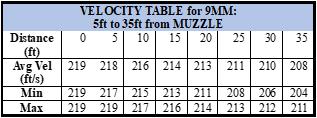 |
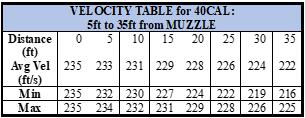 |
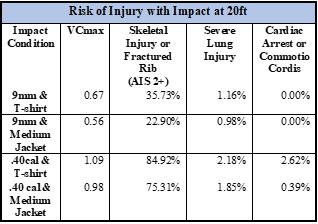 |
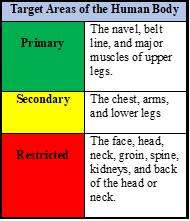 |
 |
Copies of the Company’s ballistics test reports and training documents are available upon written request.
| 35 |
Our Historical Growth and Growth Strategy
We have a global growth strategy for domestic and international professional markets of the law enforcement and security industries and have plans to develop a consumer version for global commercial markets in the next one to two years. We plan to first penetrate the U.S. law enforcement market through multiple sales and marketing initiatives to establish proof of concept with the goal to quickly gain market share soon thereafter. Our team utilizes various methods to market The Alternative®, including direct sales efforts, exhibiting at trade shows, conducting live demonstrations, and various email and online marketing campaigns. We also try to leverage the networks of our law enforcement team and our advisory board, and we work with a government relations firm to build awareness and gain political traction at the federal, state, and local levels, and with national associations and federal agencies. We have made connections with departments across the country that have expressed high interest in The Alternative®, and we believe that the sales cycle may be shortened once The Alternative® becomes more prominent in the field with successful domestic and international deployments.
After spending the better part of two years in R&D, we completed our ballistics testing in the fourth quarter of 2022, our comprehensive training program in the first quarter of 2023, and have since been introducing The Alternative® to the market in the U.S. and abroad. In December 2022, shortly after completing our ballistics testing, we were invited by the U.S. Consulate in Brazil to present at a special “Law Enforcement Showcase” event where we were one of ten U.S. companies to receive the special invitation to meet with Sao Paulo Civil Police and several other law enforcement agencies in country. In January 2023, we exhibited at our first major conference – the SHOT Show in Las Vegas, Nevada. We then exhibited at the National Sheriff’s Association Winter Conference in Washington, D.C. in February 2023. These events coupled with our various marketing initiatives have built a large audience through brand awareness and product knowledge by conducting key demonstrations and allowed us to be engaged for multiple active pilot programs in Texas, resulted in our first purchase order from a department in Florida, and may have generated anticipated purchase orders from several departments in South America.
The National Sheriff’s Association (“NSA”) has taken early interest in The Alternative® and assigned a technical advisor to follow our journey through its series of ballistics testing to follow our progress and assess the technology. After remaining in communication throughout the process, we received a commendation letter from the advisor recommending that the NSA provide an official product endorsement of The Alternative®. We are awaiting an imminent response as to next steps. We believe that this NSA endorsement could provide valuable credibility to the tireless work that went into developing and preparing our product for market, making the endorsement a highly anticipated development for us and our shareholders.
We have received a positive response to our first 12-month marketing campaign with Police1, the premier media platform for the global law enforcement industry, and we have just extended the campaign for a new 12-month term in August 2023. Our Company page on the platform has been instrumental in building awareness and interest with U.S. departments, especially with the latest publication of a series of three articles that tell the story of our journey with the concept of the technology, the testing that went into developing the technology, and the culmination of getting it on the duty belts of officers in the line of duty. Many of the departments where we are making inroads, have been in communications for the last six to 12 months, but we believe that the sales cycle may be shortened once The Alternative® has successful deployments.
We plan to continue expanding our international presence through our contacts at the U.S. Commercial Service by building business relationships with vetted and well-established affiliates, representatives, and distributors in foreign markets, as determined by this division of the U.S. Department of Commerce, which will coincide with our IP strategy where the filing window for international patents will open next year. We filed a new utility patent with the U.S. Patents and Trademarks Office (USPTO) in December 2021, which issued on January 31, 2023, as Patent No. 11,566,876. In 2022, this patent was also filed directly in multiple foreign markets where we are pursuing sales and manufacturing opportunities. In December 2022, this patent was also the basis of our PCT Application filing, where the international artwork search opinion was returned in February 2023 with no conflicts. This means that The Alternative® is a truly unique invention on a global scale, and that the path to international IP protection is clear in every country that recognizes the PCT. However, there can be no assurance that we will be able to acquire any desired patents.
| 36 |
Another significant development in the first quarter of 2023 was the completion of our training program, where deployment guidelines and protocols are developed and supported by ballistics data from the recently completed series of tests. We believe that the training program and ongoing training protocols are very important to a new technology in the field of law enforcement, which is why it was imperative for us to move forward with respect and credibility. After our first completed training course conducted by Chief Perez and lead trainer Jose Garcia, we received the following comment from the Chief Deputy of the our first pilot department in Texas, “Mr. LeBlanc, thanks for allowing me to be part of the Alternative Ballistics Trainer Program. The class and instructors were top notch. During my 35 years with Texas DPS I taught ‘general hazardous materials’ all over Texas and the U.S. so I know how hard it is to plan and carry out a successful class. I am now carrying the Dock and Projectile, and I talk about its use to everyone who asks about it. After that eight hour course, I became a believer, and now I’ve trained my deputies, and they’ve become believers as well. The Alternative® is a great product, and it has a place in my tool box.”
We expect that the training program will constitute our largest and most complex operation, as it will entail sending training teams throughout the country and eventually the globe on multiple day trips to conduct presentations, demonstrations, and training. This will involve traveling with weapons, inventory, and gear including custom targets and stands. We plan to expand the training team regionally with current and former law enforcement professionals. The program is built on repeatable practices and well-developed SOP’s to allow for scalability. After the initial training and qualification, deputies and officers will be required to requalify at least on an annual basis, and department instructors will be required to recertify on a bi-annual basis. These requirements for regularly scheduled, ongoing training, requalification, and replenishment is planned to comprise our recurring business model.
Our commercialization strategy includes two phases:
| ● | Phase 1 is our monetization initiatives, which consist of conducting certain public offerings and introductions of our business and products into the domestic and international professional markets. | |
| ● | Phase 2 is continued expansion in professional markets and the development of a consumer version to target the commercial market. |
In Phase 1, we are looking to contract at the local level with private security companies and municipal, county, tribal, and regional police departments, including sheriffs’ departments comprising patrol, corrections, and school resource officer populations. At the state level, we are aiming for state police and highway patrol. At the federal level, we are aiming for DHS agencies, such as Border Patrol, ICE, and Secret Service; DOJ agencies, such as ATF, DEA, FBI Police, U.S. Marshals, and Federal Bureau of Prisons; Department of Interior agencies, such as Bureau of Land Management (BLM), U.S. Park Ranger, and U.S. Park Police; and Legislative Branch, the U.S. Capitol Police. Phase 1 objectives also include international strategies with the PCT application process to protect our IP and begin discussions with countries around the world through the connection of USCS representatives.
In Phase 2, our focus will be on the continued expansion into the domestic and international professional markets, in addition to the development of a modified consumer version of The Alternative® for the commercial market. A prototype commercial version already exists, but we will need to begin a new round of R&D and testing to get the product ready for introduction to the commercial market.
As a unique less-lethal tool, we believe that The Alternative® is unlike any other option that is currently available to officers in the marketplace. Our technology fills a critical safety gap with an option that has not existed until now, however, we are unable to predict the market acceptance of our products or the level of future sales. We believe that The Alternative®, as a readily available option on the duty belt of an officer, provides a compelling tool to preserving life, optimizing officer safety, and mitigating the damage caused by firearm fatalities. Successful ballistics tests and high interest from law enforcement agencies here and abroad indicate that we are on target to begin fulfilling orders by the end of 2023 with an anticipated acceleration of orders in 2024 and beyond, however, there can be no assurance of the quantity or timeframe of orders or sales in the future. (See “Risk Factors.”)
Thorough Ballistics Testing of The Alternative®
We have had The Alternative® evaluated through extensive ballistics testing conducted by third-party, independent ballistics laboratories, including National Technical Systems (“NTS”) at its Chesapeake testing facility in Belcamp, Maryland (which has an accredited firing range approved by the National Institute of Justice (“NIJ”)) and Wayne State University in Detroit, Michigan.
| 37 |
We also retained one of the most respected independent data assessment and measurement companies in the United States, Sydor Technologies based in Fairport, New York, to review and analyze the data collected by NTS and Wayne State University.
Our goal in this rigorous third-party testing program was to confirm with solid empirical data that The Alternative® is truly a less-lethal option for police officers to use and, in particular, when deployed at close range (defined as zero to 35 feet) in an urgent tactical situation, The Alternative® will pose only modest but acceptable risk of serious bodily injury to a subject who has to be subdued and arrested.
Such detailed ballistic testing has thus measured and verified the precision and accuracy of the projectile when aimed at a subject within certain typical tactical distances from the officer, the velocity of the projectile at those distances from the officer, the delivered energy upon impact of the projectile and the likelihood of the projectile’s penetration of the subject’s skin and injury to any vital organs within the subject’s body.
Sydor Technologies has reviewed and assessed a good deal of our ballistics testing data and prepared a report entitled “Analysis of Results from Testing at Wayne State University.” Full copies of the Company’s ballistics test reports and additional ballistics data are available upon written request.
Objectives, Strategies, and Related Business Risks
Products and Services
| ● | Future Trends: establish proof of concept and demonstrate the value of our technology as a viable less-lethal application for the law enforcement industry. | |
| ● | Expectations: we expect that our technology can be recognized as a unique solution that fills a critical safety gap and provides an effective option for officers that has not been possible until now. | |
| ● | Objectives: our goal in 2023 is to establish proof of concept via pilot programs with several U.S. police departments and to generate revenue through full-paying contracts in the U.S. and abroad. | |
| ● | Strategies: building infrastructure and workflows in our operations to create repeatable practices and provide scalability for growth. |
Marketing and Revenue
| ● | Future Trends: work with partners to build brand awareness through multiple mediums. | |
| ● | Expectations: establish awareness and a strong following through multiple marketing campaigns, including through our law enforcement team’s professional credibility and expansive network, at the congressional level through our government relations firm, at the customer level through our media partners, at the global level through our international affiliates and distributors, and at the general public level through our social media campaigns, all of which may translate to revenue and gaining a foothold in the industry. | |
| ● | Objectives: our goal for 2023 is focusing on communications, proof of concept, and brand awareness to begin generating revenue in 2023. | |
| ● | Strategies: leverage our law enforcement team’s professional credibility and expansive network, our government relations firm for awareness at the congressional level, our media partners to build interest at the customer level (departments and agencies), our international affiliates and distributors for global expansion, and social media campaigns to build awareness with the general public. |
Research and Development
| ● | Future Trends: continue investing in R&D to expand firearm compatibility and begin developing the consumer model for the commercial market. | |
| ● | Expectations: strengthen our training program, expand our law enforcement team, and establish demand based on successful training and deployments. | |
| ● | Objectives: utilize ongoing R&D initiatives to build confidence in our technology, maximize public safety, and mitigate risk. | |
| ● | Strategies: continue working with our ballistics teams at NTS, Sydor Technologies, and Wayne State University for ongoing tests and data analysis on new models. |
| 38 |
Technology
| ● | Future Trends: protect our current IP and expand portfolio through additional U.S. patents and PCT application filings; ongoing product testing and implementation of automated assembly process. | |
| ● | Expectations: as we become known in the market and expand globally, we will continue to conduct thorough testing, develop new designs for firearm models, and develop processes to enhance scalability. | |
| ● | Objectives: be prepared to aggressively prosecute and enforce our IP protection, and for scalability, we will eventually need to implement an automated assembly process. | |
| ● | Strategies: continue working with our IP firm, Lynch LLP, on strengthening our IP portfolio and strategy on a domestic and international scale, including the prosecution of new patents and PCT applications, and the enforcement and litigation of our patents, should the need arise; automated assembly to yield an increase in productivity resulting in 20 units per minute on a sustained basis. |
Business Expansion or Restructuring
| ● | Future Trends: models for additional types of firearms in the law enforcement industry and models for the consumer market; ATF’s FITSB report (See “Our Business—Commercial Markets,”) allows us to operate with no manufacturing or selling/distribution restrictions; as the Company grows internationally, it may look to establish manufacturing in-country in given regions. | |
| ● | Expectations: new models of firearms may gain popularity and the consumer market is significantly larger than the law enforcement segment of the professional market; will be able to sell consumer version as eCommerce, through distributors, and/or through general retail/sporting goods stores. We expect to participate in both markets and hopefully with significant market share in each; if growth and margins can be optimized by a local presence we would consider establishing operations in-country. | |
| ● | Objectives: optimize all manufacturing and sales initiatives; with additional capital, we can begin development on docking molds for firearms that are gaining popularity in the law enforcement industry; begin R&D on the consumer version later this year after we’ve established proof of concept in the law enforcement vertical; and look for ways to optimize growth and margins with regard to production and order fulfillment. | |
| ● | Strategies: work with design engineering teams to stay current on popular firearm models and establish cost effective methods to build new molds, and maximize production, fulfillment, and shipping strategies domestically and internationally. |
Employment or Compensation
| ● | Future Trends: we intend to scale relative to revenue growth, which will result in the strategic hiring of key personnel in the areas of sales, marketing, operations, IT, accounting, legal, administration, and regional law enforcement representatives. | |
| ● | Expectations: the capacity to sustain key employees, as well as diversify and expand personnel, should result in our ability to maintain a full-time staff. | |
| ● | Objectives: execute on growth initiatives in order to attract top tier talent to enhance our goals and objectives; this includes expanding our advisory board with high level professionals with law enforcement, political and business backgrounds. | |
| ● | Strategies: align employment and compensation objectives to complement our vision and execution of our growth initiatives, and to enhance our public appearance through strategic hiring. |
Manufacturing and Production
We are currently able to manufacture the projectiles both domestically and internationally, and the docking units are currently manufactured domestically. While there can be no guarantees on product costs and/or suppliers, our team continues to explore contingency options, should any disruptions occur with our current suppliers. We outsource via contract manufacturing (“CM”) to multiple vendors so that we limit our reliance on a sole source.
We have multiple suppliers for each component of our platform, which includes the alloy projectile, the plastic docking unit, and the custom holster. Once the projectiles and docking units are produced, we have an in-house assembly and shipping operation. Our goal is to balance a significant volume of product ready to supply departments with necessary quantities in a timely manner, however, the volatility of the shipping industry, including freight and fuel costs, backlog, and delays may adversely impact our manufacturing, production, and supply operations.
| 39 |
Competition
Based on the LLA market in 2022 with a size of $850 million,20 some of the leading competitors in the space include, but are not limited to Combined Systems, Inc.; Amtech Less Lethal Systems; Nonlethal Technologies, Inc.; Wrap Technologies, Inc.; and Axon Ent. Unlike us, these companies are not start-up companies and have significant operations and historical data upon which to evaluate their business.
All aforementioned companies produce standalone devices. In contrast, The Alternative® attaches to the firearm (an already held device on an officer’s duty belt), giving an operator the flexibility of a multi-purpose tool. We believe that this key differentiator allows us to not compete for market share but rather carve out a new segment of the market for our next generation technology.
Intellectual Property
Patents
The following table gives details of our existing patents. In September 2020, we acquired Alternative Ballistics, L.P. (the LP). Upon completion of the acquisition, the first four patents in the table below were transferred and reassigned to us as the new owner of all rights to the intellectual property. In December 2021, we filed a new utility patent that was issued in January 2023 as patent number 11566876, which has since been directly filed in several other foreign markets as listed below, including a PCT Application that was filed in December 2022. Also in December 2022, we filed a continuation application on our latest U.S. patent, which has since issued in January 2023, to start a new family of patents. We intend to strengthen our international IP protection when the PCT filing window opens in June 2024.
| Patent Application No. | Patent No. | Patent Name | Date Filed | Date Issued | Location | |||||
| 11/353875 | 7526999 | Less-Lethal Force Device | 2/13/2006 | 5/5/2009 | USPTO | |||||
| 14/183455 | 9612074 | Less-Lethal Force Device-Impact Ratio | 2/18/2014 | 4/4/2017 | USPTO | |||||
| 14/598555 (continuation of 14/183455) | 9823033 | Less-Lethal Force Device-Impact Ratio | 1/16/2015 | 11/21/2017 | USPTO | |||||
| 15/386281 | 10295291 | Less-Lethal Force Device | 12/12/2016 | 5/21/2019 | USPTO | |||||
| 17/644060 | 11566876 | Bullet Capturing Ballistic Slugs | 12/13/2021 | 1/31/2023 | USPTO | |||||
| BR 10 2022 008832 2 | Pending | Bullet Capturing Ballistic Slugs | 5/13/2022 | Pending | Brazil | |||||
| 1-2022-02498 | Pending | Bullet Capturing Slugs | 5/13/2022 | Pending | Vietnam | |||||
| 20220103403 | Pending | Bullet Capturing Slugs | 12/13/2022 | Pending | Argentina | |||||
| 2022-000260 | Pending | Bullet Capturing Slugs | 12/13/2022 | Pending | Venezuela | |||||
| 22107593 | Pending | Bullet Capturing Slugs | 12/13/2022 | Pending | Paraguay | |||||
| PCT/US2022/81356 | N/A | International Patent Application for Bullet Capturing Slugs | 12/12/2022 | 2/1/2023 (International Artwork Search Complete) | USPTO/International Bureau | |||||
| 18/146953 | Pending | Continuation Patent Application | 12/27/2022 | Allowed | USPTO |
20 Global Less Lethal Ammunition Market Overview, By: Sejar Akre, Market Research Future, July 2023
| 40 |
Trademarks
The following table gives details of our existing trademarks.
| Matter Number | Title | Serial No. | Registration No. | G & S | ||||
| 534-00003 | THE ALTERNATIVE | 77410543 | 3519634 | Less-lethal projectile, namely, a rounded metal block encapsulated in rubber, discharged from a pistol to temporarily incapacitate a person | ||||
| 534-00004 |
ALTERNATIVE BALLISTICS LOGO [old version] |
85667538 | 4712832 | Less-lethal projectile discharged from a pistol or other firearm | ||||
| 534-00005 | ALTERNATIVE BALLISTICS LOGO 2
|
90411439 | Pending | Amended 4/8/2022 to: Firearm attachments having a mount for attaching bullet capturing projectiles and bullet capturing projectiles, sold as a unit or individually [Originally filed as: Weaponry, namely, less-lethal projectile discharged from a pistol or other firearm] | ||||
| 534-00006 | THE ALTERNATIVE | 97/352515 | Pending | Firearm attachments having a mount for attaching bullet capturing projectiles and bullet capturing projectiles, sold as a unit or individually | ||||
| 534-00007 | ALTERNATIVE BALLISTICS | 97/352517 | Pending | Firearm attachments having a mount for attaching bullet capturing projectiles and bullet capturing projectiles, sold as a unit or individually | ||||
| 534-00008 | ALTERNATIVE BALLISTICS LOGO B&W | 97/352524 | Pending | Firearm attachments having a mount for attaching bullet capturing projectiles and bullet capturing projectiles, sold as a unit or individually | ||||
| 534-00011
[Madrid System\WIPO] |
THE ALTERNATIVE | 1662198 | 1662198 | Firearm attachments having a mount for bullet capturing projectiles and bullet capturing projectiles, sold as a unit | ||||
| 534-00011 Brazil |
THE ALTERNATIVE | 501662198 | 501662198 | Firearm attachments having a mount for bullet capturing projectiles and bullet capturing projectiles, sold as a unit | ||||
| 534-00011 Vietnam | THE ALTERNATIVE | 1662198 | 1662198 | Firearm attachments having a mount for bullet capturing projectiles and bullet capturing projectiles, sold as a unit | ||||
| 534-00012 [Madrid System\WIPO] |
ALTERNATIVE BALLISTICS | 1662593 | 1662593 | Firearm attachments having a mount for bullet capturing projectiles and bullet capturing projectiles, sold as a unit | ||||
| 534-00012 Brazil |
ALTERNATIVE BALLISTICS | 501662593 | 501662593 | Firearm attachments having a mount for bullet capturing projectiles and bullet capturing projectiles, sold as a unit | ||||
| 534-00012 Vietnam | ALTERNATIVE BALLISTICS | 1662593 | 1662593 | Firearm attachments having a mount for bullet capturing projectiles and bullet capturing projectiles, sold as a unit | ||||
| 534-00013 [Madrid System\WIPO] |
ALTERNATIVE BALLISTICS LOGO B&W | 1662596 | 1662596 | Firearm attachments having a mount for bullet capturing projectiles and bullet capturing projectiles, sold as a unit | ||||
| 534-00013
Brazil |
ALTERNATIVE BALLISTICS LOGO B&W | 501662596 | 501662596 | Firearm attachments having a mount for bullet capturing projectiles and bullet capturing projectiles, sold as a unit | ||||
| 534-00013 Vietnam | ALTERNATIVE BALLISTICS LOGO B&W | 1662596 | 1662596 | Firearm attachments having a mount for bullet capturing projectiles and bullet capturing projectiles, sold as a unit |
| 41 |
Human Capital
As of the date of this Offering Circular, we have six full-time employees and five part-time employees. None of our employees are members of a labor union or covered by a collective bargaining agreement.
Properties
We currently do not own any real property. We lease office space at 5940 S. Rainbow Blvd, Las Vegas, Nevada 89118 for $1,952 per month for a term of one year, expiring on July 31, 2024. We also sublease office space at 12636 High Bluff Drive, Suite 400, San Diego, California 92130 for $500 per month on a month to month basis.
Seasonality
We do not experience seasonal variations in our quarterly operating results and capital requirements.
Legal Proceedings
We are not party to any legal proceedings the resolution of which we believe would have a material adverse effect on our business, prospects, financial condition, liquidity, or results of operation. However, we may from time to time after the date of this Offering Circular become subject to claims and litigation arising in the ordinary course of business. One or more unfavorable outcomes in any claim or litigation against us could have a material adverse effect for the period in which such claim or litigation is resolved. In addition, regardless of their merits or their ultimate outcomes, such matters are costly, divert management’s attention, and may materially adversely affect our reputation, even if resolved in our favor.
| 42 |
Directors and Executive Officers
We are managed by our directors and executive officers. Our Board of Directors consists of three directors, none of whom are independent. Our directors serve for one-year terms and until their successors are duly elected and qualified. Set forth below are the names, ages, and positions of our directors and executive officers as of the date of this Offering Circular:
| Name | Age | Position | ||
| Steven Luna | 39 | Chief Executive Officer and Director | ||
| Jason LeBlanc | 49 | Chief Operations Officer and Director | ||
| Vanessa Luna | 40 | Executive Vice President and Chairperson of the Board | ||
| Richard Nagle | 52 | Chief Financial Officer |
Biographical Information
Steven Luna, Chief Executive Officer and Director
Mr. Luna brings a wide range of business skills to the Alternative Ballistics team from his experience in various sectors of the legal and technology industries and through his time as VP of his own business and investor relations consulting firm.
Mr. Luna began his career in 2009 in the legal industry working in the investigations division for one of the nation’s leading litigation support companies. In 2013, Mr. Luna transitioned from legal into the marketing technology sector as a regional account executive providing web development and search engine optimization (SEO) services for key clients in Los Angeles and Orange County, California, which was his first exposure to the public markets through a company named LiveDeal (NASDAQ:LIVE). In 2013, he became Senior Advisor of Investor Relations for a Las Vegas, Nevada firm, and from there he launched a consultant group with two of his partners, where they focused on business development and investor relations for private and public entities. His career expertise in the public markets enabled Mr. Luna to assist over two dozen publicly traded companies on OTC and NASDAQ to create investor awareness and maintain or increase operational efficiencies. Mr. Luna has been instrumental in business execution, public and investor relations, product launch, effective go-to-market strategies, and realized revenue.
In the short time after joining our team, Mr. Luna has achieved several significant accomplishments, which include the successful reorganization of the Company into the newly formed Alternative Ballistics Corporation, the assembly of a dynamic team and strategy to fulfill The Alternative® mission, and the commencement of critical initiatives for further testing and product launch. Coming from a law enforcement family, Mr. Luna has always held his support for law enforcement in high regard, and he intends to deliver our technology, an effective less-lethal option designed with officer safety in mind, to law enforcement agencies across the country.
Jason LeBlanc, Chief Operations Officer and Director
Mr. LeBlanc provides a wide range of professional acumen to the Alternative Ballistics team related to business development, operations, compliance, and consulting skills, which he has built through his experience in the legal, fintech, and finance industries. From 2008 to 2018, Mr. Leblanc started as a Court Department Manager and ascended through the ranks becoming the San Diego Senior Division Partner of First Legal, a premier litigation support company working with some of the largest law firms in the world, with over 13 locations throughout California, Nevada, and Arizona. At First Legal, he served as the Regional Director overseeing all aspects of the business from sales and development, to operations. He led a team of more than 30 employees and was responsible for the San Diego region’s profit and loss, which ranked in the company’s top three performers out of all locations as well as for profit margin and the lowest employee turnover rate in the company.
| 43 |
After his ten-year tenure at First Legal, in 2018, he moved into an OTC fintech company, first as Director of Business Development and then as Chief Operations Officer, where he helped the company realize millions of dollars in revenue within his first year as a C-Level executive. From the Chief Operations position, he moved to Chief Compliance Officer, where he was instrumental in government relations activities, presenting to regulators and legislators in several states, including California, Washington, Nevada, Ohio, and New Jersey.
Mr. LeBlanc has successfully built and led sizeable, motivated teams to drive revenue and take multiple products to market across various sectors. In his role as our Chief Operations Officer, Mr. LeBlanc works on all aspects of the business, taking a holistic approach to developing strategic positions that enable us to scale and play to the strengths of each team member, designing a roadmap for our growth and success. He is focused on bringing The Alternative® to market in an efficient and responsible manner with critical initiatives that enhance the training program, testing, and liability/IP protection, in addition to developing marketing and government relations strategies at the federal, state, and local levels.
Vanessa Luna, Executive Vice President and Chairperson of the Board
Ms. Vanessa Luna is a seasoned professional with an extensive background in business development, operations, and organizational growth initiatives. In her more than 20 years of professional experience, Ms. Luna has held multiple C-Suite, Director, Board, and management-related positions where her experience and keen business acumen have been crucial in driving significant growth and profitability as well as the development and launch of initiatives focused on maximizing internal processes and procedures to create a more productive work environment. This experience includes executive and management roles at OTC, NASDAQ, and Fortune 500 companies, the American Red Cross, and some of the nation’s leading service organizations in the private sector including legal, prepaid card, financial, construction, technology, real estate, high-risk, and other service industries. More recently, Ms. Luna worked at GreenBox POS (now, RYVYL, Inc.) from 2021 through 2022 (NADSAQ:RYVL); Global Payout, Inc. from 2016 through 2020 (OTCPINK:PSYC); Luna Consultant Group, LLC from 2015 to Present; and LiveDeal Inc. in 2013 (NASDAQ:LIVE).
Her prior and ongoing experience remain as an acting CEO to Luna Consultant Group, LLC (“LCG”) a private corporate strategy, communications, and business development firm which she co-founded in January 2015 where she works to drive profitability and bring awareness to small-to-mid-cap companies across a diverse range of professional sectors representing both public and private clientele. Ms. Luna has worked with over two dozen publicly traded companies and continues to consult for public companies.
In her role at Alternative Ballistics Corporation as Chairperson and Executive Vice President, Ms. Luna works on all aspects of corporate strategy, funding, communications, and policies oversight, with an emphasis on maximizing Company output to work toward attaining organizational goals and fulfilling obligations to all stakeholders. She is focused on working alongside the executive management team to bring The Alternative® to market, and to gain global recognition for the Company’s mission of “Saving lives and protecting officers in the line of duty.”
Richard Nagle, Chief Financial Officer
Mr. Nagle is a highly skilled finance professional with extensive experience working in high-level positions with companies, such as Ernst & Young as a lead auditor from 2000 through to 2005; Barnes & Noble as Controller-Head of Finance from 2010 through 2014 overseeing the Nook product launch and subsequent growth from a start up to over $1 billion in annual revenue; and DivX, Inc. from 2018 through 2023 as CFO, a software company that is known for pioneering the digital video experience.
Mr. Nagle brings financial expertise to the Alternative Ballistics team in strategic initiatives, reporting to the Commission, and operations and controls, which he has gained through “Big 4” public sector and private experience, including but not limited to manufacturing, innovative software and hardware distribution, and compliance industries. He has successfully built results oriented financial operations that have aided and supported companies through exponential revenue growth, while keeping best in class control environments.
In his role as Alternative Ballistics’ Chief Financial Officer, Mr. Nagle works on all strategic financial reporting and supporting control environment initiatives of the business to enable continued growth, fulfilling a critical role in the Company’s financial audit, and establishing financial and accounting best practices, which will be instrumental as we continue to pursue our anticipated growth.
| 44 |
LAW ENFORCEMENT CONSULTANT
Alex Perez, Strategic Law Enforcement Consultant
Chief Perez (ret.), a 28-year veteran of the North Las Vegas Police Department (the “NLVPD”), recently completed his honorable and decorated career serving as the city’s top law enforcement leader. Starting as a Patrol Officer in the early 90s, he steadily rose through the ranks to working as a Narcotics Investigator on an FBI Task Force and transitioning to a position with the Joint Terrorism Task Force shortly after 9/11. He continued earning promotions to Sergeant and Lieutenant before graduating from the FBI National Academy #245 in 2011. He became Assistant Chief shortly before settling into his executive leadership role in 2015, as the City’s first Latino Chief of Police.
During his time as the City’s top cop, Chief Perez expanded the NLVPD force from 245 officers to 350 sworn officers and oversaw a team of over 150 civilian support staff. He was an innovative public official, who managed financial aspects of the department by securing and monitoring the use of budgetary monies and prepared requests to government agencies to obtain funds for special operations and equipment for the department.
Chief Perez’s success was defined by his ability to bring the community together through action and dialogue. He cultivated inclusiveness, mutual trust, transparency, and respect within the department and with the public. One of his remarkable achievements was starting the Hispanic Citizen’s Academy to educate Spanish speaking citizens on how law enforcement works, which successfully bridged a stronger relationship between the community and the department.
Chief Perez is widely regarded as one of the most effective chiefs to serve the City of North Las Vegas, and he remains a member of various law enforcement associations, such as the Nevada Sheriffs & Chiefs Association, the International Association of Chiefs of Police, and the Latino Peace Officers Association. He is a current board member of 10,000 Kids and Nevada Child Seekers, two non-profit organizations that focus on community initiatives in Nevada and around the country, which include assisting families and law enforcement in the location of missing children and putting an end to child trafficking.
In his role as Alternative Ballistics’ Strategic Law Enforcement Consultant, Chief Perez plans to leverage his deep experience as a police officer and public official to help articulate and lend credibility to our mission. He plans to connect with federal, state, and local law enforcement leaders across the country to share his vision and support of The Alternative®, as an expedient less-lethal device that is accurate and effective in stopping threats at longer ranges and designed with officer safety in mind.
Board Composition
Our Bylaws provide that the Board of Directors shall consist of at least one member, and that our Board shall determine the number of directors from time to time. Each director serves for a term that expires until the next annual meeting of shareholders or until their successor shall have been elected and qualified, or until their earlier resignation, removal from office, or death.
Committees of the Board of Directors
We do not presently have a separately constituted audit committee, compensation committee, nominating committee, or any other committees of our Board of Directors. As such, our entire Board of Directors handles matters related to audit, compliance, compensation, and nominations of directors.
Advisory Board
Our Board approved the establishment of an Advisory Board on August 14, 2023 of three to five members to provide advisory services to us, including utilizing their networks to introduce The Alternative, advise us on potential market penetration, and counsel us on public policy initiatives.
| 45 |
Our Advisory Board is mandated to meet no less than once per month and to have an annual weekend retreat to discuss strategic initiatives for the following year.
We plan to compensate the members of our Advisory Board $5,000 per calendar quarter, payable in arrears, and $20,000 worth of common stock, based on the current “Fair Market Value,” which shall be determined by the Board of Directors or, if the common stock is traded or quoted on an exchange or over the counter marketplace, by the average of the last sale price of the common stock for the ten trading days prior to the last day of the calendar quarter.
Currently, we have two persons on our Advisory Board.
Kevin Faulconer
Kevin Faulconer is a distinguished expert in governance, public policy, and operational improvement in large organizations. Mr. Faulconer served as the 36th Mayor of San Diego from 2014 to 2020. He also served in several national organizations, and as vice president at the global public relations firm, Porter Novelli, specializing in strategic crisis management and public affairs. He is currently a strategic advisor at Collaborate for California and Visiting Fellow at Pepperdine University School of Public Policy.
Shelley Zimmerman
Shelley Zimmerman is a former chief of police of the San Diego Police Department (the “SDPD”). She retired in 2018 after a 35-year career with SDPD. She is a sought-after speaker on the myriad of challenges and opportunities policing brings in the 21st century. During her law enforcement career, she held numerous assignments, including vice and narcotics undercover work, executive protection, large-scale event and protest management, night field lieutenant, and community policing outreach. As Chief of Police, she instituted new policies, procedures, and initiatives and brought in new technology. Chief Zimmerman believes public safety must be a shared responsibility, with everyone playing a role in keeping their communities safe. While she was chief, San Diego experienced historically low crime rates, including the lowest homicide rate per capita of any of the largest cities in the country. Chief Zimmerman holds a master’s degree from National University and a bachelor’s degree from The Ohio State University. She is also a graduate of the FBI National Academy 241st Session.
Family Relationships
Steven Luna, CEO, and Vanessa Luna, EVP, are brother and sister.
Director Independence
As of the date of this Offering Circular, we have no independent directors.
Significant Employees
We have no significant employees other than the executive officers described above.
Involvement in Certain Legal Proceedings
No
director, person nominated to become a director, executive officer, promoter or control person of our Company has, during the
last ten years: (i) been convicted in or is currently subject to a pending criminal proceeding (excluding traffic violations and other
minor offenses); (ii) been a party to a civil proceeding of a judicial or administrative body of competent jurisdiction and as a result
of such proceeding was or is subject to a judgment, decree or final order enjoining future violations of, or prohibiting or mandating
activities subject to any federal or state securities or banking or commodities laws including, without limitation, in any way limiting
involvement in any business activity, or finding any violation with respect to such law, nor (iii) has any bankruptcy petition
been filed by or against the business of which such person was an executive officer or a general partner, whether at the time of the
bankruptcy or for the two years prior thereto.
| 46 |
EXECUTIVE AND DIRECTOR COMPENSATION
Executive Compensation
The table below summarizes the total compensation paid or earned by our executive officers for the years ended December 31, 2022 and 2021:
| Name and Principal Position | Year | Salary ($) | Stock Awards ($) | Option Awards ($) | All Other Compensation ($) | Total ($) | ||||||||||||||||||
| Steven Luna, Chief Executive Officer | 2022 | 155,000 | 125,000 | - | 280,000 | |||||||||||||||||||
| and Director (1) | 2021 | 121,458 | 125,000 | - | 15,000 | (5) | 261,458 | |||||||||||||||||
| Jason LeBlanc, Chief Operations Officer | 2022 | 130,000 | 125,000 | - | 255,000 | |||||||||||||||||||
| And Director (1)(2) | 2021 | 91,250 | 275,000 | - | 4,000 | (5) | 370,250 | |||||||||||||||||
| Vanessa Luna, Executive Vice President and | 2022 | 116,750 | 250,000 | - | 11,235 | (5) | 377,985 | |||||||||||||||||
| Chairperson of the Board (3) | 2021 | - | - | - | 25,000 | (5) | 25,000 | |||||||||||||||||
| Richard Nagle, Chief Financial Officer(4) | 2022 | 41,000 | 250,000 | - | - | 291,000 | ||||||||||||||||||
| 2021 | - | 50,000 | - | 15,000 | (5) | 65,000 | ||||||||||||||||||
| (1) | Reflects a semiannual stock award of 1,250,000 shares of common stock with a value of $0.10 per share. | |
| (2) | Reflects a semiannual stock award of 2,750,000 shares of common stock with a value of $0.10 per share. | |
| (3) | Executive started their position on January 1, 2022, as Chairperson at an annual salary of $72,000, and started position as Executive Vice President on April 1, 2022, increasing their annual salary to $125,000. | |
| (4) | Executive began employment with the Company January 1, 2022 with an annual salary of $36,000, starting bonus of $5,000, and an annual stock award of 2,500,000 shares of common stock with a value of $0.10 per share. Executive was an independent contractor in 2021, and all compensation and stock awards during 2021 were paid as such. | |
| (5) | All Other Compensation reflects independent contractor earnings prior to employment by the Company. |
Narrative to Summary Compensation Table
We believe that the primary goal of executive compensation is to align the interests of our executive officers with those of our shareholders in a way that allows us to attract and retain the best executive talent.
Annual Base Salary. Base salary is designed to compensate our named executive officers at a fixed level of compensation that serves as a retention tool throughout the executive’s career. In determining base salaries, our Board of Directors considers each executive’s role and responsibilities, unique skills, future potential with us, salary levels for similar positions in our market, geographical location, and internal pay equity.
Option Awards. We plan to offer option awards to executives and other employees, in the discretion of the Board of Directors, considering the executive’s role and other compensation.
Health/Welfare Plans. We do not yet have a healthcare plan available to our employees. However, each Executive was entitled to a medical stipend of up to $1,000 per month in 2021 and 2022.
Employment Agreements with our Named Executive Officers
Each of our executive officers had employment agreements with the Company (the “Original Executive Employment Agreements”), pursuant to which each Executive Officer was entitled to an aggregate of 12,500,000 shares of common stock (the “Vesting Common Stock”), vesting in equal tranches of 1,250,000 shares every six months, subject to their continued employment with the Company.
In consideration of the work involved with this Offering and in entering into Amended and Rested Employment Agreements (the “A&R Employment Agreements”) as well as to ensure that the Executive Officers can maintain significance in corporate actions in light of this Offering, the Board accelerated the vesting of the Vesting Common Stock, such that all shares of Vesting Common Stock were deemed vested as of August 4, 2023, resulting in each Executive Officer being issued the remaining unvested portion of the 12,500,000 shares of Vesting Common Stock granted in the Original Executive Employment Agreements.
| 47 |
Each of our executive offers entered into the A&R Employment Agreements on August 24, 2023, for one-year terms, subject to renewal. Each of the A&R Employment Agreements include the following terms:
Medical Stipend. The Executive Officer is entitled to a medical stipend of $2,000 per month.
PTO Plan. The Executive Officer is entitled to unlimited PTO, subject to prior approval by the CEO or EVP, so long as doing so is consistent and in balance with their job responsibilities and business needs.
Golden Parachute. Each of our Executive Officers have golden parachute provisions in their employment contracts in the event there is a change-in-control of the Company, which includes a lump sum cash payment of three times of the Executive Officer’s annual salary, cash bonus, and incentive awards.
Severance Payments. Executives are entitled to severance payments in the event of a termination without cause, which include a lump sum payment of two times the Executive Officer’s annual salary, cash bonus, and incentive awards.
Compensation Terms for Steven Luna
Steven Luna is entitled to annual compensation of $250,000 and a restricted stock grant of $2,500,000 worth of shares of common stock per annum, vesting in four equal installments every quarter, granted at the fair market value on the effective date of the Employment Agreement.
Compensation Terms for Jason LeBlanc
Jason LeBlanc is entitled to annual compensation of $200,000 and a restricted stock grant of $1,500,000 worth of common stock per annum, vesting in four equal installments every quarter, granted at the fair market value of the common stock as of the effective date of the A&R Employment Agreement.
Compensation Terms for Vanessa Luna
Vanessa Luna is entitled to annual compensation of $225,000 and a restricted stock grant of $2,000,000 worth of common stock per annum, vesting in four equal installments every quarter, granted at the fair market value of the common stock as of the effective date of the A&R Employment Agreement.
Compensation Terms for Richard Nagle
Richard Nagle is entitled to annual compensation of $200,000 and a restricted stock grant of $1,500,000 worth of common stock per annum, vesting in four equal installments every quarter, granted at the fair market value of the common stock as of the effective date of the A&R Employment Agreement.
As part of the Executive Employment Agreements, each executive has the option of election to defer a portion or all of their annual salary. At the time of this filing, each executive has elected to defer a portion of their annual salary.
Long-Term Incentive Plan Awards
We established the 2021 Omnibus Equity Compensation Plan (the “2021 Equity Compensation Plan”), effective July 15, 2021, for the benefit of the directors, executives, independent contractors, and key employees. Awards under the 2021 Equity Compensation Plan may be made in the form of (i) Incentive Stock Options; (ii) Nonqualified Stock Options; (iii) Stock Appreciation Rights; (iv) Restricted Stock; (v) Deferred Stock; (vi) Stock Awards; (vii) Performance Shares; and (viii) Other Stock-Based Awards.
Administration. The Plan is administered by the Board of Directors, and once established, will be administered by the Compensation Committee.
| 48 |
Authorized Shares. The aggregate number of shares reserved for issuance under the 2021 Equity Compensation Plan is 12,500,000 shares of common stock.
Stock Options. Stock options may be granted under the 2021 Equity Compensation Plan. The exercise price of options granted under our 2021 Equity Compensation Plan must at least be equal to the fair market value of our common stock on the date of grant. The term of an incentive stock option may not exceed ten years, except that with respect to any participant who owns more than 10% of the voting power of all classes of our outstanding stock, the term must not exceed five years and the exercise price must equal at least 110% of the fair market value on the grant date. The administrator will determine the methods of payment of the exercise price of an option, which may include cash, shares, or other property acceptable to the administrator, as well as other types of consideration permitted by applicable law. After the termination of service of an employee, director, or consultant, they may exercise their options for the period of time stated in their option agreement. Generally, if termination is due to death or disability, the option will remain exercisable for 12 months. In all other cases, the option will generally remain exercisable for three months following the termination of service. However, in no event may an option be exercised later than the expiration of its term. Subject to the provisions of our 2021 Equity Compensation Plan, the administrator determines the other terms of options.
Stock Appreciation Rights. Stock Appreciation Rights may be granted in connection with Stock Options. The administrator determines whether payment with respect to exercise shall be made in cash, stock, or a combination thereof.
Restricted Stock. Terms of the Restricted Stock Awards will be determined by the administrator, including price, length, restrictions, lapse of restrictions, dividends, and distributions. If employment terminates prior to the vesting of the award, then the shares are forfeited.
Stock Awards
The administrator is authorized to grant Stock Awards and will, in their sole discretion, determine the recipients and the number of shares of common stock underlying each Stock Award. Each Stock Award will be subject to such terms and conditions consistent with the 2021 Equity Compensation Plan as determined by the administrator and as set forth in an Award agreement, including, without limitation, restrictions on the sale or other disposition of such shares and our right to reacquire such shares for no consideration upon termination of the Participant’s employment or membership on the board, as applicable, within specified periods.
Performance Shares
The administrator is authorized to grant Performance Awards and will, in their sole discretion, determine the recipients and the number of shares of common stock that may be subject to each Performance Award. Each Performance Award will be subject to such terms and conditions consistent with the 2021 Equity Compensation Plan as determined by the administrator and as set forth in an Award agreement. The administrator will set performance targets at their discretion which, depending on the extent to which they are met, will determine the number of Performance Awards that will be paid out to the Participants and may attach to such Performance Awards one or more restrictions. Performance targets may be based upon, without limitation, Company-wide, divisional, and/or individual performance.
Section 409A of the Code
Awards under the 2021 Equity Compensation Plan are intended either to be exempt from the rules of Section 409A of the Code or to satisfy those rules and shall be construed accordingly. However, we will not be liable to any Participant or other holder of an Award with respect to any Award-related adverse tax consequences arising under Section 409A or other provision of the Code.
Section 422 of the Code
The 2021 Equity Compensation Plan provides for the grant of incentive stock options within the meaning Section 422 of the Code.
Awards Granted
As of the date of this Offering Circular, there have been no awards granted under the 2021 Equity Compensation Plan.
Director Compensation
Our Directors are currently not compensated for their services as a Director. All three of our Directors are also executive officers, whose compensation is fully reflected in the compensation table above.
| 49 |
CERTAIN RELATIONSHIPS AND RELATED-PARTY TRANSACTIONS
Family Relationship
Our Chief Executive Officer, Steven Luna, and Executive Vice President, Vanessa Luna are brother and sister.
Engagement of Luna Consultant Group, LLC
Vanessa Luna is the owner of an independent consulting firm, Luna Consultant Group, LLC dba “LCG.” Prior to her full-time employment beginning in April 2022, LCG (through Ms. Luna) provided consultation services to us in order to assist in the completion of the original acquisition and business development services. Ms. Luna is expected to continue to operate LCG. We may, in the future, engage LCG for related services in the areas of communications and marketing on market standard terms.
Policies and Procedures for Transactions with Related Persons
The above transactions were approved by our Board of Directors. All future related party transactions will be voted upon by the disinterested members of the Board of Directors. The Board of Directors is responsible for evaluating each related party transaction and making a recommendation to the disinterested members of the Board of Directors as to whether the transaction at issue is fair, reasonable and within our policy and whether it should be ratified and approved. The disinterested members of the Board will consider various factors, including the benefit of the transaction to us, the terms of the transaction, and whether they are at arm’s-length and in the ordinary course of our business, the direct or indirect nature of the related person’s interest in the transaction, the size and expected term of the transaction, and other facts and circumstances that bear on the materiality of the related party transaction under applicable law and listing standards. The Board of Directors will review, at least annually, a summary of our transactions with our directors and officers and with firms that employ our directors, as well as any other related person transactions.
| 50 |
SECURITY OWNERSHIP OF CERTAIN BENEFICIAL OWNERS, MANAGEMENT, AND SELLING STOCKHOLDERS
Immediately prior to the completion of this Offering, there are 132,645,746 shares of our common stock outstanding as of the date of this Offering Circular. The following table sets forth the beneficial ownership of our common stock immediately prior to and immediately after the completion of this Offering (assuming that we raise the Maximum Offering) by:
| ● | each of our directors; | |
| ● | each of our named executive officers; | |
| ● | all of our directors and executive officers as a group; and | |
| ● | each person known by us to be the beneficial owner of 5% or more of our outstanding common stock. |
The percentage ownership information after the Offering assumes the issuance of shares of common stock for the Maximum Offering amount in this Offering.
We have determined beneficial ownership in accordance with the rules of the Commission. These rules generally attribute beneficial ownership of securities to persons who possess sole or shared voting power or investment power with respect to those securities. In addition, the rules include shares of common stock issuable pursuant to the exercise of stock options and warrants that are either immediately exercisable or exercisable on or before the date which is 60 days after the date of this Offering Circular. These shares are deemed to be outstanding and beneficially owned by the person holding those options and warrants for the purpose of computing the percentage ownership of that person, but they are not treated as outstanding for the purpose of computing the percentage ownership of any other person. Unless otherwise indicated, the persons or entities identified in this table have sole voting and investment power with respect to all shares shown as beneficially owned by them, subject to applicable community property laws.
| Amount and Nature of Beneficial Ownership | ||||||||||||||||||||
| Name and Address of Beneficial Owner (1) | Shares Owned Immediately Prior to this Offering | Percentage Immediately Prior to this Offering | Shares Owned Immediately After this Offering | Percentage Immediately After this Offering | ||||||||||||||||
| Directors and Named Executive Officers: | ||||||||||||||||||||
| Steven Luna, Chief Executive Officer and Director | 18,500,000 | 13.95 | % | 18,500,000 | 13.35 | % | ||||||||||||||
| Jason LeBlanc, Chief Operations Officer and Director | 17,000,000 | 12.82 | % | 17,000,000 | 12.27 | % | ||||||||||||||
| Vanessa Luna, Executive Vice President and Chairman of the Board | 22,528,250 | (2 | ) | 16.98 | % | 22,528,250 | 16.26 | % | ||||||||||||
| Richard Nagle, Chief Financial Officer | 17,000,000 | 12.82 | % | 17,000,000 | 12.27 | % | ||||||||||||||
| All directors and executive officers as a group (four persons) | 75,028,250 | 56.56 | % | 75,028,250 | 54.16 | % | ||||||||||||||
| (1) | The address for all of the officers and directors is 5940 S. Rainbow Blvd., Las Vegas, NV 89118. |
| (2) | Includes 5,528,250 shares of common stock owned by Luna Consultant Group, LLC. |
| 51 |
The following table sets forth the names of the Selling Stockholders, the number of shares of our common stock beneficially owned by such Selling Stockholders before this Offering, the number of shares that may be offered for such Selling Stockholders for their account and the number and (if 1% or more) the percentage of the class to be beneficially owned by such Selling Stockholders after completion of the Offering. The number of shares owned are those beneficially owned, as determined under the rules of the Commission, and such information is not necessarily indicative of beneficial ownership for any other purpose. Under such rules, beneficial ownership includes any shares of our common stock as to which a person has sole or shared voting power or investment power and any shares of common stock which the person has the right to acquire within 60 days of the date as of which the information is provided, through the exercise of any option, warrant or right, through conversion of any security or pursuant to the automatic termination of a power of attorney or revocation of a trust, discretionary account or similar arrangement, and such shares are deemed to be beneficially owned and outstanding for computing the share ownership and percentage of the person holding such options, warrants or other rights, but are not deemed outstanding for computing the percentage of any other person. Beneficial ownership percentages are calculated based on 132,645,746 shares of our common stock outstanding as of the date of this Offering Circular.
Unless otherwise set forth below, (a) the persons and entities named in the table have sole voting and sole investment power with respect to the shares set forth opposite each such Selling Stockholder’s name, subject to community property laws, where applicable, and (b) no Selling Stockholders had any position, office, or other material relationship within the past three years, with us or with any of our predecessors or affiliates. The number of shares of common stock shown as beneficially owned before the Offering is based on information furnished to us or otherwise based on information available to us at the timing of the filing of the Offering Statement of which this Offering Circular forms a part.
| Name | Shares of Common Stock Owned Prior to the Offering | Percentage of Ownership Before the Offering | Number of Shares Being Offered (1) | Shares of Common Stock Owned After the Offering (2) | Percentage of Ownership After the Offering (2) | |||||||||||||||
| Pouya Moghavem | 50,000 | 0.04 | % | 50,000 | 0 | 0 | ||||||||||||||
| Roger L. & Kristin R. Rude | 750,000 | 0.19 | % | 250,000 | 500,000 | 0.36 | % | |||||||||||||
| Mike Jackson | 100,000 | 0.08 | % | 100,000 | 0 | 0 | ||||||||||||||
| Carlos Vega | 50,000 | 0.04 | % | 50,000 | 0 | 0 | ||||||||||||||
| Michael Wetherington | 124,000 | 0.08 | % | 100,000 | 24,000 | 0.02 | % | |||||||||||||
| Yvette Nagle | 100,000 | 0.08 | % | 100,000 | 0 | 0 | ||||||||||||||
| Ronald Leitzel | 500,000 | 0.38 | % | 500,000 | 0 | 0 | ||||||||||||||
| Michele R. Manago | 150,000 | 0.11 | % | 150,000 | 0 | 0 | ||||||||||||||
| Ralph Fratus Jr & Suzanne Fratus, JTWROS | 100,000 | 0.08 | % | 100,000 | 0 | 0 | ||||||||||||||
| John C. Coats and Desiree A. Coats, Trustees of the John C. and Desiree A. Coats Trust, dated March 29, 2004 | 200,000 | 0.15 | % | 200,000 | 0 | 0 | ||||||||||||||
| Breede FLP 2013 LLC | 100,000 | 0.08 | % | 100,000 | 0 | 0 | ||||||||||||||
| JSG Living Trust John S. Grubb, Trustee | 200,000 | 0.15 | % | 200,000 | 0 | 0 | ||||||||||||||
| 1013 Partners, LLC | 300,000 | 0.23 | % | 300,000 | 0 | 0 | ||||||||||||||
| Robert Michael Olson | 160,000 | 0.12 | % | 160,000 | 0 | 0 | ||||||||||||||
| Michael Edward Breede | 100,000 | 0.08 | % | 100,000 | 0 | 0 | ||||||||||||||
| Kent D. Baker Revocable Trust | 100,000 | 0.08 | % | 100,000 | 0 | 0 | ||||||||||||||
| Richard Dion | 100,000 | 0.08 | % | 100,000 | 0 | 0 | ||||||||||||||
| Dana Amato | 1,400,000 | 0.30 | % | 400,000 | 1,000,000 | 0.72 | % | |||||||||||||
| Sal DeStefano | 100,000 | 0.08 | % | 100,000 | 0 | 0 | ||||||||||||||
| Michael A. Schern | 200,000 | 0.15 | % | 200,000 | 0 | 0 | ||||||||||||||
| Vanessa Costilla | 100,000 | 0.08 | % | 100,000 | 0 | 0 | ||||||||||||||
| OBLB19, LLC | 200,000 | 0.15 | % | 200,000 | 0 | 0 | ||||||||||||||
| Total | 5,184,000 | 3.91 | % | 3,660,000 | 1,524,000 | 3.74 | % | |||||||||||||
| (1) | The Selling Stockholders may only make offers and sales of their shares of up to 30% of the gross proceeds from this Offering. |
| (2) | Because the Selling Stockholders may offer and sell all or only some portion of the shares of our common stock being offered pursuant to this Offering Circular and may acquire additional shares of our common stock in the future, we can only estimate the number and percentage of shares of our common stock that the Selling Stockholders will hold upon termination of the Offering. These columns assume that the Selling Stockholders will sell all of their respective Resale Shares being qualified herein. |
| 52 |
General
Alternative Ballistics Corporation was formed as a Nevada company on August 27, 2020. Our authorized capital stock consists of 260,000,000 shares, comprised of 250,000,000 shares of common stock, $0.001 par value, and 10,000,000 shares of preferred stock, $0.001 par value, 5,000,000 of which are designated as Series A Preferred Stock (the “Series A Preferred Stock”).
As of the date of this Offering Circular, there are 132,645,746 shares of common stock outstanding and 2,000,000 shares of Series A Preferred Stock outstanding. Upon completion of this Offering, assuming we raise the Maximum Offering amount, as a result of the issuance of 5,890,000 shares of common stock, there will be 138,535,746 shares of our common stock issued and outstanding.
Common Stock
The holders of our common stock currently have (i) equal ratable rights to dividends from funds legally available therefore, when, as and if declared by the Board of Directors of the Company; (ii) are entitled to share ratably in all of our assets available for distribution to holders of common stock upon liquidation, dissolution, or winding up of the affairs of the Company; (iii) do not have preemptive, subscription, or conversion rights and there are no redemption or sinking fund provisions or rights applicable thereto; and (iv) are entitled to one non-cumulative vote per share on all matters on which stock holders may vote.
Preferred Stock
Our Articles of Incorporation authorize our Board of Directors to establish one or more series of preferred stock. Unless required by law or any stock exchange, the authorized but unissued shares of preferred stock will be available for issuance without further action by our shareholders. Our Board of Directors is authorized to divide the preferred stock into series and, with respect to each series, to fix and determine the designation, terms, preferences, limitations, and relative rights thereof, including dividend rights, dividend rates, conversion rights, voting rights, redemption rights and terms, liquidation preferences, sinking fund provisions and the number of shares constituting the series. Without shareholder approval, we could issue preferred stock that could impede or discourage an acquisition attempt or other transaction that some, or a majority, of our shareholders may believe is in their best interests or in which they may receive a premium for their common stock over the market price of the common stock.
Series A Preferred Stock
We have authorized 10,000,000 shares of Preferred Stock. Of these shares, 5,000,000 have been designated as Series A, of which 2,000,000 are issued and outstanding, of which 2,000,000 shares of Series A Preferred Stock are issued to our Chief Executive Officer.
Voting Rights. Our Series A Preferred Stock has no other rights other than voting rights that entitle the holder to 100 votes per each share of Series A Preferred Stock on all matters presented to be voted by the holders of common stock.
Dividends
We have never declared or paid any cash dividends on our common stock. We currently intend to retain future earnings, if any, to finance the expansion of our business. As a result, we do not anticipate paying any cash dividends on our common stock in the foreseeable future.
| 53 |
Anti-Takeover Provisions Under the Nevada Revised Statutes
Business Combinations
Sections 78.411 to 78.444 of the Nevada revised statutes (the “NRS”) prohibit a Nevada corporation from engaging in a “combination” with an “interested stockholder” for three years following the date that such person becomes an interested stockholder and places certain restrictions on such combinations even after the expiration of the three-year period. With certain exceptions, an interested stockholder is a person or group that owns 10% or more of the corporation’s outstanding voting power (including stock with respect to which the person has voting rights and any rights to acquire stock pursuant to an option, warrant, agreement, arrangement, or understanding or upon the exercise of conversion or exchange rights) or is an affiliate or associate of the corporation and was the owner of 10% or more of such voting stock at any time within the previous three years.
A Nevada corporation may elect not to be governed by Sections 78.411 to 78.444 by a provision in its articles of incorporation. We do not have such a provision in our Articles of Incorporation, as amended, pursuant to which we have elected to opt out of Sections 78.411 to 78.444; therefore, these sections apply to us.
Control Shares
Nevada law also seeks to impede “unfriendly” corporate takeovers by providing in Sections 78.378 to 78.3793 of the NRS that an “acquiring person” shall only obtain voting rights in the “control shares” purchased by such person to the extent approved by the other stockholders at a meeting. With certain exceptions, an acquiring person is one who acquires or offers to acquire a “controlling interest” in the corporation, defined as one-fifth or more of the voting power. Control shares include not only shares acquired or offered to be acquired in connection with the acquisition of a controlling interest, but also all shares acquired by the acquiring person within the preceding 90 days. The statute covers not only the acquiring person but also any persons acting in association with the acquiring person. The statute covers not only the acquiring person but also any persons acting in association with the acquiring person. The NRS control share statutes only apply to issuers that have 200 or more stockholders of record, at least 100 of whom have had addresses in Nevada appearing on the stock ledger of the corporation at all times during the 90 days immediately preceding such date; and whom do business in Nevada directly or through an affiliated corporation. We do not currently meet these requirements and as such these provisions do not apply to us.
A Nevada corporation may elect to opt out of the provisions of Sections 78.378 to 78.3793 of the NRS. We do not have a provision in our Amended and Restated Articles of Incorporation pursuant to which we have elected to opt out of Sections 78.378 to 78.3793; therefore, these sections do apply to us, subject to the above limitations.
Removal of Directors
Section 78.335 of the NRS provides that two-thirds of the voting power of the issued and outstanding shares of the Company are required to remove a Director from office. As such, it may be more difficult for stockholders to remove Directors due to the fact the NRS requires greater than majority approval of the stockholders for such removal.
Anti-Takeover Effects of Our Articles of Incorporation and Bylaws
The following provisions of our articles of incorporation and bylaws could have the effect of delaying or discouraging another party from acquiring control of us and could encourage persons seeking to acquire control of us to first negotiate with our Board of Directors:
| - | the right of our Board of Directors to elect a director to fill a vacancy created by the expansion of the Board of Directors or the resignation, death, or removal of a director; and | |
| - | the requirement that a special meeting of stockholders may be called only by either (i) the Chairman of the Board; (ii) written request by a majority of the Board; or (iii) one or more stockholders holding shares in the aggregate entitled to cast not less than 50% of the votes at that meeting. |
Limitation on Liability and Indemnification of Directors and Officers
Our charter documents limit the liability of our directors and officers. Our charter documents state that we shall indemnify, or advance expenses to, to the fullest extent authorized or permitted by the NRS, any person made, or threatened to be made, a party to any action, suit or proceeding by reason of the fact that they (i) are or were a director of the Corporation; (ii) are or were serving at the request of the Corporation as a director of another corporation; (iii) are or were an officer of the Corporation, provided that they are or were at the time a director of the Corporation; or (iv) are or were serving at the request of the Corporation as an officer of another corporation, provided that they are or were at the time a director of the Corporation or a director of such other corporation, serving at the request of the Corporation.
| 54 |
In addition to the right of indemnification, unless otherwise expressly prohibited by the Nevada Revised Statutes, the Board of Directors shall have the sole and exclusive discretion, on such terms and conditions as it shall determine, to indemnify, or advance expenses to, any person made, or threatened to be made, a party to any action, suit, or proceeding by reason of the fact that they are or were an officer, employee or agent of the Corporation, or are or were serving at the request of the Corporation as an officer, employee, or agent of another corporation, partnership, joint venture, trust or other enterprise. No person falling within the purview of the foregoing sentence may apply for indemnification of advancement of expenses to any court of competent jurisdiction.
There is no pending litigation or proceeding involving any of our directors or officers as to which indemnification is required or permitted, and we are not aware of any threatened litigation or proceeding that may result in a claim for indemnification.
Disclosure of Commission Position on Indemnification for Securities Act Liabilities.
Insofar as indemnification for liabilities under the Act may be permitted to directors, officers or persons controlling us pursuant to the above provisions, we have been informed that, in the opinion of the Commission such indemnification is against public policy as expressed in the Act and is, therefore, unenforceable. In the event that a claim for indemnification against such liabilities (other than the payment of expenses incurred or paid by a director, officer or controlling person in the successful defense of any action, suit or proceeding) is asserted by such director, officer or controlling person in connection with the securities being qualified, we will, unless in the opinion of our counsel the matter has been settled by controlling precedent, submit to a court of appropriate jurisdiction the question whether such indemnification by us is against public policy as expressed in the Act and will be governed by the final adjudication of such issue.
Transfer Agent and Registrar
Our transfer agent is VStock Transfer, LLC, 18 Lafayette Place, Woodmere, New York 11958, United States.
| 55 |
CERTAIN MATERIAL FEDERAL INCOME TAX CONSIDERATIONS
The following is a summary of certain material United States federal income tax consequences to you of the acquisition, ownership, and disposition of shares of our common stock offered pursuant to this Offering Circular. This discussion is not a complete analysis of all of the potential United States federal income tax consequences relating thereto, and, except as otherwise specifically provided herein, it does not address any estate and gift tax consequences or any tax consequences arising under any state, local or foreign tax laws, or any other United States federal tax laws. This discussion is based on the Code, Treasury Regulations promulgated thereunder, judicial decisions, and published rulings and administrative pronouncements of the Internal Revenue Service (the “IRS”), all as in effect as of the date of this Offering Circular. These authorities may change, possibly retroactively, resulting in United States federal income tax consequences different from those discussed below. No ruling has been or will be sought from the IRS with respect to the matters discussed below, and there can be no assurance that the IRS will not take a contrary position regarding the tax consequences of the acquisition, ownership, or disposition of the shares of our common stock, or that any such contrary position would not be sustained by a court.
This discussion is limited to holders who purchase shares of our common stock pursuant to this Offering Circular and who hold the shares of our common stock as a “capital asset” within the meaning of Section 1221 of the Code (generally, property held for investment). This discussion does not consider any specific facts or circumstances that may be relevant to holders subject to special rules under the United States federal income tax laws, including, without limitation:
| ● | financial institutions, banks, and thrifts; | |
| ● | insurance companies; | |
| ● | tax-exempt organizations; | |
| ● | “S” corporations, partnerships, or other pass-through entities; | |
| ● | traders in securities that elect to mark to market; | |
| ● | regulated investment companies and real estate investment trusts; | |
| ● | broker-dealers or dealers in securities or currencies; | |
| ● | United States expatriates; | |
| ● | persons subject to the alternative minimum tax; | |
| ● | persons holding our stock as a hedge against currency risks or as a position in a straddle; or | |
| ● | U.S. holders (as defined below) whose functional currency is not the United States dollar. |
If a partnership (or other entity taxed as a partnership for United States federal income tax purposes) holds shares of our common stock, the tax treatment of a partner in the partnership will depend on the status of the partner, upon the activities of the partnership, and upon certain determinations made at the partner level. Accordingly, partnerships holding our common stock and the partners in such partnerships should consult their tax advisors regarding the specific United States federal income tax consequences to them.
Prospective investors should consult their tax advisors regarding the particular United States federal income tax consequences to them of acquiring, owning, and disposing of shares of our common stock, as well as any tax consequences arising under any state, local or foreign tax laws and any other united states federal tax laws.
For purposes of this discussion, a “U.S. holder” is any beneficial owner of shares of our common stock who, for United States federal income tax purposes, is:
| ● | an individual who is a citizen or resident of the United States; | |
| ● | a corporation (or other entity treated as a corporation for United States federal income tax purposes) created or organized in or under the laws of the United States or of any state or in the District of Columbia; | |
| ● | an estate the income of which is subject to United States federal income taxation regardless of its source; or | |
| ● | a trust, if a United States court can exercise primary supervision over the administration of the trust and one or more United States persons have the authority to control all substantial decisions of the trust, or if the trust has a valid election in place to be treated as a United States person. |
A “non-U.S. holder” is any beneficial owner of our common stock that is neither a “U.S. holder” nor an entity treated as a partnership for United States federal income tax purposes.
| 56 |
Taxation of U.S. Holders
Distributions on Shares of Our Common Stock. If we make cash or other property distributions on shares of our common stock, such distributions generally will constitute dividends for United States federal income tax purposes to the extent of our current and accumulated earnings and profits, as determined under United States federal income tax principles. Subject to certain limitations, these distributions may be eligible for the dividends-received deduction in the case of U.S. holders that are corporations. Dividends paid to non-corporate U.S. holders generally will qualify for taxation at special rates as “qualified dividends” if such U.S. holder meets certain holding period and other applicable requirements. The special rate will not, however, apply to dividends received to the extent that the U.S. holder elects to treat dividends as “investment income,” which may be offset by investment expense.
Amounts not treated as dividends for United States federal income tax purposes will constitute a return of capital and will first be applied against and reduce a U.S. holder’s tax basis in the shares of our common stock, but not below zero. Distributions in excess of our current and accumulated earnings and profits and in excess of a U.S. holder’s tax basis in its shares of our common stock will be taxable as capital gain realized on the sale or other disposition of the shares of our common stock and will be treated as described under “—Sales or Other Taxable Dispositions of Shares of Our Common Stock” below.
Sale or Other Taxable Dispositions of Shares of Our Common Stock. If a U.S. holder sells or disposes of shares of our common stock, such U.S. holder generally will recognize gain or loss for United States federal income tax purposes in an amount equal to the difference between the amount of cash and the fair market value of any property received on the sale or other disposition and the U.S. holder’s adjusted basis in the shares of our common stock for United States federal income tax purposes. This gain or loss generally will be long-term capital gain or loss if the U.S. holder has held the shares of our common stock for more than one year. The deductibility of capital losses is subject to limitations.
Backup Withholding and Information Reporting. Information reporting will generally apply to U.S. holders with respect to payments of dividends on shares of our common stock and to certain payments of proceeds on the sale or other disposition of shares of our common stock. Certain U.S. holders may be subject to U.S. backup withholding on payments of dividends on shares of our common stock and certain payments of proceeds on the sale or other disposition of shares of our common stock unless the beneficial owner of shares of our common stock furnishes the payor or its agent with a taxpayer identification number, certified under penalties of perjury, and certain other information, or otherwise establishes, in the manner prescribed by law, an exemption from backup withholding.
U.S. backup withholding is not an additional tax. Any amounts withheld under the backup withholding rules may be allowed as a credit against a U.S. holder’s United States federal income tax liability, which may entitle the U.S. holder to a refund, provided the U.S. holder timely furnishes the required information to the IRS.
Medicare Tax. A U.S. person that is an individual or estate, or a trust that does not fall into a special class of trusts that is exempt from such tax, will be subject to an additional tax on the lesser of (1) the U.S. person’s “net investment income” for the relevant taxable year and (2) the excess of the U.S. person’s modified adjusted gross income for the taxable year over a certain threshold. Net investment income generally includes dividends, and net gains from the disposition of common stock, unless such income or gains are derived in the ordinary course of the conduct of a trade or business (other than a trade or business that consists of certain passive or trading activities). A U.S. holder that is an individual, estate, or trust should consult their tax advisor regarding the applicability of the Medicare tax to their income and gains in respect of their investment in our common stock.
| 57 |
Taxation of Non-U.S. Holders
Distributions on Shares of Our Common Stock. Distributions that are treated as dividends (see “Taxation of U.S. Holders—Distributions on Shares of Our Common Stock”) generally will be subject to United States federal withholding tax at a rate of 30% of the gross amount of the dividends, or such lower rate specified by an applicable income tax treaty. If we cannot determine at the time a distribution is made whether or not the distribution will exceed current and accumulated earnings and profits (and therefore whether the distribution will be treated as a dividend), we intend to withhold from the distribution at the rate applicable to dividends. A non-U.S. holder may seek a refund from the IRS of any amounts withheld if it is subsequently determined that the distribution was, in fact, in excess of our current and accumulated earnings and profits. To receive the benefit of a reduced treaty rate, a non-U.S. holder must furnish to us or our paying agent a valid IRS Form W-8BEN (or applicable successor form) certifying such non-U.S. holder’s qualification for the reduced rate. This certification must be provided to us or our paying agent prior to the payment of dividends and must be updated as required by law. Non-U.S. holders that do not timely provide us or our paying agent with the required certification, but that qualify for a reduced treaty rate, may obtain a refund of any excess amounts withheld by timely filing an appropriate claim for refund with the IRS.
If a non-U.S. holder holds shares of our common stock in connection with the conduct of a trade or business in the United States, and dividends paid on the shares of our common stock are effectively connected with such non-U.S. holder’s United States trade or business (and if required by an applicable income tax treaty, attributable to a permanent establishment maintained by the non-U.S. holder in the United States), the non-U.S. holder will be exempt from United States federal withholding tax. To claim the exemption, the non-U.S. holder must generally furnish to us or our paying agent a properly executed IRS Form W-8ECI (or applicable successor form).
Any dividends paid on shares of our common stock that are effectively connected with a non-U.S. holder’s United States trade or business (and if required by an applicable income tax treaty, attributable to a permanent establishment maintained by the non-U.S. holder in the United States) generally will be subject to United States federal income tax on a net income basis at the regular graduated United States federal income tax rates in much the same manner as if such non-U.S. holder were a resident of the United States. A non-U.S. holder that is a foreign corporation also may be subject to an additional branch profits tax equal to 30% (or such lower rate specified by an applicable income tax treaty) of its effectively connected earnings and profits for the taxable year, as adjusted for certain items. Non-U.S. holders should consult their tax advisors regarding any applicable income tax treaties that may provide for different rules.
Distributions that we determine are in excess of our current and accumulated earnings and profits and that are in excess of a non-U.S. holder’s tax basis in its shares of our common stock will be treated as gain from the sale of common stock as described under “—Sales or Other Taxable Dispositions of Shares of Our Common Stock” below.
Sales or Other Taxable Dispositions of Shares of Our Common Stock. Subject to the discussion of backup withholding and withholding tax relating to foreign accounts below, a non-U.S. holder generally will not be subject to United States federal income tax for gain recognized on a sale or other disposition of common stock unless one of the following conditions is satisfied:
| ● | the gain is effectively connected with a trade or business conducted by the non-U.S. holder in the United States (and, if an income tax treaty applies, is attributable to a permanent establishment maintained in the United States by such non-U.S. holder). The non-U.S. holder will, unless an applicable treaty provides otherwise, be taxed on its net gain derived from the sale or other disposition under regular graduated United States federal income tax rates. Effectively connected gains realized by a corporate non-U.S. holder may also, under certain circumstances, be subject to an additional “branch profits tax” at a 30% rate or a lower rate as may be specified by an applicable income tax treaty; | |
| ● | in the case of a non-U.S. holder who is an individual and holds the common stock as a capital asset, the holder is present in the United States for 183 or more days in the taxable year of the sale or other disposition and certain other conditions exist. Such gain will be subject to United States federal income tax at a flat 30% rate (or such lower rate specified by an applicable income tax treaty), but may be offset by United States source capital losses (even though the individual is not considered a resident of the United States); or | |
| ● | our common stock constitutes a USRPI within the meaning FIRPTA by reason of our status as a USRPHC for United States federal income tax purposes. |
| 58 |
With respect to the third bullet point above, because of our holdings of United States real property interests, we believe that we are a USRPHC for United States federal income tax purposes. Because the determination of whether we are a USRPHC depends on the fair market value of our United States real property interests relative to the fair market value of our other trade or business assets and any foreign real property interests, it is possible that we may not remain a USRPHC in the future. As a USRPHC, if a class of our stock is regularly traded on an established securities market, such stock will be treated as a USRPI only with respect to a non-U.S. holder that actually or constructively holds more than 5% of such class of stock at any time during the shorter of the five-year period preceding the date of disposition or the holder’s holding period for such stock. We anticipate that our common stock will be regularly traded on an established securities market following this Offering. However, no assurance can be given in this regard and no assurance can be given that our common stock will remain regularly traded in the future. If gain on the sale or other taxable disposition of shares of our common stock were subject to taxation under FIRPTA as a sale of a USRPI, the non-U.S. holder would be subject to regular United States federal income tax with respect to such gain in the same manner as a taxable U.S. holder (subject to any applicable alternative minimum tax and a special alternative minimum tax in the case of nonresident alien individuals). In addition, if the sale or other taxable disposition of shares of our common stock is subject to tax under FIRPTA, the purchaser of the stock would be required to withhold and remit to the IRS 10% of the purchase price unless an exception applies. A non-U.S. holder also will be required to file a United States federal income tax return for any taxable year in which it realizes a gain from the disposition of our common stock that is subject to United States federal income tax.
Non-U.S. holders should consult their tax advisors concerning the consequences of selling or otherwise disposing of shares of our common stock.
Backup Withholding Tax and Information Reporting. We must report annually to each non-U.S. holder of shares of our common stock and to the IRS the amount of payments on the shares of our common stock paid to such non-U.S. holder and the amount of any tax withheld with respect to those payments. These information reporting requirements apply even if no withholding was required because the payments were effectively connected with the non-U.S. holder’s conduct of a United States trade or business, or withholding was reduced or eliminated by an applicable income tax treaty. This information also may be made available under a specific treaty or agreement with the tax authorities in the country in which the non-U.S. holder resides or is established. Backup withholding, however, generally will not apply to distribution payments to a non-U.S. holder of shares of our common stock provided the non-U.S. holder furnishes to us or our paying agent the required certification as to its non-U.S. status, such as by providing a valid IRS Form W-8BEN or IRS Form W-8ECI, or certain other requirements are met. Notwithstanding the foregoing, backup withholding may apply if either we or our paying agent has actual knowledge, or reason to know, that the holder is a U.S. person that is not an exempt recipient.
Backup withholding is not an additional tax. Any amounts withheld under the backup withholding rules may be allowed as a refund or a credit against a non-U.S. holder’s United States federal income tax liability, provided the required information is timely furnished to the IRS.
Additional Withholding Tax Relating to Foreign Accounts. The Foreign Account Tax Compliance Act (“FATCA”) provides that a 30% withholding tax will be imposed on certain payments (including dividends as well as gross proceeds from sales of stock giving rise to such dividends) made to a foreign financial institution (as specifically defined in the Code) and certain other foreign entities if such entity fails to satisfy certain new disclosure and reporting rules. FATCA generally requires that (i) in the case of a foreign financial institution, the entity identifies and provides information in respect of financial accounts with such entity held (directly or indirectly) by U.S. persons and U.S.-owned foreign entities and (ii) in the case of a foreign non-financial institution, the entity identifies and provides information in respect of substantial U.S. owners of such entity. If the payee is a foreign financial institution and is subject to the diligence and reporting requirements in clause (i) above, it must enter into an agreement with the U.S. Treasury requiring, among other things, that it undertake to identify accounts held by certain U.S. persons or U.S.-owned foreign entities, annually report certain information about such accounts, and withhold 30% on payments to non-compliant foreign financial institutions and certain other account holders.
| 59 |
Best Efforts
Shares offered by the Company will be sold through our executive officers and directors on a best-efforts basis. We may also engage Placement Agents and pay such agents cash and/or securities-based compensation, which will be announced through a supplement to this Offering Circular.
Investment Limitations
Generally, no sale may be made to you in this Offering if the aggregate purchase price you pay is more than 10% of the greater of your annual income or net worth (please see below on how to calculate your net worth). Different rules apply to accredited investors and non-natural persons. Before making any representation that your investment does not exceed applicable thresholds, we encourage you to review Rule 251(d)(2)(i)I of Regulation A. For general information on investing, we encourage you to refer to www.investor.gov.
Because this is a Tier 2, Regulation A Offering, most investors must comply with the 10% limitation on investment in the Offering. The only investor in this Offering exempt from this limitation is an “accredited investor” as defined under Rule 501 of Regulation D under the Act (an “Accredited Investor”). If you meet one of the following tests you may qualify as an Accredited Investor:
| (i) | You are a natural person who has had individual income in excess of $200,000 in each of the two most recent years, or joint income with your spouse in excess of $300,000 in each of these years, and have a reasonable expectation of reaching the same income level in the current year; | |
| (ii) | You are a natural person and your individual net worth, or joint net worth with your spouse, exceeds $1,000,000 at the time you purchase the securities; | |
| (iii) | You are an executive officer or general partner of the issuer or a director, executive officer, or general partner of the general partner of the issuer; | |
| (iv) | You are a holder in good standing of the General Securities Representative license (Series 7), the Private Securities Offerings Representative license (Series 82), and the Licensed Investment Adviser Representative (Series 65), each as issued by FINRA; | |
| (v) | You are a corporation, limited liability company, partnership or are an organization described in Section 501(c)(3) of the Internal Revenue Code of 1986, as amended, a corporation or similar business trust or a partnership, not formed for the specific purpose of acquiring our securities, with total assets in excess of $5,000,000; | |
| (vi) | You are a bank or a savings and loan association or other institution as defined in the Act, a broker or dealer registered pursuant to Section 15 of the Exchange Act, an insurance company as defined by the Act, an investment company registered under the Investment Company Act of 1940 (the “Investment Company Act”), or a business development company as defined in that act, any Small Business Investment Company licensed by the Small Business Investment Act of 1958 or a private business development company as defined in the Investment Advisers Act of 1940; | |
| (vii) | You are an entity (including an Individual Retirement Account trust) in which each equity owner is an accredited investor; | |
| (viii) | You are a trust with total assets in excess of $5,000,000, your purchase of our securities is directed by a person who either alone or with his purchaser representative(s) (as defined in Regulation D promulgated under the Act) has such knowledge and experience in financial and business matters that he is capable of evaluating the merits and risks of the prospective investment, and you were not formed for the specific purpose of investing in our securities; | |
| (ix) | You are a plan established and maintained by a state, its political subdivisions, or any agency or instrumentality of a state or its political subdivisions, for the benefit of its employees, if such plan has assets in excess of $5,000,000; | |
| (x) | You are a Commission or state-registered investment adviser or a federally exempt reporting adviser; | |
| (xi) | You are a Rural Business Investment Company as defined in section 384A of the Consolidated Farm and Rural Development Act; | |
| (xii) | You are an entity not listed above that that owns “investments,” in excess of $5 million and that was not formed for the specific purpose of investing in the securities offered; or | |
| (xiii) | You are an Investor certifies that (A) it is a “family office” as defined in Rule 202(a)(11)(G)-1 under the Investment Advisers Act of 1940 (i) with at least $5 million in assets under management, (ii) not formed for the specific purpose of acquiring the securities offered and (iii) whose investment is directed by a person who has such knowledge and experience in financial and business matters that such family office is capable of evaluating the merits and risks of the prospective investment or (B) that it is a “family client” as defined in Rule 202(a)(11)(G)-1, of a family office meeting the criteria specified above. |
| 60 |
Offering Period and Expiration Date
This Offering will start on the date the Offering Statement of which this Offering Circular is a part is declared qualified by the Commission (the “Qualification Date”). We expect to commence the sale of the securities as of the Qualification Date. The Offering will terminate at the earlier of: (1) the date at which the Maximum Offering has been sold; (2) the date which is one year after this Offering being qualified by the Commission; or (3) the date on which this Offering is earlier terminated by us in our sole discretion (the “Termination Date”).
Procedures for Subscribing
If you decide to subscribe for our securities offered in this Offering, you should:
| 1. | Carefully read this Offering Circular, and any current supplement, as well as any documents described in the Offering Circular and attached hereto or which you have requested. Consult with your tax, legal and financial advisors to determine whether an investment in our common stock is suitable for you. | |
| 2. | Review the Subscription Agreement and execute the completed Subscription Agreement. | |
| 3. | Concurrently with the submission of the Subscription Agreement, you must make payment of the purchase price for the shares pursuant to the instructions in the Subscription Agreement into an escrow account that will not yield interest for investors. The Escrow Agent will hold such subscription funds in escrow until such time as your Subscription Agreement is either accepted or rejected by us and, if accepted, such further time until you are issued the shares for which you subscribed. | |
| 4. | We will review the completed subscription documentation. You may be asked to provide additional information. We will contact you directly, if required. We reserve the right to reject any subscriptions, in whole or in part, for any or no reason, and to withdraw the Offering at any time prior to accepting the funds from your investment (each, a “Closing”). | |
| 5. | Once the review is complete, we will inform you whether or not your application to subscribe for our shares is approved or denied and if approved, the number of shares for which you are entitled to subscribe. If your subscription is rejected in whole or in part, then your subscription payments (being the entire amount if your application is rejected in whole or the payments associated with those subscriptions rejected in part) will be refunded, without interest or deduction. We will accept subscriptions on a first-come, first-served basis subject to the right to reject or reduce subscriptions. | |
| 6. | If all or a part of your subscription is approved, then the number of shares you are entitled to subscribe will be issued to you upon the Closing. Simultaneously with the issuance of your shares, the subscription monies held by the Escrow Agent in escrow on your behalf will be transferred to us. |
By executing the Subscription Agreement, you agree to be bound by the terms of the Subscription Agreement. We will rely on the information you provide in the Subscription Agreement and the supplemental information you provide in order to verify that you are qualified to invest in this Offering. If any information about your status changes prior to you being issued shares, please notify us immediately using the contact details set out in the Subscription Agreement.
Any potential investor will have ample time to review the Subscription Agreement, along with their counsel, prior to making any final investment decision. We shall only deliver such Subscription Agreement upon request after a potential investor has had ample opportunity to review this Offering Circular.
| 61 |
Right to Reject Subscriptions. After we receive your complete, executed Subscription Agreement and the funds required under the Subscription Agreement have been transferred to the escrow account, we have the right to review and accept or reject your subscription in whole or in part, for any reason or for no reason. We will return all monies from rejected subscriptions immediately to you, without interest or deduction.
Acceptance of Subscriptions. Upon our acceptance of a Subscription Agreement, we will countersign the Subscription Agreement and issue the shares subscribed at Closing provided, however, that we reserve the right to reject any subscription, in whole or in part, for any reason or for no reason. Once you submit the Subscription Agreement, you may not revoke or change your subscription or request your subscription funds. All accepted Subscription Agreements are irrevocable.
NOTE: For the purposes of calculating your net worth, it is defined as the difference between total assets and total liabilities. This calculation must exclude the value of your primary residence and may exclude any indebtedness secured by your primary residence (up to an amount equal to the value of your primary residence). In the case of fiduciary accounts, net worth, and/or income suitability requirements may be satisfied by the beneficiary of the account or by the fiduciary, if the fiduciary directly or indirectly provides funds for the purchase of the securities.
In order to purchase the securities and prior to the acceptance of any funds from an investor, an investor will be required to represent, to our satisfaction, that they are either an Accredited Investor or is in compliance with the 10% of net worth or annual income limitation on investment in this Offering.
Closings
If, on the date of the first Closing (the “Initial Closing Date”), we have sold less than the Maximum Offering, then we may hold one or more additional closings for additional sales (each an “Additional Closing”) until the Termination Date. We will consider various factors in determining the timing of any Additional Closings, including but not limited to the amount of proceeds received at the Initial Closing Date, any Additional Closings that have already been held, and indications of interest shown by any additional prospective investors.
From the Qualification Date until the Initial Closing Date, and thereafter pending any Additional Closings on subsequent closing dates (“Additional Closing Dates,” and with the Initial Closing Date, a “Closing Date”) the proceeds from the Offering will be kept in an escrow account. Upon the Initial Closing Date and upon each Additional Closing, if any, the proceeds therefrom will be distributed to us and the associated securities will be issued to the investors therein. If the Initial Closing never occurs, the proceeds from the Offering will be promptly returned to investors, without deduction or interest.
Escrow Account
FitzGerald Kreditor Bolduc Risbrough LLP ( “Escrow Agent”), will act as escrow agent for the Offering.
Prior to the Qualification Date, the escrow agent shall establish a non-interest-bearing account” (the “Escrow Account”) with American Business Bank. The Escrow Account shall be a segregated deposit account at the bank. The Escrow Account maintained by the escrow agent shall be terminated in whole or in part on the earliest to occur of: (a) the Closing of the Offering, (b) the date which is one year after this Offering being qualified by the Commission, or (c) the date on which this Offering is earlier terminated by us, in our sole discretion. The foregoing sentence describes the escrow period the “Escrow Period.” During the Escrow Period, the parties agree that (i) the Escrow Account and escrowed funds will be held for the benefit of investors, and that (ii) we are not entitled to any funds received into escrow, and that no amount deposited into the Escrow Account shall become our property or any other entity, or be subject to any debts, liens, or encumbrances of any kind of any other entity, until we have triggered closing of such funds. In the event the Escrow Agent does not receive written instructions from us to release funds from the Escrow Account on or prior to termination of the Escrow Period, the Escrow Agent shall terminate the escrow and make a full and prompt return of funds so that refunds are made to each investor in the exact amount received from said investor, without deduction, penalty, or expense to investor.
| 62 |
The Escrow Agent shall process all escrowed amounts for collection through the banking system and shall maintain an accounting of each deposit posted to its ledger, which also sets forth, among other things, each investor’s name and address, the quantity of shares of common stock purchased, and the amount paid.
If any Subscription Agreement for the purchase of shares of common stock is rejected by us, in our sole discretion, then the Subscription Agreement and the escrowed amounts for such investor shall be promptly returned to the rejected investor by the Escrow Agent.
We shall be obligated to reimburse Escrow Agent for all fees, costs and expenses incurred or that become due in connection with the Escrow Agreement or the Escrow Account, including reasonable attorney’s fees.
The Escrow Agent, in no way endorses the merits of the Offering or of the securities.
No Minimum Offering Amount
There is no minimum Offering amount in this Offering and we may close on any funds that we receive. Potential investors should be aware that there can be no assurance that any other funds will be invested in this Offering other than their own funds.
Selling Stockholders
We are qualifying the sale of shares of our common stock by the Selling Stockholders named herein. The Selling Stockholders may sell shares in the amount and at the time determined solely by the Selling Stockholders, provided that the Selling Stockholders may only make offers and sales of their shares of up to 30% of the gross proceeds from this Offering, or up to $5,020,000 if we raise the Maximum Offering. We will not receive any proceeds from the sale of securities by the Selling Stockholders.
Transfer Agent and Registrar
Our transfer agent is VStock Transfer, LLC, 18 Lafayette Place, Woodmere, New York 11958, United States.
Expenses of Registration
We are bearing all costs relating to this Offering Statement. These expenses are estimated to be $100,000, including but not limited to, legal and accounting fees. The Selling Stockholders will be responsible for any commissions or other fees payable to brokers or dealers in connection with the sale of the Resale Shares, if any.
| 63 |
Certain legal matters in connection with the securities offered by this Offering Circular have been passed upon for the Company by FitzGerald Kreditor Bolduc Risbrough LLP.
INTEREST OF NAMED EXPERTS AND COUNSEL
No expert or counsel named in this Offering Circular as having prepared or certified any part of this Offering Circular or having given an opinion upon the validity of the securities being qualified or upon other legal matters in connection with the qualification or offering of the common stock was employed on a contingency basis, or had, or is to receive, in connection with the Offering, a substantial interest, direct or indirect, in the registrant. Nor was any such person connected with us as a promoter, managing or principal underwriter, voting trustee, director, officer, or employee.
Our financial statements as of December 31, 2022 and 2021, and for the years then ended have been included in this Offering Circular have been so included in reliance upon the report of M&K CPAS, PLLC, an independent registered public accounting firm, and upon the authority of said firm as experts in accounting and auditing.
WHERE YOU CAN FIND MORE INFORMATION
We filed this Offering Statement on Form 1-A with the Commission under the Act with respect to the securities being offered by this Offering Circular. This Offering Circular, which constitutes a part of the Offering Statement, does not contain all of the information set forth in the Offering Statement or the exhibits and schedules filed therewith. For further information with respect to us and our securities offered by this Offering Circular, please see the Offering Statement and the exhibits and schedules filed with the Offering Statement. Statements contained in this Offering Circular regarding the contents of any contract or any other document that is filed as an exhibit to the Offering Statement are not necessarily complete, and each such statement is qualified in all respects by reference to the full text of such contract or other document filed as an exhibit to the Offering Statement. The Offering Statement, including its exhibits and schedules, may be inspected without charge at the public reference room maintained by the Commission, located at 100 F Street, N.E., Room 1580, Washington, D.C. 20549, and copies of all or any part of the Offering Statement may be obtained from such offices upon the payment of the fees prescribed by the Commission. Please call the Commission at 1-800-SEC-0330 for further information about the public reference room. All filings we make with the Commission are available on the Commission’s web site at www.sec.gov.
| 64 |
PART F/S
INDEX TO FINANCIAL STATEMENTS AND
FINANCIAL STATEMENTS
| 65 |
Alternative Ballistics Corporation
(Unaudited)
June 30, 2023 (Unaudited) | December 31, 2022 * | |||||||
| ASSETS | ||||||||
| Current assets | ||||||||
| Cash | $ | 45,323 | $ | 379,192 | ||||
| Accounts Receivable | 2,279 | |||||||
| Prepaid expenses | 11,090 | 5,795 | ||||||
| Inventory | 30,481 | 8,250 | ||||||
| Total current assets | 89,173 | 393,237 | ||||||
| Other Assets | ||||||||
| Fixed Assets, net | 16,817 | 21,859 | ||||||
| Total other assets | 16,817 | 21,859 | ||||||
| Total assets | $ | 105,990 | $ | 415,096 | ||||
| LIABILITIES AND STOCKHOLDERS’ DEFICIT | ||||||||
| Current liabilities | ||||||||
| Accounts payable and accrued liabilities | 685,565 | 466,456 | ||||||
| Accrued liabilities | ||||||||
| Convertible notes payable - short term, net of debt discount | 100,000 | 100,000 | ||||||
| Convertible notes payable -related party | 1,950,000 | 600,000 | ||||||
| Total current liabilities | 2,735,565 | 1,166,456 | ||||||
| Loans payable - related party | - | - | ||||||
| Convertible notes payable - related party - long term, net of debt discount | - | 1,350,000 | ||||||
| Total long-term liabilities | - | 1,350,000 | ||||||
| Total liabilities | 2,735,565 | 2,516,456 | ||||||
| Stockholders’ deficit | ||||||||
| Preferred stock, $0.001 par value, 10,000,000 shares authorized, 2,000,000 and 2,000,000 shares issued and outstanding as of June 30, 2023 and December 31, 2022, respectively | 2,000 | 2,000 | ||||||
| Common stock, $0.001 par value, 250,000,000 shares authorized, 67,784,466 and 61,614,466 shares issued and outstanding as of June 30, 2023 and December 31, 2022, respectively | 67,785 | 61,615 | ||||||
| Additional paid in capital | 7,516,832 | 3,188,003 | ||||||
| Subscriptions payable | - | 1,250,000 | ||||||
| Accumulated deficit | (10,216,192 | ) | (6,602,979 | ) | ||||
| Total stockholders’ deficit | (2,629,575 | ) | (2,101,361 | ) | ||||
| Total liabilities and stockholders’ deficit | $ | 105,990 | $ | 415,096 | ||||
* Derived from Audited Financial Statements
| F-1 |
Alternative Ballistics Corporation
(Unaudited)
| For the six months ended | ||||||||
| June 30, 2023 | June 30, 2022 | |||||||
| Revenue | $ | 2,279 | $ | - | ||||
| Cost of Sales | 357 | |||||||
| Gross Margin | 1,922 | - | ||||||
| Operating expenses | ||||||||
| Sales and marketing | 164,787 | 197,750 | ||||||
| Research and development | 20,615 | 24,762 | ||||||
| Professional fees | 52,023 | 51,574 | ||||||
| General and administrative | 3,205,041 | 924,304 | ||||||
| Total operating expenses | 3,442,466 | 1,198,390 | ||||||
| Loss from operations | (3,440,544 | ) | (1,198,390 | ) | ||||
| Other expenses | ||||||||
| Interest expense | (172,669 | ) | (95,530 | ) | ||||
| Total other expenses | (172,669 | ) | (95,530 | ) | ||||
| Net loss before tax provision | (3,613,213 | ) | (1,293,920 | ) | ||||
| Tax provision | - | - | ||||||
| Net loss | $ | (3,613,213 | ) | $ | (1,293,920 | ) | ||
| Net loss per common share - basic and diluted | $ | (0.06 | ) | $ | (0.02 | ) | ||
| Weighted average number of common shares outstanding - basic and diluted | 62,104,797 | 54,024,470 | ||||||
| F-2 |
Alternative Ballistics Corporation
Statements of Stockholders’ Deficit
(Unaudited)
| Series A Preferred Stock | Common Stock | Additional Paid-in | Subscriptions | Accumulated | Stockholders’ | |||||||||||||||||||||||||||
| Shares | Amount | Shares | Amount | Capital | Payable | Deficit | Deficit | |||||||||||||||||||||||||
| Balance, December 31, 2021 | 2,000,000 | 2,000 | 52,528,752 | 52,529 | 2,082,088 | - | (2,648,905 | ) | (512,288 | ) | ||||||||||||||||||||||
| Shares issued for cash, net of offering cost | - | - | - | - | - | |||||||||||||||||||||||||||
| Stock issued for services | - | - | 5,700,000 | 5,700 | 564,300 | - | 570,000 | |||||||||||||||||||||||||
| Shares issued for the settlement of Related Party loans payable | - | - | 385,714 | 386 | 124,634 | - | - | 125,020 | ||||||||||||||||||||||||
| Interest imputed | - | - | - | - | 9,980 | - | - | 9,980 | ||||||||||||||||||||||||
| Net income | - | - | - | - | - | - | (1,293,920 | ) | (1,293,920 | ) | ||||||||||||||||||||||
| Balance, June 30, 2022 | 2,000,000 | 2,000 | 58,614,466 | 58,615 | 2,781,002 | - | (3,942,825 | ) | (1,101,208 | ) | ||||||||||||||||||||||
| Balance, December 31, 2022 | 2,000,000 | 2,000 | 61,614,466 | 61,615 | 3,188,003 | 1,250,000 | (6,602,979 | ) | (2,101,361 | ) | ||||||||||||||||||||||
| Shares issued for cash, net of offering cost | - | - | 500,000 | 500 | 249,500 | - | - | 250,000 | ||||||||||||||||||||||||
| Stock issued for services | - | - | 5,670,000 | 5,670 | 2,829,329 | - | 2,834,999 | |||||||||||||||||||||||||
| Shares issued for the settlement of loans payable | - | - | - | - | 1,250,000 | (1,250,000 | ) | - | - | |||||||||||||||||||||||
| Interest imputed | - | - | - | - | - | - | - | - | ||||||||||||||||||||||||
| Net income | - | - | - | - | - | - | (3,613,213 | ) | (3,613,213 | ) | ||||||||||||||||||||||
| Balance, June 30, 2023 | 2,000,000 | 2,000 | 67,784,466 | 67,785 | 7,516,832 | - | (10,216,192 | ) | (2,629,575 | ) | ||||||||||||||||||||||
| F-3 |
Alternative Ballistics Corporation
(Unaudited)
| For the six months ended | ||||||||
| June 30, 2023 | June 30, 2022 | |||||||
| Cash Flows from Operating Activities | ||||||||
| Net loss | $ | (3,613,213 | ) | $ | (1,293,920 | ) | ||
| Stock Based Compensation | 335,000 | 70,000 | ||||||
| Stock Based Compensation, Related Party | 2,500,000 | 500,000 | ||||||
| Imputed interest | - | 9,980 | ||||||
| Depreciation | 5,042 | 5,422 | ||||||
| Changes in assets and liabilities: | ||||||||
| Accounts Receivable | (2,279 | ) | - | |||||
| Prepaid expenses | (5,295 | ) | (6,723 | ) | ||||
| Inventory | (22,231 | ) | - | |||||
| Accounts payable and accrued liabilities | 219,107 | 119,821 | ||||||
| Net cash used in operating activities | (583,869 | ) | (595,420 | ) | ||||
| Cash Flows from Investing Activities: | ||||||||
| Purchase of fixed assets | - | (4,495 | ) | |||||
| Net cash used in investing activities | - | (4,495 | ) | |||||
| Cash Flows from Financing Activities: | ||||||||
| Proceeds from convertible notes payable | - | 1,000,000 | ||||||
| Proceeds from sale of common stock | 250,000 | - | ||||||
| Net cash provided by financing activities | 250,000 | 1,000,000 | ||||||
| Net (decrease) increase in cash | (333,869 | ) | 400,085 | |||||
| Cash, beginning of period | 379,192 | 430,450 | ||||||
| Cash, end of period | $ | 45,323 | $ | 830,535 | ||||
| Supplemental disclosure of cash flow information | ||||||||
| Cash paid for interest | $ | - | $ | - | ||||
| Cash paid for taxes | $ | - | $ | - | ||||
| SUPPLEMENTARY DISCLOSURE OF NON-CASH INVESTING AND FINANCING ACTIVITIES: | ||||||||
| Forgiveness of related party stock payable | $ | 1,250,000 | $ | - | ||||
| Loans payable - related party settled with stock | $ | - | $ | 125,000 | ||||
| F-4 |
1. ORGANIZATION AND BUSINESS OPERATIONS
Alternative Ballistics Corporation (the “Company”) was incorporated in the State of Nevada on August 27, 2020. Their offices are located at 5940 S. Rainbow Blvd, Las Vegas, Nevada 89118.
Alternative Ballistics Corporation is a next generation less-lethal technology company. It is a new venture, which specializes in the production and distribution of a less-lethal impact munition known as “The Alternative® - to Lethal Force” designed for the law enforcement industry.
Basis of Presentation
The accompanying financial statements represent the results of operations, financial position, and cash flows of Alternative Ballistics Corporation. prepared on the accrual basis of accounting and conform to accounting principles generally accepted in the United States of America.
Reclassification
Certain comparative figures have been reclassified to conform to the current year presentation.
Going Concern
The accompanying financial statements have been prepared on a going concern basis, which contemplates the realization of assets and the satisfaction of liabilities in the normal course of business. Management evaluated all relevant conditions and events that are reasonably known or reasonably knowable, in the aggregate, as of the date the financial statements are issued and determined that substantial doubt exists about the Company’s ability to continue as a going concern. The Company’s ability to continue as a going concern is dependent on the Company’s ability to generate revenues and raise capital. The Company has not generated sufficient revenues to provide sufficient cash flows to enable the Company to finance its operations internally. As of June 30, 2023 and December 31, 2022, the Company had $45,323 and $379,192 cash on hand. At June 30, 2023 and December 31, 2022, the Company has an accumulated deficit of $10,216,192 and $6,602,979, respectively. For the six months ended June 30, 2023, the Company had a net loss and cash used in operations of $3,613,213 and $583,869, respectively. For the six months ended June 30, 2022, the Company had a net loss and cash used in operations of $1,293,920 and $595,380, respectively. These factors raise substantial doubt about the Company’s ability to continue as a going concern.
Over the next 12 months, management intends to raise additional capital through debt and equity financing in order to develop and test its products. If the Company fails to obtain additional capital, the Company may be forced to scale back or discontinue its operations. However, there is no guarantee the Company will raise capital to continue operations. The financial statements do not include any adjustments that might be necessary if the Company is unable to continue as a going concern.
2. SIGNIFICANT ACCOUNTING POLICIES
Basis of Presentation and Principles of Consolidation
The accompanying financial statements represent the results of operations, financial position, and cash flows of Alternative Ballistics Corporation prepared on the accrual basis of accounting and conform to accounting principles generally accepted in the United States of America.
| F-5 |
Use of Estimates
The preparation of financial statements in conformity with accounting principles generally accepted in the United States of America requires management to make estimates and assumptions that affect the reported amounts of assets and liabilities and also requires disclosure of contingent assets and liabilities at the date of the financial statements and the reported amounts of revenues and expenses during the reporting periods. Actual results could differ from those estimates.
Fair Value of Financial Instruments
The Company measures fair value in accordance with Accounting Standards Codification (“ASC”) 820 – Fair Value Measurements. ASC 820 defines fair value and establishes a three-level valuation hierarchy for disclosures of fair value measurements. ASC 820 establishes a framework for measuring fair value in generally accepted accounting principles and expands disclosures about fair value measurements. To increase consistency and comparability in fair value measurements and related disclosures, ASC 820 establishes a fair value hierarchy which prioritizes the inputs to valuation techniques used to measure fair value into three broad levels. The fair value hierarchy gives the highest priority to quoted prices (unadjusted) in active markets for identical assets or liabilities and the lowest priority to unobservable inputs. The three levels of fair value hierarchy defined by ASC 820 are:
Level 1 — Inputs are unadjusted, quoted prices in active markets for identical assets or liabilities at the measurement date.
Level 2 — Inputs (other than quoted market prices included in Level 1) are either directly or indirectly observable for the asset or liability through correlation with market data at the measurement date and for the duration of the instrument’s anticipated life.
Level 3 — Inputs reflect management’s best estimate of what market participants would use in pricing the asset or liability at the measurement date. Consideration is given to the risk inherent in the valuation technique and the risk inherent in the inputs to the model. Valuation of instruments includes unobservable inputs to the valuation methodology that are significant to the measurement of fair value of assets or liabilities.
As defined by ASC 820, the fair value of a financial instrument is the amount at which the instrument could be exchanged in a current transaction between willing parties, other than in a forced or liquidation sale, which was further clarified as the price that would be received to sell an asset or paid to transfer a liability (“an exit price”) in an orderly transaction between market participants at the measurement date.
The reported fair values for financial instruments that use Level 2 and Level 3 inputs to determine fair value are based on a variety of factors and assumptions. Accordingly, certain fair values may not represent actual values of the Company’s financial instruments that could have been realized as of June 30, 2023 and December 31, 2022 or that will be recognized in the future, and do not include expenses that could be incurred in an actual settlement. The carrying amounts of the Company’s financial assets and liabilities, such as cash, prepaid expenses, inventory, accounts payable and accrued liabilities, and related party and third-party notes payables approximate fair value due to their relatively short maturities. The Company’s notes payable to related parties approximates the fair value of such instrument based upon management’s best estimate of terms that would be available to the Company for similar financial arrangements at June 30, 2023, and December 31, 2022.
The carrying value of financial assets and liabilities recorded at fair value is measured on a recurring or nonrecurring basis. Financial assets and liabilities measured on a non-recurring basis are those that are adjusted to fair value when a significant event occurs.
Related Parties
The Company follows ASC 850, “Related Party Disclosures,” for reporting activities with related parties. A party is considered to be related to the Company if the party directly or indirectly or through one or more intermediaries, controls, is controlled by, or is under common control with the Company. Related parties also include principal owners of the Company, its management, members of the immediate families of principal owners of the Company and its management and other parties with which the Company may deal if one party controls or can significantly influence the management or operating policies of the other to an extent that one of the transacting parties might be prevented from fully pursuing its own separate interests. A party which can significantly influence management or operating policies of the transacting parties or if it has an ownership interest in one of the transacting parties and can significantly influence the other to an extent that one or more of the transacting parties might be prevented from fully pursuing its own separate interests is also a related party.
| F-6 |
Impairment of Long-Lived Assets
Long-lived assets, including intangible assets, are reviewed for impairment whenever events or changes in circumstances indicate that the carrying amount of the asset may not be recoverable. In such situations, long-lived assets are considered impaired when future undiscounted cash flows resulting the use of the asset and its eventual disposition are less than the asset’s carrying amount. In such situations, the asset is written down to the present value of the estimated future cash flows. Factors that are considered when evaluating long-lived assets for impairment include a current expectation that it is more likely than not that the long-lived asset will be sold significantly before the end of its useful life, a significant decrease in the market price of the long-lived asset, and a change in the extent of manner in which the long-lived asset is being used. Based on management’s assessment there were no impairments to its long-lived assets at June 30, 2023 and December 31, 2022.
Property and Equipment
Property and equipment are recorded at cost for purchases over $500 and depreciated using the straight-line method over the estimated useful lives ranging from three to ten years. The Company capitalizes direct costs associated with property and equipment in accordance with ASC 360 – Property, Plant, and Equipment. Leasehold improvements are amortized on a straight-line basis over the shorter of their useful life or the term of the related lease. Expenditures for ordinary repairs and maintenance are expensed as incurred.
Advertising
The Company expenses the cost of advertising, including promotional expenses, as incurred. Advertising expenses for the six months ended June 30, 2023 and 2022 were $45,232 and $26,938, respectively.
Research and Development
Costs related to the conceptual formulation and design of products and processes are charged to Research and Development as incurred. Development of a product is deemed complete when it is qualified through reviews and tests for performance and reliability. Subsequent to product qualification, product costs are included in cost of goods sold. Research and Development expenses for the six months ended June 30, 2023 and June 30, 2022 were $20,615 and $24,762, respectively.
Stock-based Compensation
The Company recognizes stock-based compensation issued to employees in accordance with ASC 718 – Compensation: Stock Compensation, based on the fair value of the equity instrument in exchange for employee services and the resulting recognition of compensation expense.
Income Taxes
The Company accounts for its income taxes in accordance with FASB Codification Topic ASC 740-10, “Income Taxes,” which requires recognition of deferred tax assets and liabilities for future tax consequences attributable to differences between the financial statement carrying amounts of existing assets and liabilities and their respective tax bases and tax credit carry-forwards. Deferred tax assets and liabilities are measured using enacted tax rates expected to apply to taxable income in the years in which those temporary differences are expected to be recovered or settled. The effect on deferred tax assets and liabilities of a change in tax rates is recognized in income in the period that includes the enactment date.
| F-7 |
Concentrations of Credit Risk and Financial Instruments
Financial instruments that potentially subject the Company to concentrations of credit risk consist principally of cash.
The Company’s cash balances are placed at financial institutions, which at times, may exceed federally insured limits. Generally, these deposits may be redeemed upon demand and, therefore, bear minimal risk. The Company has not experienced any losses in such accounts and believes it is not exposed to any significant risk on cash
Basic and Diluted Loss per Share
The Company follows ASC Topic 260 to account for the earnings per share. Basic earnings per common share (“EPS”) calculations are determined by dividing net income by the weighted average number of shares of common stock outstanding during the year. Diluted earnings per common share calculations are determined by dividing net income by the weighted average number of common shares and dilutive common share equivalents outstanding. During periods when common stock equivalents, if any, are anti-dilutive they are not considered in the computation.
The Company reports earnings (loss) per share in accordance with FASB Codification Topic ASC 260-10 “Earnings Per Share,” Basic earnings (loss) per share is computed by dividing income (loss) available to common shareholders by the weighted average number of common shares available. Diluted earnings (loss) per share is computed similar to basic earnings (loss) per share except that the denominator is increased to include the number of additional common shares that would have been outstanding if the potential common shares had been issued and if the additional common shares were dilutive. Diluted earnings (loss) per share has not been presented for the six months ended June 30, 2023 and June 30, 2022, respectively since the effect of the assumed exercise of options and warrants to purchase common shares (common stock equivalents) would have an anti-dilutive effect. There are 12,666,667 and 22,666,667 additional shares issuable in connection with outstanding options, warrants, stock payable and convertible debts as of June 30, 2023 and June 30, 2022, respectively.
Recent Accounting Pronouncements
In June 2016, the FASB issued new accounting guidance ASU 2016-13 for recognition of credit losses on financial instruments, which is effective January 1, 2020, with early adoption permitted on January 1, 2019. The guidance introduces a new credit reserving model known as the Current Expected Credit Loss (“CECL”) model, which is based on expected losses, and differs significantly from the incurred loss approach used today. The CECL model requires measurement of expected credit losses not only based on historical experience and current conditions, but also by including reasonable and supportable forecasts incorporating forward-looking information and will likely result in earlier recognition of credit reserves. In November 2019, the FASB issued ASU No. 2019-10, which is to update the effective date of ASU No. 2016-13 for private companies, not-for-profit organizations and certain smaller reporting companies applying for credit losses standard. The new effective date for these preparers is for fiscal years beginning after December 15, 2022, including interim periods within those fiscal years. The Company has adopted the updated and does not expect the new standard to have a material impact on the Company’s results of operations or cash flows.
3. PROPERTY AND EQUIPMENT, NET
Property and equipment as of June 30, 2023 and December 31, 2022 are comprised of the following:
| June 30, 2023 | December 31, 2022 | Useful Life | ||||||||
| Tooling and molds | $ | 85,525 | $ | 85,525 | 10 years | |||||
| Computer equipment | 3,712 | 3,712 | 3 years | |||||||
| Furniture and fixtures | 2,844 | 2,844 | 5 years | |||||||
| 92,081 | 92,081 | |||||||||
| Less accumulated deprecation | (75,264 | ) | (70,222 | ) | ||||||
| Total property and equipment, net | $ | 16,817 | $ | 21,859 | ||||||
Depreciation expense for the six months ended June 30, 2023 and the year ended June 30, 2022 was $5,042 and $5,422, respectively.
| F-8 |
4. CONVERTIBLE NOTES
The Company has the following notes outstanding:
| June 30, | December 31 | |||||||
| 2023 | 2022 | |||||||
| Note payable, secured, 15% interest, due October, 2023 | $ | 100,000 | $ | 100,000 | ||||
On October 21, 2022, the Company issued convertible promissory notes with a principal amount of $100,000. The notes bear interest at a rate of 12% per annum and matures on October 21, 2023. The notes and accrued interest are convertible at the option of the noteholder upon full execution of a binding agreement between the Company and an investment bank for a firm commitment public offering with a minimum of $7,500,000 in gross proceeds at which time the noteholder can convert the note at the lesser of 75% of the Company’s initial public offering price per share or the ten day average closing price per share of common stock if publicly traded over-the-counter or a stock exchange at the time of conversion of the per share but will mandatorily convert to common stock at the same price upon an up list to a national exchange.
Interest expense and accrued interest for the six months ended June 30, 2023 was $6,296, and $8,635, respectively.
5. NOTES PAYABLE TO RELATED PARTIES
On September 17, 2017, the Company entered into two unsecured promissory note agreements with related parties for working capital purposes for total proceeds of $125,000. The promissory notes are due on demand. The Company used 8% imputed interest as there was no formal agreement with the noteholders. On May 9, 2022, the Company issued 385,714 shares of its common stock valued at $125,000 to settle its debt payable in the amount of $135,000.
Total imputed Interest for the six month ended June 30, 2023 and June 30, 2022 are $0 and $9,980, respectively.
6. CONVERTIBLE NOTES PAYABLE TO RELATED PARTIES
The Company had the following convertible notes payable to a related party outstanding:
| June 30, | December 31, | |||||||
| 2023 | 2022 | |||||||
| Related party convertible note payable, secured, 15% interest, due August 2023 | $ | 250,000 | $ | 250,000 | ||||
| Related party convertible note payable, secured, 15% interest, due October 2023 | 350,000 | 350,000 | ||||||
| Related party convertible note payable, secured, 15% interest, due March 2024 | 1,000,000 | 1,000,000 | ||||||
| Related party convertible note payable, secured, 15% interest, due January 2024 | 350,000 | 350,000 | ||||||
| Total Related Party Convertible Notes Payable | $ | 1,950,000 | $ | 1,950,000 | ||||
| Less Current Portion | - | 600,000 | ||||||
| Related Party Convertible Notes Payable - Long Term | $ | 1,950,000 | $ | 1,350,000 | ||||
| F-9 |
On August 13, 2021 and December 31, 2021, the Company issued two convertible promissory notes with a principal amount of $250,000 and $350,000, respectively. The notes bear interest at a rate of 15% per annum, and had an initial maturity date of August 13, 2022, and December 31, 2022, respectively. The notes and accrued interest are convertible at the option of the noteholder at $0.10 per share but will mandatorily convert to common stock at the same price upon an up list to a national stock exchange and have piggyback registration rights to register the shares of common stock underlying the conversion of the notes. On August 13, 2022, upon the initial maturity date of the $250,000 convertible promissory note, the Company paid the accrued interest to its holder and extended the term of the promissory note until August 13, 2023. On December 31, 2022 upon the initial maturity date of the $350,000 convertible promissory note, the Company extended the term of the promissory note until January 25, 2024 at the same rate of interest. The notes and accrued interest are convertible at the option of the noteholders but will mandatorily convert to common stock at the same price upon an up list to a national stock exchange and have piggyback registration rights to register the shares of common stock underlying the conversion of the notes.
On March 30, 2022, the Company issued a convertible promissory note with a principal amount of $1,000,000. The notes bear interest at a rate of 15% per annum and matures on March 30, 2024.
On October 18, 2022, the Company issued a convertible promissory note with a principal amount of $350,000. The notes bear interest at a rate of 15% per annum and matures on October 18, 2023. The notes and accrued interest are convertible at the option of the noteholder upon full execution of a binding agreement between the Company and an investment bank for a firm commitment public offering with a minimum of $7,500,000 in gross proceeds at which time the noteholder can convert the note at the lesser of 50% of the Company’s initial public offering price per share or the ten day average closing price per share of common stock if publicly traded over-the-counter or a stock exchange at the time of conversion of the per share but will mandatorily convert to common stock at the same price upon an up list to a national exchange.
Interest expense and accrued interest for the six months ended June 30, 2023 was $172,669 and $374,991, respectively. Interest expense and accrued interest for the six months ended June 30, 2022 was $95,530 and $100,128, respectively. Interest expense and accrued interest for the year ended December 31, 2022 was $225,607 and $199,974, respectively.
7. INCOME TAXES
The Company recognizes deferred tax assets and liabilities based on differences between the financial reporting and tax basis of assets and liabilities using the enacted tax rates and laws that are expected to be in effect when the differences are expected to be recovered. The Company provides a valuation allowance for deferred tax assets for which it does not consider realization of such assets to be more likely than not.
Uncertain Tax Positions
In accordance with ASC 740, “Income Taxes” (“ASC 740”), the Company recognizes the tax benefit from an uncertain tax position only if it is more likely than not that the tax position will be capable of withstanding examination by the taxing authorities based on the technical merits of the position. These standards prescribe a recognition threshold and measurement attribute for the financial statement recognition and measurement of a tax position taken or expected to be taken in a tax return. These standards also provide guidance on de-recognition, classification, interest and penalties, accounting in interim periods, disclosure, and transition.
8. STOCKHOLDERS’ EQUITY
Overview
The Company is authorized to issue up to 250,000,000 shares of common stock with a par value of $0.001. The Company is also authorized to issue 10,000,000 shares of preferred stock, par value $0.001, of which 5,000,000 are designated as Series A Preferred Stock, par value $0.001.
As of June 30, 2023 and December 31, 2022, there were 67,784,466 and 61,614,466 shares of common stock issued and outstanding, respectively.
As of June 30, 2023 and December 31, 2022, there were 2,000,000 and 2,000,000 shares of Series A Preferred Stock issued and outstanding, respectively.
| F-10 |
Stock Warrants
On March 4, 2021, the Company sold 2,500,000 shares of common stock and 10,000,000 two-year common stock warrants exercisable at $0.025 for cash proceeds of $250,000. These shares and warrants are included in the common stock sold for cash below.
| Number of Shares | Weighted Average Exercise Price | Weighted Average Remaining Contractual Life | ||||||||||
| Balance, December 31, 2021 | 10,000,000 | $ | 0.025 | 1.17 | ||||||||
| Warrants granted, assumed, expired | - | - | ||||||||||
| Balance, December 31, 2022 | 10,000,000 | $ | 0.025 | .17 | ||||||||
| Warrants granted, assumed, expired | (10,000,000 | ) | - | |||||||||
| Balance, June 30, 2023 | — | $ | 0.000 | - | ||||||||
No warrants were granted in 2022 and through June 30, 2023. See Note 9. “Subsequent Events” for warrants issued after June 30, 2023.
Series A Preferred Stock
On September 10, 2020, the Board of Directors approved the designation of a class of preferred stock designated as “Series A Preferred Stock” consisting of 5,000,000 shares, par value $0.001.
Under the Certificate of Designation, holders of the Series A Preferred Stock are entitled to vote together with the holders of the Company’s common stock on all matters submitted to shareholders at a rate of 100 votes for each share of Series A Preferred Stock held. The designation was filed with the Nevada Secretary of State on September 30, 2022.
As of June 30, 2023 and December 31, 2022, there were 2,000,000 and 2,000,000 shares of Series A Preferred Stock issued and outstanding, respectively.
Common Stock
During the year ended December 31, 2022, the Company issued 385,714 shares of common stock valued at $125,000 to settle certain related party debt in the amount of $125,000.
During the year ended December 31, 2022, the Company issued 50,000 shares of common stock for cash proceeds of $25,000.
During the year ended December 31, 2022, the Company issued 8,650,000 shares of common stock for services valued at $955,000, which is based on the price the Company raised capital during the year.
During the year ended December 31, 2022, the Company entered into an agreement to issue 2,500,000 shares of common stock for services valued at $1,250,000, for $0.50 per share, which is based on the price at which the Company raised capital during 2022. Subsequent to the year ended December 31, 2022, the Company’s executives forwent their shares which eliminated the stock payable to such Executives.
During the six months ended June 30, 2023 the Company issued 5,670,000 shares of common stock for services valued at $2,834,999, for $0.50 per share, which is based on the price at which the Company raised capital during 2023.
During the six months ended June 30, 2023, the Company issued 500,000 shares of common stock for cash proceeds of $250,000.
9. SUBSEQUENT EVENTS
Between July 1, 2023 and October 31, 2023, the Company issued 51,440,000 shares of common stock for services.
Between July 1, 2023 and October 31, 2023, the Company sold 2,710,000 shares of common stock in a private offering pursuant to a Private Placement Memorandum for $1,355,000.
On July 11, 2023, the Company issued a warrant of 400,000 shares of common stock, exercisable at $0.25 per share that expires on July 10, 2024.
On July 11, 2023, the Company sold 400,000 shares of common stock in a securities purchase agreement for $100,000.
On August 13, 2023, upon maturity of a $250,000 convertible promissory note, the Company converted the principal balance on the note into 5,000,000 shares of common stock and paid the accrued interest on the note.
On August 23, 2023, the Company issued a warrant of 10,000,000 shares of common stock, exercisable at $0.025 per share that expires on March 29, 2025.
On September 18, 2023, the Company converted a $350,000 convertible promissory note into 1,400,000 shares of common stock.
On September 18, 2023, the Company converted a $50,000 convertible promissory note into 500,000 shares of common stock.
On September 18, 2023, the Company converted a $100,000 convertible promissory note and associated accrued interest into 446,080 shares of common stock.
On October 3, 2023, the Company issued a warrant of 2,000,000 shares of common stock, exercisable at $0.25 per share that expires on September 29, 2024.
On October 5, 2023, the Company sold 400,000 shares of common stock in a securities purchase agreement for $100,000.
On October 6, 2023, the Company issued a warrant of 2,000,000 shares of common stock, exercisable at $0.25 per share that expires on September 29, 2024.
On October 12, 2023, the Company converted a convertible promissory note with a principal balance of $350,000, along with its associated accrued interest, into 2,565,200 shares of common stock.
| F-11 |

AUDITED FINANCIAL STATEMENTS FOR THE YEARS ENDED 2022 AND 2021
| F-12 |

REPORT OF INDEPENDENT REGISTERED PUBLIC ACCOUNTING FIRM
To the Board of Directors and Stockholders of Alternative Ballistics Corporation.
Opinion on the Financial Statements
We have audited the accompanying balance sheet of Alternative Ballistics Corporation, Inc. (the Company) as of December 31, 2022 and 2021, and the related statements of operations, statements of stockholders’ deficit, and cash flows for the two years period ended December 31, 2022, and the related notes (collectively referred to as the financial statements). In our opinion, the financial statements present fairly, in all material respects, the financial position of the Company as of December 31, 2022 and 2021, and the results of its operations and its cash flows for each of the years in the two years period ended December 31, 2022, in conformity with accounting principles generally accepted in the United States of America.
The Company’s Ability to Continue as a Going Concern
The accompanying financial statements have been prepared assuming the Company will continue as a going concern. As discussed in Note 1 to the accompanying financial statements, the Company has not yet generated any significant revenue, has incurred recurring losses from operations, generated negative cash flows from operating activities and had an accumulated deficit that raise substantial doubt about the Company’s ability to continue as a going concern. Management’s evaluation of the events and conditions and management’s plans in regarding these matters are also described in Note 1. The financial statements do not include any adjustments that might result from the outcome of this uncertainty.
Basis for Opinion
These financial statements are the responsibility of the Company’s management. Our responsibility is to express an opinion on the Company’s financial statements based on our audit. We are a public accounting firm registered with the Public Company Accounting Oversight Board (United States) (PCAOB) and are required to be independent with respect to the Company in accordance with the U.S. federal securities laws and the applicable rules and regulations of the Securities and Exchange Commission and the PCAOB.
We conducted our audit in accordance with the standards of the PCAOB. Those standards require that we plan and perform the audit to obtain reasonable assurance about whether the financial statements are free of material misstatement, whether due to error or fraud. The Company is not required to have, nor were we engaged to perform, an audit of its internal control over financial reporting. As part of our audit, we are required to obtain an understanding of internal control over financial reporting, but not for the purpose of expressing an opinion on the effectiveness of the Company’s internal control over financial reporting. Accordingly, we express no such opinion.
Our audit included performing procedures to assess the risks of material misstatement of the financial statements, whether due to error or fraud, and performing procedures that respond to those risks. Such procedures included examining, on a test basis, evidence regarding the amounts and disclosures in the financial statements. Our audit also included evaluating the accounting principles used and significant estimates made by management, as well as evaluating the overall presentation of the financial statements. We believe that our audit provides a reasonable basis for our opinion.
Critical Audit Matter
The critical audit matter communicated below is a matter arising from the current period audit of the financial statements that were communicated or required to be communicated to the audit committee and that: (1) relate to accounts or disclosures that are material to the financial statements and (2) involved our especially challenging, subjective, or complex judgments. The communication of the critical audit matter does not alter in any way our opinion on the financial statements, taken as a whole, and we are not, by communicating the critical audit matter below, providing separate opinions on the critical audit matter or on the accounts or disclosures to which it relates.
Going Concern
As discussed in Note 1, the Company has not yet generated any significant revenue, has incurred recurring losses from operations, generated negative cash flows from operating activities and had an accumulated deficit that raise substantial doubt about the Company’s ability to continue as a going concern.
Auditing management’s evaluation of a going concern can be a significant judgment given the fact that the Company uses management estimates on future revenues and expenses, which are difficult to substantiate.
We evaluated the appropriateness of the going concern, we examined and evaluated the financial information along with management’s plans to mitigate the going concern and management’s disclosure on going concern.
/s/ M&K CPAS, PLLC
www.mkacpas.com
We have served as the Company’s auditor since 2022.
The Woodlands, Texas
August 11, 2023
| F-13 |
Alternative Ballistics Corporation
Balance Sheets
| December 31, 2022 | December 31, 2021 | |||||||
| ASSETS | ||||||||
| Current assets | ||||||||
| Cash | $ | 379,192 | $ | 430,450 | ||||
| Prepaid expenses | 5,795 | - | ||||||
| Inventory | 8,250 | |||||||
| Total current assets | 393,237 | 430,450 | ||||||
| Other Assets | ||||||||
| Fixed Assets, net | 21,859 | 26,015 | ||||||
| Total other assets | 21,859 | 26,015 | ||||||
| Total assets | $ | 415,096 | $ | 456,465 | ||||
| LIABILITIES AND STOCKHOLDERS’ DEFICIT | ||||||||
| Current liabilities | ||||||||
| Accounts payable and accrued liabilities | 466,456 | 243,753 | ||||||
| Convertible notes payable - short term, net of debt discount | 100,000 | - | ||||||
| Related Party Convertible Notes payable | 600,000 | 600,000 | ||||||
| Total current liabilities | 1,166,456 | 843,753 | ||||||
| Loans payable - related party | - | 125,000 | ||||||
| Related Party Convertible notes payable - long term, net of debt discount | 1,350,000 | - | ||||||
| Total long-term liabilities | 1,350,000 | 125,000 | ||||||
| Total liabilities | 2,516,456 | 968,753 | ||||||
| Stockholders’ deficit | ||||||||
| Preferred stock, $0.001 par value, 10,000,000 shares authorized, 2,000,000 and 2,000,000 shares issued and outstanding as of December 31, 2022 and 2021, respectively | 2,000 | 2,000 | ||||||
| Common stock, $0.001 par value, 250,000,000 shares authorized, 61,614,466 and 52,528,752 shares issued and outstanding as of December 31, 2022 and 2021, respectively | 61,615 | 52,529 | ||||||
| Additional paid in capital | 3,188,003 | 2,082,088 | ||||||
| Subscriptions payable | 1,250,000 | - | ||||||
| Accumulated deficit | (6,602,979 | ) | (2,648,905 | ) | ||||
| Total stockholders’ deficit | (2,101,361 | ) | (512,288 | ) | ||||
| Total liabilities and stockholders’ deficit | $ | 415,096 | $ | 456,465 | ||||
| F-14 |
Alternative Ballistics Corporation
Statements of Operations
| For the years ended | ||||||||
| December 31, 2022 | December 31, 2021 | |||||||
| Revenue | $ | - | $ | - | ||||
| Operating expenses | ||||||||
| Sales and marketing | 428,845 | 160,438 | ||||||
| Research and development | 64,257 | 52,089 | ||||||
| Professional fees | 269,882 | 103,545 | ||||||
| General and administrative | 2,953,164 | 1,061,228 | ||||||
| Total operating expenses | 3,716,148 | 1,377,300 | ||||||
| Loss from operations | (3,716,148 | ) | (1,377,300 | ) | ||||
| Other expenses | ||||||||
| Interest expense | (237,926 | ) | (22,393 | ) | ||||
| Total other expenses | (237,926 | ) | (22,393 | ) | ||||
| Net loss before tax provision | (3,954,074 | ) | (1,399,693 | ) | ||||
| Tax provision | - | - | ||||||
| Net loss | $ | (3,954,074 | ) | $ | (1,399,693 | ) | ||
| Net loss per common share - basic and diluted | $ | (0.07 | ) | $ | (0.03 | ) | ||
| Weighted average number of common shares outstanding - basic and diluted | 57,126,139 | 47,524,072 | ||||||
| F-15 |
Alternative Ballistics Corporation
Statements of Stockholders’ Deficit
| Series A Preferred Stock | Common Stock | Additional Paid-in | Subscriptions | Accumulated | Stockholders’ | |||||||||||||||||||||||||||
| Shares | Amount | Shares | Amount | Capital | Payable | Deficit | Deficit | |||||||||||||||||||||||||
| Balance, December 31, 2020 | 2,000,000 | 2,000 | 38,809,740 | 38,810 | - | 15,705 | (1,249,212 | ) | (1,192,697 | ) | ||||||||||||||||||||||
| Shares issued for cash, net of offering cost | - | - | 3,560,000 | 3,560 | 318,291 | (15,705 | ) | - | 306,146 | |||||||||||||||||||||||
| Stock issued for services | - | - | 6,783,250 | 6,783 | 685,546 | - | 692,329 | |||||||||||||||||||||||||
| Shares issued for the settlement of loans payable | - | - | 3,375,762 | 3,376 | 1,068,251 | - | - | 1,071,627 | ||||||||||||||||||||||||
| Interest imputed | - | - | - | - | 10,000 | - | - | 10,000 | ||||||||||||||||||||||||
Net income | - | - | - | - | - | - | (1,399,693 | ) | (1,399,693 | ) | ||||||||||||||||||||||
Balance, December 31, 2021 | 2,000,000 | 2,000 | 52,528,752 | 52,529 | 2,082,088 | - | (2,648,905 | ) | (512,288 | ) | ||||||||||||||||||||||
Shares issued for cash, net of offering cost | - | - | 50,000 | 50 | 24,950 | - | - | 25,000 | ||||||||||||||||||||||||
| Stock issued for services | - | - | 8,650,000 | 8,650 | 946,351 | 1,250,000 | - | 2,205,001 | ||||||||||||||||||||||||
| Shares issued for the settlement of Related Party loans payable | - | - | 385,714 | 386 | 124,634 | - | - | 125,020 | ||||||||||||||||||||||||
| Interest imputed | - | - | - | - | 9,980 | - | - | 9,980 | ||||||||||||||||||||||||
| Net income | - | - | - | - | - | - | (3,954,074 | ) | (3,954,074 | ) | ||||||||||||||||||||||
| Balance, December 31, 2022 | 2,000,000 | 2,000 | 61,614,466 | 61,615 | 3,188,003 | 1,250,000 | (6,602,979 | ) | (2,101,361 | ) | ||||||||||||||||||||||
| F-16 |
Alternative Ballistics Corporation
Statements of Cash flows
| For the years ended | ||||||||
| December 31, 2022 | December 31, 2021 | |||||||
| Cash Flows from Operating Activities | ||||||||
| Net loss | ||||||||
| Adjustments to reconcile net loss to net cash flow from operating activity | $ | (3,954,074 | ) | $ | (1,399,693 | ) | ||
| Stock Based Compensation | 115,000 | 692,329 | ||||||
| Imputed interest | 9,980 | 10,000 | ||||||
| Depreciation | 9,641 | 8,475 | ||||||
| Stock Based Compensation, related party | 2,090,021 | - | ||||||
| Changes in assets and liabilities: | ||||||||
| Prepaid expenses | (5,795 | ) | 4,664 | |||||
| Inventory | (8,250 | ) | ||||||
| Accounts payable and accrued liabilities | 222,704 | 2,499 | ||||||
| Net cash used in operating activities | (1,520,773 | ) | (681,726 | ) | ||||
| Cash Flows from Investing Activities: | ||||||||
| Purchase of fixed assets | (5,485 | ) | (785 | ) | ||||
| Net cash used in investing activities | (5,485 | ) | (785 | ) | ||||
| Cash Flows from Financing Activities: | ||||||||
| Proceeds from convertible notes payable | 1,450,000 | 600,000 | ||||||
| Proceeds from sale of common stock | 25,000 | 306,145 | ||||||
| Net cash provided by financing activities | 1,475,000 | 906,145 | ||||||
| Net (decrease) increase in cash | (51,258 | ) | 223,634 | |||||
| Cash, beginning of period | 430,450 | 206,815 | ||||||
| Cash, end of period | $ | 379,192 | $ | 430,449 | ||||
| Supplemental disclosure of cash flow information | ||||||||
| Cash paid for interest | $ | 42,000 | $ | - | ||||
| Cash paid for taxes | $ | - | $ | - | ||||
SUPPLEMENTARY DISCLOSURE OF NON-CASH INVESTING AND FINANCING ACTIVITIES:
| Loans payable - related party settled with stock | $ | 125,020 | $ | 1,071,628 |
| F-17 |
| 1. | ORGANIZATION AND BUSINESS OPERATIONS |
Alternative Ballistics Corporation (the “Company”) was incorporated in the State of Nevada on August 27, 2020. Our offices are located at 5940 S. Rainbow Blvd, Las Vegas, NV 89118.
Alternative Ballistics Corporation is a next generation less-lethal technology company. It is a new venture, which specializes in the production and distribution of a less-lethal impact munition known as “The Alternative® - to Lethal Force” designed for the law enforcement industry.
Basis of Presentation and Principles of Consolidation
The accompanying financial statements represent the results of operations, financial position and cash flows of Alternative Ballistics Corporation. prepared on the accrual basis of accounting and conform to accounting principles generally accepted in the United States of America.
Going Concern
The accompanying financial statements have been prepared on a going concern basis, which contemplates the realization of assets and the satisfaction of liabilities in the normal course of business. Management evaluated all relevant conditions and events that are reasonably known or reasonably knowable, in the aggregate, as of the date the financial statements are issued and determined that substantial doubt exists about the Company’s ability to continue as a going concern. The Company’s ability to continue as a going concern is dependent on the Company’s ability to generate revenues and raise capital. The Company has not generated sufficient revenues to provide sufficient cash flows to enable the Company to finance its operations internally. As of December 31, 2022, and 2021, the Company had $379,192 and $430,450 cash on hand. At December 31, 2022, and 2021, the Company has an accumulated deficit of $6,602,979 and $2,648,905, respectively. For the twelve months ended December 31, 2022, the Company had a net loss and cash used in operations of $3,954,074 and $1,520,773, respectively. For the twelve months ended December 31, 2021, the Company had a net loss and cash used in operations of $1,399,693, and $681,726, respectively. These factors raise substantial doubt about the Company’s ability to continue as a going concern.
Over the next twelve months management intends to raise additional capital through debt and equity financing in order to develop and test it products. If the Company fails to obtain additional capital the Company may be forced to scale back or discontinue its operations. However, there is no guarantee the Company will raise capital to continue operations. The financial statements do not include any adjustments that might be necessary if the Company is unable to continue as a going concern.
| 2. | SIGNIFICANT ACCOUNTING POLICIES |
Basis of Presentation and Principles of Consolidation
The accompanying financial statements represent the results of operations, financial position and cash flows of Alternative Ballistics Corporation. prepared on the accrual basis of accounting and conform to accounting principles generally accepted in the United States of America.
Reclassifications
Certain prior year amounts have been reclassified for consistency with the current period presentation. These reclassifications had no effect on the reported results of operations.
| F-18 |
Use of Estimates
The preparation of financial statements in conformity with accounting principles generally accepted in the United States of America requires management to make estimates and assumptions that affect the reported amounts of assets and liabilities and also requires disclosure of contingent assets and liabilities at the date of the financial statements and the reported amounts of revenues and expenses during the reporting periods. Actual results could differ from those estimates.
Fair Value of Financial Instruments
The Company measures fair value in accordance with Accounting Standards Codification (“ASC”) 820 – Fair Value Measurements. ASC 820 defines fair value and establishes a three-level valuation hierarchy for disclosures of fair value measurements. ASC 820 establishes a framework for measuring fair value in generally accepted accounting principles and expands disclosures about fair value measurements. To increase consistency and comparability in fair value measurements and related disclosures, ASC 820 establishes a fair value hierarchy which prioritizes the inputs to valuation techniques used to measure fair value into three (3) broad levels. The fair value hierarchy gives the highest priority to quoted prices (unadjusted) in active markets for identical assets or liabilities and the lowest priority to unobservable inputs. The three (3) levels of fair value hierarchy defined by ASC 820 are:
Level 1 — Inputs are unadjusted, quoted prices in active markets for identical assets or liabilities at the measurement date.
Level 2 — Inputs (other than quoted market prices included in Level 1) are either directly or indirectly observable for the asset or liability through correlation with market data at the measurement date and for the duration of the instrument’s anticipated life.
Level 3 — Inputs reflect management’s best estimate of what market participants would use in pricing the asset or liability at the measurement date. Consideration is given to the risk inherent in the valuation technique and the risk inherent in the inputs to the model. Valuation of instruments includes unobservable inputs to the valuation methodology that are significant to the measurement of fair value of assets or liabilities.
As defined by ASC 820, the fair value of a financial instrument is the amount at which the instrument could be exchanged in a current transaction between willing parties, other than in a forced or liquidation sale, which was further clarified as the price that would be received to sell an asset or paid to transfer a liability (“an exit price”) in an orderly transaction between market participants at the measurement date.
The reported fair values for financial instruments that use Level 2 and Level 3 inputs to determine fair value are based on a variety of factors and assumptions. Accordingly, certain fair values may not represent actual values of the Company’s financial instruments that could have been realized as of December 31, 2022, and 2021 or that will be recognized in the future, and do not include expenses that could be incurred in an actual settlement. The carrying amounts of the Company’s financial assets and liabilities, such as cash, prepaid expenses, inventory, accounts payable and accrued liabilities, and related party and third- party notes payables approximate fair value due to their relatively short maturities. The Company’s notes payable to related parties approximates the fair value of such instrument based upon management’s best estimate of terms that would be available to the Company for similar financial arrangements at December 31, 2022, and 2021.
The carrying value of financial assets and liabilities recorded at fair value is measured on a recurring or nonrecurring basis. Financial assets and liabilities measured on a non-recurring basis are those that are adjusted to fair value when a significant event occurs.
Related parties
The Company follows ASC 850, “Related Party Disclosures” for reporting activities with related parties. A party is considered to be related to the Company if the party directly or indirectly or through one or more intermediaries, controls, is controlled by, or is under common control with the Company. Related parties also include principal owners of the Company, its management, members of the immediate families of principal owners of the Company and its management and other parties with which the Company may deal if one party controls or can significantly influence the management or operating policies of the other to an extent that one of the transacting parties might be prevented from fully pursuing its own separate interests. A party which can significantly influence management or operating policies of the transacting parties or if it has an ownership interest in one of the transacting parties and can significantly influence the other to an extent that one or more of the transacting parties might be prevented from fully pursuing its own separate interests is also a related party.
| F-19 |
Impairment of Long-Lived Assets
Long-lived assets, including intangible assets, are reviewed for impairment whenever events or changes in circumstances indicate that the carrying amount of the asset may not be recoverable. In such situations, long-lived assets are considered impaired when future undiscounted cash flows resulting the use of the asset and its eventual disposition are less than the asset’s carrying amount. In such situations, the asset is written down to the present value of the estimated future cash flows. Factors that are considered when evaluating long-lived assets for impairment include a current expectation that it is more likely than not that the long-lived asset will be sold significantly before the end of its useful life, a significant decrease in the market price of the long-lived asset, and a change in the extent of manner in which the long-lived asset is being used. Based on management’s assessment there were no impairments to its long-lived assets at December 31, 2022 and 2021.
Property and Equipment
Property and equipment are recorded at cost for purchases over $500 and depreciated using the straight-line method over the estimated useful lives ranging from three to ten years. The Company capitalizes direct costs associated with property and equipment in accordance with ASC 360 – Property, Plant, and Equipment. Leasehold improvements are amortized on a straight- line basis over the shorter of their useful life or the term of the related lease. Expenditures for ordinary repairs and maintenance are expensed as incurred.
Advertising
The Company expenses the cost of advertising, including promotional expenses, as incurred. Advertising expenses for the twelve months ended December 31, 2022, and 2021 was $79,821 and $29,814, respectively.
Research and Development
Costs related to the conceptual formulation and design of products and processes are charged to Research and Development as incurred. Development of a product is deemed complete when it is qualified through reviews and tests for performance and reliability. Subsequent to product qualification, product costs are included in cost of goods sold. Research and Development expenses for the twelve months ended December 31, 2022, and 2021 was $64,257 and $52,089, respectively.
Stock-based Compensation
The Company recognizes stock-based compensation issued to employees in accordance with ASC 718 – Compensation: Stock Compensation, based on the fair value of the equity instrument in exchange for employee services and the resulting recognition of compensation expense.
Income Taxes
The Company accounts for its income taxes in accordance with FASB Codification Topic ASC 740-10, “Income Taxes,” which requires recognition of deferred tax assets and liabilities for future tax consequences attributable to differences between the financial statement carrying amounts of existing assets and liabilities and their respective tax bases and tax credit carry- forwards. Deferred tax assets and liabilities are measured using enacted tax rates expected to apply to taxable income in the years in which those temporary differences are expected to be recovered or settled. The effect on deferred tax assets and liabilities of a change in tax rates is recognized in income in the period that includes the enactment date.
Concentrations of Credit Risk and Financial Instruments
Financial instruments that potentially subject the Company to concentrations of credit risk consist principally of cash.
The Company’s cash balances are placed at financial institutions, which at times, may exceed federally insured limits. Generally, these deposits may be redeemed upon demand and, therefore, bear minimal risk. The Company has not experienced any losses in such accounts and believes it is not exposed to any significant risk on cash.
Basic and Diluted Loss per Share
The Company follows ASC Topic 260 to account for the earnings per share. Basic earnings per common share (“EPS”) calculations are determined by dividing net income by the weighted average number of shares of common stock outstanding during the year. Diluted earnings per common share calculations are determined by dividing net income by the weighted average number of common shares and dilutive common share equivalents outstanding. During periods when common stock equivalents, if any, are anti-dilutive they are not considered in the computation.
| F-20 |
The Company reports earnings (loss) per share in accordance with FASB Codification Topic ASC 260-10 “Earnings Per Share,” Basic earnings (loss) per share is computed by dividing income (loss) available to common shareholders by the weighted average number of common shares available. Diluted earnings (loss) per share is computed similar to basic earnings (loss) per share except that the denominator is increased to include the number of additional common shares that would have been outstanding if the potential common shares had been issued and if the additional common shares were dilutive. Diluted earnings (loss) per share has not been presented for the year ending December 31, 2022 and December, 2021, respectively since the effect of the assumed exercise of options and warrants to purchase common shares (common stock equivalents) would have an anti-dilutive effect. There are 22,666,667 and 16,000,000 additional shares issuable in connection with outstanding options, warrants, stock payable and convertible debts as of December 31, 2022 and December, 2021, respectively.
Recent Accounting Pronouncements
In February 2016, the FASB issued ASU No. 2016-02, Leases (Topic 842), which requires companies that lease assets (lessees) to recognize the assets and related liabilities for the rights and obligations created by the leases on the balance sheet for leases with terms exceeding 12 months. ASU 2016-02 defines a lease as a contract or a part of a contract that conveys the right to control the use of identified assets for a period of time in exchange for consideration. The lessee in a lease will be required to initially measure the right-of-use asset and lease liability at the present value of remaining lease payments, as well as capitalize initial direct costs as part of the right-of-use asset. ASU 2016-02 is effective for the Company for the year ending December 31, 2021. Early adoption is permitted. The Company is evaluated an impact and noted that the new standard does not have a material impact on the Company’s results of operations or cash flows.
In August 2020, the FASB issued ASU 2020-06, “Debt - Debt with Conversion and Other Options (subtopic 470-20) and Derivatives and Hedging - Contracts in Entity’s Own Equity (subtopic 815-40),” which reduces the number of accounting models in ASC 470-20 that require separate accounting for embedded conversion features. As a result, a convertible debt instrument will be accounted for as a single liability measured at its amortized cost as long as no other features require bifurcation and recognition as derivatives. By removing those separation models, the effective interest rate of convertible debt instruments will be closer to the coupon interest rate. Further, the diluted net income per share calculation for convertible instruments will require the Company to use the if-converted method. The treasury stock method should no longer be used to calculate diluted net income per share for convertible instruments. The amendment will be effective for the Company for fiscal years beginning after December 15, 2021, including interim periods within those fiscal years. Early adoption is permitted, but no earlier than fiscal years beginning after December 15, 2020, including interim periods within those fiscal years. The Company is evaluated the impact and noted that the new standard does not have a material impact on the Company’s results of operations or cash flows
| 3. | PROPERTY AND EQUIPMENT, NET |
Property and equipment as of December 31, 2022, and 2021 comprise of the following:
| December 31, | Estimated Useful | |||||||||
| 2022 | 2021 | Lives | ||||||||
| Tooling and molds | $ | 85,525 | $ | 85,525 | 10 years | |||||
| Computer equipment | 3,712 | - | 3 years | |||||||
| Furniture and fixtures | 2,844 | 1,072 | 5 years | |||||||
| 92,081 | 86,597 | |||||||||
| Less accumulated deprecation | (70,222 | ) | (60,581 | ) | ||||||
| Total property and equipment, net | $ | 21,859 | $ | 26,016 | ||||||
Depreciation expense for the years ended December 31, 2022, and 2021 was $9,641 and $8,475, respectively.
| F-21 |
| 4. | CONVERTIBLE NOTES |
| The Company has the following notes outstanding: | December 31, | |||||||
| 2022 | 2021 | |||||||
| Note payable, secured, 15% interest, due October, 2023 | $ | 100,000 | $ | - | ||||
On October 21, 2022, the Company issued convertible promissory notes with a principal amount of $100,000. The notes bear interest at a rate of 12% per annum and matures on October 21, 2023. The notes and accrued interest are convertible at the option of the noteholder upon full execution of a binding agreement between the Company and an investment bank for a firm commitment public offering with a minimum of $7,500,000 in gross proceeds at which time the noteholder can convert the note at the lesser of 75% of the Company’s initial public offering price per share or the ten day average closing price per share of common stock if publicly traded over-the-counter or a stock exchange at the time of conversion of the per share but will mandatorily convert to common stock at the same price upon an up list to a national exchange.
Interest expense and accrued interest for the year ended December 31, 2022 was $2,339.
| 5. | NOTES PAYABLE TO RELATED PARTIES |
Between February 2014 and October 2020, the Company entered into various unsecured promissory note agreement with a related parties in consideration for accrued compensation. The promissory notes are due on demand. On January 21, 2021, the notes and accrued interest were settled through the issuance of 3,375,762 shares of common stock valued at $1,071,627. Due to the related party nature of the notes the Company did not record a gain/loss on the settlement of the notes payable. The Company used 8% imputed interest as there was no formal agreement with the note holders.
On September 17, 2017, the Company entered into two unsecured promissory note agreements with related parties for working capital purposes for total proceeds of $125,000. The promissory notes are due on demand. The Company used 8% imputed interest as there was no formal agreement with the noteholders. On May 9, 2022, the Company issued 385,714 shares of its common stock valued at $125,000 to settle its debt payable in the amount of $125,020.
Total imputed Interest for the years ended December 31, 2022 and December 31, 2021 are $9,980 and $10,000, respectively.
| 6. | CONVERTIBLE NOTES PAYABLE TO RELATED PARTIES |
The Company had the following convertible notes payable related party outstanding:
| December 31, | ||||||||
| 2022 | 2021 | |||||||
| Related party convertible note payable, secured, 15% interest, due August 2023 | $ | 250,000 | $ | 250,000 | ||||
| Related party convertible note payable, secured, 15% interest, due October 2023 | 350,000 | - | ||||||
| Related party convertible note payable, secured, 15% interest, due March 2024 | 1,000,000 | - | ||||||
| Related party convertible note payable, secured, 15% interest, due December 2024 | 350,000 | 350,000 | ||||||
| Total Related Party Convertible Notes Payable | $ | 1,950,000 | $ | 600,000 | ||||
| Less Current Portion | 600,000 | - | ||||||
| Related Party Convertible Notes Payable - Long Term | $ | 1,350,000 | $ | 600,000 | ||||
| F-22 |
On August 13, 2021, and December 31, 2021, the Company issued two convertible promissory notes with a principal amount of $250,000 and $350,000. The notes bear interest at a rate of 15% per annum, matured on August 13, 2023, and December 31, 2022, respectively. The notes and accrued interest are convertible at the option of the noteholder at $0.10 per share but will mandatorily convert to common stock at the same price upon an up list to a national exchange and will have piggyback registration rights to register the shares of common stock underlying the conversion of the notes. On August 13, 2022, upon maturity of the $250,000 convertible promissory note, the Company paid the accrued interest to its holder and extended the term of the promissory note until August 13, 2023. On December 31, 2022 upon maturity of the $350,000 convertible promissory note, the Company extended the term of the promissory note until December 31, 2024 at the same rate of interest. All notes and accrued interest are convertible at the option of the noteholders but will mandatorily convert to common stock at the same price upon an up list to a national exchange and will have piggyback registration rights to register the shares of common stock underlying the conversion of the notes.
On March 30, 2022, the Company issued a convertible promissory note with a principal amount of $1,000,000. The note bears interest at a rate of 15% per annum and matures on March 30, 2024.
On October 18, 2022, the Company issued a convertible promissory note with a principal amount of $350,000. The notes bear interest at a rate of 15% per annum and matures on October 18, 2023. The notes and accrued interest are convertible at the option of the noteholder upon full execution of a binding agreement between the Company and an investment bank for a firm commitment public offering with a minimum of $7,500,000 in gross proceeds at which time the noteholder can convert the note at the lesser of 50% of the Company’s initial public offering price per share or the ten day average closing price per share of common stock if publicly traded over-the-counter or a stock exchange at the time of conversion of the per share but will mandatorily convert to common stock at the same price upon an up list to a national exchange.
Interest expense and accrued interest in connection with these notes for the year ended December 31, 2021 was $22,392 and $14,597, respectively. Interest expense and accrued interest for the year ended December 31, 2022 was $225,607 and $199,974, respectively.
Interest expense and accrued interest for the year ended December 31, 2021 was $22,392 and $14,597, respectively. Interest expense and accrued interest for the year ended December 31, 2022 was $225,607 and $199,974, respectively.
| 7. | INCOME TAXES |
Deferred income taxes reflect the net tax effects of temporary differences between the carrying amounts of assets and liabilities for financial reporting purposes and the amounts used for income tax purposes. The Company recorded the valuation allowance due to the uncertainty of future realization of federal and state net operating loss carryforwards. The deferred income tax assets are comprised of the following at December 31, 2022 and 2021:
| 2022 | 2021 | |||||||
| Deferred income tax assets: | $ | 568,107 | $ | 200,881 | ||||
| Valuation allowance | (568,107 | ) | (200,881 | ) | ||||
| Net deferred tax asset | $ | - | $ | - | ||||
Reconciliation between the statutory rate and the effective tax rate is as follows at December 31, 2021 and 2020:
| 2022 | 2021 | |||||||
| Effective Tax Rate Reconciliation: | ||||||||
| Federal statutory tax rate | 21.0 | % | 21.0 | % | ||||
| State taxes, net of federal benefit | 0.0 | % | 0.0 | % | ||||
| Change in valuation allowance | (21.0 | )% | (21.0 | )% | ||||
| Effective tax rate | 0.0 | % | 0.0 | % | ||||
The current income tax benefit of $367,226 and 148,546 generated for the year ended December 31, 2022 and 2021, respectively, was offset by an equal increase in the valuation allowance. The valuation allowance was increased due to uncertainties as to the Company’s ability to generate sufficient taxable income to utilize the net operating loss carryforwards which is the only significant component of deferred taxes.
As of December 31, 2022, the Company had net operating loss carryforwards of approximately $2,705,651 in net operating loss carryforwards expire in 2023 through 2031. The current year’s net operating loss will carryforward indefinitely, limited to 80% of the current year taxable income.
| F-23 |
The Company recognizes interest and penalties related to uncertain tax positions in general and administrative expense. As of December 31, 2022 and 2021 the Company has no unrecognized uncertain tax positions, including interest and penalties.
| 8. | STOCKHOLDERS’ EQUITY |
Stock Warrants
On March 4, 2021, the Company sold 2,500,000 shares of common stock and 10,000,000 2-year warrants exercisable at $0.025 for cash proceeds of $250,000. These shares and warrants are included in the common stock sold for cash below.
| Number of Shares | Weighted Average Exercise Price | |||||||
| Balance, December 31, 2019 | - | $ | - | |||||
| Warrants granted and assumed | - | - | ||||||
| Balance, December 31, 2020 | - | - | ||||||
| Warrants granted and assumed | 10,000,000 | $ | 0.25 | |||||
| Balance, December 31, 2021 | 10,000,000 | $ | 0.25 | |||||
| Warrants granted and assumed | - | - | ||||||
| Balance, December 31, 2022 | 10,000,000 | $ | 0.25 | |||||
Overview
The Company is authorized to issue up to 250,000,000 shares of common stock with a par value of $0.001. The Company is also authorized to issue 5,000,000 and 5,000,000 shares of preferred stock and Series A preferred stock with a par value of $0.001, respectively.
As of December 31, 2022, and 2021, there were 61,614,466 and 52,528,752 shares of common stock issued and outstanding, respectively.
As of December 31, 2022 and 2021, there were 0 and 0 shares of Preferred stock issued and outstanding, respectively.
As of December 31, 2022 and 2021, there were 2,000,000 and 2,000,000 shares of Series A Preferred stock issued and outstanding, respectively.
Series A Preferred Stock
On September 10, 2020, the Board of Directors approved the designation of a class of preferred stock “Series A Preferred Stock” consisting of five million 5,000,000, par value $0.001.
On September 10, 2020, the Company issued 2,000,000 shares of Preferred Stock to its CEO as founder shares.
Under the Certificate of Designation, holders of the Series A Preferred Stock are entitled to vote together with the holders of the Company’s common stock on all matters submitted to shareholders at a rate of one hundred (100) votes for each share held. The formal designation was filed on September 30, 2022
Common Stock
During the year ended December 31, 2021, the Company issued 3,375,762 shares of common stock valued at $1,071,627 to settle certain related party notes payables.
During the year ended December 31, 2021, the Company issued 3,600,000 shares of common stock and 2,500,000 warrants for cash proceeds of $306,146.
| F-24 |
During the year ended December 31, 2021, the Company issued 6,783,250 shares valued at $692,329 for services, or $0.10 per share, which is price the Company raised capital during the year.
During the year ended December 31, 2022, the Company issued 385,714 of its common stock valued at $125,000 to settle certain related party debt in the amount of $125,000.
During the year ended December 31, 2022, the Company issued 50,000 shares of common stock for cash proceeds of $25,000.
During the year ended December 31, 2022, the Company issued 8,650,000 shares valued at $955,001 for service, which is based on the price the Company raised capital during the year.
During the year ended December 31, 2022, the Company entered into an agreement to issue 2,500,000 shares valued at $1,250,000 for service, which is based on the price the Company raised capital during the year. As of December 31, 2022, the shares have not been issued and were include in Stock payable.
| 9. | SUBSEQUENT EVENTS |
On January 25, 2023, upon maturity of the $250,000 convertible promissory note, the Company extended the term of the promissory note until August, 13 2023 at the same rate of interest.
On January 25, 2023, upon maturity of the $350,000 convertible promissory note, the Company extended the term of the promissory note until December 31, 2024 at the same rate of interest.
| F-25 |
5,890,000 SHARES OF COMMON STOCK BY THE COMPANY
2,510,000 SHARES OF COMMON STOCK BY THE SELLING STOCKHOLDERS
ALTERNATIVE BALLISTICS CORPORATION
OFFERING CIRCULAR
November 1, 2023
PART III. EXHIBITS.
EXHIBIT INDEX
| † | Indicates management contract or compensatory plan |
| * | To be filed by amendment |
| III-1 |
SIGNATURES
Pursuant to the requirements of Regulation A, the issuer certifies that it has reasonable grounds to believe that it meets all of the requirements for filing on Form 1-A and has duly caused this Offering Statement to be signed on its behalf by the undersigned, thereunto duly authorized, in the city of Las Vegas, State of Nevada, on November 1, 2023.
| Alternative Ballistics Corporation | ||
| By: | /s/ Steven Luna | |
| Steven Luna | ||
| Chief Executive Officer (Principal Executive Officer) | ||
KNOW ALL PERSONS BY THESE PRESENTS, that each of the undersigned constitutes and appoints Steven Luna as their true and lawful attorneys-in-fact and agents, with full power of substitution and resubstitution, for such person and in their name, place and stead, in any and all capacities, to sign this Offering Statement on Form 1-A (including all pre-qualification and post-qualification amendments), and to file the same, with all exhibits thereto, and other documents in connection therewith, with the Securities and Exchange Commission, granting unto said attorney-in-fact and agent, full power and authority to do and perform each and every act and thing requisite and necessary to be done in and about the premises, as fully to all intents and purposes as they might or could do in person, hereby ratifying and confirming that any such attorney-in-fact and agent, or their substitute or substitutes, may lawfully do or cause to be done by virtue hereof.
Pursuant to the requirements of Regulation A, as amended, this Offering Statement on Form 1-A has been signed by the following persons in the capacities and on the dates indicated.
| Signature | Title | Date | ||
| /s/ Steven Luna | Chief Executive Officer and Director (Principal Executive Officer) | November 1, 2023 | ||
| Steven Luna | ||||
| /s/ Jason LeBlanc | Chief Operations Officer and Director | November 1, 2023 | ||
| Jason LeBlanc | ||||
| /s/ Vanessa Luna | Executive Vice President and Chairman of the Board | November 1, 2023 | ||
| Vanessa Luna | ||||
| /s/ Richard Nagle | Chief Financial Officer | November 1, 2023 | ||
| Richard Nagle | (Principal Financial Officer and Principal Accounting Officer) |
| III-2 |
Exhibit 2.1
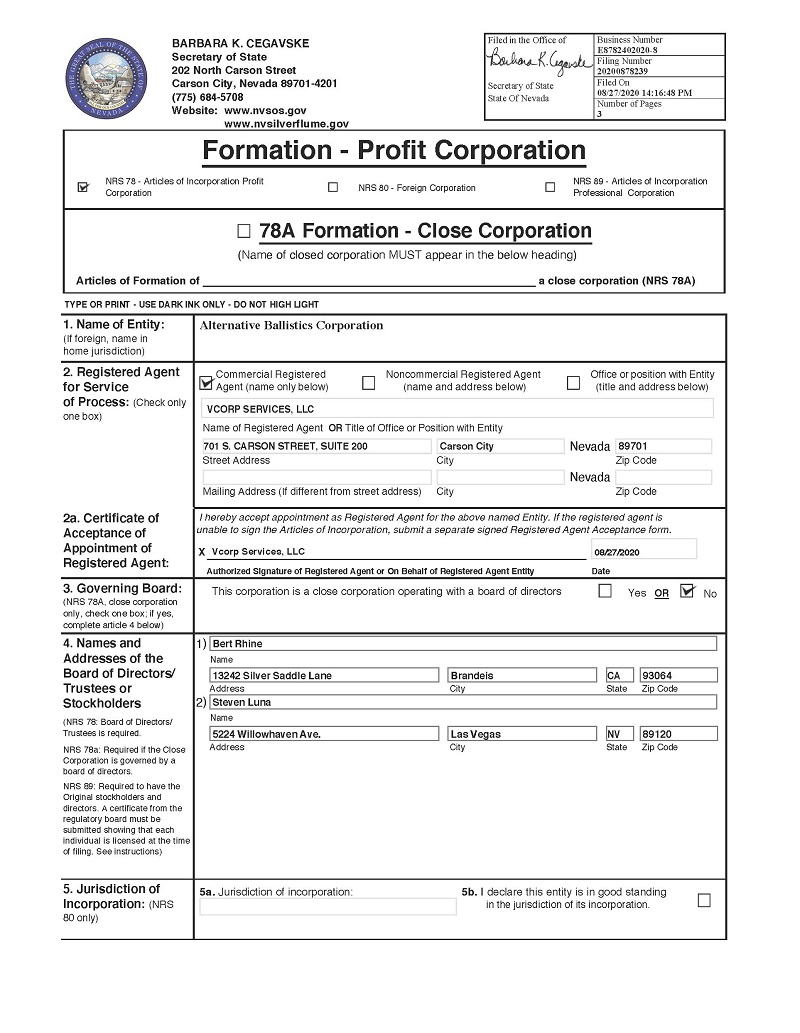

Exhibit 2.2
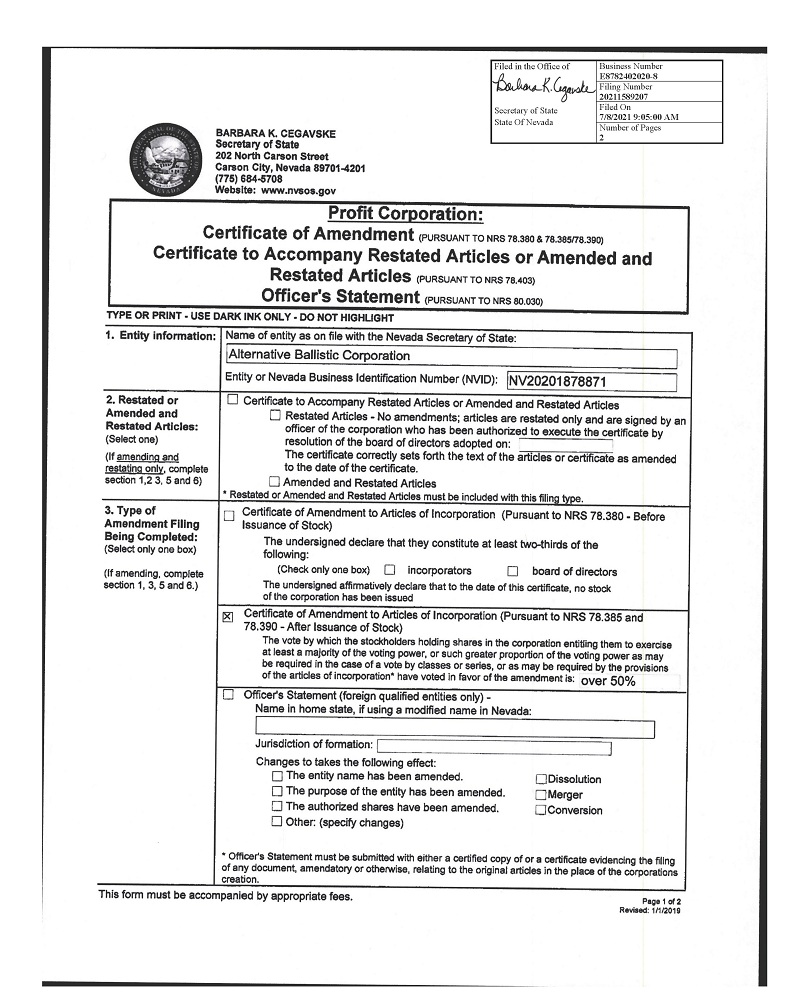
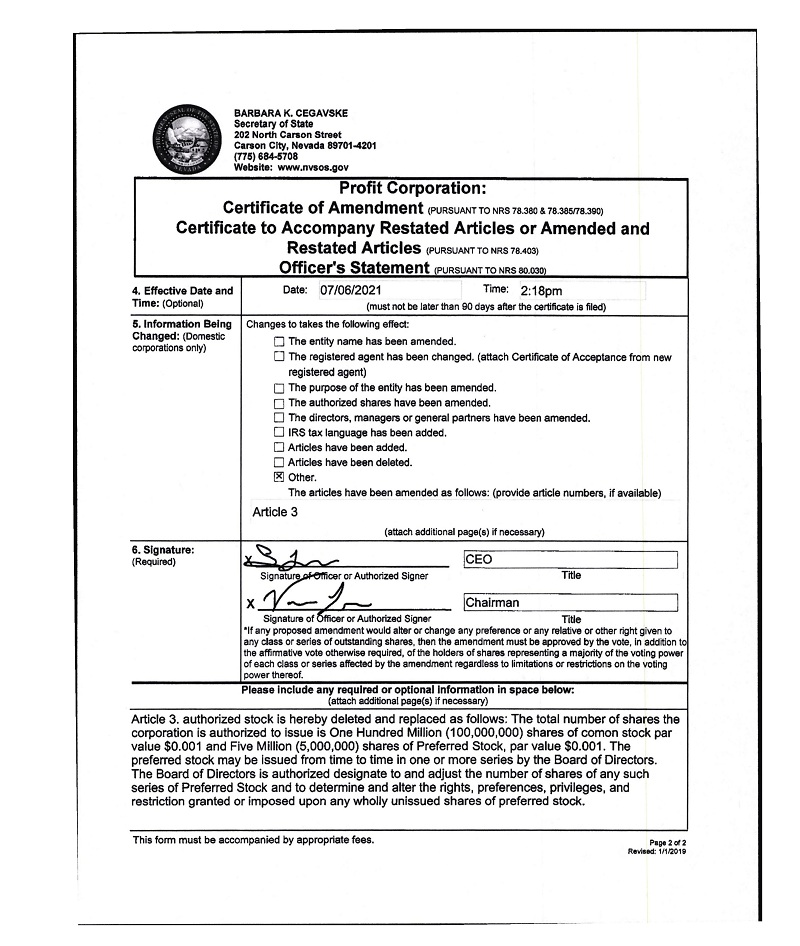
Exhibit 2.3
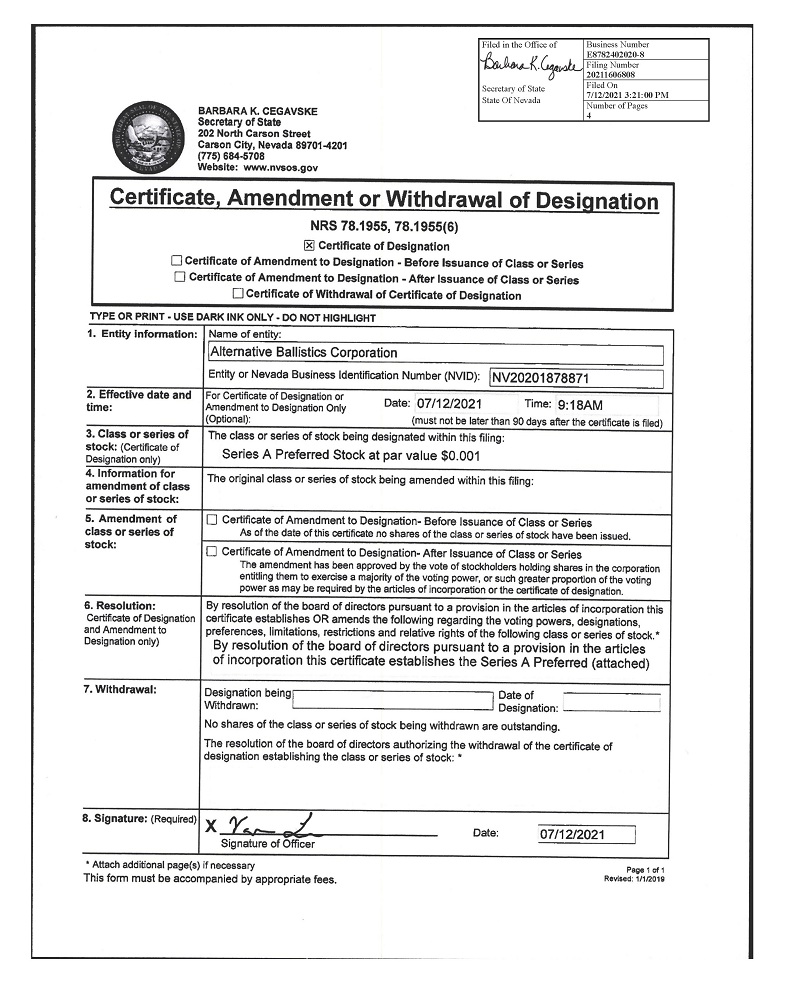
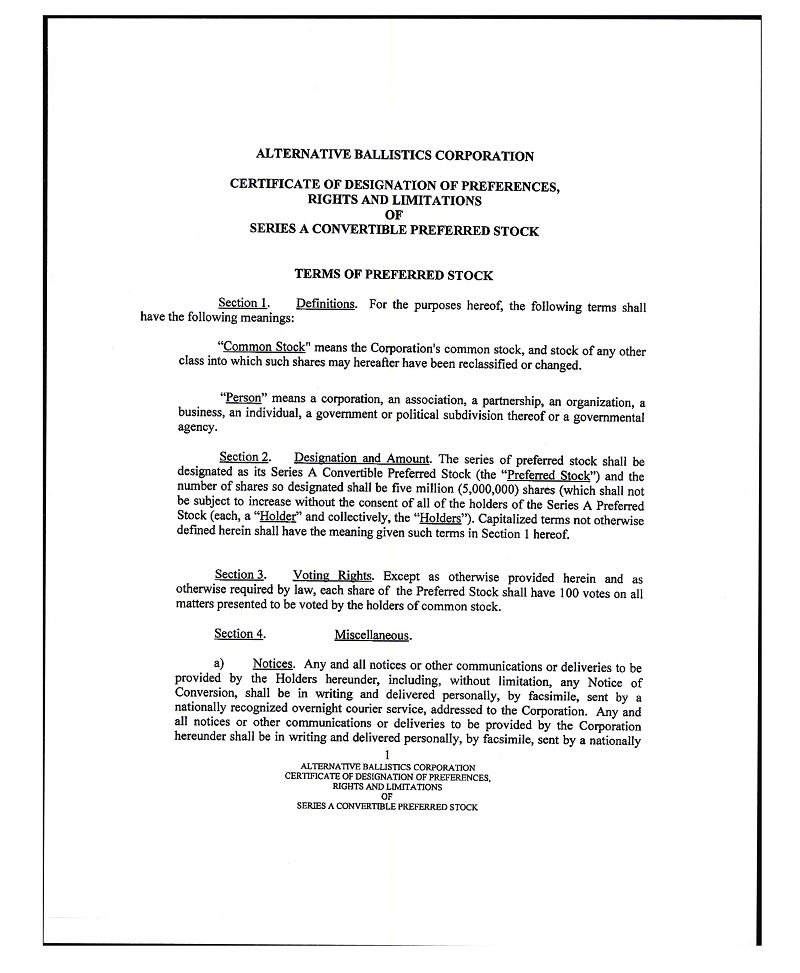
Exhibit 2.4
Exhibit 2.5
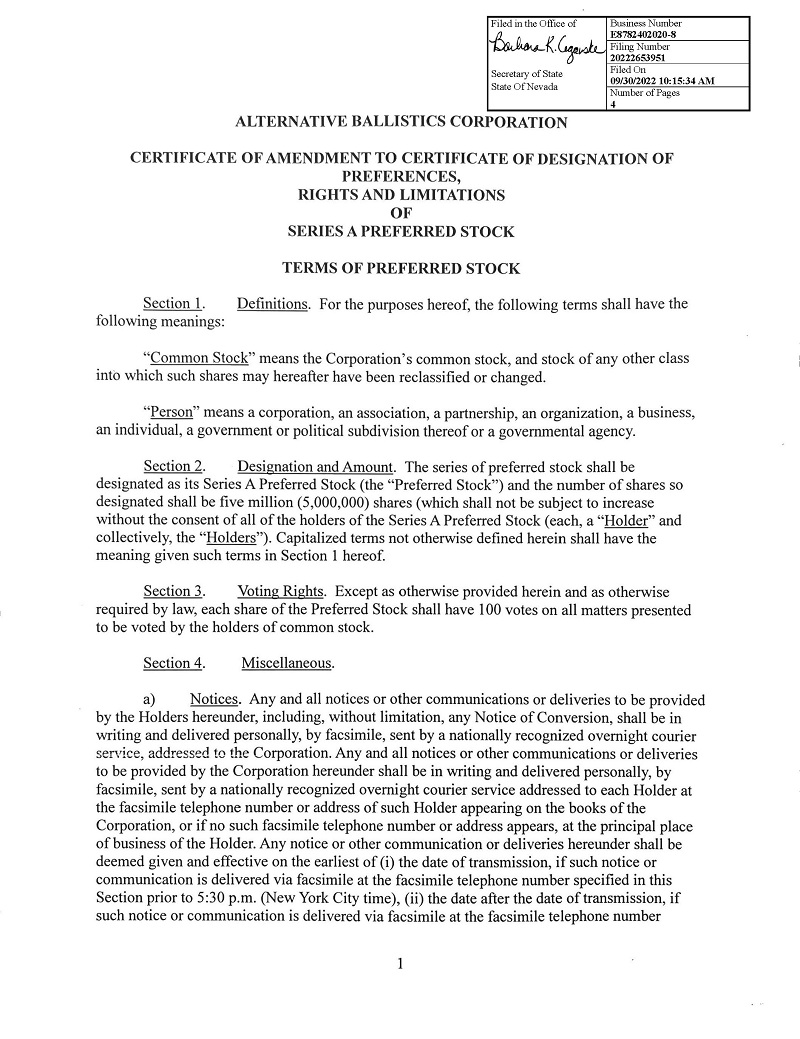
Exhibit 2.6
BYLAWS
OF
Alternative Ballistics Corporation
a Nevada corporation
ARTICLE I.
NAME AND OFFICES
Section A. Name. The name of the Corporation is Alternative Ballistics Corporation, a Nevada corporation (the “Corporation”).
Section B. Principal Office and Additional Offices. The location of the registered office of the Corporation shall be as stated in the Articles of Incorporation, which location may be changed from time to time by the Board of Directors. The Corporation may also have offices or branches at such other places, both within and without the State of Nevada, as the Board of Directors may from time to time determine or as the business of the Corporation may require.
ARTICLE II.
MEETINGS OF SHAREHOLDERS
Section A. Place of Meetings. All meetings of the shareholders of the Corporation (each a “Shareholder”) shall be held at the registered office of the Corporation, or at such other place (within or without the State of Nevada) as shall be designated from time to time by the Board of Directors and stated in the notice of the meeting.
Section B. Annual Meeting. Annual meetings of Shareholders shall be held on the date fixed from time to time by the directors. At the annual meeting, the Shareholders shall elect a Board of Directors and transact such other business as may properly be brought before the meeting.
Section C. Special Meetings. Special meetings of the Shareholders, for any purpose or purposes, unless otherwise prescribed by statute or by the Articles of Incorporation, may be called by the chairman of the Board of Directors or President, and shall be called by the chairman of the Board of Directors or President at the request in writing of a majority of the Board of Directors or at the request in writing of the holders of not less than fifty percent (50%) of all the shares entitled to vote at a meeting. Such request shall state the purpose or purposes of the proposed meeting.
Section D. List of Shareholders. The officer or agent who has charge of the stock transfer book for shares of the Corporation shall make and certify a complete list of the Shareholders entitled to vote at a Shareholders’ meeting, or any adjournment thereof. The list shall be compiled at least ten (10) days before each meeting of Shareholders if there are greater than six Shareholders of the Corporation. The list shall be arranged in alphabetical order with each class and series and show the address of each Shareholder and the number of shares registered in the name of each Shareholder. The list shall also be produced and kept at the time and place of the meeting during the whole time thereof, and may be inspected by any Shareholder who is present. See “Fixing of Record Date,” Article VI, Section E, for the method of determining which Shareholders are entitled to vote.
| 1 |
Bylaws of Alternative Ballistics Corporation |
Section E. Notice of Meetings. Except as may be provided by statute, written notice of an annual or special meeting of Shareholders stating the place, date and hour of the meeting and the purpose or purposes for which the meeting is called, shall be delivered, either personally or by first-class mail, not less than ten (10) nor more than sixty (60) days before the date of the meeting, to each Shareholder of record entitled to vote at such meeting. If mailed, such notice shall be deemed to be delivered when deposited in the United States mail addressed to the shareholder at his, her or its’ address as it appears on the stock transfer books of the Corporation with postage thereon prepaid.
Section F. Quorum. The holders of a majority of the stock issued and outstanding and entitled to vote thereat, present in person or represented by proxy, shall constitute a quorum at all meetings of the Shareholders for the transaction of business except as otherwise expressly required by statute or by the Articles of Incorporation. All Shareholders present in person or represented by proxy at such meeting may continue to do business until adjournment, notwithstanding the withdrawal of enough Shareholders to leave less than a quorum. If, however, such quorum shall not be initially present at any meeting of Shareholders, a majority of the Shareholders entitled to vote thereat shall nevertheless have power to adjourn the meeting from time to time and to another place, without notice other than announcement at the meeting, until a quorum shall be present or represented. At such adjourned meeting, at which a quorum shall be present or represented, any business may be transacted which might have been transacted at the meeting as originally notified. If after the adjournment a new record date is fixed for the adjourned meeting, a notice of the adjourned meeting shall be given to each Shareholder of record entitled to vote at the meeting.
Section G. Plurality. When an action other than the election of directors is to be taken by vote of the Shareholders, it shall be authorized by the affirmative vote of a majority of the shares represented at the meeting and entitled to vote on the subject matter, unless a greater plurality is required by express requirement of the statutes or of the Articles of Incorporation, in which case such express provision shall govern and control the decision of such question. “Shares represented at the meeting” shall be determined as of the time the existence of the quorum is determined. Except as otherwise expressly required by the Articles of Incorporation, directors shall be elected by a plurality of the votes cast at an election.
Section H. Voting of Shares and Proxies. Each shareholder shall at every meeting of the Shareholders be entitled to one (1) vote in person or by proxy for each share of the capital stock having voting power held by such Shareholder except as otherwise expressly required in the Articles of Incorporation. A vote may be cast either orally or in writing. Each proxy shall be in writing and signed by the Shareholder or his authorized agent or representative. A proxy is not valid after the expiration of eleven (11) months after its date unless the person executing it specifies therein the length of time for which it is to continue in force. Unless prohibited by law, a proxy otherwise validly granted by telegram shall be deemed to have been signed by the granting shareholder. All questions regarding the qualification of voters, the validity of proxies and the acceptance or rejection of votes shall be decided by the presiding officer of the meeting.
Section I. Waiver of Notice. Attendance of a person at a meeting of Shareholders in person or by proxy constitutes a waiver of notice of the meeting except where the shareholder attends a meeting for the express purpose of objecting at the beginning of the meeting to the transaction of any business because the meeting was not lawfully called or convened.
Section J. Written Consent Without a Meeting. Unless otherwise provided by the Articles of Incorporation, any action required to be taken at any annual or special meeting of the Shareholders, or any other action which may be taken at any annual or special meeting of the Shareholders may be taken without a meeting, without prior notice, and without a vote if a consent in writing, setting forth the action so taken, shall be signed by holders of outstanding stock having not less than the minimum number of votes that would be necessary to authorize such action at a meeting at which all shares entitled to vote thereon were present and voted. Within 10 days after obtaining such authorization by written consent, notice shall be given to those Shareholders who have not consented in writing. The notice shall fairly summarize the material features of the authorized action and, if the action be a merger, consolidation, or sale of assets for which dissenters rights are provided for by statute, the notice shall contain a clear statement of the rights of Shareholders dissenting therefrom to be paid the fair value of their shares upon compliance with further provisions of such statute regarding the rights of dissenting Shareholders.
| 2 |
Bylaws of Alternative Ballistics Corporation |
ARTICLE III.
DIRECTORS
Section A. General Powers. The business and affairs of the Corporation shall be managed by or under the direction of its Board of Directors, unless otherwise provided by the Articles of Incorporation. The Board of Directors may exercise all such powers of the Corporation and do all such lawful acts and things as are not by statute or by the Articles of Incorporation or by these Bylaws directed or required to be exercised or done by the Shareholders.
Section B. Number, Election and Term of Office. The number of directors which shall constitute the whole Board shall be not less than one (1) director. The number of directors shall be determined from time to time by resolution of the Board of Directors. In the absence of an express determination by the Board of Directors, the number of directors, until changed by the Board, shall be that number of directors elected at the most recently held annual meeting of Shareholders or, if no such meeting has been held, the number determined by the initial director as designated in the initially filed Articles of Incorporation. Directors are elected at the first annual Shareholders’ meeting and at each annual meeting thereafter. Each Director shall hold office until the next annual meeting of Shareholders or until his successor is elected. Directors need not be Shareholders or officers of the Corporation.
Section C. Vacancies and Removal. Vacancies and newly created directorships resulting from any increase in the authorized number of directors may be filled by the affirmative vote of a majority of the directors then in office, though less than a quorum, or by a sole remaining director, or by the Shareholders, and the directors so chosen shall hold office until the next annual election of directors by the Shareholders and until their successors are duly elected and qualified or until their resignation or removal. Any director may be removed, with or without cause, by the Shareholders at a meeting of the Shareholders called expressly for that purpose unless otherwise provided in the Articles of Incorporation.
Section D. Annual Meeting. The first Board of Directors shall hold office until the first annual meeting of Shareholders. Thereafter, the first meeting of each newly elected Board of Directors shall be held promptly following the annual meeting of Shareholders on the date thereof. No notice of such meeting shall be necessary to the newly elected directors in order to legally constitute the meeting, provided a quorum shall be present. In the event such meeting is not so held, the meeting may be held at such time and place as shall be specified in a notice given as hereinafter provided for special meetings of the Board of Directors. Any notice of the annual meeting need not specify the business to be transacted or the purpose of the meeting.
| 3 |
Bylaws of Alternative Ballistics Corporation |
Section E. Place of Meetings. Meetings of the Board of Directors shall be held at the principal office of the Corporation or at such other place, within or without the State of Nevada, as the Board of Directors may from time to time determine or as shall be specified in the notice of any such meeting. Unless otherwise restricted by the Articles of Incorporation, members of the Board of Directors, or any committee designated by the Board, may participate in a meeting of the Board or committee by means of conference telephone or similar communications equipment by means of which all persons participating in the meeting can hear each other, and participation in a meeting pursuant to this section shall constitute presence in person at such meeting.
Section F. Special Meetings. Special meetings of the Board of Directors may be called by the Chairman of the Board of Directors or President on four (4) days’ notice to each director by mail or twenty-four (24) hours’ notice either personally, by telephone or by facsimile; special meetings shall be called by the chairman of the Board or President in like manner and on like notice on the written request of two (2) directors. The notice need not specify the business to be transacted or the purpose of the special meeting. The notice shall specify the place of the special meeting.
Section G. Quorum. At all meetings of the Board of Directors, a majority in the number of directors fixed pursuant to Article III, Section B of these Bylaws shall constitute a quorum for the transaction of business. At all meetings of a committee of the Board of Directors a majority of the directors then members of the committee in office shall constitute a quorum for the transaction of business. The act of a majority of the members present at any meeting at which there is a quorum shall be the act of the Board of Directors or the committee, unless the vote of a larger number is specifically required by statute, by the Articles of Incorporation, or by these Bylaws. If a quorum shall not be present at any meeting of the Board of Directors or a committee, the members present thereat may adjourn the meeting from time to time and to another place without notice other than announcement at the meeting, until a quorum shall be present.
Section H. Written Consent Without a Meeting. Unless otherwise provided by the Articles of Incorporation, any action required or permitted to be taken at any meeting of the Board of Directors or of any committee thereof may be taken without a meeting, if, before or after the action, all members of the Board of Directors or committee consent thereto in writing. The written consents shall be filed with the minutes of proceedings of the Board of Directors or committee. Such consents shall have the same effect as a vote of the Board of Directors or committee for all purposes.
| 4 |
Bylaws of Alternative Ballistics Corporation |
Section I. Executive and Other Committees. A majority of the full Board of Directors may, by resolution, designate one (1) or more committees, each committee to consist of one (1) or more of the directors of the Corporation. The Board of Directors may designate one (1) or more directors as alternate members of any committee, who may replace any absent or disqualified member at any meeting of the committee. Any such committee, to the extent provided in the resolution of the Board of Directors, shall have and may exercise the powers of the Board of Directors in the management of the business and affairs of the Corporation; provided, however, such a committee shall not have the power or authority to:
1. Approve or recommend to Shareholders actions or proposals required by statute to be approved by the Shareholders.
2. Designate candidates for the office of director for purposes of proxy solicitation or otherwise.
3. Fill vacancies on the Board of Directors or any committee thereof.
4. Amend the Bylaws of the Corporation.
5. Authorize or approve the reacquisition of shares unless pursuant to a general formula or method specified by the Board of Directors.
6. Authorize or approve the issuance or sale of, or any contract to issue or sell, shares or designate the terms of a series of a class of shares, except that the Board of Directors, having acted regarding general authorization for the issuance or sale of shares, or any contract therefor, and, in the case of a series, the designation thereof, may, pursuant to a general formula or method specified by the Board of Directors by resolution or by adoption of a stock option or other plan, authorize a committee to fix the terms of any contract for the sale of the shares and to fix the terms upon which such shares may be issued or sold, including, without limitation, the price, the rate or manner of payment of dividends, provisions for redemption, sinking fund, conversion, and voting or preferential rights, and provisions for other features of a class of shares, or a series of a class of shares, with full power in such committee to adopt any final resolution setting forth all the terms thereof and to authorize the statement of the terms of a series for filing with the Nevada Department of State pursuant to the Nevada Revised Statues.
7. Such committee or committees shall have such name or names as may be determined from time to time by resolution adopted by the Board of Directors. A committee, and each member thereof, shall serve at the pleasure of the Board of Directors. Each committee shall keep regular minutes of its meetings and report the same to the Board of Directors when required.
Section J. Compensation. The Board of Directors shall have authority to fix the compensation, including fees and reimbursement of expenses of directors, for services to the Corporation in any capacity.
Section K. Resignations. A director may resign by written notice to the Corporation. The resignation is effective upon its receipt by the Corporation or a subsequent time as set forth in the notice of resignation.
Section L. Waiver of Notice. Attendance of a director at a special meeting constitutes a waiver of notice of the meeting except where a director attends a meeting for the express purpose of objecting to the transaction of any business because the meeting is not lawfully called or convened. Directors may also sign a waiver of notice before or after a special meeting.
| 5 |
Bylaws of Alternative Ballistics Corporation |
ARTICLE IV.
NOTICES
Section A. Method of Notice. Whenever, under the provisions of the statutes or of the Articles of Incorporation or of these Bylaws, written notice is required to be given to any director, committee member or Shareholder, such notice may be given in writing by mail (registered, certified or other first class mail) addressed to such director, shareholder or committee member at his address as it appears on the records of the Corporation, with postage thereon prepaid. Such notice shall be deemed to be given at the time when the same shall be deposited in a post office or official depository under the exclusive care and custody of the United States Postal Service.
Section B. Waiver of Notice. Whenever any notice is required to be given under the provision of the statutes or of the Articles of Incorporation or of these Bylaws, a waiver thereof in writing, signed by the person or persons entitled to said notice, whether before or after the time stated therein, shall be deemed equivalent thereto. Neither the business to be transacted at, nor the purpose of, any regular or special meeting of the Shareholders, directors or a committee, need be specified in any written waiver of notice.
ARTICLE V.
OFFICERS
Section M. Number and Qualification. The Board of Directors shall choose the officers of the Corporation at its first meeting after each annual meeting of Shareholders. There shall be a President, a Treasurer and a Secretary, and such other officers as may be deemed necessary, whom the Board of Directors may appoint. The same person may hold any number of offices. The Board of Directors may from time to time appoint such other officers and agents as it shall deem necessary who shall hold their offices for such terms and shall exercise such powers and perform such duties as shall be determined from time to time by the Board of Directors.
Section N. Compensation. The Board of Directors shall fix the salaries of all officers of the Corporation.
Section O. Removal, Vacancies and Resignations. The officers of the Corporation shall hold office at the pleasure of the Board of Directors. Any officer elected or appointed by the Board of Directors may be removed at any time by the Board of Directors with or without cause whenever, in its judgment, the best interests of the Corporation will be served thereby. Any vacancy occurring in any office of the Corporation by death, resignation, removal or otherwise shall be filled by the Board of Directors. An officer may resign by written notice to the Corporation. The resignation is effective upon its receipt by the Corporation or at a subsequent time specified in the notice of resignation.
| 6 |
Bylaws of Alternative Ballistics Corporation |
Section P. The President. Unless otherwise provided by resolution of the Board of Directors, the Chairman shall be the President of the Corporation, shall preside at all meetings of the Shareholders and the Board of Directors (if he or she shall be a member of the Board), shall have general and active management of the business and affairs of the Corporation and shall see that all orders and resolutions of the Board of Directors are carried into effect. The President shall execute on behalf of the Corporation, and may affix or cause the seal to be affixed to, all instruments requiring such execution except to the extent the signing and execution thereof shall be expressly delegated by the Board of Directors to some other officer or agent of the Corporation.
Section E. The Chief Executive Officer. The Chief Executive Officer shall act under the direction of the President and in the absence or disability of the President shall perform the duties and exercise the powers of the President. He or she shall perform such other duties and have such other powers as the President or the Board of Directors may from time to time prescribe.
Section F. Vice-Presidents. The Vice-Presidents shall act under the direction of the President and in the absence or disability of the President shall perform the duties and exercise the powers of the President. They shall perform such other duties and have such other powers as the President or the Board of Directors may from time to time prescribe. The Board of Directors may designate one or more executive Vice-Presidents or may otherwise specify the order of seniority of the Vice-Presidents. The duties and powers of the President shall descend to the Vice-Presidents in such specified order of seniority.
Section G. The Secretary. The Secretary shall act under the direction of the President. Subject to the direction of the President, the Secretary shall attend all meetings of the Board of Directors and all meetings of the Shareholders and record the proceedings. The Secretary shall perform like duties for the standing committees when required; shall give, or cause to be given, notice of all meetings of the Shareholders and special meetings of the Board of Directors; and shall perform such other duties as may be prescribed by the President or the Board of Directors. The Secretary shall keep in safe custody the seal of the Corporation and, when authorized by the President or the Board of Directors, cause it to be affixed to any instrument requiring it. The Secretary shall be responsible for maintaining the stock transfer book and minute book of the Corporation and shall be responsible for their updating.
Section H. Delegation of Duties. Whenever an officer is absent or whenever for any reason the Board of Directors may deem it desirable, the Board of Directors may delegate the powers and duties of an officer to any other officer or officers or to any director or directors.
Section I. Additional Powers. To the extent the powers and duties of the several officers are not provided from time to time by resolution or other directive of the Board of Directors or by the President (with respect to other officers), the officers shall have all powers and shall discharge the duties customarily and usually held and performed by like officers of the corporations similar in organization and business purposes to this Corporation.
| 7 |
Bylaws of Alternative Ballistics Corporation |
ARTICLE VI.
CERTIFICATES OF STOCK AND SHAREHOLDERS OF RECORD
Section A. Certificates Representing Shares. The shares of stock of the Corporation shall be represented by certificates signed by, or in the name of the Corporation by, the Chairman, or the President and by the Secretary of the Corporation. Each holder of stock in the Corporation shall be entitled to have such a certificate certifying the number of shares owned by him or her in the Corporation.
Section B. Transfer Agents. Any of or all the signatures on the certificates may be a facsimile if the certificate is countersigned by a transfer agent or registered by a registrar other than the Corporation itself or its employee. In case any officer who has signed or whose facsimile signature has been placed upon a certificate shall have ceased to be such officer before such certificate is issued, it may be issued by the Corporation with the same effect as if he or she were such officer at the date of issue. The seal of the Corporation or a facsimile thereof may, but need not, be affixed to the certificates of stock.
Section C. Lost, Destroyed or Mutilated Certificates. The Board of Directors may direct a new certificate for shares to be issued in place of any certificates theretofore issued by the Corporation alleged to have been lost or destroyed, upon the making of an affidavit of that fact by the person claiming the certificate of stock to be lost or destroyed. When authorizing such issue of a new certificate, the Board of Directors may, in its discretion and as a condition precedent to the issuance thereof, require the owner of such lost or destroyed certificates, or his legal representative, to give the Corporation a bond in such sum as it may direct as indemnity against any claim that may be made against the Corporation with respect to the certificates alleged to have been lost or destroyed.
Section D. Transfer of Shares. Upon surrender to the Corporation or the transfer agent of the Corporation of a certificate for shares duly endorsed or accompanied by proper evidence of succession, assignment or authority to transfer, it shall be the duty of the Corporation to issue a new certificate to the person entitled thereto, cancel the old certificate and record the transaction upon its stock transfer book for shares of the Corporation.
Section E. Fixing of Record Date. In order that the Corporation may determine the Shareholders entitled to notice of, or to vote at, any meeting of Shareholders or any adjournment thereof, or to express consent to, or to dissent from, a proposal without a meeting, or entitled to receive payment of any dividend or other distribution or allotment of any rights, or for the purpose of any other action, the Board of Directors may fix, in advance, a date as a record date, which shall not be more than sixty (60) nor less than ten (10) days before the date of such meeting, nor more than sixty (60) days prior to any other action. The stock transfer books of the Corporation shall not be closed.
| 8 |
Bylaws of Alternative Ballistics Corporation |
If no record date is fixed:
1. The record date for determining the Shareholders of record entitled to notice of, or to vote at, a meeting of Shareholders shall be at the close of business on the day on which notice is given, or, if no notice is given, at the close of business on the day next preceding the day on which the meeting is held; and
2. The record date for determining Shareholders for any other purpose shall be at the close of business on the day on which the Board of Directors adopts the resolution relating thereto.
A determination of Shareholders of record entitled to notice or to vote at a meeting of Shareholders shall apply to any adjournment of the meeting; provided, however, that the Board of Directors may fix a new record date for the adjourned meeting.
Section F. Exclusive Ownership of Shares. The Corporation shall be entitled to recognize the exclusive right of a person registered upon its stock transfer book for shares of the Corporation as the owner of shares for all purposes, including voting and dividends, and shall not be bound to recognize any equitable or other claim to interest in such share or shares on the part of any other person, whether or not it shall have express or other notice thereof, except as otherwise provided by the laws of Nevada.
Section G. Limitation on Transfer of Shares. If the holders of a majority or more of the shares of Common or, if authorized, Preferred Stock shall enter into an agreement restricting or limiting the sale, transfer, assignment, pledge, or hypothecation of the shares of the Corporation, and the Corporation shall become a party to such agreement, the officers and directors of the Corporation shall observe and carry out all of the terms and provisions of such agreement and refuse to recognize any sale, transfer, assignment, pledge or hypothecation of any or all of the shares covered by such agreement, unless it shall conform with the provisions and terms of such agreement, provided that a copy of such agreement shall be filed with the Secretary of the Corporation and be kept available at the principal office of the Corporation, and provided further, that notice of such agreement be set forth conspicuously on the face or back of each stock certificate.
ARTICLE VII.
INDEMNIFICATION
The Corporation shall indemnify, or advance expenses to, to the fullest extent authorized or permitted by the Nevada Revised Statutes, any person made, or threatened to be made, a party to any action, suit or proceeding by reason of the fact that he or she (i) is or was a director of the Corporation; (ii) is or was serving at the request of the Corporation as a director of another corporation; (iii) is or was an officer of the Corporation, provided that he or she is or was at the time a director of the Corporation; or (iv) is or was serving at the request of the Corporation as an officer of another corporation, provided that he or she is or was at the time a director of the Corporation or a director of such other corporation, serving at the request of the Corporation. Unless otherwise expressly prohibited by the Nevada Revised Statutes, and except as otherwise provided in the foregoing sentence, the Board of Directors of the Corporation shall have the sole and exclusive discretion, on such terms and conditions as it shall determine, to indemnify, or advance expenses to, any person made, or threatened to be made, a party to any action, suit, or proceeding by reason of the fact that he or she is or was an officer, employee or agent of the Corporation, or is or was serving at the request of the Corporation as an officer, employee or agent of another corporation, partnership, joint venture, trust or other enterprise. No person falling within the purview of the foregoing sentence may apply for indemnification or advancement of expenses to any court of competent jurisdiction.
| 9 |
Bylaws of Alternative Ballistics Corporation |
ARTICLE VIII.
GENERAL PROVISIONS
Section A. Checks, Drafts and Bank Accounts. All checks, drafts or demands for money and notes of the Corporation shall be signed by such officer or officers or such other person or persons as the Board of Directors may from time to time designate. All funds of the Corporation not otherwise employed shall be deposited from time to time to the credit of the Corporation in such banks, trust companies or other depositories as the Board of Directors may from time to time designate.
Section B. Fiscal Year. The fiscal year of the Corporation shall be fixed from time to time by resolution of the Board of Directors, but shall end on December 31st of each year if not otherwise fixed by the Board of Directors.
Section C. Corporate Seal. The Board of Directors has elected not to adopt a corporate seal for the Corporation.
Section D. Corporate Minutes and Stock Transfer Book. The Corporation shall keep within or without the State of Nevada books and records of account and minutes of the proceedings of its Shareholders, Board of Directors and executive committee, if any. The Corporation shall keep at its registered office or at the office of its transfer agent within or without the State of Nevada a stock transfer book for shares of the Corporation containing the names and addresses of all Shareholders, the number, class and series of shares held by each and the dates when they respectively became holders of record thereof. Any of such stock transfer book, books, records or minutes may be in written form or in any other form capable of being converted into written form within a reasonable time.
Section E. Bylaw Governance Not Exclusive. These Bylaws shall govern the internal affairs of the Corporation, but only to the extent they are consistent with law and the Articles of Incorporation. Nothing contained in the Bylaws shall, however, prevent the imposition by contract of greater voting, notice or other requirements than those set forth in these Bylaws.
Section F. Shareholders’ Agreement. Should the Shareholders of the Corporation at any time enter into a Shareholders’ Agreement following the adoption of the Bylaws then, to the extent that the terms of the Shareholders’ Agreement as thereafter amended are inconsistent with the Bylaws or the Articles of Incorporation, the terms of the Shareholders’ Agreement shall govern the internal affairs of the Corporation.
| 10 |
Bylaws of Alternative Ballistics Corporation |
ARTICLE IX.
AMENDMENTS
The Board of Directors may amend or repeal these Bylaws unless the Nevada Revised Statutes reserves the power to amend a particular Bylaw provision exclusively to the Shareholders.
| 11 |
Bylaws of Alternative Ballistics Corporation |
Exhibit 3.1

ALTERNATIVE BALLISTICS CORPORATION
2021 OMNIBUS EQUITY COMPENSATION PLAN
TABLE OF CONTENTS
| ARTICLE I | GENERAL PROVISIONS | 3 |
| ARTICLE II | DEFINITIONS | 3 |
| ARTICLE III | ADMINISTRATION | 8 |
| ARTICLE IV | INCENTIVE STOCK OPTIONS | 12 |
| ARTICLE V | NONQUALIFIED STOCK OPTIONS | 13 |
| ARTICLE VI | STOCK APPRECIATION RIGHTS | 14 |
| ARTICLE VII | INCIDENTS OF STOCK OPTIONS AND STOCK RIGHTS | 16 |
| ARTICLE VIII | RESTRICTED STOCK | 18 |
| ARTICLE IX | DEFERRED STOCK | 20 |
| ARTICLE X | STOCK AWARDS | 22 |
| ARTICLE XI | PERFORMANCE SHARES | 23 |
| ARTICLE XII | OTHER STOCK-BASED AWARDS | 24 |
| ARTICLE XIII | ACCELERATION EVENTS | 26 |
| ARTICLE XIV | AMENDMENT AND TERMINATION | 28 |
| ARTICLE XV | MISCELLANEOUS PROVISIONS | 29 |
| 2 | P a g e |
ALTERNATIVE BALLISTICS CORPORATION 2021 OMNIBUS EQUITY COMPENSATION PLAN |
ARTICLE I
GENERAL PROVISIONS
1.1 The Plan is designed for the benefit of the directors, executives, independent contractors, and key employees of the Company (i) to attract and retain for the Company personnel of exceptional ability; (ii) to motivate such personnel through added incentives to make a maximum contribution to greater profitability; (iii) to develop and maintain a highly competent management team; and (iv) to be competitive with other companies with respect to executive compensation.
1.2 Awards under the Plan may be made to Participants in the form of (i) Incentive Stock Options; (ii) Nonqualified Stock Options; (iii) Stock Appreciation Rights; (iv) Restricted Stock; (v) Deferred Stock; (vi) Stock Awards; (vii) Performance Shares; (viii) Other Stock-Based Awards; and (ix) other forms of equity-based compensation as may be provided and are permissible under this Plan and the law.
1.3 The Plan shall be effective on July 15, 2021 (the “Effective Date”), subject to the approval of the Plan by a majority of the votes cast by the holders of the Company’s Common Stock, which may be voted at the next annual or special shareholder’s meeting. Any Awards granted under the Plan prior to such approval shall be effective when made (unless otherwise specified by the Committee at the time of grant) but shall be conditioned on, and subject to, the approval of the Plan by the Company’s shareholders.
ARTICLE II
DEFINITIONS
Except where the context otherwise indicates, the following definitions apply:
2.1 “Acceleration Event” means the occurrence of an event defined in Article XIII of the Plan.
2.2 “Act” means the Securities Exchange Act of 1934, as amended.
2.3 “Agreement” means the written agreement evidencing each Award granted to a Participant under the Plan.
2.4 “Award” means an award granted to a Participant in accordance with the provisions of the Plan, including, but not limited to, a Stock Option, Stock Right, Restricted or Deferred Stock, Stock Award, Performance Share, Other Stock-Based Award, or any combination of the foregoing.
2.5 “Board” means the Board of Directors of the Company.
| 3 | P a g e |
ALTERNATIVE BALLISTICS CORPORATION 2021 OMNIBUS EQUITY COMPENSATION PLAN |
2.6 “Change in Control” shall have the meaning set forth in Section 13.2 of the Plan.
2.7 “Change in Control Price” shall have the meaning set forth in Section 13.7 of the Plan.
2.8 “Code” means the Internal Revenue Code of 1986, as amended.
2.9 “Committee” means the Compensation Committee of the Board, or in the absence of a Committee, the Board of Directors.
2.10 “Company” means Alternative Ballistics Corporation, a Nevada corporation.
2.11 “Deferral Period” means the period commencing on the date an Award of Deferred Stock is granted and ending on such date as the Committee shall determine.
2.12 “Deferred Stock” means the stock awarded under Article IX of the Plan.
2.13 “Disability” means disability as determined under procedures established by the Committee or in any Award.
2.14 “Discount Stock Options” means the Nonqualified Stock Options, which provide for an exercise price of less than the Fair Market Value of the Stock at the date of the Award.
2.15 “Early Retirement” means retirement from active employment with the Company, with the express consent of the Committee, pursuant to the early retirement provisions established by the Committee or in any Award.
2.16 “Effective Date” shall have the meaning set forth in Section 1.3 of the Plan.
2.17 “Elective Deferral Period” shall have the meaning set forth in Section 9.3 of the Plan.
2.18 “Eligible Participant” means any director, executive or key employee of the Company, as shall be determined by the Committee, as well as any other person whose participation the Committee determines is in the best interest of the Company, subject to limitations as may be provided by the Code, the Act, or the Committee. For purposes of Article IV and Incentive Stock Options that may be granted hereunder, the term “Eligible Participant” shall be limited to an executive or other key employee meeting the qualifications for receipt of an Incentive Stock Option under the provisions of Section 422 of the Code.
2.19 “ERISA” means the Employee Retirement Income Security Act of 1974, as amended.
| 4 | P a g e |
ALTERNATIVE BALLISTICS CORPORATION 2021 OMNIBUS EQUITY COMPENSATION PLAN |
2.20 “Fair Market Value” of a Share on any date of reference shall be the Closing Price of a share of Common Stock on the business day immediately preceding such date, unless the Committee in its sole discretion shall determine otherwise in a fair and uniform manner. For this purpose, the “Closing Price” of the Common Stock on any business day shall be (i) if the Common Stock is listed or admitted for trading on any United States national securities exchange, or if actual transactions are otherwise reported on a transaction reporting system, the last reported sale price of the Common Stock on such exchange or reporting system, as reported in any newspaper of general circulation, (ii) if the Common Stock is quoted on The Nasdaq Stock Market (“Nasdaq”), or any similar system of automated dissemination of quotations of securities prices in common use, the mean between the closing high bid and low asked quotations for such day of the Common Stock on such system, or (iii) if neither clause (i) nor (ii) is applicable, the mean between the high bid and low asked quotations for the Common Stock as reported by the National Quotation Bureau, Incorporated if at least two securities dealers have inserted both bid and asked quotations for the Common Stock on at least five of the 10 preceding trading days. If the information set forth in clauses (i) through (iii) above is unavailable or inapplicable to the Company (e.g., if the Company’s Common Stock is not then publicly traded or quoted), then the “Fair Market Value” of a Share shall be the fair market value (i.e., the price at which a willing seller would sell a Share to a willing buyer when neither is acting under compulsion and when both have reasonable knowledge of all relevant facts) of a share of the Common Stock on the business day immediately preceding such date as the Committee in its sole and absolute discretion shall determine in a fair and uniform manner.
2.21 “Incentive Stock Option” means a Stock Option granted under Article IV of the Plan, and as defined in Section 422 of the Code.
2.22 “Limited Stock Appreciation Rights” means a Stock Right which is exercisable only in the event of a Change in Control, as described in Section 6.8 of this Plan, which provides for an amount payable solely in cash, equal to the excess of the Stock Appreciation Right Fair Market Value of a share of Stock on the day the Stock Right is surrendered over the price at which a Participant could exercise a related Stock Option to purchase the share of Stock.
2.23 “Nonqualified Stock Option” means a Stock Option granted under Article V of the Plan.
2.24 “Normal Retirement” means retirement from active employment with the Company or any Subsidiary on or after age 65, or pursuant to such other requirements as may be established by the Committee or in any Award.
2.25 “Option Grant Date” means, as to any Stock Option, the latest of:
(a) the date on which the Committee grants the Stock Option to the Participant;
| 5 | P a g e |
ALTERNATIVE BALLISTICS CORPORATION 2021 OMNIBUS EQUITY COMPENSATION PLAN |
(b) the date the Participant receiving the Stock Option becomes an employee of the Company or its Subsidiaries, to the extent employment status is a condition of the grant or a requirement of the Code or the Act; or
(c) such other date (other than the dates described in (i) and (ii) above) as the Committee may designate.
2.26 “Other Stock-Based Award” means an Award under Article XII of the Plan that is valued in whole or in part by reference to, or is otherwise based on, Stock.
2.27 “Participant” means an Eligible Participant to whom an Award of equity-based compensation has been granted and who has entered into an Agreement evidencing the Award.
2.28 “Performance Share” means an Award under Article XI of the Plan of a unit valued by reference to a designated number of shares of Stock, which value may be paid to the Participant by delivery of such property as the Committee shall determine, including, without limitation, cash, Stock, or any combination thereof, upon achievement of such Performance Objectives during the Performance Period as the Committee shall establish at the time of such Award or thereafter.
2.29 “Performance Objectives” shall have the meaning set forth in Article XI of the Plan.
2.30 “Performance Period” shall have the meaning set forth in Article XI of the Plan.
2.31 “Plan” means the Alternative Ballistics Corporation Omnibus Equity Compensation Plan, as amended from time to time.
2.32 “Related Stock Appreciation Right” shall have the meaning set forth in Section 6.1 of the Plan.
2.33 “Restricted Stock” means an Award of Stock under Article VIII of the Plan, which Stock is issued with the restriction that the holder may not sell, transfer, pledge, or assign such Stock and with such other restrictions as the Committee, in its sole discretion, may impose (including, without limitation, any restriction on the right to vote such Stock, and the right to receive any cash dividends), which restrictions may lapse separately or in combination at such time or times, in installments or otherwise, as the Committee may deem appropriate.
2.34 “Restriction Period” means the period commencing on the date an Award of Restricted Stock is granted and ending on such date as the Committee shall determine.
2.35 “Retirement” means Normal or Early Retirement.
2.36 “Stock” means shares of common stock par value $.001 per share of the Company, as may be adjusted pursuant to the provisions of Section 3.10.
| 6 | P a g e |
ALTERNATIVE BALLISTICS CORPORATION 2021 OMNIBUS EQUITY COMPENSATION PLAN |
2.37 “Stock Appreciation Right” means a Stock Right, as described in Article VI of this Plan, which provides for an amount payable in Stock and/or cash, as determined by the Committee, equal to the excess of the Fair Market Value of a share of Stock on the day the Stock Right is exercised over the price at which the Participant could exercise a related Stock Option to purchase the share of Stock; provided that, such price shall not be less than one hundred percent (100%) of the Fair Market Value of the Stock on the date of grant.
2.38 “Stock Appreciation Right Fair Market Value” means a value established by the Committee for the exercise of a Stock Appreciation Right or a Limited Stock Appreciation Right.
2.39 “Stock Award” means an Award of Stock granted in payment of compensation, as provided in Article X of the Plan.
2.40 “Stock Option” means an Award under Article IV or V of the Plan of an option to purchase Stock. A Stock Option may be either an Incentive Stock Option or a Nonqualified Stock Option.
2.41 “Stock Right” means an Award under Article VI of the Plan. A Stock Right may be either a Stock Appreciation Right or a Limited Stock Appreciation Right.
2.42 “Termination of Employment” means the discontinuance of employment of a Participant with the Company. The determination of whether a Participant has discontinued employment shall be made by the Committee in its discretion. In determining whether a Termination of Employment has occurred, the Committee may provide that service as a consultant or service with a business enterprise in which the Company has a significant ownership interest shall be treated as employment with the Company. The Committee shall have the discretion, exercisable either at the time the Award is granted or at the time the Participant terminates employment, to establish as a provision applicable to the exercise of one or more Awards that during the limited period of exercisability following Termination of Employment, the Award may be exercised not only with respect to the number of shares of Stock for which it is exercisable at the time of the of Employment but also with respect to one or more subsequent installments for which the Award would have become exercisable had the Termination of Employment not occurred. Notwithstanding the foregoing, Termination of Employment shall, for purposes of any payment under an Award to which Section 409A of Code applies, have the same meaning as “separation from service” under Section 409A (and any regulations thereunder).
| 7 | P a g e |
ALTERNATIVE BALLISTICS CORPORATION 2021 OMNIBUS EQUITY COMPENSATION PLAN |
ARTICLE III
ADMINISTRATION
3.1 This Plan shall be administered by the Committee. Members of the Committee may vote on any matters affecting the administration of the Plan or the grant of Awards pursuant to the Plan, except that no such member shall act upon the granting of an Award to himself or herself, but any such member may be counted in determining the existence of a quorum at any meeting of the Committee or Board during which action is taken with respect to the granting of an Award to such member. The Committee, in its discretion, may delegate to one or more of its members such of its powers, as it deems appropriate. The Committee also may limit the power of any member to the extent necessary to comply with Rule 16b-3 under the Act or any other law. The Board, in its discretion, may require that all or any final actions or determinations by the Committee be made by or be subject to approval or ratification by the Board before becoming effective. To the extent all or any decisions, actions, or determinations relating to the administration of the Plan are made by the Board, the Board shall have all power and authority granted to the Committee in this Article and otherwise in this Plan, and for these purposes, all references to the “Committee” herein shall be deemed to include the Board.
3.2 The Committee shall have the exclusive right to interpret, construe and administer the Plan, to select the persons who are eligible to receive an Award, and to act in all matters pertaining to the granting of an Award and the contents of the Agreement evidencing the Award, including, without limitation, the determination of the number of Stock Options, Stock Rights, shares of Stock or Performance Shares subject to an Award and the form, terms, conditions and duration of each Award, and any amendment thereof consistent with the provisions of the Plan. All acts, determinations and decisions of the Committee made or taken pursuant to grants of authority under the Plan or with respect to any questions arising in connection with the administration and interpretation of the Plan, including the severability of any and all of the provisions thereof, shall be conclusive, final and binding upon all Participants, Eligible Participants and their beneficiaries.
3.3 The Committee may adopt such rules, regulations and procedures of general application for the administration of this Plan, as it deems appropriate.
3.4 Without limiting the foregoing Sections 3.1, 3.2 and 3.3, and notwithstanding any other provisions of the Plan, the Committee is authorized to take such action as it determines to be necessary or advisable, and fair and equitable to Participants, with respect to an Award in the event of an Acceleration Event as defined in Article XIII. Such action may include, but shall not be limited to, establishing, amending or waiving the forms, terms, conditions and duration of an Award and the Award Agreement, so as to provide for earlier, later, extended or additional times for exercise or payments, differing methods for calculating payments, alternate forms and amounts of payment, an accelerated release of restrictions or other modifications. The Committee may take such actions pursuant to this Section 3.4 by adopting rules and regulations of general applicability to all Participants or to certain categories of Participants, by including, amending or waiving terms and conditions in an Award and the Award Agreement, or by taking action with respect to individual Participants.
| 8 | P a g e |
ALTERNATIVE BALLISTICS CORPORATION 2021 OMNIBUS EQUITY COMPENSATION PLAN |
3.5 The aggregate number of shares of Stock, which are reserved for issuance under the Plan, shall be Twelve Million Five Hundred Thousand (12,500,000) shares. The aggregate number of shares of stock reserved for issuance under the Plan shall be adjusted in accordance with Section 3.10.
(a) If, for any reason, any shares of Stock or Performance Shares awarded or subject to purchase under the Plan are not delivered or purchased, or are reacquired by the Company, for reasons including, but not limited to, a forfeiture of Restricted Stock or termination, expiration or cancellation of a Stock Option, Stock Right or Performance Share, or any other termination of an Award without payment being made in the form of Stock (whether or not Restricted Stock), such shares of Stock or Performance Shares shall not be charged against the aggregate number of shares of Stock available for Award under the Plan, and shall again be available for Award under the Plan.
(b) For all purposes under the Plan, each Performance Share awarded shall be counted as one share of Stock subject to an Award.
(c) To the extent a Stock Right granted in connection with a Stock Option is exercised without payment being made in the form of Stock (whether or not Restricted Stock), the shares of Stock which otherwise would have been issued upon the exercise of such related Stock Option shall not be charged against the aggregate number of shares of Stock subject to an Award under the Plan, and shall again be available for Award under the Plan.
3.6 Each Award granted under the Plan shall be evidenced by a written Award Agreement. Each Award Agreement shall be subject to and incorporate (by reference or otherwise) the applicable terms and conditions of the Plan, and any other terms and conditions (not inconsistent with the Plan) required by the Committee.
3.7 The Company shall not be required to issue or deliver any certificates for shares of Stock prior to:
(a) the listing of such shares on any stock exchange on which the Stock may then be listed; and
(b) the completion of any registration or qualification of such shares of Stock under any federal or state law, or any ruling or regulation of any government body which the Company shall, in its discretion, determine to be necessary or advisable.
3.8 All certificates for shares of Stock delivered under the Plan shall also be subject to such stop-transfer orders and other restrictions as the Committee may deem advisable under the rules, regulations, and other requirements of the Securities and Exchange Commission, any stock exchange upon which the Stock is then listed and any applicable federal or state laws, and the Committee may cause a legend or legends to be placed on any such certificates to make appropriate reference to such restrictions. In making such determination, the Committee may rely upon an opinion of counsel for the Company.
| 9 | P a g e |
ALTERNATIVE BALLISTICS CORPORATION 2021 OMNIBUS EQUITY COMPENSATION PLAN |
3.9 Subject to the restrictions on Restricted Stock, as provided in Article VIII of the Plan and in the Restricted Stock Award Agreement, each Participant who receives an Award of Restricted Stock shall have all of the rights of a shareholder with respect to such shares of Stock, including the right to vote the shares to the extent, if any, such shares possess voting rights and receive dividends and other distributions. Except as provided otherwise in the Plan or in an Award Agreement, no Participant awarded a Stock Option, Stock Right, Deferred Stock, Stock Award or Performance Share shall have any right as a shareholder with respect to any shares of Stock covered by his or her Stock Option, Stock Right, Deferred Stock, Stock Award or Performance Share prior to the date of issuance to him or her of a certificate or certificates for such shares of Stock.
3.10 If any reorganization, recapitalization, reclassification, stock split-up, stock dividend, or consolidation of shares of Stock, merger or consolidation of the Company or its Subsidiaries or sale or other disposition by the Company or its Subsidiaries of all or a portion of its assets, any other change in the Company’s or its Subsidiaries’ corporate structure, or any distribution to shareholders other than a cash dividend results in the outstanding shares of Stock, or any securities exchanged therefor or received in their place, being exchanged for a different number or class of shares of Stock or other securities of the Company, or for shares of Stock or other securities of any other Company; or new, different or additional shares or other securities of the Company or of any other Company being received by the holders of outstanding shares of Stock, then equitable adjustments shall be made by the Committee in:
(a) the limitation of the aggregate number of shares of Stock that may be awarded as set forth in Sections 3.5, 3.15, and 4.1(e) (to the extent permitted under Section 422 of the Code) of the Plan;
(b) the number of shares and class of Stock that may be subject to an Award, and which have not been issued or transferred under an outstanding Award;
(c) the purchase price to be paid per share of Stock under outstanding Stock Options and the number of shares of Stock to be transferred in settlement of outstanding Stock Rights; and
(d) the terms, conditions or restrictions of any Award and Award Agreement, including the price payable for the acquisition of Stock; provided, however, that all adjustments made as the result of the foregoing in respect of (i) each Incentive Stock Option shall be made so that such Stock Option shall continue to be an Incentive Stock Option, as defined in Section 422 of the Code and (ii) any Award that is subject to Section 409A of the Code shall comply with Section 409A and any regulations thereunder.
| 10 | P a g e |
ALTERNATIVE BALLISTICS CORPORATION 2021 OMNIBUS EQUITY COMPENSATION PLAN |
3.11 In addition to such other rights of indemnification as they may have as directors or as members of the Committee, the members of the Committee shall be indemnified by the Company against reasonable expenses, including attorney’s fees, actually and necessarily incurred in connection with the defense of any action, suit or proceeding, or in connection with any appeal therein, to which they or any of them may be a party by reason of any action taken or failure to act under or in connection with the Plan or any Award granted thereunder, and against all amounts paid by them in settlement thereof (provided such settlement is approved by independent legal counsel selected by the Company) or paid by them in satisfaction of a judgment or settlement in any such action, suit or proceeding, except as to matters as to which the Committee member has been negligent or engaged in misconduct in the performance of his duties; provided, that within sixty (60) days after institution of any such action, suit or proceeding, a Committee member shall in writing offer the Company the opportunity, at its own expense, to handle and defend the same. Any payments required under this Section 3.11 that are subject to Section 409A of the Code shall be made by the end of year following the year in which the expenses and liabilities were incurred.
3.12 The Committee may require each person purchasing shares of Stock pursuant to a Stock Option or other Award under the Plan to represent to and agree with the Company in writing that he is acquiring the shares of Stock without a view to distribution thereof. The certificates for such shares of Stock may include any legend, which the Committee deems appropriate to reflect any restrictions on transfer.
3.13 The Committee shall be authorized to make adjustments in a performance based criteria or in the terms and conditions of other Awards in recognition of unusual or nonrecurring events affecting the Company or its financial statements or changes in applicable laws, regulations or accounting principles. The Committee may correct any defect, supply any omission or reconcile any inconsistency in the Plan or any Award Agreement in the manner and to the extent it shall deem desirable to carry it into effect or comply with applicable law. In the event the Company (or any Subsidiary, if applicable) shall assume outstanding employee benefit awards or the right or obligation to make future such awards in connection with the acquisition of another Company or business entity, the Committee may, in its discretion, make such adjustments in the terms of Awards under the Plan as it shall deem appropriate.
3.14 The Committee shall have full power and authority to determine whether, to what extent and under what circumstances, any Award shall be canceled or suspended. In particular, but without limitation, all outstanding Awards to any Participant shall be canceled if (a) the Participant, without the consent of the Committee, while employed by the Company or after termination of such employment, becomes associated with, employed by, renders services to, or owns any interest in (other than any non-substantial interest, as determined by the Committee), any business that is in competition with the Company or with any business in which the Company has a substantial interest as determined by the Committee; or (b) is terminated for cause as determined by the Committee.
| 11 | P a g e |
ALTERNATIVE BALLISTICS CORPORATION 2021 OMNIBUS EQUITY COMPENSATION PLAN |
ARTICLE IV
INCENTIVE STOCK OPTIONS
4.1 Each provision of this Article IV and of each Incentive Stock Option granted hereunder shall be construed in accordance with the provisions of Section 422 of the Code, and any provision hereof that cannot be so construed shall be disregarded. Incentive Stock Options shall be granted only to Eligible Participants, each of whom may be granted one or more such Incentive Stock Options at such time or times determined by the Committee following the Effective Date until the ten (10) year anniversary of the Effective Date, subject to the following conditions:
(a) The Incentive Stock Option price per share of Stock shall be set in the Award Agreement, but shall not be less than one hundred percent (100%) of the Fair Market Value of the Stock at the time of the Option Grant Date.
(b) The Incentive Stock Option and its related Stock Right, if any, may be exercised in full or in part from time to time within ten (10) years from the Option Grant Date, or such shorter period as may be specified by the Committee in the Award; provided, that in any event, the Incentive Stock Option and related Stock Right shall lapse and cease to be exercisable upon, or within such period following, a Termination of Employment as shall have been determined by the Committee and as specified in the Incentive Stock Option Award Agreement or its related Stock Right Award Agreement; provided, however, that such period following a Termination of Employment shall not exceed three (3) months unless employment shall have terminated:
(i) as a result of death or Disability, in which event, such period shall not exceed one year after the date of death or Disability; and
(ii) as a result of death, if death shall have occurred following a Termination of Employment and while the Incentive Stock Option or Stock Right was still exercisable, in which event, such period shall not exceed one year after the date of death; provided, further, that such period following a Termination of Employment shall in no event extend the original exercise period of the Incentive Stock Option or any related Stock Right.
(c) The aggregate Fair Market Value, determined as of the Option Grant Date, of the shares of Stock with respect to which Incentive Stock Options are exercisable for the first time during any calendar year by any Eligible Participant shall not exceed one hundred thousand dollars ($100,000); provided, however, to the extent permitted under Section 422 of the Code:
(i) if a Participant’s employment is terminated by reason of death, Disability or Retirement and the portion of any Incentive Stock Option that is otherwise exercisable during the post-termination period applied without regard to the one hundred thousand dollar ($100,000) limitation contained in Section 422 of the Code is greater than the portion of such option that is immediately exercisable as an Incentive Stock Option during such post-termination period under Section 422, such excess shall be treated as a Nonqualified Stock Option; and
| 12 | P a g e |
ALTERNATIVE BALLISTICS CORPORATION 2021 OMNIBUS EQUITY COMPENSATION PLAN |
(ii) if the exercise of an Incentive Stock Option is accelerated by reason of an Acceleration Event, any portion of such Award that is not exercisable as an Incentive Stock Option by reason of the one hundred thousand dollar ($100,000) limitation contained in Section 422 of the Code shall be treated as a Nonqualified Stock Option. Notwithstanding the foregoing, no Stock Option that is intended to be an Incentive Stock Option shall be invalid for failure to qualify as such and the Company shall honor any such stock Option as a Nonqualified Stock Option.
(d) Incentive Stock Options shall be granted only to an Eligible Participant who, at the time of the Option Grant Date, does not own Stock possessing more than 10% of the total combined voting power of all classes of stock of the Company; provided, however, the foregoing restriction shall not apply if at the time of the Option Grant Date the option price is at least one hundred ten percent (110%) of the Fair Market Value of the Stock subject to the Incentive Stock Option and such Incentive Stock Option by its terms is not exercisable after the expiration of five (5) years from the Option Grant Date.
(e) The Committee may adopt any other terms and conditions which it determines should be imposed for the Incentive Stock Option to qualify under Section 422 of the Code, as well as any other terms and conditions not inconsistent with this Article IV as determined by the Committee.
4.2 The Committee may at any time offer to buy out for a payment in cash, Stock, Deferred Stock or Restricted Stock and Incentive Stock Option previously granted, based on such terms and conditions as the Committee shall establish and communicate to the Participant at the time that such offer is made.
4.3 If the Incentive Stock Option Award Agreement so provides, the Committee may, to the extent consistent with Section 409A of the Code (and any regulations thereunder), require that all or part of the shares of Stock to be issued upon the exercise of an Incentive Stock Option shall take the form of Deferred or Restricted Stock, which shall be valued on the date of exercise, as determined by the Committee, on the basis of the Fair Market Value of such Deferred Stock or Restricted Stock determined without regard to the deferral limitations and/or forfeiture restrictions involved.
ARTICLE V
NONQUALIFIED STOCK OPTIONS
5.1 One or more Stock Options may be granted as Nonqualified Stock Options to Eligible Participants to purchase shares of Stock at such time or times determined by the Committee, following the Effective Date, subject to the terms and conditions set forth in this Article V.
| 13 | P a g e |
ALTERNATIVE BALLISTICS CORPORATION 2021 OMNIBUS EQUITY COMPENSATION PLAN |
5.2 The Nonqualified Stock Option price per share of Stock shall be established in the Award Agreement, but shall not be less than one hundred percent (100%) of the Fair Market Value of the Stock on the Option Grant Date.
5.3 The Nonqualified Stock Option and its related Stock Right, if any, may be exercised in full or in part from time to time within such period as may be specified by the Committee or in the Award Agreement; provided, that, in any event, the Nonqualified Stock Option and the related Stock Right shall lapse and cease to be exercisable upon, or within such period following, Termination of Employment as shall have been determined by the Committee and as specified in the Nonqualified Stock Option Award Agreement or Stock Right Award Agreement; provided, however, that such period following Termination of Employment shall not exceed three (3) months unless employment shall have terminated:
(a) as a result of Retirement or Disability, in which event, such period shall not exceed one year after the date of Retirement or Disability, or within such longer period as the Committee may specify; and
(b) as a result of death, or if death shall have occurred following a Termination of Employment and while the Nonqualified Stock Option or Stock Right was still exercisable, in which event, such period may exceed one year after the date of death, as provided by the Committee or in the Award Agreement.
5.4 The Nonqualified Stock Option Award Agreement may include any other terms and conditions not inconsistent with this Article V or with Article VII, as determined by the Committee.
ARTICLE VI
STOCK APPRECIATION RIGHTS
6.1 A Stock Appreciation Right may be granted to an Eligible Participant in connection with an Incentive Stock Option or a Nonqualified Stock Option granted under Article IV or Article V of this Plan (a “Related Stock Appreciation Right”), or may be granted independent of any related Incentive or Nonqualified Stock Option.
6.2 A Related Stock Appreciation Right shall entitle a holder of a Stock Option, within the period specified for the exercise of the Stock Option, to surrender the unexercised Stock Option (or a portion thereof) and to receive in exchange therefor a payment in cash or shares of Stock having an aggregate value equal to the amount by which the Fair Market Value of each share of Stock exceeds the Stock Option price per share of Stock, times the number of shares of Stock under the Stock Option, or portion thereof, which is surrendered.
| 14 | P a g e |
ALTERNATIVE BALLISTICS CORPORATION 2021 OMNIBUS EQUITY COMPENSATION PLAN |
6.3 Each Related Stock Appreciation Right granted hereunder shall be subject to the same terms and conditions as the related Stock Option, including limitations on transferability, if any, and shall be exercisable only to the extent such Stock Option is exercisable and shall terminate or lapse and cease to be exercisable when the related Stock Option terminates or lapses. The grant of a Related Stock Appreciation Right related to an Incentive Stock Option must be concurrent with the grant of the Incentive Stock Option. With respect to Nonqualified Stock Options, the grant of a Related Stock Appreciation Right either may be concurrent with the grant of the Nonqualified Stock Option, or (to the extent consistent with the exemption for stock appreciation rights under the Section 409A regulations) subsequent to the grant of the Nonqualified Stock Option, in connection with a Nonqualified Stock Option previously granted under Article V, which is unexercised and has not terminated or lapsed.
6.4 The Committee shall have the sole discretion to determine, in each case whether the payment with respect to the exercise of a Stock Appreciation Right shall be made in the form of all cash, all Stock, or any combination thereof. If payment is to be made in Stock, the number of shares of Stock shall be determined based on the Fair Market Value of the Stock on the date of exercise of the Stock Appreciation Right. If the Committee elects to make full payment in Stock, no fractional shares of Stock shall be issued and cash payments shall be made in lieu of fractional shares.
6.5 The Committee shall have sole discretion as to the timing of any payment made in cash, Stock, or a combination thereof upon exercise of a Stock Appreciation Right. Payment may, to the extent consistent with Section 409A of the Code (and any regulations thereunder), be made in a lump sum, in annual installments or may be otherwise deferred and the Committee shall have sole discretion to determine whether any deferred payments may bear amounts equivalent to interest or cash dividends.
6.6 Upon the exercise of a Related Stock Appreciation Right, the number of shares of Stock subject to exercise under any related Stock Option shall automatically be reduced by the number of shares of Stock represented by the Stock Option or portion thereof which is surrendered.
6.7 The Committee, in its sole discretion, may, to the extent consistent with the exemption for stock appreciation rights under the Section 409A regulations, also provide that, in the event of a Change in Control, the amount to be paid upon the exercise of a Stock Appreciation Right or Limited Stock Appreciation Right shall be based on the Change in Control Price, subject to such terms and conditions as the Committee may specify at grant.
6.8 In its sole discretion, the Committee may grant Limited Stock Appreciation Rights under this Article VI. Limited Stock Appreciation Rights shall become exercisable only in the event of a Change in Control, subject to such terms and conditions as the Committee, in its sole discretion, may specify at grant. Such Limited Stock Appreciation Rights shall be settled solely in cash. A Limited Stock Appreciation Right shall entitle the holder of the related Stock Option to surrender such Stock Option, or any portion thereof, to the extent unexercised, in respect of the number of shares of Stock as to which such Limited Stock Appreciation Right is exercised, and to receive a cash payment equal to the difference between (a) the Stock Appreciation Right Fair Market Value (at the date of surrender) of a share of Stock for which the surrendered Stock Option or portion thereof is then exercisable, and (b) the price at which a Participant could exercise a related Stock Option to purchase the share of Stock. Such Stock Option shall, to the extent so surrendered, thereupon cease to be exercisable. A Limited Stock Appreciation Right shall be subject to such further terms and conditions as the Committee shall, in its sole discretion, deem appropriate.
| 15 | P a g e |
ALTERNATIVE BALLISTICS CORPORATION 2021 OMNIBUS EQUITY COMPENSATION PLAN |
ARTICLE VII
INCIDENTS OF STOCK OPTIONS AND STOCK RIGHTS
7.1 Each Stock Option and Stock Right shall be granted subject to such terms and conditions, if any, not inconsistent with this Plan, as shall be determined by the Committee, including any provisions as to continued employment as consideration for the grant or exercise of such Stock Option or Stock Right and any provisions which may be advisable to comply with applicable laws, regulations or rulings of any governmental authority.
7.2 An Incentive Stock Option and its related Stock Right, if any, shall not be transferable by the Participant other than by will or by the laws of descent and distribution, and shall be exercisable during the lifetime of the Participant only by him or by his guardian or legal representative. A Nonqualified Stock Option and its related Stock Right, if any, shall be subject to the transferability and exercisability restrictions of the immediately preceding sentence unless otherwise determined by the Committee, in its sole discretion, and set forth in the applicable Award Agreement.
7.3 Shares of Stock purchased upon exercise of a Stock Option shall be paid for in such amounts, at such times and upon such terms as shall be determined by the Committee, subject to limitations set forth in the Stock Option Award Agreement. Without limiting the foregoing, the Committee may establish payment terms for the exercise of Stock Options which permit the Participant to deliver shares of Stock (or other evidence of ownership of Stock satisfactory to the Company) with a Fair Market Value equal to the exercise price of the Stock Option as payment.
7.4 No cash dividends shall be paid on shares of Stock subject to unexercised Stock Options. To the extent consistent with the exemption for stock options under the Section 409A regulations (if applicable), the Committee may provide, however, that a Participant to whom a Stock Option has been granted which is exercisable in whole or in part at a future time shall be entitled to receive an amount per share equal in value to the cash dividends, if any, paid per share on issued and outstanding Stock, as of the dividend record dates occurring during the period between the date of the grant and the time each such share of Stock is delivered pursuant to exercise of such Stock Option or the related Stock Right. Such amounts (herein called “dividend equivalents”) may, in the discretion of the Committee, be:
(a) paid in cash or Stock either from time to time prior to, or at the time of the delivery of, such Stock, or upon expiration of the Stock Option if it shall not have been fully exercised; or
| 16 | P a g e |
ALTERNATIVE BALLISTICS CORPORATION 2021 OMNIBUS EQUITY COMPENSATION PLAN |
(b) converted into contingently credited shares of Stock (with respect to which dividend equivalents may accrue) in such manner, at such value, and deliverable at such time or times, as may be determined by the Committee. Such Stock (whether delivered or contingently credited) shall be charged against the limitations set forth in Section 3.5.
7.5 The Committee may, in its sole discretion consistent with Section 409A of the Code (and any regulations thereunder), authorize payment of interest equivalents on dividend equivalents which are payable in cash at a future time.
7.6 In the event of death or Disability, the Committee, with the consent of the Participant or his legal representative, may authorize payment, in cash or in Stock, or partly in cash and partly in Stock, as the Committee may direct, of an amount equal to the difference at the time between the Fair Market Value of the Stock subject to a Stock Option and the exercise price of the Option in consideration of the surrender of the Stock Option.
7.7 If a Participant is required to pay to the Company an amount with respect to income and employment tax withholding obligations in connection with exercise of a Nonqualified Stock Option and/or with respect to certain dispositions of Stock acquired upon the exercise of an Incentive Stock Option, the Committee, in its discretion and subject to such rules as it may adopt, may permit the Participant to satisfy the obligation, in whole or in part, by making an irrevocable election that a portion of the total Fair Market Value of the shares of Stock subject to the Nonqualified Stock Option and/or with respect to certain dispositions of Stock acquired upon the exercise of an Incentive Stock Option, be paid in the form of cash in lieu of the issuance of Stock and that such cash payment be applied to the satisfaction of the withholding obligations. The amount to be withheld shall not exceed the statutory minimum Federal and State income and employment tax liability arising from the Stock Option exercise transaction.
7.8 The Committee may, to the extent consistent with the exemption for stock options under the Section 409A regulations (if applicable), permit the voluntary surrender of all or a portion of any Stock Option granted under the Plan to be conditioned upon the granting to the Participant of a new Stock Option for the same or a different number of shares of Stock as the Stock Option surrendered, or may require such voluntary surrender as a condition precedent to a grant of a new Stock Option to such Participant. Subject to the provisions of the Plan, such new Stock Option shall be exercisable at the same price, during such period and on such other terms and conditions as are specified by the Committee at the time the new Stock Option is granted. Upon surrender, the Stock Options surrendered shall be canceled and the shares of Stock previously subject to them shall be available for the grant of Awards under the Plan.
| 17 | P a g e |
ALTERNATIVE BALLISTICS CORPORATION 2021 OMNIBUS EQUITY COMPENSATION PLAN |
ARTICLE VIII
RESTRICTED STOCK
8.1 Restricted Stock Awards may be made to certain Participants as an incentive for the performance of future services that will contribute materially to the successful operation of the Company. Awards of Restricted Stock may be made either alone, in addition to or in conjunction with other Awards granted under the Plan and/or cash payments made outside of the Plan.
8.2 With respect to Awards of Restricted Stock, the Committee shall:
(a) determine the purchase price, if any, to be paid for such Restricted Stock, which may be equal to or less than par value and may be zero, subject to such minimum consideration as may be required by applicable law;
(b) determine the length of the Restriction Period subject to such limits as may be required by applicable law;
(c) determine any restrictions applicable to the Restricted Stock such as service or performance, other than those set forth in this Article VIII;
(d) determine if the restrictions shall lapse as to all shares of Restricted Stock at the end of the Restriction Period or as to a portion of the shares of Restricted Stock in installments during the Restriction Period; and
(e) determine if dividends and other distributions on the Restricted Stock are to be paid currently to the Participant or withheld by the Company for the account of the Participant.
8.3 Awards of Restricted Stock must be accepted within a period of sixty (60) days (or such other period as the Committee may specify) after the date of the Award of Restricted Stock, by executing a Restricted Stock Award Agreement and paying whatever price (if any) is required. The prospective recipient of a Restricted Stock Award shall not have any rights with respect to such Award, unless such recipient has executed a Restricted Stock Award Agreement and has delivered a fully executed copy thereof to the Committee, and has otherwise complied with the applicable terms and conditions of such Award.
8.4 Except when the Committee determines otherwise, or as otherwise provided in the Restricted Stock Award Agreement, if a Participant terminates employment with the Company for any reason before the expiration of the Restriction Period, all shares of Restricted Stock still subject to restriction shall be forfeited by the Participant and shall be reacquired by the Company.
| 18 | P a g e |
ALTERNATIVE BALLISTICS CORPORATION 2021 OMNIBUS EQUITY COMPENSATION PLAN |
8.5 Except as otherwise provided in this Article VIII, no shares of Restricted Stock received by a Participant shall be sold, exchanged, transferred, pledged, hypothecated or otherwise disposed of during the Restriction Period.
8.6 To the extent not otherwise provided in a Restricted Stock Award Agreement, in cases of death, Disability or Retirement or in cases of special circumstances, the Committee, if it finds that a waiver would be appropriate, may elect to waive any or all remaining restrictions with respect to such Participant’s Restricted Stock.
8.7 In the event of hardship or other special circumstances of a Participant whose employment with the Company is involuntarily terminated (other than for cause), the Committee may waive in whole or in part any or all remaining restrictions with respect to any or all of the Participant’s Restricted Stock, based on such factors and criteria as the Committee may deem appropriate.
8.8 The certificates representing shares of Restricted Stock may either:
(a) be held in custody by the Company until the Restriction Period expires or until restrictions thereon otherwise lapse, and the Participant shall deliver to the Company a stock power endorsed in blank relating to the Restricted Stock; and/or
(b) be issued to the Participant and registered in the name of the Participant, and shall bear an appropriate restrictive legend and shall be subject to appropriate stop-transfer orders.
8.9 Except as provided in this Article VIII, a Participant receiving a Restricted Stock Award shall have, with respect to the shares of Restricted Stock covered by any Award, all of the rights of a shareholder of the Company, including the right to vote the shares to the extent, if any, such shares possess voting rights, and the right to receive any dividends; provided, however, the Committee may, to the extent consistent with Section 409A of the Code (and any regulations thereunder), require that any dividends on such shares of Restricted Stock shall be automatically deferred and reinvested in additional Restricted Stock subject to the same restrictions as the underlying Award, or may require that dividends and other distributions on Restricted Stock shall be withheld by the Company for the account of the Participant. The Committee shall determine whether interest shall be paid on amounts withheld, the rate of any such interest, and the other terms applicable to such withheld amounts.
8.10 If and when the Restriction Period expires without a prior forfeiture of the Restricted Stock subject to such Restriction Period, unrestricted certificates for such shares shall be delivered to the Participant.
8.11 In order to better ensure that Award grants actually reflect the performance of the Company and the service of the Participant, the Committee may provide, in its sole discretion, for a tandem performance-based or other Award designed to guarantee a minimum value, payable in cash or Stock to the recipient of a Restricted Stock Award, subject to such performance, future service, deferral and other terms and conditions as may be specified by the Committee consistent (where applicable) with Section 409A of the Code (and any regulations thereunder).
| 19 | P a g e |
ALTERNATIVE BALLISTICS CORPORATION 2021 OMNIBUS EQUITY COMPENSATION PLAN |
ARTICLE IX
DEFERRED STOCK
9.1 Shares of Deferred Stock (together with cash dividend equivalents, if so determined by the Committee) may be issued either alone or in addition to other Awards granted under the Plan in the discretion of the Committee. The Committee shall determine the individuals to whom, and the time or times at which, such Awards will be made, the number of shares to be awarded, the price (if any) to be paid by the recipient of a Deferred Stock Award, the time or times within which such Awards may be subject to forfeiture, and all other conditions of the Awards. The Committee may condition Awards of Deferred Stock upon the attainment of specified performance goals or such other factors or criteria as the Committee may determine. Any such Award that is subject to Section 409A of the Code shall comply with the applicable deferral, distribution timing and other applicable rules under Section 409A (and any regulations thereunder).
9.2 Deferred Stock Awards shall be subject to the following terms and conditions:
(a) Subject to the provisions of this Plan and the applicable Deferred Stock Award Agreement, Deferred Stock Awards may not be sold, transferred, pledged, assigned or otherwise encumbered during the Deferral Period. At the expiration of the Deferral Period (or the Elective Deferral Period defined in Section 9.3), share certificates shall be delivered to the Participant, or his legal representative, in a number equal to the number of shares of Stock covered by the Deferred Stock Award. Notwithstanding the foregoing, based on service, performance and/or such other factors or criteria as the Committee may determine, the Committee, at or after the date of the grant, may accelerate the vesting of all or any part of any Deferred Stock Award and/or waive the deferral limitations for all or any part of such Deferred Stock Award.
(b) Unless otherwise determined by the Committee, amounts equal to any dividends that would have been payable during the Deferral Period with respect to the number of shares of Stock covered by a Deferred Stock Award if such shares of Stock had been outstanding shall be automatically deferred and deemed to be reinvested in additional Deferred Stock, subject to the same deferral limitations as the underlying Deferred Stock Award.
(c) Except to the extent otherwise provided in this Plan or in the applicable Deferred Stock Award Agreement, upon Termination of Employment during the Deferral Period for a given Award, the Deferred Stock covered by such Award shall be forfeited by the Participant; provided, however, the Committee may provide for accelerated vesting in the event of Termination of Employment due to death, Disability or Retirement, or in the event of hardship or other special circumstances as the Committee deems appropriate.
| 20 | P a g e |
ALTERNATIVE BALLISTICS CORPORATION 2021 OMNIBUS EQUITY COMPENSATION PLAN |
(d) The Committee may require that a designated percentage of the total Fair Market Value of the shares of Deferred Stock held by one or more Participants be paid in the form of cash in lieu of the issuance of Stock and that such cash payment be applied to the satisfaction of the federal and state income and employment tax withholding obligations that arise at the time the Deferred Stock becomes free of all restrictions; provided, that for any Award of Deferred Shares subject to Section 409A of the Code, any such offset or payment may only be made to the extent permitted under Section 409A (or any regulations thereunder). The designated percentage shall be equal to the income and employment tax withholding rate in effect at the time under federal and applicable state laws.
(e) The Committee may provide one or more Participants subject to the mandatory cash payment with an election to receive an additional percentage of the total value of the Deferred Stock in the form of a cash payment in lieu of the issuance of Deferred Stock. The additional percentage shall not exceed the difference between fifty percent (50%) and the designated percentage cash payment.
(f) The Committee may impose such further terms and conditions on partial cash payments with respect to Deferred Stock as it deems appropriate.
9.3 A Participant may elect to further defer receipt of Deferred Stock for a specified period or until a specified event (the “Elective Deferral Period”), subject in each case to the Committee’s approval and to such terms as are determined by the Committee consistent with Section 409A of the Code. Such election must be made at such time as may be permitted under Section 409A (and any regulations thereunder). The deferral of any Award under this Section 9.3 shall comply and be administered consistent with Section 409A. Notwithstanding anything herein to the contrary, in no event will any deferral of any Award be allowed if the Committee determines that the deferral would result in a violation of the requirements of Section 409A for deferral elections and/or the timing of payments. Any deferral election may be reformed by the Committee to the extent necessary or appropriate to comply with the requirements of Section 409A.
9.4 Each Award shall be confirmed by, and subject to the terms of, a Deferred Stock Award Agreement.
9.5 In order to better ensure that the Award actually reflects the performance of the Company and the service of the Participant, the Committee may provide, in its sole discretion consistent with Section 409A of the Code (where applicable), for a tandem performance-based or other Award designed to guarantee a minimum value, payable in cash or Stock to the recipient of a Deferred Stock Award, subject to such performance, future service, deferral and other terms and conditions as may be specified by the Committee.
| 21 | P a g e |
ALTERNATIVE BALLISTICS CORPORATION 2021 OMNIBUS EQUITY COMPENSATION PLAN |
ARTICLE X
STOCK AWARDS
10.1 A Stock Award shall be granted only in payment of compensation that has been earned or as compensation to be earned, including, without limitation, compensation awarded concurrently with or prior to the grant of the Stock Award.
10.2 For the purposes of this Plan, in determining the value of a Stock Award, all shares of Stock subject to such Stock Award shall be valued at not less than one hundred percent (100%) of the Fair Market Value of such shares of Stock on the date such Stock Award is granted, regardless of whether or when such shares of Stock are issued or transferred to the Participant and whether or not such shares of Stock are subject to restrictions which affect their value.
10.3 Shares of Stock subject to a Stock Award may be issued or transferred to the Participant at the time the Stock Award is granted, or (to the extent consistent with Section 409A of the Code and any regulations thereunder) at any time subsequent thereto or in installments from time to time, as the Committee shall determine. If any such issuance or transfer shall not be made to the Participant at the time the Stock Award is granted, the Committee may provide for payment to such Participant, either in cash or shares of Stock, from time to time or at the time or times such shares of Stock shall be issued or transferred to such Participant, of amounts not exceeding the dividends which would have been payable to such Participant in respect of such shares of Stock (as adjusted under Section 3.10) if such shares of Stock had been issued or transferred to such Participant at the time such Stock Award was granted. Any issuance payable in shares of Stock under the terms of a Stock Award, at the discretion of the Committee, may be paid in cash on each date on which delivery of shares of Stock would otherwise have been made, in an amount equal to the Fair Market Value on such date of the shares of Stock which would otherwise have been delivered.
10.4 A Stock Award shall be subject to such terms and conditions, including, without limitation, restrictions on the sale or other disposition of the Stock Award or of the shares of Stock issued or transferred pursuant to such Stock Award, as the Committee shall determine; provided, however, that upon the issuance or transfer of shares pursuant to a Stock Award, the Participant, with respect to such shares of Stock, shall be and become a shareholder of the Company fully entitled to receive dividends, to vote to the extent, if any, such shares possess voting rights and to exercise all other rights of a shareholder except to the extent otherwise provided in the Stock Award. Each Stock Award shall be evidenced by a written Award Agreement in such form as the Committee shall determine.
| 22 | P a g e |
ALTERNATIVE BALLISTICS CORPORATION 2021 OMNIBUS EQUITY COMPENSATION PLAN |
ARTICLE XI
PERFORMANCE SHARES
11.1 Awards of Performance Shares may be made to certain Participants as an incentive for the performance of future services that will contribute materially to the successful operation of the Company. Awards of Performance Shares may be made either alone, in addition to or in tandem with other Awards granted under the Plan and/or cash payments made outside of the Plan.
11.2 With respect to Awards of Performance Shares, which may be issued for no consideration or such minimum consideration as is required by applicable law, the Committee shall:
(a) determine and designate from time to time those Participants to whom Awards of Performance Shares are to be made;
(b) determine the performance period (the “Performance Period”) and/or performance objectives (the “Performance Objectives”) applicable to such Awards;
(c) determine the form of settlement of a Performance Share; and
(d) generally determine the terms and conditions of each such Award. At any date, each Performance Share shall have a value equal to the Fair Market Value, determined as set forth in Section 2.15.
11.3 Performance Periods may overlap, and Participants may participate simultaneously with respect to Performance Shares for which different Performance Periods are prescribed.
11.4 The Committee shall determine the Performance Objectives of Awards of Performance Shares. Performance Objectives may vary from Participant to Participant and between Awards and shall be based upon such performance criteria or combination of factors as the Committee may deem appropriate. Performance Objectives shall include any one or more of the following performance criteria, either individually, alternatively or in any combination, applied to either the Company as a whole or to a business unit or Subsidiary, either individually, alternatively or in any combination, and measured either annually or cumulatively over a period of years, on an absolute basis or relative to a pre-established target, to previous years’ results or to a designated comparison group, in each case as specified by the Committee: (a) operating income; (b) earnings before interest, taxes, depreciation and amortization (“EBITDA”); (c) earnings; (d) cash flow; (e) market share; (f) sales or revenue; (g) expenses; (h) profit/loss or profit margin; (i) working capital; (j) return on equity or capital; (k) earnings per share; (l) stock price; (m) price/earnings ratio; (n) debt or debt-to-equity; (o) balance sheet measurements; (p) cash or assets; (q) liquidity; (r) economic value added (“EVA”); (s) operations; (t) mergers and acquisitions or divestitures; (y) development status of product candidates; and (z) status of clinical trials. If during the course of a Performance Period there shall occur significant events which the Committee expects to have a substantial effect on the applicable Performance Objectives during such period, the Committee may revise such Performance Objectives.
| 23 | P a g e |
ALTERNATIVE BALLISTICS CORPORATION 2021 OMNIBUS EQUITY COMPENSATION PLAN |
11.5 The Committee shall determine for each Participant the number of Performance Shares which shall be paid to the Participant if the applicable Performance Objectives are exceeded or met in whole or in part.
11.6 If a Participant terminates service with the Company during a Performance Period because of death, Disability, Retirement or under other circumstances in which the Committee in its discretion finds that a waiver would be appropriate, that Participant, as determined by the Committee, may be entitled to a payment of Performance Shares at the end of the Performance Period based upon the extent to which the Performance Objectives were satisfied at the end of such period and prorated for the portion of the Performance Period during which the Participant was employed by the Company; provided, however, the Committee may, in its sole discretion, provide for an earlier payment in settlement of such Performance Shares in such amount and under such terms and conditions as the Committee deems appropriate or desirable. If a Participant terminates service with the Company during a Performance Period for any other reason, then such Participant shall not be entitled to any payment with respect to that Performance Period unless the Committee shall otherwise determine.
11.7 Each Award of a Performance Share shall be paid in whole shares of Stock, or cash, or a combination of Stock and cash as the Committee shall determine, with payment to be made as soon as practicable after the end of the relevant Performance Period.
11.8 The Committee shall have the authority to approve requests by Participants to defer payment of Performance Shares on terms and conditions approved by the Committee and set forth in a written Award Agreement between the Participant and the Company entered into in advance of the time of receipt or constructive receipt of payment by the Participant.
ARTICLE XII
OTHER STOCK-BASED AWARDS
12.1 Other awards of Stock and other awards that are valued in whole or in part by reference to, or are otherwise based on, Stock (“Other Stock-Based Awards”), including, without limitation, convertible preferred stock, convertible debentures, exchangeable securities, phantom stock and Stock awards or options valued by reference to book value or performance, may be granted either alone or in addition to or in tandem with Stock Options, Stock Rights, Restricted Stock, Deferred Stock or Stock Awards granted under the Plan and/or cash awards made outside of the Plan. Subject to the provisions of the Plan, the Committee shall have authority to determine the Eligible Participants to whom and the time or times at which such Awards shall be made, the number of shares of Stock subject to such Awards, and all other conditions of the Awards. The Committee also may provide for the grant of shares of Stock upon the completion of a specified Performance Period. The provisions of Other Stock-Based Awards need not be the same with respect to each recipient.
| 24 | P a g e |
ALTERNATIVE BALLISTICS CORPORATION 2021 OMNIBUS EQUITY COMPENSATION PLAN |
12.2 Other Stock-Based Awards made pursuant to this Article XII shall be subject to the following terms and conditions:
(a) Subject to the provisions of this Plan and the Award Agreement, shares of Stock subject to Awards made under this Article XII may not be sold, assigned, transferred, pledged or otherwise encumbered prior to the date on which the shares are issued, or, if later, the date on which any applicable restriction, performance or deferral period lapses.
(b) Subject to the provisions of this Plan and the Award Agreement and unless otherwise determined by the Committee at the time of the Award, the recipient of an Award under this Article XII shall be entitled to receive, currently or on a deferred basis, interest or dividends or interest or dividend equivalents with respect to the number of shares covered by the Award, as determined at the time of the Award by the Committee, in its sole discretion, and the Committee may provide that such amounts (if any) shall be deemed to have been reinvested in additional Stock or otherwise reinvested.
(c) Any Award under this Article XII and any Stock covered by any such Award shall vest or be forfeited to the extent so provided in the Award Agreement, as determined by the Committee, in its sole discretion.
(d) Upon the Participant’s Retirement, Disability or death, or in cases of special circumstances, the Committee may, in its sole discretion, waive in whole or in part any or all of the remaining limitations imposed hereunder (if any) with respect to any or all of an Award under this Article XII.
(e) Each Award under this Article XII shall be confirmed by, and subject to the terms of, an Award Agreement.
(f) Stock (including securities convertible into Stock) issued on a bonus basis under this Article XII may be issued for no cash consideration.
(g) Any such Award that is subject to Section 409A of the Code shall comply with the applicable deferral, distribution timing and other applicable rules under Section 409A (and any regulations thereunder).
12.3 Other Stock-Based Awards may include a phantom stock Award, which is subject to the following terms and conditions:
(a) The Committee shall select the Eligible Participants who may receive phantom stock Awards. The Eligible Participant shall be awarded a phantom stock unit, which shall be the equivalent to a share of Stock.
| 25 | P a g e |
ALTERNATIVE BALLISTICS CORPORATION 2021 OMNIBUS EQUITY COMPENSATION PLAN |
(b) Under an Award of phantom stock, payment shall be made on the dates or dates as specified by the Committee or as stated in the Award Agreement and phantom stock Awards may be settled in cash, Stock, or some combination thereof; provided, that if such Award is subject to Section 409A of the Code, it shall comply with the applicable deferral, distribution timing and other applicable rules under Section 409A (and any regulations thereunder).
(c) The Committee shall determine such other terms and conditions of each Award as it deems necessary in its sole discretion.
ARTICLE XIII
ACCELERATION EVENTS
13.1 For the purposes of the Plan, an Acceleration Event shall occur in the event of a “Change in Control”.
13.2 A “Change in Control” shall be deemed to have occurred if:
(a) Any “Person” as defined in Section 3(a)(9) of the Act, including a “group” (as that term is used in Sections 13(d)(3) and 14(d)(2) of the Act), but excluding the Company and any employee benefit plan sponsored or maintained by the Company and (including any trustee of such plan acting as trustee) who:
(i) makes a tender or exchange offer for any shares of the Company’s Stock (as defined below) pursuant to which any shares of the Company’s Stock are purchased (an “Offer”); or
(ii) together with its “affiliates” and “associates” (as those terms are defined in Rule 12b-2 under the Act) becomes the “Beneficial Owner” (within the meaning of Rule 13d-3 under the Act) of at least fifty percent (50%) of the Company’s Stock (an “Acquisition”);
(b) The shareholders of the Company approve a definitive agreement or plan (i) to merge or consolidate the Company with or into another Company and (x) the Company shall not be the surviving corporation or (y) the Company shall be the surviving corporation and in connection therewith, all or part of the outstanding stock shall be changed into or exchanged for stock or other securities of any other Person or cash or any other property, (ii) to sell or otherwise dispose of 50% or more of its assets, or (iii) to liquidate the Company;
| 26 | P a g e |
ALTERNATIVE BALLISTICS CORPORATION 2021 OMNIBUS EQUITY COMPENSATION PLAN |
(c) The Company shall be a party to a statutory share exchange with any other Person after which the Company is a subsidiary of any other Person; or
(d) When, as a result of, or in connection with, any tender or exchange offer, merger or other business combination, sale of assets or contested election, or any combination of the foregoing, the individuals who, prior to such transaction, constitute the Board (the “Incumbent Directors”) cease for any reason other than death to constitute at least a majority thereof.
13.3 Upon the occurrence of an Acceleration Event, the Committee may, in its discretion, declare that all then outstanding Performance Shares with respect to which the applicable Performance Period has not been completed shall be paid as soon as practicable as follows:
(a) all Performance Objectives applicable to the Award of Performance Shares shall be deemed to have been satisfied to the extent necessary to result in payment of one hundred percent (100%) of the Performance Shares covered by the Award; and
(b) the applicable Performance Period shall be deemed to have ended on the date of the Acceleration Event;
(c) the payment to the Participant shall be the amount determined either by the Committee, in its sole discretion, or in the manner stated in the Award Agreement. This amount shall then be multiplied by a fraction, the numerator of which is the number of full calendar months of the applicable Performance Period that have elapsed prior to the date of the Acceleration Event, and the denominator of which is the total number of months in the original Performance Period; and
(d) upon the making of any such payment, the Award Agreement as to which it relates shall be deemed canceled and of no further force and effect.
13.4 Upon the occurrence of an Acceleration Event, the Committee, in its discretion, may declare that 50% of all then outstanding Stock Options not previously exercisable and vested as immediately exercisable and fully vested, in whole or in part. Notwithstanding the foregoing sentence, the percentage of outstanding Stock
Options which may become immediately exercisable and fully vested upon the Acceleration Event may, in the Committee’s discretion, be higher or lower than 50%.
13.5 Upon the occurrence of an Acceleration Event, the Committee, in its discretion, may declare the restrictions applicable to Awards of Restricted Stock, Deferred Stock or Other Stock- Based Awards to have lapsed, in which case the Company shall remove all restrictive legends and stop-transfer orders applicable to the certificates for such shares of Stock, and deliver such certificates to the Participants in whose names they are registered.
| 27 | P a g e |
ALTERNATIVE BALLISTICS CORPORATION 2021 OMNIBUS EQUITY COMPENSATION PLAN |
13.6 The value of all outstanding Stock Option, Stock Rights, Restricted Stock, Deferred Stock, Performance Shares, Stock Awards and Other Stock-Based Awards, in each case to the extent vested, shall, unless otherwise determined by the Committee in its sole discretion at or after grant but prior to any Change in Control, be cashed out on the basis of the “Change in Control Price,” as defined in Section 13.7 as of the date such Change in Control is determined to have occurred or such other date as the Committee may determine prior to the Change in Control.
13.7 For purposes of Section 13.7, “Change in Control Price” means the highest price per share of Stock paid in any transaction reported on the Nasdaq Global Market tier of The Nasdaq Stock Market, or paid or offered in any bona fide transaction related to a Potential or actual Change in Control of the Company at any time during the sixty (60) day period immediately preceding the occurrence of the Change in Control, in each case as determined by the Committee except that, in the case of Incentive Stock Options and Stock Appreciation Rights (or Limited Stock Appreciation Rights) relating to such Incentive Stock Options, such price shall be based only on transactions reported for the date on which the Participant exercises such Stock Appreciation Rights (or Limited Stock Appreciation Rights). Notwithstanding the foregoing, Fair Market Value on the date of exercise shall be used for any Award, the use of any other value for which would result in the imposition of income taxes and penalties under Section 409A of the Code.
13.8 Notwithstanding the foregoing, the time for payment of any Award subject to Section 409A of the Code shall not be accelerated or otherwise changed under this Article to the extent such acceleration or other change would be contrary to the payment timing or other rules under Section 409A (or any regulations thereunder).
ARTICLE XIV
AMENDMENT AND TERMINATION
14.1 The Board, upon recommendation of the Committee, or otherwise, at any time and from time to time, may amend or terminate the Plan as may be necessary or desirable to implement or discontinue this Plan or any provision thereof. No amendment, without approval by the Company’s shareholders, shall:
(a) alter the group of persons eligible to participate in the Plan;
(b) extend the period during which Incentive Stock Option Awards may be granted beyond Ten Years [10 years maximum] ;
(c) limit or restrict the powers of the Board and the Committee with respect to the administration of this Plan; or
(d) change any of the provisions of this Article XIV.
| 28 | P a g e |
ALTERNATIVE BALLISTICS CORPORATION 2021 OMNIBUS EQUITY COMPENSATION PLAN |
14.2 No amendment to or discontinuance of this Plan or any provision thereof by the Board or the shareholders of the Company shall, without the written consent of the Participant, adversely affect, as shall be determined by the Committee, any Award theretofore granted to such Participant under this Plan; provided, however, the Committee retains the right and power to:
(a) annul any Award if the Participant competes against the Company or any Subsidiary or is terminated for cause as determined by the Committee;
(b) provide for the forfeiture of shares of Stock or other gain under an Award as determined by the Committee for competing against the Company or any Subsidiary; and
(c) convert any outstanding Incentive Stock Option to a Nonqualified Stock Option.
14.3 If an Acceleration Event has occurred, no amendment or termination shall impair the rights of any person with respect to an outstanding Award as provided in Article XIII.
ARTICLE XV
MISCELLANEOUS PROVISIONS
15.1 Nothing in the Plan or any Award granted hereunder shall confer upon any Participant any right to continue in the employ of the Company (or to serve as a director thereof) or interfere in any way with the right of the Company to terminate his or her employment at any time. Unless specifically provided otherwise, no Award granted under the Plan shall be deemed salary or compensation for the purpose of computing benefits under any employee benefit plan or other arrangement of the Company or its Subsidiaries for the benefit of its employees unless the Company shall determine otherwise. No Participant shall have any claim to an Award until it is actually granted under the Plan. To the extent that any person acquires a right to receive payments from the Company under the Plan, such right shall, except as otherwise provided by the Committee, be no greater than the right of an unsecured general creditor of the Company. All payments to be made hereunder shall be paid from the general funds of the Company, and no special or separate fund shall be established and no segregation of assets shall be made to assure payment of such amounts, except as provided in Article VIII with respect to Restricted Stock and except as otherwise provided by the Committee.
| 29 | P a g e |
ALTERNATIVE BALLISTICS CORPORATION 2021 OMNIBUS EQUITY COMPENSATION PLAN |
15.2 The Company may make such provisions and take such steps as it may deem necessary or appropriate for the withholding of any taxes which the Company or any Subsidiary is required by any law or regulation of any governmental authority, whether federal, state or local, domestic or foreign, to withhold in connection with any Stock Option or the exercise thereof, any Stock Right or the exercise thereof, or in connection with any other type of equity- based compensation provided hereunder or the exercise thereof, including, but not limited to, the withholding of payment of all or any portion of such Award or (to the extent consistent with Section 409A of the Code) another Award under this Plan until the Participant reimburses the Company for the amount the Company is required to withhold with respect to such taxes, or canceling any portion of such Award or (to the extent consistent with Section 409A) another Award under this Plan in an amount sufficient to reimburse itself for the amount it is required to so withhold, or (to the extent consistent with Section 409A) selling any property contingently credited by the Company for the purpose of paying such Award or another Award under this Plan, in order to withhold or reimburse itself for the amount it is required to so withhold.
15.3 The Plan and the grant of Awards shall be subject to all applicable federal and state laws, rules, and regulations and to such approvals by any government or regulatory agency as may be required. Any provision herein relating to compliance with Rule 16b-3 under the Act shall not be applicable with respect to participation in the Plan by Participants who are not subject to Section 16(b) of the Act.
15.4 The terms of the Plan shall be binding upon the Company, its Subsidiaries, and their successors and assigns.
15.5 Neither a Stock Option, Stock Right, nor any other type of equity-based compensation provided for hereunder, shall be transferable except as provided for herein. If any Participant makes such a transfer in violation hereof, any obligation of the Company shall forthwith terminate.
15.6 This Plan and all actions taken hereunder shall be governed by the laws of the State of Nevada, except to the extent preempted by ERISA.
15.7 The Plan is intended to constitute an “unfunded” plan for incentive and deferred compensation. With respect to any payments not yet made to a Participant by the Company, nothing contained herein shall give any such Participant any rights that are greater than those of a general creditor of the Company. In its sole discretion, the Committee may authorize the creation of trusts or other arrangements to meet the obligations created under the Plan to deliver shares of Stock or payments in lieu of or with respect to Awards hereunder; provided, however, that, unless the Committee otherwise determines with the consent of the affected Participant, the existence of such trusts or other arrangements is consistent with the “unfunded” status of the Plan.
15.8 Each Participant exercising an Award hereunder agrees to give the Committee prompt written notice of any election made by such Participant under Section 83(b) of the Code, or any similar provision thereof.
15.9 If any provision of this Plan or an Award Agreement is or becomes or is deemed invalid, illegal or unenforceable in any jurisdiction, or would disqualify the Plan or any Award Agreement under any law deemed applicable by the Committee, such provision shall be construed or deemed amended to conform to applicable laws or if it cannot be construed or deemed amended without, in the determination of the Committee, materially altering the intent of the Plan or the Award Agreement, it shall be stricken and the remainder of the Plan or the Award Agreement shall remain in full force and effect.
15.10 All Awards shall, to extent applicable, comply and be administered in accordance with the rules and requirements of Section 409A of the Code. Notwithstanding any other provision of the Plan, the Committee may take such actions as it deems necessary or appropriate to ensure that any Award comply with or be exempt from Section 409A and may interpret this Plan in any manner necessary to ensure that Awards comply with or are exempt from Section 409A. In the event that the Committee determines that an Award should comply with or be exempt from Section 409A and that a Plan provision or Award Agreement provision is necessary to ensure that such Award complies with or is exempt from Section 409A of the Code, such provision shall be deemed included in the Plan or such Award Agreement. The Committee may also unilaterally reform any Agreement to the extent necessary to comply with Section 409A.
15.11 In the event that a Participant is a “specified employee” within the meaning of Section 409A (as determined by the Company or its delegate), any payment required under this Plan that is subject to Section 409A and is payable upon Termination of Employment, shall not be made or begin until the expiration of the 6-month period following the Participant’s Termination of Employment.
| 30 | P a g e |
ALTERNATIVE BALLISTICS CORPORATION 2021 OMNIBUS EQUITY COMPENSATION PLAN |
Exhibit 6.1
amended and restated Executive Employment Agreement
This AMENDED AND RESTATED EXECUTIVE EMPLOYMENT AGREEMENT (this “Agreement”) is made as of August 24, 2023 (the “Effective Date”), by and between Alternative Ballistics Corporation, a Nevada corporation (together with its successors and assigns, the “Company”), and Steven Luna (“Executive”).
RECITALS
WHEREAS, the Company and Executive entered into that certain Executive Employment Agreement, dated December 1, 2021 (the “Prior Agreement”), and Company and Executive desire to amend and restate the Prior Agreement in its entirety as set forth in this Agreement; and
WHEREAS, the Company desires to employ Executive, and Executive desires to be employed by the Company, as the Company’s Chief Executive Officer and President.
NOW, THEREFORE, in consideration of the foregoing recitals, the mutual covenants, and conditions herein, and other good and valuable consideration, the receipt and adequacy of which are hereby acknowledged, the parties hereby agree as follows:
AGREEMENT
| 1. | Employment and Term. The Company hereby agrees to employ Executive, and Executive hereby accepts employment by the Company, on the terms and conditions hereinafter set forth. Executive’s term of employment by the Company under this Agreement (the “Term”) shall commence on the Effective Date and end on the first anniversary thereof, subject to automatic renewal of the Term for additional one-year periods unless either the Company or Executive gives the other party written notice of intent not to renew the Term not less than 60 days before the date on which the Term otherwise would automatically renew. Notwithstanding the foregoing, the Term may be terminated earlier in accordance with Section 5. |
| 2. | Position, Duties, and Responsibilities. |
| (a) | Position and Duties. During the Term, the Company shall employ Executive as Chief Executive Officer and President. Executive shall have, subject to the general direction of the Company’s Board of Directors (the “Board”), such duties, powers, and authority as are commensurate with their position as Chief Executive Officer and President and such other duties and responsibilities that are commensurate with their positions as reasonably delegated to them from time to time by the Board. In this position, Executive shall report directly to the Board. |
| 1 |
| (b) | Exclusive Services and Efforts. Executive agrees to devote their efforts, energies, and skill to the discharge of the duties and responsibilities attributable to their position and, except as set forth herein, agrees to devote substantially all of their professional time and attention to the business and affairs of the Company. Notwithstanding the foregoing, Executive shall be entitled to engage in (a) service on the board of directors of two for-profit companies, businesses, or trade organizations at any time during the Term; provided that he shall not serve on the board of any entity that materially competes with the Company, (b) service on the board of directors of not-for-profit organizations, (c) other charitable activities and community affairs, and (d) management of their personal and family investments and affairs, in each case to the extent such activities do not, either individually or in the aggregate, materially interfere with the performance of their duties and responsibilities to the Company. Executive may only engage in other employment or business activities not covered by the aforementioned with the prior written consent of the Board. |
| (c) | Compliance with Company Policies. To the extent not inconsistent with the terms and conditions of this Agreement and with due regard for their position, Executive shall be subject to the Bylaws, policies, practices, procedures, and rules of the Company, including those policies and procedures set forth in the Company’s Code of Conduct and Ethics, but in no event shall anything in such documents be construed to expand the definition of Cause hereunder. |
| 3. | Compensation. |
| (a) | Base Salary. During the first year of the Term, the Company shall pay to the Executive an annual salary of $250,000 (“Base Salary”). Thereafter, the Board or Compensation Committee of the Board if and when enacted (the “Committee”) shall consider increases in Base Salary for subsequent years in connection with performance and a review of compensation provided at peer companies, which companies shall be subject to review on a continuing basis (the “Peer Group”), taking into account Company and individual performance objectives; provided, however, that Base Salary shall be increased as of each anniversary of the Effective Date by a minimum of the greater of 3% or the annual increase in the Federal Consumer Price Index. Executive shall have the option to defer Executive’s Base Salary, subject to applicable law. |
| (b) | Annual Cash Bonus. The Board or Committee shall award Executive’s annual cash bonus based on an evaluation of performance and Peer Group compensation practices, taking into account Company and individual performance objectives. Notwithstanding the foregoing, the Board or Committee may grant a special bonus at any time. Annual cash bonuses shall be deemed “earned” if Executive is employed on the last day of the year to which the bonus relates and shall be paid no later than March 15 of the year immediately following the year to which the annual bonus relates. |
| (c) | Incentive Plan Participation. During the Term, Executive shall be eligible to participate in Company equity incentive plans according to the recommendation of the Committee, if any, and approval of the Board. |
| 2 |
| (d) | Stock Award. The Company shall pay to the Executive an annual restricted stock award of $2,500,000 worth of shares of common stock pursuant to the Company’s then existing equity incentive plan (the “Initial Award”). Thereafter, the Board or Committee shall consider stock awards for subsequent years. The Initial Award shall be granted on the Effective Date of this Agreement and the number of shares of the Company’s common stock awarded will be calculated at the then current “Fair Market Value,” which shall be determined by the Board or, if the shares are traded or quoted in an exchange or an over the counter marketplace, by the average of the last sale price of the shares for the ten trading days prior to the Effective Date of this Agreement, or the anniversary thereof, as applicable. The Initial Award shall vest in four equal installments, the first installment vesting on the Effective Date of this Agreement and each subsequent installment shall vest every three months thereafter. |
| 4. | Employee Benefits and Perquisites. |
| (a) | Benefits. Executive shall be entitled to participate in such health, group insurance, welfare, pension, and other employee benefit plans, programs, and arrangements as are made generally available from time to time to senior executives of the Company (which shall include customary health, life insurance, and disability plans), such participation in each case to be on terms and conditions no less favorable to Executive than to other senior executives of the Company generally. Executive shall also have the option to receive a medical stipend of up to $2,000 per month in lieu of participating in the Company’s employee health benefit plans. |
| (b) | Fringe Benefits, Perquisites, and Paid Time Off. During the Term, Executive shall be entitled to participate in all fringe benefits and perquisites made available to other senior executives of the Company, such participation to be at levels, and on terms and conditions, that are commensurate with their position and responsibilities at the Company and that are no less favorable than those applicable to other senior executives of the Company. In addition, Executive is entitled to unlimited paid time off (“PTO”) as needed, subject to prior approval by the Executive Vice President, so long as doing so is consistent and in balance with their job responsibilities and business needs. |
| (c) | Reimbursement of Expenses. The Company shall reimburse Executive for all reasonable business and travel expenses incurred in the performance of their job duties and the promotion of the Company’s business, promptly upon presentation of appropriate supporting documentation and otherwise in accordance with the expense reimbursement policy of the Company. |
| (d) | Attorneys’ Fees. The Company shall reimburse Executive, promptly upon presentation of appropriate supporting documentation, for all reasonable attorneys’ fees incurred by Executive in connection with the negotiation and execution of this Agreement, but in no event shall such reimbursement exceed $1,000. |
| 3 |
| 5. | Termination; Change in Control. |
| (a) | General. The Company may terminate Executive’s employment for Cause. Executive may terminate their employment at any time for any reason, but shall be entitled to various compensation terms if such employment is not terminated for Good Reason. The Company may terminate Executive’s employment without Cause, or Executive may terminate Executive’s employment with Good Reason, in each case, upon providing the other party at least 30 days’ written notice thereof. Upon termination of Executive’s employment, Executive shall be entitled to the compensation and benefits described in this Section 5 to the extent applicable and shall have no further rights to any compensation or benefits from the Company. For purposes of this Agreement, the following terms have the following meanings: |
| (i) | “Accrued Benefits” shall mean: (i) accrued but unpaid Base Salary through the Termination Date, payable within 30 days following the Termination Date; (ii) any annual cash bonus earned but unpaid with respect to the year preceding the year in which the Termination Date occurs, payable in accordance with Section 3(b) above; (iii) any long-term incentive award earned pursuant to Section 3(c) above but unpaid with respect to performance periods that ended in the year preceding the year in which Termination Date occurs; (iv) reimbursement for any unreimbursed business expenses incurred through the Termination Date (including any related tax gross-up payments), payable within 30 days following the Termination Date; and (v) all other payments, benefits, or fringe benefits to which Executive shall be entitled as of the Termination Date under the terms of any applicable compensation arrangement or benefit, equity, or fringe benefit plan or program or grant. |
| (ii) | “Cause” shall mean: (i) Executive’s refusal to perform, or repeated failure to undertake good faith efforts to perform, the duties or responsibilities reasonably assigned to Executive by the Board, which, if curable, is not cured within 30 days after Executive’s written receipt of notice thereof from the Company; (ii) Executive’s engagement in willful gross misconduct or willful gross negligence in and the course of carrying out their duties that results in material economic or reputational harm to the Company; (iii) Executive’s conviction of or plea of guilty or nolo contendere to a felony; or (iv) a material breach by Executive of Section 2(b) of this Agreement, which, if curable, is not cured within 30 days after Executive’s receipt of written notice thereof from the Company. Termination of Executive’s employment shall not be deemed to be for Cause unless Executive has had a reasonable opportunity, together with counsel, to respond to all relevant allegations upon which a contemplated termination for Cause is based. |
| (iii) | “Good Reason” shall mean any of the following that has not been approved in writing and shall mean any of the following circumstances that, if curable, has not been cured by the Company within 30 days of the Company’s receipt of notice thereof from Executive, which notice was provided within 90 days of the date on which the circumstance or event constituting Good Reason first came into existence: (i) a material reduction in Executive’s Base Salary; (ii) a material diminution of Executive’s titles, duties, responsibilities, or authorities as set forth in this Agreement or Executive being required to report to another person other than the Board; (iii) a material diminution in the budget over which Executive retains authority; (iv) a material change in the location of the Company’s offices; or (v) a material breach by the Company of this Agreement. Executive’s resignation will not be treated as being for Good Reason unless Executive’s employment terminates after the end of the cure period (if curable) and no later than six months after the occurrence of the event(s) giving rise to the termination for Good Reason. |
| 4 |
| (iv) | “Change in Control” shall mean a liquidation, merger, acquisition, sale of voting control, or sale of substantially all of the assets of the Company in which the shareholders of the Company immediately prior to the event or transaction do not own a majority of the outstanding shares of the surviving corporation after the event or transaction, or series of transactions which, in the aggregate would result in the same. |
| (v) | “Change-in-Control Severance Payments” shall mean (i) a pro-rated annual cash bonus for the year in which the Termination Date occurs (calculated based on the annual target cash bonus opportunity for the year of termination), payable when bonuses are paid to other executives of the Company in the year following the year of the Termination Date; (ii) a lump sum cash payment, payable on the Termination Date, equal to three times the sum of the following: (x) one year’s Base Salary at the annualized rate then in effect (or the rate that should be in effect but for any Base Salary diminution), (y) the greater of the annual target cash bonus opportunity for the year of termination or the highest actual annual cash bonus paid during the three preceding completed years, and (z) any target long-term incentive award granted pursuant to Section 3(c) above for the year of the Termination Date; (iii) Medical Payment Amounts (as defined below) payable each month, commencing on the first day of the month following the Termination Date and continuing until the earlier of 36 months following the Termination Date or the date on which Executive becomes employed by a third party and becomes eligible to participate in such third party’s group health plan; and (iv) to the extent permissible under applicable law and under any insurance policy insuring the Company’s health plan (if any), access to continued coverage under the Company’s health plan with the full cost payable by Executive for a period of up to 36 months commencing on the first day of the month following the Termination Date. |
| (vi) | “Disability” shall mean that Executive has been unable, with or without reasonable accommodation and due to physical or mental incapacity, to substantially perform their duties and responsibilities hereunder for at least six months. |
| (vii) | “Medical Payment Amounts” shall mean an amount, payable on a monthly basis commencing on the first day of the month following the Termination Date, equal to (i) the monthly amount of the Consolidated Omnibus Budget Reconciliation Act continuation coverage premium for such month under the Company’s group medical plans for executives of the Company less the monthly amount of Executive’s portion of the premium for such month as if Executive was still an active employee, plus (ii) a tax gross-up payment so Executive shall have no after-tax consequences with respect to the monthly amount described in clause (i) or the related tax gross-up. |
| 5 |
| (viii) | “Severance Payments” shall mean (i) a lump sum cash payment, payable on the Termination Date, equal to two times the sum of the following: (x) one year’s Base Salary at the annualized rate then in effect (or the rate that should be in effect but for any Base Salary diminution), (y) the greater of (I) the annual target cash bonus opportunity for the year of termination or (II) the average annual cash bonus for the three preceding completed years (provided, however, that if Executive has not been employed for at least three years in which an annual cash bonus was paid, such calculation will assume that an annual cash bonus equal to the target annual cash bonus opportunity was paid in the missing years), and (z) any target long-term incentive award granted pursuant to Section 3(c) above for the year of the Termination Date; (ii) Medical Payment Amounts, payable each month, commencing on the first day of the month following the Termination Date and continuing until the earlier of 24 months following the Termination Date or the date on which Executive becomes employed by a third party and becomes eligible to participate in such third party’s group health plan; and (iii) to the extent permissible under applicable law and under any insurance policy insuring the Company’s health plan (if any), access to continued coverage under the Company’s health plan with the full cost payable by Executive for a period of up to 24 months commencing on the first day of the month following the Termination Date. |
| (ix) | “Termination Date” shall mean the date on which Executive’s employment hereunder terminates in accordance with this Agreement (which, in the case of a notice of non-renewal of the Term in accordance with Section 1 hereof, shall mean the date on which the Term expires). |
| (b) | Termination for Cause or Termination by Executive Without Good Reason. In the event that Executive’s employment hereunder is terminated by the Company for Cause or by Executive without Good Reason, which shall include a non-renewal of the Term by Executive, Executive shall be entitled to receive the Accrued Benefits. |
| (c) | Termination Without Cause or Termination by Executive for Good Reason. In the event that Executive’s employment hereunder is terminated by the Company without Cause or by Executive for Good Reason, Executive shall be entitled to receive the Accrued Benefits and the Severance Payments, except as otherwise provided pursuant to Section 5(d). |
| (d) | Termination Without Cause or Termination by Executive for Good Reason Due to a Change in Control. In the event that Executive’s employment hereunder is terminated by the Company without Cause or by Executive for Good Reason within two years following or six months prior to a Change in Control, Executive shall receive the benefits described in Section 5(c), except that Executive shall receive the Change-in-Control Severance Payments in lieu of the Severance Payments. |
| (e) | Termination Due to Death or Disability. In the event that Executive’s employment hereunder is terminated due to Executive’s death or Disability, Executive shall receive the Accrued Benefits and one year of the Medical Payment Amounts for Executive in the event of disability or Executive’s family in the event of Executive’s death. |
| (f) | Return of Company Property. Upon termination of Executive’s employment for any reason or under any circumstances, Executive shall promptly return any and all of the property of the Company and any Affiliates (as defined below) (including, without limitation, all log-in and password information for all databases and programs in Executive’s possession, computers, keys, credit cards, identification tags, documents, data, confidential information, work product, and other proprietary materials), and other materials. |
| 6 |
| (g) | Post-Termination Reasonable Cooperation. Executive agrees and covenants that, following the Term, he shall, to the extent reasonably requested by the Company, cooperate in good faith with the Company to assist the Company in the pursuit or defense of (except if Executive is adverse with respect to) any claim, administrative charge, or cause of action by or against the Company as to which Executive, by virtue of their employment with the Company or any other position that Executive holds that is affiliated with or was held at the request of the Company or its Affiliates, has relevant knowledge or information, including by acting as the Company’s representative in any such proceeding and, without the necessity of a subpoena, providing truthful testimony in any jurisdiction or forum. The Company shall reimburse Executive for their reasonable out-of-pocket expenses incurred in compliance with this Section 5(g), including any reasonable travel expenses and reasonable attorneys’ fees incurred by Executive and, in the event that Executive is required to spend substantial time on such matters, the Company shall compensate Executive at an hourly rate of $250 per hour. The Company shall use reasonable business efforts to provide Executive with reasonable advance written notice of its need for Executive’s reasonable cooperation and shall attempt to coordinate with Executive the time and place at which Executive’s reasonable cooperation shall be provided with the goal of minimizing the impact of such reasonable cooperation on any other material pre-scheduled business commitment that Executive may have. Executive’s cooperation described in this Section 5(g) shall be subject to the indemnification provision and obtaining the D&O insurance policy provided under Sections 6(a) and 6(b) hereof, respectively. |
| 6. | Indemnification; D&O Insurance. |
| (a) | Indemnification. If Executive is made a party, is threatened to be made a party, or reasonably anticipates being made a party, to any Proceeding (as hereinafter defined) by reason of the fact that Executive is or was a director, officer, shareholder, employee, agent, trustee, consultant, or representative of the Company or any of its Affiliates or is or was serving at the request of the Company or any of its Affiliates, or in connection with their service hereunder as a director, officer, shareholder, employee, agent, trustee, consultant, or representative of another Person, or if any Claim (as hereinafter defined) is made, is threatened to be made, or is reasonably anticipated to be made, that arises out of or relates to Executive’s service in any of the foregoing capacities, then Executive shall promptly be indemnified and held harmless to the fullest extent permitted or authorized by any Company arrangement, or if greater, by applicable law, against any and all costs, expenses, liabilities, and losses (including, without limitation, advancement and payment of attorneys’ and other professional fees and charges, judgments, interest, expenses of investigation, penalties, fines, ERISA excise taxes or penalties, and amounts paid or to be paid in settlement, with such legal fees advanced to the maximum extent permitted by law) incurred or suffered by Executive in connection therewith or in connection with seeking to enforce their rights under this Section 6(a), and such indemnification shall continue even if Executive has ceased to be a director, officer, shareholder, employee, agent, trustee, consultant, or representative of the Company or other Person and shall inure to the benefit of their heirs, executors, and administrators. |
| 7 |
| (b) | D&O Insurance. At such time as the Company is financially able to do so and at the sole and absolute discretion of the Board, the Company shall obtain a directors’ and officers’ liability insurance policy (or policies) providing coverage to Executive that is no less favorable in any respect than the coverage then being provided to any other current or former director or officer of the Company. |
| (c) | Definitions. For purposes of this Agreement, the following terms shall have the following meanings: “Affiliate” of a Person shall mean any Person that directly or indirectly controls, is controlled by, or is under common control with, such Person; “Claim” shall mean any claim, demand, request, investigation, dispute, controversy, threat, discovery request, or request for testimony or information; “Person” shall mean any individual, corporation, partnership, limited liability company, joint venture, trust, estate, board, committee, agency, body, employee benefit plan, or other person or entity; and “Proceeding” shall mean any threatened or actual action, suit, or proceeding, whether civil, criminal, administrative, investigative, appellate, formal, informal, or other. |
| 7. | Tax Matters. |
| (a) | Withholding. The Company shall withhold all applicable federal, state, and local taxes, social security, and workers’ compensation contributions and other amounts as may be required by law with respect to compensation payable to Executive pursuant to this Agreement. |
| (b) | Section 409A. Notwithstanding anything herein to the contrary, this Agreement is intended to be interpreted and applied so that the payment of the benefits set forth herein shall either be exempt from, or in the alternative, comply with, the requirements of Section 409A of the Internal Revenue Code of 1986, as amended (the “Code”), and the published guidance thereunder (“Section 409A”). A termination of employment shall not be deemed to have occurred for purposes of any provision of this Agreement providing for the payment of any amounts or benefits upon or following a termination of employment that are considered “nonqualified deferred compensation” under Section 409A unless such termination is also a “separation from service” within the meaning of Section 409A and, for purposes of any such provision of this Agreement, references to a “termination,” “Termination Date” or like terms shall mean “separation from service.” Notwithstanding any provision of this Agreement to the contrary, if Executive is a “specified employee” within the meaning of Section 409A on the date of their “separation from service,” any payments or arrangements due upon a termination of Executive’s employment under any arrangement that constitutes a “nonqualified deferral of compensation” within the meaning of Section 409A and which do not otherwise qualify under the exemptions under Treas. Regs. Section 1.409A-1 (including without limitation, the short-term deferral exemption or the permitted payments under Treas. Regs. Section 1.409A-1(b)(9)(iii)(A)), shall be delayed and paid or provided on the earlier of (a) the date which is six months after Executive’s “separation from service” for any reason other than death, or (b) the date of Executive’s death. All tax gross-up payments provided under this Agreement or any other agreement with Executive shall be made or provided by the end of Executive’s taxable year next following Executive’s taxable year in which Executive remits the related taxes, in accordance with the requirements of Section 409A. |
| 8 |
| (c) | Section 409A Gross-Up. The Company acknowledges and agrees that if any payment, award, benefit, or distribution (or any acceleration of any payment, award, benefit, or distribution) made or provided to Executive or for Executive’s benefit in connection with this Agreement, or Executive’s employment with the Company or the termination thereof (the “Payments”) is determined to be subject to the additional taxes, interest, or penalties imposed by Section 409A, or any interest or penalties with respect to such additional taxes, interest, or penalties (such additional taxes, together with any such interest and penalties, are referred to collectively as the “Section 409A Tax”), then Executive will be entitled to receive an additional payment (a “409A Gross-Up Payment”) from the Company such that the net amount Executive retains after paying any applicable Section 409A Tax and any federal, state, or local income or FICA taxes on such 409A Gross-Up Payment, shall be equal to the amount Executive would have received if the Section 409A Tax were not applicable to the Payments. Unless otherwise agreed in writing by Executive and the Company, all determinations of the Section 409A Tax and 409A Gross-Up Payment, if any, will be made by an independent accounting firm designated by the Company, and such accounting firm shall be instructed to provide the Company and Executive with a written opinion of any determination such accounting firm has been requested to provide. The Company shall be responsible for such accounting firm’s fees. For purposes of determining the amount of the 409A Gross-Up Payment, if any, Executive will be deemed to pay federal income tax at the actual marginal rate of federal income taxation in the calendar year in which the total Payments are made and state and local income taxes at the actual marginal rate of taxation in the state and locality of Executive’s residence on the date the total Payments are made, net of the maximum reduction in federal income taxes that could be obtained from deduction of such state and local taxes. If the Section 409A Tax is determined by the Internal Revenue Service, on audit or otherwise, to exceed the amount taken into account hereunder in calculating the 409A Gross-Up Payment (including by reason of any payment the existence or amount of which cannot be determined at the time of the 409A Gross-Up Payment), the Company shall make another 409A Gross-Up Payment in respect of such excess (plus any interest, penalties, or additions payable by Executive with respect to such excess). The Company and Executive shall each reasonably cooperate with the other in connection with any administrative or judicial proceedings concerning the existence or amount of liability for Section 409A Tax with respect to the total Payments. The 409A Gross-Up Payments provided to Executive shall be made no later than the tenth business day following the last date the Payments are made but in all events within the time period specified in Section 7(b). |
| (d) | Separation from Service. After any Termination Date, Executive shall have no duties or responsibilities that are inconsistent with having a “separation from service” within the meaning of Section 409A as of the Termination Date and, notwithstanding anything in the Agreement to the contrary, distributions upon termination of employment of nonqualified deferred compensation may only be made upon a “separation from service” as determined under Section 409A and such date shall be the Termination Date for purposes of this Agreement. Each payment under this Agreement or otherwise shall be treated as a separate payment for purposes of Section 409A. In no event may Executive, directly or indirectly, designate the calendar year of any payment to be made under this Agreement which constitutes a “nonqualified deferral of compensation” within the meaning of Section 409A and to the extent an amount is payable within a time period, the time during which such amount is paid shall be in the discretion of the Company. |
| 9 |
| (e) | Reimbursements. All reimbursements and in-kind benefits provided under this Agreement shall be made or provided in accordance with the requirements of Section 409A. To the extent that any reimbursements are taxable to Executive, such reimbursements shall be paid to Executive on or before the last day of Executive’s taxable year following the taxable year in which the related expense was incurred. Reimbursements shall not be subject to liquidation or exchange for another benefit and the amount of such reimbursements that Executive receives in one taxable year shall not affect the amount of such reimbursements that Executive receives in any other taxable year. |
| (f) | Parachute Payments; Gross-Up. Anything in this Agreement to the contrary notwithstanding, in the event that Executive shall become entitled to payments and/or benefits provided by this Agreement or any other amounts in the “nature of compensation” (whether pursuant to the terms of this Agreement or any other plan, arrangement, or agreement with the Company, or any arrangement or agreement with any person whose actions result in a change of ownership or effective control or a change in the ownership of a substantial portion of the assets of the Company covered by Code Section 280G(b)(2) (a “280G Change in Control”), or any person affiliated with the Company or such person) as a result of a 280G Change in Control (collectively the “Company Payments”), and such Company Payments will be subject to the tax (the “Excise Tax”) imposed by Code Section 4999, the Company shall pay to Executive at the time specified below (i) an additional amount (the “Gross-Up Payment”) such that the net amount retained by Executive, after deduction of any Excise Tax on the Company Payments and any U.S. federal, state, and for local income or payroll tax upon the Gross-Up Payment provided for by this paragraph, but before deduction for any U.S. federal, state, and local income or payroll tax on the Company Payments, shall be equal to the Company Payments and (ii) an amount equal to the product of any deductions disallowed for federal, state, or local income tax purposes because of the inclusion of the Gross-Up Payment in Executive’s adjusted gross income multiplied by Executive’s actual marginal rate of federal, state, or local income taxation, respectively, for the calendar year in which the Gross-Up Payment is to be made. |
| (i) | Unless otherwise agreed in writing by Executive and the Company, all determinations of the Company Payments and the Gross-Up Payments, if any, will be made by an independent accounting firm designated by the Company with Executive’s approval (the “Accountant”), and the Accountant shall be instructed to provide the Company and Executive with a written opinion of any determination the Accountant has been requested to provide. |
| 10 |
| (ii) | For purposes of determining the amount of the Gross-Up Payment, Executive’s actual U.S. federal income tax rate in the calendar year in which the Gross-Up Payment is to be made and state and local income taxes at Executive’s actual rate of taxation in the state and locality of Executive’s residence for the calendar year in which the Company Payment is to be made, net of the maximum reduction in U.S. federal income taxes which could be obtained from deduction of such state and local taxes if paid in such year, shall be used. |
| (iii) | In the event that the Excise Tax is later determined by the Accountant or the Internal Revenue Service to exceed the amount taken into account hereunder at the time the Gross-Up Payment is made (including by reason of any payment the existence or amount of which cannot be determined at the time of the Gross-Up Payment), the Company shall make an additional Gross-Up Payment in respect of such excess (plus any interest or penalties payable with respect to such excess) at the time that the amount of such excess is finally determined. |
| (iv) | The Gross-Up Payment or portion thereof provided for above shall be paid not later than the 60th day following a 280G Change in Control which subjects Executive to the Excise Tax; provided, however, that if the amount of such Gross-Up Payment or portion thereof cannot be finally determined on or before such day, the Company shall pay to Executive on such day an estimate, as determined in good faith by the Accountant, of the minimum amount of such payments and shall pay the remainder of such payments, as soon as the amount thereof can reasonably be determined, but in no event later than the ninetieth day after the occurrence of the event subjecting Executive to the Excise Tax. Notwithstanding any other provision of this Agreement, all Gross-Up Payments under this Section 7(f)(iv) shall be paid pursuant to Section 7(b) of the Agreement. In the event that the amount of the estimated payments exceeds the amount subsequently determined to have been due, such excess shall constitute a loan by the Company to Executive, payable on the fifth day after demand by the Company (together with interest at the rate provided in Code Section 1274(b)(2)(B)). |
| (v) | The Company shall be responsible for all charges of the Accountant. |
| (vi) | The Company and Executive shall promptly deliver to each other copies of any written communications, and summaries of any verbal communications, with any taxing authority regarding the Excise Tax covered by this provision. |
| 11 |
| 8. | Notices. Any notice, request, instruction, or other document required by the terms of this Agreement, or deemed by any of the parties hereto to be desirable, to be given to any other party hereto shall be in writing and shall be given by personal delivery, overnight delivery, mailed by registered or certified mail, postage prepaid, with return receipt requested, or sent by electronic mail (with receipt confirmed) to the addresses of the parties as follows: |
| i. | To: | “Executive” | 5224 Willowhaven Ave. | |
| Las Vegas, NV 89120 | ||||
| Email: ____________________ |
| ii. | To: | “Company” | 5940 South Rainbow Blvd., | |
| Las Vegas, NV 89118 | ||||
| Attn: Vanessa Luna, EVP | ||||
| Email: vanessa@alternativeballistics.com |
| iii. | With Copy To: | FitzGerald Kreditor Bolduc Risbrough LLP | |
| 2 Park Plaza, Suite 850 | |||
| Irvine, CA 92614 | |||
| Attn: Lynne Bolduc, Esq. | |||
| Email: lbolduc@fkbrlegal.com |
The persons and addresses set forth above may be changed from time to time by a notice sent as aforesaid. If notice is given by personal delivery or overnight delivery in accordance with the provisions of this Section, such notice shall be conclusively deemed given at the time of such delivery provided a receipt is obtained from the recipient. If notice is given by mail in accordance with the provisions of this Section, such notice shall be conclusively deemed given upon receipt and delivery or refusal. If notice is given by electronic mail transmission in accordance with the provisions of this Section, such notice shall be conclusively deemed given at the time of delivery if between the hours of 9:00 a.m. and 5:00 p.m. Pacific time on a business day (“business hours”) and if not during business hours, at 9:00 a.m. on the next business day following delivery, provided a delivery confirmation is obtained by the sender.
| 9. | Governing Law. This Agreement shall be governed by and construed and interpreted in accordance with the laws of Nevada without giving effect to any choice of law rules or other conflicting provision or rule that would cause the laws of any jurisdiction to be applied. |
| 10. | Resolution of Disputes through Arbitration; Opt-Out Option. Executive can opt out of this arbitration provision by striking out the provisions below and by placing their initials on this page. However, provided Executive does not choose to opt out, the below arbitration provisions will apply: |
| (a) | Any controversy arising out of or relating to Executive’s employment (whether or not before or after employment), any termination of Executive’s employment, this Agreement or the enforcement or interpretation of this Agreement, or because of an alleged breach, default, or misrepresentation in connection with any of the provisions of this Agreement, including (without limitation) any state or federal statutory claims, shall be submitted to arbitration in Clark County, Nevada, before a sole arbitrator (the “Arbitrator”) selected from Judicial Arbitration Mediation Services (“JAMS”), or if JAMS is not able to supply the arbitrator, such arbitrator shall be selected from the American Arbitration Association (“AAA”), and shall be conducted in accordance with the provisions of Nevada Rules of Civil Procedure as the exclusive remedy of such dispute; provided, however, that provisional injunctive relief may, but need not, be sought in a court of law while arbitration proceedings are pending, and any provisional injunctive relief granted by such court shall remain effective until the matter is finally determined by the Arbitrator. |
| 12 |
| (b) | Final resolution of any dispute through arbitration may include any remedy or relief that would be available in a court of law, including any and all remedies provided by applicable state or federal statutes. At the conclusion of the arbitration, the Arbitrator shall issue a written decision that sets forth the essential findings and conclusions upon which the Arbitrator’s award or decision is based. Any award or relief granted by the Arbitrator hereunder shall be final and binding on the parties hereto and may be enforced by any court of competent jurisdiction. |
| (c) | By agreeing to arbitration, the parties agree that there will be no limitations on discovery. The parties shall be entitled to conduct discovery as they would be in court, as set forth in the Nevada Rules of Civil Procedure. |
| (d) | The parties acknowledge and agree that they are voluntarily waiving any rights to trial by jury in any action, proceeding or counterclaim brought by either of the parties against the other in connection with any matter whatsoever arising out of or in any way connected with any of the matters referenced in the first sentence of Section 10(a). |
| (e) | The parties agree that the Company shall be responsible for payment of the forum costs of any arbitration hereunder, including the Arbitrator’s fee. The parties further agree that in any proceeding with respect to such matters, the prevailing party will be entitled to recover their reasonable attorney’s fees and costs from the non-prevailing party (other than forum costs associated with the arbitration which in any event shall be paid by the Company). |
| 11. | Arbitration Opt-Out Forum; Attorneys’ Fees and Costs. In the event Executive elects to opt out of the arbitration provision in Section 10 above, the parties each submit to the exclusive jurisdiction of the federal courts (or state courts if federal jurisdiction is lacking) located within Clark County, Nevada In the event of a lawsuit or other legal proceeding arising out of or related to this Agreement in which Executive prevails (as determined by the deciding court), the Company shall reimburse Executive for their reasonable attorneys’ fees and costs incurred in connection with such lawsuit or legal proceeding, in addition to any other relief to which Executive may be entitled. |
| 12. | Amendments; Waivers. This Agreement may not be modified or amended or terminated except by an instrument in writing, signed by Executive and a duly authorized officer of the Company (other than Executive). By an instrument in writing similarly executed (and not by any other means), either party may waive compliance by the other party with any provision of this Agreement that such other party was or is obligated to comply with or perform; provided, however, that such waiver shall not operate as a waiver of, or estoppel with respect to, any other or subsequent failure. No failure to exercise and no delay in exercising any right, remedy, or power hereunder shall operate as a waiver thereof, nor shall any single or partial exercise of any right, remedy, or power hereunder preclude any other or further exercise thereof or the exercise of any other right, remedy, or power provided herein or by law or in equity. To be effective, any written waiver must specifically refer to the condition(s) or provision(s) of this Agreement being waived. |
| 13 |
| 13. | Inconsistencies. In the event of any inconsistency between any provision of this Agreement and any provision of any Company arrangement, the provisions of this Agreement shall control, unless Executive and the Company otherwise agree in a writing that expressly refers to the provision of this Agreement that is being waived. |
| 14. | Assignment. Except as otherwise specifically provided herein, neither party shall assign or transfer this Agreement nor any rights hereunder without the consent of the other party, and any attempted or purported assignment without such consent shall be void; provided, however, that any assignment or transfer pursuant to a merger or consolidation, or the sale or liquidation of all or substantially all of the business and assets of the Company shall be valid, so long as the assignee or transferee (a) is the successor to all or substantially all of the business and assets of the Company, and (b) assumes the liabilities, obligations and duties of the Company, as contained in this Agreement, either contractually or as a matter of law. Executive’s consent shall be required for any such transaction. This Agreement shall otherwise bind and inure to the benefit of the parties hereto and their respective successors, penalties, assigns, heirs, legatees, devisees, executors, administrators, and legal representatives. |
| 15. | Voluntary Execution; Representations. Executive acknowledges that (a) he has consulted with or has had the opportunity to consult with independent counsel of their own choosing concerning this Agreement and has been advised to do so by the Company, and (b) he has read and understands this Agreement, is competent and of sound mind to execute this Agreement, is fully aware of the legal effect of this Agreement, and has entered into it freely based on their own judgment and without duress. The Company represents and warrants that it is fully authorized, by any person or body whose authorization is required, to enter into this Agreement and to perform its obligations hereunder. |
| 16. | Headings. The headings of the Sections and subsections contained in this Agreement are for convenience only and shall not be deemed to control or affect the meaning or construction of any provision of this Agreement. |
| 17. | Construction. The language used in this Agreement shall be deemed to be the language chosen by the parties to express their mutual intent, and no rule of strict construction shall be applied against any party. |
| 18. | Beneficiaries/References. Executive shall be entitled, to the extent permitted under applicable law, to select and change a beneficiary or beneficiaries to receive any compensation or benefit hereunder following Executive’s death by giving written notice thereof. In the event of Executive’s death or a judicial determination of their incompetence, references in this Agreement to Executive shall be deemed, where appropriate, to refer to their beneficiary, estate, or other legal representative. |
| 14 |
| 19. | Survivorship. Except as otherwise set forth in this Agreement, the respective rights and obligations of the parties shall survive any termination of Executive’s employment. |
| 20. | Severability. It is the desire and intent of the parties hereto that the provisions of this Agreement be enforced to the fullest extent permissible under the laws and public policies applied in each jurisdiction in which enforcement is sought. Accordingly, if any particular provision of this Agreement shall be adjudicated by a court of competent jurisdiction or arbitrator to be invalid, prohibited, or unenforceable for any reason, such provision, as to such jurisdiction, shall be ineffective, without invalidating the remaining provisions of this Agreement or affecting the validity or enforceability of such provision in any other jurisdiction. Notwithstanding the foregoing, if such provision could be more narrowly drawn so as not to be invalid, prohibited, or unenforceable in such jurisdiction, it shall, as to such jurisdiction, be so narrowly drawn, without invalidating the remaining provisions of this Agreement or affecting the validity or enforceability of such provision in any other jurisdiction. |
| 21. | No Mitigation/No Offset. Executive shall be under no obligation to seek other employment or to otherwise mitigate the obligations of the Company under this Agreement, and there shall be no offset against amounts or benefits due to Executive under this Agreement or otherwise on account of any claim (other than any preexisting debts then due in accordance with their terms) the Company may have against their or any remuneration or other benefit earned or received by Executive after such termination. |
| 22. | Counterparts. This Agreement may be executed in any number of counterparts, each of which shall be deemed an original, but all such counterparts shall together constitute one and the same instrument. Signatures delivered by facsimile or PDF shall be effective for all purposes. |
| 23. | Entire Agreement. This Agreement contains the entire agreement of the parties and supersedes all prior or contemporaneous negotiations, correspondence, understandings, and agreements between the parties, regarding the subject matter of this Agreement. |
| 24. | Definition of “days.” When used herein, the term “days” refers to calendar days unless otherwise specified. |
[SIGNATURE PAGE TO FOLLOW]
| 15 |
IN WITNESS WHEREOF, the undersigned have executed this Agreement as of the Effective Date.
COMPANY
Alternative Ballistics Corporation,
a Nevada corporation
| By: | /s/ Vanessa Luna | |
| Name: | Vanessa Luna | |
| Title: | Chairperson of the Board of Directors | |
| EXECUTIVE | ||
| By: | /s/ Steven Luna | |
| Name: | Steven Luna | |
| 16 |
Exhibit 6.2
amended and restated Executive Employment Agreement
This AMENDED AND RESTATED EXECUTIVE EMPLOYMENT AGREEMENT (this “Agreement”) is made as of August 24, 2023 (the “Effective Date”), by and between Alternative Ballistics Corporation, a Nevada corporation (together with its successors and assigns, the “Company”), and Jason LeBlanc (“Executive”).
RECITALS
WHEREAS, the Company and Executive entered into that certain Executive Employment Agreement, dated December 1, 2021 (the “Prior Agreement”), and Company and Executive desire to amend and restate the Prior Agreement in its entirety as set forth in this Agreement; and
WHEREAS, the Company desires to employ Executive, and Executive desires to be employed by the Company, as the Company’s Chief Operating Officer.
NOW, THEREFORE, in consideration of the foregoing recitals, the mutual covenants, and conditions herein, and other good and valuable consideration, the receipt and adequacy of which are hereby acknowledged, the parties hereby agree as follows:
AGREEMENT
| 1. | Employment and Term. The Company hereby agrees to employ Executive, and Executive hereby accepts employment by the Company, on the terms and conditions hereinafter set forth. Executive’s term of employment by the Company under this Agreement (the “Term”) shall commence on the Effective Date and end on the first anniversary thereof, subject to automatic renewal of the Term for additional one-year periods unless either the Company or Executive gives the other party written notice of intent not to renew the Term not less than 60 days before the date on which the Term otherwise would automatically renew. Notwithstanding the foregoing, the Term may be terminated earlier in accordance with Section 5. |
| 2. | Position, Duties, and Responsibilities. |
| (a) | Position and Duties. During the Term, the Company shall employ Executive as Chief Operating Officer. Executive shall have, subject to the general direction of the Company’s Board of Directors (the “Board”), such duties, powers, and authority as are commensurate with their position as Chief Operating Officer and such other duties and responsibilities that are commensurate with their positions as reasonably delegated to them from time to time by the Board. In this position, Executive shall report directly to the Chief Executive Officer. |
| 1 |
| (b) | Exclusive Services and Efforts. Executive agrees to devote their efforts, energies, and skill to the discharge of the duties and responsibilities attributable to their position and, except as set forth herein, agrees to devote substantially all of their professional time and attention to the business and affairs of the Company. Notwithstanding the foregoing, Executive shall be entitled to engage in (a) service on the board of directors of two for-profit companies, businesses, or trade organizations at any time during the Term; provided that he shall not serve on the board of any entity that materially competes with the Company, (b) service on the board of directors of not-for-profit organizations, (c) other charitable activities and community affairs, and (d) management of their personal and family investments and affairs, in each case to the extent such activities do not, either individually or in the aggregate, materially interfere with the performance of their duties and responsibilities to the Company. Executive may only engage in other employment or business activities not covered by the aforementioned with the prior written consent of the Board. |
| (c) | Compliance with Company Policies. To the extent not inconsistent with the terms and conditions of this Agreement and with due regard for their position, Executive shall be subject to the Bylaws, policies, practices, procedures, and rules of the Company, including those policies and procedures set forth in the Company’s Code of Conduct and Ethics, but in no event shall anything in such documents be construed to expand the definition of Cause hereunder. |
| 3. | Compensation. |
| (a) | Base Salary. During the first year of the Term, the Company shall pay to the Executive an annual salary of $200,000 (“Base Salary”). Thereafter, the Board or Compensation Committee of the Board if and when enacted (the “Committee”) shall consider increases in Base Salary for subsequent years in connection with performance and a review of compensation provided at peer companies, which companies shall be subject to review on a continuing basis (the “Peer Group”), taking into account Company and individual performance objectives; provided, however, that Base Salary shall be increased as of each anniversary of the Effective Date by a minimum of the greater of 3% or the annual increase in the Federal Consumer Price Index. Executive shall have the option to defer Executive’s Base Salary, subject to applicable law. |
| (b) | Annual Cash Bonus. The Board or Committee shall award Executive’s annual cash bonus based on an evaluation of performance and Peer Group compensation practices, taking into account Company and individual performance objectives. Notwithstanding the foregoing, the Board or Committee may grant a special bonus at any time. Annual cash bonuses shall be deemed “earned” if Executive is employed on the last day of the year to which the bonus relates and shall be paid no later than March 15 of the year immediately following the year to which the annual bonus relates. |
| (c) | Incentive Plan Participation. During the Term, Executive shall be eligible to participate in Company equity incentive plans according to the recommendation of the Committee, if any, and approval of the Board. |
| 2 |
| (d) | Stock Award. The Company shall pay to the Executive an annual restricted stock award of $1,500,000 worth of shares of common stock pursuant to the Company’s then existing equity incentive plan (the “Initial Award”). Thereafter, the Board or Committee shall consider stock awards for subsequent years. The Initial Award shall be granted on the Effective Date of this Agreement and the number of shares of the Company’s common stock awarded will be calculated at the then current “Fair Market Value,” which shall be determined by the Board or, if the shares are traded or quoted in an exchange or an over the counter marketplace, by the average of the last sale price of the shares for the ten trading days prior to the Effective Date of this Agreement, or the anniversary thereof, as applicable. The Initial Award shall vest in four equal installments, the first installment vesting on the Effective Date of this Agreement and each subsequent installment shall vest every three months thereafter. |
| 4. | Employee Benefits and Perquisites. |
| (a) | Benefits. Executive shall be entitled to participate in such health, group insurance, welfare, pension, and other employee benefit plans, programs, and arrangements as are made generally available from time to time to senior executives of the Company (which shall include customary health, life insurance, and disability plans), such participation in each case to be on terms and conditions no less favorable to Executive than to other senior executives of the Company generally. Executive shall also have the option to receive a medical stipend of up to $2,000 per month in lieu of participating in the Company’s employee health benefit plans. |
| (b) | Fringe Benefits, Perquisites, and Paid Time Off. During the Term, Executive shall be entitled to participate in all fringe benefits and perquisites made available to other senior executives of the Company, such participation to be at levels, and on terms and conditions, that are commensurate with their position and responsibilities at the Company and that are no less favorable than those applicable to other senior executives of the Company. In addition, Executive is entitled to unlimited paid time off (“PTO”) as needed, subject to prior approval by the Chief Executive Officer or Executive Vice President, so long as doing so is consistent and in balance with their job responsibilities and business needs. |
| (c) | Reimbursement of Expenses. The Company shall reimburse Executive for all reasonable business and travel expenses incurred in the performance of their job duties and the promotion of the Company’s business, promptly upon presentation of appropriate supporting documentation and otherwise in accordance with the expense reimbursement policy of the Company. |
| (d) | Attorneys’ Fees. The Company shall reimburse Executive, promptly upon presentation of appropriate supporting documentation, for all reasonable attorneys’ fees incurred by Executive in connection with the negotiation and execution of this Agreement, but in no event shall such reimbursement exceed $1,000. |
| 3 |
| 5. | Termination; Change in Control. |
| (a) | General. The Company may terminate Executive’s employment for Cause. Executive may terminate their employment at any time for any reason, but shall be entitled to various compensation terms if such employment is not terminated for Good Reason. The Company may terminate Executive’s employment without Cause, or Executive may terminate Executive’s employment with Good Reason, in each case, upon providing the other party at least 30 days’ written notice thereof. Upon termination of Executive’s employment, Executive shall be entitled to the compensation and benefits described in this Section 5 to the extent applicable and shall have no further rights to any compensation or benefits from the Company. For purposes of this Agreement, the following terms have the following meanings: |
| (i) | “Accrued Benefits” shall mean: (i) accrued but unpaid Base Salary through the Termination Date, payable within 30 days following the Termination Date; (ii) any annual cash bonus earned but unpaid with respect to the year preceding the year in which the Termination Date occurs, payable in accordance with Section 3(b) above; (iii) any long-term incentive award earned pursuant to Section 3(c) above but unpaid with respect to performance periods that ended in the year preceding the year in which Termination Date occurs; (iv) reimbursement for any unreimbursed business expenses incurred through the Termination Date (including any related tax gross-up payments), payable within 30 days following the Termination Date; and (v) all other payments, benefits, or fringe benefits to which Executive shall be entitled as of the Termination Date under the terms of any applicable compensation arrangement or benefit, equity, or fringe benefit plan or program or grant. |
| (ii) | “Cause” shall mean: (i) Executive’s refusal to perform, or repeated failure to undertake good faith efforts to perform, the duties or responsibilities reasonably assigned to Executive by the Board, which, if curable, is not cured within 30 days after Executive’s written receipt of notice thereof from the Company; (ii) Executive’s engagement in willful gross misconduct or willful gross negligence in and the course of carrying out their duties that results in material economic or reputational harm to the Company; (iii) Executive’s conviction of or plea of guilty or nolo contendere to a felony; or (iv) a material breach by Executive of Section 2(b) of this Agreement, which, if curable, is not cured within 30 days after Executive’s receipt of written notice thereof from the Company. Termination of Executive’s employment shall not be deemed to be for Cause unless Executive has had a reasonable opportunity, together with counsel, to respond to all relevant allegations upon which a contemplated termination for Cause is based. |
| (iii) | “Good Reason” shall mean any of the following that has not been approved in writing and shall mean any of the following circumstances that, if curable, has not been cured by the Company within 30 days of the Company’s receipt of notice thereof from Executive, which notice was provided within 90 days of the date on which the circumstance or event constituting Good Reason first came into existence: (i) a material reduction in Executive’s Base Salary; (ii) a material diminution of Executive’s titles, duties, responsibilities, or authorities as set forth in this Agreement or Executive being required to report to another person other than the Board; (iii) a material diminution in the budget over which Executive retains authority; (iv) a material change in the location of the Company’s offices; or (v) a material breach by the Company of this Agreement. Executive’s resignation will not be treated as being for Good Reason unless Executive’s employment terminates after the end of the cure period (if curable) and no later than six months after the occurrence of the event(s) giving rise to the termination for Good Reason. |
| 4 |
| (iv) | “Change in Control” shall mean a liquidation, merger, acquisition, sale of voting control, or sale of substantially all of the assets of the Company in which the shareholders of the Company immediately prior to the event or transaction do not own a majority of the outstanding shares of the surviving corporation after the event or transaction, or series of transactions which, in the aggregate would result in the same. |
| (v) | “Change-in-Control Severance Payments” shall mean (i) a pro-rated annual cash bonus for the year in which the Termination Date occurs (calculated based on the annual target cash bonus opportunity for the year of termination), payable when bonuses are paid to other executives of the Company in the year following the year of the Termination Date; (ii) a lump sum cash payment, payable on the Termination Date, equal to three times the sum of the following: (x) one year’s Base Salary at the annualized rate then in effect (or the rate that should be in effect but for any Base Salary diminution), (y) the greater of the annual target cash bonus opportunity for the year of termination or the highest actual annual cash bonus paid during the three preceding completed years, and (z) any target long-term incentive award granted pursuant to Section 3(c) above for the year of the Termination Date; (iii) Medical Payment Amounts (as defined below) payable each month, commencing on the first day of the month following the Termination Date and continuing until the earlier of 36 months following the Termination Date or the date on which Executive becomes employed by a third party and becomes eligible to participate in such third party’s group health plan; and (iv) to the extent permissible under applicable law and under any insurance policy insuring the Company’s health plan (if any), access to continued coverage under the Company’s health plan with the full cost payable by Executive for a period of up to 36 months commencing on the first day of the month following the Termination Date. |
| (vi) | “Disability” shall mean that Executive has been unable, with or without reasonable accommodation and due to physical or mental incapacity, to substantially perform their duties and responsibilities hereunder for at least six months. |
| (vii) | “Medical Payment Amounts” shall mean an amount, payable on a monthly basis commencing on the first day of the month following the Termination Date, equal to (i) the monthly amount of the Consolidated Omnibus Budget Reconciliation Act continuation coverage premium for such month under the Company’s group medical plans for executives of the Company less the monthly amount of Executive’s portion of the premium for such month as if Executive was still an active employee, plus (ii) a tax gross-up payment so Executive shall have no after-tax consequences with respect to the monthly amount described in clause (i) or the related tax gross-up. |
| 5 |
| (viii) | “Severance Payments” shall mean (i) a lump sum cash payment, payable on the Termination Date, equal to two times the sum of the following: (x) one year’s Base Salary at the annualized rate then in effect (or the rate that should be in effect but for any Base Salary diminution), (y) the greater of (I) the annual target cash bonus opportunity for the year of termination or (II) the average annual cash bonus for the three preceding completed years (provided, however, that if Executive has not been employed for at least three years in which an annual cash bonus was paid, such calculation will assume that an annual cash bonus equal to the target annual cash bonus opportunity was paid in the missing years), and (z) any target long-term incentive award granted pursuant to Section 3(c) above for the year of the Termination Date; (ii) Medical Payment Amounts, payable each month, commencing on the first day of the month following the Termination Date and continuing until the earlier of 24 months following the Termination Date or the date on which Executive becomes employed by a third party and becomes eligible to participate in such third party’s group health plan; and (iii) to the extent permissible under applicable law and under any insurance policy insuring the Company’s health plan (if any), access to continued coverage under the Company’s health plan with the full cost payable by Executive for a period of up to 24 months commencing on the first day of the month following the Termination Date. |
| (ix) | “Termination Date” shall mean the date on which Executive’s employment hereunder terminates in accordance with this Agreement (which, in the case of a notice of non-renewal of the Term in accordance with Section 1 hereof, shall mean the date on which the Term expires). |
| (b) | Termination for Cause or Termination by Executive Without Good Reason. In the event that Executive’s employment hereunder is terminated by the Company for Cause or by Executive without Good Reason, which shall include a non-renewal of the Term by Executive, Executive shall be entitled to receive the Accrued Benefits. |
| (c) | Termination Without Cause or Termination by Executive for Good Reason. In the event that Executive’s employment hereunder is terminated by the Company without Cause or by Executive for Good Reason, Executive shall be entitled to receive the Accrued Benefits and the Severance Payments, except as otherwise provided pursuant to Section 5(d). |
| (d) | Termination Without Cause or Termination by Executive for Good Reason Due to a Change in Control. In the event that Executive’s employment hereunder is terminated by the Company without Cause or by Executive for Good Reason within two years following or six months prior to a Change in Control, Executive shall receive the benefits described in Section 5(c), except that Executive shall receive the Change-in-Control Severance Payments in lieu of the Severance Payments. |
| (e) | Termination Due to Death or Disability. In the event that Executive’s employment hereunder is terminated due to Executive’s death or Disability, Executive shall receive the Accrued Benefits and one year of the Medical Payment Amounts for Executive in the event of disability or Executive’s family in the event of Executive’s death. |
| (f) | Return of Company Property. Upon termination of Executive’s employment for any reason or under any circumstances, Executive shall promptly return any and all of the property of the Company and any Affiliates (as defined below) (including, without limitation, all log-in and password information for all databases and programs in Executive’s possession, computers, keys, credit cards, identification tags, documents, data, confidential information, work product, and other proprietary materials), and other materials. |
| 6 |
| (g) | Post-Termination Reasonable Cooperation. Executive agrees and covenants that, following the Term, he shall, to the extent reasonably requested by the Company, cooperate in good faith with the Company to assist the Company in the pursuit or defense of (except if Executive is adverse with respect to) any claim, administrative charge, or cause of action by or against the Company as to which Executive, by virtue of their employment with the Company or any other position that Executive holds that is affiliated with or was held at the request of the Company or its Affiliates, has relevant knowledge or information, including by acting as the Company’s representative in any such proceeding and, without the necessity of a subpoena, providing truthful testimony in any jurisdiction or forum. The Company shall reimburse Executive for their reasonable out-of-pocket expenses incurred in compliance with this Section 5(g), including any reasonable travel expenses and reasonable attorneys’ fees incurred by Executive and, in the event that Executive is required to spend substantial time on such matters, the Company shall compensate Executive at an hourly rate of $250 per hour. The Company shall use reasonable business efforts to provide Executive with reasonable advance written notice of its need for Executive’s reasonable cooperation and shall attempt to coordinate with Executive the time and place at which Executive’s reasonable cooperation shall be provided with the goal of minimizing the impact of such reasonable cooperation on any other material pre-scheduled business commitment that Executive may have. Executive’s cooperation described in this Section 5(g) shall be subject to the indemnification provision and obtaining the D&O insurance policy provided under Sections 6(a) and 6(b) hereof, respectively. |
| 6. | Indemnification; D&O Insurance. |
| (a) | Indemnification. If Executive is made a party, is threatened to be made a party, or reasonably anticipates being made a party, to any Proceeding (as hereinafter defined) by reason of the fact that Executive is or was a director, officer, shareholder, employee, agent, trustee, consultant, or representative of the Company or any of its Affiliates or is or was serving at the request of the Company or any of its Affiliates, or in connection with their service hereunder as a director, officer, shareholder, employee, agent, trustee, consultant, or representative of another Person, or if any Claim (as hereinafter defined) is made, is threatened to be made, or is reasonably anticipated to be made, that arises out of or relates to Executive’s service in any of the foregoing capacities, then Executive shall promptly be indemnified and held harmless to the fullest extent permitted or authorized by any Company arrangement, or if greater, by applicable law, against any and all costs, expenses, liabilities, and losses (including, without limitation, advancement and payment of attorneys’ and other professional fees and charges, judgments, interest, expenses of investigation, penalties, fines, ERISA excise taxes or penalties, and amounts paid or to be paid in settlement, with such legal fees advanced to the maximum extent permitted by law) incurred or suffered by Executive in connection therewith or in connection with seeking to enforce their rights under this Section 6(a), and such indemnification shall continue even if Executive has ceased to be a director, officer, shareholder, employee, agent, trustee, consultant, or representative of the Company or other Person and shall inure to the benefit of their heirs, executors, and administrators. |
| 7 |
| (b) | D&O Insurance. At such time as the Company is financially able to do so and at the sole and absolute discretion of the Board, the Company shall obtain a directors’ and officers’ liability insurance policy (or policies) providing coverage to Executive that is no less favorable in any respect than the coverage then being provided to any other current or former director or officer of the Company. |
| (c) | Definitions. For purposes of this Agreement, the following terms shall have the following meanings: “Affiliate” of a Person shall mean any Person that directly or indirectly controls, is controlled by, or is under common control with, such Person; “Claim” shall mean any claim, demand, request, investigation, dispute, controversy, threat, discovery request, or request for testimony or information; “Person” shall mean any individual, corporation, partnership, limited liability company, joint venture, trust, estate, board, committee, agency, body, employee benefit plan, or other person or entity; and “Proceeding” shall mean any threatened or actual action, suit, or proceeding, whether civil, criminal, administrative, investigative, appellate, formal, informal, or other. |
| 7. | Tax Matters. |
| (a) | Withholding. The Company shall withhold all applicable federal, state, and local taxes, social security, and workers’ compensation contributions and other amounts as may be required by law with respect to compensation payable to Executive pursuant to this Agreement. |
| (b) | Section 409A. Notwithstanding anything herein to the contrary, this Agreement is intended to be interpreted and applied so that the payment of the benefits set forth herein shall either be exempt from, or in the alternative, comply with, the requirements of Section 409A of the Internal Revenue Code of 1986, as amended (the “Code”), and the published guidance thereunder (“Section 409A”). A termination of employment shall not be deemed to have occurred for purposes of any provision of this Agreement providing for the payment of any amounts or benefits upon or following a termination of employment that are considered “nonqualified deferred compensation” under Section 409A unless such termination is also a “separation from service” within the meaning of Section 409A and, for purposes of any such provision of this Agreement, references to a “termination,” “Termination Date” or like terms shall mean “separation from service.” Notwithstanding any provision of this Agreement to the contrary, if Executive is a “specified employee” within the meaning of Section 409A on the date of their “separation from service,” any payments or arrangements due upon a termination of Executive’s employment under any arrangement that constitutes a “nonqualified deferral of compensation” within the meaning of Section 409A and which do not otherwise qualify under the exemptions under Treas. Regs. Section 1.409A-1 (including without limitation, the short-term deferral exemption or the permitted payments under Treas. Regs. Section 1.409A-1(b)(9)(iii)(A)), shall be delayed and paid or provided on the earlier of (a) the date which is six months after Executive’s “separation from service” for any reason other than death, or (b) the date of Executive’s death. All tax gross-up payments provided under this Agreement or any other agreement with Executive shall be made or provided by the end of Executive’s taxable year next following Executive’s taxable year in which Executive remits the related taxes, in accordance with the requirements of Section 409A. |
| 8 |
| (c) | Section 409A Gross-Up. The Company acknowledges and agrees that if any payment, award, benefit, or distribution (or any acceleration of any payment, award, benefit, or distribution) made or provided to Executive or for Executive’s benefit in connection with this Agreement, or Executive’s employment with the Company or the termination thereof (the “Payments”) is determined to be subject to the additional taxes, interest, or penalties imposed by Section 409A, or any interest or penalties with respect to such additional taxes, interest, or penalties (such additional taxes, together with any such interest and penalties, are referred to collectively as the “Section 409A Tax”), then Executive will be entitled to receive an additional payment (a “409A Gross-Up Payment”) from the Company such that the net amount Executive retains after paying any applicable Section 409A Tax and any federal, state, or local income or FICA taxes on such 409A Gross-Up Payment, shall be equal to the amount Executive would have received if the Section 409A Tax were not applicable to the Payments. Unless otherwise agreed in writing by Executive and the Company, all determinations of the Section 409A Tax and 409A Gross-Up Payment, if any, will be made by an independent accounting firm designated by the Company, and such accounting firm shall be instructed to provide the Company and Executive with a written opinion of any determination such accounting firm has been requested to provide. The Company shall be responsible for such accounting firm’s fees. For purposes of determining the amount of the 409A Gross-Up Payment, if any, Executive will be deemed to pay federal income tax at the actual marginal rate of federal income taxation in the calendar year in which the total Payments are made and state and local income taxes at the actual marginal rate of taxation in the state and locality of Executive’s residence on the date the total Payments are made, net of the maximum reduction in federal income taxes that could be obtained from deduction of such state and local taxes. If the Section 409A Tax is determined by the Internal Revenue Service, on audit or otherwise, to exceed the amount taken into account hereunder in calculating the 409A Gross-Up Payment (including by reason of any payment the existence or amount of which cannot be determined at the time of the 409A Gross-Up Payment), the Company shall make another 409A Gross-Up Payment in respect of such excess (plus any interest, penalties, or additions payable by Executive with respect to such excess). The Company and Executive shall each reasonably cooperate with the other in connection with any administrative or judicial proceedings concerning the existence or amount of liability for Section 409A Tax with respect to the total Payments. The 409A Gross-Up Payments provided to Executive shall be made no later than the tenth business day following the last date the Payments are made but in all events within the time period specified in Section 7(b). |
| (d) | Separation from Service. After any Termination Date, Executive shall have no duties or responsibilities that are inconsistent with having a “separation from service” within the meaning of Section 409A as of the Termination Date and, notwithstanding anything in the Agreement to the contrary, distributions upon termination of employment of nonqualified deferred compensation may only be made upon a “separation from service” as determined under Section 409A and such date shall be the Termination Date for purposes of this Agreement. Each payment under this Agreement or otherwise shall be treated as a separate payment for purposes of Section 409A. In no event may Executive, directly or indirectly, designate the calendar year of any payment to be made under this Agreement which constitutes a “nonqualified deferral of compensation” within the meaning of Section 409A and to the extent an amount is payable within a time period, the time during which such amount is paid shall be in the discretion of the Company. |
| 9 |
| (e) | Reimbursements. All reimbursements and in-kind benefits provided under this Agreement shall be made or provided in accordance with the requirements of Section 409A. To the extent that any reimbursements are taxable to Executive, such reimbursements shall be paid to Executive on or before the last day of Executive’s taxable year following the taxable year in which the related expense was incurred. Reimbursements shall not be subject to liquidation or exchange for another benefit and the amount of such reimbursements that Executive receives in one taxable year shall not affect the amount of such reimbursements that Executive receives in any other taxable year. |
| (f) | Parachute Payments; Gross-Up. Anything in this Agreement to the contrary notwithstanding, in the event that Executive shall become entitled to payments and/or benefits provided by this Agreement or any other amounts in the “nature of compensation” (whether pursuant to the terms of this Agreement or any other plan, arrangement, or agreement with the Company, or any arrangement or agreement with any person whose actions result in a change of ownership or effective control or a change in the ownership of a substantial portion of the assets of the Company covered by Code Section 280G(b)(2) (a “280G Change in Control”), or any person affiliated with the Company or such person) as a result of a 280G Change in Control (collectively the “Company Payments”), and such Company Payments will be subject to the tax (the “Excise Tax”) imposed by Code Section 4999, the Company shall pay to Executive at the time specified below (i) an additional amount (the “Gross-Up Payment”) such that the net amount retained by Executive, after deduction of any Excise Tax on the Company Payments and any U.S. federal, state, and for local income or payroll tax upon the Gross-Up Payment provided for by this paragraph, but before deduction for any U.S. federal, state, and local income or payroll tax on the Company Payments, shall be equal to the Company Payments and (ii) an amount equal to the product of any deductions disallowed for federal, state, or local income tax purposes because of the inclusion of the Gross-Up Payment in Executive’s adjusted gross income multiplied by Executive’s actual marginal rate of federal, state, or local income taxation, respectively, for the calendar year in which the Gross-Up Payment is to be made. |
| (i) | Unless otherwise agreed in writing by Executive and the Company, all determinations of the Company Payments and the Gross-Up Payments, if any, will be made by an independent accounting firm designated by the Company with Executive’s approval (the “Accountant”), and the Accountant shall be instructed to provide the Company and Executive with a written opinion of any determination the Accountant has been requested to provide. |
| 10 |
| (ii) | For purposes of determining the amount of the Gross-Up Payment, Executive’s actual U.S. federal income tax rate in the calendar year in which the Gross-Up Payment is to be made and state and local income taxes at Executive’s actual rate of taxation in the state and locality of Executive’s residence for the calendar year in which the Company Payment is to be made, net of the maximum reduction in U.S. federal income taxes which could be obtained from deduction of such state and local taxes if paid in such year, shall be used. |
| (iii) | In the event that the Excise Tax is later determined by the Accountant or the Internal Revenue Service to exceed the amount taken into account hereunder at the time the Gross-Up Payment is made (including by reason of any payment the existence or amount of which cannot be determined at the time of the Gross-Up Payment), the Company shall make an additional Gross-Up Payment in respect of such excess (plus any interest or penalties payable with respect to such excess) at the time that the amount of such excess is finally determined. |
| (iv) | The Gross-Up Payment or portion thereof provided for above shall be paid not later than the 60th day following a 280G Change in Control which subjects Executive to the Excise Tax; provided, however, that if the amount of such Gross-Up Payment or portion thereof cannot be finally determined on or before such day, the Company shall pay to Executive on such day an estimate, as determined in good faith by the Accountant, of the minimum amount of such payments and shall pay the remainder of such payments, as soon as the amount thereof can reasonably be determined, but in no event later than the ninetieth day after the occurrence of the event subjecting Executive to the Excise Tax. Notwithstanding any other provision of this Agreement, all Gross-Up Payments under this Section 7(f)(iv) shall be paid pursuant to Section 7(b) of the Agreement. In the event that the amount of the estimated payments exceeds the amount subsequently determined to have been due, such excess shall constitute a loan by the Company to Executive, payable on the fifth day after demand by the Company (together with interest at the rate provided in Code Section 1274(b)(2)(B)). |
| (v) | The Company shall be responsible for all charges of the Accountant. |
| (vi) | The Company and Executive shall promptly deliver to each other copies of any written communications, and summaries of any verbal communications, with any taxing authority regarding the Excise Tax covered by this provision. |
| 11 |
| 8. | Notices. Any notice, request, instruction, or other document required by the terms of this Agreement, or deemed by any of the parties hereto to be desirable, to be given to any other party hereto shall be in writing and shall be given by personal delivery, overnight delivery, mailed by registered or certified mail, postage prepaid, with return receipt requested, or sent by electronic mail (with receipt confirmed) to the addresses of the parties as follows: |
| i. | To: | “Executive” | 10722 Esmereldas Drive | |
San Diego, CA 92124 | ||||
| Email: ____________________ |
| ii. | To: | “Company” | 5940 South Rainbow Blvd., | |
| Las Vegas, NV 89118 | ||||
| Attn: Steven Luna, CEO | ||||
| Email: steve@alternativeballistics.com |
| iii. | With Copy To: | FitzGerald Kreditor Bolduc Risbrough LLP | |
| 2 Park Plaza, Suite 850 | |||
| Irvine, CA 92614 | |||
| Attn: Lynne Bolduc, Esq. | |||
| Email: lbolduc@fkbrlegal.com |
The persons and addresses set forth above may be changed from time to time by a notice sent as aforesaid. If notice is given by personal delivery or overnight delivery in accordance with the provisions of this Section, such notice shall be conclusively deemed given at the time of such delivery provided a receipt is obtained from the recipient. If notice is given by mail in accordance with the provisions of this Section, such notice shall be conclusively deemed given upon receipt and delivery or refusal. If notice is given by electronic mail transmission in accordance with the provisions of this Section, such notice shall be conclusively deemed given at the time of delivery if between the hours of 9:00 a.m. and 5:00 p.m. Pacific time on a business day (“business hours”) and if not during business hours, at 9:00 a.m. on the next business day following delivery, provided a delivery confirmation is obtained by the sender.
| 9. | Governing Law. This Agreement shall be governed by and construed and interpreted in accordance with the laws of California without giving effect to any choice of law rules or other conflicting provision or rule that would cause the laws of any jurisdiction to be applied. |
| 10. | Resolution of Disputes through Arbitration; Opt-Out Option. Executive can opt out of this arbitration provision by striking out the provisions below and by placing their initials on this page. However, provided Executive does not choose to opt out, the below arbitration provisions will apply: |
| (a) | Any controversy arising out of or relating to Executive’s employment (whether or not before or after employment), any termination of Executive’s employment, this Agreement or the enforcement or interpretation of this Agreement, or because of an alleged breach, default, or misrepresentation in connection with any of the provisions of this Agreement, including (without limitation) any state or federal statutory claims, shall be submitted to arbitration in Orange County, California, before a sole arbitrator (the “Arbitrator”) selected from Judicial Arbitration Mediation Services (“JAMS”), or if JAMS is not able to supply the arbitrator, such arbitrator shall be selected from the American Arbitration Association (“AAA”), and shall be conducted in accordance with the provisions of California Code of Civil Procedure as the exclusive remedy of such dispute; provided, however, that provisional injunctive relief may, but need not, be sought in a court of law while arbitration proceedings are pending, and any provisional injunctive relief granted by such court shall remain effective until the matter is finally determined by the Arbitrator. |
| 12 |
| (b) | Final resolution of any dispute through arbitration may include any remedy or relief that would be available in a court of law, including any and all remedies provided by applicable state or federal statutes. At the conclusion of the arbitration, the Arbitrator shall issue a written decision that sets forth the essential findings and conclusions upon which the Arbitrator’s award or decision is based. Any award or relief granted by the Arbitrator hereunder shall be final and binding on the parties hereto and may be enforced by any court of competent jurisdiction. |
| (c) | By agreeing to arbitration, the parties agree that there will be no limitations on discovery. The parties shall be entitled to conduct discovery as they would be in court, as set forth in the California Code of Civil Procedure. |
| (d) | The parties acknowledge and agree that they are voluntarily waiving any rights to trial by jury in any action, proceeding or counterclaim brought by either of the parties against the other in connection with any matter whatsoever arising out of or in any way connected with any of the matters referenced in the first sentence of Section 10(a). |
| (e) | The parties agree that the Company shall be responsible for payment of the forum costs of any arbitration hereunder, including the Arbitrator’s fee. The parties further agree that in any proceeding with respect to such matters, the prevailing party will be entitled to recover their reasonable attorney’s fees and costs from the non-prevailing party (other than forum costs associated with the arbitration which in any event shall be paid by the Company). |
| 11. | Arbitration Opt-Out Forum; Attorneys’ Fees and Costs. In the event Executive elects to opt out of the arbitration provision in Section 10 above, the parties each submit to the exclusive jurisdiction of the federal courts (or state courts if federal jurisdiction is lacking) located within Orange County, California In the event of a lawsuit or other legal proceeding arising out of or related to this Agreement in which Executive prevails (as determined by the deciding court), the Company shall reimburse Executive for their reasonable attorneys’ fees and costs incurred in connection with such lawsuit or legal proceeding, in addition to any other relief to which Executive may be entitled. |
| 12. | Amendments; Waivers. This Agreement may not be modified or amended or terminated except by an instrument in writing, signed by Executive and a duly authorized officer of the Company (other than Executive). By an instrument in writing similarly executed (and not by any other means), either party may waive compliance by the other party with any provision of this Agreement that such other party was or is obligated to comply with or perform; provided, however, that such waiver shall not operate as a waiver of, or estoppel with respect to, any other or subsequent failure. No failure to exercise and no delay in exercising any right, remedy, or power hereunder shall operate as a waiver thereof, nor shall any single or partial exercise of any right, remedy, or power hereunder preclude any other or further exercise thereof or the exercise of any other right, remedy, or power provided herein or by law or in equity. To be effective, any written waiver must specifically refer to the condition(s) or provision(s) of this Agreement being waived. |
| 13 |
| 13. | Inconsistencies. In the event of any inconsistency between any provision of this Agreement and any provision of any Company arrangement, the provisions of this Agreement shall control, unless Executive and the Company otherwise agree in a writing that expressly refers to the provision of this Agreement that is being waived. |
| 14. | Assignment. Except as otherwise specifically provided herein, neither party shall assign or transfer this Agreement nor any rights hereunder without the consent of the other party, and any attempted or purported assignment without such consent shall be void; provided, however, that any assignment or transfer pursuant to a merger or consolidation, or the sale or liquidation of all or substantially all of the business and assets of the Company shall be valid, so long as the assignee or transferee (a) is the successor to all or substantially all of the business and assets of the Company, and (b) assumes the liabilities, obligations and duties of the Company, as contained in this Agreement, either contractually or as a matter of law. Executive’s consent shall be required for any such transaction. This Agreement shall otherwise bind and inure to the benefit of the parties hereto and their respective successors, penalties, assigns, heirs, legatees, devisees, executors, administrators, and legal representatives. |
| 15. | Voluntary Execution; Representations. Executive acknowledges that (a) he has consulted with or has had the opportunity to consult with independent counsel of their own choosing concerning this Agreement and has been advised to do so by the Company, and (b) he has read and understands this Agreement, is competent and of sound mind to execute this Agreement, is fully aware of the legal effect of this Agreement, and has entered into it freely based on their own judgment and without duress. The Company represents and warrants that it is fully authorized, by any person or body whose authorization is required, to enter into this Agreement and to perform its obligations hereunder. |
| 16. | Headings. The headings of the Sections and subsections contained in this Agreement are for convenience only and shall not be deemed to control or affect the meaning or construction of any provision of this Agreement. |
| 17. | Construction. The language used in this Agreement shall be deemed to be the language chosen by the parties to express their mutual intent, and no rule of strict construction shall be applied against any party. |
| 18. | Beneficiaries/References. Executive shall be entitled, to the extent permitted under applicable law, to select and change a beneficiary or beneficiaries to receive any compensation or benefit hereunder following Executive’s death by giving written notice thereof. In the event of Executive’s death or a judicial determination of their incompetence, references in this Agreement to Executive shall be deemed, where appropriate, to refer to their beneficiary, estate, or other legal representative. |
| 14 |
| 19. | Survivorship. Except as otherwise set forth in this Agreement, the respective rights and obligations of the parties shall survive any termination of Executive’s employment. |
| 20. | Severability. It is the desire and intent of the parties hereto that the provisions of this Agreement be enforced to the fullest extent permissible under the laws and public policies applied in each jurisdiction in which enforcement is sought. Accordingly, if any particular provision of this Agreement shall be adjudicated by a court of competent jurisdiction or arbitrator to be invalid, prohibited, or unenforceable for any reason, such provision, as to such jurisdiction, shall be ineffective, without invalidating the remaining provisions of this Agreement or affecting the validity or enforceability of such provision in any other jurisdiction. Notwithstanding the foregoing, if such provision could be more narrowly drawn so as not to be invalid, prohibited, or unenforceable in such jurisdiction, it shall, as to such jurisdiction, be so narrowly drawn, without invalidating the remaining provisions of this Agreement or affecting the validity or enforceability of such provision in any other jurisdiction. |
| 21. | No Mitigation/No Offset. Executive shall be under no obligation to seek other employment or to otherwise mitigate the obligations of the Company under this Agreement, and there shall be no offset against amounts or benefits due to Executive under this Agreement or otherwise on account of any claim (other than any preexisting debts then due in accordance with their terms) the Company may have against their or any remuneration or other benefit earned or received by Executive after such termination. |
| 22. | Counterparts. This Agreement may be executed in any number of counterparts, each of which shall be deemed an original, but all such counterparts shall together constitute one and the same instrument. Signatures delivered by facsimile or PDF shall be effective for all purposes. |
| 23. | Entire Agreement. This Agreement contains the entire agreement of the parties and supersedes all prior or contemporaneous negotiations, correspondence, understandings, and agreements between the parties, regarding the subject matter of this Agreement. |
| 24. | Definition of “days.” When used herein, the term “days” refers to calendar days unless otherwise specified. |
[SIGNATURE PAGE TO FOLLOW]
| 15 |
IN WITNESS WHEREOF, the undersigned have executed this Agreement as of the Effective Date.
COMPANY
Alternative Ballistics Corporation,
a Nevada corporation
| By: | /s/ Steven Luna | |
| EXECUTIVE | ||
| Name: | Steven Luna | |
Title: |
Chief Executive Officer | |
By: |
/s/ Jason LeBlanc | |
| Name: | Jason LeBlanc | |
| 16 |
Exhibit 6.3
amended and restated Executive Employment Agreement
This AMENDED AND RESTATED EXECUTIVE EMPLOYMENT AGREEMENT (this “Agreement”) is made as of August 24, 2023 (the “Effective Date”), by and between Alternative Ballistics Corporation, a Nevada corporation (together with its successors and assigns, the “Company”), and Richard Nagle (“Executive”).
RECITALS
WHEREAS, the Company and Executive entered into that certain Executive Employment Agreement, dated January 1, 2022 (the “Prior Agreement”), and Company and Executive desire to amend and restate the Prior Agreement in its entirety as set forth in this Agreement; and
WHEREAS, the Company desires to employ Executive, and Executive desires to be employed by the Company, as the Company’s Chief Financial Officer.
NOW, THEREFORE, in consideration of the foregoing recitals, the mutual covenants, and conditions herein, and other good and valuable consideration, the receipt and adequacy of which are hereby acknowledged, the parties hereby agree as follows:
AGREEMENT
| 1. | Employment and Term. The Company hereby agrees to employ Executive, and Executive hereby accepts employment by the Company, on the terms and conditions hereinafter set forth. Executive’s term of employment by the Company under this Agreement (the “Term”) shall commence on the Effective Date and end on the first anniversary thereof, subject to automatic renewal of the Term for additional one-year periods unless either the Company or Executive gives the other party written notice of intent not to renew the Term not less than 60 days before the date on which the Term otherwise would automatically renew. Notwithstanding the foregoing, the Term may be terminated earlier in accordance with Section 5. |
| 2. | Position, Duties, and Responsibilities. |
| (a) | Position and Duties. During the Term, the Company shall employ Executive as Chief Financial Officer. Executive shall have, subject to the general direction of the Company’s Board of Directors (the “Board”), such duties, powers, and authority as are commensurate with their position as Chief Financial Officer and such other duties and responsibilities that are commensurate with their positions as reasonably delegated to them from time to time by the Board. In this position, Executive shall report directly to the Chief Executive Officer. |
| 1 |
| (b) | Exclusive Services and Efforts. Executive agrees to devote their efforts, energies, and skill to the discharge of the duties and responsibilities attributable to their position and, except as set forth herein, agrees to devote substantially all of their professional time and attention to the business and affairs of the Company. Notwithstanding the foregoing, Executive shall be entitled to engage in (a) service on the board of directors of two for-profit companies, businesses, or trade organizations at any time during the Term; provided that he shall not serve on the board of any entity that materially competes with the Company, (b) service on the board of directors of not-for-profit organizations, (c) other charitable activities and community affairs, and (d) management of their personal and family investments and affairs, in each case to the extent such activities do not, either individually or in the aggregate, materially interfere with the performance of their duties and responsibilities to the Company. Executive may only engage in other employment or business activities not covered by the aforementioned with the prior written consent of the Board. |
| (c) | Compliance with Company Policies. To the extent not inconsistent with the terms and conditions of this Agreement and with due regard for their position, Executive shall be subject to the Bylaws, policies, practices, procedures, and rules of the Company, including those policies and procedures set forth in the Company’s Code of Conduct and Ethics, but in no event shall anything in such documents be construed to expand the definition of Cause hereunder. |
| 3. | Compensation. |
| (a) | Base Salary. During the first year of the Term, the Company shall pay to the Executive an annual salary of $200,000 (“Base Salary”). Thereafter, the Board or Compensation Committee of the Board if and when enacted (the “Committee”) shall consider increases in Base Salary for subsequent years in connection with performance and a review of compensation provided at peer companies, which companies shall be subject to review on a continuing basis (the “Peer Group”), taking into account Company and individual performance objectives; provided, however, that Base Salary shall be increased as of each anniversary of the Effective Date by a minimum of the greater of 3% or the annual increase in the Federal Consumer Price Index. Executive shall have the option to defer Executive’s Base Salary, subject to applicable law. |
| (b) | Annual Cash Bonus. The Board or Committee shall award Executive’s annual cash bonus based on an evaluation of performance and Peer Group compensation practices, taking into account Company and individual performance objectives. Notwithstanding the foregoing, the Board or Committee may grant a special bonus at any time. Annual cash bonuses shall be deemed “earned” if Executive is employed on the last day of the year to which the bonus relates and shall be paid no later than March 15 of the year immediately following the year to which the annual bonus relates. |
| (c) | Incentive Plan Participation. During the Term, Executive shall be eligible to participate in Company equity incentive plans according to the recommendation of the Committee, if any, and approval of the Board. |
| 2 |
| (d) | Stock Award. The Company shall pay to the Executive an annual restricted stock award of $1,500,000 worth of shares of common stock pursuant to the Company’s then existing equity incentive plan (the “Initial Award”). Thereafter, the Board or Committee shall consider stock awards for subsequent years. The Initial Award shall be granted on the Effective Date of this Agreement and the number of shares of the Company’s common stock awarded will be calculated at the then current “Fair Market Value,” which shall be determined by the Board or, if the shares are traded or quoted in an exchange or an over the counter marketplace, by the average of the last sale price of the shares for the ten trading days prior to the Effective Date of this Agreement, or the anniversary thereof, as applicable. The Initial Award shall vest in four equal installments, the first installment vesting on the Effective Date of this Agreement and each subsequent installment shall vest every three months thereafter. |
| 4. | Employee Benefits and Perquisites. |
| (a) | Benefits. Executive shall be entitled to participate in such health, group insurance, welfare, pension, and other employee benefit plans, programs, and arrangements as are made generally available from time to time to senior executives of the Company (which shall include customary health, life insurance, and disability plans), such participation in each case to be on terms and conditions no less favorable to Executive than to other senior executives of the Company generally. Executive shall also have the option to receive a medical stipend of up to $2,000 per month in lieu of participating in the Company’s employee health benefit plans. |
| (b) | Fringe Benefits, Perquisites, and Paid Time Off. During the Term, Executive shall be entitled to participate in all fringe benefits and perquisites made available to other senior executives of the Company, such participation to be at levels, and on terms and conditions, that are commensurate with their position and responsibilities at the Company and that are no less favorable than those applicable to other senior executives of the Company. In addition, Executive is entitled to unlimited paid time off (“PTO”) as needed, subject to prior approval by the Chief Executive Officer or Executive Vice President, so long as doing so is consistent and in balance with their job responsibilities and business needs. |
| (c) | Reimbursement of Expenses. The Company shall reimburse Executive for all reasonable business and travel expenses incurred in the performance of their job duties and the promotion of the Company’s business, promptly upon presentation of appropriate supporting documentation and otherwise in accordance with the expense reimbursement policy of the Company. |
| (d) | Attorneys’ Fees. The Company shall reimburse Executive, promptly upon presentation of appropriate supporting documentation, for all reasonable attorneys’ fees incurred by Executive in connection with the negotiation and execution of this Agreement, but in no event shall such reimbursement exceed $1,000. |
| 3 |
| 5. | Termination; Change in Control. |
| (a) | General. The Company may terminate Executive’s employment for Cause. Executive may terminate their employment at any time for any reason, but shall be entitled to various compensation terms if such employment is not terminated for Good Reason. The Company may terminate Executive’s employment without Cause, or Executive may terminate Executive’s employment with Good Reason, in each case, upon providing the other party at least 30 days’ written notice thereof. Upon termination of Executive’s employment, Executive shall be entitled to the compensation and benefits described in this Section 5 to the extent applicable and shall have no further rights to any compensation or benefits from the Company. For purposes of this Agreement, the following terms have the following meanings: |
| (i) | “Accrued Benefits” shall mean: (i) accrued but unpaid Base Salary through the Termination Date, payable within 30 days following the Termination Date; (ii) any annual cash bonus earned but unpaid with respect to the year preceding the year in which the Termination Date occurs, payable in accordance with Section 3(b) above; (iii) any long-term incentive award earned pursuant to Section 3(c) above but unpaid with respect to performance periods that ended in the year preceding the year in which Termination Date occurs; (iv) reimbursement for any unreimbursed business expenses incurred through the Termination Date (including any related tax gross-up payments), payable within 30 days following the Termination Date; and (v) all other payments, benefits, or fringe benefits to which Executive shall be entitled as of the Termination Date under the terms of any applicable compensation arrangement or benefit, equity, or fringe benefit plan or program or grant. |
| (ii) | “Cause” shall mean: (i) Executive’s refusal to perform, or repeated failure to undertake good faith efforts to perform, the duties or responsibilities reasonably assigned to Executive by the Board, which, if curable, is not cured within 30 days after Executive’s written receipt of notice thereof from the Company; (ii) Executive’s engagement in willful gross misconduct or willful gross negligence in and the course of carrying out their duties that results in material economic or reputational harm to the Company; (iii) Executive’s conviction of or plea of guilty or nolo contendere to a felony; or (iv) a material breach by Executive of Section 2(b) of this Agreement, which, if curable, is not cured within 30 days after Executive’s receipt of written notice thereof from the Company. Termination of Executive’s employment shall not be deemed to be for Cause unless Executive has had a reasonable opportunity, together with counsel, to respond to all relevant allegations upon which a contemplated termination for Cause is based. |
| (iii) | “Good Reason” shall mean any of the following that has not been approved in writing and shall mean any of the following circumstances that, if curable, has not been cured by the Company within 30 days of the Company’s receipt of notice thereof from Executive, which notice was provided within 90 days of the date on which the circumstance or event constituting Good Reason first came into existence: (i) a material reduction in Executive’s Base Salary; (ii) a material diminution of Executive’s titles, duties, responsibilities, or authorities as set forth in this Agreement or Executive being required to report to another person other than the Board; (iii) a material diminution in the budget over which Executive retains authority; (iv) a material change in the location of the Company’s offices; or (v) a material breach by the Company of this Agreement. Executive’s resignation will not be treated as being for Good Reason unless Executive’s employment terminates after the end of the cure period (if curable) and no later than six months after the occurrence of the event(s) giving rise to the termination for Good Reason. |
| 4 |
| (iv) | “Change in Control” shall mean a liquidation, merger, acquisition, sale of voting control, or sale of substantially all of the assets of the Company in which the shareholders of the Company immediately prior to the event or transaction do not own a majority of the outstanding shares of the surviving corporation after the event or transaction, or series of transactions which, in the aggregate would result in the same. |
| (v) | “Change-in-Control Severance Payments” shall mean (i) a pro-rated annual cash bonus for the year in which the Termination Date occurs (calculated based on the annual target cash bonus opportunity for the year of termination), payable when bonuses are paid to other executives of the Company in the year following the year of the Termination Date; (ii) a lump sum cash payment, payable on the Termination Date, equal to three times the sum of the following: (x) one year’s Base Salary at the annualized rate then in effect (or the rate that should be in effect but for any Base Salary diminution), (y) the greater of the annual target cash bonus opportunity for the year of termination or the highest actual annual cash bonus paid during the three preceding completed years, and (z) any target long-term incentive award granted pursuant to Section 3(c) above for the year of the Termination Date; (iii) Medical Payment Amounts (as defined below) payable each month, commencing on the first day of the month following the Termination Date and continuing until the earlier of 36 months following the Termination Date or the date on which Executive becomes employed by a third party and becomes eligible to participate in such third party’s group health plan; and (iv) to the extent permissible under applicable law and under any insurance policy insuring the Company’s health plan (if any), access to continued coverage under the Company’s health plan with the full cost payable by Executive for a period of up to 36 months commencing on the first day of the month following the Termination Date. |
| (vi) | “Disability” shall mean that Executive has been unable, with or without reasonable accommodation and due to physical or mental incapacity, to substantially perform their duties and responsibilities hereunder for at least six months. |
| (vii) | “Medical Payment Amounts” shall mean an amount, payable on a monthly basis commencing on the first day of the month following the Termination Date, equal to (i) the monthly amount of the Consolidated Omnibus Budget Reconciliation Act continuation coverage premium for such month under the Company’s group medical plans for executives of the Company less the monthly amount of Executive’s portion of the premium for such month as if Executive was still an active employee, plus (ii) a tax gross-up payment so Executive shall have no after-tax consequences with respect to the monthly amount described in clause (i) or the related tax gross-up. |
| 5 |
| (viii) | “Severance Payments” shall mean (i) a lump sum cash payment, payable on the Termination Date, equal to two times the sum of the following: (x) one year’s Base Salary at the annualized rate then in effect (or the rate that should be in effect but for any Base Salary diminution), (y) the greater of (I) the annual target cash bonus opportunity for the year of termination or (II) the average annual cash bonus for the three preceding completed years (provided, however, that if Executive has not been employed for at least three years in which an annual cash bonus was paid, such calculation will assume that an annual cash bonus equal to the target annual cash bonus opportunity was paid in the missing years), and (z) any target long-term incentive award granted pursuant to Section 3(c) above for the year of the Termination Date; (ii) Medical Payment Amounts, payable each month, commencing on the first day of the month following the Termination Date and continuing until the earlier of 24 months following the Termination Date or the date on which Executive becomes employed by a third party and becomes eligible to participate in such third party’s group health plan; and (iii) to the extent permissible under applicable law and under any insurance policy insuring the Company’s health plan (if any), access to continued coverage under the Company’s health plan with the full cost payable by Executive for a period of up to 24 months commencing on the first day of the month following the Termination Date. |
| (ix) | “Termination Date” shall mean the date on which Executive’s employment hereunder terminates in accordance with this Agreement (which, in the case of a notice of non-renewal of the Term in accordance with Section 1 hereof, shall mean the date on which the Term expires). |
| (b) | Termination for Cause or Termination by Executive Without Good Reason. In the event that Executive’s employment hereunder is terminated by the Company for Cause or by Executive without Good Reason, which shall include a non-renewal of the Term by Executive, Executive shall be entitled to receive the Accrued Benefits. |
| (c) | Termination Without Cause or Termination by Executive for Good Reason. In the event that Executive’s employment hereunder is terminated by the Company without Cause or by Executive for Good Reason, Executive shall be entitled to receive the Accrued Benefits and the Severance Payments, except as otherwise provided pursuant to Section 5(d). |
| (d) | Termination Without Cause or Termination by Executive for Good Reason Due to a Change in Control. In the event that Executive’s employment hereunder is terminated by the Company without Cause or by Executive for Good Reason within two years following or six months prior to a Change in Control, Executive shall receive the benefits described in Section 5(c), except that Executive shall receive the Change-in-Control Severance Payments in lieu of the Severance Payments. |
| (e) | Termination Due to Death or Disability. In the event that Executive’s employment hereunder is terminated due to Executive’s death or Disability, Executive shall receive the Accrued Benefits and one year of the Medical Payment Amounts for Executive in the event of disability or Executive’s family in the event of Executive’s death. |
| (f) | Return of Company Property. Upon termination of Executive’s employment for any reason or under any circumstances, Executive shall promptly return any and all of the property of the Company and any Affiliates (as defined below) (including, without limitation, all log-in and password information for all databases and programs in Executive’s possession, computers, keys, credit cards, identification tags, documents, data, confidential information, work product, and other proprietary materials), and other materials. |
| 6 |
| (g) | Post-Termination Reasonable Cooperation. Executive agrees and covenants that, following the Term, he shall, to the extent reasonably requested by the Company, cooperate in good faith with the Company to assist the Company in the pursuit or defense of (except if Executive is adverse with respect to) any claim, administrative charge, or cause of action by or against the Company as to which Executive, by virtue of their employment with the Company or any other position that Executive holds that is affiliated with or was held at the request of the Company or its Affiliates, has relevant knowledge or information, including by acting as the Company’s representative in any such proceeding and, without the necessity of a subpoena, providing truthful testimony in any jurisdiction or forum. The Company shall reimburse Executive for their reasonable out-of-pocket expenses incurred in compliance with this Section 5(g), including any reasonable travel expenses and reasonable attorneys’ fees incurred by Executive and, in the event that Executive is required to spend substantial time on such matters, the Company shall compensate Executive at an hourly rate of $250 per hour. The Company shall use reasonable business efforts to provide Executive with reasonable advance written notice of its need for Executive’s reasonable cooperation and shall attempt to coordinate with Executive the time and place at which Executive’s reasonable cooperation shall be provided with the goal of minimizing the impact of such reasonable cooperation on any other material pre-scheduled business commitment that Executive may have. Executive’s cooperation described in this Section 5(g) shall be subject to the indemnification provision and obtaining the D&O insurance policy provided under Sections 6(a) and 6(b) hereof, respectively. |
| 6. | Indemnification; D&O Insurance. |
| (a) | Indemnification. If Executive is made a party, is threatened to be made a party, or reasonably anticipates being made a party, to any Proceeding (as hereinafter defined) by reason of the fact that Executive is or was a director, officer, shareholder, employee, agent, trustee, consultant, or representative of the Company or any of its Affiliates or is or was serving at the request of the Company or any of its Affiliates, or in connection with their service hereunder as a director, officer, shareholder, employee, agent, trustee, consultant, or representative of another Person, or if any Claim (as hereinafter defined) is made, is threatened to be made, or is reasonably anticipated to be made, that arises out of or relates to Executive’s service in any of the foregoing capacities, then Executive shall promptly be indemnified and held harmless to the fullest extent permitted or authorized by any Company arrangement, or if greater, by applicable law, against any and all costs, expenses, liabilities, and losses (including, without limitation, advancement and payment of attorneys’ and other professional fees and charges, judgments, interest, expenses of investigation, penalties, fines, ERISA excise taxes or penalties, and amounts paid or to be paid in settlement, with such legal fees advanced to the maximum extent permitted by law) incurred or suffered by Executive in connection therewith or in connection with seeking to enforce their rights under this Section 6(a), and such indemnification shall continue even if Executive has ceased to be a director, officer, shareholder, employee, agent, trustee, consultant, or representative of the Company or other Person and shall inure to the benefit of their heirs, executors, and administrators. |
| 7 |
| (b) | D&O Insurance. At such time as the Company is financially able to do so and at the sole and absolute discretion of the Board, the Company shall obtain a directors’ and officers’ liability insurance policy (or policies) providing coverage to Executive that is no less favorable in any respect than the coverage then being provided to any other current or former director or officer of the Company. |
| (c) | Definitions. For purposes of this Agreement, the following terms shall have the following meanings: “Affiliate” of a Person shall mean any Person that directly or indirectly controls, is controlled by, or is under common control with, such Person; “Claim” shall mean any claim, demand, request, investigation, dispute, controversy, threat, discovery request, or request for testimony or information; “Person” shall mean any individual, corporation, partnership, limited liability company, joint venture, trust, estate, board, committee, agency, body, employee benefit plan, or other person or entity; and “Proceeding” shall mean any threatened or actual action, suit, or proceeding, whether civil, criminal, administrative, investigative, appellate, formal, informal, or other. |
| 7. | Tax Matters. |
| (a) | Withholding. The Company shall withhold all applicable federal, state, and local taxes, social security, and workers’ compensation contributions and other amounts as may be required by law with respect to compensation payable to Executive pursuant to this Agreement. |
| (b) | Section 409A. Notwithstanding anything herein to the contrary, this Agreement is intended to be interpreted and applied so that the payment of the benefits set forth herein shall either be exempt from, or in the alternative, comply with, the requirements of Section 409A of the Internal Revenue Code of 1986, as amended (the “Code”), and the published guidance thereunder (“Section 409A”). A termination of employment shall not be deemed to have occurred for purposes of any provision of this Agreement providing for the payment of any amounts or benefits upon or following a termination of employment that are considered “nonqualified deferred compensation” under Section 409A unless such termination is also a “separation from service” within the meaning of Section 409A and, for purposes of any such provision of this Agreement, references to a “termination,” “Termination Date” or like terms shall mean “separation from service.” Notwithstanding any provision of this Agreement to the contrary, if Executive is a “specified employee” within the meaning of Section 409A on the date of their “separation from service,” any payments or arrangements due upon a termination of Executive’s employment under any arrangement that constitutes a “nonqualified deferral of compensation” within the meaning of Section 409A and which do not otherwise qualify under the exemptions under Treas. Regs. Section 1.409A-1 (including without limitation, the short-term deferral exemption or the permitted payments under Treas. Regs. Section 1.409A-1(b)(9)(iii)(A)), shall be delayed and paid or provided on the earlier of (a) the date which is six months after Executive’s “separation from service” for any reason other than death, or (b) the date of Executive’s death. All tax gross-up payments provided under this Agreement or any other agreement with Executive shall be made or provided by the end of Executive’s taxable year next following Executive’s taxable year in which Executive remits the related taxes, in accordance with the requirements of Section 409A. |
| 8 |
| (c) | Section 409A Gross-Up. The Company acknowledges and agrees that if any payment, award, benefit, or distribution (or any acceleration of any payment, award, benefit, or distribution) made or provided to Executive or for Executive’s benefit in connection with this Agreement, or Executive’s employment with the Company or the termination thereof (the “Payments”) is determined to be subject to the additional taxes, interest, or penalties imposed by Section 409A, or any interest or penalties with respect to such additional taxes, interest, or penalties (such additional taxes, together with any such interest and penalties, are referred to collectively as the “Section 409A Tax”), then Executive will be entitled to receive an additional payment (a “409A Gross-Up Payment”) from the Company such that the net amount Executive retains after paying any applicable Section 409A Tax and any federal, state, or local income or FICA taxes on such 409A Gross-Up Payment, shall be equal to the amount Executive would have received if the Section 409A Tax were not applicable to the Payments. Unless otherwise agreed in writing by Executive and the Company, all determinations of the Section 409A Tax and 409A Gross-Up Payment, if any, will be made by an independent accounting firm designated by the Company, and such accounting firm shall be instructed to provide the Company and Executive with a written opinion of any determination such accounting firm has been requested to provide. The Company shall be responsible for such accounting firm’s fees. For purposes of determining the amount of the 409A Gross-Up Payment, if any, Executive will be deemed to pay federal income tax at the actual marginal rate of federal income taxation in the calendar year in which the total Payments are made and state and local income taxes at the actual marginal rate of taxation in the state and locality of Executive’s residence on the date the total Payments are made, net of the maximum reduction in federal income taxes that could be obtained from deduction of such state and local taxes. If the Section 409A Tax is determined by the Internal Revenue Service, on audit or otherwise, to exceed the amount taken into account hereunder in calculating the 409A Gross-Up Payment (including by reason of any payment the existence or amount of which cannot be determined at the time of the 409A Gross-Up Payment), the Company shall make another 409A Gross-Up Payment in respect of such excess (plus any interest, penalties, or additions payable by Executive with respect to such excess). The Company and Executive shall each reasonably cooperate with the other in connection with any administrative or judicial proceedings concerning the existence or amount of liability for Section 409A Tax with respect to the total Payments. The 409A Gross-Up Payments provided to Executive shall be made no later than the tenth business day following the last date the Payments are made but in all events within the time period specified in Section 7(b). |
| (d) | Separation from Service. After any Termination Date, Executive shall have no duties or responsibilities that are inconsistent with having a “separation from service” within the meaning of Section 409A as of the Termination Date and, notwithstanding anything in the Agreement to the contrary, distributions upon termination of employment of nonqualified deferred compensation may only be made upon a “separation from service” as determined under Section 409A and such date shall be the Termination Date for purposes of this Agreement. Each payment under this Agreement or otherwise shall be treated as a separate payment for purposes of Section 409A. In no event may Executive, directly or indirectly, designate the calendar year of any payment to be made under this Agreement which constitutes a “nonqualified deferral of compensation” within the meaning of Section 409A and to the extent an amount is payable within a time period, the time during which such amount is paid shall be in the discretion of the Company. |
| 9 |
| (e) | Reimbursements. All reimbursements and in-kind benefits provided under this Agreement shall be made or provided in accordance with the requirements of Section 409A. To the extent that any reimbursements are taxable to Executive, such reimbursements shall be paid to Executive on or before the last day of Executive’s taxable year following the taxable year in which the related expense was incurred. Reimbursements shall not be subject to liquidation or exchange for another benefit and the amount of such reimbursements that Executive receives in one taxable year shall not affect the amount of such reimbursements that Executive receives in any other taxable year. |
| (f) | Parachute Payments; Gross-Up. Anything in this Agreement to the contrary notwithstanding, in the event that Executive shall become entitled to payments and/or benefits provided by this Agreement or any other amounts in the “nature of compensation” (whether pursuant to the terms of this Agreement or any other plan, arrangement, or agreement with the Company, or any arrangement or agreement with any person whose actions result in a change of ownership or effective control or a change in the ownership of a substantial portion of the assets of the Company covered by Code Section 280G(b)(2) (a “280G Change in Control”), or any person affiliated with the Company or such person) as a result of a 280G Change in Control (collectively the “Company Payments”), and such Company Payments will be subject to the tax (the “Excise Tax”) imposed by Code Section 4999, the Company shall pay to Executive at the time specified below (i) an additional amount (the “Gross-Up Payment”) such that the net amount retained by Executive, after deduction of any Excise Tax on the Company Payments and any U.S. federal, state, and for local income or payroll tax upon the Gross-Up Payment provided for by this paragraph, but before deduction for any U.S. federal, state, and local income or payroll tax on the Company Payments, shall be equal to the Company Payments and (ii) an amount equal to the product of any deductions disallowed for federal, state, or local income tax purposes because of the inclusion of the Gross-Up Payment in Executive’s adjusted gross income multiplied by Executive’s actual marginal rate of federal, state, or local income taxation, respectively, for the calendar year in which the Gross-Up Payment is to be made. |
| (i) | Unless otherwise agreed in writing by Executive and the Company, all determinations of the Company Payments and the Gross-Up Payments, if any, will be made by an independent accounting firm designated by the Company with Executive’s approval (the “Accountant”), and the Accountant shall be instructed to provide the Company and Executive with a written opinion of any determination the Accountant has been requested to provide. |
| 10 |
| (ii) | For purposes of determining the amount of the Gross-Up Payment, Executive’s actual U.S. federal income tax rate in the calendar year in which the Gross-Up Payment is to be made and state and local income taxes at Executive’s actual rate of taxation in the state and locality of Executive’s residence for the calendar year in which the Company Payment is to be made, net of the maximum reduction in U.S. federal income taxes which could be obtained from deduction of such state and local taxes if paid in such year, shall be used. |
| (iii) | In the event that the Excise Tax is later determined by the Accountant or the Internal Revenue Service to exceed the amount taken into account hereunder at the time the Gross-Up Payment is made (including by reason of any payment the existence or amount of which cannot be determined at the time of the Gross-Up Payment), the Company shall make an additional Gross-Up Payment in respect of such excess (plus any interest or penalties payable with respect to such excess) at the time that the amount of such excess is finally determined. |
| (iv) | The Gross-Up Payment or portion thereof provided for above shall be paid not later than the 60th day following a 280G Change in Control which subjects Executive to the Excise Tax; provided, however, that if the amount of such Gross-Up Payment or portion thereof cannot be finally determined on or before such day, the Company shall pay to Executive on such day an estimate, as determined in good faith by the Accountant, of the minimum amount of such payments and shall pay the remainder of such payments, as soon as the amount thereof can reasonably be determined, but in no event later than the ninetieth day after the occurrence of the event subjecting Executive to the Excise Tax. Notwithstanding any other provision of this Agreement, all Gross-Up Payments under this Section 7(f)(iv) shall be paid pursuant to Section 7(b) of the Agreement. In the event that the amount of the estimated payments exceeds the amount subsequently determined to have been due, such excess shall constitute a loan by the Company to Executive, payable on the fifth day after demand by the Company (together with interest at the rate provided in Code Section 1274(b)(2)(B)). |
| (v) | The Company shall be responsible for all charges of the Accountant. |
| (vi) | The Company and Executive shall promptly deliver to each other copies of any written communications, and summaries of any verbal communications, with any taxing authority regarding the Excise Tax covered by this provision. |
| 11 |
| 8. | Notices. Any notice, request, instruction, or other document required by the terms of this Agreement, or deemed by any of the parties hereto to be desirable, to be given to any other party hereto shall be in writing and shall be given by personal delivery, overnight delivery, mailed by registered or certified mail, postage prepaid, with return receipt requested, or sent by electronic mail (with receipt confirmed) to the addresses of the parties as follows: |
| i. | To: | “Executive” | 4939 Beauchamp Ct. | |
Carmel Valley, CA 92130 | ||||
| Email: richnagle@hotmail.com |
| ii. | To: | “Company” | 5940 South Rainbow Blvd., | |
| Las Vegas, NV 89118 | ||||
| Attn: Steven Luna, CEO | ||||
| Email: steve@alternativeballistics.com |
| iii. | With Copy To: | FitzGerald Kreditor Bolduc Risbrough LLP | |
| 2 Park Plaza, Suite 850 | |||
| Irvine, CA 92614 | |||
| Attn: Lynne Bolduc, Esq. | |||
| Email: lbolduc@fkbrlegal.com |
The persons and addresses set forth above may be changed from time to time by a notice sent as aforesaid. If notice is given by personal delivery or overnight delivery in accordance with the provisions of this Section, such notice shall be conclusively deemed given at the time of such delivery provided a receipt is obtained from the recipient. If notice is given by mail in accordance with the provisions of this Section, such notice shall be conclusively deemed given upon receipt and delivery or refusal. If notice is given by electronic mail transmission in accordance with the provisions of this Section, such notice shall be conclusively deemed given at the time of delivery if between the hours of 9:00 a.m. and 5:00 p.m. Pacific time on a business day (“business hours”) and if not during business hours, at 9:00 a.m. on the next business day following delivery, provided a delivery confirmation is obtained by the sender.
| 9. | Governing Law. This Agreement shall be governed by and construed and interpreted in accordance with the laws of California without giving effect to any choice of law rules or other conflicting provision or rule that would cause the laws of any jurisdiction to be applied. |
| 10. | Resolution of Disputes through Arbitration; Opt-Out Option. Executive can opt out of this arbitration provision by striking out the provisions below and by placing their initials on this page. However, provided Executive does not choose to opt out, the below arbitration provisions will apply: |
| (a) | Any controversy arising out of or relating to Executive’s employment (whether or not before or after employment), any termination of Executive’s employment, this Agreement or the enforcement or interpretation of this Agreement, or because of an alleged breach, default, or misrepresentation in connection with any of the provisions of this Agreement, including (without limitation) any state or federal statutory claims, shall be submitted to arbitration in Orange County, California, before a sole arbitrator (the “Arbitrator”) selected from Judicial Arbitration Mediation Services (“JAMS”), or if JAMS is not able to supply the arbitrator, such arbitrator shall be selected from the American Arbitration Association (“AAA”), and shall be conducted in accordance with the provisions of California Code of Civil Procedure as the exclusive remedy of such dispute; provided, however, that provisional injunctive relief may, but need not, be sought in a court of law while arbitration proceedings are pending, and any provisional injunctive relief granted by such court shall remain effective until the matter is finally determined by the Arbitrator. |
| 12 |
| (b) | Final resolution of any dispute through arbitration may include any remedy or relief that would be available in a court of law, including any and all remedies provided by applicable state or federal statutes. At the conclusion of the arbitration, the Arbitrator shall issue a written decision that sets forth the essential findings and conclusions upon which the Arbitrator’s award or decision is based. Any award or relief granted by the Arbitrator hereunder shall be final and binding on the parties hereto and may be enforced by any court of competent jurisdiction. |
| (c) | By agreeing to arbitration, the parties agree that there will be no limitations on discovery. The parties shall be entitled to conduct discovery as they would be in court, as set forth in the California Code of Civil Procedure. |
| (d) | The parties acknowledge and agree that they are voluntarily waiving any rights to trial by jury in any action, proceeding or counterclaim brought by either of the parties against the other in connection with any matter whatsoever arising out of or in any way connected with any of the matters referenced in the first sentence of Section 10(a). |
| (e) | The parties agree that the Company shall be responsible for payment of the forum costs of any arbitration hereunder, including the Arbitrator’s fee. The parties further agree that in any proceeding with respect to such matters, the prevailing party will be entitled to recover their reasonable attorney’s fees and costs from the non-prevailing party (other than forum costs associated with the arbitration which in any event shall be paid by the Company). |
| 11. | Arbitration Opt-Out Forum; Attorneys’ Fees and Costs. In the event Executive elects to opt out of the arbitration provision in Section 10 above, the parties each submit to the exclusive jurisdiction of the federal courts (or state courts if federal jurisdiction is lacking) located within Orange County, California In the event of a lawsuit or other legal proceeding arising out of or related to this Agreement in which Executive prevails (as determined by the deciding court), the Company shall reimburse Executive for their reasonable attorneys’ fees and costs incurred in connection with such lawsuit or legal proceeding, in addition to any other relief to which Executive may be entitled. |
| 12. | Amendments; Waivers. This Agreement may not be modified or amended or terminated except by an instrument in writing, signed by Executive and a duly authorized officer of the Company (other than Executive). By an instrument in writing similarly executed (and not by any other means), either party may waive compliance by the other party with any provision of this Agreement that such other party was or is obligated to comply with or perform; provided, however, that such waiver shall not operate as a waiver of, or estoppel with respect to, any other or subsequent failure. No failure to exercise and no delay in exercising any right, remedy, or power hereunder shall operate as a waiver thereof, nor shall any single or partial exercise of any right, remedy, or power hereunder preclude any other or further exercise thereof or the exercise of any other right, remedy, or power provided herein or by law or in equity. To be effective, any written waiver must specifically refer to the condition(s) or provision(s) of this Agreement being waived. |
| 13 |
| 13. | Inconsistencies. In the event of any inconsistency between any provision of this Agreement and any provision of any Company arrangement, the provisions of this Agreement shall control, unless Executive and the Company otherwise agree in a writing that expressly refers to the provision of this Agreement that is being waived. |
| 14. | Assignment. Except as otherwise specifically provided herein, neither party shall assign or transfer this Agreement nor any rights hereunder without the consent of the other party, and any attempted or purported assignment without such consent shall be void; provided, however, that any assignment or transfer pursuant to a merger or consolidation, or the sale or liquidation of all or substantially all of the business and assets of the Company shall be valid, so long as the assignee or transferee (a) is the successor to all or substantially all of the business and assets of the Company, and (b) assumes the liabilities, obligations and duties of the Company, as contained in this Agreement, either contractually or as a matter of law. Executive’s consent shall be required for any such transaction. This Agreement shall otherwise bind and inure to the benefit of the parties hereto and their respective successors, penalties, assigns, heirs, legatees, devisees, executors, administrators, and legal representatives. |
| 15. | Voluntary Execution; Representations. Executive acknowledges that (a) he has consulted with or has had the opportunity to consult with independent counsel of their own choosing concerning this Agreement and has been advised to do so by the Company, and (b) he has read and understands this Agreement, is competent and of sound mind to execute this Agreement, is fully aware of the legal effect of this Agreement, and has entered into it freely based on their own judgment and without duress. The Company represents and warrants that it is fully authorized, by any person or body whose authorization is required, to enter into this Agreement and to perform its obligations hereunder. |
| 16. | Headings. The headings of the Sections and subsections contained in this Agreement are for convenience only and shall not be deemed to control or affect the meaning or construction of any provision of this Agreement. |
| 17. | Construction. The language used in this Agreement shall be deemed to be the language chosen by the parties to express their mutual intent, and no rule of strict construction shall be applied against any party. |
| 18. | Beneficiaries/References. Executive shall be entitled, to the extent permitted under applicable law, to select and change a beneficiary or beneficiaries to receive any compensation or benefit hereunder following Executive’s death by giving written notice thereof. In the event of Executive’s death or a judicial determination of their incompetence, references in this Agreement to Executive shall be deemed, where appropriate, to refer to their beneficiary, estate, or other legal representative. |
| 14 |
| 19. | Survivorship. Except as otherwise set forth in this Agreement, the respective rights and obligations of the parties shall survive any termination of Executive’s employment. |
| 20. | Severability. It is the desire and intent of the parties hereto that the provisions of this Agreement be enforced to the fullest extent permissible under the laws and public policies applied in each jurisdiction in which enforcement is sought. Accordingly, if any particular provision of this Agreement shall be adjudicated by a court of competent jurisdiction or arbitrator to be invalid, prohibited, or unenforceable for any reason, such provision, as to such jurisdiction, shall be ineffective, without invalidating the remaining provisions of this Agreement or affecting the validity or enforceability of such provision in any other jurisdiction. Notwithstanding the foregoing, if such provision could be more narrowly drawn so as not to be invalid, prohibited, or unenforceable in such jurisdiction, it shall, as to such jurisdiction, be so narrowly drawn, without invalidating the remaining provisions of this Agreement or affecting the validity or enforceability of such provision in any other jurisdiction. |
| 21. | No Mitigation/No Offset. Executive shall be under no obligation to seek other employment or to otherwise mitigate the obligations of the Company under this Agreement, and there shall be no offset against amounts or benefits due to Executive under this Agreement or otherwise on account of any claim (other than any preexisting debts then due in accordance with their terms) the Company may have against their or any remuneration or other benefit earned or received by Executive after such termination. |
| 22. | Counterparts. This Agreement may be executed in any number of counterparts, each of which shall be deemed an original, but all such counterparts shall together constitute one and the same instrument. Signatures delivered by facsimile or PDF shall be effective for all purposes. |
| 23. | Entire Agreement. This Agreement contains the entire agreement of the parties and supersedes all prior or contemporaneous negotiations, correspondence, understandings, and agreements between the parties, regarding the subject matter of this Agreement. |
| 24. | Definition of “days.” When used herein, the term “days” refers to calendar days unless otherwise specified. |
[SIGNATURE PAGE TO FOLLOW]
| 15 |
IN WITNESS WHEREOF, the undersigned have executed this Agreement as of the Effective Date.
COMPANY
Alternative Ballistics Corporation,
a Nevada corporation
| By: | /s/ Steven Luna | |
| EXECUTIVE | ||
| Name: | Steven Luna | |
Title: |
Chief Executive Officer | |
By: |
/s/ Richard Nagle | |
| Name: | Richard Nagle | |
| 16 |
Exhibit 6.4
amended and restated Executive Employment Agreement
This AMENDED AND RESTATED EXECUTIVE EMPLOYMENT AGREEMENT (this “Agreement”) is made as of August 24, 2023 (the “Effective Date”), by and between Alternative Ballistics Corporation, a Nevada corporation (together with its successors and assigns, the “Company”), and Vanessa Luna (“Executive”).
RECITALS
WHEREAS, the Company and Executive entered into that certain Executive Employment Agreement, dated January 1, 2022 (the “Prior Agreement”), and Company and Executive desire to amend and restate the Prior Agreement in its entirety as set forth in this Agreement; and
WHEREAS, the Company desires to employ Executive, and Executive desires to be employed by the Company, as the Company’s Executive Vice President and Secretary.
NOW, THEREFORE, in consideration of the foregoing recitals, the mutual covenants, and conditions herein, and other good and valuable consideration, the receipt and adequacy of which are hereby acknowledged, the parties hereby agree as follows:
AGREEMENT
| 1. | Employment and Term. The Company hereby agrees to employ Executive, and Executive hereby accepts employment by the Company, on the terms and conditions hereinafter set forth. Executive’s term of employment by the Company under this Agreement (the “Term”) shall commence on the Effective Date and end on the first anniversary thereof, subject to automatic renewal of the Term for additional one-year periods unless either the Company or Executive gives the other party written notice of intent not to renew the Term not less than 60 days before the date on which the Term otherwise would automatically renew. Notwithstanding the foregoing, the Term may be terminated earlier in accordance with Section 5. |
| 2. | Position, Duties, and Responsibilities. |
| (a) | Position and Duties. During the Term, the Company shall employ Executive as Executive Vice President and Secretary. Executive shall have, subject to the general direction of the Company’s Board of Directors (the “Board”), such duties, powers, and authority as are commensurate with their position as Executive Vice President and Secretary and such other duties and responsibilities that are commensurate with their positions as reasonably delegated to them from time to time by the Board. In this position, Executive shall report directly to the Chief Executive Officer. |
| 1 |
| (b) | Exclusive Services and Efforts. Executive agrees to devote their efforts, energies, and skill to the discharge of the duties and responsibilities attributable to their position and, except as set forth herein, agrees to devote substantially all of their professional time and attention to the business and affairs of the Company. Notwithstanding the foregoing, Executive shall be entitled to engage in (a) service on the board of directors of two for-profit companies, businesses, or trade organizations at any time during the Term; provided that he shall not serve on the board of any entity that materially competes with the Company, (b) service on the board of directors of not-for-profit organizations, (c) other charitable activities and community affairs, and (d) management of their personal and family investments and affairs, in each case to the extent such activities do not, either individually or in the aggregate, materially interfere with the performance of their duties and responsibilities to the Company. Executive may only engage in other employment or business activities not covered by the aforementioned with the prior written consent of the Board. |
| (c) | Compliance with Company Policies. To the extent not inconsistent with the terms and conditions of this Agreement and with due regard for their position, Executive shall be subject to the Bylaws, policies, practices, procedures, and rules of the Company, including those policies and procedures set forth in the Company’s Code of Conduct and Ethics, but in no event shall anything in such documents be construed to expand the definition of Cause hereunder. |
| 3. | Compensation. |
| (a) | Base Salary. During the first year of the Term, the Company shall pay to the Executive an annual salary of $225,000 (“Base Salary”). Thereafter, the Board or Compensation Committee of the Board if and when enacted (the “Committee”) shall consider increases in Base Salary for subsequent years in connection with performance and a review of compensation provided at peer companies, which companies shall be subject to review on a continuing basis (the “Peer Group”), taking into account Company and individual performance objectives; provided, however, that Base Salary shall be increased as of each anniversary of the Effective Date by a minimum of the greater of 3% or the annual increase in the Federal Consumer Price Index. Executive shall have the option to defer Executive’s Base Salary, subject to applicable law. |
| (b) | Annual Cash Bonus. The Board or Committee shall award Executive’s annual cash bonus based on an evaluation of performance and Peer Group compensation practices, taking into account Company and individual performance objectives. Notwithstanding the foregoing, the Board or Committee may grant a special bonus at any time. Annual cash bonuses shall be deemed “earned” if Executive is employed on the last day of the year to which the bonus relates and shall be paid no later than March 15 of the year immediately following the year to which the annual bonus relates. |
| (c) | Incentive Plan Participation. During the Term, Executive shall be eligible to participate in Company equity incentive plans according to the recommendation of the Committee, if any, and approval of the Board. |
| 2 |
| (d) | Stock Award. The Company shall pay to the Executive an annual restricted stock award of $2,000,000 worth of shares of common stock pursuant to the Company’s then existing equity incentive plan (the “Initial Award”). Thereafter, the Board or Committee shall consider stock awards for subsequent years. The Initial Award shall be granted on the Effective Date of this Agreement and the number of shares of the Company’s common stock awarded will be calculated at the then current “Fair Market Value,” which shall be determined by the Board or, if the shares are traded or quoted in an exchange or an over the counter marketplace, by the average of the last sale price of the shares for the ten trading days prior to the Effective Date of this Agreement, or the anniversary thereof, as applicable. The Initial Award shall vest in four equal installments, the first installment vesting on the Effective Date of this Agreement and each subsequent installment shall vest every three months thereafter. |
| 4. | Employee Benefits and Perquisites. |
| (a) | Benefits. Executive shall be entitled to participate in such health, group insurance, welfare, pension, and other employee benefit plans, programs, and arrangements as are made generally available from time to time to senior executives of the Company (which shall include customary health, life insurance, and disability plans), such participation in each case to be on terms and conditions no less favorable to Executive than to other senior executives of the Company generally. Executive shall also have the option to receive a medical stipend of up to $2,000 per month in lieu of participating in the Company’s employee health benefit plans. |
| (b) | Fringe Benefits, Perquisites, and Paid Time Off. During the Term, Executive shall be entitled to participate in all fringe benefits and perquisites made available to other senior executives of the Company, such participation to be at levels, and on terms and conditions, that are commensurate with their position and responsibilities at the Company and that are no less favorable than those applicable to other senior executives of the Company. In addition, Executive is entitled to unlimited paid time off (“PTO”) as needed, subject to prior approval by the Chief Executive Officer, so long as doing so is consistent and in balance with their job responsibilities and business needs. |
| (c) | Reimbursement of Expenses. The Company shall reimburse Executive for all reasonable business and travel expenses incurred in the performance of their job duties and the promotion of the Company’s business, promptly upon presentation of appropriate supporting documentation and otherwise in accordance with the expense reimbursement policy of the Company. |
| (d) | Attorneys’ Fees. The Company shall reimburse Executive, promptly upon presentation of appropriate supporting documentation, for all reasonable attorneys’ fees incurred by Executive in connection with the negotiation and execution of this Agreement, but in no event shall such reimbursement exceed $1,000. |
| 3 |
| 5. | Termination; Change in Control. |
| (a) | General. The Company may terminate Executive’s employment for Cause. Executive may terminate their employment at any time for any reason, but shall be entitled to various compensation terms if such employment is not terminated for Good Reason. The Company may terminate Executive’s employment without Cause, or Executive may terminate Executive’s employment with Good Reason, in each case, upon providing the other party at least 30 days’ written notice thereof. Upon termination of Executive’s employment, Executive shall be entitled to the compensation and benefits described in this Section 5 to the extent applicable and shall have no further rights to any compensation or benefits from the Company. For purposes of this Agreement, the following terms have the following meanings: |
| (i) | “Accrued Benefits” shall mean: (i) accrued but unpaid Base Salary through the Termination Date, payable within 30 days following the Termination Date; (ii) any annual cash bonus earned but unpaid with respect to the year preceding the year in which the Termination Date occurs, payable in accordance with Section 3(b) above; (iii) any long-term incentive award earned pursuant to Section 3(c) above but unpaid with respect to performance periods that ended in the year preceding the year in which Termination Date occurs; (iv) reimbursement for any unreimbursed business expenses incurred through the Termination Date (including any related tax gross-up payments), payable within 30 days following the Termination Date; and (v) all other payments, benefits, or fringe benefits to which Executive shall be entitled as of the Termination Date under the terms of any applicable compensation arrangement or benefit, equity, or fringe benefit plan or program or grant. |
| (ii) | “Cause” shall mean: (i) Executive’s refusal to perform, or repeated failure to undertake good faith efforts to perform, the duties or responsibilities reasonably assigned to Executive by the Board, which, if curable, is not cured within 30 days after Executive’s written receipt of notice thereof from the Company; (ii) Executive’s engagement in willful gross misconduct or willful gross negligence in and the course of carrying out their duties that results in material economic or reputational harm to the Company; (iii) Executive’s conviction of or plea of guilty or nolo contendere to a felony; or (iv) a material breach by Executive of Section 2(b) of this Agreement, which, if curable, is not cured within 30 days after Executive’s receipt of written notice thereof from the Company. Termination of Executive’s employment shall not be deemed to be for Cause unless Executive has had a reasonable opportunity, together with counsel, to respond to all relevant allegations upon which a contemplated termination for Cause is based. |
| (iii) | “Good Reason” shall mean any of the following that has not been approved in writing and shall mean any of the following circumstances that, if curable, has not been cured by the Company within 30 days of the Company’s receipt of notice thereof from Executive, which notice was provided within 90 days of the date on which the circumstance or event constituting Good Reason first came into existence: (i) a material reduction in Executive’s Base Salary; (ii) a material diminution of Executive’s titles, duties, responsibilities, or authorities as set forth in this Agreement or Executive being required to report to another person other than the Board; (iii) a material diminution in the budget over which Executive retains authority; (iv) a material change in the location of the Company’s offices; or (v) a material breach by the Company of this Agreement. Executive’s resignation will not be treated as being for Good Reason unless Executive’s employment terminates after the end of the cure period (if curable) and no later than six months after the occurrence of the event(s) giving rise to the termination for Good Reason. |
| 4 |
| (iv) | “Change in Control” shall mean a liquidation, merger, acquisition, sale of voting control, or sale of substantially all of the assets of the Company in which the shareholders of the Company immediately prior to the event or transaction do not own a majority of the outstanding shares of the surviving corporation after the event or transaction, or series of transactions which, in the aggregate would result in the same. |
| (v) | “Change-in-Control Severance Payments” shall mean (i) a pro-rated annual cash bonus for the year in which the Termination Date occurs (calculated based on the annual target cash bonus opportunity for the year of termination), payable when bonuses are paid to other executives of the Company in the year following the year of the Termination Date; (ii) a lump sum cash payment, payable on the Termination Date, equal to three times the sum of the following: (x) one year’s Base Salary at the annualized rate then in effect (or the rate that should be in effect but for any Base Salary diminution), (y) the greater of the annual target cash bonus opportunity for the year of termination or the highest actual annual cash bonus paid during the three preceding completed years, and (z) any target long-term incentive award granted pursuant to Section 3(c) above for the year of the Termination Date; (iii) Medical Payment Amounts (as defined below) payable each month, commencing on the first day of the month following the Termination Date and continuing until the earlier of 36 months following the Termination Date or the date on which Executive becomes employed by a third party and becomes eligible to participate in such third party’s group health plan; and (iv) to the extent permissible under applicable law and under any insurance policy insuring the Company’s health plan (if any), access to continued coverage under the Company’s health plan with the full cost payable by Executive for a period of up to 36 months commencing on the first day of the month following the Termination Date. |
| (vi) | “Disability” shall mean that Executive has been unable, with or without reasonable accommodation and due to physical or mental incapacity, to substantially perform their duties and responsibilities hereunder for at least six months. |
| (vii) | “Medical Payment Amounts” shall mean an amount, payable on a monthly basis commencing on the first day of the month following the Termination Date, equal to (i) the monthly amount of the Consolidated Omnibus Budget Reconciliation Act continuation coverage premium for such month under the Company’s group medical plans for executives of the Company less the monthly amount of Executive’s portion of the premium for such month as if Executive was still an active employee, plus (ii) a tax gross-up payment so Executive shall have no after-tax consequences with respect to the monthly amount described in clause (i) or the related tax gross-up. |
| 5 |
| (viii) | “Severance Payments” shall mean (i) a lump sum cash payment, payable on the Termination Date, equal to two times the sum of the following: (x) one year’s Base Salary at the annualized rate then in effect (or the rate that should be in effect but for any Base Salary diminution), (y) the greater of (I) the annual target cash bonus opportunity for the year of termination or (II) the average annual cash bonus for the three preceding completed years (provided, however, that if Executive has not been employed for at least three years in which an annual cash bonus was paid, such calculation will assume that an annual cash bonus equal to the target annual cash bonus opportunity was paid in the missing years), and (z) any target long-term incentive award granted pursuant to Section 3(c) above for the year of the Termination Date; (ii) Medical Payment Amounts, payable each month, commencing on the first day of the month following the Termination Date and continuing until the earlier of 24 months following the Termination Date or the date on which Executive becomes employed by a third party and becomes eligible to participate in such third party’s group health plan; and (iii) to the extent permissible under applicable law and under any insurance policy insuring the Company’s health plan (if any), access to continued coverage under the Company’s health plan with the full cost payable by Executive for a period of up to 24 months commencing on the first day of the month following the Termination Date. |
| (ix) | “Termination Date” shall mean the date on which Executive’s employment hereunder terminates in accordance with this Agreement (which, in the case of a notice of non-renewal of the Term in accordance with Section 1 hereof, shall mean the date on which the Term expires). |
| (b) | Termination for Cause or Termination by Executive Without Good Reason. In the event that Executive’s employment hereunder is terminated by the Company for Cause or by Executive without Good Reason, which shall include a non-renewal of the Term by Executive, Executive shall be entitled to receive the Accrued Benefits. |
| (c) | Termination Without Cause or Termination by Executive for Good Reason. In the event that Executive’s employment hereunder is terminated by the Company without Cause or by Executive for Good Reason, Executive shall be entitled to receive the Accrued Benefits and the Severance Payments, except as otherwise provided pursuant to Section 5(d). |
| (d) | Termination Without Cause or Termination by Executive for Good Reason Due to a Change in Control. In the event that Executive’s employment hereunder is terminated by the Company without Cause or by Executive for Good Reason within two years following or six months prior to a Change in Control, Executive shall receive the benefits described in Section 5(c), except that Executive shall receive the Change-in-Control Severance Payments in lieu of the Severance Payments. |
| (e) | Termination Due to Death or Disability. In the event that Executive’s employment hereunder is terminated due to Executive’s death or Disability, Executive shall receive the Accrued Benefits and one year of the Medical Payment Amounts for Executive in the event of disability or Executive’s family in the event of Executive’s death. |
| (f) | Return of Company Property. Upon termination of Executive’s employment for any reason or under any circumstances, Executive shall promptly return any and all of the property of the Company and any Affiliates (as defined below) (including, without limitation, all log-in and password information for all databases and programs in Executive’s possession, computers, keys, credit cards, identification tags, documents, data, confidential information, work product, and other proprietary materials), and other materials. |
| 6 |
| (g) | Post-Termination Reasonable Cooperation. Executive agrees and covenants that, following the Term, he shall, to the extent reasonably requested by the Company, cooperate in good faith with the Company to assist the Company in the pursuit or defense of (except if Executive is adverse with respect to) any claim, administrative charge, or cause of action by or against the Company as to which Executive, by virtue of their employment with the Company or any other position that Executive holds that is affiliated with or was held at the request of the Company or its Affiliates, has relevant knowledge or information, including by acting as the Company’s representative in any such proceeding and, without the necessity of a subpoena, providing truthful testimony in any jurisdiction or forum. The Company shall reimburse Executive for their reasonable out-of-pocket expenses incurred in compliance with this Section 5(g), including any reasonable travel expenses and reasonable attorneys’ fees incurred by Executive and, in the event that Executive is required to spend substantial time on such matters, the Company shall compensate Executive at an hourly rate of $250 per hour. The Company shall use reasonable business efforts to provide Executive with reasonable advance written notice of its need for Executive’s reasonable cooperation and shall attempt to coordinate with Executive the time and place at which Executive’s reasonable cooperation shall be provided with the goal of minimizing the impact of such reasonable cooperation on any other material pre-scheduled business commitment that Executive may have. Executive’s cooperation described in this Section 5(g) shall be subject to the indemnification provision and obtaining the D&O insurance policy provided under Sections 6(a) and 6(b) hereof, respectively. |
| 6. | Indemnification; D&O Insurance. |
| (a) | Indemnification. If Executive is made a party, is threatened to be made a party, or reasonably anticipates being made a party, to any Proceeding (as hereinafter defined) by reason of the fact that Executive is or was a director, officer, shareholder, employee, agent, trustee, consultant, or representative of the Company or any of its Affiliates or is or was serving at the request of the Company or any of its Affiliates, or in connection with their service hereunder as a director, officer, shareholder, employee, agent, trustee, consultant, or representative of another Person, or if any Claim (as hereinafter defined) is made, is threatened to be made, or is reasonably anticipated to be made, that arises out of or relates to Executive’s service in any of the foregoing capacities, then Executive shall promptly be indemnified and held harmless to the fullest extent permitted or authorized by any Company arrangement, or if greater, by applicable law, against any and all costs, expenses, liabilities, and losses (including, without limitation, advancement and payment of attorneys’ and other professional fees and charges, judgments, interest, expenses of investigation, penalties, fines, ERISA excise taxes or penalties, and amounts paid or to be paid in settlement, with such legal fees advanced to the maximum extent permitted by law) incurred or suffered by Executive in connection therewith or in connection with seeking to enforce their rights under this Section 6(a), and such indemnification shall continue even if Executive has ceased to be a director, officer, shareholder, employee, agent, trustee, consultant, or representative of the Company or other Person and shall inure to the benefit of their heirs, executors, and administrators. |
| 7 |
| (b) | D&O Insurance. At such time as the Company is financially able to do so and at the sole and absolute discretion of the Board, the Company shall obtain a directors’ and officers’ liability insurance policy (or policies) providing coverage to Executive that is no less favorable in any respect than the coverage then being provided to any other current or former director or officer of the Company. |
| (c) | Definitions. For purposes of this Agreement, the following terms shall have the following meanings: “Affiliate” of a Person shall mean any Person that directly or indirectly controls, is controlled by, or is under common control with, such Person; “Claim” shall mean any claim, demand, request, investigation, dispute, controversy, threat, discovery request, or request for testimony or information; “Person” shall mean any individual, corporation, partnership, limited liability company, joint venture, trust, estate, board, committee, agency, body, employee benefit plan, or other person or entity; and “Proceeding” shall mean any threatened or actual action, suit, or proceeding, whether civil, criminal, administrative, investigative, appellate, formal, informal, or other. |
| 7. | Tax Matters. |
| (a) | Withholding. The Company shall withhold all applicable federal, state, and local taxes, social security, and workers’ compensation contributions and other amounts as may be required by law with respect to compensation payable to Executive pursuant to this Agreement. |
| (b) | Section 409A. Notwithstanding anything herein to the contrary, this Agreement is intended to be interpreted and applied so that the payment of the benefits set forth herein shall either be exempt from, or in the alternative, comply with, the requirements of Section 409A of the Internal Revenue Code of 1986, as amended (the “Code”), and the published guidance thereunder (“Section 409A”). A termination of employment shall not be deemed to have occurred for purposes of any provision of this Agreement providing for the payment of any amounts or benefits upon or following a termination of employment that are considered “nonqualified deferred compensation” under Section 409A unless such termination is also a “separation from service” within the meaning of Section 409A and, for purposes of any such provision of this Agreement, references to a “termination,” “Termination Date” or like terms shall mean “separation from service.” Notwithstanding any provision of this Agreement to the contrary, if Executive is a “specified employee” within the meaning of Section 409A on the date of their “separation from service,” any payments or arrangements due upon a termination of Executive’s employment under any arrangement that constitutes a “nonqualified deferral of compensation” within the meaning of Section 409A and which do not otherwise qualify under the exemptions under Treas. Regs. Section 1.409A-1 (including without limitation, the short-term deferral exemption or the permitted payments under Treas. Regs. Section 1.409A-1(b)(9)(iii)(A)), shall be delayed and paid or provided on the earlier of (a) the date which is six months after Executive’s “separation from service” for any reason other than death, or (b) the date of Executive’s death. All tax gross-up payments provided under this Agreement or any other agreement with Executive shall be made or provided by the end of Executive’s taxable year next following Executive’s taxable year in which Executive remits the related taxes, in accordance with the requirements of Section 409A. |
| 8 |
| (c) | Section 409A Gross-Up. The Company acknowledges and agrees that if any payment, award, benefit, or distribution (or any acceleration of any payment, award, benefit, or distribution) made or provided to Executive or for Executive’s benefit in connection with this Agreement, or Executive’s employment with the Company or the termination thereof (the “Payments”) is determined to be subject to the additional taxes, interest, or penalties imposed by Section 409A, or any interest or penalties with respect to such additional taxes, interest, or penalties (such additional taxes, together with any such interest and penalties, are referred to collectively as the “Section 409A Tax”), then Executive will be entitled to receive an additional payment (a “409A Gross-Up Payment”) from the Company such that the net amount Executive retains after paying any applicable Section 409A Tax and any federal, state, or local income or FICA taxes on such 409A Gross-Up Payment, shall be equal to the amount Executive would have received if the Section 409A Tax were not applicable to the Payments. Unless otherwise agreed in writing by Executive and the Company, all determinations of the Section 409A Tax and 409A Gross-Up Payment, if any, will be made by an independent accounting firm designated by the Company, and such accounting firm shall be instructed to provide the Company and Executive with a written opinion of any determination such accounting firm has been requested to provide. The Company shall be responsible for such accounting firm’s fees. For purposes of determining the amount of the 409A Gross-Up Payment, if any, Executive will be deemed to pay federal income tax at the actual marginal rate of federal income taxation in the calendar year in which the total Payments are made and state and local income taxes at the actual marginal rate of taxation in the state and locality of Executive’s residence on the date the total Payments are made, net of the maximum reduction in federal income taxes that could be obtained from deduction of such state and local taxes. If the Section 409A Tax is determined by the Internal Revenue Service, on audit or otherwise, to exceed the amount taken into account hereunder in calculating the 409A Gross-Up Payment (including by reason of any payment the existence or amount of which cannot be determined at the time of the 409A Gross-Up Payment), the Company shall make another 409A Gross-Up Payment in respect of such excess (plus any interest, penalties, or additions payable by Executive with respect to such excess). The Company and Executive shall each reasonably cooperate with the other in connection with any administrative or judicial proceedings concerning the existence or amount of liability for Section 409A Tax with respect to the total Payments. The 409A Gross-Up Payments provided to Executive shall be made no later than the tenth business day following the last date the Payments are made but in all events within the time period specified in Section 7(b). |
| (d) | Separation from Service. After any Termination Date, Executive shall have no duties or responsibilities that are inconsistent with having a “separation from service” within the meaning of Section 409A as of the Termination Date and, notwithstanding anything in the Agreement to the contrary, distributions upon termination of employment of nonqualified deferred compensation may only be made upon a “separation from service” as determined under Section 409A and such date shall be the Termination Date for purposes of this Agreement. Each payment under this Agreement or otherwise shall be treated as a separate payment for purposes of Section 409A. In no event may Executive, directly or indirectly, designate the calendar year of any payment to be made under this Agreement which constitutes a “nonqualified deferral of compensation” within the meaning of Section 409A and to the extent an amount is payable within a time period, the time during which such amount is paid shall be in the discretion of the Company. |
| 9 |
| (e) | Reimbursements. All reimbursements and in-kind benefits provided under this Agreement shall be made or provided in accordance with the requirements of Section 409A. To the extent that any reimbursements are taxable to Executive, such reimbursements shall be paid to Executive on or before the last day of Executive’s taxable year following the taxable year in which the related expense was incurred. Reimbursements shall not be subject to liquidation or exchange for another benefit and the amount of such reimbursements that Executive receives in one taxable year shall not affect the amount of such reimbursements that Executive receives in any other taxable year. |
| (f) | Parachute Payments; Gross-Up. Anything in this Agreement to the contrary notwithstanding, in the event that Executive shall become entitled to payments and/or benefits provided by this Agreement or any other amounts in the “nature of compensation” (whether pursuant to the terms of this Agreement or any other plan, arrangement, or agreement with the Company, or any arrangement or agreement with any person whose actions result in a change of ownership or effective control or a change in the ownership of a substantial portion of the assets of the Company covered by Code Section 280G(b)(2) (a “280G Change in Control”), or any person affiliated with the Company or such person) as a result of a 280G Change in Control (collectively the “Company Payments”), and such Company Payments will be subject to the tax (the “Excise Tax”) imposed by Code Section 4999, the Company shall pay to Executive at the time specified below (i) an additional amount (the “Gross-Up Payment”) such that the net amount retained by Executive, after deduction of any Excise Tax on the Company Payments and any U.S. federal, state, and for local income or payroll tax upon the Gross-Up Payment provided for by this paragraph, but before deduction for any U.S. federal, state, and local income or payroll tax on the Company Payments, shall be equal to the Company Payments and (ii) an amount equal to the product of any deductions disallowed for federal, state, or local income tax purposes because of the inclusion of the Gross-Up Payment in Executive’s adjusted gross income multiplied by Executive’s actual marginal rate of federal, state, or local income taxation, respectively, for the calendar year in which the Gross-Up Payment is to be made. |
| (i) | Unless otherwise agreed in writing by Executive and the Company, all determinations of the Company Payments and the Gross-Up Payments, if any, will be made by an independent accounting firm designated by the Company with Executive’s approval (the “Accountant”), and the Accountant shall be instructed to provide the Company and Executive with a written opinion of any determination the Accountant has been requested to provide. |
| 10 |
| (ii) | For purposes of determining the amount of the Gross-Up Payment, Executive’s actual U.S. federal income tax rate in the calendar year in which the Gross-Up Payment is to be made and state and local income taxes at Executive’s actual rate of taxation in the state and locality of Executive’s residence for the calendar year in which the Company Payment is to be made, net of the maximum reduction in U.S. federal income taxes which could be obtained from deduction of such state and local taxes if paid in such year, shall be used. |
| (iii) | In the event that the Excise Tax is later determined by the Accountant or the Internal Revenue Service to exceed the amount taken into account hereunder at the time the Gross-Up Payment is made (including by reason of any payment the existence or amount of which cannot be determined at the time of the Gross-Up Payment), the Company shall make an additional Gross-Up Payment in respect of such excess (plus any interest or penalties payable with respect to such excess) at the time that the amount of such excess is finally determined. |
| (iv) | The Gross-Up Payment or portion thereof provided for above shall be paid not later than the 60th day following a 280G Change in Control which subjects Executive to the Excise Tax; provided, however, that if the amount of such Gross-Up Payment or portion thereof cannot be finally determined on or before such day, the Company shall pay to Executive on such day an estimate, as determined in good faith by the Accountant, of the minimum amount of such payments and shall pay the remainder of such payments, as soon as the amount thereof can reasonably be determined, but in no event later than the ninetieth day after the occurrence of the event subjecting Executive to the Excise Tax. Notwithstanding any other provision of this Agreement, all Gross-Up Payments under this Section 7(f)(iv) shall be paid pursuant to Section 7(b) of the Agreement. In the event that the amount of the estimated payments exceeds the amount subsequently determined to have been due, such excess shall constitute a loan by the Company to Executive, payable on the fifth day after demand by the Company (together with interest at the rate provided in Code Section 1274(b)(2)(B)). |
| (v) | The Company shall be responsible for all charges of the Accountant. |
| (vi) | The Company and Executive shall promptly deliver to each other copies of any written communications, and summaries of any verbal communications, with any taxing authority regarding the Excise Tax covered by this provision. |
| 11 |
| 8. | Notices. Any notice, request, instruction, or other document required by the terms of this Agreement, or deemed by any of the parties hereto to be desirable, to be given to any other party hereto shall be in writing and shall be given by personal delivery, overnight delivery, mailed by registered or certified mail, postage prepaid, with return receipt requested, or sent by electronic mail (with receipt confirmed) to the addresses of the parties as follows: |
| i. | To: | “Executive” | P.O. Box 2812 | |
Rancho Santa Fe, CA 92067 | ||||
| Email: ____________________ |
| ii. | To: | “Company” | 5940 South Rainbow Blvd., | |
| Las Vegas, NV 89118 | ||||
| Attn: Vanessa Luna, EVP | ||||
| Email: vanessa@alternativeballistics.com |
| iii. | With Copy To: | FitzGerald Kreditor Bolduc Risbrough LLP | |
| 2 Park Plaza, Suite 850 | |||
| Irvine, CA 92614 | |||
| Attn: Lynne Bolduc, Esq. | |||
| Email: lbolduc@fkbrlegal.com |
The persons and addresses set forth above may be changed from time to time by a notice sent as aforesaid. If notice is given by personal delivery or overnight delivery in accordance with the provisions of this Section, such notice shall be conclusively deemed given at the time of such delivery provided a receipt is obtained from the recipient. If notice is given by mail in accordance with the provisions of this Section, such notice shall be conclusively deemed given upon receipt and delivery or refusal. If notice is given by electronic mail transmission in accordance with the provisions of this Section, such notice shall be conclusively deemed given at the time of delivery if between the hours of 9:00 a.m. and 5:00 p.m. Pacific time on a business day (“business hours”) and if not during business hours, at 9:00 a.m. on the next business day following delivery, provided a delivery confirmation is obtained by the sender.
| 9. | Governing Law. This Agreement shall be governed by and construed and interpreted in accordance with the laws of California without giving effect to any choice of law rules or other conflicting provision or rule that would cause the laws of any jurisdiction to be applied. |
| 10. | Resolution of Disputes through Arbitration; Opt-Out Option. Executive can opt out of this arbitration provision by striking out the provisions below and by placing their initials on this page. However, provided Executive does not choose to opt out, the below arbitration provisions will apply: |
| (a) | Any controversy arising out of or relating to Executive’s employment (whether or not before or after employment), any termination of Executive’s employment, this Agreement or the enforcement or interpretation of this Agreement, or because of an alleged breach, default, or misrepresentation in connection with any of the provisions of this Agreement, including (without limitation) any state or federal statutory claims, shall be submitted to arbitration in Orange County, California, before a sole arbitrator (the “Arbitrator”) selected from Judicial Arbitration Mediation Services (“JAMS”), or if JAMS is not able to supply the arbitrator, such arbitrator shall be selected from the American Arbitration Association (“AAA”), and shall be conducted in accordance with the provisions of California Code of Civil Procedure as the exclusive remedy of such dispute; provided, however, that provisional injunctive relief may, but need not, be sought in a court of law while arbitration proceedings are pending, and any provisional injunctive relief granted by such court shall remain effective until the matter is finally determined by the Arbitrator. |
| 12 |
| (b) | Final resolution of any dispute through arbitration may include any remedy or relief that would be available in a court of law, including any and all remedies provided by applicable state or federal statutes. At the conclusion of the arbitration, the Arbitrator shall issue a written decision that sets forth the essential findings and conclusions upon which the Arbitrator’s award or decision is based. Any award or relief granted by the Arbitrator hereunder shall be final and binding on the parties hereto and may be enforced by any court of competent jurisdiction. |
| (c) | By agreeing to arbitration, the parties agree that there will be no limitations on discovery. The parties shall be entitled to conduct discovery as they would be in court, as set forth in the California Code of Civil Procedure. |
| (d) | The parties acknowledge and agree that they are voluntarily waiving any rights to trial by jury in any action, proceeding or counterclaim brought by either of the parties against the other in connection with any matter whatsoever arising out of or in any way connected with any of the matters referenced in the first sentence of Section 10(a). |
| (e) | The parties agree that the Company shall be responsible for payment of the forum costs of any arbitration hereunder, including the Arbitrator’s fee. The parties further agree that in any proceeding with respect to such matters, the prevailing party will be entitled to recover their reasonable attorney’s fees and costs from the non-prevailing party (other than forum costs associated with the arbitration which in any event shall be paid by the Company). |
| 11. | Arbitration Opt-Out Forum; Attorneys’ Fees and Costs. In the event Executive elects to opt out of the arbitration provision in Section 10 above, the parties each submit to the exclusive jurisdiction of the federal courts (or state courts if federal jurisdiction is lacking) located within Orange County, California In the event of a lawsuit or other legal proceeding arising out of or related to this Agreement in which Executive prevails (as determined by the deciding court), the Company shall reimburse Executive for their reasonable attorneys’ fees and costs incurred in connection with such lawsuit or legal proceeding, in addition to any other relief to which Executive may be entitled. |
| 12. | Amendments; Waivers. This Agreement may not be modified or amended or terminated except by an instrument in writing, signed by Executive and a duly authorized officer of the Company (other than Executive). By an instrument in writing similarly executed (and not by any other means), either party may waive compliance by the other party with any provision of this Agreement that such other party was or is obligated to comply with or perform; provided, however, that such waiver shall not operate as a waiver of, or estoppel with respect to, any other or subsequent failure. No failure to exercise and no delay in exercising any right, remedy, or power hereunder shall operate as a waiver thereof, nor shall any single or partial exercise of any right, remedy, or power hereunder preclude any other or further exercise thereof or the exercise of any other right, remedy, or power provided herein or by law or in equity. To be effective, any written waiver must specifically refer to the condition(s) or provision(s) of this Agreement being waived. |
| 13 |
| 13. | Inconsistencies. In the event of any inconsistency between any provision of this Agreement and any provision of any Company arrangement, the provisions of this Agreement shall control, unless Executive and the Company otherwise agree in a writing that expressly refers to the provision of this Agreement that is being waived. |
| 14. | Assignment. Except as otherwise specifically provided herein, neither party shall assign or transfer this Agreement nor any rights hereunder without the consent of the other party, and any attempted or purported assignment without such consent shall be void; provided, however, that any assignment or transfer pursuant to a merger or consolidation, or the sale or liquidation of all or substantially all of the business and assets of the Company shall be valid, so long as the assignee or transferee (a) is the successor to all or substantially all of the business and assets of the Company, and (b) assumes the liabilities, obligations and duties of the Company, as contained in this Agreement, either contractually or as a matter of law. Executive’s consent shall be required for any such transaction. This Agreement shall otherwise bind and inure to the benefit of the parties hereto and their respective successors, penalties, assigns, heirs, legatees, devisees, executors, administrators, and legal representatives. |
| 15. | Voluntary Execution; Representations. Executive acknowledges that (a) he has consulted with or has had the opportunity to consult with independent counsel of their own choosing concerning this Agreement and has been advised to do so by the Company, and (b) he has read and understands this Agreement, is competent and of sound mind to execute this Agreement, is fully aware of the legal effect of this Agreement, and has entered into it freely based on their own judgment and without duress. The Company represents and warrants that it is fully authorized, by any person or body whose authorization is required, to enter into this Agreement and to perform its obligations hereunder. |
| 16. | Headings. The headings of the Sections and subsections contained in this Agreement are for convenience only and shall not be deemed to control or affect the meaning or construction of any provision of this Agreement. |
| 17. | Construction. The language used in this Agreement shall be deemed to be the language chosen by the parties to express their mutual intent, and no rule of strict construction shall be applied against any party. |
| 18. | Beneficiaries/References. Executive shall be entitled, to the extent permitted under applicable law, to select and change a beneficiary or beneficiaries to receive any compensation or benefit hereunder following Executive’s death by giving written notice thereof. In the event of Executive’s death or a judicial determination of their incompetence, references in this Agreement to Executive shall be deemed, where appropriate, to refer to their beneficiary, estate, or other legal representative. |
| 14 |
| 19. | Survivorship. Except as otherwise set forth in this Agreement, the respective rights and obligations of the parties shall survive any termination of Executive’s employment. |
| 20. | Severability. It is the desire and intent of the parties hereto that the provisions of this Agreement be enforced to the fullest extent permissible under the laws and public policies applied in each jurisdiction in which enforcement is sought. Accordingly, if any particular provision of this Agreement shall be adjudicated by a court of competent jurisdiction or arbitrator to be invalid, prohibited, or unenforceable for any reason, such provision, as to such jurisdiction, shall be ineffective, without invalidating the remaining provisions of this Agreement or affecting the validity or enforceability of such provision in any other jurisdiction. Notwithstanding the foregoing, if such provision could be more narrowly drawn so as not to be invalid, prohibited, or unenforceable in such jurisdiction, it shall, as to such jurisdiction, be so narrowly drawn, without invalidating the remaining provisions of this Agreement or affecting the validity or enforceability of such provision in any other jurisdiction. |
| 21. | No Mitigation/No Offset. Executive shall be under no obligation to seek other employment or to otherwise mitigate the obligations of the Company under this Agreement, and there shall be no offset against amounts or benefits due to Executive under this Agreement or otherwise on account of any claim (other than any preexisting debts then due in accordance with their terms) the Company may have against their or any remuneration or other benefit earned or received by Executive after such termination. |
| 22. | Counterparts. This Agreement may be executed in any number of counterparts, each of which shall be deemed an original, but all such counterparts shall together constitute one and the same instrument. Signatures delivered by facsimile or PDF shall be effective for all purposes. |
| 23. | Entire Agreement. This Agreement contains the entire agreement of the parties and supersedes all prior or contemporaneous negotiations, correspondence, understandings, and agreements between the parties, regarding the subject matter of this Agreement. |
| 24. | Definition of “days.” When used herein, the term “days” refers to calendar days unless otherwise specified. |
[SIGNATURE PAGE TO FOLLOW]
| 15 |
IN WITNESS WHEREOF, the undersigned have executed this Agreement as of the Effective Date.
COMPANY
Alternative Ballistics Corporation,
a Nevada corporation
| By: | /s/ Steven Luna | |
| Name: | Steven Luna | |
| Title: | Chief Executive Officer | |
| EXECUTIVE | ||
| By: | /s/ Vanessa Luna | |
| Name: | Vanessa Luna | |
| 16 |
Exhibit 6.5
ADVISORY BOARD AGREEMENT
This ADVISORY BOARD AGREEMENT (“Agreement”) dated effective as of ________________ is by and between Alternative Ballistics Corporation, a Nevada corporation (the “Company”), and ______________, an individual (the “Advisor”).
RECITALS:
WHEREAS, the Company desires to retain the Advisor for its advisory board (the “Advisory Board”); and
WHEREAS, the Advisor is willing to serve on the Advisory Board upon the terms and conditions herein set forth.
NOW, THEREFORE, in consideration of the promises and mutual covenants herein set forth it is agreed as follows:
AGREEMENT:
1. Retention. The Company hereby retains the Advisor to serve on the Advisory Board until removed by the Board or until the Advisor resigns.
2. Duties. The Advisor shall perform those functions generally performed by persons of such title and position, including but not limited to utilizing their network for introduction of the Company’s products, advising the Company on market penetration, and counseling the Company on public policy initiatives. The Advisory Board will have one meeting per month and one annual weekend retreat for strategizing on the following year’s initiatives. The Advisor shall use best efforts to attend all such meetings and the annual retreat of the Advisory Board. In addition, the Advisor shall perform any and all related duties and shall have any and all powers as may be prescribed by resolution of the Advisory Board, and shall be available to confer and consult with and advise the officers and directors of the Company at such times that may be required by the Company.
3. Compensation. The Advisor shall be entitled to compensation as follows:
(a) $5,000 per calendar quarter, payable in arrears; and
(b) That certain number of shares of the Company’s common stock (the “Shares”), payable in arrears, and issued on the last day of every calendar quarter, equal to $20,000 calculated at the then current “Fair Market Value,” which shall be determined by the Board of Directors of the Company or, if the Shares are traded or quoted on an exchange or over the counter marketplace, by the average of the last sale price of the Shares for the ten trading days prior to the last day of the calendar quarter.
| 1 |
4. Expenses. The Advisor shall submit to the Company reasonably detailed receipts with respect thereto which substantiate the Advisor’s expenses, including expenses to attend all Advisory Board meetings and retreats and the Company shall reimburse the Advisor for all reasonable documented expenses; however, any individual expense exceeding $100 must be pre-approved by the Company.
5. Permissions. The Advisor hereby grants permission to the Company to utilize the Advisor’s name, likeness, and biographical information in Company documents, including for commercial purposes.
6. Secrecy. At no time shall the Advisor disclose to anyone any confidential or secret information (not already constituting information available to the public) concerning: (a) internal affairs or proprietary business operations of the Company or its affiliates or (b) any trade secrets, new product developments, patents, programs or programming, especially unique processes or methods.
7. Termination.
(a) Termination by the Company
(i) The Company may terminate this Agreement immediately for Cause. For purposes hereof, “Cause” shall mean (a) the conviction of the Advisor for the commission of a felony; and/or (b) the habitual abuse of alcohol or controlled substances. In no event shall the alleged incompetence of the Advisor in the performance of the Advisor’s duties be deemed grounds for termination for Cause.
(ii) This Agreement automatically shall terminate upon the death of the Advisor, except that the Advisor’s estate shall be entitled to receive any amount accrued under Sections 3 and 4 for the period prior to the Advisor’s death and any other amount to which the Advisor was entitled of the time at his or her death.
(iii) The Company may terminate this Agreement at any time for any reason or no reason at all upon ten calendar days written notice to the Advisor. Upon such termination, the Advisor shall be entitled to receive any amount accrued under Sections 3 and 4 for the period prior to the Advisor’s termination.
8. Representations of Advisor. Advisor represents and warrants to Company as follows:
(a) Advisor acknowledges that the Shares will initially be “restricted securities” (as such term is defined in Rule 144 promulgated under the Securities Act of 1933, as amended) (“Rule 144”) and that the certificates evidencing the Shares will include this legend:
THE SHARES (OR OTHER SECURITIES) REPRESENTED BY THIS CERTIFICATE HAVE NOT BEEN REGISTERED UNDER THE SECURITIES ACT OF 1933. THE SHARES MAY NOT BE SOLD OR TRANSFERRED IN THE ABSENCE OF SUCH REGISTRATION OR AN OPINION OF COUNSEL THAT AN EXEMPTION FROM REGISTRATION UNDER SUCH ACT IS AVAILABLE.
| 2 |
Advisor further acknowledges that the Shares cannot be sold unless registered with the United States Securities and Exchange Commission and qualified by appropriate state securities regulators, or unless Advisor obtains written consent from the Company and otherwise complies with an exemption from such registration and qualification (including, without limitation, compliance with Rule 144).
(b) Advisor has adequate means of providing for current needs and contingencies, has no need for liquidity in the investment, and is able to bear the economic risk of an investment in the Shares offered by the Company of the size contemplated. Advisor represents that Advisor is able to bear the economic risk of the investment and at the present time can afford a complete loss of such investment. The Advisor has had a full opportunity to inspect the books and records of the Company and to make any and all inquiries of the Company’s officers and directors regarding the Company and its business as Advisor deems appropriate.
(c) Advisor is an “Accredited Investor” as defined in Regulation D of the Securities Act of 1933 (the “Act”) and Advisor has sufficient knowledge and experience in financial and business matters that Advisor is capable of evaluating the merits and risks of an investment in the Shares offered by the Company and of making an informed investment decision with respect thereto and has the capacity to protect Advisor’s own interests in connection with Advisor’s proposed investment in the Shares.
(d) Advisor is acquiring the Shares solely for Advisor’s own account as principal, for investment purposes only and not with a view to the resale or distribution thereof, in whole or in part, and no other person or entity has a direct or indirect beneficial interest in such Shares.
(e) Advisor will not sell or otherwise transfer the Shares without registration under the Act or an exemption therefrom and fully understands and agrees that Advisor must bear the economic risk of Advisor’s purchase for an indefinite period of time because, among other reasons, the Shares have not been registered under the Act or under the securities laws of any state and, therefore, cannot be resold, pledged, assigned, or otherwise disposed of unless they are subsequently registered under the Act and under the applicable securities laws of such states or unless an exemption from such registration is available.
9. Attorneys’ Fees and Costs. In the event any party hereto shall commence legal proceedings against the other to enforce the terms hereof, or to declare rights hereunder, as the result of a breach of any covenant or condition of this Agreement, the prevailing party in any such proceeding shall be entitled to recover from the losing party its costs of suit, including reasonable attorneys’ fees, as may be fixed by the court.
10. Entire Agreement; Survival. This Agreement constitutes the entire agreement between the parties hereto with respect to the Advisor’s employment and supersedes all prior verbal and written agreements and understandings related thereto. This Agreement may be amended only by a written agreement executed by all of the parties hereto. Waiver of or failure to exercise any rights provided by this Agreement and in any respect shall not be deemed a waiver of any further or future rights. The provisions of this Agreement shall survive the termination of this Agreement.
| 3 |
11. Assignment. Any assignment of this Agreement without the express written consent of all parties hereto shall be void.
12. Exclusive Jurisdiction and Venue. The parties agree that the state and federal courts in the County of Orange, State of California shall have sole and exclusive jurisdiction and venue for the resolution of all disputes arising under the terms of this Agreement and the transactions contemplated herein.
13. Notices. Any notice, request, instruction, or other document required by the terms of this Agreement, or deemed by any of the parties hereto to be desirable, to be given to any other party hereto shall be in writing and shall be given by personal delivery, overnight delivery, mailed by registered or certified mail, postage prepaid, with return receipt requested, or sent by electronic mail (with receipt confirmed) to the addresses of the parties as follows:
| To: | “Advisor” | |||
| To: | “Company” | 5940 South Rainbow Blvd., | |
| Las Vegas, NV 89118 | |||
| Attn: Steven Luna, CEO | |||
| Email: steve@alternativeballistics.com |
| With Copy To: | FitzGerald Kreditor Bolduc Risbrough LLP | ||
| 2 Park Plaza, Suite 850 | |||
| Irvine, CA 92614 | |||
| Attn: Lynne Bolduc, Esq. | |||
| Email: lbolduc@fkbrlegal.com | |||
The persons and addresses set forth above may be changed from time to time by a notice sent as aforesaid. If notice is given by personal delivery or overnight delivery in accordance with the provisions of this Section, such notice shall be conclusively deemed given at the time of such delivery provided a receipt is obtained from the recipient. If notice is given by mail in accordance with the provisions of this Section, such notice shall be conclusively deemed given upon receipt and delivery or refusal. If notice is given by electronic mail transmission in accordance with the provisions of this Section, such notice shall be conclusively deemed given at the time of delivery if between the hours of 9:00 a.m. and 5:00 p.m. Pacific time on a business day (“business hours”) and if not during business hours, at 9:00 a.m. on the next business day following delivery, provided a delivery confirmation is obtained by the sender.
14. Severability of Agreement. If any provision hereof is held to be illegal, invalid, or unenforceable under present or future laws effective during the term hereof, such provision shall be fully severable. This Agreement shall be construed and enforced as if such illegal, invalid, or unenforceable provision had never comprised a part hereof, and the remaining provisions hereof shall remain in full force and effect and shall not be affected by the illegal, invalid, or unenforceable provision or by its severance wherefrom.
15. Choice of Law. This Agreement and the rights of the parties hereunder shall be governed by and construed in accordance with the laws of the State of Nevada including all matters of construction, validity, performance, and enforcement and without giving effect to the principles of conflict of laws.
16. Incorporation of Recitals. The recitals set forth on Page 1 of this Agreement are incorporated into this Agreement by this reference.
[SIGNATURES ON FOLLOWING PAGE]
| 4 |
IN WITNESS WHEREOF, the undersigned have executed this Agreement as of the date first above written.
| THE COMPANY: | THE ADVISOR: | |||
| ALTERNATIVE BALLISTICS CORPORATION, | ||||
| a Nevada corporation | ||||
| By: | Steven Luna | Name: | ||
| Its: | Chief Executive Officer and President | |||
| 5 |
Exhibit 6.6
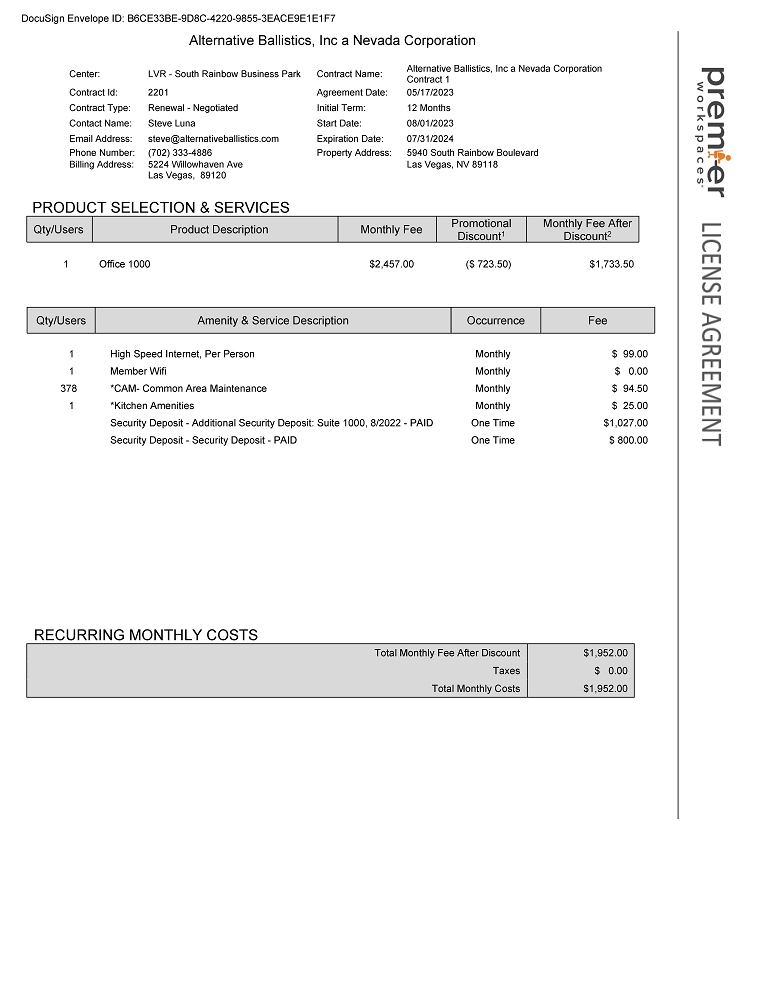


Exhibit 11.2

CONSENT OF INDEPENDENT REGISTERED PUBLIC ACCOUNTING FIRM
We consent to the inclusion in the foregoing Form 1-A Regulation A Offering Statement of our report August 11, 2023, relating to our audit the financial statements of Alternative Ballistics Corporation as of December 31, 2022 and 2021, and for the periods then ended, and the reference to our firm under the caption “Experts” in the Offering Statement.
| /s/ M&K CPAS, PLLC | |
| The Woodlands, Texas | |
| November 1, 2023 |