__________________________________________________________
UNITED STATES
SECURITIES AND EXCHANGE COMMISSION
WASHINGTON, D.C. 20549
(Mark One) For the fiscal Or For the transaction period from ___________ to _________ Commission File No (Exact name of registrant as specified in its charter)
(State or other jurisdiction of incorporation or organization) (I.R.S. Employer Identification No.) (Address of principal executive offices, Zip Code) Securities registered pursuant to Section 12(b) of the Exchange Act: (Title of each class) Securities registered pursuant to Section 12(g) of the Exchange Act: Title of each class Trading Symbol(s) Name of each exchange on which registered Common Stock, $0.002 par value Indicate by check mark if the registrant is a well-known seasoned issuer, as defined in Rule 405 of the Securities Act. o Yes x Indicate by check mark if the registrant is not required to file reports pursuant to Section 13 or Section 15(d) of the Act. o Yes x Indicate by check mark whether the registrant (1) has filed all reports required to be filed by Section 13 or 15(d) of the Securities Exchange Act of 1934 during the preceding 12 months (or for such shorter period that the registrant was required to file such reports), and (2) has been subject to such filing requirements for the past 90 days. Indicate by check mark whether the registrant has submitted electronically every Interactive Data File required to be submitted pursuant to Rule 405 of Regulation S-T (§ 232.405 of this chapter) during the preceding 12 months (or for such shorter period that the registrant was required to submit such files). 1
Indicate by check mark whether the registrant is a large accelerated filer, an accelerated filer, a Large accelerated filer ¨ Accelerated filer ¨ Non-accelerated filer Smaller reporting company Emerging growth company If an emerging growth company, indicate by check mark if the registrant has elected not to use the extended transition period for complying with any new or revised financial accounting standards provided pursuant to Section 13(a) of the Exchange Act. Indicate by check mark whether the registrant has filed a report on and attestation to its management’s assessment of the effectiveness of its internal control over financial reporting under Section 404(b) of the Sarbanes-Oxley Act (15 U.S.C. 7262(b)) by the registered public accounting firm that prepared or issued its audit report. o Indicate by check mark whether the registrant is a shell company (as defined in Rule 12b-2 of the Act). The aggregate market value of the voting 2
TABLE OF CONTENTS Cautionary Note Regarding Forward-Looking Statements Page PART I ITEM 1: 6 ITEM 1A: 12 ITEM 1B: 24 ITEM 2: 24 ITEM 3: 38 ITEM 4: 39 PART II ITEM 5: MARKET FOR COMMON EQUITY, RELATED STOCKHOLDER MATTERS AND PURCHASES OF EQUITY SECURITIES 39 ITEM 6: 41 ITEM 7: MANAGEMENT'S DISCUSSION AND ANALYSIS OF FINANCIAL CONDITION AND RESULTS OF OPERATION 41 ITEM 7A: 45 ITEM 8: 46 ITEM 9: CHANGES IN AND DISAGREEMENTS WITH ACCOUNTANTS ON ACCOUNTING AND FINANCIAL DISCLOSURE 71 ITEM 9A: 71 ITEM 9B: 73 PART III ITEM 10: 73 ITEM 11: 74 ITEM 12: SECURITY OWNERSHIP OF CERTAIN BENEFICIAL OWNERS AND MANAGEMENT AND RELATED STOCKHOLDER MATTERS 75 ITEM 13: CERTAIN RELATIONSHIPS AND RELATED TRANSACTIONS, AND DIRECTOR INDEPENDENCE 76 ITEM 14: 76 PART IV ITEM 15: 77 ITEM 16: 77 78 3
Unless the context requires otherwise, references to “Santa Fe Gold,” “Santa Fe,” “we,” “us,” “our” and the “Company” refer to Santa Fe Gold Corporation and its consolidated subsidiaries. ADDITIONAL INFORMATION Descriptions of agreements or other documents contained in this Annual Report filed on Form 10-K are intended as summaries and are not necessarily complete. Please refer to the agreements or other documents filed or incorporated herein and furnished herewith as exhibits for more complete descriptions of the terms and conditions set forth therein. Please see the exhibit index at the end of this report for a complete list of those exhibits. CAUTIONARY STATEMENT ON FORWARD-LOOKING STATEMENTS This Annual Report may contain certain “forward-looking” statements as such term is defined by the Commission in its rules, regulations and releases, which represent the Company’s expectations or beliefs, including but not limited to, statements concerning the registrant’s operations, economic performance, financial condition, growth and acquisition strategies, investments, and future operational plans. For this purpose, any statements contained herein that are not statements of historical fact may be deemed to be forward-looking statements. Without limiting the generality of the foregoing, words such as “may,” “will,” “expect,” “believe,” “anticipate,” “intent,” “could,” “estimate,” “might,” “plan,” “predict,” “strategy” or “continue” or the negative or other variations thereof or comparable terminology are intended to identify forward-looking statements. This information may involve known and unknown risks, uncertainties and other factors which may cause our actual results, performance, or achievements to be materially different from the future results, performance or achievements expressed or implied by any forward-looking statements. Forward-looking statements, many assuming that the Company secures adequate financing and is able to continue as a going concern,
important factors that could prevent us from achieving objectives include but are not limited to those set forth in other “Risk Factors” section in this report and the following:
·our ability to continue as a going concern;
·our ability to acquire financing to allow us to remain in business
·our anticipated cash requirements and the availability for current projects and financing thereof;
·projections regarding capital costs, expenditures, potential revenues, operating costs, production and economic returns may differ significantly from those that we have anticipated;
·our ability to secure permits or other regulatory approvals to operate or explore our mineral properties;
·exposure to all of the risks associated with mining operations, if any development of one or more of our projects is found to be economically feasible;
·title to some of our mineral properties may be uncertain or defective;
·land reclamation and mine closure may be burdensome and costly;
·significant risk and hazards associated with mining operations;
·the requirements that we obtain, maintain and renew environmental, construction and mining permits, which is often a costly and time-consuming process and may be opposed by local environmental group;
·
·claims
4
·our lack of necessary financial resources to complete development of our projects and the uncertainty of our future best
·our exposure to material costs, liabilities and obligations as a result of environmental laws and regulations (including changes thereto) and permits;
·changes in the price of silver and gold;
·extensive regulation by the U.S. government as well as state and local governments;
·
·our growth strategies,
·anticipated trends in our industry;
·unfavorable weather conditions;
·the commercial and economic viability of any mines;
·availability of labor, materials and equipment;
·the volatility in the market price of our stock;
·our ability to acquire and retain key mining personnel to effectively operate and move forward the Company; ·failure of equipment to process or operate in accordance with specifications, including expected throughput, which could prevent the production of commercially viable output; and ·our ability to seek out and acquire high quality gold Actual events or results may differ materially from those discussed in forward-looking statements 5
PART I
Overview We are As an exploration mining company, we are engaged in the business of acquiring and developing mines and mining properties as well as securing production from existing and developed mining and mineral properties. Currently we own certain mining leases and other mineral rights, however none of them contain any proven or probable reserves, as defined in Regulation S-K 1300; and they are all currently considered “exploratory” in nature. Currently we have three projects, each of which management has determined is “material” based on the costs to secure the rights associated with them, as required by Regulation S-K 1304, these are: our Alhambra Property, the Jim Crow Imperial Mine and the Billali Mine, each of which are exploratory in nature and is described more fully in the properties section of this report. Although management is optimistic about its plans for developing certain such properties, to date, minimal mining activities have commenced at the Jim Crow Imperial Mine and the Billali Mine sites and there can be no assurance After the dismissal from bankruptcy in June 2016, we had no assets and approximately $20 million of indebtedness was reinstated. The properties we currently own were acquired subsequent to our dismissal from bankruptcy proceedings. We We are considered an exploration stage company, as defined in S-K 1300. The Company has not demonstrated the existence of mineral reserves at any of our properties. Under Regulation S-K 1300, the SEC defines a “mineral reserve” as “an estimate of tonnage and grade or quality of indicated and measured mineral resources that, in the opinion of the qualified person, can be the basis of an economically viable project.” To have mineral resources, there must be reasonable prospects for economic extraction. Per the SEC, “probable mineral reserves” are the economically mineable part of an indicated and, in some cases, a measured mineral resource and “proven mineral reserves” can only result from measured mineral resources. Mineral reserves cannot be considered proven or probable unless and until they are supported by a preliminary feasibility study or feasibility study, indicating that the mineral reserves have had the requisite geologic, technical and economic work performed and are economically and legally extractable. We have not completed a preliminary feasibility study or feasibility study with regard to any of our properties to date. We do not anticipate leaving exploration stage company for the foreseeable future. Under S-K we will not exit the exploration stage until such time, if ever, that we demonstrate the existence of proven or probable mineral reserves that meet the guidelines under S-K 1300. When we begin extracting material from our properties, we will remain an exploration company under S-K 1300 guidelines. 6
Company Organizational Chart Overview of Current Events Our Business As a mining company in the exploration stage, we are engaged in the business of acquiring mineral properties that may contain recoverable mineral deposits, (we are currently targeting gold and/or silver deposits) with a view to develop them and, if there are mineral resources identified or mineral reserves, to actively mine them. Although management is optimistic about its prospects for favorable exploration results on the properties in which it has acquired interests, to date no mineral reserves have been determined. There are however minimal mining activities that have commenced and we have conducted limited extraction activity. Nevertheless, there can be no assurance it will continue or, that if it does, that any of the mining activities will be profitable, with or without mineral reserves. Management’s continuing efforts were successfully rewarded as the Company secured, what management believes will ultimately be, promising mining leases and other mineral rights. The properties we now own are exploratory in nature and consist of certain mining leases and other mineral rights. As stated, they were acquired subsequent to our dismissal from bankruptcy proceedings and, although management is optimistic, none of them contain any proven and probable reserves. In October 2021, we exercised the purchase option for $164,335 on the mill property in Duncan, Arizona, and the transaction closed on November 9, 2021. The Company is currently in the process of acquiring a mill operation for its head ore to be located on its property in Duncan, Arizona. The seller of the mill has disassembled the mill in Kellogg, Idaho and relocated the mill to the Duncan, Arizona site. Currently all associated costs of the mill and its relocation are being accumulated and finalized by the seller. At this time there are no agreements between the seller and the Company as to terms and sales price of the delivered disassembled mill and such price is anticipated to be negotiated and determined in late fall 2022, when the necessary funding will be raised by the Company for the acquisition of the mill equipment and its construction. At the time of filing this Form 10-K, negotiations for the purchase of the disassembled mill with the seller have not taken place and will be finalized upon the Company raising the adequate funding for the acquisition and determination if the seller or the Company will be responsible for its The Company 7
Ultimately, while the underlying circumstances that gave rise to the Company’s delinquent filings were, in part, caused by an individual who was dismissed upon discovery of On May 14, 2022, the Company filed a Form 10-12G Registration statement with the SEC and was withdrawn by the Company on July 12, 2021 due to comments not completely cleared by the SEC. On July 20, 2021, we refiled a new Form 10-12G and on September 17, 2021 we withdrew the filing due to SEC comments requiring financial restatements. The Company made the required financial restatements and our auditors recertified the audited financial statements and we submitted a new Form 10-12G on June 14, 2022 and on August 4, 2022 the SEC declared our Form 10-12G Registration effective. Although the Company is not trading currently and we are a reporting Company under Section 12(g) of the Securities and Exchange Act of 1934, as amended and are required to timely file periodic and current reports with the SEC. The Company is working on securing a broker dealer to Competition The mining industry is highly competitive. We will be competing with numerous companies, substantially all of which have far greater resources available to them that we are likely to have when Compliance with Government Regulations Continuing to acquire and explore mineral properties in the State of New Mexico will require the Company to comply with all regulations, rules and directives of governmental authorities and agencies applicable to the exploration of minerals in the State of New Mexico and the United States. 8
The mining industry, (specifically the activities of exploration, drilling) operate in a legal environment that requires permits to conduct virtually all operations Local authorities, usually counties, also have control over mining activity. The various permits address such issues as prospecting, development, production, labor standards, taxes, occupational health and safety, toxic substances, air quality, water use, water discharge, water quality, noise, dust, wildlife impacts, as well as other environmental and socioeconomic issues. Like all other mining companies doing business in the United States, we are subject to a variety of federal, state and local statutes, rules and regulations designed to protect the quality of the air and water, and to protect threatened or endangered species, in the vicinity of our mining operations. These include “permitting” or “pre-operating approval” requirements that are designed: (i) to ensure the environmental integrity of a proposed mining facility, (ii) to ensure operating plans are designed to mitigate the effects of discharges into the environment during exploration, mining operations, and reclamation and (iii) that post-operation plans are designed to remediate the lands affected by a mining facility once commercial mining operations have ceased. United States Mining in the State of New Mexico is subject to federal, state and local law. Three types of laws are of particular importance to the Company’s U.S. mineral properties: those affecting land ownership and mining rights; those regulating mining operations; and those dealing with the environment.
Land Ownership On Federal Lands, mining rights are governed by the General Mining Law of 1872 (“General Mining Law”) as amended, 30 U.S.C. §§
Mining Operations The exploration of mining properties and development and operation of mines is governed by both federal and state laws. The State of New Mexico likewise requires various permits and approvals before mining operations can begin, although the state and federal regulatory agencies usually cooperate to minimize duplication of permitting efforts. The State of New Mexico Mining and Minerals Division requires mine permits for each mining location. The permit has an Annual Permit Fee that is due by April 30 of each year. The Annual Permit Fee for minimal impact mines is currently $250. Prior to receiving the necessary permits to explore or mine, the operator must comply with all regulatory requirements imposed by all governmental authorities having jurisdiction over the project. Effect of Existing or Potential Government Regulations
Mineral exploration, including mining operations 9
Environmental Laws Federal legislation in the United States and implementing regulations adopted and administered by the Environmental Protection Agency, the Forest Service, the Bureau of Land Management, the Fish and Wildlife Service, the Army Corps of Engineers and other agencies—in particular, legislation such as the federal Clean Water Act, the Clean Air Act, the National Environmental Policy Act, the Endangered Species Act, the National Forest Management Act, the Wilderness Act, and the Comprehensive Environmental Response, Compensation and Liability Act ‘have a direct bearing on domestic mining operations. These federal initiatives are often administered and enforced through state agencies operating under parallel state statutes and regulations. The Clean Water Act The Federal Clean Water Act is the principal Federal environmental protection law regulating mining operations in the United States as it pertains to water quality. At the state level, water quality is regulated by the New Mexico Environment Department. If our exploration or any future development activities could affect a ground water aquifer, we are required to apply for a ground water discharge permit in compliance with the groundwater regulations. If exploration affects surface water, then compliance with surface water regulations is required. The Clean Air Act The Federal Clean Air Act establishes ambient air quality standards, limits the discharges of new sources and hazardous air pollutants and establishes a federal air quality permitting program for such discharges. Hazardous materials are defined in the Federal Clean Air Act and enabling regulations adopted under the Federal Clean Air Act to include various metals. The Federal Clean Air Act also imposes limitations on the level of particulate matter generated from mining operations. National Environmental Policy Act (“NEPA”) NEPA requires all governmental agencies to consider the impact on the human environment of major federal actions as therein defined. Endangered Species Act (“ESA”) The ESA requires federal agencies to ensure that any action authorized, funded or carried out by such agency is not likely to jeopardize the continued existence of any endangered or threatened species or result in the destruction or adverse modification of their critical habitat. In order to facilitate the conservation of imperiled species, the ESA establishes an interagency consultation process. When a federal agency proposes an action that “may affect” a listed species, it must consult with the USFWS and must prepare a “biological assessment” of the effects of a major construction activity if the USFWS advises that a threatened species may be present in the area of the activity. National Forest Management Act The National Forest Management Act, as implemented through Title 36 of the Code of Federal Regulations, provides a planning framework for lands and resource management of the National Forests. The planning framework seeks to manage the National Forest System resources in a combination that best serves the public interest without impairment of the productivity of the land, consistent with the Multiple Use Sustained Yield Act of 1960. Wilderness Act The Wilderness Act of 1964 created a National Wilderness Preservation System composed of Federally owned areas designated by Congress as “wilderness areas” to be preserved for future use and enjoyment. The Comprehensive Environmental Response, Compensation and Liability Act (“CERCLA”) CERCLA generally imposes joint and several liability, without regard to fault or legality of conduct, on classes of persons who are considered to be responsible for the release of a “hazardous substance” into the environment. These persons include the current owner or operator of a contaminated facility, a former owner or operator of the facility at the time of contamination and those persons that disposed or arranged for the disposal of the hazardous substance. Under CERCLA and comparable state statutes, such persons may be subject to strict joint and several liability for the costs of cleaning up the hazardous substances that have been released into the environment, for damages to natural resources and for the costs of certain health studies. In addition, it is not uncommon for neighboring landowners and other third parties to file claims for personal injury and property damage allegedly caused by the hazardous substances released into the environment. Governmental agencies or third parties may seek to hold the Company responsible under CERCLA and comparable state statutes for all or part of the costs to clean up sites at which such “hazardous substances” have been released. 10
The Resource Conservation and Recovery Act (“RCRA”) RCRA was designed and implemented to regulate the disposal of solid and hazardous wastes. It restricts solid waste disposal practices and the management, reuse or recovery of solid wastes and imposes substantial additional requirements on the subcategory of solid wastes that are determined to be hazardous. Like the Clean Water Act, RCRA provides for citizens’ suits to enforce the provisions of the law. National Historic Preservation Act The National Historic Preservation Act was designed and implemented to protect historic and cultural properties. Compliance with the Act is necessary where federal properties or federal actions are undertaken, such as mineral exploration on federal land, which may impact historic or traditional cultural properties, including native or Indian cultural sites. Reclamation We generally will be required to mitigate long-term environmental impacts by stabilizing, contouring, re-sloping and revegetating various portions of a site after mining and mineral processing operations are completed. These reclamation efforts would be conducted in accordance with detailed plans, which must be reviewed and approved by the appropriate regulatory agencies. As soon as we have a mining operation, we will be required to arrange and pledge certificates of deposits for reclamation with the state regulatory agencies. At this time no reclamation cost is required to be calculated or carried forward. Employees We currently have Employment Agreements Effective July 7, 2020, the Company retained a new Chief Financial Officer and the Insurance We normally maintain property, liability and workmen’s compensation insurance Exploration The Company has spent only nominal amounts during each of the last Seasonality We have no properties at this time that are subject to material restrictions on our operations due to seasonality. Office Facilities Our principal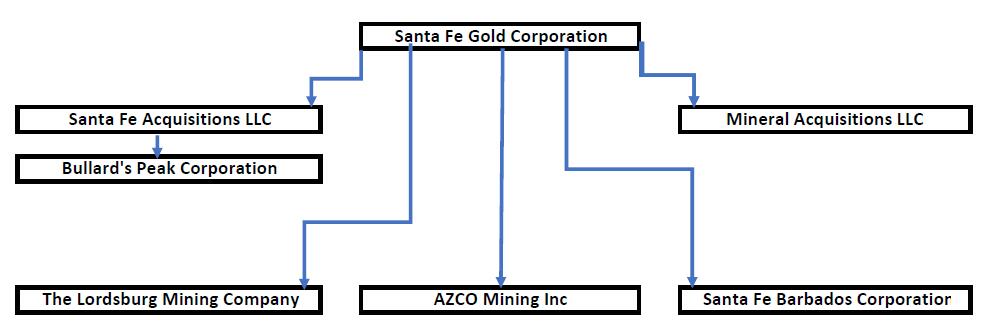

11
Dismissal of Bankruptcy Proceeding and Emergence from Voluntary Reorganization
In August 2015, the Company filed for Bankruptcy protection under Chapter 11
After the dismissal
·The approximately $20 million of indebtedness outstanding on account of the Company’s
·The
The Company received Bankruptcy Court confirmation of the dismissal in June 2016, and subsequently emerged from bankruptcy. The only funds available for the future administrative costs were prepaid insurance funds of approximately $49,000. The Company subsequently began selling, on a best-efforts basis, equity for the cash needed for working capital purposes. Currently we have no continuing commitment from any party to provide working capital, and there is no certainty that the Company will be able to continue its current business plan.
Available Information
We make available, free of charge, on or through our Internet website, at www.santafegoldcorp.com, our annual report on Form 10-K, our quarterly reports on Form 10-Q and our current reports on Form 8-K and amendments to those reports filed or furnished pursuant to Section 13(a) or 15(d) of the U.S. Securities Exchange Act of 1934. Our Internet website and the information contained therein or connected thereto are not intended to be, and are not, incorporated into this report on Form 10-K.
You can read our SEC filings, including this annual report as well as our other periodic and current reports, on the SEC’s website at www.sec.gov. You may also read and copy any document we file with the SEC at its public reference facilities at 100 F Street, N.E., Room 1580, Washington, D.C. 20549. You may also obtain copies of the documents at prescribed rates by writing to the Public Reference Section of the SEC at 100 F Street, N.E., Room 1580, Washington, D.C. 20549. Please call the SEC at 1-800-SEC-0330 for further information on the operation of the public reference facilities.
The Company operates in a rapidly changing environment that involves numerous risks and uncertainties involving precious metal prices, explorations costs and government oversight. Investors should carefully consider the risks described below before purchasing the Company’s common shares. The occurrence of any of the following events could negatively affect our business operations and our results of operations. If these events occur, the trading price of the Company’s common shares could decline, and shareholders may lose part or even all of their investment.
Risk Associated with Our Business
You should invest in our common stock only if you can afford to lose your entire investment. Your decision to invest in our common stock should only be made after you have knowingly accepted the possibilities of such a loss and the associated risks. 12
Risks Related to Our Business All of our properties are in the exploration stage. There can be no assurance that we will establish the existence of any mineral resource or We have not established that any of our mining properties contain The commercial viability of an established mineral deposit will depend on a large number of factors; including, by way of example, the size, grade and other attributes of the mineral Even if commercial viability of a mineral or metal deposit is established, we may be required to expend significant resources until production is possible, during which time the economic feasibility of production may change. Substantial expenditures are required to both establish proven and probable reserves as well as those required to implement permitting and drilling operations. Because of these uncertainties, investors have no assurances that our drilling programs will result in commercially viable operations nor that we will be successful in the establishment or expansion of any resources or reserves. Any failure in our ability to successfully execute on the forgoing will adversely impact our business results of operations, in turn leading to losses for investors. As the Company has adopted the required disclosure prescribed in Regulation S-K 1300 et. seq., the concept of a feasibility study is “mineral resources,” as the term under Reg. S-K 1300 means not only that there are mineral deposits present but that they have been determined to be economically viable for extraction. The mineral deposits on our properties have a great amount of uncertainty as to their existence, and great uncertainty as to their economic If we establish the existence of commercially viable mineral If we do discover mineral Our exploration and extraction activities may not be commercially successful. 13
While we believe there are positive indicators that our properties contain commercially exploitable minerals and metals, such belief has been based solely on preliminary tests that we have conducted and data provided by third parties. There can be no assurance that the tests and data upon which we have relied are correct or accurate. Moreover, mineral exploration is highly speculative in nature, involves many risks and is frequently non-productive. ·the identification of potential mineralization based on analysis; ·the availability of permits; ·compliance with environmental requirements; ·increases in operating mining related costs; ·the quality of our management and our geological and technical expertise; and ·the capital available for mining operations. Substantial expenditures and time are required to establish existing proven and probable reserves through drilling and analysis, and to develop the mines and facilities and infrastructure at any site chosen for mining. There may be challenges to the title of our mineral properties. The Company has acquired certain rights to its properties by unpatented claims, ownership of land or by lease from those owning the property and its patented claims are limited. The validity of title to many types of natural resource property depends upon numerous circumstances and factual matters (many of which are not discoverable of record or by other readily available means) and is subject to many uncertainties of existing law and its application. There can be no assurance that the validity of our titles to our properties will be upheld or that third parties will not otherwise seek to invalidate those rights. In the event the validity of our title to any of these properties are not upheld, such events would have a material adverse effect on us. Mineral operations are subject to applicable law and government regulations. Even if we discover a mineral resource in a commercially exploitable quantity, these laws and regulations could restrict or prohibit the exploitation of them. If we cannot exploit any mineral resources that we discover on our properties, our business may fail. Both mineral exploration and extraction require permits from various foreign, federal, state, provincial and local governmental authorities and are governed by laws and regulations, including those with respect to prospecting, mine development, mineral production, transport, export, taxation, labor standards, occupational health, waste disposal, toxic substances, land use, environmental protection, mine safety and other matters.
Companies, such as ours that plan to engage in exploration and extraction activities, often experience increased costs and delays in production and other schedules as a result of the need to comply with applicable laws, regulations and permits. Issuance of permits for our activities is subject to the discretion of government authorities, and we may be unable to obtain or maintain such permits. Permits required for future exploration or development may not be obtainable on reasonable terms, on a timely basis or at all. There can be no assurance that we will be able to obtain or maintain any of the permits required for the continued exploration or development of our mineral properties or for the construction and operation of a mine on our properties at economically viable costs. If we cannot accomplish these objectives, our business could face difficulty and/or fail.
We believe that we are in compliance with all material laws and regulations that currently apply to our activities but there can be no assurance that we can continue to do so. Current laws and regulations could be amended and we might not be able to comply with them, as amended. Further, there can be no assurance that we will be able to obtain or maintain all permits necessary for our future operations, or that we will be able to obtain them on reasonable terms. To the extent such approvals are required and are not obtained, we may be delayed or prohibited from proceeding with planned exploration or development of our mineral properties.
Environmental hazards unknown to us, which have been caused by previous or existing owners or operators of the properties, may exist on the properties in which we hold an interest.
14
Competition in the mining industry is intense, and we have limited financial and personnel resources with which to compete.
Competition in the mining industry for desirable properties, investment capital, equipment and personnel are intense. Numerous companies headquartered in the United States, Canada and elsewhere throughout the world compete for properties on a global basis, including areas where we intend to operate. We are currently an insignificant participant in the mining industry due, in part, to our limited financial and personnel resources. We may be unable to: i) attract the necessary investment capital or a joint venture partner to fully develop our mineral properties, ii) acquire other desirable properties, iii) attract and hire necessary personnel, or iv) purchase necessary equipment.
The nature of mineral exploration and production activities involves a high degree of risk and the possibility of uninsured losses.
The business of exploring for and extracting minerals and metals involves a high degree of risk. Few properties are ultimately developed into producing mines. Whether a mineral deposit can be commercially viable depends upon a number of factors, including the particular attributes of the deposit, including size, grade and proximity to infrastructure, metal prices, which can be highly variable, and government regulation, including environmental and reclamation obligations. These factors are not within our control. Uncertainties as to the metallurgical amenability of any minerals discovered may not warrant the mining of these metals or minerals on the basis of available technology. Our operations are subject to all of the operating hazards and risks normally incident to exploring for and developing mineral or metal properties, such as, but not limited to:
·encountering unusual or unexpected formations;
·environmental pollution;
·personal injury, flooding and landslides;
·variations in grades of minerals or metals;
·political and economic related conditions;
·labor disputes; and
·a decline in the price of gold
We currently have no insurance or hedges to guard against any of these risks. If we determine that capitalized costs associated with any of our mineral interests are not likely to be recovered, we would incur a write-down on our investment in such property interests.
Our exploration and development activities are subject to environmental risks, which could expose us to significant liability and delay, suspension or termination of our operations.
The exploration, possible future development and production phases of our business will be subject to federal, state and local environmental regulation. These regulations mandate, among other things, the maintenance of air and water quality standards and land reclamation. They also set out limitations on the generation, transportation, storage and disposal of solid and hazardous waste. Environmental legislation is evolving in a manner which will require stricter standards and enforcement, increased fines and penalties for non-compliance, more stringent environmental assessments, and a heightened degree of responsibility for companies and their officers, directors and employees. Future changes in environmental regulations, if any, may adversely affect our operations. If we fail to comply with any of the applicable environmental laws, regulations or permit requirements, we could face regulatory or judicial sanctions. Penalties imposed by either the courts or administrative bodies could delay or stop our operations or require a considerable capital expenditure. Although we intend to comply with all environmental laws and permitting obligations in conducting our business, there is always a possibility that those opposed to exploration and mining may attempt to interfere with our operations, whether by legal process, regulatory process or otherwise.
We could be subject to environmental lawsuits.
Neighboring landowners, other third parties and governmental entities could file claims based on environmental statutes and common law for personal injury and property damage allegedly caused by the release of hazardous substances or other waste material into the environment on or around our properties.
The Company’s industry is highly competitive and we have less capital and resources than many of our competitors which may give them an advantage in developing and securing mining claims and marketing products similar to ours or make our products obsolete.
We are involved in a highly competitive industry where we may compete with numerous other companies who offer alternative methods or approaches. These competitors may have far greater resources, more experience, and personnel perhaps more qualified than we do.
15
Such resources may give our competitors an advantage in developing and marketing products similar to ours or products that make our products obsolete. There can be no assurance that we will be able to successfully compete against these other entities.
The Company’s failure to continue to attract, train, or retain highly qualified personnel could harm the Company’s business:
The Company’s success also depends on the Company’s ability to attract, train, and retain qualified personnel, specifically those with management and product development skills. In particular, the Company must hire additional skilled personnel to further the Company’s research and development efforts. Competition for such personnel is intense. If the Company does not succeed in attracting new personnel or retaining and motivating the Company’s current personnel, the Company’s business could be harmed.
Risks Related to
Litigation with respect to Mr. Laws may not result in additional funds being obtained to reduce his indebtedness owed to the Company.
The Company has determined by its records that Mr. Laws initially
There were also expenses associated with engaging the special committee to conduct a forensic review of the Company’s books and records in connection with the transactions giving rise to the Missing Funds.
There can be no assurance the Company will successfully implement its plans.
We have historically incurred net losses from operations and we expect losses in the future periods. Our likelihood of success must be considered in light of the problems, expenses, difficulties, complications and delays frequently encountered in connection with the formation of a new business which seeks to obtain funds to finance its operations in a highly competitive environment. There can be no assurance that we will successfully implement any of our plans (including without limitation production of any mine, shipping ore to a smelter or otherwise commercially exploit our properties) in a timely or effective manner or that we will ever be profitable. In addition, there can be no assurances that we will choose to continue to develop any of our current properties because we intend to consider and, as appropriate, to divest ourselves of properties that may no longer be a strategic fit to our business strategy or that we lack the necessary capital to develop. If we lack the capital to implement our plans, we will be forced to curtail or cease operations.
Mineral exploration and development inherently
The exploration for and development of mineral deposits involves significant financial risks, which even a combination of careful evaluation, experience and knowledge may not eliminate. Unprofitable efforts may result from the failure to discover mineral deposits. Even if mineral deposits are found, such deposits may be insufficient in quantity and quality to return a profit from production, or it may take a number of years until production is possible, during which time the economic viability of the project may change. Few properties which are explored are ultimately developed into producing mines. Mining companies rely on consultants and others for exploration, development, construction and operating expertise.
Substantial expenditures are required to establish ore reserves, extract metals from ores and, in the case of new properties, to construct mining and processing facilities. The economic feasibility of any development project is based upon, among other things, estimates of the size and grade of ore reserves, proximity to infrastructures and other resources (such as water and power), metallurgical recoveries, production rates and capital and operating costs of such development projects, and metals prices. Development projects are also subject to the completion of favorable feasibility studies, issuance and maintenance of necessary permits and receipt of adequate financing.
Once a mineral deposit is developed, whether it will be commercially viable depends on a number of factors, including: the particular attributes of the deposit, such as size, grade and proximity to infrastructure; government regulations including taxes, royalties and land tenure; land use, importing and exporting of minerals and environmental protection; and mineral prices. Factors that affect adequacy of infrastructure include: reliability of roads, bridges, power sources and water supply; unusual or infrequent weather phenomena; sabotage; and government or other interference in the maintenance or provision of such infrastructure. All of these factors are highly cyclical. The exact effect of these factors cannot be accurately predicted, but the combination may result in not receiving an adequate return on invested capital.
16
Significant investment risks and operational costs are associated with our exploration activities. These risks and costs may result in lower economic returns and may adversely affect our business.
Mineral exploration, particularly for gold, involves many risks and is frequently unproductive. If mineralization is discovered, it may take a number of years until production is possible, during which time the economic viability of the project may change. Development projects may have no operating history upon which to base estimates of future operating costs and capital requirements. Development project items such as estimates of reserves, metal recoveries and cash operating costs are to a large extent based upon the interpretation of geologic data, obtained from a limited number of drill holes and other sampling techniques, and feasibility studies. Estimates of cash operating costs are then derived based upon anticipated tonnage and grades of ore to be mined and processed, the configuration of the ore body, expected recovery rates of metals from the ore, comparable facility and equipment costs, anticipated climate conditions and other factors. As a result, actual cash operating costs and economic returns of any and all development projects may materially differ from the costs and returns estimated, and accordingly, our financial condition and results of operations may be negatively affected.
Any of our future acquisitions may result in significant risks, which may adversely affect our business.
An important element of our business strategy is the opportunistic acquisition of operating mines, properties and businesses or interests therein within our geographical area of interest. While it is our practice to engage independent mining consultants to assist in evaluating and making acquisitions, any mining properties or interests therein we may acquire may not be developed profitably or, if profitable when acquired, that profitability might not be sustained. In connection with any future acquisitions, we may incur indebtedness or issue equity securities, resulting in increased interest expense, or dilution of the percentage ownership of existing shareholders. We cannot predict the impact of future acquisitions on the price of our business or our common stock. Unprofitable acquisitions, or additional indebtedness or issuances of securities in connection with such acquisitions, may impact the price of our common stock and negatively affect our results of operations.
Our ability to find and acquire new mineral properties is uncertain. Accordingly, our prospects are uncertain for the future growth of our business.
Because mines have limited lives based on proven and probable ore reserves, we may seek to replace and expand our future ore reserves, if any. Identifying promising mining properties is difficult and speculative. Furthermore, we encounter strong competition from other mining companies in connection with the acquisition of properties producing or capable of producing gold. Many of these companies have greater financial resources than we do. Consequently, we may be unable to replace and expand future ore reserves through the acquisition of new mining properties or interests therein on terms we consider acceptable. As a result, our future revenues from the sale of gold or other precious metals, if any, may decline, resulting in lower income and reduced growth.
Delaware law and our by-laws protect our directors from certain types of lawsuits.
Delaware law provides that our directors will not be liable to us or our stockholders for monetary damages except for certain types of conduct as directors. Our by-laws require us to indemnify our directors and officers against all damages incurred in connection with our business to the fullest extent provided or allowed by law. The exculpation provisions may have the effect of preventing stockholders from recovering damages against our directors caused by their negligence, poor judgment, or other circumstances. The indemnification provisions may require us to use our assets to defend our directors and officers against claims, including claims arising out of their negligence, poor judgment, or other circumstances.
The Company is in the preliminary stages of mining operations in the Jim Crow
17
Dismissal of Bankruptcy
After the dismissal of the bankruptcy petition in June 2016 and the sale of the Company’s significant assets, the Company emerged with
·The approximately $20 million of indebtedness outstanding on account of the Company’s senior notes and unsecured claims were reinstated; and
·The courts established a trust in April 2016 for the benefit of certain creditors. A profit interest was attached to the Summit mine with the benefit for certain creditors holding unsecured claims filed by each creditor.
Accordingly, there can be no assurance that the Company’s remaining liabilities
We have a history of operating losses and expect to incur substantial operating losses and negative operating cash flows for the foreseeable future, and we may never achieve or maintain profitability.
We have had no revenues
We may never be able to write-down certain liabilities and this may have a negative impact on our ability to raise capital and on the market price of our common stock, when we resume trading.
At the end of the Company’s fiscal year ending June 30, 2019, the Company wrote off debt and related accrued interest aggregating $12,507,540. The write off of debt was related to two finance facilities governed by and enforceable under British Columbia statutes. The Company retained legal services in British Columbia to research the British Columbia statutes of limitations on the collectability of the finance facilities. Legal counsel reviewed all related documents, records of proceedings and all records and documents deemed relevant to the two finance facilities. The finance facilities were subject to the laws of the Providence of British Columbia and the National laws of Canada and as a result, the Company secured a written legal opinion from Canadian counsel that any liability under the two finance facilities, because of the Limitations Act (British Columbia) and the relevant case law in British Columbia, were no longer enforceable. That is, because the statute of limitations had run for the two liabilities, pursuant to the Limitations Act (British Columbia), no future claims could be commenced in the Province of British Columbia and therefore, the Company had no outstanding legal obligations on the two finance facilities. With this, the Company wrote down $12,507,540 in liabilities and this has been the Company’s position; however, upon review of earlier Registration Statements that were subsequently withdrawn, the SEC Staff expressed its concern with the Company taking this write-down because FASB ASC 405-20-40-1(b) states that “a liability has been extinguished if the debtor is legally released from being the primary obligor under the liability, either judicially or by the creditor.” Since management knew that one of the creditors had been dissolved and was no longer in existence and the other creditor had written-off the amounts that had been owed to it by the Company in one of its annual reports, it knew that it would be difficult if not impossible to get both creditors to release it from liability and that obtaining a court order would be time consuming and expensive at best. The Commission Staff was willing to allow an opinion of counsel, however the opinions we provided did not meet the standard that the Commission requires. The standard that the Commission Staff requires is what is sometimes referred to as a “would” or “will” opinion. In requiring a “will” or “would” opinion, the Commission is looking for greater assurance that the Company “would” or “will” be successful in the event that one of the creditors sought to collect on the liabilities. Although this standard may seem subjective, “will opinions” are regularly used in the context of tax law where a tax opinion is needed. In that context the term “will” means that the drafter of the opinion believes and is effectively stating that there is a 90%-95% probability that a given result “will” come to pass based on the facts present. Absent the availability of one of these three routes to write-off the liabilities, he Commission Staff’s position is that
18
the correct treatment of the aforementioned liabilities is to continue carrying them on the Company’s balance sheets. The Company was not able to procure a judicial order in a timely manner, specific written agreement of the creditors nor an opinion of counsel meeting the “would” or “will” standard, therefore it determined the most expeditious course of action was to restate the consolidated financial statements so that the liabilities that were written-off are now included in the liabilities of the Company once again; in effect, restating the consolidated financial statements as of June 30, 2019 and 2020. Although, in a future period, while the Company plans to either seek a judicial determination or an opinion of counsel that meets the “would” or “will” standard with respect to the liabilities, there can be no assurance that the Company will be successful in meeting the requirements necessary to write-off the aforementioned liabilities or that the Commission will agree that the judicial determination or opinion of counsel satisfies the requirements and spirit of FASB ASC 405-20-40-1(b). To meet the requirements of the Commission, the Company reinstated the debt and restated our financial statements in question in our Registration Statement on Form 10-12G filed on June 14, 2022 and became effective on August 4, 2022. As a result of these restated financial statements and the forward impact on future financial statements, our stock prices as well as our ability to secure necessary financial funding could be harmed as a result.
We have a limited operating history on which to base an evaluation of our business and properties.
Any investment in the Company’s securities should be considered a high-risk investment because investors will be placing funds at risk in an early
Successful expansion of our business will depend on our ability to effectively attract and manage staff, strategic business relationships, and shareholders. Specifically, we will need to hire skilled management and technical personnel as well as manage partnerships and joint ventures to navigate shifts in the general economic environment. Expansion has the potential to place significant strains on financial, management, and operational resources, yet failure to expand will inhibit our profitability goals.
If we cannot secure additional funding, we will be unable to implement our business plan.
Since we do not generate any revenues, we may not have sufficient financial resources ourselves, to undertake all planned development activities relating to our business plan.
Our resources may not be sufficient to manage our expected growth; failure to properly manage our potential growth would be detrimental to our business.
Even if we obtain funding for operations, we may fail to adequately manage our anticipated future growth. Any growth in our operations will place a significant strain on our administrative, financial and operational resources, and increase demands on our management, as well as our operational and administrative systems, controls and other resources. There can be no assurances that our existing personnel, systems, procedures or controls will be adequate to support our operations in the future; or that we will be able to successfully implement appropriate measures consistent with our growth strategy. As part of this growth, we may have to implement new operational and financial systems, procedures and controls to expand, train and manage our employee base, and maintain close coordination among our staff. There can be no guarantee that we will be able to do so, or that if we are able to do so, we will be able to effectively integrate them into our existing staff and systems.
19
If we are unable to manage growth effectively, our business, operating results and financial condition could be materially adversely affected. As with all expanding businesses, the potential exists that growth will occur rapidly. If we are unable to effectively manage this growth, our business and operating results could suffer. Anticipated growth in future operations may place a significant strain on management systems and resources. In addition, the integration of new personnel will continue to result in some disruption to ongoing operations. The ability to effectively manage growth in a rapidly evolving market requires effective planning and management processes. We will need to continue to improve operational, financial and managerial controls, reporting systems and procedures, and will need to continue to expand, train and manage our work force.
The loss of key personnel could adversely impact the Company.
The nature of our business, including our ability to continue our current activities depends, in large part, on the efforts of our key personnel, the loss of any of which could have a material adverse effect on our business.
We may be unable to continue as a going concern.
As a result of our financial condition, our auditors have expressed doubt as to our ability to continue as a going concern which may have an adverse impact on our relationship with third parties with whom we do business, and could make it challenging and difficult for us to raise additional debt or equity financing, all of which could have a material adverse impact on our business, results of operations, financial condition and future prospects. The consolidated financial statements have been prepared on a going concern basis, which contemplates the realization of assets and satisfaction of liabilities and commitments in the normal course of business. Should the Company be unable to continue as a going concern, it may be unable to realize the carrying value of its assets and to meet its liabilities as they become due.
A substantial or extended decline in gold and silver prices would have a material adverse effect on the value of our assets, on our ability to raise capital and could result in lower than estimated economic returns.
The value of our assets, our ability to raise capital and any future economic returns are substantially dependent on the prices of gold and silver. Gold and silver prices fluctuate
·gold sales or leasing by governments and central banks or changes in their monetary policy, including gold inventory management and reallocation of reserves;
·speculative short positions taken by significant investors or traders in gold;
·the relative strength of the U.S. dollar;
·expectations of the future rate of inflation;
·interest rates;
·changes to economic activity in the United States, China, India and other industrialized or developing countries;
·geopolitical conflicts;
·changes in industrial, jewelry or investment demand;
·changes in supply from production, disinvestment and scrap; and
·
Risks Related to our Common Stock
The Company’s Common Stock was Deregistered and Trading was Halted.
In July of 2020, the Company received notice from the SEC that it was seeking to deregister the Company’s common stock pursuant to Section 12(j), based on the Company’s failure to file periodic reports with the Commission and otherwise provide current information to the market. This failure was based in large part from the need to restate its financial statements and the need to find and engage a PCAOB auditor who was willing to conduct and provide the required audits amid the SEC and DOJ’s investigations. Although we were able to secure a qualified auditor, we were not able to make our filings quickly enough and by the time they were completed, the Commission had already sent a notice under Section 12(k). The Commission takes a hardline position in these situations such that once they have instituted deregistration proceedings, the only options available to the Company were to litigate or settle and consent to the deregistration of the Company’s common stock. Historically, registrants have not been successful in litigating with the Commission over Section 12(j) matters and therefore the Company determined that the best course of action was to consent to deregistration of its common stock and then file a new registration statement on Form 10-12G. The Company has signed a settlement agreement with the SEC with respect to the registration of its common stock in response to the Commission’s institution of deregistration proceedings under Section 12(j), and has re-registered the same under Section 12(g) by way of filing our Form 10-12G and the filing has been ordered effective by the SEC on August 4, 2022. Currently the Company is preparing the application to the Over-the-Counter Markets Group (“the OTC”) to trade on their QB tier. Upon the OTC completing their due diligence on the application their and approval of the
20
application, it will submit a Form 211 to the Financial Industry Regulatory Authority (“FINRA”) for their final review and acceptance of the OTC due diligence process. The Company filed a complete and current Form 10-12G and it meets the informational requirements of the SEC Rule 15c2-11. Upon the FINRA approval, they will issue our trading symbol and the Company will begin trading. Any delay or failure in securing FINRA’s final approval and issuance of our trading symbol would result in our shareholders not having a public market to sell their shares. Further, it would make it more difficult for the Company to obtain the financing it requires.
Our common stock is not currently traded, and there is no guarantee that our stock will be tradable or that if it is as to the prices at which the shares may trade.
Trading of our common stock
Currently the Company is preparing the application to the OTC to trade on their QB tier. Upon the OTC completing their due diligence on the application and their approval of the application, it will submit a Form 211 to the Financial Industry Regulatory Authority (“FINRA”) for their final review and acceptance of the OTC due diligence process. The Company filed a complete and current Form 10-12G and it meets the informational requirements of the SEC Rule 15c-211. Upon the FINRA approval, they will issue our trading symbol and the Company will begin trading. Any delay or failure in securing FINRA’s final approval and issuance of our trading symbol would result in our shareholders not having a public market to sell their shares. This in turn would negatively affect the Company’s ability to secure the funding required for it to execute on its business plan, which would negatively affect its operations and could result in a complete loss to investors.
Although our Form 10-12G became effective, with all comments cleared, we still face challenges in receiving FINRA approval and even if we are successful and resume trading, trading may still be limited or suffer because we are not listed on an established securities exchange.
Although management is optimistic that we will receive approval to resume trading and views any delays as a short-term issue as of the date of
Because our common stock is currently a “penny stock,” it may be difficult to sell shares at times and prices that are acceptable.
Assuming we are successful in having our stock resume trading on OTC Markets, our common stock will likely be considered a “penny stock.” Broker-dealers who sell penny stocks must provide purchasers of these stocks with a standardized risk disclosure document prepared by the SEC. This document provides information about penny stocks and the nature and level of risks involved in investing in the penny stock market. A broker must also give a purchaser, orally or in writing, bid and offer quotations and information regarding broker and salesperson compensation, make a written determination that the penny stock is a suitable investment for the purchaser, and obtain the purchaser’s written agreement to the purchase. Assuming a market maker are allowed to provide bid and offer quotations because we have been successful in securing through our OTC application process and we are able to satisfy FINRA’s requirements, we will continue to be considered a “penny stock.” The penny stock rules may make it difficult for you to sell your shares of our common stock. Because of these rules, many brokers choose not to participate in penny stock transactions and there is less trading in penny stocks overall as a result. Accordingly, you may not always be able to resell shares of our common stock in ordinary transactions at times and prices that you feel are appropriate.
21
Any sales of a significant amount of common stock by existing shareholders may depress the price otherwise causing the price of our common stock may decline.
A small number of existing shareholders own a significant portion of our common stock, which could limit your ability to influence the outcome of any shareholder vote.
A relatively small number of shareholders hold large concentrations of shares and under our certificate of incorporation and Delaware law, the vote of a majority of the shares outstanding is generally required to approve most shareholder actions. As a result, these individuals and entities will be able to influence the outcome of shareholder votes for the foreseeable future, including votes concerning the election of directors, amendments to our certificate of incorporation or proposed mergers or other significant corporate transactions.
The market price of our common stock
The Company will not pay dividends on its common stock.
We have never paid any cash dividends on any shares of our capital stock, and we do not anticipate that we will pay any dividends in the foreseeable future. Our current business plan is to retain any future earnings to finance the expansion of our business. Any future determination to pay cash dividends will be at the discretion of our Board of Directors, and will be dependent upon our financial condition, results of operations, capital requirements and other factors as our board of directors may deem relevant at that time. If we do not pay cash dividends, our stock may be less valuable because a return on your investment will only occur if our stock price appreciates. This may never happen and investors may lose all of their investment in our company.
We have offered and sold and will continue to offer and sell shares without registration under the Securities Act, through exemptions available under the Securities Act. All such shares are "restricted securities" as defined by Rule 144 ("Rule 144") when issued under available exemptions from registration under the Securities Act, and cannot be resold without registration except in reliance on Rule 144 or another applicable exemption from registration. In general, under Rule 144, our non-affiliates (who have not been affiliates within the past 90 days) can sell restricted shares held for at least six months, subject only to the requirement that we make current information available publicly as required by Rule 144.
No prediction can be made as to the effect, if any, that future sales of restricted shares of common stock, or the availability of such common stock for sale,
Risk Factors Related to the COVID-
An
22
Because we may issue additional shares of our common stock, investment in our company could be subject to substantial dilution.
Investors’ interests in our Company will be diluted and investors may suffer dilution in their net book value per share when we issue additional shares. We are authorized to issue 550,000,000 shares of common stock, $0.002 par value per share. As of June 30, 2022 and 2021 there were 441,308,551 and 433,018,551, shares of our common stock issued and outstanding, respectively. We anticipate that all or at least some of our future funding, if any, will be in the form of equity financing from the sale of our common stock. If we do sell more common stock, investors’ investment in our company will likely be diluted. Dilution is the difference between what investors pay for their stock and the net tangible book value per share immediately after the additional shares are sold by us. If dilution occurs, any investment in our Company’s common stock could seriously decline in value.
Our prior trading in our common stock on the OTC Pink Exchange has been subject to wide fluctuations.
Our common stock was quoted for public trading on OTC Markets prior to Commission order suspending trading that went into effect on December 17, 2020. Historically, the trading price of our common stock has been subject to wide fluctuations. Assuming trading resumes, of which there can be no assurance, the trading prices of our common stock may fluctuate in response to a number of factors, many of which will be beyond our control. The stock market has generally experienced extreme price and volume fluctuations that have often been unrelated or disproportionate to the operating performance of companies with limited business operations. There can be no assurance that trading prices and price earnings ratios previously experienced by our common stock will be matched or maintained. These broad market and industry factors may adversely affect the market price of our common stock, regardless of our operating performance. In the past, following periods of volatility in the market price of a company’s securities, securities class-action litigation has often been instituted. Such litigation, if instituted, could result in substantial costs for us and a diversion of management’s attention and resources.
Delaware law our Certificate of Incorporation and our by-laws provide for the indemnification of our officers and directors at our expense, and correspondingly limits their liability, which may result in a major cost to us and hurt the interests of our shareholders because corporate resources may be expended for the benefit of officers and/or directors.
Our Certificate of Incorporation and By-Laws include provisions that eliminate the personal liability of our directors for monetary damages to the fullest extent possible under the laws of the State of Delaware or other applicable law. These provisions eliminate the liability of our directors and our shareholders for monetary damages arising out of any violation of a director of his fiduciary duty of due care. Under Delaware law, however, such provisions do not eliminate the personal liability of a director for (i) breach of the director's duty of loyalty, (ii) acts or omissions not in good faith or involving intentional misconduct or knowing violation of law, (iii) payment of dividends or repurchases of stock other than from lawfully available funds, or (iv) any transaction from which the director derived an improper benefit. These provisions do not affect a director's liabilities under the federal securities laws or the recovery of damages by third parties.
FINRA sales practice requirements may also limit a stockholder’s ability to buy and sell our stock.
In addition to the “penny stock” rules described above, the Financial Industry Regulatory Authority (known as “FINRA”) has adopted rules that require that in recommending an investment to a customer, a broker-dealer must have reasonable grounds for believing that the investment is suitable for that customer. Prior to recommending speculative low-priced securities to their non-institutional customers, broker-dealers must make reasonable efforts to obtain information about the customer’s financial status, tax status, investment objectives and other information. Under interpretations of these rules, FINRA believes that there is a high probability that speculative low-priced securities will not be suitable for at least some customers. FINRA requirements make it more difficult for broker-dealers to recommend that their customers buy our common shares, which may limit your ability to buy and sell our stock and have an adverse effect on the market for our shares.
Trading was suspended on our common stock following the deregistration of our common stock in accordance with our settlement with the SEC.
Trading in our common stock was suspended after the SEC commenced Administrative Proceedings under 12k of the Exchange Act. The Commission then commenced proceedings under 12j of the Exchange Act to deregister our common stock because we had not posted current information by filing the required Periodic Reports on Forms 10-K and 10-Q. We had not made these filings because of the need to restate our financial statements following the misappropriation of funds by our former CEO, Thomas Laws. However, notwithstanding these mitigating circumstances, the failure to file the required reports is a matter of strict liability and has resulted in the deregistration of our common stock, which became effective on December 17, 2020 following execution of our settlement agreement with the Commission. We may not be able unable to satisfy FINRA’s requirements in a timely manner or at all, market makers will not post bids or offers for our common stock.
On September 28, 2021, the SEC compliance date of their amended Rule 15c2-11and the amended FINRA rule 6432 went into effect. The amended Rule 15c2-11 allows a qualified IDOS (i.e., the OTC Markets) to comply with the information review requirements, to
23
publish an affirmative determination that it has conducted such review, and for the broker-dealer to rely on the OTC markets determination without conducting an independent review. As long as the OTC Markets makes it known to the public that it has completed a review, a broker-dealer can quote or resume quoting the securities and be in compliance with Rule 15c2-11. The amended Rule 6432 requires that (i) a qualified inter-dealer quotation system (Qualified IDOS) (i.e. OTC Markets) submit a modified Form 211 filing to FINRA in connection with each initial information review that it conducts; (ii) a Qualified IDOS ( OTC Markets) that makes a certain publicly available determination under Rule 15c2-11 submit a daily security file to FINRA containing applicable summary information for all securities quoted on its system, and (iii) other changes to the FINRA Rule 6432 and the form 211 to further clarify the operation of the rule and conform it to the amended Rule 15c2-11.
The Company has registered its common stock with the SEC on Form 10-12G and the filing has been declared effective by the SEC on August 4, 2022, resulting in the Company becoming an Exchange Act reporting company at that time. The information contained in its Form 10-12G filing was complete and current information, and as a result, the effective filing contains the current information that meets the requirements of Rule 15c2-11.
We hold
Unpatented Mining Claims:
maintained in accordance with the U.S. General Mining Law of 1872, or the “General Mining Law.” Unpatented mining claims are unique U.S. property interests and are generally considered to be subject to greater title risk than other real property interests because the validity of unpatented mining claims is often uncertain. The validity of an unpatented mining claim, in terms of both its location and its maintenance, is dependent on strict compliance with a complex body of federal and state statutory and decisional law that supplement the General Mining Law. Also, unpatented mining claims and related rights, including rights to use the surface, are subject to possible challenges by third parties or contests by the federal government. In addition, there are few public records that definitively control the issues of validity and ownership of unpatented mining claims. We have not filed a patent application for any of our unpatented mining claims that are located on federal public lands in the United States and, under possible future legislation to change the General Mining Law, patents may be difficult to obtain.
Our exploration, development and mining rights relate to patented and unpatented mining claims covering federal and State lands in the State of New Mexico. Location of mining claims under the General Mining Law, is a self-initiation system under which a person physically stakes an unpatented mining claim on public land that is open to location, posts a location notice and monuments the
24
boundaries of the claim in compliance with federal laws and regulations and with state location laws, and files notice of that location in the county records and with the Bureau of Land Management (“BLM”). Mining claims can be located on land as to which the surface was patented into private ownership under the Stock
The holder of a valid unpatented mining claim has possessory title to the land covered thereby, which gives the claimant exclusive possession of the surface for mining purposes and the right to mine and remove minerals from the claim. Legal title to land encompassed by an unpatented mining claim remains in the United States, and the government can contest the validity of a mining claim. The General Mining Law requires the performance of annual assessment work for each claim, and subsequent to enactment of the Federal Land Policy and Management Act of 1976, 43 U.S.C. §1201 et seq., mining claims are invalidated if evidence of assessment work is not timely filed with the BLM. However, in 1993 Congress enacted a provision requiring payment of a small claim maintenance fee in lieu of performing assessment work, subject to an exception for small miners having less than 10 claims. No royalty is paid to the United States with respect to minerals mined and sold from a mining claim. The General Mining Law provides a procedure for a qualified claimant to obtain a mineral patent (i.e., fee simple title to the mining claim) under certain conditions. It has become much more difficult in recent years to obtain a patent. Beginning in 1994, Congress imposed a funding moratorium on the processing of mineral patent applications which had not reached a designated stage in the patent process at the time the moratorium went into effect. Additionally, Congress has considered several bills in recent years to repeal the General Mining Law or to amend it to provide for the payment of royalties to the United States and to eliminate or substantially limit the patent provisions of the law. Any such changes to the law and increases to our costs would have a negative impact on our results of operations.
Mining claims are conveyed by deed or leased by the claimant to the party seeking to develop the property. Such a deed or lease (or memorandum of it needs to be recorded in the real property records of the county where the property is located, and evidence of such transfer needs to be filed with
[The Remainder of this Page is Intentionally Left Blank]

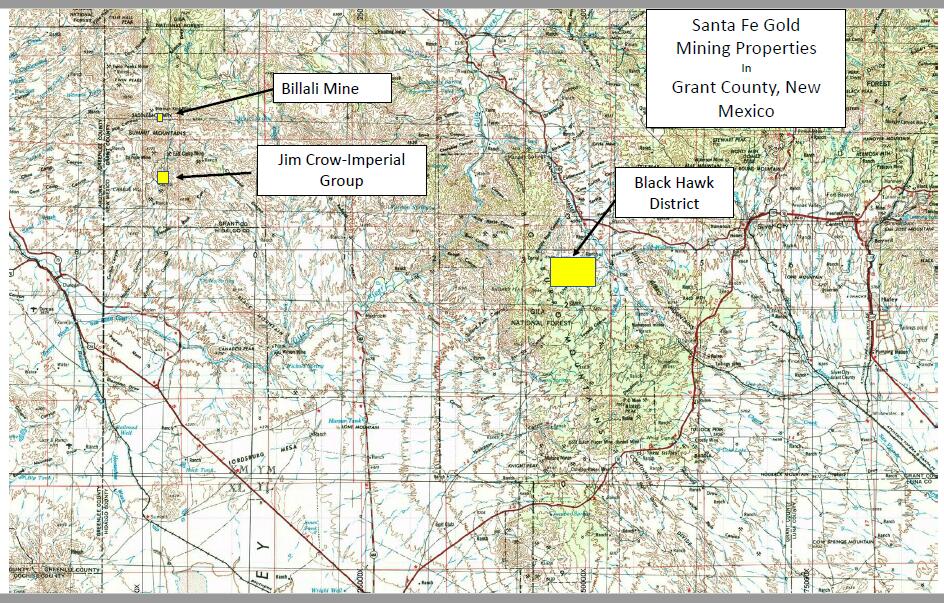
Steeple Rock District, Grant County New Mexico –
Properties - The Jim Crow, Imperial and Billali Mines
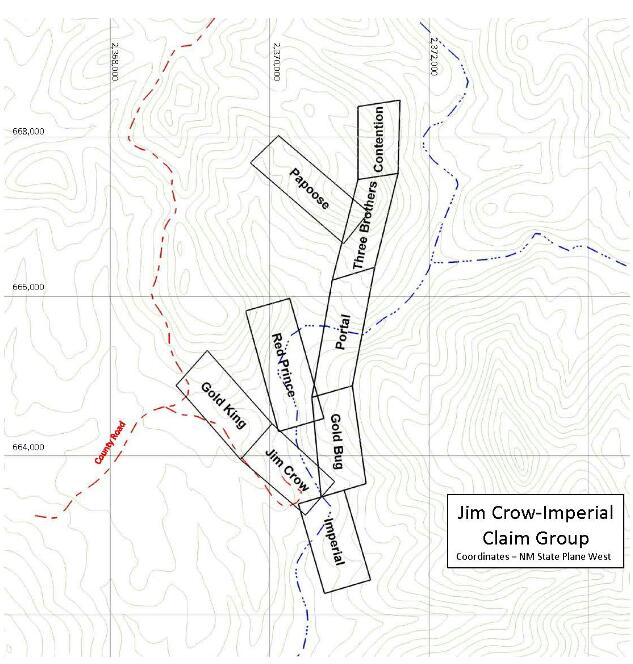
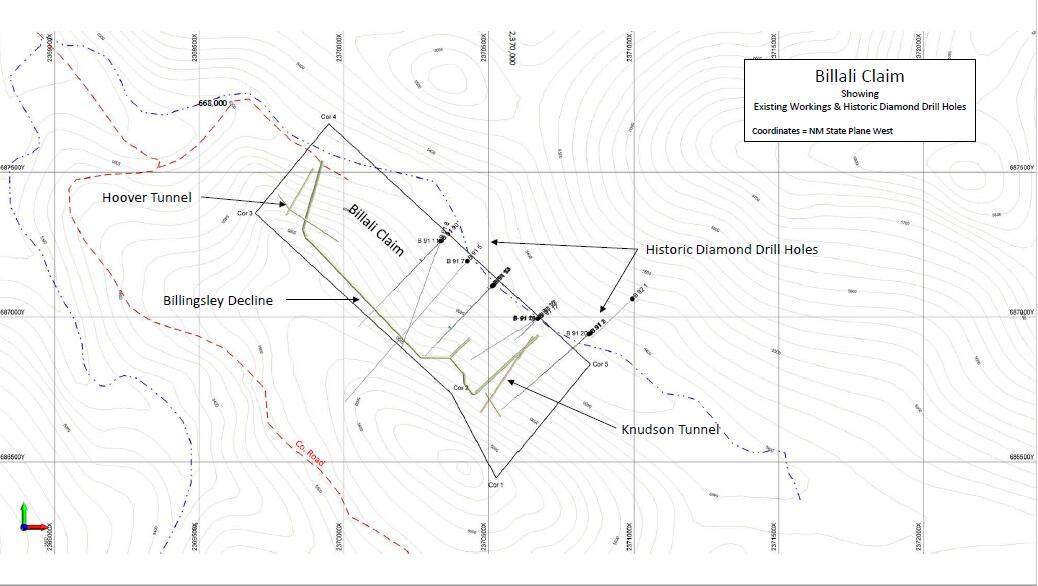
Santa Fe’s properties consist of the Jim Crow group of patented and unpatented claims in the southern part of the district and the Billali patented claim in the northern part of the district. The Jim Crow group is made up of
Patented Lode Claims
| Name | MS No. |
1 | Imperial Lode | MS 1012 A |
2 | Jim Crow Lode | MS 1012 B |
3 | Gold King Lode | MS 1012 C |
4 | Portal Lode | MS 1012 D |
5 | Gold Bug Lode | MS 1012 E |
6 | Red Prince Lode | MS 1012 F |
7 | Three Brothers Lode | MS 1012 G |
8 | Contention Lode | MS 1012 H |
The Jim Crow group also consists of two unpatented mining claims and Mineral Acquisitions, LLC controls nine unpatented mining claims.
Unpatented Lode Claims
26
| All the combined mining claims for this project encompass approximately 343 acres.
| |||||||||||||||||||||||||||||||||||||
Location and Access
The Steeple Rock mining district is in the western part of Grant County, New Mexico. The district lies approximately 45 miles east of the town of Safford, Arizona and approximately 10 miles northeast of Duncan, Arizona. The district is reached by well-maintained county roads from Duncan.


District, Historical and Prior Operations
The Steeple Rock district was discovered in the 1860’s and was in production until the so-called “silver panic” of 1893. Since 1893, there has been little activity. We believe that the Steeple Rock district was reopened at different times in the 1950’s, 1960’s and the 1970’s, but no sustained development or production is believed to have occurred.
Title and Ownership of the Billali The Company determined the Agreement with the sellers of the properties is
Mineralization and Geology The Steeple Rock district is classified as a high level, epithermal gold and silver bearing, quartz vein system hosted principally in andesite lava flow rock which comprises the lower part of the The ore in the Steeple Rock district appears to be controlled by rock lithology, with the host rock being a coarse-grained quartz diorite. Vein boundaries are sharp and the vein filings are generally recognizable visually. Mineralization in the Steeple Rock mining district consists of numerous narrow carbonate veins containing varying amounts of cobalt and nickel, silver, uranium, and arsenic.
Description of the Jim Crow and Imperial Mines The Jim Crow group covers approximately 4,000 feet strike length on the north trending Imperial vein and approximately 2,600 feet strike length of the northwest trending Jim Crow vein system. The Imperial mine occupies the southernmost 1,000 feet of the Imperial vein at which point the Jim Crow system branches to the northwest. The north trending Imperial continues another 3,050 to the property end line. The Jim Crow trend consists of three, possibly more, sub-parallel veins converging The Jim Crow mine is well equipped and in good working order. It is served by a 320 The location of the Jim Crow mine is highly advantageous in that the unexplored and undeveloped segments of the Imperial and Jim Crow veins can be easily accessed from the mine. The lower 300
Description of the Billali Mine The Billali property consists of one patented mining claim. It covers 1,200 feet of vein length and is situated approximately 3,000 feet northwest of the Summit mine. The principal working on the Billali is a 12’ x12’ decline driven at grade of -20% for approximately 1120 feet. The decline was started on the northeast flank of the vein zone, driven across it for approximately 260 feet and then turned southeast and continued straight along the zone for another, approximately 580 feet. The present water level is at approximately 800 The Billali Mine occupies the northwest extension of the Summit vein. In the 1990-1992 time period Byron Bay Resources, a Canadian mining company, conducted an extensive exploration program on the Summit vein including the Billali mine. Data in the mine owner’s archives are poorly documented and drill hole collars are not definitely located. Diamond drilling was done on the Billali claim in 1990, 1991 and 1992. Partial data is available for twenty of these drill holes. Byron Bay Resources company reports dated 1990 and 1991 describe a vein zone approximately 350 feet wide with a discontinuously mineralized footwall and hanging wall quartz veins, ranging from 3 to 15 feet true width. In 2013 and 2014 Shooting Star Mining Co. optioned the property and continued development. Their intention was to expand on the previous work of Biron The work by these two companies has demonstrated that, although the vein is not consistently mineralized enough to support a large-scale operation, there are numerous lenses and pockets of high-grade rock that could be profitably extracted by careful development and mining Exploration Status
Exploration and development work done in the 1990’s and in the 2011-14 time period suggest there are potentially high-grade zones with indications of vertical continuity distributed throughout the length of the property. These can be in any of the three or more veins that are presently identified within the approximately 350 Santa Fe is currently mining one of these gold-silver bearing pipe-like bodies that has recently been discovered approximately 180 feet from the portal. We have not established that our Billali Mine and Jim Crow Mine rights contain proven or probable reserves, as defined under Reg. S-K 1300. The Company has conducted a limited amount of exploration work on the Jim Crow mine to date. The Company commenced work at the Jim Crow mine in late 2019. Work to date has consisted of upgrading the surface facilities, rehabilitating the shaft, expanding the hoisting capability and underground excavation on three levels and a crushing plant site was purchased on January 1, 2020, in Duncan, Arizona. We have extracted approximately 2,000 tons of ore that is sitting on our property awaiting further processing and analysis. The Company will need to conduct further work on the mine properties for sustained production. Such work will consist of exploration drilling from the surface and underground. The Company will continue to be considered an exploration stage property until it has disclosed reserves and once it has disclosed reserves it will be considered a development stage. Further work to be done includes drifting, raising and slope development, as Power and Water The Company will be required to use water from the mine, to be stored in a water tank to be placed on the property, for its water source. It is believed that this water will be sufficient for any development purposes.
Development Plans Santa Fe Gold believes that a profitable operation can be established and sustained in the Steeple Rock district by careful development and mining the high silica, gold and silver bearing vein rock thought to be present in both the Jim Crow and Billali mines, although we have not conducted any analytical work to demonstrate this. The district has a long record of producing high quality smelter flux ores that were previously directly shipped to a nearby copper With that current situation, we were required to advance our business plan by approximately a year referencing the design and construction of a mine-mill complex in Duncan, Arizona. This site will service both the Company’s property sites in the Steeple Rock mining district and the Black Hawk mining district. The Company will need to raise or finance the construction of the mill complex. The Company’s future revenue is contingent on the construction of a mill complex. The mill complex will require us to raise financing in order for it to be constructed and ramp-up operations at the mill complex and for mining operations. The Company’s plan for operations is reliant on our ability to secure the financing required to construct and operate the mill-complex and continue mining operations. No assurances can be made that the Company will be successful in securing this needed financing or that if it is able to, that it will be on terms acceptable to the Company.
The Company currently has its crushing equipment on this site and retained a specialist firm in Colorado which has completed the analysis our ore and prepared a process and mill site plan with the optimal equipment, methods, chemical reagents that will allow us to realize the maximum yield from our ore. We received the report in late September 2021. This is the first step needed for the construction of our mill and we have the detailed plan of what will be required. The Company anticipates that the total cost to construct the mill site will approximate around $1,200,000. We will need to secure these funds in order to begin construction and to purchase the equipment and materials necessary and to have the mill operational, of which there can be no assurance. 30
As of filing this Form 10-K, the Company is currently in process of acquiring a mill operation for its head ore to be located on its property in Duncan, Arizona. The seller of the mill has disassembled the mill in Kellogg, Idaho and relocated the mill to the Duncan, Arizona site. Currently all associated costs of the mill and its relocation are being accumulated and finalized by the seller. At this time there are no agreements between the seller and the Company as to terms and sales price of the delivered disassembled mill and such price is anticipated to be negotiated and determined in late fall 2022, when the necessary funding will be raised by the Company for the acquisition of the mill equipment and its construction. At the time of filing this Form 10-K, negotiations for the purchase of the disassembled mill with the seller have not taken place and will be finalized upon the Company raising the adequate funding for the acquisition and determination if the seller or the Company will be responsible for its construction at the mill site. Description of Black Hawk Project Property Location and Access The Black Hawk district, also called the Bullard’s Peak district in some references, is located approximately 15 miles west-southwest of Silver City New Mexico. Santa Fe Gold Corp. owns 13 patented and 82 unpatented mining claims covering approximately 72% of the known extent of the district. This property includes four of the five mines with recorded production among which are the two largest, the Black Hawk and the Alhambra. The property is reached by truck on a private dirt road that turns left off a paved highway, which access road is approximately 15 miles west-southwest of Silver City. The claims are all located within approximately 1,900 acres. Property Description The Black Hawk district, sometimes referred to as the Bullard Peak district, is located in Grant County, New Mexico, approximately 15 miles by road west of Silver City, New Mexico, the terminus of a branch line of the Atchison, Topeka and Santa Fe Railway. The ore in the Black Hawk district appears to be controlled by rock lithology, with the host rock being a coarse-grained quartz diorite. Patented Lode Claims Name MS No. 1 Alhambra Lode MS 869 2 Kent County Lode MS 778
3 Blackhawk Lode MS 364A 4 Butternut Lode MS 546 5 Little Rody Lode MS 365A 6 Extension Lode MS 772 7 Pumpkin Lode MS 548 8 Silver Glance Lode MS 366A 9 Good Hope Lode MS 480 10 Chicago Lode MS 771 11 Surprise Lode MS 367A 12 Cornicopia Lode MS 770 13 Stonewall Lode MS 547 Unpatented Lode Claims Name BLM Serial Number 1 Alhambra Extension – Lode NMMC 50356 2 Easy Days – Lode NMMC 50357 3 Old Hobson – Lode NMMC 50358 4 Argentine No. 5 – Lode NMMC 85992 5 Argentine No. 6 – Lode NMMC 85993 6 Argentine No. 7 – Lode NMMC 85994 7 Argentine No. 8 – Lode NMMC 85995 8 Argentine No. 9 – Lode NMMC 85996 9 Argentine No. 17 – Lode NMMC 86004 10 Argentite #1 – Lode NMMC 64721 11 Argentite #2 – Lode NMMC 64722 12 Argentite #3 – Lode NMMC 64723 13 Argentite #4 – Lode NMMC 64724 14 Argentite #10 – Lode NMMC 64725 15 Argentite #11 – Lode NMMC 64726 16 Argentite #12 – Lode NMMC 64727 17 Argentite #13 – Lode NMMC 64728 18 Argentite #14 – Lode NMMC 64729 19 Argentite #15 – Lode NMMC 64730 20 Argentite #16 – Lode NMMC 64731 21 Argentite #18 – Lode NMMC 64732 22 Argentite #19 – Lode NMMC 64733 23 Argentite #20 – Lode NMMC 64734 24 Argentite #21 – Lode NMMC 64735 25 Argentite #22 – Lode NMMC 64736 26 Contention #1 – Lode NMMC 64719 27 Contention #2 – Lode NMMC 64720 28 No Show #1 – Lode NMMC 106382 29 No Show #2 – Lode NMMC 106383 30 No Show #3 – Lode NMMC 106384 31 No Show #4 – Lode NMMC 106385 32 No Show #5 – Lode NMMC 106386 33 No Show #6 – Lode NMMC 106387 34 No Show #7 – Lode NMMC 106388 35 No Show #8 – Lode NMMC 106389 36 No Show #9 – Lode NMMC 106390 37 No Show #10 – Lode NMMC 106391 38 No Show #11– Lode NMMC 106392 39 No Show #12 – Lode NMMC 106393 40 No Show #13 – Lode NMMC 106394
41 No Show #14 – Lode NMMC 106395 42 No Show #15 – Lode NMMC 106396 43 No Show #16 – Lode NMMC 106397 44 No Show #17 – Lode NMMC 106398 45 No Show #18 – Lode NMMC 106399 46 No Show #19 – Lode NMMC 106400 47 No Show #20 – Lode NMMC 106401 48 Rhonda #1 – Lode NMMC 106402 49 Rhonda #2 – Lode NMMC 106403 50 Rhonda #3 – Lode NMMC 106404 51 Rhonda #4 – Lode NMMC 106405 52 Rhonda #5 – Lode NMMC 106406 53 Rhonda #6 – Lode NMMC 106407 54 Rhonda #7 – Lode NMMC 106408 55 Rhonda #8 – Lode NMMC 106409 56 Rhonda #9 – Lode NMMC 106410 57 Rhonda #10 – Lode NMMC 106411 58 Rhonda #11 – Lode NMMC 106412 59 Rhonda #12 – Lode NMMC 106413 60 Rhonda #13 – Lode NMMC 106414 61 Rhonda #14 – Lode NMMC 106415 62 Rhonda #15 – Lode NMMC 106416 63 Rhonda #16 – Lode NMMC 106417 64 Rhonda #17 – Lode NMMC 106418 65 Rhonda #18 – Lode NMMC 106419 66 Pec-II #1 – Lode NMMC 106420 67 Barite – Lode NMMC 109082 68 Barite No. 2 – Lode NMMC 109083 69 Barite No. 3 – Lode NMMC 109084 70 Jody #1 – Lode NMMC 115276 71 Jody #2 – Lode NMMC 115277 72 Jody #3 – Lode NMMC 115278 73 Jody #4 – Lode NMMC 115279 74 Jody #5 – Lode NMMC 115280 75 Jody #7 – Lode NMMC 115281 76 Jody #8 – Lode NMMC 115282 77 Jody #9 – Lode NMMC 115283 78 Jody #10 – Lode NMMC 115284 79 Stonewall Surprise – Lode NMMC 193678 80 Alhambra Extension 2 – Lode NMMC 193679 81 No Show No. 21 – Lode NMMC 193680 82 No Show No. 23 - Lode NMMC 193681 The Black Hawk district was discovered in 1881 and was in production until the so called “silver panic” of 1893. Since its main productive period, ending in its closure in late 1893 or early 1894, there has been little activity in the Black Hawk district. One of the mines, the Black Hawk was reopened in 1917 and some development done in the upper levels. Both the Black Hawk and the Alhambra were reopened at different times in the 1950’s, 1960’s, and the 1970’s but no sustained development or production was achieved.
Project Status and Exploration Activities We have not established that our Black Hawk and Bullard Peak rights contain proven or 33
has not (i) commenced or adopted plans to conduct any exploration, (ii) prepared drilling plans, proposals, timetables or budgets for exploration work, or (iii) identified engineers and other personnel that will conduct or assist in any exploration work. The Company will need to prepare the property for exploration and drilling activities, including building infrastructure, installing facilities, and purchasing equipment. Future exploration drilling on any of our properties that consist of BLM land will require us to either file a Notice of Intent (NOI) or a Plan of Operations with the BLM, depending upon the amount of new surface disturbance that is planned. A Notice of Intent is required for planned surface activities that anticipate less than 5.0 acres of surface disturbance, and usually can be obtained within a 30 to 60-day time period. On December 1, 2020, the Company made a joint announcement with Texas Mineral Resources Corp. (“TMRC”), of the execution of a letter agreement to pursue, negotiate and thereafter enter into a definitive joint venture agreement with TMRC to jointly explore and develop a targeted silver property to be selected by TMRC among patented and unpatented mining claims held by Santa Fe Gold within the Black Hawk Mining District in Grant County, New Mexico. Completion of a joint venture agreement is subject to the successful outcome of a multi-phase exploration plan to be undertaken in the near future by TMRC. Under terms of the letter agreement TMRC plans to conduct a district-wide evaluation among the patented and unpatented claims held by Santa Fe Gold consisting of geologic mapping, sampling, trenching, radiometric surveying, geophysics, drilling and/or other methods as warranted. The purpose of the letter agreement was to allow TMRC the ability to enter onto the Company’s property, begin incurring the costs associated with the work necessary to secure a bankable feasible study. The parties may then secure the funding needed to develop and mine the 80 acres that TMRC identifies. TMRC will be responsible for mining operations and will receive 51% of the profits as defined in the definitive agreement, when executed. The Company will receive 49% of the profits. On July 28, 2022, TMRC issued a press release that updated the successful completion of their geophysical work in the Blackhawk mining district in New Mexico. The related project details that were provided to TMRC by the advanced technology deployed were cost effective and will assist TMRC in developing their next phase in their exploration program on project site. Mineralization and Geology Mineralization in the Black Hawk mining district consists of numerous narrow carbonate veins containing varying amounts of cobalt The Silver City quadrangle covers approximately 20,650 square kilometers chiefly in the southern basin and range province of Although there is some local variation in some of the districts, the five metal types of deposits in the Black Hawk district are fissure veins where the carbonate and the ore minerals fill open space caused by the fracturing. The project requires further evaluation of its mineralogical makeup and economic modeling to determine the appropriate course for any potential future development and production.
Power and Water The Company will be required to use water from the mine The following definitions are taken from 
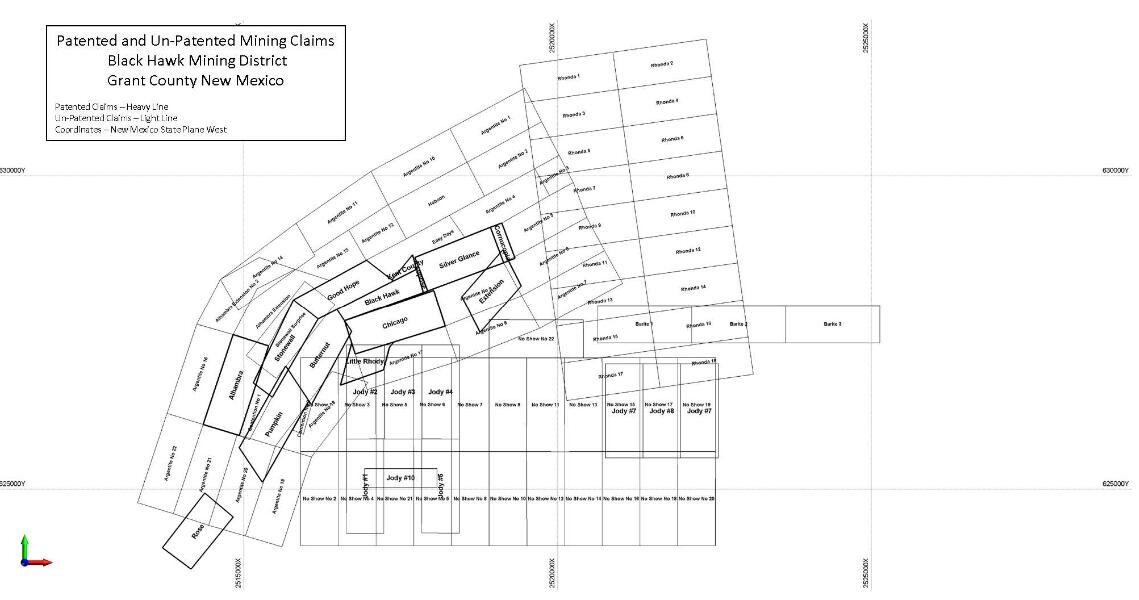
Exploration Stage Property |
| The term “exploration stage property” is a property that has no mineral reserves disclosed. |
|
|
|
Development Stage Property |
| The term “development stage property” is a property that has mineral reserves disclosed, pursuant to …[the definition in Reg S-K 1300], but no material extraction. |
|
|
|
Inferred Mineral Resource |
| The term “inferred mineral resource” is that part of a mineral resource for which quantity and grade or quality are estimated on the basis of limited geological evidence and sampling. The level of geological uncertainty associated with an inferred mineral resource is too high to apply relevant technical and economic factors likely to influence the prospects of economic extraction in a manner useful for evaluation of economic viability. Because an inferred mineral resource has the lowest level of geological confidence of all mineral resources, which prevents the application of the modifying factors in a manner useful for evaluation of economic viability, an inferred mineral resource may not be considered when assessing the economic viability of a mining project, and may not be converted to a mineral reserve. |
|
|
|
Mineral Reserves |
| The term “mineral reserve” is an estimate of tonnage and grade or quality of indicated and measured mineral resources that, in the opinion of the qualified person, can be the basis of an economically viable project. More specifically, it is the economically mineable part of a measured or indicated mineral resource, which includes diluting materials and allowances for losses that may occur when the material is mined or extracted |
|
|
|
Mineral Resource |
| The term “mineral resource” is a concentration or occurrence of material of economic interest in or on the Earth's crust in such form, grade or quality, and quantity that there are reasonable prospects for economic extraction. A mineral resource is a reasonable estimate of mineralization, taking into account relevant factors such as cut-off grade, likely mining dimensions, location or continuity, that, with the assumed and justifiable technical and economic conditions, is likely to, in whole or in part, become economically extractable. It is not merely an inventory of all mineralization drilled or sampled. |
|
|
|
Probable Mineral Reserve |
| The term “probable mineral reserve” is the economically mineable part of an indicated and, in some cases, a measured mineral resource. |
|
|
|
Production Stage Property |
| The term “production stage property” is a property with material extraction of mineral reserves. |
|
|
|
Proven Mineral Reserve |
| The term “proven mineral reserve” is the economically mineable part of a measured mineral resource and can only result from conversion of a measured mineral resource. |
|
|
|
35
Qualified Person |
| The term “qualified person” is an individual who is: |
(1) A mineral industry professional with at least five years of relevant experience in the type of mineralization and type of deposit under consideration and in the specific type of activity that person is undertaking on behalf of the registrant; and | ||
(2) An eligible member or licensee in good standing of a recognized professional organization at the time the technical report is prepared. For an organization to be a recognized professional organization, it must: | ||
(i) Be either: | ||
(A) An organization recognized within the mining industry as a reputable professional association; or | ||
(B) A board authorized by U.S. federal, state or foreign statute to regulate professionals in the mining, geoscience or related field; | ||
(ii) Admit eligible members primarily on the basis of their academic qualifications and experience; | ||
(iii) Establish and require compliance with professional standards of competence and ethics; | ||
(iv) Require or encourage continuing professional development; | ||
(v) Have and apply disciplinary powers, including the power to suspend or expel a member regardless of where the member practices or resides; and | ||
(vi) Provide a public list of members in good standing. | ||
Relevant experience means, for purposes of determining whether a party is a qualified person, that the party has experience in the specific type of activity that the person is undertaking on behalf of the registrant. If the qualified person is preparing or supervising the preparation of a technical report concerning exploration results, the relevant experience must be in exploration. If the qualified person is estimating, or supervising the estimation of mineral resources, the relevant experience must be in the estimation, assessment and evaluation of mineral resources and associated technical and economic factors likely to influence the prospect of economic extraction. If the qualified person is estimating, or supervising the estimation of mineral reserves, the relevant experience must be in engineering and other disciplines required for the estimation, assessment, evaluation and economic extraction of mineral reserves. | ||
(1) Relevant experience also means, for purposes of determining whether a party is a qualified person, that the party has experience evaluating the specific type of mineral deposit under consideration (e.g., coal, metal, base metal, industrial mineral, or mineral brine). The type of experience necessary to qualify as relevant is a facts and circumstances determination. For example, experience in a high-nugget, vein-type mineralization such as tin or tungsten would likely be relevant experience for estimating mineral resources for vein-gold mineralization, whereas experience in a low grade disseminated gold deposit likely would not be relevant. | ||
| ||
Note 1 to paragraph (1) of the definition of relevant experience: It is not always necessary for a person to have five years' experience in each and every type of deposit in order to be an eligible qualified person if that person has relevant experience in similar deposit types. For example, a person with 20 years' experience in estimating mineral resources for a variety of metalliferous hard-rock deposit types may not require as much as five years of specific experience in porphyry-copper deposits to act as a qualified person. Relevant experience in the other deposit types could count towards the experience in relation to porphyry-copper deposits. |
36
|
| (2) For a qualified person providing a technical report for exploration results or mineral resource estimates, relevant experience also requires, in addition to experience in the type of mineralization, sufficient experience with the sampling and analytical techniques, as well as extraction and processing techniques, relevant to the mineral deposit under consideration. Sufficient experience means that level of experience necessary to be able to identify, with substantial confidence, problems that could affect the reliability of data and issues associated with processing. |
(3) For a qualified person applying the modifying factors, as defined by this section, to convert mineral resources to mineral reserves, relevant experience also requires: | ||
(i) Sufficient knowledge and experience in the application of these factors to the mineral deposit under consideration; and | ||
(ii) Experience with the geology, geostatistics, mining, extraction and processing that is applicable to the type of mineral and mining under consideration.
(Remainder of page left blank.) | ||
|
37
The SEC replaced its disclosure requirements for mining companies and replacing Industry Guide 7 with Regulation S-K 1300 et. seq. This new disclosure goes into effect for the Company beginning with the first quarter of our fiscal year beginning July 1, 2021. Because of this, we are required to file our annual reports and quarterly reports aligned to S-K 1300 requirements. The S-K 1300 is aligned more closely to CRIRSC definitions and shares similarities with, but not equal to, other reporting codes applicable to the mining industry such as NI 43-101. Industry Guide 7 will remain effective until all registrants are required to comply with the rules, at which time Industry Guide 7 will be rescinded. Note that under Reg. S-K 1300, there is a greater focus on “materiality” and integrity or quality of information. The concept of a “qualified person” is added where there are results of exploration disclosed in terms of quantified mineral content and the various reports with the prescribed content required in each, every technical report referenced under Regulation. S-K 1300 must be prepared by a qualified person. Thus, where previously we could have disclosed certain limited exploration results that we were able to secure from the prior owner of a property in which we now have mining interests, where the data was incomplete and yet the prior owner’s notes did have the gold and silver content listed per ton at various drill holes listed, where that information was purported to have come from a report prepared in a large exploration program of the area where the property is situated, however under Regulation S-K 1300 we may not disclose that information if it was not based on work prepared by a qualified person. Without a way to determine that the reports, summary technical report or property disclosure was prepared by a qualified person, as defined in Regulation S-K 1300. Under Item 1302(a)(1) of Regulation S-K 1300, we may disclose historical information in technical reports, property disclosures and other summaries of work, provided it is based on the work of a qualified person. However, since it is from the prior owner’s notes and those notes were incomplete and there isn’t a way to determine conclusively if it was based on the work of a qualified person, we have determined that the information may not be disclosed.
ITEM 3. LEGAL PROCEEDINGS
All legal proceedings were stayed with the filing of Chapter 11 bankruptcy.
Boart
Wagner Equipment Co. v. Lordsburg Mining Company, Case No. D-2014-02372, County of Bernalillo, NM 28 is a collection case by Wagner equipment, who obtained judgment for equipment delivered to Lordsburg Mining Company in the amount of $115,789 and has a rate of interest of 8.75% per annum.
obligation for the years ended June 30, 2022 and 2021 was $10,132, respectively.
With the completion of the bankruptcy in June 2016, all pending legal actions were reinstated and debts at the time of the bankruptcy are currently due and in default, but none of the then existing litigation has to date resulted in subsequent legal proceedings. There can be no assurance that subsequent legal proceedings will not materialize. After the dismissal of the bankruptcy case, the Company had limited assets, but remained liable for all commitments and debts that then were outstanding. Santa Fe Gold Barbados, The Lordsburg Mining Company and AZCO are subsidiaries of the Company with nominal assets and all of their commitments, debts and legal proceedings remain. The bankruptcy court set up a trust fund funded by the activities of the Summit mine (main asset sold in bankruptcy proceedings) for five years from reopening of the mine and the trust funds will be distributed by an independent trustee to certain unsecured creditors of record.
Subsequent professional costs including legal, auditing, forensic accounting and related filing costs related to this event have been added to the amounts owed by Mr. Laws. As of the filing of this annual report, we have determined that the costs associated with Mr. Laws action currently aggregate to approximately $1,651,263 including legal charges and forensic accounting, of which we have collected $990,632 in cash and property with an estimated net market value of $25,800 as of the date of filing of this Form 10-K.
As of the filing of this report, Mr. Laws has plead guilty to various charges brought against him by the U. S. District Attorney for the District of New Mexico, which include the Company’s allegations. Mr. Laws has been sentenced on the charges which he plead, to 81 months in prison. Currently he is serving that sentence. The Company attorneys have filed all required documents for future monetary settlements to be determined by the court. In November 2020 the court awarded various Law’s properties to the Company and in
38
December 2020 the Company was provided good title, free and clear of any encumbrances to them. Law’s residence was levied on pursuant to court order and has been sold by the court and the net proceeds received by the Company
In April 2021, the Company was served with a complaint in the State of Florida by Euro Bentley Advisors, LLC (“EBA”) for the sum of $120,000 based on the alleged breach of contract between the Company and EBA. The Company has settled this litigation in the amount
We are subject from time to time
ITEM 4. MINE SAFETY DISCLOSURES
Pursuant to Section 1503(a) of the recently enacted Dodd-Frank Wall Street Reform and Consumer Protection Act (The “Dodd-Frank Act”), issuers that are operators, or that have a subsidiary that is an operator, of a coal or other mine in the United States are required to disclose in their periodic reports filed with the SEC information regarding specified health and safety violations, orders and citations, related assessments and legal actions, and mining-related fatalities. During the fiscal years ended June 30,
PART II
ITEM 5. MARKET FOR COMMON EQUITY, RELATED STOCKHOLDER MATTERS AND PURCHASE OF EQUITY SECURITIES
Market Information
OTCPINK (U.S. $) HIGH LOW Fiscal 2022 Quarter ended September 30, 2021 Delisted 0.0000 0.0000 Quarter ended December 31, 2021 Delisted 0.0000 0.0000 Quarter ended March 31, 2022 Delisted 0.0000 0.0000 Quarter ended June 30, 2022 Delisted 0.0000 0.0000 Fiscal 2021 Quarter ended September 30, 2020 0.0940 0.0480 Quarter ended December 31, 2020 0.0598 0.0300 Quarter ended March 31, 2021 Delisted 0.0000 0.0000 Quarter ended June 30, 2021 Delisted 0.0000 0.0000 Holders of Common Equity As of June 30, Transfer Agent Colonial Stock Transfer Co. is the transfer agent for our common stock. The principal office of Colonial Stock Transfer Co. is located at 39
Dividend Policy We have never declared or paid dividends on our common stock. Payment of future dividends, if any, will be at the discretion of our board of directors after taking into account various factors, including the terms of any credit arrangements, our financial condition, operating results, current and anticipated cash needs and plans for expansion. Securities Authorized for Issuance under Equity Compensation Plans We do not have Recent Sales of Unregistered Securities Date Security Number of Shares Purchaser Proceeds ($) Consideration 7/07/2020 Common Stock 750,0000 Investor Nil Bonus 7/13/2020 Common Stock 3,500,000 Investors 175,000 Cash 7/15/2020 Common Stock 1,500,000 Investor 105,000 Cash 7/28/2020 Common Stock 1,500,000 Investor 105,000 Cash 7/31/2020 Common Stock 213,162 Consultant Nil Advisory Services 9/03/2020 Common Stock 750,000 Investor 52,500 Cash 9/29/2020 Common Stock 833,334 Investor 50,000 Cash 10/08/2020 Common Stock 2,500,000 Investor 150,000 Cash 10/31/2020 Common Stock 230,167 Consultant Nil Advisory Services 11/04/2020 Common Stock 2,500,000 Investor 150,000 Cash 01/07/2021 Common Stock 250,000 Investor 17,500 Cash 01/11/2021 Common Stock 833,334 Investor 50,000 Cash 01/31/2021 Common Stock 250,000 Consultant Nil Advisory Services 02/22/2021 Common Stock 150,000 Investor 10,500 Cash 03/11/2021 Common Stock 1,000,000 Investor 60,000 Cash 03/22/2021 Common Stock 50,000 Investor 3,500 Cash 04/30/2021 Common Stock 250,836 Consultant Nil Advisory Services 7/12/2021 Common Stock 70,000 Investor 3,500 Cash 7/30/2021 Common Stock 2,000,000 Investor 100,000 Cash 8/17/2021 Common Stock 2,000,000 Investor 100,000 Cash 9/14/2021 Common Stock 100,000 Investor 5,000 Cash 10/28/2021 Common Stock 600,000 Investor 30,000 Cash 01/01/2022 Common Stock 60,000 Investor 3,000 Cash 02/02/2022 Common Stock 1,000,000 Investor 50,000 Cash 02/17/2022 Common Stock 1,400,000 Investor 70,000 Cash 04/21/2022 Common Stock 1,000,000 Investor 50,000 Cash 05/02/2022 Common Stock 60,000 Investor 3,000 Cash 40
We are a smaller reporting company as defined by Rule 12b-2 of the Exchange Act and are not required to provide the information required under this item. ITEM 7. MANAGEMENT’S DISCUSSION AND ANALYSIS OF FINANCIAL CONDITION AND RESULTS OF OPERATIONS Except for the historical information, the following discussion contains forward-looking statements that are subject to risks and uncertainties. Readers are cautioned that the following discussion contains certain forward-looking statements and should be read in conjunction with the “Cautionary Statement on Forward-Looking Statements” appearing at the beginning of this Annual Report. We caution you not to put undue reliance on any forward-looking statements, which speak only as of the date of this report. Our actual results or actions may differ materially from these forward-looking statements for many reasons, including the risks described in “Risk Factors” and elsewhere in this annual report. Our discussion and analysis of our financial condition and results of operations should be read in conjunction with the Financial Statements of the Company and notes thereto included elsewhere in Overview of Operating Highlights We are a company engaged in the business of acquiring, exploring and developing precious metal projects in New Mexico. We own an advanced stage exploration project in the Black Hawk mining district located in Grant County, New Mexico and have the mineral and mining rights to our project in the Steeple Rock District, Grant County New Mexico. The consolidated financial statements have been prepared on a going concern basis, which contemplates the realization of assets and satisfaction of liabilities and commitments in the ordinary course of business. If the Company becomes unable to continue as a going concern, it may be unable to realize the carrying value of its assets or to meet its liabilities as they become due. Current Plan of Operation We believe that investors will gain a better understanding of our Company if they understand how we measure and talk about our results. As an exploration company, we recognize the importance of managing our liquidity and capital resources. We pay close attention to non-discretionary cash expenses and look for ways to minimize them when possible. We ensure we have sufficient cash on hand to meet our annual land holding costs as the maintenance of mining claims and leases that are essential to preserve the value of our mineral property assets and mineral interests we hold. For the fiscal year 2023, our current business plan is Finalize the mill purchase and construction for ore processing and concentration. Continued mine enhancements at the Jim Crow and Billali mines. Resume mining operations at the Jim Crow and Billali mines. Process ore into concentrates and monetize for working capital cash flow.
Results of Operations The following table sets forth For the Year Ended June 30, 2022 2021 Revenues $ — $ — Exploration and mine related 124,447 546,895 General and administrative 1,332,181 1,662,022 Loss on asset disposition — 1,836 Total expenses from operations 1,456,628 2,210,753 (Loss) from Operations (1,456,628) (2,210,753) Other (Expense) Income (877,464) 130,241 Net (Loss) $ (2,334,092) $ (2,080,512) Significant changes in our results of operations are more fully described below. Fiscal Year Ended June 30, Operating Our operating cost incurred in our fiscal year ended June 30, Exploration and other mine related costs: The decrease in exploration and mine related costs General and administrative: The decrease in general and administrative of $329,841 was mainly Other Income (Expense) Other income and (expense) for the fiscal year ended June 30,
Recent Equity Transactions, Financing Facilities and Debt Settlements Below summarizes equity financing, financing facilities and debt settlements in our fiscal years ended June 30, For the Year Ended June 30, 2022 2021 Restricted common stock sold to accredited investors 8,290,000 25,399,720 Funds Generated Gross proceeds from equity financing $ 414,500 $ 929,000 SBA PPP loan proceeds — 127,520 Note payable proceeds 500,000 — Insurance proceeds — 17,906 Proceeds from sale of assets 38,167 — Cash provided for working capital $ 952,667 $ 1,074,426 Funds Utilized Cash payments on notes payable $ 10,000 $ — Payments on mineral leases 300,000 300,000 Purchase of property and equipment and deposits 179,469 22,860 Rent deposit 125 — Payments on lease principle 4,403 17,503 Cash utilized from working $ 493,997 $ 340,363 Significant changes in our results of operations are more fully described below. Liquidity and Capital Resources As of June 30, Currently, there can be no assurance of any revenue from these mine sites until we construct our processing mill. Ore previously produced is being inventoried for future processing at the future mill site. Even if we are successful in developing any of our properties, we expect to incur operating losses for the foreseeable future and may never become profitable. We also expect to continue to incur significant operating and capital expenditures and anticipate that our expenses will increase substantially in the foreseeable future. As the Company has currently has no commitment for debt or equity financing, the Company will be reliant upon its own best Cash Flows Cash used to fund our operations which included corporate general and administration expenses, land holding costs, and mine maintenance programs at our Jim Crow and Bilalli projects was $466,189. The Company continues to build our asset base with capital expenditures. In fiscal Factors Affecting Future Operating Results Currently we have no continuing commitment from any party to provide additional working capital, or if one becomes available, there is no certainty that its terms will be favorable or acceptable to the Company. Historically, we and other similar exploration and development public companies have accessed capital through equity financing arrangements or by the sale of royalties on its mineral properties. If, however we are unable to obtain additional capital or financing, our exploration and development activities will be 43
significantly adversely affected. Until positive cash flow is generated from operations, we will be dependent upon future working capital facilities or equity financing arrangements, to meet our expenses and to fund execution on our business plan. • $880 thousand on corporate administration expenses, comprising of executive management and
• $2.8 million to $3.5 million on the Jim Crow and Billali projects including, exploration, mine development and enhancements, mine operational costs, including employee compensation, benefits, land holding costs and potential new mine properties in the Black Hawk mining district.
• $1.9 million for the mill site construction project in Duncan, Arizona. Costs include final design fees, mill equipment purchase, site construction, permits and project development ramp up. Critical Accounting Policies Our discussion and analysis of our consolidated financial condition and results of operations are based on the Company’s consolidated financial statements, which have been prepared in accordance with accounting principles generally accepted in the United States. The preparation of these consolidated financial statements requires us to make estimates and judgments that affect the reported amount of assets and liabilities and disclosure of contingent assets and liabilities at the date of the consolidated financial statements and the reported amount of revenues and expenses for each period. Critical accounting policies are defined, as policies that management believes are the most important to the portrayal of our consolidated financial condition and results of operations. These policies may require us to make difficult, subjective or complex judgments, commonly about the effects of matters that are inherently uncertain. Our significant accounting policies are described in the audited consolidated financial statements and notes thereto. See Note 2, “Summary of Significant Accounting Policies” in the Notes to the Consolidated Financial Statements for We believe our most critical accounting policies relate to asset Impairment of Long-Lived Assets The Company reviews long-lived assets for impairment annually or whenever events or changes in circumstances indicate that the carrying amount of the assets may not be fully recoverable. The Company recognizes an impairment loss when the sum of expected undiscounted future cash flows is less than the carrying amount of the asset. The amount of impairment is measured as the difference between the asset’s estimated fair value and its book value. Mineral Rights Mineral properties are capitalized at their fair value at the acquisition date, either as an individual asset purchase or as part of a business combination. When it is determined that a mineral property can be economically developed as a result of establishing reserves, subsequent mine development is capitalized and are amortized using the units of production method over the estimated life of the ore body based on estimated recoverable tonnage in proven and probable reserves. Estimates The preparation of consolidated financial statements in conformity with accounting principles generally accepted in the United States of America (“GAAP”) requires management to make estimates and assumptions that affect the reported amounts of assets and liabilities and disclosure of contingent assets and liabilities at the date of the consolidated financial statements and the reported amounts of revenues and expenses during the reporting year. Actual results could differ from those estimates under different assumptions or conditions. 44
Derivative Financial Instruments Derivative financial instruments are initially measured at their fair value. For derivative financial instruments that are accounted for as liabilities, the derivative instrument is initially recorded at its fair value and is then re-valued at each reporting date, with changes in the fair value reported as charges or credits to income. To the extent that the initial fair values of the freestanding and/or bifurcated derivative instrument liabilities exceed the total proceeds received, an immediate charge to income is recognized as a one-day derivative loss, in order to initially record the derivative instrument liabilities at their fair value. When required to arrive at the fair value of derivatives associated with the convertible notes and warrants, a Black Scholes or a Monte Carlo model is utilized that values the Convertible Note and Warrant based on average discounted cash flow factoring in the various potential outcomes by a Chartered Financial Analyst (‘CFA”). In determining the fair value of the financial derivatives, the CFA assumed that the Company’s business would be conducted as a going concern. Off-Balance Sheet Arrangements During the fiscal years ended June 30, 2022 and 2021, we did not engage in any off-balance sheet arrangements as set forth in Item 303(a) (4) of the Regulation S-K. ITEM 7A. QUANTITATIVE AND QUALITATIVE DISCLOSURES ABOUT MARKET RISK This section is not required to be completed by smaller reporting companies.
ITEM 8. FINANCIAL STATEMENTS AND SUPPLEMENTARY DATA
SANTA FE GOLD CORPORATION
CONSOLIDATED FINANCIAL STATEMENTS
As of and for the Years ended June 30,
SANTA FE GOLD CORPORATION | |||
| |||
TABLE OF CONTENTS
| |||
|
|
|
|
REPORT OF INDEPENDENT REGISTERED PUBLIC ACCOUNTING FIRM (PCAOB ID |
| 48 |
|
|
|
|
|
FINANCIAL STATEMENTS: |
|
|
|
|
|
|
|
| 49 |
| |
|
|
|
|
| 50 |
| |
|
|
|
|
| 51 |
| |
|
|
|
|
| 52 |
| |
|
|
|
|
| 53 |
| |
REPORT OF INDEPENDENT REGISTERED PUBLIC ACCOUNTING FIRM
To the
and Stockholders of Santa Fe Gold Corp.:
Opinion on the
We have audited the accompanying
Going Concern Matter
The accompanying consolidated financial statements have been prepared assuming that the Company will continue as a going concern. As discussed in Note 2
Basis for Opinion
These financial statements are the responsibility of the Company’s management. Our responsibility is to express an opinion on the Company’s financial statements based on our
We conducted our
Our audits included performing procedures to assess the risks of material misstatement of the financial statements, whether due to error or fraud, and performing procedures that respond to those risks. Such procedures included examining, on a test basis, evidence regarding the amounts and disclosures in the
Critical audit matters are matters arising from the current period audit of the financial statements that were communicated or required to be communicated to the audit committee and that: (1) relate to accounts or disclosures that are material to the financial statements and (2) involved our especially challenging, subjective, or complex judgments. We determined that there are no critical audit matters. /s/ We have served as the Company’s auditor since 2018.
October 13, 2022
SANTA FE GOLD CORPORATION CONSOLIDATED BALANCE SHEETS June 30, June 30, 2022 2021 ASSETS Current Assets: Cash and cash equivalents $ $ Prepaid expenses and other current assets Total current assets NON-CURRENT ASSETS: Property and equipment, net Mineral property Finance lease right-of-use asset, net Deposit Assets held for sale Total Assets $ $ LIABILITIES AND STOCKHOLDERS' DEFICIT Current Liabilities: Accounts payable $ $ Accrued liabilities Finance lease liability Notes payable, current maturities Completion guaranty payable Total Current Liabilities Non-current notes payable Total Liabilities Commitments and Contingencies Stockholders' Deficit: Common stock, $ Additional paid-in capital Accumulated deficit ( ) ( ) Total Stockholders' Deficit ( ) ( ) Total Liabilities and Stockholders' Deficit $ $ The accompanying notes are an integral part of these audited consolidated financial statements. 49
SANTA FE GOLD CORPORATION CONSOLIDATED STATEMENTS OF OPERATIONS Years Ended June 30, 2022 2021 Revenues $ $ Operating Expenses: Exploration and other mine related costs General and administrative Loss on asset disposition Total Operating Expenses Loss from Operations ( ) ( ) Other Income (Expense): Miscellaneous income Gain on debt forgiveness Recovery (loss) associated with misappropriated funds ( ) Financing costs-commodity supply agreements ( ) Interest expense ( ) ( ) Total Other (Expense) Income ( ) Income (Loss) Before Provision for Income Taxes ( ) ( ) Provision for Income Taxes Net (Loss) $ ( ) $ ( ) Basic and Diluted Per Share Data: Net (Loss) – Basic and diluted $ ( ) $ ( ) Weighted Average Common Shares Outstanding: Basic and diluted The accompanying notes are an integral part of these audited consolidated financial statements. 50
June 30, 2021;
SANTA FE GOLD CORPORATION
CONSOLIDATED
|
|
|
|
| Additional |
|
|
|
|
|
|
| ||||||||
|
| Common Stock |
|
| Paid-In |
|
| Accumulated |
|
|
|
| ||||||||
|
| Shares |
|
| Amount |
|
| Capital |
|
| Deficit |
|
| Total |
| |||||
Balance, June 30, 2020 (Restated) |
|
|
|
| $ |
|
| $ |
|
| $ | ( | ) |
| $ | ( | ) | |||
Common shares issued for consulting |
|
|
|
|
|
|
|
|
|
|
|
|
|
|
| |||||
Sale of common shares for cash |
|
|
|
|
|
|
|
|
|
|
|
|
|
|
| |||||
Common shares issued for bonus award |
|
|
|
|
|
|
|
|
|
|
|
|
|
|
| |||||
Value of warrants issued |
|
|
|
|
|
|
|
|
|
|
|
|
|
|
| |||||
Net income |
|
|
|
|
|
|
|
|
|
|
| ( | ) |
|
| ( | ) | |||
Balance June 30, 2021 |
|
|
|
| $ |
|
| $ |
|
| $ | ( | ) |
| $ | ( | ) | |||
Sale of common shares for cash |
|
|
|
|
|
|
|
|
|
|
|
|
|
|
| |||||
Value of warrants issued |
|
|
|
|
|
|
|
|
|
|
|
|
|
|
| |||||
Net loss |
|
|
|
|
|
|
|
|
|
|
| ( | ) |
|
| ( | ) | |||
Balance, June 30, 2022 |
|
|
|
| $ |
|
| $ |
|
| $ | ( | ) |
| $ | ( | ) | |||
The accompanying notes are an integral part of these audited consolidated financial statements.
51
SANTA FE GOLD CORPORATION CONSOLIDATED STATEMENTS OF CASH FLOWS | ||||||
|
|
|
| |||
|
| Years Ended June 30, |
| |||
|
| 2022 |
|
| 2021 |
|
Cash Flows from Operating Activities: |
|
|
|
|
|
|
Net loss | $ | ( | ) | $ | ( | ) |
Adjustments to reconcile net income (loss) to net cash used in operating activities: |
|
|
|
|
|
|
Stock based compensation |
|
|
|
| ||
Warrant/option expense from derivative liability |
|
|
|
| ||
Gain on PPP debt forgiveness |
|
|
| ( | ) | |
Depreciation and amortization |
|
|
|
| ||
Non-cash interest expense |
|
|
|
| ||
Non-cash expense |
| ( | ) |
|
| |
Loss on asset disposition |
|
|
|
| ||
Non-cash loss (recovery) associated with misappropriated funds |
|
|
| ( | ) | |
Net change in operating assets and liabilities: |
|
|
|
|
|
|
Prepaid expenses and other current assets |
|
|
|
| ||
Accounts payable and accrued liabilities |
|
|
|
| ||
Net Cash Used in Operating Activities |
| ( | ) |
| ( | ) |
|
|
|
|
|
|
|
Cash Flows from Investing Activities: |
|
|
|
|
|
|
Payment on mineral leases |
| ( | ) |
| ( | ) |
Purchase of property and equipment |
| ( | ) |
| ( | ) |
Deposit on mill design and engineering contract |
|
|
| ( | ) | |
Net Cash Used in Investing Activities |
| ( | ) |
| ( | ) |
|
|
|
|
|
|
|
Cash Flows from Financing Activities: |
|
|
|
|
|
|
Proceeds from issuance of common stock |
|
|
|
| ||
Net proceeds from assets for sale |
|
|
|
| ||
Proceeds from notes payable |
|
|
|
| ||
Insurance proceeds from truck loss |
|
|
|
| ||
Payment on note principal |
| ( | ) |
|
| |
Rent deposit payment |
| ( | ) |
|
| |
Payment on lease principle |
| ( | ) |
| ( | ) |
Net Cash Provided by Financing Activities |
|
|
|
| ||
|
|
|
|
|
|
|
Net (Decrease) Increase in Cash and Cash Equivalents |
| ( | ) |
| ( | ) |
Cash and Cash Equivalents Beginning of year |
|
|
|
| ||
Cash and Cash Equivalents End of Year | $ |
| $ |
| ||
|
|
|
|
|
|
|
Supplemental Cash Flow Information: |
|
|
|
|
|
|
Cash paid for interest | $ |
| $ |
| ||
Cash paid for income taxes | $ | |
| $ |
| |
|
|
|
|
|
|
|
Supplemental Disclosure of Non-Cash Investing and Financing Activities: |
|
|
|
|
|
|
Shares issued for bonus award | $ |
| $ |
| ||
Finance charges on commodity supply agreement, in accrued liabilities | $ |
| $ |
| ||
The accompanying notes are an integral part of the audited consolidated financial statements.
SANTA FE GOLD CORPORATION NOTE 1 – Santa Fe Gold Corporation (the “Company”, “our” or “we”) is a U.S. mining company incorporated in Delaware in August 1991. Our general business strategy is to acquire, explore, develop and mine mineral properties. The Company elected on August 26, 2015, to file for Chapter 11 Bankruptcy protection, Case # 15-11761 (MFW) and that case was dismissed on June 15, 2016. The Summit Silver-Gold Project, the Lordsburg Copper Project, Black Canyon Mica Project, Planet MIO Project, all claims and other assets were lost in the process. After the Company emerged from the bankruptcy with a management team of two with no assets, we developed a business plan to raise equity funds to acquire new mining claims, a potential processing plant or arrangements with a processing plant in an acceptable geographic location to potential new mining claims. In August 2017, the Company acquired all the capital stock of Bullard’s Peak Corporation and the related patented and unpatented claims in the Black Hawk district of New Mexico from Black Hawk Consolidated Mines Company for a purchase price of $3,115,365. The mine property is known as the Alhambra mine site. The transaction was finalized and closed in In January 2019 the Company has acquired We are considered an “exploration stage” company under the U.S. Securities and Exchange Commission (“SEC”) S-K 1300. The mining leases and other mineral rights we have control of, however, none of them contain any proven or probable reserves, as defined under S-K 1300. As such, they are all currently considered “exploratory” in nature. The new S-K 1300 guide replaced SEC Guide 7 and went into effect for the Company beginning with our fiscal year July 1, 2021. We are now required to file our Forms 10-Q and 10-K reports with the Commission aligned to S-K 1300 requirements. S-K 1300 is aligned more closely to CRIRSC definitions and shares similarities with, but not equal to, other reporting codes applicable to the mining industry such as NI 43-101. Covid-19 On January 30, 2020, the World Health Organization (“WHO”) announced a global health emergency because of a new strain of coronavirus originating in Wuhan, China (the “COVID-19 outbreak”) and the risks to the international community as the virus spreads globally beyond its point of origin. In March 2020, the WHO classified the COVID-19 outbreak as a pandemic, based on the rapid increase in exposure globally. At this time, we cannot foresee whether the outbreak of COVID-19 will continue be effectively contained, nor can we predict the severity and duration of its impact. If the outbreak of COVID-19 or other infectious viruses are not effectively and timely controlled, our business plans and financial condition may be materially and adversely affected as a result of the potential deteriorating economic outlook or other factors that we cannot foresee. Any of these factors and other factors beyond our control could have an adverse effect on the overall business environment and cause our business to suffer in ways that we cannot predict at this time and that may materially and adversely impact our business plans, financial condition and results of operations. With three of our mine employees contacted the COVID-19 virus in the last week of November 2020, we shut the mining operation down and currently the mines and equipment are under a maintenance protocol. With the current COVID -19 situation and the current inability to process the mined ore we anticipate not restarting the mining operation until late 2022, depending on the projected completion of our mill operation in Duncan, Arizona. At this time, we cannot foresee whether the potential COVID-19 or any other variants that may affect our future operations, nor if an occurrence should happen, can we predict the severity and duration of its impact.
NOTE 2 – SUMMARY OF SIGNIFICANT ACCOUNTING POLICIES
NOTES TO THE CONSOLIDATED FINANCIAL STATEMENTS
Liquidity and Going Concern The financial statements have been prepared on a going concern basis, which contemplates the realization of assets and satisfaction of liabilities and commitments in the normal course of business. Should the Company be unable to continue as a going concern, it may be unable to realize the carrying value of its assets and to meet its liabilities as they become due. Below presents summary financial information
June 30, 2022 2021 Cash on hand $ $ Working capital (deficit) $ ( ) $ ( ) Stockholder (deficit) $ ( ) $ ( ) Current year net (loss) $ ( ) $ ( ) On August 26, 2015, Santa Fe filed for Chapter 11 Bankruptcy protection, Case # 15-11761 (MFW) in Delaware. With the dismissal of our bankruptcy case in June 15, To continue as a going concern, the Company is dependent on continued capital financing for project development, repayment of various debt facilities and payment of current operating expenses until the Company has constructed its mill operation and implemented ore production at As of the fiscal years ending June 30,
|
|
|
| June 30, |
|
|
| ||||
|
|
| 2022 |
|
|
| 2021 |
|
|
| |
Accounts payable and other accrued liabilities |
|
| $ |
|
| $ |
|
|
| ||
Amounts due Sandstorm under the Gold Stream Agreement |
|
| $ |
|
| $ |
|
|
| ||
Notes payable and accrued interest |
|
| $ |
|
| $ |
|
|
| ||
Principles of Consolidation
The consolidated financial statements include the accounts of the Company and its wholly-owned subsidiaries AZCO Mica, Inc., a Delaware corporation
Estimates
The preparation of consolidated financial statements in conformity with accounting principles generally accepted in the United States of America (“GAAP”) requires management to make estimates and assumptions that affect the reported amounts of assets and liabilities and disclosure of contingent assets and liabilities at the date of the consolidated financial statements and the reported amounts of revenues and expenses during the reporting year. Actual results could differ from those estimates under different assumptions or conditions.
54
Significant estimates are used when accounting for the Company’s carrying value of mineral properties, useful life of fixed assets, depreciation and amortization, accruals, derivative instrument liabilities, taxes and contingencies, asset retirement obligations, revenue recognition, and stock-based compensation which are discussed in the respective notes to the consolidated financial statements.
Fair Value of Financial Instruments
The
Level 1 |
| Quoted market prices available in active markets for identical assets or liabilities as of the reporting date. |
Level 2 |
| Pricing inputs other than quoted prices in active markets included in Level 1, which are either directly or indirectly observable as of the reporting date. |
Level 3 |
| Pricing inputs that are generally observable inputs and not corroborated by market data. |
Financial assets are considered Level 3 when their fair values are determined using pricing models, discounted cash flow methodologies or similar techniques and at least one significant model assumption or input is unobservable. A slight change in unobservable inputs such as volatility can significantly have a significant impact on the fair value measurement of the derivatives liabilities.
The fair value hierarchy gives the highest priority to quoted prices (unadjusted) in active markets for identical assets or liabilities and the lowest priority to unobservable inputs. If the inputs used to measure the financial assets and liabilities fall within more than one level described above, the categorization is based on the lowest level input that is significant to the fair value measurement of the instrument.
The carrying amounts of the Company’s financial assets and liabilities, such as cash and accounts payable approximate their fair values because of the short maturity of these instruments.
Cash and Cash Equivalents
The Company considers all liquid investments purchased with an initial maturity of three months or less to be cash equivalents. The Company maintains its cash in bank deposit accounts which, at times, may exceed federally insured limits. The Company has not experienced any losses in such accounts. The Company believes it is not exposed to any significant credit risk on cash balances.
Property and Equipment
Property is carried at cost. The cost of repairs and maintenance are expensed as incurred and major replacements and improvements are capitalized. When assets are retired or disposed of, the cost and accumulated depreciation are removed from the accounts, and any resulting gains or losses are included in income in the year of disposition. Depreciation is calculated on a straight-line basis over the estimated useful life of the assets as follows.
Vehicles | |
Mine equipment | |
General equipment | |
Small tools |
55
Mine Development
Mine development costs include engineering and metallurgical studies, drilling, and other related costs to delineate an ore body, and the building of access ways, shafts, lateral access, drifts, ramps and other infrastructure in an underground mine. Costs incurred before mineralization is classified as proven and probable reserves are expensed and classified as exploration expense. Capitalization of mine development project costs, that meet the definition of an asset, begins once mineralization is classified as proven and probable reserves.
Drilling and related costs are capitalized for an ore body where proven and probable reserves exist and the activities are directed at obtaining additional information on the ore body or converting non-reserve mineralization to proven and probable reserves. All other drilling and related costs are expensed as incurred. Drilling costs incurred during the production phase for operational ore control are allocated to inventory costs and then included as a component of costs applicable to sales.
Mine development is amortized using the units-of-production method based upon estimated recoverable ounces in proven and probable reserves. To the extent that these costs benefit an entire ore body, they are amortized over the estimated life of the ore body. Costs incurred to access specific ore blocks or areas that only provide benefit over the life of that area are amortized over the estimated life of that specific ore body. Currently, with no claims or mines in our possession
As of June 30,
Mineral Rights
Mineral properties are capitalized at their fair value at the acquisition date, either as an individual asset purchase or as part of a business combination. When it is determined that a mineral property can be economically developed as a result of establishing reserves, subsequent mine development is capitalized and are amortized using the units of production method over the estimated life of the ore body based on estimated recoverable tonnage in proven and probable reserves.
The Company’s mineral rights generally are enforceable regardless of whether proven and probable reserves have been established. The Company has the ability and intent to renew mineral interests where the existing term is not sufficient to recover all identified and valued proven and probable reserves and/or undeveloped mineralized material.
Costs of exploration, carrying and retaining unproven mineral lease properties are expensed as incurred. The Company expenses all mineral exploration costs as incurred as it is still in the exploration stage. If the Company identifies proven and probable reserves in its investigation of its properties and upon development of a plan for operating a mine, it would enter the development stage and capitalize future costs until production is established.
When a property reaches the production stage, the related capitalized costs are amortized on a units-of-production basis over the proven and probable reserves following the commencement of production. The Company assesses the carrying costs of the capitalized mineral properties for impairment under ASC 360-10, “Impairment of long-lived assets”, and evaluates the carrying value under ASC 930-360, “Extractive Activities - Mining”, annually. An impairment is recognized when the sum of the expected undiscounted future cash flows is less than the carrying amount of the mineral properties. Impairment losses, if any, are measured as the excess of the carrying amount of the mineral properties over its estimated fair value.
To date, the Company has not established the commercial feasibility of any of our exploration prospects; therefore, all exploration costs are expensed as incurred.
The Company
56
Reclamation and Asset Retirement Costs
Reclamation obligations are recognized when incurred and recorded as liabilities at fair value. The liability is accreted over time through periodic charges to accretion expense. The asset retirement cost is capitalized as part of the asset’s carrying value and depreciated over the life of the related asset. Reclamation costs are periodically adjusted to reflect changes in the estimated present value resulting from the passage of time and revisions to the estimates of either the timing or amount of the reclamation costs. The reclamation obligation is based on when spending for an existing disturbance will occur. The Company reviews, on an annual basis, unless otherwise deemed necessary, the reclamation obligation at each mine site in accordance with ASC guidance for reclamation obligations. No reclamation costs were required for the end of our fiscal
Derivative Financial Instruments
The Company does not use derivative instruments to hedge exposures to cash flow, market, or foreign currency risks. From time to time, the Company reviews the terms of convertible debt, equity instruments and other financing arrangements to determine whether there are embedded derivative instruments, including embedded conversion options that are required to be bifurcated and accounted for separately as a derivative financial instrument. Also, in connection with the issuance of financing instruments, the Company may issue freestanding options or warrants that may, depending on their terms, be accounted for as derivative instrument liabilities, rather than as equity. The Company may also issue options or warrants to non-employees in connection with consulting or other services.
Derivative financial instruments are initially measured at their fair value. For derivative financial instruments that are accounted for as liabilities, the derivative instrument is initially recorded at its fair value and is then re-valued at each reporting date, with changes in the fair value reported as charges or credits to income. To the extent that the initial fair values of the freestanding and/or bifurcated derivative instrument liabilities exceed the total proceeds received, an immediate charge to income is recognized as a one-day derivative loss, in order to initially record the derivative instrument liabilities at their fair value.
The discount from the face value of convertible debt or equity instruments resulting from allocating some or all of the proceeds to the derivative instruments, together with the stated interest on the instrument, is amortized over the life of the instrument through periodic charges to income, using the effective interest method.
When required to arrive at the fair value of derivatives associated with the convertible notes and warrants, a Black Scholes or Monte Carlo models are utilized that values the Convertible Note and Warrant based on average discounted cash flow factoring in the various potential outcomes by a Chartered Financial Analyst (‘CFA”). In determining the fair value of the financial derivatives, the CFA assumes that the Company’s business would be conducted as a going concern.
The classification of derivative instruments, including whether such instruments should be recorded as liabilities or as equity, is reassessed at the end of each reporting period. If reclassification is required, the fair value of the derivative instrument, as of the determination date, is reclassified. Any previous charges or credits to income for changes in the fair value of the derivative instrument are not reversed. Derivative instrument liabilities are classified in the balance sheet as current or non-current based on whether or not net-cash settlement of the derivative instrument could be required within twelve months of the balance sheet date.
Leases
In February 2016, the FASB issued ASU 2016-02, “Leases (Topic 842),” which requires lessees to recognize assets and liabilities on the balance sheet for the rights and obligations created by all leases with a term of more than one year. Accounting by lessors will remain similar to existing U.S. GAAP. Subsequent accounting standards updates have been issued, which amend and/or clarify the application of ASU 2016-02. For the purposes of recognizing ROU assets and lease liabilities associated with the Company’s leases, the Company has elected the practical expedient to not recognize a ROU asset or lease liability for short-term leases, which are leases with a term of twelve months or less. The lease term is defined as the noncancelable portion of the lease term plus any periods covered by an option to extend the lease if it is reasonably certain that the option will be exercised. The guidance is effective for fiscal years, and interim periods within those years, beginning after December 15, 2018. The Company adopted Topic 842 as of July 1, 2019 and the standard will not have a significant impact on our consolidated financial statements until a significant a lease agreement is entered.
Warrants and Options
In connection with certain financing, the Company has issued warrants to purchase shares of its common stock. The outstanding warrants are standalone instruments that are not puttable or mandatorily redeemable by the holder and are classified as equity awards. The Company measures the fair value of the awards using the Black-Scholes option pricing model as of the measurement date. Warrants are recorded at fair value as expense over the requisite service period or at the date of issuance, if there is not a service period.
57
The Company assessed the classification of its common stock purchase warrants as of the date of each equity offering and determines that such instruments meet the criteria for equity classification, as the settlement terms indicate that the instruments are indexed to the entity’s underlying stock. Warrant and option expense for the fiscal years ended June 30, 2022 and 2021 was $
Income Taxes
The Company accounts for income taxes using the asset and liability approach, which requires recognition of deferred tax liabilities and assets for the expected future tax consequences of temporary differences between the carrying amounts and the tax basis of such assets and liabilities. This method utilizes enacted statutory tax rates in effect for the year in which the temporary differences are expected to reverse and gives immediate effect to changes in income tax rates upon enactment. A valuation allowance is recorded when it is more likely than not that deferred tax assets will be unrealizable in future periods. As of June 30, 2022 and
Net Earnings (Loss) Per Share
Basic
|
|
| June 30, | ||
|
|
| 2022 |
| 2021 |
Options to purchase common stock |
|
|
| ||
Warrants to purchase common stock |
|
|
| ||
Total |
|
|
| ||
Stock-Based Compensation In connection with terms of employment with the Company’s executives and employees, the Company occasionally issues options to acquire its common stock. Awards are made at the discretion of the Board of Directors. Such options may be exercisable at varying exercise prices and generally vested upon date of grant or may vest over a period of six months to a year. The Company accounts for The Company has adopted the provisions of FASB ASC 718, “Stock Compensation” (“ASC 718”), which establishes accounting for equity instruments exchanged for employee services. Under the provisions of ASC 718, stock-based compensation cost is measured at the grant date, based on the calculated fair value of the award, and is recognized as an expense over the employee’s requisite service period (generally the vesting period of the equity grant). New shares of the Company’s common stock are issued for any options exercised. Share based payments to nonemployees are valued at the earlier or a commitment date or completion of services. Stock based compensation for the years ended June 30,
58
Recent Accounting Pronouncements
In December 2019, the FASB issued ASU
In August 2020, the FASB issued ASU
In August 2020, the Financial Accounting Standards Board ("FASB") issued Accounting Standards Update ("ASU") 2020-06-Debt-Debt with Conversion and Other Options (Subtopic 470-20) and Derivatives and Hedging-Contracts in Entity's Own Equity (Subtopic 815-40)-Accounting For Convertible Instruments and Contracts in an Entity's Own Equity. The ASU simplifies accounting for convertible instruments by removing major separation models required under current GAAP. Consequently, more convertible debt instruments will be reported as a single liability instrument with no separate accounting for embedded conversion features. The ASU removes certain settlement conditions that are required for equity contracts to qualify for the
In March 2022, the
Other recent accounting pronouncements issued by the FASB (including its Emerging Issues Task Force, and the SEC did not, or are not believed by management to, have a material impact on the Company's present or future financial position, results of operations or cash flows.
NOTE 3 – PROPERTY AND EQUIPMENT
Property and equipment consist of the following at June 30, 2022 and 2021 are as follows:
|
| June 30, |
|
|
| ||||||
| 2022 |
|
| 2021 |
|
|
| ||||
Mine equipment |
| $ |
|
| $ |
|
|
| |||
General equipment |
|
|
|
|
|
| |||||
Small tools |
|
|
|
|
|
| |||||
Mill site property |
|
|
|
|
|
| |||||
Mill site development costs |
|
|
|
|
|
| |||||
Land |
|
|
|
|
|
| |||||
|
|
|
|
|
|
|
| ||||
Less: accumulated depreciation |
|
| ( | ) |
|
| ( | ) |
|
| |
Property and equipment, net |
| $ |
|
| $ |
|
|
| |||
59
Depreciation and amortization expense on property and equipment for the years ended June 30, 2022 and 2021 was $
NOTE 4 – MINERAL PROPERTIES
The Company has capitalized acquisition costs on mineral properties at June 30, 2022 and 2021 are as follows:
| June 30, |
|
|
| |||||
2022 |
|
| 2021 |
|
|
| |||
Alhambra – Blackhawk project | $ |
|
| $ |
|
|
| ||
Billali – Jim crow Imperial minerals rights |
|
|
|
|
| ||||
| 4,215,365 |
|
| 3,915,365 |
|
|
| ||
Less: Accumulated amortization |
|
|
|
|
| ||||
Total mineral property | $ |
|
| $ |
|
|
| ||
Exploration Status Overview
We have not established that the Alhambra - Blackhawk project or Billali Mine - Jim Crow / Imperial Mine rights projects contain proven or probable reserves, as defined under SEC S-K 1300.
To date, with respect to the Alhambra - Blackhawk project, the Company has not (i) commenced or adopted plans to conduct any exploration, (ii) prepared drilling plans, proposals, timetables or budgets for exploration work, or (iii) identified engineers and other personnel that will conduct or assist in any exploration work. The Company will need to raise funds to conduct exploration work and it currently lacks a firm financing commitment for any exploration activities.
On December 1, 2020, the Company made a joint announcement with Texas Mineral Resources Corp. (“TMRC”), of the execution of a letter agreement to pursue, negotiate and thereafter enter into a definitive joint venture agreement with TMRC to jointly explore and develop a targeted silver property to be selected by TMRC among patented and unpatented mining claims held by Santa Fe Gold within the Black Hawk Mining District in Grant County, New Mexico. Completion of a joint venture agreement is subject to the successful outcome of a multi-phase exploration plan to be undertaken in the near future by TMRC. Under terms of the letter agreement TMRC plans to conduct a district-wide evaluation among the patented and unpatented claims held by Santa Fe Gold consisting of geologic mapping, sampling, trenching, radiometric surveying, geophysics, drilling and/or other methods as warranted. The purpose of the letter agreement was to allow TMRC the ability to enter onto the Company’s property, begin incurring the costs associated with the work necessary to secure a bankable feasible study. The parties may then secure the funding needed to develop and mine the 80 acres that TMRC identifies. TMRC will be responsible for mining operations and will receive 51% of the profits as defined in the definitive agreement, when executed. The Company will receive 49% of the profits. TMRC has currently completed its phase two of their field work consisting of geophysical work in the Black Hawk district. As detailed in the TMRC press release on July 28, 2022, analysis of their field data completed to date covers approximate 10% of the area surveyed. Upon completion their field data analysis, it will provide TMRC information to develop a detailed targeted drilling program for phase three of their exploration program.
We commenced exploration work on the Jim Crow mine in late 2019. Work to date has consisted of beginning the upgrading of the surface facilities, rehabilitating the shaft, expanding the hoisting capability and underground excavation and mining preparation on three levels. Early in the third quarter of 2020 we commenced initial mining operations in the Jim Crow mine. The Company had our mined ore tested at a nearby smelter that it had used prior to our bankruptcy proceedings and the ore was approved for processing at the smelter. In November the smelter ceased taking all outside ore due to a new certification they were attempting to secure. At that time the Company was currently forced to change its current business plan and look for a favorable mill site to process our mined ore. In January 2020 a purchase option agreement was entered into for a mill site in Duncan, Arizona. The Company the exercised purchase option on the site in November 2021.
With three of our mine employees having contacted the COVID-19 virus in the last week of November 2020, we shut the mining operation down and currently the mines and equipment are under a maintenance protocol. With the current COVID -19 situation and the current inability to process the mined ore we anticipate not restarting the mining operation in late 2022, depending on the projected completion of our planned mill operation in Duncan, Arizona.
Acquired mineral rights are considered tangible assets under ASC 930-805. ASC 930-805 requires that mineral rights be recognized at fair value as of the acquisition date. Mining assets include mineral rights. The payments made under the Billali Mine - Jim Crow Mine
60
Agreement are capitalized by the Company and if a revenue stream is attained, of which there can be no assurance, the capitalized balance will be amortized to expenses based on the estimated site production life by our qualified person.
NOTE 5 – FINANCE LEASE RIGHT-OF-USE ASSET
The right-of-use property (“ROU”) consists of the following at June 30, 2022 and 2021, as follows:
|
| June 30, |
| |||||
| 2022 |
|
| 2021 |
| |||
ROU asset |
| $ |
|
| $ |
| ||
Less: accumulated amortization |
|
|
|
| ||||
Financial lease right-of-use asset, net |
| $ |
|
| $ |
| ||
Amortization expense on the ROU asset for the years ended June 30, 2022 and 2021 was $
NOTE 6 - ACCRUED LIABILITIES
Accrued liabilities consist of the following at June 30, 2022 and
are as follows:
June 30, 2022 2021 Franchise taxes $ $ Audit fees Merger costs, net Payroll burden Vacation pay Accrued director fees Other Commodity supply agreement (See NOTE 11 ) Interest Total $ $
NOTE
We signed a finance lease purchase agreement effective January 1, 2020, for the acquisition of a non-mineral property for our processing plant site to house our crusher and related future milling operations.
The
61
The
Year ended June 30, 2022 Year ended June 30, 2021 Lease Cost: Financing lease cost included in exploration and mine costs for fiscal 2022 and 2021 is $6,090 and $18,272 and $97 and $1,933 in interest expense in Company’s audited consolidated statement of operations, respectively $ $ Cash paid for amounts included in the measurement of lease liabilities for the year ended June 30, 2022 and 2021 $ $ Other Information: Remaining lease term - operating lease (in years) Discount rate - financing lease Effective rate - financing lease As of June 30, 2022 As of June 30, 2021 Financing lease: Right-of-use asset, net $ $ Financing lease liability - current portion $ $ Long-term portion Total operating lease liabilities $ $ Financing Financing Fiscal Year Ending 6/30: Lease Lease 2021 2022 Total lease payments $ Less: Present value discount ( Present value of lease liabilities $
Lease associated costs for fiscal June 30, 2022 and 2021 were $
NOTE
On June 1, 2012, the Company entered into an installment sales contract for $
Tyhee Merger Agreement
In conjunction with the Merger Agreement, Tyhee Gold Corp. (“Tyhee”) and the Company entered into a Bridge Loan Agreement (“Bridge Loan”), pursuant to which Tyhee was obligated to advance up to $3 million to the Company in accordance with the terms thereof. Tyhee advanced the Company $
62
proceeds from the Bridge Loan. The Company recorded merger expenses that are due to Tyhee of $
A shareholder in April 2022, loaned the Company $
The following summarizes notes payable:
| June 30, |
|
|
| |||||
2022 |
|
| 2021 |
|
|
| |||
Installment sales note in 48 monthly installments of $13,874, including interest through July 16, 2016 | $ |
|
| $ |
|
|
| ||
Unsecured bridge loan notes payable, interest at 2% monthly, payable August 17, 2014, six months after the first advance on the bridge loan |
|
|
|
|
| ||||
Note payable, interest at 6% |
|
|
|
|
| ||||
Note payable, 12% |
|
|
|
|
| ||||
$ |
|
| $ |
|
|
| |||
NOTE
NOTE 10 – NON-CURRENT NOTES PAYABLE
Notes Payable
During the quarter ended December 31, 2021, a shareholder made two secured loans of $200,000 each, with an annual interest rate of 10% and, note maturity dates of two years from the date of the notes. Interest is due and payable on the annual anniversary dates and the principal is due on the maturity date of the notes. The note holder loans are secured by the Duncan, Arizona mill property. Accrued interest on the notes at June 30, 2022 is $26,575. Interest expense on these notes for the year ended June 30, 2022 is $26,575. In conjunction with each note issuance, the Company granted 4,000,000 two-year vested stock options with a strike price of $0.05 per share.
Paycheck Protection Program Loans
During the quarter ending June 30, 2020, the Company entered into a Promissory Notes (the “PPP Notes”) with Bank of Oklahoma as the
63
The PPP Loan proceeds are available to
During our fiscal year 2021 our PPP loans received in 2020, and the accrued interest thereon were forgiven in the amount of $
During our fiscal year 2022 we received two loans in the second round of the PPP loan program in the principal amount of $
The PPP Loan proceeds are available to be used to pay for payroll costs, including salaries, and similar compensation, group health care benefits, and paid leaves; rent; utilities; and interest on certain other outstanding debt. Any amount that will be forgiven will be calculated in part with reference to the Company’s
The interest rate on the PPP Note is a fixed rate of 1% per annum. To the extent that the amounts owed under the PPP Loans, or a portion of them, are not forgiven, the Company will
Under current regulations, any monthly installments would begin approximately seventeen months from March
The following summarizes non-current debt at June 30, 2022 and
2021:
| June 30, |
|
|
| |||||
2022 |
|
| 2021 |
|
|
| |||
Notes payable | $ |
|
| $ |
|
|
| ||
Loans payable to bank under the Paycheck Protection Program |
|
|
|
|
|
|
| ||
Accrued interest on Paycheck Protection Program Loans |
|
|
|
|
| ||||
$ |
|
| $ |
|
|
| |||
NOTE
Commodity Supply Agreement
In December 2009, the Company entered into a definitive gold stream agreement (the “Gold Stream Agreement”) with Sandstorm to deliver a portion of the life-of-mine gold production (excluding all silver production) from the Company’s Summit silver-gold mine. Under the agreement, the Company received advances of $
Under the Gold Stream Agreement, the Company has a recorded obligation at June 30,
64
on the balance sheet, net of the Fixed Price of $400 per ounce to be received upon delivery. The Summit silver-gold mine property referred to in this Gold Stream Agreement was sold in the 363 Asset Sale as of asset transfer on February 26, 2016.
The Company determined the agreement on the Billali and Jim Crow/
Costs of exploration, mine development, and carrying and retaining unproven mineral lease properties are expensed as incurred. The Company expenses all mineral exploration and development costs as incurred as we are in the exploration stage. If the Company identifies
over the estimated remaining mine life as determined by our qualified person.
As of June 30, 2022, the Company has not established
It should also be noted, that the Company may never exit the exploration stage company status due to the costs of determining mineral reserves under regulation S-K 1300.
Payments under Amendment
Fiscal years ending June 30: |
| |
Prior year payments to 6/30/2020 | $ | |
2021 |
| |
2022 |
| |
2023 |
| |
2024 |
| |
2025 |
| |
Thereafter |
| |
Total lease payments | $ | |
Office and Real Property Leases
The Company’s work office consists of a single room located in Albuquerque, NM, at the home of the former CFO for a monthly rent of $
Title to Mineral Properties
Although the Company has taken steps, consistent with industry standards, to verify title to mineral properties in which it has an interest, these procedures do not guarantee the Company’s title. Such properties may be subject to prior agreements or transfers and title may be affected by undetected defects.
NOTE
The Company’s Common Stock
In July of 2020, the Company received notice from the SEC that it was seeking to deregister the Company’s common stock pursuant to Section 12(j), based on the Company’s failure to file periodic reports with the Commission and otherwise provide current information to the market. This failure was based in large part from the need to restate its financial statements and the need to find and engage a PCAOB auditor who was willing to conduct and provide the required audits amid the SEC and DOJ’s investigations. Although we were able to secure a qualified auditor, we were not able to make our filings quickly enough and by the time they were completed, the Commission had already sent a notice under Section 12(k). The Commission takes a hardline position in these situations such that once they have instituted deregistration proceedings, the only options available to the Company were
The Company filed the Form 10-12G Registration Statement with the SEC and on August 4, 2022 the
Common Stock Transactions
Fiscal year ended June 30, 2022, the Company:
| (i) | Accepted subscriptions for an aggregate of |
Fiscal year ended June 30, 2021:
| (i) | Issued an aggregate of |
| (ii) | Accepted subscriptions for an aggregate of |
| (iii) | Issued |
During the fiscal year ended June 30,
fair value of the issued warrants is $132,115.
During the fiscal year ended June 30,
Stock Options
During the fiscal year ended June 30, 2022, the Company granted 8,000,000 two-year options
During our fiscal years ended June 30,
The Black-Scholes option-pricing model was used to estimate the fair value of the options and warrants with the following weighted-average assumptions for the fiscal years ending June 30, 2022 and 2021 were
|
| June 30, |
| June 30, |
|
66
|
| 2022 |
| 2021 |
|
Risk-free interest rate |
| % | % | ||
Expected volatility |
| % | % | ||
Expected life (years) |
|
|
| ||
Expected dividend yield |
| % | % |
67
Stock option and warrant activity for the
|
| Options |
|
| Warrants |
| ||||||
|
| Number of |
|
| Exercise |
|
| Number of |
|
| Exercise |
|
|
| Shares |
|
| Price |
|
| Shares |
|
| Price |
|
Outstanding at June 30, 2020 |
|
| $ |
|
|
| $ |
| ||||
Granted |
| --- |
|
| --- |
|
|
| $ |
| ||
Cancelled |
| --- |
|
| --- |
|
| --- |
|
| --- |
|
Expired |
| --- |
| $ | --- |
|
| --- |
| $ | --- |
|
Exercised |
| --- |
|
| --- |
|
| --- |
|
| --- |
|
Outstanding at June 30, 2021 |
|
| $ |
|
|
| $ |
| ||||
Granted |
|
| $ |
|
|
| $ |
| ||||
Canceled |
|
|
|
|
| --- |
|
| --- |
| ||
Expired |
|
| $ |
|
|
|
|
| ||||
Exercised |
| --- |
|
| --- |
|
| --- |
|
| --- |
|
Outstanding at June 30, 2022 |
|
| $ |
|
|
| $ |
| ||||
Stock options and warrants outstanding and exercisable at June 30,
|
| Outstanding and Exercisable Options |
|
|
|
|
|
|
|
| Outstanding and Exercisable Warrants |
|
|
|
| ||||||||||||
|
|
|
|
|
|
|
| Weighted |
|
|
|
|
|
|
|
|
|
|
|
|
|
| Weighted |
|
|
|
|
|
|
|
|
|
|
|
| Average |
|
|
|
|
|
|
|
|
|
|
|
|
|
| Average |
|
|
|
|
|
|
|
|
|
|
|
| Contractual |
|
| Weighted |
|
|
|
|
|
|
|
|
|
|
| Contractual |
|
| Weighted |
|
Exercise |
|
|
|
|
|
|
| Remaining |
|
| Average |
|
| Exercise |
|
|
|
|
|
|
|
| Remaining |
|
| Average |
|
Price |
| Outstanding |
|
| Exercisable |
|
| Life |
|
| Exercise |
|
| Price |
|
| Outstanding |
|
| Exercisable |
|
| Life |
|
| Exercise |
|
Range |
| Number |
|
| Number |
|
| (in Years) |
|
| Price |
|
| Range |
|
| Number |
|
| Number |
|
| (in Years) |
|
| Price |
|
$ |
|
|
|
|
|
|
|
|
| $ |
|
|
|
|
|
|
|
|
|
| |||||||
$ |
|
|
|
|
|
|
|
|
| $ |
|
|
|
|
|
|
|
|
|
| |||||||
$ |
|
|
|
|
|
|
|
|
| $ |
|
|
|
|
|
|
|
|
|
| |||||||
$ |
|
|
|
|
|
|
|
|
| $ |
|
|
|
|
|
|
|
|
|
| |||||||
|
|
|
|
|
|
|
|
|
|
|
|
|
|
|
|
|
|
|
|
|
|
|
| ||||
|
|
|
|
|
|
|
|
|
|
|
|
|
|
|
|
|
|
|
|
|
|
|
|
|
|
|
|
|
| Outstanding Options |
|
| 1.56 |
| $ | 0.05 |
|
| Outstanding Warrants |
|
|
|
|
| 1.04 |
| $ | 0.056 |
| ||||||
|
| Exercisable Options |
|
| 1.56 |
| $ | 0.05 |
|
| Exercisable Warrants |
|
|
|
|
| 1.04 |
| $ | 0.056 |
| ||||||
As of June 30,
The total intrinsic value associated with options exercised during the year fiscal ended June 30,
The total grant-date fair value of option and warrant shares vested during the fiscal year ended June 30,
NOTE
The Company has had no income tax expense or benefit since July 1, 1997, because of operating losses. Deferred tax assets and liabilities are determined based on the estimated future tax effect of differences between the financial statement and tax reporting basis of assets and liabilities, as well as for net operating loss carry forwards, given the provisions of existing tax laws. The Company files income tax returns in the U.S. and state jurisdictions and there are open statutes of limitations for taxing authorities to audit the Company’s tax returns
68
The approximate income tax benefit is computed by applying the current revised U.S. federal income tax rate of 21% to net income (loss) before taxes for the fiscal years ended June 30,
The components of the income tax benefit provision are as follows:
Fiscal Year Ended June 30, 2022 2021 (Restated) Tax (benefit) at the federal statutory rate $ ( ) $ ( ) State tax (benefit) ( ) ( ) Reduction in Federal and/or State tax rates Decrease (increase) in valuation allowance ( ) Income tax expense $ $
The components of the deferred tax
| Fiscal Year Ended June 30, | |||||
| 2022 |
|
| 2021 (Restated) |
| |
Federal net operating loss carry forwards | $ |
| $ |
| ||
State net operating loss carry forwards |
|
|
|
| ||
Valuation allowance |
| ( | ) |
| ( | ) |
Net deferred tax asset | $ | |
| $ | |
|
In assessing the realizability of estimated deferred tax assets, the Company considers whether it is more likely than not that some portion or all of the deferred tax assets will not be realized. The ultimate realization of deferred tax assets is dependent upon the generation of future taxable income. Due to the Company’s history of losses, the deferred tax assets are fully offset by a valuation allowance as of June 30,
At June 30,
For tax years beginning after December 31, 2017, the TCJA eliminated the two-year carryback period but allows for an infinite carryforward.
For NOL’s generated in tax years beginning prior to December 31, 2017, the prior tax law still applies, and the 80 percent limitation does not apply, and the NOL’s can be carried forward for 20 years. The Company has an approximate NOL under the old tax law of $
At June 30,
NOTE
Since August 2015, the Company has leased a home office space from Mr. Mueller for $
Since
Misappropriated Funds and Entry into a Material Definitive Agreement
69
special committee investigation. The security interests include certain real estate and a Cessna model 182G airplane. The Secured Promissory Note also contains late fee and default provisions under the deeds of trust, Security Agreement and other agreements.
As of the filing of this report, Mr. Laws has plead guilty to various charges brought against him by the U. S. District Attorney for the District of New Mexico, which include the Company’s allegations. Mr. Laws is currently has been sentenced on the charges which he plead, to 81 months in prison. Currently he is serving that sentence. The Company attorneys have filed all required documents for future monetary settlements to be determined by the court. In November 2020 the court awarded various Law’s properties to the Company and in December 2020 the Company was provided good title, free and clear of any encumbrances to them. Law’s residence was levied on pursuant to court order and has been sold by the court and the net proceeds received by the Company in March, 2021. The Company does not anticipate receiving any additional substantial reimbursement of the remaining expenses that were incurred as a result of Laws malfeasance after the sale of the remaining property received from the court.
Transactions involving related parties cannot be presumed to be carried out on an arm's-length basis, as the requisite conditions of competitive, free-market dealings may not exist. Representations about transactions with related parties, if made, shall not imply that the related party transactions were consummated on terms equivalent to those that prevail in arm's-length transactions unless such representations can be substantiated.
NOTE 15– LEGAL PROCEEDINGS
All legal proceedings were stayed with the filing of Chapter 11 bankruptcy.
Wagner Equipment Co. v. Lordsburg Mining Company, Case No. D-2014-02372, County of Bernalillo, NM 28 is a collection case by Wagner equipment, who obtained judgment for equipment delivered to Lordsburg Mining Company in the amount of $
With the completion of the bankruptcy in June 2016, all pending legal actions were reinstated and debts at the time of the bankruptcy are currently due and in default, but none of the then existing litigation has to date resulted in subsequent legal proceedings. There can be no assurance that subsequent legal proceedings will not materialize. After the dismissal of the bankruptcy case, the Company had limited assets, but remained liable for all commitments and debts that then were outstanding. Santa Fe Gold Barbados, The Lordsburg Mining Company and AZCO are subsidiaries of the Company with nominal assets and all of their commitments, debts and legal proceedings remain. The bankruptcy court set up a trust fund funded by the activities of the Summit mine (main asset sold in bankruptcy proceedings) for five years from reopening of the mine and the trust funds will be distributed by an independent trustee to certain unsecured creditors of record.
As disclosed in the Company’s Form 8-K filed on October 1, 2018, a director and former chief executive officer of the Company, Mr. Thomas H. Laws, entered into a secured promissory note and security agreement in the principal amount of $
Subsequent professional costs including legal, auditing, forensic accounting and related filing costs related to this event have been added to the amounts owed by Mr. Laws. As of the filing of this annual report, we have determined that the costs associated with Mr. Laws
70
action currently aggregate to approximately $
As of the filing of this report, Mr. Laws has plead guilty to various charges brought against him by the U. S. District Attorney for the District of New Mexico, which include the Company’s allegations. Mr. Laws is currently has been sentenced on the charges which he plead, to 81 months in prison. Currently he is serving that sentence. The Company attorneys have filed all required documents for future monetary settlements to be determined by the court. In November 2020 the court awarded various Law’s properties to the Company and in December 2020 the Company was provided good title, free and clear of any encumbrances to them. Law’s residence was levied on pursuant to court order and has been sold by the court and the net proceeds received by the Company
In April 2021, the Company was served with a complaint in the State of Florida by Euro Bentley Advisors, LLC (“EBA”) for the sum of $
We are subject from time to time to litigation, claims and suits arising in the ordinary course of business.
NOTE 16 –
Recent Issuances of Unregistered Securities
In the period from July
In the period from July 1,
Miscellaneous Events
On
On August 4, 2022, the SEC declared the Company’s Form 10-12G Registration Statement effective. With our registration effective, the Company is a reporting company required to file its quarterly and annual filings with the SEC. The effectiveness of our registration statement does not
ITEM 9. CHANGES IN AND DISAGREEMENTS WITH ACCOUNTANTS ON ACCOUNTING AND FINANCIAL DISCLOSURE
ITEM 9A. CONTROLS AND PROCEDURES
Evaluation of Disclosure Controls and Procedures
Our management, with the participation of our
Material Weakness
Management has previously identified material weaknesses in our internal control over financial reporting relating to lack the of segregation of duties. The Company has not yet retained sufficient staff to segregate various financial functions and multiple levels of review. We will in the future with growth, be required to expend resources hiring and engaging additional accounting staff for the appropriate segregation of various responsibilities for proper internal control purposes. We have determined that these internal control deficiencies may constitute a material weaknesses in our control over financial reporting. A material weakness is a deficiency or combination of deficiencies in our internal control over financial reporting, such that there is a potential possibility that a material misstatement of our annual or quarterly condensed financial statements that would not be prevented or detected on a timely basis.
Current Remediation Plan
To assist in preventing reoccurrences of prior problems the Company has experienced, management has developed and is executing a remediation plan to address the previously disclosed material weaknesses that the Company has described within this report. The Chief Executive Officer and Chief Financial Officer are actively engaged in a review process of all corporate disbursements and material Company contracts entered into. The Chief Financial Officer reports all corporate funding to the Chief Executive Office with weekly updates on cash funds, current funding requirements and submittal of any Company commitments.
The Chief Financial Officer approves and signs all disbursements and has developed a written review process for quarterly closings for each subsidiary and period accounting transaction cutoff procedures to ensure the material accuracy of financial statements issued by the Company.
Changes in Internal Control over Financial Reporting
There have been no changes in our internal control over financial reporting, as defined in Rule 13a-15(f) and 15d-15(f) promulgated under the Exchange Act, during the year ended June 30,
Inherent Limitations over Internal Controls
The Company’s internal control over financial reporting is designed to provide reasonable assurance regarding the reliability of financial reporting and the preparation of financial statements for external purposes in accordance with U.S. generally accepted accounting principles (“GAAP”).
Management, including the Company’s Chief Executive Officer and | ||
72
The Company’s management is responsible for establishing and maintaining adequate internal control over financial reporting (as defined in Rule 13a-15(f) under the Exchange Act). Management conducted an assessment of the effectiveness of the Company’s internal control over financial reporting based on the criteria set forth in the 2013 Internal Control –
PART III
ITEM 10. DIRECTORS, EXECUTIVE OFFICERS AND CORPORATE GOVERNANCE |
The following individuals serve as the directors and executive officers of our Company as of the report date hereof:
Name |
| Principal Occupation |
| Age |
| Date Elected |
Brian Adair |
| Director |
| 58 |
| April 5, 2018 |
|
| Chairman of the Board, acting Chief Executive Officer |
|
|
| July 26, 2018 |
|
|
|
|
|
|
|
Stephen J. Antol |
| Chief Financial Officer, Secretary, Director |
| 79 |
| July 7, 2020 |
Brian J. Adair, earned his Bachelor’s degree in Business Administration from LaRoche College. He then continued his studies at Duquesne University to earn his Master’s degree. Brian’s vision to protecting and preserving personal wealth paved the way to establish Adair Financial Group in 2004, of which he has served as principal since inception. Adair Financial Group is a comprehensive, solutions-driven firm, well known for high standards and business ethics. His client’s needs are addressed in a collaborative fashion by using the client’s advisory team of financial, legal and tax experts, often representing multiple generations of families. Adair Financial Group can handle any case regardless of the complexity and is unique in that the intellectual property is not reserved for just the ultra-wealthy client. Mr. Adair’s financial guidance and expertise is beneficial to the Company in his role as a director. Mr. Adair was nominated to the board by the current directors on April 5, 2018.
In 2012, the National Senior Market recognized Brian as a “Finalist for Advisor of the Year”. In addition, Mr. Adair was recently inducted into the “Top of the Table - Million Dollar Round Table” organization. This elite industry group recognizes top financial services professionals. His designation as the “Top of the Table” is only awarded to the top 1% of the top 1% of financial professionals –
Stephen J. Antol, has consulted with the Company since July 2005, prepared the federal and state income tax returns and assisted from in our financial closings and reporting. Mr. Antol, previously served as Chief Financial Officer from November 2004 to May 2007 and from April 2009 until current, for a small reporting precious metals company. For the period May 2007 to May 2009, and from late 1992 through November 2004, Mr. Antol rendered services as a consultant chief financial officer for a number of small and medium-size businesses, public and private companies requiring technical expertise on a limited or recurring basis. From 1990 to 1992, Mr. Antol served as Chief Financial Officer of Lou Register Furniture, a fine furniture retailer located in Phoenix, Arizona. From 1987 to 1990, Mr. Antol served as Director of Finance for F.S. Inc. (dba Audio Express and Country House Furniture), a retailer of furniture and stereo equipment in four southwestern states. From 1975 to 1987, Mr. Antol worked for Giant Industries, Inc., an independent refiner and marketer of petroleum products, in such capacities as Corporate Controller and Corporate Treasurer. Mr. Antol also has six years audit and tax experience with two major certified public accounting firms in Phoenix, Arizona. Mr. Antol received a Bachelor of Arts degree from Michigan State University in 1968, and became a licensed Certified Public Accountant in 1970 after meeting a two year resident requirement. He no longer practices as a licensed CPA.
Board members are elected to the board by the shareholders at the annual shareholders meeting or a new board member may be nominated to the board by current board members and are confirmed to the board by the shareholders at the next annual shareholder meeting. All
Board Meetings
During fiscal
73
As the Company is small and with limited directors, we do not maintain
Compliance with Section 16(a) of The Securities Exchange Act of 1934 Based solely on our review of the SEC website, we believe that, during the fiscal Our board has adopted a code of business conduct that is applicable to all members of our board, our executive officers and our employees. We have posted our code of business conduct on our website at www.santafegoldcorp.com. Code of Ethics Effective June 2006, we adopted a Code of Ethics that was filed as an exhibit to our Annual Report on Form 10-KSB for the year ended June 30, 2006. The code summarizes the legal, ethical and regulatory standards that we must follow. Compliance with this code and high standards of business conduct is mandatory for each of our officers. As adopted, our Code of Ethics sets forth written standards that are designed to deter wrongdoing and to promote: 1) honest and ethical conduct, including the ethical handling of actual or apparent conflicts of interest between personal and professional relationships; 2) compliance with applicable governmental laws, rules and regulations; 3) the prompt internal reporting of violations of the Code of Ethics to an appropriate person or persons identified in the Code of Ethics; and 4) accountability for adherence to the Code of Ethics. We will provide a copy of the Code of Ethics to any person without charge, upon request. Requests can be sent to: Santa Fe Gold Corporation, P.O. Box 25201, Albuquerque, NM 87125. Summary Compensation Table The following table summarizes the compensation awarded to, earned by or paid during the last
Name and Principal Position |
| Year |
| Salary ($) |
| Bonus ($) |
| Stock Awards ($) |
| Non-Equity Incentive Plan Compensation ($) |
| All Other Compensation ($) |
| Total ($) | |||||||||||||||||||||||||
Brian Adair, Acting CEO |
|
| 2022 |
|
|
| 300,000 |
|
|
| — |
|
|
| — |
|
|
| — |
|
|
| — |
|
| 300,000 | |||||||||||||
Board Chairman |
|
| 2021 |
|
|
| 300,000 |
|
|
| — |
|
|
| — |
|
|
| — |
|
|
| — |
|
| 300,000 | |||||||||||||
|
|
|
|
|
|
|
|
|
|
|
|
|
|
|
|
|
|
|
|
|
|
|
|
|
|
| |||||||||||||
Steve Antol |
|
| 2022 |
|
|
| 150,000 |
|
|
| — |
|
|
| — |
|
|
| — |
|
|
| — |
|
| 150,000 | |||||||||||||
CFO |
|
| 2021 |
|
|
| 150,000 |
|
|
| — |
|
|
| — |
|
|
| — |
|
|
| — |
|
| 150,000 | |||||||||||||
Outstanding Equity Awards as of June 30, The following table summarizes the outstanding equity awards as of June 30, 74
Outstanding Equity Awards as of June 30, Name Number of Securities Underlying Unexercised Options Exercisable Number of Securities Underlying Unexercised Options Exercisable Option Exercise Price Option Expiration Date Brian Adair 15,000,000 — $ 0.05 3/20/2024 Compensation of Directors The Company has not paid any compensation to its directors during the last
two fiscal years.
Compensation Committee
The Company does not maintain a compensation committee and all compensation for the executive officers and any consultant is determined by the board of directors. The Company does not maintain any processes or procedures for the consideration and determination of compensation and currently all compensation is approved by the board of directors.
Employment and Change in Control Agreements
In May 2016, we entered into a change of control agreement with Frank Mueller, our chief financial officer. The change of control agreement provides that if there is a change of control of the Company (including a change in the composition of the board of directors) and the individual leaves the employment of the Company, for reason other than discharge for cause, death, or disability, within six months after such change of control, the employee shall receive a lump sum cash payment of 200% of the base salary in effect at the time of change of control. In addition, the employee will continue to be covered by our medical, health, life and dental plans for 24 months after such cessation of employment.
The Company leases a home office space from Mr. Mueller for $500 a month, plus a $50 per month cell phone reimbursement, which office currently serves as the corporate administrative office in Albuquerque, NM. The Company employs Nataliia Mueller, wife of Mr. Mueller, as an assistant to the prior and
SECURITY OWNERSHIP OF CERTAIN BENEFICIAL OWNERS AND MANAGEMENT AND RELATED STOCKHOLDER MATTERS |
The following table sets forth, as of
|
| Common Stock |
|
| |||
Name and Address of Beneficial Owner |
| Shares |
|
| % of Class (1) |
|
|
5% Stockholders |
|
|
|
|
|
|
|
Boonyin Investments |
| 69,936,590 |
|
| 15.85% |
|
|
|
|
|
|
|
|
|
|
Michael Musulin (2) |
| 42,573,504 |
|
| 9.39% |
|
|
|
|
|
|
|
|
|
|
Directors and Executive Officers |
|
|
|
|
|
|
|
Brian Adair (3) |
| 81,914,525 |
|
| 16.56% |
|
|
Stephen J. Antol |
| 2,900,000 |
|
| 0.70% |
|
|
Current officers and directors as a group (2 persons) |
| 84,814.525 |
|
| 17.07% |
|
|
______________
* | Less than 1% | |
(1) | Applicable percentage of ownership is based on | |
(2) | Includes 1,500,000 shares in Mr. Musulin’s spouse’s name, 2,500,000 shares issuable upon exercise of warrants and 10,000,000 shares issuable upon exercise of options, both that are currently exercisable within sixty days following | |
(3)
Mr. Adair is Chairman of the Board, Audit Committee Chairman and
ITEM 13
In March 2019, the Company issued to each of Mr. Adair and Mr. Mueller a 5-year warrant to purchase 15 million shares of Company common stock at an exercise price of $0.05 per share.
Adair purchased
ITEM 14PRINCIPAL ACCOUNTING FEES AND SERVICE
The following table discloses the fees approximate fees for professional services provided by TAAD, LLP for the fiscal years ended June 30,
|
|
| June 30, |
|
| |||
|
|
| 2022 |
|
| 2021 |
|
|
Audit and quarterly reports fees |
|
| $ 89,145 |
|
| $ 74,714 |
|
|
Tax fees |
|
| — |
|
| — |
|
|
All other fees |
|
| — |
|
| — |
|
|
|
|
| $ 89,145 |
|
| $ 74,714 |
|
|
(1) | Includes services rendered for audit of the Company’s consolidated financial statements, review of quarterly financial information, and assistance and issuance of consents associated with SEC filings. |
(2) | Relates to services rendered for tax advice and compliance services. |
EXHIBITS, FINANCIAL STATEMENT AND SCHEDULES |
EXHIBIT INDEX
The following exhibits are attached hereto or are incorporated by reference:
Exhibit No. | Description |
|
|
3.1 | |
3.2 | |
3.3 | Certificate of Amendment of Certificate of Incorporation dated June 6, 2011(1) |
3.4 | |
3.5 | |
3.6 | |
4.1 | |
10.1 | |
10.2 | Purchase Agreement dated August 18, 2017, as subsequently amended, by and between Santa Fe Acquisition, LLC, Bullard’s Peak Corporation and Black Hawk Consolidated Mines Company(1) |
10.3 | Daniel E. Gorski consulting agreement dated November 2018(1) |
10.4 | Change of Control Agreement for Frank Mueller(1) |
10.5 | Verbal employment agreement for Frank Mueller(1) |
10.6 | |
10.7 | Written chief financial officer consulting contract(1) |
14.1 | |
21.1 | |
31.1 | Certification of Principal Executive Officer and Chief Executive Officer pursuant to Rule 13a-14(a)/15d-14(a)(1) |
31.2 | |
32.1 |
101.INS(2) |
| XBRL Instance Document |
101.SCH(2) |
| XBRL Taxonomy Extension — |
101.CAL(2) |
| XBRL Taxonomy Extension — |
101.DEF(2) |
| XBRL Taxonomy Extension — |
101.LAB(2) |
| XBRL Taxonomy Extension — |
101.PRE(2) |
| XBRL Taxonomy Extension — |
Management contract or compensatory plan or arrangement.
(1)Filed herewith.
(2)Submitted Electronically Herewith. Attached as Exhibit 101 to this report are the following formatted in XBRL (Extensible Business Reporting Language)
SIGNATURES
Pursuant to the requirements of Section 13 or 15(d) of the Securities Exchange Act of 1934, the registrant has duly caused this report to be signed on its behalf by the undersigned, thereunto duly authorized.
Date: October 13, 2022 | By: | /s/ |
Brian Adair | ||
| Chief Executive Officer and Director | |
| (Principal Executive Officer) | |
Date: October 13, 2022 | By: | /s/ Stephen J. Antol |
| Stephen J. Antol | |
| Chief Financial Officer | |
| ( (Principal Financial and Accounting Officer | |
Pursuant to the requirements of the Securities Exchange Act of 1934, this report has been signed below by the following persons on behalf of the registrant and in the capacities and on the dates indicated.
Name |
| Title |
| Date | |
/s/ |
| Chief Executive Officer and Director |
| October 13, 2022 | |
Brian Adair |
| (Principal Executive Officer) |
|
| |
/s/ Stephen J. Antol |
| Chief Financial Officer, Secretary and Director |
| ||
Stephen J. Antol |
| (Principal Financial | |||
|
| ||||
|
| ||||
|